EP0606743A2 - Datenspeichereinrichtung - Google Patents
Datenspeichereinrichtung Download PDFInfo
- Publication number
- EP0606743A2 EP0606743A2 EP93310102A EP93310102A EP0606743A2 EP 0606743 A2 EP0606743 A2 EP 0606743A2 EP 93310102 A EP93310102 A EP 93310102A EP 93310102 A EP93310102 A EP 93310102A EP 0606743 A2 EP0606743 A2 EP 0606743A2
- Authority
- EP
- European Patent Office
- Prior art keywords
- data
- disc
- stores
- transfer
- storage apparatus
- Prior art date
- Legal status (The legal status is an assumption and is not a legal conclusion. Google has not performed a legal analysis and makes no representation as to the accuracy of the status listed.)
- Granted
Links
Images

Classifications
-
- H—ELECTRICITY
- H04—ELECTRIC COMMUNICATION TECHNIQUE
- H04N—PICTORIAL COMMUNICATION, e.g. TELEVISION
- H04N21/00—Selective content distribution, e.g. interactive television or video on demand [VOD]
- H04N21/20—Servers specifically adapted for the distribution of content, e.g. VOD servers; Operations thereof
- H04N21/21—Server components or server architectures
- H04N21/218—Source of audio or video content, e.g. local disk arrays
- H04N21/21815—Source of audio or video content, e.g. local disk arrays comprising local storage units
- H04N21/2182—Source of audio or video content, e.g. local disk arrays comprising local storage units involving memory arrays, e.g. RAID disk arrays
-
- G—PHYSICS
- G06—COMPUTING OR CALCULATING; COUNTING
- G06F—ELECTRIC DIGITAL DATA PROCESSING
- G06F11/00—Error detection; Error correction; Monitoring
- G06F11/07—Responding to the occurrence of a fault, e.g. fault tolerance
- G06F11/08—Error detection or correction by redundancy in data representation, e.g. by using checking codes
- G06F11/10—Adding special bits or symbols to the coded information, e.g. parity check, casting out 9's or 11's
- G06F11/1076—Parity data used in redundant arrays of independent storages, e.g. in RAID systems
-
- G—PHYSICS
- G06—COMPUTING OR CALCULATING; COUNTING
- G06F—ELECTRIC DIGITAL DATA PROCESSING
- G06F3/00—Input arrangements for transferring data to be processed into a form capable of being handled by the computer; Output arrangements for transferring data from processing unit to output unit, e.g. interface arrangements
- G06F3/06—Digital input from, or digital output to, record carriers, e.g. RAID, emulated record carriers or networked record carriers
- G06F3/0601—Interfaces specially adapted for storage systems
-
- G—PHYSICS
- G06—COMPUTING OR CALCULATING; COUNTING
- G06F—ELECTRIC DIGITAL DATA PROCESSING
- G06F3/00—Input arrangements for transferring data to be processed into a form capable of being handled by the computer; Output arrangements for transferring data from processing unit to output unit, e.g. interface arrangements
- G06F3/06—Digital input from, or digital output to, record carriers, e.g. RAID, emulated record carriers or networked record carriers
- G06F3/0601—Interfaces specially adapted for storage systems
- G06F3/0602—Interfaces specially adapted for storage systems specifically adapted to achieve a particular effect
- G06F3/061—Improving I/O performance
-
- G—PHYSICS
- G06—COMPUTING OR CALCULATING; COUNTING
- G06F—ELECTRIC DIGITAL DATA PROCESSING
- G06F3/00—Input arrangements for transferring data to be processed into a form capable of being handled by the computer; Output arrangements for transferring data from processing unit to output unit, e.g. interface arrangements
- G06F3/06—Digital input from, or digital output to, record carriers, e.g. RAID, emulated record carriers or networked record carriers
- G06F3/0601—Interfaces specially adapted for storage systems
- G06F3/0628—Interfaces specially adapted for storage systems making use of a particular technique
- G06F3/0655—Vertical data movement, i.e. input-output transfer; data movement between one or more hosts and one or more storage devices
-
- G—PHYSICS
- G06—COMPUTING OR CALCULATING; COUNTING
- G06F—ELECTRIC DIGITAL DATA PROCESSING
- G06F3/00—Input arrangements for transferring data to be processed into a form capable of being handled by the computer; Output arrangements for transferring data from processing unit to output unit, e.g. interface arrangements
- G06F3/06—Digital input from, or digital output to, record carriers, e.g. RAID, emulated record carriers or networked record carriers
- G06F3/0601—Interfaces specially adapted for storage systems
- G06F3/0668—Interfaces specially adapted for storage systems adopting a particular infrastructure
- G06F3/0671—In-line storage system
- G06F3/0683—Plurality of storage devices
- G06F3/0689—Disk arrays, e.g. RAID, JBOD
-
- G—PHYSICS
- G06—COMPUTING OR CALCULATING; COUNTING
- G06F—ELECTRIC DIGITAL DATA PROCESSING
- G06F11/00—Error detection; Error correction; Monitoring
- G06F11/07—Responding to the occurrence of a fault, e.g. fault tolerance
- G06F11/08—Error detection or correction by redundancy in data representation, e.g. by using checking codes
- G06F11/10—Adding special bits or symbols to the coded information, e.g. parity check, casting out 9's or 11's
-
- G—PHYSICS
- G06—COMPUTING OR CALCULATING; COUNTING
- G06F—ELECTRIC DIGITAL DATA PROCESSING
- G06F3/00—Input arrangements for transferring data to be processed into a form capable of being handled by the computer; Output arrangements for transferring data from processing unit to output unit, e.g. interface arrangements
- G06F3/06—Digital input from, or digital output to, record carriers, e.g. RAID, emulated record carriers or networked record carriers
- G06F3/0601—Interfaces specially adapted for storage systems
- G06F3/0668—Interfaces specially adapted for storage systems adopting a particular infrastructure
- G06F3/0671—In-line storage system
- G06F3/0673—Single storage device
Definitions
- the invention relates to a data storage apparatus.
- the invention relates to a data storage apparatus for storing data representing a series of images which together create a moving picture when displayed on a monitor.
- data storing apparatus may be used advantageously in an electronic editing system.
- Electronic editing systems for editing clips of video or film are known.
- an initial clip, or clips, of video or film converted into electronic data is stored in a high capacity storage device such as a disc store.
- the user of the editing system will read frame data from the store and may modify it in some way before writing it back to the store.
- the frames in the edited clip may be in a different order to the order of the frames in the initial clip or clips and indeed consecutive frames in the edited clip can come from different initial clips.
- data representing the frames in an edited clip may not be stored in frame order and may instead be randomly distributed in the storage device. Huge amounts of data are generated and if the editing system is to be able to play back the clip at normal speed the storage device must be capable both of randomly accessing the stored data on a frame by frame basis and of sustaining a high rate of continuous data transfer.
- Disc stores generally are capable of supplying high speed bursts of data for short periods of time, but the accessing of data on the platter in the disc store takes time while the head is moved to the appropriate track on the platter and the platter is rotated so that the appropriate sector thereon containing the data is positioned under the head. Accordingly, there are relatively large periods of time in which data is not being read from the disc store. It will be appreciated that the same problems occur in reverse when data is being written to the disc store. As a result, the average data transfer rate or bandwidth achievable with a store comprising a single platter is no greater than about 2 to 3 MBs ⁇ 1 (million bytes per second). Multiple platter disc stores are also widely available. In such stores the multiple platters provide increased storage capacity, but are usually arranged so that data can only be read from or written to one platter at a time. Most multiple platter disc stores thus have a bandwidth similar to that of a single platter store.
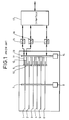
- FIG. 1 of the accompanying drawings shows a schematic representation of a parallel transfer disc store in which a plurality of platters 1 to 6 are mounted to a common spindle 7 driven by a motor 8.
- Each platter 1 to 6 has an associated pair of read-write heads, for example heads 9 and 10 for platter 1, by which data is read from or written to both sides of each disc.
- the read-write heads are mounted to a respective arm, e.g. arms 11 and 12, which in turn is mounted to a rotatable shaft 13 driven by a motor 14.
- the motor 8 causes the spindle 7 and the platters mounted thereto to rotate at high speed and the motor 14 causes the shaft to rotate through an angle so that all of the heads are positioned over a predetermined track on the respective face of each platter.
- Each head is connected via a respective read-write circuit 15, 16 to an interface 17.
- the read-write circuits 15, 16 are provided for conditioning signals after they are read from and before the data are written to the platters via the respective heads 9, 10.
- the read/write circuits 15, 16 and heads 9, 10 are delicate devices and this makes them difficult and time consuming to set up correctly during manufacture.
- DOMINO digital compositor clips are displayed at a high resolution corresponding to the European High Definition Television (HDTV) standard of 1440 x 1024 picture elements, about a quarter of the resolution of that in which data representing the film frames are stored.
- Our DOMINO compositor requires a bandwidth of approximately 108 MBs ⁇ 1, and eight parallel transfer disc stores in parallel therefore provide sufficient bandwidth for displaying of a clip at HDTV resolution.
- Parallel transfer disc stores are not widely used because in most computer applications the processing circuitry is not capable of handling data at a rate of, for example, 15 MBs ⁇ 1 from a store and is generally only capable of processing around 2 to 3 MBs ⁇ 1 for sustained periods of time.
- the market for parallel transfer discs is therefore limited to a few specialist areas including supercomputers and, of course, electronic picture editing and processing. As a result parallel transfer disc stores are expensive.
- Level one and two RAIDs are concerned with improving the reliability of data retrieval without any significant increase in data transfer rates as compared to that of a single small disc store.
- a level one RAID uses a second disc store to mirror the contents of the first and a level two RAID uses several small disc stores to store data together with an interleaved Hamming code. Data transfer rates are improved significantly in level three, four and five RAIDs.
- a level three RAID a single redundant check disc or parity disc is used and data is written to or read from other discs in the array simultaneously.
- Level four and five RAIDs provide variations on the level three RAID as regards the manner in which data, including parity data, is transferred to and from the small disc stores of the array.
- RAIDs can be built which offer improved data transfer rates as compared to that of a single small disc store the improvement is limited by the manner in which data is transferred to and from disc stores. As already mentioned hereinabove, data is transferred in bursts to and from the disc stores and therefore RAIDs suffer from similar problems to those suffered by parallel transfer disc stores. We are unaware of any RAIDs that have been designed to have a data transfer rate greater than about 10 MBs ⁇ 1.
- the invention aims to provide a data storage apparatus which is able to maintain a sustained, continuous high data transfer rate.
- the invention also aims to provide a data storage apparatus comprising a plurality of disc stores, in which the effect of delays caused for example by the movement of a read/write head to a desired track on a platter and the rotation of the platter to the desired sector in the track, is significantly reduced thereby enabling the data to be output continuously at a high rate from the apparatus.
- the invention aims to provide a data storage apparatus in which error checking data is created when the data is written for storage in the apparatus and the error checking data is used to correct errors in data read from the apparatus.
- a data storage apparatus comprising: a plurality of disc stores for storing one or more sets of data, the data in the or each set being distributed among the disc stores; a plurality of respective buffer storing means; a plurality of respective data transferring means to interface each disc store and the respective buffer storing means for transferring data therebetween, the transferring means comprising means for providing an indication when said data is available for transfer between said disc stores and respective buffer storing means; controlling means for generating control data identifying at least one set of data to be transferred between the transferring means and the buffer storing means, which control data is output to said transferring means for transfer to the disc stores for control thereof, the controlling means being responsive to said indication from said transferring means for controlling said transferring means and said buffer storing means to transfer data in the identified set between said transferring means and said storing means; and interfacing means coupled to a data highway which is connectable to external apparatus for a substantially continuous sequential transfer of the data in the identified set or all of the identified sets, the interfacing means being controlled
- a data storing system in which data representing one or more image frames is distributed among a plurality of disc stores, each disc store being interfaced to a respective transfer highway which, in turn, is interfaced to a respective random access buffer such that the data can be transferred asynchronously between the disc stores and respective buffers, the transfer of data between one disc store and the respective buffer being asynchronous with the transfer of data between other disc stores and respective buffers and being controlled by a controller which identifies the data required to be transferred in advance of the requirement for the data and sends identification data to said disc stores via said transfer highway, each of the random access buffers being interfaced to a sequential data highway and being controlled by the controller such that data can be transferred substantially continuously when required in a controlled sequence between the buffers and the highway.
- a memory system in which data is distributed among a plurality of storing devices, each storing device having an associated temporary store and being arranged so that data can be transferred between each storing device and associated store substantially simultaneously with and independently of transfers of data between the other storing devices and their associated stores, the temporary stores being connected to a common data bus for a transfer of data in a predetermined order between the system and an external device to which the system is connectable, the memory system including a data generator for generating error checking data as data is input to the system for storage among the storing devices and a data regenerator for regenerating valid data in the event that erroneous data is identified during the reading of data from the storage devices.
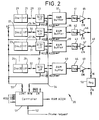
- FIG. 20 a data storage system, indicated generally at 20, comprising a plurality of disc stores 21 to 24 each having an associated Small Computer System Interface (SCSI) interface 25 to 28.
- Each of the disc stores 21 to 24 is a relatively small (physically) single disc storage device, e.g. a 31 ⁇ 2 inch disc drive and contains several platters and read/write circuitry (not shown) for reading from or writing to one platter at a time.
- Such disc storage devices presently available are capable of storing up to 520 or even 1200 MBytes (MB) of data depending on the type of device used and it is expected that within the next year or so equivalent devices will be available with a capacity of approximately 2500 MB.
- MB MBytes
- any of the aforementioned disc stores are well suited to use in the system 20. Suitable disc storage devices with built-in SCSI interfaces are available from several different manufacturers. Each of the SCSI interfaces 25 to 28 is connected via a respective SCSI highway 29 to 32 to a respective second SCSI interface 33 to 36 each associated with a RAM buffer 37 to 40. Each of the RAM buffers 37 to 40 is a solid state device and has sufficient storage locations for up to about 2 MB of data.
- the system 20 as shown comprises twenty disc stores each connected via an associated SCSI highway to a respective one of twenty RAM buffers.
- this provides a storage capacity in the disc stores of approximately 10 GB which corresponds to approximately 15 minutes of video at normal television rates.
- the RAM buffers 37 to 40 provide storage for 40 MB of data representing nearly two seconds of video at normal 625 or 525 line rates at least 22 MBs ⁇ 1).
- Each of the RAM buffers 37 to 40 outputs data to a respective register 41 to 44 which in turn outputs data via an associated tri-state buffer 45 to 48 to a single data highway 49.
- Data on the highway 49 is in the form of 16-bit words and is reduced to 8-bit bytes of data by a register 50 before being output from the apparatus for display or processing by an editing or a processing system (not shown) to which the storage system 20 is connected.
- the system 20 is controlled by a system controller 51 which receives frame request data from an external processing apparatus (not shown) via request bus 52 and in response thereto outputs control data along control bus 53 to the second SCSI interfaces 33 to 36 identifying the next frame of data to be output from the disc stores 21 to 24.
- the controller 51 also receives request signals REQ from each of the second SCSI interfaces 33 to 36 associated with the RAM buffers 37 to 40 and respective enable signals EN to each of the tri-state buffers 45 to 48, thereby controlling the outputting of data to the highway 49.
- the system 20 is intended for use as a data store from which data is read for processing by external equipment and to which data is written once processed by external equipment.
- the apparatus is configured for the continuous reading of data from the disc stores.
- the apparatus can also be configured to enable data to be written to the disc stores, the writing operation being substantially the reverse of the reading operation with incoming data from the highway 49 being written to the RAM buffers 37 to 40 and subsequently being transferred therefrom to the disc stores 21 to 24 via the SCSI buses and interfaces 25 to 36.
- the controller In response to a request from external equipment (such as a processing or editing system) on bus 52 for a frame of image data, the controller outputs frame data identifying the required frame to the twenty second SCSI interfaces via control bus 53.
- the frame data is transmitted by the second SCSI interfaces 33 to 36 over the SCSI highways 29 to 32 to the first SCSI interfaces 25 to 28 where it is converted into read instructions which identify the location in the disc stores of data relating to the requested frame.
- the disc stores respond to the instructions by reading the requested data for output over the SCSI highways.
- the use of disc stores having dedicated or built-in SCSI interfaces simplifies considerably the control data required to control the identification and accessing of image data on the discs.
- the SCSI interface comprises a processor which interprets incoming control data and converts the same into commands which are used to drive the discs and to access desired data at the correct locations thereon.
- the data for each image frame is distributed evenly and in a predetermined manner among the twenty disc stores.
- the data for the first pixel in a frame may be stored in disc store 21, the data for the second pixel in disc store 22, the data for the third in store 23 and so on.
- each disc store and associated first SCSI interface is arranged so that data for each frame distributed among the disc stores is stored at the same location in each of the stores.
- data for the first picture element in a frame could be stored in the first track, first sector of the second platter of disc store 21 and data for the second picture element stored in the first track, first sector of the second platter of disc store 22.
- Requested data is read from each disc store 21 to 24 and transferred by the first SCSI interfaces 25 to 28 along the associated SCSI highway 29 to 32 to the respective second SCSI interfaces 33 to 36 associated with the RAM buffers 37 to 40. Data is transferred along the SCSI highway a byte (8 bits) at a time. Each second SCSI interface 33 to 36 waits until it has received a word (two bytes) of data and then outputs a request signal REQ to the controller 51.
- Each of the disc stores 21 to 24 includes an internal buffer (not shown) which goes some way to controlling the outputting of data from the store. Nevertheless, data is transferred in uneven and unsynchronised bursts from the disc stores 21 to 24 depending on the time taken for the read heads in the store to move to the correct position over the platters therein. Considering for the moment only one disc store, say store 21, once the correct position is reached by the read head the data is read from the correct platter as a burst of information at an average rate of up to 3 MBs ⁇ 1. The burst of data is transferred at this rate a byte at a time over the SCSI highway 29 to the second SCSI interface 33 which assembles it into data words.
- the SCSI highway 29 should be able to deliver data at a rate at least equal to the maximum rate of a burst of information from the disc store 21.
- a SCSI highway has a bandwidth of around 5 MBs ⁇ 1' and is therefore well able to handle bursts of data at 3 MBs ⁇ 1.
- control data including the frame data generated by the controller 51 is transferred from the second SCSI interfaces 33 to 36 to the respective first SCSI interfaces 25 to 28.
- the controller 51 is arranged to utilise the buffering provided by the SCSI interface and to wait until all twenty of the second interfaces have output a request signal before outputting a write strobe signal over line 54 to the RAM buffers 37 to 40.
- the write strobe signal causes the RAM buffers 37 to 40 to receive a word of data from their respective second SCSI interfaces 33 to 36.
- the controller 51 outputs RAM address data to the RAM buffers 37 to 40 so that the data from the second SCSI interfaces 33 to 36 is stored at the same respective locations in the RAM buffers 37 to 40. This process is repeated until all of the data relating to the requested frame has been copied from the disc stores 21 to 24 to the RAM buffers 37 to 40.
- this function of the controller 51 could, if desired, be realised by individual sub-controllers (not shown) between each of the second SCSI interfaces 33 to 36 and their respective RAM buffers 37 to 40.
- Each sub-controller would monitor the request signal REQ from its second SCSI interface and in response to a request would strobe the write line of its RAM buffer causing a word to be transferred from the second SCSI interface to the RAM buffer.
- the single controller 51 arrangement is preferred because it considerably simplifies the control and addressing of the RAM buffers 37 to 40 because all twenty RAM buffers are controlled and addressed simultaneously over common lines.
- the SCSI interfaces and highways thus provide a means by which the twenty disc stores can output data asynchronously and the provision of such a large number of disc stores and associated interfaces and highways enables an extremely high data transfer rate (potentially 100 MBs ⁇ 1 albeit in unsynchronised bursts) to be achieved between the disc stores and the RAM buffers.
- Data is transferred from the RAM buffers 37 to 40 in rapid succession to the highway 49 to the extent that data is transferred over the highway at a substantially continuous rate of about 40 MBs ⁇ 1.
- this is well in excess of the 27 MBs ⁇ 1 bandwidth required for normal television rates and well in excess of the 30 MBs ⁇ 1 available using two parallel transfer disc stores.
- higher rates can be achieved simply by placing two or more systems in parallel.
- a greater number of disc stores, SCSI interfaces and highways and RAM buffers may be used in the system 20 to achieve higher data transfer rates.
- the reading of the data from the discs is asynchronous and there are therefore no difficulties in expanding the system to accommodate a larger number of disc drives and associated circuitry.
- a request for data representing another frame can be input to the controller 51 via bus 52 and in response thereto the controller 51 outputs new frame data to the SCSI interfaces 25 to 28 of the disc stores 21 to 24.
- the disc stores 21 to 24 are primed ready to start outputting new data as soon as the RAM buffers 37 to 40 are ready for it.
- the speed of the system can be further increased by using two port RAM devices with one port being used for the writing of data from the respective second SCSI interface 33 to 36 while the other port is used for the reading of data for the respective registers 41 to 44.
- the reading of data from one port and the writing of data to the other port of a RAM buffer occurs independently and so long as there is space available in the RAM buffers to accommodate new data the reading and writing of data can take place at the same time.
- the high data rates (up to 100 Mbs ⁇ 1) at which data is transferred over the twenty parallel SCSI highways between the disc stores and the RAM buffers enables the system 20 to be treated as a frame random access store. That is to say, any frame of data stored in the disc stores 21 to 24 can be accessed as quickly as any other frame of data.
- the high data rate on the parallel SCSI highways is well in excess of the 40 MBs ⁇ 1 rate at which data is output from the system on the highway 49 and thus any delays caused by the positioning of heads in the disc stores will not affect the data rate on the highway 49.
- As a random access frame store the system 20 is well suited for use in an editing system.
- Disc stores are nowadays provided with internal circuitry which use cyclic redundancy checking (CRC) techniques to check for errors in data as it is read from the platter.
- CRC cyclic redundancy checking
- This internal error checking is usually very good and can be relied upon to provide an indication of an error during the reading out of data from the store.
- the system 20 can be modified to take advantage of this built-in error checking in each of the disc stores and to use error correction techniques to correct a thus detected error before the data is output from the system.
- the system 20 shown in Figure 2 can be modified to make use of error correction based on an exclusive-or operation applied to groups of data words as the words are written to and read from the disc stores.
- each disc store 21, 24 has respectively a SCSI interface 25, 28 a SCSI highway 29, 32 and a second SCSI interface 33, 36 that interfaces to a respective RAM buffer 37, 40.
- Data from each RAM buffer 37, 40 is output via a respective register 41, 44 and tri-state buffer 45, 48 to the data highway 49.
- one of the disc stores e.g. the last disc store 24, is not used to store image data but instead is used to store parity data which is generated by a parity generator 55 from sets of image data as the image data is input for storage in the disc stores.
- Incoming 16-bit words of data from the register 50 are input to the parity generator 55 where they are sequentially processed in an exclusive-or operation to produce a 16-bit parity word.
- the received data words are then output for storage in a respective one of the first nineteen disc stores and the newly generated parity word is stored in the twentieth disc store 24.
- the data thus output from the registers 41 to 44 is input via highway 49 to a data regenerator unit 56 and a delay shift register 57.
- the data regenerator 56 performs a bit-wise exclusive-or operation, similar to that performed by the parity generator 55, on the data that it receives from highway 49.
- the effect of performing an exclusive-or operation on eighteen words of good data together with the associated parity word is to generate an output word which is the same as the missing word of data.
- the data words are output from the delay shift register 57 in order until the parity word is reached.
- the parity word is discarded and the missing data word regenerated by the data regenerator 56 is output in its correct place in the data sequence.
- the delay shift register 57 is included to delay the outputting of data from the system while the data regenerator 56 calculates the missing data.
- the delay shift register 57 introduces a delay into the highway 49 corresponding to the transmission of nineteen words of data on the highway. When there are no detected errors data is simply output unaltered via the delay shift register 57 to the register 50.
Landscapes
- Engineering & Computer Science (AREA)
- Theoretical Computer Science (AREA)
- Physics & Mathematics (AREA)
- General Engineering & Computer Science (AREA)
- General Physics & Mathematics (AREA)
- Human Computer Interaction (AREA)
- Quality & Reliability (AREA)
- Databases & Information Systems (AREA)
- Multimedia (AREA)
- Signal Processing (AREA)
- Signal Processing For Digital Recording And Reproducing (AREA)
- Studio Circuits (AREA)
- Data Exchanges In Wide-Area Networks (AREA)
- Techniques For Improving Reliability Of Storages (AREA)
- Multi Processors (AREA)
Applications Claiming Priority (2)
| Application Number | Priority Date | Filing Date | Title |
|---|---|---|---|
| GB9226199 | 1992-12-16 | ||
| GB9226199A GB2273584B (en) | 1992-12-16 | 1992-12-16 | A data storage apparatus |
Publications (3)
| Publication Number | Publication Date |
|---|---|
| EP0606743A2 true EP0606743A2 (de) | 1994-07-20 |
| EP0606743A3 EP0606743A3 (de) | 1994-08-31 |
| EP0606743B1 EP0606743B1 (de) | 1999-09-15 |
Family
ID=10726691
Family Applications (1)
| Application Number | Title | Priority Date | Filing Date |
|---|---|---|---|
| EP93310102A Expired - Lifetime EP0606743B1 (de) | 1992-12-16 | 1993-12-15 | Datenspeichereinrichtung |
Country Status (5)
| Country | Link |
|---|---|
| US (1) | US5765186A (de) |
| EP (1) | EP0606743B1 (de) |
| JP (1) | JP3657283B2 (de) |
| DE (1) | DE69326430T2 (de) |
| GB (1) | GB2273584B (de) |
Cited By (4)
| Publication number | Priority date | Publication date | Assignee | Title |
|---|---|---|---|---|
| WO1997016783A1 (en) * | 1995-10-30 | 1997-05-09 | Sony Corporation | Methods and apparatus for controlling access to a recording disk |
| EP1422857A1 (de) * | 2002-11-19 | 2004-05-26 | Hitachi, Ltd. | Speichersystem |
| WO2017144407A1 (de) | 2016-02-23 | 2017-08-31 | Salzgitter Flachstahl Gmbh | Walze, insbesondere dressierarbeitswalze, und dressiertes flachprodukt |
| EP3677355B1 (de) | 2017-08-29 | 2024-01-24 | Baoshan Iron & Steel Co., Ltd. | Walze zum walzen der oberflächentopografie einer stahlplatte und verfahren zur herstellung davon |
Families Citing this family (23)
| Publication number | Priority date | Publication date | Assignee | Title |
|---|---|---|---|---|
| GB2312319B (en) | 1996-04-15 | 1998-12-09 | Discreet Logic Inc | Video storage |
| CA2201679A1 (en) | 1996-04-15 | 1997-10-15 | Raju C. Bopardikar | Video data storage |
| US6018778A (en) * | 1996-05-03 | 2000-01-25 | Netcell Corporation | Disk array controller for reading/writing striped data using a single address counter for synchronously transferring data between data ports and buffer memory |
| JP3825099B2 (ja) * | 1996-09-26 | 2006-09-20 | 富士通株式会社 | 映像データ転送方式およびビデオサーバ装置 |
| US6058443A (en) * | 1997-02-18 | 2000-05-02 | Advanced Micro Devices, Inc. | System for partitioning PC chipset functions into logic and port integrated circuits |
| US5974492A (en) * | 1997-02-18 | 1999-10-26 | Advanced Micro Devices, Inc. | Method for input/output port replication using an interconnection bus |
| GB2323734B (en) | 1997-03-27 | 2001-04-11 | Quantel Ltd | A video processing system |
| GB2323735C (en) | 1997-03-27 | 2006-08-10 | Quantel Ltd | An image processing system |
| JPH1168797A (ja) * | 1997-08-26 | 1999-03-09 | Nec Corp | 可変長セル対応位相乗換装置 |
| US6263385B1 (en) * | 1997-10-20 | 2001-07-17 | Advanced Micro Devices, Inc. | PC parallel port structure partitioned between two integrated circuits interconnected by a serial bus |
| US6119243A (en) * | 1998-07-06 | 2000-09-12 | Intel Corp. | Architecture for the isochronous transfer of information within a computer system |
| US6260119B1 (en) * | 1998-07-06 | 2001-07-10 | Intel Corporation | Memory cache management for isochronous memory access |
| GB0008691D0 (en) * | 2000-04-07 | 2000-05-31 | Post Impressions Systems Ltd | Input and output systems for data processing |
| US6557060B1 (en) * | 2000-04-25 | 2003-04-29 | Intel Corporation | Data transfer in host expansion bridge |
| US6977927B1 (en) | 2000-09-18 | 2005-12-20 | Hewlett-Packard Development Company, L.P. | Method and system of allocating storage resources in a storage area network |
| US6804819B1 (en) | 2000-09-18 | 2004-10-12 | Hewlett-Packard Development Company, L.P. | Method, system, and computer program product for a data propagation platform and applications of same |
| US7386610B1 (en) | 2000-09-18 | 2008-06-10 | Hewlett-Packard Development Company, L.P. | Internet protocol data mirroring |
| US6606690B2 (en) | 2001-02-20 | 2003-08-12 | Hewlett-Packard Development Company, L.P. | System and method for accessing a storage area network as network attached storage |
| WO2004092942A2 (en) * | 2003-04-09 | 2004-10-28 | Netcell Corp. | Method and apparatus for synchronizing data from asynchronous disk drive data transfers |
| KR20060025135A (ko) * | 2003-04-21 | 2006-03-20 | 네트셀 코포레이션 | 재구성 가능한 데이터 경로를 갖는 디스크 어레이 제어기 |
| US7512700B2 (en) * | 2005-09-30 | 2009-03-31 | International Business Machines Corporation | Real-time mining and reduction of streamed data |
| EP2126682A1 (de) * | 2007-03-26 | 2009-12-02 | Record4Free.TV AG | Videodatenübertragung über usb-schnittstelle |
| US9374108B2 (en) * | 2014-05-19 | 2016-06-21 | International Business Machines Corporation | Convolution-encoded hyper-speed channel with robust trellis error-correction |
Family Cites Families (16)
| Publication number | Priority date | Publication date | Assignee | Title |
|---|---|---|---|---|
| US4590559A (en) * | 1983-11-23 | 1986-05-20 | Tokyo Shibaura Denki Kabushiki Kaisha | Data disc system for a computed tomography X-ray scanner |
| FR2561428B1 (fr) * | 1984-03-16 | 1986-09-12 | Bull Sa | Procede d'enregistrement dans une memoire a disques et systeme de memoire a disques |
| GB8408113D0 (en) * | 1984-03-29 | 1984-05-10 | Quantel Ltd | Video editing/viewing systems |
| US4722085A (en) * | 1986-02-03 | 1988-01-26 | Unisys Corp. | High capacity disk storage system having unusually high fault tolerance level and bandpass |
| US5257367A (en) * | 1987-06-02 | 1993-10-26 | Cab-Tek, Inc. | Data storage system with asynchronous host operating system communication link |
| US4942579A (en) * | 1987-06-02 | 1990-07-17 | Cab-Tek, Inc. | High-speed, high-capacity, fault-tolerant error-correcting storage system |
| US4870643A (en) * | 1987-11-06 | 1989-09-26 | Micropolis Corporation | Parallel drive array storage system |
| US5218689A (en) * | 1988-08-16 | 1993-06-08 | Cray Research, Inc. | Single disk emulation interface for an array of asynchronously operating disk drives |
| WO1990006550A1 (en) * | 1988-12-08 | 1990-06-14 | Cray Research, Inc. | Single disk emulation for asynchronous disk array |
| US5402428A (en) * | 1989-12-25 | 1995-03-28 | Hitachi, Ltd. | Array disk subsystem |
| GB9019891D0 (en) * | 1990-09-12 | 1990-10-24 | Di Data Ltd | Computer memory array control |
| EP0478337B1 (de) * | 1990-09-28 | 1999-12-22 | Xerox Corporation | Verfahren zur Datenspeicherung auf und Datenwiedergabe von mehreren Platten |
| JP2550444B2 (ja) * | 1991-03-07 | 1996-11-06 | 富士通株式会社 | デバイス制御装置 |
| US5345565A (en) * | 1991-03-13 | 1994-09-06 | Ncr Corporation | Multiple configuration data path architecture for a disk array controller |
| US5337414A (en) * | 1992-09-22 | 1994-08-09 | Unisys Corporation | Mass data storage and retrieval system |
| US5487160A (en) * | 1992-12-04 | 1996-01-23 | At&T Global Information Solutions Company | Concurrent image backup for disk storage system |
-
1992
- 1992-12-16 GB GB9226199A patent/GB2273584B/en not_active Expired - Lifetime
-
1993
- 1993-12-15 EP EP93310102A patent/EP0606743B1/de not_active Expired - Lifetime
- 1993-12-15 DE DE69326430T patent/DE69326430T2/de not_active Expired - Lifetime
- 1993-12-16 JP JP31643793A patent/JP3657283B2/ja not_active Expired - Lifetime
-
1996
- 1996-12-30 US US08/773,613 patent/US5765186A/en not_active Expired - Lifetime
Cited By (5)
| Publication number | Priority date | Publication date | Assignee | Title |
|---|---|---|---|---|
| WO1997016783A1 (en) * | 1995-10-30 | 1997-05-09 | Sony Corporation | Methods and apparatus for controlling access to a recording disk |
| EP1422857A1 (de) * | 2002-11-19 | 2004-05-26 | Hitachi, Ltd. | Speichersystem |
| US7305605B2 (en) | 2002-11-19 | 2007-12-04 | Hitachi, Ltd. | Storage system |
| WO2017144407A1 (de) | 2016-02-23 | 2017-08-31 | Salzgitter Flachstahl Gmbh | Walze, insbesondere dressierarbeitswalze, und dressiertes flachprodukt |
| EP3677355B1 (de) | 2017-08-29 | 2024-01-24 | Baoshan Iron & Steel Co., Ltd. | Walze zum walzen der oberflächentopografie einer stahlplatte und verfahren zur herstellung davon |
Also Published As
| Publication number | Publication date |
|---|---|
| JP3657283B2 (ja) | 2005-06-08 |
| DE69326430T2 (de) | 1999-12-30 |
| GB2273584B (en) | 1997-04-16 |
| US5765186A (en) | 1998-06-09 |
| JPH0746465A (ja) | 1995-02-14 |
| DE69326430D1 (de) | 1999-10-21 |
| GB9226199D0 (en) | 1993-02-10 |
| EP0606743A3 (de) | 1994-08-31 |
| EP0606743B1 (de) | 1999-09-15 |
| GB2273584A (en) | 1994-06-22 |
Similar Documents
| Publication | Publication Date | Title |
|---|---|---|
| EP0606743B1 (de) | Datenspeichereinrichtung | |
| US5623595A (en) | Method and apparatus for transparent, real time reconstruction of corrupted data in a redundant array data storage system | |
| EP0727750B1 (de) | Server für kontinuierliche Daten und Datentransferschema für mehrfache gleichzeitige Datenzugriffe | |
| US5758057A (en) | Multi-media storage system | |
| EP0572564B1 (de) | Paritätsberechnung in einer effizienten matrix von massenspeichergeräten | |
| US5283791A (en) | Error recovery method and apparatus for high performance disk drives | |
| US6397347B1 (en) | Disk array apparatus capable of dealing with an abnormality occurring in one of disk units without delaying operation of the apparatus | |
| US5878280A (en) | Data buffering system for plural data memory arrays | |
| JPH07105633A (ja) | ディスク・ドライブ・アレイのデータ再生チャネル | |
| JPH06161672A (ja) | プログラム可能なディスクドライブアレイコントローラ | |
| US6457153B2 (en) | Storage device and storage subsystem for efficiently writing error correcting code | |
| US5787463A (en) | Disk array system including a dual-ported staging memory and concurrent redundancy calculation capability | |
| JP2001518211A (ja) | エラー検査方法及びその装置 | |
| US5313589A (en) | Low level device interface for direct access storage device including minimum functions and enabling high data rate performance | |
| WO1998045771A1 (en) | Recording and reproducing device | |
| US20040205269A1 (en) | Method and apparatus for synchronizing data from asynchronous disk drive data transfers | |
| US5838892A (en) | Method and apparatus for calculating an error detecting code block in a disk drive controller | |
| US7136578B2 (en) | Apparatus and method for recording and reproducing data, and AV server | |
| US5761220A (en) | Minimum latency asynchronous data path controller in a digital recording system | |
| JPH09258914A (ja) | コンピュータシステムのデータ転送方式 | |
| JP3615250B2 (ja) | ディスクアレイ装置 | |
| JP3175999B2 (ja) | ディスクアレイ装置 | |
| WO1991001524A1 (en) | An error recovery method and apparatus for high performance disk drives | |
| JPH07320418A (ja) | データ再生装置 | |
| JPH11305945A (ja) | データ記憶制御装置およびデータ記憶制御方法 |
Legal Events
| Date | Code | Title | Description |
|---|---|---|---|
| PUAI | Public reference made under article 153(3) epc to a published international application that has entered the european phase |
Free format text: ORIGINAL CODE: 0009012 |
|
| PUAL | Search report despatched |
Free format text: ORIGINAL CODE: 0009013 |
|
| AK | Designated contracting states |
Kind code of ref document: A2 Designated state(s): DE FR IT NL |
|
| AK | Designated contracting states |
Kind code of ref document: A3 Designated state(s): DE FR GB IT NL |
|
| 17P | Request for examination filed |
Effective date: 19950127 |
|
| 17Q | First examination report despatched |
Effective date: 19970916 |
|
| GRAG | Despatch of communication of intention to grant |
Free format text: ORIGINAL CODE: EPIDOS AGRA |
|
| GRAG | Despatch of communication of intention to grant |
Free format text: ORIGINAL CODE: EPIDOS AGRA |
|
| GRAH | Despatch of communication of intention to grant a patent |
Free format text: ORIGINAL CODE: EPIDOS IGRA |
|
| RBV | Designated contracting states (corrected) |
Designated state(s): DE FR IT NL |
|
| GRAH | Despatch of communication of intention to grant a patent |
Free format text: ORIGINAL CODE: EPIDOS IGRA |
|
| GRAA | (expected) grant |
Free format text: ORIGINAL CODE: 0009210 |
|
| AK | Designated contracting states |
Kind code of ref document: B1 Designated state(s): DE FR IT NL |
|
| ITF | It: translation for a ep patent filed | ||
| REF | Corresponds to: |
Ref document number: 69326430 Country of ref document: DE Date of ref document: 19991021 |
|
| ET | Fr: translation filed | ||
| PLBE | No opposition filed within time limit |
Free format text: ORIGINAL CODE: 0009261 |
|
| STAA | Information on the status of an ep patent application or granted ep patent |
Free format text: STATUS: NO OPPOSITION FILED WITHIN TIME LIMIT |
|
| 26N | No opposition filed | ||
| PGFP | Annual fee paid to national office [announced via postgrant information from national office to epo] |
Ref country code: DE Payment date: 20121213 Year of fee payment: 20 |
|
| PGFP | Annual fee paid to national office [announced via postgrant information from national office to epo] |
Ref country code: IT Payment date: 20121220 Year of fee payment: 20 |
|
| PGFP | Annual fee paid to national office [announced via postgrant information from national office to epo] |
Ref country code: NL Payment date: 20121208 Year of fee payment: 20 Ref country code: FR Payment date: 20130107 Year of fee payment: 20 |
|
| REG | Reference to a national code |
Ref country code: DE Ref legal event code: R071 Ref document number: 69326430 Country of ref document: DE |
|
| REG | Reference to a national code |
Ref country code: NL Ref legal event code: V4 Effective date: 20131215 |
|
| PG25 | Lapsed in a contracting state [announced via postgrant information from national office to epo] |
Ref country code: DE Free format text: LAPSE BECAUSE OF EXPIRATION OF PROTECTION Effective date: 20131217 |