EP0606889B1 - Copolymères réticulés d'amine vinylique et d'alcool vinylique pour addition dans la partie sèche - Google Patents
Copolymères réticulés d'amine vinylique et d'alcool vinylique pour addition dans la partie sèche Download PDFInfo
- Publication number
- EP0606889B1 EP0606889B1 EP94100307A EP94100307A EP0606889B1 EP 0606889 B1 EP0606889 B1 EP 0606889B1 EP 94100307 A EP94100307 A EP 94100307A EP 94100307 A EP94100307 A EP 94100307A EP 0606889 B1 EP0606889 B1 EP 0606889B1
- Authority
- EP
- European Patent Office
- Prior art keywords
- dry
- copolymer
- paper
- wet
- added
- Prior art date
- Legal status (The legal status is an assumption and is not a legal conclusion. Google has not performed a legal analysis and makes no representation as to the accuracy of the status listed.)
- Expired - Lifetime
Links
- 229920001577 copolymer Polymers 0.000 title claims description 64
- IMROMDMJAWUWLK-UHFFFAOYSA-N Ethenol Chemical compound OC=C IMROMDMJAWUWLK-UHFFFAOYSA-N 0.000 title description 4
- 229920002451 polyvinyl alcohol Polymers 0.000 claims description 63
- LEQAOMBKQFMDFZ-UHFFFAOYSA-N glyoxal Chemical compound O=CC=O LEQAOMBKQFMDFZ-UHFFFAOYSA-N 0.000 claims description 52
- 239000004372 Polyvinyl alcohol Substances 0.000 claims description 45
- 238000000034 method Methods 0.000 claims description 37
- 230000008569 process Effects 0.000 claims description 27
- 229940015043 glyoxal Drugs 0.000 claims description 26
- 239000003431 cross linking reagent Substances 0.000 claims description 13
- UYMKPFRHYYNDTL-UHFFFAOYSA-N ethenamine Chemical group NC=C UYMKPFRHYYNDTL-UHFFFAOYSA-N 0.000 claims description 13
- 238000004132 cross linking Methods 0.000 claims description 12
- 238000004513 sizing Methods 0.000 claims description 12
- 230000007062 hydrolysis Effects 0.000 claims description 10
- 238000006460 hydrolysis reaction Methods 0.000 claims description 10
- 229920002689 polyvinyl acetate Polymers 0.000 claims description 10
- 239000011118 polyvinyl acetate Substances 0.000 claims description 10
- 229920000877 Melamine resin Polymers 0.000 claims description 5
- 229920001807 Urea-formaldehyde Polymers 0.000 claims description 4
- 239000000203 mixture Substances 0.000 claims description 4
- ODGAOXROABLFNM-UHFFFAOYSA-N polynoxylin Chemical compound O=C.NC(N)=O ODGAOXROABLFNM-UHFFFAOYSA-N 0.000 claims description 3
- SXRSQZLOMIGNAQ-UHFFFAOYSA-N Glutaraldehyde Chemical compound O=CCCCC=O SXRSQZLOMIGNAQ-UHFFFAOYSA-N 0.000 claims description 2
- 150000001991 dicarboxylic acids Chemical class 0.000 claims description 2
- 125000005442 diisocyanate group Chemical group 0.000 claims description 2
- 239000003822 epoxy resin Substances 0.000 claims description 2
- IVJISJACKSSFGE-UHFFFAOYSA-N formaldehyde;1,3,5-triazine-2,4,6-triamine Chemical compound O=C.NC1=NC(N)=NC(N)=N1 IVJISJACKSSFGE-UHFFFAOYSA-N 0.000 claims description 2
- LNEPOXFFQSENCJ-UHFFFAOYSA-N haloperidol Chemical compound C1CC(O)(C=2C=CC(Cl)=CC=2)CCN1CCCC(=O)C1=CC=C(F)C=C1 LNEPOXFFQSENCJ-UHFFFAOYSA-N 0.000 claims description 2
- 229920001568 phenolic resin Polymers 0.000 claims description 2
- 229920000647 polyepoxide Polymers 0.000 claims description 2
- ATJFFYVFTNAWJD-UHFFFAOYSA-N Tin Chemical compound [Sn] ATJFFYVFTNAWJD-UHFFFAOYSA-N 0.000 claims 1
- 239000000123 paper Substances 0.000 description 64
- -1 poly(ethyleneimine) Polymers 0.000 description 48
- 235000019422 polyvinyl alcohol Nutrition 0.000 description 43
- 239000000654 additive Substances 0.000 description 32
- 229920000642 polymer Polymers 0.000 description 27
- XLYOFNOQVPJJNP-UHFFFAOYSA-N water Substances O XLYOFNOQVPJJNP-UHFFFAOYSA-N 0.000 description 23
- 238000012360 testing method Methods 0.000 description 20
- ZQXSMRAEXCEDJD-UHFFFAOYSA-N n-ethenylformamide Chemical compound C=CNC=O ZQXSMRAEXCEDJD-UHFFFAOYSA-N 0.000 description 16
- 239000003795 chemical substances by application Substances 0.000 description 12
- 239000000243 solution Substances 0.000 description 12
- 229920005989 resin Polymers 0.000 description 11
- 239000011347 resin Substances 0.000 description 11
- XTXRWKRVRITETP-UHFFFAOYSA-N Vinyl acetate Chemical compound CC(=O)OC=C XTXRWKRVRITETP-UHFFFAOYSA-N 0.000 description 10
- 150000001412 amines Chemical class 0.000 description 10
- 230000014759 maintenance of location Effects 0.000 description 9
- 230000000996 additive effect Effects 0.000 description 8
- 125000002091 cationic group Chemical group 0.000 description 8
- 238000002360 preparation method Methods 0.000 description 8
- 230000001143 conditioned effect Effects 0.000 description 7
- VVJKKWFAADXIJK-UHFFFAOYSA-N Allylamine Chemical compound NCC=C VVJKKWFAADXIJK-UHFFFAOYSA-N 0.000 description 6
- WSFSSNUMVMOOMR-UHFFFAOYSA-N Formaldehyde Chemical compound O=C WSFSSNUMVMOOMR-UHFFFAOYSA-N 0.000 description 6
- 238000010521 absorption reaction Methods 0.000 description 6
- 239000000839 emulsion Substances 0.000 description 6
- 238000006116 polymerization reaction Methods 0.000 description 6
- 239000004971 Cross linker Substances 0.000 description 5
- 229920002873 Polyethylenimine Polymers 0.000 description 5
- 229920002472 Starch Polymers 0.000 description 5
- 229920001002 functional polymer Polymers 0.000 description 5
- 235000019698 starch Nutrition 0.000 description 5
- 239000000126 substance Substances 0.000 description 5
- 230000015572 biosynthetic process Effects 0.000 description 4
- 238000012662 bulk polymerization Methods 0.000 description 4
- 239000000835 fiber Substances 0.000 description 4
- 239000000945 filler Substances 0.000 description 4
- 238000004519 manufacturing process Methods 0.000 description 4
- 239000000178 monomer Substances 0.000 description 4
- 239000008107 starch Substances 0.000 description 4
- XZMCDFZZKTWFGF-UHFFFAOYSA-N Cyanamide Chemical compound NC#N XZMCDFZZKTWFGF-UHFFFAOYSA-N 0.000 description 3
- 150000001408 amides Chemical class 0.000 description 3
- 238000007334 copolymerization reaction Methods 0.000 description 3
- 238000010528 free radical solution polymerization reaction Methods 0.000 description 3
- 239000000463 material Substances 0.000 description 3
- 239000013055 pulp slurry Substances 0.000 description 3
- 239000007787 solid Substances 0.000 description 3
- 239000002904 solvent Substances 0.000 description 3
- 229920002554 vinyl polymer Polymers 0.000 description 3
- RSWGJHLUYNHPMX-UHFFFAOYSA-N Abietic-Saeure Natural products C12CCC(C(C)C)=CC2=CCC2C1(C)CCCC2(C)C(O)=O RSWGJHLUYNHPMX-UHFFFAOYSA-N 0.000 description 2
- HRPVXLWXLXDGHG-UHFFFAOYSA-N Acrylamide Chemical compound NC(=O)C=C HRPVXLWXLXDGHG-UHFFFAOYSA-N 0.000 description 2
- 229920002134 Carboxymethyl cellulose Polymers 0.000 description 2
- 229920003270 Cymel® Polymers 0.000 description 2
- ROSDSFDQCJNGOL-UHFFFAOYSA-N Dimethylamine Chemical compound CNC ROSDSFDQCJNGOL-UHFFFAOYSA-N 0.000 description 2
- BRLQWZUYTZBJKN-UHFFFAOYSA-N Epichlorohydrin Chemical compound ClCC1CO1 BRLQWZUYTZBJKN-UHFFFAOYSA-N 0.000 description 2
- KHPCPRHQVVSZAH-HUOMCSJISA-N Rosin Natural products O(C/C=C/c1ccccc1)[C@H]1[C@H](O)[C@@H](O)[C@@H](O)[C@@H](CO)O1 KHPCPRHQVVSZAH-HUOMCSJISA-N 0.000 description 2
- 229940037003 alum Drugs 0.000 description 2
- 230000008901 benefit Effects 0.000 description 2
- 230000009172 bursting Effects 0.000 description 2
- 239000001768 carboxy methyl cellulose Substances 0.000 description 2
- 235000010948 carboxy methyl cellulose Nutrition 0.000 description 2
- 239000008112 carboxymethyl-cellulose Substances 0.000 description 2
- 229940105329 carboxymethylcellulose Drugs 0.000 description 2
- 238000007720 emulsion polymerization reaction Methods 0.000 description 2
- UIWXSTHGICQLQT-UHFFFAOYSA-N ethenyl propanoate Chemical compound CCC(=O)OC=C UIWXSTHGICQLQT-UHFFFAOYSA-N 0.000 description 2
- 239000008394 flocculating agent Substances 0.000 description 2
- 229920001519 homopolymer Polymers 0.000 description 2
- 239000003999 initiator Substances 0.000 description 2
- 239000000976 ink Substances 0.000 description 2
- 239000002655 kraft paper Substances 0.000 description 2
- 239000007788 liquid Substances 0.000 description 2
- JDSHMPZPIAZGSV-UHFFFAOYSA-N melamine Chemical compound NC1=NC(N)=NC(N)=N1 JDSHMPZPIAZGSV-UHFFFAOYSA-N 0.000 description 2
- RQAKESSLMFZVMC-UHFFFAOYSA-N n-ethenylacetamide Chemical compound CC(=O)NC=C RQAKESSLMFZVMC-UHFFFAOYSA-N 0.000 description 2
- 239000011087 paperboard Substances 0.000 description 2
- 239000005011 phenolic resin Substances 0.000 description 2
- 229920002401 polyacrylamide Polymers 0.000 description 2
- 239000002243 precursor Substances 0.000 description 2
- 229920006395 saturated elastomer Polymers 0.000 description 2
- 238000005728 strengthening Methods 0.000 description 2
- 239000000725 suspension Substances 0.000 description 2
- 238000010557 suspension polymerization reaction Methods 0.000 description 2
- KHPCPRHQVVSZAH-UHFFFAOYSA-N trans-cinnamyl beta-D-glucopyranoside Natural products OC1C(O)C(O)C(CO)OC1OCC=CC1=CC=CC=C1 KHPCPRHQVVSZAH-UHFFFAOYSA-N 0.000 description 2
- 229920001567 vinyl ester resin Polymers 0.000 description 2
- SMZOUWXMTYCWNB-UHFFFAOYSA-N 2-(2-methoxy-5-methylphenyl)ethanamine Chemical compound COC1=CC=C(C)C=C1CCN SMZOUWXMTYCWNB-UHFFFAOYSA-N 0.000 description 1
- LBLYYCQCTBFVLH-UHFFFAOYSA-N 2-Methylbenzenesulfonic acid Chemical compound CC1=CC=CC=C1S(O)(=O)=O LBLYYCQCTBFVLH-UHFFFAOYSA-N 0.000 description 1
- NIXOWILDQLNWCW-UHFFFAOYSA-N 2-Propenoic acid Natural products OC(=O)C=C NIXOWILDQLNWCW-UHFFFAOYSA-N 0.000 description 1
- YAXXOCZAXKLLCV-UHFFFAOYSA-N 3-dodecyloxolane-2,5-dione Chemical class CCCCCCCCCCCCC1CC(=O)OC1=O YAXXOCZAXKLLCV-UHFFFAOYSA-N 0.000 description 1
- QTBSBXVTEAMEQO-UHFFFAOYSA-N Acetic acid Chemical group CC(O)=O QTBSBXVTEAMEQO-UHFFFAOYSA-N 0.000 description 1
- NLHHRLWOUZZQLW-UHFFFAOYSA-N Acrylonitrile Chemical compound C=CC#N NLHHRLWOUZZQLW-UHFFFAOYSA-N 0.000 description 1
- KXDHJXZQYSOELW-UHFFFAOYSA-N Carbamic acid Chemical group NC(O)=O KXDHJXZQYSOELW-UHFFFAOYSA-N 0.000 description 1
- 229920003043 Cellulose fiber Polymers 0.000 description 1
- 244000007835 Cyamopsis tetragonoloba Species 0.000 description 1
- 241001082241 Lythrum hyssopifolia Species 0.000 description 1
- CERQOIWHTDAKMF-UHFFFAOYSA-N Methacrylic acid Chemical compound CC(=C)C(O)=O CERQOIWHTDAKMF-UHFFFAOYSA-N 0.000 description 1
- GYCMBHHDWRMZGG-UHFFFAOYSA-N Methylacrylonitrile Chemical compound CC(=C)C#N GYCMBHHDWRMZGG-UHFFFAOYSA-N 0.000 description 1
- 229920001410 Microfiber Polymers 0.000 description 1
- WHNWPMSKXPGLAX-UHFFFAOYSA-N N-Vinyl-2-pyrrolidone Chemical compound C=CN1CCCC1=O WHNWPMSKXPGLAX-UHFFFAOYSA-N 0.000 description 1
- 235000008331 Pinus X rigitaeda Nutrition 0.000 description 1
- 235000011613 Pinus brutia Nutrition 0.000 description 1
- 241000018646 Pinus brutia Species 0.000 description 1
- 125000002777 acetyl group Chemical group [H]C([H])([H])C(*)=O 0.000 description 1
- 150000003926 acrylamides Chemical class 0.000 description 1
- 239000003463 adsorbent Substances 0.000 description 1
- GZCGUPFRVQAUEE-SLPGGIOYSA-N aldehydo-D-glucose Chemical compound OC[C@@H](O)[C@@H](O)[C@H](O)[C@@H](O)C=O GZCGUPFRVQAUEE-SLPGGIOYSA-N 0.000 description 1
- 125000003277 amino group Chemical group 0.000 description 1
- 150000008064 anhydrides Chemical class 0.000 description 1
- 229920006318 anionic polymer Polymers 0.000 description 1
- 229920006320 anionic starch Polymers 0.000 description 1
- 239000007864 aqueous solution Substances 0.000 description 1
- 239000007900 aqueous suspension Substances 0.000 description 1
- 239000011230 binding agent Substances 0.000 description 1
- 239000011111 cardboard Substances 0.000 description 1
- 229920002678 cellulose Polymers 0.000 description 1
- 239000001913 cellulose Substances 0.000 description 1
- 235000010980 cellulose Nutrition 0.000 description 1
- 238000006243 chemical reaction Methods 0.000 description 1
- 238000005352 clarification Methods 0.000 description 1
- 230000015271 coagulation Effects 0.000 description 1
- 238000005345 coagulation Methods 0.000 description 1
- 239000011248 coating agent Substances 0.000 description 1
- 238000000576 coating method Methods 0.000 description 1
- 238000010961 commercial manufacture process Methods 0.000 description 1
- 239000012612 commercial material Substances 0.000 description 1
- 230000003750 conditioning effect Effects 0.000 description 1
- 238000001816 cooling Methods 0.000 description 1
- 230000002079 cooperative effect Effects 0.000 description 1
- 230000003111 delayed effect Effects 0.000 description 1
- 238000011161 development Methods 0.000 description 1
- 230000018109 developmental process Effects 0.000 description 1
- 238000001035 drying Methods 0.000 description 1
- 230000000694 effects Effects 0.000 description 1
- 229920001971 elastomer Polymers 0.000 description 1
- 125000004185 ester group Chemical group 0.000 description 1
- 150000002148 esters Chemical class 0.000 description 1
- 125000002485 formyl group Chemical group [H]C(*)=O 0.000 description 1
- 235000011389 fruit/vegetable juice Nutrition 0.000 description 1
- 230000002209 hydrophobic effect Effects 0.000 description 1
- 125000002887 hydroxy group Chemical group [H]O* 0.000 description 1
- 238000010348 incorporation Methods 0.000 description 1
- IQPQWNKOIGAROB-UHFFFAOYSA-N isocyanate group Chemical group [N-]=C=O IQPQWNKOIGAROB-UHFFFAOYSA-N 0.000 description 1
- WARQUFORVQESFF-UHFFFAOYSA-N isocyanatoethene Chemical compound C=CN=C=O WARQUFORVQESFF-UHFFFAOYSA-N 0.000 description 1
- 150000004668 long chain fatty acids Chemical class 0.000 description 1
- 239000003658 microfiber Substances 0.000 description 1
- 235000013336 milk Nutrition 0.000 description 1
- 239000008267 milk Substances 0.000 description 1
- 210000004080 milk Anatomy 0.000 description 1
- OFESGEKAXKKFQT-UHFFFAOYSA-N n-ethenyl-n-methylformamide Chemical compound C=CN(C)C=O OFESGEKAXKKFQT-UHFFFAOYSA-N 0.000 description 1
- DYUWTXWIYMHBQS-UHFFFAOYSA-N n-prop-2-enylprop-2-en-1-amine Chemical compound C=CCNCC=C DYUWTXWIYMHBQS-UHFFFAOYSA-N 0.000 description 1
- 150000002825 nitriles Chemical class 0.000 description 1
- WVJVHUWVQNLPCR-UHFFFAOYSA-N octadecanoyl octadecanoate Chemical compound CCCCCCCCCCCCCCCCCC(=O)OC(=O)CCCCCCCCCCCCCCCCC WVJVHUWVQNLPCR-UHFFFAOYSA-N 0.000 description 1
- 239000002245 particle Substances 0.000 description 1
- 230000035515 penetration Effects 0.000 description 1
- 150000002978 peroxides Chemical class 0.000 description 1
- 239000000049 pigment Substances 0.000 description 1
- 229920005670 poly(ethylene-vinyl chloride) Polymers 0.000 description 1
- 229920002959 polymer blend Polymers 0.000 description 1
- 238000012545 processing Methods 0.000 description 1
- 125000001501 propionyl group Chemical group O=C([*])C([H])([H])C([H])([H])[H] 0.000 description 1
- 229920005604 random copolymer Polymers 0.000 description 1
- 238000012552 review Methods 0.000 description 1
- 239000005060 rubber Substances 0.000 description 1
- 238000009738 saturating Methods 0.000 description 1
- 239000002002 slurry Substances 0.000 description 1
- 239000011122 softwood Substances 0.000 description 1
- 239000007921 spray Substances 0.000 description 1
- 238000003892 spreading Methods 0.000 description 1
- 230000007480 spreading Effects 0.000 description 1
- 229940014800 succinic anhydride Drugs 0.000 description 1
- 239000002352 surface water Substances 0.000 description 1
- 239000000375 suspending agent Substances 0.000 description 1
- 230000002195 synergetic effect Effects 0.000 description 1
- 238000003786 synthesis reaction Methods 0.000 description 1
- 239000008399 tap water Substances 0.000 description 1
- 235000020679 tap water Nutrition 0.000 description 1
- 229920001187 thermosetting polymer Polymers 0.000 description 1
- LVLANIHJQRZTPY-UHFFFAOYSA-N vinyl carbamate Chemical compound NC(=O)OC=C LVLANIHJQRZTPY-UHFFFAOYSA-N 0.000 description 1
- 125000000391 vinyl group Chemical group [H]C([*])=C([H])[H] 0.000 description 1
- 229920003169 water-soluble polymer Polymers 0.000 description 1
Images


Classifications
-
- D—TEXTILES; PAPER
- D21—PAPER-MAKING; PRODUCTION OF CELLULOSE
- D21H—PULP COMPOSITIONS; PREPARATION THEREOF NOT COVERED BY SUBCLASSES D21C OR D21D; IMPREGNATING OR COATING OF PAPER; TREATMENT OF FINISHED PAPER NOT COVERED BY CLASS B31 OR SUBCLASS D21G; PAPER NOT OTHERWISE PROVIDED FOR
- D21H17/00—Non-fibrous material added to the pulp, characterised by its constitution; Paper-impregnating material characterised by its constitution
- D21H17/20—Macromolecular organic compounds
- D21H17/33—Synthetic macromolecular compounds
- D21H17/46—Synthetic macromolecular compounds obtained otherwise than by reactions only involving carbon-to-carbon unsaturated bonds
- D21H17/47—Condensation polymers of aldehydes or ketones
- D21H17/49—Condensation polymers of aldehydes or ketones with compounds containing hydrogen bound to nitrogen
-
- D—TEXTILES; PAPER
- D21—PAPER-MAKING; PRODUCTION OF CELLULOSE
- D21H—PULP COMPOSITIONS; PREPARATION THEREOF NOT COVERED BY SUBCLASSES D21C OR D21D; IMPREGNATING OR COATING OF PAPER; TREATMENT OF FINISHED PAPER NOT COVERED BY CLASS B31 OR SUBCLASS D21G; PAPER NOT OTHERWISE PROVIDED FOR
- D21H17/00—Non-fibrous material added to the pulp, characterised by its constitution; Paper-impregnating material characterised by its constitution
- D21H17/03—Non-macromolecular organic compounds
- D21H17/05—Non-macromolecular organic compounds containing elements other than carbon and hydrogen only
- D21H17/06—Alcohols; Phenols; Ethers; Aldehydes; Ketones; Acetals; Ketals
-
- D—TEXTILES; PAPER
- D21—PAPER-MAKING; PRODUCTION OF CELLULOSE
- D21H—PULP COMPOSITIONS; PREPARATION THEREOF NOT COVERED BY SUBCLASSES D21C OR D21D; IMPREGNATING OR COATING OF PAPER; TREATMENT OF FINISHED PAPER NOT COVERED BY CLASS B31 OR SUBCLASS D21G; PAPER NOT OTHERWISE PROVIDED FOR
- D21H17/00—Non-fibrous material added to the pulp, characterised by its constitution; Paper-impregnating material characterised by its constitution
- D21H17/03—Non-macromolecular organic compounds
- D21H17/05—Non-macromolecular organic compounds containing elements other than carbon and hydrogen only
- D21H17/14—Carboxylic acids; Derivatives thereof
- D21H17/15—Polycarboxylic acids, e.g. maleic acid
-
- D—TEXTILES; PAPER
- D21—PAPER-MAKING; PRODUCTION OF CELLULOSE
- D21H—PULP COMPOSITIONS; PREPARATION THEREOF NOT COVERED BY SUBCLASSES D21C OR D21D; IMPREGNATING OR COATING OF PAPER; TREATMENT OF FINISHED PAPER NOT COVERED BY CLASS B31 OR SUBCLASS D21G; PAPER NOT OTHERWISE PROVIDED FOR
- D21H17/00—Non-fibrous material added to the pulp, characterised by its constitution; Paper-impregnating material characterised by its constitution
- D21H17/20—Macromolecular organic compounds
- D21H17/33—Synthetic macromolecular compounds
- D21H17/34—Synthetic macromolecular compounds obtained by reactions only involving carbon-to-carbon unsaturated bonds
- D21H17/36—Polyalkenyalcohols; Polyalkenylethers; Polyalkenylesters
-
- D—TEXTILES; PAPER
- D21—PAPER-MAKING; PRODUCTION OF CELLULOSE
- D21H—PULP COMPOSITIONS; PREPARATION THEREOF NOT COVERED BY SUBCLASSES D21C OR D21D; IMPREGNATING OR COATING OF PAPER; TREATMENT OF FINISHED PAPER NOT COVERED BY CLASS B31 OR SUBCLASS D21G; PAPER NOT OTHERWISE PROVIDED FOR
- D21H17/00—Non-fibrous material added to the pulp, characterised by its constitution; Paper-impregnating material characterised by its constitution
- D21H17/20—Macromolecular organic compounds
- D21H17/33—Synthetic macromolecular compounds
- D21H17/46—Synthetic macromolecular compounds obtained otherwise than by reactions only involving carbon-to-carbon unsaturated bonds
- D21H17/52—Epoxy resins
-
- D—TEXTILES; PAPER
- D21—PAPER-MAKING; PRODUCTION OF CELLULOSE
- D21H—PULP COMPOSITIONS; PREPARATION THEREOF NOT COVERED BY SUBCLASSES D21C OR D21D; IMPREGNATING OR COATING OF PAPER; TREATMENT OF FINISHED PAPER NOT COVERED BY CLASS B31 OR SUBCLASS D21G; PAPER NOT OTHERWISE PROVIDED FOR
- D21H21/00—Non-fibrous material added to the pulp, characterised by its function, form or properties; Paper-impregnating or coating material, characterised by its function, form or properties
- D21H21/14—Non-fibrous material added to the pulp, characterised by its function, form or properties; Paper-impregnating or coating material, characterised by its function, form or properties characterised by function or properties in or on the paper
- D21H21/18—Reinforcing agents
-
- D—TEXTILES; PAPER
- D21—PAPER-MAKING; PRODUCTION OF CELLULOSE
- D21H—PULP COMPOSITIONS; PREPARATION THEREOF NOT COVERED BY SUBCLASSES D21C OR D21D; IMPREGNATING OR COATING OF PAPER; TREATMENT OF FINISHED PAPER NOT COVERED BY CLASS B31 OR SUBCLASS D21G; PAPER NOT OTHERWISE PROVIDED FOR
- D21H23/00—Processes or apparatus for adding material to the pulp or to the paper
- D21H23/76—Processes or apparatus for adding material to the pulp or to the paper characterised by choice of auxiliary compounds which are added separately from at least one other compound, e.g. to improve the incorporation of the latter or to obtain an enhanced combined effect
Definitions
- This invention relates to a method of improving the properties of cellulosic paper.
- it relates to paper which exhibits improvements in properties such as wet and dry tensile strength, wet and dry burst strength, wet and dry tear resistance, fold resistance, and the like.
- Cellulosic pulp based products comprise one of the largest and most important markets for commercial materials.
- the technology involved with paper and cardboard is well developed and comprises many additives to yield a multitude of property improvements.
- Property improvements desired include wet and dry tensile strength, wet and dry burst strength, wet and dry tear resistance, fold resistance, oil resistance, solvent/stain resistance, etc.
- Additives to paper are characterized by the position of addition relative to the paper-making process.
- the addition of additives to the slurried pulp (paper stock) prior to sheet formation is commonly referred to as wet-end addition.
- the addition to paper after formation and at least partial drying is referred to as dry-end addition.
- additives are applied to the pulp slurry prior to sheet formation. These include retention aids to retain fines and fillers (e.g. alum, poly(ethyleneimine), cationic starches), drainage aids (e.g. poly(ethyleneimine), defoamers, additives which control pitch or stickies (e.g. microfibers, adsorbent fillers). Additionally wet strength additives such as cationic polyacrylamides and poly(amide amine/epichlorohydrin) are added in the wet end to improve wet strength as well as dry strength. Starch, guar gums, and polyacrylamides are also added to yield dry strength improvements. Urea-formaldehyde and melamine-formaldehyde resins are employed as low cost wet strength additives; however, due to residual formaldehyde these resins have fallen out of favor and are being replaced.
- retention aids e.g. alum, poly(ethyleneimine), cationic starches
- drainage aids e.g
- Sizing agents are added to impart hydrophobic character to the hydrophilic cellulosic fibers. These agents are used for liquid containers (e.g. milk, juice), paper cups, and surfaces printed by aqueous inks (to prevent spreading of the ink). Rosin sizes derived from pine trees were initially used as well as wax emulsions. More recently, cellulose-reactive sizes have been employed. These include alkyl ketene dimer (AKD) and alkenyl succinic anhydride (ASA). AKD is discussed by Marton (TAPPI J., p. 139, Nov. 1990) and Zhou (Paper Technology, p. 19, July 1991).
- the additives noted above can also be added to the dry-end of the papermaking process. These additives can be added various ways. One of the common methods is referred to as the size press addition. This generally involves nip rolls in which a water solution of the additive(s) is flooded and allowed to penetrate the paper. Other methods of addition include spray application and tub sizing.
- Starch is the most commonly employed additive in size press addition.
- Carboxy methyl cellulose, polyvinyl alcohol, cellulose reactive sizes, wax emulsions are also commonly employed for size press addition.
- Poly(vinyl acetate) emulsions, as well as poly(ethylene-vinyl chloride), poly(styrene-butadiene) and polyacrylic emulsions are commonly added at the dry-end of the paper making process as a surface size or paper coating additive.
- the add-on levels (dry additive on dry pulp) at the dry end can be low (0.05-4 wt%) as sizing additives (either surface or internal sizing) or high (4-20+ wt% dry-on-dry) in the case of saturation sizing.
- the properties desired are variable, however, include wet and dry tensile strength, fold resistance, wet and dry burst strength, porosity closing, wet and dry tear strength, printability, surface characteristics, oil resistance, etc.
- poly(vinyl alcohol) offers many of these improvements, specifically dry strength, wet strength, fold resistance, burst strength and oil resistance.
- Poly(vinyl alcohol) is generally added in dry-end application as it has poor substansivity to cellulosic products.
- Highly crystalline poly(vinyl alcohol) generally yields the best wet strength properties as it is insoluble in cold water.
- Crosslinking additives such as glyoxal can be added to yield specific property improvements.
- the copolymers are prepared by hydrolysis of vinylcarbamate/vinyl acetate copolymers made by copolymerization of vinyl acetate and vinyl isocyanate followed by the conversion of the isocyanate functionality to carbamate functionality with an alkanol.
- CA-A-1,155,597 (1983) discloses wet-strength resins used in papermaking, including polymers of diallylamine reacted with epihalohydrin and a vinyl polymer reacted with epihalohydrin wherein the vinyl polymer is formed from a monomer prepared by reacting an aromatic vinyl alkyl halide with an amine, such as dimethylamine.
- Utilities for the polymers as sizing agents, drainage aids, size retention aids and as binders for pigments are disclosed but not demonstrated.
- EP-A-0,331,047 (1989) notes the utility of high molecular weight poly(vinylamine) as a wet-end additive in papermaking for improved dry strength and as a filler retention aid.
- US-A-Patent 4,614,762 discusses a water soluble product of polyethyleneimine reacted with formaldehyde and poly(vinyl alcohol). The product is noted to be useful as an improved drainage and retention aid in papermaking.
- the polymer can be added to the pulp or applied to the formed sheet.
- the two polymers used to show dry and wet strength improvements are said to contain 40% and 60% N-vinylformamide before hydrolysis. Lower levels of amine functionality in poly(vinyl alcohol) are not demonstrated to be effective.
- amine functional polymers for use in improving the dry and wet strength of paper.
- These amine functional polymers are based on copolymers comprising 10 to 95 mole % N-vinyl formamide which are hydrolyzed to yield amine functionality.
- the copolymer also contains an ethylenically unsaturated monomer including vinyl esters (such as vinyl acetate), alkyl vinyl ethers, N-vinyl pyrrolidone, and the esters, nitriles and amides of acrylic acid or methacrylic acid.
- EP-A-0,337,310 (1989) describes improving moist compressive strength of paper products using the combination of hydrolyzed poly(vinyl-acetate-vinylamide) and an anionic polymer such as carboxymethyl cellulose or anionic starch.
- the hydrolyzed polymer can contain 1-50 mole% vinylamine units and examples are given of polymers having amine functionality of 3-30%.
- Sizing agents are used to reduce penetration of liquids, especially water, into paper which, being cellulosic, is very hydrophilic.
- Sizing agents disclosed are rosin-based agents, synthetic cellulose-reactive materials such as alkyl ketene dimer (AKD), alkenyl succinic anhydrides (ASA) and anhydrides of long-chain fatty acids, such as stearic anhydride, wax emulsions and fluorochemical sizes.
- Cationic retention aids such as alum, cationic starch or aminopolyamide-epichlorohydrin wet-strength resin, are used to retain the size particles in the sheet.
- crosslinking additives along with polyvinyl alcohol/vinylamine copolymers (PVOH/VAm) at the dry end step of a papermaking process as disclosed in claim 1 results in unexpected improvements in the properties of the resultant paper products, especially at low levels of copolymer addition; i.e., from about 0.1 to 8 wt% dry-on-dry (dry additive/dry pulp).
- the properties which are enhanced by this process include wet and dry tensile strength, burst strength and fold resistance.
- An option of this invention involves the addition of the copolymer at the wet end with the crosslinking additive added at the dry end.
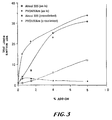
- Figure 1 is a graph of wet tensile strength as a function of wt% (dry-on-dry) copolymer add-on for Airvol 325 (a polyvinyl alcohol available commercially from Air Products and Chemicals, Inc.); Airvol 325 with a crosslinking agent; PVOH/VAm copolymer; and PVOH/VAm copolymer with a crosslinking agent.
- Airvol 325 a polyvinyl alcohol available commercially from Air Products and Chemicals, Inc.
- Airvol 325 with a crosslinking agent Airvol 325 with a crosslinking agent
- PVOH/VAm copolymer a polyvinyl alcohol available commercially from Air Products and Chemicals, Inc.
- PVOH/VAm copolymer a polyvinyl alcohol available commercially from Air Products and Chemicals, Inc.
- Figure 2 is a graph of dry tensile strength as a function of wt% (dry-on-dry) copolymer add-on for the same compositions as in the graph of Figure 1.
- Figure 3 is a graph of wet burst strength as a function of wt% (dry-on-dry) copolymer add-on for the same compositions as in the graph of Figure 1.
- crosslinking additives along with polyvinyl alcohol/vinylamine copolymers offer significant improvements in property achievements in dry end addition to cellulosic based materials (e.g. paper and paper-type products).
- the addition of the crosslinking agents allows for significant property improvements with low levels of PVOH/VAm addition.
- wet tensile strength and wet burst strength show significant improvements at copolymer addition levels from about 0.1 to 8 wt% (dry-on-dry) when crosslinking additives are employed.
- PVOH/VAm crosslinked versions also show improvements in dry tensile strength, dry burst strength and fold resistance at these levels of copolymer addition. Synergistic results are also observed when cellulosic reactive sizes are added.
- An option to dry end addition of both copolymer and crosslinking additive is to add the copolymer at the wet end of the papermaking operation with the crosslinker added at the dry end. When both the copolymer and the crosslinker are added at the wet end no advantage is seen with crosslinker addition.
- the vinyl alcohol/vinylamine copolymers used in this process contain between 0.5 and 25 mole% vinylamine units, with from 2 to 12 mole% being preferred, and can be produced by the polymerization of vinyl acetate/N-vinylamides (e.g. N-vinyl formamide, N-vinyl acetamide) followed by the hydrolysis of both the vinyl acetate (to vinyl alcohol) and the vinyl amide (to vinylamine). Hydrolysis does not have to be complete, and suitable PVOH/VAm copolymers may contain up to 60% of unhydrolyzed amide units and up to 25% unhydrolyzed acetate units.
- vinyl acetate/N-vinylamides e.g. N-vinyl formamide, N-vinyl acetamide
- suitable PVOH/VAm copolymers may contain up to 60% of unhydrolyzed amide units and up to 25% unhydrolyzed acetate units.
- Poly(vinyl acetate) can be prepared by methods well known in the art including emulsion, suspension, solution or bulk polymerization techniques. Rodriguez in “Principles of Polymer Systems,” p. 98-101, 403, 405 (McGraw-Hill, NY, 1970) describes bulk and solution polymerization procedures and the specifics of emulsion polymerization.
- Amine functional poly(vinyl alcohol) can be prepared by copolymerization of N-vinyl amides (e.g. N-vinyl formamide or N-vinyl acetamide) or allyl amine with vinyl acetate using methods employed for poly(vinyl acetate) polymerizations.
- the monomer When preparing poly(vinyl acetate) by suspension polymerization, the monomer is typically dispersed in water containing a suspending agent such as poly(vinyl alcohol) wherein an initiator such as peroxide is added thereto. The unreacted monomer is devolatilized after polymerization is completed and the polymer is filtered and dried.
- a suspending agent such as poly(vinyl alcohol) wherein an initiator such as peroxide is added thereto.
- the unreacted monomer is devolatilized after polymerization is completed and the polymer is filtered and dried.
- This procedure for preparation of poly(vinyl acetate) can also be employed for the vinyl acetate copolymers (as precursors for amine functional poly(vinyl alcohol)) of this invention.
- Poly(vinyl acetate) can also be prepared via solution polymerization wherein the vinyl acetate is dissolved in a solvent in the presence of an initiator for polymerization. Following completion of the polymerization, the polymer is recovered by coagulation and the solvent is removed by devolatilization.
- the vinyl acetate copolymers (as precursors for amine functional poly(vinyl alcohol)) can be prepared via this procedure.
- Bulk polymerization is not normally practiced in the commercial manufacture of poly(vinyl acetate) or vinyl acetate copolymers. However, bulk polymerization could be utilized if proper provisions are made for heat of polymerization removal.
- Crosslinking agents which are added along with the copolymer include glyoxal, glutaraldehyde, phenol-formaldehyde resins, urea-formaldehyde, melamine-formaldehyde, epoxy resins, maleic anhydride copolymers, diisocyanates, dicarboxylic acids and other crosslinking agents commonly employed for poly(vinyl alcohol).
- the crosslinking agents can be added to the copolymer prior to addition to the dry end pulp, or may be added separately to the dry end pulp either before or after the addition of the copolymer.
- the crosslinking agent is added in a concentration from about 2 to 50 wt% based upon copolymer, with from 4 to 30 wt% being preferred.
- Test samples were prepared as follows using Whatman #4 filter paper all from the same lot (roll). The filter paper was cut into 7.62 cm (3") wide pieces which were then weighed. 8% aqueous solutions of the various polymers were prepared in accordance with standard synthesis techniques. Solution solids were adjusted to achieve the desired coat weights. Crosslinking material was added to the solution for those particular tests. The desired solution was poured into a pan and a filter paper sample was then submerged in the pan with solution for several seconds until thoroughly saturated. The polymer saturated sample was then put through an Atlas Padder to remove excess polymer solution. The sized sample was then placed in an oven at 150°C for 5 minutes. After cooling and equilibrating, the dried filter paper sample was then reweighed and the final coat weight calculated.
- This test was used to measure the air resistance of paper by measuring the time it takes a given volume of air to pass through a sample.
- test sample pre-conditioned at 24°C and 50% relative humidity
- the amount of time it takes 100 ml of air to pass through the test sample is measured to the nearest 0.1 second.
- the basic apparatus consists of a stationary clamping jaw, a spring assembly to apply the desired load and an oscillating clamping jaw to induce folding of the sample.
- test sample pre-conditioned at 24°C and 50% relative humidity was placed in the test apparatus.
- the spring assembly was set to 0.25 kilograms. Power was turned on and the oscillating jaw folded the sample 175 ⁇ 25 cycles/min. An automatic counter recorded the number of double fold cycles to sample breakage.
- This test was used to measure the bursting strength, both wet and dry, of the paper samples.
- test sample pre-conditioned at 24°C and 50% relative humidity was clamped into the testing apparatus. Power was turned on and air pressure was continually applied to expand a rubber diaphragm until the paper sample burst. The dry burst strength was reported. For wet burst strength, the pre-conditioned test sample was soaked for 5 seconds in water. The sample was then immediately clamped into the testing apparatus and the burst strength measured.
- This test was developed to measure the amount of water absorbed by the test sample.
- test sample pre-conditioned at 24°C and 50% relative humidity, was pre-weighed to the nearest .01 gram. The sample was then immersed in a pan of water for 5 seconds and then blotted to remove excess surface water and reweighed. The result was reported as the percent of water weight gained with respect to the original samples dry weight.
- a test similar to TAPPI T-494 was used to measure the force per unit width required to break a sample.
- the test sample pre-conditioned at 24°C and 50% relative humidity is cut into 1.27 cm (1/2") strips.
- the test sample pre-conditioned at 24°C and 50% relative humidity is cut into 1.27 cm (1/2") strips.
- For dry tensiles the strips were clamped into an Instron tensile tester. The gauge length was 10.16 cm (4") and crosshead speed was 0.508 cm (0.20 in)/min. A 9.08-22.7 kg (20 to 50 pound) load range was used depending on the strength of the sample.
- the dry strips (3-4 samples) were then broken with average dry tensile reported.
- the 1.27 cm (1/2") strips were soaked in tap water for 30 minutes, blotted and immediately clamped into the Instron. Instrument conditions for wet tensiles were the same as dry tensiles except a 4.54 kg (10 pound) load range was used. Again 3-4 samples were run and
- Samples were prepared according to the previously described Sample Preparation section using polyvinyl alcohol/(10%) vinylamine (PVOH/VAm), a fully hydrolyzed, medium molecular weight, water soluble copolymer from Air Products and Chemicals. Samples were prepared at a coat weight of 8%, with and without Glyoxal N-40 from American Hoechst added at 15% dry based on dry polymer. Results showed the PVOH/VAm copolymer with no Glyoxal N-40 addition improved all paper properties tested except Gurley Porosity, when compared to untreated Whatman #4 filter paper. All Gurley porosity values are very low and comparable. When 15% Glyoxal N-40 was added, all wet strength properties improved even much more over the untreated filter paper.
- PVOH/VAm polyvinyl alcohol/(10%) vinylamine
- Samples were prepared according to the previously described Sample Preparation section using polyvinyl alcohol/(5%) vinylamine (PVOH/VAm), a fully hydrolyzed, medium molecular weight, water soluble copolymer from Air Products and Chemicals. Samples were prepared at a coat weight of 8%, with and without Glyoxal N-40 from American Hoechst, Glyoxal N-40 added at 15% dry based on dry polymer. Results showed the PVOH/VAm copolymer with no Glyoxal N-40 addition improved all paper properties tested except Gurley Porosity and wet Mullen Burst, when compared to untreated Whatman #4 filter paper. When 15% Glyoxal N-40 was added, all properties improved except MIT fold over the untreated filter paper.
- PVOH/VAm polyvinyl alcohol/(5%) vinylamine
- Samples were prepared according to the previously described Sample Preparation Section using polyvinyl alcohol/10% vinylamine (PVOH/VAm), a fully hydrolyzed, medium molecular weight, water soluble copolymer. Samples were prepared at a coat weight of 1.5% dry polymer based on dry paper using 5 and 15% levels (based on dry polymer) of Parez 802 (urea formaldehyde resin from American Cyanamid) for crosslinking. Results showed improvements in wet and dry tensiles, wet and dry Mullen Burst strength and MIT fold resistance over uncrosslinked PVOH/10% VAm and untreated control paper (#4 Whatman filter paper).
- Samples were prepared according to the previously described Sample Preparation section using polyvinyl alcohol/10% vinyl amine (PVOH/VAm), a fully hydrolyzed, medium molecular weight, water soluble copolymer. Samples were prepared at a lower coat weight of 1.5% dry polymer based on dry paper using 15% level (based on dry polymer) of Cymel 385 (melamine formaldehyde resin from American Cyanamid) for crosslinking. The resin was catalyzed using 2% Cycat 6060 (toluene sulfonic acid type from American Cyanamid).
- PVOH/VAm polyvinyl alcohol/10% vinyl amine
- Samples were prepared according to the previously described Sample Preparation section using polyvinyl alcohol/(5%) vinylamine (PVOH/VAm), a fully hydrolyzed, medium molecular weight, water soluble copolymer from Air Products and Chemicals and Airvol 325, a fully hydrolyzed, medium molecular weight, polyvinyl alcohol from Air Products and Chemicals. Samples were prepared at coat weights of 0.5, 1.5, 4 and 8%, with and without Glyoxal N-40 from American Hoechst, Glyoxal N-40 added at 15% based on dry polymer.
- PVOH/VAm polyvinyl alcohol/(5%) vinylamine
- An intermediate size paper machine capable of 226.5 kg (500 lbs)/hour was employed to make an unbleached paper based on unbleached Southern Softwood Pulp (K#-60) from Champion International. Pulp was added to a pulp chest and mixed with water and added to a beater to reduce the Canadian Freeness to -650. The resultant pulp was pumped to another pulp chest where a poly(vinylalcohol/vinylamine) (HCl) ( ⁇ 7 mole% VAm ⁇ HCl) was added (predissolved in water).
- the PVOH/VAm ⁇ HCl had a 4% solution pH of 2.99 and a 4% solution viscosity of 45.30 cps.
- the PVOH/VAm ⁇ HCl was added at dry-on-dry levels of 0.5 wt% and 0.95 wt% on the pulp.
- the pulp slurry was fed to the paper machine to yield a basis weight of 81.33 g/m 2 (50 lbs/3000 ft 2 ).
- the paper width produced was a 121.92 cm (48 inch) slice with a 106.68 cm (42 inch) trim.
- the line rate was 38.1 m (125 ft)/min.
- the dried paper was rolled up after production samples were taken and tested in the machine direction (see Table 6). A control paper without any additives was also produced for comparison.
- the addition of PVOH/VAm ⁇ HCl (wet-end) yielded increased dry and wet tensile strength and wet and dry burst strength.
- the unbleached Kraft paper containing either 0.5% or 0.95% PVOH/VAm copolymer was post-treated with a solution containing glyoxal N-40.
- the glyoxal was applied at levels of both 20 and 40% active glyoxal based on dry polymer solids.
- the glyoxal application was accomplished by saturating the Kraft paper sheet in the appropriate solution, processing the wet paper through an Atlas coater and then curing it in an oven at 150°C for 5 minutes. Then the samples were conditioned overnight in a CTH chamber (23°C, 50% humidity). After conditioning, the samples were tested for dry and wet tensile strength, dry and wet Mullen burst strength and percent water absorption. Also tested for comparison were papers containing the two levels of PVOH/VAm copolymers without glyoxal post-treatment and untreated control paper.
Landscapes
- Chemical & Material Sciences (AREA)
- Chemical Kinetics & Catalysis (AREA)
- Paper (AREA)
Claims (13)
- Procédé pour la fabrication de papier possédant des propriétés de résistance améliorées, comprenant les étapes consistant à : ajouter un alcool de polyvinyle/copolymère de vinylamine contenant entre 0,5 et 25 % en moles d'unités de vinylamine rapportés à la pâte de papier dans le procédé de fabrication du papier dans une quantité allant d'environ 0,1 à 8 % en poids de copolymère sec rapportés à la pâte sèche et également en ajoutant à la pâte de papier, un agent de réticulation capable de réticuler le copolymère, agent de réticulation qui est ajouté au niveau du train de séchage du procédé de fabrication de papier.
- Procédé selon la revendication 1, dans lequel l'agent de réticulation est choisi dans le groupe constitué par du glyoxal, du glutaraldéhyde, des résines de formaldéhyde-phénol, urée-formaldéhyde, mélamine-formaldéhyde, résines époxy, copolymères d'anhydride maléique, diisocyanate, acides dicarboxyliques et leurs mélanges.
- Procédé selon la revendication 1, dans lequel le copolymère est ajouté à la pâte de papier au niveau du train de séchage du procédé de fabrication de papier.
- Procédé selon la revendication 1, dans lequel le copolymère est ajouté à la pâte de papier au niveau de la partie humide du procédé de fabrication de papier.
- Procédé selon la revendication 1, dans lequel l'agent de réticulation est ajouté au copolymère avant d'être ajouté à la pâte de papier au niveau du train de séchage du procédé de fabrication du papier.
- Procédé selon la revendication 1, dans lequel l'agent de réticulation est ajouté à la pâte à papier avant l'addition du copolymère.
- Procédé selon la revendication 1, dans lequel le copolymère est ajouté à la pâte à papier avant l'addition de l'agent de réticulation.
- Procédé selon la revendication 1, dans lequel l'alcool de polyvinyle/copolymère de vinylamine est produit par hydrolyse de l'acétate de polyvinyle correspondant/copolymère N-vinylamide.
- Procédé selon la revendication 1, dans lequel le copolymère contient entre 2 et 12 % en moles d'unités de vinylamine.
- Procédé selon la revendication 1, dans lequel on ajoute également un agent d'encollage réactif cellulosique au niveau du train de séchage du procédé de fabrication du papier.
- Procédé selon la revendication 10, dans lequel on effectue l'encollage par saturation au niveau du train de séchage.
- Procédé selon la revendication 11, dans lequel on effectue l'encollage en surface au niveau du train de séchage.
- Produit de papier à base cellulosique présentant une résistance améliorée à la rupture à l'état humide et sec, une résistance améliorée à l'essai d'éclatement, obtenu par le procédé de la revendication 1.
Applications Claiming Priority (2)
| Application Number | Priority Date | Filing Date | Title |
|---|---|---|---|
| US3760 | 1993-01-13 | ||
| US08/003,760 US5281307A (en) | 1993-01-13 | 1993-01-13 | Crosslinked vinyl alcohol/vinylamine copolymers for dry end paper addition |
Publications (2)
| Publication Number | Publication Date |
|---|---|
| EP0606889A1 EP0606889A1 (fr) | 1994-07-20 |
| EP0606889B1 true EP0606889B1 (fr) | 1997-08-06 |
Family
ID=21707453
Family Applications (1)
| Application Number | Title | Priority Date | Filing Date |
|---|---|---|---|
| EP94100307A Expired - Lifetime EP0606889B1 (fr) | 1993-01-13 | 1994-01-11 | Copolymères réticulés d'amine vinylique et d'alcool vinylique pour addition dans la partie sèche |
Country Status (8)
| Country | Link |
|---|---|
| US (1) | US5281307A (fr) |
| EP (1) | EP0606889B1 (fr) |
| JP (1) | JPH06235191A (fr) |
| KR (1) | KR940018523A (fr) |
| CA (1) | CA2112949A1 (fr) |
| DE (1) | DE69404680T2 (fr) |
| FI (1) | FI940120L (fr) |
| NO (1) | NO940071L (fr) |
Cited By (3)
| Publication number | Priority date | Publication date | Assignee | Title |
|---|---|---|---|---|
| US5994449A (en) * | 1997-01-23 | 1999-11-30 | Hercules Incorporated | Resin compositions for making wet and dry strength paper and their use as creping adhesives |
| US6824650B2 (en) * | 2001-12-18 | 2004-11-30 | Kimberly-Clark Worldwide, Inc. | Fibrous materials treated with a polyvinylamine polymer |
| US7214633B2 (en) | 2001-12-18 | 2007-05-08 | Kimberly-Clark Worldwide, Inc. | Polyvinylamine treatments to improve dyeing of cellulosic materials |
Families Citing this family (58)
| Publication number | Priority date | Publication date | Assignee | Title |
|---|---|---|---|---|
| US5374334A (en) * | 1993-12-06 | 1994-12-20 | Nalco Chemical Company | Class of polymeric adhesives for yankee dryer applications |
| JP3265113B2 (ja) * | 1994-03-04 | 2002-03-11 | 三菱製紙株式会社 | インクジェット記録シート |
| US5519093A (en) * | 1994-05-11 | 1996-05-21 | Air Products And Chemicals, Inc. | Synthesis of amine functional co-and terpolymers |
| US5629184A (en) * | 1995-01-25 | 1997-05-13 | Amgen Inc. | Cationic copolymers of vinylamine and vinyl alcohol for the delivery of oligonucleotides |
| US20030192664A1 (en) * | 1995-01-30 | 2003-10-16 | Kulick Russell J. | Use of vinylamine polymers with ionic, organic, cross-linked polymeric microbeads in paper-making |
| ES2135849T3 (es) * | 1995-05-18 | 1999-11-01 | Fort James Corp | Nuevas formulaciones de adhesivo de crespado, metodo de crespado y banda fibrosa crespada. |
| US6815497B1 (en) * | 1995-05-18 | 2004-11-09 | Fort James Corporation | Crosslinkable creping adhesive formulations |
| CA2227605A1 (fr) * | 1995-07-27 | 1997-02-13 | Richard Barkman Wasser | Polymeres cationiques synthetiques facilitant le collage de l'anhydride succinique d'alcenyle |
| US6419790B1 (en) | 1996-05-09 | 2002-07-16 | Fort James Corporation | Methods of making an ultra soft, high basis weight tissue and product produced thereby |
| US5776618A (en) * | 1996-07-25 | 1998-07-07 | Mobil Oil Corporation | Barrier film structures |
| US6419789B1 (en) | 1996-10-11 | 2002-07-16 | Fort James Corporation | Method of making a non compacted paper web containing refined long fiber using a charge controlled headbox and a single ply towel made by the process |
| DE69700228T2 (de) * | 1997-03-20 | 1999-12-16 | Ilford Imaging Switzerland Gmbh, Marly | Aufzeichnungsblatt für das Tintenstrahldruckverfahren |
| KR20010024108A (ko) * | 1997-09-18 | 2001-03-26 | 랜달 제이. 로저스 | 셀룰로오스 여과지 포화제 |
| US6162328A (en) * | 1997-09-30 | 2000-12-19 | Hercules Incorporated | Method for surface sizing paper with cellulose reactive and cellulose non-reactive sizes, and paper prepared thereby |
| US6146497A (en) * | 1998-01-16 | 2000-11-14 | Hercules Incorporated | Adhesives and resins, and processes for their production |
| WO1999064673A1 (fr) * | 1998-06-12 | 1999-12-16 | Fort James Corporation | Procede de fabrication d'une bande papier presentant un volume vide interieur eleve constitue de fibres secondaires et produit fabrique a l'aide dudit procede |
| CA2277131A1 (fr) | 1998-08-14 | 2000-02-14 | Schweitzer-Mauduit International, Inc. | Procede pour augmenter la resistance humide des enveloppes de tampon poreux a utiliser dans les articles de fumeur |
| US6248210B1 (en) | 1998-11-13 | 2001-06-19 | Fort James Corporation | Method for maximizing water removal in a press nip |
| US6383752B1 (en) * | 1999-03-31 | 2002-05-07 | Hybridon, Inc. | Pseudo-cyclic oligonucleobases |
| US6379499B1 (en) | 1999-09-28 | 2002-04-30 | University Of Georgia Research Foundation, Inc. | Polymer-aldehyde additives to improve paper properties |
| US20040226675A1 (en) * | 2000-01-11 | 2004-11-18 | Raisio Chemicals Ltd. | Method for improving printability and coatability of paper and board |
| US6365000B1 (en) | 2000-12-01 | 2002-04-02 | Fort James Corporation | Soft bulky multi-ply product and method of making the same |
| US20030114631A1 (en) * | 2001-03-12 | 2003-06-19 | Walton Cynthia D. | Resins acting as wet strength agents and creping aids and processes for preparing and using the same |
| US7494566B2 (en) * | 2002-09-13 | 2009-02-24 | University Of Pittsburgh - Of The Commonwealth System Of Higher Education | Composition for increasing cellulosic product strength and method of increasing cellulosic product strength |
| US7090745B2 (en) * | 2002-09-13 | 2006-08-15 | University Of Pittsburgh | Method for increasing the strength of a cellulosic product |
| US7144946B2 (en) | 2002-12-19 | 2006-12-05 | Hugh McIntyre Smith | Cationic polyvinyl alcohol-containing compositions |
| US20040118540A1 (en) * | 2002-12-20 | 2004-06-24 | Kimberly-Clark Worlwide, Inc. | Bicomponent strengtheninig system for paper |
| DE10319741A1 (de) * | 2003-04-30 | 2004-11-18 | Basf Ag | Verfahren zur Verbesserung der Bedruckbarkeit von Papier und Papierprodukten beim Bedrucken mit Hilfe des Tintenstrahldruckverfahrens |
| DE10329262B3 (de) * | 2003-06-23 | 2004-12-16 | Infineon Technologies Ag | Verfahren zur Behandlung eines Substrates und ein Halbleiterbauelement |
| BRPI0508227A (pt) * | 2004-02-27 | 2007-07-17 | Univ Pittsburgh | géis poliméricos interligados e uso de tais géis poliméricos na recuperação de hidrocarboneto |
| JP2006176758A (ja) * | 2004-11-26 | 2006-07-06 | Mitsubishi Chemicals Corp | 水溶性樹脂組成物、これを用いたガスバリアフィルム及び包装材料 |
| US20060116471A1 (en) * | 2004-11-26 | 2006-06-01 | Mitsubishi Chemical Corporation | Water soluble resin composition, gas barrier film and packaging material employing it |
| US9266301B2 (en) * | 2005-06-30 | 2016-02-23 | Nalco Company | Method to adhere and dislodge crepe paper |
| DE102006039941A1 (de) * | 2006-08-25 | 2008-02-28 | Wacker Chemie Ag | Verfahren zur Behandlung von cellulosehaltigen Fasern oder Flächengebilde enthaltend cellulosehaltige Fasern |
| US7875676B2 (en) * | 2006-09-07 | 2011-01-25 | Ciba Specialty Chemicals Corporation | Glyoxalation of vinylamide polymer |
| US8088250B2 (en) | 2008-11-26 | 2012-01-03 | Nalco Company | Method of increasing filler content in papermaking |
| AR071441A1 (es) * | 2007-11-05 | 2010-06-23 | Ciba Holding Inc | N- vinilamida glioxilada |
| WO2009073140A1 (fr) * | 2007-11-30 | 2009-06-11 | Celanese International Corporation | Composition d'additif pour des mortiers, des ciments et des composés de pâte à joint et compositions cimentaires produites à partir de cette dernière |
| CA2725378C (fr) * | 2008-05-27 | 2016-11-22 | Georgia-Pacific Consumer Products Lp | Tissu de bain de premiere qualite |
| CA2735867C (fr) * | 2008-09-16 | 2017-12-05 | Dixie Consumer Products Llc | Feuille de base d'emballage alimentaire a microfibre de cellulose regeneree |
| US20110005008A1 (en) * | 2009-04-16 | 2011-01-13 | Schoots Harrie P | Vinyl acetate/ethylene (vae) copolymers for fabric finishing |
| US20100314333A1 (en) * | 2009-06-10 | 2010-12-16 | Hollingsworth & Vose Company | Flutable fiber webs with low surface electrical resistivity for filtration |
| US8236082B2 (en) * | 2009-06-19 | 2012-08-07 | Hollingsworth & Vose Company | Flutable fiber webs with high dust holding capacity |
| CA2777545C (fr) * | 2009-11-06 | 2018-01-23 | Hercules Incorporated | Application superficielle de polymeres et de melanges de polymeres pour ameliorer la resistance mecanique du papier |
| CA2813996C (fr) | 2010-11-05 | 2015-01-27 | Hercules Incorporated | Application en surface de polymeres pour ameliorer la resistance du papier |
| US8496784B2 (en) | 2011-04-05 | 2013-07-30 | P.H. Glatfelter Company | Process for making a stiffened paper |
| US9133583B2 (en) | 2011-04-05 | 2015-09-15 | P.H. Glatfelter Company | Process for making a stiffened paper |
| FI20115664A0 (fi) * | 2011-06-23 | 2011-06-23 | Kemira Oyj | Polymeerituote ja sen käyttö dispergointiaineena |
| WO2013084062A2 (fr) | 2011-12-06 | 2013-06-13 | Basf Se | Préparation d'adduits réactifs cellulosiques de polyvinylamide |
| CA2921043C (fr) | 2013-09-09 | 2023-03-14 | Basf Se | Copolymeres de polyacrylamide glyoxalate de grande masse moleculaire et de grande charge cationique et methodes de fabrication et d'utilisation |
| US9976259B2 (en) | 2013-12-10 | 2018-05-22 | Buckman Laboratories International, Inc. | Adhesive formulation and creping methods using same |
| US9567708B2 (en) | 2014-01-16 | 2017-02-14 | Ecolab Usa Inc. | Wet end chemicals for dry end strength in paper |
| US8894817B1 (en) * | 2014-01-16 | 2014-11-25 | Ecolab Usa Inc. | Wet end chemicals for dry end strength |
| US9702086B2 (en) * | 2014-10-06 | 2017-07-11 | Ecolab Usa Inc. | Method of increasing paper strength using an amine containing polymer composition |
| US9920482B2 (en) | 2014-10-06 | 2018-03-20 | Ecolab Usa Inc. | Method of increasing paper strength |
| TWI703936B (zh) * | 2015-03-27 | 2020-09-11 | 瑞士商菲利浦莫里斯製品股份有限公司 | 用於電熱式氣溶膠產生物件之紙質包覆材料 |
| US10648133B2 (en) | 2016-05-13 | 2020-05-12 | Ecolab Usa Inc. | Tissue dust reduction |
| SE545995C2 (en) * | 2020-10-21 | 2024-04-09 | Stora Enso Oyj | Use of a coated paperboard for beverage container carriers and corresponding beverage container carrier |
Family Cites Families (15)
| Publication number | Priority date | Publication date | Assignee | Title |
|---|---|---|---|---|
| DE1692854A1 (de) * | 1967-11-29 | 1971-10-21 | Hoechst Ag | Verfahren zur Entwaesserung von Cellulosefaser-Suspensionen |
| US3535288A (en) * | 1968-04-30 | 1970-10-20 | Diamond Shamrock Corp | Cationic polyamide-epichlorohydrin resins |
| US3597313A (en) * | 1968-09-23 | 1971-08-03 | American Cyanamid Co | Polyaldehyde crosslinked aliphatic alcohol resins and a process of making temporary wet strength paper and paper made therefrom |
| US3715336A (en) * | 1971-01-07 | 1973-02-06 | Dow Chemical Co | Copolymers of vinyl amine and vinyl alcohol as flocculants |
| AU529801B2 (en) * | 1978-06-19 | 1983-06-23 | Monsanto Company | Paper additives |
| GB2056997B (en) * | 1979-07-12 | 1983-04-07 | Kuraray Co | Copolymers containing cationic groups |
| DE3128478A1 (de) * | 1981-07-18 | 1983-02-03 | Basf Ag, 6700 Ludwigshafen | Verfahren zur herstellung von linearen, basischen polymerisaten |
| US4614762A (en) * | 1984-06-15 | 1986-09-30 | W. R. Grace & Co. | Water soluble linear polyethyleneimine derivative from water-insoluble polyethyleneimine, polyvinyl alcohol and aldehyde |
| DE3534273A1 (de) * | 1985-09-26 | 1987-04-02 | Basf Ag | Verfahren zur herstellung von vinylamin-einheiten enthaltenden wasserloeslichen copolymerisaten und deren verwendung als nass- und trockenverfestigungsmittel fuer papier |
| DE3620065A1 (de) * | 1986-06-14 | 1987-12-17 | Basf Ag | Verfahren zur herstellung von papier, pappe und karton |
| US4808683A (en) * | 1986-06-19 | 1989-02-28 | Mitsubishi Chemical Industries Limited | Vinylamine copolymer, flocculating agent using the same, and process for preparing the same |
| CA1283748C (fr) * | 1986-06-25 | 1991-04-30 | Takaharu Itagaki | Copolymere vinylamine, agent de floculation et agent de renforcement du papier qui en fait usage, ainsi que methode de production connexe |
| EP0331048B1 (fr) * | 1988-02-27 | 1994-06-08 | Fuji Photo Film Co., Ltd. | Procédé et appareil pour lire le code barre d'un film photographique et procéde de détermination de l'orientation d'un film photographique |
| EP0337310A1 (fr) * | 1988-04-15 | 1989-10-18 | Air Products And Chemicals, Inc. | Copolymères de l'alcool et de l'amine vinylique pour obtenir une résistance modifiée contre la compression à l'état humide de produits papetiers |
| DE3927812A1 (de) * | 1989-08-23 | 1991-02-28 | Basf Ag | Kationische harnstoff-formaldehyd-harze, verfahren zu ihrer herstellung und ihre verwendung in der papierindustrie |
-
1993
- 1993-01-13 US US08/003,760 patent/US5281307A/en not_active Expired - Lifetime
-
1994
- 1994-01-06 CA CA002112949A patent/CA2112949A1/fr not_active Abandoned
- 1994-01-07 NO NO940071A patent/NO940071L/no unknown
- 1994-01-11 EP EP94100307A patent/EP0606889B1/fr not_active Expired - Lifetime
- 1994-01-11 FI FI940120A patent/FI940120L/fi unknown
- 1994-01-11 DE DE69404680T patent/DE69404680T2/de not_active Expired - Fee Related
- 1994-01-12 JP JP6001732A patent/JPH06235191A/ja active Pending
- 1994-01-12 KR KR1019940000385A patent/KR940018523A/ko not_active Ceased
Cited By (4)
| Publication number | Priority date | Publication date | Assignee | Title |
|---|---|---|---|---|
| US5994449A (en) * | 1997-01-23 | 1999-11-30 | Hercules Incorporated | Resin compositions for making wet and dry strength paper and their use as creping adhesives |
| US6824650B2 (en) * | 2001-12-18 | 2004-11-30 | Kimberly-Clark Worldwide, Inc. | Fibrous materials treated with a polyvinylamine polymer |
| US7214633B2 (en) | 2001-12-18 | 2007-05-08 | Kimberly-Clark Worldwide, Inc. | Polyvinylamine treatments to improve dyeing of cellulosic materials |
| US7435266B2 (en) | 2001-12-18 | 2008-10-14 | Kimberly-Clark Worldwide, Inc. | Polyvinylamine treatments to improve dyeing of cellulosic materials |
Also Published As
| Publication number | Publication date |
|---|---|
| FI940120A7 (fi) | 1994-07-14 |
| JPH06235191A (ja) | 1994-08-23 |
| FI940120L (fi) | 1994-07-14 |
| EP0606889A1 (fr) | 1994-07-20 |
| CA2112949A1 (fr) | 1994-07-14 |
| NO940071L (no) | 1994-07-14 |
| DE69404680T2 (de) | 1997-12-18 |
| DE69404680D1 (de) | 1997-09-11 |
| FI940120A0 (fi) | 1994-01-11 |
| KR940018523A (ko) | 1994-08-18 |
| NO940071D0 (no) | 1994-01-07 |
| US5281307A (en) | 1994-01-25 |
Similar Documents
| Publication | Publication Date | Title |
|---|---|---|
| US5281307A (en) | Crosslinked vinyl alcohol/vinylamine copolymers for dry end paper addition | |
| CA2100117C (fr) | Amelioration de la resistance du papier a l'etat humide au moyen d'un appret reactif cellulosique et d'un alcool polyvinylique amine | |
| US5338406A (en) | Dry strength additive for paper | |
| US5380403A (en) | Amine functional poly(vinyl alcohol) for improving properties of recycled paper | |
| US6103861A (en) | Strength resins for paper and repulpable wet and dry strength paper made therewith | |
| AU701985B2 (en) | Methods and agents for improving paper printability and strength | |
| US20030121632A1 (en) | Stock size for paper or board manufacture, method preparation of size, use of size | |
| KR20180115744A (ko) | 종이의 제조방법 | |
| AU6597996A (en) | Synthetic cationic polymers as promoters for ASA sizing | |
| EP2294094A1 (fr) | Polyvinylamine à faible teneur en amidine, compositions contenant celles-ci et procédés | |
| WO1998006898A1 (fr) | Polyacrylamides amphoteres utilises comme additifs de resistance a l'etat sec pour la fabrication de papier | |
| US4181566A (en) | Cellulosic materials internally sized with ammoniated acid copolymers and epihalohydrin/alkylamine reaction products | |
| FI3697963T3 (en) | METHOD FOR MANUFACTURE OF MULTILAYERED PAPER | |
| WO2004101279A1 (fr) | Materiau d'emballage composite dote d'au moins deux couches et destine a la fabrication de conteneurs pour le conditionnement de liquides | |
| CA2876609C (fr) | Procede ameliore de fabrication de papier utilisant un polymere cationique obtenu par degradation d'hofmann | |
| CA1325303C (fr) | Resine a bonne resistance a sec de colloide amino/aldehyde-acide avec un polymere a base d'acrylamide, procede pour sa production et papier produit a partir de celui-ci | |
| US4880498A (en) | Dry strength resin of amino/aldehyde acid colloid with acrylamide polymer, process for the production thereof and paper produced therefrom | |
| US20060162883A1 (en) | Use of polymers containing vinylamine units as promoters for alkyldiketene glueing | |
| WO2000034584A1 (fr) | Polyacrylamides glyoxales utilises comme agents de renforcement du papier | |
| WO1995008670A1 (fr) | Agents favorisant la retention | |
| KR20200055796A (ko) | 종이 또는 판지의 제조 방법 | |
| JP2005232604A (ja) | 嵩低減抑制剤、製紙方法、および紙 | |
| CA2213314C (fr) | Dispersions aqueuses d'alkyldicetene et leur utilisation comme produits d'encollage pour papier | |
| EP0289823A2 (fr) | Feuilles humides ayant une résistance élevée pour la fabrication de papier et procédé de fabrication de papier en produisant des feuilles fibreuses ayant une résistance à l'état humide |
Legal Events
| Date | Code | Title | Description |
|---|---|---|---|
| PUAI | Public reference made under article 153(3) epc to a published international application that has entered the european phase |
Free format text: ORIGINAL CODE: 0009012 |
|
| AK | Designated contracting states |
Kind code of ref document: A1 Designated state(s): BE DE FR GB SE |
|
| 17P | Request for examination filed |
Effective date: 19940721 |
|
| 17Q | First examination report despatched |
Effective date: 19951027 |
|
| GRAG | Despatch of communication of intention to grant |
Free format text: ORIGINAL CODE: EPIDOS AGRA |
|
| GRAH | Despatch of communication of intention to grant a patent |
Free format text: ORIGINAL CODE: EPIDOS IGRA |
|
| GRAH | Despatch of communication of intention to grant a patent |
Free format text: ORIGINAL CODE: EPIDOS IGRA |
|
| GRAA | (expected) grant |
Free format text: ORIGINAL CODE: 0009210 |
|
| AK | Designated contracting states |
Kind code of ref document: B1 Designated state(s): BE DE FR GB SE |
|
| PG25 | Lapsed in a contracting state [announced via postgrant information from national office to epo] |
Ref country code: FR Free format text: LAPSE BECAUSE OF FAILURE TO SUBMIT A TRANSLATION OF THE DESCRIPTION OR TO PAY THE FEE WITHIN THE PRESCRIBED TIME-LIMIT Effective date: 19970806 Ref country code: BE Effective date: 19970806 |
|
| REF | Corresponds to: |
Ref document number: 69404680 Country of ref document: DE Date of ref document: 19970911 |
|
| PG25 | Lapsed in a contracting state [announced via postgrant information from national office to epo] |
Ref country code: SE Effective date: 19971106 |
|
| EN | Fr: translation not filed | ||
| PG25 | Lapsed in a contracting state [announced via postgrant information from national office to epo] |
Ref country code: GB Free format text: LAPSE BECAUSE OF NON-PAYMENT OF DUE FEES Effective date: 19980111 |
|
| PLBE | No opposition filed within time limit |
Free format text: ORIGINAL CODE: 0009261 |
|
| STAA | Information on the status of an ep patent application or granted ep patent |
Free format text: STATUS: NO OPPOSITION FILED WITHIN TIME LIMIT |
|
| 26N | No opposition filed | ||
| GBPC | Gb: european patent ceased through non-payment of renewal fee |
Effective date: 19980111 |
|
| PG25 | Lapsed in a contracting state [announced via postgrant information from national office to epo] |
Ref country code: DE Free format text: LAPSE BECAUSE OF NON-PAYMENT OF DUE FEES Effective date: 19981001 |