EP0607295B1 - Appareil pour observer in vivo la structure microscopique de la peau ou d'un tissu similaire - Google Patents
Appareil pour observer in vivo la structure microscopique de la peau ou d'un tissu similaire Download PDFInfo
- Publication number
- EP0607295B1 EP0607295B1 EP92921712A EP92921712A EP0607295B1 EP 0607295 B1 EP0607295 B1 EP 0607295B1 EP 92921712 A EP92921712 A EP 92921712A EP 92921712 A EP92921712 A EP 92921712A EP 0607295 B1 EP0607295 B1 EP 0607295B1
- Authority
- EP
- European Patent Office
- Prior art keywords
- endpiece
- contact
- skin
- lens
- central opening
- Prior art date
- Legal status (The legal status is an assumption and is not a legal conclusion. Google has not performed a legal analysis and makes no representation as to the accuracy of the status listed.)
- Expired - Lifetime
Links
Images


Classifications
-
- G—PHYSICS
- G02—OPTICS
- G02B—OPTICAL ELEMENTS, SYSTEMS OR APPARATUS
- G02B21/00—Microscopes
- G02B21/0004—Microscopes specially adapted for specific applications
- G02B21/002—Scanning microscopes
- G02B21/0024—Confocal scanning microscopes (CSOMs) or confocal "macroscopes"; Accessories which are not restricted to use with CSOMs, e.g. sample holders
- G02B21/0052—Optical details of the image generation
- G02B21/006—Optical details of the image generation focusing arrangements; selection of the plane to be imaged
-
- A—HUMAN NECESSITIES
- A61—MEDICAL OR VETERINARY SCIENCE; HYGIENE
- A61B—DIAGNOSIS; SURGERY; IDENTIFICATION
- A61B5/00—Measuring for diagnostic purposes; Identification of persons
- A61B5/0059—Measuring for diagnostic purposes; Identification of persons using light, e.g. diagnosis by transillumination, diascopy, fluorescence
- A61B5/0062—Arrangements for scanning
- A61B5/0068—Confocal scanning
-
- A—HUMAN NECESSITIES
- A61—MEDICAL OR VETERINARY SCIENCE; HYGIENE
- A61B—DIAGNOSIS; SURGERY; IDENTIFICATION
- A61B5/00—Measuring for diagnostic purposes; Identification of persons
- A61B5/44—Detecting, measuring or recording for evaluating the integumentary system, e.g. skin, hair or nails
- A61B5/441—Skin evaluation, e.g. for skin disorder diagnosis
-
- A—HUMAN NECESSITIES
- A61—MEDICAL OR VETERINARY SCIENCE; HYGIENE
- A61B—DIAGNOSIS; SURGERY; IDENTIFICATION
- A61B5/00—Measuring for diagnostic purposes; Identification of persons
- A61B5/68—Arrangements of detecting, measuring or recording means, e.g. sensors, in relation to patient
- A61B5/6801—Arrangements of detecting, measuring or recording means, e.g. sensors, in relation to patient specially adapted to be attached to or worn on the body surface
- A61B5/683—Means for maintaining contact with the body
- A61B5/6832—Means for maintaining contact with the body using adhesives
- A61B5/6833—Adhesive patches
-
- A—HUMAN NECESSITIES
- A61—MEDICAL OR VETERINARY SCIENCE; HYGIENE
- A61B—DIAGNOSIS; SURGERY; IDENTIFICATION
- A61B5/00—Measuring for diagnostic purposes; Identification of persons
- A61B5/68—Arrangements of detecting, measuring or recording means, e.g. sensors, in relation to patient
- A61B5/6801—Arrangements of detecting, measuring or recording means, e.g. sensors, in relation to patient specially adapted to be attached to or worn on the body surface
- A61B5/683—Means for maintaining contact with the body
- A61B5/6835—Supports or holders, e.g., articulated arms
-
- G—PHYSICS
- G02—OPTICS
- G02B—OPTICAL ELEMENTS, SYSTEMS OR APPARATUS
- G02B21/00—Microscopes
- G02B21/0004—Microscopes specially adapted for specific applications
- G02B21/002—Scanning microscopes
- G02B21/0024—Confocal scanning microscopes (CSOMs) or confocal "macroscopes"; Accessories which are not restricted to use with CSOMs, e.g. sample holders
- G02B21/0028—Confocal scanning microscopes (CSOMs) or confocal "macroscopes"; Accessories which are not restricted to use with CSOMs, e.g. sample holders specially adapted for specific applications, e.g. for endoscopes, ophthalmoscopes, attachments to conventional microscopes
-
- A—HUMAN NECESSITIES
- A61—MEDICAL OR VETERINARY SCIENCE; HYGIENE
- A61B—DIAGNOSIS; SURGERY; IDENTIFICATION
- A61B2562/00—Details of sensors; Constructional details of sensor housings or probes; Accessories for sensors
- A61B2562/02—Details of sensors specially adapted for in-vivo measurements
- A61B2562/0233—Special features of optical sensors or probes classified in A61B5/00
- A61B2562/0242—Special features of optical sensors or probes classified in A61B5/00 for varying or adjusting the optical path length in the tissue
-
- A—HUMAN NECESSITIES
- A61—MEDICAL OR VETERINARY SCIENCE; HYGIENE
- A61B—DIAGNOSIS; SURGERY; IDENTIFICATION
- A61B2562/00—Details of sensors; Constructional details of sensor housings or probes; Accessories for sensors
- A61B2562/14—Coupling media or elements to improve sensor contact with skin or tissue
- A61B2562/146—Coupling media or elements to improve sensor contact with skin or tissue for optical coupling
Definitions
- the invention relates to an apparatus for in vivo observation of the microscopic structure of the skin or similar tissue, over a sufficient depth from the outer surface.
- This device includes a confocal microscope equipped with appropriate lighting and a rotating disc with holes of reduced diameter, known under the name of Nipkow disc, a receiver of images with high sensitivity and a objective with immersion.
- This device allows non-invasive observation of the structure of the skin or similar tissue. However, the quality of the images obtained and the depth of the observations in the skin need to be improved.
- the spatial resolution is relatively limited, of the order of 100 micrometers, and is not sufficient for observation on a cellular scale.
- the devices proposed to date for in vivo observation of the skin do not make it possible to carry out observations as fine and precise as those carried out in vitro, by destructive or invasive route.
- the invention aims, above all, to provide an apparatus for observing in vivo, in a non-invasive manner, the microscopic structure of the skin or a similar tissue, giving a good image quality and an accuracy comparable to that obtained by in vitro, destructive or invasive methods of observation. Furthermore, it is desirable that such an apparatus allow rapid observations to be made.
- an apparatus for in vivo observation of the microscopic structure of the skin or of a similar tissue comprising a confocal microscope equipped with appropriate lighting, and a rotating disc provided with holes of reduced diameter, generally known as the disc name of Nipkow, of a high-sensitivity image receptor and of an immersion objective is characterized by the fact that it comprises a contact tip intended to be placed against the skin and in which is engaged at the minus the lower part of said objective, this tip having a central opening and being bonded to the skin around said central opening, the assembly being mounted so that a relative axial displacement is possible between the contact tip and the goal.
- a drop of a liquid whose refractive index is substantially equal to that of the upper layer of the skin (stratum corneum) is placed in the central opening of the contact tip, between the lens and the skin with which said drop is in contact.
- the liquid is advantageously constituted by an immersion oil whose refractive index is equal to 1.5.
- the apparatus of the invention by ensuring the maintenance of the area of the skin to be observed, and by facilitating the placement and conservation of the drop of immersion liquid, makes it possible to obtain quality images.
- the contact end piece has a channel, in particular a capillary channel, making it possible to replenish said central opening of the contact end piece with liquid.
- the contact tip can be bonded to the skin using a double-sided adhesive washer having a central hole, corresponding to the central opening of the contact tip.
- the contact endpiece is detachably fixed, in particular by screwing, on an arm.
- the objective of the confocal microscope is carried by a fixed support while the contact tip is mounted with the possibility of sliding relative to the objective.
- the objective can be moved manually, in particular to reach different sites of the body, said objective being further mounted so as to be able to be displaced in sliding motion relative to the contact tip, immobile on the skin.
- Micrometric displacement means in particular actuated by an electric stepping motor, are advantageously provided for controlling the relative displacements between the objective and the contact tip. These means also allow precise measurements of the depths reached.
- the illumination of the confocal microscope is carried out in white light, in particular using a mercury lamp filtered in the 400 nm - 700 nm band.
- the high-sensitivity image receiver is advantageously constituted by a DAGE MTI SIT 68 intensified camera (10 -5 lux).
- the objective has a magnification of the order of 50, and a numerical aperture (NA) generally greater than 0.7 and preferably 0.85.
- the front distance of the lens is at least 200 micrometers.
- the invention consists, apart from the arrangements set out above, of a certain number of other arrangements which will be more explicitly discussed below, with reference to the appended drawings, in connection with an exemplary embodiment of a device according to the invention, but which is in no way limiting.
- FIG. 1 of these drawings is a diagram of the apparatus according to the invention.
- Figure 2 is a plan view of the Nipkow disc of the confocal microscope of the apparatus of Figure 1.
- FIG. 3 is an elevation view, with cut parts, on a larger scale, of the objective and of the contact tip of the apparatus of FIG. 1.
- Figure 4 is a top view with respect to Figure 3, the lens being removed.
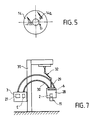
- Figure 5 is a plan view of a double-sided adhesive washer.
- Figure 6 is a schematic section of the skin.
- FIG 7 is a simplified diagram of a variant of the apparatus.
- FIG. 1 one can see an apparatus A allowing the microscopic structure of the skin to be observed in vivo.
- the device A is used to observe an area of the skin P of the arm B of a patient.
- the apparatus A comprises a confocal microscope 1, for example of the TSM TRACOR type for observation in real time.
- This microscope 1 is provided with an oil immersion objective 2, the magnification of which is advantageously equal to 50 and the numerical aperture equal to 0.85.
- the front distance of objective 2 (that is to say the distance between its exit face and the focal point) is at least equal to 200 micrometers.
- the area to be observed is illuminated by a source 3 of white light, constituted for example by a mercury lamp, filtered in the 400-700 nm band.
- the light beam passes through an inverting system 4 and is returned by a set 5 of mirrors, or equivalent means, along the optical axis of the objective 2.
- the beam of light coming from the source 3 is chopped by a disc 6 comprising a multitude of holes 7 of reduced diameter, (see Figure 2), judiciously distributed.
- the disc 6 is rotated about an axis perpendicular to its plane and parallel to the axis of the chopped light beam.
- Disc 6 is known as the Nipkow disc.
- the light returned by the area to be observed is focused on a receiving surface 8 with high sensitivity, in particular constituted by the receiving surface of an intensified camera E for example of the DAGE MTI SIT 68 type, sensitive up to 10 -5 lux.
- the light returned by the area to be observed is directed, towards the sensitive surface 8, by a semi-transparent mirror 9, or equivalent, and by a set of reflective surfaces 10.
- the returned beam, before reaching the surface 8, passes through holes 7 in disc 6.
- the traces of the light beams on the disc 6 are shown diagrammatically by circles t .
- the apparatus A comprises a contact tip 11 schematically represented in FIG. 1 and shown in more detail in FIG. 3, constituted by a sort of sleeve comprising a bottom 12 provided with a circular central opening 13 with a diameter at least equal to and preferably greater than the exit diameter of the objective 2.
- This objective at least through its lower part, is engaged in the end piece 11.
- the contact tip 11 is intended to bear by the lower flat face of its bottom 12 against the skin P and to be bonded to the skin in the annular region surrounding the opening 13.
- connection between the nozzle 11 and the skin is advantageously carried out using a double-sided adhesive washer 14 which has, in its center, a hole 14 has a diameter at least equal to that of the opening 13 .
- the assembly is mounted in such a way that a micrometric axial relative movement is possible between the contact end piece 11 and the objective 2.
- the objective 2 is carried by a fixed cross member 15, itself carried by a frame not shown.
- the contact plate 11 is carried by an arm 16, parallel to the cross bar 15 and slidably mounted along a direction parallel to the axis of the lens 2, by means of a guide 15 fixed on the cross member 15.
- the micrometric displacements of the arm 16, and therefore of the contact tip 11, relative to the cross member 15 are provided by a precision micrometer 17, carried by the cross member 15, with vernier to the micrometer.
- the relative movements between the contact tip 11 and the objective 2 are advantageously controlled by a stepping motor 18 and a control module 19. This arrangement makes it possible to measure the depths reached with an accuracy of 1 micrometer.
- the displays of the observation depths, corresponding to the relative displacements of the contact tip 11 and of the objective 2 can be displayed on a control screen 20.
- Fixing the contact plate 11 in the arm 16 is carried removably by screwing an external thread 11 provided on the end piece 11, a female thread 16a of the arm 16. It is thus possible to change the tip 11 and choose it according to the objective and the site to be observed.
- the micrometric displacements of the contact tip 11 relative to the objective 2 make it possible to vary the depth of the images, constituting horizontal sections of the skin, provided by the objective 2 This depth can reach 150 micrometers and the possible displacements of the nozzle 11 are therefore of an amplitude at least equal to 150 micrometers.
- a drop 21 of a liquid whose refractive index is substantially equal to that of the stratum cornea (surface layer of the skin) is provided between the exit face of the lens 2 and the skin to suppress interfaces and reflections of the skin surface.
- the drop 21 is a drop of oil with an immersion of refractive index equal to 1.5, while the refractive index of the stratum corneum is approximately 1.5.
- a capillary channel 22 is provided in the end piece 11 and opens on the one hand into the opening 13 and on the other hand on the cylindrical peripheral surface of this end piece 11, below the arm 16.
- This capillary channel 22 makes it possible to replenish the opening 13 with immersion oil, for example using a syringe, to maintain the presence of a drop 21 throughout the observation phase.
- the adhesive washer 14 contributes to the maintenance of the meniscus of the drop of oil 21.
- the apparatus A comprises a gutter system G (see FIG. 1) for holding the limb, namely the arm B in the example considered.
- the gutter G can be articulated on a ball joint R to allow adjustment in a horizontal plane.
- the apparatus A can be moved vertically as a whole to bring the end piece 11 into contact with the skin.
- the apparatus according to the invention be mobile as much as possible, to allow all skin parts of the human body to be reached relatively easily.
- FIG. 7 of the drawings schematically illustrates an alternative embodiment intended to give the device great mobility.
- the light source 3 and the camera E remain fixed, in a sub-assembly or fixed part 27 formed for example by a housing fixed to a frame.
- the other elements of the apparatus A shown in FIG. 1 form a sub-assembly or mobile part 28.
- the optical connection between the fixed part 27 and the mobile part 28 is ensured by two bundles 29, 30 of flexible optical fibers.
- the movable part 28 is therefore composed of the head of the microscope with the Nipkow disk 6, the objective 2, the contact tip 11 as well as the various optical elements 4, 5, 9 and 10 appearing in FIG. 1.
- the crew formed by the mobile part 28 is suspended from a fixed mast 31 by means of an arm 32 with ball joints, allowing the orientation of the mobile part 28 in all directions, and its movement to reach all the parts of the skin of the human body.
- the microscope head is illuminated by a 250 watt arc lamp, constituting the source 3, by means of the flexible optical fibers 29.
- the image is transmitted remotely to the camera E via an image conduit consisting of the bundle 30 of flexible optical fibers, with a length of about one meter.
- the moving element could only include the objective 2 and the contact system 11 and would therefore be lighter than in the variant mentioned above.
- the mobile equipment / microscope head link would be provided by optical fibers after correction of the trajectories. Again, the micrometric displacements would be communicated to the objective 2 while the end piece 11 would remain stationary during the observation.
- the image collected by the sensitive surface 8 can undergo processing, after recording on a tape. Denoising can be performed by real-time averaging. The elimination of the bands due to the spiral arrangement of the holes 7 of the disk of Nipkow 6 can be carried out by frequency analysis.
- Thickness measurements can give rise to field averaging in four virtual vertical cylinders with a diameter of 40 micrometers, the centers of which are located on a circle and angularly offset from each other by 90 °, so as to correct a possible inclination of the surface observed with respect to the optical axis of objective 2.
- a volume representation with registration of optical sections and transparency from 3D + and MIPS software can be performed (MISIS-St Etienne).
- the apparatus according to the invention makes it possible to carry out precise and quality observations of the skin in vivo over a depth of 150 micrometers which reaches, as illustrated in FIG. 6, the capillaries. It is therefore possible to make optical sections, in a non-invasive and non-destructive manner, through the stratum corneum SC, the epidermis EP (granular layer 22, spinous layer 23 and basal layer 24) and through the capillaries (terminal loops 25 and large handles 26).
- the average depths, expressed in micrometers, from the surface of the skin have been shown in Figure 6.
- the resolution is less than a micrometer and covers an observation field of 300 micrometers in diameter.
- the device works in real time which makes it possible to work in a 4D space (three dimensions + time).
- the contact tip 11 linked to the skin makes it possible to immobilize the field of observation by avoiding uncontrolled movements of the patient, following two directions X, Y, which contributes to obtaining good images.
- the tip 11, detachably attached to the arm 16 is interchangeable and its shape can be adapted to the anatomical site.
- connection between the underside of the bottom 12 of the nozzle and the skin makes it possible to limit the pressure of the contact on the skin and to eliminate the arterial beat. This connection makes it possible to maintain the meniscus of oil and to make exact thickness measurements.
Landscapes
- Health & Medical Sciences (AREA)
- Life Sciences & Earth Sciences (AREA)
- Physics & Mathematics (AREA)
- General Health & Medical Sciences (AREA)
- Surgery (AREA)
- Pathology (AREA)
- Veterinary Medicine (AREA)
- Engineering & Computer Science (AREA)
- Biomedical Technology (AREA)
- Heart & Thoracic Surgery (AREA)
- Medical Informatics (AREA)
- Molecular Biology (AREA)
- Biophysics (AREA)
- Animal Behavior & Ethology (AREA)
- Public Health (AREA)
- Radiology & Medical Imaging (AREA)
- Chemical & Material Sciences (AREA)
- Analytical Chemistry (AREA)
- General Physics & Mathematics (AREA)
- Optics & Photonics (AREA)
- Nuclear Medicine, Radiotherapy & Molecular Imaging (AREA)
- Dermatology (AREA)
- Ophthalmology & Optometry (AREA)
- Measurement Of The Respiration, Hearing Ability, Form, And Blood Characteristics Of Living Organisms (AREA)
- Measuring And Recording Apparatus For Diagnosis (AREA)
- Microscoopes, Condenser (AREA)
- Investigating Or Analysing Biological Materials (AREA)
Abstract
Description
- L'invention est relative à un appareil pour observer in vivo la structure microscopique de la peau ou d'un tissu similaire, sur une profondeur suffisante depuis la surface extérieure.
- On a proposé d'utiliser la microscopie confocale, en temps réel, pour obtenir des images de cellules de tissus in vivo, en particulier pour la cornée de l'oeil. L'article "IN VIVO REAL-TIME CONFOCAL IMAGING" de JAMES V. JESTER, PETER M. ANDREWS, W. MATTHEW PETROLL, MICHAEL A. LEMP, et H. DWIGHT CAVANAGH publié en mai 1991 dans "Journal of Electron Microscopy Technique", 18 (1991) pages 50-60, donne divers exemples sur le sujet. Il n'y est cependant pas question de configuration d'appareil permettant de réaliser des images in vivo de la peau, par microscopie confocale.
- L'article "In Vivo Imaging of Human Teeth and Skin Using Real-Time Confocal Microscopy" de NEW et al. publié dans SCANNING, vol. 13, n° 5, septembre 1991, pp. 369-372, montre un appareil permettant d'observer la peau in vivo. Cet appareil comprend un microscope confocal équipé d'un éclairage approprié et d'un disque rotatif muni de trous de diamètre réduit, connu sous le nom de disque de Nipkow, d'un récepteur d'images à haute sensibilité et d'un objectif à immersion. Cet appareil permet d'observer de manière non-invasive la structure de la peau ou d'un tissu similaire. Toutefois, la qualité des images obtenues et la profondeur des observations dans la peau demandent à être améliorées.
- On a déjà proposé des appareils à ultrasons ou des appareils utilisant la résonance magnétique nucléaire (RMN) pour observer, in situ, la peau humaine.
- La résolution spatiale est relativement limitée, de l'ordre de 100 micromètres, et n'est pas suffisante pour une observation à l'échelle cellulaire.
- Autrement dit, les appareils proposés jusqu'à ce jour pour l'observation in vivo de la peau, ne permettent pas de réaliser des observations aussi fines et précises que celles effectuées in vitro, par voie destructive ou invasive.
- L'invention a pour but, surtout, de fournir un appareil pour observer in vivo, de manière non-invasive, la structure microscopique de la peau ou d'un tissu similaire, donnant une bonne qualité d'image et une précision comparable à celle obtenue par les méthodes d'observation in vitro, destructives ou invasives. Il est souhaitable, en outre, qu'un tel appareil permette d'effectuer des observations rapides.
- Selon l'invention, un appareil pour observer in vivo la structure microscopique de la peau ou d'un tissu similaire comprenant un microscope confocal équipé d'un éclairage approprié, et d'un disque rotatif muni de trous de diamètre réduit, généralement connu sous le nom de disque de Nipkow, d'un récepteur d'images à haute sensibilité et d'un objectif à immersion est caractérisé par le fait qu'il comporte un embout de contact destiné à être placé contre la peau et dans lequel est engagée au moins la partie inférieure dudit objectif, cet embout comportant une ouverture centrale et étant lié à la peau autour de ladite ouverture centrale, l'ensemble étant monté de telle sorte qu'un déplacement relatif axial soit possible entre l'embout de contact et l'objectif.
- Pour l'observation, une goutte d'un liquide dont l'indice de réfraction est sensiblement égal à celui de la couche supérieure de la peau (stratum cornéum) est placée dans l'ouverture centrale de l'embout de contact, entre l'objectif et la peau avec lesquels ladite goutte est en contact. Le liquide est avantageusement constitué par une huile d'immersion dont l'indice de réfraction est égal à 1,5.
- L'appareil de l'invention, en assurant le maintien de la zone de la peau à observer, et en facilitant la mise en place et la conservation de la goutte de liquide d'immersion, permet d'obtenir des images de qualité.
- Avantageusement, l'embout de contact comporte un canal, en particulier capillaire, permettant de réalimenter en liquide ladite ouverture centrale de l'embout de contact.
- L'embout de contact peut être lié à la peau à l'aide d'une rondelle adhésive double face comportant un trou central, en correspondance avec l'ouverture centrale de l'embout de contact.
- De préférence, l'embout de contact est fixé de manière démontable, en particulier par vissage, sur un bras.
- Selon une première possibilité, l'objectif du microscope confocal est porté par un support fixe tandis que l'embout de contact est monté avec possibilité de coulissement relativement à l'objectif.
- Selon une autre possibilité, l'objectif peut être déplacé manuellement, en particulier pour atteindre différents sites du corps, ledit objectif étant en outre monté pour pouvoir être déplacé en coulissement relativement à l'embout de contact, immobile sur la peau.
- Des moyens de déplacement micrométrique, en particulier actionnés par un moteur électrique pas à pas, sont avantageusement prévus pour commander les déplacements relatifs entre l'objectif et l'embout de contact. Ces moyens permettent en outre des mesures précises des profondeurs atteintes.
- L'éclairage du microscope confocal est réalisé en lumière blanche, en particulier à l'aide d'une lampe à mercure filtrée dans la bande 400 nm - 700 nm.
- Le récepteur d'images à haute sensibilité est avantageusement constitué par une caméra intensifiée DAGE MTI SIT 68 (10-5 lux).
- L'objectif a un grossissement de l'ordre de 50, et une ouverture numérique (NA) généralement supérieure à 0,7 et de préférence de 0,85.
- La distance frontale de l'objectif est au moins égale à 200 micromètres.
- L'invention consiste, mises à part les dispositions exposées ci-dessus, en un certain nombre d'autres dispositions dont il sera plus explicitement question ci-après, avec référence aux dessins annexés, à propos d'un exemple de réalisation d'un appareil conforme à l'invention, mais qui n'est nullement limitatif.
- La figure 1, de ces dessins, est un schéma de l'appareil conforme à l'invention.
- La figure 2 est une vue en plan du disque de Nipkow du microscope confocal de l'appareil de la figure 1.
- La figure 3 est une vue en élévation, avec parties coupées, à plus grande échelle, de l'objectif et de l'embout de contact de l'appareil de la figure 1.
- La figure 4 est une vue de dessus par rapport à la figure 3, l'objectif étant retiré.
- La figure 5 est une vue en plan d'une rondelle adhésive double face.
- La figure 6 est une coupe schématique de la peau.
- La figure 7, enfin, est un schéma simplifié d'une variante de l'appareil.
- En se reportant aux dessins, notamment à la figure 1, on peut voir un appareil A permettant d'observer in vivo la structure microscopique de la peau. Dans l'exemple considéré, l'appareil A est utilisé pour observer une zone de la peau P du bras B d'un patient.
- L'appareil A comprend un microscope confocal 1 par exemple du type TSM TRACOR pour observation en temps réel. Ce microscope 1 est muni d'un objectif 2 à immersion d'huile, dont le grossissement est avantageusement égal à 50 et l'ouverture numérique égale à 0,85. La distance frontale de l'objectif 2 (c'est-à-dire la distance entre sa face de sortie et le foyer) est au moins égale à 200 micromètres. L'éclairage de la zone à observer est assuré par une source 3 de lumière blanche, constituée par exemple par une lampe à mercure, filtrée dans la bande 400-700 nm. Le faisceau de lumière traverse un système inverseur 4 et est renvoyé par un jeu 5 de miroirs, ou moyens équivalents, suivant l'axe optique de l'objectif 2.
- D'une manière connue, pour assurer le balayage de la zone à observer, par un point lumineux, focalisé par l'objectif 2, le faisceau de lumière provenant de la source 3 est haché par un disque 6 comportant une multitude de trous 7 de diamètre réduit, (voir figure 2), judicieusement répartis. Le disque 6 est entraîné en rotation autour d'un axe perpendiculaire à son plan et parallèle à l'axe du faisceau lumineux haché.
- Le disque 6 est connu sous le nom de disque de Nipkow.
- La lumière renvoyée par la zone à observer est focalisée sur une surface réceptrice 8 à haute sensibilité, en particulier constituée par la surface réceptrice d'une caméra intensifiée E par exemple du type DAGE MTI SIT 68, sensible jusqu'à 10-5 lux. La lumière renvoyée par la zone à observer est dirigée, vers la surface sensible 8, par un miroir semi-transparent 9, ou équivalent, et par un ensemble de surfaces réfléchissantes 10. Le faisceau renvoyé, avant d'atteindre la surface 8, traverse des trous 7 du disque 6.
- Les traces des faisceaux lumineux sur le disque 6 sont schématisés par des cercles t.
- L'appareil A comprend un embout de contact 11 schématiquement représenté sur la figure 1 et montré plus en détail sur la figure 3, constitué par une sorte de manchon comportant un fond 12 muni d'une ouverture centrale circulaire 13 d'un diamètre au moins égal et de préférence supérieur au diamètre de sortie de l'objectif 2. Cet objectif 2, au moins par sa partie inférieure, est engagé dans l'embout 11.
- L'embout de contact 11 est destiné à s'appuyer par la face plane inférieure de son fond 12 contre la peau P et à être lié à la peau dans la région annulaire entourant l'ouverture 13.
- La liaison entre l'embout 11 et la peau est avantageusement réalisée à l'aide d'une rondelle adhésive double face 14 qui comporte, en son centre, un trou 14a d'un diamètre au moins égal à celui de l'ouverture 13.
- L'ensemble est monté de telle sorte qu'un déplacement relatif axial micrométrique soit possible entre l'embout de contact 11 et l'objectif 2.
- Dans l'exemple de réalisation de la figure 3, l'objectif 2 est porté par une traverse 15 fixe, elle-même portée par un bâti non représenté. L'embout de contact 11 est porté par un bras 16, parallèle à la traverse 15 et monté coulissant, suivant une direction parallèle à l'axe de l'objectif 2, à l'aide d'un guidage 15a fixé sur la traverse 15. Les déplacements micrométriques du bras 16, et donc de l'embout de contact 11, relativement à la traverse 15 sont assurés par un micromètre de précision 17, porté par la traverse 15, avec vernier au micromètre.
- Les déplacements relatifs entre l'embout de contact 11 et l'objectif 2 sont avantageusement pilotés par un moteur pas à pas 18 et un module de commande 19. Cette disposition permet de mesurer avec une précision de 1 micromètre les profondeurs atteintes. Les affichages des profondeurs d'observation, correspondant aux déplacements relatifs de l'embout de contact 11 et de l'objectif 2 peuvent être affichés sur un écran de contrôle 20.
- La fixation de l'embout de contact 11 dans le bras 16 est réalisée de manière démontable par vissage d'un filetage extérieur 11a prévu sur l'embout 11, dans un taraudage 16a du bras 16. Il est ainsi possible de changer l'embout 11 et de le choisir selon l'objectif et le site à observer.
- En jouant sur l'élasticité de la peau, les déplacements micrométriques de l'embout de contact 11 relativement à l'objectif 2, permettent de faire varier la profondeur des images, constituant des coupes horizontales de la peau, fournies par l'objectif 2. Cette profondeur peut atteindre 150 micromètres et les déplacements possibles de l'embout 11 sont donc d'une amplitude au moins égale à 150 micromètres.
- Une goutte 21 d'un liquide dont l'indice de réfraction est sensiblement égal à celui du stratum cornéum (couche superficielle de la peau) est prévue entre la face de sortie de l'objectif 2 et la peau pour supprimer les interfaces et les réflexions de la surface cutanée. Avantageusement, la goutte 21 est une goutte d'huile à immersion d'indice de réfraction égal à 1,5, alors que l'indice de réfraction du stratum cornéum est d'environ 1,5.
- Un canal capillaire 22 est prévu dans l'embout 11 et débouche d'une part dans l'ouverture 13 et d'autre part sur la surface périphérique cylindrique de cet embout 11, au-dessous du bras 16. Ce canal capillaire 22 permet de réalimenter l'ouverture 13 en huile d'immersion, par exemple à l'aide d'une seringue, pour maintenir la présence d'une goutte 21 tout au long de la phase d'observation.
- Il convient de noter que la rondelle adhésive 14 contribue au maintien du ménisque de la goutte d'huile 21.
- L'appareil A comprend un système de gouttière G (voir figure 1) pour maintenir le membre, à savoir le bras B dans l'exemple considéré. La gouttière G peut être articulée sur rotule R pour permettre un ajustement dans un plan horizontal. L'appareil A peut être déplacé verticalement dans son ensemble pour amener l'embout 11 en contact avec la peau.
- Il est souhaitable que l'appareil selon l'invention soit mobile au maximum, pour permettre d'atteindre relativement facilement toutes les parties de peau de corps humain.
- La figure 7 des dessins illustre schématiquement une variante de réalisation visant à donner à l'appareil une grande mobilité.
- La source de lumière 3 et la caméra E restent fixes, dans un sous-ensemble ou partie fixe 27 formé par exemple par un boîtier fixé sur un châssis. Les autres éléments de l'appareil A représentés sur la figure 1 forment un sous-ensemble ou partie mobile 28. La liaison optique entre la partie fixe 27 et la partie mobile 28 est assurée par deux faisceaux 29, 30 de fibres optiques souples.
- La partie mobile 28 est donc composée de la tête du microscope avec le disque de Nipkow 6, l'objectif 2, l'embout de contact 11 ainsi que les différents éléments optiques 4, 5, 9 et 10 apparaissant sur la figure 1.
- L'équipage formé par la partie mobile 28 est suspendu à un mât fixe 31 par l'intermédiaire d'un bras 32 à rotules, permettant l'orientation de la partie mobile 28 dans toutes les directions, et son déplacement pour atteindre toute les parties de la peau du corps humain.
- L'éclairage de la tête du microscope est assuré par une lampe à arc de 250 watts, constituant la source 3, par l'intermédiaire des fibres optiques souples 29.
- L'image est transmise à distance à la caméra E par l'intermédiaire d'un conduit d'images constitué de la liasse 30 de fibres optiques souples, d'une longueur d'un mètre environ.
- Dans une telle variante, lors de l'observation, l'embout de contact 11 reste immobile, tandis que des déplacements micrométriques sont communiqués à l'objectif 2, relativement à cet embout de contact 11.
- Dans une autre variante, l'équipage mobile pourrait ne comprendre que l'objectif 2 et le système à contact 11 et serait donc plus léger que dans la variante évoquée précédemment. La liaison équipage mobile/tête de microscope serait assurée par des fibres optiques après correction des trajectoires. Là encore les déplacements micrométriques seraient communiqués à l'objectif 2 alors que l'embout 11 resterait immobile lors de l'observation.
- L'image recueillie par la surface sensible 8 peut subir un traitement, après enregistrement sur une bande. Un débruitage peut être réalisé par moyennage en temps réel. L'élimination des bandes dues à la disposition en spirale des trous 7 du disque de Nipkow 6 peut être réalisée par analyse fréquentielle.
- Des mesures automatiques des épaisseurs du stratum cornéum et de l'épiderme, par seuillage des noyaux épidermiques peuvent être réalisées. Autrement dit, par observation des images obtenues, on peut déterminer, lors de l'apparition de structures différentes, la transition du stratum cornéum à l'épiderme et de l'épiderme au derme. En repérant l'amplitude du déplacement relatif nécessaire entre objectif 2 et embout de contact 11, pour obtenir ces transitions, on effectue une mesure d'épaisseur relativement précise.
- Les mesures d'épaisseur peuvent donner lieu à un moyennage par champs dans quatre cylindres verticaux virtuels de diamètre de 40 micromètres, dont les centres sont situés sur un cercle et décalés angulairement les uns par rapport aux autres de 90°, de manière à corriger une inclinaison éventuelle de la surface observée vis-à-vis de l'axe optique de l'objectif 2.
- Une représentation volumique avec recalage des coupes optiques et transparisation à partir de logiciels 3D+ et MIPS peut être effectuée (MISIS-St Etienne).
- L'appareil conforme à l'invention permet de réaliser des observations précises et de qualité de la peau in vivo sur une profondeur de 150 micromètres qui atteint, comme illustré sur la figure 6, les capillaires. On peut donc réaliser des coupes optiques, de manière non invasive et non destructive, à travers le stratum cornéum SC, l'épiderme EP (couche granuleuse 22, couche spineuse 23 et couche basale 24) et à travers les capillaires (boucles terminales 25 et grandes anses 26). Les profondeurs moyennes, exprimées en micromètres, à partir de la surface de la peau, ont été indiquées sur la figure 6.
- La résolution est inférieure au micromètre et couvre un champ d'observation de 300 micromètres de diamètre. L'appareil travaille en temps réel ce qui permet de travailler dans un espace 4D (trois dimensions + temps).
- L'embout de contact 11 lié à la peau permet d'immobiliser le champ d'observation en s'affranchissant des mouvements incontrôlés du patient, suivant deux directions X, Y, ce qui contribue à l'obtention de bonnes images. L'embout 11, fixé de manière démontable sur le bras 16 est interchangeable et sa forme peut être adaptée au site anatomique.
- La liaison entre la face inférieure du fond 12 de l'embout et la peau permet de limiter la pression du contact sur la peau et d'éliminer le battement artériel. Cette liaison permet de maintenir le ménisque d'huile et de réaliser des mesures exactes d'épaisseur.
- Suivant la réalisation choisie, concernant les mesures des différentes couches épidermiques, dont la reproductibilité peut être affectée par les mouvements du patient et en particulier les mouvements dans le sens vertical, il a été conçu d'effectuer l'enregistrement video de la zone mesurée avec une vitesse de déplacement vertical d'au moins µm/seconde. Pour chaque enregistrement, l'altitude de la couche enregistrée est indiquée. Grâce à une carte de mixage video, il est ensuite possible de superposer les enregistrements d'images qui ont été pris au même niveau de profondeur dans la peau, permettant ainsi d'obtenir par ce procédé de superposition, des images plus nettes et d'obtenir également une altitude de pénétration plus élevée.
Claims (10)
- Appareil pour observer in vivo la structure microscopique de la peau ou d'un tissu similaire, comprenant un microscope confocal (1) équipé d'un éclairage approprié, et d'un disque rotatif (6) muni de trous de diamètre réduit, généralement connu sous le nom de disque de Nipkow, d'un récepteur d'images (8) à haute sensibilité et d'un objectif (2) à immersion, caractérisé par le fait qu'il comporte un embout de contact (11) destiné à être placé contre la peau et dans lequel est engagée au moins la partie inférieure dudit objectif (2), cet embout (11) comportant une ouverture centrale (13) et étant lié à la peau autour de ladite ouverture centrale, l'ensemble étant monté de telle sorte qu'un déplacement relatif axial soit possible entre l'embout de contact (11) et l'objectif (2).
- Appareil selon la revendication 1, caractérisé par le fait que l'embout de contact (11) est lié à la peau à l'aide d'une rondelle (14) adhésive double face comportant un trou central (14a), en correspondance avec l'ouverture centrale (13) de l'embout de contact (11).
- Appareil selon la revendication 1 ou 2, caractérisé par le fait que l'embout de contact (11) est fixé de manière démontable, en particulier par vissage, sur un bras (16).
- Appareil selon l'une des revendications précédentes, caractérisé par le fait que l'objectif (2) du microscope confocal est porté par un support fixe (15) tandis que l'embout de contact (11) est monté avec possibilité de coulissement relativement à l'objectif.
- Appareil selon la revendication 1 ou 2, caractérisé par le fait qu'il comprend une partie fixe (27) comportant une source de lumière (3) et une caméra (E) et une partie mobile (28) composée de la tête du microscope avec le disque de Nipkow (6), l'objectif (2) et l'embout de contact (11), la liaison optique entre la partie fixe (27) et la partie mobile (28) étant assurée par deux faisceaux (29, 30) de fibres optiques souples.
- Appareil selon la revendication 5, caractérisé par le fait que la partie mobile (28) est suspendue à un mât fixe (31) par l'intermédiaire d'un bras (32) à rotules.
- Appareil selon la revendication 4 ou 5, caractérisé par le fait que des moyens (17) de déplacement micrométrique, en particulier actionnés par un moteur électrique pas à pas (18), sont prévus pour commander les déplacements relatifs entre l'objectif (2) et l'embout de contact (11).
- Appareil selon la revendication 1, caractérisé par le fait qu'au cours de l'observation, une goutte (21) d'un liquide dont l'indice de réfraction est sensiblement égal à celui de la couche supérieure de la peau (stratum corneum) est placée dans l'ouverture centrale (13) de l'embout de contact (11).
- Appareil selon la revendication 8, caractérisé par le fait que le liquide est constitué par une huile d'immersion dont l'indice de réfraction est égal à 1,5.
- Appareil selon la revendication 8 ou 9, caractérisé par le fait que l'embout de contact (11) comporte un canal (22), en particulier capillaire, permettant de réalimenter en liquide ladite ouverture centrale (13) de l'embout de contact (11).
Applications Claiming Priority (3)
| Application Number | Priority Date | Filing Date | Title |
|---|---|---|---|
| FR9112541 | 1991-10-11 | ||
| FR9112541A FR2682490B1 (fr) | 1991-10-11 | 1991-10-11 | Appareil pour observer in vivo la structure microscopique de la peau ou d'un tissu similaire. |
| PCT/FR1992/000924 WO1993007522A1 (fr) | 1991-10-11 | 1992-10-05 | Appareil pour observer in vivo la structure microscopique de la peau ou d'un tissu similaire |
Publications (2)
| Publication Number | Publication Date |
|---|---|
| EP0607295A1 EP0607295A1 (fr) | 1994-07-27 |
| EP0607295B1 true EP0607295B1 (fr) | 1997-04-09 |
Family
ID=9417820
Family Applications (1)
| Application Number | Title | Priority Date | Filing Date |
|---|---|---|---|
| EP92921712A Expired - Lifetime EP0607295B1 (fr) | 1991-10-11 | 1992-10-05 | Appareil pour observer in vivo la structure microscopique de la peau ou d'un tissu similaire |
Country Status (7)
| Country | Link |
|---|---|
| EP (1) | EP0607295B1 (fr) |
| JP (2) | JPH06511406A (fr) |
| CA (1) | CA2120034A1 (fr) |
| DE (1) | DE69218957T2 (fr) |
| ES (1) | ES2099835T3 (fr) |
| FR (1) | FR2682490B1 (fr) |
| WO (1) | WO1993007522A1 (fr) |
Families Citing this family (17)
| Publication number | Priority date | Publication date | Assignee | Title |
|---|---|---|---|---|
| US5880880A (en) * | 1995-01-13 | 1999-03-09 | The General Hospital Corp. | Three-dimensional scanning confocal laser microscope |
| DE19654207A1 (de) | 1996-12-24 | 1998-06-25 | Leica Lasertechnik | TV-Kamera |
| US5978695A (en) * | 1997-08-18 | 1999-11-02 | Lucid Inc. | System for imaging mechanically stabilized tissue |
| NL1009296C2 (nl) * | 1998-06-02 | 1999-12-03 | Gerold Staudinger | Inrichting voor het optisch testen van objecten. |
| JP4504479B2 (ja) * | 1999-09-21 | 2010-07-14 | オリンパス株式会社 | 顕微鏡用液浸対物レンズ |
| JP2005128240A (ja) * | 2003-10-23 | 2005-05-19 | Olympus Corp | 対物レンズユニット及び顕微鏡並びに顕微鏡システム |
| JP2005301065A (ja) * | 2004-04-14 | 2005-10-27 | Olympus Corp | 観察装置 |
| JP4694139B2 (ja) * | 2004-04-01 | 2011-06-08 | オリンパス株式会社 | 顕微鏡 |
| JP4587693B2 (ja) * | 2004-04-07 | 2010-11-24 | オリンパス株式会社 | 生体観察装置 |
| US7698068B2 (en) | 2004-06-17 | 2010-04-13 | Cadent Ltd. | Method for providing data associated with the intraoral cavity |
| CA2721271C (fr) | 2008-04-09 | 2017-12-12 | Julian Itzcovitz | Systeme medical comprenant une sonde transcutanee |
| JP5712573B2 (ja) * | 2010-11-26 | 2015-05-07 | 花王株式会社 | 血流画像の形成方法 |
| JP6504913B2 (ja) * | 2015-05-20 | 2019-04-24 | 花王株式会社 | 皮膚毛細血管の観察方法 |
| JP6504914B2 (ja) * | 2015-05-20 | 2019-04-24 | 花王株式会社 | 皮膚毛細血管の観察方法 |
| JP6688164B2 (ja) * | 2016-06-09 | 2020-04-28 | 花王株式会社 | 皮膚毛細血管の観察方法 |
| FR3093635B1 (fr) * | 2019-03-14 | 2022-04-08 | Univ Bordeaux | Dispositif d’examen d’une zone capillaire |
| TWI778808B (zh) | 2021-09-24 | 2022-09-21 | 國立臺灣大學 | 影像鏡頭的保護組件及影像器材組 |
Family Cites Families (2)
| Publication number | Priority date | Publication date | Assignee | Title |
|---|---|---|---|---|
| JP2512299B2 (ja) * | 1986-12-16 | 1996-07-03 | 株式会社 ハイロックス | 照明装置付き近接撮影用レンズ |
| CA2009129C (fr) * | 1989-02-04 | 1995-02-14 | Mitsubishi Chemical Corporation | Tete de capteur d'images |
-
1991
- 1991-10-11 FR FR9112541A patent/FR2682490B1/fr not_active Expired - Fee Related
-
1992
- 1992-10-05 WO PCT/FR1992/000924 patent/WO1993007522A1/fr not_active Ceased
- 1992-10-05 DE DE69218957T patent/DE69218957T2/de not_active Expired - Fee Related
- 1992-10-05 JP JP5506667A patent/JPH06511406A/ja active Pending
- 1992-10-05 CA CA 2120034 patent/CA2120034A1/fr not_active Abandoned
- 1992-10-05 ES ES92921712T patent/ES2099835T3/es not_active Expired - Lifetime
- 1992-10-05 EP EP92921712A patent/EP0607295B1/fr not_active Expired - Lifetime
-
2001
- 2001-08-17 JP JP2001248425A patent/JP2002148518A/ja active Pending
Also Published As
| Publication number | Publication date |
|---|---|
| JP2002148518A (ja) | 2002-05-22 |
| DE69218957T2 (de) | 1997-07-17 |
| CA2120034A1 (fr) | 1993-04-15 |
| EP0607295A1 (fr) | 1994-07-27 |
| JPH06511406A (ja) | 1994-12-22 |
| DE69218957D1 (de) | 1997-05-15 |
| FR2682490B1 (fr) | 1993-12-17 |
| ES2099835T3 (es) | 1997-06-01 |
| FR2682490A1 (fr) | 1993-04-16 |
| WO1993007522A1 (fr) | 1993-04-15 |
Similar Documents
| Publication | Publication Date | Title |
|---|---|---|
| WO1993007522A1 (fr) | Appareil pour observer in vivo la structure microscopique de la peau ou d'un tissu similaire | |
| US5719700A (en) | Apparatus for in vivo observation of the microscopic structure of the skin or of a similar tissue | |
| US7616986B2 (en) | Optical fiber scanner for performing multimodal optical imaging | |
| EP1114348B9 (fr) | Dispositif d'observation de l'interieur d'un corps produisant une qualite d'observation perfectionnee | |
| EP4185914B1 (fr) | Systèmes et procédés d'analyse microscopique d'un échantillon | |
| JP5140396B2 (ja) | 光コネクタおよびこれを用いる光断層画像化装置 | |
| US6441356B1 (en) | Fiber-coupled, high-speed, angled-dual-axis optical coherence scanning microscopes | |
| CN101884524B (zh) | 基于自适应光学技术的宽视场光学相干层析仪 | |
| FR2537428A1 (fr) | Procede et dispositif pour produire une image du fond de l'oeil | |
| JP2005529322A (ja) | 対象イメージング方法、その実現する装置および低干渉性光学放射の届け用装置 | |
| FR2619002A1 (fr) | Appareil electronystagmographique infrarouge/video pour l'observation et l'enregistrement des mouvements de l'oeil | |
| US8184365B2 (en) | Optical instruments having dynamic focus | |
| FR2791548A1 (fr) | Dispositif d'observation d'un corps a haute resolution | |
| WO2006024152A1 (fr) | Ligne de retard de balayage a transmission pour oct | |
| EP1703837B1 (fr) | Tete optique miniature a balayage integre pour la realisation d' une image confocale homogene, et systeme d' imagerie confocale utilisant ladite tete | |
| US8593644B2 (en) | White light optical profilometer for measuring complex surfaces | |
| Rolland et al. | Gabor domain optical coherence microscopy | |
| US20070070328A1 (en) | Method of determining a property of a fluid and spectroscopic system | |
| JP3650364B2 (ja) | 光走査プローブ装置 | |
| FR2852394A1 (fr) | Procede et appareillage d'imagerie de fluorescence fibree haute resolution | |
| US20250152002A1 (en) | Device for measuring the characteristics of the human eye using oct technology | |
| AU2022214125B2 (en) | Devices for ex vivo microscopic analysis of samples and in vivo microscopic analysis of the skin | |
| RU2458337C2 (ru) | Способ определения малых немагнитных включений и устройство для его осуществления | |
| CN107242850A (zh) | 一种三向协同扫描光学相干层析成像手持探头 | |
| FR2685789A1 (fr) | Microscope en champ proche fonctionnant par detection tunnel optique. |
Legal Events
| Date | Code | Title | Description |
|---|---|---|---|
| PUAI | Public reference made under article 153(3) epc to a published international application that has entered the european phase |
Free format text: ORIGINAL CODE: 0009012 |
|
| 17P | Request for examination filed |
Effective date: 19940124 |
|
| AK | Designated contracting states |
Kind code of ref document: A1 Designated state(s): DE ES FR GB IT |
|
| GRAG | Despatch of communication of intention to grant |
Free format text: ORIGINAL CODE: EPIDOS AGRA |
|
| 17Q | First examination report despatched |
Effective date: 19960712 |
|
| GRAH | Despatch of communication of intention to grant a patent |
Free format text: ORIGINAL CODE: EPIDOS IGRA |
|
| GRAH | Despatch of communication of intention to grant a patent |
Free format text: ORIGINAL CODE: EPIDOS IGRA |
|
| GRAA | (expected) grant |
Free format text: ORIGINAL CODE: 0009210 |
|
| AK | Designated contracting states |
Kind code of ref document: B1 Designated state(s): DE ES FR GB IT |
|
| ITF | It: translation for a ep patent filed | ||
| GBT | Gb: translation of ep patent filed (gb section 77(6)(a)/1977) |
Effective date: 19970410 |
|
| REF | Corresponds to: |
Ref document number: 69218957 Country of ref document: DE Date of ref document: 19970515 |
|
| REG | Reference to a national code |
Ref country code: ES Ref legal event code: FG2A Ref document number: 2099835 Country of ref document: ES Kind code of ref document: T3 |
|
| PLBE | No opposition filed within time limit |
Free format text: ORIGINAL CODE: 0009261 |
|
| STAA | Information on the status of an ep patent application or granted ep patent |
Free format text: STATUS: NO OPPOSITION FILED WITHIN TIME LIMIT |
|
| 26N | No opposition filed | ||
| PGFP | Annual fee paid to national office [announced via postgrant information from national office to epo] |
Ref country code: GB Payment date: 20011003 Year of fee payment: 10 |
|
| PGFP | Annual fee paid to national office [announced via postgrant information from national office to epo] |
Ref country code: FR Payment date: 20011010 Year of fee payment: 10 |
|
| PGFP | Annual fee paid to national office [announced via postgrant information from national office to epo] |
Ref country code: DE Payment date: 20011022 Year of fee payment: 10 |
|
| PGFP | Annual fee paid to national office [announced via postgrant information from national office to epo] |
Ref country code: ES Payment date: 20011025 Year of fee payment: 10 |
|
| REG | Reference to a national code |
Ref country code: GB Ref legal event code: IF02 |
|
| PG25 | Lapsed in a contracting state [announced via postgrant information from national office to epo] |
Ref country code: GB Free format text: LAPSE BECAUSE OF NON-PAYMENT OF DUE FEES Effective date: 20021005 |
|
| PG25 | Lapsed in a contracting state [announced via postgrant information from national office to epo] |
Ref country code: ES Free format text: LAPSE BECAUSE OF NON-PAYMENT OF DUE FEES Effective date: 20021006 |
|
| PG25 | Lapsed in a contracting state [announced via postgrant information from national office to epo] |
Ref country code: DE Free format text: LAPSE BECAUSE OF NON-PAYMENT OF DUE FEES Effective date: 20030501 |
|
| GBPC | Gb: european patent ceased through non-payment of renewal fee |
Effective date: 20021005 |
|
| PG25 | Lapsed in a contracting state [announced via postgrant information from national office to epo] |
Ref country code: FR Free format text: LAPSE BECAUSE OF NON-PAYMENT OF DUE FEES Effective date: 20030630 |
|
| REG | Reference to a national code |
Ref country code: FR Ref legal event code: ST |
|
| REG | Reference to a national code |
Ref country code: ES Ref legal event code: FD2A Effective date: 20031112 |
|
| PG25 | Lapsed in a contracting state [announced via postgrant information from national office to epo] |
Ref country code: IT Free format text: LAPSE BECAUSE OF NON-PAYMENT OF DUE FEES Effective date: 20051005 |