EP0607437A1 - Geschicklichkeit lehrende freizeitvorrichtung - Google Patents
Geschicklichkeit lehrende freizeitvorrichtung Download PDFInfo
- Publication number
- EP0607437A1 EP0607437A1 EP92918614A EP92918614A EP0607437A1 EP 0607437 A1 EP0607437 A1 EP 0607437A1 EP 92918614 A EP92918614 A EP 92918614A EP 92918614 A EP92918614 A EP 92918614A EP 0607437 A1 EP0607437 A1 EP 0607437A1
- Authority
- EP
- European Patent Office
- Prior art keywords
- balls
- recreational
- training device
- educational
- modules
- Prior art date
- Legal status (The legal status is an assumption and is not a legal conclusion. Google has not performed a legal analysis and makes no representation as to the accuracy of the status listed.)
- Withdrawn
Links
Images







Classifications
-
- A—HUMAN NECESSITIES
- A63—SPORTS; GAMES; AMUSEMENTS
- A63F—CARD, BOARD, OR ROULETTE GAMES; INDOOR GAMES USING SMALL MOVING PLAYING BODIES; VIDEO GAMES; GAMES NOT OTHERWISE PROVIDED FOR
- A63F9/00—Games not otherwise provided for
- A63F9/06—Patience; Other games for self-amusement
- A63F9/08—Puzzles provided with elements movable in relation, i.e. movably connected, to each other
- A63F9/0826—Three-dimensional puzzles with slidable or rotatable elements or groups of elements, the main configuration remaining unchanged, e.g. Rubik's cube
- A63F9/0873—Three-dimensional puzzles with slidable or rotatable elements or groups of elements, the main configuration remaining unchanged, e.g. Rubik's cube a sphere rotatable with respect to an inner sphere
Definitions
- the invention relates to a recreational, educational and skill device, as indicated by the wording, which is a toy or a means of diversion composed of a ball (spherical body), belonging to so-called toys or games of skill , with a high or difficult coefficient of execution and whose possibilities of realization or versatility of execution are unlimited and still remain to be determined and will in any case be compiled in an instruction manual as and when it is put at the test.
- the toy or recreational device according to the invention is composed of a ball or sphere inside which will be housed a set of 30 balls of the same size and in different colors, distributed in three (theoretical) sliding channels which coincide with the three orthogonally perpendicular planes of the sphere, which can, essentially, be moved independently, in the direction of said planes and in both directions thereof.
- the displacement and the location of the balls can be followed through windows provided in the carcass or envelope of the ball and / or even through the possible transparency of the carcass itself of the sphere, so that the balls obviously cannot be dislodged.
- the main philosophy of the invention is that the half-bodies or hemispheres of the sphere (main body) can move normally in the gyratory direction, independently of each other, along the three axes orthogonally perpendicular to the sphere, each of which coincides with the channels or corridors (orthogonally perpendicular) of the balls to move, as a function of the turned hemisphere, the balls of the respective channel or corridor, thus being able, alternatively, to pass intercalate or transfer the balls from one corridor to another to make combinations with the difficulty coefficient which will be established, the balls being visible through the windows and / or the possible transparency of the sphere.
- the concept of the invention falls within the framework of the apparatus or toys of cubic address of the "State of the Art" which have for foundation to combine the various parts in which they are subdivided by the rotation of a set of orthogonal planes and which are distinguished by the fact of presenting different colors.
- the version of the previous case is a hexahedral volume where each module or combinable part is assembled or is necessarily connected to the central module.
- the toy is a prismatic body with a pentagonal base with concave angles which requires, in a similar combination and a similar solution, a coefficient of greater difficulty to move or rotate the planes of the volume.
- a "puzzle” sphere which consists in locating or positioning a series of equal portions in which is divided a set of three rings which rotate in three orthogonal planes but in such a way that the remaining volume caps are fixed.
- the structural solution is a hollow spherical body reanured in the three positions of the rings covered by the latter, and the rest of the fixed portions of the carcass.
- the rings are subdivided into flat portions with small pivots fitting into internal supports of the volume.
- the main idea of the invention is to develop a game of skill in which, by moving the half-spheres of the general volume, we move a general game of balls (30 balls) free and independent housed inside the sphere and guided or aligned in three channels or corridors distributed in three positions orthogonally perpendicular to each other.
- each lane or channel is occupied by the same number of balls, successively and correlatively, without spacing between them, that is to say in tangential contact but so that at the confluence or intersection of the lanes (six intersections) coincides with one of the balls which can be moved in two directions, or in four directions, the eight remaining balls of the game remaining between them, in each channel or corridor.
- each channel or corridor has at a point on its route, preferably a point located at the same height or position of each corridor, a stop or cleat, preferably retractable, to prevent movement or crazy rotation of the balls, making that their displacement is necessarily carried out by moving the hemispherical parts of the volume, alternating them depending on whether it is proposed to guide or cause the balls to have a color determined by one corridors to obtain combinations evaluated in accordance with a preset difficulty coefficient, or according to the possibilities that the development of the game allows.
- Another aspect of the invention is that the combination of the balls is followed through oblong, elongated windows or notches which allow at least two balls to be seen and which are provided on the carcass or envelope of the sphere in the same direction as that of the channels or guideways of the balls, but with an opening which prevents their exit.
- stops or tabs which prevent any accidental displacement of the balls, are elastic stops which can be crossed or overcome by the balls by exerting pressure on the latter through a determined window of each corridor.
- the invention comprises a hollow general spherical volume or body covered with a carcass or breastplate composed of eight trihedral-pyramidal modules or fragments spherical, divided into two sections: an outer part and another inner part; the outer part has its eight equal fragments while the inner part has seven equal fragments and an uneven fragment or master fragment.
- Another characteristic of the invention is that the eight fragments or modules are mounted on an equi-concentric spherical core, the uneven fragment in a fixed manner and the seven remaining fragments in a mobile or rotary manner on the core and around the uneven fixed part. or centerpiece which acts as an eccentric pivot.
- the outer section of the eight modules or fragments is a triangular equilateral spherical cap with catheters indented in a lowered arc (or arch in basket handle) and with bidihedral angular vertices and provided with an internal perpendicular axial tubular rod. , at the closed base although with a hole for the entry of a screw or a stud fixing it on the interior section.
- the interior section of the seven modules or fragments is a spherical trihedral-pyramidal body equivalent to 1 / 8th of the general spherical volume. It is composed of three planes staggered and proportionally decreasing inwards. Each plane is a triangular spherical cap and the confluence of these planes are concave vertices.
- the inter-combination of the fragments 8/8 makes the plans of each coincide by delimiting the three channels or corridors for the sliding of the balls.
- the edges of the intermediate planes have notches for the passage of the fittings or means for fixing the fragments on the core or for facilitate assembly and this inner body has an axial hole for assembly to the outer part of the module or fragment.
- the lower plane has a pattern homologous to that of the previous one, but proportional to the volume of the equi-concentric nucleus.
- This plane includes 1 / 8th of the spherical volume of said nucleus but with a negative tolerance (less) shared by the seven planes of the seven equal fragments of the set to compensate for the positive tolerance (in addition) of the uneven module or fragment.
- Another characteristic of the interior section of the uneven module or fragment or centerpiece is that it is substantially identical to that of the other seven fragments and of the same volume, with the exception of the three catheters or facets of the intermediate plane which are provided central notches for the passage of the stops or retaining lugs for the balls, in each of the three orthogonal passages of the assembly, thin blind holes being made there, on both sides, for said stop or cleat, and the lower plane or base of the module has a positive tolerance (in addition) compared to the bases of the other seven parts and each vertex has incomplete vertical holes for the fittings or means for fixing the fragment to the equi-concentric core, by now fixed there.
- the stops or cleats are springs made of a thin rod, which have an elevated loop or turn in the shape of an "omega” or the like and a fork profile whose ends (due to of their elastic nature) are embedded under pressure in holes or lateral bores of the notches of the catheters of the fragment or centerpiece, while that the loop emerges from said indentation by partially encroaching on the channel or corridor of the balls and by acting as a stop opposing the sliding of the latter but by yielding, due to their elastic nature, under a certain pressure exerted on the balls and temporarily retracting to let them pass.
- the core is a spherical body which has six bores or blind holes or three holes - diametrically through in the three orthogonal positions of the channels or corridors of the balls, according to a diametrically opposite distribution of each two holes for mooring or retaining the means of fixing the eight modules or fragments of the assembly, three of which partially retain, in a fixed manner, the base of the uneven fragment or centerpiece and these three, the other three making it possible to retain or fix seven remaining so that each comprises or retains the four converging vertices, at each of the orthogonal points of the equi-concentric nucleus, which is, logically, a nucleus equidistant from the body or volume of the whole sphere, and so that said means fixing or retaining do not prevent rotation on the spherical core and / or around the master fragment which acts as an eccentric pivot.
- the retaining means which are fixed on the core are screws provided with a concave washer of the appropriate diameter to simultaneously embrace the four vertices of the confluent bases at an orthogonal point of the core of four of the modules of the 'together.
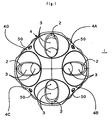
- the assembly is a sphere or spherical body (1) (Fig. 1), composed of or subdivided into eight triangular spherical caps of 90o base (4); that between each two caps (4) is provided an oblong window or groove (2), through which we see a set of balls (3) housed inside.
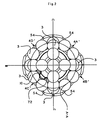
- the windows (2) are arranged equidistantly or aligned along the three orthogonally perpendicular axes of the sphere, coinciding with the arrangement of the balls which are represented in FIG. 2 and referenced under A, B and C.
- the general spherical body or sphere (1) comprising the caps (4) is composed, as a graphic representation, of the caps 4A, 4B, 4C and 4D in a hemisphere or hemisphere (Fig. 1) and of the caps 4A ' , 4B ', 4C' and 4D 'in the other (Fig. 2).
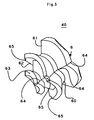
- Each spherical cap (4) consists of two parts: an outer part (5) and an inner part (40-41) (Fig. 4, 5 and 6).
- the outer part (5) (Fig. 4) has its eight equal caps (4), while the inner part (40) (Fig. 6) has seven of its equal parts and one uneven part (41) (Fig. 7 ) which is the fragment or centerpiece.
- the outer parts (5) are connected by a male end and interlocking assembly (Fig. 5 and 6A) coaxial, by means of the tubular rod (51) of the part (5), the inner parts (40-41) coming being housed in a hole or axial bore (66) and being connected, for example, by means of a screw (53) which passes through the hole (52) of the rod (51) and fixed on the nut, the ring, sleeve or other (67) of the hole or bore (66) which has access from the outside through the mouth or opening (50) of the caps (5).
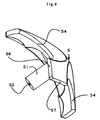
- the cap 5 (Fig. 4) is 1 / 8th of the carcass or spherical envelope of the assembly (1). It is a spherical cap in an equilateral triangle ending in four points, (55) with double facet (56) (57) or angular points adapting respectively to the rest of the parts (5) which make up the spherical body (1), while the sides or catheters are formed by concave notches (54) in the form of a lowered arch (or in basket handle) which, associated with two two, form the windows or grooves (2) of the spherical body (1).
- the internal part (40-41) of the parts (4) is a prismatic pyramidal trihedral body having a head (6), (7) respectively for coupling the external part (5), and comprising three parallel planes (61, 62, 63 and 71, 72, 73) respectively, with the surfaces or areas proportionally decreasing downwards and with a profile similar to the outer sphero-triangular cap (5) and, by combining the eight pyramidal fragments (40-41), we forms the corridors (60-70), (64-74) and another, orthogonally opposite to the latter, for guiding or channeling the balls or balls (3), according to formation A, B and C of FIG. 2.
- notches or notches (65-75) to facilitate the passage of the retaining means or fixing (Fig. 5 and 6) on a core equi-concentric (Fig. 8) on which the spherical body (1) turns or pivots according to the movement of its two hemispheres, in the same arrangement of axes A, B and C (Fig. 2).
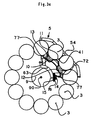
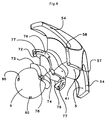
- the uneven fragment or centerpiece (41) (Fig. 8) is characterized in that it comprises, in the intermediate plane (72), notches (76) cut out in the center of its catheters for the passage of a stop or cleat (10) (Fig. 3A and 26) which is mounted on fine perforations (77) adjacent to said notch (76) to establish stops elastic in the corridors (60-70), (64-74) and another not referenced, to limit or avoid the accidental displacement, or the mad displacement, of the balls or balls (3) according to their three positions A, B and C (Fig. 2).
- Said fragment or centerpiece (41) also differs in that the smallest lower plane or base (73) is slightly larger than the bases (63) of the other seven fragments (40), that it has a slight negative tolerance , at least with regard to the surface or area of the base (73), that open vertical holes (78) have also been drilled at its apices for the passage of the retaining means or fixing (FIG. 3A, 27, 28, 29) which fix this part (41) on the equi-concentric core (Fig. 3A), while the other seven equal fragments (40) are retained but free to be able to turn or pivot on the equi-concentric core (Fig 3) and around said fragment or centerpiece (41) which acts as an eccentric pivot.
- the smallest lower plane or base (73) is slightly larger than the bases (63) of the other seven fragments (40), that it has a slight negative tolerance , at least with regard to the surface or area of the base (73), that open vertical holes (78) have also been drilled at its apices for the passage of the retaining means or fixing (FI
- the stops or cleats (10) are springs made of a thin elastic rod which, according to a preferred embodiment of the invention, is provided with a high loop in the shape of an "omega" ( 11) in the center of a "u" fork, the branches (12) (13) of which are pressurized into the orifices (77) adjacent to the notches (76) and through which the loops (11) pass to form the stops or tabs intended to prevent the mad sliding of the balls (3) (Fig. 3A).
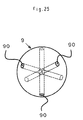
- the seven equal pyramidal fragments (40) and the unequal fragment or centerpiece (41) are mounted on a spherical equi-concentric core (9) (Fig. 3, 3A, 8 and 25) to the volume proportionally appropriate to the whole of the sphere (1) and provided for this purpose with six threaded or duly fitted holes (90) for the retaining means or fixing (Fig. 3A, 27, 28 and 29) and arranged orthogonally (two by two) along three axes coinciding with A, B and C (Fig. 2).
- the retaining or fixing means are composed of a set comprising a rod (14), a screw preferably provided with a washer (15) and a damping spider (16) interposed between this last and the head of (14).
- Each set (14, 15, 16) retains the four vertices coinciding with the point (90) of the bases (63-73) so that the three points of the base (73) are immobilized thanks to the holes or bores (78) where are housed the rods (14) and that the remaining bases (63) can rotate or pivot freely on the core (9) and around the master fragment (41).
- the spherical assembly (1) assembled and mounted as described on the spherical and equi-concentric core (9), admits that the seven identical fragments (40) can rotate or pivot on the core (9) and around the master fragment (41) which acts as an eccentric pivot.
- the movement takes place externally and normally on the body of the sphere (1) so that the two spherical half-halves of said body can be rotated in blocks in the three directions determined by the orthogonal position of the balls ( 3), along axes A, B and C of Figure 2, since the independence of the eight parts (4), composed of the association and assembly of seven (5 and 40) and one (5 and 41) , admits the rotation by combining, four by four (4A, 4B, 4C and 4D) or their antagonists (4A ', 4B', 4C 'and 4D') of said parts in any one of the three above-mentioned orthogonal positions A, B and C (Fig. 2).
- the rotation of the hemispheres or hemispheres (4A, 4B, 4C and 4D or their antagonics) sets in motion the balls or balls (3) housed in the corridor or channel of the axis, A, B or C respectively, their displacement can be seen through windows (2) through which they cannot escape and / or even if the body (1) of the sphere was transparent.
- the alternation correlation combination, etc ... of said balls or balls (3) must be obtained thanks to the address, in the mathematical sense or the intuition, the speed or the mobility of the user, by guiding or making them route through the different corridors A, B, C by rotating the hemispheres or hemispheres (4A, 4B, 4C and 4D or antagonistic) by any of the three orthogonal axes A, B, C where the balls are arranged or balls and, physically, by the channels or corridors (60-70) (64-74) and the third not referenced from being hidden in the drawings.
- the elastic stops or stops (10) located in each lane A, B, C, on the master fragment (41) make it possible to avoid the crazy rotation of the balls or balls (3) by forcing this that their combination is effected by the handling of the hemispheres (4A, 4B, 4C and 4D or antagonistic) but by admitting that the elasticity of the loop (11) yields under a certain pressure exerted on the balls or balls in order to move them expressly, either to establish an order at the start of game, either to require a certain degree of difficulty or for any other claim or function that is required spontaneously and calculated.
Landscapes
- Engineering & Computer Science (AREA)
- Multimedia (AREA)
- Toys (AREA)
Applications Claiming Priority (1)
| Application Number | Priority Date | Filing Date | Title |
|---|---|---|---|
| PCT/ES1992/000066 WO1994004235A1 (es) | 1992-08-13 | 1992-08-13 | Aparato recreativo didactico de habilidad |
Publications (1)
| Publication Number | Publication Date |
|---|---|
| EP0607437A1 true EP0607437A1 (de) | 1994-07-27 |
Family
ID=8275736
Family Applications (1)
| Application Number | Title | Priority Date | Filing Date |
|---|---|---|---|
| EP92918614A Withdrawn EP0607437A1 (de) | 1992-08-13 | 1992-08-13 | Geschicklichkeit lehrende freizeitvorrichtung |
Country Status (4)
| Country | Link |
|---|---|
| EP (1) | EP0607437A1 (de) |
| JP (1) | JPH08500749A (de) |
| AU (1) | AU2493892A (de) |
| WO (1) | WO1994004235A1 (de) |
Cited By (1)
| Publication number | Priority date | Publication date | Assignee | Title |
|---|---|---|---|---|
| EP0882479A1 (de) * | 1997-06-02 | 1998-12-09 | Francisco Josa Patermann | Didaktisches Geschicklichkeitsspiel oder Miniaturornament mit mehrfachen Kombinationen |
Families Citing this family (2)
| Publication number | Priority date | Publication date | Assignee | Title |
|---|---|---|---|---|
| US5779238A (en) * | 1996-10-02 | 1998-07-14 | Josa-Patermann; Francisco | Recreational didactic multicombinable device |
| US7963278B2 (en) * | 2008-11-25 | 2011-06-21 | Makowski Gary G | Apparatus for deploying a bola |
Family Cites Families (4)
| Publication number | Priority date | Publication date | Assignee | Title |
|---|---|---|---|---|
| HU181966B (en) * | 1980-07-05 | 1983-11-28 | Generalimpex Magyar Kulkereske | Symbol variation toy |
| EP0062395A1 (de) * | 1981-05-01 | 1982-10-13 | Christopher Charles Wiggs | Perlen-Puzzle |
| US4415158A (en) * | 1981-09-21 | 1983-11-15 | General Symmetrics, Inc. | Puzzle |
| US5074562A (en) * | 1991-05-14 | 1991-12-24 | Green Daniel E | Spherical mechanical puzzle |
-
1992
- 1992-08-13 EP EP92918614A patent/EP0607437A1/de not_active Withdrawn
- 1992-08-13 JP JP6505928A patent/JPH08500749A/ja active Pending
- 1992-08-13 AU AU24938/92A patent/AU2493892A/en not_active Abandoned
- 1992-08-13 WO PCT/ES1992/000066 patent/WO1994004235A1/es not_active Ceased
Non-Patent Citations (1)
| Title |
|---|
| See references of WO9404235A1 * |
Cited By (3)
| Publication number | Priority date | Publication date | Assignee | Title |
|---|---|---|---|---|
| US6027116A (en) * | 1997-02-06 | 2000-02-22 | National Project S.A. | Didactic skill-developing, multi-combinable miniature toy or ornament |
| EP0882479A1 (de) * | 1997-06-02 | 1998-12-09 | Francisco Josa Patermann | Didaktisches Geschicklichkeitsspiel oder Miniaturornament mit mehrfachen Kombinationen |
| ES2134139A1 (es) * | 1997-06-02 | 1999-09-16 | Nat Project Sa | Juguete o adorno en miniatura multicombinable, didactico de habilidad. |
Also Published As
| Publication number | Publication date |
|---|---|
| JPH08500749A (ja) | 1996-01-30 |
| AU2493892A (en) | 1994-03-15 |
| WO1994004235A1 (es) | 1994-03-03 |
Similar Documents
| Publication | Publication Date | Title |
|---|---|---|
| US7963500B1 (en) | Snowman mold | |
| US4758196A (en) | Block unit for making three-dimensional blocks composed of geometric points, lines and planes | |
| US6244597B1 (en) | Logical ball-shaped toy with broken surface including rotated and permutated elements | |
| FR2492675A1 (fr) | Jouet logique a trois dimensions | |
| EP0408450A1 (de) | Zelt mit einem Bogenrahmen | |
| EP0661087A2 (de) | Bauspielzeug | |
| KR101773024B1 (ko) | 컨넥터 및 그를 포함하는 조립 완구 세트 | |
| US7547020B1 (en) | Three dimensional toy having multi-shaped interlocking members which have a spring mechanism inside a cylindrical threaded shaft for interlocking one member to another member | |
| US4214808A (en) | Kaleidoscopic mobile | |
| FR2519559A1 (de) | ||
| FR2477027A1 (fr) | Jeu logique cylindrique | |
| EP0882479B1 (de) | Didaktisches Geschicklichkeitsspiel oder Miniaturornament mit mehrfachen Kombinationen | |
| EP0607437A1 (de) | Geschicklichkeit lehrende freizeitvorrichtung | |
| EP0882479A2 (de) | Didaktisches Geschicklichkeitsspiel oder Miniaturornament mit mehrfachen Kombinationen | |
| FR2494353A1 (fr) | Dispositif d'assemblage de panneaux et/ou de tiges | |
| FR2491346A1 (de) | ||
| FR2614210A1 (fr) | Structure constituee de modules polyedriques articules avec moyens de maintien en forme utilisable notamment comme jeu. | |
| FR2656361A1 (fr) | Mur a geometrie variable. | |
| WO2015126322A1 (en) | Building block | |
| JP2003176600A (ja) | 立体フレーム | |
| DE2748677A1 (de) | Bauelement zum aufbau von spielgeraeten fuer kinder | |
| EP0157993A1 (de) | Netzartige und räumliche Konstruktion mit Stabelementen | |
| FR2706783A1 (en) | Assembly comprising polyhedral movable elements and a support which can be used as a game and decorative element | |
| EP0076824A1 (de) | Logisches spielzeug mit gegenüber einander und gegenüber dem kern bewegbaren einheiten | |
| EP0712649B1 (de) | Didaktisches Geschicklichkeitsspiel mit mehrfachen Kombinationen |
Legal Events
| Date | Code | Title | Description |
|---|---|---|---|
| PUAI | Public reference made under article 153(3) epc to a published international application that has entered the european phase |
Free format text: ORIGINAL CODE: 0009012 |
|
| AK | Designated contracting states |
Kind code of ref document: A1 Designated state(s): AT BE CH DE DK ES FR GB GR IE IT LI LU MC NL SE |
|
| 17P | Request for examination filed |
Effective date: 19940831 |
|
| 17Q | First examination report despatched |
Effective date: 19940522 |
|
| 18W | Application withdrawn |
Withdrawal date: 19950908 |