EP0607470A1 - Benne de forage à évacuation automatique - Google Patents
Benne de forage à évacuation automatique Download PDFInfo
- Publication number
- EP0607470A1 EP0607470A1 EP93100232A EP93100232A EP0607470A1 EP 0607470 A1 EP0607470 A1 EP 0607470A1 EP 93100232 A EP93100232 A EP 93100232A EP 93100232 A EP93100232 A EP 93100232A EP 0607470 A1 EP0607470 A1 EP 0607470A1
- Authority
- EP
- European Patent Office
- Prior art keywords
- drive shaft
- blade member
- main body
- shaft member
- arm
- Prior art date
- Legal status (The legal status is an assumption and is not a legal conclusion. Google has not performed a legal analysis and makes no representation as to the accuracy of the status listed.)
- Granted
Links
- 238000005553 drilling Methods 0.000 title claims abstract description 18
- 230000007704 transition Effects 0.000 claims abstract description 9
- 239000004576 sand Substances 0.000 description 10
- 238000000034 method Methods 0.000 description 4
- 238000009412 basement excavation Methods 0.000 description 2
- 230000002093 peripheral effect Effects 0.000 description 2
- 239000012634 fragment Substances 0.000 description 1
Images




Classifications
-
- E—FIXED CONSTRUCTIONS
- E21—EARTH OR ROCK DRILLING; MINING
- E21B—EARTH OR ROCK DRILLING; OBTAINING OIL, GAS, WATER, SOLUBLE OR MELTABLE MATERIALS OR A SLURRY OF MINERALS FROM WELLS
- E21B10/00—Drill bits
- E21B10/42—Rotary drag type drill bits with teeth, blades or like cutting elements, e.g. fork-type bits, fish tail bits
-
- E—FIXED CONSTRUCTIONS
- E21—EARTH OR ROCK DRILLING; MINING
- E21B—EARTH OR ROCK DRILLING; OBTAINING OIL, GAS, WATER, SOLUBLE OR MELTABLE MATERIALS OR A SLURRY OF MINERALS FROM WELLS
- E21B27/00—Containers for collecting or depositing substances in boreholes or wells, e.g. bailers, baskets or buckets for collecting mud or sand; Drill bits with means for collecting substances, e.g. valve drill bits
-
- Y—GENERAL TAGGING OF NEW TECHNOLOGICAL DEVELOPMENTS; GENERAL TAGGING OF CROSS-SECTIONAL TECHNOLOGIES SPANNING OVER SEVERAL SECTIONS OF THE IPC; TECHNICAL SUBJECTS COVERED BY FORMER USPC CROSS-REFERENCE ART COLLECTIONS [XRACs] AND DIGESTS
- Y10—TECHNICAL SUBJECTS COVERED BY FORMER USPC
- Y10S—TECHNICAL SUBJECTS COVERED BY FORMER USPC CROSS-REFERENCE ART COLLECTIONS [XRACs] AND DIGESTS
- Y10S37/00—Excavating
- Y10S37/901—Bucket cleaners
Definitions
- the present invention relates generally to a drilling bucket for excavating the ground on the earth drill method or the like and, more particularly, to an automatic evacuation drilling bucket which can automatically evacuate earth and sand received therein.
- the earth drill method is well known, which is one of methods of substructure work wherein a drilling bucket is used to excavate the ground so as to form a hole, earth and sand due to excavation being received therein for evacuation on the ground.
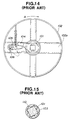
- Figs. 13-15 show one of drilling buckets for use in the earth drill method which is disclosed, for example, in JP-B2 2-59917.
- a drive shaft member designated generally by reference numeral 101, is connected to a kelly-bar (not shown), and splined to a follower 103 arranged to a support frame portion 102a of a bucket main body 102.
- an operating arm 104 is arranged to the drive shaft member 101, whereas an osculating arm 105 is disposed opposite to the operating arm 104 to be capable of coming in contact therewith, and it is integrally formed with an operating shaft 106 arranged to the bucket main body 102.
- a stop 107 Arranged to the operating shaft 106 at its lower end is a stop 107 which is detachably engaged with a receiver 109 of a bottom cover 108 which is mounted to the bucket main body 102 in a manner to be capable of opening and closing operation.
- the operating arm 104 is rotated from the position as indicated by a fully drawn line to the position as indicated by a one-dotted chain line in Fig. 14, thus rotating the osculating arm 105.
- the operating shaft 106 is rotated, so that the stop 107 is disengaged with the receiver 109 to open the bottom cover 108, evacuating earth and sand within the bucket main body 102.
- the drive shaft member 101 is rotated by the kelly-bar in the direction of arrow A in Fig. 14 for quick stoppage, the same operation is made, evacuating earth and sand within the bucket main body 101.
- the drive shaft member 101 when the drive shaft member 101 is rotated in the normal direction to excavate the ground, the operating arm 104 fails to come in contact with the osculating arm 105, so that the operating shaft 106 is not rotated to open the bottom cover 108.
- the drive shaft member 101 becomes incapable of rotation by encountering in the ground obstacles such as a big rubble, a driftwood, an old pile, a concrete fragment, or that the bucket main body 102 is locked in the hole as excavate by a wall thereof which overhangs the bucket main body 102 due to a soft bed, the drive shaft member 101 may be obliged to rotate in the reverse direction.
- the operating arm 104 comes in contact with the osculating arm 105 to rotate the operating shaft 106, opening the bottom cover. 108. If the bottom cover 108 is opened in the hole as excavated, it functions as an anchor, resulting in difficult lifting of the bucket main body 102 from the hole.
- an object of the present invention to provide an automatic evacuation drilling bucket wherein a bottom cover fails to be opened even when a drive shaft member is rotated in the reverse direction, or with a bucket being suspended.
- a drilling bucket including a drive shaft member for receiving a torque from a kelly-bar and a main body mounted to the drive shaft member and having a bottom cover, the drive shaft member being rotatable in a normal direction and a reverse direction, comprising: a blade member fixedly mounted to the drive shaft member for rotating together; a follower disposed to the main body, said follower being formed with a space for receiving said blade member; an arm rotatably mounted to the main body, said arm being capable of coming in contact with said blade member to open the bottom cover of the main body; first means for allowing an engagement of said blade member with said follower when the drive shaft member is rotated in the normal direction and the reverse direction; and second means for allowing a contact of said blade member with said arm when the drive shaft member is rotated in the reverse direction.
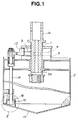
- a drive shaft member designated generally by reference numeral 1
- a socket 1a with which a substantially square section kelly-bar (not shown) is engaged.
- the drive shaft member 1 is fitted in a mounting hole 2a formed in the center of an upper side of a bucket main body 2.
- a pair of blade members 3, 4 are fixed to the drive shaft member 1 in the center of its peripheral wall.
- a follower 5 fixed to the bucket main body 2 in the center of its upper side is a follower 5 in which the drive shaft member 1 is rotatably and slidably fitted.
- the follower 5 is formed with a pair of working spaces 6, 7 wherein the pair of blade members 3, 4 are located, respectively.
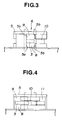
- the working space 6 has a lower compartment 8 in its lower portion to obtain engagement of the blade member 3 with the follower 5 when the blade member 3 is urged to move downward.
- the blade member 3 located in the lower compartment 8 is constructed to come in contact with first and second stopper walls 5a, 5b.
- the blade member 3 when pulling up the drive shaft member 1, the blade member 3 is urged to move upward.
- the working space 6 has an upper compartment 9 in its upper portion to obtain engagement of the blade member 3 with the follower 5 when the blade member 3 is urged to move upward.
- the blade member 3 When locating in the upper compartment 9, the blade member 3 also comes in contact with the first or second stopper wall 5a, 5b, so that the drive shaft member 1 makes the follower 5 rotate in the normal or reverse direction in the same manner.
- a transition compartment 10 for allowing the blade member 3 to move in the working space 6 in the direction opposite to that of arrow B in Fig. 2.
- the working space 6 has a receiving compartment (third compartment) 11 corresponding to the direction of this movement.
- the working space 7 has its lower compartment, upper compartment, transition compartment, and receiving compartment.
- an osculating arm 13 is disposed on the side of the receiving compartment 11 of the working space 6 to be opposite to the blade member 3, so that when moving into the receiving compartment 11 through the transition compartment 10, an end portion of the blade member 3 protruding from an outer peripheral wall of the follower 5 comes in contact with the osculating arm 13. Since the osculating arm 13 has a thick end portion, the blade member 3 can come in contact with the osculating arm 13 no matter which position the blade member 3 occupies in the receiving compartment 11.
- the osculating arm 13 is fixed to an operating shaft 14 rotatably supported to the bucket main body 2 at its marginal portion. It is to be noted that the osculating arm 13 always undergoes counterclockwise biasing force.
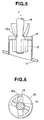
- a stop 15 mounted to the operating shaft 14 at its lower end is a stop 15 which is engaged with a stop hole 16a of a receiver 16 as shown in Figs. 6, 7a and 7b.
- the receiver 16 includes a twisted guide portion 16b, and it is arranged to a bottom cover 17 mounted to the bucket main body 2 at its bottom in a manner to be capable of opening and closing operation.
- the operating shaft 14, stop 15, and receiver 17 constitute a lock mechanism for locking the bottom cover 17 to the bucket main body 2. With rotation of the operating arm 14, the stop 15 is disengaged with the receiver 16, allowing the bottom cover 17 to open.
- the drive shaft member 1 When the drive shaft member 1 is pressed down by the kelly-bar to drill a hole in the ground, it slides in the follower 5, so that the blade member 3 is urged to move into the lower compartment 8 of the working space 6 as indicated by a fully drawn line in Fig. 8, engaging with the follower 5. With rotation of the drive shaft member 1 in the normal direction, the bucket main body 2 is rotated in the normal direction, so that earth and sand are excavated and received within the bucket main body 2. If, during excavation, the bucket main body 2 becomes incapable of rotation by encountering obstacles in the ground, it is preferable to rotate the bucket main body 2 in the reverse direction. This reverse rotation is possible since the blade member 3 is engaged with the follower 5 as described above. In that case, the blade member 3 is located in the lower compartment 8, and is not urged to move into the receiving compartment 11 through the transition compartment 10, so that it fails to rotate the osculating arm 13, keeping the bottom cover 17 locked.
- the drive shaft member 1 When the bucket main body 2 becomes full of earth and sand as excavated, the drive shaft member 1 is pulled up to lift the bucket main body 2 from the hole for evacuation. Then, the blade member 3 is urged to move into the upper compartment 9 as indicated by a one-dotted chain line in Fig. 8, engaging with the follower 5 likewise.
- the bucket main body 2 may be locked in the hole by a wall thereof which overhangs the bucket main body 2 due to a soft bed. Under these conditions, it is preferable to rotate the drive shaft member 1 in the normal and reverse directions for release from this lock state. In that case also, the blade member 3 fails to rotate the osculating arm 13, keeping the bottom cover 17 locked.
- the bucket main body 2 is softly landed on the ground or a bed of a dump truck.
- the blade member 3 is urged to move from the lower compartment 8 to the receiving compartment 11 through the transition compartment 10 as indicated by a two-dotted chain line in Fig. 8.
- the blade member 3 comes in contact with the osculating arm 13 to rotate it clockwise as viewed in Fig. 2.
- the stop 15 is disengaged with the receiver 16 through the operating shaft 14, releasing a lock state of the bottom cover 17.
- the bottom cover 17 is opened to evacuate earth and sand within the bucket main body 2.
- the bucket main body 2 When closing the bottom cover 17, the bucket main body 2 is softly landed on the ground or the bed of the dump truck. This moves the blade member 3 from a position as indicated by a broken line in Fig. 8 to a position as indicated by the two-dotted chain line in Fig. 8. Subsequently, when the drive shaft member 1 is rotated rightward, the blade member 3 is urged to move in the direction of the upper and lower compartments 9, 8 through the transition compartment 10. Thus, as shown in Figs. 1 and 2, the osculating arm 3 is returned by a spring 19 to a position as indicated by a fully drawn line in Fig. 2 from a position as indicated by a two-dotted line in Fig. 2, and the stop 15 is engaged with the receiver 16 to lock the bottom cover 17.
- the stop 15 is not rotated even though the blade member 3 is urged to move in the aforementioned direction, obtaining no lock of the bottom cover 17. Therefore, when suspending the bucket main body 2, the bottom cover 17 is opened. In that case, the bucket main body 2 is landed again on the ground or the bed of the dump truck to rotate the stop 15 up to a position of the stop hole 16a of the receiver 16 along a bevel of the guide portion 16b (see Figs. 7a and 7b), obtaining lock of the bottom cover 17.
- the bucket main body 2 is lifted to open the bottom cover 17.
- the stop 15 is held in its engagement position by a spring, so that without the guide portion 16b, soft landing of the bucket main body 2 fails to allow engagement of the stop 15 with the receiver 16, i.e., lock of the bottom cover 17, due to a positional difference between the stop 15 and the stop hole 16a of the receiver 16.
- the blade member 3 should be urged to move in the direction opposite to the aforementioned direction, and softly landed again, resulting in a complicated operation.
- a positional adjustment of the stop 15 by rotating the blade member 3 is unnecessary, resulting in a simple operation.
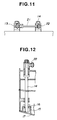
- FIG. 9-12 there is shown a second preferred embodiment of an automatic evacuation drilling bucket.
- the second preferred embodiment is substantially similar to the first preferred embodiment except that the bucket main body 2 is large in size. Since the lock mechanism for locking the bottom cover 17 to bucket main body 12 is disposed also, preferably, at the marginal portion of the bottom cover 17, the osculating arm 13 is connected to the operating shaft 14 by a connecting rod 21 and an auxiliary arm 22.
Landscapes
- Engineering & Computer Science (AREA)
- Life Sciences & Earth Sciences (AREA)
- Geology (AREA)
- Mining & Mineral Resources (AREA)
- Physics & Mathematics (AREA)
- Environmental & Geological Engineering (AREA)
- Fluid Mechanics (AREA)
- General Life Sciences & Earth Sciences (AREA)
- Geochemistry & Mineralogy (AREA)
- Mechanical Engineering (AREA)
- Earth Drilling (AREA)
Priority Applications (3)
| Application Number | Priority Date | Filing Date | Title |
|---|---|---|---|
| US07/998,846 US5234062A (en) | 1992-12-30 | 1992-12-30 | Automatic evacuation drilling bucket |
| EP93100232A EP0607470B1 (fr) | 1992-12-30 | 1993-01-08 | Benne de forage à évacuation automatique |
| DE1993600101 DE69300101T2 (de) | 1993-01-08 | 1993-01-08 | Bohrgreifer mit automatischer Abfuhr. |
Applications Claiming Priority (2)
| Application Number | Priority Date | Filing Date | Title |
|---|---|---|---|
| US07/998,846 US5234062A (en) | 1992-12-30 | 1992-12-30 | Automatic evacuation drilling bucket |
| EP93100232A EP0607470B1 (fr) | 1992-12-30 | 1993-01-08 | Benne de forage à évacuation automatique |
Publications (2)
| Publication Number | Publication Date |
|---|---|
| EP0607470A1 true EP0607470A1 (fr) | 1994-07-27 |
| EP0607470B1 EP0607470B1 (fr) | 1995-04-05 |
Family
ID=26133041
Family Applications (1)
| Application Number | Title | Priority Date | Filing Date |
|---|---|---|---|
| EP93100232A Expired - Lifetime EP0607470B1 (fr) | 1992-12-30 | 1993-01-08 | Benne de forage à évacuation automatique |
Country Status (2)
| Country | Link |
|---|---|
| US (1) | US5234062A (fr) |
| EP (1) | EP0607470B1 (fr) |
Cited By (1)
| Publication number | Priority date | Publication date | Assignee | Title |
|---|---|---|---|---|
| GB2373801A (en) * | 2001-03-29 | 2002-10-02 | Cementation Found Skanska Ltd | Pile boring tools |
Families Citing this family (5)
| Publication number | Priority date | Publication date | Assignee | Title |
|---|---|---|---|---|
| US7704342B2 (en) * | 2001-12-27 | 2010-04-27 | Solutia, Inc. | Glass lamination process |
| CN102168528B (zh) * | 2011-04-25 | 2013-07-10 | 山河智能装备股份有限公司 | 连贯打开斗门并强制卸土的钻斗 |
| CN102287140A (zh) * | 2011-05-21 | 2011-12-21 | 山河智能装备股份有限公司 | 一种强制卸土钻斗 |
| US8615906B2 (en) | 2012-04-16 | 2013-12-31 | Pengo Corporation | Drilling bucket |
| JP6387503B2 (ja) * | 2014-05-28 | 2018-09-12 | システム計測株式会社 | バケット装置 |
Citations (7)
| Publication number | Priority date | Publication date | Assignee | Title |
|---|---|---|---|---|
| US1665365A (en) * | 1926-04-26 | 1928-04-10 | Raymond Concrete Pile Co | Apparatus for forming molds for columns with bases |
| US1787001A (en) * | 1927-08-26 | 1930-12-30 | Raymond Concrete Pile Co | Excavating apparatus |
| US1916688A (en) * | 1932-03-03 | 1933-07-04 | Raymond Concrete Pile Co | Earth boring apparatus |
| US2879974A (en) * | 1956-03-12 | 1959-03-31 | Frankignoul Pieux Armes | Grab-type tool for sinking wells in the ground |
| US2997797A (en) * | 1960-07-29 | 1961-08-29 | James A Archer | Dredging bucket |
| FR2165181A5 (fr) * | 1971-12-21 | 1973-08-03 | Bourlier Jacques | |
| JPS61294086A (ja) * | 1985-06-19 | 1986-12-24 | 井上 八郎 | 自動排土ドリリングバケツト |
Family Cites Families (9)
| Publication number | Priority date | Publication date | Assignee | Title |
|---|---|---|---|---|
| US1713037A (en) * | 1927-11-08 | 1929-05-14 | Harry E Ellis | Cutter head for pumps |
| US3185226A (en) * | 1959-03-17 | 1965-05-25 | Robbins Richard James | Shaft sinking apparatus |
| CH540839A (de) * | 1972-03-24 | 1973-08-31 | Alusuisse | Saugförderer für Schüttgut mit Saugkopf und Zuteilvorrichtung |
| US4307525A (en) * | 1979-08-16 | 1981-12-29 | Amtec Development Company | Pneumatic-hydraulic pump dredge |
| DE3114612C2 (de) * | 1981-04-07 | 1983-11-10 | Hochstrasser, Jürgen, 6600 Saarbrücken | Bohrvorrichtung für Hartgestein |
| SU1247522A1 (ru) * | 1985-02-25 | 1986-07-30 | Goj Vladimir L | Устройство дл отбора проб грунта |
| JPH0259917A (ja) * | 1988-08-26 | 1990-02-28 | Nec Corp | 初期化回路 |
| US4945661A (en) * | 1988-11-29 | 1990-08-07 | Ube Industries, Ltd. | Dredging apparatus |
| US4971163A (en) * | 1989-09-12 | 1990-11-20 | Kabushiki Kaisha Konoike Gumi | Drilling bucket apparatus for cast-in-place piles with expanded bottoms |
-
1992
- 1992-12-30 US US07/998,846 patent/US5234062A/en not_active Expired - Fee Related
-
1993
- 1993-01-08 EP EP93100232A patent/EP0607470B1/fr not_active Expired - Lifetime
Patent Citations (7)
| Publication number | Priority date | Publication date | Assignee | Title |
|---|---|---|---|---|
| US1665365A (en) * | 1926-04-26 | 1928-04-10 | Raymond Concrete Pile Co | Apparatus for forming molds for columns with bases |
| US1787001A (en) * | 1927-08-26 | 1930-12-30 | Raymond Concrete Pile Co | Excavating apparatus |
| US1916688A (en) * | 1932-03-03 | 1933-07-04 | Raymond Concrete Pile Co | Earth boring apparatus |
| US2879974A (en) * | 1956-03-12 | 1959-03-31 | Frankignoul Pieux Armes | Grab-type tool for sinking wells in the ground |
| US2997797A (en) * | 1960-07-29 | 1961-08-29 | James A Archer | Dredging bucket |
| FR2165181A5 (fr) * | 1971-12-21 | 1973-08-03 | Bourlier Jacques | |
| JPS61294086A (ja) * | 1985-06-19 | 1986-12-24 | 井上 八郎 | 自動排土ドリリングバケツト |
Cited By (3)
| Publication number | Priority date | Publication date | Assignee | Title |
|---|---|---|---|---|
| GB2373801A (en) * | 2001-03-29 | 2002-10-02 | Cementation Found Skanska Ltd | Pile boring tools |
| US6739412B2 (en) | 2001-03-29 | 2004-05-25 | Cementation Foundations Skanska Limited | Pile boring tools |
| GB2373801B (en) * | 2001-03-29 | 2005-02-16 | Cementation Found Skanska Ltd | Pile boring tools |
Also Published As
| Publication number | Publication date |
|---|---|
| EP0607470B1 (fr) | 1995-04-05 |
| US5234062A (en) | 1993-08-10 |
Similar Documents
| Publication | Publication Date | Title |
|---|---|---|
| US3077999A (en) | Multi-purpose loader bucket | |
| US5367796A (en) | Multitote carrier for excavator | |
| US5234062A (en) | Automatic evacuation drilling bucket | |
| DE19717567A1 (de) | Tagebauschaufelbagger | |
| US4635386A (en) | Paved asphalt stripping and digging bucket apparatus | |
| KR100539630B1 (ko) | 어스 드릴용 굴삭기구 | |
| CA2240872A1 (fr) | Verrouillage de la fleche d'une pelle retrocaveuse | |
| US4370090A (en) | Boom lock | |
| GB2051735A (en) | Locking earth working implrments for transport | |
| JPH0364654B2 (fr) | ||
| US2491793A (en) | Trench digger | |
| JP3225878U (ja) | 穴掘削用排土バケット | |
| JP2530905B2 (ja) | 掘削ビットの礫破砕装置 | |
| JPH0579268A (ja) | 自動排土ドリリングバケツト | |
| JPH0426554Y2 (fr) | ||
| JP3230183B2 (ja) | 省力型深掘用ショベル | |
| JP2592076B2 (ja) | 掘削機のグリッパ駆動装置 | |
| JP2003090192A (ja) | アースドリル用掘削バケット | |
| JPS632551Y2 (fr) | ||
| JPH09177114A (ja) | 土嚢製造装置 | |
| RU2093642C1 (ru) | Ковш экскаватора-драглайна | |
| JPH0724473Y2 (ja) | アースオーガ機 | |
| KR970000013Y1 (ko) | 크레인 트럭 부착용 굴착기 | |
| RU2107774C1 (ru) | Ковш экскаватора-драглайна | |
| JPS641637B2 (fr) |
Legal Events
| Date | Code | Title | Description |
|---|---|---|---|
| PUAI | Public reference made under article 153(3) epc to a published international application that has entered the european phase |
Free format text: ORIGINAL CODE: 0009012 |
|
| 17P | Request for examination filed |
Effective date: 19931015 |
|
| AK | Designated contracting states |
Kind code of ref document: A1 Designated state(s): DE FR GB IT NL |
|
| GRAA | (expected) grant |
Free format text: ORIGINAL CODE: 0009210 |
|
| AK | Designated contracting states |
Kind code of ref document: B1 Designated state(s): DE FR GB IT NL |
|
| REF | Corresponds to: |
Ref document number: 69300101 Country of ref document: DE Date of ref document: 19950511 |
|
| ITF | It: translation for a ep patent filed | ||
| ET | Fr: translation filed | ||
| PLBE | No opposition filed within time limit |
Free format text: ORIGINAL CODE: 0009261 |
|
| STAA | Information on the status of an ep patent application or granted ep patent |
Free format text: STATUS: NO OPPOSITION FILED WITHIN TIME LIMIT |
|
| 26N | No opposition filed | ||
| PGFP | Annual fee paid to national office [announced via postgrant information from national office to epo] |
Ref country code: NL Payment date: 19970124 Year of fee payment: 5 |
|
| PGFP | Annual fee paid to national office [announced via postgrant information from national office to epo] |
Ref country code: GB Payment date: 19971219 Year of fee payment: 6 |
|
| PGFP | Annual fee paid to national office [announced via postgrant information from national office to epo] |
Ref country code: FR Payment date: 19980119 Year of fee payment: 6 |
|
| PGFP | Annual fee paid to national office [announced via postgrant information from national office to epo] |
Ref country code: DE Payment date: 19980225 Year of fee payment: 6 |
|
| PG25 | Lapsed in a contracting state [announced via postgrant information from national office to epo] |
Ref country code: GB Free format text: LAPSE BECAUSE OF NON-PAYMENT OF DUE FEES Effective date: 19990108 |
|
| PG25 | Lapsed in a contracting state [announced via postgrant information from national office to epo] |
Ref country code: NL Free format text: LAPSE BECAUSE OF NON-PAYMENT OF DUE FEES Effective date: 19990801 |
|
| GBPC | Gb: european patent ceased through non-payment of renewal fee |
Effective date: 19990108 |
|
| PG25 | Lapsed in a contracting state [announced via postgrant information from national office to epo] |
Ref country code: FR Free format text: LAPSE BECAUSE OF NON-PAYMENT OF DUE FEES Effective date: 19990930 |
|
| PG25 | Lapsed in a contracting state [announced via postgrant information from national office to epo] |
Ref country code: DE Free format text: LAPSE BECAUSE OF NON-PAYMENT OF DUE FEES Effective date: 19991103 |
|
| REG | Reference to a national code |
Ref country code: FR Ref legal event code: ST |
|
| PG25 | Lapsed in a contracting state [announced via postgrant information from national office to epo] |
Ref country code: IT Free format text: LAPSE BECAUSE OF NON-PAYMENT OF DUE FEES;WARNING: LAPSES OF ITALIAN PATENTS WITH EFFECTIVE DATE BEFORE 2007 MAY HAVE OCCURRED AT ANY TIME BEFORE 2007. THE CORRECT EFFECTIVE DATE MAY BE DIFFERENT FROM THE ONE RECORDED. Effective date: 20050108 |