EP0607747B1 - Méthode pour régler l'emplacement de la figure du tissu et un métier à tisser pour réaliser cette méthode - Google Patents
Méthode pour régler l'emplacement de la figure du tissu et un métier à tisser pour réaliser cette méthode Download PDFInfo
- Publication number
- EP0607747B1 EP0607747B1 EP19930810027 EP93810027A EP0607747B1 EP 0607747 B1 EP0607747 B1 EP 0607747B1 EP 19930810027 EP19930810027 EP 19930810027 EP 93810027 A EP93810027 A EP 93810027A EP 0607747 B1 EP0607747 B1 EP 0607747B1
- Authority
- EP
- European Patent Office
- Prior art keywords
- cloth
- warp
- run
- fell
- goods
- Prior art date
- Legal status (The legal status is an assumption and is not a legal conclusion. Google has not performed a legal analysis and makes no representation as to the accuracy of the status listed.)
- Expired - Lifetime
Links
- 239000004744 fabric Substances 0.000 title claims description 24
- 238000000034 method Methods 0.000 title claims description 21
- 230000001105 regulatory effect Effects 0.000 title claims description 6
- 238000009941 weaving Methods 0.000 title description 15
- 238000003780 insertion Methods 0.000 claims description 2
- 230000037431 insertion Effects 0.000 claims description 2
- 238000005259 measurement Methods 0.000 claims description 2
- 230000004075 alteration Effects 0.000 claims 3
- 235000014676 Phragmites communis Nutrition 0.000 description 4
- 230000006399 behavior Effects 0.000 description 4
- 210000000481 breast Anatomy 0.000 description 4
- 230000006978 adaptation Effects 0.000 description 2
- 238000010586 diagram Methods 0.000 description 1
- 238000006073 displacement reaction Methods 0.000 description 1
- 230000007704 transition Effects 0.000 description 1
- 230000001960 triggered effect Effects 0.000 description 1
Images


Classifications
-
- D—TEXTILES; PAPER
- D03—WEAVING
- D03D—WOVEN FABRICS; METHODS OF WEAVING; LOOMS
- D03D49/00—Details or constructional features not specially adapted for looms of a particular type
- D03D49/04—Control of the tension in warp or cloth
- D03D49/06—Warp let-off mechanisms
- D03D49/10—Driving the warp beam to let the warp off
-
- D—TEXTILES; PAPER
- D03—WEAVING
- D03D—WOVEN FABRICS; METHODS OF WEAVING; LOOMS
- D03D49/00—Details or constructional features not specially adapted for looms of a particular type
- D03D49/04—Control of the tension in warp or cloth
Definitions
- the present invention relates to a method for Regulation of the marginalization of goods with regard to Weaving shop position in a weaving machine and weaving machine for Execution of the procedure.
- EP-A-0 117 479 describes a method with which the warp tension values per revolution of the Main shaft measured, the average of the measured values is integrated and stored so that the weaving machine in the same condition as before the business interruption can be started.
- EP-A-0 208 366 discloses a method for Regulation of the edge of the goods, in which the Edge of goods position scanned by a sensor and the goods edge by means of a movable breast tree is adjusted. During operation, the Displacement of the goods edge and breast tree continuously sampled and the samples a controller forwarded, which the provision of the goods margin concerned. This is based on the assumption that the shift only from the chain and not from the fabric going out. This assumption is incorrect. Since both the Chain as well as the fabric have elastic property can be a misconduct with the warp or goods run interacting elements cannot be excluded.
- the invention as characterized in the claims is, the task solves a procedure of the beginning to create the type mentioned, in which the by the Misconduct with the warp or goods run interacting elements Edge shift in relation to the Reverse reed position during operation is continuously regulated.
- the free length of the warp or goods run and / or the measure of warp and / or delivery of goods and / or the Position at least one with the warp or goods run interacting element depending on the Main shaft position measured. This allows in advantageously the operating behavior of the weaving machine be included.
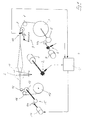
- the weaving machine contains one Main shaft 1 with a signal generator 2 for the Angular position of the main shaft, a warp beam 3, the a drive device 4 with chain 5 for the Warp let off and a signal generator 6 for the Warp let position, a support tree 7, a Spanning boom 8 with a clamping device 9, which is movable is arranged to keep the warp thread tension constant hold, and with a signal generator 10 for the position of Spannbaumes, a reed 11, a breast tree 12, one Switch tree 13 with a drive device 14 and one Goods circuit 15 to withdraw the goods, a Pressure roller 16 and a goods tree 17 to the goods wind up.
- control device 18 provided with the signal generator 2 for the angle of rotation the main shaft 1, the signal generator 6 for the Warp let-off position and the signal generator 10 for the Spanning tree position on the one hand and with the Drive device 14 of the switching tree 13 on the other hand connected is.
- FIG. 2 An embodiment of the control device is shown in FIG. 2 shown.
- the control device contains one Data memory 19, a program memory 20 and one Processor 21, which is connected to one another via data lines on the one hand and with an adaptation circuit 22 on the other hand are in operative connection.
- the Adaptation circuit 22 is in turn with the Signal generators 2, 6 and 10 and with the goods circuit 14 connected.
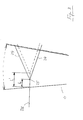
- FIG. 3 is a schematic representation of the Area of the weaving machine in which the actual Weaving takes place.
- Fig. 3 the reed 11 is in the retracted position Position with a dashed line and in the Reverse position shown with a solid line.
- the compartment formed by the warp threads 24 goes on Goods edge 25 into the goods 26 over.
- the distance L between the goods edge 25 and that in the reverse position Web reel 11 located represents the target value, the with the inventive method at issue here after is regulated.
- L ' which is the actual value represents the goods edge position.
- the length of the Edge shifting results from the relationship L-L '.
- the Angular position of the main shaft measured.
- the rotation the main shaft 1 is monitored.
- an angle of rotation of n ° e.g. 10 ° executed the length drained from the warp beam, the Position of the spanning tree 8 and on the goods tree wound length measured; being for every turn the main shaft the same number of measurements is provided.
- These measured values are actual values and are filed in the fi-fo memory 19. From a number of Shot entries including the last one Weft insertion becomes the average of the measured values determined, which is taken as target values. Through this The procedure will be advantageous Operating behavior of the loom to determine the Setpoints L1 and L2 taken into account.
- correction value for the chain side it is also possible to set the correction value for the chain side to calculate. In this case, the correction value for the warp let-off and / or the position of the tensioning boom calculated and then set accordingly.
- the procedure described is particularly useful if the weaving machine is back in operation after a standstill is taken. By determining the setpoint at running weaving machine can due to the calculation model Setting can be made very precisely. Will the Standstill triggered by a weft break, see above can be the setpoint related to the weft removed can be corrected without additional equipment.
Landscapes
- Engineering & Computer Science (AREA)
- Textile Engineering (AREA)
- Looms (AREA)
Claims (9)
- Procédé pour régler l'emplacement du bord de tissu relativement à la position du battant dans un métier à tisser, la position du bord de tissu étant commandée en modifiant la longueur libre des articles chaíne, l'emplacement du bord de tissu étant réglé d'une manière continue sur la base d'une comparaison des valeurs réelles et de consigne du déplacement du bord de tissu relativement à la position d'inversion de peigne pendant le fonctionnement, caractérisé en ce qu'on prend également en considération pour la comparaison des valeurs réelles et de consigne un modèle d'élasticité par lequel est calculé l'écart du bord du tissu à partir du rapport des modèles d'élasticité de la chaíne et du tissu.
- Procédé selon la revendication 1, caractérisé en ce que la longueur libre du passage de chaíne respectivement du tissu et/ou l'étendue de l'amenée de chaíne et/ou de tissu et/ou la position d'au moins un élément coopérant avec le passage de chaíne respectivement de tissu est mesurée en fonction de la position de l'arbre principal pour déterminer l'état réel du passage de chaíne respectivement de tissu.
- Procédé selon la revendication 2, caractérisé en ce que les valeurs de mesure sont balayées optiquement ou mécaniquement pour déterminer l'état réel du passage de chaíne respectivement de tissu.
- Procédé selon l'une des revendications 1 à 3, caractérisé en ce que les valeurs mesurées ou balayées sont stockées et que les valeurs moyennes sont calculées pour un nombre sélectif de duites pour déterminer l'état de consigne du passage de chaíne respectivement de tissu.
- Procédé selon la revendication 1, caractérisé en ce que le déplacement du bord du tissu, par une modification de la longueur déroulée de l'ensouple et/ou de la longueur enroulée sur l'ensouple de tissu est annulé.
- Procédé selon la revendication 1, caractérisé en ce que le déplacement du bord du tissu est annulé en modifiant la position d'au moins un élément coopérant avec le passage de chaíne respectivement de tissu, choisi dans le groupe comprenant l'ensouple de serrage, la poitrinière ou le cylindre oscillant, etc.
- Procédé selon l'une des revendication 1 à 6, caractérisé en ce que, lors de la survenue d'une fausse duite, le nombre des fils de trame éliminés est pris en considération comme facteur de correction.
- Procédé selon l'une des revendications 1 à 7, caractérisé en ce qu'est pris en considération en outre le changement d'armure lors de la détermination de la valeur moyenne.
- Métier à tisser, qui présente une ensouple (3), une ensouple de tissu (17), un autre élément (7, 8, 12, 13, 16) en liaison active avec le passage de chaíne respectivement de tissu, un dispositif pour déplacer l'élément et le passage de chaíne respectivement de tissu l'un relativement à l'autre et un dispositif de commande (18), caractérisé en ce que le dispositif de commande comporte des moyens pour régler l'emplacement du bord du tissu relativement à la position du battant selon un procédé des revendications 1-9.
Priority Applications (4)
| Application Number | Priority Date | Filing Date | Title |
|---|---|---|---|
| DE59309430T DE59309430D1 (de) | 1993-01-19 | 1993-01-19 | Verfahren zur Regelung der Warenrandstellung und Webmaschine zur Durchführung des Verfahrens |
| EP19930810027 EP0607747B1 (fr) | 1993-01-19 | 1993-01-19 | Méthode pour régler l'emplacement de la figure du tissu et un métier à tisser pour réaliser cette méthode |
| JP33093593A JP3542626B2 (ja) | 1993-01-19 | 1993-12-27 | 織布の織前の規制方法及びその方法を実施する織機 |
| US08/409,383 US5538048A (en) | 1993-01-19 | 1995-03-23 | System and method for regulating the cloth fell position in a loom |
Applications Claiming Priority (1)
| Application Number | Priority Date | Filing Date | Title |
|---|---|---|---|
| EP19930810027 EP0607747B1 (fr) | 1993-01-19 | 1993-01-19 | Méthode pour régler l'emplacement de la figure du tissu et un métier à tisser pour réaliser cette méthode |
Publications (2)
| Publication Number | Publication Date |
|---|---|
| EP0607747A1 EP0607747A1 (fr) | 1994-07-27 |
| EP0607747B1 true EP0607747B1 (fr) | 1999-03-10 |
Family
ID=8214908
Family Applications (1)
| Application Number | Title | Priority Date | Filing Date |
|---|---|---|---|
| EP19930810027 Expired - Lifetime EP0607747B1 (fr) | 1993-01-19 | 1993-01-19 | Méthode pour régler l'emplacement de la figure du tissu et un métier à tisser pour réaliser cette méthode |
Country Status (3)
| Country | Link |
|---|---|
| EP (1) | EP0607747B1 (fr) |
| JP (1) | JP3542626B2 (fr) |
| DE (1) | DE59309430D1 (fr) |
Cited By (1)
| Publication number | Priority date | Publication date | Assignee | Title |
|---|---|---|---|---|
| EP1394304A2 (fr) | 2002-08-29 | 2004-03-03 | Siemens Aktiengesellschaft | Méthode de commande d'un métier à tisser |
Families Citing this family (3)
| Publication number | Priority date | Publication date | Assignee | Title |
|---|---|---|---|---|
| JP2004225172A (ja) * | 2003-01-20 | 2004-08-12 | Tsudakoma Corp | 織段防止機能付き織機 |
| JP5860656B2 (ja) * | 2011-10-11 | 2016-02-16 | 津田駒工業株式会社 | 織機における情報表示装置 |
| CN111118707B (zh) * | 2020-01-21 | 2021-06-11 | 江苏工程职业技术学院 | 一种毛巾织机的间歇送经装置 |
Family Cites Families (5)
| Publication number | Priority date | Publication date | Assignee | Title |
|---|---|---|---|---|
| JPH0694614B2 (ja) * | 1983-02-25 | 1994-11-24 | 津田駒工業株式会社 | 織機の電動送り出し方法およびその装置 |
| BE902865A (nl) * | 1985-07-12 | 1986-01-13 | Picanol Nv | Werkwijze voor het regelen bij weefmachines van de plaats van de zogenaamde doeklijn en borstboom en borstboomsturing hierbij aangewend |
| CH668997A5 (en) * | 1985-12-16 | 1989-02-15 | Zellweger Uster Ag | Re-start working parameter control - for weaving loom by warp tension sensor and microcomputer with memory |
| JP2894709B2 (ja) * | 1988-12-28 | 1999-05-24 | 株式会社豊田中央研究所 | 経糸速度制御装置 |
| JP2565004B2 (ja) * | 1991-03-06 | 1996-12-18 | 株式会社豊田自動織機製作所 | 織機における織段発生防止装置 |
-
1993
- 1993-01-19 EP EP19930810027 patent/EP0607747B1/fr not_active Expired - Lifetime
- 1993-01-19 DE DE59309430T patent/DE59309430D1/de not_active Expired - Fee Related
- 1993-12-27 JP JP33093593A patent/JP3542626B2/ja not_active Expired - Fee Related
Cited By (1)
| Publication number | Priority date | Publication date | Assignee | Title |
|---|---|---|---|---|
| EP1394304A2 (fr) | 2002-08-29 | 2004-03-03 | Siemens Aktiengesellschaft | Méthode de commande d'un métier à tisser |
Also Published As
| Publication number | Publication date |
|---|---|
| EP0607747A1 (fr) | 1994-07-27 |
| JPH06316840A (ja) | 1994-11-15 |
| JP3542626B2 (ja) | 2004-07-14 |
| DE59309430D1 (de) | 1999-04-15 |
Similar Documents
| Publication | Publication Date | Title |
|---|---|---|
| DE4137681C2 (de) | Verfahren zur Verhinderung der Erzeugung eines Schußstreifens in einer Webmaschine | |
| DE69002652T2 (de) | Verfahren zum Weben eines Gewebes mit Gewebemuster. | |
| DE69013381T2 (de) | Verfahren und Vorrichtung zum Verhüten von Schussstreifen in Gewebe beim Wiederanlaufen einer Webmaschine nach einem Stillstand. | |
| EP1272699B1 (fr) | Procede pour le reglage de parametres de tissage pour des metiers mecaniques et dispositif de commande | |
| EP0344104B1 (fr) | Métier à tisser avec système de réglage de l'insertion de la trame | |
| CH668997A5 (en) | Re-start working parameter control - for weaving loom by warp tension sensor and microcomputer with memory | |
| EP0648875B1 (fr) | Procédé pour éviter les bandes de tissage sur un métier à tisser | |
| WO1994026964A1 (fr) | Metier a rubans comportant une aiguille d'insertion de trame | |
| DE69307648T2 (de) | Verbesserte Vorrichtung zum automatischen Ändern der Gewebeanschlagkantenposition in einer Webmaschine | |
| DE4226693C2 (de) | Düsenwebautomat und Verfahren zu dessen Steuerung | |
| DE60012134T2 (de) | Verfahren und Gerät zur Steuerung der Vorrichtung zum Bilden einer Webkante in eine Webmaschine | |
| EP0715010B1 (fr) | Méthode pour éviter les fautes de tissage sur les tissus unis et à poils | |
| DE19913398C2 (de) | Verfahren zur Bestimmung der Startzeit des Schusseintrags bei Drehzahlwechsel des Hauptantriebs einer Luftdüsenwebmaschine | |
| DE69203012T2 (de) | Vorrichtung für das Vermeiden von Schussbanden in eine Webmaschine. | |
| CH671591A5 (fr) | ||
| EP0607747A1 (fr) | Méthode pour régler l'emplacement de la figure du tissu et un métier à tisser pour réaliser cette méthode | |
| EP0682131A1 (fr) | Méthode pour régler le mouvement du relâchement de la chaîne de poil et machine pour tissu éponge pour réaliser la dite méthode | |
| EP0567428B1 (fr) | Procédé pour démarrer un métier à tisser et métier à tisser pour effectuer ce procédé | |
| EP1335052B1 (fr) | Procédé et appareil pour ajuster et contrôler la tension de la chaîne dans les métiers à tisser | |
| EP0158655B1 (fr) | Procede de fonctionement d'un metier automatique et application du procede | |
| DE602005002337T2 (de) | Verfahren zum Anpassen der Spannung von Florkettfäden | |
| DE2716282A1 (de) | Verfahren und vorrichtung zur fadenbeeinflussung bei der herstellung von florgeweben | |
| DE4404423C2 (de) | System zum Aufrechterhalten einer konstanten Schlingenhöhe bei Frottiergewebe während des Rücklaufs der Webmaschine nach Fadenbruch | |
| CH623872A5 (en) | Shuttleless weaving machine. | |
| EP0839938B1 (fr) | Procédé pour couper un fil de trame à insérer dans un métier à griffes |
Legal Events
| Date | Code | Title | Description |
|---|---|---|---|
| PUAI | Public reference made under article 153(3) epc to a published international application that has entered the european phase |
Free format text: ORIGINAL CODE: 0009012 |
|
| AK | Designated contracting states |
Kind code of ref document: A1 Designated state(s): BE DE IT |
|
| 17P | Request for examination filed |
Effective date: 19941223 |
|
| 17Q | First examination report despatched |
Effective date: 19960208 |
|
| GRAG | Despatch of communication of intention to grant |
Free format text: ORIGINAL CODE: EPIDOS AGRA |
|
| GRAG | Despatch of communication of intention to grant |
Free format text: ORIGINAL CODE: EPIDOS AGRA |
|
| GRAG | Despatch of communication of intention to grant |
Free format text: ORIGINAL CODE: EPIDOS AGRA |
|
| GRAH | Despatch of communication of intention to grant a patent |
Free format text: ORIGINAL CODE: EPIDOS IGRA |
|
| GRAH | Despatch of communication of intention to grant a patent |
Free format text: ORIGINAL CODE: EPIDOS IGRA |
|
| GRAA | (expected) grant |
Free format text: ORIGINAL CODE: 0009210 |
|
| AK | Designated contracting states |
Kind code of ref document: B1 Designated state(s): BE DE IT |
|
| REF | Corresponds to: |
Ref document number: 59309430 Country of ref document: DE Date of ref document: 19990415 |
|
| ITF | It: translation for a ep patent filed | ||
| PLBE | No opposition filed within time limit |
Free format text: ORIGINAL CODE: 0009261 |
|
| STAA | Information on the status of an ep patent application or granted ep patent |
Free format text: STATUS: NO OPPOSITION FILED WITHIN TIME LIMIT |
|
| 26N | No opposition filed | ||
| PGFP | Annual fee paid to national office [announced via postgrant information from national office to epo] |
Ref country code: DE Payment date: 20050106 Year of fee payment: 13 |
|
| PGFP | Annual fee paid to national office [announced via postgrant information from national office to epo] |
Ref country code: BE Payment date: 20050223 Year of fee payment: 13 |
|
| PG25 | Lapsed in a contracting state [announced via postgrant information from national office to epo] |
Ref country code: BE Free format text: LAPSE BECAUSE OF NON-PAYMENT OF DUE FEES Effective date: 20060131 |
|
| PGFP | Annual fee paid to national office [announced via postgrant information from national office to epo] |
Ref country code: IT Payment date: 20060131 Year of fee payment: 14 |
|
| PG25 | Lapsed in a contracting state [announced via postgrant information from national office to epo] |
Ref country code: DE Free format text: LAPSE BECAUSE OF NON-PAYMENT OF DUE FEES Effective date: 20060801 |
|
| BERE | Be: lapsed |
Owner name: *SULZER RUTI A.G. Effective date: 20060131 |
|
| PG25 | Lapsed in a contracting state [announced via postgrant information from national office to epo] |
Ref country code: IT Free format text: LAPSE BECAUSE OF NON-PAYMENT OF DUE FEES Effective date: 20070119 |