EP0607825A1 - 6-H-4-Oxo-3-chinolinecarbonsäure und ihre Analoge als antibakterielle Mittel - Google Patents
6-H-4-Oxo-3-chinolinecarbonsäure und ihre Analoge als antibakterielle Mittel Download PDFInfo
- Publication number
- EP0607825A1 EP0607825A1 EP94100204A EP94100204A EP0607825A1 EP 0607825 A1 EP0607825 A1 EP 0607825A1 EP 94100204 A EP94100204 A EP 94100204A EP 94100204 A EP94100204 A EP 94100204A EP 0607825 A1 EP0607825 A1 EP 0607825A1
- Authority
- EP
- European Patent Office
- Prior art keywords
- oxo
- dihydro
- methyl
- acid
- cyclopropyl
- Prior art date
- Legal status (The legal status is an assumption and is not a legal conclusion. Google has not performed a legal analysis and makes no representation as to the accuracy of the status listed.)
- Withdrawn
Links
- 239000003242 anti bacterial agent Substances 0.000 title claims abstract description 5
- 229910052739 hydrogen Inorganic materials 0.000 claims abstract description 49
- 239000001257 hydrogen Substances 0.000 claims abstract description 49
- UFHFLCQGNIYNRP-UHFFFAOYSA-N Hydrogen Chemical compound [H][H] UFHFLCQGNIYNRP-UHFFFAOYSA-N 0.000 claims abstract description 33
- 239000002253 acid Substances 0.000 claims abstract description 24
- 238000000034 method Methods 0.000 claims abstract description 17
- 238000002360 preparation method Methods 0.000 claims abstract description 3
- -1 hydroxy, methoxy, amino, methylamino Chemical group 0.000 claims description 57
- 150000001875 compounds Chemical class 0.000 claims description 51
- 125000002496 methyl group Chemical group [H]C([H])([H])* 0.000 claims description 46
- 150000002431 hydrogen Chemical group 0.000 claims description 32
- 125000002887 hydroxy group Chemical group [H]O* 0.000 claims description 25
- 229910052736 halogen Inorganic materials 0.000 claims description 20
- 150000002367 halogens Chemical group 0.000 claims description 20
- 125000004432 carbon atom Chemical group C* 0.000 claims description 18
- 125000002023 trifluoromethyl group Chemical group FC(F)(F)* 0.000 claims description 18
- 239000011737 fluorine Chemical group 0.000 claims description 17
- 229910052731 fluorine Chemical group 0.000 claims description 17
- 125000002924 primary amino group Chemical group [H]N([H])* 0.000 claims description 16
- 125000006273 (C1-C3) alkyl group Chemical group 0.000 claims description 13
- 125000001559 cyclopropyl group Chemical group [H]C1([H])C([H])([H])C1([H])* 0.000 claims description 12
- 150000003839 salts Chemical class 0.000 claims description 12
- 125000001495 ethyl group Chemical group [H]C([H])([H])C([H])([H])* 0.000 claims description 11
- 229910052757 nitrogen Inorganic materials 0.000 claims description 10
- LISFMEBWQUVKPJ-UHFFFAOYSA-N quinolin-2-ol Chemical compound C1=CC=C2NC(=O)C=CC2=C1 LISFMEBWQUVKPJ-UHFFFAOYSA-N 0.000 claims description 10
- ZAMOUSCENKQFHK-UHFFFAOYSA-N Chlorine atom Chemical compound [Cl] ZAMOUSCENKQFHK-UHFFFAOYSA-N 0.000 claims description 9
- 125000004453 alkoxycarbonyl group Chemical group 0.000 claims description 9
- 125000004029 hydroxymethyl group Chemical group [H]OC([H])([H])* 0.000 claims description 9
- 125000000956 methoxy group Chemical group [H]C([H])([H])O* 0.000 claims description 9
- 125000001997 phenyl group Chemical group [H]C1=C([H])C([H])=C(*)C([H])=C1[H] 0.000 claims description 9
- 229910052784 alkaline earth metal Inorganic materials 0.000 claims description 8
- 125000000217 alkyl group Chemical group 0.000 claims description 7
- 239000000460 chlorine Substances 0.000 claims description 7
- 229910052801 chlorine Inorganic materials 0.000 claims description 7
- 125000004435 hydrogen atom Chemical group [H]* 0.000 claims description 7
- PMGVNGKNLMRPNP-UHFFFAOYSA-N 1-cyclopropyl-5,7-difluoro-4-oxo-8-(trifluoromethyl)quinoline-3-carboxylic acid Chemical compound C12=C(C(F)(F)F)C(F)=CC(F)=C2C(=O)C(C(=O)O)=CN1C1CC1 PMGVNGKNLMRPNP-UHFFFAOYSA-N 0.000 claims description 6
- PCJAYPISTMMNOD-UHFFFAOYSA-N 1-cyclopropyl-7,8-difluoro-4-oxo-5-(trifluoromethyl)quinoline-3-carboxylic acid Chemical compound C12=C(F)C(F)=CC(C(F)(F)F)=C2C(=O)C(C(=O)O)=CN1C1CC1 PCJAYPISTMMNOD-UHFFFAOYSA-N 0.000 claims description 6
- CYVZKNGTMLEZJV-UHFFFAOYSA-N 8-chloro-1-(2,4-difluorophenyl)-7-fluoro-4-oxoquinoline-3-carboxylic acid Chemical compound C12=C(Cl)C(F)=CC=C2C(=O)C(C(=O)O)=CN1C1=CC=C(F)C=C1F CYVZKNGTMLEZJV-UHFFFAOYSA-N 0.000 claims description 6
- 125000003545 alkoxy group Chemical group 0.000 claims description 6
- 125000004663 dialkyl amino group Chemical group 0.000 claims description 6
- 239000003814 drug Substances 0.000 claims description 6
- 125000001153 fluoro group Chemical group F* 0.000 claims description 6
- 125000000391 vinyl group Chemical group [H]C([*])=C([H])[H] 0.000 claims description 6
- 229920002554 vinyl polymer Polymers 0.000 claims description 6
- 125000006274 (C1-C3)alkoxy group Chemical group 0.000 claims description 5
- NGLDWMSYOVCBJM-DTWKUNHWSA-N 7,8-difluoro-1-[(1r,2s)-2-fluorocyclopropyl]-4-oxoquinoline-3-carboxylic acid Chemical compound C12=C(F)C(F)=CC=C2C(=O)C(C(=O)O)=CN1[C@@H]1C[C@@H]1F NGLDWMSYOVCBJM-DTWKUNHWSA-N 0.000 claims description 5
- UCMALGPOKGHHBC-UHFFFAOYSA-N 8-chloro-1-cyclopropyl-7-fluoro-4-oxoquinoline-3-carboxylic acid Chemical compound C12=C(Cl)C(F)=CC=C2C(=O)C(C(=O)O)=CN1C1CC1 UCMALGPOKGHHBC-UHFFFAOYSA-N 0.000 claims description 5
- RGAXBLUMQQIVDG-RKDXNWHRSA-N 8-chloro-7-fluoro-1-[(1r,2r)-2-fluorocyclopropyl]-4-oxoquinoline-3-carboxylic acid Chemical compound C12=C(Cl)C(F)=CC=C2C(=O)C(C(=O)O)=CN1[C@@H]1C[C@H]1F RGAXBLUMQQIVDG-RKDXNWHRSA-N 0.000 claims description 5
- 150000001735 carboxylic acids Chemical class 0.000 claims description 5
- UBSZUDXXSVNPOI-UHFFFAOYSA-N ethyl 7-chloro-1-(2,4-difluorophenyl)-4-oxo-1,8-naphthyridine-3-carboxylate Chemical compound C12=NC(Cl)=CC=C2C(=O)C(C(=O)OCC)=CN1C1=CC=C(F)C=C1F UBSZUDXXSVNPOI-UHFFFAOYSA-N 0.000 claims description 5
- DFGOAOUXPTZDHD-UHFFFAOYSA-N 1-(2,4-difluorophenyl)-7,8-difluoro-4-oxoquinoline-3-carboxylic acid Chemical compound C12=C(F)C(F)=CC=C2C(=O)C(C(=O)O)=CN1C1=CC=C(F)C=C1F DFGOAOUXPTZDHD-UHFFFAOYSA-N 0.000 claims description 4
- WXWWWVVJPQQHPP-UHFFFAOYSA-N 1-cyclopropyl-5,7,8-trifluoro-4-oxoquinoline-3-carboxylic acid Chemical compound C12=C(F)C(F)=CC(F)=C2C(=O)C(C(=O)O)=CN1C1CC1 WXWWWVVJPQQHPP-UHFFFAOYSA-N 0.000 claims description 4
- ZWDOGGWAZPIAQF-UHFFFAOYSA-N 1-cyclopropyl-7-fluoro-4-oxo-8-(trifluoromethyl)quinoline-3-carboxylic acid Chemical compound C12=C(C(F)(F)F)C(F)=CC=C2C(=O)C(C(=O)O)=CN1C1CC1 ZWDOGGWAZPIAQF-UHFFFAOYSA-N 0.000 claims description 4
- SZESLTPCOVTJOL-UHFFFAOYSA-N 1-cyclopropyl-7-fluoro-4-oxoquinoline-3-carboxylic acid Chemical compound C12=CC(F)=CC=C2C(=O)C(C(=O)O)=CN1C1CC1 SZESLTPCOVTJOL-UHFFFAOYSA-N 0.000 claims description 4
- STXGXKMSBSCFDC-UHFFFAOYSA-N 1-cyclopropyl-7-fluoro-8-methyl-4-oxoquinoline-3-carboxylic acid Chemical compound CC1=C(F)C=CC(C(C(C(O)=O)=C2)=O)=C1N2C1CC1 STXGXKMSBSCFDC-UHFFFAOYSA-N 0.000 claims description 4
- PNDIMNCSIJHBFG-UHFFFAOYSA-N 8-chloro-1-ethyl-7-fluoro-4-oxoquinoline-3-carboxylic acid Chemical compound C1=C(F)C(Cl)=C2N(CC)C=C(C(O)=O)C(=O)C2=C1 PNDIMNCSIJHBFG-UHFFFAOYSA-N 0.000 claims description 4
- ZRALSGWEFCBTJO-UHFFFAOYSA-N Guanidine Chemical class NC(N)=N ZRALSGWEFCBTJO-UHFFFAOYSA-N 0.000 claims description 4
- BQCADISMDOOEFD-UHFFFAOYSA-N Silver Chemical compound [Ag] BQCADISMDOOEFD-UHFFFAOYSA-N 0.000 claims description 4
- 150000004677 hydrates Chemical class 0.000 claims description 4
- 238000004519 manufacturing process Methods 0.000 claims description 4
- 229910052709 silver Inorganic materials 0.000 claims description 4
- 239000004332 silver Substances 0.000 claims description 4
- 125000004178 (C1-C4) alkyl group Chemical group 0.000 claims description 3
- 125000006656 (C2-C4) alkenyl group Chemical group 0.000 claims description 3
- 125000005913 (C3-C6) cycloalkyl group Chemical group 0.000 claims description 3
- KJXQTAGMRVOZHF-UHFFFAOYSA-N 1-ethyl-7,8-difluoro-4-oxoquinoline-3-carboxylic acid Chemical compound C1=C(F)C(F)=C2N(CC)C=C(C(O)=O)C(=O)C2=C1 KJXQTAGMRVOZHF-UHFFFAOYSA-N 0.000 claims description 3
- 229910052783 alkali metal Inorganic materials 0.000 claims description 3
- 150000001342 alkaline earth metals Chemical class 0.000 claims description 3
- AOUDSRSOXFMPNL-UHFFFAOYSA-N ethyl 7-chloro-1-cyclopropyl-4-oxo-1,8-naphthyridine-3-carboxylate Chemical compound C12=NC(Cl)=CC=C2C(=O)C(C(=O)OCC)=CN1C1CC1 AOUDSRSOXFMPNL-UHFFFAOYSA-N 0.000 claims description 3
- 125000002534 ethynyl group Chemical group [H]C#C* 0.000 claims description 3
- 150000001340 alkali metals Chemical class 0.000 claims description 2
- HSFWRNGVRCDJHI-UHFFFAOYSA-N alpha-acetylene Natural products C#C HSFWRNGVRCDJHI-UHFFFAOYSA-N 0.000 claims description 2
- YCKRFDGAMUMZLT-UHFFFAOYSA-N Fluorine atom Chemical group [F] YCKRFDGAMUMZLT-UHFFFAOYSA-N 0.000 claims 5
- 239000000463 material Substances 0.000 claims 1
- 239000003674 animal food additive Substances 0.000 abstract description 2
- 238000002844 melting Methods 0.000 description 90
- 230000008018 melting Effects 0.000 description 90
- XLYOFNOQVPJJNP-UHFFFAOYSA-N water Substances O XLYOFNOQVPJJNP-UHFFFAOYSA-N 0.000 description 88
- LFQSCWFLJHTTHZ-UHFFFAOYSA-N Ethanol Chemical compound CCO LFQSCWFLJHTTHZ-UHFFFAOYSA-N 0.000 description 77
- 239000000047 product Substances 0.000 description 77
- 239000000203 mixture Substances 0.000 description 64
- ZMXDDKWLCZADIW-UHFFFAOYSA-N N,N-Dimethylformamide Chemical compound CN(C)C=O ZMXDDKWLCZADIW-UHFFFAOYSA-N 0.000 description 57
- WEVYAHXRMPXWCK-UHFFFAOYSA-N Acetonitrile Chemical compound CC#N WEVYAHXRMPXWCK-UHFFFAOYSA-N 0.000 description 54
- YXFVVABEGXRONW-UHFFFAOYSA-N Toluene Chemical compound CC1=CC=CC=C1 YXFVVABEGXRONW-UHFFFAOYSA-N 0.000 description 54
- WYURNTSHIVDZCO-UHFFFAOYSA-N Tetrahydrofuran Chemical compound C1CCOC1 WYURNTSHIVDZCO-UHFFFAOYSA-N 0.000 description 52
- YMWUJEATGCHHMB-UHFFFAOYSA-N Dichloromethane Chemical compound ClCCl YMWUJEATGCHHMB-UHFFFAOYSA-N 0.000 description 48
- QTBSBXVTEAMEQO-UHFFFAOYSA-N Acetic acid Chemical class CC(O)=O QTBSBXVTEAMEQO-UHFFFAOYSA-N 0.000 description 43
- 239000000243 solution Substances 0.000 description 39
- 238000006243 chemical reaction Methods 0.000 description 36
- IAZDPXIOMUYVGZ-UHFFFAOYSA-N Dimethylsulphoxide Chemical compound CS(C)=O IAZDPXIOMUYVGZ-UHFFFAOYSA-N 0.000 description 29
- BWHMMNNQKKPAPP-UHFFFAOYSA-L potassium carbonate Chemical compound [K+].[K+].[O-]C([O-])=O BWHMMNNQKKPAPP-UHFFFAOYSA-L 0.000 description 28
- YLQBMQCUIZJEEH-UHFFFAOYSA-N tetrahydrofuran Natural products C=1C=COC=1 YLQBMQCUIZJEEH-UHFFFAOYSA-N 0.000 description 26
- 239000005457 ice water Substances 0.000 description 25
- VEXZGXHMUGYJMC-UHFFFAOYSA-N Hydrochloric acid Chemical compound Cl VEXZGXHMUGYJMC-UHFFFAOYSA-N 0.000 description 23
- 238000000354 decomposition reaction Methods 0.000 description 22
- WFDIJRYMOXRFFG-UHFFFAOYSA-N Acetic anhydride Chemical compound CC(=O)OC(C)=O WFDIJRYMOXRFFG-UHFFFAOYSA-N 0.000 description 21
- XEKOWRVHYACXOJ-UHFFFAOYSA-N Ethyl acetate Chemical compound CCOC(C)=O XEKOWRVHYACXOJ-UHFFFAOYSA-N 0.000 description 20
- QAOWNCQODCNURD-UHFFFAOYSA-N Sulfuric acid Chemical class OS(O)(=O)=O QAOWNCQODCNURD-UHFFFAOYSA-N 0.000 description 20
- 239000012043 crude product Substances 0.000 description 19
- FYSNRJHAOHDILO-UHFFFAOYSA-N thionyl chloride Chemical compound ClS(Cl)=O FYSNRJHAOHDILO-UHFFFAOYSA-N 0.000 description 18
- 238000001816 cooling Methods 0.000 description 15
- JOXIMZWYDAKGHI-UHFFFAOYSA-N toluene-4-sulfonic acid Chemical compound CC1=CC=C(S(O)(=O)=O)C=C1 JOXIMZWYDAKGHI-UHFFFAOYSA-N 0.000 description 15
- 229910000027 potassium carbonate Inorganic materials 0.000 description 14
- 239000002904 solvent Substances 0.000 description 14
- QMNBWOHIZQXHJZ-UHFFFAOYSA-N 2,3,3a,4,7,7a-hexahydro-1h-isoindol-4-amine Chemical compound NC1C=CCC2CNCC12 QMNBWOHIZQXHJZ-UHFFFAOYSA-N 0.000 description 13
- PXGOKWXKJXAPGV-UHFFFAOYSA-N Fluorine Chemical compound FF PXGOKWXKJXAPGV-UHFFFAOYSA-N 0.000 description 13
- PMZURENOXWZQFD-UHFFFAOYSA-L Sodium Sulfate Chemical compound [Na+].[Na+].[O-]S([O-])(=O)=O PMZURENOXWZQFD-UHFFFAOYSA-L 0.000 description 13
- 229910052938 sodium sulfate Inorganic materials 0.000 description 13
- 235000011152 sodium sulphate Nutrition 0.000 description 13
- HEMHJVSKTPXQMS-UHFFFAOYSA-M Sodium hydroxide Chemical compound [OH-].[Na+] HEMHJVSKTPXQMS-UHFFFAOYSA-M 0.000 description 12
- 238000010992 reflux Methods 0.000 description 12
- VZGDMQKNWNREIO-UHFFFAOYSA-N tetrachloromethane Chemical compound ClC(Cl)(Cl)Cl VZGDMQKNWNREIO-UHFFFAOYSA-N 0.000 description 12
- IMNIMPAHZVJRPE-UHFFFAOYSA-N triethylenediamine Chemical compound C1CN2CCN1CC2 IMNIMPAHZVJRPE-UHFFFAOYSA-N 0.000 description 12
- LTMRRSWNXVJMBA-UHFFFAOYSA-L 2,2-diethylpropanedioate Chemical compound CCC(CC)(C([O-])=O)C([O-])=O LTMRRSWNXVJMBA-UHFFFAOYSA-L 0.000 description 11
- WZLAZGPMHURVPH-UHFFFAOYSA-N 7-methyl-2,3,3a,4,7,7a-hexahydro-1h-isoindol-4-amine Chemical compound CC1C=CC(N)C2CNCC12 WZLAZGPMHURVPH-UHFFFAOYSA-N 0.000 description 11
- RTZKZFJDLAIYFH-UHFFFAOYSA-N Diethyl ether Chemical compound CCOCC RTZKZFJDLAIYFH-UHFFFAOYSA-N 0.000 description 11
- 239000012280 lithium aluminium hydride Substances 0.000 description 11
- FAPWRFPIFSIZLT-UHFFFAOYSA-M Sodium chloride Chemical class [Na+].[Cl-] FAPWRFPIFSIZLT-UHFFFAOYSA-M 0.000 description 10
- OKKJLVBELUTLKV-UHFFFAOYSA-N Methanol Chemical compound OC OKKJLVBELUTLKV-UHFFFAOYSA-N 0.000 description 9
- ZMANZCXQSJIPKH-UHFFFAOYSA-N Triethylamine Chemical compound CCN(CC)CC ZMANZCXQSJIPKH-UHFFFAOYSA-N 0.000 description 9
- 238000009835 boiling Methods 0.000 description 9
- VLKZOEOYAKHREP-UHFFFAOYSA-N n-Hexane Chemical compound CCCCCC VLKZOEOYAKHREP-UHFFFAOYSA-N 0.000 description 9
- IJGRMHOSHXDMSA-UHFFFAOYSA-N Atomic nitrogen Chemical compound N#N IJGRMHOSHXDMSA-UHFFFAOYSA-N 0.000 description 8
- 239000002244 precipitate Substances 0.000 description 8
- 125000006239 protecting group Chemical group 0.000 description 8
- HTJDQJBWANPRPF-UHFFFAOYSA-N Cyclopropylamine Chemical compound NC1CC1 HTJDQJBWANPRPF-UHFFFAOYSA-N 0.000 description 7
- 239000000470 constituent Substances 0.000 description 7
- 238000010438 heat treatment Methods 0.000 description 7
- RYHBNJHYFVUHQT-UHFFFAOYSA-N 1,4-Dioxane Chemical compound C1COCCO1 RYHBNJHYFVUHQT-UHFFFAOYSA-N 0.000 description 6
- UIIMBOGNXHQVGW-UHFFFAOYSA-M Sodium bicarbonate Chemical compound [Na+].OC([O-])=O UIIMBOGNXHQVGW-UHFFFAOYSA-M 0.000 description 6
- DTQVDTLACAAQTR-UHFFFAOYSA-N Trifluoroacetic acid Chemical compound OC(=O)C(F)(F)F DTQVDTLACAAQTR-UHFFFAOYSA-N 0.000 description 6
- 238000004821 distillation Methods 0.000 description 6
- 239000000706 filtrate Substances 0.000 description 6
- WBJINCZRORDGAQ-UHFFFAOYSA-N formic acid ethyl ester Natural products CCOC=O WBJINCZRORDGAQ-UHFFFAOYSA-N 0.000 description 6
- 239000007789 gas Substances 0.000 description 6
- GKASDNZWUGIAMG-UHFFFAOYSA-N triethyl orthoformate Chemical compound CCOC(OCC)OCC GKASDNZWUGIAMG-UHFFFAOYSA-N 0.000 description 6
- CFLBIADORGSMCX-UHFFFAOYSA-N 2h-1,4-benzoxazine-6-carboxylic acid Chemical compound O1CC=NC2=CC(C(=O)O)=CC=C21 CFLBIADORGSMCX-UHFFFAOYSA-N 0.000 description 5
- 241000894006 Bacteria Species 0.000 description 5
- FYYHWMGAXLPEAU-UHFFFAOYSA-N Magnesium Chemical compound [Mg] FYYHWMGAXLPEAU-UHFFFAOYSA-N 0.000 description 5
- PEEHTFAAVSWFBL-UHFFFAOYSA-N Maleimide Chemical compound O=C1NC(=O)C=C1 PEEHTFAAVSWFBL-UHFFFAOYSA-N 0.000 description 5
- 239000003513 alkali Substances 0.000 description 5
- 150000001412 amines Chemical class 0.000 description 5
- 239000003153 chemical reaction reagent Substances 0.000 description 5
- 150000002148 esters Chemical class 0.000 description 5
- 229910052749 magnesium Inorganic materials 0.000 description 5
- 239000011777 magnesium Substances 0.000 description 5
- NRKAHECMMVDYGU-UHFFFAOYSA-N n-methyl-2,3,3a,4,7,7a-hexahydro-1h-isoindol-4-amine Chemical compound CNC1C=CCC2CNCC12 NRKAHECMMVDYGU-UHFFFAOYSA-N 0.000 description 5
- 239000012071 phase Substances 0.000 description 5
- 239000011541 reaction mixture Substances 0.000 description 5
- 239000007787 solid Substances 0.000 description 5
- 239000007858 starting material Substances 0.000 description 5
- 238000003756 stirring Methods 0.000 description 5
- GQHTUMJGOHRCHB-UHFFFAOYSA-N 2,3,4,6,7,8,9,10-octahydropyrimido[1,2-a]azepine Chemical compound C1CCCCN2CCCN=C21 GQHTUMJGOHRCHB-UHFFFAOYSA-N 0.000 description 4
- RGAXBLUMQQIVDG-DTWKUNHWSA-N 8-chloro-7-fluoro-1-[(1r,2s)-2-fluorocyclopropyl]-4-oxoquinoline-3-carboxylic acid Chemical compound C12=C(Cl)C(F)=CC=C2C(=O)C(C(=O)O)=CN1[C@@H]1C[C@@H]1F RGAXBLUMQQIVDG-DTWKUNHWSA-N 0.000 description 4
- 229920001817 Agar Polymers 0.000 description 4
- KWIUHFFTVRNATP-UHFFFAOYSA-N Betaine Natural products C[N+](C)(C)CC([O-])=O KWIUHFFTVRNATP-UHFFFAOYSA-N 0.000 description 4
- 238000005698 Diels-Alder reaction Methods 0.000 description 4
- QUSNBJAOOMFDIB-UHFFFAOYSA-N Ethylamine Chemical compound CCN QUSNBJAOOMFDIB-UHFFFAOYSA-N 0.000 description 4
- TWRXJAOTZQYOKJ-UHFFFAOYSA-L Magnesium chloride Chemical compound [Mg+2].[Cl-].[Cl-] TWRXJAOTZQYOKJ-UHFFFAOYSA-L 0.000 description 4
- KWIUHFFTVRNATP-UHFFFAOYSA-O N,N,N-trimethylglycinium Chemical compound C[N+](C)(C)CC(O)=O KWIUHFFTVRNATP-UHFFFAOYSA-O 0.000 description 4
- HEDRZPFGACZZDS-MICDWDOJSA-N Trichloro(2H)methane Chemical compound [2H]C(Cl)(Cl)Cl HEDRZPFGACZZDS-MICDWDOJSA-N 0.000 description 4
- 239000008272 agar Substances 0.000 description 4
- 229960003237 betaine Drugs 0.000 description 4
- 239000003085 diluting agent Substances 0.000 description 4
- UAEPNZWRGJTJPN-UHFFFAOYSA-N methylcyclohexane Chemical compound CC1CCCCC1 UAEPNZWRGJTJPN-UHFFFAOYSA-N 0.000 description 4
- 239000000126 substance Substances 0.000 description 4
- 238000010792 warming Methods 0.000 description 4
- YETODIXQMRZKEG-UHFFFAOYSA-N 1,2,3,3a,4,5,6,6a-octahydropyrrolo[2,3-c]pyrrole Chemical compound C1NCC2NCCC21 YETODIXQMRZKEG-UHFFFAOYSA-N 0.000 description 3
- KARNZIBTRGPSBA-UHFFFAOYSA-N 1-(2,3,3a,4,7,7a-hexahydro-1h-isoindol-4-yl)-n-methylmethanamine Chemical compound CNCC1C=CCC2CNCC12 KARNZIBTRGPSBA-UHFFFAOYSA-N 0.000 description 3
- DTRLPBIKMIQFEJ-UHFFFAOYSA-N 1-trimethylsilylpyrrole-2,5-dione Chemical compound C[Si](C)(C)N1C(=O)C=CC1=O DTRLPBIKMIQFEJ-UHFFFAOYSA-N 0.000 description 3
- CEPCPXLLFXPZGW-UHFFFAOYSA-N 2,4-difluoroaniline Chemical compound NC1=CC=C(F)C=C1F CEPCPXLLFXPZGW-UHFFFAOYSA-N 0.000 description 3
- HSOIWELONVQDIV-UHFFFAOYSA-N 7-cyclopropyl-2,3,3a,4,7,7a-hexahydro-1h-isoindol-4-amine Chemical compound C12CNCC2C(N)C=CC1C1CC1 HSOIWELONVQDIV-UHFFFAOYSA-N 0.000 description 3
- CSCPPACGZOOCGX-UHFFFAOYSA-N Acetone Chemical compound CC(C)=O CSCPPACGZOOCGX-UHFFFAOYSA-N 0.000 description 3
- 241000194032 Enterococcus faecalis Species 0.000 description 3
- 241000588724 Escherichia coli Species 0.000 description 3
- PEDCQBHIVMGVHV-UHFFFAOYSA-N Glycerine Chemical compound OCC(O)CO PEDCQBHIVMGVHV-UHFFFAOYSA-N 0.000 description 3
- SECXISVLQFMRJM-UHFFFAOYSA-N N-Methylpyrrolidone Chemical compound CN1CCCC1=O SECXISVLQFMRJM-UHFFFAOYSA-N 0.000 description 3
- 241000191967 Staphylococcus aureus Species 0.000 description 3
- 239000004480 active ingredient Substances 0.000 description 3
- 230000000844 anti-bacterial effect Effects 0.000 description 3
- KRKNYBCHXYNGOX-UHFFFAOYSA-N citric acid Chemical compound OC(=O)CC(O)(C(O)=O)CC(O)=O KRKNYBCHXYNGOX-UHFFFAOYSA-N 0.000 description 3
- 125000002147 dimethylamino group Chemical group [H]C([H])([H])N(*)C([H])([H])[H] 0.000 description 3
- 229940032049 enterococcus faecalis Drugs 0.000 description 3
- RURDTLWJWHPJGF-UHFFFAOYSA-N ethyl 2-(3-chloro-2,4-difluorobenzoyl)-3-ethoxyprop-2-enoate Chemical compound CCOC=C(C(=O)OCC)C(=O)C1=CC=C(F)C(Cl)=C1F RURDTLWJWHPJGF-UHFFFAOYSA-N 0.000 description 3
- 150000004678 hydrides Chemical class 0.000 description 3
- 244000005700 microbiome Species 0.000 description 3
- PPNDPGDWMJJOSY-UHFFFAOYSA-N n,6-dimethyl-2,3,3a,4,7,7a-hexahydro-1h-isoindol-4-amine Chemical compound CNC1C=C(C)CC2CNCC12 PPNDPGDWMJJOSY-UHFFFAOYSA-N 0.000 description 3
- SFIBLXYGWQPAOY-UHFFFAOYSA-N n,7-dimethyl-2,3,3a,4,7,7a-hexahydro-1h-isoindol-4-amine Chemical compound CNC1C=CC(C)C2CNCC12 SFIBLXYGWQPAOY-UHFFFAOYSA-N 0.000 description 3
- 244000052769 pathogen Species 0.000 description 3
- 230000002829 reductive effect Effects 0.000 description 3
- 229910000030 sodium bicarbonate Inorganic materials 0.000 description 3
- 235000017557 sodium bicarbonate Nutrition 0.000 description 3
- OJUYYFXYYWYJLE-UHFFFAOYSA-N tert-butyl n-(1,3-dioxo-3a,4,7,7a-tetrahydroisoindol-4-yl)carbamate Chemical compound CC(C)(C)OC(=O)NC1C=CCC2C(=O)NC(=O)C12 OJUYYFXYYWYJLE-UHFFFAOYSA-N 0.000 description 3
- KTMNQGDEQPAFIO-UHFFFAOYSA-N tert-butyl n-[(1,3-dioxo-3a,4,7,7a-tetrahydroisoindol-4-yl)methyl]carbamate Chemical compound CC(C)(C)OC(=O)NCC1C=CCC2C(=O)NC(=O)C12 KTMNQGDEQPAFIO-UHFFFAOYSA-N 0.000 description 3
- DKBQOIAVVRJJJL-UHFFFAOYSA-N tert-butyl n-buta-1,3-dienylcarbamate Chemical compound CC(C)(C)OC(=O)NC=CC=C DKBQOIAVVRJJJL-UHFFFAOYSA-N 0.000 description 3
- XUKALTRSOXMVKA-UHFFFAOYSA-N tert-butyl n-penta-1,3-dienylcarbamate Chemical compound CC=CC=CNC(=O)OC(C)(C)C XUKALTRSOXMVKA-UHFFFAOYSA-N 0.000 description 3
- WMOXWVRJMDXJKS-UHFFFAOYSA-N tert-butyl n-penta-2,4-dienylcarbamate Chemical compound CC(C)(C)OC(=O)NCC=CC=C WMOXWVRJMDXJKS-UHFFFAOYSA-N 0.000 description 3
- 238000011282 treatment Methods 0.000 description 3
- TUKJTSUSKQOYCD-STHAYSLISA-N (1r,2s)-2-fluorocyclopropan-1-amine Chemical compound N[C@@H]1C[C@@H]1F TUKJTSUSKQOYCD-STHAYSLISA-N 0.000 description 2
- 0 *C1C=CCC2C1CNC2 Chemical compound *C1C=CCC2C1CNC2 0.000 description 2
- RMARJGBDQHQYCP-UHFFFAOYSA-N 1-cyclopropyl-7,8-difluoro-4-oxoquinoline-3-carboxylic acid Chemical compound C12=C(F)C(F)=CC=C2C(=O)C(C(=O)O)=CN1C1CC1 RMARJGBDQHQYCP-UHFFFAOYSA-N 0.000 description 2
- 238000005160 1H NMR spectroscopy Methods 0.000 description 2
- DOTTWZPJAUAGBM-UHFFFAOYSA-N 2,3,3a,4,7,7a-hexahydro-1h-isoindol-4-ylmethanol Chemical compound OCC1C=CCC2CNCC12 DOTTWZPJAUAGBM-UHFFFAOYSA-N 0.000 description 2
- KSCPLKVBWDOSAI-UHFFFAOYSA-N 2,3,4,4a,5,6,7,7a-octahydro-1h-pyrrolo[3,4-b]pyridine Chemical compound N1CCCC2CNCC21 KSCPLKVBWDOSAI-UHFFFAOYSA-N 0.000 description 2
- OLTIALGKEMEUCV-UHFFFAOYSA-N 2,3,4-trifluoro-6-(trifluoromethyl)benzoic acid Chemical compound OC(=O)C1=C(F)C(F)=C(F)C=C1C(F)(F)F OLTIALGKEMEUCV-UHFFFAOYSA-N 0.000 description 2
- HCWMVVSPTWDSFT-UHFFFAOYSA-N 2,3,4-trifluoro-6-(trifluoromethyl)benzoyl chloride Chemical compound FC1=CC(C(F)(F)F)=C(C(Cl)=O)C(F)=C1F HCWMVVSPTWDSFT-UHFFFAOYSA-N 0.000 description 2
- NXRQXCFBZGIRGN-UHFFFAOYSA-N 2,3,4-trifluorobenzoyl chloride Chemical compound FC1=CC=C(C(Cl)=O)C(F)=C1F NXRQXCFBZGIRGN-UHFFFAOYSA-N 0.000 description 2
- SNMPXWDJLWYDAF-UHFFFAOYSA-N 2,4,6-trifluoro-3-(trifluoromethyl)benzoic acid Chemical compound OC(=O)C1=C(F)C=C(F)C(C(F)(F)F)=C1F SNMPXWDJLWYDAF-UHFFFAOYSA-N 0.000 description 2
- OELMPUNBBJFMGM-UHFFFAOYSA-N 2,4,6-trifluoro-3-(trifluoromethyl)benzoyl chloride Chemical compound FC1=CC(F)=C(C(F)(F)F)C(F)=C1C(Cl)=O OELMPUNBBJFMGM-UHFFFAOYSA-N 0.000 description 2
- RHOJXSFJDSOLSS-UHFFFAOYSA-N 2,4-difluoro-3-(trifluoromethyl)benzoic acid Chemical compound OC(=O)C1=CC=C(F)C(C(F)(F)F)=C1F RHOJXSFJDSOLSS-UHFFFAOYSA-N 0.000 description 2
- MSYKNPIYKRIIDZ-UHFFFAOYSA-N 2,4-difluoro-3-(trifluoromethyl)benzoyl chloride Chemical compound FC1=CC=C(C(Cl)=O)C(F)=C1C(F)(F)F MSYKNPIYKRIIDZ-UHFFFAOYSA-N 0.000 description 2
- MGNBLRRWEORKEQ-UHFFFAOYSA-N 2-(3-chloro-2,4-difluorobenzoyl)-3-ethoxyprop-2-enoic acid Chemical compound CCOC=C(C(=O)C1=C(C(=C(C=C1)F)Cl)F)C(=O)O MGNBLRRWEORKEQ-UHFFFAOYSA-N 0.000 description 2
- XNWFRZJHXBZDAG-UHFFFAOYSA-N 2-METHOXYETHANOL Chemical compound COCCO XNWFRZJHXBZDAG-UHFFFAOYSA-N 0.000 description 2
- YGYZTZAEZMCPSC-UHFFFAOYSA-N 3-chloro-2,4-difluorobenzoic acid Chemical compound OC(=O)C1=CC=C(F)C(Cl)=C1F YGYZTZAEZMCPSC-UHFFFAOYSA-N 0.000 description 2
- SCDZKQLACYSLHP-UHFFFAOYSA-N 7-(4-amino-1,3,3a,4,7,7a-hexahydroisoindol-2-yl)-1-cyclopropyl-4-oxo-1,8-naphthyridine-3-carboxylic acid;hydrochloride Chemical compound Cl.C1C2C(N)C=CCC2CN1C(N=1)=CC=C(C(C(C(O)=O)=C2)=O)C=1N2C1CC1 SCDZKQLACYSLHP-UHFFFAOYSA-N 0.000 description 2
- BBYVGYUJUDSFPM-UHFFFAOYSA-N 7-(4-amino-7-methyl-1,3,3a,4,7,7a-hexahydroisoindol-2-yl)-1-cyclopropyl-4-oxo-1,8-naphthyridine-3-carboxylic acid;hydrochloride Chemical compound Cl.C1C2C(C)C=CC(N)C2CN1C(N=1)=CC=C(C(C(C(O)=O)=C2)=O)C=1N2C1CC1 BBYVGYUJUDSFPM-UHFFFAOYSA-N 0.000 description 2
- GPHDVZHPWUOPBG-UHFFFAOYSA-N 7-propan-2-yl-2,3,3a,4,7,7a-hexahydro-1h-isoindol-4-amine Chemical compound CC(C)C1C=CC(N)C2CNCC12 GPHDVZHPWUOPBG-UHFFFAOYSA-N 0.000 description 2
- XKRFYHLGVUSROY-UHFFFAOYSA-N Argon Chemical compound [Ar] XKRFYHLGVUSROY-UHFFFAOYSA-N 0.000 description 2
- KZMGYPLQYOPHEL-UHFFFAOYSA-N Boron trifluoride etherate Chemical compound FB(F)F.CCOCC KZMGYPLQYOPHEL-UHFFFAOYSA-N 0.000 description 2
- CURLTUGMZLYLDI-UHFFFAOYSA-N Carbon dioxide Chemical compound O=C=O CURLTUGMZLYLDI-UHFFFAOYSA-N 0.000 description 2
- HEDRZPFGACZZDS-UHFFFAOYSA-N Chloroform Chemical compound ClC(Cl)Cl HEDRZPFGACZZDS-UHFFFAOYSA-N 0.000 description 2
- HRWWDKFQEAVTIT-UHFFFAOYSA-N Cl.C1C2C(C)C=CC(N)C2CN1C(N=1)=CC=C(C(C(C(O)=O)=C2)=O)C=1N2C1=CC=C(F)C=C1F Chemical compound Cl.C1C2C(C)C=CC(N)C2CN1C(N=1)=CC=C(C(C(C(O)=O)=C2)=O)C=1N2C1=CC=C(F)C=C1F HRWWDKFQEAVTIT-UHFFFAOYSA-N 0.000 description 2
- RGHNJXZEOKUKBD-SQOUGZDYSA-N D-gluconic acid Chemical compound OC[C@@H](O)[C@@H](O)[C@H](O)[C@@H](O)C(O)=O RGHNJXZEOKUKBD-SQOUGZDYSA-N 0.000 description 2
- XTHFKEDIFFGKHM-UHFFFAOYSA-N Dimethoxyethane Chemical compound COCCOC XTHFKEDIFFGKHM-UHFFFAOYSA-N 0.000 description 2
- AEMRFAOFKBGASW-UHFFFAOYSA-N Glycolic acid Chemical class OCC(O)=O AEMRFAOFKBGASW-UHFFFAOYSA-N 0.000 description 2
- KFZMGEQAYNKOFK-UHFFFAOYSA-N Isopropanol Chemical compound CC(C)O KFZMGEQAYNKOFK-UHFFFAOYSA-N 0.000 description 2
- CSNNHWWHGAXBCP-UHFFFAOYSA-L Magnesium sulfate Chemical compound [Mg+2].[O-][S+2]([O-])([O-])[O-] CSNNHWWHGAXBCP-UHFFFAOYSA-L 0.000 description 2
- AFVFQIVMOAPDHO-UHFFFAOYSA-N Methanesulfonic acid Chemical compound CS(O)(=O)=O AFVFQIVMOAPDHO-UHFFFAOYSA-N 0.000 description 2
- BZLVMXJERCGZMT-UHFFFAOYSA-N Methyl tert-butyl ether Chemical compound COC(C)(C)C BZLVMXJERCGZMT-UHFFFAOYSA-N 0.000 description 2
- MZRVEZGGRBJDDB-UHFFFAOYSA-N N-Butyllithium Chemical compound [Li]CCCC MZRVEZGGRBJDDB-UHFFFAOYSA-N 0.000 description 2
- OFBQJSOFQDEBGM-UHFFFAOYSA-N Pentane Chemical compound CCCCC OFBQJSOFQDEBGM-UHFFFAOYSA-N 0.000 description 2
- 241000589517 Pseudomonas aeruginosa Species 0.000 description 2
- JUJWROOIHBZHMG-UHFFFAOYSA-N Pyridine Chemical compound C1=CC=NC=C1 JUJWROOIHBZHMG-UHFFFAOYSA-N 0.000 description 2
- VYPSYNLAJGMNEJ-UHFFFAOYSA-N Silicium dioxide Chemical compound O=[Si]=O VYPSYNLAJGMNEJ-UHFFFAOYSA-N 0.000 description 2
- VSCWAEJMTAWNJL-UHFFFAOYSA-K aluminium trichloride Chemical compound Cl[Al](Cl)Cl VSCWAEJMTAWNJL-UHFFFAOYSA-K 0.000 description 2
- RDOXTESZEPMUJZ-UHFFFAOYSA-N anisole Chemical compound COC1=CC=CC=C1 RDOXTESZEPMUJZ-UHFFFAOYSA-N 0.000 description 2
- 244000052616 bacterial pathogen Species 0.000 description 2
- 239000011230 binding agent Substances 0.000 description 2
- 125000002915 carbonyl group Chemical group [*:2]C([*:1])=O 0.000 description 2
- MVPPADPHJFYWMZ-UHFFFAOYSA-N chlorobenzene Chemical compound ClC1=CC=CC=C1 MVPPADPHJFYWMZ-UHFFFAOYSA-N 0.000 description 2
- IJOOHPMOJXWVHK-UHFFFAOYSA-N chlorotrimethylsilane Chemical compound C[Si](C)(C)Cl IJOOHPMOJXWVHK-UHFFFAOYSA-N 0.000 description 2
- FPKZHZLZWDUACK-UHFFFAOYSA-N diethyl 2-(2,6-dichloropyridine-3-carbonyl)propanedioate Chemical compound CCOC(=O)C(C(=O)OCC)C(=O)C1=CC=C(Cl)N=C1Cl FPKZHZLZWDUACK-UHFFFAOYSA-N 0.000 description 2
- 238000001035 drying Methods 0.000 description 2
- 150000002170 ethers Chemical class 0.000 description 2
- YWNCHRCOKLRKGQ-UHFFFAOYSA-N ethyl 1-cyclopropyl-5,7,8-trifluoro-4-oxoquinoline-3-carboxylate Chemical compound C12=C(F)C(F)=CC(F)=C2C(=O)C(C(=O)OCC)=CN1C1CC1 YWNCHRCOKLRKGQ-UHFFFAOYSA-N 0.000 description 2
- RDAHBDVSJDCXJE-UHFFFAOYSA-N ethyl 1-cyclopropyl-7-fluoro-4-oxoquinoline-3-carboxylate Chemical compound C12=CC(F)=CC=C2C(=O)C(C(=O)OCC)=CN1C1CC1 RDAHBDVSJDCXJE-UHFFFAOYSA-N 0.000 description 2
- GENMVKGMQPIUFJ-UHFFFAOYSA-N ethyl 3-ethoxy-2-(2,3,4-trifluorobenzoyl)prop-2-enoate Chemical compound CCOC=C(C(=O)OCC)C(=O)C1=CC=C(F)C(F)=C1F GENMVKGMQPIUFJ-UHFFFAOYSA-N 0.000 description 2
- 229930195733 hydrocarbon Natural products 0.000 description 2
- 150000002430 hydrocarbons Chemical class 0.000 description 2
- 239000000543 intermediate Substances 0.000 description 2
- JVTAAEKCZFNVCJ-UHFFFAOYSA-N lactic acid Chemical class CC(O)C(O)=O JVTAAEKCZFNVCJ-UHFFFAOYSA-N 0.000 description 2
- 229910001629 magnesium chloride Inorganic materials 0.000 description 2
- GYNNXHKOJHMOHS-UHFFFAOYSA-N methyl-cycloheptane Natural products CC1CCCCCC1 GYNNXHKOJHMOHS-UHFFFAOYSA-N 0.000 description 2
- LYKNTLRUUFDJEK-UHFFFAOYSA-N n-methyl-7-propan-2-yl-2,3,3a,4,7,7a-hexahydro-1h-isoindol-4-amine Chemical compound CNC1C=CC(C(C)C)C2CNCC12 LYKNTLRUUFDJEK-UHFFFAOYSA-N 0.000 description 2
- 239000011368 organic material Substances 0.000 description 2
- 239000012074 organic phase Substances 0.000 description 2
- 239000003960 organic solvent Substances 0.000 description 2
- 239000000825 pharmaceutical preparation Substances 0.000 description 2
- BDERNNFJNOPAEC-UHFFFAOYSA-N propan-1-ol Chemical compound CCCO BDERNNFJNOPAEC-UHFFFAOYSA-N 0.000 description 2
- 239000000741 silica gel Substances 0.000 description 2
- 229910002027 silica gel Inorganic materials 0.000 description 2
- SQGYOTSLMSWVJD-UHFFFAOYSA-N silver(1+) nitrate Chemical compound [Ag+].[O-]N(=O)=O SQGYOTSLMSWVJD-UHFFFAOYSA-N 0.000 description 2
- 239000011734 sodium Substances 0.000 description 2
- PUZPDOWCWNUUKD-UHFFFAOYSA-M sodium fluoride Chemical compound [F-].[Na+] PUZPDOWCWNUUKD-UHFFFAOYSA-M 0.000 description 2
- 239000000725 suspension Substances 0.000 description 2
- DYTNTYHQHKPQEX-SWLXLVAMSA-N (1r,2r)-2-fluorocyclopropan-1-amine;hydrochloride Chemical compound Cl.N[C@@H]1C[C@H]1F DYTNTYHQHKPQEX-SWLXLVAMSA-N 0.000 description 1
- AVQQQNCBBIEMEU-UHFFFAOYSA-N 1,1,3,3-tetramethylurea Chemical compound CN(C)C(=O)N(C)C AVQQQNCBBIEMEU-UHFFFAOYSA-N 0.000 description 1
- WSLDOOZREJYCGB-UHFFFAOYSA-N 1,2-Dichloroethane Chemical compound ClCCCl WSLDOOZREJYCGB-UHFFFAOYSA-N 0.000 description 1
- SGPXFVDJRSZIPK-UHFFFAOYSA-N 1,3,5-trifluoro-2-(trifluoromethyl)benzene Chemical compound FC1=CC(F)=C(C(F)(F)F)C(F)=C1 SGPXFVDJRSZIPK-UHFFFAOYSA-N 0.000 description 1
- NKKFHDNJRMWBFS-UHFFFAOYSA-N 1,3-difluoro-2-(trifluoromethyl)benzene Chemical compound FC1=CC=CC(F)=C1C(F)(F)F NKKFHDNJRMWBFS-UHFFFAOYSA-N 0.000 description 1
- KVBSLDAWMZFUMJ-UHFFFAOYSA-N 1-(2,4-difluorophenyl)-7-fluoro-4-oxoquinoline-3-carboxylic acid Chemical compound C12=CC(F)=CC=C2C(=O)C(C(=O)O)=CN1C1=CC=C(F)C=C1F KVBSLDAWMZFUMJ-UHFFFAOYSA-N 0.000 description 1
- DURPTKYDGMDSBL-UHFFFAOYSA-N 1-butoxybutane Chemical compound CCCCOCCCC DURPTKYDGMDSBL-UHFFFAOYSA-N 0.000 description 1
- LCGBIIJQCHEVON-UHFFFAOYSA-N 1-cyclopropyl-5,8-difluoro-7-[4-(methylamino)-1,3,3a,4,7,7a-hexahydroisoindol-2-yl]-4-oxoquinoline-3-carboxylic acid Chemical compound C1C2C(NC)C=CCC2CN1C(C=1F)=CC(F)=C(C(C(C(O)=O)=C2)=O)C=1N2C1CC1 LCGBIIJQCHEVON-UHFFFAOYSA-N 0.000 description 1
- OFVKALHKJFXTRS-UHFFFAOYSA-N 1-cyclopropyl-7,8-difluoro-4-oxo-2,3-dihydroquinoline-3-carboxylic acid Chemical compound C12=C(F)C(F)=CC=C2C(=O)C(C(=O)O)CN1C1CC1 OFVKALHKJFXTRS-UHFFFAOYSA-N 0.000 description 1
- CQBMLEBLBDAYOM-UHFFFAOYSA-N 1-cyclopropyl-7,8-difluoro-5-methyl-4-oxoquinoline-3-carboxylic acid Chemical compound C1=C(C(O)=O)C(=O)C=2C(C)=CC(F)=C(F)C=2N1C1CC1 CQBMLEBLBDAYOM-UHFFFAOYSA-N 0.000 description 1
- DSVJLLHPPDVMHY-UHFFFAOYSA-N 1-cyclopropyl-7-[4-(methylamino)-1,3,3a,4,7,7a-hexahydroisoindol-2-yl]-4-oxoquinoline-3-carboxylic acid Chemical compound C1C2C(NC)C=CCC2CN1C(C=1)=CC=C(C(C(C(O)=O)=C2)=O)C=1N2C1CC1 DSVJLLHPPDVMHY-UHFFFAOYSA-N 0.000 description 1
- BZHFSDYKFLNPST-UHFFFAOYSA-N 1-cyclopropyl-7-fluoro-8-methoxy-4-oxoquinoline-3-carboxylic acid Chemical compound COC1=C(F)C=CC(C(C(C(O)=O)=C2)=O)=C1N2C1CC1 BZHFSDYKFLNPST-UHFFFAOYSA-N 0.000 description 1
- MOPWOAGQHVEDAT-UHFFFAOYSA-N 1-ethyl-7-fluoro-4-oxoquinoline-3-carboxylic acid Chemical compound C1=C(F)C=C2N(CC)C=C(C(O)=O)C(=O)C2=C1 MOPWOAGQHVEDAT-UHFFFAOYSA-N 0.000 description 1
- FWYFRUJMEBBNIH-UHFFFAOYSA-N 1-ethyl-7-fluoro-8-methyl-4-oxoquinoline-3-carboxylic acid Chemical compound C1=C(F)C(C)=C2N(CC)C=C(C(O)=O)C(=O)C2=C1 FWYFRUJMEBBNIH-UHFFFAOYSA-N 0.000 description 1
- QVLUVOZDWSAEIP-UHFFFAOYSA-N 1-methyl-2,3,4,4a,5,6,7,7a-octahydropyrrolo[3,4-b]pyridine Chemical compound CN1CCCC2CNCC12 QVLUVOZDWSAEIP-UHFFFAOYSA-N 0.000 description 1
- PADILUPDIURJJL-UHFFFAOYSA-N 2,3,3a,4,7,7a-hexahydro-1h-isoindol-4-ol Chemical compound OC1C=CCC2CNCC12 PADILUPDIURJJL-UHFFFAOYSA-N 0.000 description 1
- KLPRLRZZEGYDDK-UHFFFAOYSA-N 2,3,3a,4,7,7a-hexahydro-1h-isoindol-4-ylmethanamine Chemical compound NCC1C=CCC2CNCC12 KLPRLRZZEGYDDK-UHFFFAOYSA-N 0.000 description 1
- HWZHYUCYEYJQTE-UHFFFAOYSA-N 2,3,3a,4,7,7a-hexahydro-1h-isoindole Chemical class C1C=CCC2CNCC21 HWZHYUCYEYJQTE-UHFFFAOYSA-N 0.000 description 1
- UMIZTIYZNFUATK-UHFFFAOYSA-N 2,3,4,4a,5,6,7,7a-octahydropyrrolo[3,4-b][1,4]oxazine Chemical compound O1CCNC2CNCC21 UMIZTIYZNFUATK-UHFFFAOYSA-N 0.000 description 1
- WEPXLRANFJEOFZ-UHFFFAOYSA-N 2,3,4-trifluorobenzoic acid Chemical compound OC(=O)C1=CC=C(F)C(F)=C1F WEPXLRANFJEOFZ-UHFFFAOYSA-N 0.000 description 1
- 125000006334 2,4-difluoro benzoyl group Chemical group [H]C1=C([H])C(C(*)=O)=C(F)C([H])=C1F 0.000 description 1
- RTSJQGKALZWPTG-UHFFFAOYSA-N 2,4-difluorobenzoyl fluoride Chemical compound FC(=O)C1=CC=C(F)C=C1F RTSJQGKALZWPTG-UHFFFAOYSA-N 0.000 description 1
- JHMHYTKDALCQSZ-UHFFFAOYSA-N 2,6-dichloropyridine-3-carbonyl chloride Chemical compound ClC(=O)C1=CC=C(Cl)N=C1Cl JHMHYTKDALCQSZ-UHFFFAOYSA-N 0.000 description 1
- QEPWKOADCYCLAE-UHFFFAOYSA-N 2-(2,3,3a,4,7,7a-hexahydro-1h-isoindol-4-yl)ethanamine Chemical compound NCCC1C=CCC2CNCC12 QEPWKOADCYCLAE-UHFFFAOYSA-N 0.000 description 1
- CYFUOBOYBXLKCT-UHFFFAOYSA-N 2-chloro-1,3-difluoro-4-(trifluoromethyl)benzene Chemical compound FC1=CC=C(C(F)(F)F)C(F)=C1Cl CYFUOBOYBXLKCT-UHFFFAOYSA-N 0.000 description 1
- XGKKQSXUVHMKGM-UHFFFAOYSA-N 3-chloro-2,4-difluorobenzoyl chloride Chemical compound FC1=CC=C(C(Cl)=O)C(F)=C1Cl XGKKQSXUVHMKGM-UHFFFAOYSA-N 0.000 description 1
- PZUZDNGNEFEKNJ-UHFFFAOYSA-N 4-methyl-3,4a,5,6,7,7a-hexahydro-2h-pyrrolo[3,4-b][1,4]oxazine Chemical compound CN1CCOC2CNCC12 PZUZDNGNEFEKNJ-UHFFFAOYSA-N 0.000 description 1
- WZMZVCGCIYIMEG-UHFFFAOYSA-N 5-bromo-1-cyclopropyl-7,8-difluoro-4-oxoquinoline-3-carboxylic acid Chemical compound C12=C(F)C(F)=CC(Br)=C2C(=O)C(C(=O)O)=CN1C1CC1 WZMZVCGCIYIMEG-UHFFFAOYSA-N 0.000 description 1
- DIWZMILXDFRZPW-UHFFFAOYSA-N 5-chloro-1-cyclopropyl-7,8-difluoro-4-oxoquinoline-3-carboxylic acid Chemical compound C12=C(F)C(F)=CC(Cl)=C2C(=O)C(C(=O)O)=CN1C1CC1 DIWZMILXDFRZPW-UHFFFAOYSA-N 0.000 description 1
- RRBUYIUXZJLGFW-UHFFFAOYSA-N 7,8-dichloro-1-ethyl-4-oxoquinoline-3-carboxylic acid Chemical compound C1=C(Cl)C(Cl)=C2N(CC)C=C(C(O)=O)C(=O)C2=C1 RRBUYIUXZJLGFW-UHFFFAOYSA-N 0.000 description 1
- NGLDWMSYOVCBJM-UHFFFAOYSA-N 7,8-difluoro-1-(2-fluorocyclopropyl)-4-oxoquinoline-3-carboxylic acid Chemical compound C12=C(F)C(F)=CC=C2C(=O)C(C(=O)O)=CN1C1CC1F NGLDWMSYOVCBJM-UHFFFAOYSA-N 0.000 description 1
- QHUUMECYCVFOIY-UHFFFAOYSA-N 7-(1,2,3,4,4a,5,7,7a-octahydropyrrolo[3,4-b]pyridin-6-yl)-1-cyclopropyl-4-oxoquinoline-3-carboxylic acid Chemical compound C12=CC(N3CC4NCCCC4C3)=CC=C2C(=O)C(C(=O)O)=CN1C1CC1 QHUUMECYCVFOIY-UHFFFAOYSA-N 0.000 description 1
- LNAPSYSYVBZSGY-UHFFFAOYSA-N 7-(2,3,3a,4,6,6a-hexahydro-1h-pyrrolo[2,3-c]pyrrol-5-yl)-1-cyclopropyl-8-fluoro-4-oxoquinoline-3-carboxylic acid Chemical compound C12=C(F)C(N3CC4NCCC4C3)=CC=C2C(=O)C(C(=O)O)=CN1C1CC1 LNAPSYSYVBZSGY-UHFFFAOYSA-N 0.000 description 1
- JGBCGRWRWJEQSK-UHFFFAOYSA-N 7-(2,3,3a,4,6,6a-hexahydro-1h-pyrrolo[2,3-c]pyrrol-5-yl)-8-chloro-1-cyclopropyl-4-oxoquinoline-3-carboxylic acid Chemical compound C12=C(Cl)C(N3CC4NCCC4C3)=CC=C2C(=O)C(C(=O)O)=CN1C1CC1 JGBCGRWRWJEQSK-UHFFFAOYSA-N 0.000 description 1
- PEWGPSLZPXEPGN-UHFFFAOYSA-N 7-(3-aminopyrrolidin-1-yl)-1-cyclopropyl-8-fluoro-4-oxoquinoline-3-carboxylic acid Chemical compound C1C(N)CCN1C1=CC=C2C(=O)C(C(O)=O)=CN(C3CC3)C2=C1F PEWGPSLZPXEPGN-UHFFFAOYSA-N 0.000 description 1
- DQEUYXUSPJWVDF-UHFFFAOYSA-N 7-(3-aminopyrrolidin-1-yl)-8-fluoro-2-oxo-1h-quinoline-3-carboxylic acid Chemical class C1C(N)CCN1C1=CC=C(C=C(C(O)=O)C(=O)N2)C2=C1F DQEUYXUSPJWVDF-UHFFFAOYSA-N 0.000 description 1
- IBKFCQVNFZZRAJ-UHFFFAOYSA-N 7-(4-amino-1,3,3a,4,7,7a-hexahydroisoindol-2-yl)-1-(2,4-difluorophenyl)-4-oxo-1,8-naphthyridine-3-carboxylic acid;hydrochloride Chemical compound Cl.C1C2C(N)C=CCC2CN1C(N=1)=CC=C(C(C(C(O)=O)=C2)=O)C=1N2C1=CC=C(F)C=C1F IBKFCQVNFZZRAJ-UHFFFAOYSA-N 0.000 description 1
- MIFKOYPIRAXJQM-UHFFFAOYSA-N 7-(4-amino-1,3,3a,4,7,7a-hexahydroisoindol-2-yl)-1-cyclopropyl-5,8-difluoro-4-oxoquinoline-3-carboxylic acid Chemical compound C1C2C(N)C=CCC2CN1C(C=1F)=CC(F)=C(C(C(C(O)=O)=C2)=O)C=1N2C1CC1 MIFKOYPIRAXJQM-UHFFFAOYSA-N 0.000 description 1
- KWNAONIYPRKSDR-UHFFFAOYSA-N 7-(4-amino-1,3,3a,4,7,7a-hexahydroisoindol-2-yl)-1-cyclopropyl-5-fluoro-4-oxo-8-(trifluoromethyl)quinoline-3-carboxylic acid Chemical compound C1C2C(N)C=CCC2CN1C(C=1C(F)(F)F)=CC(F)=C(C(C(C(O)=O)=C2)=O)C=1N2C1CC1 KWNAONIYPRKSDR-UHFFFAOYSA-N 0.000 description 1
- WBFALSKFPDECDE-UHFFFAOYSA-N 7-(4-amino-1,3,3a,4,7,7a-hexahydroisoindol-2-yl)-1-cyclopropyl-8-fluoro-4-oxo-5-(trifluoromethyl)quinoline-3-carboxylic acid Chemical compound C1C2C(N)C=CCC2CN1C(C=1F)=CC(C(F)(F)F)=C(C(C(C(O)=O)=C2)=O)C=1N2C1CC1 WBFALSKFPDECDE-UHFFFAOYSA-N 0.000 description 1
- KOPDXYLHMUQTHJ-UHFFFAOYSA-N 7-(4-amino-1,3,3a,4,7,7a-hexahydroisoindol-2-yl)-3-chloro-1-cyclopropyl-4-oxo-2h-quinoline-3-carboxylic acid Chemical compound C1C2C(N)C=CCC2CN1C(C=C12)=CC=C1C(=O)C(Cl)(C(O)=O)CN2C1CC1 KOPDXYLHMUQTHJ-UHFFFAOYSA-N 0.000 description 1
- RMMPBKAJLDNHSK-QVDWDGJVSA-N 7-(4-amino-1,3,3a,4,7,7a-hexahydroisoindol-2-yl)-8-chloro-1-[(1R,2S)-2-fluorocyclopropyl]-4-oxoquinoline-3-carboxylic acid Chemical compound C1C2C(N)C=CCC2CN1C(C=1Cl)=CC=C(C(C(C(O)=O)=C2)=O)C=1N2[C@@H]1C[C@@H]1F RMMPBKAJLDNHSK-QVDWDGJVSA-N 0.000 description 1
- RMMPBKAJLDNHSK-SLBUSWOPSA-N 7-(4-amino-1,3,3a,4,7,7a-hexahydroisoindol-2-yl)-8-chloro-1-[(1r,2r)-2-fluorocyclopropyl]-4-oxoquinoline-3-carboxylic acid Chemical compound C1C2C(N)C=CCC2CN1C(C=1Cl)=CC=C(C(C(C(O)=O)=C2)=O)C=1N2[C@@H]1C[C@H]1F RMMPBKAJLDNHSK-SLBUSWOPSA-N 0.000 description 1
- AQMOQIIMRICJFC-QVDWDGJVSA-N 7-(4-amino-1,3,3a,4,7,7a-hexahydroisoindol-2-yl)-8-fluoro-1-[(1R,2S)-2-fluorocyclopropyl]-4-oxoquinoline-3-carboxylic acid Chemical compound C1C2C(N)C=CCC2CN1C(C=1F)=CC=C(C(C(C(O)=O)=C2)=O)C=1N2[C@@H]1C[C@@H]1F AQMOQIIMRICJFC-QVDWDGJVSA-N 0.000 description 1
- VAANEPYROORXGS-UHFFFAOYSA-N 7-(4-amino-7-methyl-1,3,3a,4,7,7a-hexahydroisoindol-2-yl)-1-cyclopropyl-4-oxo-8-(trifluoromethyl)quinoline-3-carboxylic acid Chemical compound C1C2C(C)C=CC(N)C2CN1C(C=1C(F)(F)F)=CC=C(C(C(C(O)=O)=C2)=O)C=1N2C1CC1 VAANEPYROORXGS-UHFFFAOYSA-N 0.000 description 1
- DQVMMHUJACZIGH-UHFFFAOYSA-N 7-(4-amino-7-methyl-1,3,3a,4,7,7a-hexahydroisoindol-2-yl)-1-cyclopropyl-5-fluoro-4-oxo-8-(trifluoromethyl)quinoline-3-carboxylic acid Chemical compound C1C2C(C)C=CC(N)C2CN1C(C=1C(F)(F)F)=CC(F)=C(C(C(C(O)=O)=C2)=O)C=1N2C1CC1 DQVMMHUJACZIGH-UHFFFAOYSA-N 0.000 description 1
- BCFXRJPXBOYJJE-UHFFFAOYSA-N 7-(4-amino-7-methyl-1,3,3a,4,7,7a-hexahydroisoindol-2-yl)-1-cyclopropyl-8-fluoro-4-oxo-5-(trifluoromethyl)quinoline-3-carboxylic acid Chemical compound C1C2C(C)C=CC(N)C2CN1C(C=1F)=CC(C(F)(F)F)=C(C(C(C(O)=O)=C2)=O)C=1N2C1CC1 BCFXRJPXBOYJJE-UHFFFAOYSA-N 0.000 description 1
- OBZPJMKIVNFFLA-UHFFFAOYSA-N 7-(4-amino-7-methyl-1,3,3a,4,7,7a-hexahydroisoindol-2-yl)-1-cyclopropyl-8-fluoro-4-oxoquinoline-3-carboxylic acid Chemical compound C1C2C(C)C=CC(N)C2CN1C(C=1F)=CC=C(C(C(C(O)=O)=C2)=O)C=1N2C1CC1 OBZPJMKIVNFFLA-UHFFFAOYSA-N 0.000 description 1
- UPRNMRYKQLHMSW-CCXBFXECSA-N 7-(4-amino-7-methyl-1,3,3a,4,7,7a-hexahydroisoindol-2-yl)-8-chloro-1-[(1R,2R)-2-fluorocyclopropyl]-4-oxoquinoline-3-carboxylic acid Chemical compound C1C2C(C)C=CC(N)C2CN1C(C=1Cl)=CC=C(C(C(C(O)=O)=C2)=O)C=1N2[C@@H]1C[C@H]1F UPRNMRYKQLHMSW-CCXBFXECSA-N 0.000 description 1
- UPRNMRYKQLHMSW-RDFFTUEMSA-N 7-(4-amino-7-methyl-1,3,3a,4,7,7a-hexahydroisoindol-2-yl)-8-chloro-1-[(1r,2s)-2-fluorocyclopropyl]-4-oxoquinoline-3-carboxylic acid Chemical compound C1C2C(C)C=CC(N)C2CN1C(C=1Cl)=CC=C(C(C(C(O)=O)=C2)=O)C=1N2[C@@H]1C[C@@H]1F UPRNMRYKQLHMSW-RDFFTUEMSA-N 0.000 description 1
- VVKUNBFTKQOVIR-UHFFFAOYSA-N 7-(4-amino-7-methyl-1,3,3a,4,7,7a-hexahydroisoindol-2-yl)-8-chloro-1-ethyl-4-oxoquinoline-3-carboxylic acid Chemical compound C1C(C(C=CC2N)C)C2CN1C1=CC=C2C(=O)C(C(O)=O)=CN(CC)C2=C1Cl VVKUNBFTKQOVIR-UHFFFAOYSA-N 0.000 description 1
- SZWUSAMEYZFRMH-RDFFTUEMSA-N 7-(4-amino-7-methyl-1,3,3a,4,7,7a-hexahydroisoindol-2-yl)-8-fluoro-1-[(1R,2S)-2-fluorocyclopropyl]-4-oxoquinoline-3-carboxylic acid Chemical compound C1C2C(C)C=CC(N)C2CN1C(C=1F)=CC=C(C(C(C(O)=O)=C2)=O)C=1N2[C@@H]1C[C@@H]1F SZWUSAMEYZFRMH-RDFFTUEMSA-N 0.000 description 1
- CLSQTNYHNGBELH-UHFFFAOYSA-N 7-chloro-1-(2,4-difluorophenyl)-4-oxo-1,8-naphthyridine-3-carboxylic acid Chemical compound C12=NC(Cl)=CC=C2C(=O)C(C(=O)O)=CN1C1=CC=C(F)C=C1F CLSQTNYHNGBELH-UHFFFAOYSA-N 0.000 description 1
- PISYZMAJMMQIRQ-UHFFFAOYSA-N 7-chloro-1-cyclopropyl-4-oxoquinoline-3-carboxylic acid Chemical compound C12=CC(Cl)=CC=C2C(=O)C(C(=O)O)=CN1C1CC1 PISYZMAJMMQIRQ-UHFFFAOYSA-N 0.000 description 1
- QZUCTUIUIAGUSQ-UHFFFAOYSA-N 7-chloro-1-ethyl-4-oxoquinoline-3-carboxylic acid Chemical compound C1=C(Cl)C=C2N(CC)C=C(C(O)=O)C(=O)C2=C1 QZUCTUIUIAGUSQ-UHFFFAOYSA-N 0.000 description 1
- ROKPIDBUBYNZNU-UHFFFAOYSA-N 7-chloro-1-ethyl-8-fluoro-4-oxoquinoline-3-carboxylic acid Chemical compound C1=C(Cl)C(F)=C2N(CC)C=C(C(O)=O)C(=O)C2=C1 ROKPIDBUBYNZNU-UHFFFAOYSA-N 0.000 description 1
- HBAQYPYDRFILMT-UHFFFAOYSA-N 8-[3-(1-cyclopropylpyrazol-4-yl)-1H-pyrazolo[4,3-d]pyrimidin-5-yl]-3-methyl-3,8-diazabicyclo[3.2.1]octan-2-one Chemical class C1(CC1)N1N=CC(=C1)C1=NNC2=C1N=C(N=C2)N1C2C(N(CC1CC2)C)=O HBAQYPYDRFILMT-UHFFFAOYSA-N 0.000 description 1
- XDNVXLVTNVTOHU-UHFFFAOYSA-N 8-chloro-6,7-dihydro-1-oxo-1h,5h-benzo-[ij]quinolizine-2-carboxylic acid Chemical compound C1CCC2=C(Cl)C=CC3=C2N1C=C(C(=O)O)C3=O XDNVXLVTNVTOHU-UHFFFAOYSA-N 0.000 description 1
- RGAXBLUMQQIVDG-UHFFFAOYSA-N 8-chloro-7-fluoro-1-(2-fluorocyclopropyl)-4-oxoquinoline-3-carboxylic acid Chemical compound C12=C(Cl)C(F)=CC=C2C(=O)C(C(=O)O)=CN1C1CC1F RGAXBLUMQQIVDG-UHFFFAOYSA-N 0.000 description 1
- OKAIKPXITAZWQM-UHFFFAOYSA-N 8-methyl-2-oxo-7-piperazin-1-yl-1h-quinoline-3-carboxylic acid Chemical class C1=CC=2C=C(C(O)=O)C(=O)NC=2C(C)=C1N1CCNCC1 OKAIKPXITAZWQM-UHFFFAOYSA-N 0.000 description 1
- 241000589291 Acinetobacter Species 0.000 description 1
- 241000251468 Actinopterygii Species 0.000 description 1
- QGZKDVFQNNGYKY-UHFFFAOYSA-N Ammonia Chemical compound N QGZKDVFQNNGYKY-UHFFFAOYSA-N 0.000 description 1
- 208000035143 Bacterial infection Diseases 0.000 description 1
- VBRHTJBGTCAHRL-UHFFFAOYSA-N C(C)C(=C(C(=O)O)C(C1=C(C(=C(C=C1)F)Cl)F)=O)NC1CC1 Chemical compound C(C)C(=C(C(=O)O)C(C1=C(C(=C(C=C1)F)Cl)F)=O)NC1CC1 VBRHTJBGTCAHRL-UHFFFAOYSA-N 0.000 description 1
- AZAUFXPUQBUODW-UHFFFAOYSA-N C(C)C(=C(C(=O)O)C(C1=C(C(=C(C=C1)F)Cl)F)=O)NCC Chemical compound C(C)C(=C(C(=O)O)C(C1=C(C(=C(C=C1)F)Cl)F)=O)NCC AZAUFXPUQBUODW-UHFFFAOYSA-N 0.000 description 1
- CKJSJQGSBALVGN-UHFFFAOYSA-N C12=NC(N3CC4C(C(C=CC4N)C)C3)=CC=C2C(=O)C(C(=O)OCC)=CN1C1=CC=C(F)C=C1F Chemical compound C12=NC(N3CC4C(C(C=CC4N)C)C3)=CC=C2C(=O)C(C(=O)OCC)=CN1C1=CC=C(F)C=C1F CKJSJQGSBALVGN-UHFFFAOYSA-N 0.000 description 1
- WOETWTVSPHCNBM-UHFFFAOYSA-N C1C(C)=CC(NC(=O)OC(C)(C)C)C2C(=O)NC(=O)C12 Chemical compound C1C(C)=CC(NC(=O)OC(C)(C)C)C2C(=O)NC(=O)C12 WOETWTVSPHCNBM-UHFFFAOYSA-N 0.000 description 1
- FAISXUQMXXYXEP-UHFFFAOYSA-N C1C2C(C)C=CC(N)C2CN1C(C=1Cl)=CC=C(C(C(C(O)=O)=C2)=O)C=1N2C1=CC=C(F)C=C1F Chemical compound C1C2C(C)C=CC(N)C2CN1C(C=1Cl)=CC=C(C(C(C(O)=O)=C2)=O)C=1N2C1=CC=C(F)C=C1F FAISXUQMXXYXEP-UHFFFAOYSA-N 0.000 description 1
- FPJMEMGQHYHYTE-UHFFFAOYSA-N C1C2C(N)C=CCC2CN1C(C=1Cl)=CC=C(C(C(C(O)=O)=C2)=O)C=1N2C1=CC=C(F)C=C1F Chemical compound C1C2C(N)C=CCC2CN1C(C=1Cl)=CC=C(C(C(C(O)=O)=C2)=O)C=1N2C1=CC=C(F)C=C1F FPJMEMGQHYHYTE-UHFFFAOYSA-N 0.000 description 1
- ZJAUXRDNGBYUST-UHFFFAOYSA-N C1C2C(NC)C=CCC2CN1C(C=1F)=CC(N)=C(C(C(C(O)=O)=C2)=O)C=1N2C1CC1 Chemical compound C1C2C(NC)C=CCC2CN1C(C=1F)=CC(N)=C(C(C(C(O)=O)=C2)=O)C=1N2C1CC1 ZJAUXRDNGBYUST-UHFFFAOYSA-N 0.000 description 1
- CLFLMLNMMQBDKW-UHFFFAOYSA-N C1C2CC=CC(N)C2CN1C1=CC=C2C(=O)C(C(O)=O)=CN(CC)C2=C1Cl Chemical compound C1C2CC=CC(N)C2CN1C1=CC=C2C(=O)C(C(O)=O)=CN(CC)C2=C1Cl CLFLMLNMMQBDKW-UHFFFAOYSA-N 0.000 description 1
- BGFJXEPTOAJQJP-UHFFFAOYSA-N CC(C)(C)OC(=O)NC=CC=CC1CC1.O=C1NC(=O)C2C1C(NC(=O)OC(C)(C)C)C=CC2C1CC1 Chemical compound CC(C)(C)OC(=O)NC=CC=CC1CC1.O=C1NC(=O)C2C1C(NC(=O)OC(C)(C)C)C=CC2C1CC1 BGFJXEPTOAJQJP-UHFFFAOYSA-N 0.000 description 1
- PKWNIMDPKKEXQD-UHFFFAOYSA-N CC1C=CC(NC(=O)OC(C)(C)C)C2C(=O)NC(=O)C12 Chemical compound CC1C=CC(NC(=O)OC(C)(C)C)C2C(=O)NC(=O)C12 PKWNIMDPKKEXQD-UHFFFAOYSA-N 0.000 description 1
- CGLDTFRXUKZHDQ-UHFFFAOYSA-N CCC(NC(C=CC(F)=C1)=C1F)=C(C(C(C1)(C=CC(F)=C1Cl)F)=O)C(O)=O Chemical compound CCC(NC(C=CC(F)=C1)=C1F)=C(C(C(C1)(C=CC(F)=C1Cl)F)=O)C(O)=O CGLDTFRXUKZHDQ-UHFFFAOYSA-N 0.000 description 1
- FALMXUHINWYTPW-UHFFFAOYSA-N CCC(NC(C=CC(F)=C1)=C1F)=C(C(C(C=CC(Cl)=N1)=C1Cl)=O)C(O)=O Chemical compound CCC(NC(C=CC(F)=C1)=C1F)=C(C(C(C=CC(Cl)=N1)=C1Cl)=O)C(O)=O FALMXUHINWYTPW-UHFFFAOYSA-N 0.000 description 1
- KEEKOTWMDLRJCW-UHFFFAOYSA-N CCC(NC(C=CC(F)=C1)=C1F)=C(C(C(C=CC(F)=C1F)=C1F)=O)C(O)=O Chemical compound CCC(NC(C=CC(F)=C1)=C1F)=C(C(C(C=CC(F)=C1F)=C1F)=O)C(O)=O KEEKOTWMDLRJCW-UHFFFAOYSA-N 0.000 description 1
- QRSUJALMAWRXED-WCBMZHEXSA-N CCC(N[C@H](C1)[C@H]1F)=C(C(C(C=CC(F)=C1Cl)=C1F)=O)C(O)=O Chemical compound CCC(N[C@H](C1)[C@H]1F)=C(C(C(C=CC(F)=C1Cl)=C1F)=O)C(O)=O QRSUJALMAWRXED-WCBMZHEXSA-N 0.000 description 1
- LMPBQJPKMBCJBX-WCBMZHEXSA-N CCC(N[C@H](C1)[C@H]1F)=C(C(C(C=CC(F)=C1F)=C1F)=O)C(O)=O Chemical compound CCC(N[C@H](C1)[C@H]1F)=C(C(C(C=CC(F)=C1F)=C1F)=O)C(O)=O LMPBQJPKMBCJBX-WCBMZHEXSA-N 0.000 description 1
- 229930186147 Cephalosporin Natural products 0.000 description 1
- LMDQJBXSQNQPJD-UHFFFAOYSA-N Cl.C1C2C(C)C=CC(N)C2CN1C(C=1F)=CC=C(C(C(C(O)=O)=C2)=O)C=1N2C1CC1 Chemical compound Cl.C1C2C(C)C=CC(N)C2CN1C(C=1F)=CC=C(C(C(C(O)=O)=C2)=O)C=1N2C1CC1 LMDQJBXSQNQPJD-UHFFFAOYSA-N 0.000 description 1
- XDTMQSROBMDMFD-UHFFFAOYSA-N Cyclohexane Chemical compound C1CCCCC1 XDTMQSROBMDMFD-UHFFFAOYSA-N 0.000 description 1
- RGHNJXZEOKUKBD-UHFFFAOYSA-N D-gluconic acid Natural products OCC(O)C(O)C(O)C(O)C(O)=O RGHNJXZEOKUKBD-UHFFFAOYSA-N 0.000 description 1
- FEWJPZIEWOKRBE-JCYAYHJZSA-N Dextrotartaric acid Chemical compound OC(=O)[C@H](O)[C@@H](O)C(O)=O FEWJPZIEWOKRBE-JCYAYHJZSA-N 0.000 description 1
- ZAFNJMIOTHYJRJ-UHFFFAOYSA-N Diisopropyl ether Chemical compound CC(C)OC(C)C ZAFNJMIOTHYJRJ-UHFFFAOYSA-N 0.000 description 1
- 241000305071 Enterobacterales Species 0.000 description 1
- ZKHCCYINQZZPDE-UHFFFAOYSA-N FC=1CC(F)(C(F)(F)F)C=C(F)C=1C(=O)C(C(=O)OCC)=CNC1CC1 Chemical compound FC=1CC(F)(C(F)(F)F)C=C(F)C=1C(=O)C(C(=O)OCC)=CNC1CC1 ZKHCCYINQZZPDE-UHFFFAOYSA-N 0.000 description 1
- 241000192125 Firmicutes Species 0.000 description 1
- IAJILQKETJEXLJ-UHFFFAOYSA-N Galacturonsaeure Natural products O=CC(O)C(O)C(O)C(O)C(O)=O IAJILQKETJEXLJ-UHFFFAOYSA-N 0.000 description 1
- WHUUTDBJXJRKMK-UHFFFAOYSA-N Glutamic acid Natural products OC(=O)C(N)CCC(O)=O WHUUTDBJXJRKMK-UHFFFAOYSA-N 0.000 description 1
- 241001000287 Helvetia Species 0.000 description 1
- DGAQECJNVWCQMB-PUAWFVPOSA-M Ilexoside XXIX Chemical compound C[C@@H]1CC[C@@]2(CC[C@@]3(C(=CC[C@H]4[C@]3(CC[C@@H]5[C@@]4(CC[C@@H](C5(C)C)OS(=O)(=O)[O-])C)C)[C@@H]2[C@]1(C)O)C)C(=O)O[C@H]6[C@@H]([C@H]([C@@H]([C@H](O6)CO)O)O)O.[Na+] DGAQECJNVWCQMB-PUAWFVPOSA-M 0.000 description 1
- 241000588747 Klebsiella pneumoniae Species 0.000 description 1
- CKLJMWTZIZZHCS-REOHCLBHSA-N L-aspartic acid Chemical compound OC(=O)[C@@H](N)CC(O)=O CKLJMWTZIZZHCS-REOHCLBHSA-N 0.000 description 1
- WHUUTDBJXJRKMK-VKHMYHEASA-N L-glutamic acid Chemical compound OC(=O)[C@@H](N)CCC(O)=O WHUUTDBJXJRKMK-VKHMYHEASA-N 0.000 description 1
- WHXSMMKQMYFTQS-UHFFFAOYSA-N Lithium Chemical compound [Li] WHXSMMKQMYFTQS-UHFFFAOYSA-N 0.000 description 1
- 239000012448 Lithium borohydride Substances 0.000 description 1
- 241000549250 Mirococcus Species 0.000 description 1
- FXHOOIRPVKKKFG-UHFFFAOYSA-N N,N-Dimethylacetamide Chemical compound CN(C)C(C)=O FXHOOIRPVKKKFG-UHFFFAOYSA-N 0.000 description 1
- MVCBQTPXAOWNOZ-UHFFFAOYSA-N NC1C=CCC(C2)C1CN2c(cc1)c(C(F)(F)F)c(N(C2CC2)C=C2C(O)=O)c1C2=O Chemical compound NC1C=CCC(C2)C1CN2c(cc1)c(C(F)(F)F)c(N(C2CC2)C=C2C(O)=O)c1C2=O MVCBQTPXAOWNOZ-UHFFFAOYSA-N 0.000 description 1
- 238000005481 NMR spectroscopy Methods 0.000 description 1
- CTQNGGLPUBDAKN-UHFFFAOYSA-N O-Xylene Chemical compound CC1=CC=CC=C1C CTQNGGLPUBDAKN-UHFFFAOYSA-N 0.000 description 1
- UBWVAYNRCOYUMF-UHFFFAOYSA-N OC(C(C(c1ccc2C3CC3)=O)=CN(c(c(F)c3)ccc3F)c1c2F)=O Chemical compound OC(C(C(c1ccc2C3CC3)=O)=CN(c(c(F)c3)ccc3F)c1c2F)=O UBWVAYNRCOYUMF-UHFFFAOYSA-N 0.000 description 1
- 229930182555 Penicillin Natural products 0.000 description 1
- ZLMJMSJWJFRBEC-UHFFFAOYSA-N Potassium Chemical compound [K] ZLMJMSJWJFRBEC-UHFFFAOYSA-N 0.000 description 1
- 241000588774 Providencia sp. Species 0.000 description 1
- KDYFGRWQOYBRFD-UHFFFAOYSA-N Succinic acid Chemical class OC(=O)CCC(O)=O KDYFGRWQOYBRFD-UHFFFAOYSA-N 0.000 description 1
- FEWJPZIEWOKRBE-UHFFFAOYSA-N Tartaric acid Natural products [H+].[H+].[O-]C(=O)C(O)C(O)C([O-])=O FEWJPZIEWOKRBE-UHFFFAOYSA-N 0.000 description 1
- 239000004098 Tetracycline Substances 0.000 description 1
- JEDZLBFUGJTJGQ-UHFFFAOYSA-N [Na].COCCO[AlH]OCCOC Chemical compound [Na].COCCO[AlH]OCCOC JEDZLBFUGJTJGQ-UHFFFAOYSA-N 0.000 description 1
- 150000007513 acids Chemical class 0.000 description 1
- 239000013543 active substance Substances 0.000 description 1
- IAJILQKETJEXLJ-RSJOWCBRSA-N aldehydo-D-galacturonic acid Chemical compound O=C[C@H](O)[C@@H](O)[C@@H](O)[C@H](O)C(O)=O IAJILQKETJEXLJ-RSJOWCBRSA-N 0.000 description 1
- 229910000288 alkali metal carbonate Inorganic materials 0.000 description 1
- 150000008041 alkali metal carbonates Chemical class 0.000 description 1
- 150000008044 alkali metal hydroxides Chemical class 0.000 description 1
- 150000001409 amidines Chemical class 0.000 description 1
- 125000003277 amino group Chemical group 0.000 description 1
- 229940126575 aminoglycoside Drugs 0.000 description 1
- 229940088710 antibiotic agent Drugs 0.000 description 1
- 239000002246 antineoplastic agent Substances 0.000 description 1
- 239000011260 aqueous acid Substances 0.000 description 1
- 239000008346 aqueous phase Substances 0.000 description 1
- 229910052786 argon Inorganic materials 0.000 description 1
- 235000003704 aspartic acid Nutrition 0.000 description 1
- 208000022362 bacterial infectious disease Diseases 0.000 description 1
- 125000001797 benzyl group Chemical group [H]C1=C([H])C([H])=C(C([H])=C1[H])C([H])([H])* 0.000 description 1
- OQFSQFPPLPISGP-UHFFFAOYSA-N beta-carboxyaspartic acid Natural products OC(=O)C(N)C(C(O)=O)C(O)=O OQFSQFPPLPISGP-UHFFFAOYSA-N 0.000 description 1
- 230000003115 biocidal effect Effects 0.000 description 1
- KDYFGRWQOYBRFD-NUQCWPJISA-N butanedioic acid Chemical class O[14C](=O)CC[14C](O)=O KDYFGRWQOYBRFD-NUQCWPJISA-N 0.000 description 1
- 159000000007 calcium salts Chemical class 0.000 description 1
- 239000002775 capsule Substances 0.000 description 1
- 239000001569 carbon dioxide Substances 0.000 description 1
- 229910002092 carbon dioxide Inorganic materials 0.000 description 1
- 150000001732 carboxylic acid derivatives Chemical class 0.000 description 1
- 229940124587 cephalosporin Drugs 0.000 description 1
- 150000001780 cephalosporins Chemical class 0.000 description 1
- 239000007795 chemical reaction product Substances 0.000 description 1
- 239000003638 chemical reducing agent Substances 0.000 description 1
- 238000002512 chemotherapy Methods 0.000 description 1
- 235000015165 citric acid Nutrition 0.000 description 1
- 230000001332 colony forming effect Effects 0.000 description 1
- 239000006071 cream Substances 0.000 description 1
- 238000002425 crystallisation Methods 0.000 description 1
- 230000008025 crystallization Effects 0.000 description 1
- 125000000596 cyclohexenyl group Chemical group C1(=CCCCC1)* 0.000 description 1
- 229940127089 cytotoxic agent Drugs 0.000 description 1
- 230000003247 decreasing effect Effects 0.000 description 1
- 230000002950 deficient Effects 0.000 description 1
- 150000001993 dienes Chemical class 0.000 description 1
- BDSYVCVFTFZVCR-UHFFFAOYSA-N diethyl 2-(2,4-difluorobenzoyl)propanedioate Chemical compound CCOC(=O)C(C(=O)OCC)C(=O)C1=CC=C(F)C=C1F BDSYVCVFTFZVCR-UHFFFAOYSA-N 0.000 description 1
- SLJAXQFNNQFGDL-UHFFFAOYSA-N diethyl 2-[2,4,6-trifluoro-3-(trifluoromethyl)benzoyl]propanedioate Chemical compound CCOC(=O)C(C(=O)OCC)C(=O)C1=C(F)C=C(F)C(C(F)(F)F)=C1F SLJAXQFNNQFGDL-UHFFFAOYSA-N 0.000 description 1
- CRENBXIYSJKBKK-UHFFFAOYSA-N diethyl 2-[2,4-difluoro-3-(trifluoromethyl)benzoyl]propanedioate Chemical compound CCOC(=O)C(C(=O)OCC)C(=O)C1=CC=C(F)C(C(F)(F)F)=C1F CRENBXIYSJKBKK-UHFFFAOYSA-N 0.000 description 1
- 238000010790 dilution Methods 0.000 description 1
- 239000012895 dilution Substances 0.000 description 1
- 201000010099 disease Diseases 0.000 description 1
- 208000037265 diseases, disorders, signs and symptoms Diseases 0.000 description 1
- ODCCJTMPMUFERV-UHFFFAOYSA-N ditert-butyl carbonate Chemical compound CC(C)(C)OC(=O)OC(C)(C)C ODCCJTMPMUFERV-UHFFFAOYSA-N 0.000 description 1
- 239000008298 dragée Substances 0.000 description 1
- 230000000694 effects Effects 0.000 description 1
- 239000000839 emulsion Substances 0.000 description 1
- DUFHRRGJUOONKX-UHFFFAOYSA-N ethyl 1-(2,4-difluorophenyl)-7,8-difluoro-4-oxoquinoline-3-carboxylate Chemical compound C12=C(F)C(F)=CC=C2C(=O)C(C(=O)OCC)=CN1C1=CC=C(F)C=C1F DUFHRRGJUOONKX-UHFFFAOYSA-N 0.000 description 1
- BCNGOCXXVJDXES-UHFFFAOYSA-N ethyl 1-cyclopropyl-5,7-difluoro-4-oxo-8-(trifluoromethyl)quinoline-3-carboxylate Chemical compound C12=C(C(F)(F)F)C(F)=CC(F)=C2C(=O)C(C(=O)OCC)=CN1C1CC1 BCNGOCXXVJDXES-UHFFFAOYSA-N 0.000 description 1
- MPXLXVHWTXGOAV-UHFFFAOYSA-N ethyl 1-cyclopropyl-7,8-difluoro-4-oxo-5-(trifluoromethyl)quinoline-3-carboxylate Chemical compound C12=C(F)C(F)=CC(C(F)(F)F)=C2C(=O)C(C(=O)OCC)=CN1C1CC1 MPXLXVHWTXGOAV-UHFFFAOYSA-N 0.000 description 1
- DUYZBXQTPZGLFZ-UHFFFAOYSA-N ethyl 1-cyclopropyl-7-fluoro-4-oxo-8-(trifluoromethyl)quinoline-3-carboxylate Chemical compound C12=C(C(F)(F)F)C(F)=CC=C2C(=O)C(C(=O)OCC)=CN1C1CC1 DUYZBXQTPZGLFZ-UHFFFAOYSA-N 0.000 description 1
- BCBMYVCFZJTEEU-UHFFFAOYSA-N ethyl 1-cyclopropyl-7-fluoro-8-methyl-4-oxoquinoline-3-carboxylate Chemical compound C12=C(C)C(F)=CC=C2C(=O)C(C(=O)OCC)=CN1C1CC1 BCBMYVCFZJTEEU-UHFFFAOYSA-N 0.000 description 1
- XONQGZXKUAYDLP-UHFFFAOYSA-N ethyl 1-ethyl-7,8-difluoro-4-oxoquinoline-3-carboxylate Chemical compound FC1=CC=C2C(=O)C(C(=O)OCC)=CN(CC)C2=C1F XONQGZXKUAYDLP-UHFFFAOYSA-N 0.000 description 1
- WLDNTAIBAORFKK-UHFFFAOYSA-N ethyl 2-(2,4-difluorobenzoyl)-3-ethoxyprop-2-enoate Chemical compound CCOC=C(C(=O)OCC)C(=O)C1=CC=C(F)C=C1F WLDNTAIBAORFKK-UHFFFAOYSA-N 0.000 description 1
- OEWIHUFEAFZGBF-UHFFFAOYSA-N ethyl 2-(2,6-dichloropyridine-3-carbonyl)-3-ethoxyprop-2-enoate Chemical compound CCOC=C(C(=O)OCC)C(=O)C1=CC=C(Cl)N=C1Cl OEWIHUFEAFZGBF-UHFFFAOYSA-N 0.000 description 1
- GDVHCOFRERUXCD-UHFFFAOYSA-N ethyl 2-[2,4-difluoro-3-(trifluoromethyl)benzoyl]-3-ethoxyprop-2-enoate Chemical compound CCOC=C(C(=O)OCC)C(=O)C1=CC=C(F)C(C(F)(F)F)=C1F GDVHCOFRERUXCD-UHFFFAOYSA-N 0.000 description 1
- OMUYTCWJWMSYAA-UHFFFAOYSA-N ethyl 3-(cyclopropylamino)-2-(2,4-difluoro-3-methylbenzoyl)prop-2-enoate Chemical compound C=1C=C(F)C(C)=C(F)C=1C(=O)C(C(=O)OCC)=CNC1CC1 OMUYTCWJWMSYAA-UHFFFAOYSA-N 0.000 description 1
- DQWLIPOKOMMGPU-UHFFFAOYSA-N ethyl 3-(cyclopropylamino)-2-(2,4-difluorobenzoyl)prop-2-enoate Chemical compound C=1C=C(F)C=C(F)C=1C(=O)C(C(=O)OCC)=CNC1CC1 DQWLIPOKOMMGPU-UHFFFAOYSA-N 0.000 description 1
- WXFXYMYBHHIRHD-UHFFFAOYSA-N ethyl 3-(cyclopropylamino)-2-(2,6-dichloropyridine-3-carbonyl)prop-2-enoate Chemical compound C=1C=C(Cl)N=C(Cl)C=1C(=O)C(C(=O)OCC)=CNC1CC1 WXFXYMYBHHIRHD-UHFFFAOYSA-N 0.000 description 1
- ZWFMUONVCCIAOW-UHFFFAOYSA-N ethyl 3-(cyclopropylamino)-2-[2,3,4-trifluoro-6-(trifluoromethyl)benzoyl]prop-2-enoate Chemical compound FC=1C(F)=C(F)C=C(C(F)(F)F)C=1C(=O)C(C(=O)OCC)=CNC1CC1 ZWFMUONVCCIAOW-UHFFFAOYSA-N 0.000 description 1
- GPGYYKSFPDCSGI-UHFFFAOYSA-N ethyl 3-(cyclopropylamino)-2-[2,4-difluoro-4-(trifluoromethyl)cyclohexa-1,5-diene-1-carbonyl]prop-2-enoate Chemical compound FC=1CC(F)(C(F)(F)F)C=CC=1C(=O)C(C(=O)OCC)=CNC1CC1 GPGYYKSFPDCSGI-UHFFFAOYSA-N 0.000 description 1
- MJGQVTITARSSOE-UHFFFAOYSA-N ethyl 3-ethoxy-2-[2,3,4-trifluoro-6-(trifluoromethyl)benzoyl]prop-2-enoate Chemical compound CCOC=C(C(=O)OCC)C(=O)C1=C(F)C(F)=C(F)C=C1C(F)(F)F MJGQVTITARSSOE-UHFFFAOYSA-N 0.000 description 1
- VMBYLIPKZSTGAC-UHFFFAOYSA-N ethyl 5-amino-1-cyclopropyl-7,8-difluoro-4-oxoquinoline-3-carboxylate Chemical compound C12=C(F)C(F)=CC(N)=C2C(=O)C(C(=O)OCC)=CN1C1CC1 VMBYLIPKZSTGAC-UHFFFAOYSA-N 0.000 description 1
- JHVQDLBAUWXOJX-WDEREUQCSA-N ethyl 7,8-difluoro-1-[(1r,2s)-2-fluorocyclopropyl]-4-oxoquinoline-3-carboxylate Chemical compound C12=C(F)C(F)=CC=C2C(=O)C(C(=O)OCC)=CN1[C@@H]1C[C@@H]1F JHVQDLBAUWXOJX-WDEREUQCSA-N 0.000 description 1
- OHAZPNLBOYJGCR-UHFFFAOYSA-N ethyl 7-(4-amino-1,3,3a,4,7,7a-hexahydroisoindol-2-yl)-1-(2,4-difluorophenyl)-4-oxo-1,8-naphthyridine-3-carboxylate Chemical compound C12=NC(N3CC4C(N)C=CCC4C3)=CC=C2C(=O)C(C(=O)OCC)=CN1C1=CC=C(F)C=C1F OHAZPNLBOYJGCR-UHFFFAOYSA-N 0.000 description 1
- DJQXXVNZJODYME-UHFFFAOYSA-N ethyl 7-(4-amino-1,3,3a,4,7,7a-hexahydroisoindol-2-yl)-1-cyclopropyl-4-oxo-1,8-naphthyridine-3-carboxylate Chemical compound C12=NC(N3CC4C(N)C=CCC4C3)=CC=C2C(=O)C(C(=O)OCC)=CN1C1CC1 DJQXXVNZJODYME-UHFFFAOYSA-N 0.000 description 1
- VPPMHSXMJAOSQG-UHFFFAOYSA-N ethyl 7-(4-amino-7-methyl-1,3,3a,4,7,7a-hexahydroisoindol-2-yl)-1-cyclopropyl-4-oxo-1,8-naphthyridine-3-carboxylate Chemical compound C12=NC(N3CC4C(C(C=CC4N)C)C3)=CC=C2C(=O)C(C(=O)OCC)=CN1C1CC1 VPPMHSXMJAOSQG-UHFFFAOYSA-N 0.000 description 1
- YLDCLFRHZQOEHY-UHFFFAOYSA-N ethyl 7-chloro-1-(4-fluorophenyl)-5-methyl-4-oxo-1,8-naphthyridine-3-carboxylate Chemical compound C12=NC(Cl)=CC(C)=C2C(=O)C(C(=O)OCC)=CN1C1=CC=C(F)C=C1 YLDCLFRHZQOEHY-UHFFFAOYSA-N 0.000 description 1
- KHPNOCNHKUEYRB-UHFFFAOYSA-N ethyl 8-chloro-1-(2,4-difluorophenyl)-7-fluoro-4-oxoquinoline-3-carboxylate Chemical compound C12=C(Cl)C(F)=CC=C2C(=O)C(C(=O)OCC)=CN1C1=CC=C(F)C=C1F KHPNOCNHKUEYRB-UHFFFAOYSA-N 0.000 description 1
- KZBYNZVZRQIGAE-UHFFFAOYSA-N ethyl 8-chloro-1-cyclopropyl-5,7-difluoro-4-oxoquinoline-3-carboxylate Chemical compound C12=C(Cl)C(F)=CC(F)=C2C(=O)C(C(=O)OCC)=CN1C1CC1 KZBYNZVZRQIGAE-UHFFFAOYSA-N 0.000 description 1
- NQCALTKJASHDST-UHFFFAOYSA-N ethyl 8-chloro-1-cyclopropyl-7-fluoro-4-oxoquinoline-3-carboxylate Chemical compound C12=C(Cl)C(F)=CC=C2C(=O)C(C(=O)OCC)=CN1C1CC1 NQCALTKJASHDST-UHFFFAOYSA-N 0.000 description 1
- BXVLEUAZVOYMBS-UHFFFAOYSA-N ethyl 8-chloro-1-ethyl-7-fluoro-4-oxoquinoline-3-carboxylate Chemical compound FC1=CC=C2C(=O)C(C(=O)OCC)=CN(CC)C2=C1Cl BXVLEUAZVOYMBS-UHFFFAOYSA-N 0.000 description 1
- HBMSVHWZTBDGCH-GHMZBOCLSA-N ethyl 8-chloro-7-fluoro-1-[(1r,2r)-2-fluorocyclopropyl]-4-oxoquinoline-3-carboxylate Chemical compound C12=C(Cl)C(F)=CC=C2C(=O)C(C(=O)OCC)=CN1[C@@H]1C[C@H]1F HBMSVHWZTBDGCH-GHMZBOCLSA-N 0.000 description 1
- HBMSVHWZTBDGCH-WDEREUQCSA-N ethyl 8-chloro-7-fluoro-1-[(1r,2s)-2-fluorocyclopropyl]-4-oxoquinoline-3-carboxylate Chemical compound C12=C(Cl)C(F)=CC=C2C(=O)C(C(=O)OCC)=CN1[C@@H]1C[C@@H]1F HBMSVHWZTBDGCH-WDEREUQCSA-N 0.000 description 1
- 238000001704 evaporation Methods 0.000 description 1
- 238000004992 fast atom bombardment mass spectroscopy Methods 0.000 description 1
- 239000000835 fiber Substances 0.000 description 1
- 238000001914 filtration Methods 0.000 description 1
- 235000013305 food Nutrition 0.000 description 1
- 125000000524 functional group Chemical group 0.000 description 1
- 238000004817 gas chromatography Methods 0.000 description 1
- 239000000499 gel Substances 0.000 description 1
- 239000000174 gluconic acid Substances 0.000 description 1
- 235000012208 gluconic acid Nutrition 0.000 description 1
- 239000004220 glutamic acid Substances 0.000 description 1
- 235000013922 glutamic acid Nutrition 0.000 description 1
- 239000008187 granular material Substances 0.000 description 1
- 125000001188 haloalkyl group Chemical group 0.000 description 1
- 150000008282 halocarbons Chemical class 0.000 description 1
- 244000000013 helminth Species 0.000 description 1
- 150000003840 hydrochlorides Chemical class 0.000 description 1
- 208000015181 infectious disease Diseases 0.000 description 1
- 230000002401 inhibitory effect Effects 0.000 description 1
- 238000011081 inoculation Methods 0.000 description 1
- 239000011147 inorganic material Substances 0.000 description 1
- 239000004310 lactic acid Chemical class 0.000 description 1
- 235000014655 lactic acid Nutrition 0.000 description 1
- 239000010985 leather Substances 0.000 description 1
- 239000011968 lewis acid catalyst Substances 0.000 description 1
- 229910052744 lithium Inorganic materials 0.000 description 1
- 239000006210 lotion Substances 0.000 description 1
- 231100000053 low toxicity Toxicity 0.000 description 1
- 239000000314 lubricant Substances 0.000 description 1
- 229910052943 magnesium sulfate Inorganic materials 0.000 description 1
- 235000019341 magnesium sulphate Nutrition 0.000 description 1
- AUHZEENZYGFFBQ-UHFFFAOYSA-N mesitylene Substances CC1=CC(C)=CC(C)=C1 AUHZEENZYGFFBQ-UHFFFAOYSA-N 0.000 description 1
- 125000001827 mesitylenyl group Chemical group [H]C1=C(C(*)=C(C([H])=C1C([H])([H])[H])C([H])([H])[H])C([H])([H])[H] 0.000 description 1
- 229940098779 methanesulfonic acid Drugs 0.000 description 1
- UZKWTJUDCOPSNM-UHFFFAOYSA-N methoxybenzene Substances CCCCOC=C UZKWTJUDCOPSNM-UHFFFAOYSA-N 0.000 description 1
- FFACAHMRMSJQDK-UHFFFAOYSA-N methyl hexa-3,5-dienoate Chemical compound COC(=O)CC=CC=C FFACAHMRMSJQDK-UHFFFAOYSA-N 0.000 description 1
- 150000007522 mineralic acids Chemical class 0.000 description 1
- 239000012452 mother liquor Substances 0.000 description 1
- ZGHCGRBMRYSXEI-UHFFFAOYSA-N n,5-dimethyl-2,3,3a,4,7,7a-hexahydro-1h-isoindol-4-amine Chemical compound C1C=C(C)C(NC)C2CNCC21 ZGHCGRBMRYSXEI-UHFFFAOYSA-N 0.000 description 1
- UQOQSDFUSIRLCU-UHFFFAOYSA-N n,6,7-trimethyl-2,3,3a,4,7,7a-hexahydro-1h-isoindol-4-amine Chemical compound CNC1C=C(C)C(C)C2CNCC12 UQOQSDFUSIRLCU-UHFFFAOYSA-N 0.000 description 1
- DIEWEMZWQWGRNU-UHFFFAOYSA-N n,7a-dimethyl-1,2,3,3a,4,7-hexahydroisoindol-4-amine Chemical compound CNC1C=CCC2(C)CNCC12 DIEWEMZWQWGRNU-UHFFFAOYSA-N 0.000 description 1
- BUYXVBOFHPFEIB-UHFFFAOYSA-N n,n-dimethyl-2,3,3a,4,7,7a-hexahydro-1h-isoindol-4-amine Chemical compound CN(C)C1C=CCC2CNCC12 BUYXVBOFHPFEIB-UHFFFAOYSA-N 0.000 description 1
- OSZKJPGPCAAACZ-UHFFFAOYSA-N n-ethyl-2,3,3a,4,7,7a-hexahydro-1h-isoindol-4-amine Chemical compound CCNC1C=CCC2CNCC12 OSZKJPGPCAAACZ-UHFFFAOYSA-N 0.000 description 1
- MCFBDZCQPABHLF-UHFFFAOYSA-N n-methyl-2,3,3a,4,7,7a-hexahydro-1h-isoindol-1-amine Chemical compound C1C=CCC2C(NC)NCC21 MCFBDZCQPABHLF-UHFFFAOYSA-N 0.000 description 1
- XBDPVNKGUTWIMJ-UHFFFAOYSA-N n-methyl-2,3,3a,4,7,7a-hexahydro-1h-isoindol-4-amine;dihydrochloride Chemical compound Cl.Cl.CNC1C=CCC2CNCC12 XBDPVNKGUTWIMJ-UHFFFAOYSA-N 0.000 description 1
- 125000004433 nitrogen atom Chemical group N* 0.000 description 1
- 239000002674 ointment Substances 0.000 description 1
- 150000007524 organic acids Chemical class 0.000 description 1
- 239000003973 paint Substances 0.000 description 1
- WLJNZVDCPSBLRP-UHFFFAOYSA-N pamoic acid Chemical compound C1=CC=C2C(CC=3C4=CC=CC=C4C=C(C=3O)C(=O)O)=C(O)C(C(O)=O)=CC2=C1 WLJNZVDCPSBLRP-UHFFFAOYSA-N 0.000 description 1
- 239000000123 paper Substances 0.000 description 1
- 239000002245 particle Substances 0.000 description 1
- 239000006072 paste Substances 0.000 description 1
- 150000002960 penicillins Chemical class 0.000 description 1
- HSFHMJJDUVEWRQ-UHFFFAOYSA-N penta-2,4-dien-1-amine Chemical compound NCC=CC=C HSFHMJJDUVEWRQ-UHFFFAOYSA-N 0.000 description 1
- 239000003208 petroleum Substances 0.000 description 1
- 239000006187 pill Substances 0.000 description 1
- 229920000642 polymer Polymers 0.000 description 1
- 229910052700 potassium Inorganic materials 0.000 description 1
- 239000011591 potassium Substances 0.000 description 1
- 239000000843 powder Substances 0.000 description 1
- 230000001376 precipitating effect Effects 0.000 description 1
- 238000004321 preservation Methods 0.000 description 1
- 230000002265 prevention Effects 0.000 description 1
- 238000011321 prophylaxis Methods 0.000 description 1
- UMJSCPRVCHMLSP-UHFFFAOYSA-N pyridine Natural products COC1=CC=CN=C1 UMJSCPRVCHMLSP-UHFFFAOYSA-N 0.000 description 1
- 238000013207 serial dilution Methods 0.000 description 1
- 150000003378 silver Chemical class 0.000 description 1
- 229910001961 silver nitrate Inorganic materials 0.000 description 1
- 229910052708 sodium Inorganic materials 0.000 description 1
- 239000012279 sodium borohydride Substances 0.000 description 1
- 229910000033 sodium borohydride Inorganic materials 0.000 description 1
- 239000011775 sodium fluoride Substances 0.000 description 1
- 235000013024 sodium fluoride Nutrition 0.000 description 1
- GGCZERPQGJTIQP-UHFFFAOYSA-N sodium;9,10-dioxoanthracene-2-sulfonic acid Chemical compound [Na+].C1=CC=C2C(=O)C3=CC(S(=O)(=O)O)=CC=C3C(=O)C2=C1 GGCZERPQGJTIQP-UHFFFAOYSA-N 0.000 description 1
- 241000894007 species Species 0.000 description 1
- 238000001228 spectrum Methods 0.000 description 1
- 239000007921 spray Substances 0.000 description 1
- 125000001424 substituent group Chemical group 0.000 description 1
- HXJUTPCZVOIRIF-UHFFFAOYSA-N sulfolane Chemical compound O=S1(=O)CCCC1 HXJUTPCZVOIRIF-UHFFFAOYSA-N 0.000 description 1
- 229940124530 sulfonamide Drugs 0.000 description 1
- 150000003456 sulfonamides Chemical class 0.000 description 1
- 239000000829 suppository Substances 0.000 description 1
- 238000003786 synthesis reaction Methods 0.000 description 1
- 230000009885 systemic effect Effects 0.000 description 1
- 239000003826 tablet Substances 0.000 description 1
- 239000011975 tartaric acid Substances 0.000 description 1
- 235000002906 tartaric acid Nutrition 0.000 description 1
- OEALUTRSNGFHND-UHFFFAOYSA-N tert-butyl n-(3-methylbuta-1,3-dienyl)carbamate Chemical compound CC(=C)C=CNC(=O)OC(C)(C)C OEALUTRSNGFHND-UHFFFAOYSA-N 0.000 description 1
- IZIHVVDVPIXTBB-UHFFFAOYSA-N tert-butyl n-(5-methylhexa-1,3-dienyl)carbamate Chemical compound CC(C)C=CC=CNC(=O)OC(C)(C)C IZIHVVDVPIXTBB-UHFFFAOYSA-N 0.000 description 1
- 235000019364 tetracycline Nutrition 0.000 description 1
- 150000003522 tetracyclines Chemical class 0.000 description 1
- 229940040944 tetracyclines Drugs 0.000 description 1
- 238000002560 therapeutic procedure Methods 0.000 description 1
- 125000000026 trimethylsilyl group Chemical group [H]C([H])([H])[Si]([*])(C([H])([H])[H])C([H])([H])[H] 0.000 description 1
- 238000002255 vaccination Methods 0.000 description 1
- 239000002023 wood Substances 0.000 description 1
- 239000008096 xylene Substances 0.000 description 1
Classifications
-
- C—CHEMISTRY; METALLURGY
- C07—ORGANIC CHEMISTRY
- C07D—HETEROCYCLIC COMPOUNDS
- C07D401/00—Heterocyclic compounds containing two or more hetero rings, having nitrogen atoms as the only ring hetero atoms, at least one ring being a six-membered ring with only one nitrogen atom
- C07D401/02—Heterocyclic compounds containing two or more hetero rings, having nitrogen atoms as the only ring hetero atoms, at least one ring being a six-membered ring with only one nitrogen atom containing two hetero rings
- C07D401/04—Heterocyclic compounds containing two or more hetero rings, having nitrogen atoms as the only ring hetero atoms, at least one ring being a six-membered ring with only one nitrogen atom containing two hetero rings directly linked by a ring-member-to-ring-member bond
-
- A—HUMAN NECESSITIES
- A01—AGRICULTURE; FORESTRY; ANIMAL HUSBANDRY; HUNTING; TRAPPING; FISHING
- A01N—PRESERVATION OF BODIES OF HUMANS OR ANIMALS OR PLANTS OR PARTS THEREOF; BIOCIDES, e.g. AS DISINFECTANTS, AS PESTICIDES OR AS HERBICIDES; PEST REPELLANTS OR ATTRACTANTS; PLANT GROWTH REGULATORS
- A01N43/00—Biocides, pest repellants or attractants, or plant growth regulators containing heterocyclic compounds
- A01N43/34—Biocides, pest repellants or attractants, or plant growth regulators containing heterocyclic compounds having rings with one nitrogen atom as the only ring hetero atom
- A01N43/40—Biocides, pest repellants or attractants, or plant growth regulators containing heterocyclic compounds having rings with one nitrogen atom as the only ring hetero atom six-membered rings
- A01N43/42—Biocides, pest repellants or attractants, or plant growth regulators containing heterocyclic compounds having rings with one nitrogen atom as the only ring hetero atom six-membered rings condensed with carbocyclic rings
-
- A—HUMAN NECESSITIES
- A01—AGRICULTURE; FORESTRY; ANIMAL HUSBANDRY; HUNTING; TRAPPING; FISHING
- A01N—PRESERVATION OF BODIES OF HUMANS OR ANIMALS OR PLANTS OR PARTS THEREOF; BIOCIDES, e.g. AS DISINFECTANTS, AS PESTICIDES OR AS HERBICIDES; PEST REPELLANTS OR ATTRACTANTS; PLANT GROWTH REGULATORS
- A01N43/00—Biocides, pest repellants or attractants, or plant growth regulators containing heterocyclic compounds
- A01N43/90—Biocides, pest repellants or attractants, or plant growth regulators containing heterocyclic compounds having two or more relevant hetero rings, condensed among themselves or with a common carbocyclic ring system
-
- A—HUMAN NECESSITIES
- A61—MEDICAL OR VETERINARY SCIENCE; HYGIENE
- A61P—SPECIFIC THERAPEUTIC ACTIVITY OF CHEMICAL COMPOUNDS OR MEDICINAL PREPARATIONS
- A61P31/00—Antiinfectives, i.e. antibiotics, antiseptics, chemotherapeutics
- A61P31/04—Antibacterial agents
-
- A—HUMAN NECESSITIES
- A61—MEDICAL OR VETERINARY SCIENCE; HYGIENE
- A61P—SPECIFIC THERAPEUTIC ACTIVITY OF CHEMICAL COMPOUNDS OR MEDICINAL PREPARATIONS
- A61P33/00—Antiparasitic agents
-
- A—HUMAN NECESSITIES
- A61—MEDICAL OR VETERINARY SCIENCE; HYGIENE
- A61P—SPECIFIC THERAPEUTIC ACTIVITY OF CHEMICAL COMPOUNDS OR MEDICINAL PREPARATIONS
- A61P33/00—Antiparasitic agents
- A61P33/02—Antiprotozoals, e.g. for leishmaniasis, trichomoniasis, toxoplasmosis
-
- A—HUMAN NECESSITIES
- A61—MEDICAL OR VETERINARY SCIENCE; HYGIENE
- A61P—SPECIFIC THERAPEUTIC ACTIVITY OF CHEMICAL COMPOUNDS OR MEDICINAL PREPARATIONS
- A61P33/00—Antiparasitic agents
- A61P33/10—Anthelmintics
-
- C—CHEMISTRY; METALLURGY
- C07—ORGANIC CHEMISTRY
- C07D—HETEROCYCLIC COMPOUNDS
- C07D471/00—Heterocyclic compounds containing nitrogen atoms as the only ring hetero atoms in the condensed system, at least one ring being a six-membered ring with one nitrogen atom, not provided for by groups C07D451/00 - C07D463/00
- C07D471/02—Heterocyclic compounds containing nitrogen atoms as the only ring hetero atoms in the condensed system, at least one ring being a six-membered ring with one nitrogen atom, not provided for by groups C07D451/00 - C07D463/00 in which the condensed system contains two hetero rings
- C07D471/04—Ortho-condensed systems
-
- C—CHEMISTRY; METALLURGY
- C07—ORGANIC CHEMISTRY
- C07D—HETEROCYCLIC COMPOUNDS
- C07D487/00—Heterocyclic compounds containing nitrogen atoms as the only ring hetero atoms in the condensed system, not provided for by groups C07D451/00 - C07D477/00
- C07D487/02—Heterocyclic compounds containing nitrogen atoms as the only ring hetero atoms in the condensed system, not provided for by groups C07D451/00 - C07D477/00 in which the condensed system contains two hetero rings
- C07D487/04—Ortho-condensed systems
-
- C—CHEMISTRY; METALLURGY
- C10—PETROLEUM, GAS OR COKE INDUSTRIES; TECHNICAL GASES CONTAINING CARBON MONOXIDE; FUELS; LUBRICANTS; PEAT
- C10M—LUBRICATING COMPOSITIONS; USE OF CHEMICAL SUBSTANCES EITHER ALONE OR AS LUBRICATING INGREDIENTS IN A LUBRICATING COMPOSITION
- C10M133/00—Lubricating compositions characterised by the additive being an organic non-macromolecular compound containing nitrogen
- C10M133/02—Lubricating compositions characterised by the additive being an organic non-macromolecular compound containing nitrogen having a carbon chain of less than 30 atoms
- C10M133/38—Heterocyclic nitrogen compounds
Definitions
- the invention relates to new quinolone and naphthyridonecarboxylic acid derivatives which carry hydrogen in the 6-position, processes for their preparation and antibacterial agents and feed additives containing them.
- veterinary medicine also includes the treatment of fish for therapy or for the prevention of bacterial infections.
- Examples include: 1-cyclopropyl-7,8-difluoro-1,4-dihydro-4-oxo-3-quinolinecarboxylic acid, 7-chloro-1-cyclopropyl-1,4-dihydro-4-oxo-3-quinolinecarboxylic acid, 7-chloro-1-ethyl-8-fluoro-1,4-dihydro-4-oxo-3-quinolinecarboxylic acid, 1-ethyl-7-fluoro-1,4-dihydro-4-oxo-3-quinolinecarboxylic acid, 7-chloro-1-ethyl-1,4-dihydro-4-oxo-3-quinolinecarboxylic acid, 7,8-dichloro-1-ethyl-1,4-dihydro-4-oxo-3-quinolinecarboxylic acid, 1-ethyl-7-fluoro-8-methyl-1,4-dihydro-4-oxo-3-quinolinecarboxylic acid,
- amines of the formula (III) used as starting compounds are known. Chiral amines can be used both as racemates and as enantiomerically or diastereomerically pure compounds.
- Examples include: 2,7-diazabicyclo [3.3.0] octane, 2,8-diazabicyclo [4.3.0] nonane, 2-methyl-2,8-diazabicyclo [4.3.0] nonane, 2-oxa-5,8-diazabicyclo [4.3.0] nonane, 5-methyl-2-oxa-5,8-diazabicyclo [4.3.0] nonane, 4-amino-1,3,3a, 4,7,7a-hexahydroisoindole, 4-methylamino-1,3,3a, 4,7,7a-hexahydroisoindole, 5-methyl-4-methylamino-1,3,3a, 4,7,7a-hexahydroisoindole, 7-methyl-4-methylamino-1,3,3a, 4,7,7a-hexahydroisoindole, 7-methyl-4-methylamino-1,3,3a, 4,7,7a
- the substituted 1,3,3a, 4,7,7a-hexahydro-isoindoles are predominantly new.
- All inert organic solvents can be used as diluents for the Diels-Alder reaction.
- ethers such as diisopropyl ether, di-n-butyl ether, dimethoxyethane, tetrahydrofuran and anisole, hydrocarbons such as e.g. Hexane, methylcyclohexane, toluene, xylene and mesitylene and halogenated hydrocarbons such as e.g. Chloroform, 1,2-dichloroethane and chlorobenzene.
- the Diels-Alder reaction can also be carried out without a solvent.
- the reaction temperatures can be varied over a wide range. Generally one works between about -20 ° C and + 200 ° C, preferably between -20 ° C and + 150 ° C.
- the Diels-Alder reaction is usually carried out at normal pressure. However, pressures up to 1.5 GPa can also be used to accelerate the reaction.
- the reduction of the carbonyl groups can be achieved with complex hydrides.
- hydrides for example lithium aluminum hydride, lithium borohydride, lithium triethyl borohydride, Sodium bis [2-methoxyethoxy] aluminum hydride or sodium borohydride can be used in the presence of Lewis acid catalysts such as chlorotrimethylsilane, boron trifluoride etherate or aluminum chloride.
- ethers such as e.g. Diethyl ether, tetrahydrofuran, dioxane or dimethoxyethane and hydrocarbons such as e.g. Hexane, methylcyclohexane and toluene or mixtures thereof can be used.
- reaction temperatures can be varied in the range between -40 and + 180 ° C, preferably between 0 ° and 140 ° C.
- the reduction is generally carried out under normal pressure, but it can also be carried out under reduced pressure or under superatmospheric pressure.
- the complex hydrides are used at least in an amount corresponding to the stoichiometry of the reduction. In general, however, an excess, preferably between 30 and 300%, is used.
- a protective group is split off using the generally known methods of protective group chemistry (see, for example, T.W. Greene, "Protective Groups in Organic Synthesis", John Wiley & Sons, New York 1981).
- the starting materials of formulas (1) and (2) are known or can be prepared by generally known methods in organic chemistry [cf. e.g. J. Am. Chem. Soc. 100 , 5179 (1978), J. Org. Chem. 43 , 2164 (1978), DE 39 27 115, J. Org. Chem. 40 , 24 (1975)].
- reaction of (II) with (III), in which the compounds (III) can also be used in the form of their salts, such as, for example, the hydrochlorides, is preferably carried out in a diluent such as dimethyl sulfoxide, N, N-dimethylformamide, N-methylpyrrolidone, hexamethyl-phosphoric acid trisamide, sulfolane, acetonitrile, water, an alcohol such as methanol, ethanol, n-propanol, isopropanol, glycol monomethyl ether or pyridine. Mixtures of these diluents can also be used.
- a diluent such as dimethyl sulfoxide, N, N-dimethylformamide, N-methylpyrrolidone, hexamethyl-phosphoric acid trisamide, sulfolane, acetonitrile, water, an alcohol such as methanol, ethanol, n-propanol, isopropan
- acid binders can be used as acid binders. These preferably include the alkali metal hydroxides, alkali metal carbonates, organic amines and amidines. The following may be mentioned as particularly suitable: triethylamine, 1,4-diazabicyclo [2.2.2] octane (DABCO), 1,8-diazabicyclo [5.4.0] undec-7-ene (DBU) or excess amine (III).
- DABCO 1,4-diazabicyclo [2.2.2] octane
- DBU 1,8-diazabicyclo [5.4.0] undec-7-ene
- III excess amine
- reaction temperatures can be varied over a wide range. Generally one works between about 20 and 200 ° C, preferably between 80 and 180 ° C.
- the reaction can be carried out at normal pressure, but also at elevated pressure. Generally one works at pressures between about 1 and 100 bar, preferably between 1 and 10 bar.
- Free amino groups can be protected during the reaction by a suitable amino protecting group, for example the tert-butoxycarbonyl radical, and can be released again after the reaction has ended by treatment with a suitable acid such as hydrochloric acid or trifluoroacetic acid (see Houben-Weyl, Methods of Organic Chemistry, Volume E4, page 144 (1983); JFW McOmie, Protective Groups in Organic Chemistry (1973), page 43).
- a suitable amino protecting group for example the tert-butoxycarbonyl radical
- a suitable acid such as hydrochloric acid or trifluoroacetic acid
- esters according to the invention are reacted with suitable haloalkyl derivatives in a solvent such as dimethylformamide, dimethylacetamide by reacting an alkali metal salt of the underlying carboxylic acid, which may optionally be protected on the N atom by a protective group such as the tert-butoxycarbonyl radical, N-methylpyrrolidone, dimethyl sulfoxide or tetramethylurea at temperatures of about 0 to 100 ° C, preferably 0 to 50 ° C, obtained.
- a protective group such as the tert-butoxycarbonyl radical, N-methylpyrrolidone, dimethyl sulfoxide or tetramethylurea
- the acid addition salts of the compounds according to the invention are prepared in a customary manner, for example by dissolving the betaine in a sufficient amount of aqueous acid and precipitating the salt with a water-miscible organic solvent such as methanol, ethanol, acetone, acetonitrile. You can also heat equivalent amounts of betaine and acid in water or an alcohol such as glycol monomethyl ether and then evaporate to dryness or vacuum the precipitated salt.
- a water-miscible organic solvent such as methanol, ethanol, acetone, acetonitrile.
- Examples of pharmaceutically usable salts are the salts of hydrochloric acid, sulfuric acid, acetic acid, glycolic acid, lactic acid, succinic acid, citric acid, tartaric acid, methanesulfonic acid, 4-toluenesulfonic acid, galacturonic acid, gluconic acid, embonic acid, glutamic acid or aspartic acid.
- the alkali or alkaline earth metal salts of the carboxylic acids according to the invention are obtained, for example, by dissolving the betaine in a deficient alkali or alkaline earth metal solution, filtering undissolved betaine and evaporating the filtrate to dryness.
- Sodium, potassium or calcium salts are pharmaceutically suitable.
- the corresponding silver salts are obtained by reacting an alkali or alkaline earth metal salt with a suitable silver salt such as silver nitrate.
- the compounds according to the invention have a strong antibiotic effect and, with low toxicity, show a broad antibacterial spectrum against gram-positive and gram-negative germs, in particular against enterobacteria; especially against those that are resistant to various antibiotics, such as Penicillins, cephalosporins, aminoglycosides, sulfonamides, tetracyclines.
- the compounds according to the invention are active against a very broad spectrum of microorganisms. With their help, gram-negative and gram-positive bacteria and bacterial-like microorganisms can be combated and the diseases caused by these pathogens can be prevented, improved and / or cured.
- the compounds according to the invention are distinguished by an increased action on dormant and resistant germs.
- dormant bacteria i.e. bacteria that show no detectable growth
- the compounds act far below concentrations of previously known substances. This relates not only to the amount to be used, but also to the speed of the kill.
- Such results have been observed in gram-positive and negative bacteria, particularly Staphylococcus aureus, Pseudomonas aeruginosa, Enterococcus faecalis and Escherichia coli.
- the compounds according to the invention also show surprising increases in activity against bacteria which are classified as less sensitive to comparable substances, in particular resistant Staphylococcus aureus, Escherichia coli, Pseudomonas aeruginosa and Enterococcus faecalis.
- the compounds according to the invention are particularly effective against bacteria and bacteria-like microorganisms. They are therefore particularly well suited for the prophylaxis and chemotherapy of local and systemic infections in human and veterinary medicine, which are caused by these pathogens.
- the compounds are also suitable for combating protozoonoses and helminths.
- the compounds according to the invention can be used in various pharmaceutical preparations. Tablets, dragees, capsules, pills, granules, suppositories, solutions, suspensions and emulsions, pastes, ointments, gels, creams, lotions, powders and sprays may be mentioned as preferred pharmaceutical preparations.
- the minimum inhibitory concentrations were determined by serial dilution on Iso-Sensitest Agar (Oxoid). A series of agar plates were prepared for each test substance, which contained decreasing concentrations of the active ingredient at twice the dilution. The agar plates were inoculated with a multipoint inoculator (Denley). Overnight cultures of the pathogens were used for inoculation, which had previously been diluted so that each vaccination point contained approximately 104 colony-forming particles. The inoculated agar plates were incubated at 37 ° C and the germ growth was read after about 20 hours. The MIC value ( ⁇ g / ml) indicates the lowest active substance concentration at which no growth was visible to the naked eye.
- the table below shows the MIC values of some of the compounds according to the invention compared to 7- (3-aminopyrrolidin-1-yl) -1-cyclopropyl-8-fluoro-1,4-dihydro-4-oxo-3-quinolinecarboxylic acid ( Journal of Medicinal Chemistry 35 , 198 (1992)) as a reference compound.
- the cooled reaction mixture is then added dropwise under nitrogen to 7.6 g (0.2 mol) of lithium aluminum hydride in 200 ml of absolute tetrahydrofuran.
- the mixture is then boiled under reflux for 14 hours.
- 7.6 g of water in 23 ml of tetrahydrofuran, 7.6 g of 10% sodium hydroxide solution and 22.8 g of water are added dropwise to the cooled reaction mixture.
- the salts are filtered off and the filtrate is concentrated in vacuo.
- the residue (10.3 g) is distilled at 87 ° C / 0.8 mbar.
- the distillate is taken up in 80 ml of absolute pentane, filtered and the product is crystallized by cooling to -70 ° C. Yield: 3.3 g, melting point: 72-82 ° C.
- Example 2 Analogously to Example 1, the title compound is obtained in the reaction with 4-methylamino-1,3,3a, 4,7,7a-hexahydroisoindole. Melting point: 238-240 ° C
- Example 29 Analogously to Example 29, the title compound is obtained in the reaction with 4-amino-1,3,3a, 4,7,7a-hexahydroisoindole. Melting point: 272-274 ° C (with decomposition)
- Example 31 Analogously to Example 31, the title compound is obtained in the reaction with 4-amino-1,3,3a, 4,7,7a-hexahydroisoindole. Melting point: 194-196 ° C (with decomposition)
Landscapes
- Chemical & Material Sciences (AREA)
- Organic Chemistry (AREA)
- Health & Medical Sciences (AREA)
- Life Sciences & Earth Sciences (AREA)
- General Health & Medical Sciences (AREA)
- Veterinary Medicine (AREA)
- Chemical Kinetics & Catalysis (AREA)
- General Chemical & Material Sciences (AREA)
- Dentistry (AREA)
- Environmental Sciences (AREA)
- Nuclear Medicine, Radiotherapy & Molecular Imaging (AREA)
- Animal Behavior & Ethology (AREA)
- Medicinal Chemistry (AREA)
- Public Health (AREA)
- Pharmacology & Pharmacy (AREA)
- Zoology (AREA)
- Wood Science & Technology (AREA)
- Agronomy & Crop Science (AREA)
- Pest Control & Pesticides (AREA)
- Plant Pathology (AREA)
- Engineering & Computer Science (AREA)
- Tropical Medicine & Parasitology (AREA)
- Oil, Petroleum & Natural Gas (AREA)
- Oncology (AREA)
- Communicable Diseases (AREA)
- Pharmaceuticals Containing Other Organic And Inorganic Compounds (AREA)
- Nitrogen Condensed Heterocyclic Rings (AREA)
- Fodder In General (AREA)
- Plural Heterocyclic Compounds (AREA)
- Nitrogen And Oxygen Or Sulfur-Condensed Heterocyclic Ring Systems (AREA)
Abstract
Die Erfindung betrifft neue Chinolon- und Naphthyridoncarbonsäurederivate, die in der 6-Position Wasserstoff tragen der allgemeinen Formel I
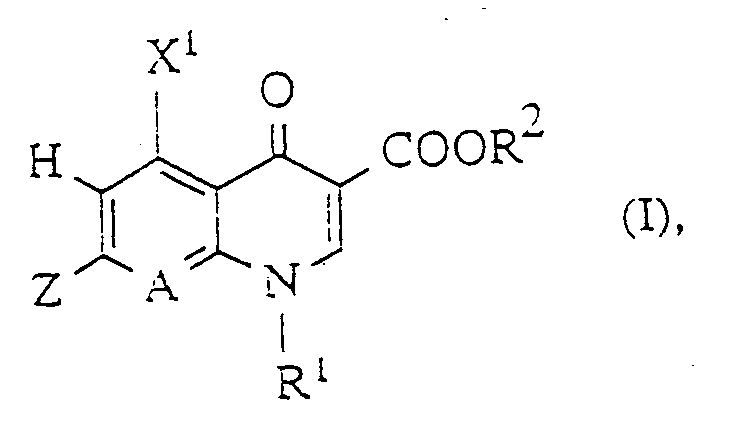
in welcher
Z für Reste der Strukturen 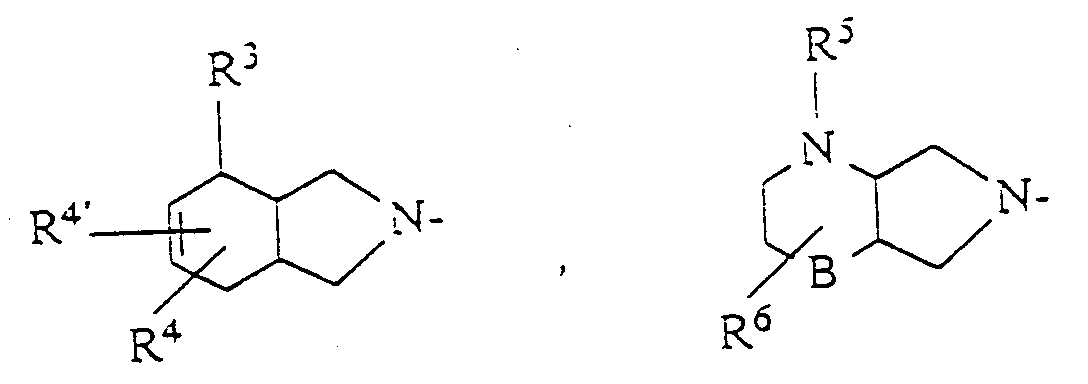
steht,
der 6-Position Wasserstoff tragen, Verfahren zu ihrer Herstellung sowie diese enthaltende antibakterielle Mittel und Futterzusatzstoffe.
in welcher
Z für Reste der Strukturen
steht,
der 6-Position Wasserstoff tragen, Verfahren zu ihrer Herstellung sowie diese enthaltende antibakterielle Mittel und Futterzusatzstoffe.
Description
- Die Erfindung betrifft neue Chinolon- und Naphthyridoncarbonsäurederivate, die in der 6-Position Wasserstoff tragen, Verfahren zu ihrer Herstellung sowie diese enthaltende antibakterielle Mittel und Futterzusatzstoffe.
- Es ist bereits bekannt geworden, daß derartige Chinoloncarbonsäuren antibakteriell wirksam sind. Beispiele hierfür finden sich in US 4.416.884, EP-A 393 400, 8-Methyl-7-piperazinyl-chinoloncarbonsäuren wurden in DE-A 3 007 006 und 7-(3-Aminopyrrolidinyl)-8-fluorchinoloncarbonsäuren im Journal of Medicinal Chemistry 35, 198 (1992) beschrieben.
- Es wurden nun Verbindungen der allgemeinen Formel (I) gefunden

in welcher - R¹
- für gegebenenfalls durch Hydroxy, Halogen oder C₁-C₃-Alkoxy substituiertes geradkettiges oder verzweigtes C₁-C₄-Alkyl, für gegebenenfalls durch C₁-C₃-Alkyl oder Halogen substituiertes C₃-C₆-Cycloalkyl, C₂-C₄-Alkenyl, ferner für C₁-C₃-Alkoxy, Amino, Monoalkylamino mit 1 bis 3 C-Atomen, Dialkylamino mit 1 bis 3 C-Atomen je Alkylgruppe oder für gegebenenfalls durch Halogen ein- bis dreifach substituiertes Phenyl steht,
- R²
- für Wasserstoff, gegebenenfalls durch Hydroxy, Methoxy, Amino, Methylamino oder Dimethylamino substituiertes Alkyl mit 1 bis 4 Kohlenstoffatomen oder (5-Methyl-2-oxo-1,3-dioxol-4-yl)-methyl,
- X¹
- für Wasserstoff, Halogen, Amino, Methyl oder Trifluormethyl,
- Z
- für Reste der Strukturen

- R³
- für Wasserstoff, Hydroxy, -NR⁷R⁸, Hydroxymethyl oder -CH₂-NR⁷R⁸ steht,
wobei - R⁷
- Wasserstoff, gegebenenfalls durch Hydroxy substituiertes C₁-C₃-Alkyl, Alkoxycarbonyl mit 1 bis 4 C-Atomen im Alkoxyteil oder C₁-C₃-Acyl und
- R⁸
- Wasserstoff oder Methyl bedeutet,
- R⁴
- für Wasserstoff, geradkettiges oder verzweigtes C₁-C₃-Alkyl oder Cyclopropyl,
- R4'
- für Wasserstoff oder Methyl,
- R⁵
- für Wasserstoff oder Methyl,
- R⁶
- für Wasserstoff, Methyl oder Reste der Strukturen -CH=CH-CO₂R5', -CH₂-CH₂-CO₂R5', -CH₂-CO-CH₃, -CH₂-CH₂-CN,
- R5'
- für Methyl oder Ethyl,
- B
- für -CH₂-, O oder eine direkte Bindung steht und
- A
- für N oder C-R⁹ steht, worin
- R⁹
- für H, Halogen, Methyl, Trifluormethyl, Vinyl, Ethinyl, Hydroxy oder Methoxy steht oder auch gemeinsam mit R¹ eine Brücke der Struktur

- Sie eignen sich daher als Wirkstoffe für die Human- und Veterinärmedizin, wobei zur Veterinärmedizin auch die Behandlung von Fischen zur Therapie oder zur Vorbeugung bakterieller Infektionen zu zählen ist.
- Bevorzugt sind Verbindungen der Formel (I), in welcher
- R¹
- für gegebenenfalls durch Hydroxy oder Fluor substituiertes C₁-C₂-Alkyl, für gegebenenfalls durch Fluor substituiertes C₃-C₅-Cycloalkyl, Vinyl, Amino, Monoalkylamino mit 1 bis 2 C-Atomen,
Dialkylamino mit 1 bis 2 C-Atomen je Alkylgruppe oder für gegebenenfalls durch Halogen ein- bis zweifach substituiertes Phenyl steht, - R²
- für Wasserstoff, gegebenenfalls durch Amino oder Dimethylamino substituiertes Alkyl mit 1 bis 2 Kohlenstoffatomen oder (5-Methyl-2-oxo-1,3-dioxol-4-yl)-methyl,
- X¹
- für Wasserstoff, Fluor, Chlor, Trifluormethyl oder Amino,
- Z
- für Reste der Strukturen

worin - R³
- für Wasserstoff, Hydroxy, -NR⁷R⁸, Hydroxymethyl oder -CH₂-NR⁷R⁸ steht,
wobei - R⁷
- Wasserstoff, gegebenenfalls durch Hydroxy substituiertes C₁-C₂-Alkyl, Alkoxycarbonyl mit 1 bis 4 C-Atomen im Alkoxyteil oder C₁-C₃-Acyl und
- R⁸
- Wasserstoff oder Methyl bedeutet,
- R⁴
- für Wasserstoff, geradkettiges oder verzweigtes C₁-C₃-Alkyl oder Cyclopropyl,
- R⁵
- für Wasserstoff oder Methyl,
- B
- für -CH₂-, O oder eine direkte Bindung steht und
- A
- für N oder C-R⁹ steht, worin
- R⁹
- für H, Chlor, Fluor, Methyl, Trifluormethyl, Hydroxy oder Methoxy steht oder auch gemeinsam mit R¹ eine Brücke der Struktur

- Besonders bevorzugt sind die Verbindungen der Formel (I), in welcher
- R¹
- für Methyl, Ethyl, gegebenenfalls durch Fluor substituiertes Cyclopropyl oder für gegebenenfalls durch Fluor ein- oder zweifach substituiertes Phenyl steht,
- R²
- für Wasserstoff, Methyl oder Ethyl,
- X¹
- für Wasserstoff, Fluor, Trifluormethyl oder Amino,
- Z
- für Reste der Strukturen

worin - R³
- für Wasserstoff, Hydroxy, -NR⁷R⁸, Hydroxymethyl oder -CH₂-NR⁷R⁸ steht,
wobei - R⁷
- Wasserstoff, Methyl, Alkoxycarbonyl mit 1 bis 4 C-Atomen im Alkoxyteil oder C₁-C₃-Acyl und
- R⁸
- Wasserstoff oder Methyl bedeutet,
- R⁴
- für Wasserstoff, geradkettiges oder verzweigtes C₁-C₃-Alkyl oder Cyclopropyl,
- R⁵
- für Wasserstoff oder Methyl,
- B
- für -CH₂-, O oder eine direkte Bindung steht und
- A
- für N oder C-R⁹ steht, worin
- R⁹
- für H, Chlor, Fluor, Methyl, Methoxy, Trifluormethyl steht oder auch gemeinsam mit R¹ eine Brücke der Struktur

- Weiterhin wurde gefunden, daß man Verbindungen der Formel (I) erhält, wenn man Verbindungen der Formel (II)

in welcher - R¹, R², X¹ und A
- die oben angegebene Bedeutung haben und
- X²
- für Halogen, insbesondere Fluor oder Chlor, steht,
- Z
- die oben angegebene Bedeutung hat,
- Verwendet man beispielsweise 1-Cyclopropyl-7,8-difluor-1,4-dihydro-4-oxo-3-chinolincarbonsäure und 4-Methylamino-1,3,3a,4,7,7a-hexahydroisoindol, so kann der Reaktionsverlauf durch das folgende Formelschema wiedergegeben werden:

Die als Ausgangsverbindungen verwendeten Verbindungen der Formel (II) sind bekannt, bzw. können nach bekannten Verfahren hergestellt werden. Sie können gegebenenfalls als Racemate, Enantiomere oder reine Diastereomere eingesetzt werden. - Als Beispiele seien genannt:
1-Cyclopropyl-7,8-difluor-1,4-dihydro-4-oxo-3-chinolincarbonsäure,
7-Chlor-1-cyclopropyl-1,4-dihydro-4-oxo-3-chinolincarbonsäure,
7-Chlor-1-ethyl-8-fluor-1,4-dihydro-4-oxo-3-chinolincarbonsäure,
1-Ethyl-7-fluor-1,4-dihydro-4-oxo-3-chinolincarbonsäure,
7-Chlor-1-ethyl-1,4-dihydro-4-oxo-3-chinolincarbonsäure,
7,8-Dichlor-1-ethyl-1,4-dihydro-4-oxo-3-chinolincarbonsäure,
1-Ethyl-7-fluor-8-methyl-1,4-dihydro-4-oxo-3-chinolincarbonsäure,
7-Chlor-1-(4-fluorphenyl)-1,4-dihydro-5-methyl-4-oxo-1,8-naphthyridin-3-carbonsäureethylester,
8-Chlor-1-cyclopropyl-5,7-difluor-1,4-dihydro-4-oxo-3-chinolincarbonsäureethylester,
5-Amino-1-cyclopropyl-7,8-difluor-1,4-dihydro-4-oxo-3-chinolincarbonsäureethylester,
1-Cyclopropyl-5,7,8-trifluor-1,4-dihydro-4-oxo-3-chinolincarbonsäureethylester,
1-Cyclopropyl-7-fluor-1,4-dihydro-8-methyl-4-oxo-3-chinolincarbonsäure,
1-Cyclopropyl-7,8-difluor-1,4-dihydro-5-methyl-4-oxo-3-chinolincarbonsäure,
5-Brom-1-cyclopropyl-7,8-difluor-1,4-dihydro-4-oxo-3-chinolincarbonsäure,
5-Chlor-1-cyclopropyl-7,8-difluor-1,4-dihydro-4-oxo-3-chinolincarbonsäure,
1-Cyclopropyl-7-fluor-1,4-dihydro-8-methoxy-4-oxo-3-chinolincarbonsäure,
7,8-Difluor-1-(2,4-difluorphenyl)-1,4-dihydro-4-oxo-3-chinolincarbonsäure,
8-Chlor-7-fluor-1-(2,4-difluorphenyl)-1,4-dihydro-4-oxo-3-chinolincarbonsäure,
7-Fluor-1-(2,4-difluorphenyl)-1,4-dihydro-4-oxo-3-chinolincarbonsäure,
10-Fluor-2,3-dihydro-3-methyl-7-oxo-7H-pyrido[1,2,3-d,e][1,4]benzoxazin-6-carbonsäure,
10-Chlor-2,3-dihydro-3-methyl-7-oxo-7H-pyrido[1,2,3-d,e][1,4]benzoxazin-6-carbonsäure,
10-Chlor-8-fluor-2,3-dihydro-3-methyl-7-oxo-7H-pyrido[1,2,3-d,e][1,4]benzoxazin-6-carbonsäure,
10-Chlor-2,3-dihydro-3-methyl-8-nitro-7-oxo-7H-pyrido[1,2,3-d,e][1,4]benzoxazin-6-carbonsäure,
10-Chlor-2,3-dihydro-3,8-dimethyl-7-oxo-7H-pyrido[1,2,3-d,e][1,4]benzoxazin-6-carbonsäure,
8-Chlor-6,7-dihydro-1-oxo-1H, 5H-benzo[ij]chinolizin-2-carbonsäure,
8-Chlor-1-cyclopropyl-7-fluor-1,4-dihydro-4-oxo-3-chinolincarbonsäure,
7,8-Difluor-1-(2-fluorcyclopropyl)-1,4-dihydro-4-oxo-3-chinolincarbonsäure,
8-Chlor-7-fluor-1-(2-fluorcyclopropyl)-1,4-dihydro-4-oxo-3-chinolincarbonsäure,
1-Cyclopropyl-7,8-difluor-5-trifluormethyl-1,4-dihydro-4-oxo-3-chinolincarbonsäure,
1-Cyclopropyl-5,7-difluor-8-trifluormethyl-1,4-dihydro-4-oxo-3-chinolincarbonsäure,
7-Chlor-1-cyclopropyl-1,4-dihydro-4-oxo-1,8-naphthydridin-3-carbonsäure,
7-Chlor-1-(2,4-difluorphenyl)-1,4-dihydro-4-oxo-1,8-naphthyridin-3-carbonsäure. - Die als Ausgangsverbindungen verwendeten Amine der Formel (III) sind zum Teil bekannt. Chirale Amine können sowohl als Racemate, als auch als enantiomeren-oder diastereomerenreine Verbindungen eingesetzt werden.
- Als Beispiele seien genannt:
2,7-Diazabicyclo[3.3.0]octan,
2,8-Diazabicyclo[4.3.0]nonan,
2-Methyl-2,8-diazabicyclo[4.3.0]nonan,
2-Oxa-5,8-diazabicyclo[4.3.0]nonan,
5-Methyl-2-oxa-5,8-diazabicyclo[4.3.0]nonan,
4-Amino-1,3,3a,4,7,7a-hexahydroisoindol,
4-Methylamino-1,3,3a,4,7,7a-hexahydroisoindol,
5-Methyl-4-methylamino-1,3,3a,4,7,7a-hexahydroisoindol,
7-Methyl-4-methylamino-1,3,3a,4,7,7a-hexahydroisoindol,
7a-Methyl-4-methylamino-1,3,3a,4,7,7a-hexahydroisoindol,
6,7-Dimethyl-4-methylamino-1,3,3a,4,7,7a-hexahydroisoindol,
4-Dimethylamino-1,3,3a,4,7,7a-hexahydroisoindol,
4-Ethylamino-1,3,3a,4,7,7a-hexahydroisoindol,
4-Aminoethyl-1,3,3a,4,7,7a-hexahydroisoindol,
4-Methylaminomethyl-1,3,3a,4,7,7a-hexahydroisoindol,
4-Hydroxy-1,3,3a,4,7,7a-hexahydroisoindol,
7-Isopropyl-4-methylamino-1,3,3a,4,7,7a-hexahydroisoindol,
4-Amino-7-isopropyl-1,3,3a,4,7,7a-hexahydroisoindol,
4-Hydroxymethyl-1,3,3a,4,7,7a-hexahydroisoindol,
4-Amino-7-cyclopropyl-1,3,3a,4,7,7a-hexahydroisoindol. - Die substituierten 1,3,3a,4,7,7a-Hexahydro-isoindole sind überwiegend neu. Sie können zum Beispiel durch Diels-Alder-Reaktion von Dienen der Formel (1)

wobei R⁴ die oben angegebene Bedeutung hat und R¹⁰ entweder mit R³ identisch ist oder eine funktionelle Gruppe darstellt, die in R³ umgewandelt werden kann, mit Dienophilen der Formel (2),
in welcher R¹¹ Wasserstoff oder eine Schutzgruppe wie Trimethylsilyl, Benzyl, C₁-C₄-Alkylphenylmethyl, Methoxybenzyl oder Benzylhydryl bedeuten, und der nachfolgenden Reduktion der Carbonylgruppen sowie gegebenenfalls der Abspaltung der Schutzgruppe erhalten werden. - Für die Diels-Alder-Reaktion kommen als Verdünnungsmittel alle inerten organischen Lösungsmittel in Frage. Hierzu gehören vorzugsweise Ether, wie Diisopropylether, Di-n-butylether, Dimethoxyethan, Tetrahydrofuran und Anisol, Kohlenwasserstoffe, wie z.B. Hexan, Methylcyclohexan, Toluol, Xylol und Mesitylen und halogenierte Kohlenwasserstoffe, wie z.B. Chloroform, 1,2-Dichlorethan und Chlorbenzol. Die Diels-Alder-Reaktion kann aber auch ohne Lösungsmittel durchgeführt werden.
- Die Reaktionstemperaturen können in einem größeren Bereich variiert werden. Im allgemeinen arbeitet man zwischen etwa -20°C und +200°C, vorzugsweise zwischen -20°C und +150°C. Die Diels-Alder-Reaktion wird normalerweise bei Normaldruck durchgeführt. Zur Beschleunigung der Reaktion können aber auch Drucke bis zu 1,5 GPa eingesetzt werden.
- Die Reduktion der Carbonylgruppen kann mit komplexen Hydriden erreicht werden. Als Hydride können z.B. Lithiumaluminiumhydrid, Lithiumborhydrid, Lithiumtriethylborhydrid, Natrium-bis-[2-methoxyethoxy]-aluminiumhydrid oder Natriumborhydrid in Gegenwart von Lewis-Säure-Katalysatoren wie Chlortrimethylsilan, Bortrifluorid-Etherat oder Aluminiumchlorid eingesetzt werden.
- Als Verdünnungsmittel können Ether, wie z.B. Diethylether, Tetrahydrofuran, Dioxan oder Dimethoxyethan und Kohlenwasserstoffe, wie z.B. Hexan, Methylcyclohexan und Toluol oder auch deren Gemische verwendet werden.
- Die Reaktionstemperaturen können im Bereich zwischen -40 und +180°C, vorzugsweise zwischen 0° und 140°C, variiert werden. Die Reduktion wird im allgemeinen unter Normaldruck durchgeführt, sie kann aber auch unter vermindertem Druck oder unter Überdruck durchgeführt werden.
- Die Anwendung von Drucken zwischen 100 und 1000 kPa empfiehlt sich, um mit leicht siedenden Lösungsmitteln höhere Reaktionstemperaturen zu erreichen.
- Die komplexen Hydride werden mindestens in einer der Stöchiometrie der Reduktion entsprechenden Menge eingesetzt. Im allgemeinen wird aber ein Überschuß, vorzugsweise zwischen 30 und 300 %, eingesetzt.
- Die Abspaltung einer eventuellen Schutzgruppe erfolgt nach den allgemein bekannten Methoden der Schutzgruppenchemie (vergl. z.B. T.W. Greene, "Protective Groups in Organic Synthesis", John Wiley & Sons, New York 1981).
- Die Ausgangsstoffe der Formeln (1) und (2) sind bekannt oder können nach allgemein bekannten Methoden der organischen Chemie hergestellt werden [vergl. z.B. J. Am. Chem. Soc. 100, 5179 (1978), J. Org. Chem. 43, 2164 (1978), DE 39 27 115, J. Org. Chem. 40, 24 (1975)].
- Verwendet man beispielsweise 1-(tert.-Butyloxycarbonylamino)-1,3-butadien und Maleinimid als Ausgangsmaterialien und Lithiumaluminiumhydrid als Reduktionsmittel, so kann der Reaktionsablauf durch das folgende Formelschema wiedergegeben werden:

In einer besonderen Ausführungsform des Herstellungsverfahrens können alle Stufen bei Verwendung eines geeigneten Lösungsmittels, wie z.B. Tetrahydrofuran, ohne Isolierung der Zwischenprodukte durchgeführt werden. Verwendet man z.B. 1-(tert.-Butyloxycarbonylamino)-1,3-pentadien und N-Trimethylsilyl-maleinimid als Ausgangsmaterialien, so kann der Reaktionsablauf durch das folgende Formelschema wiedergegeben werden:
Durch NMR-Spektroskopie kann in diesem Fall nachgewiesen werden, daß alle Substituenten des Cyclohexen-Rings cis-Anordnung zueinander aufweisen. - Die Umsetzung von (II) mit (III), bei der die Verbindungen (III) auch in Form ihrer Salze, wie z.B. der Hydrochloride eingesetzt werden können, wird vorzugsweise in einem Verdünnungsmittel wie Dimethylsulfoxid, N,N-Dimethylformamid, N-Methylpyrrolidon, Hexamethyl-phosphorsäuretrisamid, Sulfolan, Acetonitril, Wasser, einem Alkohol wie Methanol, Ethanol, n-Propanol, Isopropanol, Glykolmonomethylether oder Pyridin vorgenommen. Ebenso können Gemische dieser Verdünnungsmittel verwendet werden.
- Als Säurebinder können alle üblichen anorganischen und organischen Säurebindungsmittel verwendet werden. Hierzu gehören vorzugsweise die Alkalihydroxide, Alkalicarbonate, organische Amine und Amidine. Als besonders geeignet seien im einzelnen genannt: Triethylamin, 1,4-Diazabicyclo[2.2.2]octan (DABCO), 1,8-Diazabicyclo[5.4.0]undec-7-en (DBU) oder überschüssiges Amin (III).
- Die Reaktionstemperaturen können in einem größeren Bereich variiert werden. Im allgemeinen arbeitet man zwischen etwa 20 und 200°C, vorzugsweise zwischen 80 und 180°C.
- Die Umsetzung kann bei Normaldruck, aber auch bei erhöhtem Druck durchgeführt werden. Im allgemeinen arbeitet man bei Drucken zwischen etwa 1 und 100 bar, vorzugsweise zwischen 1 und 10 bar.
- Bei der Durchführung des erfindungsgemäßen Verfahrens setzt man auf 1 Mol der Verbindung (II) 1 bis 15 Mol, vorzugsweise 1 bis 6 Mol der Verbindung (III) ein.
- Freie Aminogruppen können während der Umsetzung durch eine geeignete Aminoschutzgruppe, zum Beispiel durch den tert.-Butoxycarbonylrest, geschützt und nach Beendigung der Reaktion durch Behandlung mit einer geeigneten Säure wie Chlorwasserstoffsäure oder Trifluoressigsäure wieder freigesetzt werden (siehe Houben-Weyl, Methoden der Organischen Chemie, Band E4, Seite 144 (1983); J.F.W. McOmie, Protective Groups in Organic Chemistry (1973), Seite 43).
- Die erfindungsgemäßen Ester werden durch Umsetzung eines Alkalisalzes der zugrundeliegenden Carbonsäure, die gegebenenfalls am N-Atom durch eine Schutzgruppe wie den tert.-Butoxycarbonylrest geschützt sein kann, mit geeigneten Halogenalkylderivaten in einem Lösungsmittel wie Dimethylformamid, Dimethylacetamid, N-Methylpyrrolidon, Dimethylsulfoxid oder Tetramethylharnstoff bei Temperaturen von etwa 0 bis 100°C, vorzugsweise 0 bis 50°C, erhalten.
- Die Herstellung der Säureadditionssalze der erfindungsgemäßen Verbindungen erfolgt in üblicher Weise zum Beispiel durch Lösen des Betains in ausreichender Menge wäßriger Säure und Ausfällen des Salzes mit einem mit Wasser mischbaren organischen Lösungsmittel wie Methanol, Ethanol, Aceton, Acetonitril. Man kann auch äquivalente Mengen Betain und Säure in Wasser oder einem Alkohol wie Glykolmonomethylether erhitzen und anschließend bis zur Trockne eindampfen oder das ausgefallene Salz absaugen. Als pharmazeutisch verwendbare Salze sind beispielsweise die Salze der Salzsäure, Schwefelsäure, Essigsäure, Glykolsäure, Milchsäure, Bernsteinsäure, Zitronensäure, Weinsäure, Methansulfonsäure, 4-Toluolsulfonsäure, Galacturonsäure, Gluconsäure, Embonsäure, Glutaminsäure oder Asparaginsäure zu verstehen.
- Die Alkali- oder Erdalkalisalze der erfindungsgemäßen Carbonsäuren werden beispielsweise durch Lösen des Betains in unterschüssiger Alkali- oder Erdalkalilauge, Filtration von ungelöstem Betain und Eindampfen des Filtrats bis zur Trockne erhalten. Pharmazeutisch geeignet sind Natrium-, Kalium- oder Calciumsalze. Durch Umsetzung eines Alkali- oder Erdalkalisalzes mit einem geeigneten Silbersalz wie Silbernitrat werden die entsprechenden Silbersalze erhalten.
- Außer den in den Beispielen genannten erfindungsgemäßen Verbindungen können auch die in der folgenden Tabelle aufgeführten hergestellt werden, die sowohl in racemischer als auch in enantiomerenreiner oder diastereomerenreiner Form vorliegen können:


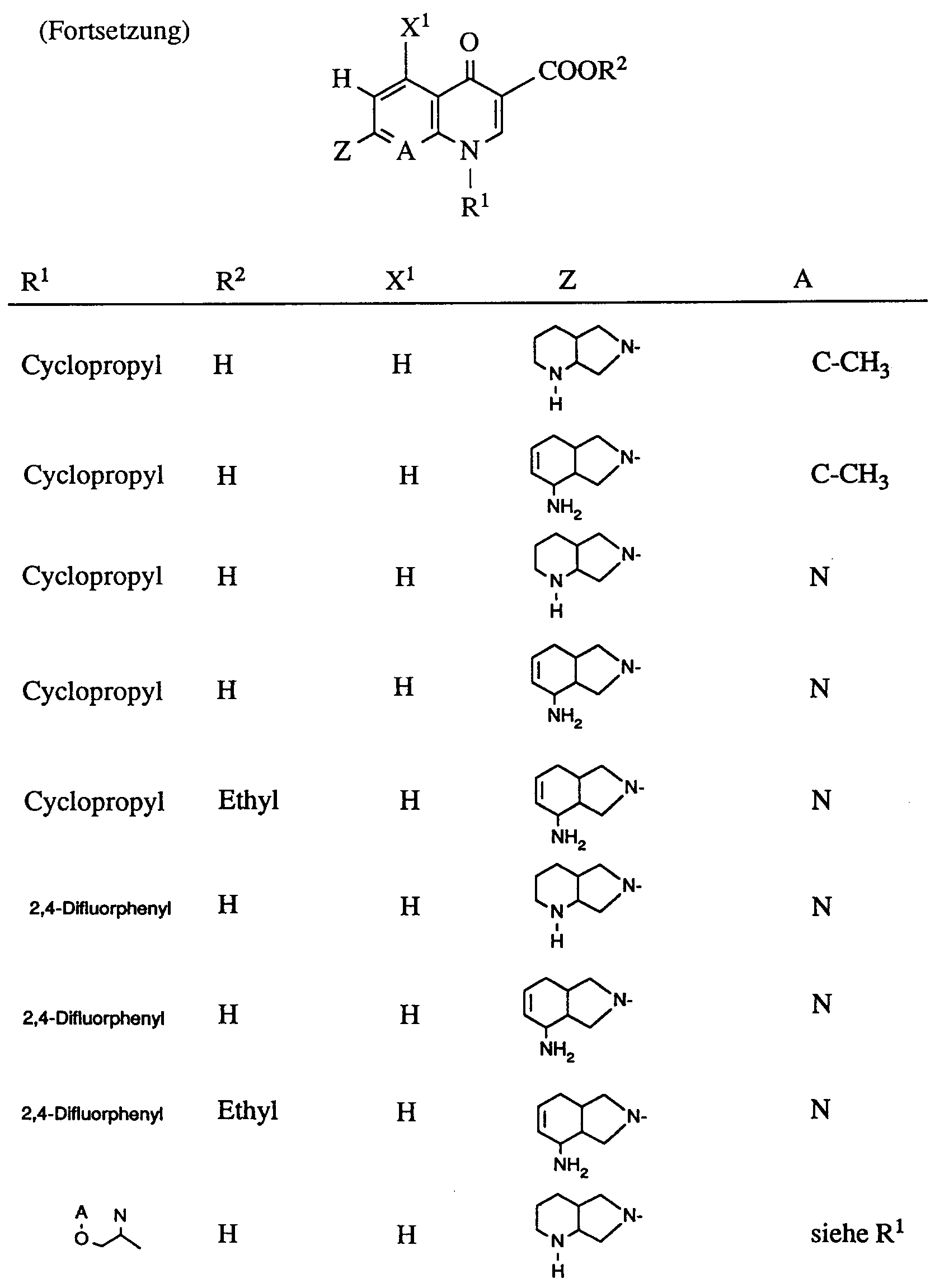
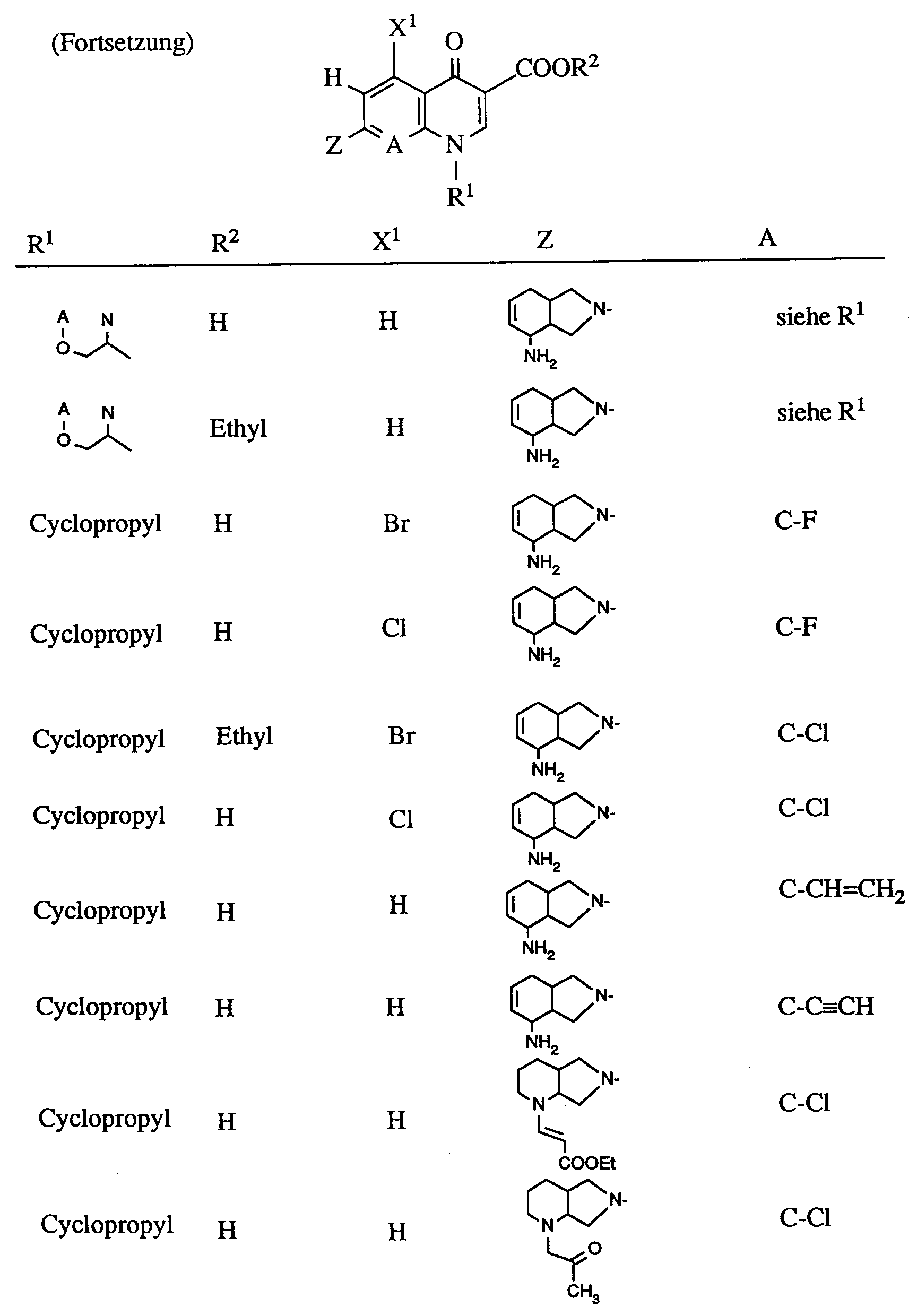
- Die erfindungsgemäßen Verbindungen wirken stark antibiotisch und zeigen bei geringer Toxizität ein breites antibakterielles Spektrum gegen grampositive und gramnegative Keime, insbesondere gegen Enterobakterien; vor allem auch gegen solche, die resistent sind gegen verschiedene Antibiotika, wie z.B. Penicilline, Cephalosporine, Aminoglykoside, Sulfonamide, Tetracycline.
- Diese wertvollen Eigenschaften ermöglichen ihre Verwendung als chemotherapeutische Wirkstoffe in der Medizin sowie als Stoffe zur Konservierung von anorganischen und organischen Materialien, insbesondere von organischen Materialien aller Art, z.B. Polymeren, Schmiermitteln, Farben, Fasern, Leder, Papier und Holz, von Lebensmitteln und von Wasser.
- Die erfindungsgemäßen Verbindungen sind gegen ein sehr breites Spektrum von Mikroorganismen wirksam. Mit ihrer Hilfe können gramnegative und grampositive Bakterien und bakterienähnliche Mikroorganismen bekämpft sowie die durch diese Erreger hervorgerufenen Erkrankungen verhindert, gebessert und/oder geheilt werden.
- Die erfindungsgemäßen Verbindungen zeichnen sich durch verstärkte Wirkung auf ruhende und resistente Keime aus. Bei ruhenden Bakterien, also Bakterien, die kein nachweisbares Wachstum zeigen, wirken die Verbindungen weit unterhalb von Konzentrationen bisher bekannter Substanzen. Dies bezieht sich nicht nur auf die einzusetzende Menge, sondern auch auf die Geschwindigkeit der Abtötung. Solche Ergebnisse konnten bei grampositiven und -negativen Bakterien, insbesondere bei Staphylococcus aureus, Pseudomonas aeruginosa, Enterococcus faecalis und Escherichia coli beobachtet werden.
- Auch gegenüber Bakterien, die gegenüber vergleichbaren Substanzen als weniger empfindlich eingestuft werden, insbesondere resistenten Staphylococcus aureus, Escherichia coli, Pseudomonas aeruginosa und Enterococcus faecalis zeigen die erfindungsgemäßen Verbindungen überraschende Wirkungssteigerungen.
- Besonders wirksam sind die erfindungsgemäßen Verbindungen gegen Bakterien und bakterienähnliche Mikroorganismen. Sie sind daher besonders gut zur Prophylaxe und Chemotherapie von lokalen und systemischen Infektionen in der Human-und Tiermedizin geeignet, die durch diese Erreger hervorgerufen werden.
- Die Verbindungen eignen sich ferner zur Bekämpfung von Protozoonosen und Helminthosen.
- Die erfindungsgemäßen Verbindungen können in verschiedenen pharmazeutischen Zubereitungen angewendet werden. Als bevorzugte pharmazeutische Zubereitungen seien Tabletten, Dragees, Kapseln, Pillen, Granulate, Suppositorien, Lösungen, Suspensionen und Emulsionen, Pasten, Salben, Gele, Cremes, Lotions, Puder und Sprays genannt.
- Die minimalen Hemmkonzentrationen (MHK) wurden per Reihenverdünnungsverfahren auf Iso-Sensitest Agar (Oxoid) bestimmt. Für jede Prüfungssubstanz wurde eine Reihe von Agarplatten hergestellt, die bei jeweils doppelter Verdünnung abfallende Konzentrationen des Wirkstoffs enthielten. Die Agarplatten wurden mit einem Multipoint-Inokulator (Denley) beimpft. Zum Beimpfen wurden Übernachtkulturen der Erreger verwandt, die zuvor so verdünnt wurden, daß jeder Impfpunkt ca. 10⁴ koloniebildende Partikel enthielt. Die beimpften Agarplatten wurden bei 37°C bebrütet, und das Keimwachstum wurde nach ca. 20 Stunden abgelesen. Der MHK-Wert (µg/ml) gibt die niedrigste Wirkstoffkonzentration an, bei der mit bloßem Auge kein Wachstum zu erkennen war.
- In der nachstehenden Tabelle sind die MHK-Werte einiger der erfindungsgemäßen Verbindungen im Vergleich zu 7-(3-Aminopyrrolidin-1-yl)-1-cyclopropyl-8-fluor-1,4-dihydro-4-oxo-3-chinolincarbonsäure (Journal of Medicinal Chemistry 35, 198 (1992)) als Referenzverbindung aufgeführt.
Tabelle MHK-Werte Spezies Stamm Beispiel Nr. Referenz 7 8 20 21 E. coli Neumann 0,0078 0,015 0,03 0,015 0,031 455/7 0,5 0,5 1 0,5 1 Klebsiella pneumoniae 8085 0,015 0,03 0,03 0,3 0,062 63 0,015 0,03 0,03 0,3 0,062 Providencia sp. 12012 0,015 0,06 0,06 0,06 0,06 12052 1 1 1 1 2 Mirococcus luteus 9341 0,03 0,06 0,06 0,125 0,5 Staphylococcus aureus ICB 25701 0,06 0,06 0,25 0,25 4 1756 0,0039 0,0078 0,015 0,015 0,125 133 0,0039 0,0078 0,03 0,015 0,125 25768 2 2 4 2 16 Enterococcus faecalis 27101 0,015 0,06 0,06 0,06 0,25 9790 0,03 0,06 0,06 0,06 0,25 Acinetobacter caloaceticus 14068 0,015 0,03 0,06 0,03 0,25 -

- 14,4 g (60 mmol) 70 %iges 1-(tert.-Butyloxycarbonylamino)-1,3-butadien [J.Org.Chem. 43, 2164 (1978)] werden als Lösung in 30 ml absolutem Tetrahydrofuran zu vorgelegten 10,1 g (60 mmol) N-Trimethylsilylmaleinimid [J.Org.Chem. 40, 24 (1975)] in 30 ml absolutem Tetrahydrofuran getropft. Nach dem Abklingen der exothermen Reaktion wird noch 1 Stunde unter Rückflußkühlung gekocht.
- Die erkaltete Reaktionsmischung wird dann unter Stickstoff zu vorgelegten 7,6 g (0,2 mol) Lithiumaluminiumhydrid in 200 ml absolutem Tetrahydrofuran getropft. Dann wird 14 Stunden unter Rückflußkühlung gekocht. Zu der erkalteten Reaktionsmischung werden dann nacheinander 7,6 g Wasser in 23 ml Tetrahydrofuran, 7,6 g 10 %ige Natronlauge und 22,8 g Wasser getropft. Die Salze werden abfiltriert und das Filtrat im Vakuum eingeengt. Der Rückstand (10,3 g) wird bei 87°C/0,8 mbar destilliert.
- Das Destillat wird in 80 ml absolutem Pentan aufgenommen, filtriert und das Produkt durch Abkühlen auf -70°C kristallisiert.
Ausbeute: 3,3 g, Schmelzpunkt: 72-82°C. - Durch Behandeln mit äquimolarer Menge 2n Salzsäure erhält man 4-Methylamino-1,3,3a,4,7,7a-hexahydro-isoindol-Dihydrochlorid vom Schmelzpunkt 265-268°C (aus Methanol).
-
- a) 4-(tert.-Butyloxycarbonylamino)-1,3-dioxo-1,3,3a,4,7,7a-hexahydroisoindol,
48,8 g (0,5 mol) Maleinimid werden in 200 ml absolutem Tetrahydrofuran gelöst vorgelegt und 120 g (0,5 mol) ca 70 %iges 1-(tert.-Butyloxycarbonylamino)-1,3-butadien als Lösung in 500 ml absolutem Tetrahydrofuran zugetropft, wobei die Temperatur bei 20 bis 30°C gehalten wird. Über Nacht wird bei Raumtemperatur nachgerührt. Dann wird eingeengt und aus Essigsäureethylester umkristallisiert. Es werden 57 g Produkt mit einem Schmelzpunkt von 177 bis 182°C erhalten. Aus der Mutterlauge werden weitere 13 g mit einem Schmelzpunkt von 158 bis 160°C erhalten. - b) 4-Methylamino-1,3,3a,4,7,7a-hexahydroisoindol,
27,1 g (0,71 mol) Lithiumaluminiumhydrid werden unter Stickstoff in 300 ml absolutem Tetrahydrofuran vorgelegt und eine Lösung von 57 g (0,21 mol) 4-(tert.-Butyloxycarbonylamino)-1,3-dioxo-1,3,3a,4,7,7a-hexahydroisoindol in 570 ml absolutem Tetrahydrofuran zugetropft. Dann wird über Nacht unter Rückflußkühlung gekocht. Nach dem Erkalten werden nacheinander, 27,1 g Wasser in 82 ml Tetrahydrofuran, 27,1 g 10 %ige Natronlauge und 81,3 g Wasser zu dem Ansatz getropft. Die Salze werden abgesaugt, mit Tetrahydrofuran gewaschen und das Filtrat im Vakuum eingeengt. Der Rückstand wird im Hochvakuum destilliert.
Ausbeute: 19,1 g -

13,3 g (50 mmol) 4-tert.-Butyloxycarbonylamino-1,3-dioxo-1,3,3a,4,7,7a-hexahydroisoindol (aus Beispiel A, Methode II) werden in 166 ml Trifluoressigsäure über Nacht bei Raumtemperatur gerührt. Dann wird die Trifluoressigsäure bei 10 mbar abdestilliert und der Rückstand bei 50° im Hochvakuum von Säureresten befreit Anschließend wird in absolutem Tetrahydrofuran aufgenommen und im Vakuum eingeengt. Der Rückstand wird in 100 ml absolutem Tetrahydrofuran aufgenommen und unter Stickstofff zu einer Lösung von 11,3 g (0,3 mol) Lithiumaluminiumhydrid in 300 ml absolutem Tetrahydrofuran getropft. Dann wird 16 Stunden unter Rückflußkühlung gekocht Nach dem Erkalten werden nacheinander 11,3 g Wasser in 34 ml Tetrahydrofuran, 11,3 ml 10 %ige Natronlauge und 34 ml Wasser zugetropft. Der Niederschlag wird abgesaugt und mit Tetrahydrofuran gewaschen. Das Filtrat wird eingeengt und der Rückstand destilliert.
Ausbeute: 2,2 g, Gehalt: 92 % (gaschromatographisch bestimmt)
Siedepunkt: 70°/0,2 mbar -

In Analogie zu Beispiel A, Methode I werden 21,9 g (0,12 mol) 1-(tert.-Butyloxycarbonylamino)-1,3-pentadien mit 20,3 g (0,12 mol) N-Trimethylsilyl-maleinimid umgesetzt und anschließend mit 15,2 g (0,4 mol) Lithiumaluminiumhydrid reduziert. Das Rohprodukt wird aus Tetrahydrofuran umkristallisiert.
Ausbeute: 6,2 g, Schmelzpunkt: 106-108°C. -

50 g (0,24 mol) 1-(tert-Butyloxycarbonylamino)-5-methyl-1,3-hexadien werden zusammen mit 23 g (0,24 mol) Maleinimid in 75 ml Ethanol und 75 ml Wasser 24 Stunden unter Rückfluß gerührt. Nach dem Abkühlen saugt man den Feststoff ab, wäscht mit Wasser nach und erhält nach dem Trocknen 56,3 g (76 % der Theorie) eines Feststoffes mit dem Schmelzpunkt 192-195°C. 15 g (0,049 mol) werden zusammen mit 11 g (0,29 mol) Lithiumaluminiumhydrid in 300 ml Tetrahydrofuran 10 Stunden unter Rückfluß gerührt. Nach dem Abkühlen wird mit 10 ml Wasser hydrolysiert. Man saugt von Niederschlag ab, wäscht mit Tetrahydrofuran nach, und engt die vereinigten Filtrate zur Trockne ein. Es werden 8,7 g eines Feststoffes erhalten, der durch Kristallisation (Petrolether-Essigsäureethylester = 1:5) gereinigt wird.
Ausbeute: 43,5 g (51 % der Theorie),
Schmelzpunkt: 76-81°C. -

Die Darstellung erfolgt analog Beispiel B. - ¹H-NMR (200 MHz, CDCl₃): δ = 0,95 (6H); 2,3-2,7 (m, 7H); 5,75 (2H). MS: m/e (% rel.Int.): 180 [M⁺] (7); 163 (45); 120 (100); 67 (100).
-

25 g (0,22 mol) 2,4-Pentadiencarbonsäuremethylester werden in 100 ml Dioxan mit 20 g (0,21 mol) Maleinsäureimid 40 Stunden unter Rückfluß gerührt. Das nach dem Einengen erhaltene Öl (51 g) wird in 350 ml Tetrahydrofuran mit 20 g (0,52 mol) Lithiumaluminiumhydrid 16 Stunden unter Rückfluß gerührt. Nach dem Abkühlen wird mit 63 ml Wasser, 63 ml 10 proz. Natronlauge und zuletzt 60 ml Wasser hydrolysiert, vom Niederschlag abgesaugt und dieser noch mehrmals mit Tetrahydrofuran nachgewaschen. Die vereinigten Filtrate werden eingeengt und im Hochvakuum destilliert.
Ausbeute: 10 g (30 % der Theorie)
Siedepunkt: 96-115°C/0,07 mbar. -

- a) 1-tert.-Butyloxycarbonylamino-2,4-pentadien
Durch Umsetzung von 1-Amino-2,4-pentadien (P.A. Grieco et al., Tetrahedron 42, 2847 [1986]) mit Di-tert.-butylcarbonat in Dioxan bei Raumtemperatur während 12 Stunden bei pH 8-10 erhält man 1-tert.-Butyloxycarbonylamino-2,4-pentadien als helles Öl in quantitativer Ausbeute.
¹H-NMR (200 MHz, CDCl₃): δ = 1,45 (9H), 3,78 (2H); 4,65 (br., 1H); 5,05-5,21 (m, 2H); 5,60-5,75 (m, 1H); 6,08-6,42 ppm (m, 2H). - b) 4-tert.-Butyloxycarbonylaminomethyl-1,3-dioxo-1,3,3a,4,7,7a-hexahydroisoindol,
30 g (0,16 mol) 1-tert-Butyloxycarbonylamino-2,4-pentadien werden zusammen mit 16 g (0,16 mol) Maleinimid in 120 ml Dioxan 12 Stunden bei Rückfluß gerührt. Nach dem Abkühlen engt man zur Hälfte ein und saugt den Feststoff ab.
Ausbeute: 35,3 g (76 %)
Schmelzpunkt: 197,5-198,5°C. - c) 4-Methylaminomethyl-1,3,3a,4,7,7a-hexahydroisoindol,
Man reduziert 4-tert.-Butyloxycarbonylaminomethyl-1,3-dioxo-1,3,3a,4,7,7a-hexahydroisoindol mit Lithiumaluminiumhydrid analog wie in Beispiel A, Methode IIb beschrieben: gelbes Öl.
Siedepunkt = 78°C/0,05 mbar. -

Man setzt 4-tert.-Butyloxycarbonylaminomethyl-1,3-dioxo-1,3,3a,4,7,7a-hexahydroisoindol analog wie in Beispiel B beschrieben ein.
Siedepunkt = 135-140°C/0,1 mbar. -

- a) 4-(tert.-Butyloxycarbonylamino)-1,3-dioxo-6-methyl-1,3,3a,4,7,7a-hexahydroisoindol,
Entsprechend Beispiel A/Methode IIa setzt man mit 1-tert-Butyloxycarbonylamino-3-methyl-1,3-butadien in Dioxan um. Schmelzpunkt: 135°C - b) 6-Methyl-4-methylamino-1,3,3a,4,7,7a-hexahydroisoindol,
In Analogie zu Beispiel B werden 5,6 g (20 mmol) des Produkts aus Beispiel Ma) mit 2,2 g (60 mmol) Lithiumaluminiumhydrid in 60 ml Tetrahydrofuran 15 Stunden unter Rückfluß erhitzt. Bei der destillativen Aufarbeitung werden 1,2 g des Produkts vom Siedepunkt 68-71°C/0,2-0,3 mbar erhalten. -
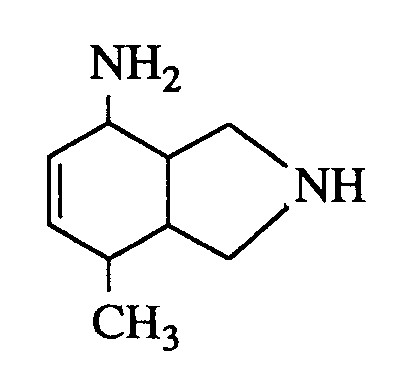
- a) 4-(tert.-Butyloxycarbonylamino)-1,3-dioxo-7-methyl-1,3,3a,4,7,7a-hexahydroisoindol,
Entsprechend Beispiel A/Methode IIa setzt man mit 1-tert-Butyloxycarbonylamino-1,3-pentadien um und kristallisiert das Reaktionsprodukt aus Dioxan um.
Ausbeute: 79 %
Schmelzpunkt: 298-211°C - b) 4-Amino-7-methyl-1,3,3a,4,7,7a-hexahydroisoindol,
Entsprechend Beispiel B setzt man das Produkt aus Beispiel Na) ein und erhält das freie Amin als Öl vom Siedepunkt 83-92°C/0,1 mbar, das beim Stehen kristallisiert.
Gehalt: 90 %ig (nach Gaschromatogramm) -
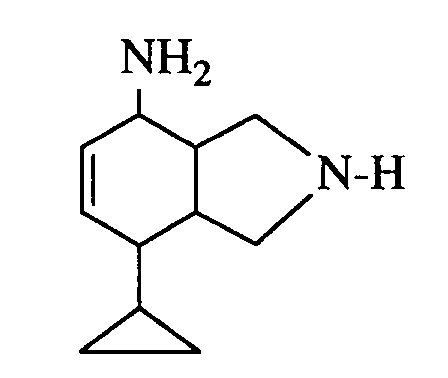
- a) 4-(tert.-Butoxycarbonylamino)-7-cyclopropyl-1,3-dioxo-1,3,3a,4,7,7a-hexahydroisoindol
1-tert.-Butoxycarbonylamino-4-cyclopropyl-1,3.-butadien (hergestellt analog der in J. Org, Chem. 43, 2164 [1978] beschriebenen Methode; IR (CCl₄): 330, 1720, 1605 cm⁻¹) wird analog Beispiel A/Methode II umgesetzt.
Schmelzpunkt: 195,5-196,5°C. - b) 4-Amino-7-cyclopropyl-1,3,3a,4,7,7a-hexahydroisoindol
Das Produkt aus Beispiel Oa wird analog Beispiel B mit Lithiumaluminiumhydrid zu einem viskosen Öl umgesetzt.
FAB-MS (Glycerin/DMSO): m/e 179 [M+H]⁺). -

- a) (2,4-Difluorbenzoyl)malonsäurediethylester
Man legt 13,47 g (0,14 mol) Magnesiumchlorid bei 0°C in 140 ml absolutem Acetonitril vor und tropft unter Eisbadkühlung 23,5 g (0,14 mol) Malonsäurediethylester zu. Anschließend werden 28,17 g (0,28 mol) Triethylamin bei 0°C zugetropft, nach 30 minütigem Nachrühren werden bei 0°C 22,4 g (0,14 mol) 2,4-Difluorbenzoesäurefluorid (US 4.847.442) zugetropft und unter Erwärmung auf Raumtemperatur über Nacht nachgerührt. Es wird mit 90 ml 18 %iger Salzsäure versetzt und mit Methylenchlorid extrahiert, über Natriumsulfat getrocknet und im Vakuum eingeengt.
Rohausbeute: 41,4 g - b) (2,4-Difluorbenzoyl)essigsäureethylester
41,4 g des rohen (2,4-Difluorbenzoyl)malonsäurediethylesters werden in 130 ml Wasser mit 170 mg p-Toluolsulfonsäure 8,5 Stunden zum Rückfluß erhitzt. Es wird mit Methylenchlorid extrahiert, mit Wasser gewaschen, über Natriumsulfat getrocknet und im Vakuum eingeengt.
Rohausbeute: 29,0 g - c) 2-(2,4-Difluorbenzoyl)-3-ethoxyacrylsäureethylester
29,0 g (0,127 mol) des Produktes von b. werden in 29,98 g (0,20 mol) Orthoameisensäureethylester und 34,5 g (0,34 mol) Essigsäureanhydrid zwei Stunden auf 150-160°C erwärmt. Alle leicht flüchtigen Bestandteile werden im Hochvakuum bei einer Badtemperatur bis 100°C abdestilliert und das Rohprodukt direkt weiter umsetzt.
Rohausbeute: 28,4 g - d) 3-Cyclopropylamino-2-(2,4-difluorbenzoyl)acrylsäureethylester
Zu 28,4 g des Rohproduktes von c. werden in 220 ml Ethanol bei 0°C 6,27 g (0,11 mol) Cyclopropylamin getropft und zwei Stunden bei Raumtemperatur nachgerührt. Es wird mit 220 im Wasser versetzt und das auskristallisierte Produkt isoliert.
Ausbeute: 22,2 g (54 % der Theorie)
Schmelzpunkt: 71°C - e) 1-Cyclopropyl-7-fluor-1,4-dihydro-4-oxo-3-chinolin-carbonsäureethylester
2,95 g (0,01 mol) des unter d. erhaltenen Produktes werden in 33 ml Dimethylformamid mit 0,63 g (0,015 mol) Natriumfluorid sechs Stunden auf 140°C erwärmt. Nach dem Abkühlen wird mit Wasser versetzt und das auskristallisierte Produkt isoliert und bei 100°C getrocknet.
Ausbeute: 2,1 g (76 % der Theorie)
Schmelzpunkt: 190-192°C - f) 1-Cyclopropyl-7-fluor-1,4-dihydro-4-oxo-3-chinolincarbonsäure
2,75 g (0,01 mol) 1-Cyclopropyl-7-fluor-1,4-dihydro-4-oxo-3-chinolincarbonsäureethylester werden in einer Mischung aus 12 ml Essigsäure, 12 ml Wasser und 1,2 ml konzentrierter Schwefelsäure vier Stunden unter Rückfluß erhitzt. Das abgekühlte Reaktionsgemisch wird auf Eiswasser gegeben, der Niederschlag abfiltriert, mit Wasser nachgewaschen und im Trockenschrank bei 100°C getrocknet.
Ausbeute: 2,2 g (89 % der Theorie)
Schmelzpunkt: 291°C (Zersetzung) -

- a) 3-Chlor-2,4-difluorbenzoesäure
Zu 400 ml konzentrierter Schwefelsäure werden 200 g (0,92 mol) 3-Chlor-2,4-difluorbenzotrifluorid gegeben und für drei Stunden unter Rühren auf 118°C erhitzt. Nach dem Abkühlen wird auf 500 g Eis ausgetragen, der weiße Feststoff abgesaugt und im Vakuum bei 60°C getrocknet.
Ausbeute: 172 g (97 % der Theorie)
Schmelzpunkt: 173-175°C - b) 3-Chlor-2,4-difluor-benzoesäurechlorid
Zu einer Suspension von 235 g (1,22 mol) 3-Chlor-2,4-difluorbenzoesäure in 800 ml Toluol und 3 ml Dimethylformamid wird bei 70°C so lange Thionylchlorid dosiert, bis eine klare Lösung entstanden ist und keine Gasentwicklung mehr beobachtet wird. Danach wird das Toluol und überschüssiges Thionylchlorid abdestilliert und anschließend das Produkt durch Destillation erhalten.
Ausbeute: 256 g (99 % der Theorie)
Siedepunkt: 108-110°C/22 mbar - c) (3-Chlor-2,4-difluorbenzoyl)malonsäurediethylester
3,9 g (0,16 mol) Magnesium werden in 8,6 ml Ethanol vorgelegt und die Reaktion mit Tetrachlorkohlenstoff gestartet. Bei 50-60°C Innentemperatur wird eine Lösung von 23,1 g (0,144 mol) Malonsäurediethylester in 16,3 ml Ethanol so zugetropft, daß die Temperatur gehalten wird. Anschließend wird eine Stunde bei 60°C nachgerührt. Danach wird bei -10 bis -5°C eine Lösung von 31,3 g (0,148 mol) 3-Chlor-2,4-difluorbenzoesäurechlorid in 16 ml Toluol zugetropft, eine Stunde bei 0°C und anschließend unter Erwärmung auf Raumtemperatur über Nacht nachgerührt. Das Reaktionsgemisch wird auf Eiswasser gegeben, mit 10 ml konzentrierter Schwefelsäure angesäuert und mit Toluol extrahiert. Es wird mit gesättigter Natriumchloridlösung gewaschen und das Lösungsmittel im Vakuum entfernt.
Rohausbeute: 49,9 g - d) (3-Chlor-2,4-difluorbenzoyl)essigsäureethylester
49,9 g des unter c. erhaltenen Rohproduktes werden in 60 ml Wasser mit 1,83 g p-Toluolsulfonsäure 4,5 Stunden zum Rückfluß erhitzt. Der erkaltete Ansatz wird mit Methylenchlorid extrahiert, mit gesättigter Natriumchloridlösung gewaschen, über Natriumsulfat getrocknet und im Vakuum eingeengt.
Rohausbeute: 37,3 g - e) 2-(3-Chlor-2,4-difluorbenzoyl)-3-ethoxyacrylsäureethylester
37,3 g des unter d. erhaltenen Rohproduktes werden mit 33,4 g (0,226 mol) Orthoameisensäureethylester und 37,2 g (0,365 mol) Essigsäureanhydrid zwei Stunden auf 150-160°C erwärmt. Überschüssiges Reagenz wird zunächst im Vakuum und anschließend im Hochvakuum bis zu einer Badtemperatur von 100°C entfernt.
Rohausbeute: 40,2 g - f) 2-(3-Chlor-2,4-difluorbenzoyl)-3-cyclopropylaminoacrylsäureethylester
40,2 g des unter e. erhaltenen Rohproduktes werden in 100 ml Ethanol gelöst und unter Eisbadkühlung 9,6 g (0,168 mol) Cyclopropylamin zugetropft. Es wird 30 Minuten bei Raumtemperatur nachgerührt und anschließend das Reaktionsgemisch mit 100 ml Eiswasser versetzt. Das ausgefallene Produkt wird isoliert, mit Wasser gewaschen und bei 100°C getrocknet.
Ausbeute: 30,8 g (63 % der Theorie bezogen auf (c))
Schmelzpunkt: 101-104°C - g) 8-Chlor-1-cyclopropyl-7-fluor-1,4-dihydro-4-oxo-3-chinolincarbonsäureethylester
15 g (0,046 mol) des unter f. erhaltenen Rohproduktes werden in 90 ml Dimethylformamid mit 7,2 g (0,052 mol) Kaliumcarbonat zwei Stunden auf 140-150°C erwärmt. Der erkaltete Ansatz wird auf Wasser gegeben, das Produkt isoliert, mit Wasser nachgewaschen und bei 100°C getrocknet.
Ausbeute: 13,5 g (95 % der Theorie)
Schmelzpunkt: 149-153°C - h) 8-Chlor-1-cyclopropyl-7-fluor-1,4-dihydro-4-oxo-3-chinolincarbonsäure
13,5 g (0,044 mol) des unter g. erhaltenen Esters werden in einer Mischung aus 52 ml Essigsäure, 52 ml Wasser und 5,2 ml konzentrierter Schwefelsäure vier Stunden zum Rückfluß erhitzt. Der erkaltete Ansatz wird auf Eiswasser gegeben, das Produkt wird isoliert, gründlich mit Wasser nachgewaschen und bei 100°C getrocknet.
Ausbeute: 11,6 g (94 % der Theorie)
Schmelzpunkt: 192-193°C -
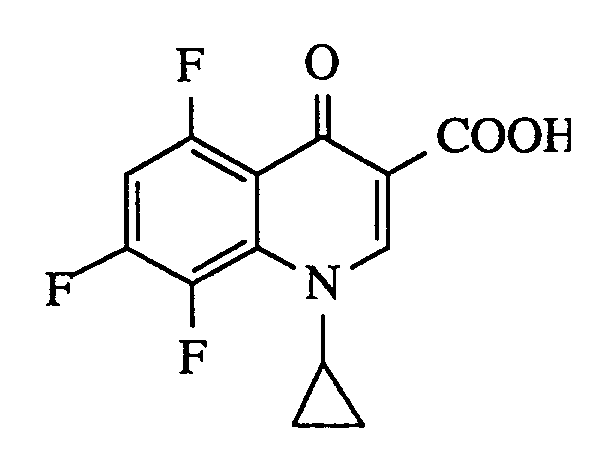
36,7 g (0,118 mol) 1-Cyclopropyl-5,7,8-trifluor-1,4-dihydro-4-oxo-3-chinolincarbonsäureethylester (JP 1308281) werden in eine Mischung aus 285 ml Essigsäure, 190 ml Wasser und 30 ml konzentrierter Schwefelsäure eingetragen und zwei Stunden zum Rückfluß erhitzt. Der Ansatz wird auf Eis gegeben, das Produkt isoliert, mit Wasser nachgewaschen und bei 100°C getrocknet.
Ausbeute: 31,6g (94 % der Theorie)
Schmelzpunkt: 218-220°C -

- a) 2,3,4-Trifluorbenzoesäurechlorid
Zu 1300 ml Thionylchlorid und 5 ml Dimethylformamid werden bei 50°C portionsweise über eine Dosierschnecke 1000 g (5,68 mol) 2,3,4-Trifluorbenzoesäure eingetragen. Nach dem Ende der Dosierung wird so lange zum Rückfluß erhitzt bis die Gasentwicklung beendet ist. Danach wird das überschüssige Thionylchlorid durch Destillation abgetrennt und das Produkt im Vakuum destilliert.
Ausbeute: 1027 g (93 % der Theorie)
Siedepunkt: 65°C / 10 mbar - b) (2,3,4-Trifluorbenzoyl)malonsäurediethylester
3,6 g (0,148 mol) Magnesiumspäne werden in 8,1 ml Ethanol vorgelegt, die Reaktion mit einigen Tropfen Tetrachlorkohlenstoff gestartet und anschließend die Lösung von 21,8 g (0,136 mol) Malonsäurediethylester in 15 ml Ethanol und 58 ml Toluol so zugetropft, daß die Innentemperatur zwischen 50 und 60°C liegt. Anschließend wird eine Stunde bei 60°C nachgerührt. Bei -10 bis -5°C wird die Lösung von 27,6 g (0,15 mol) 2,3,4-Trifluorbenzoesäurechlorid in 15,4 ml Toluol zugetropft, eine Stunde bei 0°C und anschließend unter Erwärmung auf Raumtemperatur über Nacht nachgerührt. Der Ansatz wird auf 60 ml Eiswasser gegeben, mit 9,7 ml konzentrierter Schwefelsäure versetzt und mit Toluol extrahiert. Es wird mit gesättigter Natriumchloridlösung gewaschen und das Lösungsmittel im Vakuum entfernt.
Rohausbeute: 45,2 g - c) (2,3,4-Trifluorbenzoyl)essigsäureethylester
45,2 g des bei b. erhaltenen Rohproduktes werden in 57 ml Wasser mit 1,66 g p-Toluolsulfonsäure 4,5 Stunden zum Rückfluß erhitzt. Der erkaltete Ansatz wird mit Methylenchlorid extrahiert, mit gesättigter Natriumchloridlösung gewaschen, über Natriumsulfat getrocknet und im Vakuum eingeengt.
Rohausbeute: 33 g - d) 3-Ethoxy-2-(2,3,4-trifluorbenzoyl)acrylsäureethylester
33 g des unter c. erhaltenen Produktes werden mit 31,5 g (0,213 mol) Orthoameisensäureethylester und 31,5 g (0,344 mol) Essigsäureanhydrid zwei Stunden auf 150-160°C erwärmt. Überschüssiges Reagenz wird zunächst im Vakuum, dann im Hochvakuum bis zu einer Badtemperatur von 100°C entfernt.
Rohausbeute: 34,5 g - e) 3-Ethylamin-2-(2,3,4-trifluorbenzoyl)acrylsäureethylester
9,06 g (0,03 mol) des unter d. erhaltenen Produktes werden in 60 ml Ethanol bei 0°C vorgelegt und 2,12 ml (0,033 mol) einer 70 %igen Ethylaminlösung zugetropft. Es wird vier Stunden bei Raumtemperatur nachgerührt, 60 ml Wasser zugetropft und das ausfallende Produkt isoliert. Es wird mit Wasser nachgewaschen und bei ca. 100°C getrocknet.
Ausbeute: 5,0 g (55 % der Theorie)
Schmelzpunkt: 106-108°C - f) 1-Ethyl-7,8-difluor-1,4-dihydro-4-oxo-3-chinolincarbonsäureethylester
5,0 g (0,017 mol) des unter e. erhaltenen Produktes werden mit 2,6 g (0,019 mol) Kaliumcarbonat in 30 ml Dimethylformamid vier Stunden auf 100°C erwärmt. Der erkaltete Ansatz wird auf Eiswasser gegeben, das Produkt isoliert, mit Wasser nachgewaschen und bei 100°C getrocknet.
Ausbeute: 3,6 g (77 % der Theorie)
Schmelzpunkt: 164-166°C - g) 1-Ethyl-7,8-difluor-1,4-dihydro-4-oxo-3-chinolincarbonsäure
3,5 g des unter f. erhaltenen Produktes werden in einem Gemisch aus 16 ml Essigsäure, 16 ml Wasser und 1,6 ml konzentrierter Schwefelsäure vier Stunden auf 140°C erwärmt. Der erkaltete Ansatz wird auf Eiswasser gegeben, das ausgefallene Produkt isoliert, mit Wasser nachgewaschen und bei 100°C getrocknet.
Ausbeute: 3,0 g (99 % der Theorie)
Schmelzpunkt: 237-239°C -

- a) 2-(2,3,4-Trifluorbenzoyl)-3-(2,4-difluorphenylamino)-acrylsäureethylester
9,06 g des unter Od. erhaltenen Produktes werden mit 4,26 g (0,33 mol) 2,4-Difluoranilin analog Beispiel Oe. umgesetzt.
Ausbeute: 7,3 g (63 % der Theorie)
Schmelzpunkt: 123-125°C - b) 7,8-Difluor-1-(2,4-difluorphenyl)-1,4-dihydro-4-oxo-3-chinolincarbonsäureethylester
7,3 g (0,019 mol) des unter a. erhaltenen Produktes werden mit 2,96 g (0,021 mol) Kaliumcarbonat analog zum Beispiel Of. umgesetzt.
Ausbeute: 5,8 g (83 % der Theorie)
Schlmelzpunkt: 159-160°C - c) 7,8-Difluor-1-(2,4-difluorphenyl)-1,4-dihydro-4-oxo-3-chinolincarbonsäure
5,7 g (0,016 mol) des unter b. erhaltenen Produktes werden analog zum Beispiel Og. umgesetzt.
Ausbeute: 4,9 g (94 % der Theorie)
Schmelzpunkt: 222-224°C -

- a) 2-(3-Chlor-2,4-difluorbenzoyl)-3-ethylamino-acrylsäureethylester
9,55 g (0,03 mol) 2-(3-Chlor-2,4-difluorbenzoyl)-3-ethoxyacrylsäureethylester werden in 66 ml Ethanol gelöst. Unter Eiskühlung werden 2,12 ml (0,033 mol) einer 70 %igen Ethylaminlösung zugetropft und unter Erwärmung auf Raumtemperatur über Nacht nachgerührt. Nach Zugabe von Wasser wird das Produkt isoliert, mit Wasser gewaschen und getrocknet.
Ausbeute: 6,3 g (66 % der Theorie)
Schmelzpunkt: 107-109°C - b) 8-Chlor-1-ethyl-7-fluor-1,4-dihydro-4-oxo-3-chinolin-carbonsäureethylester
3,175 g (0,01 mol) des unter a. erhaltenen Produktes werden mit 1,56 g (0,011 mol) Kaliumcarbonat in 20 ml Dimethylformamid vier Stunden auf 100°C erwärmt. Der erkaltete Ansatz wird auf Eiswasser gegeben, das Produkt wird isoliert, mit Wasser nachgewaschen und bei 100°C getrocknet.
Ausbeute: 2,8 g (94 % der Theorie)
Schmelzpunkt: 167-169°C - c) 8-Chlor-1-ethyl-7-fluor-1,4-dihydro-4-oxo-3-chinolincarbonsäure
2,7 g (9,1 mol) des unter b. erhaltenen Produktes werden in einer Mischung aus 11 ml Essigsäure, 11 ml Wasser und 1,1 ml konzentrierter Schwefelsäure vier Stunden zum Rückfluß erhitzt. Der Ansatz wird mit Wasser versetzt, das Produkt isoliert, mit Wasser nachgewaschen und bei 100°C getrocknet.
Ausbeute: 2,4g (98 % der Theorie)
Schmelzpunkt: 211-212°C -
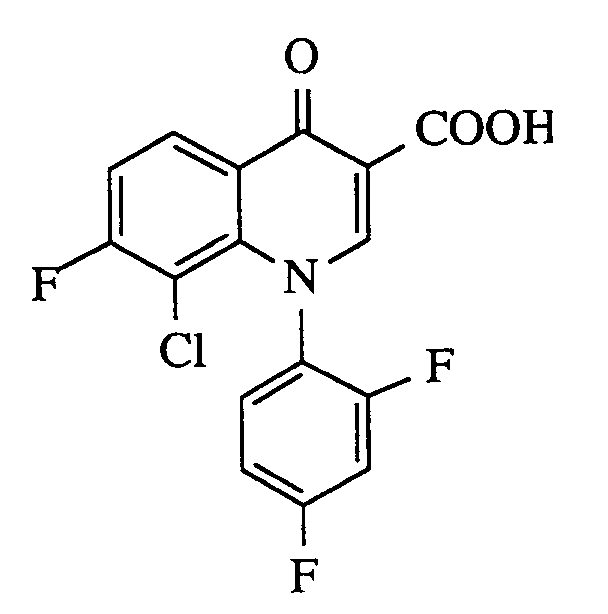
- a) 2-(3-Chlor-1,4-difluorbenzoyl)-3-(2,4-difluorphenylamino)-acrylsäureethylester
Analog zum Beispiel Oa. werden 9,55 g (0,03 mol) 2-(3-Chlor-2,4-difluorbenzoyl)-3-ethoxyacrylsäureethylester und 4,26 g (0,033 mol) 2,4-Difluorphenylamin umgesetzt.
Ausbeute: 9,4g (78 % der Theorie)
Schmelzpunkt: 115-116°C - b) 8-Chlor-7-fluor-1-(2,4-difluorphenyl)-1,4-dihydro-4-oxo-3-chinolincarbonsäureethylester
4,01 g (0,01 mol) des bei a) erhaltenen Produktes werden analog zum Beispiel Ob. mit 1,56 g (0,011 mol) Kaliumcarbonat in Dimethylformamid umgesetzt.
Ausbeute: 3,3 g (86 % der Theorie)
Schmelzpunkt: 183-185°C - c) 8-Chlor-7-fluor-1-(2,4-difluorphenyl)-1,4-dihydro-4-oxo-3-chinolincarbonsäure
3,2 g (8,4 mmol) des bei b. erhaltenen Esters werden analog zum Beispiel Oc. verseift.
Ausbeute: 2,7 g (91 % der Theorie)
Schmelzpunkt: 204-206°C -

- a) 3-Cyclopropylamino-2-(2,4-difluor-3-methylbenzoyl)-acrylsäureethylester
Zur bei 0°C rührenden Lösung von 10 g (0,034 mol) 3-Ethoxy-2-(2,4-difluor-3-methylbenzoyl)acrylsäureethylester (DE 3 615 767) werden 2,3 g (0,034 mol) Cyclopropylamin getropft und 30 Minuten bei Raumtemperatur nachgerührt. Der Ansatz wird auf Eiswasser gegeben und das ausgefallene Produkt mit Ethanol/Wasser gewaschen.
Ausbeute: 6,5 g (62 % der Theorie)
Schmelzpunkt: 96-97°C - b) 1-Cyclopropyl-7-fluor-1,4-dihydro-8-methyl-4-oxo-3-chinolincarbonsäureethylester
6,5 g (0,021 mol) des unter a. erhaltenen Produktes werden mit 3,4 g (0,025 mol) Kaliumcarbonat in 30 ml Dimethylformamid auf 140°C erwärmt. Der erkaltete Ansatz wird auf Eiswasser gegeben, das Produkt isoliert, mit Wasser gewaschen und bei 100°C getrocknet.
Ausbeute: 5,5g (90 % der Theorie)
Schmelzpunkt: 167-168°C - c) 1-Cyclopropyl-7-fluor-1,4-dihydro-8-methyl-4-oxo-3-chinolincarbonsäure
4,5 g (0,016 mol) des unter b. erhaltenen Esters werden in einer Mischung aus 18 ml Essigsäure, 14 ml Wasser und 1,6 ml konzentrierter Schwefelsäure zwei Stunden zum Rückfluß erhitzt. Der Ansatz wird auf Wasser gegeben, das Produkt isoliert und gründlich mit Wasser gewaschen.
Ausbeute: 3,9 g (93 % der Theorie)
Schmelzpunkt: 236-238°C -

- a) (2,6-Dichlornicotinoyl)malonsäurediethylester
Man legt 7,21 g (0,075 mol) Magnesiumchlorid bei 0°C in 75 ml absolutem Acetonitril vor und tropft unter Eisbadkühlung 12,12 g (0,075 mol) Malonsäurediethylester zu. Anschließend werden 15,34 g (0,150 mol) Triethylamin bei 0°C zugetropft, nach 60-minütigem Nachrühren werden bei 0°C 17,0 g (0,075 mol) 2,6-Dichlornicotinsäurechlorid (Helvetia Chimica Acta 59, 222, (1976)) zugetropft und unter Erwärmung auf Raumtemperatur über Nacht nachgerührt. Es wird mit 80 ml 18 %iger Salzsäure versetzt und mit Methyl-tert.-butylether extrahiert, über Natriumsulfat getrocknet und im Vakuum eingeengt. - b) (2,6-Dichlornicotinoyl)essigsäureethylester
Der rohe (2,6-Dichlornicotinoyl)-malonsäurediethylester wird in 45 ml Wasser mit 90 mg p-Toluolsulfonsäure 2 Stunden zum Rückfluß erhitzt. Es wird mit Methylenchlorid extrahiert, mit Wasser gewaschen, über Natriumsulfat getrocknet und im Vakuum eingeengt. Das Rohprodukt wird an Kieselgel (Laufmittel Dichlormethan) gereinigt.
Ausbeute: 14,2 g (72 % der Theorie über zwei Schritte) - c) 2-(2,6-Dichlornicotinoyl)-3-ethoxyacrylsäureethylester
43 g (0,162 mol) des Produktes von b. werden in 38,1 g (0,26 mol) Orthoameisensäureethylester und 42,4 g (0,42 mol) Essigsäureanhydrid zwei Stunden auf 150-160°C erwärmt. Alle leicht flüchtigen Bestandteile werden im Hochvakuum bei einer Badtemperatur bis 100°C abdestilliert und das Rohprodukt direkt weiter umgesetzt.
Rohausbeute: 50,5 g - d) 3-Cyclopropylamino-2-(2,6-dichlornicotinoyl)-acrylsäureethylester
Zu 9,54 g des Rohproduktes von c. werden in 66 ml Ethanol bei 0°C 1,88 g (0,33 mol) Cyclopropylamin getropft und über Nacht bei Raumtemperatur nachgerührt. Es wird mit Wasser versetzt und das auskristallisierte Produkt isoliert.
Ausbeute: 9,3 g (94 % der Theorie)
Schmelzpunkt: 123-124°C - e) 1-Cyclopropyl-7-chlor-1,4-dihydro-4-oxo-1,8-naphthyridin-3-carbonsäureethylester
3,29 g (0,01 mol) des unter d. erhaltenen Produktes werden in 20 ml Dimethylformamid mit 1,6 g (0,019 mol) Kaliumcarbonat eine Stunde auf 100°C erwärmt. Nach dem Abkühlen wird mit Wasser versetzt, das auskristallisierte Produkt isoliert und bei 100°C getrocknet.
Ausbeute: 2,8 g (95 % der Theorie)
Schmelzpunkt: 187-190°C -

- a) 2-(2,6-Dichlornicotinoyl)-3-(2,4-difluorphenylamino)-acrylsäureethylester
Zu 9,54 g des Rohproduktes von Tc. werden in 66 ml Ethanol bei 0°C 4,26 g (0,33 mol) 2,4-Difluorphenylamin getropft und über Nacht bei Raumtemperatur nachgerührt. Es wird mit Wasser versetzt und das auskristallisierte Produkt isoliert.
Ausbeute: 8,8 g (73 % der Theorie)
Schmelzpunkt: 128-129°C - b) 7-Chlor-1-(2,4-difluorphenyl)-1,4-dihydro-4-oxo-1,8-naphthyridin-3-carbonsäureethylester
4,01 g (0,01 mol) des unter a. erhaltenen Produktes werden in 20 ml Dimethylformamid mit 1,6 g (0,019 mol) Kaliumcarbonat eine Stunde auf 100°C erwärmt. Nach dem Abkühlen wird mit Wasser versetzt und das auskristallisierte Produkt isoliert und bei 100°C getrocknet.
Ausbeute: 3,5 g (96 % der Theorie)
Schmelzpunkt: 200-202°C -

- a) 2-(3-Chlor-2,4-difluorbenzoyl)-3-(cis-2-fluorcyclopropylamino)-acrylsäureethylester
4,8 g (0,015 mol) 2-(3-Chlor-2,4-difluorbenzoyl)-3-ethoxyacrylsäureethylester und 1,67 g (0,015 mol) cis-2-Fluorcyclopropylaminhydrochlorid (JP 3291258 A2) werden bei 0°C in einer Mischung aus 22,5 ml Dichlormethan und 9 ml Wasser vorgelegt. Bei 0°C wird anschließend die Lösung von 1,275 g Natriumhydrogencarbonat in 15 ml Wasser zugetropft und unter Erwärmung auf Raumtemperatur über Nacht nachgerührt. Die Phasen werden getrennt, mit Dichlormethan reextrahiert, über Natriumsulfat getrocknet und das Lösungmittel im Vakuum entfernt.
Ausbeute: 4,9 g (94 % der Theorie), Öl - b) 8-Chlor-7-fluor-1-(cis-2-fluorcyclopropyl)-1,4-dihydro-4-oxo-3-chinolincarbonsäureethylester
4,0 g (0,012 mol) des unter a. erhaltenen Produktes werden mit 1,9 g (0,014 mol) Kaliumcarbonat in 25 ml Dimethylformarmid vier Stunden auf 100°C erwärmt. Der erkaltete Ansatz wird auf Eiswasser gegeben und mit Dichlormethan extrahiert Die organischen Phasen werden über Natriumsulfat getrocknet, das Lösungsmittel im Vakuum entfernt, das Rohprodukt wird mit Acetonitril verrührt und das Produkt isoliert.
Ausbeute: 1,9 g (48 % der Theorie)
Schmelzpunkt: 179-180°C - c) 8-Chlor-7-fluor-1-(cis-2-fluorcyclopropyl)-1,4-dihydro-4-oxo-3-chinolincarbonsäure
1,0 g (3 mmol) des unter b. erhaltenen Produktes werden in einer Mischung aus 4 ml Essigsäure, 4 ml Wasser und 0,4 ml konzentrierter Schwefelsäure vier Stunden zum Rückfluß erhitzt. Der Ansatz wird mit Eiswassser versetzt, das Produkt isoliert, mit Wasser nachgewaschen und bei 100°C getrocknet.
Ausbeute: 0,76 g (85 % der Theorie)
Schmelzpunkt: 178-180°C -
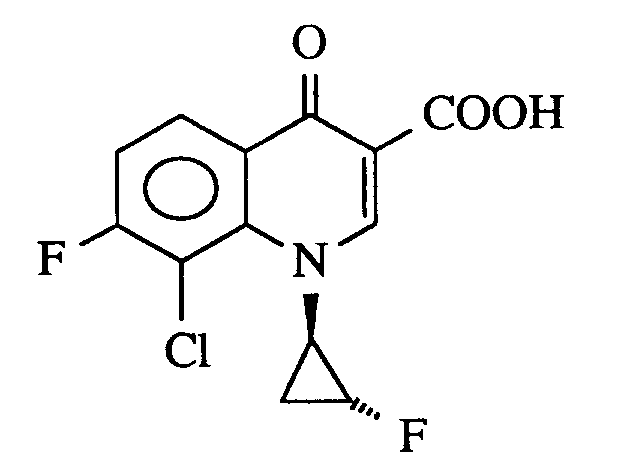
- a) 2-(3-Chlor-2,4-difluorbenzoyl)-3-(trans-2-fluorcyclopropylamino)-acrylsäureethylester
4,8 g (0,015 mol) 2-(3-Chlor-2,4-difluorbenzoyl)-3-ethoxyacrylsäureethylester und 1,67 g (0,015 mol) trans-2-Fluorcyclopropylaminhydrochlorid (JP 3291258 A2) werden bei 0°C in einer Mischung aus 22,5 ml Dichlormethan und 9 ml Wasser vorgelegt. Bei 0°C wird anschließend die Lösung von 1,275 g Natriumhydrogencarbonat in 15 ml Wasser zugetropft und unter Erwärmung auf Raumtemperatur über Nacht nachgerührt. Die Phasen werden getrennt, mit Dichlormethan reextrahiert, über Natriumsulfat getrocknet und das Lösungsmittel im Vakuum entfernt.
Ausbeute: 5,0 g (96 % der Theorie), Öl - b) 8-Chlor-7-fluor-1-(trans-2-fluorcyclopropyl)-1,4-dihydro-4-oxo-3-chinolincarbonsäureethylester
4,2 g (0,012 mol) des unter a. erhaltenen Produktes werden mit 1,9 g (0,014 mol) Kaliumcarbonat in 25 ml Dimethylformamid vier Stunden auf 100°C erwärmt. Der erkaltete Ansatz wird auf Eiswasser gegeben und das Produkt isoliert.
Ausbeute: 3,0 g (76 % der Theorie)
Schmelzpunkt: 184-186°C - c) 8-Chlor-7-fluor-1-(trans-2-fluorcyclopropyl)-1,4-dihydro-4-oxo-3-chinolincarbonsäure
2,3 g (7 mmol) des unter b. erhaltenen Produktes werden in einer Mischung aus 9,2 ml Essigsäure, 9,2 ml Wasser und 0,9 ml konzentrierter Schwefelsäure vier Stunden zum Rückfluß erhitzt. Der Ansatz wird mit Eiswasser versetzt, das Produkt isoliert, mit Wasser nachgewaschen und bei 100°C getrocknet.
Ausbeute: 1,8 g (86 % der Theorie)
Schmelzpunkt: 234-236°C -

- a) 2-(2,3,4-Trifluorbenzoyl)-3-(cis-2-fluorcyclopropylamino)acrylsäureethylester
4,53 g (0,015 mol) 2-(2,3,4-Trifluorbenzoyl)-3-ethoxy-acrylsäureethylester und 1,67 g (0,015 mol) cis-2-Fluorcyclopropylaminhydrochlorid (JP 3291258 A2) werden bei 0°C in einer Mischung aus 22,5 ml Dichlormethan und 9 ml Wasser vorgelegt. Bei 0°C wird anschließend die Lösung von 1,275 g Natriumhydrogencarbonat in 15 ml Wasser zugetropft und unter Erwärmung auf Raumtemperatur über Nacht nachgerührt. Die Phasen werden getrennt, mit Dichlormethan reextrahiert, über Natriumsulfat getrocknet und das Lösungsmittel im Vakuum entfernt.
Ausbeute: 4,7 g (94 % der Theorie)
Schmelzpunkt: 78-80°C - b) 7,8-Difluor-1-(cis-2-fluorcyclopropyl)-1,4-dihydro-4-oxo-3-chinolincarbonsäureethylester
4,5 g (0,0136 mol) des unter a. erhaltenen Produktes werden mit 2,12 g (0,015 mol) Kaliumcarbonat in 25 ml Dimethylformamid zwei Stunden auf 100°C erwärmt. Der erkaltete Ansatz wird auf Eiswasser gegeben und das Produkt isoliert.
Ausbeute: 3,1 g (74 % der Theorie)
Schmelzpunkt: 189-190°C - c) 7,8-Difluor-1-(cis-2-fluorcyclopropyl)-1,4-dihydro-4-oxo-3-chinolincarbonsäure
3,1 g (10 mmol) des unter b. erhaltenen Produktes werden in einer Mischung aus 13 ml Essigsäure, 13 ml Wasser und 1,3 ml konzentrierter Schwefelsäure zwei Stunden zum Rückfluß erhitzt. Der Ansatz wird mit Eiswasser versetzt, das Produkt isoliert, mit Wasser nachgewaschen und bei 100°C getrocknet.
Ausbeute: 2,4 g (85 % der Theorie)
Schmelzpunkt: 229-230°C -

- a) 2,4-Difluor-3-trifluormethylbenzoesäure
Unter Stickstoff werden 91 g (0,5 mol) 1,3-Difluor-2-trifluormethylbenzol in einem Gemisch aus 300 ml absolutem Tetrahydrofuran und 300 ml absolutem Diethylether gelöst und bei -70°C tropfenweise mit 220 ml (0,55 mol) einer 2,5 M n-Butyllithium-Lösung in Hexan versetzt. Nach einstündigem Nachrühren werden ca. 200 g Kohlendioxid bei -20°C durch die Lösung geleitet. Anschließend läßt man auf 5°C auftauen, rührt eine Stunde nach und hydrolysiert mit 200 ml 2 N Salzsäure. Die wäßrige Phase wird abgetrennt und zweimal mit Diethylether extrahiert Die vereinigten organischen Phasen werden mit verdünnter Salzsäure und Wasser gewaschen, über Magnesiumsulfat getrocknet und einrotiert.
Ausbeute: 48,6 g (43 % der Theorie)
Schmelzpunkt: 70-71°C - b) 2,4-Difluor-3-trifluormethylbenzoesäurechlorid
Zu 130 ml Thionylchlorid werden bei Raumtemperatur portionsweise 19,3 g (0,085 mol) 2,4-Difluor-3-trifluormethylbenzoesäure eingetragen. Nach dem Ende der Dosierung wird so lange auf 50°C erwärmt bis die Gasentwicklung beendet ist. Danach wird das überschüssige Thionylchlorid durch Destillation abgetrennt und das Rohprodukt direkt weiter umgesetzt.
Ausbeute: 20,0 g (90 % der Theorie) - c) (2,4-Difluor-3-trifluormethylbenzoyl)malonsäurediethylester
2,15 g (0,09 mol) Magnesiumspäne werden in 4,8 ml Ethanol vorgelegt, die Reaktion mit einigen Tropfen Tetrachlorkohlenstoff gestartet und anschließend die Lösung von 12,8 g (0,075 mol) Malonsäurediethylester in 9 ml Ethanol und 35 ml Toluol so zugetropft, daß die Innentemperatur zwischen 50 und 60°C liegt. Anschließend wird eine Stunde bei 60°C nachgerührt. Bei -10 bis -5°C wird die Lösung von 20,0 g (0,082 mol) 2,4-Difluor-3-trifluormethylbenzoesäurechlorid in 9 ml Toluol zugetropft, eine Stunde bei 0°C und anschließend unter Erwärmung auf Raumtemperatur nachgerührt. Der Ansatz wird auf 35 ml Eiswasser gegeben mit 5,7 ml konzentrierter Schwefelsäure versetzt und mit Toluol extrahiert. Es wird mit gesättigter Natriumchloridlösung gewaschen und das Lösungsmittel im Vakuum entfernt.
Rohausbeute: 30,0 g - d) (2,4-Difluor-3-trifluormethylbenzoyl)essigsäureethylester
30,0 g des bei c. erhaltenen Rohproduktes werden in 30 ml Wasser mit 0,96 g p-Toluolsulfonsäure 4,5 Stunden zum Rückfluß erhitzt. Der erkaltete Ansatz wird mit Methylenchlorid extrahiert, mit gesättigter Natriumchloridlösung gewaschen, über Natriumsulfat getrocknet und im Vakuum eingeengt.
Rohausbeute: 22 g - e) 3-Ethoxy-2-(2,4-difluor-3-trifluormethylbenzoyl)-acrylsäureethylester
22 g des unter d. erhaltenen Produktes werden mit 17,4 g (0,12 mol) Orthoameisensäureethylester und 19,4 g (0,19 mol) Essigsäureanhydrid zwei Stunden auf 150-160°C erwärmt. Überschüssiges Reagenz wird zunächst im Vakuum, dann im Hochvakuum bis zu einer Badtemperatur von 100°C entfernt.
Rohausbeute: 23,1 g - f) 3-Cyclopropylamino-2-(2,4-difluor-4-trifluormethylbenzoyl)-acrylsäureethylester
23,0 g (0,065 mol) des unter e. erhaltenen Produktes werden in 140 ml Ethanol bei 0°C vorgelegt und 4,08 g (0,072 mol) Cyclopropylamin zugetropft. Es wird über Nacht bei Raumtemperatur nachgerührt, 140 ml Wasser zugetropft und das ausfallende Produkt isoliert. Es wird mit Wasser nachgewaschen und bei ca. 100°C getrocknet.
Ausbeute: 9,4 g (39 % der Theorie)
Schmelzpunkt: 104-105°C - g) 1-Cyclopropyl-7-fluor-8-trifluormethyl-1,4-dihydro-4-oxo-3-chinolincarbonsäureethylester
9,0 g (0,025 mol) des unter f. erhaltenen Produktes werden mit 3,9 g (0,028 mol) Kaliumcarbonat in 50 ml Dimethylformamid vier Stunden auf 100°C erwärmt. Der erkaltete Ansatz wird auf Eiswasser gegeben, das Produkt isoliert, mit Wasser nachgewaschen und bei 100°C getrocknet.
Ausbeute: 8,1 g (98 % der Theorie)
Schmelzpunkt: 154-155°C - h) 1-Cyclopropyl-7-fluor-8-trifluormethyl-1,4-dihydro-4-oxo-3-chinolincarbonsäure
8,0 g (0,023 mol) des unter g. erhaltenen Produktes werden in einem Gemisch aus 30 ml Essigsäure, 30 ml Wasser und 3 ml konzentrierter Schwefelsäure zwei Stunden auf 140°C erwärmt. Der erkaltete Ansatz wird auf Eiswasser gegeben, das ausgefallene Produkt isoliert, mit Wasser nachgewaschen und bei 100°C getrocknet.
Ausbeute: 7,0 g (96 % der Theorie)
Schmelzpunkt: 209-210°C -
- a) 2,4,6-Trifluor-3-trifluormethylbenzoesäure
Analog zum Beispiel Ya. wird bei der Umsetzung von 1,3,5-Trifluor-2-trifluormethylbenzol die Titelverbindung erhalten.
Schmelzpunkt: 70-71°C - b) 2,4,6-Trifluor-3-trifluormethylbenzoesäurechlorid
Zu 40 ml Thionylchlorid werden bei Raumtemperatur portionsweise 5,8 g (0,024 mol) 2,4,6-Trifluor-3-trifluormethylbenzoesäure gegeben. Nach dem Ende der Dosierung wird so lange auf 50°C erwärmt bis die Gasentwicklung beendet ist. Danach wird das überschüssige Thionylchlorid durch Destillation abgetrennt und das Rohprodukt direkt weiter umgesetzt.
Ausbeute: 6,0 g (95 % der Theorie) - c) (2,4,6-Trifluor-3-trifluormethylbenzoyl)malonsäurediethylester
0,58 g (0,024 mol) Magnesiumspäne werden in 1,3 ml Ethanol vorgelegt, die Reaktion mit einigen Tropfen Tetrachlorkohlenstoff gestartet und anschließend die Lösung von 3,4 g (0,019 mol) Malonsäurediethylester in 2,4 ml Ethanol und 9 ml Toluol so zugetropft, daß die Innentemperatur zwischen 50 und 60°C liegt. Anschließend wird eine Stunde bei 60°C nachgerührt. Bei -10 bis -5°C wird die Lösung von 5,8 g (0,027 mol) 2,4,6-Trifluor-3-trifluormethylbenzoesäurechlorid in 2,5 ml Toluol zugetropft, eine Stunde bei 0°C und anschließend unter Erwärmung auf Raumtemperatur nachgerührt. Der Ansatz wird auf 10 ml Eiswasser gegeben, mit 1,5 ml konzentrierter Schwefelsäure versetzt und mit Toluol extrahiert. Es wird mit gesättigter Natriumchloridlösung gewaschen und das Lösungsmittel im Vakuum entfernt.
Rohausbeute: 8,6 g - d) (2,4,6-Trifluor-3 trifluormethylbenzoyl)essigsäureethylester
8,6 g des bei c. erhaltenen Rohproduktes werden in 9 ml Wasser mit 0,26 g p-Toluolsulfonsäure 4,5 Stunden zum Rückfluß erhitzt. Der erkaltete Ansatz wird mit Methylenchlorid extrahiert, mit gesättigter Natriumchloridlösung gewaschen, über Natriumsulfat getrocknet und im Vakuum eingeengt.
Rohausbeute: 5,6 g - e) 3-Ethoxy-2-(2,4,6-trifluor-3-trifluormethylbenzoyl)-acrylsäureethylester
5,4 g (0,017 mol) des unter d. erhaltenen Produktes werden mit 4,0 g (0,027 mol) Orthoameisensäureethylester und 4,45 g (0,043 mol) Essigsäureanhydrid zwei Stunden auf 150-160°C erwärmt. Überschüssiges Reagenz wird zunächst im Vakuum, dann im Hochvakuum bis zu einer Badtemperatur von 100°C entfernt.
Rohausbeute: 3,8 g - f) 3-Cyclopropylamino-2-(2,4,6-trifluor-4-trifluormethylbenzoyl)-acrylsäureethylester
3,8 g (0,01 mol) des unter e. erhaltenen Produktes werden in 22 ml Ethanol bei 0°C vorgelegt und 0,63 g (0,011 mol) Cyclopropylamin zugetropft. Es wird über Nacht bei Raumtemperatur nachgerührt, 22 ml Wasser zugetropft und das ausfallende Produkt isoliert. Es wird mit Wasser nachgewaschen und bei ca. 100°C getrocknet.
Ausbeute: 3,3 g (86 % der Theorie)
Schmelzpunkt: 146-148°C - g) 1-Cyclopropyl-5,7-difluor-8-trifluormethyl-1,4-dihydro-4-oxo-3-chinolincarbonsäureethylester
3,5 g (9,2 mmol) des unter f. erhaltenen Produktes werden mit 1,45 g (0,01 mol) Kaliumcarbonat in 18 ml Dimethylformamid eine Stunde auf 100°C erwärmt. Der erkaltete Ansatz wird auf Eiswasser gegeben, das Produkt isoliert, mit Wasser nachgewaschen. Die Reinigung des Produktes erfolgt an Kieselgel, Laufmittel Cyclohexan/Tetrahydrofuran 7/3
Ausbeute: 1,4 g (42 % der Theorie)
Schmelzpunkt: 197-198°C - h) 1-Cyclopropyl-5,7-difluor-8-trifluormethyl-1,4-dihydro-4-oxo-3-chinolincarbonsäure
1,4 g (3,9 mmol) des unter g. erhaltenen Produktes werden in einem Gemisch aus 5 ml Essigsäure, 5 ml Wasser und 0,5 ml konzentrierter Schwefelsäure zwei Stunden auf 140°C erwärmt. Der erkaltete Ansatz wird auf Eiswasser gegeben, das ausgefallene Produkt isoliert, mit Wasser nachgewaschen und bei 100°C getrocknet.
Ausbeute: 1,1 g (84 % der Theorie)
Schmelzpunkt: 208-210°C -

- a) 2,3,4-Trifluor-6-trifluormethylbenzoesäure
Analog zum Beispiel Ya. wird bei der Umsetzung von 1,2,3,-Trifluor-5-trifluormethylbenzol die Titelverbindung erhalten.
Schmelzpunkt: 83-84°C - b) 2,3,4-Trifluor-6-trifluormethylbenzoesäurechlorid
Zu 40 ml Thionylchlorid werden bei Raumtemperatur portionsweise 5,8 g (0,024 mol) 2,3,4,-Trifluor-6-trifluormethylbenzoesäure eingetragen. Nach dem Ende der Dosierung wird so lange auf 50°C erwärmt bis die Gasentwicklung beendet ist. Danach wird das überschüssige Thionylchlorid durch Destillation abgetrennt und das Rohprodukt direkt weiter umgesetzt.
Ausbeute: 5,0 g (79 % der Theorie) - c) (2,3,4-Trifluor-6-trifluormethylbenzoyl)malonsäurediethylester
0,47 g (0,019 mol) Magnesiumspäne werden in 1,0 ml Ethanol vorgelegt, die Reaktion mit einigen Tropfen Tetrachlorkohlenstoff gestartet und anschließend die Lösung von 2,8 g (0,016 mol) Malonsäurediethylester in 2,0 ml Ethanol und 7,5 ml Toluol so zugetropft, daß die Innentemperatur zwischen 50 und 60°C liegt. Anschließend wird eine Stunde bei 60°C nachgerührt. Bei -10 bis -5°C wird die Lösung von 4,8 g (0,027 mol) 2,3,4-Trifluor-6-trifluormethylbenzoesäurechlorid in 2,0 ml Toluol zugetropft, eine Stunde bei 0°C und anschließend unter Erwärmung auf Raumtemperatur nachgerührt. Der Ansatz wird auf 10 ml Eiswasser gegeben, mit 1,25 ml konzentrierter Schwefelsäure versetzt und mit Toluol extrahiert. Es wird mit gesättigter Natriumchloridlösung gewaschen und das Lösungsmittel im Vakuum entfernt.
Rohausbeute: 6,6 g - d) (2,3,4-Trifluor-6-trifluormethylbenzoyl)essigsäureethylester
6,6 g des bei c. erhaltenen Rohproduktes werden in 7,5 ml Wasser mit 0,21 g p-Toluolsulfonsäure 4,5 Stunden zum Rückfluß erhitzt. Der erkaltete Ansatz wird mit Methylenchlorid extrahiert, mit gesättigter Natriumchloridlösung gewaschen, über Natriumsulfat getrocknet und im Vakuum eingeengt.
Rohausbeute: 4,2 g - e) 3-Ethoxy-2-(2,3,4-trifluor-6-trifluormethylbenzoyl)-acrylsäureethylester
4,0 g (0,013 mol) des unter d. erhaltenen Produktes werden mit 3,5 g (0,024 mol) Orthoameisensäureethylester und 3,4 g (0,033 mol) Essigsäureanhydrid zwei Stunden auf 150-160°C erwärmt. Überschüssiges Reagenz wird zunächst im Vakuum, dann im Hochvakuum bis zu einer Badtemperatur von 100°C entfernt.
Rohausbeute: 2,7 g - f) 3-Cyclopropylamino-2-(2,3,4-trifluor-6-trifluormethylbenzoyl)-acrylsäureethylester
2,7 g (7,3 mmol) des unter e. erhaltenen Produktes werden in 16 ml Ethanol bei 0°C vorgelegt und 0,46 g (8 mmol) Cyclopropylamin zugetropft. Es wird über Nacht bei Raumtemperatur nachgerührt, 16 ml Wasser zugetropft und das ausfallende Produkt isoliert. Es wird mit Wasser nachgewaschen und bei ca. 100°C getrocknet.
Ausbeute: 2,1 g (75 % der Theorie)
Schmelzpunkt: 165-168°C - g) 1-Cyclopropyl-7,8-difluor-5-trifluormethyl-1,4-dihydro-4-oxo-3-chinolincarbonsäureethylester
2,1 g (5,5 mmol) des unter f. erhaltenen Produktes werden mit 0,88 g (6,4 mmol) Kaliumcarbonat in 11 ml Dimethylformamid eine Stunde auf 100°C erwärmt. Der erkaltete Ansatz wird auf Eiswasser gegeben, das Produkt isoliert, mit Wasser nachgewaschen.
Ausbeute: 1,7 g (85 % der Theorie)
Schmelzpunkt: 188-190°C - h) 1-Cyclopropyl-7,8-difluor-5-trifluormethyl-1,4-dihydro-4-oxo-3-chinolincarbonsäure
1,5 g (4,2 mmol) des unter g. erhaltenen Produktes werden in einem Gemisch aus 5,5 ml Essigsäure, 5,5 ml Wasser und 0,55 ml konzentrierter Schwefelsäure zwei Stunden auf 140°C erwärmt. Der erkaltete Ansatz wird auf Eiswasser gegeben, das ausgefallene Produkt isoliert, mit Wasser nachgewaschen und bei 100°C getrocknet.
Ausbeute: 1,3 g (92 % der Theorie)
Schmelzpunkt: 226-228°C -
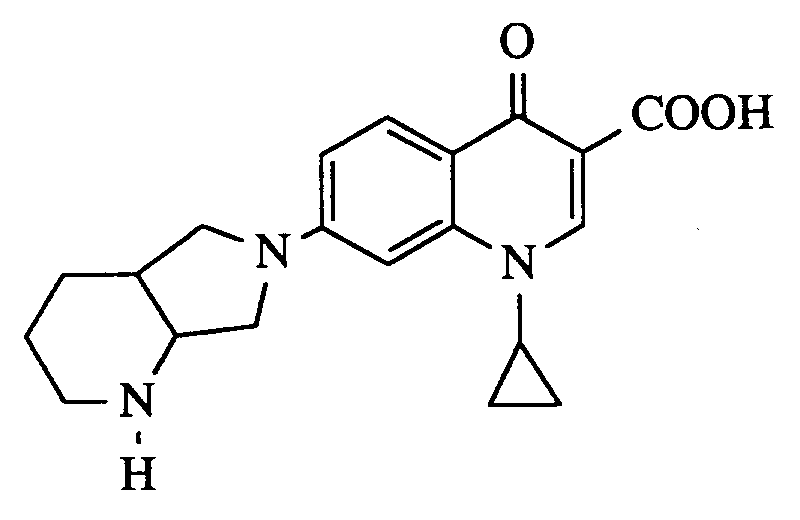
- 741 mg (3 mmol) 1-Cyclopropyl-7-fluor-1,4-dihydro-4-oxo-3-chinolincarbonsäure werden mit 567 mg (4,5 mol) 2,8-Diazabicyclo[4.3.0]nonan und 672 mg 1,4-Diazabicyclo[2.2.2]octan in 30 ml N-Methylpyrrolidon zwei Stunden auf 100°C erwärmt. Die Mischung wird im Hochvakuum eingeengt, der Rückstand mit Acetonitril gründlich verrührt und bei 100°C getrocknet.
Ausbeute: 820 mg (77 % der Theorie)
Schmelzpunkt: 250-252°C (unter Zersetzung) -

-
- Analog zum Beispiel 1 wird bei der Umsetzung mit 4-Methylamino-1,3,3a,4,7,7a-hexahydroisoindol die Titelverbindung erhalten.
Schmelzpunkt: 238-240°C -

- 650 mg (2,3 mmol) 8-Chlor-1-cyclopropyl-7-fluor-1,4-dihydro-4-oxo-3-chinolincarbonsäure werden mit 315 mg (2,8 mmol) 2,7-Diazabicyclo[3.3.0]octan und 510 mg (4,6 mmol) 1,4-Diazabicyclo[2.2.2]octan in 23 ml Dimethylsulfoxid sechs Stunden auf 120°C erwärmt. Alle flüchtigen Komponenten werden im Hochvakuum entfernt, der Rückstand gründlich mit Acetonitril verrührt und bei ca 100°C getrocknet.
Ausbeute: 629 mg (72 % der Theorie)
Schmelzpunkt: 202-204°C (unter Zersetzung) -


-

-
- 2 g (5 mmol) 7-(4-Amino-1,3,3a,4,7,7a-hexahydroisoindol-2-yl)-3-chlor-1-cyclopropyl-1,4-dihydro-4-oxo-3-chinolincarbonsäure werden in 60 ml halbkonzentrierter Salzsäure 30 Minuten bei 60°C gerührt. Überschüssige Salzsäure wird im Vakuum entfernt und der Rückstand mit Acetonitril verrührt.
Ausbeute: 1,8 g (82 % der Theorie)
Schmelzpunkt: 118-120°C (unter Zersetzung) -

- 620 mg (2,3 mmol) 1-Cyclopropyl-7,8-difluor-1,3-dihydro-4-oxo-3-chinolincarbonsäure werden mit 315 mg (2,8 mmol) 2,7-Diazabicyclo[3.3.0]octan und 0,51 g (4,6 mmol) 1,4-Diazabicyclo[2.2.2]octan in 23 ml Dimethylsulfoxid zwei Stunden auf 120°C erwärmt. Alle flüchtigen Bestandteile werden im Hochvakuum entfernt und der Rückstand gründlich mit Acetonitril verrührt und bei ca. 100°C getrocknet.
Ausbeute: 770 mg (93 % der Theorie)
Schmelzpunkt: 249-251°C (unter Zersetzung) -


-

-
- Analog zum Beispiel 15 wird bei der Umsetzung von 7-(4-Amino-7-methyl-1,3,3a,4,7,7a-hexahydroisoindol-2-yl)-1-cyclopropyl-8-fluor-1,4-dihydro-4-oxo-3-chinolincarbonsäure die Titelverbindung erhalten.
Schmelzpunkt: 262-264°C (unter Zersetzung) -
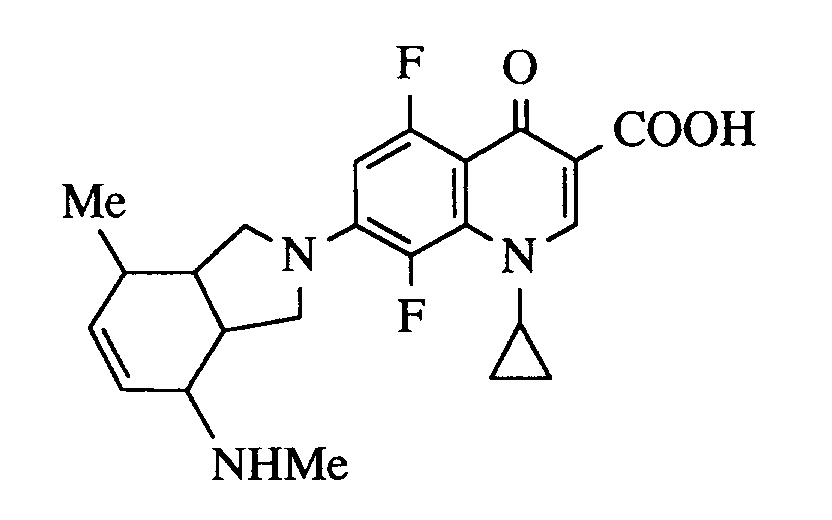
- 1,1 g (4 mmol) 1-Cyclopropyl-5,7,8-trifluor-1,4-dihydro-4-oxo-3-chinolincarbonsäure werden mit 797 mg (4,8 mmol) 7-Methyl-4-methylamino-1,3,3a,4,7,7a-hexahydroisoindol und 896 mg (8 mmol) 1,4-Diazabicyclo[2.2.2]octan in 40 ml Dimethylsulfoxid zwei Tage bei Raumtemperatur gerührt. Alle flüchtigen Bestandteile werden im Hochvakuum entfernt, der Rückstand mit Acetonitril verrührt und bei ca. 100°C getrocknet.
Ausbeute: 1,2 g (70 % der Theorie)
Schmelzpunkt: 210-212°C (unter Zersetzung) -
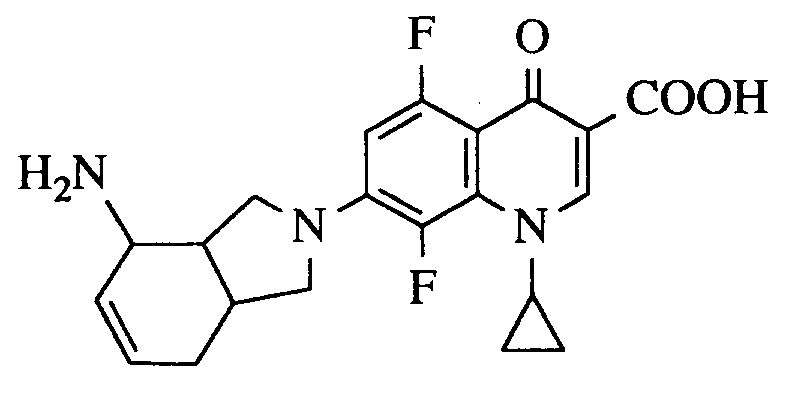
- Analog zum Beispiel 29 wird bei der Umsetzung mit 4-Amino-1,3,3a,4,7,7a-hexahydroisoindol die Titelverbindung erhalten.
Schmelzpunkt: 272-274°C (unter Zersetzung) -

- 270 mg (1 mmol) 8-Chlor-1-ethyl-7-fluor-1,4-dihydro-4-oxo-3-chinolincarbonsäure werden mit 180 mg (1,2 mmol) 4-Amino-7-methyl-1,3,3a,4,7,7a-hexahydroisoindol und 224 mg (2 mmol) 1,4-Diazabicyclo[2.2.2]octan in 10 ml Dimethylsulfoxid drei Stunden auf 100°C erwärmt.
- Alle flüchtigen Bestandteile werden im Hochvakuum entfernt, der Rückstand mit Acetonitril verrührt und bei 100°C getrocknet.
Ausbeute: 340 mg (85 % der Theorie)
Schmelzpunkt: 164-166°C -

- Analog zum Beispiel 31 wird bei der Umsetzung mit 4-Amino-1,3,3a,4,7,7a-hexahydroisoindol die Titelverbindung erhalten.
Schmelzpunkt: 194-196°C (unter Zersetzung) -

-
- Analog zum Beispiel 31 wird bei der Umsetzung von 8-Chlor-7-fluor-1-(2,4-difluorphenyl)-1,4-dihydro-4-oxo-3-chinolincarbonsäure mit 4-Amino-7-methyl-1,3,3a,4,7,7a-hexahydroisoindol die Titelverbindung erhalten.
Schmelzpunkt: 231-233°C (unter Zersetzung) -

- Analog zum Beispiel 31 wird bei der Umsetzung von 8-Chlor-7-fluor-1-(2,4-difluorphenyl)-1,4-dihydro-4-oxo-3-chinolincarbonsäure mit 4-Amino-1,3,3a,4,7,7a-hexahydroisoindol die Titelverbindung erhalten.
Schmelzpunkt: 256-258°C (unter Zersetzung) -

- a) 7-(4-Amino-1,3,3a,4,7,7a-hexahydroisoindol-2-yl)-1-cyclopropyl-1,4-dihydro-4-oxo-1,8-naphthyridin-3-carbonsäureethylester
292 mg (1 mmol) 7-Chlor-1-cyclopropyl-1,4-dihydro-4-oxo-1,8-naphthyridin-3-carbonsäureethylester werden mit 0,3 g (2,2 mmol) 4-Amino-1,3,3a,4,7,7a-hexahydroisoindol in einer Mischung aus 3 ml Dimethylformamid und 6 ml Acetonitril zwei Stunden unter Argon bei Raumtemperatur gerührt. Die Lösungsmittel werden im Hochvakuum entfernt und der Rückstand mit Acetonitril verrührt.
Ausbeute: 160 mg (40 % der Theorie)
Schmelzpunkt: 192-193°C (unter Zersetzung) - b) 7-(4-Amino-1,3,3a,4,7,7a-hexahydroisoindol-2-yl)-1-cyclopropyl-1,4-dihydro-4-oxo-1,8-naphthyridin-3-carbonsäurehydrochlorid
150 mg (0,38 mmol) des oben erhaltenen Esters werden in 4,2 ml Essigsäure und 3,4 ml 18 %iger Salzsäure zehn Stunden zum Rückfluß erhitzt. Es wird bis zur Trockene einrotiert und bei ca 100°C getrocknet.
Ausbeute: 110 mg (73 % der Theorie)
Schmelzpunkt: 268-270°C(Zersetzung) -

- a) 7-(4-Amino-7-methyl-1,3,3a,4,7,7a-hexahydroisoindol-2-yl)-1-cyclopropyl-1,4-dihydro-4-oxo-1,8-naphthyridin-3-carbonsäureethylester
Analog zum Beispiel 35 a. wird bei der Umsetzung mit 4-Amino-7-methyl-1,3,3a,4,7,7a-hexahydroisoindol die Titelverbindung erhalten.
Schmelzpunkt: 172-176°C - b) 7-(4-Amino-7-methyl-1,3,3a,4,7,7a-hexahydroisoindol-2-yl)-1-cyclopropyl-1,4-dihydro-4-oxo-1,8-naphthyridin-3-carbonsäurehydrochlorid
Analog zum Beispiel 35 b. wird bei der Umsetzung der oben erhaltenen Verbindung die Titelverbindung erhalten.
Schmelzpunkt: 260-262°C -

- a) 7-(4-Amino-1,3,3a,4,7,7a-hexahydroisoindol-2-yl)-1-(2,4-difluorphenyl)-1,4-dihydro-4-oxo-1,8-naphthyridin-3-carbonsäureethylester
Analog zum Beispiel 35 a. wird bei der Umsetzung von 7-Chlor-1-(2,4-difluorphenyl)-1,4-dihydro-4-oxo-1,8-naphthyridin-3-carbonsäureethylester mit 4-Amino-1,3,3a,4,7,7a-hexahydroisoindol die Titelverbindung erhalten.
Schmelzpunkt: 178-180°C - b) 7-(4-Amino-1,3,3a,4,7,7a-hexahydroisoindol-2-yl)-1-(2,4-diflourphenyl)-1,4-dihydro-4-oxo-1,8-naphthyridin-3-carbonsäurehydrochlorid
Analog zum Beispiel 35 b. wird bei der Umsetzung der oben erhaltenen Verbindung die Titelverbindung erhalten.
Schmelzpunkt: 254-256°C -

- a) 7-(4-Amino-7-methyl-1,3,3a,4,7,7a-hexahydroisoindol-2-yl)-1-(2,4-difluorphenyl)1,4-dihydro-4-oxo-1,8-naphthyridin-3-carbonsäureethylester
Analog zum Beispiel 35 a. wird bei der Umsetzung von 7-Chlor-1-(2,4-difluorphenyl)-1,4-dihydro-4-oxo-1,8-naphthyridin-3-carbonsäureethylester mit 4-Amino-7-methyl-1,3,3a,4,7,7a-hexahydroisoindol die Titelverbindung erhalten.
Schmelzpunkt: 143-144°C - b) 7-(4-Amino-7-methyl-1,3,3a,4,7,7a-hexahydroisoindol-2-yl)-1-(2,4-difluorphenyl)-1,4-dihydro-4-oxo-1,8-naphthyridin-3-carbonsäurehydrochlorid
Analog zum Beispiel 35 b. wird bei der Umsetzung der oben erhaltenen Verbindung die Titelverbindung erhalten.
Schmelzpunkt: 244-245°C -

299 mg (1 mmol) 8-Chlor-7-fluor-1-(cis-2-fluorcyclopropyl)-1,4-dihydro-4-oxo-3-chinolincarbonsäure werden mit 165 mg (1,2 mmol) 4-Amino-1,3,3a,4,7,7a-hexahydroisoindol und 224 mg (2 mmol) 1,4-Diazabicyclo[2.2.2]octan in 10 ml Dimethylsulfoxid über Nacht bei Raumtemperatur gerührt. Alle flüchtigen Bestandteile werden im Hochvakuum entfernt, der Rückstand mit Acetonitril verrührt und bei 100°C getrocknet.
Ausbeute: 400 mg (95 % der Theorie)
Schmelzpunkt: 159-161°C -

Analog zum Beispiel 39 wird bei der Umsetzung von 8-Chlor-7-fluor-1-(cis-2-fluorcyclopropyl)-1,4-dihydro-4-oxo-3-chinolincarbonsäure mit 4-Amino-7-methyl-1,3,3a,4,7,7a-hexahydroisoindol die Titelverbindung erhalten.
Schmelzpunkt: 168-170°C -

299 mg (1 mmol) 8-Chlor-7-fluor-1-(trans-2-fluorcyclopropyl)-1,4-dihydro-4-oxo-3-chinolincarbonsäure werden mit 165 mg (1,2 mmol) 4-Amino-1,3,3a,4,7,7a-hexahydroisoindol und 224 mg (2 mmol) 1,4-Diazabicyclo[2.2.2]octan in 10 ml Dimethylsulfoxid über Nacht bei Raumtemperatur gerührt. Alle flüchtigen Bestandteile werden im Hochvakuum entfernt, der Rückstand mit Acetonitril verrührt und bei 100°C getrocknet.
Ausbeute: 400 mg (95 % der Theorie)
Schmelzpunkt: 181-183°C -

Analog zum Beispiel 41 wird bei der Umsetzung von 8-Chlor-7-fluor-1-(trans-2-fluorcyclopropyl)-1,4-dihydro-4-oxo-3-chinolincarbonsäure mit 4-Amino-7-methyl-1,3,3a,4,7,7a-hexahydroisoindol die Titelverbindung erhalten.
Schmelzpunkt: 177-179°C -

283 mg (1 mmol) 7,8-Difluor-1-(cis-2-fluorcyclopropyl)-1,4-dihydro-4-oxo-3-chinolincarbonsäure werden mit 165 mg (1,2 mmol) 4-Amino-1,3,3a,4,7,7a-hexahydroisoindol und 224 mg (2 mmol) 1,4-Diazabicyclo[2.2.2]octan in 10 ml Dimethylsulfoxid über Nacht bei Raumtemperatur gerührt. Alle flüchtigen Bestandteile werden im Hochvakuum entfernt, der Rückstand mit Ethanol verrührt und bei 100°C getrocknet.
Ausbeute: 330 mg (82 % der Theorie)
Schmelzpunkt: 244-246°C (unter Zersetzung) -

Analog zum Beispiel 43 wird bei der Umsetzung von 7,8-Difluor-1-(cis-2-fluorcyclopropyl)-1,4-dihydro-4-oxo-3-chinolincarbonsäure mit 4-Amino-7-methyl-1,3,3a,4,7,7a-hexahydroisoindol die Titelverbindung erhalten.
Schmelzpunkt: 204-206°C (unter Zersetzung) -

333 mg (1 mmol) 1-Cyclopropyl-7,8-difluor-5-trifluormethyl-1,4-dihydro-4-oxo-3-chinolincarbonsäure werden mit 165 mg (1,2 mmol) 4-Amino-1,3,3a,4,7,7a-hexahydroisoindol und 224 mg (2 mmol) 1,4-Diazabicyclo[2.2.2]octan in 10 ml Dimethylsulfoxid über Nacht bei Raumtemperatur gerührt. Alle flüchtigen Bestandteile werden im Hochvakuum entfernt, der Rückstand mit Acetonitril verrührt und bei 100°C getrocknet.
Ausbeute: 330 mg (73 % der Theorie)
Schmelzpunkt: 248-249°C (unter Zersetzung) -
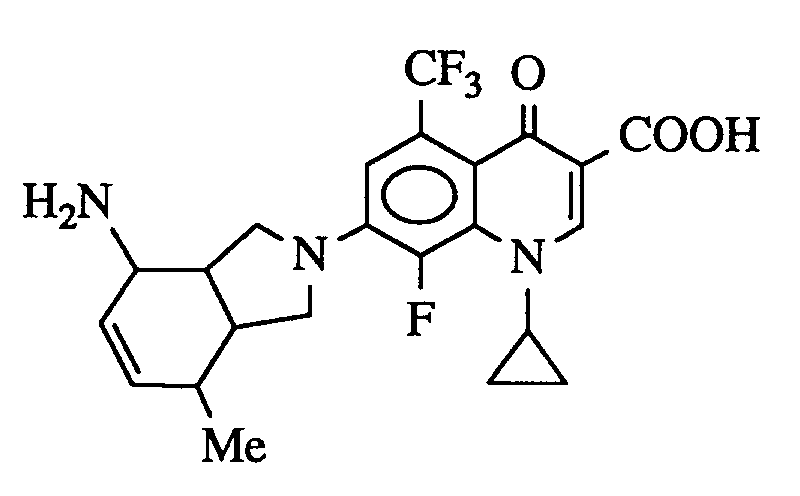
Analog zum Beispiel 45 wird bei der Umsetzung von 1-Cyclopropyl-7,8-difluor-5-trifluormethyl-1,4-dihydro-4-oxo-3-chinolincarbonsäure mit 4-Amino-7-methyl-1,3,3a,4,7,7a-hexahydroisoindol die Titelverbindung erhalten.
Schmelzpunkt: 242-244°C (unter Zersetzung) -

Analog zum Beispiel 45 wird bei der Umsetzung von 1-Cyclopropyl-5,7-difluor-8-trifluormethyl-1,4-dihydro-4-oxo-3-chinolincarbonsäure mit 4-Amino-1,3,3a,4,7,7a-hexahydroisoindol die Titelverbindung erhalten.
Schmelzpunkt: 238-240°C (unter Zersetzung) -

Analog zum Beispiel 45 wird bei der Umsetzung von 1-Cyclopropyl-5,7-difluor-8-trifluormethyl-1,4-dihydro-4-oxo-3-chinolincarbonsäure mit 4-Amino-7-methyl-1,3,3a,4,7,7a-hexahydroisoindol die Titelverbindung erhalten.
Schmelzpunkt: 234-236°C (unter Zersetzung) -

315 mg (1 mmol) 1-Cyclopropyl-7-fluor-8-trifluormethyl-1,4-dihydro-4-oxo-3-chinolincarbonsäure werden mit 165 mg (1,2 mmol) 4-Amino-1,3,3a,4,7,7a-hexahydroisoindol und 224 mg (2 mmol) 1,4-Diazabicyclo[2.2.2]octan in 10 ml Dimethylsulfoxid zwei Stunden bei 100°C gerührt Alle flüchtigen Bestandteile werden im Hochvakuum entfernt, der Rückstand mit Acetonitril verrührt und bei 100°C getrocknet.
Ausbeute: 280 mg (65 % der Theorie)
Schmelzpunkt: 168-170°C (unter Zersetzung) -

4,245 g (0,015 mol) 1-Cyclopropyl-5,7,8-trifluor-1,4-dihydro-4-oxo-3-chinolincarbonsäure werden mit 2,736 g (0,018 mol) 3-Methylamino-1,3,3a,4,7,7a-hexahydroisoindol und 3,36 g (0,03 mol) 1,4-Diazabicyclo[2.2.2]octan in 150 ml Dimethylsulfoxid über Nacht bei Raumtemperatur gerührt. Alle flüchtigen Komponenten werden im Hochvakuum entfernt und der Rückstand mit Acetonitril verrührt.
Ausbeute: 5,5 g (88 % der Theorie)
Schmelzpunkt: 238-240°C (unter Zersetzung) -

2 g (4,8 mmol) 1-Cyclopropyl-5,8-difluor-1,4-dihydro-7-(4-methylamino-1,3,3a,4,7,7a-hexahydroisoindol-2yl)-4-oxo-3-chinolincarbonsäure werden in 200 ml Dimethylsulfoxid in einem Autoklaven vorgelegt. Nach Zugabe von 5 ml flüssigen Ammoniak wird 9 Stunden bei 140°C und 6 bar gerührt. Alle flüchtigen Komponenten werden im Vakuum entfernt und der Rückstand mit Ethanol verrührt.
Ausbeute: 0,7 g (35,5 % der Theorie)
Schmelzpunkt: 156-158°C (unter Zersetzung)
Z-H (III),
in welcher
Claims (10)
- Chinolon- und Naphthyridoncarbonsäurederivate der allgemeinen Formel (I)
 R¹ für gegebenenfalls durch Hydroxy, Halogen oder C₁-C₃-Alkoxy substituiertes geradkettiges oder verzweigtes C₁-C₄-Alkyl, für gegebenenfalls durch C₁-C₃-Alkyl oder Halogen substituiertes C₃-C₆-Cycloalkyl, C₂-C₄-Alkenyl, ferner für C₁-C₃-Alkoxy, Amino, Monoalkylamino mit 1 bis 3 C-Atomen, Dialkylamino mit 1 bis 3 C-Atomen je Alkylgruppe oder für gegebenenfalls durch Halogen ein- bis dreifach substituiertes Phenyl steht,R² für Wasserstoff, gegebenenfalls durch Hydroxy, Methoxy, Amino, Methylamino oder Dimethylamino substituiertes Alkyl mit 1 bis 4 Kohlenstoffatomen oder (5-Methyl-2-oxo-1,3-dioxol-4-yl)-methyl,X¹ für Wasserstoff, Halogen, Amino, Methyl oder Trifluormethyl,Z für Reste der Strukturen

worinR³ für Wasserstoff, Hydroxy, -NR⁷R⁸, Hydroxymethyl oder -CH₂-NR⁷R⁸ steht,
wobeiR⁷ Wasserstoff, gegebenenfalls durch Hydroxy substituiertes C₁-C₃-Alkyl, Alkoxycarbonyl mit 1 bis 4 C-Atomen im Alkoxyteil oder C₁-C₃-Acyl undR⁸ Wasserstoff oder Methyl bedeutet,R⁴ für Wasserstoff, geradkettiges oder verzweigtes C₁-C₃-Alkyl oder Cyclopropyl,R4' für Wasserstoff oder Methyl,R⁵ für Wasserstoff oder Methyl,R⁶ für Wasserstoff, Methyl oder Reste der Strukturen -CH=CH-CO₂R5', -CH₂-CH₂-CO₂R5', -CH₂-CO-CH₃, -CH₂-CH₂-CN,R5' für Methyl oder Ethyl,B für -CH₂-, O oder eine direkte Bindung steht undA für N oder C-R⁹ steht,
worinR⁹ für H, Halogen, Methyl, Trifluormethyl, Vinyl, Ethinyl, Hydroxy oder Methoxy steht oder auch gemeinsam mit R¹ eine Brücke der Strukturin Form von Racematen oder als enantiomerenreine Verbindungen, deren pharmazeutisch verwendbaren Hydrate und Säureadditionsalze sowie die Alkali-, Erdalkali-, Silber- und Guanidiniumsalze der zugrundeliegenden Carbonsäuren.
- Chinolon- und Naphthyridoncarbonsäurederivate gemäß Anspruch 1, dadurch gekennzeichnet, daß in Formel (I)R¹ für gegebenenfalls durch Hydroxy oder Fluor substituiertes C₁-C₂-Alkyl, für gegebenenfalls durch Fluor substituiertes C₃-C₅-Cycloalkyl, Vinyl, Amino, Monoalkylamino mit 1 bis 2 C-Atomen, Dialkylamino mit 1 bis 2 C-Atomen je Alkylgruppe oder für gegebenenfalls durch Halogen ein- bis zweifach substituiertes Phenyl steht,R² für Wasserstoff, gegebenenfalls durch Amino oder Dimethylamino substituiertes Alkyl mit 1 bis 2 Kohlenstoffatomen oder (5-Methyl-2-oxo-1,3-dioxol-4-yl)-methyl,X¹ für Wasseistoff, Fluor, Chlor, Trifluormethyl oder Amino,Z für Reste der Strukturen

worinR³ für Wasserstoff, Hydroxy, -NR⁷R⁸, Hydroxymethyl oder -CH₂-NR⁷R⁸ steht,
wobeiR⁷ Wasserstoff, gegebenenfalls durch Hydroxy substituiertes C₁-C₂-Alkyl, Alkoxycarbonyl mit 1 bis 4 C-Atomen im Alkoxyteil oder C₁-C₃-Acyl undR⁸ Wasserstoff oder Methyl bedeutet,R⁴ für Wasserstoff, geradkettiges oder verzweigtes C₁-C₃-Alkyl oder Cyclopropyl,R⁵ für Wasserstoff oder Methyl,B für -CH₂-, O oder eine direkte Bindung steht undA für N oder C-R⁹ steht,
worinR⁹ für H, Chlor, Fluor, Methyl, Trifluormethyl, Hydroxy oder Methoxy steht oder auch gemeinsam mit R¹ eine Brücke der Struktur
- Chinolon- und Naphthyridoncarbonsäurederivate gemäß Anspruch 1, dadurch gekennzeichnet, daß in Formel (I)R¹ für Methyl, Ethyl, gegebenenfalls durch Fluor substituiertes Cyclopropyl oder für gegebenenfalls durch Fluor ein- oder zweifach substituiertes Phenyl steht,R² für Wasserstoff, Methyl oder Ethyl,X¹ für Wasserstoff, Fluor, Trifluormethyl oder Amino,Z für Reste der Strukturen

worinR³ für Wasserstoff, Hydroxy, -NR⁷R⁸, Hydroxymethyl oder -CH₂-NR⁷R⁸ steht,
wobeiR⁷ Wasserstoff, Methyl, Alkoxycarbonyl mit 1 bis 4 C-Atomen im Alkoxyteil oder C₁-C₃-Acyl undR⁸ Wasserstoff oder Methyl bedeutet,R⁴ für Wasserstoff, geradkettiges oder verzweigtes C₁-C₃-Alkyl oder Cyclopropyl,R⁵ für Wasserstoff oder Methyl,B für -CH₂-, O oder eine direkte Bindung steht undA für N oder C-R⁹ steht,
worinR⁹ für H, Chlor, Fluor, Methyl, Methoxy, Trifluormethyl steht oder auch gemeinsam mit R¹ eine Brücke der Struktur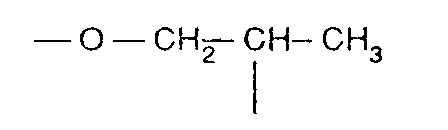
- Arzneimittel enthaltend Chinolon- und Naphthyridoncarbonsäurederivate gemäß, Ansprüchen 1 bis 3.
- Antibakterielle Mittel enthaltend Chinolon- und Naphthyridoncarbonsäurederivate gemäß Ansprüchen 1 bis 3.
- Verwendung von Chinolon- und Naphthyridoncarbonsäurederivate gemäß Ansprüchen 1 bis 3 bei der Herstellung von Arzneimitteln.
- Verwendung von Chinolon- und Naphthyridoncarbonsäurederivate gemäß Ansprüchen 1 bis 3 zum Materialschutz.
- Futtermittel und Prämixe enthaltend Chinolon- und Naphthyridoncarbonsäurederivate gemäß Ansprüchen 1 bis 3.
- Verfahren zur Herstellung von Chinolon- und Naphthyridoncarbonsäurederivate gemäß Ansprüchen 1 bis 3, dadurch gekennzeichnet, daß Verbindungen der Formel (II)
 R¹, R², X¹ und A die Bedeutung gemäß Ansprüchen 1 bis 3 haben undX² für Halogen steht,mit Verbindungen der Formel (III)
Z-H (III),
in welcherZ die Bedeutung gemäß Ansprüchen 1 bis 3 hat,gegebenenfalls in Gegenwart von Säurefängern umgesetzt werden. - Verbindungen aus der Gruppe bestehend aus
1-Cyclopropyl-7-fluor-1,4-dihydro-4-oxo-3-chinolincarbonsäure,
8-Chlor-1-cyclopropyl-7-fluor-1,4-dihydro-4-oxo-3-chinolincarbonsäure,
1-Cyclopropyl-5,7,8-trifluor-1,4-dihydro-4-oxo-3-chinolincarbonsäure,
1-Ethyl-7,8-difluor-1,4-dihydro-4-oxo-3-chinolincarbonsäure,
7,8-Difluor-1-(2,4-difluorphenyl)-1,4-dihydro-4-oxo-3-chinolincarbonsäure,
8-Chlor-1-ethyl-7-fluor-1,4-dihydro-4-oxo-3-chinolincarbonsäure,
8-Chlor-7-fluor-1-(2,4-difluorphenyl)-1,4-dihydro-4-oxo-3-chinolincarbonsäure,
1-Cyclopropyl-7-fluor-1,4-dihydro-8-methyl-4-oxo-3-chinolincarbonsäure,
7-Chlor-1-cyclopropyl-1,4-dihydro-4-oxo-1,8-naphthyridin-3-carbonsäureethylester,
7-Chlor-1-(2,4-difluorphenyl)-1,4-dihydro-4-oxo-1,8-naphthyridin-3-carbonsäureethylester,
8-Chlor-7-fluor-1-(trans-2-fluorcyclopropyl)-1,4-dihydro-4-oxo-3-chinolincarbonsäure,
7,8-Difluor-1-(cis-2-fluorcyclopropyl)-1,4-dihydro-4-oxo-3-chinolincarbonsäure,
1-Cyclopropyl-7-fluor-8-trifluormethyl-1,4-dihydro-4-oxo-3-chinolincarbonsäure,
1-Cyclopropyl-5,7-difluor-8-trifluormethyl-1,4-dihydro-4-oxo-3-chinolincarbonsäure,
1-Cyclopropyl-7,8-difluor-5-trifluormethyl-1,4-dihydro-4-oxo-3-chinolincarbonsäure.
Applications Claiming Priority (2)
| Application Number | Priority Date | Filing Date | Title |
|---|---|---|---|
| DE4301246A DE4301246A1 (de) | 1993-01-19 | 1993-01-19 | Chinolon- und Naphthyridoncarbonsäurederivate |
| DE4301246 | 1993-01-19 |
Publications (1)
| Publication Number | Publication Date |
|---|---|
| EP0607825A1 true EP0607825A1 (de) | 1994-07-27 |
Family
ID=6478454
Family Applications (1)
| Application Number | Title | Priority Date | Filing Date |
|---|---|---|---|
| EP94100204A Withdrawn EP0607825A1 (de) | 1993-01-19 | 1994-01-07 | 6-H-4-Oxo-3-chinolinecarbonsäure und ihre Analoge als antibakterielle Mittel |
Country Status (21)
| Country | Link |
|---|---|
| US (1) | US5457104A (de) |
| EP (1) | EP0607825A1 (de) |
| JP (1) | JPH06247962A (de) |
| KR (1) | KR940018380A (de) |
| CN (1) | CN1097423A (de) |
| AU (2) | AU667757B2 (de) |
| CA (1) | CA2113513A1 (de) |
| CZ (1) | CZ10094A3 (de) |
| DE (1) | DE4301246A1 (de) |
| FI (1) | FI940216A7 (de) |
| HU (1) | HUT68455A (de) |
| IL (1) | IL108347A (de) |
| MX (1) | MX9400341A (de) |
| MY (1) | MY110747A (de) |
| NO (1) | NO940039L (de) |
| NZ (1) | NZ250681A (de) |
| PL (1) | PL301928A1 (de) |
| RU (1) | RU2114832C1 (de) |
| SK (1) | SK5394A3 (de) |
| TW (1) | TW266213B (de) |
| ZA (1) | ZA94332B (de) |
Cited By (8)
| Publication number | Priority date | Publication date | Assignee | Title |
|---|---|---|---|---|
| EP0726270A1 (de) * | 1995-02-09 | 1996-08-14 | Bayer Ag | 1,6-Naphthyridoncarbonsäurederivate |
| EP0704443A3 (de) * | 1994-08-04 | 1996-08-14 | Bayer Ag | Chinolon- und Naphthyrdioncarbonsäure-Derivate |
| US5811433A (en) * | 1995-02-09 | 1998-09-22 | Bayer Aktiengesellschaft | 1,6-naphthyridonecarboxylic acid derivatives |
| EP0947513B1 (de) * | 1996-10-25 | 2004-05-19 | Daiichi Pharmaceutical Co., Ltd. | Tricyclische aminderivate |
| WO2013068948A1 (en) | 2011-11-08 | 2013-05-16 | Actelion Pharmaceuticals Ltd | 2-oxo-oxazolidin-3,5-diyl antibiotic derivatives |
| WO2018011017A1 (de) | 2016-07-11 | 2018-01-18 | Bayer Pharma Aktiengesellschaft | 7-substituierte 1-pyridyl-naphthyridin-3-carbonsäureamide und ihre verwendung |
| EP3296298A1 (de) | 2016-09-14 | 2018-03-21 | Bayer Pharma Aktiengesellschaft | 7-substituierte 1-aryl-naphthyridin-3-carbonsäureamide und ihre verwendung |
| WO2018050510A1 (de) | 2016-09-14 | 2018-03-22 | Bayer Aktiengesellschaft | 7-substituierte 1-aryl-naphthyridin-3-carbonsäureamide und ihre verwendung |
Families Citing this family (18)
| Publication number | Priority date | Publication date | Assignee | Title |
|---|---|---|---|---|
| DE3906365A1 (de) * | 1988-07-15 | 1990-01-18 | Bayer Ag | 7-(1-pyrrolidinyl)-3-chinolon- und -naphthyridoncarbonsaeure-derivate, verfahren sowie substituierte (oxa)diazabicyclooctane und -nonane als zwischenprodukte zu ihrer herstellung, und sie enthaltende antibakterielle mittel und futterzusatzstoffe |
| DE4230804A1 (de) * | 1992-09-15 | 1994-03-17 | Bayer Ag | 7-Isoindolinyl-chinolon- und -naphthyridon-Derivate |
| KR100276477B1 (ko) * | 1996-02-09 | 2000-12-15 | 나카노 가쓰히코 | 퀴놀론카복실산유도체또는그의염 |
| CN1264837C (zh) * | 1997-09-15 | 2006-07-19 | 普罗克特和甘保尔公司 | 喹诺酮抗微生物剂、其组合物和应用 |
| US6387928B1 (en) | 1997-09-15 | 2002-05-14 | The Procter & Gamble Co. | Antimicrobial quinolones, their compositions and uses |
| ATE342897T1 (de) * | 1998-04-06 | 2006-11-15 | Toyama Chemical Co Ltd | Chinoloncarbonsäurederivate oder deren salze |
| ATE304539T1 (de) * | 2000-12-14 | 2005-09-15 | Procter & Gamble | Antimikrobielle chinolone |
| AU2002230893B2 (en) | 2000-12-14 | 2005-06-09 | The Procter & Gamble Company | Antimicrobial 2-pyridones, their compositions and uses |
| DE10108750A1 (de) * | 2001-02-23 | 2002-09-05 | Bayer Ag | Verbessertes Verfahren zur Herstellung von Fluorchinoloncarbonsäuren |
| BRPI0709209A2 (pt) * | 2006-03-28 | 2011-06-28 | Procter & Gamble | processo de redução de hidreto para preparo de intermediários de quinolona |
| ES2366150T3 (es) * | 2006-03-28 | 2011-10-17 | Warner Chilcott Company, Llc | Malatos de polimorfos de ácido (3s,5s)-7-[3-amino-5-metil-piperidinil]-1-ciclopropil-1,4-dihidro-8-metoxi-4-oxo-3-quinolinocarboxílico. |
| CA2647454A1 (en) * | 2006-03-28 | 2007-10-04 | The Procter & Gamble Company | A coupling process for preparing quinolone intermediates |
| BRPI1010981A2 (pt) | 2009-05-15 | 2018-12-04 | Redx Pharma Ltd | "derivados de fármaco redox" |
| CN109942488A (zh) * | 2019-04-04 | 2019-06-28 | 山东省联合农药工业有限公司 | 一种喹啉羧酸酯类化合物及其制备方法与用途 |
| US20200385398A1 (en) | 2019-06-07 | 2020-12-10 | Elanco Tiergesundheit Ag | New bicyclic derivatives |
| CN115368957B (zh) * | 2019-08-14 | 2023-10-13 | 胜牌全球产品知识产权有限公司 | 含有无灰tbn分子的润滑剂组合物 |
| CN116941624B (zh) * | 2021-04-29 | 2026-01-30 | 山东省联合农药工业有限公司 | 一种杀菌杀虫组合物及其应用 |
| CN113929579A (zh) * | 2021-11-22 | 2022-01-14 | 南京一苇医药科技有限公司 | 一种克林沙星关键中间体的制备方法 |
Citations (6)
| Publication number | Priority date | Publication date | Assignee | Title |
|---|---|---|---|---|
| US4416884A (en) * | 1978-04-12 | 1983-11-22 | Otsuka Pharmaceutical Co., Ltd. | Piperazinylbenzoheterocyclic compounds |
| EP0393400A1 (de) * | 1989-03-31 | 1990-10-24 | Wakunaga Seiyaku Kabushiki Kaisha | Chinolinon-Derivate, Verfahren zu ihrer Herstellung und diese Derivate enthaltende antibakteriell wirkende Mittel |
| EP0429304A2 (de) * | 1989-11-21 | 1991-05-29 | SHIONOGI SEIYAKU KABUSHIKI KAISHA trading under the name of SHIONOGI & CO. LTD. | Pyridon-Carbonsäurederivate und ihre Verwendung als Tierarzneimittel |
| EP0516861A1 (de) * | 1990-12-27 | 1992-12-09 | Banyu Pharmaceutical Co., Ltd. | Pyridoncarbonsäurederivat |
| EP0520240A1 (de) * | 1991-06-22 | 1992-12-30 | Bayer Ag | 7-Isoindolinyl-chinolon- und naphthyridoncarbonsäure-Derivate |
| EP0550903A1 (de) * | 1992-01-10 | 1993-07-14 | Bayer Ag | Chinolon- und Naphthyridon-Carbonsäurederivate als antibakterielles Mittel |
Family Cites Families (5)
| Publication number | Priority date | Publication date | Assignee | Title |
|---|---|---|---|---|
| JPS604820B2 (ja) * | 1979-02-26 | 1985-02-06 | 大塚製薬株式会社 | キノリンカルボン酸誘導体 |
| DE3441788A1 (de) * | 1984-11-15 | 1986-05-15 | Bayer Ag, 5090 Leverkusen | Alkyl-1-cyclopropyl-1,4-dihydro-4-oxo-3-chinolincarbonsaeuren, verfahren zu ihrer herstellung sowie diese enthaltende antibakterielle mittel |
| DE3615767A1 (de) * | 1986-05-10 | 1987-11-12 | Bayer Ag | Verfahren zur herstellung von 4-hydroxy-chinolin-3-carbonsaeuren |
| US5270340A (en) * | 1988-12-27 | 1993-12-14 | Bayer Aktiengesellschaft | Substituted 2-cyclohexen-1-yl-amine fungicidal and herbicidal agents |
| DE4230804A1 (de) * | 1992-09-15 | 1994-03-17 | Bayer Ag | 7-Isoindolinyl-chinolon- und -naphthyridon-Derivate |
-
1993
- 1993-01-19 DE DE4301246A patent/DE4301246A1/de not_active Withdrawn
- 1993-12-20 TW TW082110770A patent/TW266213B/zh active
- 1993-12-20 AU AU52561/93A patent/AU667757B2/en not_active Ceased
-
1994
- 1994-01-05 NO NO940039A patent/NO940039L/no unknown
- 1994-01-07 EP EP94100204A patent/EP0607825A1/de not_active Withdrawn
- 1994-01-07 MX MX9400341A patent/MX9400341A/es not_active Application Discontinuation
- 1994-01-12 MY MYPI94000082A patent/MY110747A/en unknown
- 1994-01-12 US US08/180,948 patent/US5457104A/en not_active Expired - Fee Related
- 1994-01-14 NZ NZ250681A patent/NZ250681A/en unknown
- 1994-01-14 JP JP6014979A patent/JPH06247962A/ja active Pending
- 1994-01-14 CA CA002113513A patent/CA2113513A1/en not_active Abandoned
- 1994-01-17 CZ CZ94100A patent/CZ10094A3/cs unknown
- 1994-01-17 FI FI940216A patent/FI940216A7/fi unknown
- 1994-01-17 SK SK53-94A patent/SK5394A3/sk unknown
- 1994-01-17 RU RU94000714A patent/RU2114832C1/ru active
- 1994-01-17 IL IL108347A patent/IL108347A/en not_active IP Right Cessation
- 1994-01-17 PL PL94301928A patent/PL301928A1/xx unknown
- 1994-01-18 ZA ZA94332A patent/ZA94332B/xx unknown
- 1994-01-18 HU HU9400143A patent/HUT68455A/hu unknown
- 1994-01-18 KR KR1019940000818A patent/KR940018380A/ko not_active Withdrawn
- 1994-01-19 CN CN94101078A patent/CN1097423A/zh active Pending
-
1996
- 1996-01-16 AU AU42033/96A patent/AU4203396A/en not_active Abandoned
Patent Citations (6)
| Publication number | Priority date | Publication date | Assignee | Title |
|---|---|---|---|---|
| US4416884A (en) * | 1978-04-12 | 1983-11-22 | Otsuka Pharmaceutical Co., Ltd. | Piperazinylbenzoheterocyclic compounds |
| EP0393400A1 (de) * | 1989-03-31 | 1990-10-24 | Wakunaga Seiyaku Kabushiki Kaisha | Chinolinon-Derivate, Verfahren zu ihrer Herstellung und diese Derivate enthaltende antibakteriell wirkende Mittel |
| EP0429304A2 (de) * | 1989-11-21 | 1991-05-29 | SHIONOGI SEIYAKU KABUSHIKI KAISHA trading under the name of SHIONOGI & CO. LTD. | Pyridon-Carbonsäurederivate und ihre Verwendung als Tierarzneimittel |
| EP0516861A1 (de) * | 1990-12-27 | 1992-12-09 | Banyu Pharmaceutical Co., Ltd. | Pyridoncarbonsäurederivat |
| EP0520240A1 (de) * | 1991-06-22 | 1992-12-30 | Bayer Ag | 7-Isoindolinyl-chinolon- und naphthyridoncarbonsäure-Derivate |
| EP0550903A1 (de) * | 1992-01-10 | 1993-07-14 | Bayer Ag | Chinolon- und Naphthyridon-Carbonsäurederivate als antibakterielles Mittel |
Cited By (12)
| Publication number | Priority date | Publication date | Assignee | Title |
|---|---|---|---|---|
| EP0704443A3 (de) * | 1994-08-04 | 1996-08-14 | Bayer Ag | Chinolon- und Naphthyrdioncarbonsäure-Derivate |
| US5605910A (en) * | 1994-08-04 | 1997-02-25 | Bayer Aktiengesellschaft | Quinolone-and naphthyridonecarboxylic acid derivatives |
| US5986105A (en) * | 1994-08-04 | 1999-11-16 | Bayer Aktiengesellschaft | Quinolone- and naphthyridonecarboxylic acid derivatives |
| US5990122A (en) * | 1994-08-04 | 1999-11-23 | Bayer Aktiengesellschaft | Quinolone- and naphthyridonecarboxylic acid derivatives |
| EP0726270A1 (de) * | 1995-02-09 | 1996-08-14 | Bayer Ag | 1,6-Naphthyridoncarbonsäurederivate |
| US5811433A (en) * | 1995-02-09 | 1998-09-22 | Bayer Aktiengesellschaft | 1,6-naphthyridonecarboxylic acid derivatives |
| EP0947513B1 (de) * | 1996-10-25 | 2004-05-19 | Daiichi Pharmaceutical Co., Ltd. | Tricyclische aminderivate |
| WO2013068948A1 (en) | 2011-11-08 | 2013-05-16 | Actelion Pharmaceuticals Ltd | 2-oxo-oxazolidin-3,5-diyl antibiotic derivatives |
| US9079922B2 (en) | 2011-11-08 | 2015-07-14 | Actelion Pharmaceuticals Ltd | 2-oxo-oxazolidin-3,5-diyl antibiotic derivatives |
| WO2018011017A1 (de) | 2016-07-11 | 2018-01-18 | Bayer Pharma Aktiengesellschaft | 7-substituierte 1-pyridyl-naphthyridin-3-carbonsäureamide und ihre verwendung |
| EP3296298A1 (de) | 2016-09-14 | 2018-03-21 | Bayer Pharma Aktiengesellschaft | 7-substituierte 1-aryl-naphthyridin-3-carbonsäureamide und ihre verwendung |
| WO2018050510A1 (de) | 2016-09-14 | 2018-03-22 | Bayer Aktiengesellschaft | 7-substituierte 1-aryl-naphthyridin-3-carbonsäureamide und ihre verwendung |
Also Published As
| Publication number | Publication date |
|---|---|
| ZA94332B (en) | 1994-08-26 |
| SK5394A3 (en) | 1994-12-07 |
| FI940216A0 (fi) | 1994-01-17 |
| US5457104A (en) | 1995-10-10 |
| MY110747A (en) | 1999-02-27 |
| NO940039D0 (no) | 1994-01-05 |
| CN1097423A (zh) | 1995-01-18 |
| AU5256193A (en) | 1994-07-28 |
| KR940018380A (ko) | 1994-08-16 |
| IL108347A0 (en) | 1994-04-12 |
| RU2114832C1 (ru) | 1998-07-10 |
| CZ10094A3 (en) | 1995-03-15 |
| IL108347A (en) | 1998-02-22 |
| CA2113513A1 (en) | 1994-07-20 |
| AU4203396A (en) | 1996-04-04 |
| TW266213B (de) | 1995-12-21 |
| AU667757B2 (en) | 1996-04-04 |
| FI940216A7 (fi) | 1994-07-20 |
| HUT68455A (en) | 1995-06-28 |
| MX9400341A (es) | 1994-08-31 |
| DE4301246A1 (de) | 1994-07-21 |
| NO940039L (no) | 1994-07-20 |
| PL301928A1 (en) | 1994-07-25 |
| JPH06247962A (ja) | 1994-09-06 |
| HU9400143D0 (en) | 1994-05-30 |
| NZ250681A (en) | 1995-06-27 |
Similar Documents
| Publication | Publication Date | Title |
|---|---|---|
| EP0350733B1 (de) | 7-(1-Pyrrolidinyl)-3-chinolon- und -naphthyridoncarbon-säure-Derivate, Verfahren zu ihrer Herstellung sowie substituierte mono-und bicyclische Pyrrolidinderivate als Zwischenprodukte zu ihrer Herstellung, und sie enthaltende antibakterielle Mittel und Futterzusatzstoffe | |
| DE4301246A1 (de) | Chinolon- und Naphthyridoncarbonsäurederivate | |
| EP0520240A1 (de) | 7-Isoindolinyl-chinolon- und naphthyridoncarbonsäure-Derivate | |
| EP0520277A2 (de) | 7-Azaisoindolinyl-chinolon- und naphthyridoncarbonsäure-Derivate | |
| EP0523512B1 (de) | 8-Vinyl- und 8-Ethinyl-chinoloncarbonsäuren | |
| EP0588166B1 (de) | Antibakterielle 7-Isoindolinyl-chinolon- und naphthyridon-Derivate | |
| EP0284935A1 (de) | 5-Substituierte Chinolon- und Naphthyridoncarbonsäure-Derivate | |
| DE69531305T2 (de) | Pyridoncarboxylat- derivate oder salze davon und antibakterielle zusammensetzungen die diese als aktiven bestandteil enthalten | |
| EP0187376B1 (de) | 6,7-Disubstituierte 1-Cyclopropyl-1,4-dihydro-4-oxo-1,8-naphthyridin-3-carbonsäuren | |
| EP0230274A2 (de) | 7-(Azabicycloalkyl)-chinoloncarbonsäure- und -naphthyridoncarbonsäure-Derivate | |
| EP0481274B1 (de) | 7-(2,7-Diazabicyclo[3,3.0]octyl)-3-chinolon- und -naphthyridoncarbonsäure-Derivate | |
| EP0705828B1 (de) | Chinolon- und Naphthyridoncarbonsäure-Derivate als antibakterielle Mittel | |
| EP0589318B1 (de) | Antibakterielle 7-(Aminomethyl-oxa-7-aza-bicyclo 3.3.0 oct-7-yl)chinolon- und -naphthyridoncarbonsäure-Derivate | |
| EP0770083B1 (de) | PYRIDO[3,2,1-i,j][3,1]BENZOXAZINDERIVATE | |
| EP0653425A1 (de) | 1-(2-Fluorcyclopropyl)-chinolon- und naphthyridoncarbonsäure-Derivate, deren Herstellung und deren Verwendung in antibakteriellen Mitteln | |
| EP0704443B1 (de) | Chinolon- und Naphthyridoncarbonsäurederivate | |
| EP0726270B1 (de) | 1,6-Naphthyridoncarbonsäurederivate | |
| EP0721948B1 (de) | Chinolon- und Naphthyridoncarbonsäure-Derivate als antibakterielle Mittel | |
| DE19506535A1 (de) | 1,6-Naphthyridoncarbonsäurederivate | |
| DD285601A5 (de) | Verfahren zur herstellung von 7-(1-pyrrolidinyl)-3-chinolon- und naphthyridoncarbonsaeure-derivaten | |
| DD257428A5 (de) | Verfahren zur herstellung von 1-cyclopropyl-1,4-dihydro-4-oxo-1,8-naphthydridin-3-carbonsaeuren |
Legal Events
| Date | Code | Title | Description |
|---|---|---|---|
| PUAI | Public reference made under article 153(3) epc to a published international application that has entered the european phase |
Free format text: ORIGINAL CODE: 0009012 |
|
| AK | Designated contracting states |
Kind code of ref document: A1 Designated state(s): AT BE CH DE DK ES FR GB GR IE IT LI LU MC NL PT SE |
|
| 17P | Request for examination filed |
Effective date: 19950110 |
|
| 17Q | First examination report despatched |
Effective date: 19980810 |
|
| STAA | Information on the status of an ep patent application or granted ep patent |
Free format text: STATUS: THE APPLICATION HAS BEEN WITHDRAWN |
|
| 18W | Application withdrawn |
Withdrawal date: 19981106 |