EP0608493A2 - Copolycarbonate aromatique, procédé pour sa préparation et dispositif optique à guide d'onde fabriqué à partir du dit copolycarbonate - Google Patents
Copolycarbonate aromatique, procédé pour sa préparation et dispositif optique à guide d'onde fabriqué à partir du dit copolycarbonate Download PDFInfo
- Publication number
- EP0608493A2 EP0608493A2 EP93117336A EP93117336A EP0608493A2 EP 0608493 A2 EP0608493 A2 EP 0608493A2 EP 93117336 A EP93117336 A EP 93117336A EP 93117336 A EP93117336 A EP 93117336A EP 0608493 A2 EP0608493 A2 EP 0608493A2
- Authority
- EP
- European Patent Office
- Prior art keywords
- plastic optical
- mol
- component
- aromatic polycarbonate
- polycarbonate copolymer
- Prior art date
- Legal status (The legal status is an assumption and is not a legal conclusion. Google has not performed a legal analysis and makes no representation as to the accuracy of the status listed.)
- Withdrawn
Links
Images

Classifications
-
- C—CHEMISTRY; METALLURGY
- C08—ORGANIC MACROMOLECULAR COMPOUNDS; THEIR PREPARATION OR CHEMICAL WORKING-UP; COMPOSITIONS BASED THEREON
- C08G—MACROMOLECULAR COMPOUNDS OBTAINED OTHERWISE THAN BY REACTIONS ONLY INVOLVING UNSATURATED CARBON-TO-CARBON BONDS
- C08G64/00—Macromolecular compounds obtained by reactions forming a carbonic ester link in the main chain of the macromolecule
- C08G64/04—Aromatic polycarbonates
- C08G64/06—Aromatic polycarbonates not containing aliphatic unsaturation
- C08G64/08—Aromatic polycarbonates not containing aliphatic unsaturation containing atoms other than carbon, hydrogen or oxygen
- C08G64/10—Aromatic polycarbonates not containing aliphatic unsaturation containing atoms other than carbon, hydrogen or oxygen containing halogens
-
- G—PHYSICS
- G02—OPTICS
- G02B—OPTICAL ELEMENTS, SYSTEMS OR APPARATUS
- G02B1/00—Optical elements characterised by the material of which they are made; Optical coatings for optical elements
- G02B1/04—Optical elements characterised by the material of which they are made; Optical coatings for optical elements made of organic materials, e.g. plastics
- G02B1/045—Light guides
- G02B1/046—Light guides characterised by the core material
Definitions
- the present invention relates to an aromatic polycarbonate copolymer, a process for producing the same, and a plastic optical waveguide (e.g., plastic optical fiber) that uses the same. More particularly the present invention relates to an aromatic polycarbonate copolymer particularly excellent in hydrolysis resistance, heat resistance, heat stability, and oxidation resistance, and good in transparency and molding properties; a process for producing the same; and a plastic optical waveguide using the same.
- Polycarbonates obtained from 2,2-bis(4-hydroxyphenyl)propane (hereinafter abbreviated bisphenol A) and a carbonate precursor substance, such as diphenyl carbonate or phosgene, are conventionally known as typical aromatic polycarbonates. Since they have a variety of excellent properties; that is, they are transparent and they are excellent in heat resistance and mechanical properties, and good in dimensional accuracy, they are widely used as engineering plastics. However, in recent years, amid the trend that light weight, thinness, and compactness (downsizing) of machinery, tools, and the like are considered important, there are increased cases in which engineering plastics are used at locations closer to a heat source in optical usage. Consequently, it is required that engineering plastics be good in optical properties, such as light transmittance, and in addition higher in hydrolysis resistance, heat resistance, heat stability, and oxidation resistance.
- aromatic polycarbonates excellent in heat resistance can be obtained by reacting 2,2-bis(4-hydroxyphenyl)-1,1,1,3,3,3-hexafluoropropane (hereinafter abbreviated to bisphenol AF) with a carbonate precursor substance (Japanese Patent Publication No. 12283/1991).
- bisphenol AF 2,2-bis(4-hydroxyphenyl)-1,1,1,3,3,3-hexafluoropropane
- carbonate precursor substance Japanese Patent Publication No. 12283/1991.
- aromatic polycarbonates obtained from usual bisphenol AF are poorer in hydrolysis resistance and heat stability than polycarbonates from bisphenol A; in addition the glass transition temperature thereof is less than 160°C, and the heat resistance thereof is not sufficiently satisfactory.
- an aromatic polycarbonate excellent in heat resistance is obtained by reacting 9,9-bis(4-hydroxyphenyl)fluorene (hereinafter referred to as bisphenol FL) with a carbonate precursor substance (U.S. Patent No. 3,546,165).
- bisphenol FL 9,9-bis(4-hydroxyphenyl)fluorene
- a carbonate precursor substance U.S. Patent No. 3,546,165.
- problems as that when this aromatic polycarbonate is synthesized, a large amount of an insoluble gel is formed in the solvent and the yield of the solvent-soluble component is at most 60 to 70%, which hinder practicability; and that even when melt-molding of this aromatic polycarbonate is attempted, the melt viscosity is too high for it to be molded.
- an alternating copolymer of bisphenol AF and bisphenol FL is also known ( Macromolecules , Vol. 3, No.
- this copolymer is not such a random copolymer as described in the present invention, but an alternating copolymer in which the molar ratio of bisphenol AF and bisphenol FL is 50 : 50.
- the softening point of the alternating copolymer is too high compared with the random copolymer having specific molar ratio of the present invention, resulting it being difficult to be melt molded. Further, this alternating copolymer is poor in oxidation resistance and lacks in practicability.
- polycarbonates obtained from bisphenol A which are conventionally known as typical aromatic polycarbonates, and which are obtained by reacting bisphenol A with phosgene are, transparent, recently their transparency has been taken advantage of and they have been developed for application in the field of information disks, optical fibers, lenses, etc.
- plastic optical fibers are high in light transmission loss and thus generally cannot be used for long-distance transmission, but since they are flexible and are easy in terminal workability, they should be useful for signal transmission lines of automobiles and electronic equipment. Since the core part of most conventional plastic optical fibers is made of a polymethyl methacrylate, it has a heat resistance no higher than 100°C, and therefore the conventional plastic optical fibers cannot be used in engine compartments of automobiles or contained in heat-resistant parts of electronic equipment.
- plastic optical fibers having a core part that uses a polycarbonate A having repeating units with the below-given structural formula (A)
- the heat resistance of optical plastic fiber using this polycarbonate is only 125 to 130°C.
- polycarbonates AF are susceptible to hydrolysis and are poor in reliability under high temperatures, and when they are heated under a high humidity for a long period of time, the transmission loss increases.
- a plastic optical fiber having a core part made of a polycarbonate AF is exposed to high temperatures, the elongation at breakage of the fiber lowers considerably.
- the glass transition temperature of polycarbonates AF is on the order of 160°C, and the upper limit of the temperature at which the plastic optical fiber having a core part made of a polycarbonate AF can be used is about 145°C.
- polycarbonates AP having the below-given structural formula (C) and a glass transition temperature of 179°C
- polycarbonates PP having the below-given structural formula (D) and a glass transition temperature of 196°C
- polycarbonates Z having the below-given structural formula (E) and a glass transition temperature of 170°C
- AP having the below-given structural formula (C) and a glass transition temperature of 179°C
- polycarbonates PP having the below-given structural formula (D) and a glass transition temperature of 196°C
- polycarbonates Z having the below-given structural formula (E) and a glass transition temperature of 170°C
- a plastic optical fiber was intended to be manufactured by using polycarbonates having the below-given structural formula (F), but molding was impossible because the molecule was rigid.
- a plastic optical fiber was intended to be manufactured by using polycarbonates having the below-given structural formula (G) and a glass transition temperature of 278°C, but the molding of the polycarbonates into a plastic optical fiber was difficult because the melt-molding temperature was too high.
- an aromatic polycarbonate copolymer that has a specific viscosity within a specified range and that is excellent, for example, in optical properties, transparency, hydrolysis resistance, oxidation resistance, heat resistance, and heat stability; which copolymer can be obtained by reacting a dihydric phenol component, containing bisphenol AF and at least one selected from bisphenol FL and bisphenol AP in a prescribed ratio, with a carbonate precursor substance.
- An object of the present invention is to provide an aromatic polycarbonate copolymer that is excellent in optical properties, such as light transmittance, and excellent in such properties as hydrolysis resistance, heat resistance, oxidation resistance, heat stability, and moldability.
- Another object of the present invention is to provide a production process that can produce an aromatic polycarbonate copolymer having versatile properties, including optical properties, thermal properties, water resistance, and moldability, without producing a large amount of an insoluble gel.
- a still further object of the present invention is to provide an optical waveguide, such as a plastic optical fiber that use the above aromatic polycarbonate copolymer which optical waveguide is high in heat resistance and its increase in transmission loss is low even when used at high temperatures.
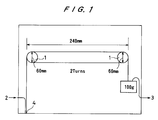
- Fig. 1 is an explanatory view of a tensile test for measuring the transmission loss of a plastic optical fiber when a force is applied to the plastic optical fiber.
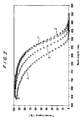
- Figs. 2 and 3 are charts of spectral light transmittance of solutions of heat-treated aromatic polycarbonate, to indicate the oxidation resistance of the aromatic polycarbonate.
- An aromatic polycarbonate copolymer characterized in that said aromatic polycarbonate copolymer is obtained by reacting a dihydric phenol component, comprising mainly dihydric phenols of 53 to 99.5 mol% of 2,2-bis(4-hydroxyphenyl)-1,1,1,3,3,3-hexafluoropropane and 47 to 0.5 mol% of 9,9-bis(4-hydroxyphenyl)fluorene, with a carbonate precursor substance; wherein when 0.7 g of said aromatic polycarbonate copolymer is dissolved in 100 ml of methylene chloride, the specific viscosity of the thus obtained solution measured at 20°C is 0.160 to 0.418 (hereinafter referred to as the copolymer of the first embodiment), and an aromatic polycarbonate copolymer, characterized in that said aromatic polycarbonate copolymer is obtained by reacting a dihydric phenol, comprising mainly dihydric phenols of 15 to 99.5 mol%
- the bisphenol AF for use in the production of the copolymers of the first and second embodiments can be obtained by reacting hexafluoroacetone with phenol. If the amount of impurities in the bisphenol AF is too large, since the transparency and the heat stability of the obtainable copolymer drop, preferably the bisphenol AF is one that has been recrystallized, particularly preferably one that has been recrystallized repeatedly, so that the amount of impurities may be decreased to 0.02% or below, measured by liquid chromatography, to bring the purity to 99.98% or more.
- the bisphenol FL is obtained by reacting florenone with phenol.
- the bisphenol FL is one that has been recrystallized, particularly preferably one that has been recrystallized repeatedly, so that the amount of impurities may be decreased to 1% or below, measured by liquid chromatography, to bring the purity to 99% or more.
- the proportion of the bisphenol AF to the bisphenol FL i.e., the copolymerization proportion
- the proportion of the former is from 53 to 99.5 mol%, and the proportion of the latter is from 47 to 0.5 mol%; preferably the proportion of the former is from 53 to 95 mol%, and the proportion of the latter is from 47 to 5 mol%, and more preferably the proportion of the former is from 60 to 95 mol%, and the proportion of the latter is from 40 to 5 mol%.
- the proportion of the bisphenol FL is less than 0.5 mol%, the desired hydrolysis resistance cannot be obtained; whereas if the proportion exceeds 47 mol%, the molding properties and the oxidation resistance are deteriorated.
- the proportion of the bisphenol FL is increased to 5 mol% or more, the hydrolysis resistance is further improved, and at the same time a high heat resistance can be secured.
- the bisphenol AP for use in the copolymer of the second embodiment is obtained by reacting acetophenone with phenol. If the amount of impurities in the bisphenol AF is too large, since the transparency and the heat stability of the obtainable copolymer also drop, preferably the bisphenol AF is one that has been recrystallized, particularly preferably one that has been recrystallized repeatedly so that the amount of impurities may be decreased to 0.05% or below, measured by liquid chromatography, to bring the purity to 99.95% or more.
- the proportion of the bisphenol AF to the bisphenol AP i.e.
- the copolymerization proportion is such that the proportion of the former is from 15 to 99.5 mol%, and the proportion of the latter is from 85 to 0.5 mol%; preferably the proportion of the former is from 15 to 95 mol%, and the proportion of the latter is 85 to 5 mol%; and more preferably the proportion of the former is 30 to 95 mol%, and the proportion of the latter is 70 to 5 mol%. If the proportion of the bisphenol AP is less than 0.5 mol%, the desired hydrolysis resistance cannot be obtained; whereas if the proportion exceeds 85 mol%, satisfactory heat stability is hardly secured. Further, if the proportion of the bisphenol AP is increased to 5 mol% or more, the hydrolysis resistance is further improved, and at the same time an excellent heat resistance can be obtained.
- the description concerning the case wherein bisphenol AF and bisphenol FL are used as the dihydric phenol component also applies to the case wherein, instead of bisphenol FL, bisphenol FL and bisphenol AP are used in combination. Therefore the later case is also involved in the present invention.
- the total content of the bisphenol FL and bisphenol AP in the dihydric phenol component is the same value as that of bisphenol FL of the former case, which is 47 to 0.5 mol%.
- other dihydric phenol can be further copolymerized if the amount thereof is small (generally 10 mol% or below).
- examples of other dihydric phenol are bisphenol A, 4,4'-dihydroxybiphenyl, bis(4-hydroxyphenyl)methane, 1,1-bis(4-hydroxyphenyl)ethane, 1,1-bis(4-hydroxyphenyl)phenylethane, 2,2-bis(3-methyl-4-hydroxyphenyl)propane, 1,1-bis(4-hydroxyphenyl)cyclohexane, 2,2-bis(3-phenyl-4-hydroxyphenyl)propane, 2,2-bis(3-isopropyl-4-hydroxyphenyl)propane, 2,2-bis(4-hydroxyphenyl)butane, 2,2-bis(3,5-dimethyl-4-hydroxyphenyl)propane, 2,2-bis(3,5-dibromo-4-hydroxyphenyl)propane, 4,4
- the carbonate precursor substance that is reacted with the above dihydric phenol for example, phosgene and diphenyl carbonate can be mentioned.
- the usual methods used in producing a polycarbonate from bisphenol A for example, the reaction of a dihydric phenol with phosgene and the ester exchange reaction of a dihydric phenol with a bisaryl carbonate preferably can be used.
- the molar ratio of the dihydric phenol to phosgene is generally such that 1 mol of the dihydric phenol is used to 1.05 to 1.50 mol of phosgene.
- the reaction of the dihydric phenol with phosgene is generally carried out in the presence of an acid-bonding agent and an organic solvent.
- an acid-bonding agent for example, a hydroxide of an alkali metal, such as sodium hydroxide and potassium hydroxide, and pyridine can be used.
- the organic solvent for example, a halogenated hydrocarbon, such as methylene chloride and chlorobenzene, can be used.
- a catalyst such as a tertiary amine and a quaternary ammonium salt, can be used; and as a molecular weight modifier, a terminating agent is desirably used, such as phenol and p-tert-butylphenol.
- the reaction temperature is usually 0 to 40°C; the reaction time is a few seconds to 5 hours; and preferably the pH during the reaction is generally kept at 10 or over.
- a dihydric phenol and a bisaryl carbonate are mixed in the atmosphere of an inert gas and are reacted generally at 120 to 350°C under-reduced pressure.
- the reduced pressure is changed stepwise and finally brought to 1 mmHg or below, to distill off formed phenols from the system.
- the reaction time is usually about 1 to 4 hours.
- a molecular-weight-controlling agent and an antioxidant may be added.
- the specific viscosity of aromatic polycarbonate copolymer when 0.7 g of the copolymer is dissolved in 100 ml of methylene chloride and measurement is done at 20°C, is in the range from 0.160 to 0.418 (copolymer of the first embodiment) or from 0.160 to 0.410 (copolymer of the second embodiment), preferably in the range from 0.165 to 0.345, and more preferably in the range from 0.160 to 0.290.
- the aromatic polycarbonate copolymers of the present invention will be molded into a film or other molded article.
- a method used for molding usual aromatic polycarbonates can be used; for example, the injection molding method, the compression molding method, the extrusion molding method, or the solution casting method may be arbitrarily used.
- the aromatic polycarbonate copolymers of the present invention may be molded as they are, if necessary, and depending on the usage, various additives, such as an antioxidant, a heat stabilizer, a light stabilizer, a lubricant, a releaser, a fire retardant, a dye, a pigment, an antistatic agent, a weathering agent, glass fiber, carbon fiber, and metal fiber, and inorganic materials, such as talc, may be added.
- additives such as an antioxidant, a heat stabilizer, a light stabilizer, a lubricant, a releaser, a fire retardant, a dye, a pigment, an antistatic agent, a weathering agent, glass fiber, carbon fiber, and metal fiber, and inorganic materials, such as talc, may be added.
- additives are mixed, for example, in the form of solutions, or are mixed in an arbitrary way; for example, by using a tumbler, a supermixer, or a Nauta mixer, and the mixture can be extruded into pellets or can be formed into a fiber, film, and the like.
- the aromatic polycarbonate copolymers of the present invention may be used by mixing them with some other thermoplastic resins.
- the aromatic polycarbonate copolymers of the present invention are mixed with at least one antioxidant that is a phosphite type, a phenol type, or an organosulfur type.
- the phosphite type antioxidant used herein includes, triesters of phosphorous acid and diesters or monoesters of phosphorous acid which are formed by substituting the ester parts of esters of phosphorous acid, for example, by an alkyl group, a phenyl group, or an alkylaryl group, such as triphenyl phosphite, tris(nonylphenyl) phosphite, tris(2,4-di-tert-butylphenyl) phosphite, tridecyl phosphite, trioctyl phosphite, trioctadecyl phosphite, didecyl-monophenyl phosphite, dioctyl-monoph
- the phenol type antioxidant is a hindered phenol compound that is a phenol compound having a bulky group(s) in the ortho position(s) relative to the hydroxyl group of the phenol compound, such as triethylene glycol bis[3-(3-tert-butyl-5-methyl-4-hydroxyphenyl) propionate], 1,6-hexanediol-bis[3-(3,5-di-tert-butyl-4-hydroxyphenyl) propionate], pentaerythritol-tetrakis[3-(3,5-di-tert-butyl-4-hydroxyphenyl) propionate], octadecyl-3-(3,5-di-tert-butyl-4-hydroxyphenyl) propionate, 1,3,5-trimethyl-2,4,6-tris(3,5-di-tert-butyl-4-hydroxybenzyl)benzene, N-N'-hexamethylenebis (3,5-di-
- organosulfur antioxidant for example, tetrakis[methylene-3-(hexylthio) propionate]methane, tetrakis[methylene-3-(decylthio) propionate]methane, tetrakis[methylene-3-(laurylthio) propionate]methane, tetrakis[methylene-3-(octylthio) propionate]methane, dilauryl-3,3'-thiodipropionate, dimyristyl-3,3'-thiodipropionate, distearyl-3,3'-thiodipropionate, ditridecyl-3,3'-thiodipropionate, 2,2-thio-diethylenebis[3-(3,5-di-tert-butyl-4-hydroxyphenyl) propionate], 2,2-thiobis(4-methyl-6-tert-butylphenol), and 2-mercaptobenzimi
- the amount of such an antioxidant to be used is 0.001 to 1.0 part by weight per 100 parts by weight of the aromatic polycarbonate copolymer.
- a method comprises reacting an aqueous alkali solution, containing dihydric phenols comprising mainly bisphenol A and bisphenol FL or bisphenol AP, with phosgene in the presence of an organic solvent, with the molar ratio of the phosgene to all of the bisphenols being from 1.15 to 1.30 and the reaction temperature being 20°C or below.
- the reaction with phosgene is first carried out.
- the phosgenation is carried out in such a way either that bisphenol AF and bisphenol FL or bisphenol AF and bisphenol AP are dissolved in an aqueous alkali solution.
- An organic solvent is added thereto, and, after phosgene is reacted with the temperature kept at 20°C or below, preferably 10 to 15°C, the polycondensation reaction is effected.
- an aqueous alkali solution containing bisphenol AF or bisphenol AP and an aqueous alkali solution containing bisphenol FL are separately prepared, an organic solvent is added to each of the aqueous alkali solutions, then phosgene is reacted with each of the solutions with the temperature kept at 20°C or below, preferably 10 to 15°C.
- the obtained oligomers are mixed and subjected to a polycondensation reaction.
- gaseous phosgene is blown into the aqueous alkali solutions, or liquid phosgene is mixed with the bisphenol in the aqueous alkali solutions.
- the reaction temperature exceeds 20°C, decomposition of the terminal chloroformate increases and the heat stability of the resulting copolymer is deteriorated.
- the molar ratio of phosgene to be used is preferably in the range of from 1.15 to 1.30 per mol of total bisphenols.
- the phosgene to be involved in the reaction becomes insufficient and a copolymer having a satisfactory degree of polymerization is hardly obtained; whereas if the molar ratio is too large, the terminal chloroformate remains in a large amount or that terminal chloroformate is hydrolyzed, to increase the amount of terminal OH groups, and therefore the heat stability and the oxidation resistance of the resulting copolymer become poor.
- the pH is preferably kept at 10 or over, and at the time of phosgenation a small amount of a reducing agent, such as hydrosulfite, may be added.
- the alkali used herein is preferably a strongly basic compound, such as a hydroxide of an alkali metal or an alkali earth metal, with particular preference given to sodium hydroxide and potassium hydroxide or the like.
- the water used in the aqueous alkali solutions is preferably one subjected to ion exchange treatment and preferably the aqueous alkali solutions are used after being deoxidized by passing nitrogen gas or the like.
- the concentration of the aqueous alkali solution is generally 1 to 10 wt%, preferably 3 to 7 wt%.
- the concentration of the bisphenols dissolved in the aqueous alkali solution is such that the total amount of the bisphenol AF and bisphenol FL is generally 1 to 20 wt%, preferably 3 to 10 wt%.
- the concentration of the bisphenols dissolved in the aqueous alkali solution is such that the total amount of the bisphenol AF and the bisphenol AP is generally 10 to 30 wt%, preferably 15 to 20 wt%.
- an organic solvent inert to the reaction for example a halogenated hydrocarbon, such as methylene chloride and chlorobenzene, is preferable, and the organic solvent is also used preferably after being deoxidized, like the aqueous alkali solution.
- an end-terminating agent can be used.
- the end-terminating agent for example, monohydric phenols, such as phenol and an alkylphenol, phenyl chlorocarbonate, or an acid halide, such as an aromatic or aliphatic carboxylic acid chloride, are used in a prescribed amount in a known manner.
- the polycondensation reaction is effected generally at a temperature of 25 to 35°C, preferably 28 to 30°C.
- the reaction time is generally 10 min to 5 hours, preferably 30 min to 2 hours.
- the pH is preferably kept at 12 or over. Further, in order to facilitate the reaction, a small amount of an amine catalyst can be used.
- quaternary ammonium compounds and tertiary amines such as triethylamine, trimethylamine, triethylammonium bromide, and triethylammonium hydroxide, can be mentioned, and the amount of the catalyst to be used is generally 0.0001 to 0.01, preferably 0.002 to 0.005, in terms of molar ratio to the total amount of the bisphenols.
- the aromatic polycarbonate copolymer is preferably such that when 0.7 g of the polymer is dissolved in 100 ml of methylene chloride, the specific viscosity measured at 20°C is in the range of 0.160 to 0.418 (in the case wherein the dihydric bisphenol comprises bisphenol FL) or 0.160 to 0.410 (in the case wherein the dihydric phenol comprises bisphenol AP) although an aromatic polycarbonate copolymer having the specific viscosity falling outside these ranges can of course be produced.
- the aromatic polycarbonate copolymer of the present invention is particularly excellent in hydrolysis resistance, heat resistance, heat stability, and oxidation resistance, as well as being excellent in transparency and moldability, the aromatic polycarbonate copolymer of the present invention is quite useful in a field in which high heat resistance and optical properties are required; for example it is quite useful as a material for various optical devices, such as headlamp lenses, a variety of lenses, prisms, optical waveguides such as optical fiber, connectors, optical disks, and liquid crystal panels.
- various optical devices such as headlamp lenses, a variety of lenses, prisms, optical waveguides such as optical fiber, connectors, optical disks, and liquid crystal panels.
- the aromatic polycarbonate copolymer of the present invention is molded into a fiber to form an optical waveguide.
- optical waveguide means a light transmission device including an optical fiber, an optical lightguide, a plane optical waveguide, connecting part of optical waveguide, and an optical coupler.
- optical fiber embodiment According to the optical fiber embodiment, the present invention, is described below. However these description can usually be applied to other optical waveguide embodiments.
- the above aromatic polycarbonate copolymers can be preferably used as a core material of a plastic optical fiber and they can give such a plastic optical fiber having a low transmission loss, such that when the plastic optical fiber is kept under a high temperature the increase in transmission loss is small and the extension of the fiber does not lower, and when a force is applied to the plastic optical fiber at that high temperature, the increase in transmission loss is small.
- the first optical waveguide is described below.
- the respective proportions of the bisphenol AF and the bisphenol FL used in the production of the aromatic polycarbonate are preferably from 53 to 95 mol% and from 47 to 5 mol%, more preferably from 60 to 95 mol% and from 40 to 5 mol%.
- the proportion of the bisphenol FL is less than 0.5 mol%, the polycarbonate of the core material is liable to be hydrolyzed under high temperatures and humidities, and therefore when the plastic optical fiber is exposed to a high temperature under a high humidity for a long period of time, the increase in transmission loss of the plastic optical fiber becomes large, and the physical strength of fiber lowers. Further, when the plastic optical fiber is exposed to even higher temperatures, the lowering in extension of the plastic optical fiber increases and the reliability of the plastic optical fiber becomes poor.
- the proportion of the bisphenol FL when the proportion of the bisphenol FL is increased to 5% or more, not only can long-term resistance to heat up to about 145°C, and suppression of the lowering of the extension of the plastic optical fiber under a high temperature, be attained, but also mechanical strength at a temperature of about 150°C can be secured, such that the plastic optical fiber will not shrink at about 150°C and it will not extend when pulled a little under that temperature.
- the proportion of the bisphenol AF is smaller than 53 mol%, the moldability becomes poor; therefore molding has to be carried out at a high temperature; and the plastic optical fiber is colored at the time of molding, which increases the transmission loss; and in addition, although a mechanical change, such as shrinkage or lowering in mechanical strength, under application under high temperatures would not occur, a conspicuous increase in transmission loss is recognized.
- the polycarbonate copolymer to be used for the first optical fiber of the present invention is such that, when 0.7 g of the polycarbonate copolymer is dissolved in 100 ml of methylene chloride, the specific viscosity measured at 20°C is 0.160 to 0.418. If the specific viscosity is smaller than 0.160, the strength of the plastic optical fiber drops noticeably; whereas if the specific viscosity is larger than 0.418, the molding becomes difficult and the value of the transmission loss of the obtainable plastic optical fiber becomes inevitably high.
- the specific viscosity is preferably in the range from 0.165 to 0.345, more preferably in the range from 0.165 to 0.290.
- the polycarbonate copolymer of the core part of the plastic optical fiber is chemically stable and has a glass transition temperature as high as 155°C or more, the increase in transmission loss is small if the present plastic optical fiber is exposed to a temperature of 145°C for a long period of time. Further, if the present plastic optical fiber is exposed to that temperature for a long period of time, the drop of extension of the fiber is small.
- the proportion of the bisphenol FL is increased to 5% or more, since the polycarbonate copolymer of the core part of the plastic optical fiber has a glass transition temperature of 160°C or higher, the plastic optical fiber will not shrink or deform at a temperature of about 150°C. Also the increase in transmission loss is small if the plastic optical fiber is pulled by applying a force at that temperature. Further, the increase in transmission loss is very small if the plastic optical fiber is exposed to a temperature of 150°C.
- this polycarbonate copolymer is excellent in heat stability and it can be molded without its constituent polymer decomposing at the time of molding; that is, it can be molded with the transmission loss being low.
- this polycarbonate copolymer can be molded at a relatively low temperature of about 250 to 290°C, and the moldability is good. Further, since the polycarbonate copolymer can be molded at a temperature of 250 to 290°C, the polycarbonate is not decomposed at the time of the molding, and a plastic optical fiber having a low transmission loss can be obtained without lowering the transmission.
- the second optical waveguide is described below.
- the respective proportions of the bisphenol AF and the bisphenol AP used in the production of the aromatic polycarbonate are from 15 to 99.5% and from 85 to 0.5 mol%, preferably from 15 to 95 mol% and from 85 to 5 mol%, and more preferably from 30 to 90 mol% and from 70 to 5 mol%.
- the proportion of the bisphenol AP becomes smaller than 0.5 mol%, the polycarbonate that is the core material is liable to be decomposed under high temperatures and humidities, and therefore when the plastic optical fiber is exposed to a high humidity and a high temperature for a long period of time, the increase in transmission loss of the plastic optical fiber becomes large, and the physical strength of the fiber lowers. Further, when the plastic optical fiber is exposed to an even higher temperature, the drop in extension of the plastic optical fiber becomes large, and the reliability of the plastic optical fiber becomes poor.
- the proportion of the bisphenol AP when the proportion of the bisphenol AP is increased to 5% or more, not only can the long-term resistance to heat up to about 145°C, and the suppression of the lowering of the extension of the plastic optical fiber under a high temperature, be attained, but also the mechanical strength at a temperature of about 150°C can be secured, such that the plastic optical fiber will not shrink at about 150°C and it will not extend when pulled a little under that temperature.
- the proportion of the bisphenol AF is smaller than 15 mol%, the moldability becomes poor; therefore molding has to be carried out at a high temperature; and the plastic optical fiber is colored at the time of molding, which increases the transmission loss; and in addition, although a mechanical change, such as shrinkage or lowering in mechanical strength, at high temperatures would not occur, a conspicuous increase in transmission loss is recognized.
- the polycarbonate copolymer used for this optical fiber is such that, when 0.7 g of the polycarbonate copolymer is dissolved in 100 ml of methylene chloride, the specific viscosity measured at 20°C is 0.160 to 0.410. If the specific viscosity is smaller than 0.160, the strength of the plastic optical fiber drops noticeably; whereas if the specific viscosity is larger than 0.410, the molding becomes difficult and the value of the transmission loss of the obtainable plastic optical fiber becomes inevitably high.
- the specific viscosity is preferably in the range from 0.165 to 0.345, more preferably in the range from 0.165 to 0.290.
- the polycarbonate copolymer of the core part of the present plastic optical fiber is chemically stable and has a glass transition temperature as high as 155°C or more, the increase in transmission loss is small if the present plastic optical fiber is exposed to a temperature of 145°C for a long period of time. Further, if the present plastic optical fiber is exposed to that temperature for a long period of time, the drop of extension of the fiber is small.
- the plastic optical fiber when the proportion of the bisphenol AP is increased to 5 mol% or more, since the polycarbonate copolymer of the core part of the plastic optical fiber has a glass transition temperature of 160 to 175°C, the plastic optical fiber will not shrink or deform at a temperature of about 150°C. The increase in transmission loss is small if the plastic optical fiber is pulled by applying a force at that temperature.
- optical waveguide of this invention is generally described below.
- the core part of the plastic optical fiber of the present invention is colored very slightly at a temperature of about 150°C, and the increase in transmission loss at that temperature is very small.
- a plastic optical fiber that uses a polycarbonate AP homopolymer for the core part is colored noticeably at a temperature of about 120°C and cannot be used, the plastic optical fiber of the present invention attains a heat resistance service temperature that is 20 or more degree C higher than that temperature.
- the plastic optical fiber of the present invention changes little in mechanical properties under a high temperature, and it also shrinks little under a high temperature.
- the polymer can be molded into a fiber without the polymer decomposing; that is, with the transmission loss being low.
- the plastic optical fiber can be molded at a temperature of about 240 to 270°C.
- a fluororesin, a silicone resin, and an imidated acrylic resin can be used as a clad layer of the plastic optical fiber of the present invention.
- resin include a tetrafluoroethylene/hexafluoroethylene copolymer, a tetrafluoroethylene/perfluoroalkyl vinyl ether copolymer, an ethylene/tetrafluoroethylene copolymer, a fluorinated polymethyl methacrylate, Teflon AF (trade name, manufactured by E.I. du Pont de Nemours & Co. Inc.), and Cytop (trade name, manufactured by Asahi Glass Co., Ltd.).
- the plastic optical fiber can be formed by the common double drawing method or some other method.
- the temperature of the head is about 240 to 280°C.
- a preform is formed by a heated and reduced-pressure-applied method disclosed in Japanese Patent Application No. 245433/1990, and the preform may be made into a plastic optical fiber.
- the plastic optical waveguide uses a specific polycarbonate copolymer for the core layer, the plastic optical waveguide is excellent in heat resistance, and it exhibits an excellent effect in that the increase in transmission loss is small without the occurrence of the decrease of extension (extensibility), even when the plastic optical waveguide is kept under a high temperature or when a force is applied to it under a high temperature. Therefore the optical waveguides can be used in various fields, in which heat resistance is required, for example in automobiles and electronic equipment.
- the polymer was compression-molded at 280°C into a disk of diameter 40 mm and thickness 2 mm, and the light transmittance of the disk was measured.
- the glass transition temperature was measured at a heating rate of 10°C/min using a DSC-910, manufactured by E.I. du Pont de Nemours & Co., Ltd.
- the polymer After 40 g of the polymer was heated for 4 hours at 280°C in an air atmosphere in a thermostatic chamber, it was dissolved in 400 g of methylene chloride; then the transmittance of light of 860 nm to 280 nm for the solution was measured using a quartz cell having an optical path length of 25 cm through a U-3400 spectrophotometer, and the light transmittance was expressed in terms of the light transmittance per cm of the polymer.
- the transmission loss of the plastic optical fiber was measured by the 10 m/1 m cut-back method, using an LED of 660 nm as a light source.
- the plastic optical fiber of length 3 m, was set in an apparatus shown in Fig. 1, which was in turn placed in a thermostatic chamber at 150°C, thereby carrying out the evaluation.
- the increase in transmission loss was continuously monitored using an LED of 660 nm as a light source, and the evaluation was made by relative comparison with the initial value of the amount of outputted light.
- 1 indicates pulleys of diameter 60 mm
- 2 indicates a light source (660 nm: LED)
- 3 indicates the output
- 4 indicates the fixed end of the plastic optical fiber.
- the plastic optical fiber was pulled using a cylindrical chuck at a rate of extension of 100 mm/min, with the distance between gages being 100 mm, and the absolute value of the extension was measured.
- the plastic optical fiber was pulled using a cylindrical chuck at a rate of extension of 100 mm/min, with the distance between gages being 100 mm, and the absolute value of the extension was measured.
- the plastic optical fiber was held in steam at 120°C for 4 days, it was pulled using a cylindrical chuck at a rate of extension of 100 mm/min, with the distance between gages being 100 mm, and the absolute value of the extension was measured.
- the glass transition temperature was 167°C, showing high heat resistance; the light transmittance was 89%, which is good, and the light transmittance after the heat treatment was 82%, showing excellent heat stability; and the oxidation resistance was remarkably excellent in comparison with the polymer obtained from bisphenol A as shown by curve 1 ( ⁇ ) in Fig. 2.
- the specific viscosity of this copolymerized polymer was 0.177, the retention of the specific viscosity after the steam treatment was 80%, showing good hydrolysis resistance, the glass transition temperature was 178°C, showing high heat resistance, the light transmittance was 89%, which is good, the light transmittance after the heat treatment was 80%, showing excellent heat stability, and the oxidation resistance was remarkably excellent in comparison with the polymer obtained from bisphenol A as shown by curve 2 (+) in Fig. 2.
- the specific viscosity of this copolymerized polymer was 0.178, the retention of the specific viscosity after the steam treatment was 85% and the glass transition temperature was 215°C, which show high hydrolysis resistance and high heat resistance, the light transmittance was 89%, which is good, the light transmittance after the heat treatment was 89%, showing excellent heat stability; and the oxidation resistance was remarkably excellent in comparison with the polymer obtained from bisphenol A as shown by curve 3 ( ⁇ ) in Fig. 2.
- the glass transition temperature of the copolymerized polymer was 159°C, the specific viscosity was 0.172, the lowering rate of the specific viscosity after the steam treatment was 76%, showing good hydrolysis resistance, the light transmittance was 89%, which is good, and the light transmittance after the heat treatment was 84%, showing excellent heat stability.
- Example 1 was repeated, except that bisphenol FL was not used and the amount of the bisphenol AF was changed to 30.2 parts, thereby obtaining a homopolymer of bisphenol AF.
- the glass transition temperature of this homopolymer was 157°C, showing poor heat resistance, the specific viscosity was 0.194, and the light transmittance was 89%, which is good, but the retention of the specific viscosity after the steam treatment was 69%, showing poor hydrolysis resistance.
- the light transmittance after heat treatment was as low as 71%, and the heat stability was deteriorated.
- Example 1 was repeated, except that the bisphenol AF was not used and the amount of bisphenol FL was changed to 31.5 parts, thereby obtaining a homopolycarbonate of bisphenol FL. Although the glass transition temperature was enough as high as 287°C, the homopolycarbonate was not fully melted at 300°C and could not give a satisfactory molded item.
- Example 1 was repeated, except that the amount of the used phosgene was changed to 12.0 parts (molar ratio: 1.35), thereby obtaining a copolymerized polymer.
- the specific viscosity of this copolymerized polymer was 0.203, and the glass transition temperature was 165°C, showing a high heat resistance, but the light transmittance after the heat treatment was 74%, showing poor heat stability.
- Example 1 was repeated, except that the amount of the used phosgene was changed to 9.95 parts (molar ratio: 1.12), thereby obtaining a copolymerized polymer.
- the specific viscosity of this copolymerized polymer was only 0.150 and the copolymerized polymer was brittle and was not suitable for practical use.
- the polycarbonate copolymer prepared in Example 1 that had been passed through a 0.1- ⁇ m filter, to eliminate foreign matter was introduced into a resin introduction path of a spinning apparatus and was made into a thread with the head temperature being 245°C.
- a die was placed in the course of the draw-out and a thermosetting silicone resin (X-38-040HAB, manufactured by Shin-Etsu Chemical Co., Ltd.) was added thereinto, and was set in an oven positioned downstream thereof, thereby obtaining a plastic optical fiber having a core clad layer.
- the obtained plastic optical fiber had a core diameter of 0.96 mm and an outer diameter of 1.02 mm and the transmission loss was 940 dB/km (660 nm: LED).
- the transmission loss was 1,000 dB/km (660 nm: LED).
- a load of 100 g was applied as shown in Fig. 1, then it was placed in a thermostatic chamber at 150°C, after three days the increase in transmission loss of the plastic optical fiber was measured, and it was found that the increase was 80 dB/km.
- the polycarbonate copolymer prepared in Example 2 that had been passed through a 0.1- ⁇ m filter to eliminate foreign matter was introduced into a resin introduction path of a spinning apparatus and was made into a thread with the head temperature being 255°C.
- a die was placed in the course of the draw-out and a thermosetting silicone resin (X-38-040HAB, manufactured by Shin-Etsu Chemical Co., Ltd.) was added thereinto, and was set in an oven positioned downstream thereof, thereby obtaining a plastic optical fiber having a core clad layer.
- the obtained plastic optical fiber had a core diameter of 0.96 mm and an outer diameter of 1.02 mm and the transmission loss was 1,000 dB/km (660 nm: LED).
- the transmission loss was 1,000 dB/km (660 nm: LED).
- a load of 100 g was applied as shown in Fig. 1, then it was placed in a thermostatic chamber at 150°C, after three days the increase in transmission loss of the plastic optical fiber was measured, and it was found that the increase was 60 dB/km.
- the polycarbonate copolymer prepared in Example 3 that had been passed through a 0.1- ⁇ m filter, to eliminate foreign matter, was introduced into a resin introduction path of a spinning apparatus and was made into a thread with the head temperature being 280°C.
- a die was placed in the course of the draw-out and a thermosetting silicone resin (X-38-040HAB, manufactured by Shin-Etsu Chemical Co., Ltd.) was added thereinto, and was set in an oven positioned downstream thereof, thereby obtaining a plastic optical fiber having a core clad layer.
- the obtained plastic optical fiber had a core diameter of 0.96 mm and an outer diameter of 1.02 mm and the transmission loss was 1,250 dB/km (660 nm: LED).
- the transmission loss was 1,450 dB/km (660 nm: LED).
- a load of 100 g was applied as shown in Fig. 1, then it was placed in a thermostatic chamber at 150°C, after three days the increase in transmission loss of the plastic optical fiber was measured, and it was found that the increase was 60 dB/km.
- the polycarbonate copolymer prepared above that had been passed through a 0.1- ⁇ m filter, to eliminate foreign matter, was introduced into a resin introduction path of a spinning apparatus and was made into a thread with the head temperature being 245°C.
- a die was placed in the course of the draw-out and a thermosetting silicone resin (X-38-040HAB, manufactured by Shin-Etsu Chemical Co., Ltd.) was added thereinto, and was set in an oven positioned downstream thereof, thereby obtaining a plastic optical fiber having a core clad layer.
- the obtained plastic optical fiber had a core diameter of 0.96 mm and an outer diameter of 1.02 mm and the transmission loss was 800 dB/km (660 nm: LED).
- the transmission loss was 820 dB/km (660 nm: LED).
- a load of 100 g was applied as shown in Fig. 1, then it was placed in a thermostatic chamber at 150°C, after three days the increase in transmission loss of the plastic optical fiber was measured, and it was found that the increase was 150 dB/km.
- the polycarbonate copolymer prepared above that had been passed through a 0.1- ⁇ m filter to eliminate foreign matter was introduced into a resin introduction path of a spinning apparatus and was made into a thread with the head temperature being 240°C.
- a die was placed in the course of the draw-out and a thermosetting silicone resin (X-38-040HAB manufactured by Shin-Etsu Chemical Co., Ltd.) was added thereinto, and was set in an oven positioned downstream thereof, thereby obtaining a plastic optical fiber having a core clad layer.
- the obtained plastic optical fiber had a core diameter of 0.96 mm and an outer diameter of 1.02 mm and the transmission loss was 780 dB/km (660 nm: LED).
- the transmission loss was 790 dB/km (660 nm: LED).
- a load of 100 g was applied as shown in Fig. 1, then it was placed in a thermostatic chamber at 150°C, after three days the increase in transmission loss of the plastic optical fiber was measured, and it was found that the increase was 420 dB/km.
- the plastic optical fiber (Example 5) could be reliably and satisfactorily used at a temperature of about 145°C.
- the homopolymer (polycarbonate AF) prepared in Comparative Example 1 that had been passed through a 0.1- ⁇ m filter to eliminate foreign matter was introduced into a resin introduction path of a spinning apparatus and was made into a thread with the head temperature being 240°C.
- a die was placed in the course of the draw-out and a thermosetting silicone resin (X-38-040HAB, manufactured by Shin-Etsu Chemical Co., Ltd.) was added thereinto, and was set in an oven positioned downstream thereof, thereby obtaining a plastic optical fiber having a core clad layer.
- the obtained plastic optical fiber had a core diameter of 0.96 mm and an outer diameter of 1.02 mm and the transmission loss was 780 dB/km (660 nm: LED).
- the transmission loss was 790 dB/km (660 nm: LED).
- a load of 100 g was applied as shown in Fig. 1, then it was placed in a thermostatic chamber at 150°C, after three days the increase in transmission loss of the plastic optical fiber was measured, and it was found that the increase was 450 dB/km.
- the humidity resistance heat test of the plastic optical fiber at 120°C was carried out and it was found that the extension of the fiber after 4 days of steaming at 120°C was 10% or less, and the fiber became brittle being apt to break.
- Example 1 was repeated, except that the bisphenol AF and bisphenol FL were not used and 250 g of bisphenol AP of 99.96% purity was used, thereby obtaining a homopolymer.
- the specific viscosity of this homopolymer was 0.188 and the glass transition temperature was as high as 175°C.
- a die was placed in the course of the draw-out and a thermosetting silicone resin (X-38-040HAB, manufactured by Shin-Etsu Chemical Co., Ltd.) was added thereinto, and was set in an oven positioned downstream thereof, thereby obtaining a plastic optical fiber having a core clad layer.
- the obtained plastic optical fiber had a core diameter of 0.96 mm and an outer diameter of 1.02 mm and the transmission loss was 1,450 dB/km (660 nm: LED).
- the transmission loss could not be measured because it was 3,000 dB/km (660 nm: LED).
- the specific viscosity of the obtained copolymerized polymer was 0.255, the retention of the specific viscosity after the steam treatment was 84% and the glass transition temperature was 170°C, which show high hydrolysis resistance and high heat resistance, and the light transmittance after the heat treatment was 80%, showing excellent heat stability.
- the oxidation resistance thereof was remarkably excellent in comparison with the polymer obtained from bisphenol AP and the polymer obtained from bisphenol A as shown by curve 1 ( ⁇ ) in Fig. 3.
- Example 10 was repeated, except that the amount of the bisphenol AF to be used was changed to 25.4 parts and the amount of the bisphenol AP to be used was changed to 51.2 parts, thereby preparing a copolymerized polymer.
- the specific viscosity of the copolymerized polymer was 0.263, the retention of the specific viscosity after the steam treatment was 88% and the glass transition temperature was 173°C, which show high hydrolysis resistance and high heat resistance, and the light transmittance after the heat treatment was 79%, showing excellent heat stability.
- the oxidation resistance thereof was remarkably excellent in comparison with the polymer obtained from bisphenol AP and the polymer obtained from bisphenol A as shown by curve 2 ( ⁇ ) in Fig. 3.
- Example 10 was repeated, except that the amount of the bisphenol AF to be used was changed to 83.7 parts and the amount of the bisphenol AP to be used was changed to 0.73 parts, thereby preparing a copolymerized polymer.
- the glass transition temperature of this copolymerized polymer was 159°C
- the specific viscosity was 0.242
- the retention of the specific viscosity after the steam treatment was 79%, showing high hydrolysis resistance
- the light transmittance after the heat treatment was 84%, showing excellent heat stability.
- Example 10 was repeated, except that the bisphenol AF was not used and the amount of the bisphenol AP was changed to 73.1 parts, thereby obtaining a homopolymer of bisphenol AP.
- the specific viscosity of this homopolymer was 0.301, the glass transition temperature was 179°C, showing high heat resistance, but the light transmission after the heat treatment was 69%, showing low heat stability, and the oxidation resistance was poor as shown by curve 3 (+) in Fig. 3.
- Example 10 was repeated, except that the amount of the used phosgene was changed to 574.3 parts (molar ratio: 1.12), thereby obtaining a copolymerized polymer.
- the specific viscosity of this copolymerized polymer was only 0.153 and the copolymerized polymer was brittle and was not suitable for practical use.
- Example 10 was repeated, except that the amount of the used phosgene was changed to 692.3 parts (molar ratio: 1.35), thereby obtaining a copolymerized polymer.
- the specific viscosity of this copolymerized polymer was 0.245, and the glass transition temperature was 165°C, but the light transmittance after the heat treatment was as low as 71%, showing poor heat stability.
- the polycarbonate copolymer prepared in Example 10 that had been passed through a 0.1- ⁇ m filter to eliminate foreign matter was introduced into a resin introduction path of a spinning apparatus and was made into a thread with the head temperature being 250°C.
- a die was placed in the course of the draw-out and a thermosetting silicone resin (X-38-091HAB, manufactured by Shin-Etsu Chemical Co., Ltd.) was added thereinto, and was set in an oven positioned downstream thereof, thereby obtaining a plastic optical fiber having a core clad layer.
- the obtained plastic optical fiber had a core diameter of 0.96 mm and an outer diameter of 1.02 mm and the transmission loss was 920 dB/km (660 nm: LED).
- the transmission loss was 1,020 dB/km (660 nm: LED).
- a load of 100 g was applied as shown in Fig. 1, then it was placed in a thermostatic chamber at 150°C, after three days the increase in transmission loss of the plastic optical fiber was measured, and it was found that the increase was 100 dB/km.
- the specific viscosity of this copolymerized polymer was 0.210 and the glass transition temperature was 162°C.
- the polycarbonate copolymer prepared above that had been passed through a 0.1- ⁇ m filter to eliminate foreign matter was introduced into a resin introduction path of a spinning apparatus and was made into a thread with thee head temperature being 240°C.
- a die was placed in the course of the draw-out and a thermosetting silicone resin (X-38-091HAB, manufactured by Shin-Etsu Chemical Co., Ltd.) was added thereinto, and was set in an oven positioned downstream thereof, thereby obtaining a plastic optical fiber having a core clad layer.
- the obtained plastic optical fiber had a core diameter of 0.96 mm and an outer diameter of 1.02 mm and the transmission loss was 850 dB/km (660 nm: LED).
- the transmission loss was 930 dB/km (660 nm: LED).
- a load of 100 g was applied as shown in Fig. 1, then it was placed in a thermostatic chamber at 150°C, after three days the increase in transmission loss of the plastic optical fiber was measured, and it was found that the increase was 180 dB/km.
- the polycarbonate copolymer prepared above that had been passed through a 0.1- ⁇ m filter to eliminate foreign matter was introduced into a resin introduction path of a spinning apparatus and was made into a thread with the head temperature being 260°C.
- a die was placed in the course of the draw-out and a thermosetting silicone resin (X-38-091HAB, manufactured by Shin-Etsu Chemical Co., Ltd.) was added thereinto, and was set in an oven positioned downstream thereof, thereby obtaining a plastic optical fiber having a core clad layer.
- the obtained plastic optical fiber had a core diameter of 0.96 mm and an outer diameter of 1.02 mm and the transmission loss was 1,050 dB/km (660 nm: LED).
- the transmission loss was 1,200 dB/km (660 nm: LED).
- a load of 100 g was applied as shown in Fig. 1, then it was placed in a thermostatic chamber at 150°C, after three days the increase in transmission loss of the plastic optical fiber was measured, and it was found that the increase was 80 dB/km.
- the polycarbonate copolymer prepared above that had been passed through a 0.1- ⁇ m filter to eliminate foreign matter was introduced into a resin introduction path of a spinning apparatus and was made into a thread with the head temperature being 240°C.
- a die was placed in the course of the draw-out and a thermosetting silicone resin (X-38-091HAB, manufactured by Shin-Etsu Chemical Co., Ltd.) was added thereinto, and was set in an oven positioned downstream thereof, thereby obtaining a plastic optical fiber having a core clad layer.
- the obtained plastic optical fiber had a core diameter of 0.96 mm and an outer diameter of 1.02 mm and the transmission loss was 780 dB/km (660 nm: LED).
- the transmission loss was 790 dB/km (660 nm: LED).
- a load of 100 g was applied as shown in Fig. 1, then it was placed in a thermostatic chamber at 150°C, after three days the increase in transmission loss of the plastic optical fiber was measured, and it was found that the increase was 420 dB/km.
- the tension test was carried out similarly at 145°C, the increase in transmission loss was 150 dB/km.
- Example 16 can be withstand to be used at a temperature of about 145°C.
- Table 3 The results of Examples 13 to 16 are summarized in Table 3.
- Example 10 was repeated, except that the bisphenol AF was not used and the amount of bisphenol AP of 99.98% purity was changed to 731 parts, thereby obtaining a homopolymer of bisphenol AP.
- the specific viscosity of this homopolymer was 0.201 and the glass transition temperature was 179°C, showing a high heat resistance.
- the above polycarbonate AP that had been passed through a 0.1- ⁇ m filter to eliminate foreign matter was introduced into a resin introduction path of a spinning apparatus and was made into a thread with the head temperature being 270°C.
- a die was placed in the course of the draw-out and a thermosetting silicone resin (X-38-091HAB, manufactured by Shin-Etsu Chemical Co., Ltd.) was added thereinto, and was set in an oven positioned downstream thereof, thereby obtaining a plastic optical fiber having a core clad layer.
- the obtained plastic optical fiber had a core diameter of 0.96 mm and an outer diameter of 1.02 mm and the transmission loss was 1,450 dB/km (660 nm: LED).
- the transmission loss could not be measured because it was 3,000 dB/km (660 nm: LED) over.
- a load of 100 g was applied as shown in Fig. 1, then it was placed in a thermostatic chamber at 150°C, after three days the increase in transmission loss of the plastic optical fiber was measured, and it was found that the increase was 400 dB/km.
- Example 10 was repeated, except that the amount of bisphenol AF of 99.98 purity was changed to 73.1 parts and the amount of bisphenol AP of 99.98% purity was changed to 657.7 parts, thereby obtaining a polycarbonate copolymer.
- the specific viscosity of this polycarbonate copolymer was 0.189.
- the above polycarbonate AP that had been passed through a 0.1- ⁇ m filter to eliminate foreign matter was introduced into a resin introduction path of a spinning apparatus and was made into a thread with the head temperature being 270°C.
- a die was placed in the course of the draw-out and a thermosetting silicone resin (X-38-091HAB, manufactured by Shin-Etsu Chemical Co., Ltd.) was added thereinto, and was set in an oven positioned downstream thereof, thereby obtaining a plastic optical guide having a core clad layer.
- the obtained plastic optical fiber had a core diameter of 0.96 mm and an outer diameter of 1.02 mm and the transmission loss was 130 dB/km (660 nm: LED).
- the transmission loss was 2,500 dB/km (660 nm: LED).
- a load of 100 g was applied as shown in Fig. 1, then it was placed in a thermostatic chamber at 150°C, after three days the increase in transmission loss of the plastic optical fiber was measured, and it was found that the increase was 220 dB/km.
Landscapes
- Chemical & Material Sciences (AREA)
- Physics & Mathematics (AREA)
- Health & Medical Sciences (AREA)
- Chemical Kinetics & Catalysis (AREA)
- Medicinal Chemistry (AREA)
- Polymers & Plastics (AREA)
- Organic Chemistry (AREA)
- General Physics & Mathematics (AREA)
- Optics & Photonics (AREA)
- Polyesters Or Polycarbonates (AREA)
- Optical Fibers, Optical Fiber Cores, And Optical Fiber Bundles (AREA)
Priority Applications (1)
| Application Number | Priority Date | Filing Date | Title |
|---|---|---|---|
| EP97110234A EP0802212A3 (fr) | 1992-11-02 | 1993-10-26 | Copolycarbonate aromatique, procédé pour sa préparation et dispositif optique à guide d'onde fabriqué à partir de ce copolycarbonate |
Applications Claiming Priority (12)
| Application Number | Priority Date | Filing Date | Title |
|---|---|---|---|
| JP29442192A JP3155092B2 (ja) | 1992-11-02 | 1992-11-02 | 芳香族ポリカーボネート共重合体の製造方法 |
| JP31559792 | 1992-11-02 | ||
| JP31560192 | 1992-11-02 | ||
| JP315595/92 | 1992-11-02 | ||
| JP315597/92 | 1992-11-02 | ||
| JP315599/92 | 1992-11-02 | ||
| JP315604/92 | 1992-11-02 | ||
| JP29442292A JP3150456B2 (ja) | 1992-11-02 | 1992-11-02 | 芳香族ポリカーボネート共重合体の製造方法 |
| JP31559992 | 1992-11-02 | ||
| JP294421/92 | 1992-11-02 | ||
| JP31559592 | 1992-11-02 | ||
| JP294422/92 | 1992-11-02 |
Related Child Applications (1)
| Application Number | Title | Priority Date | Filing Date |
|---|---|---|---|
| EP97110234A Division EP0802212A3 (fr) | 1992-11-02 | 1993-10-26 | Copolycarbonate aromatique, procédé pour sa préparation et dispositif optique à guide d'onde fabriqué à partir de ce copolycarbonate |
Publications (2)
| Publication Number | Publication Date |
|---|---|
| EP0608493A2 true EP0608493A2 (fr) | 1994-08-03 |
| EP0608493A3 EP0608493A3 (fr) | 1994-11-17 |
Family
ID=27554488
Family Applications (2)
| Application Number | Title | Priority Date | Filing Date |
|---|---|---|---|
| EP97110234A Withdrawn EP0802212A3 (fr) | 1992-11-02 | 1993-10-26 | Copolycarbonate aromatique, procédé pour sa préparation et dispositif optique à guide d'onde fabriqué à partir de ce copolycarbonate |
| EP19930117336 Withdrawn EP0608493A3 (fr) | 1992-11-02 | 1993-10-26 | Copolycarbonate aromatique, procédé pour sa préparation et dispositif optique à guide d'onde fabriqué à partir du dit copolycarbonate. |
Family Applications Before (1)
| Application Number | Title | Priority Date | Filing Date |
|---|---|---|---|
| EP97110234A Withdrawn EP0802212A3 (fr) | 1992-11-02 | 1993-10-26 | Copolycarbonate aromatique, procédé pour sa préparation et dispositif optique à guide d'onde fabriqué à partir de ce copolycarbonate |
Country Status (2)
| Country | Link |
|---|---|
| US (2) | US5409975A (fr) |
| EP (2) | EP0802212A3 (fr) |
Cited By (4)
| Publication number | Priority date | Publication date | Assignee | Title |
|---|---|---|---|---|
| US5486577A (en) * | 1995-03-21 | 1996-01-23 | The Dow Chemical Company | Blends of diaryl fluorene carbonate polymers with bisphenol A carbonate polymers |
| US5516877A (en) * | 1994-08-16 | 1996-05-14 | The Dow Chemical Company | Crosslinkable carbonate polymers of dihydroxyaryl fluorene |
| US5872882A (en) * | 1995-03-13 | 1999-02-16 | Akzo Nobel Nv | Non-linear optical polycarbonates |
| EP4032932A4 (fr) * | 2019-09-18 | 2022-10-12 | Mitsubishi Gas Chemical Company, Inc. | Procédé de fabrication d'une résine de polycarbonate et corps moulé |
Families Citing this family (6)
| Publication number | Priority date | Publication date | Assignee | Title |
|---|---|---|---|---|
| US6697552B2 (en) | 2001-02-23 | 2004-02-24 | Lightwave Microsystems Corporation | Dendritic taper for an integrated optical wavelength router |
| EP1489123B1 (fr) * | 2002-03-28 | 2009-09-23 | Teijin Chemicals, Ltd. | Copolycarbonate et element resistant a la chaleur comprenant le copolymere |
| EP1947131A4 (fr) * | 2005-11-10 | 2010-10-27 | Teijin Chemicals Ltd | Dispositif optique et lentille achromatique |
| US20140063831A1 (en) * | 2012-08-31 | 2014-03-06 | Sabic Innovative Plastics Ip B.V. | Methods of making and articles comprising a yellowing resistant polycarbonate composition |
| KR20170016842A (ko) * | 2014-06-11 | 2017-02-14 | 미츠비시 가스 가가쿠 가부시키가이샤 | 폴리카보네이트 수지 조성물, 그의 성형품 및 제조 방법 |
| JP7856089B2 (ja) * | 2021-02-17 | 2026-05-11 | 三菱瓦斯化学株式会社 | 樹脂組成物並びにそれを用いた印刷用インキ及び導電性ペースト |
Family Cites Families (12)
| Publication number | Priority date | Publication date | Assignee | Title |
|---|---|---|---|---|
| US3546165A (en) * | 1966-02-01 | 1970-12-08 | Du Pont | Soluble high-melting,thermally stable linear polyesters |
| US4346211A (en) * | 1979-10-22 | 1982-08-24 | Mobay Chemical Corporation | Copolycarbonates prepared with 2,2'-bis(p-hydroxyphenyl) 1,1,1,3,3,3-hexafluoropropane |
| JPS608317A (ja) * | 1983-06-27 | 1985-01-17 | Sumitomo Chem Co Ltd | 芳香族ポリカ−ボネ−ト成形体 |
| JPS61292105A (ja) * | 1985-06-19 | 1986-12-22 | Kanegafuchi Chem Ind Co Ltd | 耐熱性に優れたプラスチツクオプテイカルフアイバ− |
| JPS63182336A (ja) * | 1987-01-23 | 1988-07-27 | Nippon Steel Corp | 耐熱性ポリカ−ボネ−トの製造法 |
| JPS63221301A (ja) * | 1987-03-11 | 1988-09-14 | Idemitsu Petrochem Co Ltd | プラスチツク光伝送性繊維 |
| JPS6419307A (en) * | 1987-07-14 | 1989-01-23 | Idemitsu Petrochemical Co | Light transmittable plastic fiber |
| JPS6431825A (en) * | 1987-07-28 | 1989-02-02 | Mitsubishi Chem Ind | Material for optical parts formation |
| JPS6478519A (en) * | 1987-09-19 | 1989-03-24 | Mitsubishi Electric Corp | Power-on reset circuit |
| JPH01178519A (ja) * | 1988-01-11 | 1989-07-14 | Daicel Chem Ind Ltd | 光学材料用樹脂 |
| JPH0312283A (ja) * | 1989-06-08 | 1991-01-21 | Fuji Electric Co Ltd | 溶存オゾン水中のオゾン除去方法及び除去装置 |
| JPH0345908A (ja) * | 1989-07-14 | 1991-02-27 | Furukawa Electric Co Ltd:The | 耐熱性プラスチック光ファイバ |
-
1993
- 1993-10-25 US US08/140,544 patent/US5409975A/en not_active Expired - Fee Related
- 1993-10-26 EP EP97110234A patent/EP0802212A3/fr not_active Withdrawn
- 1993-10-26 EP EP19930117336 patent/EP0608493A3/fr not_active Withdrawn
-
1995
- 1995-01-17 US US08/373,368 patent/US5556904A/en not_active Expired - Fee Related
Non-Patent Citations (1)
| Title |
|---|
| Macromolecules, Vol. 3, No. 5, 1970, pages 536-544 * |
Cited By (5)
| Publication number | Priority date | Publication date | Assignee | Title |
|---|---|---|---|---|
| US5516877A (en) * | 1994-08-16 | 1996-05-14 | The Dow Chemical Company | Crosslinkable carbonate polymers of dihydroxyaryl fluorene |
| US5872882A (en) * | 1995-03-13 | 1999-02-16 | Akzo Nobel Nv | Non-linear optical polycarbonates |
| US5486577A (en) * | 1995-03-21 | 1996-01-23 | The Dow Chemical Company | Blends of diaryl fluorene carbonate polymers with bisphenol A carbonate polymers |
| EP4032932A4 (fr) * | 2019-09-18 | 2022-10-12 | Mitsubishi Gas Chemical Company, Inc. | Procédé de fabrication d'une résine de polycarbonate et corps moulé |
| US12371530B2 (en) | 2019-09-18 | 2025-07-29 | Mitsubishi Gas Chemical Company, Inc. | Method for producing polycarbonate resin, and molded body |
Also Published As
| Publication number | Publication date |
|---|---|
| US5556904A (en) | 1996-09-17 |
| EP0802212A3 (fr) | 1997-12-03 |
| EP0608493A3 (fr) | 1994-11-17 |
| EP0802212A2 (fr) | 1997-10-22 |
| US5409975A (en) | 1995-04-25 |
Similar Documents
| Publication | Publication Date | Title |
|---|---|---|
| US5496913A (en) | Aromatic polycarbonate, a method for producing the same, and a plastic optical waveguide using the same | |
| US5475786A (en) | Aromatic polycarbonate copolymer, a process for producing the same, and a plastic optical waveguide using the same | |
| GB1592724A (en) | Polycarbonate optical lenses | |
| US5556904A (en) | Aromatic polycarbonate copolymer, a process for producing the same, and a plastic optical waveguide using the same | |
| JP7219291B2 (ja) | ポリカーボネート系樹脂組成物または共重合体、および光学フィルム | |
| KR20140075520A (ko) | 폴리카보네이트 수지, 그 제조방법 및 이를 포함하는 제품 | |
| JP2022028757A (ja) | 光学用ポリカーボネート樹脂組成物及びその製造方法並びにそれを含むメガネレンズ及びカメラレンズ | |
| JPH1077339A (ja) | ポリカーボネート樹脂、その製造方法及び該樹脂を用いたプラスチック光導波路 | |
| JP3155092B2 (ja) | 芳香族ポリカーボネート共重合体の製造方法 | |
| US6222004B1 (en) | Branched polycarbonate resin | |
| JP3268663B2 (ja) | 芳香族ポリカーボネート | |
| US5021541A (en) | Polycarbonate resin from bis(hydroxy benzoyl oxy-tetra oxa spiro) cpd. | |
| JPH06201924A (ja) | 耐熱性を有するプラスチック光ファイバ及び光導波路 | |
| JPH06145492A (ja) | 芳香族ポリカーボネート樹脂組成物 | |
| JPH11152328A (ja) | ポリカーボネート樹脂及び該樹脂を用いたプラスチック光導波路 | |
| JPH06148438A (ja) | 耐熱性を有するプラスチック光ファイバ及び光導波路 | |
| JPH11335458A (ja) | 芳香族−脂肪族共重合ポリカーボネートおよびその製造方法 | |
| KR920002773B1 (ko) | 광학기구용 수지재료 | |
| JP3150456B2 (ja) | 芳香族ポリカーボネート共重合体の製造方法 | |
| JPH0618701A (ja) | レンズ | |
| JPH06200004A (ja) | 芳香族ポリカーボネート共重合体 | |
| JPH1077400A (ja) | ポリカーボネート樹脂組成物及びそれを用いたプラスチック光導波路 | |
| JP3276748B2 (ja) | 耐熱性を有するプラスチック光ファイバ及び光導波路 | |
| JPH06228296A (ja) | 芳香族ポリカーボネート樹脂の改質法 | |
| JPH06200005A (ja) | 芳香族ポリカーボネート共重合体 |
Legal Events
| Date | Code | Title | Description |
|---|---|---|---|
| PUAI | Public reference made under article 153(3) epc to a published international application that has entered the european phase |
Free format text: ORIGINAL CODE: 0009012 |
|
| AK | Designated contracting states |
Kind code of ref document: A2 Designated state(s): DE FR GB NL |
|
| PUAL | Search report despatched |
Free format text: ORIGINAL CODE: 0009013 |
|
| AK | Designated contracting states |
Kind code of ref document: A3 Designated state(s): DE FR GB NL |
|
| 17P | Request for examination filed |
Effective date: 19950517 |
|
| 17Q | First examination report despatched |
Effective date: 19961213 |
|
| RAP1 | Party data changed (applicant data changed or rights of an application transferred) |
Owner name: TEIJIN CHEMICALS, LTD. Owner name: THE FURUKAWA ELECTRIC CO., LTD. |
|
| GRAG | Despatch of communication of intention to grant |
Free format text: ORIGINAL CODE: EPIDOS AGRA |
|
| STAA | Information on the status of an ep patent application or granted ep patent |
Free format text: STATUS: THE APPLICATION HAS BEEN WITHDRAWN |
|
| 18W | Application withdrawn |
Withdrawal date: 19991013 |