EP0608582B1 - Colorants de pyrrolinone et matériaux photographiques les contenant - Google Patents
Colorants de pyrrolinone et matériaux photographiques les contenant Download PDFInfo
- Publication number
- EP0608582B1 EP0608582B1 EP93203595A EP93203595A EP0608582B1 EP 0608582 B1 EP0608582 B1 EP 0608582B1 EP 93203595 A EP93203595 A EP 93203595A EP 93203595 A EP93203595 A EP 93203595A EP 0608582 B1 EP0608582 B1 EP 0608582B1
- Authority
- EP
- European Patent Office
- Prior art keywords
- substituted
- carbon atoms
- group
- unsubstituted
- dye
- Prior art date
- Legal status (The legal status is an assumption and is not a legal conclusion. Google has not performed a legal analysis and makes no representation as to the accuracy of the status listed.)
- Expired - Lifetime
Links
- 0 C*CCN(C)C(*)=CC Chemical compound C*CCN(C)C(*)=CC 0.000 description 4
Classifications
-
- G—PHYSICS
- G03—PHOTOGRAPHY; CINEMATOGRAPHY; ANALOGOUS TECHNIQUES USING WAVES OTHER THAN OPTICAL WAVES; ELECTROGRAPHY; HOLOGRAPHY
- G03C—PHOTOSENSITIVE MATERIALS FOR PHOTOGRAPHIC PURPOSES; PHOTOGRAPHIC PROCESSES, e.g. CINE, X-RAY, COLOUR, STEREO-PHOTOGRAPHIC PROCESSES; AUXILIARY PROCESSES IN PHOTOGRAPHY
- G03C1/00—Photosensitive materials
- G03C1/76—Photosensitive materials characterised by the base or auxiliary layers
- G03C1/825—Photosensitive materials characterised by the base or auxiliary layers characterised by antireflection means or visible-light filtering means, e.g. antihalation
- G03C1/83—Organic dyestuffs therefor
- G03C1/832—Methine or polymethine dyes
-
- C—CHEMISTRY; METALLURGY
- C09—DYES; PAINTS; POLISHES; NATURAL RESINS; ADHESIVES; COMPOSITIONS NOT OTHERWISE PROVIDED FOR; APPLICATIONS OF MATERIALS NOT OTHERWISE PROVIDED FOR
- C09B—ORGANIC DYES OR CLOSELY-RELATED COMPOUNDS FOR PRODUCING DYES, e.g. PIGMENTS; MORDANTS; LAKES
- C09B23/00—Methine or polymethine dyes, e.g. cyanine dyes
- C09B23/0066—Methine or polymethine dyes, e.g. cyanine dyes the polymethine chain being part of a carbocyclic ring,(e.g. benzene, naphtalene, cyclohexene, cyclobutenene-quadratic acid)
-
- C—CHEMISTRY; METALLURGY
- C09—DYES; PAINTS; POLISHES; NATURAL RESINS; ADHESIVES; COMPOSITIONS NOT OTHERWISE PROVIDED FOR; APPLICATIONS OF MATERIALS NOT OTHERWISE PROVIDED FOR
- C09B—ORGANIC DYES OR CLOSELY-RELATED COMPOUNDS FOR PRODUCING DYES, e.g. PIGMENTS; MORDANTS; LAKES
- C09B23/00—Methine or polymethine dyes, e.g. cyanine dyes
- C09B23/0091—Methine or polymethine dyes, e.g. cyanine dyes having only one heterocyclic ring at one end of the methine chain, e.g. hemicyamines, hemioxonol
-
- C—CHEMISTRY; METALLURGY
- C09—DYES; PAINTS; POLISHES; NATURAL RESINS; ADHESIVES; COMPOSITIONS NOT OTHERWISE PROVIDED FOR; APPLICATIONS OF MATERIALS NOT OTHERWISE PROVIDED FOR
- C09B—ORGANIC DYES OR CLOSELY-RELATED COMPOUNDS FOR PRODUCING DYES, e.g. PIGMENTS; MORDANTS; LAKES
- C09B23/00—Methine or polymethine dyes, e.g. cyanine dyes
- C09B23/02—Methine or polymethine dyes, e.g. cyanine dyes the polymethine chain containing an odd number of >CH- or >C[alkyl]- groups
Definitions
- This invention relates to dyes and, more particularly, to novel pyrrolinone dyes that are useful in photographic materials.
- a wide variety of dyes is employed in photographic materials.
- spectral sensitizing dyes are used to extend the sensitivity of silver halides, which are inherently sensitive only to blue light, to other wavelengths of radiation.
- dyes commonly employed for this purpose are the cyanines and merocyanines, which are discussed in T.H. James, editor, The Theory of the Photographic Process , 4th Edition, Macmillan, New York, 1977, Chapter 8, and in F. M. Hamer, Cyanine Dyes and Related Compounds , Wiley, New York, 1964.
- Dyes are also used in color photographic materials as filters, typically located in overcoats, interlayers or undercoats, to absorb incident radiation and improve image sharpness.
- Intergrain absorber dyes may also be added directly to a spectrally sensitized silver halide emulsion to absorb light and thereby modify the sensitivity of the emulsion.
- various oxonol and arylidene dyes are frequently utilized for these purposes. A discussion of arylidene dyes can be found in K. Venkataraman, The Chemistry of Synthetic Dyes, Academic Press, New York, 1970, Volume III.
- the pyrrolin-2-one nucleus can exist in the isomeric forms shown below.
- dyes of the present invention have a 3-position electron withdrawing group, and a moiety in conjugation with the 2-position oxygen which moiety is linked to the pyrrolinone ring 5-position through a substituted or unsubstituted methine bridge, and in which dye the pyrrolinone ring nitrogen has a substituent other than hydrogen.
- the dyes of the present invention are of the formula I below: wherein;
- the present invention also provides photographic elements containing dyes of the foregoing types.
- R 1 groups of up to 12 carbon atoms may particularly include aryl groups such as phenyl, or cycloalkyl groups such as a substituted or unsubstituted cyclohexyl.
- R 2 may particularly be a group containing a benzene ring (for example, a substituted or unsubstituted phenyl ring) or may be the alkyl group trifluoromethyl.
- D preferably contains an atom with an available electron pair positioned in conjugation with the oxygen of the pyrrolinone ring which atom is an O, N, Se or S, or is a C with at least one electron withdrawing group bonded thereto, or D may be a group containing a benzene ring.
- D may particularly contain an O or N atom, or a -C(CN) 2 positioned in conjugation with the oxygen of the pyrrolinone ring.
- conjugation it is meant that there is a conjugated system between the oxygen and the atom of D.
- conjugated systems are generally known in organic chemistry and refer to a chain in which a single bond, and a double or triple bond, appear alternately.
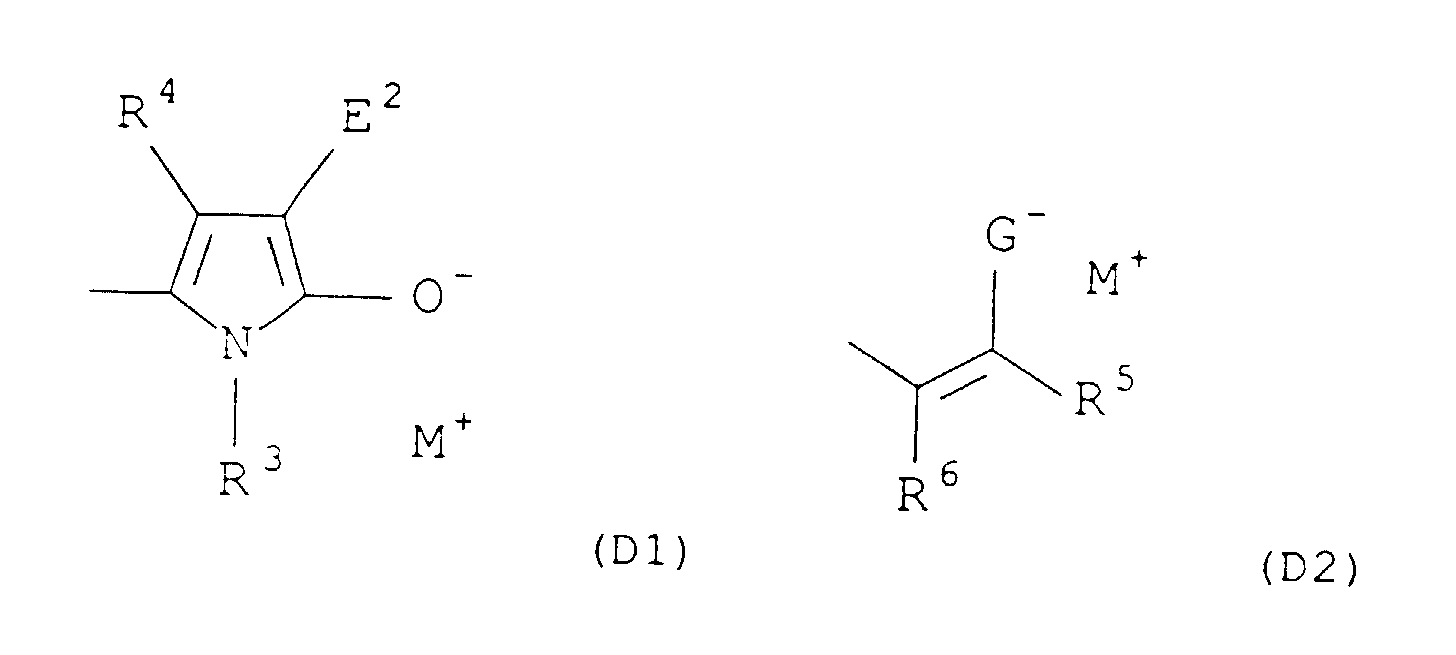
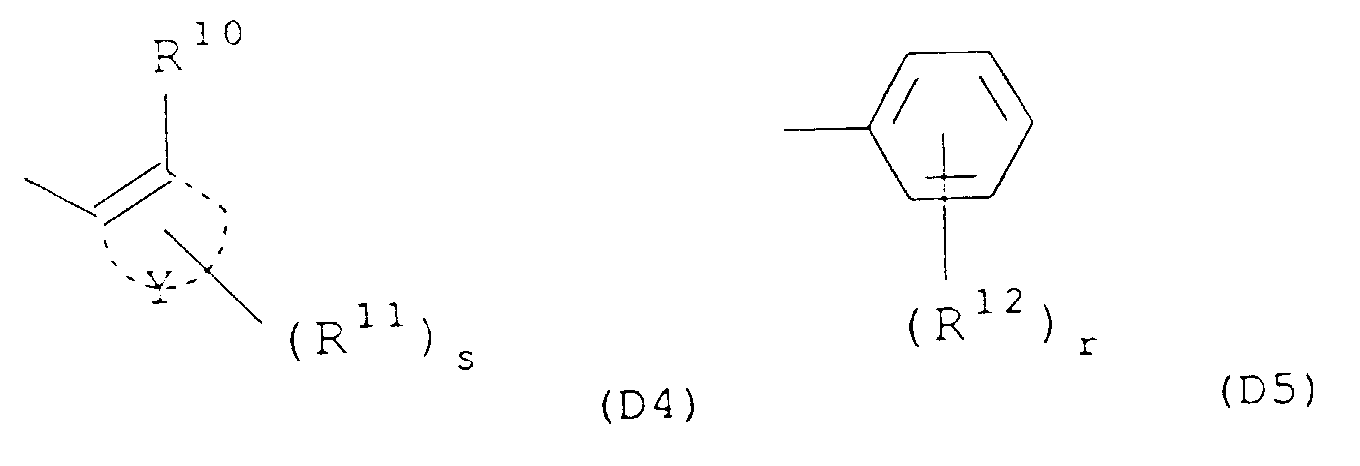
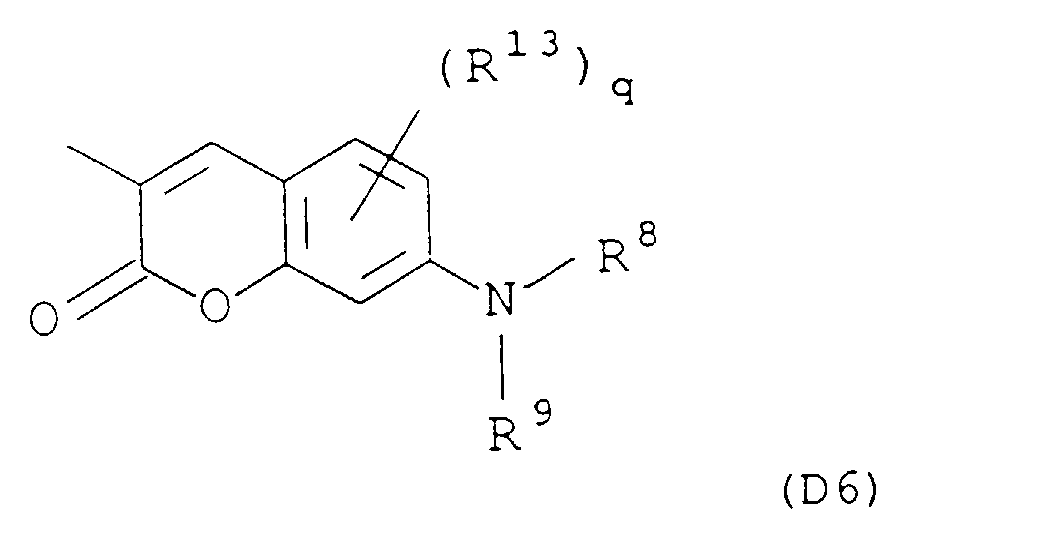
- Particular groups for D include:
- E 2 represents an electron withdrawing group.
- R 3 represents an aryl group (which includes substituted or unsubstituted aryl) preferably of 6 to 14 carbon atoms, or an alkyl group of from 1 to 12 carbon atoms.
- R 4 represents an alkyl or alkylthio group preferably of 1 to 20 (preferably 1 to 8) carbon atoms, or an alkenyl group of 2 to 20 (preferably of 2 to 8) carbon atoms; or an aryl, aralkyl, heterocyclic or cycloalkyl group preferably of 5 to 14 carbon atoms.
- R 4 can represent a hydroxy, cyano, chloro, nitro or hydrogen.
- R 5 represents an alkyl group ("group" wherever used in the present application includes the possibility of being substituted or unsubstituted alkyl) of 1 to 20 (preferably 1 to 8) carbon atoms or an alkenyl group of 2 to 20 (preferably of 2 to 8) carbon atoms; or an aryl, aralkyl, heterocyclic or cycloalkyl group preferably of 5 to about 14 carbon atoms.
- R 6 is also an electron withdrawing group. Electron withdrawing substituents are discussed in March, Advanced Organic Chemistry , pages 20-21, 228-229, 386-387, 494-497.
- preferred electron withdrawing substituents would have a Hammett ⁇ p constant of greater than 0.1 and preferably between 0.1 and 1.0 (for example, between any of 0.3, 0.4, 0.5 or 0.6 and 1.0).
- Hammett ⁇ p values are discussed in Advanced Organic Chemistry 3rd Ed., J. March, (John Wiley Sons, NY; 1985). Note that the " p " subscript refers to the fact that the ⁇ values are measured with the substituents in the para position of a benzene ring. Additional tables relating to Hammett ⁇ p constants can be found in Chemical Reviews Volume 91, pages 165-195 (authored by C Hansch et al.).
- Groups for E 1 , E 2 and R 6 may include cyano, acyl, benzoyl, phenacyl, aminocarbonyl, alkoxycarbonyl, aryl, or alkylsulfonyl group (any of which particularly may have 2 to 20, and preferably of 2 to 8, carbon atoms), or an arylsulfonyl or any sulfamoyl group (either particularly including those of 1 to 8, and preferably 1 to 20, carbon atoms).
- R 5 and R 6 may together represent the non-metallic atoms necessary to complete a substituted or unsubstituted ring containing at least one 5- or 6-membered heterocyclic or unsaturated alicyclic nucleus.
- R 7 , R 10 , R 11 , R 12 and R 13 each individually represents hydrogen, carboxy, carboxyalkyl, sulfonamido, sulfamoyl, or an alkyl, aralkyl, cycloalkyl, alkoxy, alkylamino, or alkylthio group preferably of 1 to 10 carbon atoms.
- R 5 , R 8 , R 9 , R 15 , and R 16 each individually represents an alkyl group preferably of 1 to 20 (and more preferably 1 to 8) carbon atoms or an alkenyl group preferably of 2 to 8 carbon atoms, or an aryl, aralkyl, heterocyclic or cycloalkyl group preferably of 5 to about 14 carbon atoms.
- R 8 and R 9 , or R 15 and R 16 together represent the non-metallic atoms required to form a substituted or unsubstituted 5- or 6-membered ring with each other, or R 8 and R 9 individually represent the non-metallic atoms necessary to form a substituted or unsubstituted 5- or 6-membered fused ring with the phenyl ring to which the nitrogen is attached.
- R 14 represents an alkyl group preferably of 1 to about 8 carbon atoms, or an aralkyl or cycloalkyl group preferably of 5 to about 10 carbon atoms.
- G represents -O or -C(CN) 2 .
- Y and Z individually represent the non-metallic atoms necessary to complete a substituted or unsubstituted ring system containing at least one 5- or 6-membered heterocyclic nucleus.
- the group formed by Y includes pyridine, pyrazole, pyrrole, furan, thiophene, and the like, or fused ring systems such as indole, benzoxazole, and the like.
- the atoms represented by Z can complete a 5- or 6-membered heterocyclic nucleus, which can be fused with additional substituted or unsubstituted rings such as a benzo ring.
- Suitable heterocyclic nuclei are of the type commonly used in sensitizing dyes and are well known in the art. Many are described, for example, in the previously mentioned James, The Theory of the Photographic Process , 4th Edition, pages 195-203.
- Useful heterocyclic nuclei include thiazole, selenazole, oxazole, imidazole, indole, benzothiazole, benzindole, naphthothiazole, naphthoxazole, benzimidazole, and the like.
- Z represents the atoms necessary to complete a substituted or unsubstituted benzoxazole or benzothiazole nucleus.
- M + is a cation.
- L 1 through L 6 each individually represents a methine group which may be substituted or unsubstituted. The foregoing includes the possibility that any of them may be members of a 5 or 6 membered ring.
- m is 0, 1, 2, or 3.
- n is 0 or 1.
- p is 0, 1, 2, 3, or 4.
- q is 0, 1, 2, or 3.
- r is 0, 1, 2, 3, 4, or 5.
- s is 0, 1, or 2.
- D4 may particularly have the structure:
- Active methylene moieties of D2, as represented by where G represents O, are well known in the art and are described, for example, in the previously mentioned Hamer, Cyanine Dyes and Related Compounds , pages 469-494 and 595-604.
- M + is a cation such as H + , Et 3 NH + , C 5 H 5 NH + , Na + ,
- L 1 through L 6 are methine groups (the term "group", as already mentioned, is used in this application to include substituted or unsubstituted).
- Substituents on L 1 through L 6 may include a substituted or unsubstituted alkyl, alkenyl, aryl, aralkyl, chloro or acetoxy, or cycloalkyl group, as described above for R 2 and R 4 .
- Any of L 1 through L 6 may be members of a carbocyclic or heterocyclic ring (particularly a 5- or 6-membered ring of either type), such as cyclopentyl, cyclohexyl, and the like.
- alkyl groups mentioned above are methyl, ethyl, propyl, isopropyl, butyl, isobutyl, t-butyl, pentyl, hexyl, octyl, 2-ethylhexyl, and the like.
- Cycloalkyl groups can be cyclopentyl, cyclohexyl, 4-methylcyclohexyl, and the like.
- Alkenyl groups can be vinyl, 1-propenyl, 1-butenyl, 2-butenyl, and the like.
- Aryl groups can be phenyl, naphthyl, styryl, and the like.
- Aralkyl groups can be benzyl, phenethyl, and the like.
- Useful substituents on any of the foregoing or other groups disclosed, include halogen, alkoxy, acyl, alkoxycarbonyl, aminocarbonyl, carbonamido, carboxy, sulfamoyl, sulfonamido, sulfo, nitro, hydroxy, amino and the like.
- the dyes of the present invention can be prepared by condensation of a suitably substituted 3-pyrrolin-2-one compound with electrophilic compounds containing a leaving group such as anilino, acetamido, alkoxy, hydroxy, and the like, or by condensation with aldehydes and ketones. These condensation reactions, which are well known in the sensitizing dye art, are discussed in the previously mentioned James, The Theory of the Photographic Process , pages 206-211.
- the 3-pyrrolin-2-one compounds of the present invention can be prepared by Method A or Method B as shown.
- R 1 , R 2 and E 1 are substituents of the 3-pyrrolin-2-one compounds and represent groups as defined above.
- R 18 represents an alkyl group such as methyl, ethyl, or the like. Preparation of the 3-pyrrolin-2-one compounds by Method A is preferred in the cases in which R 2 is aryl, and preparation by Method B is preferred when R 2 is alkyl.
- the pyrrolinone dyes of the present invention are potentially useful in a wide variety of photographic and non-photographic application.
- One example of an application of these dyes in photographic materials is in solid particle filter dye dispersions, as previously disclosed in patents US. 4,803,150; US 4,855,221; US 4,857,446; US 4,900,653; US 4,900,654; and US 5,098,820.
- Solid particle dispersions of compounds of formula (I) may be useful as general purpose filter dyes, alone or in combination with other filter dyes in photographic elements. In such an application the particles might have an average particle size of 0.01 ⁇ m to 100 ⁇ m, preferably 0.1 ⁇ m to 10 ⁇ m, and more preferably 0.1 ⁇ m to 2 ⁇ m.
- Dyes of the formula (I) incorporated into solid particle dispersions require the presence of at least one base-ionizable functionality including, but not restricted to, carboxy (-COOH), sulfonamido (-NHSO 2 R 19 ) or sulfamoyl (-SO 2 NHR 20 ) where R 19 and R 20 represent groups as defined above for R 2 and R 4 .
- R 20 can be hydrogen.
- solid particle filter dye dispersions of such dyes of the present invention will be insoluble at coating pH's of 6 or less (generally 4 to 6) and soluble at processing pH's of 8 or more (generally 8 to 12). Thus, they do not interact with other components of the photographic elements during coating or storage but are fully solubilized during photographic processing.
- Water soluble filter dyes of the formula (I) can also be used either within a silver halide emulsion layer as an intergrain absorber or immobilized by cationic mordants in a separate layer, or coated in a layer on the support on the side opposite to the layers containing silver halide emulsions.
- Dyes of formula (I) used in this manner would incorporate one or more solubilizing groups such as sulfo (-SO 3 - ) or sulfato (-OSO 3 - ). Such dyes would readily wash out of the silver halide emulsions upon normal photographic processing.
- Amounts of dyes described which can be used in photographic elements of the present invention can vary widely. Particularly the amount used in such elements is from 0.1 mg/m 2 to 1000 mg/m 2 , or preferably from 1 mg/m 2 to 100 mg/m 2 .
- Dyes which are not removed from photographic elements can also be useful, particularly in color negative materials as printer compatibility dyes to add D min at desired wavelenghts.
- Dyes of the present invention can also be used as a tint in photographic element supports.
- at least some dyes of the present invention can also be used as spectral sensitizers for silver halide, and the present invention includes photographic elements with silver halide spectrally sensitized by dyes of the present invention.
- dyes of the present invention may be incorporated in a hydrophilic layer of a photographic element which is either a radiation sensitive layer or a non-radiation sensitive layer. Further, the dyes may be located on the same side of a support of a photographic element as a radiation sensitive layer, or on the opposite side of the support. More specifically, the dyes (either particle or water soluble) would be incorporated in an anti-halation layer or an anti-halation subbing layer.
- dyes of the present invention may be incorporated in a hydrophilic layer of a photographic element which is either a radiation sensitive layer or a non-radiation sensitive layer. Further, the dyes may be located on the same side of a support of a photographic element as a radiation sensitive layer, or on the opposite side of the support. More specifically, the dyes (either particle or water soluble) could be incorporated in an anti-halation layer or an anti-halation subbing layer.
- pyrrolinone merocyanine dyes of the present invention are shown in Table 1
- pyrrolinone arylidene dyes are shown in Table 2
- pyrrolinone oxonol dyes in Table 3
- miscellaneous pyrrolinone dyes in Table 4.
- Table 5 lists solution absorbance maxima for some representative dyes of the present invention. The examples below further illustrate the present invention.
- the silver halide used in the photographic elements of the present invention may be silver bromoiodide, silver bromide, silver chloride, silver chlorobromide, and the like, which are provided in the form of an emulsion.
- the silver halide emulsion may be at least 90% or 95% silver chloride, or even substantially pure silver chloride (that is, at least 99% silver chloride).
- the silver chloride could be treated with a bromide solution to increase its sensitivity, although the bulk concentration of bromide in the resulting emulsion will be no more than about 2 to 2.5 mole% and preferably between about 0.6 to 1.2 mole% (that is, the chloride concentration would preferably be 99.4% to 98.2%).
- the photographic elements of the present invention may, for example, use tabular grain silver halide emulsions.
- Tabular silver halide grains are grains having two substantially parallel crystal faces that are larger than any other surface on the grain.
- the silver halide grains to be used in the invention may be prepared according to methods known in the art, such as those described in Research Disclosure , (Kenneth Mason Publications Ltd, Emsworth, England) Item 308119, December, 1989 (hereinafter referred to as Research Disclosure I ) and James, The Theory of the Photographic Process . These include methods such as ammoniacal emulsion making, neutral or acid emulsion making, and others known in the art. These methods generally involve mixing a water soluble silver salt with a water soluble halide salt in the presence of a protective colloid, and controlling the temperature, pAg, pH values, etc, at suitable values during formation of the silver halide by precipitation.
- the silver halide to be used in elements of the invention may be advantageously subjected to chemical sensitization with compounds such as gold sensitizers (e.g., aurous sulfide) and others known in the art.
- gold sensitizers e.g., aurous sulfide
- Compounds and techniques useful for chemical sensitization of silver halide are known in the art and described in Research Disclosure I and the references cited therein.
- the photographic elements of the present invention provide the silver halide in the form of an emulsion.
- an emulsion e.g., negative-working emulsions such as surface-sensitive emulsions of unfogged internal latent image-forming emulsions, direct-positive emulsions such as surface fogged emulsions, or others described in, for example, Research Disclosure I ) may be used.
- Photographic emulsions generally include a vehicle for coating the emulsion as a layer of a photographic element.
- Useful vehicles include both naturally occurring substances such as proteins, protein derivatives, cellulose derivatives (e.g., cellulose esters), gelatin (e.g., alkali-treated gelatin such as cattle bone or hide gelatin, or acid treated gelatin such as pigskin gelatin), gelatin derivatives (e.g., acetylated gelatin, phthalated gelatin, and the like), and others as described in Research Disclosure I .
- Also useful as vehicles or vehicle extenders are hydrophilic water-permeable colloids.
- the vehicle can be present in the emulsion in any amount useful in photographic emulsions.
- the emulsion can also include any of the addenda known to be useful in photographic emulsions.
- Chemical sensitizers such as active gelatin, sulfur, selenium, tellurium, gold, platinum, palladium, iridium, osmium, rhenium, phosphorous, or combinations thereof. Chemical sensitization is generally carried out at pAg levels of from 5 to 10, pH levels of from 5 to 8, and temperatures of from 30 to 80 o C, as illustrated in Research Disclosure , June 1975, item 13452 and U.S. Patent No. 3,772,031.
- the silver halide may be sensitized by sensitizing dyes using known methods, such as described in Research Disclosure I .
- the dye may be added to an emulsion of the silver halide grains and a hydrophilic colloid at any time prior to (e.g., during or after chemical sensitization) or simultaneous with the coating of the emulsion on a photographic element.
- the dye/silver halide emulsion may be mixed with a dispersion of color image-forming coupler immediately before coating or in advance of coating (for example, 2 hours).
- the sensitizing dyes can be used alone, or may be used in combination with other sensitizing dyes, e.g. to also provide the silver halide with sensitivity to wavelengths of light outside the green region or to supersensitize the silver halide.
- addenda in the emulsion may include antifoggants, stabilizers, filter dyes, light absorbing or reflecting pigments, vehicle hardeners such as gelatin hardeners, coating aids, dye-forming couplers, and development modifiers such as development inhibitor releasing couplers, timed development inhibitor releasing couplers, and bleach accelerators.
- vehicle hardeners such as gelatin hardeners
- coating aids such as dye-forming couplers
- development modifiers such as development inhibitor releasing couplers, timed development inhibitor releasing couplers, and bleach accelerators.
- the emulsion may also include brighteners, such as stilbene brighteners. Such brighteners are well-known in the art and are used to counteract dye stain.
- An emulsion layer in elements of the present invention may be coated simultaneously or sequentially with other emulsion layers, subbing layers, filter dye layers, interlayers, or overcoat layers, all of which may contain various addenda known to be included in photographic elements. These include antifoggants, oxidized developer scavengers, DIR couplers, antistatic agents, optical brighteners, light-absorbing or light-scattering pigments, and the like.
- the layers of the photographic element can be coated onto a support using techniques well-known in the art. These techniques include immersion or dip coating, roller coating, reverse roll coating, air knife coating, doctor blade coating, stretch-flow coating, and curtain coating, to name a few.
- the coated layers of the element may be chill-set or dried, or both. Drying may be accelerated by known techniques such as conduction, convection, radiation heating, or a combination thereof.
- Photographic elements of the present invention can be black and white, color negative, color reversal, X-ray film, black and white or color printing paper, or the like.
- a color photographic element generally contains three silver emulsion layers or sets of layers (each set of layers often consisting of emulsions of the same spectral sensitivity but different speed): a blue-sensitive layer having a yellow dye-forming color coupler associated therewith; a green-sensitive layer having a magenta dye-forming color coupler associated therewith; and a red-sensitive layer having a cyan dye-forming color coupler associated therewith.
- dye forming couplers are provided in the emulsion typically by first dissolving or dispersing them in a water immiscible, high boiling point organic solvent, the resulting mixture then being dispersed in the emulsion.
- Suitable solvents include those in European Patent Application 87119271.2.
- Dye-forming couplers are well-known in the art and are disclosed, for example, in Research Disclosure I .
- Photographic elements of the present invention can be processed in any of a number of well-known photographic processes utilizing any of a number of well-known processing compositions, described, for example, in Research Disclosure I , or in James, The Theory of the Photographic Process 4th, 1977.
- the product mixture was diluted with 500 mL of 50% aqueous ethanol and, with rapid stirring, 30 mL of concentrated hydrochloric acid was added in 10 mL portions over 30 minutes. The resulting slurry was stirred for 20 minutes and the precipitated product mixture was collected by filtration. The product mixture was washed with 2 x 250 mL 50% aqueous ethanol, 1 x 500 mL ethanol, 1 x 500 mL dichloromethane, and finally 1 x 500 mL ligroin and dried to afford 44.5 grams (0.15 mol, 76% yield) of 2-(4-sulfoanilino)acetophenone in 97% purity, m. p. > 300° C.
- the crude gummy product was dissolved in 25 mL absolute ethanol at reflux and treated with a solution of 6.0 grams (40 mmol) of sodium iodide in 10 mL of methanol.
- the resulting bronze colored powder product was collected by filtration after cooling to 50° C and washed with ethanol and ligroin.
- the crude dye was dissolved in water and precipitated from acetone, then dissolved in 50 mL methanol at reflux and filtered while hot.
- a number of the pyrrolinone dyes of the present invention (in solid particle format) were coated in gelatin. The absorbance maximum were then measured, along with density at the maximum both before and after a 5 minute distilled water wash and after processing in the Kodak Process E-6 (described, for example, in British Journal of Photography , 1988, p. 193-196.
Landscapes
- Chemical & Material Sciences (AREA)
- Organic Chemistry (AREA)
- Engineering & Computer Science (AREA)
- Materials Engineering (AREA)
- Physics & Mathematics (AREA)
- General Physics & Mathematics (AREA)
- Nitrogen Condensed Heterocyclic Rings (AREA)
Claims (9)
- Elément photographique contenant une couche sensible aux rayonnements et un colorant 3-pyrrolin-2-one, ledit colorant ayant un groupe attracteur d'électrons en position 3 et un radical conjugué avec l'atome d'oxygène en position 2, ledit radical étant relié à la position 5 du cycle pyrrolinone par l'intermédiaire d'un pont méthine substitué ou non et dans lequel l'atome d'azote du cycle pyrrolinone comprend un substituant autre que l'hydrogène.
- Elément photographique selon la revendication 1 contenant une couche sensible aux rayonnements et un colorant de formule :où :
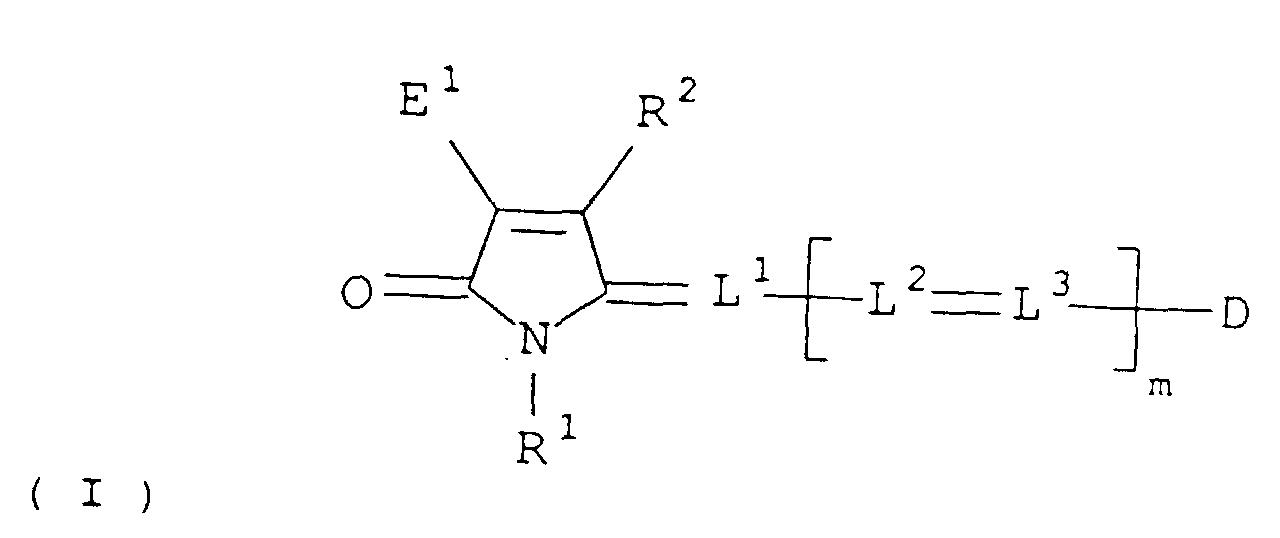 E1 représente un groupe attracteur d'électrons ;R1 représente un groupe aryle substitué ou non de 6 à 14 atomes de carbone ou un groupe alkyle substitué ou non de 1 à 12 atomes de carbone ;R2 représente un groupe alkyle substitué ou non de 1 à 20 atomes de carbone ou un groupe alcényle substitué ou non de 2 à 20 atomes de carbone ou un groupe aryle, aralkyle, hétérocyclique ou cycloalkyle de 5 à 14 atomes de carbone, tous ces groupes pouvant être substitués ou non, ou un radical hydroxy, cyano, chloro, nitro ou l'hydrogène ;chaque L représente un groupe méthine ;m est 0, 1, 2 ou 3 ; et D est un radical conjugué avec l'atome d'oxygène du cycle pyrrolinone.
 - Elément photographique selon la revendication 2, dans lequel D contient un atome avec une paire d'électrons disponible conjuguée avec l'atome d'oxygène du cycle pyrrolinone, ledit atome étant 0, N, Se ou S ou est C avec au moins un groupe attracteur d'électrons relié à ce dernier ou D est un groupe contenant un cycle benzenique.
- Elément photographique selon la revendication 2, dans lequel D contient un atome 0 ou N ou un groupe -C(CN)2 conjugué avec l'atome d'oxygène du cycle pyrrolinone.
- Elément photographique selon la revendication 2, dans lequel D est n'importe quel groupe choisi parmi la liste suivante :

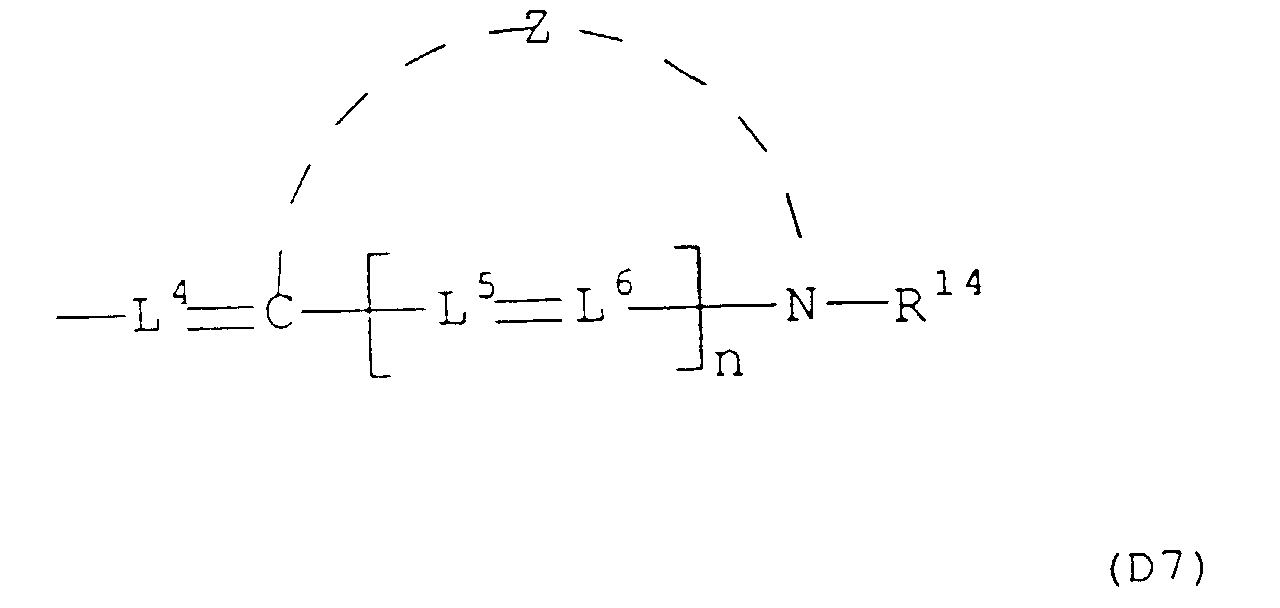 et où :
 E2 représente un groupe attracteur d'électrons ;R3 représente un groupe aryle substitué ou non de 6 à 14 atomes de carbone ou un groupe alkyle substitué ou non de 1 à 12 atomes de carbone ;R4 représente un groupe alkyle ou alkylthio substitué ou non de 1 à 20 atomes de carbone ou un groupe alcényle substitué ou non de 2 à 20 atomes de carbone ou un groupe aryle, aralkyle, hétérocyclique ou cycloalkyle de 5 à 14 atomes de carbone, tous ces groupes pouvant être substitués ou non, ou un radical hydroxy, cyano, chloro, nitro ou l'hydrogène ;R5 représente un groupe alkyle substitué ou non de 1 à 20 atomes de carbone ou un groupe alcényle substitué ou non de 2 à 20 atomes de carbone ou un groupe aryle, aralkyle ou cycloalkyle de 5 à 14 atomes de carbone, tous ces groupes pouvant être substitués ou non, et R6 représente un radical cyano ou un groupe aryle, aminocarbonyle ou alcoxycarbonyle substitué ou non de 2 à 20 atomes de carbone, ou un groupe alkylsulfonyle, arylsulfonyle ou sulfamoyle de 1 à 20 atomes de carbone, tous ces groupes pouvant être substitués ou non ou R5 et R6 peuvent ensemble représenter les atomes non métalliques nécessaires pour compléter un cycle substitué ou non contenant au moins un noyau hétérocyclique alicyclique non saturé à 5 ou 6 membres ;R7, R10, R11, R12 et R13 représentent chacun individuellement l'hydrogène, un radical carboxy, carboxyalkyle, sulfonamido, sulfamoyle ou un groupe alkyle, aralkyle, cycloalkyle, alcoxy, alkylamino ou alkylthio de 1 à 10 atomes de carbone, tous ces groupes pouvant être substitués ou non ;R8, R9, R15 et R16 représentent chacun individuellement un groupe alkyle substitué ou non de 1 à 20 atomes de carbone ou un groupe alcényle substitué ou non de 2 à 8 atomes de carbone ou un groupe aryle, aralkyle ou cycloalkyle de 5 à 14 atomes de carbone, tous ces groupes pouvant être substitués ou non, ou R8 et R9 ou R15 et R16 représentent ensemble les atomes non métalliques nécessaires pour former l'un avec l'autre un cycle substitué ou non à 5 ou 6 membres, ou R8 et R9 représentent individuellement les atomes non métalliques nécessaires pour former un cycle condensé substitué ou non de 5 ou 6 membres avec le cycle phényle auquel l'atome d'azote est rattaché ;R14 représente un groupe alkyle de 1 à 20 atomes de carbone ou un groupe aralkyle ou cycloalkyle de 5 à 10 atomes de carbone, tous ces groupes pouvant être substitués ou non ;G représente -O ou -C(CN)2 ;Y et Z représentent chacun individuellement les atomes non métalliques nécessaires pour compléter un groupe contenant au moins un cycle hétérocyclique à 5 ou 6 membres ;M+ est un cation ;L1 à L6 représentent chacun individuellement un groupe méthine ;n est 0 ou 1 ;p est 0, 1, 2, 3 ou 4 ;q est 0, 1, 2 ou 3 ;r est 0, 1, 2, 3, 4 ou 5 ; ets est 0, 1 ou 2.
 - Elément photographique selon la revendication 5, dans lequel (D4) est représenté par la structure :où R10 et R14 sont tels que définis dans la revendication 5.

- Elément photographique selon l'une quelconque des revendications 1 à 6, dans lequel le colorant comprend au moins un substituant carboxy, sulfonamido, sulfamoyle, sulfato ou sulfo.
- Elément photographique selon l'une quelconque des revendications 2 à 7, dans lequel R1 ou D comprend au moins un substituant carboxy, sulfonamido, sulfamoyle, sulfato ou sulfo.
- Colorant tel que défini dans l'une quelconque des revendications 1 à 8.
Applications Claiming Priority (2)
| Application Number | Priority Date | Filing Date | Title |
|---|---|---|---|
| US995436 | 1992-12-23 | ||
| US07/995,436 US5283165A (en) | 1992-12-23 | 1992-12-23 | Pyrrolinone dyes |
Publications (3)
| Publication Number | Publication Date |
|---|---|
| EP0608582A2 EP0608582A2 (fr) | 1994-08-03 |
| EP0608582A3 EP0608582A3 (fr) | 1995-04-19 |
| EP0608582B1 true EP0608582B1 (fr) | 1999-03-10 |
Family
ID=25541796
Family Applications (1)
| Application Number | Title | Priority Date | Filing Date |
|---|---|---|---|
| EP93203595A Expired - Lifetime EP0608582B1 (fr) | 1992-12-23 | 1993-12-20 | Colorants de pyrrolinone et matériaux photographiques les contenant |
Country Status (3)
| Country | Link |
|---|---|
| US (1) | US5283165A (fr) |
| EP (1) | EP0608582B1 (fr) |
| JP (1) | JPH06220338A (fr) |
Families Citing this family (2)
| Publication number | Priority date | Publication date | Assignee | Title |
|---|---|---|---|---|
| US5750323A (en) * | 1995-08-31 | 1998-05-12 | Eastman Kodak Company | Solid particle dispersions for imaging elements |
| US5695917A (en) * | 1995-11-22 | 1997-12-09 | Eastman Kodak Company | Combination of yellow filter dye and 4-equivalent pyrazolone magenta coupler |
Family Cites Families (11)
| Publication number | Priority date | Publication date | Assignee | Title |
|---|---|---|---|---|
| US3753721A (en) * | 1970-08-13 | 1973-08-21 | Eastman Kodak Co | Photographic materials |
| US4234677A (en) * | 1978-01-26 | 1980-11-18 | Ciba-Geigy Ag | Pyrazolone dyestuffs and their use in photographic materials |
| DE3305219A1 (de) * | 1983-02-16 | 1984-08-16 | Koenig & Bauer AG, 8700 Würzburg | Bogenzufuehrung fuer druckmaschinen |
| JP2537614B2 (ja) * | 1987-03-17 | 1996-09-25 | コニカ株式会社 | ハロゲン化銀写真感光材料 |
| DE3819241A1 (de) * | 1987-06-05 | 1989-01-05 | Fuji Photo Film Co Ltd | Photographische silberhalogenidemulsionen |
| US4923788A (en) * | 1989-02-09 | 1990-05-08 | Eastman Kodak Company | Filter dyes for photographic elements |
| US5011811A (en) * | 1990-03-07 | 1991-04-30 | Eastman Kodak Company | In situ dye generation for thermal transfer printing |
| JPH049042A (ja) * | 1990-04-19 | 1992-01-13 | Konica Corp | ハロゲン化銀写真感光材料 |
| JP2709750B2 (ja) * | 1991-03-27 | 1998-02-04 | 富士写真フイルム株式会社 | ハロゲン化銀写真感光材料 |
| US5213956A (en) * | 1991-07-22 | 1993-05-25 | Eastman Kodak Company | Solid particle dispersions of filter dyes for photographic elements |
| JP2787628B2 (ja) * | 1992-01-21 | 1998-08-20 | 富士写真フイルム株式会社 | ハロゲン化銀写真感光材料 |
-
1992
- 1992-12-23 US US07/995,436 patent/US5283165A/en not_active Expired - Fee Related
-
1993
- 1993-12-20 EP EP93203595A patent/EP0608582B1/fr not_active Expired - Lifetime
- 1993-12-22 JP JP5323990A patent/JPH06220338A/ja active Pending
Also Published As
| Publication number | Publication date |
|---|---|
| EP0608582A2 (fr) | 1994-08-03 |
| EP0608582A3 (fr) | 1995-04-19 |
| JPH06220338A (ja) | 1994-08-09 |
| US5283165A (en) | 1994-02-01 |
Similar Documents
| Publication | Publication Date | Title |
|---|---|---|
| US5213956A (en) | Solid particle dispersions of filter dyes for photographic elements | |
| EP0251282B1 (fr) | Colorants absorbant l'infrarouge et éléments photographiques les contenant | |
| JP2000086928A (ja) | 分散物及びそれを含む写真要素 | |
| EP0679939B1 (fr) | Colorants oxonol substitués par acyl | |
| US5098820A (en) | Solid particle dispersions of filter dyes for photographic elements | |
| EP0598420B1 (fr) | Colorants du type imine et éléments photographiques les contenant | |
| EP0608582B1 (fr) | Colorants de pyrrolinone et matériaux photographiques les contenant | |
| US5418126A (en) | Furan or pyrrole substituted dye compounds and silver halide photographic elements containing such dyes | |
| EP0828183A1 (fr) | Elément photographique comprenant du colorant absorbant à l'infrarouge | |
| EP0565083B1 (fr) | Composé colorant et élément photographique le contenant | |
| EP0331414B1 (fr) | Colorant sensibilisateur pour composition photographique à l'halogénure d'argent à haute teneur en chlorure d'argent et à basse teneur en iodure d'argent | |
| US5266454A (en) | Solid particle dispersions of filter dyes for photographic elements | |
| EP0323728B1 (fr) | Colorants filtres pour éléments photographiques | |
| EP0434026A1 (fr) | Composé méthine | |
| EP0323729B1 (fr) | Dispersions de particules solides de colorants utilisés dans des éléments photographiques | |
| EP1334999A2 (fr) | Colorants polyméthines et azométhines pour éléments formateurs d' images | |
| EP0412379A1 (fr) | Matériaux photographiques couleur à l'halogénure d'argent sensibles à la lumière | |
| US5470695A (en) | Solid particle dispersions of filter dyes for photographic elements | |
| US3352680A (en) | Sensitizing and filter dyes for photographic elements | |
| EP1335243A1 (fr) | Matériaux d'enregistrement d'images contenant colorants benzothiaziniques | |
| US5919610A (en) | Dyes for use in diverse applications | |
| JP3440167B2 (ja) | トリメチン化合物およびこれを用いるハロゲン化銀写真感光材料 | |
| EP0781816B1 (fr) | Colorants utilisables dans différentes applications | |
| JPH09179244A (ja) | 写真材料用フィルター色材 | |
| JPH09188824A (ja) | 多用途で使用するための新規染料 |
Legal Events
| Date | Code | Title | Description |
|---|---|---|---|
| PUAI | Public reference made under article 153(3) epc to a published international application that has entered the european phase |
Free format text: ORIGINAL CODE: 0009012 |
|
| AK | Designated contracting states |
Kind code of ref document: A2 Designated state(s): GB |
|
| PUAL | Search report despatched |
Free format text: ORIGINAL CODE: 0009013 |
|
| AK | Designated contracting states |
Kind code of ref document: A3 Designated state(s): BE CH DE FR GB IT LI NL |
|
| 17P | Request for examination filed |
Effective date: 19951011 |
|
| GRAG | Despatch of communication of intention to grant |
Free format text: ORIGINAL CODE: EPIDOS AGRA |
|
| 17Q | First examination report despatched |
Effective date: 19980630 |
|
| GRAG | Despatch of communication of intention to grant |
Free format text: ORIGINAL CODE: EPIDOS AGRA |
|
| GRAH | Despatch of communication of intention to grant a patent |
Free format text: ORIGINAL CODE: EPIDOS IGRA |
|
| RBV | Designated contracting states (corrected) |
Designated state(s): GB |
|
| GRAH | Despatch of communication of intention to grant a patent |
Free format text: ORIGINAL CODE: EPIDOS IGRA |
|
| REG | Reference to a national code |
Ref country code: DE Ref legal event code: 8566 |
|
| GRAA | (expected) grant |
Free format text: ORIGINAL CODE: 0009210 |
|
| AK | Designated contracting states |
Kind code of ref document: B1 Designated state(s): GB |
|
| PG25 | Lapsed in a contracting state [announced via postgrant information from national office to epo] |
Ref country code: GB Free format text: LAPSE BECAUSE OF NON-PAYMENT OF DUE FEES Effective date: 19991220 |
|
| PLBE | No opposition filed within time limit |
Free format text: ORIGINAL CODE: 0009261 |
|
| 26N | No opposition filed | ||
| GBPC | Gb: european patent ceased through non-payment of renewal fee |
Effective date: 19991220 |