EP0608708B1 - Automatische Zeichenerkennung mit Verwendung statischer und dynamischer Parameter - Google Patents
Automatische Zeichenerkennung mit Verwendung statischer und dynamischer Parameter Download PDFInfo
- Publication number
- EP0608708B1 EP0608708B1 EP94100357A EP94100357A EP0608708B1 EP 0608708 B1 EP0608708 B1 EP 0608708B1 EP 94100357 A EP94100357 A EP 94100357A EP 94100357 A EP94100357 A EP 94100357A EP 0608708 B1 EP0608708 B1 EP 0608708B1
- Authority
- EP
- European Patent Office
- Prior art keywords
- dynamic
- static
- character
- handwriting
- block
- Prior art date
- Legal status (The legal status is an assumption and is not a legal conclusion. Google has not performed a legal analysis and makes no representation as to the accuracy of the status listed.)
- Expired - Lifetime
Links
Images





Classifications
-
- G—PHYSICS
- G06—COMPUTING OR CALCULATING; COUNTING
- G06V—IMAGE OR VIDEO RECOGNITION OR UNDERSTANDING
- G06V30/00—Character recognition; Recognising digital ink; Document-oriented image-based pattern recognition
- G06V30/10—Character recognition
- G06V30/32—Digital ink
- G06V30/36—Matching; Classification
- G06V30/373—Matching; Classification using a special pattern or subpattern alphabet
-
- G—PHYSICS
- G06—COMPUTING OR CALCULATING; COUNTING
- G06F—ELECTRIC DIGITAL DATA PROCESSING
- G06F18/00—Pattern recognition
- G06F18/20—Analysing
- G06F18/25—Fusion techniques
- G06F18/254—Fusion techniques of classification results, e.g. of results related to same input data
- G06F18/256—Fusion techniques of classification results, e.g. of results related to same input data of results relating to different input data, e.g. multimodal recognition
-
- G—PHYSICS
- G06—COMPUTING OR CALCULATING; COUNTING
- G06V—IMAGE OR VIDEO RECOGNITION OR UNDERSTANDING
- G06V30/00—Character recognition; Recognising digital ink; Document-oriented image-based pattern recognition
- G06V30/10—Character recognition
- G06V30/19—Recognition using electronic means
- G06V30/191—Design or setup of recognition systems or techniques; Extraction of features in feature space; Clustering techniques; Blind source separation
- G06V30/1918—Fusion techniques, i.e. combining data from various sources, e.g. sensor fusion
-
- G—PHYSICS
- G06—COMPUTING OR CALCULATING; COUNTING
- G06V—IMAGE OR VIDEO RECOGNITION OR UNDERSTANDING
- G06V30/00—Character recognition; Recognising digital ink; Document-oriented image-based pattern recognition
- G06V30/10—Character recognition
- G06V30/32—Digital ink
- G06V30/333—Preprocessing; Feature extraction
- G06V30/347—Sampling; Contour coding; Stroke extraction
Definitions
- This invention relates to apparatus and methods for automatically recognizing handwriting.
- Symbols formed by handwriting, when traced on an electronic tablet, are represented by sequences of x-y coordinate pairs.
- a fundamental unit of handwriting is the stroke.
- a stroke is considered as a sequence of points, represented by their respective x-y coordinates.
- Symbols, such as letters of the alphabet and numbers, are assemblages of such strokes.
- Desirable features of an automatic handwriting recognition system include an ability to process the input data so as to minimize redundancies, and to also model the data by means of robust statistical techniques. Parameters that are considered are typically dependent on the direction of pen movement. That is, the temporal order of the points is preserved when deriving feature vectors. The rational for preserving the temporal ordering of the stroke data is that there is a degree of consistency in the way characters are formed by a given writer. For example, the letter "O" may be written either in a clockwise or counter-clockwise motion. By allowing for these two possibilities, and retaining the direction of pen movement, it is possible to design a recognition system that is robust with respect to noise because the overall temporal trace of the system is not affected by small fluctuations. Furthermore, it is often possible to distinguish between similar shapes, such as an 'S' formed with one stroke and a '5' that is formed with two strokes, by virtue of the number of strokes and/or the direction of pen movement.
- a handwriting recognition system that is dependent solely upon stroke order may exhibit certain deficiencies.
- One such deficiency is a difficulty in properly handling delayed strokes, such as the crossing of a 't' and the dotting of an 'i' or a 'j'.
- Retraces of characters may also present difficulties.
- Another deficiency of handwriting recognition systems that process only temporal, or dynamic, input data is an ambiguity that is introduced when modeling multi-stroke characters, such as capital letters. This ambiguity exists because the number of representations of such multi-stroke characters increases geometrically with the number of strokes.
- the use of a large number of templates increases both the memory requirements of the handwriting recognition system and also the processing time that is required to search through the templates to find a most probable match with an input character.
- a feature extraction and reduction procedure is disclosed that relies principally on the static or shape information, wherein the temporal order in which the points are captured by the tablet may be disregarded. Thus, only the shape of the character is considered. This is achieved by generating and processing the data with three independent sets of feature vectors which encode the shape information of the input character information. These feature vectors include horizontal (x-axis) and vertical (y-axis) slices of a bit-mapped image of the input character data, and an additional feature vector to encode an absolute y-axis displacement from a baseline of the bit-mapped image.
- the method of this invention is logically divided into two operations.
- a first operation is a training phase wherein estimates of the parameters of a character model are obtained.
- a second operation is a decoding phase which recognizes incoming unknown handwriting-generated signals. Methods to combine probability scores from the dynamic and the static character models are also disclosed.
- a presently preferred embodiment of this invention employs techniques to process handwriting input, specifically dynamic (temporal) processing of the handwriting input, that are disclosed in commonly assigned U.S. Patent Application S.N. 07/785,642, filed 10/31/91, entitled "A Statistical Mixture Approach to Automatic Handwriting Recognition", by J. Bellagarda, E. Bellagarda, D. Nahamoo and K. Nathan.
- the present invention extends this teaching by the use of static, shape-based character feature vectors, and by a combination of static and dynamic feature vectors.
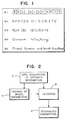
- handwritten characters In handwriting recognition, handwritten characters generally fall into five groups depicted in Fig. 1, the groups being depicted in increasing order of recognition complexity. Specifically, these groups include a first type of writing (W1) known as box discrete wherein individual characters are formed within predefined areas, or boxes, thereby simplifying the task of character segmentation.
- W1 first type of writing
- a second type of writing is known as spaced discrete wherein the user intentionally for seach character such that no character touches another.
- a third type of writing (W3) is known as run-on discrete wherein the user may form characters that touch or "run-on" to, one another.
- a fourth type of writing (W4) is cursive writing where the user normally writes the whole word as a series of connected letters, and then subsequently crosses the t's and dots the i's and j's.
- a fifth type of writing (W5) is unconstrained writing wherein the user may use a mixture of run-on and cursive writing. The last type is most difficult and presents the most complex segmentation and recognition task of the five styles depicted in Fig. 1.
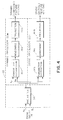
- FIG. 2 there is illustrated, in block diagram form, a handwriting recognition system that is constructed in accordance with this invention.
- a generalized discussion of Fig. 2 is first provided, followed by a detailed description of the operation of each of the blocks shown therein.
- data acquisition of stylus or pen stroke information is operated on to recognize the handwriting information.
- the acquired handwriting information is analyzed, in reference to a known, training script, to train the underlying models purporting to represent this information.
- the model parameters obtained during training are used by decoding block 6, together with feature vectors corresponding to the (unknown) handwriting to be recognized.
- Recognized handwriting is thereafter made available for use by block 8.
- a recognized message may be simply converted to an alphanumeric format and displayed upon a display device.
- the recognized message may also be provided to any application that would conventionally receive messages from a keyboard such as, by example, a word processing system.
- FIG. 3 is a block diagram of a handwriting recognition system that implements the methods of the invention that are described below.
- a data processing system 10 which for any example may be an IBM 3090/VF or an IBM RS 6000, receives character or stroke information produced by a user using a handwriting transducer, typically a stylus 12 that writes on an electronic tablet 14. The character or stroke information may be displayed on the electronic tablet 14 or another display device (not shown).
- the computer 10 can be used either in a training mode 16 or in a decoding mode 18.
- a front-end parameter extraction block 22 is employed.
- the front-end parameter extraction block is operable for extracting both dynamic (temporally-based) feature vectors and also static (shape-based or spatially-based) feature vectors from the output of the tablet 14.
- the system In the training mode 16 the system includes a dynamic prototype construction block 24a and also a static prototype construction block 24b.
- the system includes a dynamic likelihood estimator 28a, a static likelihood estimator 28b, an overall (combined) likelihood estimator 28c, and a decoder 30 that operates with a language model block 26.
- the front-end parameter extraction block 22 provides dynamic and static feature vectors to the prototype construction blocks 24a and 24b, respectively, during the training mode 16, or to the likelihood estimator blocks 28a and 28b, respectively, during the decoding mode 18.
- the parameter extraction block 22 operates in accordance with the following nine method steps.
- Step 19 indicates the end of the training phase.
- the output of the static recognizer, at the character level can be employed to estimate the a posteriori probability of the entire unknown character U. Then s d , as described above, encompasses the entire character. This can be combined with the a posteriori probability of the unknown character using the dynamic features by assuming that the two sources o information are independent. The additional information is treated as arising from an independent codebook.
- a j ) Pr(U t
- Each sampled point of handwriting is represented by a point which is defined by coordinates x n and y n .
- This coordinate pair is provided to a pre-filtering block 34, which performs step 1 of both the dynamic and the static handwriting recognition methods set forth above.
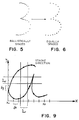
- the points are ballistically spaced as shown in Fig. 5. That is, the spacing of the points is a function of the velocity or speed of writing which the writer used to form the current character. For a variety of reasons, writers are seldom consistent in their velocity or writing speed, which may introduce high error rates in handwriting recognition.
- the pre-filtering block 34 normalizes the points of Fig. 5 to provide equally spaced points x m and y m comprising a character, as shown in Fig. 6.
- Points x m and y m are provided to a dynamic parameter extraction block 36a, which performs Steps 2 and 3 of the dynamic handwriting recognition method for providing the vector v m . Details of this parameter extraction are described below relative to Figs. 11, 12, 13 and 14.
- the vector v m is provided to a windowing block 38a, which performs Steps 4 and 5 of the dynamic handwriting recognition method, for providing a spliced vector S i . Details of how the spliced vector S i is provided is described below relative to Figs. 14, 15, and 16.
- the spliced vector S i is provided to a projection block 40a, which performs Steps 6-9 of the dynamic handwriting recognition method, for producing a feature vector r i .
- Projection block 40a responds to the spliced vector S i to provide a feature vector r i which is provided to the dynamic prototype construction block 24a and the dynamic likelihood estimator 28a, as previously explained with respect to Fig. 3. Details of projection block 40a are set forth relative to the flow chart of Fig. 17.
- Fig. 7 is representative of the upper 1/4 curved portion of Fig. 5.
- the density of points is increased by performing some interpolation between the original raw points (denoted by a dot). This results in a sequence of points comprising the set of original raw points (.) and the interpolated points (
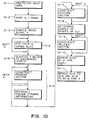
- filtering is accomplished by a priori determining that equal spacing between points is a distance r suitably related to the distance between two pels as manifested on the electronic tablet 14 (Fig.
- Distance is again computed in block 44 and compared with R in block 46. Eventually the distance becomes greater than R, so the point 55 is accepted (m is made equal to n in block 58).
- the point (x n ,y n ) is stored as a filtered point (x m ,y m ), point 56, which is the 12th point.
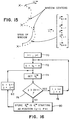
- Figs. 11, 12, 13 and 14 illustrate how parameter extraction, block 36a of Fig. 4, which performs Steps 2 and 3 of the dynamic handwriting recognition algorithm, is derived for providing a parameter vector v m .
- Fig. 11 shows the local parameter extraction
- Fig. 12 the local parameter vector
- Fig. 13 is the global parameter extraction
- Fig. 14 the global parameter vector.
- calculations are made relative to a current point 64 relative to previous points 66 and 67 and following points 68 and 69.
- the specific calculation for local parameter vectors are shown in Fig. 12.
- Figs. 15 and 16 Details of the windowing block 38a of Fig. 4 are now set forth relative to Figs. 15 and 16 to show how feature events are extracted from the data.
- a small number of approximately equidistant feature points are determined using the same algorithm as in Fig. 8, but with a different value of R, and parameter vectors are spliced at those points.
- Fig. 15 feature points are shown by dots, and window centers are shown by an X. Dots are referenced as points k, and X's are referenced by index i as points k i .
- i and a counter j are each set equal to 1.
- k is set to k i -H and at block 74 the corresponding v k (of dimension P) is obtained.
- a determination is then made at block 76 whether or not (2H+1) v k have been seen. If so, j is reinitialized to 1 and i is incremented by 1 in block 78 and the procedure repeats as just explained.
- v k is appended to V i starting at position (j-1) P+1. k and j are both incremented by 1 in block 82 and a return is made to block 74 to get the next v k , and the procedure repeats as just explained.
- the projection block is utilized to eliminate redundancy in the splice parameter vectors from the windowing block 38.
- a covariance matrix is computed for all spliced vectors in block 71, and the associated eigenvalue and eigenvectors are found through principal component analysis, in block 75.
- the spliced vectors are projected in block 77 onto a subspace of smaller dimension called chirographic space, resulting in the projected vectors r i .
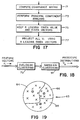
- Fig. 18 and 19 details the prototype construction block 24 of Fig. 3, to produce chirographic prototypes.
- the feature vectors are provided to block 79 to perform k-means Euclidean clustering. Details of block 79 are set forth relative to Figs. 19 and 20.
- the results of Euclidean clustering are provided to block 81 to perform k-means Gaussian clustering to provide prototype distributions ⁇ k . Details of block 81 are set forth relative to Fig. 21. Figs. 18-21 detail how steps 10 and 11 of the dynamic handwriting recognition method are performed.
- the prototype distributions or chirographic prototypes are provided to the dynamic likelihood estimator 28a (Fig. 3) to produce candidate characters to decoder 30 (Fig. 3), if operating only with dynamic feature vectors, or to provide input to the overall likelihood estimator 28c if operating with joint static and dynamic feature vectors.
- Fig. 19 illustrates a space 83 which is divided into clusters 84, 86 and 88.
- Each cluster includes a plurality of vectors indicated as points x, with a centroid ⁇ being computed for each such cluster of vectors.
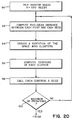
- Fig. 20 details block 79 of Fig. 18.
- a number of random seeds, chosen to be 250, is picked at block 90 from all points in the chirographic space obtained from block 22 in Fig. 3.
- the Euclidean distance between each point and each seed is calculated at block 92.
- the space is partitioned into clusters at block 94. This corresponds to the clusters 84, 86 and 88 of Fig. 19.
- the centroid of each cluster is computed at block 96. This corresponds to the ⁇ in Fig. 19. These centroids are set to replace the original seeds at block 98.
- a determination is made if the maximum number of iterations is reached. If not, a return is made to block 92 and the steps are repeated as just described. If so, the calculation of the Euclidean clustering is complete.
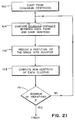
- Fig. 21 details the Gaussian clustering block 81 of Fig. 18.
- the Euclidean clusters obtained in block 79 (Fig. 18) are provided at block 102.
- the Gaussian distance between each point and each centroid is calculated at block 104.
- the new centroid of each cluster is computed at block 108.
- a determination is made if the maximum number of iterations is complete. If not, a return is made set to replace the original seeds at block 98.
- decision block 100 a determination is made if the maximum number of iterations is reached. If not, a return is made to block 92 and the steps are repeated as just described. If so, the calculation of the Euclidean clustering is complete.
- Fig. 21 details the Gaussian clustering block 81 of Fig. 18.
- the Euclidean clusters obtained in block 79 (Fig. 18) are provided at block 102.
- the Gaussian distance between each point and each centroid is calculated at block 104.
- the space is partitioned into clusters at block 106.
- the new centroid of each cluster is computed at block 108.
- decision block 110 a determination is made if the maximum number of iterations is complete. If not, a return is made to block 104 and the steps are repeated as just described. If so, the calculations of the Gaussian clustering is complete. This results in final prototype distributions in chirographic space.
- Fig. 22 which performs step 16 of the handwriting recognition technique for one codebook only, and which illustrates how information resulting from steps 12 and 13 of the dynamic handwriting recognition method is operated on by the dynamic likelihood estimator 28a of Fig. 3 to produce candidate characters for the decoder 30.
- a variable i which is indicative of the current frame (or window center) is initialized to 1
- the dynamic test feature vector is provided from the front end parameter extraction 22 (Fig. 4) as indicated at block 116.
- the conditional probability of this feature vector given this prototype distribution is computed at block 120 and is provided to block 122.
- the prototype construction block 24a (Fig. 3) of the training phase as represented by the chirographic prototype distributions II k in block 124 and mixture coefficients Pr(II k
- decision block 128 a determination is made if k has reached the maximum number of clusters. If not, k is incremented by 1 as indicated at block 130, and a return is made to block 120 and the just recited process is repeated. If so, the scores just stored are accumulated at block 132 for all characters a j in the underlying alphabet.
- decision block 134 a determination is made if all frames i have been seen for the current character under consideration.
- i is incremented by 1 at block 136 and a return is made to block 116 and the just recited process is repeated. If so, the accumulated scores are ordered in block 138 and a candidate list of characters a j is formed from the top J scores for provision to the decoder 30 (Fig. 3).
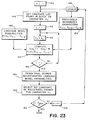
- Fig. 23 is a flow chart representation indicative of the operation of the decoder 30 (Fig. 3) for the case of decoding only the output of the dynamic likelihood estimator 28a of Fig. 3.
- a variable t which is indicative of the current character under consideration, is initialized to 1 at block 142.
- the candidate list of characters from the likelihood estimator 28a (Fig. 3) for character C t is provided at block 144.
- a variable j indicative of the current candidate character is initialized to 1 at block 146, and C t is tentatively set equal to a j at block 148.
- Language Model probabilities 26 (Fig. 3) are provided at block 150.
- the final score of the character a j is computed at block 152. This score represents the likelihood that C t is recognized as a j taking into account the contextual information through the language model.
- t is incremented by 1 in block 164, to get the next character to be recognized.
- An update is made at block 166, to insert the recognized C 1 in block 154, and a return is made to block 144, with the just recited process being repeated. If so, the process is complete as indicated at block 168 and the whole string of characters has been recognized.
- Steps 1 and 12-19 of the static determination operate in the same manner, as do the corresponding blocks of the static processor 22b of Fig. 4.
- Steps 2-11 of the static determination method are not limited for use only with online handwriting systems, but may be employed to advantage in off-line systems wherein the input signals are not generated in real time.
- the spatially-based feature vector determination can be used in Optical Character Recognition systems wherein a printed text is scanned and converted to a digital format. Individual characters of the input may be processed to derive feature vectors, based on the shape of the characters, for subsequent recognition.
Landscapes
- Engineering & Computer Science (AREA)
- Computer Vision & Pattern Recognition (AREA)
- Theoretical Computer Science (AREA)
- Physics & Mathematics (AREA)
- General Physics & Mathematics (AREA)
- Multimedia (AREA)
- Data Mining & Analysis (AREA)
- Life Sciences & Earth Sciences (AREA)
- Artificial Intelligence (AREA)
- Bioinformatics & Cheminformatics (AREA)
- Bioinformatics & Computational Biology (AREA)
- Evolutionary Biology (AREA)
- Evolutionary Computation (AREA)
- General Engineering & Computer Science (AREA)
- Character Discrimination (AREA)
Claims (16)
- Vorrichtung zum Analysieren von Handschriften, folgendes umfassend:Handschriftwandlermittel mit einem Ausgang, der x-y-Koordinateninformationen bereitstellt, die von einem Schreiber beim Schreiben eines Zeichens erzeugt wurden;erstes Extrahierungsmittel (22a), mit einem Eingang, der an den genannten Ausgang des genannten Handschriftwandlermittels gekoppelt ist, zum Extrahieren und Ausgeben von auf Linienzügen basierenden Merkmalsvektoren, wodurch der genannte, auf Linienzügen basierende Merkmalsvektor abhängt von der Reihenfolge der Aufzeichnung der genannten x-y-Koordinateninformation;erstes Schulungsmittel (24a), das auf die auf Linienzügen basierenden Merkmalsvektoren anspricht, zum Aufbauen eines ersten entsprechenden Zeichenprototyps;zweites Extrahierungsmittel (22b), dessen Eingang gekoppelt ist an den genannten Ausgang des genannten Handschriftwandlermittels, zum Extrahieren und zur Ausgabe von auf der Form basierenden Merkmalsvektoren anhand der x-y-Koordinateninformation, wodurch der genannte auf der Form basierende Merkmalsvektor nicht von der Reihenfolge der Aufzeichnung der genannten x-y-Koordinateninformation abhängt; undzweites Schulungsmittel (24b), das auf die auf der Form basierenden Merkmalsvektoren anspricht, zum Aufbauen eines zweiten entsprechenden Zeichenprototyps.
- Vorrichtung zum Analysieren von Handschriften nach Anspruch 1, weiter folgendes umfassend:erste Zeichenprototypmittel zum Speichern von Zeichenprototypen, die entsprechend den auf dem Linienzug basierenden Merkmalsvektoren aufgebaut sind;erstes Wahrscheinlichkeitsschätzmittel (28a), mit einem ersten Eingang, der an einen Ausgang des genannten ersten Extrahierungsmittels gekoppelt ist, und einem zweiten Eingang, der an einen Ausgang des genannten ersten Zeichenprototypmittels gekoppelt ist, zur Bestimmung eines wahrscheinlichsten Zeichens, das von den auf dem Linienzug basierenden Merkmalsvektoren dargestellt wird;zweites Zeichenprototypmittel zum Speichern von Zeichenprototypen, welche entsprechend den auf der Form basierenden Merkmalsvektoren aufgebaut sind; undzweites Wahrscheinlichkeitsschätzmittel (28b), mit einem ersten Eingang, der an einen Ausgang des genannten zweiten Extrahierungsmittels gekoppelt ist, und einem zweiten Eingang, der an einen Ausgang des genannten zweiten Zeichenprototypmittels gekoppelt ist, zur Bestimmung eines wahrscheinlichsten Zeichens, das durch die auf der Form basierenden Merkmalsvektoren dargestellt ist.
- Vorrichtung zum Analysieren einer Handschrift nach Anspruch 2, weiter folgendes umfassend:Gesamtwahrscheinlichkeits-Schätzmittel (28c), das auf das genannte erste Wahrscheinlichkeitsschätzmittel (28a) anspricht und auf das genannte zweite Wahrscheinlichkeitsschätzmittel (28b), um mindestens ein wahrscheinlichstes Zeichen zu bestimmen, das von einer Kombination der auf dem Linienzug basierenden Merkmalsvektoren und der auf der Form basierenden Merkmalsvektoren dargestellt wird.
- Vorrichtung zum Analysieren von Handschriften nach Anspruch 3, weiter folgendes umfassend:Dekodierermittel (30), welches auf das Gesamtwahrscheinlichkeits-Schätzmittel (28c) und auf ein Sprachmodellmittel (26) anspricht, um ein wahrscheinlichstes Zeichen zu identifizieren, das von dem Schreiber geschrieben wird.
- Ein Hanschriftanalysesystem, folgendes umfassend:Mittel zum Abtasten von Handschrifteingängen von mindestens einem Schreiber;Mittel, um (36a, 36b) sowohl statische als auch dynamische Parametervektordarstellungen der genannten Handschrifteingänge bereitzustellen, wobei die genannten dynamischen Parametervektordarstellungen abhängen von der Reihenfolge der Aufzeichung der x-y-Koordinateninformation und die genannten statischen Parametervektordarstellungen nicht abhängen von der Reihenfolge der Aufzeichnung der x-y-Koordinateninformation;Mittel zum Verketten (38b) einer Gruppe von statischen Parametervektordarstellunge, die x-Achsen-Werten zugeordnet sind, welche dem aktuellen x-Achsen-Wert vorangehen, der statischen Parametervektordarstellung an dem aktuellen Punkt, und einer Gruppe von statischen Parametervektordarstellungen, die x-Achsen-Werten zugeordnet sind, welche auf den aktuellen x-Achsen-Wert folgen, woraus sich statische gespleißte Vektordarstellungen der genannten Handschrifteingänge ergeben;Mittel zum Verketten (38a) einer Gruppe von dynamischen Parametervektordarstellungen, welche - in der Reihenfolge der Aufzeichnung - einem aktuellen Punkt, der dynamischen Parametervektordarstellung an dem aktuellen Punkt und einer Gruppe von dynamischen Parametervektordarstellungen vorausgehen, die - in der Reihenfolge der Aufzeichnung - auf den aktuellen Punkt folgen, woraus sich dynamische gespleißte Vektordarstellungen der genannten Handschrifteingänge ergeben.
- Ein Handschriftanalysesystem nach Anspruch 5 und weiter folgendes umfassend:Mittel zum Bestimmen einer Kovarianzmatrix der genannten statischen und dynamischen gespleißten Vektordarstellungen;Mittel zum Bestimmen von Eigenwerten und Eigenvektoren, die jeder bestimmten Kovarianzmatrix zugeordnet sind; undMittel zum Anwenden einer Transformation, basierend auf den genannten bestimmten Eigenvektoren, auf jede der genannten statischen und dynamischen gespleißten Vektordarstellungen, um statische Merkmalsvektordarstellungen und dynamische Merkmalsvektordarstellungen bereitzustellen.
- Ein Handschriftanalysesystem nach Anspruch 5 oder 6, und weiter folgendes umfassend:Mittel zum Ausführen einer Cluster-Bildung sowohl in dem statischen Merkmalsvektorraum als auch in dem dynamischen Merkmalsvektorraum, um sowohl statische als auch dynamische Prototypverteilungen in den genannten Merkmalsvektorräumen bereitzustellen;Mittel zum Durchführen einer Gaußschen Modellierung in jedem der genannten Merkmalsvektorräume; undMittel zum Bestimmen sowohl statischer als auch dynamischer Mischungskoeffizienten, zum Auswerten der relativen Anteile jeder Prototypverteilung an einer aktuellen Abtastung von Handschrifteingängen.
- Eine Methode zum Betreiben eines Handschriftanalysesystems, folgende Schritte umfassend:Abtasten von Handschrifteingängen von mindestens einem Schreiber;Bereitstellen (36a, 36b) sowohl statischer als auch dynamischer Parametervektordarstellungen der genannten Handschrifteingänge, wobei die genannten dynamischen Parametervektordarstellungen abhängen von der Reihenfolge der Aufzeichnung der x-y-Koordinateninformation und die genannten statischen Parametervektordarstellungen nicht abhängen von der Reihenfolge der Aufzeichnung der x-y-Koordinateninformation;Verkettung (38b) einer Gruppe von statischen Parametervektordarstellungen, die x-Achsen-Werten zugeordnet sind, welche dem aktuellen x-Achsen-Wert, der statischen Parametervektordarstellung an dem aktuellen Punkt und einer Gruppe von statischen Parametervektordarstellungen vorangehen, die den x-Achsen-Werten zugeordnet sind, welche auf den aktuellen x-Achsen-Wert folgen, woraus sich statische gespleißte Vektordarstellungen der genannten Handschrifteingänge ergeben;Verkettung (38a) einer Gruppe von dynamischen Parametervektordarstellungen, welche - in der Reihenfolge der Aufzeichnung - einem aktuellen Punkt, der dynamischen Parametervektordarstellung an dem aktuellen Punkt und einer Gruppe von dynamischen Parametervektordarstellungen vorangehen, die ihrerseits - in der Reihenfolge der Aufzeichnung - auf den aktuellen Punkt folgen, woraus sich dynamische gespleißte Vektordarstellungen der genannten Handschrifteingänge ergeben.
- Eine Methode nach Anspruch 8 und weiter folgende Schritte umfassend:Bestimmen einer Kovarianzmatrix der statischen und dynamischen gespleißten Vektordarstellungen;Bestimmen von Eigenwerten und Eigenvektoren, die einer jeder bestimmten Kovarianzmatrix zugeordnet sind; undAnwenden einer Transformation, basierend auf den genannten bestimmten Eigenvektoren, auf jede der genannten statischen und dynamischen gespleißten Vektordarstellungen, um statische Merkmalsvektordarstellungen und dynamische Merkmalsvektordarstellungen bereitzustellen.
- Eine Methode nach Anspruch 8 oder 9 und weiter folgende Schritte umfassend:Durchführen einer Cluster-Bildung sowohl in einem statischen Merkmalsvektorraum als auch in einem dynamischen Merkmalsvektorraum, um sowohl statische als auch dynamische Prototypverteilungen in den Merkmalsvektorräumen bereitzustellen;Durchführen einer Gaußschen Modellierung in jedem der Merkmalsvektorräume; undBestimmen sowohl statischer als auch dynamischer Mischungskoeffizienten zur Auswertung der relativen Anteile einer jeden Prototypverteilung an einer aktuellen Abtastung von Handschrifteingängen.
- Eine Methode nach einem jeden der Ansprüche 8, 9 oder 10, umfassend die folgenden Schritte zur Verarbeitung von Eingangssignalen, die ein Zeichen darstellen, wobei die Eingangssignale als Punkte angeordnet sind, die jeweils über einen x-Achsen-Koordinatenwert und einen y-Achsen-Koordinatenwert verfügen:(a) Sortieren der Punkte in Form von x-Achsen-Werten;(b) Abtasten entlang der x-Achse in Intervallen von δx, somit Definition einer Folge von x-Werten der Form {xi}, wobei(c) Für jeden Abtastpunkt xi, Definieren einer Scheibe der Breite lw, die auf diese Abtastung zentriert ist, und Zuordnen aller y-Achsen-Werte, deren x-Achsen-Werte innerhalb der Breite dieser Scheibe liegen, zu dieser Abtastung, dadurch Erzeugen eines Vektors der Formy(xi);
 (d) Quantisieren eines Bereichs von y-Achsen-Werten auf ny Ebenen mit gleichem Abstand, lk, und, für jedes xi, Zuweisen, aller zugeordneten y-Achsen-Werte zu einer Ebene, entsprechend dem Ausdruck:(e) Aufbauen einer Bitmap aus der Scheibe mit einer Gittergröße ny, wobei der Schritt des Aufbauens für jedes xi einen Schritt des Bestimmens eines ersten Merkmalsvektors
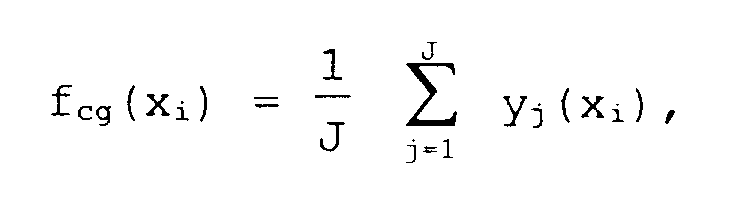
 - Eine Methode nach Anspruch 11,weiter umfassend die folgenden Schritte:(f) Für jedes xi, Aufbauen eines zweiten Merkmalsvektors der Länge 1, fcg(xi), so daß:wobei die Summierung über alle y-Achsen-Werte y1(xi), . . .yJ(xi) von Punkten innerhalb der Scheibe durch xi definiert wird.
- Eine Methode nach Anspruch 11 oder 12, weiter umfassend die folgenden Schritte:(g) Bestimmen einer Teilgruppe von x-Werten {xi}, so daß die x-Werte einen Abstand von Δx haben, wobei die Teilgruppe der x-Werte als {Xi} definiert ist;(h) Aufbauen, an jedem Punkt Xi, eines N-dimensionalen gespleißten Merkmalsvektors, durch Verkettung von Hx Merkmalsvektoren fx, welche x-Achsen-Werten zugeordnet sind, die dem aktuellen x-Wert Xi, einem Merkmalsvektor
- Eine Methode nach Anspruch 13, weiter umfassend den folgenden Schritt:(j) Wiederholen der Schritte (a) bis (e) und (g) bis (h) für die y-Achsen-Dimension, um einen Merkmalsvektor
- Eine Methode nach einem jeden der Ansprüche 11 bis 14,bei der die Eingangssignale erzeugt werden von einem Handschriftwandler, der auf einen Schreiber anspricht, undbei der der Schritt (e) weiter umfaßt einen Schritt des Codierens einer dynamischen Information durch Definition dreier möglicher Zustände für jedes Element von
- Eine Methode zum Betreiben eines Handschriftanalysesystems, um zu bestimmen, ob ein von einem Schreiber geschriebenes Zeichen ein Zeichen ineinem Zeichenalphabet (a) ist, folgende Schritte umfassend:Von einem Handschriftwandlermittel, Empfangen von x-y-Koordinateninformationen, die von dem Schreiber erzeugt wurden;Partitionieren der x-y-Koordinateninformation in eine Vielzahl von Rahmen wt;Unter Verwendung der auf Linienzügen basierenden Merkmalsvektoren und auf Linienzügen basierenden Zeichenmodelle, Decodieren aller Rahmen wt, um eine erste Wahrscheinlichkeit Pr(wt|aj) ∀j, ∀t zu erhalten;Unter Verwendung der auf der Form basierenden Merkmalsvektoren und der auf der Form basierenden Zeichenmodelle, Decodieren der x-y-Koordinateninformationen, die einem räumlichen Bildblock s zugeordnet sind, um eine zweite Wahrscheinlichkeit Pr(sd|aj) ∀j zu erhalten;für jeden Bildblock s, Identifizieren aller Rahmen wt, die in diesem Bildblock liegen;Definieren einer dritten Wahrscheinlichkeit als:wobei T die Anzahl der Rahmen von wt innerhalb s ist; und
 Bestimmen einer vierten Wahrscheinlichkeit, daß ein Bildblock s, wenn aj gegeben ist, ein wahrscheinlichstes Zeichen ist, das von dem Schreiber geschrieben wird, und zwar entsprechend des folgenden Ausdrucks:
Applications Claiming Priority (2)
| Application Number | Priority Date | Filing Date | Title |
|---|---|---|---|
| US9515 | 1979-02-05 | ||
| US08/009,515 US5491758A (en) | 1993-01-27 | 1993-01-27 | Automatic handwriting recognition using both static and dynamic parameters |
Publications (3)
| Publication Number | Publication Date |
|---|---|
| EP0608708A2 EP0608708A2 (de) | 1994-08-03 |
| EP0608708A3 EP0608708A3 (de) | 1995-03-29 |
| EP0608708B1 true EP0608708B1 (de) | 2000-05-03 |
Family
ID=21738125
Family Applications (1)
| Application Number | Title | Priority Date | Filing Date |
|---|---|---|---|
| EP94100357A Expired - Lifetime EP0608708B1 (de) | 1993-01-27 | 1994-01-12 | Automatische Zeichenerkennung mit Verwendung statischer und dynamischer Parameter |
Country Status (4)
| Country | Link |
|---|---|
| US (5) | US5491758A (de) |
| EP (1) | EP0608708B1 (de) |
| JP (1) | JP2667954B2 (de) |
| DE (1) | DE69424196T2 (de) |
Families Citing this family (214)
| Publication number | Priority date | Publication date | Assignee | Title |
|---|---|---|---|---|
| US7382929B2 (en) | 1989-05-22 | 2008-06-03 | Pixel Instruments Corporation | Spatial scan replication circuit |
| US6529637B1 (en) | 1989-05-22 | 2003-03-04 | Pixel Instruments Corporation | Spatial scan replication circuit |
| JPH0773190A (ja) * | 1993-04-29 | 1995-03-17 | Matsushita Electric Ind Co Ltd | ペンベースコンピューターシステム用絵文字ネーミング |
| US6011865A (en) * | 1993-05-12 | 2000-01-04 | International Business Machines Corporation | Hybrid on-line handwriting recognition and optical character recognition system |
| US5710916A (en) * | 1994-05-24 | 1998-01-20 | Panasonic Technologies, Inc. | Method and apparatus for similarity matching of handwritten data objects |
| US5633957A (en) * | 1994-09-16 | 1997-05-27 | Compaq Computer Corporation | Method and apparatus for determining positional guidelines of handwritten data |
| US5812818A (en) * | 1994-11-17 | 1998-09-22 | Transfax Inc. | Apparatus and method for translating facsimile text transmission |
| US5838302A (en) * | 1995-02-24 | 1998-11-17 | Casio Computer Co., Ltd. | Data inputting devices for inputting typed and handwritten data in a mixed manner |
| US5764797A (en) * | 1995-04-25 | 1998-06-09 | Microsoft Corporation | Method and system for modeling handwriting using polynomials as a function of time |
| US5689620A (en) * | 1995-04-28 | 1997-11-18 | Xerox Corporation | Automatic training of character templates using a transcription and a two-dimensional image source model |
| US5737593A (en) * | 1995-06-02 | 1998-04-07 | International Business Machines Corporation | System and method for defining shapes with which to mine time sequences in computerized databases |
| US5970170A (en) * | 1995-06-07 | 1999-10-19 | Kodak Limited | Character recognition system indentification of scanned and real time handwritten characters |
| US5991441A (en) * | 1995-06-07 | 1999-11-23 | Wang Laboratories, Inc. | Real time handwriting recognition system |
| US5828997A (en) * | 1995-06-07 | 1998-10-27 | Sensimetrics Corporation | Content analyzer mixing inverse-direction-probability-weighted noise to input signal |
| US6137909A (en) * | 1995-06-30 | 2000-10-24 | The United States Of America As Represented By The Secretary Of The Navy | System and method for feature set reduction |
| US5774576A (en) * | 1995-07-17 | 1998-06-30 | Nec Research Institute, Inc. | Pattern recognition by unsupervised metric learning |
| US5835633A (en) * | 1995-11-20 | 1998-11-10 | International Business Machines Corporation | Concurrent two-stage multi-network optical character recognition system |
| US5828772A (en) * | 1995-12-27 | 1998-10-27 | Lucent Technologies Inc. | Method and apparatus for parametric signature verification using global features and stroke-direction codes |
| DE19614285C2 (de) * | 1996-04-11 | 1998-11-12 | Siemens Ag | Verfahren zur Erkennung von Ziffernfolgen |
| US5828999A (en) * | 1996-05-06 | 1998-10-27 | Apple Computer, Inc. | Method and system for deriving a large-span semantic language model for large-vocabulary recognition systems |
| US6038340A (en) * | 1996-11-08 | 2000-03-14 | Seiko Epson Corporation | System and method for detecting the black and white points of a color image |
| JP3335538B2 (ja) * | 1996-11-08 | 2002-10-21 | 日本サイバーサイン株式会社 | 手書き文字列の照合方法および装置 |
| US5889889A (en) * | 1996-12-13 | 1999-03-30 | Lucent Technologies Inc. | Method and apparatus for machine recognition of handwritten symbols from stroke-parameter data |
| JP3969775B2 (ja) * | 1996-12-17 | 2007-09-05 | キヤノン株式会社 | 手書き情報入力装置および手書き情報入力方法 |
| US5930466A (en) * | 1997-03-11 | 1999-07-27 | Lexmark International Inc | Method and apparatus for data compression of bitmaps using rows and columns of bit-mapped printer data divided into vertical slices |
| US6687404B1 (en) | 1997-06-20 | 2004-02-03 | Xerox Corporation | Automatic training of layout parameters in a 2D image model |
| US5930393A (en) * | 1997-08-11 | 1999-07-27 | Lucent Technologies Inc. | Method and apparatus for enhancing degraded document images |
| US5920647A (en) * | 1997-08-12 | 1999-07-06 | Motorola, Inc. | Method and apparatus for recognition of hand-printed characters represented as an electronic ink stream using a box filtering technique |
| US6272243B1 (en) * | 1997-09-15 | 2001-08-07 | Motorola, Inc. | Method and apparatus for entering characters into a writing recognizer |
| JPH11203402A (ja) * | 1998-01-16 | 1999-07-30 | Canon Inc | 画像処理装置及び画像処理方法 |
| RU2145115C1 (ru) * | 1998-08-10 | 2000-01-27 | Закрытое акционерное общество "Аби Программное обеспечение" | Групповой способ аби (abbyy) верификации компьютерных кодов с соответствующими им оригиналами |
| US7157314B2 (en) * | 1998-11-16 | 2007-01-02 | Sandisk Corporation | Vertically stacked field programmable nonvolatile memory and method of fabrication |
| US6952803B1 (en) * | 1998-12-29 | 2005-10-04 | Xerox Corporation | Method and system for transcribing and editing using a structured freeform editor |
| US6587577B1 (en) | 1999-04-21 | 2003-07-01 | International Business Machines Corporation | On-line signature verification |
| AU2628301A (en) * | 2000-01-06 | 2001-07-16 | Zen Optical Technology Llc | Pen-based handwritten character recognition and storage system |
| DE60005293T2 (de) * | 2000-02-23 | 2004-07-01 | Ser Solutions Inc. | Methode und Vorrichtung zur Verarbeitung elektronischer Dokumente |
| US8645137B2 (en) | 2000-03-16 | 2014-02-04 | Apple Inc. | Fast, language-independent method for user authentication by voice |
| US8575719B2 (en) | 2000-04-28 | 2013-11-05 | Sandisk 3D Llc | Silicon nitride antifuse for use in diode-antifuse memory arrays |
| US9177828B2 (en) | 2011-02-10 | 2015-11-03 | Micron Technology, Inc. | External gettering method and device |
| ES2375403T3 (es) | 2001-08-27 | 2012-02-29 | BDGB Enterprise Software Sàrl | Un método para la indexación automática de documentos. |
| AUPR824501A0 (en) * | 2001-10-15 | 2001-11-08 | Silverbrook Research Pty. Ltd. | Methods and systems (npw003) |
| US7111248B2 (en) * | 2002-01-15 | 2006-09-19 | Openwave Systems Inc. | Alphanumeric information input method |
| US7010167B1 (en) | 2002-04-30 | 2006-03-07 | The United States Of America As Represented By The National Security Agency | Method of geometric linear discriminant analysis pattern recognition |
| US6970877B2 (en) * | 2002-06-28 | 2005-11-29 | Microsoft Corporation | Reducing and controlling sizes of prototype-based recognizers |
| US6988107B2 (en) * | 2002-06-28 | 2006-01-17 | Microsoft Corporation | Reducing and controlling sizes of model-based recognizers |
| US7366352B2 (en) * | 2003-03-20 | 2008-04-29 | International Business Machines Corporation | Method and apparatus for performing fast closest match in pattern recognition |
| JP4297442B2 (ja) * | 2004-11-30 | 2009-07-15 | 富士通株式会社 | 手書き情報入力装置 |
| US7587087B2 (en) * | 2004-12-10 | 2009-09-08 | Nokia Corporation | On-line handwriting recognition |
| JP4708913B2 (ja) * | 2005-08-12 | 2011-06-22 | キヤノン株式会社 | 情報処理方法及び情報処理装置 |
| JP4834351B2 (ja) * | 2005-08-22 | 2011-12-14 | 株式会社東芝 | 文字認識装置及び文字認識方法 |
| US8677377B2 (en) | 2005-09-08 | 2014-03-18 | Apple Inc. | Method and apparatus for building an intelligent automated assistant |
| US7646913B2 (en) * | 2005-12-19 | 2010-01-12 | Microsoft Corporation | Allograph based writer adaptation for handwritten character recognition |
| US7421452B2 (en) * | 2006-06-14 | 2008-09-02 | International Business Machines Corporation | Method and apparatus for predicting future behavior of data streams |
| US9318108B2 (en) | 2010-01-18 | 2016-04-19 | Apple Inc. | Intelligent automated assistant |
| US8010307B2 (en) * | 2006-12-07 | 2011-08-30 | Hermes-Microvision, Inc. | In-line overlay measurement using charged particle beam system |
| TWI336055B (en) * | 2007-01-05 | 2011-01-11 | Compal Electronics Inc | Symbol recognition method |
| US8074172B2 (en) | 2007-01-05 | 2011-12-06 | Apple Inc. | Method, system, and graphical user interface for providing word recommendations |
| US20080175468A1 (en) * | 2007-01-24 | 2008-07-24 | Hermes Microvision, Inc. | Method and system for creating knowledge and selecting features in a semiconductor device |
| US8977255B2 (en) | 2007-04-03 | 2015-03-10 | Apple Inc. | Method and system for operating a multi-function portable electronic device using voice-activation |
| US9330720B2 (en) | 2008-01-03 | 2016-05-03 | Apple Inc. | Methods and apparatus for altering audio output signals |
| US8996376B2 (en) | 2008-04-05 | 2015-03-31 | Apple Inc. | Intelligent text-to-speech conversion |
| US10496753B2 (en) | 2010-01-18 | 2019-12-03 | Apple Inc. | Automatically adapting user interfaces for hands-free interaction |
| US20100030549A1 (en) | 2008-07-31 | 2010-02-04 | Lee Michael M | Mobile device having human language translation capability with positional feedback |
| US8331682B2 (en) * | 2008-08-27 | 2012-12-11 | Northrop Grumman Systems Corporation | System and method for single stroke character recognition |
| US9251407B2 (en) * | 2008-09-04 | 2016-02-02 | Northrop Grumman Systems Corporation | Security system utilizing gesture recognition |
| US9959870B2 (en) | 2008-12-11 | 2018-05-01 | Apple Inc. | Speech recognition involving a mobile device |
| US10241644B2 (en) | 2011-06-03 | 2019-03-26 | Apple Inc. | Actionable reminder entries |
| US10255566B2 (en) | 2011-06-03 | 2019-04-09 | Apple Inc. | Generating and processing task items that represent tasks to perform |
| US10241752B2 (en) | 2011-09-30 | 2019-03-26 | Apple Inc. | Interface for a virtual digital assistant |
| US9858925B2 (en) | 2009-06-05 | 2018-01-02 | Apple Inc. | Using context information to facilitate processing of commands in a virtual assistant |
| US9431006B2 (en) | 2009-07-02 | 2016-08-30 | Apple Inc. | Methods and apparatuses for automatic speech recognition |
| JP5495657B2 (ja) * | 2009-08-04 | 2014-05-21 | 三菱電機株式会社 | 文字認識装置、文字認識プログラム |
| US9152883B2 (en) * | 2009-11-02 | 2015-10-06 | Harry Urbschat | System and method for increasing the accuracy of optical character recognition (OCR) |
| US9158833B2 (en) | 2009-11-02 | 2015-10-13 | Harry Urbschat | System and method for obtaining document information |
| US8321357B2 (en) * | 2009-09-30 | 2012-11-27 | Lapir Gennady | Method and system for extraction |
| US9213756B2 (en) * | 2009-11-02 | 2015-12-15 | Harry Urbschat | System and method of using dynamic variance networks |
| US10553209B2 (en) | 2010-01-18 | 2020-02-04 | Apple Inc. | Systems and methods for hands-free notification summaries |
| US10679605B2 (en) | 2010-01-18 | 2020-06-09 | Apple Inc. | Hands-free list-reading by intelligent automated assistant |
| US10705794B2 (en) | 2010-01-18 | 2020-07-07 | Apple Inc. | Automatically adapting user interfaces for hands-free interaction |
| US10276170B2 (en) | 2010-01-18 | 2019-04-30 | Apple Inc. | Intelligent automated assistant |
| DE202011111062U1 (de) | 2010-01-25 | 2019-02-19 | Newvaluexchange Ltd. | Vorrichtung und System für eine Digitalkonversationsmanagementplattform |
| US8682667B2 (en) | 2010-02-25 | 2014-03-25 | Apple Inc. | User profiling for selecting user specific voice input processing information |
| US8768062B2 (en) | 2010-11-09 | 2014-07-01 | Tata Consulting Services Limited | Online script independent recognition of handwritten sub-word units and words |
| US10762293B2 (en) | 2010-12-22 | 2020-09-01 | Apple Inc. | Using parts-of-speech tagging and named entity recognition for spelling correction |
| US9262612B2 (en) | 2011-03-21 | 2016-02-16 | Apple Inc. | Device access using voice authentication |
| US8977059B2 (en) * | 2011-06-03 | 2015-03-10 | Apple Inc. | Integrating feature extraction via local sequential embedding for automatic handwriting recognition |
| US10057736B2 (en) | 2011-06-03 | 2018-08-21 | Apple Inc. | Active transport based notifications |
| US8994660B2 (en) | 2011-08-29 | 2015-03-31 | Apple Inc. | Text correction processing |
| US10134385B2 (en) | 2012-03-02 | 2018-11-20 | Apple Inc. | Systems and methods for name pronunciation |
| US9483461B2 (en) | 2012-03-06 | 2016-11-01 | Apple Inc. | Handling speech synthesis of content for multiple languages |
| US9280610B2 (en) | 2012-05-14 | 2016-03-08 | Apple Inc. | Crowd sourcing information to fulfill user requests |
| US9354725B2 (en) * | 2012-06-01 | 2016-05-31 | New York University | Tracking movement of a writing instrument on a general surface |
| US9721563B2 (en) | 2012-06-08 | 2017-08-01 | Apple Inc. | Name recognition system |
| US9495129B2 (en) | 2012-06-29 | 2016-11-15 | Apple Inc. | Device, method, and user interface for voice-activated navigation and browsing of a document |
| US9576574B2 (en) | 2012-09-10 | 2017-02-21 | Apple Inc. | Context-sensitive handling of interruptions by intelligent digital assistant |
| US9547647B2 (en) | 2012-09-19 | 2017-01-17 | Apple Inc. | Voice-based media searching |
| US9591339B1 (en) | 2012-11-27 | 2017-03-07 | Apple Inc. | Agnostic media delivery system |
| US9774917B1 (en) | 2012-12-10 | 2017-09-26 | Apple Inc. | Channel bar user interface |
| US9171204B2 (en) | 2012-12-12 | 2015-10-27 | Qualcomm Incorporated | Method of perspective correction for devanagari text |
| US10200761B1 (en) | 2012-12-13 | 2019-02-05 | Apple Inc. | TV side bar user interface |
| US9532111B1 (en) | 2012-12-18 | 2016-12-27 | Apple Inc. | Devices and method for providing remote control hints on a display |
| US10521188B1 (en) | 2012-12-31 | 2019-12-31 | Apple Inc. | Multi-user TV user interface |
| DE112014000709B4 (de) | 2013-02-07 | 2021-12-30 | Apple Inc. | Verfahren und vorrichtung zum betrieb eines sprachtriggers für einen digitalen assistenten |
| US9368114B2 (en) | 2013-03-14 | 2016-06-14 | Apple Inc. | Context-sensitive handling of interruptions |
| US10652394B2 (en) | 2013-03-14 | 2020-05-12 | Apple Inc. | System and method for processing voicemail |
| US12149779B2 (en) | 2013-03-15 | 2024-11-19 | Apple Inc. | Advertisement user interface |
| US9274607B2 (en) | 2013-03-15 | 2016-03-01 | Bruno Delean | Authenticating a user using hand gesture |
| WO2014144949A2 (en) | 2013-03-15 | 2014-09-18 | Apple Inc. | Training an at least partial voice command system |
| WO2014144579A1 (en) | 2013-03-15 | 2014-09-18 | Apple Inc. | System and method for updating an adaptive speech recognition model |
| US9582608B2 (en) | 2013-06-07 | 2017-02-28 | Apple Inc. | Unified ranking with entropy-weighted information for phrase-based semantic auto-completion |
| WO2014197336A1 (en) | 2013-06-07 | 2014-12-11 | Apple Inc. | System and method for detecting errors in interactions with a voice-based digital assistant |
| WO2014197334A2 (en) | 2013-06-07 | 2014-12-11 | Apple Inc. | System and method for user-specified pronunciation of words for speech synthesis and recognition |
| WO2014197335A1 (en) | 2013-06-08 | 2014-12-11 | Apple Inc. | Interpreting and acting upon commands that involve sharing information with remote devices |
| KR101959188B1 (ko) | 2013-06-09 | 2019-07-02 | 애플 인크. | 디지털 어시스턴트의 둘 이상의 인스턴스들에 걸친 대화 지속성을 가능하게 하기 위한 디바이스, 방법 및 그래픽 사용자 인터페이스 |
| US20140361983A1 (en) * | 2013-06-09 | 2014-12-11 | Apple Inc. | Real-time stroke-order and stroke-direction independent handwriting recognition |
| US9898187B2 (en) | 2013-06-09 | 2018-02-20 | Apple Inc. | Managing real-time handwriting recognition |
| US10176167B2 (en) | 2013-06-09 | 2019-01-08 | Apple Inc. | System and method for inferring user intent from speech inputs |
| US20140363082A1 (en) * | 2013-06-09 | 2014-12-11 | Apple Inc. | Integrating stroke-distribution information into spatial feature extraction for automatic handwriting recognition |
| US9495620B2 (en) | 2013-06-09 | 2016-11-15 | Apple Inc. | Multi-script handwriting recognition using a universal recognizer |
| KR101809808B1 (ko) | 2013-06-13 | 2017-12-15 | 애플 인크. | 음성 명령에 의해 개시되는 긴급 전화를 걸기 위한 시스템 및 방법 |
| KR101749009B1 (ko) | 2013-08-06 | 2017-06-19 | 애플 인크. | 원격 디바이스로부터의 활동에 기초한 스마트 응답의 자동 활성화 |
| KR20150104808A (ko) * | 2014-03-06 | 2015-09-16 | 삼성전자주식회사 | 피드백을 출력하는 전자 장치 및 방법 |
| US9620105B2 (en) | 2014-05-15 | 2017-04-11 | Apple Inc. | Analyzing audio input for efficient speech and music recognition |
| US10592095B2 (en) | 2014-05-23 | 2020-03-17 | Apple Inc. | Instantaneous speaking of content on touch devices |
| US9502031B2 (en) | 2014-05-27 | 2016-11-22 | Apple Inc. | Method for supporting dynamic grammars in WFST-based ASR |
| US9715875B2 (en) | 2014-05-30 | 2017-07-25 | Apple Inc. | Reducing the need for manual start/end-pointing and trigger phrases |
| US9633004B2 (en) | 2014-05-30 | 2017-04-25 | Apple Inc. | Better resolution when referencing to concepts |
| US10170123B2 (en) | 2014-05-30 | 2019-01-01 | Apple Inc. | Intelligent assistant for home automation |
| US9734193B2 (en) | 2014-05-30 | 2017-08-15 | Apple Inc. | Determining domain salience ranking from ambiguous words in natural speech |
| US9430463B2 (en) | 2014-05-30 | 2016-08-30 | Apple Inc. | Exemplar-based natural language processing |
| US10289433B2 (en) | 2014-05-30 | 2019-05-14 | Apple Inc. | Domain specific language for encoding assistant dialog |
| US9842101B2 (en) | 2014-05-30 | 2017-12-12 | Apple Inc. | Predictive conversion of language input |
| US9760559B2 (en) | 2014-05-30 | 2017-09-12 | Apple Inc. | Predictive text input |
| US9785630B2 (en) | 2014-05-30 | 2017-10-10 | Apple Inc. | Text prediction using combined word N-gram and unigram language models |
| WO2015184186A1 (en) | 2014-05-30 | 2015-12-03 | Apple Inc. | Multi-command single utterance input method |
| US10078631B2 (en) | 2014-05-30 | 2018-09-18 | Apple Inc. | Entropy-guided text prediction using combined word and character n-gram language models |
| EP3126952B1 (de) | 2014-06-24 | 2023-07-12 | Apple Inc. | Eingabevorrichtung und benutzerschnittstelleninteraktionen |
| CN111782130B (zh) | 2014-06-24 | 2024-03-29 | 苹果公司 | 用于在用户界面中导航的列界面 |
| US9864508B2 (en) * | 2014-06-24 | 2018-01-09 | Apple Inc. | Character recognition on a computing device |
| US10659851B2 (en) | 2014-06-30 | 2020-05-19 | Apple Inc. | Real-time digital assistant knowledge updates |
| US9338493B2 (en) | 2014-06-30 | 2016-05-10 | Apple Inc. | Intelligent automated assistant for TV user interactions |
| US10446141B2 (en) | 2014-08-28 | 2019-10-15 | Apple Inc. | Automatic speech recognition based on user feedback |
| US9818400B2 (en) | 2014-09-11 | 2017-11-14 | Apple Inc. | Method and apparatus for discovering trending terms in speech requests |
| US10789041B2 (en) | 2014-09-12 | 2020-09-29 | Apple Inc. | Dynamic thresholds for always listening speech trigger |
| US10074360B2 (en) | 2014-09-30 | 2018-09-11 | Apple Inc. | Providing an indication of the suitability of speech recognition |
| US9668121B2 (en) | 2014-09-30 | 2017-05-30 | Apple Inc. | Social reminders |
| US9646609B2 (en) | 2014-09-30 | 2017-05-09 | Apple Inc. | Caching apparatus for serving phonetic pronunciations |
| US9886432B2 (en) | 2014-09-30 | 2018-02-06 | Apple Inc. | Parsimonious handling of word inflection via categorical stem + suffix N-gram language models |
| US10127911B2 (en) | 2014-09-30 | 2018-11-13 | Apple Inc. | Speaker identification and unsupervised speaker adaptation techniques |
| US10552013B2 (en) | 2014-12-02 | 2020-02-04 | Apple Inc. | Data detection |
| US9711141B2 (en) | 2014-12-09 | 2017-07-18 | Apple Inc. | Disambiguating heteronyms in speech synthesis |
| US9865280B2 (en) | 2015-03-06 | 2018-01-09 | Apple Inc. | Structured dictation using intelligent automated assistants |
| US9721566B2 (en) | 2015-03-08 | 2017-08-01 | Apple Inc. | Competing devices responding to voice triggers |
| US10567477B2 (en) | 2015-03-08 | 2020-02-18 | Apple Inc. | Virtual assistant continuity |
| US9886953B2 (en) | 2015-03-08 | 2018-02-06 | Apple Inc. | Virtual assistant activation |
| US9899019B2 (en) | 2015-03-18 | 2018-02-20 | Apple Inc. | Systems and methods for structured stem and suffix language models |
| US9842105B2 (en) | 2015-04-16 | 2017-12-12 | Apple Inc. | Parsimonious continuous-space phrase representations for natural language processing |
| US10083688B2 (en) | 2015-05-27 | 2018-09-25 | Apple Inc. | Device voice control for selecting a displayed affordance |
| US10127220B2 (en) | 2015-06-04 | 2018-11-13 | Apple Inc. | Language identification from short strings |
| US10101822B2 (en) | 2015-06-05 | 2018-10-16 | Apple Inc. | Language input correction |
| US10186254B2 (en) | 2015-06-07 | 2019-01-22 | Apple Inc. | Context-based endpoint detection |
| US10255907B2 (en) | 2015-06-07 | 2019-04-09 | Apple Inc. | Automatic accent detection using acoustic models |
| US11025565B2 (en) | 2015-06-07 | 2021-06-01 | Apple Inc. | Personalized prediction of responses for instant messaging |
| US10671428B2 (en) | 2015-09-08 | 2020-06-02 | Apple Inc. | Distributed personal assistant |
| US10747498B2 (en) | 2015-09-08 | 2020-08-18 | Apple Inc. | Zero latency digital assistant |
| US9697820B2 (en) | 2015-09-24 | 2017-07-04 | Apple Inc. | Unit-selection text-to-speech synthesis using concatenation-sensitive neural networks |
| US11010550B2 (en) | 2015-09-29 | 2021-05-18 | Apple Inc. | Unified language modeling framework for word prediction, auto-completion and auto-correction |
| US10366158B2 (en) | 2015-09-29 | 2019-07-30 | Apple Inc. | Efficient word encoding for recurrent neural network language models |
| US11587559B2 (en) | 2015-09-30 | 2023-02-21 | Apple Inc. | Intelligent device identification |
| US10691473B2 (en) | 2015-11-06 | 2020-06-23 | Apple Inc. | Intelligent automated assistant in a messaging environment |
| US10049668B2 (en) | 2015-12-02 | 2018-08-14 | Apple Inc. | Applying neural network language models to weighted finite state transducers for automatic speech recognition |
| US10223066B2 (en) | 2015-12-23 | 2019-03-05 | Apple Inc. | Proactive assistance based on dialog communication between devices |
| KR101729434B1 (ko) * | 2016-02-16 | 2017-04-24 | 주식회사 시큐브 | 공간분할 세그먼트에 대한 동적이동 추적 기반 수기서명 인증 시스템 및 방법 |
| US10446143B2 (en) | 2016-03-14 | 2019-10-15 | Apple Inc. | Identification of voice inputs providing credentials |
| US9934775B2 (en) | 2016-05-26 | 2018-04-03 | Apple Inc. | Unit-selection text-to-speech synthesis based on predicted concatenation parameters |
| US9972304B2 (en) | 2016-06-03 | 2018-05-15 | Apple Inc. | Privacy preserving distributed evaluation framework for embedded personalized systems |
| US10249300B2 (en) | 2016-06-06 | 2019-04-02 | Apple Inc. | Intelligent list reading |
| US10049663B2 (en) | 2016-06-08 | 2018-08-14 | Apple, Inc. | Intelligent automated assistant for media exploration |
| DK179588B1 (en) | 2016-06-09 | 2019-02-22 | Apple Inc. | INTELLIGENT AUTOMATED ASSISTANT IN A HOME ENVIRONMENT |
| US10586535B2 (en) | 2016-06-10 | 2020-03-10 | Apple Inc. | Intelligent digital assistant in a multi-tasking environment |
| US10067938B2 (en) | 2016-06-10 | 2018-09-04 | Apple Inc. | Multilingual word prediction |
| US10490187B2 (en) | 2016-06-10 | 2019-11-26 | Apple Inc. | Digital assistant providing automated status report |
| US10509862B2 (en) | 2016-06-10 | 2019-12-17 | Apple Inc. | Dynamic phrase expansion of language input |
| US10192552B2 (en) | 2016-06-10 | 2019-01-29 | Apple Inc. | Digital assistant providing whispered speech |
| DK179343B1 (en) | 2016-06-11 | 2018-05-14 | Apple Inc | Intelligent task discovery |
| DK201670540A1 (en) | 2016-06-11 | 2018-01-08 | Apple Inc | Application integration with a digital assistant |
| DK179415B1 (en) | 2016-06-11 | 2018-06-14 | Apple Inc | Intelligent device arbitration and control |
| DK179049B1 (en) | 2016-06-11 | 2017-09-18 | Apple Inc | Data driven natural language event detection and classification |
| DK201670582A1 (en) | 2016-06-12 | 2018-01-02 | Apple Inc | Identifying applications on which content is available |
| DK201670581A1 (en) | 2016-06-12 | 2018-01-08 | Apple Inc | Device-level authorization for viewing content |
| DK179374B1 (en) | 2016-06-12 | 2018-05-28 | Apple Inc | Handwriting keyboard for monitors |
| US11966560B2 (en) | 2016-10-26 | 2024-04-23 | Apple Inc. | User interfaces for browsing content from multiple content applications on an electronic device |
| US10593346B2 (en) | 2016-12-22 | 2020-03-17 | Apple Inc. | Rank-reduced token representation for automatic speech recognition |
| DK179745B1 (en) | 2017-05-12 | 2019-05-01 | Apple Inc. | SYNCHRONIZATION AND TASK DELEGATION OF A DIGITAL ASSISTANT |
| DK201770431A1 (en) | 2017-05-15 | 2018-12-20 | Apple Inc. | Optimizing dialogue policy decisions for digital assistants using implicit feedback |
| US10192127B1 (en) | 2017-07-24 | 2019-01-29 | Bank Of America Corporation | System for dynamic optical character recognition tuning |
| US10346702B2 (en) | 2017-07-24 | 2019-07-09 | Bank Of America Corporation | Image data capture and conversion |
| CN108288067B (zh) * | 2017-09-12 | 2020-07-24 | 腾讯科技(深圳)有限公司 | 图像文本匹配模型的训练方法、双向搜索方法及相关装置 |
| CN107820096B (zh) * | 2017-11-09 | 2019-12-03 | 京东方科技集团股份有限公司 | 图像处理装置及方法、图像处理系统及训练方法 |
| US12307082B2 (en) | 2018-02-21 | 2025-05-20 | Apple Inc. | Scrollable set of content items with locking feature |
| AU2019100574B4 (en) | 2018-06-03 | 2020-02-20 | Apple Inc. | Setup procedures for an electronic device |
| WO2020198238A1 (en) | 2019-03-24 | 2020-10-01 | Apple Inc. | User interfaces for a media browsing application |
| US12008232B2 (en) | 2019-03-24 | 2024-06-11 | Apple Inc. | User interfaces for viewing and accessing content on an electronic device |
| WO2020198237A1 (en) | 2019-03-24 | 2020-10-01 | Apple Inc. | User interfaces including selectable representations of content items |
| US11683565B2 (en) | 2019-03-24 | 2023-06-20 | Apple Inc. | User interfaces for interacting with channels that provide content that plays in a media browsing application |
| US11863837B2 (en) | 2019-05-31 | 2024-01-02 | Apple Inc. | Notification of augmented reality content on an electronic device |
| EP3977245A1 (de) | 2019-05-31 | 2022-04-06 | Apple Inc. | Benutzerschnittstellen für eine anwendung zum durchsuchen und wiedergeben von podcasts |
| US11194467B2 (en) | 2019-06-01 | 2021-12-07 | Apple Inc. | Keyboard management user interfaces |
| CN110826324B (zh) * | 2019-10-30 | 2024-02-09 | 支付宝(杭州)信息技术有限公司 | 语言模型的训练及分词预测方法和装置、语言模型 |
| US11843838B2 (en) | 2020-03-24 | 2023-12-12 | Apple Inc. | User interfaces for accessing episodes of a content series |
| US11899895B2 (en) | 2020-06-21 | 2024-02-13 | Apple Inc. | User interfaces for setting up an electronic device |
| US11720229B2 (en) | 2020-12-07 | 2023-08-08 | Apple Inc. | User interfaces for browsing and presenting content |
| US12118811B2 (en) | 2021-01-28 | 2024-10-15 | Samsung Electronics Co., Ltd. | Electronic device and method for shape recognition based on stroke analysis in electronic device |
| US11934640B2 (en) | 2021-01-29 | 2024-03-19 | Apple Inc. | User interfaces for record labels |
Family Cites Families (12)
| Publication number | Priority date | Publication date | Assignee | Title |
|---|---|---|---|---|
| JPS5953989A (ja) * | 1982-09-21 | 1984-03-28 | Casio Comput Co Ltd | 入力デ−タ認識方式 |
| JPS6068484A (ja) * | 1983-09-22 | 1985-04-19 | Hitachi Ltd | オンライン手書き文字認識処理方式 |
| DE3716787A1 (de) * | 1986-05-19 | 1987-11-26 | Ricoh Kk | Zeichenerkennungsverfahren |
| US5058182A (en) * | 1988-05-02 | 1991-10-15 | The Research Foundation Of State Univ. Of New York | Method and apparatus for handwritten character recognition |
| DE3822671A1 (de) * | 1988-07-05 | 1990-01-11 | Kromer Theodor Gmbh & Co Kg | Verfahren und vorrichtung zum elektronischen vergleichen von linienzuegen |
| US5265174A (en) * | 1989-03-03 | 1993-11-23 | Canon Kabushiki Kaisha | Pattern recognition apparatus |
| JPH03122604A (ja) * | 1989-10-06 | 1991-05-24 | Sumitomo Metal Mining Co Ltd | 光導波路素子及びその製造方法 |
| US5005205A (en) * | 1990-01-12 | 1991-04-02 | International Business Machines Corporation | Handwriting recognition employing pairwise discriminant measures |
| WO1992005517A1 (en) * | 1990-09-26 | 1992-04-02 | Roth Richard G | Audio-augmented handwriting recognition |
| US5105468A (en) * | 1991-04-03 | 1992-04-14 | At&T Bell Laboratories | Time delay neural network for printed and cursive handwritten character recognition |
| US5111512A (en) * | 1991-05-14 | 1992-05-05 | At&T Bell Laboratories | Method for signature verification |
| US5343537A (en) * | 1991-10-31 | 1994-08-30 | International Business Machines Corporation | Statistical mixture approach to automatic handwriting recognition |
-
1993
- 1993-01-27 US US08/009,515 patent/US5491758A/en not_active Expired - Fee Related
- 1993-11-24 JP JP5293291A patent/JP2667954B2/ja not_active Expired - Fee Related
-
1994
- 1994-01-12 DE DE69424196T patent/DE69424196T2/de not_active Expired - Fee Related
- 1994-01-12 EP EP94100357A patent/EP0608708B1/de not_active Expired - Lifetime
-
1995
- 1995-05-25 US US08/450,556 patent/US5544261A/en not_active Expired - Fee Related
- 1995-05-25 US US08/450,558 patent/US5539839A/en not_active Expired - Lifetime
- 1995-05-25 US US08/450,557 patent/US5550931A/en not_active Expired - Fee Related
- 1995-05-25 US US08/451,001 patent/US5544264A/en not_active Expired - Fee Related
Also Published As
| Publication number | Publication date |
|---|---|
| EP0608708A3 (de) | 1995-03-29 |
| US5491758A (en) | 1996-02-13 |
| DE69424196D1 (de) | 2000-06-08 |
| US5544264A (en) | 1996-08-06 |
| US5550931A (en) | 1996-08-27 |
| JPH06243297A (ja) | 1994-09-02 |
| JP2667954B2 (ja) | 1997-10-27 |
| EP0608708A2 (de) | 1994-08-03 |
| US5544261A (en) | 1996-08-06 |
| US5539839A (en) | 1996-07-23 |
| DE69424196T2 (de) | 2000-12-21 |
Similar Documents
| Publication | Publication Date | Title |
|---|---|---|
| EP0608708B1 (de) | Automatische Zeichenerkennung mit Verwendung statischer und dynamischer Parameter | |
| US5343537A (en) | Statistical mixture approach to automatic handwriting recognition | |
| US5392363A (en) | On-line connected handwritten word recognition by a probabilistic method | |
| US5636291A (en) | Continuous parameter hidden Markov model approach to automatic handwriting recognition | |
| US6052481A (en) | Automatic method for scoring and clustering prototypes of handwritten stroke-based data | |
| US5768417A (en) | Method and system for velocity-based handwriting recognition | |
| US7174043B2 (en) | On-line handwriting recognizer | |
| US5854855A (en) | Method and system using meta-classes and polynomial discriminant functions for handwriting recognition | |
| US6556712B1 (en) | Methods and apparatus for handwriting recognition | |
| US7336827B2 (en) | System, process and software arrangement for recognizing handwritten characters | |
| US5802205A (en) | Method and system for lexical processing | |
| US20080008387A1 (en) | Method and apparatus for recognition of handwritten symbols | |
| US5757964A (en) | System and method for automatic subcharacter unit and lexicon generation for handwriting recognition | |
| Sundaram et al. | Bigram language models and reevaluation strategy for improved recognition of online handwritten Tamil words | |
| Saon | Cursive word recognition using a random field based hidden Markov model | |
| Theeramunkong et al. | Off-line isolated handwritten Thai OCR using island-based projection with n-gram model and hidden Markov models | |
| Garain et al. | On machine understanding of online handwritten mathematical expressions | |
| Fu | Introduction to pattern processing | |
| Senior | O-line cursive handwriting recognition using recurrent neural networks | |
| Gargouri et al. | Towards unsupervised learning and graphical representation for on-line handwriting script | |
| KR960001102B1 (ko) | 수서인식 시스템에서의 케이스 혼동을 해결하는 방법 | |
| Lucas et al. | Fast convolutional OCR with the scanning n-tuple grid | |
| Ahmadi et al. | Off-line persian handwritten recognition using hidden Markov models | |
| Hill | Practical Project Report | |
| JPH06215185A (ja) | 手書き文字認識システム |
Legal Events
| Date | Code | Title | Description |
|---|---|---|---|
| PUAI | Public reference made under article 153(3) epc to a published international application that has entered the european phase |
Free format text: ORIGINAL CODE: 0009012 |
|
| AK | Designated contracting states |
Kind code of ref document: A2 Designated state(s): DE FR GB |
|
| 17P | Request for examination filed |
Effective date: 19941125 |
|
| PUAL | Search report despatched |
Free format text: ORIGINAL CODE: 0009013 |
|
| AK | Designated contracting states |
Kind code of ref document: A3 Designated state(s): DE FR GB |
|
| 17Q | First examination report despatched |
Effective date: 19960422 |
|
| GRAG | Despatch of communication of intention to grant |
Free format text: ORIGINAL CODE: EPIDOS AGRA |
|
| GRAG | Despatch of communication of intention to grant |
Free format text: ORIGINAL CODE: EPIDOS AGRA |
|
| GRAG | Despatch of communication of intention to grant |
Free format text: ORIGINAL CODE: EPIDOS AGRA |
|
| GRAH | Despatch of communication of intention to grant a patent |
Free format text: ORIGINAL CODE: EPIDOS IGRA |
|
| GRAH | Despatch of communication of intention to grant a patent |
Free format text: ORIGINAL CODE: EPIDOS IGRA |
|
| GRAA | (expected) grant |
Free format text: ORIGINAL CODE: 0009210 |
|
| AK | Designated contracting states |
Kind code of ref document: B1 Designated state(s): DE FR GB |
|
| PG25 | Lapsed in a contracting state [announced via postgrant information from national office to epo] |
Ref country code: FR Free format text: LAPSE BECAUSE OF FAILURE TO SUBMIT A TRANSLATION OF THE DESCRIPTION OR TO PAY THE FEE WITHIN THE PRESCRIBED TIME-LIMIT Effective date: 20000503 |
|
| REF | Corresponds to: |
Ref document number: 69424196 Country of ref document: DE Date of ref document: 20000608 |
|
| EN | Fr: translation not filed | ||
| PLBE | No opposition filed within time limit |
Free format text: ORIGINAL CODE: 0009261 |
|
| STAA | Information on the status of an ep patent application or granted ep patent |
Free format text: STATUS: NO OPPOSITION FILED WITHIN TIME LIMIT |
|
| 26N | No opposition filed | ||
| REG | Reference to a national code |
Ref country code: GB Ref legal event code: IF02 |
|
| PGFP | Annual fee paid to national office [announced via postgrant information from national office to epo] |
Ref country code: DE Payment date: 20021230 Year of fee payment: 10 |
|
| PG25 | Lapsed in a contracting state [announced via postgrant information from national office to epo] |
Ref country code: DE Free format text: LAPSE BECAUSE OF NON-PAYMENT OF DUE FEES Effective date: 20040803 |
|
| REG | Reference to a national code |
Ref country code: GB Ref legal event code: 746 Effective date: 20071206 |
|
| PGFP | Annual fee paid to national office [announced via postgrant information from national office to epo] |
Ref country code: GB Payment date: 20130121 Year of fee payment: 20 |
|
| REG | Reference to a national code |
Ref country code: GB Ref legal event code: PE20 Expiry date: 20140111 |
|
| PG25 | Lapsed in a contracting state [announced via postgrant information from national office to epo] |
Ref country code: GB Free format text: LAPSE BECAUSE OF EXPIRATION OF PROTECTION Effective date: 20140111 |