EP0608959B1 - Photographisches Element und Verfahren mit verbesserter Farbwiedergabe - Google Patents
Photographisches Element und Verfahren mit verbesserter Farbwiedergabe Download PDFInfo
- Publication number
- EP0608959B1 EP0608959B1 EP94200199A EP94200199A EP0608959B1 EP 0608959 B1 EP0608959 B1 EP 0608959B1 EP 94200199 A EP94200199 A EP 94200199A EP 94200199 A EP94200199 A EP 94200199A EP 0608959 B1 EP0608959 B1 EP 0608959B1
- Authority
- EP
- European Patent Office
- Prior art keywords
- coupler
- inhibitor
- layer
- dir
- green
- Prior art date
- Legal status (The legal status is an assumption and is not a legal conclusion. Google has not performed a legal analysis and makes no representation as to the accuracy of the status listed.)
- Expired - Lifetime
Links
- 238000000034 method Methods 0.000 title description 10
- 230000008569 process Effects 0.000 title description 6
- 239000003112 inhibitor Substances 0.000 claims description 79
- -1 silver halide Chemical class 0.000 claims description 30
- 229910052709 silver Inorganic materials 0.000 claims description 28
- 239000004332 silver Substances 0.000 claims description 28
- 239000012634 fragment Substances 0.000 claims description 26
- 239000000975 dye Substances 0.000 claims description 24
- 238000011161 development Methods 0.000 claims description 22
- 230000000873 masking effect Effects 0.000 claims description 22
- 239000001043 yellow dye Substances 0.000 claims description 12
- 230000035945 sensitivity Effects 0.000 claims description 9
- 239000002243 precursor Substances 0.000 claims description 8
- AJDUTMFFZHIJEM-UHFFFAOYSA-N n-(9,10-dioxoanthracen-1-yl)-4-[4-[[4-[4-[(9,10-dioxoanthracen-1-yl)carbamoyl]phenyl]phenyl]diazenyl]phenyl]benzamide Chemical compound O=C1C2=CC=CC=C2C(=O)C2=C1C=CC=C2NC(=O)C(C=C1)=CC=C1C(C=C1)=CC=C1N=NC(C=C1)=CC=C1C(C=C1)=CC=C1C(=O)NC1=CC=CC2=C1C(=O)C1=CC=CC=C1C2=O AJDUTMFFZHIJEM-UHFFFAOYSA-N 0.000 claims description 7
- GGZHVNZHFYCSEV-UHFFFAOYSA-N 1-Phenyl-5-mercaptotetrazole Chemical group SC1=NN=NN1C1=CC=CC=C1 GGZHVNZHFYCSEV-UHFFFAOYSA-N 0.000 claims description 2
- 206010034960 Photophobia Diseases 0.000 claims description 2
- 208000013469 light sensitivity Diseases 0.000 claims description 2
- AZQWKYJCGOJGHM-UHFFFAOYSA-N 1,4-benzoquinone Chemical compound O=C1C=CC(=O)C=C1 AZQWKYJCGOJGHM-UHFFFAOYSA-N 0.000 claims 2
- 239000012964 benzotriazole Substances 0.000 claims 1
- 125000003354 benzotriazolyl group Chemical group N1N=NC2=C1C=CC=C2* 0.000 claims 1
- LGRLWUINFJPLSH-UHFFFAOYSA-N methanide Chemical compound [CH3-] LGRLWUINFJPLSH-UHFFFAOYSA-N 0.000 claims 1
- 239000010410 layer Substances 0.000 description 123
- 239000000839 emulsion Substances 0.000 description 44
- 150000001875 compounds Chemical class 0.000 description 37
- 108010010803 Gelatin Proteins 0.000 description 27
- 229920000159 gelatin Polymers 0.000 description 27
- 239000008273 gelatin Substances 0.000 description 27
- 235000019322 gelatine Nutrition 0.000 description 27
- 235000011852 gelatine desserts Nutrition 0.000 description 27
- XMBWDFGMSWQBCA-UHFFFAOYSA-N hydrogen iodide Chemical compound I XMBWDFGMSWQBCA-UHFFFAOYSA-N 0.000 description 25
- ZUNKMNLKJXRCDM-UHFFFAOYSA-N silver bromoiodide Chemical compound [Ag].IBr ZUNKMNLKJXRCDM-UHFFFAOYSA-N 0.000 description 25
- 239000000463 material Substances 0.000 description 17
- 230000000269 nucleophilic effect Effects 0.000 description 17
- 239000003795 chemical substances by application Substances 0.000 description 16
- 230000005764 inhibitory process Effects 0.000 description 15
- 230000000694 effects Effects 0.000 description 14
- 238000006243 chemical reaction Methods 0.000 description 13
- BQCADISMDOOEFD-UHFFFAOYSA-N Silver Chemical compound [Ag] BQCADISMDOOEFD-UHFFFAOYSA-N 0.000 description 10
- 238000012360 testing method Methods 0.000 description 9
- 230000008878 coupling Effects 0.000 description 8
- 238000010168 coupling process Methods 0.000 description 8
- 238000005859 coupling reaction Methods 0.000 description 8
- 230000007935 neutral effect Effects 0.000 description 8
- 125000001424 substituent group Chemical group 0.000 description 7
- 125000004429 atom Chemical group 0.000 description 6
- 239000011248 coating agent Substances 0.000 description 6
- 238000000576 coating method Methods 0.000 description 6
- 238000006073 displacement reaction Methods 0.000 description 6
- 239000011229 interlayer Substances 0.000 description 6
- 238000000926 separation method Methods 0.000 description 6
- 230000002401 inhibitory effect Effects 0.000 description 5
- 238000012545 processing Methods 0.000 description 5
- 238000011160 research Methods 0.000 description 5
- IJGRMHOSHXDMSA-UHFFFAOYSA-N Atomic nitrogen Chemical compound N#N IJGRMHOSHXDMSA-UHFFFAOYSA-N 0.000 description 4
- 125000003118 aryl group Chemical group 0.000 description 4
- 239000004848 polyfunctional curative Substances 0.000 description 4
- 238000001228 spectrum Methods 0.000 description 4
- 241001479434 Agfa Species 0.000 description 3
- ZMXDDKWLCZADIW-UHFFFAOYSA-N N,N-Dimethylformamide Chemical compound CN(C)C=O ZMXDDKWLCZADIW-UHFFFAOYSA-N 0.000 description 3
- 238000010521 absorption reaction Methods 0.000 description 3
- 125000000217 alkyl group Chemical group 0.000 description 3
- 230000015572 biosynthetic process Effects 0.000 description 3
- 230000006870 function Effects 0.000 description 3
- 239000003381 stabilizer Substances 0.000 description 3
- PAYRUJLWNCNPSJ-UHFFFAOYSA-N Aniline Chemical compound NC1=CC=CC=C1 PAYRUJLWNCNPSJ-UHFFFAOYSA-N 0.000 description 2
- 229920002284 Cellulose triacetate Polymers 0.000 description 2
- RTZKZFJDLAIYFH-UHFFFAOYSA-N Diethyl ether Chemical compound CCOCC RTZKZFJDLAIYFH-UHFFFAOYSA-N 0.000 description 2
- NNLVGZFZQQXQNW-ADJNRHBOSA-N [(2r,3r,4s,5r,6s)-4,5-diacetyloxy-3-[(2s,3r,4s,5r,6r)-3,4,5-triacetyloxy-6-(acetyloxymethyl)oxan-2-yl]oxy-6-[(2r,3r,4s,5r,6s)-4,5,6-triacetyloxy-2-(acetyloxymethyl)oxan-3-yl]oxyoxan-2-yl]methyl acetate Chemical compound O([C@@H]1O[C@@H]([C@H]([C@H](OC(C)=O)[C@H]1OC(C)=O)O[C@H]1[C@@H]([C@@H](OC(C)=O)[C@H](OC(C)=O)[C@@H](COC(C)=O)O1)OC(C)=O)COC(=O)C)[C@@H]1[C@@H](COC(C)=O)O[C@@H](OC(C)=O)[C@H](OC(C)=O)[C@H]1OC(C)=O NNLVGZFZQQXQNW-ADJNRHBOSA-N 0.000 description 2
- 239000006096 absorbing agent Substances 0.000 description 2
- 238000013019 agitation Methods 0.000 description 2
- 125000003545 alkoxy group Chemical group 0.000 description 2
- 125000004453 alkoxycarbonyl group Chemical group 0.000 description 2
- 125000004104 aryloxy group Chemical group 0.000 description 2
- 125000004432 carbon atom Chemical group C* 0.000 description 2
- 238000003776 cleavage reaction Methods 0.000 description 2
- 125000004122 cyclic group Chemical group 0.000 description 2
- 230000002950 deficient Effects 0.000 description 2
- 238000005213 imbibition Methods 0.000 description 2
- 238000010348 incorporation Methods 0.000 description 2
- 125000005647 linker group Chemical group 0.000 description 2
- 238000004519 manufacturing process Methods 0.000 description 2
- 125000000449 nitro group Chemical group [O-][N+](*)=O 0.000 description 2
- 229910052757 nitrogen Inorganic materials 0.000 description 2
- BWHMMNNQKKPAPP-UHFFFAOYSA-L potassium carbonate Chemical compound [K+].[K+].[O-]C([O-])=O BWHMMNNQKKPAPP-UHFFFAOYSA-L 0.000 description 2
- 239000011241 protective layer Substances 0.000 description 2
- JEXVQSWXXUJEMA-UHFFFAOYSA-N pyrazol-3-one Chemical class O=C1C=CN=N1 JEXVQSWXXUJEMA-UHFFFAOYSA-N 0.000 description 2
- 230000027756 respiratory electron transport chain Effects 0.000 description 2
- 230000007017 scission Effects 0.000 description 2
- ADZWSOLPGZMUMY-UHFFFAOYSA-M silver bromide Chemical compound [Ag]Br ADZWSOLPGZMUMY-UHFFFAOYSA-M 0.000 description 2
- 230000003595 spectral effect Effects 0.000 description 2
- 239000004094 surface-active agent Substances 0.000 description 2
- GVEYRUKUJCHJSR-UHFFFAOYSA-N (4-azaniumyl-3-methylphenyl)-ethyl-(2-hydroxyethyl)azanium;sulfate Chemical compound OS(O)(=O)=O.OCCN(CC)C1=CC=C(N)C(C)=C1 GVEYRUKUJCHJSR-UHFFFAOYSA-N 0.000 description 1
- ILKZXYARHQNMEF-UHFFFAOYSA-N (4-azaniumyl-3-methylphenyl)-ethyl-(2-methoxyethyl)azanium;4-methylbenzenesulfonate Chemical compound CC1=CC=C(S(O)(=O)=O)C=C1.CC1=CC=C(S(O)(=O)=O)C=C1.COCCN(CC)C1=CC=C(N)C(C)=C1 ILKZXYARHQNMEF-UHFFFAOYSA-N 0.000 description 1
- XTBFKMDOQMQYPP-UHFFFAOYSA-N 4-n,4-n-diethylbenzene-1,4-diamine;hydron;chloride Chemical compound Cl.CCN(CC)C1=CC=C(N)C=C1 XTBFKMDOQMQYPP-UHFFFAOYSA-N 0.000 description 1
- GONFBOIJNUKKST-UHFFFAOYSA-N 5-ethylsulfanyl-2h-tetrazole Chemical compound CCSC=1N=NNN=1 GONFBOIJNUKKST-UHFFFAOYSA-N 0.000 description 1
- BVKZGUZCCUSVTD-UHFFFAOYSA-L Carbonate Chemical compound [O-]C([O-])=O BVKZGUZCCUSVTD-UHFFFAOYSA-L 0.000 description 1
- 206010070834 Sensitisation Diseases 0.000 description 1
- NINIDFKCEFEMDL-UHFFFAOYSA-N Sulfur Chemical compound [S] NINIDFKCEFEMDL-UHFFFAOYSA-N 0.000 description 1
- MPLZNPZPPXERDA-UHFFFAOYSA-N [4-(diethylamino)-2-methylphenyl]azanium;chloride Chemical compound [Cl-].CC[NH+](CC)C1=CC=C(N)C(C)=C1 MPLZNPZPPXERDA-UHFFFAOYSA-N 0.000 description 1
- 125000002252 acyl group Chemical group 0.000 description 1
- 125000004423 acyloxy group Chemical group 0.000 description 1
- 239000000654 additive Substances 0.000 description 1
- 230000002411 adverse Effects 0.000 description 1
- 125000004390 alkyl sulfonyl group Chemical group 0.000 description 1
- 125000004414 alkyl thio group Chemical group 0.000 description 1
- 125000004397 aminosulfonyl group Chemical group NS(=O)(=O)* 0.000 description 1
- 229940051880 analgesics and antipyretics pyrazolones Drugs 0.000 description 1
- 125000005161 aryl oxy carbonyl group Chemical group 0.000 description 1
- QVGXLLKOCUKJST-UHFFFAOYSA-N atomic oxygen Chemical compound [O] QVGXLLKOCUKJST-UHFFFAOYSA-N 0.000 description 1
- 230000009286 beneficial effect Effects 0.000 description 1
- 150000001565 benzotriazoles Chemical class 0.000 description 1
- WZTQWXKHLAJTRC-UHFFFAOYSA-N benzyl 2-amino-6,7-dihydro-4h-[1,3]thiazolo[5,4-c]pyridine-5-carboxylate Chemical compound C1C=2SC(N)=NC=2CCN1C(=O)OCC1=CC=CC=C1 WZTQWXKHLAJTRC-UHFFFAOYSA-N 0.000 description 1
- 238000004061 bleaching Methods 0.000 description 1
- 239000007844 bleaching agent Substances 0.000 description 1
- 125000003917 carbamoyl group Chemical group [H]N([H])C(*)=O 0.000 description 1
- 125000002915 carbonyl group Chemical group [*:2]C([*:1])=O 0.000 description 1
- 125000003178 carboxy group Chemical group [H]OC(*)=O 0.000 description 1
- 238000012937 correction Methods 0.000 description 1
- 230000007812 deficiency Effects 0.000 description 1
- 238000009792 diffusion process Methods 0.000 description 1
- 238000001035 drying Methods 0.000 description 1
- 125000001495 ethyl group Chemical group [H]C([H])([H])C([H])([H])* 0.000 description 1
- 229910052736 halogen Inorganic materials 0.000 description 1
- 150000002367 halogens Chemical class 0.000 description 1
- 229910052739 hydrogen Inorganic materials 0.000 description 1
- 239000001257 hydrogen Substances 0.000 description 1
- 125000004435 hydrogen atom Chemical group [H]* 0.000 description 1
- 230000007062 hydrolysis Effects 0.000 description 1
- 238000006460 hydrolysis reaction Methods 0.000 description 1
- 125000002887 hydroxy group Chemical group [H]O* 0.000 description 1
- PTFYQSWHBLOXRZ-UHFFFAOYSA-N imidazo[4,5-e]indazole Chemical class C1=CC2=NC=NC2=C2C=NN=C21 PTFYQSWHBLOXRZ-UHFFFAOYSA-N 0.000 description 1
- 239000000314 lubricant Substances 0.000 description 1
- 239000006224 matting agent Substances 0.000 description 1
- 230000007246 mechanism Effects 0.000 description 1
- 125000000956 methoxy group Chemical group [H]C([H])([H])O* 0.000 description 1
- 238000013508 migration Methods 0.000 description 1
- 230000005012 migration Effects 0.000 description 1
- 239000003607 modifier Substances 0.000 description 1
- 150000004780 naphthols Chemical class 0.000 description 1
- 125000004433 nitrogen atom Chemical group N* 0.000 description 1
- 125000000962 organic group Chemical group 0.000 description 1
- 229910052760 oxygen Inorganic materials 0.000 description 1
- 239000001301 oxygen Substances 0.000 description 1
- 150000004989 p-phenylenediamines Chemical class 0.000 description 1
- 150000002989 phenols Chemical class 0.000 description 1
- 125000005499 phosphonyl group Chemical group 0.000 description 1
- 239000004014 plasticizer Substances 0.000 description 1
- 229920000139 polyethylene terephthalate Polymers 0.000 description 1
- 239000005020 polyethylene terephthalate Substances 0.000 description 1
- 229910000027 potassium carbonate Inorganic materials 0.000 description 1
- 238000010944 pre-mature reactiony Methods 0.000 description 1
- 238000002360 preparation method Methods 0.000 description 1
- 238000007639 printing Methods 0.000 description 1
- 238000003672 processing method Methods 0.000 description 1
- MCSKRVKAXABJLX-UHFFFAOYSA-N pyrazolo[3,4-d]triazole Chemical class N1=NN=C2N=NC=C21 MCSKRVKAXABJLX-UHFFFAOYSA-N 0.000 description 1
- 230000005855 radiation Effects 0.000 description 1
- 230000009467 reduction Effects 0.000 description 1
- 230000008313 sensitization Effects 0.000 description 1
- 239000000126 substance Substances 0.000 description 1
- 229940124530 sulfonamide Drugs 0.000 description 1
- 150000003456 sulfonamides Chemical class 0.000 description 1
- 125000005420 sulfonamido group Chemical group S(=O)(=O)(N*)* 0.000 description 1
- 229910052717 sulfur Inorganic materials 0.000 description 1
- 239000011593 sulfur Substances 0.000 description 1
- 125000002813 thiocarbonyl group Chemical group *C(*)=S 0.000 description 1
- 230000001052 transient effect Effects 0.000 description 1
- 238000005406 washing Methods 0.000 description 1
Classifications
-
- G—PHYSICS
- G03—PHOTOGRAPHY; CINEMATOGRAPHY; ANALOGOUS TECHNIQUES USING WAVES OTHER THAN OPTICAL WAVES; ELECTROGRAPHY; HOLOGRAPHY
- G03C—PHOTOSENSITIVE MATERIALS FOR PHOTOGRAPHIC PURPOSES; PHOTOGRAPHIC PROCESSES, e.g. CINE, X-RAY, COLOUR, STEREO-PHOTOGRAPHIC PROCESSES; AUXILIARY PROCESSES IN PHOTOGRAPHY
- G03C7/00—Multicolour photographic processes or agents therefor; Regeneration of such processing agents; Photosensitive materials for multicolour processes
- G03C7/30—Colour processes using colour-coupling substances; Materials therefor; Preparing or processing such materials
- G03C7/32—Colour coupling substances
- G03C7/3225—Combination of couplers of different kinds, e.g. yellow and magenta couplers in a same layer or in different layers of the photographic material
-
- G—PHYSICS
- G03—PHOTOGRAPHY; CINEMATOGRAPHY; ANALOGOUS TECHNIQUES USING WAVES OTHER THAN OPTICAL WAVES; ELECTROGRAPHY; HOLOGRAPHY
- G03C—PHOTOSENSITIVE MATERIALS FOR PHOTOGRAPHIC PURPOSES; PHOTOGRAPHIC PROCESSES, e.g. CINE, X-RAY, COLOUR, STEREO-PHOTOGRAPHIC PROCESSES; AUXILIARY PROCESSES IN PHOTOGRAPHY
- G03C7/00—Multicolour photographic processes or agents therefor; Regeneration of such processing agents; Photosensitive materials for multicolour processes
- G03C7/30—Colour processes using colour-coupling substances; Materials therefor; Preparing or processing such materials
- G03C7/3003—Materials characterised by the use of combinations of photographic compounds known as such, or by a particular location in the photographic element
-
- Y—GENERAL TAGGING OF NEW TECHNOLOGICAL DEVELOPMENTS; GENERAL TAGGING OF CROSS-SECTIONAL TECHNOLOGIES SPANNING OVER SEVERAL SECTIONS OF THE IPC; TECHNICAL SUBJECTS COVERED BY FORMER USPC CROSS-REFERENCE ART COLLECTIONS [XRACs] AND DIGESTS
- Y10—TECHNICAL SUBJECTS COVERED BY FORMER USPC
- Y10S—TECHNICAL SUBJECTS COVERED BY FORMER USPC CROSS-REFERENCE ART COLLECTIONS [XRACs] AND DIGESTS
- Y10S430/00—Radiation imagery chemistry: process, composition, or product thereof
- Y10S430/156—Precursor compound
- Y10S430/158—Development inhibitor releaser, DIR
Definitions
- This invention relates to color photographic elements and processes which produce improved color rendition.
- DIR couplers or development inhibitor releasing" couplers as defined in C. R. Barr, J. R. Thirtle, and P. W. Vittum, Photographic Science and Engineering, Vol. 13, 74N, 80 214-217 (1969),are generally known to provide interlayer effects and improve color reproduction through the imagewise release of inhibitor fragments.
- DIRs linked through a timing group to a pyrazolone nucleus are unstable and costly to manufacture. Therefore, there is a need to have DIR compounds in the green sensitive layers which overcome the existing deficiencies.
- U.S. Patent 4,804,619 discloses the use of diffusible DIRs in a highest green-sensitive layer of a specified layer thickness.
- the inhibitor fragment released from the DIR may be diffusible because of its weak inhibiting ability or may be linked through a timing group to permit it to diffuse.
- no particular combination of DIRs to be used in the fast and in the slower layers is disclosed.
- U.S. Patent 4,414,308 teaches the inclusion of a DIR with a timing group in the fast, the slow and/or an intermediate nonsensitive layer of a multilayer pack. No particular arrangement of layers nor combination of DIRs is suggested.
- EP-A-0476327 suggests the use of a triple-coated green sensitive layer having the same DIR coupler in the highest and mid-sensitive layers. No suggestion of providing a certain type of DIR in a higher sensitivity layer and another type of DIR in a lower sensitivity layer is made.
- a photographic element and process useful therewith comprises at least two light sensitive silver halide layers sensitized to green light and having differing degrees of light sensitivity, comprising in association with a higher sensitivity layer a yellow dye forming DIR coupler which releases a development inhibitor containing a weak inhibitor fragment having an Inhibitor Strength value less than 50, and further comprising in association with the lower sensitivity layer a cyan dye forming DIR coupler with a timing group containing a strong inhibitor fragment having an Inhibitor Strength value of 50 or more which releases a precursor of the development inhibitor fragment.
- This layer arrangement provides the ability to inhibit the red- and the blue-sensitive layers to the desired degree as a function of the green-sensitive layer development and and thereby provides improved color rendition.
- the element of the present invention is comprised of a highly green-sensitive layer containing a yellow dye-forming development inhibitor releasing (DIR) coupler which releases a weak inhibitor and a lower green sensitive layer containing a cyan dye forming DIR coupler having a timing group which releases a strong inhibitor.
- DIR development inhibitor releasing
- the coupler containing the weak inhibitor fragment forms a yellow dye upon coupling. This has the effect of offsetting the inhibiting effect that this inhibitor might have on the blue sensitive layer. increased formation of yellow dye in the green-sensitive layer.
- the fact that the inhibitor is weak serves to minimize the inhibiting effect on the green-sensitive layer from which the DIR is released and this helps to minimize the adverse effect on green speed.
- the coupler containing the strong inhibitor with the timing group forms a cyan dye upon coupling.
- This cyan dye helps offset the inhibition of the formation of cyan dye in the red-sensitive layer as a result of the release of inhibitor in the green-sensitive layer.
- timing group in conjunction with the strong inhibitor helps to minimize the inhibiting effect in the green-sensitive layer where it is released as a precursor which is not itself inhibiting. The precursor is thus free to migrate from the layer in which it was released.
- Couplers that form cyan dyes upon reaction with oxidized color developing agents are described in such representative patents and publications as: U.S. Pat. Nos. 2,772,162, 2,895,826, 3,002,836, 3,034,892, 2,474,293, 2,423,730, 2,367,531, 3,041,236, 4,883,746 and "Farbkuppler-eine Literaturschreibsicht,” published in Agfa Mitteilungen, Band III, pp. 156-175 (1961).
- couplers are phenols and naphthols that form cyan dyes on reaction with oxidized color developing agent.
- Couplers that form magenta dyes upon reaction with oxidized color developing agent are described in such representative patents and publications as: U.S. Pat; Nos. 2,600,788, 2,369,489, 2,343,703i 2,311,082, 3,152,896, 3,519,429, 3,062,653, 2,908,573 and "Farbkuppler-eine Literaturschreibsicht,” published in Agfa Mitannonen, Band III, pp. 126-156 (1961).
- couplers are pyrazolones, pyrazolotriazoles, or pyrazolobenzimidazoles that form magenta dyes upon reaction with oxidized color developing agents.
- Couplers that form yellow dyes upon reaction with oxidized and color developing agent are described in such representative patents and publications as: U.S. Pat. Nos. 2,875,057, 2,407,210, 3,265,506, 2,298,443, 3,048,194, 3,447,928 and "Farbkuppler-eine Literaturschreibsicht,” published in Agfa Mitannonen, Band III, pp. 112-126 (1961).
- Such couplers are typically open chain ketomethylene compounds.
- the method for evaluating the inhibitor strength of an inhibitor releasing coupler is well known in the art. See for example U.S. Patent 5,006,448.
- DIRs containing inhibitor fragments with I.S. values of 50 or more are classified as strong inhibitors and those having such values less than 50 are classified as weak inhibitors.
- Development inhibitors are generally released imagewise from an incorporated DIR compound during processing of the exposed photographic element.
- an imbibition test is used. This involves imbibing an exposed film strip with a solution containing a given concentration of the free inhibitor to be tested. Nitrogen burst agitation of the imbibing solution improves the repeatability and effectiveness of inhibitor incorporation. The measured strength obtained by this test serves as an important guide in selecting inhibitors for desired photographic acutance and color rendition improvements.
- Film samples for imbibition testing of inhibitors were prepared having the following schematic layer structure and using a silver bromoiodide emulsion containing 6.4 mole % iodide(numerical values denote coating coverages in mg/m 2 and the silver halide values are for equivalent weights of silver): Overcoat Gelatin - 2691; Bis(vinlylsulfonylmethyl) ether hardener at 1.75% by weight of total gelatin Cyan Layer Gelatin - 2691; Green-sensitized AgBrI 1615; Cyan dye forming coupler (C-1) 753 Film Support Poly(ethylene terephthalate)
- each test set included a check strip which was immersed in a prebath containing no inhibitor and strips immersed in prebaths containing the comparison inhibitors phenylmercaptotetrazole (CI-1) and ethylmercaptotetrazole (CI-2).
- the preferred weak inhibitors usable in the invention are the benzotriazoles and alkylmercaptotetrazoles. Table I shows typical examples of weak inhibitors and their corresponding I.S. numbers.
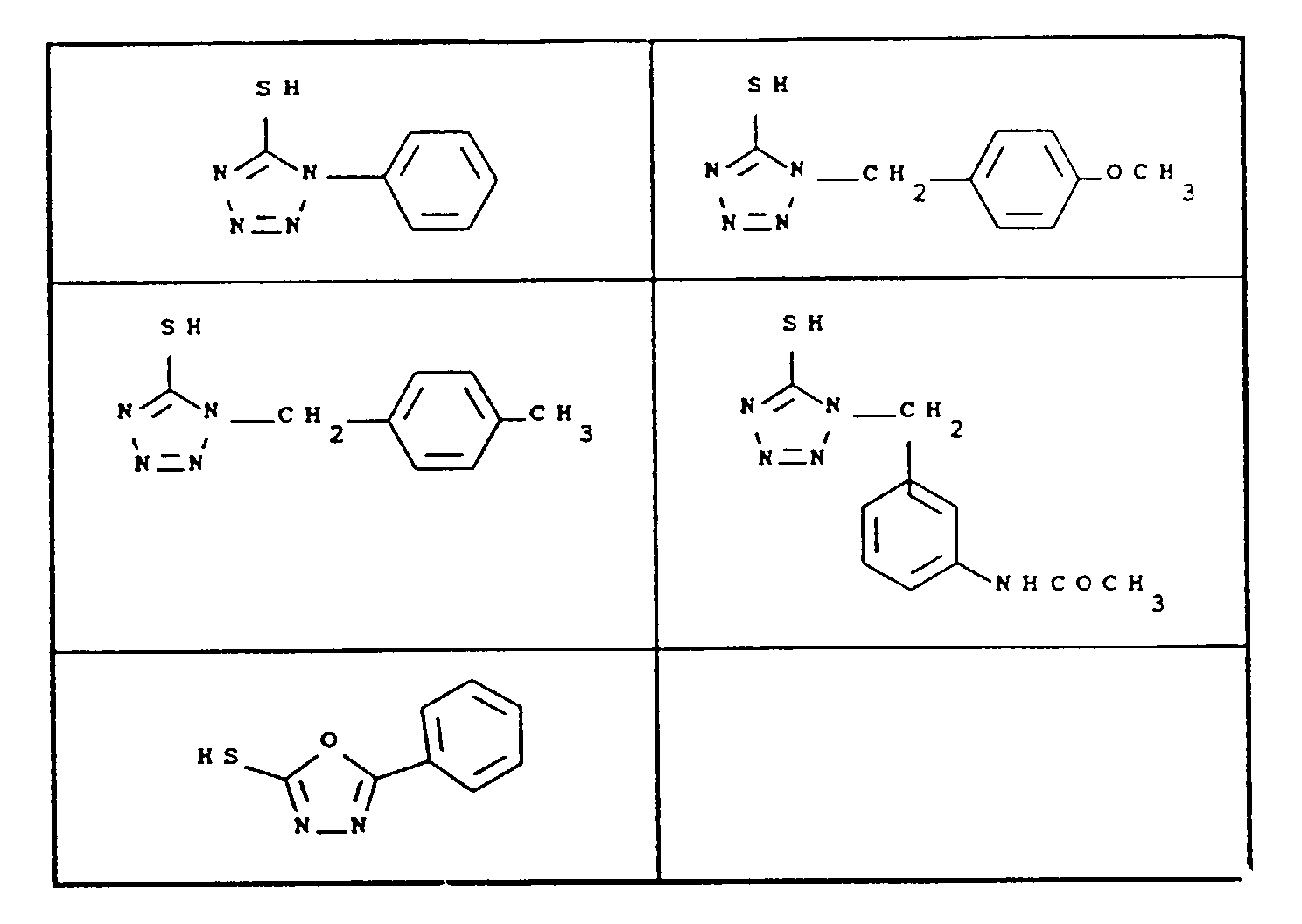
- the strong inhibitors usable in the invention are preferably aryl and arylalkyl mercaptotetrazoles and aryl oxadiazoles. Suitable examples of the strong inhibitors and their corresponding I.S. numbers are as shown in Table II.
- DIRs having weak and strong inhibitor groups are shown, for example, in U.S. Patent U.S. 5,006,448.
- the DIR in the green layer of lower sensitivity in the invention includes a timing group in addition to having a strong inhibitor.
- the timing group is joined to the coupler moiety at any of the positions from which groups released from couplers by reaction with oxidized color developing agent can be attached.
- the timing group is attached at the coupling position of the coupler moiety so that upon reaction of the coupler with oxidized color developing agent the timing group will be displaced.
- the timing group can be attached to a non-coupling position of the coupler moiety from which it will be displaced as a result of reaction of the coupler with oxidized color developing agent.
- timing group is at a non-coupling position of the coupler moiety
- other groups can be in the coupling position, including conventional coupling-off groups or the same or different inhibitor fragments or precursors from that described in the invention.
- the coupler moiety can have a timing group at each of the coupling position and a non-coupling position. Accordingly, couplers used in this invention can release more than one mole of inhibitor or other photographically useful material per mole of coupler. These released fragments can be the same or different and can be released at the same or different times and rates.
- the timing group can be any organic group that will serve to connect the coupler to the inhibitor fragment or precursor moiety and which, after cleavage from the coupler, will cleave from the inhibitor moiety preferably by an intramolecular nucleophilic displacement reaction of the type described in, for example, U.S. Patent 4,248,962 or by electron transfer down a conjugated chain as described in, for example, U.S. Patent 4,409,323 (quinone-methide types). Timing groups utilizing the mechanism in which there is electron transfer down a conjugated chain are especially preferred.
- U. S. Patents 4,842,994 and 5,135,839 contain a detailed explanation of timing groups which may be suitable for use in the invention.
- intramolecular nucleophilic displacement reaction refers to a reaction in which a nucleophilic center of a compound reacts directly, or indirectly through an intervening molecule, at another site on the compound, which is an electrophilic center, to effect displacement of a group or atom attached to the electrophilic center.
- Such compounds have a nucleophilic group and an electrophilic group spatially related by the configuration of the molecule to promote reactive proximity.
- the nucleophilic group and the electrophilic group are located in the compound so that a cyclic organic ring, or a transient cyclic organic ring, can be easily formed by an intramolecular reaction involving the nucleophilic center and the electrophilic center.
- a useful illustrative class of timing group (T) is represented by the structure: -(Nu - X - E)- wherein:
- a nucleophilic group (Nu) is understood to be a grouping of atoms wherein one of which is electron rich. This atom is referred to as the nucleophilic center.
- An electrophilic group (E) is understood to be a grouping of atoms wherein one of which is electron deficient. This atom is referred to as the electrophilic center.
- the timing group can contain a nucleophilic group and an electrophilic group that are spatially related with respect to one another by a linking group so that upon release from the coupler moiety, the nucleophilic center and the electrophilic center will react to effect displacement of the inhibitor moiety from the timing group.
- the nucleophilic center should be prevented from reacting with the electrophilic center until release from the coupler moiety and the electrophilic center should be resistant to external attack such as hydrolysis.
- Premature reaction can be prevented by attaching the coupler moiety to the timing group at the nucleophilic center or at an atom in conjunction with a nucleophilic center, so that cleavage of the timing group and the inhibitor moiety from the coupler moiety unblocks the nucleophilic center and permits it to react with the electrophilic center, or by positioning the nucleophilic group and the electrophilic group so that they are prevented from coming into reactive proximity until release.
- the timing group can contain additional substituents, such as additional photographically useful groups , or precursors thereof, which may remain attached to the timing group or be released.
- Representative Nu groups contain electron rich oxygen, sulfur and nitrogen atoms.
- Representative E groups contain electron deficient carbonyl, thiocarbonyl, phosphonyl and thiophosphonyl moieties. Other useful Nu and E groups will be apparent to those skilled in the art.
- Typical W groups are -NO2,-NHSO 2 CH 3 , -NHSO 2 C 16 H 33 , -NHCOCH 3 , -NHCOC 11 H 23 , -Cl, -Br, -OCH 3 , -OCH 2 CH 2 OCH 3 , etc.
- Other useful timing groups are described in U.S. Patents 4,737,451; 4,546,073; 4,564,587;4,618,571; 4,698,297 and European Published Patent Applications 167,168A, 255,085A, and 362,870A.
- the timing group can contain moieties and substituents that will permit control of one or more of the rates of reaction of the coupler with oxidized color developing agent, the rate of diffusion of the inhibitor fragment once it is released from the coupler, and the rate of release of the inhibitor.
- the timing group can contain added substituents, such as added photographically useful groups, that can remain attached to the timing group and be released independently.
- the timing groups can contain a ballast group.
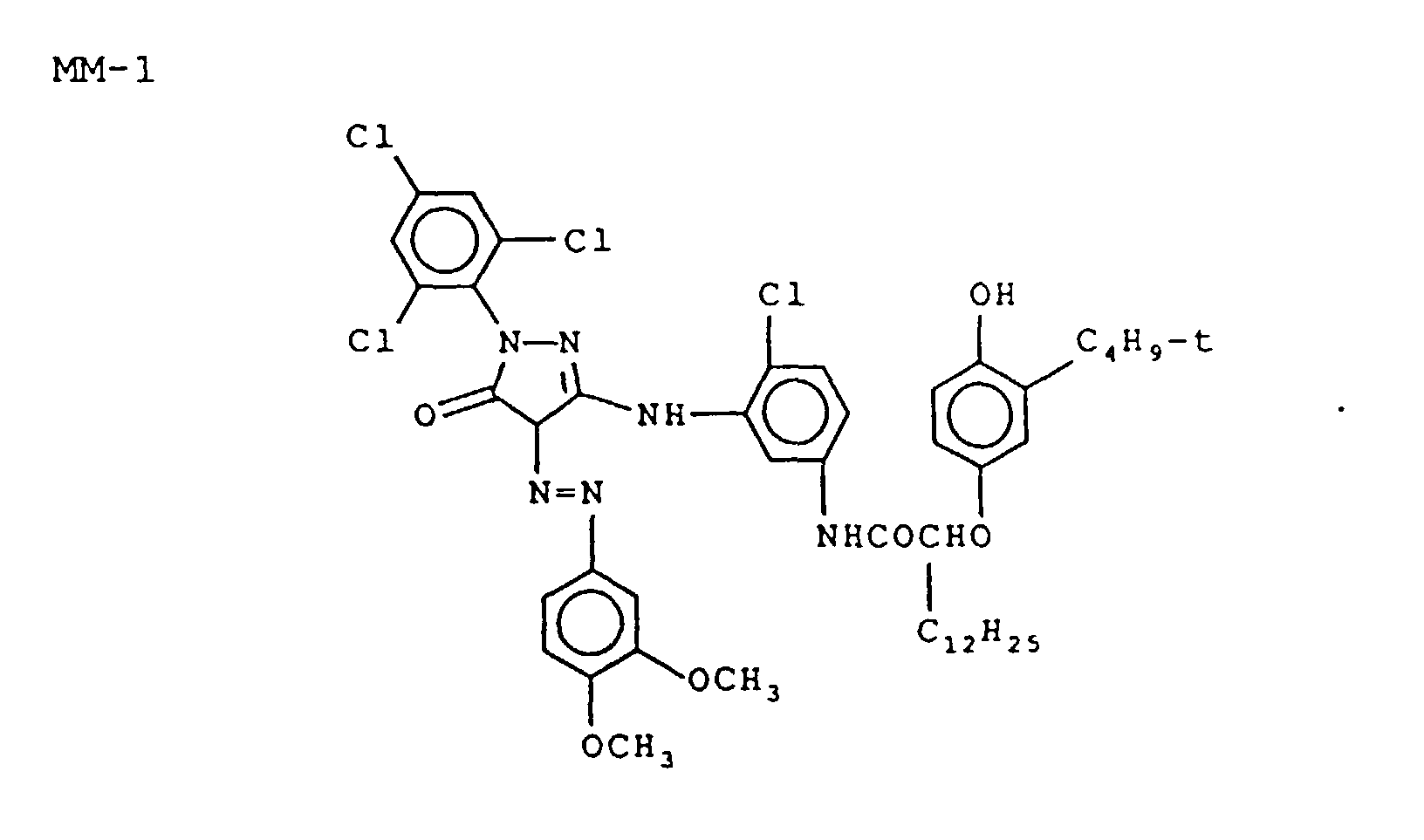
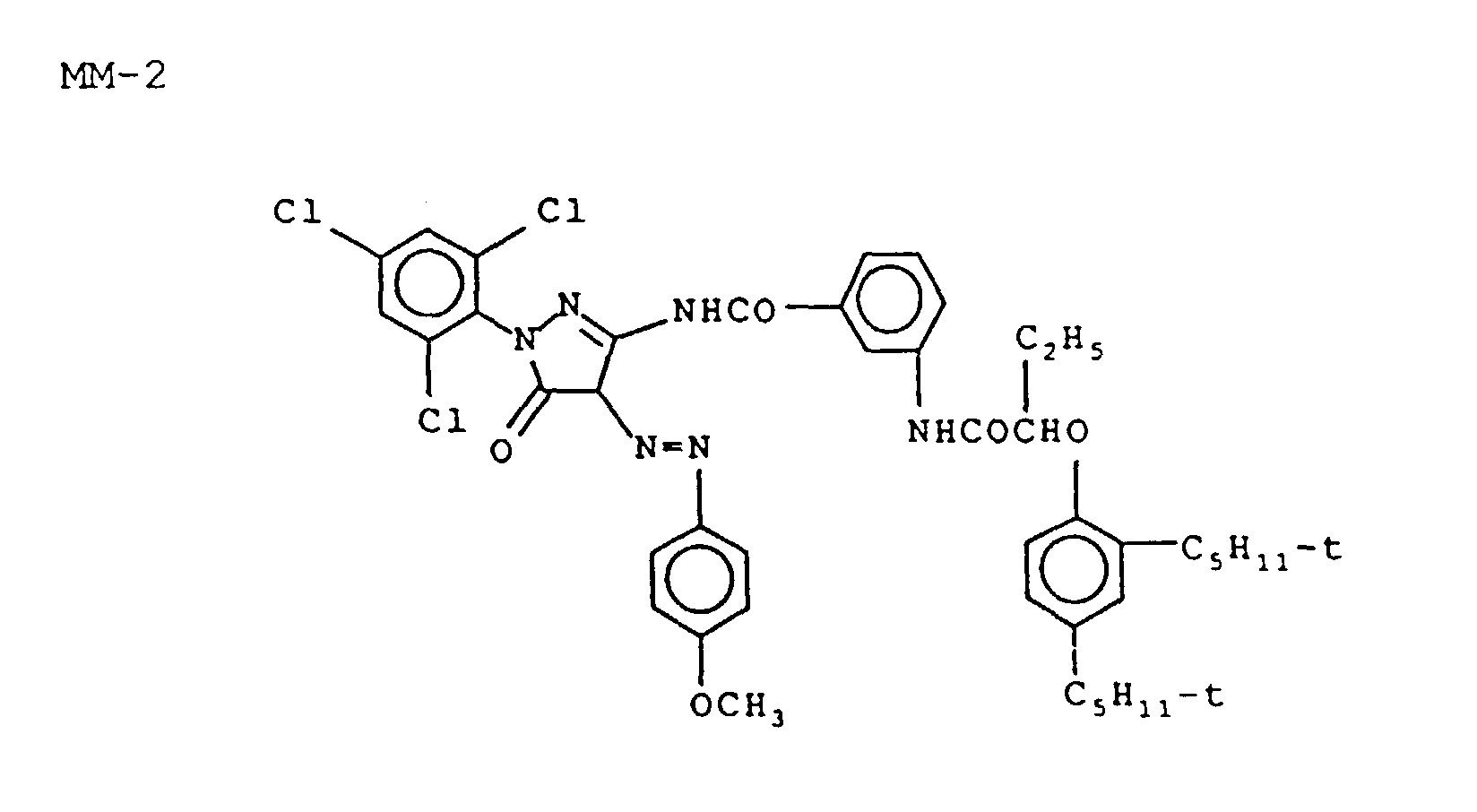
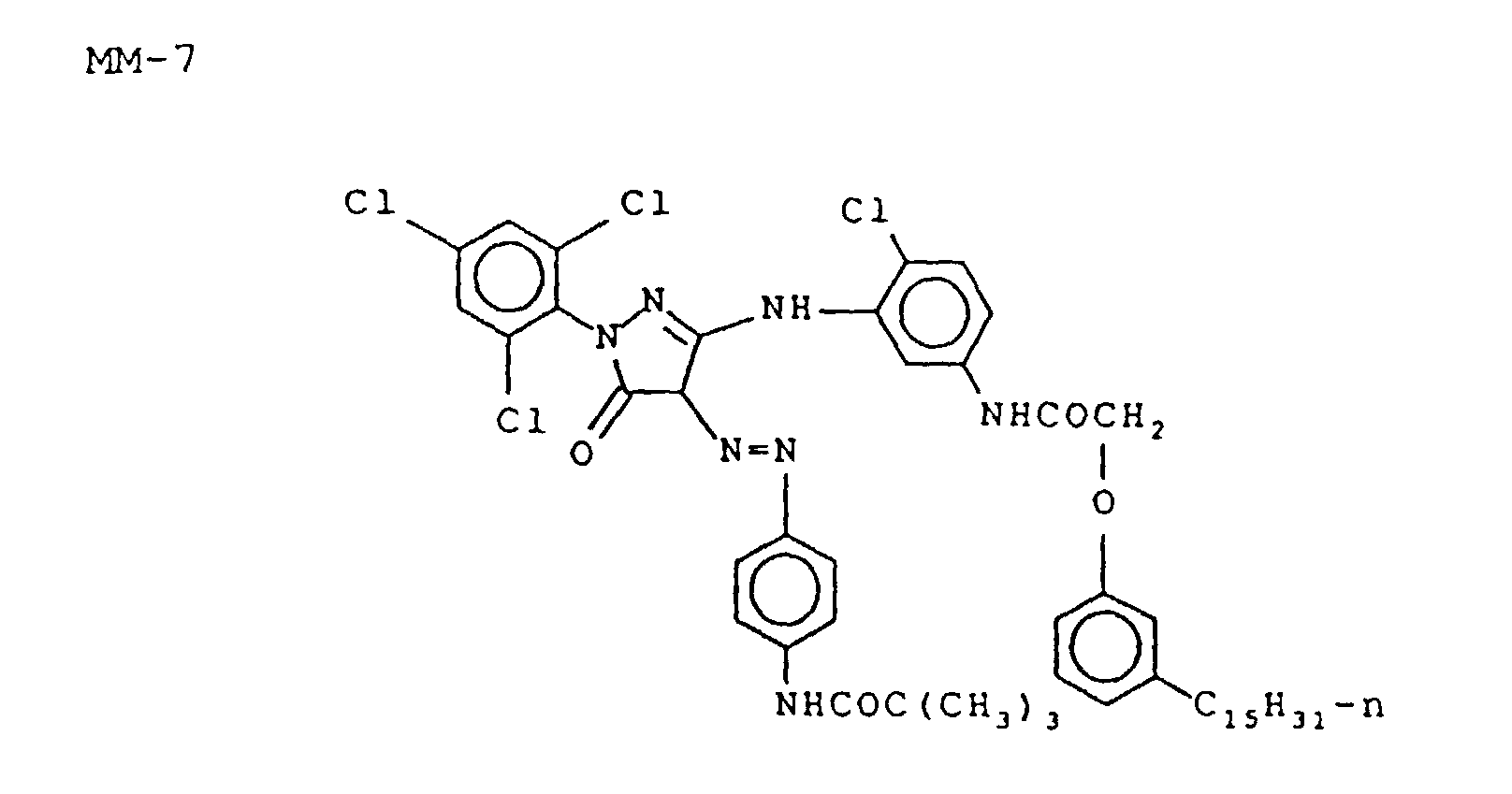
- one or more of the green-sensitive layers contains a yellow colored magenta dye-forming masking coupler.
- Any coupler known for this purpose may be employed.
- the use of 4-arylazopyrazolone masking couplers is known in the art. See, for example, U.S. 2,455,170; U.S. 2,428,034; U.S. 2,808,329; U.S. 2,434,272; U.S. 2,704,711; U.S. 2,688,539; U.S. 3,796,574; U.S. 3,476,560; U.S. 4,427,763; EP 213,490; and U.S.
- the present invention has beneficial effects on color rendition where a two-layer green sensitive pack is employed but the best results are obtainable with the use of a three-layer green-sensitive pack or "triple coat". In such case, it is preferred to employ the weak inhibitor DIR in the high green-sensitive layer and the strong inhibitor DIR with a timing group in the mid-sensitivity layer.
- the materials of the invention can be used in any of the ways and in any of the combinations known in the art.
- the invention materials are incorporated in a silver halide emulsion and the emulsion coated as a layer on a support to form part of a photographic element.
- they can be incorporated at a location adjacent to the silver halide emulsion layer where, during development, they will be in reactive association with development products such as oxidized color developing agent.
- the term "associated" signifies that the compound is in the silver halide emulsion layer or in an adjacent location where, during processing, it is capable of reacting with silver halide development products.
- ballast groups include substituted or unsubstituted alkyl or aryl groups containing 8 to 42 carbon atoms.
- substituents on such groups include alkyl, aryl, alkoxy, aryloxy, alkylthio, hydroxy, halogen, alkoxycarbonyl, aryloxcarbonyl, carboxy, acyl, acyloxy, amino, anilino, carbonamido, carbamoyl, alkylsulfonyl, arysulfonyl, sulfonamido, and sulfamoyl groups wherein the substituents typically contain 1 to 42 carbon atoms. Such substituents can also be further substituted.
- the photographic elements can be single color elements or multicolor elements.
- Multicolor elements contain image dye-forming units sensitive to each of the three primary regions of the spectrum.
- Each unit can comprise a single emulsion layer or multiple emulsion layers sensitive to a given region of the spectrum.
- the layers of the element, including the layers of the image-forming units, can be arranged in various orders as known in the art.
- the emulsions sensitive to each of the three primary regions of the spectrum can be disposed as a single segmented layer.
- a typical multicolor photographic element comprises a support bearing a cyan dye image-forming unit comprised of at least one red-sensitive silver halide emulsion layer having associated therewith at least one cyan dye-forming coupler, a magenta dye image-forming unit comprising at least one green-sensitive silver halide emulsion layer having associated therewith at least one magenta dye-forming coupler, and a yellow dye image-forming unit comprising at least one blue-sensitive silver halide emulsion layer having associated therewith at least one yellow dye-forming coupler.
- the element can contain additional layers, such as filter layers, interlayers, overcoat layers, subbing layers, and the like.
- the photographic element can be used in conjunction with an applied magnetic layer as described in Research Disclosure, November 1992, Item 34390 published by Kenneth Mason Publications, Ltd., Dudley Annex, 12a North Street, Emsworth, Hampshire PO10 7DQ, ENGLAND.
- Sections hereafter referred to are Sections of the Research Disclosure.
- the silver halide emulsions employed in the elements of this invention can be either negative-working or positive-working. Suitable emulsions and their preparation as well as methods of chemical and spectral sensitization are described in Sections I through IV. Color materials and development modifiers are described in Sections VII and XXI. Vehicles are described in Section IX, and various additives such as brighteners, antifoggants, stabilizers, light absorbing and scattering materials, hardeners, coating aids, plasticizers, lubricants and matting agents are described , for example, in Sections V, VI, VIII, X, XI, XII, and XVI. Manufacturing methods are described in Sections XIV and XV, other layers and supports in Sections XIII and XVII, processing methods and agents in Sections XIX and XX, and exposure alternatives in Section XVIII.
- Photographic elements can be exposed to actinic radiation, typically in the visible region of the spectrum, to form a latent image and can then be processed to form a visible dye image.
- Processing to form a visible dye image includes the step of contacting the element with a color developing agent to reduce developable silver halide and oxidize the color developing agent. Oxidized color developing agent in turn reacts with the coupler to yield a dye.
- the processing step described above provides a negative image.
- the described elements can be processed in the known C-41 color process as described in The British Journal of Photography Annual of 1988, pages 191-198.
- Preferred color developing agents are p-phenylenediamines such as:
- Development is usually followed by the conventional steps of bleaching, fixing, or bleach-fixing, to remove silver or silver halide, washing, and drying.
- a color photographic recording material (Photographic Sample 101) for color negative development was prepared by applying the following layers in the given sequence to a transparent support of cellulose triacetate.
- the quantities of silver halide are given in grams of silver per m 2 .
- the quantities of other materials are given in grams per m 2 .
- This film was hardened at coating with 2% by weight to total gelatin of hardener H-1.
- Surfactants, coating aids, scavengers, soluble absorber dyes and stabilizers were added to the various layers of this sample as is commonly practiced in the art.
- the controlling principal of the data is that a neutral exposure will cause exposure and development of the adjacent color records. This, in turn, will allow the adjacent records to release inhibitor which can migrate to the record of interest and thereby inhibit the development in the layer of interest. The gamma of the color of interest is therefore suppressed.
- exposure of the element to a monochrome which affects only one color record will not cause the release of the inhibitors in adjacent records, and thus the monochrome exposure represents a noninhibited mode from an inter-image standpoint. Without inhibition, the ratio would be one. With increasing inhibition due to inter-image effects, the ratio increases due to the reduction in neutral gamma.
- the photographic samples incorporating weak inhibitor DIR compound D-4 in the most green-sensitive layer and containing the same weak inhibitor DIR compound in the lower sensitive layer exhibit increased inhibition of the red record without any significant increase in the inhibition of the blue record. This combination does not achieve the desired inhibition effect on the blue record.
- the photographic samples incorporating the strong inhibitor DIR containing a timing group, compound D-1, in the lower green-sensitive layer exhibit had the effect of increasing blue inhibition as a result of green exposure while maintaining the red inhibition. This is the desired objective.
- a color photographic recording material (Photographic Sample 107) for color negative development was prepared by applying the following layers in the given sequence to a transparent support of cellulose triacetate.
- the quantities of silver halide are given in g of silver per m 2 .
- the quantities of other materials are given in g per m 2 .
- This film was hardened at coating with 2% by weight to total gelatin of hardener H-1.
- Surfactants, coating aids, scavengers, soluble absorber dyes and stabilizers were added to the various layers of this sample as is commonly practiced in the art.
- the interimage effect of blue inhibition as a result of green exposure can be controlled throughout the desired exposure region to improve color rendition.
- an untimed yellow dye-forming DIR coupler which releases a weak inhibitor fragment, such as D-4, can be used in the more green-sensitive silver halide emulsion layer to control red inhibition
- a cyan dye-forming DIR coupler with a timing group and containing a strong inhibitor fragment, such as D-1 can be used in the lower green-sensitive silver halide emulsion layer to control blue inhibition
- a masking coupler, such as MM-1 can be distributed in one or more of the green-sensitive silver halide emulsion layers to balance the interimage inhibition of blue as a result of green exposure over the desired exposure region.
Landscapes
- Physics & Mathematics (AREA)
- General Physics & Mathematics (AREA)
- Silver Salt Photography Or Processing Solution Therefor (AREA)
Claims (10)
- Fotografisches Element mit mindestens zwei licht-empfindlichen Silberhalogenid-Schichten, die gegenüber grünem Licht sensibilisiert sind und unterschiedliche Grade der Licht-Empfindlichkeit aufweisen,
dadurch gekennzeichnet, daß
der Schicht mit der höheren Empfindlichkeit ein, einen gelben Farbstoff erzeugender DIR-Kuppler zugeordnet ist, der einen Entwicklungs-Inhibitor freisetzt, der ein schwaches Inhibitor-Fragment mit einem Inhibitor-Stärkenwert von geringer als 50 enthält, und daß der Schicht mit der geringeren Empfindlichkeit ein, einen blaugrünen Farbstoff erzeugender DIR-Kuppler zugeordnet ist, der eine Zeit-Steuergruppe aufweist, die ein starkes Inhibitor-Fragment enthält, mit einem Inhibitor-Stärkenwert von 50 oder darüber, der einen Vorläufer des Entwicklungs-Inhibitor-Fragmentes freisetzt. - Element nach Anspruch 1, in dem der DIR-Kuppler, der den schwachen Inhibitor enthält, ein Inhibitor-Fragment enthält, das eine Struktur, ausgewählt aus den folgenden Strukturen, hat:

- Element nach Anspruch 1, in dem der DIR-Kuppler mit einem starken Inhibitor ein Inhibitor-Fragment enthält, das ausgewählt ist aus der Gruppe, bestehend aus den folgenden Gruppen:
- Element nach Anspruch 1, in dem das schwache Inhibitor-Fragment ein Benzotriazol oder Alkylmercaptotetrazol ist.
- Element nach Anspruch 1, in dem das starke Inhibitor-Fragment ein Phenylmercaptotetrazol ist.
- Element nach einem der Ansprüche 1-5, in dem der DIR-Kuppler mit einer Zeit-Steuergruppe eine Chinonmethid-Zeit-Steuergruppe enthält.
- Element nach einem der Ansprüche 1-6, in dem der einen gelben Farbstoff erzeugende Kuppler in der empfindlichsten Schicht enthalten ist.
- Element nach einem der Ansprüche 1-7, in dem das Element drei gegenüber grünem Licht empfindliche Schichten aufweist, mit einer höheren, mittleren und geringeren Empfindlichkeit gegenüber Licht, in dem der einen blaugrünen Farbstoff erzeugende Kuppler in der Schicht von mittlerer Empfindlichkeit enthalten ist.
- Element nach einem der Ansprüche 1-8, enthaltend einen gelb-farbigen, einen purpurroten Farbstoff erzeugenden Maskierungs-Kuppler in mindestens einer der grün-empfindlichen Schichten.
- Element nach Anspruch 9, in dem der Maskierungs-Kuppler ausgewählt ist aus den folgenden Kupplern:



Applications Claiming Priority (2)
| Application Number | Priority Date | Filing Date | Title |
|---|---|---|---|
| US11032 | 1993-01-29 | ||
| US08/011,032 US5314792A (en) | 1993-01-29 | 1993-01-29 | Photographic element and process providing improved color rendition |
Publications (2)
| Publication Number | Publication Date |
|---|---|
| EP0608959A1 EP0608959A1 (de) | 1994-08-03 |
| EP0608959B1 true EP0608959B1 (de) | 2001-03-21 |
Family
ID=21748566
Family Applications (1)
| Application Number | Title | Priority Date | Filing Date |
|---|---|---|---|
| EP94200199A Expired - Lifetime EP0608959B1 (de) | 1993-01-29 | 1994-01-27 | Photographisches Element und Verfahren mit verbesserter Farbwiedergabe |
Country Status (4)
| Country | Link |
|---|---|
| US (1) | US5314792A (de) |
| EP (1) | EP0608959B1 (de) |
| JP (1) | JP3268104B2 (de) |
| DE (1) | DE69426899T2 (de) |
Families Citing this family (5)
| Publication number | Priority date | Publication date | Assignee | Title |
|---|---|---|---|---|
| US5811228A (en) * | 1995-10-31 | 1998-09-22 | Eastman Kodak Company | Density correction dyes for color negative films with magnetic recording layers |
| EP0772081B1 (de) * | 1995-10-31 | 2003-09-24 | Eastman Kodak Company | Dichtekorrekturfarbstoffe für Farbnegativfilme mit magnetischen Aufzeichnunsschichten |
| US6190847B1 (en) * | 1997-09-30 | 2001-02-20 | Eastman Kodak Company | Color negative film for producing images of reduced granularity when viewed following electronic conversion |
| DE69920665T2 (de) | 1999-05-25 | 2005-10-06 | Ferrania S.P.A., Cairo Montenotte | Farbphotographische lichtempfindliche Silberhalogenidelemente mit verbesserter Bildqualität |
| US6190848B1 (en) * | 1999-07-21 | 2001-02-20 | Eastman Kodak Company | Color photographic element containing ballasted triazole derivative and inhibitor releasing coupler |
Family Cites Families (8)
| Publication number | Priority date | Publication date | Assignee | Title |
|---|---|---|---|---|
| US4414308A (en) * | 1981-03-20 | 1983-11-08 | Konishiroku Photo Industry Co., Ltd. | Silver halide color photographic photosensitive material |
| JPS6224252A (ja) * | 1985-07-24 | 1987-02-02 | Fuji Photo Film Co Ltd | ハロゲン化銀カラ−写真感光材料 |
| JP2550331B2 (ja) * | 1986-11-15 | 1996-11-06 | コニカ株式会社 | ハロゲン化銀カラ−写真感光材料 |
| JPH0192747A (ja) * | 1987-06-15 | 1989-04-12 | Fuji Photo Film Co Ltd | ハロゲン化銀カラ−写真感光材料 |
| US4782012A (en) * | 1987-07-17 | 1988-11-01 | Eastman Kodak Company | Photographic material containing a novel dir-compound |
| US5006448A (en) * | 1989-06-15 | 1991-04-09 | Eastman Kodak Company | Photographic material and process |
| WO1991006037A1 (en) * | 1989-10-10 | 1991-05-02 | Eastman Kodak Company | Color photographic recording material |
| EP0476327B1 (de) * | 1990-08-20 | 1999-11-17 | Fuji Photo Film Co., Ltd. | Datenbehaltendes photographisches Filmerzeugnis und Verfahren zur Herstellung eines Farbbildes |
-
1993
- 1993-01-29 US US08/011,032 patent/US5314792A/en not_active Expired - Fee Related
-
1994
- 1994-01-27 DE DE69426899T patent/DE69426899T2/de not_active Expired - Fee Related
- 1994-01-27 EP EP94200199A patent/EP0608959B1/de not_active Expired - Lifetime
- 1994-01-31 JP JP00949194A patent/JP3268104B2/ja not_active Expired - Fee Related
Also Published As
| Publication number | Publication date |
|---|---|
| JPH06295037A (ja) | 1994-10-21 |
| DE69426899T2 (de) | 2001-09-13 |
| US5314792A (en) | 1994-05-24 |
| DE69426899D1 (de) | 2001-04-26 |
| EP0608959A1 (de) | 1994-08-03 |
| JP3268104B2 (ja) | 2002-03-25 |
Similar Documents
| Publication | Publication Date | Title |
|---|---|---|
| US5272043A (en) | Photographic material and process comprising DIR coupler | |
| JPH0310289B2 (de) | ||
| US4980267A (en) | Photographic element and process comprising a development inhibitor releasing coupler and a yellow dye-forming coupler | |
| EP0649056B1 (de) | Photographisches Element und Verfahren in dem den Farbton korrigerende Kuppler verwendet werden | |
| US5389504A (en) | Color photographic elements containing a combination of pyrazolone and pyrazoloazole couplers | |
| EP0608959B1 (de) | Photographisches Element und Verfahren mit verbesserter Farbwiedergabe | |
| US4518683A (en) | Silver halide color photographic light-sensitive material | |
| EP0606952A2 (de) | Farbphotographisches Umkehrelement mit verbesserter Farbwiedergabe | |
| US5464733A (en) | Photographic material having reduced fog | |
| US5387500A (en) | Color photographic elements containing a combination of pyrazoloazole couplers | |
| JP3160421B2 (ja) | 粒状度が改良された写真材料 | |
| US5612173A (en) | One equivalent couplers and low PKA release dyes | |
| EP1072951A1 (de) | Farbphotographisches Element, das ein mit Ballast versehenesTriazolderivat und einen einen Entwicklungsinhibitor freisetzenden Kuppler enthält | |
| EP0622673B1 (de) | Photographische Farbkuppler und Materialien, die diese Kuppler enthalten | |
| EP0566416A1 (de) | Photographisches Material mit nebeneinanderliegenden grünempfindlichen Schichten | |
| US5478712A (en) | Photographic elements protected against color contamination and dye stain | |
| EP0277647A2 (de) | Lichtempfindliches farbphotographisches silberhalogenidmaterial mit verbesserter Feinheit und Körnigkeit | |
| EP0348134A2 (de) | Photographische Materialien, die abspaltbare Verbindungen enthalten | |
| JP3195425B2 (ja) | 水可溶化ナフトール系カプラーを用いるハロゲン化銀写真材料及び写真処理 | |
| US5270152A (en) | Photographic material having faithful rendition of the red color | |
| EP0566415A2 (de) | Photographisches Material mit geringem Schleier | |
| EP0571030A2 (de) | Photographisches Material mit aneinander grenzenden rotempfindlichen Schichten | |
| EP0600561B1 (de) | Gelbkuppler mit ionisierbare und/oder auflösbare Aryloxy freisetzbare Gruppen | |
| EP0577192B1 (de) | Photographisches Element enthaltend einen DIR-Kuppler und einen eine Säure löslichmachende Gruppe enthaltenden Bleich- beschleuniger freisetzenden Kuppler | |
| JPH04238347A (ja) | ハロゲン化銀カラー写真感光材料 |
Legal Events
| Date | Code | Title | Description |
|---|---|---|---|
| PUAI | Public reference made under article 153(3) epc to a published international application that has entered the european phase |
Free format text: ORIGINAL CODE: 0009012 |
|
| AK | Designated contracting states |
Kind code of ref document: A1 Designated state(s): DE GB |
|
| 17P | Request for examination filed |
Effective date: 19941220 |
|
| 17Q | First examination report despatched |
Effective date: 19980505 |
|
| GRAG | Despatch of communication of intention to grant |
Free format text: ORIGINAL CODE: EPIDOS AGRA |
|
| GRAG | Despatch of communication of intention to grant |
Free format text: ORIGINAL CODE: EPIDOS AGRA |
|
| GRAH | Despatch of communication of intention to grant a patent |
Free format text: ORIGINAL CODE: EPIDOS IGRA |
|
| RBV | Designated contracting states (corrected) |
Designated state(s): DE GB |
|
| GRAH | Despatch of communication of intention to grant a patent |
Free format text: ORIGINAL CODE: EPIDOS IGRA |
|
| GRAA | (expected) grant |
Free format text: ORIGINAL CODE: 0009210 |
|
| AK | Designated contracting states |
Kind code of ref document: B1 Designated state(s): DE GB |
|
| REF | Corresponds to: |
Ref document number: 69426899 Country of ref document: DE Date of ref document: 20010426 |
|
| EN | Fr: translation not filed | ||
| PGFP | Annual fee paid to national office [announced via postgrant information from national office to epo] |
Ref country code: GB Payment date: 20011214 Year of fee payment: 9 |
|
| REG | Reference to a national code |
Ref country code: GB Ref legal event code: IF02 |
|
| PLBE | No opposition filed within time limit |
Free format text: ORIGINAL CODE: 0009261 |
|
| STAA | Information on the status of an ep patent application or granted ep patent |
Free format text: STATUS: NO OPPOSITION FILED WITHIN TIME LIMIT |
|
| 26N | No opposition filed | ||
| PG25 | Lapsed in a contracting state [announced via postgrant information from national office to epo] |
Ref country code: GB Free format text: LAPSE BECAUSE OF NON-PAYMENT OF DUE FEES Effective date: 20030127 |
|
| GBPC | Gb: european patent ceased through non-payment of renewal fee | ||
| PGFP | Annual fee paid to national office [announced via postgrant information from national office to epo] |
Ref country code: DE Payment date: 20040130 Year of fee payment: 11 |
|
| PG25 | Lapsed in a contracting state [announced via postgrant information from national office to epo] |
Ref country code: DE Free format text: LAPSE BECAUSE OF NON-PAYMENT OF DUE FEES Effective date: 20050802 |