EP0609934A2 - Fernsehempfänger mit Teletextdecoder - Google Patents
Fernsehempfänger mit Teletextdecoder Download PDFInfo
- Publication number
- EP0609934A2 EP0609934A2 EP94200167A EP94200167A EP0609934A2 EP 0609934 A2 EP0609934 A2 EP 0609934A2 EP 94200167 A EP94200167 A EP 94200167A EP 94200167 A EP94200167 A EP 94200167A EP 0609934 A2 EP0609934 A2 EP 0609934A2
- Authority
- EP
- European Patent Office
- Prior art keywords
- page
- checkword
- teletext
- television receiver
- stored
- Prior art date
- Legal status (The legal status is an assumption and is not a legal conclusion. Google has not performed a legal analysis and makes no representation as to the accuracy of the status listed.)
- Granted
Links
- 230000015654 memory Effects 0.000 claims description 29
- 125000004122 cyclic group Chemical group 0.000 claims description 3
- 238000012986 modification Methods 0.000 claims description 2
- 230000004048 modification Effects 0.000 claims description 2
- 230000005540 biological transmission Effects 0.000 description 3
- 230000006399 behavior Effects 0.000 description 1
- 230000002457 bidirectional effect Effects 0.000 description 1
- 239000002131 composite material Substances 0.000 description 1
- 230000007423 decrease Effects 0.000 description 1
- 239000000463 material Substances 0.000 description 1
- 238000011022 operating instruction Methods 0.000 description 1
Images




Classifications
-
- H—ELECTRICITY
- H04—ELECTRIC COMMUNICATION TECHNIQUE
- H04N—PICTORIAL COMMUNICATION, e.g. TELEVISION
- H04N7/00—Television systems
- H04N7/08—Systems for the simultaneous or sequential transmission of more than one television signal, e.g. additional information signals, the signals occupying wholly or partially the same frequency band, e.g. by time division
- H04N7/087—Systems for the simultaneous or sequential transmission of more than one television signal, e.g. additional information signals, the signals occupying wholly or partially the same frequency band, e.g. by time division with signal insertion during the vertical blanking interval only
- H04N7/088—Systems for the simultaneous or sequential transmission of more than one television signal, e.g. additional information signals, the signals occupying wholly or partially the same frequency band, e.g. by time division with signal insertion during the vertical blanking interval only the inserted signal being digital
- H04N7/0882—Systems for the simultaneous or sequential transmission of more than one television signal, e.g. additional information signals, the signals occupying wholly or partially the same frequency band, e.g. by time division with signal insertion during the vertical blanking interval only the inserted signal being digital for the transmission of character code signals, e.g. for teletext
Definitions
- the invention relates to a television receiver including a teletext decoder for receiving and displaying teletext pages.
- Television receivers of the type mentioned in the opening paragraph are generally known. They enable the consumer to consult a large quantity of textual and graphic information. The information is accommodated in a plurality of teletext pages which are transmitted cyclically. Each individual page in the cycle has a page number enabling the user to select this page.
- the World System Teletext standard used in many countries provides for the transmission of an Update Indicator for each teletext page.
- This is a 1-bit indicator which is set once by the page editor when the page contents are modified so as to indicate that the page has been modified with respect to its previous transmission.
- this information is used to inform the user of the fact that the displayed page has been refreshed. While waiting for this information, the user may, for example watch the television program.
- JP 3-214983 describes a teletext receiver which compares a transmitted revision flag with a corresponding stored bit. If they differ, it is inferred therefrom that the contents have been changed, which will be stated to the user.
- the television receiver comprises means for forming a checkword upon reception of a teletext page from the data codes constituting the contents of the page, means for storing the checkword upon display of a received teletext page in a memory location associated with the page, and means for comparing the checkword formed for the received page with the checkword stored for said page and for generating an attention signal in conformity therewith.
- the checkword may be constituted from the data codes transmitted by the transmitter. It may alternatively be constituted from the data codes stored in a page memory after decoding.
- the checkword may further be constituted in various ways. In a possible embodiment the checkword is formed at the receiver end by the modulo-N checksum of the data codes. Another possibility is to compute a Cyclic Redundancy Check (CRC) of the data codes. It is to be noted that it is known per se to form a checksum or CRC of at least a part of a teletext page. See, for example "VPV-Videotext programs video recorder" in IEEE Transactions on Consumer Electronics, vol. 34, no.
- the checkword may alternatively be formed at the transmitter end and be transmitted together with the corresponding page. This embodiment is attractive because the checkword then need not be computed in the television receiver but only read. Moreover, such a checkword can be protected against transmission errors by means of protection bits. Also in this embodiment the checkword may be in the form of a checksum or CRC. However, it is already sufficient when it takes the form of an ordinal number, for example a sequential modulo-N ordinal number which is raised upon every modification of the page.
- a further embodiment of the television receiver is obtained if the receiver further comprises means ensuring that, upon reception of predetermined teletext pages, the checkword formed upon said reception is stored in a further memory location associated with the received page.
- the checkword for the predetermined pages for example, preprogrammed preferred pages
- the checkword for the predetermined pages is stored upon each reception. If one of the preferred pages is actually consulted, it can immediately be ascertained whether the version last transmitted is new with respect to the version last consulted. If this is not the case, it is very likely that also the page which is still to be received has not been refreshed. It is now possible to state this to the user even before the requested page is received after the customary waiting time.
- the same embodiment also enhances the ease of use of multipage teletext decoders in which the predetermined pages are acquired in advance and stored for later display without any waiting time.
- a page memory used for storing a page which has meanwhile been consulted can then be utilized temporarily for another page until the original page is refreshed again.
- Fig. 1 shows the general structure of a television receiver including a teletext decoder according to the invention.
- Fig. 2 shows some possible divisions of a memory shown in Fig. 1.
- Fig. 3 shows a flow chart to explain a control program performed by a microprocessor shown in Fig. 1.
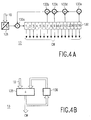
- Fig. 4 shows some embodiments of a checkword generator shown in Fig. 1.
- Figs. 5 and 6 show flow charts to explain a further embodiment of the control program performed by the microprocessor shown in Fig. 1.
- Fig. 1 shows the general structure of a television receiver including a teletext decoder according to the invention.
- the transmitter signals received at an antenna 1 are applied to a customary tuning and demodulation circuit 2.
- the obtained composite video signal CVBS of the selected television program is applied to a video signal processing circuit 3 and to a teletext decoder 4.
- colour signals RGB v are applied to a display screen 6 from video signal processing circuit 3 via a multiplexer 5 so as to enable the user to watch the received television program.
- colour signals RGB t of the teletext decoder 4 are displayed on the display screen.
- the television receiver comprises a section for sound reception and reproduction (not shown).
- Operating instructions by the user are generated in a (remote-control) operating unit 7 and applied to a microprocessor 9 via a receiver circuit 8.
- Teletext decoder 4 is connected to this microprocessor by means of a bidirectional command bus 10.
- An interface 11 for tuning the receiver to stations, controlling picture brightness and sound volume, and the like is further connected to the command bus. This is shown by way of the appropriate symbols in the Figure.
- the microprocessor is coupled via the command bus to a memory 12 and a checkword generator 13.
- the teletext decoder 4 is, for example of the type as described in Technical Publication 112 "Computer Controlled Teletext (CCT)" of Philips Electronic Components and Materials.
- the decoder comprises a plurality of acquisition circuits each being able to look up a teletext page with a requested page number and store it in a page memory (not shown) coupled thereto.
- An interesting property of said type of decoder is that the page memories can be read and written by the microprocessor 9 via the command bus 10. More particularly, the character codes of a received teletext page can be read by the microprocessor. Moreover, locally generated "On Screen Display" messages can be applied to the teletext decoder 4 for the purpose of display.
- Fig. 2A shows a possible division of the memory 12.
- the memory has a memory location for storing a multi-bit checkword CW(p).
- the memory is preferably non-volatile so that the stored data are preserved also after switching off, or at least in the standby mode, of the receiver. It is assumed that upon first use of the receiver all memory locations CW(100) ... CW(899) have a predetermined initial value, for example the value 0.
- the division shown in Fig. 2B will be explained hereinafter.
- Fig. 1 shows the operation of the television receiver shown in Fig. 1 based on a control program stored in the microprocessor 9.
- This control program is generally known in so far as it is adapted to tune to stations and control picture and sound. Therefore, the control program will hereinafter be described only in so far as the television receiver is in the teletext operating mode.
- Fig. 3 shows the flow chart of a page request program REQ(p) which is performed in the teletext operating mode after the user has entered a page number p.
- a waiting loop 31 a waiting time is observed for the reception of this page.
- the page is stored in a page memory of the teletext decoder. Subsequently a check routine 32 is performed.
- the character codes which jointly constitute the contents of the received page, are read by the microprocessor and successively applied to the checkword generator 13 (see Fig. 1).
- the contents of a page are constituted, for example by the character codes of the text rows 1 to 24 (possibly 25) as stored for display. If the page header, which is customary in World System Teletext, is considered to be part of the contents, the time indication occurring therein is to be excluded from the contents.
- Fig. 4A shows a first embodiment of checkword generator 13.
- the generator comprises a parallel-series converter 131 which receives character codes of, for example 8 bits in a parallel format via the command bus 10.
- the generator further comprises a 16-bit shift register 132. Its input receives the modulo-2 sum of one bit of a character code and the contents of the 7th, 9th, 12th and 16th stage of the register.
- the modulo-2 sum is formed by modulo-2 adders 133a-133e.
- the shift register is initially given the value 0 by means of a reset signal (not shown). After all bits of all character codes have been successively applied to the generator, the register 132 comprises a 16-bit checkword CW, also referred to as Cyclic Redundancy Check.
- FIG. 4B shows a second embodiment of checkword generator 13.
- the generator now comprises an adder 135, a first input of which receives the 8-bit character codes via the command bus 10.
- the 8-bit output of the adder is fed back to the second input of the adder via a register 136.
- Register 136 is initially given the value 0 by means of a reset signal (not shown).
- adder 135 supplies an 8-bit checkword CW in the form of a modulo-256 checksum.
- the checkword comprises 16 and 8 bits, respectively. However, other bit numbers are alternatively possible. The likelihood of different pages supplying the same checkword decreases as the checkword comprises more bits.
- this routine solely comprises the reading of a checkword formed at the transmitter end and transmitted with the page.
- the transmitted checkword may also have the form of a CRC or checksum. However, in this case it may alternatively have the form of a sequential modulo-N ordinal number which is raised at the transmitter end whenever the page is refreshed.
- the obtained checkword CW is compared in a step 33 of the request program with a value CW(p) which is stored in memory location p of memory 12 (see Fig. 2A).
- CW(p) initially has a predetermined value, for example the value 0.
- the computed checkword will generally not have the value 0, so that steps 34 and 35 are performed.
- the step 34 the teletext page which has just been received is displayed, thus enabling the user to consult it.
- the computed checkword CW is stored in the memory location CW(p). After this, the program is ended.
- the teletext request program is always run through upon request of a new page. In this way a checkword for each consulted teletext page is stored in memory 12 (see Fig. 1) of the television receiver, which checkword is representative of the contents of said page. If the user consults the teletext program some time later again, the program shown in Fig. 3 is run through again for each page request. It is then very likely that the user will again request a number of previously consulted teletext pages. In this case two situations can be distinguished:
- Fig. 2B shows a division of the memory 12 of Fig. 1 for a further embodiment of the television receiver according to the invention.
- the memory again has a memory location for each receivable teletext page number p for storing the checkword CW(p) which is representative of the contents of a consulted page.
- the memory also has a second memory location for storing a further checkword CW R (p).
- this further checkword is representative of the contents of a recently transmitted version of page p.
- the teletext control program which is performed by the microprocessor in this further embodiment of the television receiver, now comprises a page request program REQ(p) and a background program BGR.
- the background program BGR will first be described with reference to a flow chart which is shown in Fig. 5.
- a first step 51 of the program the acquisition of page x is started.
- x is a "don't care" page number.
- This means that the teletext decoder receives the next page of the broadcast, independent of its page number.
- a waiting loop 52 of the program a waiting time is observed for the reception of the page, whereafter in a step 53 the page number q of the received page is fixed. For the sake of completeness it is to be noted that the received page is not shown.
- a check routine 54 the checkword CW is formed in the manner already described hereinbefore from the contents of the received page.
- this checkword is stored in memory location CW R (q).
- the program returns to the start so as to acquire a subsequent page.
- Page number x may alternatively be a predetermined page number, for example a page number from a list of preferred page numbers which have previously been programmed by the user. In that case the checkword of all preferred pages is stored.
- Fig. 6 shows the page request program REQ(p) which is performed as soon as the user requests a page with page number p.
- a step 61 it is now checked whether the stored checkword CW R (p) is equal to the stored checkword CW(p). In other words, whether the contents of page p upon its most recent reception are still identical to those of the previously consulted page. In that case also the page p still to be received is most likely unchanged. In fact, teletext pages are transmitted at a high frequency (for example, every 20 to 30 seconds) but only refreshed at a low frequency (many pages remain unchanged for hours, sometimes even days).
- a step 62 the user is informed that the page has not yet been refreshed. It should be emphasized that this information is given immediately after the page has been requested.
- step 61 If it has been found in step 61 that the two checkwords do not correspond to each other, a waiting time is observed for the reception of the page (waiting loop 63) whereafter the page is displayed (step 64). Moreover, the checkword is formed (check routine 65) and stored (step 66) for the displayed page.
- the checkword generator 13 has been described as a hardware circuit. Those skilled in the art will be able to implement such a circuit also entirely in a software version.
- the memory 12 need not necessarily have a memory location for each receivable page number. In practice, only a relatively small number of pages is consulted. It may then be more economical to store both the checkword and the associated page number in these memory locations. It is further feasible not to store the checkword of a displayed page until after this page has been displayed at least for a predetermined period of time, i.e. when it is most likely that the user has actually read the page.
Landscapes
- Engineering & Computer Science (AREA)
- Multimedia (AREA)
- Signal Processing (AREA)
- Television Systems (AREA)
Priority Applications (1)
| Application Number | Priority Date | Filing Date | Title |
|---|---|---|---|
| EP19940200167 EP0609934B1 (de) | 1993-02-01 | 1994-01-25 | Fernsehempfänger mit Teletextdecoder |
Applications Claiming Priority (3)
| Application Number | Priority Date | Filing Date | Title |
|---|---|---|---|
| EP93200252 | 1993-02-01 | ||
| EP93200252 | 1993-02-01 | ||
| EP19940200167 EP0609934B1 (de) | 1993-02-01 | 1994-01-25 | Fernsehempfänger mit Teletextdecoder |
Publications (3)
| Publication Number | Publication Date |
|---|---|
| EP0609934A2 true EP0609934A2 (de) | 1994-08-10 |
| EP0609934A3 EP0609934A3 (de) | 1995-05-10 |
| EP0609934B1 EP0609934B1 (de) | 1999-04-07 |
Family
ID=26133626
Family Applications (1)
| Application Number | Title | Priority Date | Filing Date |
|---|---|---|---|
| EP19940200167 Expired - Lifetime EP0609934B1 (de) | 1993-02-01 | 1994-01-25 | Fernsehempfänger mit Teletextdecoder |
Country Status (1)
| Country | Link |
|---|---|
| EP (1) | EP0609934B1 (de) |
Cited By (4)
| Publication number | Priority date | Publication date | Assignee | Title |
|---|---|---|---|---|
| WO1996008895A1 (en) * | 1994-09-14 | 1996-03-21 | Ericsson Inc. | Method and apparatus for decoder optimization |
| EP0808063A1 (de) * | 1996-05-15 | 1997-11-19 | Matsushita Electric Industrial Co., Ltd. | Verfahren und Vorrichtung zum Empfangen von Teletext |
| EP0760583A3 (de) * | 1995-08-25 | 1998-11-04 | NOKIA TECHNOLOGY GmbH | Fernsehgerät mit einer Empfangs- und Akquirierschaltung für Teletextsendungen |
| WO2007039859A3 (en) * | 2005-10-05 | 2007-07-05 | Nxp Bv | Teletext processing circuit |
Family Cites Families (1)
| Publication number | Priority date | Publication date | Assignee | Title |
|---|---|---|---|---|
| JPH03106191A (ja) * | 1989-09-19 | 1991-05-02 | Sanyo Electric Co Ltd | 文字放送受信器付きビデオテープレコーダ |
-
1994
- 1994-01-25 EP EP19940200167 patent/EP0609934B1/de not_active Expired - Lifetime
Cited By (6)
| Publication number | Priority date | Publication date | Assignee | Title |
|---|---|---|---|---|
| WO1996008895A1 (en) * | 1994-09-14 | 1996-03-21 | Ericsson Inc. | Method and apparatus for decoder optimization |
| US5577053A (en) * | 1994-09-14 | 1996-11-19 | Ericsson Inc. | Method and apparatus for decoder optimization |
| EP0760583A3 (de) * | 1995-08-25 | 1998-11-04 | NOKIA TECHNOLOGY GmbH | Fernsehgerät mit einer Empfangs- und Akquirierschaltung für Teletextsendungen |
| EP0808063A1 (de) * | 1996-05-15 | 1997-11-19 | Matsushita Electric Industrial Co., Ltd. | Verfahren und Vorrichtung zum Empfangen von Teletext |
| US6043849A (en) * | 1996-05-15 | 2000-03-28 | Matsushita Electric Industrial Co., Ltd. | Similar change information takeout method, similar change information takeout apparatus, and teletext receiver |
| WO2007039859A3 (en) * | 2005-10-05 | 2007-07-05 | Nxp Bv | Teletext processing circuit |
Also Published As
| Publication number | Publication date |
|---|---|
| EP0609934B1 (de) | 1999-04-07 |
| EP0609934A3 (de) | 1995-05-10 |
Similar Documents
| Publication | Publication Date | Title |
|---|---|---|
| KR100328801B1 (ko) | 텔레비젼수상기용픽쳐-인-픽쳐시스템 | |
| EP0187417B1 (de) | Fernsehempfänger mit einer Teletextdecoderschaltung und einem Seitennummernspeicher | |
| US6052145A (en) | System and method for controlling the broadcast and recording of television programs and for distributing information to be displayed on a television screen | |
| CA2188707C (en) | System providing freeze of closed captioning data | |
| US5410359A (en) | Teletext decoder and television receiver provided with a teletext decoder | |
| JPH10171664A5 (de) | ||
| KR0172943B1 (ko) | 텔리비젼 및 텔레텍스트 신호 수신기 | |
| KR100445541B1 (ko) | 그래픽이미지전송방법및전송기,디스플레이신호발생기,수신기,비디오레코더,그래픽이미지표시신호및저장매체 | |
| US5729298A (en) | Teletext decoder with page update indication | |
| US20050076310A1 (en) | Display controller, display control method, and recording medium with program for executing the display control method recorded therein | |
| US5978036A (en) | Character signal processing apparatus and character signal processing system and personal computer | |
| KR100330104B1 (ko) | 복수의텔레비젼프로그램을전송하기위한송신국과그프로그램수신을위한수신기 | |
| EP0609934B1 (de) | Fernsehempfänger mit Teletextdecoder | |
| KR100380257B1 (ko) | 텔레텍스트페이지의전송방법및텔레텍스트페이지송신국및수신기 | |
| US6011539A (en) | Television on-screen display system utilizing text data compression | |
| AU688422B2 (en) | Method of transmitting teletext pages | |
| EP0567185B1 (de) | Teletextdekoder und Fernsehempfänger ausgestattet mit einem Teletextdekoder | |
| US20020003882A1 (en) | Method of, and means for, delivering information services over the air | |
| JP3235460B2 (ja) | Fm多重情報受信装置 | |
| JP3652374B2 (ja) | テレテキストページを伝送する方法 | |
| JP3274598B2 (ja) | 文字放送受信装置 | |
| KR20030089092A (ko) | 프로그램 업데이트 장치 및 방법 | |
| EP0683959A1 (de) | Lokales nachrichtensystem und station zur anwendung in einem solchen system | |
| JP3379687B2 (ja) | テレビジョン受像機 | |
| KR100255440B1 (ko) | 제어 기능 동기 방법 및 장치 |
Legal Events
| Date | Code | Title | Description |
|---|---|---|---|
| PUAI | Public reference made under article 153(3) epc to a published international application that has entered the european phase |
Free format text: ORIGINAL CODE: 0009012 |
|
| AK | Designated contracting states |
Kind code of ref document: A2 Designated state(s): DE FR GB IT |
|
| RAP1 | Party data changed (applicant data changed or rights of an application transferred) |
Owner name: N.V. PHILIPS' GLOEILAMPENFABRIEKEN |
|
| PUAL | Search report despatched |
Free format text: ORIGINAL CODE: 0009013 |
|
| AK | Designated contracting states |
Kind code of ref document: A3 Designated state(s): DE FR GB IT |
|
| 17P | Request for examination filed |
Effective date: 19951110 |
|
| 17Q | First examination report despatched |
Effective date: 19970811 |
|
| GRAG | Despatch of communication of intention to grant |
Free format text: ORIGINAL CODE: EPIDOS AGRA |
|
| RAP3 | Party data changed (applicant data changed or rights of an application transferred) |
Owner name: KONINKLIJKE PHILIPS ELECTRONICS N.V. |
|
| GRAG | Despatch of communication of intention to grant |
Free format text: ORIGINAL CODE: EPIDOS AGRA |
|
| GRAH | Despatch of communication of intention to grant a patent |
Free format text: ORIGINAL CODE: EPIDOS IGRA |
|
| GRAH | Despatch of communication of intention to grant a patent |
Free format text: ORIGINAL CODE: EPIDOS IGRA |
|
| GRAA | (expected) grant |
Free format text: ORIGINAL CODE: 0009210 |
|
| AK | Designated contracting states |
Kind code of ref document: B1 Designated state(s): DE FR GB IT |
|
| REF | Corresponds to: |
Ref document number: 69417605 Country of ref document: DE Date of ref document: 19990512 |
|
| ET | Fr: translation filed | ||
| PLBE | No opposition filed within time limit |
Free format text: ORIGINAL CODE: 0009261 |
|
| STAA | Information on the status of an ep patent application or granted ep patent |
Free format text: STATUS: NO OPPOSITION FILED WITHIN TIME LIMIT |
|
| 26N | No opposition filed | ||
| REG | Reference to a national code |
Ref country code: GB Ref legal event code: IF02 |
|
| REG | Reference to a national code |
Ref country code: GB Ref legal event code: 746 Effective date: 20020923 |
|
| REG | Reference to a national code |
Ref country code: FR Ref legal event code: D6 |
|
| PGFP | Annual fee paid to national office [announced via postgrant information from national office to epo] |
Ref country code: FR Payment date: 20030127 Year of fee payment: 10 |
|
| PGFP | Annual fee paid to national office [announced via postgrant information from national office to epo] |
Ref country code: GB Payment date: 20030131 Year of fee payment: 10 |
|
| PGFP | Annual fee paid to national office [announced via postgrant information from national office to epo] |
Ref country code: DE Payment date: 20030317 Year of fee payment: 10 |
|
| PG25 | Lapsed in a contracting state [announced via postgrant information from national office to epo] |
Ref country code: GB Free format text: LAPSE BECAUSE OF NON-PAYMENT OF DUE FEES Effective date: 20040125 |
|
| PG25 | Lapsed in a contracting state [announced via postgrant information from national office to epo] |
Ref country code: DE Free format text: LAPSE BECAUSE OF NON-PAYMENT OF DUE FEES Effective date: 20040803 |
|
| GBPC | Gb: european patent ceased through non-payment of renewal fee |
Effective date: 20040125 |
|
| PG25 | Lapsed in a contracting state [announced via postgrant information from national office to epo] |
Ref country code: FR Free format text: LAPSE BECAUSE OF NON-PAYMENT OF DUE FEES Effective date: 20040930 |
|
| REG | Reference to a national code |
Ref country code: FR Ref legal event code: ST |
|
| PG25 | Lapsed in a contracting state [announced via postgrant information from national office to epo] |
Ref country code: IT Free format text: LAPSE BECAUSE OF NON-PAYMENT OF DUE FEES;WARNING: LAPSES OF ITALIAN PATENTS WITH EFFECTIVE DATE BEFORE 2007 MAY HAVE OCCURRED AT ANY TIME BEFORE 2007. THE CORRECT EFFECTIVE DATE MAY BE DIFFERENT FROM THE ONE RECORDED. Effective date: 20050125 |