EP0610923A2 - Flüssigkristall-Anzeige mit vielfachdomänen Struktur - Google Patents
Flüssigkristall-Anzeige mit vielfachdomänen Struktur Download PDFInfo
- Publication number
- EP0610923A2 EP0610923A2 EP94102004A EP94102004A EP0610923A2 EP 0610923 A2 EP0610923 A2 EP 0610923A2 EP 94102004 A EP94102004 A EP 94102004A EP 94102004 A EP94102004 A EP 94102004A EP 0610923 A2 EP0610923 A2 EP 0610923A2
- Authority
- EP
- European Patent Office
- Prior art keywords
- liquid crystal
- pair
- transparent substrates
- crystal display
- polarizers
- Prior art date
- Legal status (The legal status is an assumption and is not a legal conclusion. Google has not performed a legal analysis and makes no representation as to the accuracy of the status listed.)
- Granted
Links
Images




Classifications
-
- G—PHYSICS
- G02—OPTICS
- G02F—OPTICAL DEVICES OR ARRANGEMENTS FOR THE CONTROL OF LIGHT BY MODIFICATION OF THE OPTICAL PROPERTIES OF THE MEDIA OF THE ELEMENTS INVOLVED THEREIN; NON-LINEAR OPTICS; FREQUENCY-CHANGING OF LIGHT; OPTICAL LOGIC ELEMENTS; OPTICAL ANALOGUE/DIGITAL CONVERTERS
- G02F1/00—Devices or arrangements for the control of the intensity, colour, phase, polarisation or direction of light arriving from an independent light source, e.g. switching, gating or modulating; Non-linear optics
- G02F1/01—Devices or arrangements for the control of the intensity, colour, phase, polarisation or direction of light arriving from an independent light source, e.g. switching, gating or modulating; Non-linear optics for the control of the intensity, phase, polarisation or colour
- G02F1/13—Devices or arrangements for the control of the intensity, colour, phase, polarisation or direction of light arriving from an independent light source, e.g. switching, gating or modulating; Non-linear optics for the control of the intensity, phase, polarisation or colour based on liquid crystals, e.g. single liquid crystal display cells
- G02F1/133—Constructional arrangements; Operation of liquid crystal cells; Circuit arrangements
- G02F1/1333—Constructional arrangements; Manufacturing methods
- G02F1/1337—Surface-induced orientation of the liquid crystal molecules, e.g. by alignment layers
- G02F1/133753—Surface-induced orientation of the liquid crystal molecules, e.g. by alignment layers with different alignment orientations or pretilt angles on a same surface, e.g. for grey scale or improved viewing angle
-
- G—PHYSICS
- G02—OPTICS
- G02F—OPTICAL DEVICES OR ARRANGEMENTS FOR THE CONTROL OF LIGHT BY MODIFICATION OF THE OPTICAL PROPERTIES OF THE MEDIA OF THE ELEMENTS INVOLVED THEREIN; NON-LINEAR OPTICS; FREQUENCY-CHANGING OF LIGHT; OPTICAL LOGIC ELEMENTS; OPTICAL ANALOGUE/DIGITAL CONVERTERS
- G02F1/00—Devices or arrangements for the control of the intensity, colour, phase, polarisation or direction of light arriving from an independent light source, e.g. switching, gating or modulating; Non-linear optics
- G02F1/01—Devices or arrangements for the control of the intensity, colour, phase, polarisation or direction of light arriving from an independent light source, e.g. switching, gating or modulating; Non-linear optics for the control of the intensity, phase, polarisation or colour
- G02F1/13—Devices or arrangements for the control of the intensity, colour, phase, polarisation or direction of light arriving from an independent light source, e.g. switching, gating or modulating; Non-linear optics for the control of the intensity, phase, polarisation or colour based on liquid crystals, e.g. single liquid crystal display cells
- G02F1/133—Constructional arrangements; Operation of liquid crystal cells; Circuit arrangements
- G02F1/1333—Constructional arrangements; Manufacturing methods
- G02F1/1335—Structural association of cells with optical devices, e.g. polarisers or reflectors
- G02F1/133528—Polarisers
- G02F1/133531—Polarisers characterised by the arrangement of polariser or analyser axes
-
- G—PHYSICS
- G02—OPTICS
- G02F—OPTICAL DEVICES OR ARRANGEMENTS FOR THE CONTROL OF LIGHT BY MODIFICATION OF THE OPTICAL PROPERTIES OF THE MEDIA OF THE ELEMENTS INVOLVED THEREIN; NON-LINEAR OPTICS; FREQUENCY-CHANGING OF LIGHT; OPTICAL LOGIC ELEMENTS; OPTICAL ANALOGUE/DIGITAL CONVERTERS
- G02F1/00—Devices or arrangements for the control of the intensity, colour, phase, polarisation or direction of light arriving from an independent light source, e.g. switching, gating or modulating; Non-linear optics
- G02F1/01—Devices or arrangements for the control of the intensity, colour, phase, polarisation or direction of light arriving from an independent light source, e.g. switching, gating or modulating; Non-linear optics for the control of the intensity, phase, polarisation or colour
- G02F1/13—Devices or arrangements for the control of the intensity, colour, phase, polarisation or direction of light arriving from an independent light source, e.g. switching, gating or modulating; Non-linear optics for the control of the intensity, phase, polarisation or colour based on liquid crystals, e.g. single liquid crystal display cells
- G02F1/133—Constructional arrangements; Operation of liquid crystal cells; Circuit arrangements
- G02F1/1333—Constructional arrangements; Manufacturing methods
- G02F1/1337—Surface-induced orientation of the liquid crystal molecules, e.g. by alignment layers
- G02F1/133753—Surface-induced orientation of the liquid crystal molecules, e.g. by alignment layers with different alignment orientations or pretilt angles on a same surface, e.g. for grey scale or improved viewing angle
- G02F1/133757—Surface-induced orientation of the liquid crystal molecules, e.g. by alignment layers with different alignment orientations or pretilt angles on a same surface, e.g. for grey scale or improved viewing angle with different alignment orientations
-
- G—PHYSICS
- G02—OPTICS
- G02F—OPTICAL DEVICES OR ARRANGEMENTS FOR THE CONTROL OF LIGHT BY MODIFICATION OF THE OPTICAL PROPERTIES OF THE MEDIA OF THE ELEMENTS INVOLVED THEREIN; NON-LINEAR OPTICS; FREQUENCY-CHANGING OF LIGHT; OPTICAL LOGIC ELEMENTS; OPTICAL ANALOGUE/DIGITAL CONVERTERS
- G02F1/00—Devices or arrangements for the control of the intensity, colour, phase, polarisation or direction of light arriving from an independent light source, e.g. switching, gating or modulating; Non-linear optics
- G02F1/01—Devices or arrangements for the control of the intensity, colour, phase, polarisation or direction of light arriving from an independent light source, e.g. switching, gating or modulating; Non-linear optics for the control of the intensity, phase, polarisation or colour
- G02F1/13—Devices or arrangements for the control of the intensity, colour, phase, polarisation or direction of light arriving from an independent light source, e.g. switching, gating or modulating; Non-linear optics for the control of the intensity, phase, polarisation or colour based on liquid crystals, e.g. single liquid crystal display cells
- G02F1/133—Constructional arrangements; Operation of liquid crystal cells; Circuit arrangements
- G02F1/1333—Constructional arrangements; Manufacturing methods
- G02F1/1337—Surface-induced orientation of the liquid crystal molecules, e.g. by alignment layers
- G02F1/133765—Surface-induced orientation of the liquid crystal molecules, e.g. by alignment layers without a surface treatment
Definitions
- This invention relates to a liquid crystal display and a manufacturing method thereof, and more particularly to a liquid crystal display and a manufacturing method thereof capable of improving the visual angle.
- the orientation of liquid crystal molecules is changed from one particular state to other different state by some external action.
- the change in the optical property caused by the change of orientation of the liquid crystal molecules is utilized as a visual change in a display.
- the external action is application of an electric field.
- the surfaces of the glass substrates which sandwich a liquid crystal layer are usually subjected to orientation treatment.
- the orientation treatment is achieved by rubbing the glass substrates, which sandwich a liquid crystal layer, with a cloth or the like in one direction, i.e. so-called rubbing treatment.
- a pair of substrates are assembled in such a way that the rubbing directions of the upper and lower substrates are orthogonal to each other.
- a liquid crystal cell filled with liquid crystal material is sandwiched between a pair of linear polarizers.
- parallel polarizers are disposed, interposing the liquid crystal cell, in such a way that one of the rubbing directions is parallel to the polarization axis of the neighboring polarizer.
- crossed polarizers are disposed, interposing the liquid crystal cell, in such a way that the polarization axes are parallel to the rubbing direction of the neighboring substrate.
- Fig.4A shows an example of equi-contrast curves representing the visual angle characteristics of a TN type liquid crystal cell.
- the direction in the horizontal plane (substrate surface) is represented by the azimuthal angle q).
- each thick solid curve represents an equi-contrast curve.
- a contrast ratio (CR) value is attached to each curve. It can be seen in Fig.4A, that the visual angle region with high contrast ratio is restricted in particular angular ranges. Therefore, such a liquid crystal cell has visual angle dependency that the cell is easily seen from particular directions but is not so easily seen from other directions.
- the visual angle dependency as shown in Fig.4A can be ascribed to the pre-tilt of liquid crystal molecules due to rubbing.
- the direction of pre-tilt of liquid crystal molecules coincides with the vector direction of rubbing.
- liquid crystal molecules When a voltage is applied to a liquid crystal cell, liquid crystal molecules begin to stand up along the pre-tilt direction of liquid crystal molecules. When the display is viewed from that direction, the polarization rotation is easily dissolved. Therefore, the terminating direction of the vector is the direction of easy observation.
- rubbing the substrate may generate electrostatic charge by friction, which may cause dielectric breakdown of the orientation film, and hence a display defect by insufficient orientation of liquid crystal molecules thereat.
- rubbing a substrate which has thin film transistors (TFT) or other drive elements and wirings formed thereon, may cause breakage of elements or wirings by the electrostatic charge caused by rubbing.
- TFT thin film transistors
- the electrostatic charge caused by rubbing may break thin wirings.
- An object of this invention is to provide a liquid crystal display capable of improving the visual angle characteristics.
- Another object of this invention is to provide a liquid crystal display capable of solving the problems arising from the rubbing treatment.
- Further object of this invention is to provide a method of manufacturing a liquid crystal display capable of improving the visual angle characteristics.
- Another object of this invention is to provide a method of manufacturing a liquid crystal display capable of solving the problems arising from rubbing treatment.
- a liquid crystal display comprising a pair of transparent substrates, each having no uniform orientation direction, and jointly constituting display pixels having a reference direction; a liquid crystal layer formed from chiral nematic liquid crystal or nematic liquid crystal and sandwiched between said pair of transparent substrates; a pair of polarizers disposed outside of said pair of transparent substrates and having polarization axis disposed in a predetermined mutual angular relationship, at least one of said polarisers having a transparent axis or absorption axis aligned with said reference direction.
- the substrate having no uniform orientation direction can be made without rubbing treatment. No rubbing treatment enables solving various problems arising from the rubbing treatment.
- Japanese Patent application 4-236652 (US patent application serial No. 8/115,441, European patent application No. 93114150.1), which is incorporated herein by reference, proposed a liquid crystal display which does not need any rubbing and can uniformalize the visual angle dependency.
- a liquid crystal layer is sandwiched between a pair of substrates having no orientation structure. Because the substrate has no orientation structure, the liquid crystal molecules in the cell forms multi-domain structure constituted by a multiplicity of micro domains. For example, when a area of several hundred micrometers square is considered, multi-domain structure is formed in this area.
- FIG.3A An example of the multi-domain structure is illustrated in Fig.3A.
- Fig.3A There are many micro domains 30, in each of which liquid crystal molecules 31 are aligned along a certain direction and exhibit parallel orientation.
- orientation of the domains 30 are random. It can be considered that the orientations of liquid crystal molecules are directed to every direction on the substrate surface in a liquid crystal cell as a whole.
- liquid crystal display cell When such a liquid crystal cell is given a right angle twist by chiral agent and sandwiched between a pair of linear polarizers having crossed or parallel polarization axes, a liquid crystal display cell of positive or negative type can be obtained.
- the direction of the polarization axes of the polarizers are automatically determined by the direction of orientation of the liquid crystal molecules.
- the orientation directions are random in a liquid crystal cell as a whole (equal possibility in every direction), there is no need to align the orientation directions and the polarization axes of the polarizers.
- the polarization axes of a pair of polarizers are kept in orthogonal or parallel relationship, the polarization axes of the polarizers can be directed to any direction in the plane parallel to the liquid crystal cell substrate.
- the distance between the substrates with no orientation structure is set at a value, for example, which enables a predetermined rotation of the polarization direction, e.g. 90 degrees, and a chiral nematic liquid crystal is injected between the substrates to form a liquid crystal cell.
- a pair of linear polarizers are disposed to sandwich the liquid crystal cell, without setting any particular relationship between the direction of polarization axes and the substrates, and then fixed. In this way, a liquid crystal display without rubbing treatment can be formed.
- Fig.1A shows a schematic cross sectional view of a liquid crystal display cell according to an embodiment of this invention.
- a liquid crystal layer 3 of chiral nematic type or nematic type is sandwiched between a pair of transparent glass substrates 1 and 2.
- a pair of linear polarizer plates 11 and 12 are disposed parallel to the substrates and to have their polarization axes P1 and P2 in a predetermined mutual angular relationship, for example, orthogonal relationship.
- the orientation directions of the liquid crystal molecules at the interface between the liquid crystal layer and the substrates are directed uniformly to every direction when considered in the whole cell.
- the orientation directions of the liquid crystal molecules are directed along a certain direction at the interface.
- Fig.3A shows such orientation configuration.
- liquid crystal molecules take a twisted structure varying with the distance from the interface with a chirality defined by d/p, where d represents the thickness of the liquid crystal layer, and p represents the chiral pitch of the chiral nematic or nematic liquid crystal.
- d the thickness of the liquid crystal layer
- p the chiral pitch of the chiral nematic or nematic liquid crystal.
- Orientation and twisting of liquid crystal molecules take similar configuration in each micro domain of the multi-domain structure. As shown in Figs.lB and 3A, the orientation direction differs from micro domain to to micro domain. In the case of a chiral nematic liquid crystal, on the interface on the opposite side substrate, similar multi-domain structure but with every orientation direction rotated by the twist angle is produced.
- values p and d are determined to satisfy, for example, 0.15 ⁇ d/p ⁇ 0.75.
- liquid crystal material for example, known nematic liquid crystals and known cholesteric liquid crystals can be used.
- chiral agent may be added to a nematic liquid crystal.
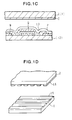
- driving element Q such as a thin film transistor (TFT) using amorphous silicon or polycrystalline silicon
- wiring W formed of a metal such as chromium Cr, transparent pixel electrode P formed of indium-tin-oxide (ITO) etc. are formed on one glass substrats 1 (2). It is preferable to further coat these surfaces with an insulating protective film 13.
- a common electrode C is formed on the whole surface.
- parallel electrodes 15 and 16 are formed on a pair of transparent substrates 1 and 2, and arranged to cross orthogonally.
- Protective insulating film and/or orientation film may not necessarily be formed on the substrates 1 and 2, but may also be formed. In any case, however, rubbing is not achieved.
- Fig.1 E shows schematic appearance of an active or a simple matrix display.
- a matrix display 20 has a multiplicity of pixels 21 disposed in rows and columns. These pixels are defined by the transparent electrode P as shown in Fig.1 C or crossed areas of the crossed electrodes in Fig.1 D.
- the direction of column 22 or direction of row 23 forms a reference direction.
- the display is designed to present an image when an observer views the display from the direction of column or row.
- the reference direction is illustrated by V in Fig.lA.
- liquid crystal molecules will take a configuration of 90 ° twist between two substrates. It is noted again that in a multi-domain structure, a multiplicity of domains are directed in every direction at the interface between the liquid crystal layer and a substrate.
- the temperature of the liquid crystal is preferably kept equal to or above N-I point which is the phace transition temperature between the nematic (N) phace and the isotropic (I) phace of the liquid crystal to keep the liquid crystal in the isotropic face.
- N-I point is the phace transition temperature between the nematic (N) phace and the isotropic (I) phace of the liquid crystal to keep the liquid crystal in the isotropic face.
- N-I point is the phace transition temperature between the nematic (N) phace and the isotropic (I) phace of the liquid crystal to keep the liquid crystal in the isotropic face.
- the temperature of the substrates before injection of the liquid crystal equal to or above N-I point and to inject the liquid crystal between the substrates. Then, the temperature of the substrates may be gradually lowered below N-I point. The resultant liquid crystal cell becomes better in display by this method.
- the liquid crystal in a cell without any orientation force will take a multi-domain structure, when considering that the liquid crystal in bulk state (a state without any external orientation force) takes a multi-domain state. Especially, it is considered that the tendency of taking a multi-domain structure becomes stronger and that the size of micro domains in a multi-domain structure when it is injected between the substrates while keeping the temperature of the liquid crystal equal to or above N-I point becomes more uniform.
- the orientation of the polarization axes of the polarizers are orthogonal in the case of positive display and parallel in the case of negative display. In the case of 0 ° twisted liquid crystal display, this relation is reversed.
- a reference direction of orientation such as rubbing direction on the substrate surface
- the direction of row or column of the matrix will become the reference direction.
- the reference direction is defined by the direction from which the segment display is seen to recognize figure "8".
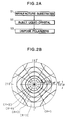
- Fig.2B shows an example of visual angle characteristics obtained in the liquid crystal display cell of Fig.lA.
- the equi-contrast curves CR have direction dependency. Contrast is high in directions of polarization axes of the polarisers (direction of 0° - 180 ° and the direction of 90 ° - 270°), and is low in the intermediate angle regions therebetween. That is to say, there are regions of wide visual angle and regions of narrow visual angle.
- Fig.2A is a flow chart of a method of manufacturing a liquid crystal display according to an embodiment of this invention. The respective steps can be achieved according to the conventional process.
- step S1 electrode lines, driving elements, etc. are formed on a pair of glass substrates. No orientation film is formed on the substrates.
- orientation film may be formed but no rubbing treatment is done thereon.
- step S2 a pair of glass substrates are disposed face to face.
- Gap controlling members such as quartz balls are distributed between the sbstrates and the substrates are fixed at a predetermined gap. Periferies of the sbstrates are sealed and then a liquid crystal material is injected between the substrates. The gap of the liquid crystal cell is selected as described above.
- the step injecting a liquid crystal material into a cell that the liquid crystal is maintained at a temperature of N-I point or above. Heating the liquid crystal cell at the same time is more preferable as described above.
- step S3 the liquid crystal injection port is sealed and a pair of polarizers are disposed to sandwich the liquid crystal cell substrates from the both sides.
- the two polarizers are kept in orthogonal relationship, for example, and the polarization axis or absorption axis of one of polarizers is set at the observation angle which is the reference direction of the display (the direction at which possibility of observing the display is highest, in this case 0°, 90°, 180 ° and 270 ° In this way, a liquid crystal display having such characteristics as shown in Fig.2B is formed.
- Fig.3A is an enlarged plan view of the cell.
- a multiplicity of minute regions, i.e. micro domains 30 are formed, and liquid crystal molecules 31 in each micro domain 30 are aligned substantially parallel in a certain direction as shown by arrows.
- the liquid crystal molecules 31 are directed randomly at all the directions. It can be understood that the visual angle characteristics is effectively isotropic.
- such a structure can be formed wherein liquid crystal molecules 31 do not form particular domains, but change the orientation directions continuously.
- the orientation directions are random and the liquid crystal molecules 31 are orientated to every direction at equal possibility.
- a structure which may be considered as a combination of Fig.3A and Fig.3B can be formed as shown in Fig.3C. That is to say, micro domains 30 are distributed discretely, in each of which liquid crystal molecules are orietated at a uniform direction. Among the micro domains 30, liquid crystal molecules 31 are distributed, while varying the orientation directions continuously. In this case too, the orientation directions as a whole in the cell are random.
- orientation treatment is possible without performing any rubbing treatment.
- orientation treatment of minute regions can be done by irradiating light beem, utilizing polarization memory film.
- Fig.1 F shows an example of such positive orientation structure.
- the display surface is divided into a multiplicity of small regions.
- a polarization memory film is coated on a substrate and the polarization axis of exposing light is varied from region to region.
- Orientation structure is formed by such polarized light beam.
- a display cell is formed by utilizing at least one such substrate.
- the display cell include enough number of such small regions to exhibit orientation directions at effectively all directions at each pixel. It is necessary to include orientation directions of various directions so that each pixel can be considered to have random orientation directions by utilizing a substrate or substrates subjected to such orientation treatment.
- a multi-domain structure similar to those described above can be formed. Because no rubbing treatment is done, similar effects of performing no rubbing treatment can be obtained.
- the polarization memory film can be formed by
- the invention may be summarized as follows:
Landscapes
- Physics & Mathematics (AREA)
- Nonlinear Science (AREA)
- Spectroscopy & Molecular Physics (AREA)
- Mathematical Physics (AREA)
- Chemical & Material Sciences (AREA)
- Crystallography & Structural Chemistry (AREA)
- General Physics & Mathematics (AREA)
- Optics & Photonics (AREA)
- Liquid Crystal (AREA)
Applications Claiming Priority (6)
| Application Number | Priority Date | Filing Date | Title |
|---|---|---|---|
| JP2249893 | 1993-02-10 | ||
| JP22498/93 | 1993-02-10 | ||
| JP2249893 | 1993-02-10 | ||
| JP293455/93 | 1993-11-24 | ||
| JP29345593 | 1993-11-24 | ||
| JP5293455A JP2572537B2 (ja) | 1993-02-10 | 1993-11-24 | 液晶表示装置とその製造方法 |
Publications (3)
| Publication Number | Publication Date |
|---|---|
| EP0610923A2 true EP0610923A2 (de) | 1994-08-17 |
| EP0610923A3 EP0610923A3 (de) | 1995-05-10 |
| EP0610923B1 EP0610923B1 (de) | 2001-10-04 |
Family
ID=26359732
Family Applications (1)
| Application Number | Title | Priority Date | Filing Date |
|---|---|---|---|
| EP94102004A Expired - Lifetime EP0610923B1 (de) | 1993-02-10 | 1994-02-09 | Flüssigkristall-Anzeige mit vielfachdomänen Struktur |
Country Status (4)
| Country | Link |
|---|---|
| US (1) | US5479282A (de) |
| EP (1) | EP0610923B1 (de) |
| JP (1) | JP2572537B2 (de) |
| DE (1) | DE69428474T2 (de) |
Cited By (1)
| Publication number | Priority date | Publication date | Assignee | Title |
|---|---|---|---|---|
| US5712696A (en) * | 1994-02-17 | 1998-01-27 | Stanley Electric, Co., Ltd. | Manufacture of LCD device by transferring the orientation state from a parent substrate to a child substrate |
Families Citing this family (39)
| Publication number | Priority date | Publication date | Assignee | Title |
|---|---|---|---|---|
| US5670083A (en) * | 1994-02-23 | 1997-09-23 | Fuji Xerox Co., Ltd. | Optical element and process for producing the same |
| US5710611A (en) * | 1994-11-17 | 1998-01-20 | Nec Corporation | Liquid crystal display apparatus preventing image on screen from influences of disclination line |
| KR100236256B1 (ko) * | 1995-04-24 | 1999-12-15 | 가네꼬 히사시 | 액정 표시 장치, 그 제조 방법 및 그 구동 방법 |
| US5831700A (en) * | 1995-05-19 | 1998-11-03 | Kent State University | Polymer stabilized four domain twisted nematic liquid crystal display |
| JP3506804B2 (ja) * | 1995-05-23 | 2004-03-15 | 富士通ディスプレイテクノロジーズ株式会社 | 液晶表示パネル |
| JPH09297310A (ja) * | 1996-05-01 | 1997-11-18 | Stanley Electric Co Ltd | 液晶表示素子とその製造方法 |
| KR0182876B1 (ko) | 1996-01-09 | 1999-05-01 | 구자홍 | 액정셀의 프리틸트방향 제어방법 |
| JP2872628B2 (ja) | 1996-02-05 | 1999-03-17 | スタンレー電気株式会社 | 液晶表示素子の製造方法 |
| KR100206560B1 (ko) * | 1996-05-14 | 1999-07-01 | 김광호 | 광시야각을 위한 액정 표시 장치의 배향막 처리방법 |
| US6191836B1 (en) | 1996-11-07 | 2001-02-20 | Lg Philips Lcd, Co., Ltd. | Method for fabricating a liquid crystal cell |
| JP3226830B2 (ja) * | 1997-03-31 | 2001-11-05 | 日本電気株式会社 | 液晶表示装置 |
| US6292296B1 (en) | 1997-05-28 | 2001-09-18 | Lg. Philips Lcd Co., Ltd. | Large scale polarizer and polarizer system employing it |
| KR100254857B1 (ko) | 1997-06-30 | 2000-05-01 | 김영환 | 고분자박막 배향방법 및 이를 이용한 액정배향방법 |
| US6184961B1 (en) * | 1997-07-07 | 2001-02-06 | Lg Electronics Inc. | In-plane switching mode liquid crystal display device having opposite alignment directions for two adjacent domains |
| KR100259258B1 (ko) | 1997-11-21 | 2000-06-15 | 구본준 | 액정표시소자 |
| US5953091A (en) * | 1998-04-09 | 1999-09-14 | Ois Optical Imaging Systems, Inc. | Multi-domain LCD and method of making same |
| US6124907A (en) | 1998-04-24 | 2000-09-26 | Ois Optical Imaging Systems, Inc. | Liquid crystal display with internal polarizer and method of making same |
| US6181401B1 (en) * | 1998-08-07 | 2001-01-30 | Honeywell International Inc. | Liquid crystal display with reduced off state luminance |
| JP2000122062A (ja) * | 1998-10-13 | 2000-04-28 | Sony Corp | 光学素子とその製造方法、及び光学装置とその製造方法 |
| US6061115A (en) * | 1998-11-03 | 2000-05-09 | International Business Machines Incorporation | Method of producing a multi-domain alignment layer by bombarding ions of normal incidence |
| US5982464A (en) * | 1998-12-16 | 1999-11-09 | Technoloogy Resource International Corporation | Multi-twist color liquid crystal display |
| KR100339332B1 (ko) | 1999-02-08 | 2002-06-03 | 구본준, 론 위라하디락사 | 멀티도메인 액정표시소자 |
| KR100301853B1 (ko) | 1999-03-25 | 2001-09-26 | 구본준, 론 위라하디락사 | 액정표시소자용 배향막 |
| KR100357214B1 (ko) | 1999-04-21 | 2002-10-18 | 엘지.필립스 엘시디 주식회사 | 액정표시소자 |
| US6313896B1 (en) | 1999-08-31 | 2001-11-06 | International Business Machines Corporation | Method for forming a multi-domain alignment layer for a liquid crystal display device |
| US7084087B2 (en) * | 1999-09-07 | 2006-08-01 | Abb Lummus Global Inc. | Zeolite composite, method for making and catalytic application thereof |
| KR100475107B1 (ko) | 1999-10-14 | 2005-03-09 | 엘지.필립스 엘시디 주식회사 | 멀티도메인 액정셀의 제조방법 |
| KR100595300B1 (ko) * | 2000-10-28 | 2006-07-03 | 엘지.필립스 엘시디 주식회사 | 광배향성 물질 및 이를 이용한 액정표시소자 |
| KR100565739B1 (ko) | 2000-10-28 | 2006-03-29 | 엘지.필립스 엘시디 주식회사 | 광배향성 물질 및 이를 이용한 액정표시소자 |
| WO2003005283A2 (en) * | 2001-07-02 | 2003-01-16 | Tri D Store Ip, Llc | Multilayer combined liquid crystal optical memory systems with means for recording and reading information |
| TWI271573B (en) * | 2001-08-22 | 2007-01-21 | Advanced Display Kk | Liquid crystal display device and method of producing the same |
| US7068336B2 (en) * | 2002-12-13 | 2006-06-27 | Lg.Philips Lcd Co., Ltd. | Liquid crystal display device having variable viewing angle |
| TWI255368B (en) * | 2003-03-19 | 2006-05-21 | Innolux Display Corp | Liquid crystal display and tis manufacting method |
| US7244627B2 (en) | 2003-08-25 | 2007-07-17 | Lg.Philips Lcd Co., Ltd. | Method for fabricating liquid crystal display device |
| KR101066483B1 (ko) * | 2004-06-30 | 2011-09-22 | 엘지디스플레이 주식회사 | 액정 표시 장치 및 이의 제조방법 |
| JP2006317656A (ja) * | 2005-05-12 | 2006-11-24 | Dainippon Printing Co Ltd | 異方性光学素子 |
| JP4404118B2 (ja) * | 2007-08-22 | 2010-01-27 | セイコーエプソン株式会社 | 液晶表示装置、並びに、プロジェクタ |
| TWI386722B (zh) * | 2008-10-24 | 2013-02-21 | Taiwan Tft Lcd Ass | 光學片、顯示裝置及其製作方法 |
| KR20160122305A (ko) * | 2015-04-13 | 2016-10-24 | 삼성디스플레이 주식회사 | 액정 표시 장치 및 그 제조 방법 |
Family Cites Families (11)
| Publication number | Priority date | Publication date | Assignee | Title |
|---|---|---|---|---|
| US3503673A (en) * | 1967-09-14 | 1970-03-31 | Rca Corp | Reduction of turn-on delay in liquid crystal cell |
| DD146347A1 (de) * | 1979-09-26 | 1981-02-04 | Joachim Bergner | Depolarisator |
| JPS56156817A (en) * | 1980-05-09 | 1981-12-03 | Hitachi Ltd | Liquid-crystal display element |
| JPS59111102A (ja) * | 1982-12-16 | 1984-06-27 | Nippon Denso Co Ltd | 防眩型反射鏡 |
| GB8616165D0 (en) * | 1986-07-02 | 1986-08-06 | Stc Plc | Liquid crystal cell |
| JPH03256922A (ja) * | 1990-03-02 | 1991-11-15 | Nitta Ind Corp | 軽量物体の搬送装置 |
| US5216531A (en) * | 1990-08-28 | 1993-06-01 | Asahi Glass Company Ltd. | Projection type active matrix polymer dispersed liquid crystal display apparatus with particles of liquid crystal material randomly oriented |
| JP2945143B2 (ja) * | 1990-12-07 | 1999-09-06 | 富士通株式会社 | 液晶表示装置 |
| JP2801102B2 (ja) * | 1991-02-01 | 1998-09-21 | 富士通株式会社 | 液晶表示装置 |
| JPH04301618A (ja) * | 1991-03-29 | 1992-10-26 | Nippon Telegr & Teleph Corp <Ntt> | 表示・記録媒体、方法および装置 |
| US5453862A (en) * | 1992-09-04 | 1995-09-26 | Stanley Electric Co., Ltd. | Rubbing-free (chiral) nematic liquid crystal display |
-
1993
- 1993-11-24 JP JP5293455A patent/JP2572537B2/ja not_active Expired - Fee Related
-
1994
- 1994-02-04 US US08/191,554 patent/US5479282A/en not_active Expired - Fee Related
- 1994-02-09 DE DE69428474T patent/DE69428474T2/de not_active Expired - Fee Related
- 1994-02-09 EP EP94102004A patent/EP0610923B1/de not_active Expired - Lifetime
Cited By (1)
| Publication number | Priority date | Publication date | Assignee | Title |
|---|---|---|---|---|
| US5712696A (en) * | 1994-02-17 | 1998-01-27 | Stanley Electric, Co., Ltd. | Manufacture of LCD device by transferring the orientation state from a parent substrate to a child substrate |
Also Published As
| Publication number | Publication date |
|---|---|
| DE69428474T2 (de) | 2002-06-06 |
| JP2572537B2 (ja) | 1997-01-16 |
| DE69428474D1 (de) | 2001-11-08 |
| EP0610923B1 (de) | 2001-10-04 |
| EP0610923A3 (de) | 1995-05-10 |
| US5479282A (en) | 1995-12-26 |
| JPH06294959A (ja) | 1994-10-21 |
Similar Documents
| Publication | Publication Date | Title |
|---|---|---|
| US5479282A (en) | Liquid crystal display of multi-domain structure | |
| US5453862A (en) | Rubbing-free (chiral) nematic liquid crystal display | |
| US5793459A (en) | Liquid crystal display of horizontal field type | |
| KR100241815B1 (ko) | 액정전기광학장치 | |
| KR100288371B1 (ko) | 액정 전기 광학 장치, 그것을 이용한 투사형 표시 시스템 및 액정 전기 광학 장치의 구동 방법 | |
| JPH09105941A (ja) | 液晶表示装置 | |
| JPH0772484A (ja) | 液晶表示素子とその製造方法 | |
| US5757454A (en) | Liquid crystal display device with homeotropic alignment in which two liquid crystal regions on the same subtrate have different pretilt directions because of rubbing | |
| JPH09197420A (ja) | 液晶素子 | |
| US5877831A (en) | Multi-domain LCD with subpixels having twist angles with opposite twist sense of within 60 and small/greater 90 degrees | |
| EP0610924B1 (de) | Flüssigkristall-Anzeige mit vielfachdomänen Struktur | |
| JPH06194655A (ja) | 液晶表示素子とその製造方法 | |
| JPH07333632A (ja) | 液晶表示装置 | |
| JP2000356775A (ja) | 液晶表示素子とその製造方法 | |
| JP2000131698A (ja) | 液晶表示素子とその製造方法 | |
| EP0775930A2 (de) | Flüssigkristallanzeigevorrichtung | |
| JP2809980B2 (ja) | 液晶表示素子とその製造方法 | |
| JPH0815707A (ja) | 液晶表示素子とその製造方法 | |
| JPH09325339A (ja) | 液晶表示素子およびその製造方法 | |
| JP3657708B2 (ja) | 液晶電気光学装置 | |
| KR0159130B1 (ko) | 액정표시장치 및 그 제조방법 | |
| KR100477132B1 (ko) | 강유전성 액정 물질을 사용하는 액정 표시 장치의 제조 방법 | |
| US7307678B2 (en) | Liquid crystal display and fabricating method thereof | |
| JPH08338995A (ja) | 液晶表示パネルおよびその製造方法 | |
| KR0150490B1 (ko) | 액정표시소자 및 그 제조방법 |
Legal Events
| Date | Code | Title | Description |
|---|---|---|---|
| PUAI | Public reference made under article 153(3) epc to a published international application that has entered the european phase |
Free format text: ORIGINAL CODE: 0009012 |
|
| AK | Designated contracting states |
Kind code of ref document: A2 Designated state(s): DE FR GB IT NL |
|
| PUAL | Search report despatched |
Free format text: ORIGINAL CODE: 0009013 |
|
| AK | Designated contracting states |
Kind code of ref document: A3 Designated state(s): DE FR GB IT NL |
|
| 17P | Request for examination filed |
Effective date: 19951109 |
|
| 17Q | First examination report despatched |
Effective date: 19970707 |
|
| GRAG | Despatch of communication of intention to grant |
Free format text: ORIGINAL CODE: EPIDOS AGRA |
|
| GRAG | Despatch of communication of intention to grant |
Free format text: ORIGINAL CODE: EPIDOS AGRA |
|
| GRAH | Despatch of communication of intention to grant a patent |
Free format text: ORIGINAL CODE: EPIDOS IGRA |
|
| GRAH | Despatch of communication of intention to grant a patent |
Free format text: ORIGINAL CODE: EPIDOS IGRA |
|
| GRAA | (expected) grant |
Free format text: ORIGINAL CODE: 0009210 |
|
| AK | Designated contracting states |
Kind code of ref document: B1 Designated state(s): DE FR GB IT NL |
|
| PG25 | Lapsed in a contracting state [announced via postgrant information from national office to epo] |
Ref country code: IT Free format text: LAPSE BECAUSE OF FAILURE TO SUBMIT A TRANSLATION OF THE DESCRIPTION OR TO PAY THE FEE WITHIN THE PRESCRIBED TIME-LIMIT;WARNING: LAPSES OF ITALIAN PATENTS WITH EFFECTIVE DATE BEFORE 2007 MAY HAVE OCCURRED AT ANY TIME BEFORE 2007. THE CORRECT EFFECTIVE DATE MAY BE DIFFERENT FROM THE ONE RECORDED. Effective date: 20011004 |
|
| REF | Corresponds to: |
Ref document number: 69428474 Country of ref document: DE Date of ref document: 20011108 |
|
| REG | Reference to a national code |
Ref country code: GB Ref legal event code: IF02 |
|
| PGFP | Annual fee paid to national office [announced via postgrant information from national office to epo] |
Ref country code: GB Payment date: 20020213 Year of fee payment: 9 |
|
| PGFP | Annual fee paid to national office [announced via postgrant information from national office to epo] |
Ref country code: NL Payment date: 20020228 Year of fee payment: 9 Ref country code: DE Payment date: 20020228 Year of fee payment: 9 |
|
| ET | Fr: translation filed | ||
| PLBE | No opposition filed within time limit |
Free format text: ORIGINAL CODE: 0009261 |
|
| STAA | Information on the status of an ep patent application or granted ep patent |
Free format text: STATUS: NO OPPOSITION FILED WITHIN TIME LIMIT |
|
| 26N | No opposition filed | ||
| PG25 | Lapsed in a contracting state [announced via postgrant information from national office to epo] |
Ref country code: GB Free format text: LAPSE BECAUSE OF NON-PAYMENT OF DUE FEES Effective date: 20030209 |
|
| PG25 | Lapsed in a contracting state [announced via postgrant information from national office to epo] |
Ref country code: NL Free format text: LAPSE BECAUSE OF NON-PAYMENT OF DUE FEES Effective date: 20030901 |
|
| PG25 | Lapsed in a contracting state [announced via postgrant information from national office to epo] |
Ref country code: DE Free format text: LAPSE BECAUSE OF NON-PAYMENT OF DUE FEES Effective date: 20030902 |
|
| GBPC | Gb: european patent ceased through non-payment of renewal fee | ||
| NLV4 | Nl: lapsed or anulled due to non-payment of the annual fee |
Effective date: 20030901 |
|
| PG25 | Lapsed in a contracting state [announced via postgrant information from national office to epo] |
Ref country code: FR Free format text: LAPSE BECAUSE OF NON-PAYMENT OF DUE FEES Effective date: 20040430 |
|
| REG | Reference to a national code |
Ref country code: FR Ref legal event code: ST |
|
| PG25 | Lapsed in a contracting state [announced via postgrant information from national office to epo] |
Ref country code: FR Free format text: LAPSE BECAUSE OF NON-PAYMENT OF DUE FEES Effective date: 20020228 |