EP0611050B1 - Polyol-Zusammensetzungen und Polyisocynate sowie ihre Verwendung zur Herstellung von Polyurethanen - Google Patents
Polyol-Zusammensetzungen und Polyisocynate sowie ihre Verwendung zur Herstellung von Polyurethanen Download PDFInfo
- Publication number
- EP0611050B1 EP0611050B1 EP94300435A EP94300435A EP0611050B1 EP 0611050 B1 EP0611050 B1 EP 0611050B1 EP 94300435 A EP94300435 A EP 94300435A EP 94300435 A EP94300435 A EP 94300435A EP 0611050 B1 EP0611050 B1 EP 0611050B1
- Authority
- EP
- European Patent Office
- Prior art keywords
- carbon atoms
- partially
- independently represent
- compound
- fully fluorinated
- Prior art date
- Legal status (The legal status is an assumption and is not a legal conclusion. Google has not performed a legal analysis and makes no representation as to the accuracy of the status listed.)
- Expired - Lifetime
Links
- LHDGMZKMASAWQQ-CGXWXWIYSA-N CC(C)(/C=C\C=C\N)C(C)=C Chemical compound CC(C)(/C=C\C=C\N)C(C)=C LHDGMZKMASAWQQ-CGXWXWIYSA-N 0.000 description 1
Classifications
-
- C—CHEMISTRY; METALLURGY
- C08—ORGANIC MACROMOLECULAR COMPOUNDS; THEIR PREPARATION OR CHEMICAL WORKING-UP; COMPOSITIONS BASED THEREON
- C08G—MACROMOLECULAR COMPOUNDS OBTAINED OTHERWISE THAN BY REACTIONS ONLY INVOLVING UNSATURATED CARBON-TO-CARBON BONDS
- C08G18/00—Polymeric products of isocyanates or isothiocyanates
- C08G18/06—Polymeric products of isocyanates or isothiocyanates with compounds having active hydrogen
- C08G18/70—Polymeric products of isocyanates or isothiocyanates with compounds having active hydrogen characterised by the isocyanates or isothiocyanates used
- C08G18/72—Polyisocyanates or polyisothiocyanates
- C08G18/77—Polyisocyanates or polyisothiocyanates having heteroatoms in addition to the isocyanate or isothiocyanate nitrogen and oxygen or sulfur
- C08G18/771—Polyisocyanates or polyisothiocyanates having heteroatoms in addition to the isocyanate or isothiocyanate nitrogen and oxygen or sulfur oxygen
-
- C—CHEMISTRY; METALLURGY
- C07—ORGANIC CHEMISTRY
- C07C—ACYCLIC OR CARBOCYCLIC COMPOUNDS
- C07C217/00—Compounds containing amino and etherified hydroxy groups bound to the same carbon skeleton
- C07C217/78—Compounds containing amino and etherified hydroxy groups bound to the same carbon skeleton having amino groups and etherified hydroxy groups bound to carbon atoms of six-membered aromatic rings of the same carbon skeleton
- C07C217/80—Compounds containing amino and etherified hydroxy groups bound to the same carbon skeleton having amino groups and etherified hydroxy groups bound to carbon atoms of six-membered aromatic rings of the same carbon skeleton having amino groups and etherified hydroxy groups bound to carbon atoms of non-condensed six-membered aromatic rings
- C07C217/82—Compounds containing amino and etherified hydroxy groups bound to the same carbon skeleton having amino groups and etherified hydroxy groups bound to carbon atoms of six-membered aromatic rings of the same carbon skeleton having amino groups and etherified hydroxy groups bound to carbon atoms of non-condensed six-membered aromatic rings of the same non-condensed six-membered aromatic ring
- C07C217/84—Compounds containing amino and etherified hydroxy groups bound to the same carbon skeleton having amino groups and etherified hydroxy groups bound to carbon atoms of six-membered aromatic rings of the same carbon skeleton having amino groups and etherified hydroxy groups bound to carbon atoms of non-condensed six-membered aromatic rings of the same non-condensed six-membered aromatic ring the oxygen atom of at least one of the etherified hydroxy groups being further bound to an acyclic carbon atom
-
- C—CHEMISTRY; METALLURGY
- C07—ORGANIC CHEMISTRY
- C07C—ACYCLIC OR CARBOCYCLIC COMPOUNDS
- C07C265/00—Derivatives of isocyanic acid
- C07C265/12—Derivatives of isocyanic acid having isocyanate groups bound to carbon atoms of six-membered aromatic rings
-
- C—CHEMISTRY; METALLURGY
- C08—ORGANIC MACROMOLECULAR COMPOUNDS; THEIR PREPARATION OR CHEMICAL WORKING-UP; COMPOSITIONS BASED THEREON
- C08G—MACROMOLECULAR COMPOUNDS OBTAINED OTHERWISE THAN BY REACTIONS ONLY INVOLVING UNSATURATED CARBON-TO-CARBON BONDS
- C08G18/00—Polymeric products of isocyanates or isothiocyanates
- C08G18/06—Polymeric products of isocyanates or isothiocyanates with compounds having active hydrogen
- C08G18/28—Polymeric products of isocyanates or isothiocyanates with compounds having active hydrogen characterised by the compounds used containing active hydrogen
- C08G18/40—High-molecular-weight compounds
- C08G18/48—Polyethers
- C08G18/50—Polyethers having heteroatoms other than oxygen
- C08G18/5021—Polyethers having heteroatoms other than oxygen having nitrogen
- C08G18/5033—Polyethers having heteroatoms other than oxygen having nitrogen containing carbocyclic groups
-
- C—CHEMISTRY; METALLURGY
- C08—ORGANIC MACROMOLECULAR COMPOUNDS; THEIR PREPARATION OR CHEMICAL WORKING-UP; COMPOSITIONS BASED THEREON
- C08G—MACROMOLECULAR COMPOUNDS OBTAINED OTHERWISE THAN BY REACTIONS ONLY INVOLVING UNSATURATED CARBON-TO-CARBON BONDS
- C08G65/00—Macromolecular compounds obtained by reactions forming an ether link in the main chain of the macromolecule
- C08G65/02—Macromolecular compounds obtained by reactions forming an ether link in the main chain of the macromolecule from cyclic ethers by opening of the heterocyclic ring
- C08G65/26—Macromolecular compounds obtained by reactions forming an ether link in the main chain of the macromolecule from cyclic ethers by opening of the heterocyclic ring from cyclic ethers and other compounds
- C08G65/2618—Macromolecular compounds obtained by reactions forming an ether link in the main chain of the macromolecule from cyclic ethers by opening of the heterocyclic ring from cyclic ethers and other compounds the other compounds containing nitrogen
- C08G65/2621—Macromolecular compounds obtained by reactions forming an ether link in the main chain of the macromolecule from cyclic ethers by opening of the heterocyclic ring from cyclic ethers and other compounds the other compounds containing nitrogen containing amine groups
- C08G65/2624—Macromolecular compounds obtained by reactions forming an ether link in the main chain of the macromolecule from cyclic ethers by opening of the heterocyclic ring from cyclic ethers and other compounds the other compounds containing nitrogen containing amine groups containing aliphatic amine groups
-
- C—CHEMISTRY; METALLURGY
- C08—ORGANIC MACROMOLECULAR COMPOUNDS; THEIR PREPARATION OR CHEMICAL WORKING-UP; COMPOSITIONS BASED THEREON
- C08G—MACROMOLECULAR COMPOUNDS OBTAINED OTHERWISE THAN BY REACTIONS ONLY INVOLVING UNSATURATED CARBON-TO-CARBON BONDS
- C08G65/00—Macromolecular compounds obtained by reactions forming an ether link in the main chain of the macromolecule
- C08G65/02—Macromolecular compounds obtained by reactions forming an ether link in the main chain of the macromolecule from cyclic ethers by opening of the heterocyclic ring
- C08G65/26—Macromolecular compounds obtained by reactions forming an ether link in the main chain of the macromolecule from cyclic ethers by opening of the heterocyclic ring from cyclic ethers and other compounds
- C08G65/2639—Macromolecular compounds obtained by reactions forming an ether link in the main chain of the macromolecule from cyclic ethers by opening of the heterocyclic ring from cyclic ethers and other compounds the other compounds containing elements other than oxygen, nitrogen or sulfur
-
- C—CHEMISTRY; METALLURGY
- C07—ORGANIC CHEMISTRY
- C07C—ACYCLIC OR CARBOCYCLIC COMPOUNDS
- C07C2601/00—Systems containing only non-condensed rings
- C07C2601/12—Systems containing only non-condensed rings with a six-membered ring
- C07C2601/14—The ring being saturated
Definitions
- the present invention relates to novel polyols and polyisocyanates, which can be used in the synthesis of polyurethanes.
- the present invention relates also to the polyurethanes obtained by using said compounds.
- polyurethane materials of a cellular or non-cellular, flexible or rigid nature by reacting organic polyisocyanates having two or more isocyanate groups per molecule with compounds containing a plurality of isocyanate reactive groups, for example polyols and polyamines, in the presence, where required, of other components such as blowing agents, cross-linking agents, catalysts and surfactants.
- organic polyisocyanates having two or more isocyanate groups per molecule
- compounds containing a plurality of isocyanate reactive groups for example polyols and polyamines
- other components such as blowing agents, cross-linking agents, catalysts and surfactants.
- Polyols for use in preparing polyurethanes are usually prepared by reacting an initiator compounds having a plurality of active hydrogen atoms (alcohols or amines) with an alkylene oxide (usually propylene oxide).
- a suitable initiator compound is diaminodiphenylmethane (methylenedianiline).
- Polyamines for use in preparing polyurethanes are obtained by converting the hydroxyl end-groups of the polyols to amino end-groups.
- Organic polyisocyanates for use in preparing polyurethanes are conventionally manufactured by reacting phosgene with the corresponding organic polyamines.
- the starting materials for diisocyanatodiphenylmethane (MDI) and its homologues are the mixtures of isomers and homologues of diaminodiphenylmethane that are formed by the condensation reaction of formaldehyde and aniline.
- Bis-(4-aminophenoxy)methane (compound of formula (I) wherein R 1 and R 2 both represent hydrogen, n and n' both are 0 and wherein the amino substituents are in para position) has been described in SU 598877 for use in polyamide synthesis.
- Bis-(2- and 3- and 4-aminophenoxy)methane have been described in DE 2904124 for use in the synthesis of bisazo dyes.
- Diamino compounds corresponding to formula (I) have also been described in JP 90/144 149 and in GB 2 068 379 but not in relation to their use in the synthesis of polyols and polyisocynates.
- At least one of the R 1 , R 2 , R and R' substituents, and preferably at least one of the R and R' substituents, represents an alkyl chain (for example methyl or t-butyl).
- R 1 and R 2 together represent an alkylene chain, preferably of 5 carbon atoms, also for solubility reasons.
- the compounds according to formula (I) wherein R 1 and R 2 both represent hydrogen are prepared by reacting the corresponding (substituted) aminophenol(s) with methylenechloride under basic conditions. Methods for performing this reaction are known in the art and are described in Chemistry Letters, 1988, pages 1773 to 1776. When the two aminophenols are different then mixtures of compounds according to formula (I) are obtained.
- R 1 and R 2 do not both represent hydrogen are prepared by reacting the corresponding (substituted) nitrophenol(s) with the corresponding substituted ketone or aldehyde under acid conditions followed by reduction of the nitro groups (for example, by Pd(C) under hydrogen atmosphere).
- Compounds according to formula (I) are useful in the preparation of polyurethanes. They can be used as such and have the function of, for example, amine chain extenders (especially in flexible foam applications) or they can be converted into polyols and/or polyisocyanates which in turn can be converted into polyurethanes.
- the present invention provides polyol compositions obtainable by oxyalkylation of a compound of formula (I) and optionally a second initiator.
- the polyol compositions according to the present invention may contain oxyalkylene units derived solely from propylene oxide or, alternatively, units derived from both propylene and ethylene oxides may be present. In the latter case it is preferred that the ethylene oxide content does not exceed 70 % of the total alkylene oxide units on a molar basis.
- propylene and ethylene oxides When both propylene and ethylene oxides are employed in the oxyalkylation, they may be reacted either simultaneously or sequentially with the compound according to formula (I).
- another initiator may be used in the formation of the polyol compositions according to the present invention.
- Suitable co-initiators include: water and polyols, for example ethylene glycol, propylene glycol and their oligomers, glycerol, trimethylolpropane, triethanolamine, pentaerythritol, sorbitol and sucrose; polyamines, for example ethylene diamine, tolylene diamine, diaminodiphenylmethane and polymethylene polyphenylene polyamines; and aminoalcohols, for example ethanolamine and diethanolamine; and mixtures of such initiators.
- Preferred co-initiators are the bi- and trifunctional ones such as diethylene glycol and glycerol.
- the co-initiator can be used in varying ratios but generally 10 to 40 parts of co-initiator are used for 100 parts of initiator according to the invention.
- Polyols having hydroxyl values in the range 30 to 880 mg KOH/g can be prepared, preferably in the range 30 to 620 mg KOH/g and more preferably in the range 300 to 500 mg KOH/g.
- the method for making the polyol compositions according to the present invention basically follows prior art modes of making polyether polyols.
- the oxyalkylation is performed in the presence of ionic catalysts as known in the art.
- the amount of catalyst utilised may vary over a wide weight percentage based on the weight of the initiator(s). Usually an amount of catalyst ranging from 0.01 to 5 weight % is employed, based on the weight of the initiator. More often, the amount employed is 0.1-2 %, and most often is 0.3-1 %.
- Basic catalysts are used. Potassium hydroxide or sodium hydroxide are most preferred. Other metal hydroxides (such as cesium hydroxide) or tertiary amines can also be used. Acid catalysis is also possible. Lewis-acids like boron trifluoride, stannic chloride, or combinations of ferric chloride with thionyl chloride are preferred.
- the amount of alkylene oxide added to the compound of formula (I) and the optional co-initiator may range over a wide range of about 1-100 moles of alkylene oxide per mole of initiator. More often, 1-50 moles of alkylene oxide are reacted per mole of initiator.
- the temperature of reaction may range from about 50 C to about 200 C, and is preferably from 80 C to 150 C.
- the polyols should have average hydroxyl numbers in the range from 300 to 880 mg KOH/g, especially in the range from 300 to 500 mg KOH/g, and a hydroxyl functionality in the range from 2 to 8, especially in the range from 3 to 6, preferably 4.
- a co-initiator containing from 5 to 8 active hydrogens per molecule should be used.
- the polyols should have a molecular weight in the range from 1000 to 10000, preferably from 3000 to 7500, and a number average functionality in the range from 2 to 4. In that case a co-initiator is not really necessary; if one is used said co-initiator should contain from 2 to 4 active hydrogens per molecule.
- the present invention also provides polyisocyanate compositions obtainable by phosgenation of compounds of formula (I) with the exception of bis-(3- or 4- isocyanatophenoxy)methane.
- the phosgenation is performed according to methods generally known in the art.
- the phosgenation can take place both continuously and discontinuously.
- the phosgenation can take place in two steps according to the well-known cold/hot phosgenation principle or in one step according to the hot phosgenation principle.
- Inert organic compounds are used as solvent. Suitable solvents include aliphatic, cycloaliphatic and aromatic hydrocarbons, halogenated hydrocarbons, nitro-substituted hydrocarbons, aliphatic-aromatic ethers, aromatic ethers, carboxylic acid esters, carboxylic acid nitriles, sulfone, phosphoric acid halogenide and phosphoric acid ester. Chlorobenzene and ortho dichlorobenzene have been generally accepted as the most commonly used solvents. Further the phosgenation can take place at normal or slightly elevated pressure.
- the phosgene is added to the composition in an amount of 1 to 10 times, in particular 1.05 to 6 times the stoichiometric amount.
- Catalysts such as dimethylformamide and acid acceptors such as pyridine can accelerate the phosgenation.
- reaction mixture after the phosgenation involves the recovery of gaseous substances (hydrogen chloride and excess of phosgene) and multistage distillation to separate the solvent.
- gaseous substances hydrogen chloride and excess of phosgene
- the isocyanate itself can then be recovered by means of extraction, crystallisation, distillation or sublimation.
- the isocyanates according to formula (VII) can be post-reacted; they can be trimerised, urea-modified, allophonate-modified, biuret-modified or they can be prepolymerised (i.e. reacted with polyols, etc.) . In any of these forms they can then be used in the preparation of polyurethanes.
- the compounds according to general formula (I) can also be used in the production of modified diaminodiphenylmethane (DADPM) compounds.
- DADPM modified diaminodiphenylmethane
- the polyol compositions and polyisocyanate compositions resulting from compounds according to formula (I) or from compounds according to formula (VIII) can be used in a conventional manner in order to prepare polyurethane materials.
- the polyurethane materials can be solid (e.g. elastomers) or they can be cellular.
- the polyurethane material can be in the form of rigid foams, flexible foams, self-skinning foams, elastomers, thermoplastic polyurethane (TPU) or as coatings, adhesives, sealants and binders.
- polyurethane as used herein is meant to also include urethane-modified polyisocyanurate.
- polyurethane preparation involves reacting a polyol composition with an organic polyisocyanate in the presence of a foaming agent in the case of polyurethane foam preparation, and usually, catalysts, surfactants and other known additives.
- a polyol composition according to the present invention may be reacted with a conventional polyisocyanate composition, or a polyisocyanate composition according to the present invention may be reacted with a conventional polyol composition.
- a polyol composition according to the present invention may be reacted with a polyisocyanate composition according to the present invention.
- the polyol composition used may comprise a mixture of different types of polyols, including conventional polyols and polyols according to the present invention; similarly the polyisocyanate composition used may comprise a mixture of different types of polyisocyanates, including conventional polyisocyanates and polyisocyanates according to the invention.
- polyisocyanates for use in the polyurethane forming process include aliphatic, cycloaliphatic, araliphatic and aromatic polyisocyanates as proposed in the literature.
- aromatic diisocyanates such as tolylene and diphenylmethane diisocyanate in the well known pure, modified and crude forms, in particular the so-called MDI variants and the mixtures of diphenylmethane diisocyanate(s) and oligomers thereof known in the art as "crude” or "polymeric" MDI.
- the polyisocyanates used in the polyurethane forming process can be in the form of a prepolymer, or in the form of a trimerised isocyanate or a modified (urea, allophonate, biuret) isocyanate.
- Preferred polyisocyanates for the preparation of rigid polyurethane foams are those having an average nominal functionality of 2.4-3.0 and in particular of 2.4-2.9.
- Preferred polyisocyanates for the preparation of flexible and integral skin foams and for microcellular elastomers are those having an average nominal functionality of 2.0 to 2.4.
- MDI based polyurethane prepolymers and semi- or quasi-prepolymers having an NCO value of 5 to 31 % by weight may be used.
- Foaming agents which may be used include carbon dioxide-evolving compounds such as water and inert low boiling compounds having a boiling point of above -70 C at atmospheric pressure.
- Suitable inert blowing agents include those well known and described in the art, for example, hydrocarbons, dialkyl ethers, alkyl alkanoates, aliphatic and cycloaliphatic hydrofluorocarbons, hydrochlorofluorocarbons, chlorofluorocarbons, hydrochlorocarbons and fluorine-containing ethers.
- Catalysts include the usual tertiary amines and tin compounds whilst useful surfactants include siloxane-oxyalkylene copolymers and conventional non-ionic types. Other useful additives include fire-retardants, for example, tris-2-chloroethyl phosphate and dimethyl methylphosphonate.
- the known one-shot full prepolymer or semi-prepolymer techniques may be used together with conventional mixing methods and the foams and elastomers may be prepared in the form of mouldings, cavity fillings, sprayed foam, frothed foam, slabstock foam or laminates with other materials such as hardboard, plasterboard, plastics, paper or metals.
- the compounds according to formula (I) or (VIII) are used as chain extenders in the polyurethane forming process they are conveniently added to the pre-blended polyol formulation in an amount of from 0.1 to 20 parts by weight based on the total polyol composition.
- the compounds according to the invention may be used as chain extenders either as the sole isocyanate-reactive ingredient (apart from water in case water is used as blowing agent) or together with other isocyanate-reactive ingredients, like other chain extenders and high molecular weight polyol in relatively small amounts.
- polyurethanes derived from the polyol and/or polyisocyanate compositions according to the present invention show improved physical properties, in particular dimensional stability, improved fire performance, and improved thermal insulation ageing.
- solubility of the blowing agent is improved by using polyol compositions according to the present invention. And particularly when gaseous blowing agents are used the frothing effect is diminished.
- dichloromethane 150 ml was added once again, the mixture was agitated and allowed to stand for a while, followed by separation of the dichloromethane layer.
- the dichloromethane layers were collected, dried over magnesium sulfate and filtered. The dichloromethane was evaporated under reduced pressure. Liquid products were obtained.
- Compound I.3 was prepared along the lines of the above general procedure starting from 2.2 mole 2-amino-p-cresol. Yield was 99 %. Compound I.3 was fully characterised by means of IR and NMR.
- Aniline, a bis(aminophenoxy/cresoxy)methane (from 1 to 30 % based on the aniline weight) (2.4 mole in total amines) and aqueous hydrochloric acid (0.5 mole) were mixed under stirring and heated to 45 C.
- Formaldehyde solution (1 mole formaldehyde) was added over a period of 40 minutes while maintaining the temperature at 45 C.
- the temperature was increased to 100 C and the mixture was maintained at that temperature for 1 hour 30 minutes to ensure that the reaction was complete.
- the mixture was then neutralised with excess sodium hydroxide solution.
- the neutralised modified DADPM products were washed with water and the aniline was stripped off.
- Example 5 Synthesis of polyurethane foam.
- a polyol blend comprising 62.88 pbw of the polyol prepared in example 2, 20.94 pbw of a polyether polyol of hydroxyl value 440 and functionality 4.5 and 5 pbw of a polyether polyol of hydroxyl value 540 and functionality 3, 5.7 pbw of a triethylphosphate fire retardant, 0.89 pbw of a silicone surfactant (DC 193 sold by Dow Corning) and 3.05 pbw of a tertiary amine catalyst (DABCO 33 LV sold by Air Products), 2.5 pbw of water and 17 pbw of CFC 11 as blowing agent (ARCTON 11 supplied by Imperial Chemical Industries) were reacted with polymeric MDI (Suprasec VM 85 HF sold by Imperial Chemical Industries) under standard foam forming conditions and several properties of the resultant foam (foam 1) were determined.
- ARCTON 11 supplied by Imperial Chemical Industries
- a polyurethane foam (foam 2) was prepared having the same ingredients but using a DADPM based polyether polyol instead of the polyol according to the invention. The same properties were measured for the comparative foam. The results are also listed in table 3.
- polyurethane foam according to the present invention shows improved dimensional stability, improved thermal insulation ageing, improved fire performance, more resistance to deformation under load and improved compression strength as compared to a conventional polyurethane foam.
- CE-X The mixture comprising 31 % by weight of bis-(4-aminophenoxy)methane, 47 % by weight of compound I.6 and 22 % by weight of compound I.3, as prepared in example 1, was used and will be referred to as CE-X.
- foams according to the invention show an improved, lower recession and a good compression set/tear strength balance.
- Foams 2 and 3 are comparative foams not comprising CE-X.
Landscapes
- Chemical & Material Sciences (AREA)
- Organic Chemistry (AREA)
- Health & Medical Sciences (AREA)
- Chemical Kinetics & Catalysis (AREA)
- Medicinal Chemistry (AREA)
- Polymers & Plastics (AREA)
- Emergency Medicine (AREA)
- Polyurethanes Or Polyureas (AREA)
- Organic Low-Molecular-Weight Compounds And Preparation Thereof (AREA)
- Polyethers (AREA)
Claims (14)
- Polyolzusammensetzungen, erhältlich durch Oxyalkylierung von (a) einem Initiator/Initiatoren,
dadurch gekennzeichnet, daß
mindestens einer der Initiatoren eine Verbindung ist, die der Formel (I) entspricht: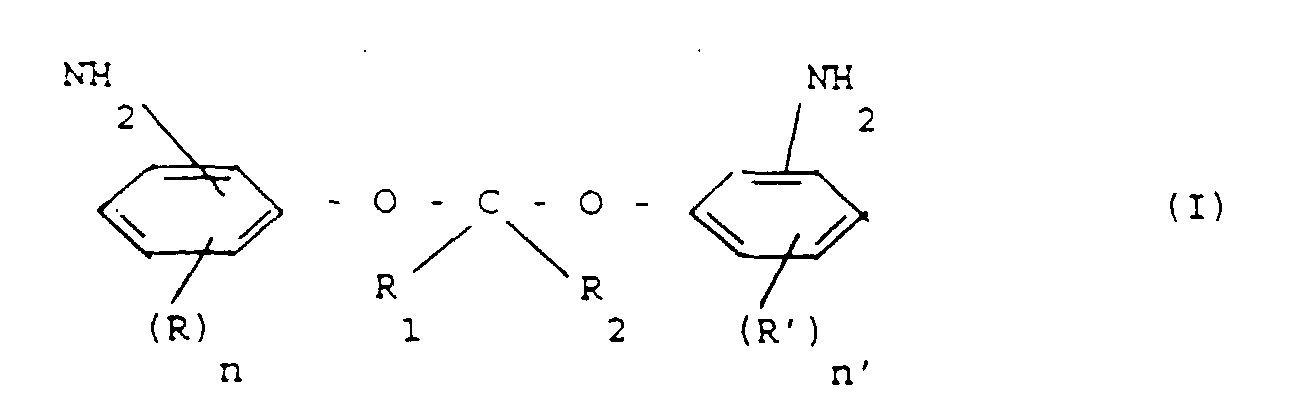 R und R' jeweils unabhängig eine Alkylkette aus 1 bis 10 Kohlenstoffatomen darstellen, die verzweigt sein kann, und die teilweise oder vollständig fluoriert sein kann;n und n' stellen unabhängig eine ganze Zahl von 0 bis 4 dar, die R- beziehungsweise R'-Substituenten können gleich oder verschieden sein, wenn n beziehungsweise n' größer als 1 ist;R1 und R2 stellen unabhängig Wasserstoff oder eine Alkylkette aus 1 bis 5 Kohlenstoffatomen dar, die verzweigt sein kann, und die teilweise oder vollständig fluoriert sein kann, oder R1 und R2 stellen zusammen eine Alkylenkette aus 2 bis 6 Kohlenstoffatomen dar, die mit Alkylgruppen substituiert sein kann, und die teilweise oder vollständig fluoriert sein kann;und wobei die Aminosubstituenten in bezug auf den Sauerstoffsubstituenten in ortho-, meta- oder para-Position angeordnet sind.
 - Verfahren zur Herstellung einer Polyolzusammensetzung durch Oxyalkylierung von (a) einem Initiator/Initiatoren,
dadurch gekennzeichnet, daß
mindestens einer der Initiatoren eine Verbindung ist, die der Formel (I) entspricht: R und R' jeweils unabhängig eine Alkylkette aus 1 bis 10 Kohlenstoffatomen darstellen, die verzweigt sein kann, und die teilweise oder vollständig fluoriert sein kann;n und n' stellen unabhängig eine ganze Zahl von 0 bis 4 dar, die R- beziehungsweise R'-Substituenten können gleich oder verschieden sein, wenn n beziehungsweise n' größer als 1 ist;R1 und R2 stellen unabhängig Wasserstoff oder eine Alkylkette aus 1 bis 5 Kohlenstoffatomen dar, die verzweigt sein kann, und die teilweise oder vollständig fluoriert sein kann, oder R1 und R2 stellen zusammen eine Alkylenkette aus 2 bis 6 Kohlenstoffatomen dar, die mit Alkylgruppen substituiert sein kann, und die teilweise oder vollständig fluoriert sein kann;und wobei die Aminosubstituenten in bezug auf den Sauerstoffsubstituenten in ortho-, meta- oder para-Position angeordnet sind.
 - Polyisocyanat entsprechend der allgemeinen Formel (VII)
 R und R' unabhängig eine Alkylkette aus 1 bis 10 Kohlenstoffatomen darstellen, die verzeigt sein kann, und die teilweise oder vollständig fluoriert sein kann;n und n' stellen unabhängig eine ganze Zahl von 0 bis 4 dar, die R- beziehungsweise R'-Substituenten können gleich oder verschieden sein, wenn n beziehungsweise n' größer als 1 ist;R1 und R2 stellen unabhängig Wasserstoff oder eine Alkylkette aus 1 bis 5 Kohlenstoffatomen dar, die verzweigt sein kann, und die teilweise oder vollständig fluoriert sein kann, oder R1 und R2 stellen zusammen eine Alkylenkette aus 2 bis 6 Kohlenstoffatomen dar, die mit Alkylgruppen substituiert sein kann, und die teilweise oder vollständig fluoriert sein kann;und wobei die Isocyanatsubstituenten in bezug auf den Sauerstoffsubstituenten in ortho-, meta- oder para-Position angeordnet sind;mit Ausnahme von Bis-(3- und 4-isocyanatophenoxy)methan.
 - Verfahren zur Herstellung eines Polyisocyanats durch Phosgenierung einer Verbindung entsprechend der allgemeinen Formel (I)
 R und R' unabhängig eine Alkylkette aus 1 bis 10 Kohlenstoffatomen darstellen, die verzeigt sein kann, und die teilweise oder vollständig fluoriert sein kann;n und n' stellen unabhängig eine ganze Zahl von 0 bis 4 dar, die R- beziehungsweise R'-Substituenten können gleich oder verschieden sein, wenn n beziehungsweise n' größer als 1 ist;R1 und R2 stellen unabhängig Wasserstoff oder eine Alkylkette aus 1 bis 5 Kohlenstoffatomen dar, die verzweigt sein kann, und die teilweise oder vollständig fluoriert sein kann, oder R1 und R2 stellen zusammen eine Alkylenkette aus 2 bis 6 Kohlenstoffatomen dar, die mit Alkylgruppen substituiert sein kann, und die teilweise oder vollständig fluoriert sein kann;und wobei die Aminosubstituenten in bezug auf den Sauerstoff substituenten in ortho-, meta- oder para-Position angeordnet sind.
 - Modifizierte Diaminodiphenylmethanverbindungen, die durch die Umsetzung einer Verbindung der Formel (I) mit Anilin und Formaldehyd erhalten werden können,
 R und R' jeweils unabhängig eine Alkylkette aus 1 bis 10 Kohlenstoffatomen darstellen, die verzeigt sein kann, und die teilweise oder vollständig fluoriert sein kann;n und n' stellen unabhängig eine ganze Zahl von 0 bis 4 dar, die R- beziehungsweise R'-Substituenten können gleich oder verschieden sein, wenn n beziehungsweise n' größer als 1 ist;R1 und R2 stellen unabhängig Wasserstoff oder eine Alkylkette aus 1 bis 5 Kohlenstoffatomen dar, die verzweigt sein kann, und die teilweise oder vollständig fluoriert sein kann, oder R1 und R2 stellen zusammen eine Alkylenkette aus 2 bis 6 Kohlenstoffatomen dar, die mit Alkylgruppen substituiert sein kann, und die teilweise oder vollständig fluoriert sein kann;und wobei die Aminosubstituenten in bezug auf den Sauerstoffsubstituenten in ortho-, meta- oder para-Position angeordnet sind.
 - Verfahren zur Herstellung einer modifizierten Diaminodiphenylmethanverbindung durch die Umsetzung einer Verbindung der Formel (I) mit Anilin und Formaldehyd
 R und R' jeweils unabhängig eine Alkylkette aus 1 bis 10 Kohlenstoffatomen darstellen, die verzeigt sein kann, und die teilweise oder vollständig fluoriert sein kann;n und n' stellen unabhängig eine ganze Zahl von 0 bis 4 dar, die R- beziehungsweise R'-Substituenten können gleich oder verschieden sein, wenn n beziehungsweise n' größer als 1 ist;R1 und R2 stellen unabhängig Wasserstoff oder eine Alkylkette aus 1 bis 5 Kohlenstoffatomen dar, die verzweigt sein kann, und die teilweise oder vollständig fluoriert sein kann, oder R1 und R2 stellen zusammen eine Alkylenkette aus 2 bis 6 Kohlenstoffatomen dar, die mit Alkylgruppen substituiert sein kann, und die teilweise oder vollständig fluoriert sein kann;und wobei die Aminosubstituenten in bezug auf den Sauerstoffsubstituenten in ortho-, meta- oder para-Position angeordnet sind.
 - Polyolzusammensetzungen, die durch die Oxyalkylierung von (a) einem Initiator/Initiatoren erhalten werden können,
dadurch gekennzeichnet, daß
mindestens einer der Initiatoren eine wie in Anspruch 5 definierte Verbindung ist. - Verfahren zur Herstellung einer Polyolzusammensetzung durch die Oxyalkylierung von (a) einem Initiator/Initiatoren,
dadurch gekennzeichnet, daß
mindestens einer der Initiatoren eine wie in Anspruch 5 definierte Verbindung ist. - Polyisocyanatzusammensetzung, die durch die Phosgenierung einer wie in Anspruch 5 definierten Verbindung erhalten werden kann.
- Verfahren zur Herstellung einer Polyisocyanatzusammensetzung durch die Phosgenierung einer wie in Anspruch 5 definierten Verbindung.
- Verfahren zur Herstellung eines Polyurethanmaterials durch die Umsetzung einer Polyolzusammensetzung mit einer Polyisocyanatzusammensetzung,
dadurch gekennzeichnet, daß
die Polyolzusammensetzung ein wie in Anspruch 1 oder Anspruch 7 definiertes Polyol oder/und die Polyisocyanatzusammensetzung ein wie in Anspruch 3 oder Anspruch 9 definiertes Produkt oder Bis-(3- oder 4-isocyanatophenoxy)methan umfaßt. - Polyurethan, das durch die Umsetzung einer Polyolzusammensetzung mit einer Polyisocyanatzusammensetzung erhältlich ist,
dadurch gekennzeichnet, daß
die Polyolzusammensetzung ein wie in Anspruch 1 oder Anspruch 7 definiertes Polyol oder/und die Polyisocyanatzusammensetzung ein wie in Anspruch 3 oder Anspruch 9 definiertes Produkt oder Bis- (3- oder 4-isocyanatophenoxy)methan umfaßt. - Verfahren zur Herstellung eines Polyurethanmaterials durch die Umsetzung eines Polyols mit einem Polyisocyanat in Gegenwart eines Kettenverlängerers,
dadurch gekennzeichnet, daß
der Kettenverlängerer eine der Formel (I) entsprechende Verbindung oder eine Verbindung ist, wie sie in Anspruch 5 definiert ist. - Polyolzusammensetzung, die einen Kettenverlängerer in einer Menge von 0,1 bis 20 Gewichtsteilen, bezogen auf die gesamte Zusammensetzung, enthält,
dadurch gekennzeichnet, daß
der Kettenverlängerer eine der Formel (I) entsprechende Verbindung oder eine Verbindung ist, wie sie in Anspruch 5 definiert ist.
Applications Claiming Priority (2)
| Application Number | Priority Date | Filing Date | Title |
|---|---|---|---|
| GB9302418 | 1993-02-08 | ||
| GB939302418A GB9302418D0 (en) | 1993-02-08 | 1993-02-08 | Novel di-and polyamino compounds for use in the preparation of polyurethanes |
Publications (2)
| Publication Number | Publication Date |
|---|---|
| EP0611050A1 EP0611050A1 (de) | 1994-08-17 |
| EP0611050B1 true EP0611050B1 (de) | 1997-06-18 |
Family
ID=10730021
Family Applications (1)
| Application Number | Title | Priority Date | Filing Date |
|---|---|---|---|
| EP94300435A Expired - Lifetime EP0611050B1 (de) | 1993-02-08 | 1994-01-20 | Polyol-Zusammensetzungen und Polyisocynate sowie ihre Verwendung zur Herstellung von Polyurethanen |
Country Status (11)
| Country | Link |
|---|---|
| US (1) | US5731399A (de) |
| EP (1) | EP0611050B1 (de) |
| JP (1) | JPH06279370A (de) |
| KR (1) | KR940019672A (de) |
| CN (1) | CN1091421A (de) |
| BR (1) | BR9400449A (de) |
| CA (1) | CA2114577A1 (de) |
| DE (1) | DE69403824T2 (de) |
| ES (1) | ES2103104T3 (de) |
| GB (1) | GB9302418D0 (de) |
| HK (1) | HK1005446A1 (de) |
Families Citing this family (9)
| Publication number | Priority date | Publication date | Assignee | Title |
|---|---|---|---|---|
| US7608710B2 (en) * | 2005-06-07 | 2009-10-27 | Omnova Solutions Inc. | Cationic surfactants |
| MY158316A (en) * | 2008-12-15 | 2016-09-30 | Teijin Ltd | Cyclic carbodiimide compound |
| CN102498145B (zh) * | 2009-07-10 | 2013-10-23 | 巴斯夫欧洲公司 | 基于可再生资源生产多元醇的方法 |
| EA023283B1 (ru) * | 2010-11-30 | 2016-05-31 | Адэссо Эдванст Материалс Уси Ко., Лтд. | Новые вещества для повторно перерабатываемых эпоксидных смол |
| EP2986590B8 (de) * | 2013-04-18 | 2018-12-19 | Adesso Advanced Materials Wuhu Co., Ltd. | Neuartige härtungsmittel und abbaubare polymere sowie darauf basierende verbundstoffe |
| CN103694140B (zh) * | 2013-12-02 | 2016-09-28 | 艾达索高新材料无锡有限公司 | 可降解异氰酸酯及其应用 |
| CN107849206A (zh) * | 2015-05-03 | 2018-03-27 | 艾达索高新材料无锡有限公司 | 可降解聚氨酯及其复合材料 |
| FR3090641B1 (fr) * | 2018-12-19 | 2022-02-11 | Bostik Sa | Composition (méth)acrylique comprenant un polyuréthane modifié |
| US20220356150A1 (en) * | 2021-04-30 | 2022-11-10 | Evoco Limited | Biobased diisocyanates, and process for preparation of same |
Family Cites Families (9)
| Publication number | Priority date | Publication date | Assignee | Title |
|---|---|---|---|---|
| DE1809172C3 (de) * | 1968-11-15 | 1979-10-11 | Bayer Ag, 5090 Leverkusen | Verfahren zur Herstellung von Polyurethanelastomeren |
| US4218543A (en) * | 1976-05-21 | 1980-08-19 | Bayer Aktiengesellschaft | Rim process for the production of elastic moldings |
| SU598877A1 (ru) * | 1976-08-01 | 1978-03-25 | Кемеровский Научно-Исследовательский Институт Химической Промышленности | Бис-(4-аминофенокси)-метан в качестве мономера дл получени термостойких полиамидных полимеров и способ его получени |
| DE2658329C2 (de) * | 1976-12-23 | 1983-01-13 | Hoechst Ag, 6000 Frankfurt | Nitroaminäther, Verfahren zu ihrer Herstellung und ihre Verwendung als Disazoverbindungen |
| US4161474A (en) * | 1977-11-25 | 1979-07-17 | Monsanto Company | Bis-(alkylaminophenoxy)alkanes as antidegradants for rubber |
| DE2904124A1 (de) * | 1979-02-03 | 1980-08-14 | Hoechst Ag | Wasserloesliche, faserreaktive disazofarbstoffe, verfahren zu deren herstellung und ihre verwendung zum faerben und bedrucken von hydroxygruppen- und carbonamidgruppenhaltigen fasermaterialien |
| US4769439A (en) * | 1986-09-29 | 1988-09-06 | General Electric Company | Polyimides and method for making |
| JP2577978B2 (ja) * | 1988-11-22 | 1997-02-05 | 宇部興産株式会社 | 白金族金属担持触媒の再活性化方法 |
| JP3026459B2 (ja) * | 1991-03-14 | 2000-03-27 | 株式会社東芝 | 感光性樹脂組成物 |
-
1993
- 1993-02-08 GB GB939302418A patent/GB9302418D0/en active Pending
-
1994
- 1994-01-20 EP EP94300435A patent/EP0611050B1/de not_active Expired - Lifetime
- 1994-01-20 DE DE69403824T patent/DE69403824T2/de not_active Expired - Fee Related
- 1994-01-20 ES ES94300435T patent/ES2103104T3/es not_active Expired - Lifetime
- 1994-01-31 CA CA002114577A patent/CA2114577A1/en not_active Abandoned
- 1994-02-07 BR BR9400449A patent/BR9400449A/pt not_active Application Discontinuation
- 1994-02-08 JP JP6014192A patent/JPH06279370A/ja active Pending
- 1994-02-08 KR KR1019940002321A patent/KR940019672A/ko not_active Withdrawn
- 1994-02-08 CN CN94101579A patent/CN1091421A/zh active Pending
-
1995
- 1995-12-18 US US08/573,792 patent/US5731399A/en not_active Expired - Fee Related
-
1998
- 1998-05-26 HK HK98104538A patent/HK1005446A1/en not_active IP Right Cessation
Also Published As
| Publication number | Publication date |
|---|---|
| KR940019672A (ko) | 1994-09-14 |
| DE69403824T2 (de) | 1997-11-20 |
| EP0611050A1 (de) | 1994-08-17 |
| ES2103104T3 (es) | 1997-08-16 |
| CN1091421A (zh) | 1994-08-31 |
| DE69403824D1 (de) | 1997-07-24 |
| GB9302418D0 (en) | 1993-03-24 |
| HK1005446A1 (en) | 1999-01-08 |
| US5731399A (en) | 1998-03-24 |
| JPH06279370A (ja) | 1994-10-04 |
| CA2114577A1 (en) | 1994-08-09 |
| BR9400449A (pt) | 1995-03-07 |
Similar Documents
| Publication | Publication Date | Title |
|---|---|---|
| KR960005794B1 (ko) | 폴리우레탄 발포체의 제조방법 | |
| CA1078997A (en) | Polyisocyanurate foams | |
| KR101077759B1 (ko) | 알칼리성 폴리에테르 폴리올로부터 경질 포옴의 제조 방법 | |
| KR100195669B1 (ko) | 경질폴리우레탄 및/또는 폴리이소시안우레이트 포옴의 제조방법 및 이에 사용하는 폴리올 | |
| EP0611050B1 (de) | Polyol-Zusammensetzungen und Polyisocynate sowie ihre Verwendung zur Herstellung von Polyurethanen | |
| US4410641A (en) | Polysiocyanurate-polyurethane foams | |
| EP0294110B1 (de) | Verfahren zur Herstellung von Hartschäumen. | |
| HK1005446B (en) | Polyol compositions and polyisocyanates for use in the preparation of polyurethanes | |
| US5393799A (en) | Process for rigid foams | |
| US4618706A (en) | Process for the preparation of aromatic polyisocyanates containing urea and/or biuret groups | |
| JP2021533208A (ja) | ポリウレタン製造用触媒 | |
| EP0812310A1 (de) | Neue di- und polyaminoverbindungen zur anwendung für die herstellung von polyurethanstoffen | |
| US4480081A (en) | Isocyanate-reactive compounds from modified TDI distillation residue intermediates and polyurethanes prepared therefrom | |
| US4489177A (en) | Isocyanate-reactive compounds from TDI distillation residue and polyurethanes prepared therefrom | |
| JPS62260814A (ja) | ポリ尿素成形品の製造方法 | |
| US3899454A (en) | Process for the production of synthetic plastics comprising urethane groups and biuret groups | |
| JPH0597950A (ja) | 液体高分子イソシアネートの製造方法 | |
| US4548752A (en) | Chemical compositions and methods | |
| US5306735A (en) | Polyurethane, process for producing the same, and process for producing polyurethane foam | |
| US4898971A (en) | Liquid isocyanate prepolymers | |
| US3993610A (en) | Polyurethane foam | |
| KR970002520B1 (ko) | 경질 포움 | |
| US6583314B2 (en) | Stable isocyanate formulations | |
| JPH09235346A (ja) | ポリイソシアヌレートフォーム用組成物、及びポリイソシアヌレートフォームの製造方法 | |
| KR20170136612A (ko) | Tdi 액체 잔류물을 기초로 하는 절연성 폴리우레탄 경질 폼 |
Legal Events
| Date | Code | Title | Description |
|---|---|---|---|
| PUAI | Public reference made under article 153(3) epc to a published international application that has entered the european phase |
Free format text: ORIGINAL CODE: 0009012 |
|
| AK | Designated contracting states |
Kind code of ref document: A1 Designated state(s): BE DE ES FR GB IT NL PT |
|
| 17P | Request for examination filed |
Effective date: 19950105 |
|
| 17Q | First examination report despatched |
Effective date: 19960404 |
|
| GRAG | Despatch of communication of intention to grant |
Free format text: ORIGINAL CODE: EPIDOS AGRA |
|
| GRAH | Despatch of communication of intention to grant a patent |
Free format text: ORIGINAL CODE: EPIDOS IGRA |
|
| GRAH | Despatch of communication of intention to grant a patent |
Free format text: ORIGINAL CODE: EPIDOS IGRA |
|
| GRAA | (expected) grant |
Free format text: ORIGINAL CODE: 0009210 |
|
| ITF | It: translation for a ep patent filed | ||
| AK | Designated contracting states |
Kind code of ref document: B1 Designated state(s): BE DE ES FR GB IT NL PT |
|
| REF | Corresponds to: |
Ref document number: 69403824 Country of ref document: DE Date of ref document: 19970724 |
|
| REG | Reference to a national code |
Ref country code: ES Ref legal event code: FG2A Ref document number: 2103104 Country of ref document: ES Kind code of ref document: T3 |
|
| ET | Fr: translation filed | ||
| PG25 | Lapsed in a contracting state [announced via postgrant information from national office to epo] |
Ref country code: PT Effective date: 19970918 |
|
| PGFP | Annual fee paid to national office [announced via postgrant information from national office to epo] |
Ref country code: FR Payment date: 19971208 Year of fee payment: 5 |
|
| PGFP | Annual fee paid to national office [announced via postgrant information from national office to epo] |
Ref country code: GB Payment date: 19971218 Year of fee payment: 5 |
|
| PGFP | Annual fee paid to national office [announced via postgrant information from national office to epo] |
Ref country code: DE Payment date: 19971222 Year of fee payment: 5 |
|
| PGFP | Annual fee paid to national office [announced via postgrant information from national office to epo] |
Ref country code: NL Payment date: 19971231 Year of fee payment: 5 |
|
| PGFP | Annual fee paid to national office [announced via postgrant information from national office to epo] |
Ref country code: BE Payment date: 19980108 Year of fee payment: 5 |
|
| PGFP | Annual fee paid to national office [announced via postgrant information from national office to epo] |
Ref country code: ES Payment date: 19980113 Year of fee payment: 5 |
|
| PLBE | No opposition filed within time limit |
Free format text: ORIGINAL CODE: 0009261 |
|
| STAA | Information on the status of an ep patent application or granted ep patent |
Free format text: STATUS: NO OPPOSITION FILED WITHIN TIME LIMIT |
|
| 26N | No opposition filed | ||
| PG25 | Lapsed in a contracting state [announced via postgrant information from national office to epo] |
Ref country code: GB Free format text: LAPSE BECAUSE OF NON-PAYMENT OF DUE FEES Effective date: 19990120 |
|
| PG25 | Lapsed in a contracting state [announced via postgrant information from national office to epo] |
Ref country code: ES Free format text: LAPSE BECAUSE OF NON-PAYMENT OF DUE FEES Effective date: 19990121 |
|
| PG25 | Lapsed in a contracting state [announced via postgrant information from national office to epo] |
Ref country code: BE Free format text: LAPSE BECAUSE OF NON-PAYMENT OF DUE FEES Effective date: 19990131 |
|
| BERE | Be: lapsed |
Owner name: IMPERIAL CHEMICAL INDUSTRIES P.L.C. Effective date: 19990131 |
|
| PG25 | Lapsed in a contracting state [announced via postgrant information from national office to epo] |
Ref country code: NL Free format text: LAPSE BECAUSE OF NON-PAYMENT OF DUE FEES Effective date: 19990801 |
|
| GBPC | Gb: european patent ceased through non-payment of renewal fee |
Effective date: 19990120 |
|
| PG25 | Lapsed in a contracting state [announced via postgrant information from national office to epo] |
Ref country code: FR Free format text: LAPSE BECAUSE OF NON-PAYMENT OF DUE FEES Effective date: 19990930 |
|
| PG25 | Lapsed in a contracting state [announced via postgrant information from national office to epo] |
Ref country code: DE Free format text: LAPSE BECAUSE OF NON-PAYMENT OF DUE FEES Effective date: 19991103 |
|
| REG | Reference to a national code |
Ref country code: FR Ref legal event code: ST |
|
| REG | Reference to a national code |
Ref country code: ES Ref legal event code: FD2A Effective date: 20010503 |
|
| PG25 | Lapsed in a contracting state [announced via postgrant information from national office to epo] |
Ref country code: IT Free format text: LAPSE BECAUSE OF NON-PAYMENT OF DUE FEES;WARNING: LAPSES OF ITALIAN PATENTS WITH EFFECTIVE DATE BEFORE 2007 MAY HAVE OCCURRED AT ANY TIME BEFORE 2007. THE CORRECT EFFECTIVE DATE MAY BE DIFFERENT FROM THE ONE RECORDED. Effective date: 20050120 |