EP0612731A1 - Neue Chinolon- und Naphthyridoncarbonsäurederivate - Google Patents
Neue Chinolon- und Naphthyridoncarbonsäurederivate Download PDFInfo
- Publication number
- EP0612731A1 EP0612731A1 EP94101223A EP94101223A EP0612731A1 EP 0612731 A1 EP0612731 A1 EP 0612731A1 EP 94101223 A EP94101223 A EP 94101223A EP 94101223 A EP94101223 A EP 94101223A EP 0612731 A1 EP0612731 A1 EP 0612731A1
- Authority
- EP
- European Patent Office
- Prior art keywords
- carbon atoms
- straight
- chain
- triazol
- hydrogen
- Prior art date
- Legal status (The legal status is an assumption and is not a legal conclusion. Google has not performed a legal analysis and makes no representation as to the accuracy of the status listed.)
- Granted
Links
- ZFRUGZMCGCYBRC-UHFFFAOYSA-N 1h-1,8-naphthyridin-2-one Chemical class C1=CC=NC2=NC(O)=CC=C21 ZFRUGZMCGCYBRC-UHFFFAOYSA-N 0.000 title 1
- 238000000034 method Methods 0.000 claims abstract description 24
- 239000003814 drug Substances 0.000 claims abstract description 10
- 238000002360 preparation method Methods 0.000 claims abstract description 8
- LFQSCWFLJHTTHZ-UHFFFAOYSA-N Ethanol Chemical compound CCO LFQSCWFLJHTTHZ-UHFFFAOYSA-N 0.000 claims description 125
- 150000001875 compounds Chemical class 0.000 claims description 80
- 125000004432 carbon atom Chemical group C* 0.000 claims description 66
- -1 hydroxy, mercapto Chemical group 0.000 claims description 66
- 229910052739 hydrogen Inorganic materials 0.000 claims description 58
- 239000001257 hydrogen Substances 0.000 claims description 58
- 125000000217 alkyl group Chemical group 0.000 claims description 57
- 239000002904 solvent Substances 0.000 claims description 57
- BWHMMNNQKKPAPP-UHFFFAOYSA-L potassium carbonate Chemical compound [K+].[K+].[O-]C([O-])=O BWHMMNNQKKPAPP-UHFFFAOYSA-L 0.000 claims description 44
- UFHFLCQGNIYNRP-UHFFFAOYSA-N Hydrogen Chemical compound [H][H] UFHFLCQGNIYNRP-UHFFFAOYSA-N 0.000 claims description 42
- 150000002431 hydrogen Chemical group 0.000 claims description 42
- 125000003545 alkoxy group Chemical group 0.000 claims description 39
- 150000002148 esters Chemical class 0.000 claims description 32
- PXGOKWXKJXAPGV-UHFFFAOYSA-N Fluorine Chemical compound FF PXGOKWXKJXAPGV-UHFFFAOYSA-N 0.000 claims description 30
- ZAMOUSCENKQFHK-UHFFFAOYSA-N Chlorine atom Chemical compound [Cl] ZAMOUSCENKQFHK-UHFFFAOYSA-N 0.000 claims description 29
- 229910052736 halogen Inorganic materials 0.000 claims description 28
- 150000002367 halogens Chemical group 0.000 claims description 28
- 239000000460 chlorine Substances 0.000 claims description 25
- 229910052801 chlorine Inorganic materials 0.000 claims description 25
- 125000002887 hydroxy group Chemical group [H]O* 0.000 claims description 24
- 229910000027 potassium carbonate Inorganic materials 0.000 claims description 22
- 229910052731 fluorine Inorganic materials 0.000 claims description 21
- 239000011737 fluorine Substances 0.000 claims description 21
- 239000002253 acid Substances 0.000 claims description 19
- 125000004414 alkyl thio group Chemical group 0.000 claims description 18
- WKBOTKDWSSQWDR-UHFFFAOYSA-N Bromine atom Chemical compound [Br] WKBOTKDWSSQWDR-UHFFFAOYSA-N 0.000 claims description 17
- GDTBXPJZTBHREO-UHFFFAOYSA-N bromine Substances BrBr GDTBXPJZTBHREO-UHFFFAOYSA-N 0.000 claims description 16
- 229910052794 bromium Inorganic materials 0.000 claims description 16
- 238000006243 chemical reaction Methods 0.000 claims description 15
- 150000007513 acids Chemical class 0.000 claims description 12
- 125000002496 methyl group Chemical group [H]C([H])([H])* 0.000 claims description 12
- 229910052757 nitrogen Inorganic materials 0.000 claims description 12
- 125000004433 nitrogen atom Chemical group N* 0.000 claims description 12
- 150000003839 salts Chemical class 0.000 claims description 10
- 125000002252 acyl group Chemical group 0.000 claims description 9
- 125000002023 trifluoromethyl group Chemical group FC(F)(F)* 0.000 claims description 9
- 125000001607 1,2,3-triazol-1-yl group Chemical group [*]N1N=NC([H])=C1[H] 0.000 claims description 6
- 125000001401 1,2,4-triazol-4-yl group Chemical group N=1N=C([H])N([*])C=1[H] 0.000 claims description 6
- 125000004453 alkoxycarbonyl group Chemical group 0.000 claims description 6
- 150000004677 hydrates Chemical class 0.000 claims description 6
- 125000002883 imidazolyl group Chemical group 0.000 claims description 6
- 125000000168 pyrrolyl group Chemical group 0.000 claims description 6
- 125000003626 1,2,4-triazol-1-yl group Chemical group [*]N1N=C([H])N=C1[H] 0.000 claims description 5
- 150000001298 alcohols Chemical class 0.000 claims description 5
- 125000005110 aryl thio group Chemical group 0.000 claims description 5
- 125000000304 alkynyl group Chemical group 0.000 claims description 4
- 239000012442 inert solvent Substances 0.000 claims description 4
- 125000005010 perfluoroalkyl group Chemical group 0.000 claims description 4
- 125000003831 tetrazolyl group Chemical group 0.000 claims description 4
- 125000004178 (C1-C4) alkyl group Chemical group 0.000 claims description 3
- 125000000229 (C1-C4)alkoxy group Chemical group 0.000 claims description 3
- 125000003342 alkenyl group Chemical group 0.000 claims description 3
- 150000001408 amides Chemical class 0.000 claims description 3
- 125000001997 phenyl group Chemical group [H]C1=C([H])C([H])=C(*)C([H])=C1[H] 0.000 claims description 3
- 125000003356 phenylsulfanyl group Chemical group [*]SC1=C([H])C([H])=C([H])C([H])=C1[H] 0.000 claims description 3
- 235000015320 potassium carbonate Nutrition 0.000 claims description 3
- LISFMEBWQUVKPJ-UHFFFAOYSA-N quinolin-2-ol Chemical compound C1=CC=C2NC(=O)C=CC2=C1 LISFMEBWQUVKPJ-UHFFFAOYSA-N 0.000 claims description 3
- 125000000391 vinyl group Chemical group [H]C([*])=C([H])[H] 0.000 claims description 3
- 229920002554 vinyl polymer Polymers 0.000 claims description 3
- 230000004913 activation Effects 0.000 claims description 2
- 150000001412 amines Chemical class 0.000 claims description 2
- 238000007796 conventional method Methods 0.000 claims description 2
- 125000004663 dialkyl amino group Chemical group 0.000 claims description 2
- ZMKWNAFTWVIMSD-UHFFFAOYSA-N hydroxy thiohypofluorite Chemical compound OSF ZMKWNAFTWVIMSD-UHFFFAOYSA-N 0.000 claims description 2
- 238000004519 manufacturing process Methods 0.000 claims description 2
- 125000000449 nitro group Chemical group [O-][N+](*)=O 0.000 claims description 2
- JVJQPDTXIALXOG-UHFFFAOYSA-N nitryl fluoride Chemical group [O-][N+](F)=O JVJQPDTXIALXOG-UHFFFAOYSA-N 0.000 claims description 2
- UUEVFMOUBSLVJW-UHFFFAOYSA-N oxo-[[1-[2-[2-[2-[4-(oxoazaniumylmethylidene)pyridin-1-yl]ethoxy]ethoxy]ethyl]pyridin-4-ylidene]methyl]azanium;dibromide Chemical compound [Br-].[Br-].C1=CC(=C[NH+]=O)C=CN1CCOCCOCCN1C=CC(=C[NH+]=O)C=C1 UUEVFMOUBSLVJW-UHFFFAOYSA-N 0.000 claims description 2
- 125000001424 substituent group Chemical group 0.000 claims description 2
- 125000004435 hydrogen atom Chemical group [H]* 0.000 claims 3
- 239000003443 antiviral agent Substances 0.000 abstract description 2
- YMWUJEATGCHHMB-UHFFFAOYSA-N Dichloromethane Chemical compound ClCCl YMWUJEATGCHHMB-UHFFFAOYSA-N 0.000 description 156
- OKKJLVBELUTLKV-UHFFFAOYSA-N Methanol Chemical compound OC OKKJLVBELUTLKV-UHFFFAOYSA-N 0.000 description 102
- ZMXDDKWLCZADIW-UHFFFAOYSA-N N,N-Dimethylformamide Chemical compound CN(C)C=O ZMXDDKWLCZADIW-UHFFFAOYSA-N 0.000 description 97
- 238000002844 melting Methods 0.000 description 82
- 230000008018 melting Effects 0.000 description 82
- XLYOFNOQVPJJNP-UHFFFAOYSA-N water Substances O XLYOFNOQVPJJNP-UHFFFAOYSA-N 0.000 description 52
- HEMHJVSKTPXQMS-UHFFFAOYSA-M Sodium hydroxide Chemical compound [OH-].[Na+] HEMHJVSKTPXQMS-UHFFFAOYSA-M 0.000 description 51
- 239000000203 mixture Substances 0.000 description 47
- IAZDPXIOMUYVGZ-UHFFFAOYSA-N Dimethylsulphoxide Chemical compound CS(C)=O IAZDPXIOMUYVGZ-UHFFFAOYSA-N 0.000 description 39
- 239000000047 product Substances 0.000 description 34
- VYPSYNLAJGMNEJ-UHFFFAOYSA-N Silicium dioxide Chemical compound O=[Si]=O VYPSYNLAJGMNEJ-UHFFFAOYSA-N 0.000 description 32
- 239000000741 silica gel Substances 0.000 description 32
- 229910002027 silica gel Inorganic materials 0.000 description 32
- 238000004440 column chromatography Methods 0.000 description 28
- VEXZGXHMUGYJMC-UHFFFAOYSA-N Hydrochloric acid Chemical compound Cl VEXZGXHMUGYJMC-UHFFFAOYSA-N 0.000 description 25
- QTBSBXVTEAMEQO-UHFFFAOYSA-N Acetic acid Chemical compound CC(O)=O QTBSBXVTEAMEQO-UHFFFAOYSA-N 0.000 description 21
- XEKOWRVHYACXOJ-UHFFFAOYSA-N Ethyl acetate Chemical compound CCOC(C)=O XEKOWRVHYACXOJ-UHFFFAOYSA-N 0.000 description 21
- ZMANZCXQSJIPKH-UHFFFAOYSA-N Triethylamine Chemical compound CCN(CC)CC ZMANZCXQSJIPKH-UHFFFAOYSA-N 0.000 description 21
- 239000012043 crude product Substances 0.000 description 21
- 241000700605 Viruses Species 0.000 description 20
- 235000011181 potassium carbonates Nutrition 0.000 description 19
- CSCPPACGZOOCGX-UHFFFAOYSA-N Acetone Chemical compound CC(C)=O CSCPPACGZOOCGX-UHFFFAOYSA-N 0.000 description 18
- WYURNTSHIVDZCO-UHFFFAOYSA-N Tetrahydrofuran Chemical compound C1CCOC1 WYURNTSHIVDZCO-UHFFFAOYSA-N 0.000 description 16
- 239000005457 ice water Substances 0.000 description 16
- QVCUKHQDEZNNOC-UHFFFAOYSA-N 1,2-diazabicyclo[2.2.2]octane Chemical compound C1CC2CCN1NC2 QVCUKHQDEZNNOC-UHFFFAOYSA-N 0.000 description 15
- WMFOQBRAJBCJND-UHFFFAOYSA-M Lithium hydroxide Chemical compound [Li+].[OH-] WMFOQBRAJBCJND-UHFFFAOYSA-M 0.000 description 15
- YZTJYBJCZXZGCT-UHFFFAOYSA-N phenylpiperazine Chemical compound C1CNCCN1C1=CC=CC=C1 YZTJYBJCZXZGCT-UHFFFAOYSA-N 0.000 description 15
- KFZMGEQAYNKOFK-UHFFFAOYSA-N Isopropanol Chemical compound CC(C)O KFZMGEQAYNKOFK-UHFFFAOYSA-N 0.000 description 14
- 210000004027 cell Anatomy 0.000 description 14
- KQKDPROKNKSZOD-UHFFFAOYSA-N ethyl 3-ethoxy-2-(2,4,5-trifluorobenzoyl)prop-2-enoate Chemical compound CCOC=C(C(=O)OCC)C(=O)C1=CC(F)=C(F)C=C1F KQKDPROKNKSZOD-UHFFFAOYSA-N 0.000 description 12
- PMZURENOXWZQFD-UHFFFAOYSA-L Sodium Sulfate Chemical compound [Na+].[Na+].[O-]S([O-])(=O)=O PMZURENOXWZQFD-UHFFFAOYSA-L 0.000 description 10
- 239000002585 base Substances 0.000 description 10
- 229910052938 sodium sulfate Inorganic materials 0.000 description 10
- 235000011152 sodium sulphate Nutrition 0.000 description 10
- WEVYAHXRMPXWCK-UHFFFAOYSA-N Acetonitrile Chemical compound CC#N WEVYAHXRMPXWCK-UHFFFAOYSA-N 0.000 description 9
- 241000725303 Human immunodeficiency virus Species 0.000 description 9
- QAOWNCQODCNURD-UHFFFAOYSA-N Sulfuric acid Chemical compound OS(O)(=O)=O QAOWNCQODCNURD-UHFFFAOYSA-N 0.000 description 9
- YXFVVABEGXRONW-UHFFFAOYSA-N Toluene Chemical compound CC1=CC=CC=C1 YXFVVABEGXRONW-UHFFFAOYSA-N 0.000 description 9
- 208000015181 infectious disease Diseases 0.000 description 9
- RTZKZFJDLAIYFH-UHFFFAOYSA-N Diethyl ether Chemical compound CCOCC RTZKZFJDLAIYFH-UHFFFAOYSA-N 0.000 description 8
- YLQBMQCUIZJEEH-UHFFFAOYSA-N tetrahydrofuran Natural products C=1C=COC=1 YLQBMQCUIZJEEH-UHFFFAOYSA-N 0.000 description 8
- HXNDOWXVGWVDCY-UHFFFAOYSA-N 3-(triazol-2-ylmethyl)aniline Chemical compound NC1=CC=CC(CN2N=CC=N2)=C1 HXNDOWXVGWVDCY-UHFFFAOYSA-N 0.000 description 7
- XOSOJIXGFRWWKZ-UHFFFAOYSA-N 6,7-difluoro-4-oxo-1-[4-(triazol-1-ylmethyl)phenyl]quinoline-3-carboxylic acid Chemical compound C12=CC(F)=C(F)C=C2C(=O)C(C(=O)O)=CN1C(C=C1)=CC=C1CN1C=CN=N1 XOSOJIXGFRWWKZ-UHFFFAOYSA-N 0.000 description 7
- 235000011054 acetic acid Nutrition 0.000 description 7
- 239000003054 catalyst Substances 0.000 description 7
- 239000012074 organic phase Substances 0.000 description 7
- 238000011282 treatment Methods 0.000 description 7
- AVJKDKWRVSSJPK-UHFFFAOYSA-N 1-(4-fluorophenyl)piperazine Chemical compound C1=CC(F)=CC=C1N1CCNCC1 AVJKDKWRVSSJPK-UHFFFAOYSA-N 0.000 description 6
- OGSMQKCMSLRGIU-UHFFFAOYSA-N 2-(triazol-1-ylmethyl)aniline Chemical compound NC1=CC=CC=C1CN1N=NC=C1 OGSMQKCMSLRGIU-UHFFFAOYSA-N 0.000 description 6
- HUPWURLXXFQEKJ-UHFFFAOYSA-N 3-(triazol-1-ylmethyl)aniline Chemical compound NC1=CC=CC(CN2N=NC=C2)=C1 HUPWURLXXFQEKJ-UHFFFAOYSA-N 0.000 description 6
- UHOVQNZJYSORNB-UHFFFAOYSA-N Benzene Chemical compound C1=CC=CC=C1 UHOVQNZJYSORNB-UHFFFAOYSA-N 0.000 description 6
- 241000283707 Capra Species 0.000 description 6
- SECXISVLQFMRJM-UHFFFAOYSA-N N-Methylpyrrolidone Chemical compound CN1CCCC1=O SECXISVLQFMRJM-UHFFFAOYSA-N 0.000 description 6
- JUJWROOIHBZHMG-UHFFFAOYSA-N Pyridine Chemical compound C1=CC=NC=C1 JUJWROOIHBZHMG-UHFFFAOYSA-N 0.000 description 6
- HEDRZPFGACZZDS-MICDWDOJSA-N Trichloro(2H)methane Chemical compound [2H]C(Cl)(Cl)Cl HEDRZPFGACZZDS-MICDWDOJSA-N 0.000 description 6
- NROKBHXJSPEDAR-UHFFFAOYSA-M potassium fluoride Chemical compound [F-].[K+] NROKBHXJSPEDAR-UHFFFAOYSA-M 0.000 description 6
- 238000007127 saponification reaction Methods 0.000 description 6
- 206010001513 AIDS related complex Diseases 0.000 description 5
- 238000001816 cooling Methods 0.000 description 5
- 238000000354 decomposition reaction Methods 0.000 description 5
- 239000011698 potassium fluoride Substances 0.000 description 5
- 238000011321 prophylaxis Methods 0.000 description 5
- ZGLQVRIVLWGDNA-UHFFFAOYSA-N 4-(1,2,4-triazol-1-ylmethyl)aniline Chemical compound C1=CC(N)=CC=C1CN1N=CN=C1 ZGLQVRIVLWGDNA-UHFFFAOYSA-N 0.000 description 4
- CUSKJWJUMHRIHA-UHFFFAOYSA-N 4-(triazol-1-ylmethyl)aniline Chemical compound C1=CC(N)=CC=C1CN1N=NC=C1 CUSKJWJUMHRIHA-UHFFFAOYSA-N 0.000 description 4
- DMCVXJBWURUDAY-UHFFFAOYSA-N 8-chloro-6,7-difluoro-4-oxo-1-[4-(1,2,4-triazol-1-ylmethyl)phenyl]quinoline-3-carboxylic acid Chemical compound C12=C(Cl)C(F)=C(F)C=C2C(=O)C(C(=O)O)=CN1C(C=C1)=CC=C1CN1C=NC=N1 DMCVXJBWURUDAY-UHFFFAOYSA-N 0.000 description 4
- USDAKFWDQLOJAP-UHFFFAOYSA-N 8-chloro-6,7-difluoro-4-oxo-1-[4-(triazol-1-ylmethyl)phenyl]quinoline-3-carboxylic acid Chemical compound C12=C(Cl)C(F)=C(F)C=C2C(=O)C(C(=O)O)=CN1C(C=C1)=CC=C1CN1C=CN=N1 USDAKFWDQLOJAP-UHFFFAOYSA-N 0.000 description 4
- AFVFQIVMOAPDHO-UHFFFAOYSA-N Methanesulfonic acid Chemical compound CS(O)(=O)=O AFVFQIVMOAPDHO-UHFFFAOYSA-N 0.000 description 4
- JGFZNNIVVJXRND-UHFFFAOYSA-N N,N-Diisopropylethylamine (DIPEA) Chemical compound CCN(C(C)C)C(C)C JGFZNNIVVJXRND-UHFFFAOYSA-N 0.000 description 4
- 241001494479 Pecora Species 0.000 description 4
- UIIMBOGNXHQVGW-UHFFFAOYSA-M Sodium bicarbonate Chemical class [Na+].OC([O-])=O UIIMBOGNXHQVGW-UHFFFAOYSA-M 0.000 description 4
- 230000009435 amidation Effects 0.000 description 4
- 238000007112 amidation reaction Methods 0.000 description 4
- 239000000825 pharmaceutical preparation Substances 0.000 description 4
- 239000012071 phase Substances 0.000 description 4
- 239000000126 substance Substances 0.000 description 4
- FYSNRJHAOHDILO-UHFFFAOYSA-N thionyl chloride Chemical compound ClS(Cl)=O FYSNRJHAOHDILO-UHFFFAOYSA-N 0.000 description 4
- RYHBNJHYFVUHQT-UHFFFAOYSA-N 1,4-Dioxane Chemical compound C1COCCO1 RYHBNJHYFVUHQT-UHFFFAOYSA-N 0.000 description 3
- PWZDJIUQHUGFRJ-UHFFFAOYSA-N 1-(2-chlorophenyl)piperazine Chemical compound ClC1=CC=CC=C1N1CCNCC1 PWZDJIUQHUGFRJ-UHFFFAOYSA-N 0.000 description 3
- XCRWSJGCCFNKLD-UHFFFAOYSA-N 1-[(2-nitrophenyl)methyl]triazole Chemical compound [O-][N+](=O)C1=CC=CC=C1CN1N=NC=C1 XCRWSJGCCFNKLD-UHFFFAOYSA-N 0.000 description 3
- IZVYBOAHMLOLBO-UHFFFAOYSA-N 1-[(3-nitrophenyl)methyl]triazole Chemical compound [O-][N+](=O)C1=CC=CC(CN2N=NC=C2)=C1 IZVYBOAHMLOLBO-UHFFFAOYSA-N 0.000 description 3
- QWENRTYMTSOGBR-UHFFFAOYSA-N 1H-1,2,3-Triazole Chemical compound C=1C=NNN=1 QWENRTYMTSOGBR-UHFFFAOYSA-N 0.000 description 3
- GSBFMKAAXPOQKT-UHFFFAOYSA-N 2-[(2-nitrophenyl)methyl]triazole Chemical compound [O-][N+](=O)C1=CC=CC=C1CN1N=CC=N1 GSBFMKAAXPOQKT-UHFFFAOYSA-N 0.000 description 3
- MWIDSSMQUXHYIW-UHFFFAOYSA-N 2-[(3-nitrophenyl)methyl]triazole Chemical compound [O-][N+](=O)C1=CC=CC(CN2N=CC=N2)=C1 MWIDSSMQUXHYIW-UHFFFAOYSA-N 0.000 description 3
- LFINNEVQJQXPHN-UHFFFAOYSA-N 3-(1,2,4-triazol-1-ylmethyl)aniline Chemical compound NC1=CC=CC(CN2N=CN=C2)=C1 LFINNEVQJQXPHN-UHFFFAOYSA-N 0.000 description 3
- HCDMJFOHIXMBOV-UHFFFAOYSA-N 3-(2,6-difluoro-3,5-dimethoxyphenyl)-1-ethyl-8-(morpholin-4-ylmethyl)-4,7-dihydropyrrolo[4,5]pyrido[1,2-d]pyrimidin-2-one Chemical compound C=1C2=C3N(CC)C(=O)N(C=4C(=C(OC)C=C(OC)C=4F)F)CC3=CN=C2NC=1CN1CCOCC1 HCDMJFOHIXMBOV-UHFFFAOYSA-N 0.000 description 3
- BRKJRFRGHKOGTL-UHFFFAOYSA-N 6,7,8-trifluoro-4-oxo-1-[4-(1,2,4-triazol-1-ylmethyl)phenyl]quinoline-3-carboxylic acid Chemical compound C12=C(F)C(F)=C(F)C=C2C(=O)C(C(=O)O)=CN1C(C=C1)=CC=C1CN1C=NC=N1 BRKJRFRGHKOGTL-UHFFFAOYSA-N 0.000 description 3
- IWLWMUIOVCXKPI-UHFFFAOYSA-N 6,7,8-trifluoro-4-oxo-1-[4-(triazol-1-ylmethyl)phenyl]quinoline-3-carboxylic acid Chemical compound C12=C(F)C(F)=C(F)C=C2C(=O)C(C(=O)O)=CN1C(C=C1)=CC=C1CN1C=CN=N1 IWLWMUIOVCXKPI-UHFFFAOYSA-N 0.000 description 3
- MKYUKYRQBGRJAP-UHFFFAOYSA-N 6-fluoro-1-[2-(imidazol-1-ylmethyl)phenyl]-4-oxo-7-(4-phenylpiperazin-1-yl)quinoline-3-carboxylic acid Chemical compound C12=CC(N3CCN(CC3)C=3C=CC=CC=3)=C(F)C=C2C(=O)C(C(=O)O)=CN1C1=CC=CC=C1CN1C=CN=C1 MKYUKYRQBGRJAP-UHFFFAOYSA-N 0.000 description 3
- CYJRNFFLTBEQSQ-UHFFFAOYSA-N 8-(3-methyl-1-benzothiophen-5-yl)-N-(4-methylsulfonylpyridin-3-yl)quinoxalin-6-amine Chemical compound CS(=O)(=O)C1=C(C=NC=C1)NC=1C=C2N=CC=NC2=C(C=1)C=1C=CC2=C(C(=CS2)C)C=1 CYJRNFFLTBEQSQ-UHFFFAOYSA-N 0.000 description 3
- WBBGVHPVZUOABO-UHFFFAOYSA-N 8-chloro-6,7-difluoro-4-oxo-1-[4-(triazol-2-ylmethyl)phenyl]quinoline-3-carboxylic acid Chemical compound C12=C(Cl)C(F)=C(F)C=C2C(=O)C(C(=O)O)=CN1C(C=C1)=CC=C1CN1N=CC=N1 WBBGVHPVZUOABO-UHFFFAOYSA-N 0.000 description 3
- WFDIJRYMOXRFFG-UHFFFAOYSA-N Acetic anhydride Chemical compound CC(=O)OC(C)=O WFDIJRYMOXRFFG-UHFFFAOYSA-N 0.000 description 3
- ALTFLAPROMVXNX-UHFFFAOYSA-N CC1OC(C)(C)OC1 Chemical compound CC1OC(C)(C)OC1 ALTFLAPROMVXNX-UHFFFAOYSA-N 0.000 description 3
- HEDRZPFGACZZDS-UHFFFAOYSA-N Chloroform Chemical compound ClC(Cl)Cl HEDRZPFGACZZDS-UHFFFAOYSA-N 0.000 description 3
- 206010061598 Immunodeficiency Diseases 0.000 description 3
- 208000029462 Immunodeficiency disease Diseases 0.000 description 3
- FAPWRFPIFSIZLT-UHFFFAOYSA-M Sodium chloride Chemical class [Na+].[Cl-] FAPWRFPIFSIZLT-UHFFFAOYSA-M 0.000 description 3
- 239000003513 alkali Substances 0.000 description 3
- 230000037396 body weight Effects 0.000 description 3
- KRKNYBCHXYNGOX-UHFFFAOYSA-N citric acid Chemical compound OC(=O)CC(O)(C(O)=O)CC(O)=O KRKNYBCHXYNGOX-UHFFFAOYSA-N 0.000 description 3
- UAOMVDZJSHZZME-UHFFFAOYSA-N diisopropylamine Chemical compound CC(C)NC(C)C UAOMVDZJSHZZME-UHFFFAOYSA-N 0.000 description 3
- 201000010099 disease Diseases 0.000 description 3
- 208000037265 diseases, disorders, signs and symptoms Diseases 0.000 description 3
- YGSUQWXHGDPJSZ-UHFFFAOYSA-N ethyl 2-(2,5-dichloro-4-fluoropyridine-3-carbonyl)-3-ethoxyprop-2-enoate Chemical compound CCOC=C(C(=O)OCC)C(=O)C1=C(Cl)N=CC(Cl)=C1F YGSUQWXHGDPJSZ-UHFFFAOYSA-N 0.000 description 3
- XWYBYHJIKDFWCE-UHFFFAOYSA-N ethyl 7-chloro-6-fluoro-4-oxo-1-[4-(triazol-1-ylmethyl)phenyl]-1,8-naphthyridine-3-carboxylate Chemical compound CCOC(=O)C1=CN(C2=NC(=C(C=C2C1=O)F)Cl)C3=CC=C(C=C3)CN4C=CN=N4 XWYBYHJIKDFWCE-UHFFFAOYSA-N 0.000 description 3
- RIFGWPKJUGCATF-UHFFFAOYSA-N ethyl chloroformate Chemical compound CCOC(Cl)=O RIFGWPKJUGCATF-UHFFFAOYSA-N 0.000 description 3
- 238000000605 extraction Methods 0.000 description 3
- 239000001963 growth medium Substances 0.000 description 3
- 230000007813 immunodeficiency Effects 0.000 description 3
- VLKZOEOYAKHREP-UHFFFAOYSA-N n-Hexane Chemical compound CCCCCC VLKZOEOYAKHREP-UHFFFAOYSA-N 0.000 description 3
- 230000007935 neutral effect Effects 0.000 description 3
- 239000003960 organic solvent Substances 0.000 description 3
- 235000003270 potassium fluoride Nutrition 0.000 description 3
- UMJSCPRVCHMLSP-UHFFFAOYSA-N pyridine Natural products COC1=CC=CN=C1 UMJSCPRVCHMLSP-UHFFFAOYSA-N 0.000 description 3
- 238000010992 reflux Methods 0.000 description 3
- VZGDMQKNWNREIO-UHFFFAOYSA-N tetrachloromethane Chemical compound ClC(Cl)(Cl)Cl VZGDMQKNWNREIO-UHFFFAOYSA-N 0.000 description 3
- IMNIMPAHZVJRPE-UHFFFAOYSA-N triethylenediamine Chemical compound C1CN2CCN1CC2 IMNIMPAHZVJRPE-UHFFFAOYSA-N 0.000 description 3
- QPFMBZIOSGYJDE-UHFFFAOYSA-N 1,1,2,2-tetrachloroethane Chemical compound ClC(Cl)C(Cl)Cl QPFMBZIOSGYJDE-UHFFFAOYSA-N 0.000 description 2
- SGUVLZREKBPKCE-UHFFFAOYSA-N 1,5-diazabicyclo[4.3.0]-non-5-ene Chemical compound C1CCN=C2CCCN21 SGUVLZREKBPKCE-UHFFFAOYSA-N 0.000 description 2
- PAMIQIKDUOTOBW-UHFFFAOYSA-N 1-methylpiperidine Chemical compound CN1CCCCC1 PAMIQIKDUOTOBW-UHFFFAOYSA-N 0.000 description 2
- 238000005160 1H NMR spectroscopy Methods 0.000 description 2
- LTMRRSWNXVJMBA-UHFFFAOYSA-L 2,2-diethylpropanedioate Chemical compound CCC(CC)(C([O-])=O)C([O-])=O LTMRRSWNXVJMBA-UHFFFAOYSA-L 0.000 description 2
- MPUHOVAVZQKRAW-UHFFFAOYSA-N 2-[(4-nitrophenyl)methyl]triazole Chemical compound C1=CC([N+](=O)[O-])=CC=C1CN1N=CC=N1 MPUHOVAVZQKRAW-UHFFFAOYSA-N 0.000 description 2
- RIMRLBGNCLMSNH-UHFFFAOYSA-N 2-phenylpiperazine Chemical compound C1NCCNC1C1=CC=CC=C1 RIMRLBGNCLMSNH-UHFFFAOYSA-N 0.000 description 2
- WNEODWDFDXWOLU-QHCPKHFHSA-N 3-[3-(hydroxymethyl)-4-[1-methyl-5-[[5-[(2s)-2-methyl-4-(oxetan-3-yl)piperazin-1-yl]pyridin-2-yl]amino]-6-oxopyridin-3-yl]pyridin-2-yl]-7,7-dimethyl-1,2,6,8-tetrahydrocyclopenta[3,4]pyrrolo[3,5-b]pyrazin-4-one Chemical compound C([C@@H](N(CC1)C=2C=NC(NC=3C(N(C)C=C(C=3)C=3C(=C(N4C(C5=CC=6CC(C)(C)CC=6N5CC4)=O)N=CC=3)CO)=O)=CC=2)C)N1C1COC1 WNEODWDFDXWOLU-QHCPKHFHSA-N 0.000 description 2
- BMYNFMYTOJXKLE-UHFFFAOYSA-N 3-azaniumyl-2-hydroxypropanoate Chemical compound NCC(O)C(O)=O BMYNFMYTOJXKLE-UHFFFAOYSA-N 0.000 description 2
- NJRZJZTXQXDDMV-UHFFFAOYSA-N 4-(triazol-2-ylmethyl)aniline Chemical compound C1=CC(N)=CC=C1CN1N=CC=N1 NJRZJZTXQXDDMV-UHFFFAOYSA-N 0.000 description 2
- IRPVABHDSJVBNZ-RTHVDDQRSA-N 5-[1-(cyclopropylmethyl)-5-[(1R,5S)-3-(oxetan-3-yl)-3-azabicyclo[3.1.0]hexan-6-yl]pyrazol-3-yl]-3-(trifluoromethyl)pyridin-2-amine Chemical compound C1=C(C(F)(F)F)C(N)=NC=C1C1=NN(CC2CC2)C(C2[C@@H]3CN(C[C@@H]32)C2COC2)=C1 IRPVABHDSJVBNZ-RTHVDDQRSA-N 0.000 description 2
- YJQKSVOHBPZNFL-UHFFFAOYSA-N 6,7-difluoro-1-[2-(imidazol-1-ylmethyl)phenyl]-4-oxoquinoline-3-carboxylic acid Chemical compound C12=CC(F)=C(F)C=C2C(=O)C(C(=O)O)=CN1C1=CC=CC=C1CN1C=CN=C1 YJQKSVOHBPZNFL-UHFFFAOYSA-N 0.000 description 2
- WVBJVTSTNMSFEP-UHFFFAOYSA-N 6,7-difluoro-1-[3-(imidazol-1-ylmethyl)phenyl]-4-oxoquinoline-3-carboxylic acid Chemical compound C12=CC(F)=C(F)C=C2C(=O)C(C(=O)O)=CN1C(C=1)=CC=CC=1CN1C=CN=C1 WVBJVTSTNMSFEP-UHFFFAOYSA-N 0.000 description 2
- ABMZNLRJHBDKOC-UHFFFAOYSA-N 6,7-difluoro-1-[4-(imidazol-1-ylmethyl)phenyl]-4-oxoquinoline-3-carboxylic acid Chemical compound C12=CC(F)=C(F)C=C2C(=O)C(C(=O)O)=CN1C(C=C1)=CC=C1CN1C=CN=C1 ABMZNLRJHBDKOC-UHFFFAOYSA-N 0.000 description 2
- OYWDYWKUTXMSOU-UHFFFAOYSA-N 6,7-difluoro-4-oxo-N-propan-2-yl-1-[4-(triazol-1-ylmethyl)phenyl]quinoline-3-carboxamide Chemical compound CC(C)NC(=O)C1=CN(C2=CC(=C(C=C2C1=O)F)F)C3=CC=C(C=C3)CN4C=CN=N4 OYWDYWKUTXMSOU-UHFFFAOYSA-N 0.000 description 2
- PTWIMQZYUOKPKC-UHFFFAOYSA-N 6-fluoro-1-[3-(imidazol-1-ylmethyl)phenyl]-4-oxo-7-(4-phenylpiperazin-1-yl)quinoline-3-carboxylic acid Chemical compound C12=CC(N3CCN(CC3)C=3C=CC=CC=3)=C(F)C=C2C(=O)C(C(=O)O)=CN1C(C=1)=CC=CC=1CN1C=CN=C1 PTWIMQZYUOKPKC-UHFFFAOYSA-N 0.000 description 2
- NCQPPKCHQJAZRT-UHFFFAOYSA-N 6-fluoro-1-[4-(imidazol-1-ylmethyl)phenyl]-4-oxo-7-(4-phenylpiperazin-1-yl)quinoline-3-carboxylic acid Chemical compound C12=CC(N3CCN(CC3)C=3C=CC=CC=3)=C(F)C=C2C(=O)C(C(=O)O)=CN1C(C=C1)=CC=C1CN1C=CN=C1 NCQPPKCHQJAZRT-UHFFFAOYSA-N 0.000 description 2
- RPYGQZYZVPHLRM-UHFFFAOYSA-N 6-fluoro-4-oxo-7-(4-phenylpiperazin-1-yl)-1-[3-(triazol-1-ylmethyl)phenyl]quinoline-3-carboxylic acid Chemical compound C12=CC(N3CCN(CC3)C=3C=CC=CC=3)=C(F)C=C2C(=O)C(C(=O)O)=CN1C(C=1)=CC=CC=1CN1C=CN=N1 RPYGQZYZVPHLRM-UHFFFAOYSA-N 0.000 description 2
- CQZCDFIETDXDAV-UHFFFAOYSA-N 6-fluoro-4-oxo-7-(4-phenylpiperazin-1-yl)-1-[3-(triazol-2-ylmethyl)phenyl]quinoline-3-carboxylic acid Chemical compound C12=CC(N3CCN(CC3)C=3C=CC=CC=3)=C(F)C=C2C(=O)C(C(=O)O)=CN1C(C=1)=CC=CC=1CN1N=CC=N1 CQZCDFIETDXDAV-UHFFFAOYSA-N 0.000 description 2
- LQALNXHGFVSOII-UHFFFAOYSA-N 6-fluoro-7-[4-(4-fluorophenyl)piperazin-1-yl]-4-oxo-1-[4-(triazol-1-ylmethyl)phenyl]quinoline-3-carboxylic acid Chemical compound C12=CC(N3CCN(CC3)C=3C=CC(F)=CC=3)=C(F)C=C2C(=O)C(C(=O)O)=CN1C(C=C1)=CC=C1CN1C=CN=N1 LQALNXHGFVSOII-UHFFFAOYSA-N 0.000 description 2
- 208000030507 AIDS Diseases 0.000 description 2
- 208000014644 Brain disease Diseases 0.000 description 2
- 0 CN1CCN(*)CC1 Chemical compound CN1CCN(*)CC1 0.000 description 2
- 241000713756 Caprine arthritis encephalitis virus Species 0.000 description 2
- XDTMQSROBMDMFD-UHFFFAOYSA-N Cyclohexane Chemical compound C1CCCCC1 XDTMQSROBMDMFD-UHFFFAOYSA-N 0.000 description 2
- 208000032274 Encephalopathy Diseases 0.000 description 2
- 241000283073 Equus caballus Species 0.000 description 2
- VZCYOOQTPOCHFL-OWOJBTEDSA-N Fumaric acid Chemical compound OC(=O)\C=C\C(O)=O VZCYOOQTPOCHFL-OWOJBTEDSA-N 0.000 description 2
- 241000598436 Human T-cell lymphotropic virus Species 0.000 description 2
- 206010020460 Human T-cell lymphotropic virus type I infection Diseases 0.000 description 2
- 241000714260 Human T-lymphotropic virus 1 Species 0.000 description 2
- TWRXJAOTZQYOKJ-UHFFFAOYSA-L Magnesium chloride Chemical compound [Mg+2].[Cl-].[Cl-] TWRXJAOTZQYOKJ-UHFFFAOYSA-L 0.000 description 2
- LRHPLDYGYMQRHN-UHFFFAOYSA-N N-Butanol Chemical compound CCCCO LRHPLDYGYMQRHN-UHFFFAOYSA-N 0.000 description 2
- AYCPARAPKDAOEN-LJQANCHMSA-N N-[(1S)-2-(dimethylamino)-1-phenylethyl]-6,6-dimethyl-3-[(2-methyl-4-thieno[3,2-d]pyrimidinyl)amino]-1,4-dihydropyrrolo[3,4-c]pyrazole-5-carboxamide Chemical compound C1([C@H](NC(=O)N2C(C=3NN=C(NC=4C=5SC=CC=5N=C(C)N=4)C=3C2)(C)C)CN(C)C)=CC=CC=C1 AYCPARAPKDAOEN-LJQANCHMSA-N 0.000 description 2
- 238000005481 NMR spectroscopy Methods 0.000 description 2
- CTQNGGLPUBDAKN-UHFFFAOYSA-N O-Xylene Chemical compound CC1=CC=CC=C1C CTQNGGLPUBDAKN-UHFFFAOYSA-N 0.000 description 2
- NBIIXXVUZAFLBC-UHFFFAOYSA-N Phosphoric acid Chemical compound OP(O)(O)=O NBIIXXVUZAFLBC-UHFFFAOYSA-N 0.000 description 2
- DTQVDTLACAAQTR-UHFFFAOYSA-N Trifluoroacetic acid Chemical compound OC(=O)C(F)(F)F DTQVDTLACAAQTR-UHFFFAOYSA-N 0.000 description 2
- 239000004480 active ingredient Substances 0.000 description 2
- 229910001854 alkali hydroxide Inorganic materials 0.000 description 2
- 229910001860 alkaline earth metal hydroxide Inorganic materials 0.000 description 2
- 125000006193 alkinyl group Chemical group 0.000 description 2
- HSFWRNGVRCDJHI-UHFFFAOYSA-N alpha-acetylene Natural products C#C HSFWRNGVRCDJHI-UHFFFAOYSA-N 0.000 description 2
- RDOXTESZEPMUJZ-UHFFFAOYSA-N anisole Chemical compound COC1=CC=CC=C1 RDOXTESZEPMUJZ-UHFFFAOYSA-N 0.000 description 2
- 230000000844 anti-bacterial effect Effects 0.000 description 2
- WPYMKLBDIGXBTP-UHFFFAOYSA-N benzoic acid Chemical compound OC(=O)C1=CC=CC=C1 WPYMKLBDIGXBTP-UHFFFAOYSA-N 0.000 description 2
- 229950005499 carbon tetrachloride Drugs 0.000 description 2
- 150000001732 carboxylic acid derivatives Chemical class 0.000 description 2
- 238000004113 cell culture Methods 0.000 description 2
- 229960001701 chloroform Drugs 0.000 description 2
- 239000012973 diazabicyclooctane Substances 0.000 description 2
- XBDQKXXYIPTUBI-UHFFFAOYSA-N dimethylselenoniopropionate Natural products CCC(O)=O XBDQKXXYIPTUBI-UHFFFAOYSA-N 0.000 description 2
- 150000002170 ethers Chemical class 0.000 description 2
- UCKBRIDVNDEKNN-UHFFFAOYSA-N ethyl 3-ethoxy-2-(2,3,4,5-tetrafluorobenzoyl)prop-2-enoate Chemical compound CCOC=C(C(=O)OCC)C(=O)C1=CC(F)=C(F)C(F)=C1F UCKBRIDVNDEKNN-UHFFFAOYSA-N 0.000 description 2
- OJLATROBUFURRD-UHFFFAOYSA-N ethyl 6-fluoro-4-oxo-7-(3-phenylpiperazin-1-yl)-1-[4-(triazol-1-ylmethyl)phenyl]quinoline-3-carboxylate Chemical compound C(C)OC(=O)C1=CN(C2=CC(=C(C=C2C1=O)F)N1CC(NCC1)C1=CC=CC=C1)C1=CC=C(C=C1)CN1N=NC=C1 OJLATROBUFURRD-UHFFFAOYSA-N 0.000 description 2
- HPBOIXWPEKXMQB-UHFFFAOYSA-N ethyl 6-fluoro-4-oxo-7-(4-phenylpiperazin-1-yl)-1-[3-(triazol-1-ylmethyl)phenyl]quinoline-3-carboxylate Chemical compound CCOC(=O)C1=CN(C2=CC(=C(C=C2C1=O)F)N3CCN(CC3)C4=CC=CC=C4)C5=CC=CC(=C5)CN6C=CN=N6 HPBOIXWPEKXMQB-UHFFFAOYSA-N 0.000 description 2
- KVWJTNPNTPCQPE-UHFFFAOYSA-N ethyl 6-fluoro-4-oxo-7-(4-phenylpiperazin-1-yl)-1-[4-(triazol-2-ylmethyl)phenyl]quinoline-3-carboxylate Chemical compound CCOC(=O)C1=CN(C2=CC(=C(C=C2C1=O)F)N3CCN(CC3)C4=CC=CC=C4)C5=CC=C(C=C5)CN6N=CC=N6 KVWJTNPNTPCQPE-UHFFFAOYSA-N 0.000 description 2
- NSRDFLLLGZMEJU-UHFFFAOYSA-N ethyl 7-chloro-6-fluoro-4-oxo-1-[4-(1,2,4-triazol-1-ylmethyl)phenyl]-1,8-naphthyridine-3-carboxylate Chemical compound C(C)OC(=O)C1=CN(C2=NC(=C(C=C2C1=O)F)Cl)C1=CC=C(C=C1)CN1N=CN=C1 NSRDFLLLGZMEJU-UHFFFAOYSA-N 0.000 description 2
- 229940052308 general anesthetics halogenated hydrocarbons Drugs 0.000 description 2
- 150000008282 halocarbons Chemical class 0.000 description 2
- 229930195733 hydrocarbon Natural products 0.000 description 2
- 150000002430 hydrocarbons Chemical class 0.000 description 2
- 230000002458 infectious effect Effects 0.000 description 2
- JVTAAEKCZFNVCJ-UHFFFAOYSA-N lactic acid Chemical compound CC(O)C(O)=O JVTAAEKCZFNVCJ-UHFFFAOYSA-N 0.000 description 2
- 210000000265 leukocyte Anatomy 0.000 description 2
- 229940098779 methanesulfonic acid Drugs 0.000 description 2
- 239000008188 pellet Substances 0.000 description 2
- VLTRZXGMWDSKGL-UHFFFAOYSA-N perchloric acid Chemical compound OCl(=O)(=O)=O VLTRZXGMWDSKGL-UHFFFAOYSA-N 0.000 description 2
- 239000003208 petroleum Substances 0.000 description 2
- 239000000546 pharmaceutical excipient Substances 0.000 description 2
- BDERNNFJNOPAEC-UHFFFAOYSA-N propan-1-ol Chemical compound CCCO BDERNNFJNOPAEC-UHFFFAOYSA-N 0.000 description 2
- WGYKZJWCGVVSQN-UHFFFAOYSA-N propylamine Chemical compound CCCN WGYKZJWCGVVSQN-UHFFFAOYSA-N 0.000 description 2
- 150000003254 radicals Chemical class 0.000 description 2
- 239000000376 reactant Substances 0.000 description 2
- XIIOFHFUYBLOLW-UHFFFAOYSA-N selpercatinib Chemical compound OC(COC=1C=C(C=2N(C=1)N=CC=2C#N)C=1C=NC(=CC=1)N1CC2N(C(C1)C2)CC=1C=NC(=CC=1)OC)(C)C XIIOFHFUYBLOLW-UHFFFAOYSA-N 0.000 description 2
- 238000001179 sorption measurement Methods 0.000 description 2
- 238000003756 stirring Methods 0.000 description 2
- JOXIMZWYDAKGHI-UHFFFAOYSA-N toluene-4-sulfonic acid Chemical compound CC1=CC=C(S(O)(=O)=O)C=C1 JOXIMZWYDAKGHI-UHFFFAOYSA-N 0.000 description 2
- VZCYOOQTPOCHFL-UHFFFAOYSA-N trans-butenedioic acid Natural products OC(=O)C=CC(O)=O VZCYOOQTPOCHFL-UHFFFAOYSA-N 0.000 description 2
- 239000008096 xylene Substances 0.000 description 2
- MAYZWDRUFKUGGP-VIFPVBQESA-N (3s)-1-[5-tert-butyl-3-[(1-methyltetrazol-5-yl)methyl]triazolo[4,5-d]pyrimidin-7-yl]pyrrolidin-3-ol Chemical compound CN1N=NN=C1CN1C2=NC(C(C)(C)C)=NC(N3C[C@@H](O)CC3)=C2N=N1 MAYZWDRUFKUGGP-VIFPVBQESA-N 0.000 description 1
- UOCLXMDMGBRAIB-UHFFFAOYSA-N 1,1,1-trichloroethane Chemical compound CC(Cl)(Cl)Cl UOCLXMDMGBRAIB-UHFFFAOYSA-N 0.000 description 1
- BGNORAQHPDCDDJ-UHFFFAOYSA-N 1,2,3,4,6,7,8,10a-octahydropyrimido[1,2-a]azepine Chemical compound C1=CCCCN2CCCNC21 BGNORAQHPDCDDJ-UHFFFAOYSA-N 0.000 description 1
- WSLDOOZREJYCGB-UHFFFAOYSA-N 1,2-Dichloroethane Chemical compound ClCCCl WSLDOOZREJYCGB-UHFFFAOYSA-N 0.000 description 1
- HXBMIQJOSHZCFX-UHFFFAOYSA-N 1-(bromomethyl)-2-nitrobenzene Chemical compound [O-][N+](=O)C1=CC=CC=C1CBr HXBMIQJOSHZCFX-UHFFFAOYSA-N 0.000 description 1
- APGGSERFJKEWFG-UHFFFAOYSA-N 1-(chloromethyl)-3-nitrobenzene Chemical compound [O-][N+](=O)C1=CC=CC(CCl)=C1 APGGSERFJKEWFG-UHFFFAOYSA-N 0.000 description 1
- PVOAHINGSUIXLS-UHFFFAOYSA-N 1-Methylpiperazine Chemical compound CN1CCNCC1 PVOAHINGSUIXLS-UHFFFAOYSA-N 0.000 description 1
- YCWRFIYBUQBHJI-UHFFFAOYSA-N 2-(4-aminophenyl)acetonitrile Chemical group NC1=CC=C(CC#N)C=C1 YCWRFIYBUQBHJI-UHFFFAOYSA-N 0.000 description 1
- QTGCFYAOEWCKHO-UHFFFAOYSA-N 2-(imidazol-1-ylmethyl)aniline Chemical compound NC1=CC=CC=C1CN1C=NC=C1 QTGCFYAOEWCKHO-UHFFFAOYSA-N 0.000 description 1
- XFLAKQDNEGGVHB-UHFFFAOYSA-N 2-(triazol-2-ylmethyl)aniline Chemical compound NC1=CC=CC=C1CN1N=CC=N1 XFLAKQDNEGGVHB-UHFFFAOYSA-N 0.000 description 1
- LBLYYCQCTBFVLH-UHFFFAOYSA-N 2-Methylbenzenesulfonic acid Chemical compound CC1=CC=CC=C1S(O)(=O)=O LBLYYCQCTBFVLH-UHFFFAOYSA-N 0.000 description 1
- BSKHPKMHTQYZBB-UHFFFAOYSA-N 2-methylpyridine Chemical compound CC1=CC=CC=N1 BSKHPKMHTQYZBB-UHFFFAOYSA-N 0.000 description 1
- HOZXQBSHRUITCX-UHFFFAOYSA-N 3-(imidazol-1-ylmethyl)aniline Chemical compound NC1=CC=CC(CN2C=NC=C2)=C1 HOZXQBSHRUITCX-UHFFFAOYSA-N 0.000 description 1
- DGHAOTHIDTUSJY-UHFFFAOYSA-N 4-(imidazol-1-ylmethyl)aniline Chemical compound C1=CC(N)=CC=C1CN1C=NC=C1 DGHAOTHIDTUSJY-UHFFFAOYSA-N 0.000 description 1
- VOLRSQPSJGXRNJ-UHFFFAOYSA-N 4-nitrobenzyl bromide Chemical compound [O-][N+](=O)C1=CC=C(CBr)C=C1 VOLRSQPSJGXRNJ-UHFFFAOYSA-N 0.000 description 1
- GWTUTNVUDUEEAG-UHFFFAOYSA-N 4-oxo-7-(4-phenylpiperazin-1-yl)-1-[4-(1,2,4-triazol-1-ylmethyl)phenyl]-1,8-naphthyridine-3-carboxylic acid Chemical compound C12=NC(N3CCN(CC3)C=3C=CC=CC=3)=CC=C2C(=O)C(C(=O)O)=CN1C(C=C1)=CC=C1CN1C=NC=N1 GWTUTNVUDUEEAG-UHFFFAOYSA-N 0.000 description 1
- GPEOAEVZTOQXLG-UHFFFAOYSA-N 4-piperazin-1-ium-1-ylphenolate Chemical compound C1=CC(O)=CC=C1N1CCNCC1 GPEOAEVZTOQXLG-UHFFFAOYSA-N 0.000 description 1
- DNLFROFNBCUGMW-UHFFFAOYSA-N 6,7-difluoro-4-oxo-1-[4-(1,2,4-triazol-1-ylmethyl)phenyl]quinoline-3-carboxylic acid Chemical compound N1(C=NC=N1)CC1=CC=C(N2C=C(C(=O)C3=CC(=C(F)C=C23)F)C(=O)O)C=C1 DNLFROFNBCUGMW-UHFFFAOYSA-N 0.000 description 1
- VRGJRXCSYGCDPV-UHFFFAOYSA-N 6,8-difluoro-4-oxo-7-(4-phenylpiperazin-1-yl)-1-[4-(triazol-1-ylmethyl)phenyl]quinoline-3-carboxylic acid Chemical compound C12=C(F)C(N3CCN(CC3)C=3C=CC=CC=3)=C(F)C=C2C(=O)C(C(=O)O)=CN1C(C=C1)=CC=C1CN1C=CN=N1 VRGJRXCSYGCDPV-UHFFFAOYSA-N 0.000 description 1
- KCBWAFJCKVKYHO-UHFFFAOYSA-N 6-(4-cyclopropyl-6-methoxypyrimidin-5-yl)-1-[[4-[1-propan-2-yl-4-(trifluoromethyl)imidazol-2-yl]phenyl]methyl]pyrazolo[3,4-d]pyrimidine Chemical compound C1(CC1)C1=NC=NC(=C1C1=NC=C2C(=N1)N(N=C2)CC1=CC=C(C=C1)C=1N(C=C(N=1)C(F)(F)F)C(C)C)OC KCBWAFJCKVKYHO-UHFFFAOYSA-N 0.000 description 1
- YJWVUXDTJLVHKJ-UHFFFAOYSA-N 6-fluoro-4-oxo-7-(3-phenylpiperazin-1-yl)-1-[4-(triazol-1-ylmethyl)phenyl]quinoline-3-carboxylic acid Chemical compound C12=CC(N3CC(NCC3)C=3C=CC=CC=3)=C(F)C=C2C(=O)C(C(=O)O)=CN1C(C=C1)=CC=C1CN1C=CN=N1 YJWVUXDTJLVHKJ-UHFFFAOYSA-N 0.000 description 1
- VYVVUMAONSNQOL-UHFFFAOYSA-N 6-fluoro-4-oxo-7-(4-phenylpiperazin-1-yl)-1-[2-(1,2,4-triazol-1-ylmethyl)phenyl]quinoline-3-carboxylic acid Chemical compound C12=CC(N3CCN(CC3)C=3C=CC=CC=3)=C(F)C=C2C(=O)C(C(=O)O)=CN1C1=CC=CC=C1CN1C=NC=N1 VYVVUMAONSNQOL-UHFFFAOYSA-N 0.000 description 1
- WQQACRKIWSKCBP-UHFFFAOYSA-N 6-fluoro-4-oxo-7-(4-phenylpiperazin-1-yl)-1-[2-(triazol-1-ylmethyl)phenyl]quinoline-3-carboxylic acid Chemical compound C12=CC(N3CCN(CC3)C=3C=CC=CC=3)=C(F)C=C2C(=O)C(C(=O)O)=CN1C1=CC=CC=C1CN1C=CN=N1 WQQACRKIWSKCBP-UHFFFAOYSA-N 0.000 description 1
- HHKRZUUKNFXNOA-UHFFFAOYSA-N 6-fluoro-4-oxo-7-(4-phenylpiperazin-1-yl)-1-[3-(1,2,4-triazol-1-ylmethyl)phenyl]-1,8-naphthyridine-3-carboxylic acid Chemical compound C12=NC(N3CCN(CC3)C=3C=CC=CC=3)=C(F)C=C2C(=O)C(C(=O)O)=CN1C(C=1)=CC=CC=1CN1C=NC=N1 HHKRZUUKNFXNOA-UHFFFAOYSA-N 0.000 description 1
- YIXDZAKRPNZIIE-UHFFFAOYSA-N 6-fluoro-4-oxo-7-(4-phenylpiperazin-1-yl)-1-[3-(1,2,4-triazol-1-ylmethyl)phenyl]quinoline-3-carboxylic acid Chemical compound C12=CC(N3CCN(CC3)C=3C=CC=CC=3)=C(F)C=C2C(=O)C(C(=O)O)=CN1C(C=1)=CC=CC=1CN1C=NC=N1 YIXDZAKRPNZIIE-UHFFFAOYSA-N 0.000 description 1
- AQMVZBJLEWLCTQ-UHFFFAOYSA-N 6-fluoro-4-oxo-7-(4-phenylpiperazin-1-yl)-1-[4-(1,2,4-triazol-1-ylmethyl)phenyl]-1,8-naphthyridine-3-carboxylic acid Chemical compound C12=NC(N3CCN(CC3)C=3C=CC=CC=3)=C(F)C=C2C(=O)C(C(=O)O)=CN1C(C=C1)=CC=C1CN1C=NC=N1 AQMVZBJLEWLCTQ-UHFFFAOYSA-N 0.000 description 1
- ZMSAYWACELSLMW-UHFFFAOYSA-N 6-fluoro-4-oxo-7-(4-phenylpiperazin-1-yl)-1-[4-(1,2,4-triazol-1-ylmethyl)phenyl]quinoline-3-carboxylic acid Chemical compound C12=CC(N3CCN(CC3)C=3C=CC=CC=3)=C(F)C=C2C(=O)C(C(=O)O)=CN1C(C=C1)=CC=C1CN1C=NC=N1 ZMSAYWACELSLMW-UHFFFAOYSA-N 0.000 description 1
- YRHCIIUKURIUES-UHFFFAOYSA-N 6-fluoro-4-oxo-7-(4-phenylpiperazin-1-yl)-1-[4-(triazol-1-ylmethyl)phenyl]-1,8-naphthyridine-3-carboxylic acid Chemical compound C12=NC(N3CCN(CC3)C=3C=CC=CC=3)=C(F)C=C2C(=O)C(C(=O)O)=CN1C(C=C1)=CC=C1CN1C=CN=N1 YRHCIIUKURIUES-UHFFFAOYSA-N 0.000 description 1
- BJLMDOCOXHEMQR-UHFFFAOYSA-N 6-fluoro-4-oxo-7-(4-phenylpiperazin-1-yl)-1-[4-(triazol-1-ylmethyl)phenyl]quinoline-3-carboxylic acid Chemical compound C12=CC(N3CCN(CC3)C=3C=CC=CC=3)=C(F)C=C2C(=O)C(C(=O)O)=CN1C(C=C1)=CC=C1CN1C=CN=N1 BJLMDOCOXHEMQR-UHFFFAOYSA-N 0.000 description 1
- JZMXGUPOGGPNDE-UHFFFAOYSA-N 6-fluoro-4-oxo-7-(4-phenylpiperazin-1-yl)-1-[4-(triazol-2-ylmethyl)phenyl]quinoline-3-carboxylic acid Chemical compound C12=CC(N3CCN(CC3)C=3C=CC=CC=3)=C(F)C=C2C(=O)C(C(=O)O)=CN1C(C=C1)=CC=C1CN1N=CC=N1 JZMXGUPOGGPNDE-UHFFFAOYSA-N 0.000 description 1
- UPXUCBJRCUQDHA-UHFFFAOYSA-N 6-fluoro-7-[4-(4-fluorophenyl)piperazin-1-yl]-4-oxo-N-propyl-1-[4-(triazol-1-ylmethyl)phenyl]quinoline-3-carboxamide Chemical compound C(CC)NC(=O)C1=CN(C2=CC(=C(C=C2C1=O)F)N1CCN(CC1)C1=CC=C(C=C1)F)C1=CC=C(C=C1)CN1N=NC=C1 UPXUCBJRCUQDHA-UHFFFAOYSA-N 0.000 description 1
- PYYRYDLXLYUWPK-UHFFFAOYSA-N 6-fluoro-7-[4-(4-hydroxyphenyl)piperazin-1-yl]-4-oxo-1-[4-(triazol-1-ylmethyl)phenyl]quinoline-3-carboxylic acid Chemical compound C12=CC(N3CCN(CC3)C=3C=CC(O)=CC=3)=C(F)C=C2C(=O)C(C(=O)O)=CN1C(C=C1)=CC=C1CN1C=CN=N1 PYYRYDLXLYUWPK-UHFFFAOYSA-N 0.000 description 1
- VDQKLXKVOLOPHH-UHFFFAOYSA-N 7-[4-(4-fluorophenyl)piperazin-1-yl]-4-oxo-1-[4-(1,2,4-triazol-1-ylmethyl)phenyl]-1,8-naphthyridine-3-carboxylic acid Chemical compound C12=NC(N3CCN(CC3)C=3C=CC(F)=CC=3)=CC=C2C(=O)C(C(=O)O)=CN1C(C=C1)=CC=C1CN1C=NC=N1 VDQKLXKVOLOPHH-UHFFFAOYSA-N 0.000 description 1
- PUNBYNVQVDQIKH-UHFFFAOYSA-N 8-chloro-6-fluoro-7-[4-(4-fluorophenyl)piperazin-1-yl]-4-oxo-1-[4-(1,2,4-triazol-1-ylmethyl)phenyl]quinoline-3-carboxylic acid Chemical compound C12=C(Cl)C(N3CCN(CC3)C=3C=CC(F)=CC=3)=C(F)C=C2C(=O)C(C(=O)O)=CN1C(C=C1)=CC=C1CN1C=NC=N1 PUNBYNVQVDQIKH-UHFFFAOYSA-N 0.000 description 1
- MPZQAOVOOLLWKQ-UHFFFAOYSA-N 8-chloro-6-fluoro-7-[4-(4-fluorophenyl)piperazin-1-yl]-4-oxo-1-[4-(triazol-1-ylmethyl)phenyl]quinoline-3-carboxylic acid Chemical compound C12=C(Cl)C(N3CCN(CC3)C=3C=CC(F)=CC=3)=C(F)C=C2C(=O)C(C(=O)O)=CN1C(C=C1)=CC=C1CN1C=CN=N1 MPZQAOVOOLLWKQ-UHFFFAOYSA-N 0.000 description 1
- SOBWXEFDLLSCDZ-UHFFFAOYSA-N 8-chloro-6-fluoro-7-[4-(4-fluorophenyl)piperazin-1-yl]-4-oxo-1-[4-(triazol-2-ylmethyl)phenyl]quinoline-3-carboxylic acid Chemical compound C12=C(Cl)C(N3CCN(CC3)C=3C=CC(F)=CC=3)=C(F)C=C2C(=O)C(C(=O)O)=CN1C(C=C1)=CC=C1CN1N=CC=N1 SOBWXEFDLLSCDZ-UHFFFAOYSA-N 0.000 description 1
- UGZRPEVFDUNBMH-UHFFFAOYSA-N 8-chloro-7-[4-(2-chlorophenyl)piperazin-1-yl]-6-fluoro-4-oxo-1-[4-(1,2,4-triazol-1-ylmethyl)phenyl]quinoline-3-carboxylic acid Chemical compound C12=C(Cl)C(N3CCN(CC3)C=3C(=CC=CC=3)Cl)=C(F)C=C2C(=O)C(C(=O)O)=CN1C(C=C1)=CC=C1CN1C=NC=N1 UGZRPEVFDUNBMH-UHFFFAOYSA-N 0.000 description 1
- GAFPDBZVTKISNH-UHFFFAOYSA-N 8-chloro-7-[4-(2-chlorophenyl)piperazin-1-yl]-6-fluoro-4-oxo-1-[4-(triazol-1-ylmethyl)phenyl]quinoline-3-carboxylic acid Chemical compound C12=C(Cl)C(N3CCN(CC3)C=3C(=CC=CC=3)Cl)=C(F)C=C2C(=O)C(C(=O)O)=CN1C(C=C1)=CC=C1CN1C=CN=N1 GAFPDBZVTKISNH-UHFFFAOYSA-N 0.000 description 1
- AXUVTAZTCVXECG-UHFFFAOYSA-N 8-chloro-7-[4-(2-chlorophenyl)piperazin-1-yl]-6-fluoro-4-oxo-1-[4-(triazol-2-ylmethyl)phenyl]quinoline-3-carboxylic acid Chemical compound C12=C(Cl)C(N3CCN(CC3)C=3C(=CC=CC=3)Cl)=C(F)C=C2C(=O)C(C(=O)O)=CN1C(C=C1)=CC=C1CN1N=CC=N1 AXUVTAZTCVXECG-UHFFFAOYSA-N 0.000 description 1
- 101710186708 Agglutinin Proteins 0.000 description 1
- 239000005711 Benzoic acid Substances 0.000 description 1
- 108091003079 Bovine Serum Albumin Proteins 0.000 description 1
- QQGXAWROFSOCSH-UHFFFAOYSA-N C1=CC(=CC(=C1)N2C=C(C(=O)C3=CC(=C(C=C32)F)F)C(=O)O)CN4C=CN=N4 Chemical compound C1=CC(=CC(=C1)N2C=C(C(=O)C3=CC(=C(C=C32)F)F)C(=O)O)CN4C=CN=N4 QQGXAWROFSOCSH-UHFFFAOYSA-N 0.000 description 1
- GEVVVYBIOYZDBN-UHFFFAOYSA-N C1=CC(=CC(=C1)N2C=C(C(=O)C3=CC(=C(C=C32)F)F)C(=O)O)CN4C=NC=N4 Chemical compound C1=CC(=CC(=C1)N2C=C(C(=O)C3=CC(=C(C=C32)F)F)C(=O)O)CN4C=NC=N4 GEVVVYBIOYZDBN-UHFFFAOYSA-N 0.000 description 1
- WPGRGKKBKMFHFX-UHFFFAOYSA-N C1=CC(=CC(=C1)N2C=C(C(=O)C3=CC(=C(C=C32)F)F)C(=O)O)CN4N=CC=N4 Chemical compound C1=CC(=CC(=C1)N2C=C(C(=O)C3=CC(=C(C=C32)F)F)C(=O)O)CN4N=CC=N4 WPGRGKKBKMFHFX-UHFFFAOYSA-N 0.000 description 1
- HGVPHPJBTJWXBH-UHFFFAOYSA-N C1=CC(=CC=C1CN2N=CC=N2)N3C=C(C(=O)C4=CC(=C(C=C43)F)F)C(=O)O Chemical compound C1=CC(=CC=C1CN2N=CC=N2)N3C=C(C(=O)C4=CC(=C(C=C43)F)F)C(=O)O HGVPHPJBTJWXBH-UHFFFAOYSA-N 0.000 description 1
- XKSXTSAYZOYLGT-UHFFFAOYSA-N C1=CC=C(C(=C1)CN2C=CN=N2)N3C=C(C(=O)C4=CC(=C(C=C43)F)F)C(=O)O Chemical compound C1=CC=C(C(=C1)CN2C=CN=N2)N3C=C(C(=O)C4=CC(=C(C=C43)F)F)C(=O)O XKSXTSAYZOYLGT-UHFFFAOYSA-N 0.000 description 1
- KVOYOIVTJPNBDE-UHFFFAOYSA-N C1=CC=C(C(=C1)CN2C=NC=N2)N3C=C(C(=O)C4=CC(=C(C=C43)F)F)C(=O)O Chemical compound C1=CC=C(C(=C1)CN2C=NC=N2)N3C=C(C(=O)C4=CC(=C(C=C43)F)F)C(=O)O KVOYOIVTJPNBDE-UHFFFAOYSA-N 0.000 description 1
- PYQUIMNUNLXOHU-UHFFFAOYSA-N C1=CC=C(C(=C1)CN2N=CC=N2)N3C=C(C(=O)C4=CC(=C(C=C43)F)F)C(=O)O Chemical compound C1=CC=C(C(=C1)CN2N=CC=N2)N3C=C(C(=O)C4=CC(=C(C=C43)F)F)C(=O)O PYQUIMNUNLXOHU-UHFFFAOYSA-N 0.000 description 1
- KKYGRNNOWRAIPI-UHFFFAOYSA-N CC(C)N(C(C)C)C(=O)C1=CN(C2=CC(=C(C=C2C1=O)F)F)C3=CC=C(C=C3)CN4C=CN=N4 Chemical compound CC(C)N(C(C)C)C(=O)C1=CN(C2=CC(=C(C=C2C1=O)F)F)C3=CC=C(C=C3)CN4C=CN=N4 KKYGRNNOWRAIPI-UHFFFAOYSA-N 0.000 description 1
- ITHAYZKUWJZLIM-UHFFFAOYSA-N CCC(NC1=C(CN2C=NC=C2)C=CC=C1)=C(C(C(C=C(C(F)=C1)F)=C1F)=O)C(O)=O Chemical compound CCC(NC1=C(CN2C=NC=C2)C=CC=C1)=C(C(C(C=C(C(F)=C1)F)=C1F)=O)C(O)=O ITHAYZKUWJZLIM-UHFFFAOYSA-N 0.000 description 1
- CVCJAUVTNSVMJJ-UHFFFAOYSA-N CCC(NC1=C(CN2N=CC=N2)C=CC=C1)=C(C(C(C=C(C(F)=C1)F)=C1F)=O)C(O)=O Chemical compound CCC(NC1=C(CN2N=CC=N2)C=CC=C1)=C(C(C(C=C(C(F)=C1)F)=C1F)=O)C(O)=O CVCJAUVTNSVMJJ-UHFFFAOYSA-N 0.000 description 1
- NEAITGFOJAJDDN-UHFFFAOYSA-N CCC(NC1=C(CN2N=CN=C2)C=CC=C1)=C(C(C(C=C(C(F)=C1)F)=C1F)=O)C(O)=O Chemical compound CCC(NC1=C(CN2N=CN=C2)C=CC=C1)=C(C(C(C=C(C(F)=C1)F)=C1F)=O)C(O)=O NEAITGFOJAJDDN-UHFFFAOYSA-N 0.000 description 1
- FWWDFYXIGWXMQO-UHFFFAOYSA-N CCC(NC1=C(CN2N=NC=C2)C=CC=C1)=C(C(C(C=C(C(F)=C1)F)=C1F)=O)C(O)=O Chemical compound CCC(NC1=C(CN2N=NC=C2)C=CC=C1)=C(C(C(C=C(C(F)=C1)F)=C1F)=O)C(O)=O FWWDFYXIGWXMQO-UHFFFAOYSA-N 0.000 description 1
- FSXQFNMKHZGVSI-UHFFFAOYSA-N CCC(NC1=CC(CN2C=NC=C2)=CC=C1)=C(C(C(C=C(C(F)=C1)F)=C1F)=O)C(O)=O Chemical compound CCC(NC1=CC(CN2C=NC=C2)=CC=C1)=C(C(C(C=C(C(F)=C1)F)=C1F)=O)C(O)=O FSXQFNMKHZGVSI-UHFFFAOYSA-N 0.000 description 1
- CAWOPVUGFOSDCM-UHFFFAOYSA-N CCC(NC1=CC(CN2N=CC=N2)=CC=C1)=C(C(C(C=C(C(F)=C1)F)=C1F)=O)C(O)=O Chemical compound CCC(NC1=CC(CN2N=CC=N2)=CC=C1)=C(C(C(C=C(C(F)=C1)F)=C1F)=O)C(O)=O CAWOPVUGFOSDCM-UHFFFAOYSA-N 0.000 description 1
- LTBBYAFHDVUYIJ-UHFFFAOYSA-N CCC(NC1=CC(CN2N=CN=C2)=CC=C1)=C(C(C(C(F)=C(C=N1)Cl)=C1Cl)=O)C(O)=O Chemical compound CCC(NC1=CC(CN2N=CN=C2)=CC=C1)=C(C(C(C(F)=C(C=N1)Cl)=C1Cl)=O)C(O)=O LTBBYAFHDVUYIJ-UHFFFAOYSA-N 0.000 description 1
- RNWVNWTUWOJVPD-UHFFFAOYSA-N CCC(NC1=CC(CN2N=CN=C2)=CC=C1)=C(C(C(C=C(C(F)=C1)F)=C1F)=O)C(O)=O Chemical compound CCC(NC1=CC(CN2N=CN=C2)=CC=C1)=C(C(C(C=C(C(F)=C1)F)=C1F)=O)C(O)=O RNWVNWTUWOJVPD-UHFFFAOYSA-N 0.000 description 1
- BQWOPQITLNRRRU-UHFFFAOYSA-N CCC(NC1=CC(CN2N=NC=C2)=CC=C1)=C(C(C(C=C(C(F)=C1)F)=C1F)=O)C(O)=O Chemical compound CCC(NC1=CC(CN2N=NC=C2)=CC=C1)=C(C(C(C=C(C(F)=C1)F)=C1F)=O)C(O)=O BQWOPQITLNRRRU-UHFFFAOYSA-N 0.000 description 1
- HMIPYTNKZSPSQB-UHFFFAOYSA-N CCC(NC1=CC=C(CN2C=NC=C2)C=C1)=C(C(C(C=C(C(F)=C1)F)=C1F)=O)C(O)=O Chemical compound CCC(NC1=CC=C(CN2C=NC=C2)C=C1)=C(C(C(C=C(C(F)=C1)F)=C1F)=O)C(O)=O HMIPYTNKZSPSQB-UHFFFAOYSA-N 0.000 description 1
- HLNAYRHGUJTUPI-UHFFFAOYSA-N CCC(NC1=CC=C(CN2N=CC=N2)C=C1)=C(C(C(C=C(C(F)=C1)F)=C1F)=O)C(O)=O Chemical compound CCC(NC1=CC=C(CN2N=CC=N2)C=C1)=C(C(C(C=C(C(F)=C1)F)=C1F)=O)C(O)=O HLNAYRHGUJTUPI-UHFFFAOYSA-N 0.000 description 1
- ODIUGPWODRIBCF-UHFFFAOYSA-N CCC(NC1=CC=C(CN2N=CN=C2)C=C1)=C(C(C(C(F)=C(C=N1)Cl)=C1Cl)=O)C(O)=O Chemical compound CCC(NC1=CC=C(CN2N=CN=C2)C=C1)=C(C(C(C(F)=C(C=N1)Cl)=C1Cl)=O)C(O)=O ODIUGPWODRIBCF-UHFFFAOYSA-N 0.000 description 1
- YJDFSNPAEWYIJZ-UHFFFAOYSA-N CCC(NC1=CC=C(CN2N=CN=C2)C=C1)=C(C(C(C=C(C(F)=C1)F)=C1F)=O)C(O)=O Chemical compound CCC(NC1=CC=C(CN2N=CN=C2)C=C1)=C(C(C(C=C(C(F)=C1)F)=C1F)=O)C(O)=O YJDFSNPAEWYIJZ-UHFFFAOYSA-N 0.000 description 1
- XNHYSCCMRUTKKA-UHFFFAOYSA-N CCC(NC1=CC=C(CN2N=CN=C2)C=C1)=C(C(C(C=C(C(F)=C1F)F)=C1F)=O)C(O)=O Chemical compound CCC(NC1=CC=C(CN2N=CN=C2)C=C1)=C(C(C(C=C(C(F)=C1F)F)=C1F)=O)C(O)=O XNHYSCCMRUTKKA-UHFFFAOYSA-N 0.000 description 1
- QDGGVUJAEWCZPQ-UHFFFAOYSA-N CCC(NC1=CC=C(CN2N=CN=C2)C=C1)=C(C(C(C=C(C=N1)Cl)=C1Cl)=O)C(O)=O Chemical compound CCC(NC1=CC=C(CN2N=CN=C2)C=C1)=C(C(C(C=C(C=N1)Cl)=C1Cl)=O)C(O)=O QDGGVUJAEWCZPQ-UHFFFAOYSA-N 0.000 description 1
- BAXRZALNNWTITH-UHFFFAOYSA-N CCC(NC1=CC=C(CN2N=NC=C2)C=C1)=C(C(C(C(F)=C(C=N1)Cl)=C1Cl)=O)C(O)=O Chemical compound CCC(NC1=CC=C(CN2N=NC=C2)C=C1)=C(C(C(C(F)=C(C=N1)Cl)=C1Cl)=O)C(O)=O BAXRZALNNWTITH-UHFFFAOYSA-N 0.000 description 1
- ROFWCLHVRWGLGS-UHFFFAOYSA-N CCC(NC1=CC=C(CN2N=NC=C2)C=C1)=C(C(C(C=C(C(F)=C1)F)=C1F)=O)C(O)=O Chemical compound CCC(NC1=CC=C(CN2N=NC=C2)C=C1)=C(C(C(C=C(C(F)=C1)F)=C1F)=O)C(O)=O ROFWCLHVRWGLGS-UHFFFAOYSA-N 0.000 description 1
- JLVYUNBTTPPUKQ-UHFFFAOYSA-N CCC(NC1=CC=C(CN2N=NC=C2)C=C1)=C(C(C(C=C(C(F)=C1Cl)F)=C1F)=O)C(O)=O Chemical compound CCC(NC1=CC=C(CN2N=NC=C2)C=C1)=C(C(C(C=C(C(F)=C1Cl)F)=C1F)=O)C(O)=O JLVYUNBTTPPUKQ-UHFFFAOYSA-N 0.000 description 1
- WJKNCZHJEOUFRU-UHFFFAOYSA-N CCC(NC1=CC=C(CN2N=NC=C2)C=C1)=C(C(C(C=C(C(F)=C1F)F)=C1F)=O)C(O)=O Chemical compound CCC(NC1=CC=C(CN2N=NC=C2)C=C1)=C(C(C(C=C(C(F)=C1F)F)=C1F)=O)C(O)=O WJKNCZHJEOUFRU-UHFFFAOYSA-N 0.000 description 1
- 241000282693 Cercopithecidae Species 0.000 description 1
- VEXZGXHMUGYJMC-UHFFFAOYSA-M Chloride anion Chemical compound [Cl-] VEXZGXHMUGYJMC-UHFFFAOYSA-M 0.000 description 1
- FEWJPZIEWOKRBE-JCYAYHJZSA-N Dextrotartaric acid Chemical compound OC(=O)[C@H](O)[C@@H](O)C(O)=O FEWJPZIEWOKRBE-JCYAYHJZSA-N 0.000 description 1
- IAZDPXIOMUYVGZ-WFGJKAKNSA-N Dimethyl sulfoxide Chemical compound [2H]C([2H])([2H])S(=O)C([2H])([2H])[2H] IAZDPXIOMUYVGZ-WFGJKAKNSA-N 0.000 description 1
- 241000714165 Feline leukemia virus Species 0.000 description 1
- 241000282326 Felis catus Species 0.000 description 1
- ZRALSGWEFCBTJO-UHFFFAOYSA-N Guanidine Chemical class NC(N)=N ZRALSGWEFCBTJO-UHFFFAOYSA-N 0.000 description 1
- 208000031886 HIV Infections Diseases 0.000 description 1
- 208000037357 HIV infectious disease Diseases 0.000 description 1
- 208000005599 HTLV-I Infections Diseases 0.000 description 1
- 208000007687 HTLV-II Infections Diseases 0.000 description 1
- 101710146024 Horcolin Proteins 0.000 description 1
- 241000714259 Human T-lymphotropic virus 2 Species 0.000 description 1
- 102000000588 Interleukin-2 Human genes 0.000 description 1
- 108010002350 Interleukin-2 Proteins 0.000 description 1
- NHTMVDHEPJAVLT-UHFFFAOYSA-N Isooctane Chemical compound CC(C)CC(C)(C)C NHTMVDHEPJAVLT-UHFFFAOYSA-N 0.000 description 1
- 101710189395 Lectin Proteins 0.000 description 1
- 241000713666 Lentivirus Species 0.000 description 1
- 208000008771 Lymphadenopathy Diseases 0.000 description 1
- 101710179758 Mannose-specific lectin Proteins 0.000 description 1
- 101710150763 Mannose-specific lectin 1 Proteins 0.000 description 1
- 101710150745 Mannose-specific lectin 2 Proteins 0.000 description 1
- JCXJVPUVTGWSNB-UHFFFAOYSA-N Nitrogen dioxide Chemical class O=[N]=O JCXJVPUVTGWSNB-UHFFFAOYSA-N 0.000 description 1
- 206010035664 Pneumonia Diseases 0.000 description 1
- OFOBLEOULBTSOW-UHFFFAOYSA-N Propanedioic acid Natural products OC(=O)CC(O)=O OFOBLEOULBTSOW-UHFFFAOYSA-N 0.000 description 1
- 239000012980 RPMI-1640 medium Substances 0.000 description 1
- 208000005074 Retroviridae Infections Diseases 0.000 description 1
- FEWJPZIEWOKRBE-UHFFFAOYSA-N Tartaric acid Natural products [H+].[H+].[O-]C(=O)C(O)C(O)C([O-])=O FEWJPZIEWOKRBE-UHFFFAOYSA-N 0.000 description 1
- XSTXAVWGXDQKEL-UHFFFAOYSA-N Trichloroethylene Chemical group ClC=C(Cl)Cl XSTXAVWGXDQKEL-UHFFFAOYSA-N 0.000 description 1
- FIGLZBZCOVINNN-UHFFFAOYSA-N [N+](=O)([O-])ClF Chemical compound [N+](=O)([O-])ClF FIGLZBZCOVINNN-UHFFFAOYSA-N 0.000 description 1
- 239000008186 active pharmaceutical agent Substances 0.000 description 1
- 239000013543 active substance Substances 0.000 description 1
- 239000000910 agglutinin Substances 0.000 description 1
- 229910000147 aluminium phosphate Inorganic materials 0.000 description 1
- 208000007502 anemia Diseases 0.000 description 1
- 150000008064 anhydrides Chemical class 0.000 description 1
- 230000000840 anti-viral effect Effects 0.000 description 1
- 150000007514 bases Chemical class 0.000 description 1
- SRSXLGNVWSONIS-UHFFFAOYSA-N benzenesulfonic acid Chemical compound OS(=O)(=O)C1=CC=CC=C1 SRSXLGNVWSONIS-UHFFFAOYSA-N 0.000 description 1
- 229940092714 benzenesulfonic acid Drugs 0.000 description 1
- 235000010233 benzoic acid Nutrition 0.000 description 1
- OYSVJKWYDWBTDC-UHFFFAOYSA-N benzyl 6-fluoro-7-[4-(4-fluorophenyl)piperazin-1-yl]-4-oxo-1-[4-(triazol-1-ylmethyl)phenyl]quinoline-3-carboxylate Chemical compound C(C1=CC=CC=C1)OC(=O)C1=CN(C2=CC(=C(C=C2C1=O)F)N1CCN(CC1)C1=CC=C(C=C1)F)C1=CC=C(C=C1)CN1N=NC=C1 OYSVJKWYDWBTDC-UHFFFAOYSA-N 0.000 description 1
- 230000015572 biosynthetic process Effects 0.000 description 1
- CODNYICXDISAEA-UHFFFAOYSA-N bromine monochloride Chemical compound BrCl CODNYICXDISAEA-UHFFFAOYSA-N 0.000 description 1
- 150000001735 carboxylic acids Chemical class 0.000 description 1
- GPXMBOYPMZDXSZ-UHFFFAOYSA-N chloro-fluoro-hydroxy-lambda3-bromane Chemical compound OBr(Cl)F GPXMBOYPMZDXSZ-UHFFFAOYSA-N 0.000 description 1
- 238000004587 chromatography analysis Methods 0.000 description 1
- 235000015165 citric acid Nutrition 0.000 description 1
- 239000000470 constituent Substances 0.000 description 1
- 230000006378 damage Effects 0.000 description 1
- 230000007812 deficiency Effects 0.000 description 1
- 239000012024 dehydrating agents Substances 0.000 description 1
- FPKZHZLZWDUACK-UHFFFAOYSA-N diethyl 2-(2,6-dichloropyridine-3-carbonyl)propanedioate Chemical compound CCOC(=O)C(C(=O)OCC)C(=O)C1=CC=C(Cl)N=C1Cl FPKZHZLZWDUACK-UHFFFAOYSA-N 0.000 description 1
- IJKVHSBPTUYDLN-UHFFFAOYSA-N dihydroxy(oxo)silane Chemical compound O[Si](O)=O IJKVHSBPTUYDLN-UHFFFAOYSA-N 0.000 description 1
- 229940043279 diisopropylamine Drugs 0.000 description 1
- 229960001760 dimethyl sulfoxide Drugs 0.000 description 1
- JVSWJIKNEAIKJW-UHFFFAOYSA-N dimethyl-hexane Natural products CCCCCC(C)C JVSWJIKNEAIKJW-UHFFFAOYSA-N 0.000 description 1
- 229940079593 drug Drugs 0.000 description 1
- 230000000694 effects Effects 0.000 description 1
- CCIVGXIOQKPBKL-UHFFFAOYSA-M ethanesulfonate Chemical compound CCS([O-])(=O)=O CCIVGXIOQKPBKL-UHFFFAOYSA-M 0.000 description 1
- OEWIHUFEAFZGBF-UHFFFAOYSA-N ethyl 2-(2,6-dichloropyridine-3-carbonyl)-3-ethoxyprop-2-enoate Chemical compound CCOC=C(C(=O)OCC)C(=O)C1=CC=C(Cl)N=C1Cl OEWIHUFEAFZGBF-UHFFFAOYSA-N 0.000 description 1
- VOLUOOYGRKDBSQ-UHFFFAOYSA-N ethyl 2-(3-chloro-2,4,5-trifluorobenzoyl)-3-ethoxyprop-2-enoate Chemical compound CCOC=C(C(=O)OCC)C(=O)C1=CC(F)=C(F)C(Cl)=C1F VOLUOOYGRKDBSQ-UHFFFAOYSA-N 0.000 description 1
- HTAYXMRRRLRKEP-UHFFFAOYSA-N ethyl 4-oxo-7-(4-phenylpiperazin-1-yl)-1-[4-(1,2,4-triazol-1-ylmethyl)phenyl]-1,8-naphthyridine-2-carboxylate Chemical compound O=C1C=C(N(C2=NC(=CC=C12)N1CCN(CC1)C1=CC=CC=C1)C1=CC=C(C=C1)CN1N=CN=C1)C(=O)OCC HTAYXMRRRLRKEP-UHFFFAOYSA-N 0.000 description 1
- NXMIUGPQBHGSDE-UHFFFAOYSA-N ethyl 6,7-difluoro-1-[2-(imidazol-1-ylmethyl)phenyl]-4-oxoquinoline-3-carboxylate Chemical compound FC=1C=C2C(C(=CN(C2=CC1F)C1=C(C=CC=C1)CN1C=NC=C1)C(=O)OCC)=O NXMIUGPQBHGSDE-UHFFFAOYSA-N 0.000 description 1
- LWKRKHOUTVETHA-UHFFFAOYSA-N ethyl 6,7-difluoro-1-[3-(imidazol-1-ylmethyl)phenyl]-4-oxoquinoline-3-carboxylate Chemical compound FC=1C=C2C(C(=CN(C2=CC1F)C1=CC(=CC=C1)CN1C=NC=C1)C(=O)OCC)=O LWKRKHOUTVETHA-UHFFFAOYSA-N 0.000 description 1
- WMZQQNWJWLRTND-UHFFFAOYSA-N ethyl 6,7-difluoro-1-[4-(imidazol-1-ylmethyl)phenyl]-4-oxoquinoline-3-carboxylate Chemical compound FC=1C=C2C(C(=CN(C2=CC1F)C1=CC=C(C=C1)CN1C=NC=C1)C(=O)OCC)=O WMZQQNWJWLRTND-UHFFFAOYSA-N 0.000 description 1
- SUGCDQSBUOPPEW-UHFFFAOYSA-N ethyl 6,7-difluoro-4-oxo-1-[2-(1,2,4-triazol-1-ylmethyl)phenyl]quinoline-3-carboxylate Chemical class FC=1C=C2C(C(=CN(C2=CC1F)C1=C(C=CC=C1)CN1N=CN=C1)C(=O)OCC)=O SUGCDQSBUOPPEW-UHFFFAOYSA-N 0.000 description 1
- BZYPDULPTANMAK-UHFFFAOYSA-N ethyl 6,7-difluoro-4-oxo-1-[2-(triazol-1-ylmethyl)phenyl]quinoline-3-carboxylate Chemical compound C(C)OC(=O)C1=CN(C2=CC(=C(C=C2C1=O)F)F)C1=C(C=CC=C1)CN1N=NC=C1 BZYPDULPTANMAK-UHFFFAOYSA-N 0.000 description 1
- RBBDZJLPJPWVOE-UHFFFAOYSA-N ethyl 6,7-difluoro-4-oxo-1-[2-(triazol-2-ylmethyl)phenyl]quinoline-3-carboxylate Chemical compound C(C)OC(=O)C1=CN(C2=CC(=C(C=C2C1=O)F)F)C1=C(C=CC=C1)CN1N=CC=N1 RBBDZJLPJPWVOE-UHFFFAOYSA-N 0.000 description 1
- KWVJMQVWQJABAX-UHFFFAOYSA-N ethyl 6,7-difluoro-4-oxo-1-[3-(1,2,4-triazol-1-ylmethyl)phenyl]quinoline-3-carboxylate Chemical class C(C)OC(=O)C1=CN(C2=CC(=C(C=C2C1=O)F)F)C1=CC(=CC=C1)CN1N=CN=C1 KWVJMQVWQJABAX-UHFFFAOYSA-N 0.000 description 1
- WGOUHCNDOUNGEA-UHFFFAOYSA-N ethyl 6,7-difluoro-4-oxo-1-[3-(triazol-2-ylmethyl)phenyl]quinoline-3-carboxylate Chemical compound C(C)OC(=O)C1=CN(C2=CC(=C(C=C2C1=O)F)F)C1=CC(=CC=C1)CN1N=CC=N1 WGOUHCNDOUNGEA-UHFFFAOYSA-N 0.000 description 1
- XAAFYXWFCRBDFO-UHFFFAOYSA-N ethyl 6,7-difluoro-4-oxo-1-[4-(1,2,4-triazol-1-ylmethyl)phenyl]quinoline-3-carboxylate Chemical compound C(C)OC(=O)C1=CN(C2=CC(=C(C=C2C1=O)F)F)C1=CC=C(C=C1)CN1N=CN=C1 XAAFYXWFCRBDFO-UHFFFAOYSA-N 0.000 description 1
- KIXSQMVCMWZQIO-UHFFFAOYSA-N ethyl 6,7-difluoro-4-oxo-1-[4-(triazol-2-ylmethyl)phenyl]quinoline-3-carboxylate Chemical compound C(C)OC(=O)C1=CN(C2=CC(=C(C=C2C1=O)F)F)C1=CC=C(C=C1)CN1N=CC=N1 KIXSQMVCMWZQIO-UHFFFAOYSA-N 0.000 description 1
- ZQOOXDJMPNXCLK-UHFFFAOYSA-N ethyl 6-fluoro-4-oxo-7-(4-phenylpiperazin-1-yl)-1-[2-(1,2,4-triazol-1-ylmethyl)phenyl]quinoline-3-carboxylate Chemical compound C(C)OC(=O)C1=CN(C2=CC(=C(C=C2C1=O)F)N1CCN(CC1)C1=CC=CC=C1)C1=C(C=CC=C1)CN1N=CN=C1 ZQOOXDJMPNXCLK-UHFFFAOYSA-N 0.000 description 1
- DCITYGXAYRLSOR-UHFFFAOYSA-N ethyl 6-fluoro-4-oxo-7-(4-phenylpiperazin-1-yl)-1-[2-(triazol-1-ylmethyl)phenyl]quinoline-3-carboxylate Chemical compound C(C)OC(=O)C1=CN(C2=CC(=C(C=C2C1=O)F)N1CCN(CC1)C1=CC=CC=C1)C1=C(C=CC=C1)CN1N=NC=C1 DCITYGXAYRLSOR-UHFFFAOYSA-N 0.000 description 1
- UKANBDNCEKKTRW-UHFFFAOYSA-N ethyl 6-fluoro-4-oxo-7-(4-phenylpiperazin-1-yl)-1-[2-(triazol-2-ylmethyl)phenyl]quinoline-3-carboxylate Chemical compound C(C)OC(=O)C1=CN(C2=CC(=C(C=C2C1=O)F)N1CCN(CC1)C1=CC=CC=C1)C1=C(C=CC=C1)CN1N=CC=N1 UKANBDNCEKKTRW-UHFFFAOYSA-N 0.000 description 1
- KKYUKSYNGQENNE-UHFFFAOYSA-N ethyl 6-fluoro-4-oxo-7-(4-phenylpiperazin-1-yl)-1-[3-(1,2,4-triazol-1-ylmethyl)phenyl]-1,8-naphthyridine-3-carboxylate Chemical compound CCOC(=O)C1=CN(C2=NC(=C(C=C2C1=O)F)N3CCN(CC3)C4=CC=CC=C4)C5=CC=CC(=C5)CN6C=NC=N6 KKYUKSYNGQENNE-UHFFFAOYSA-N 0.000 description 1
- GJKTXVNZKWAKSZ-UHFFFAOYSA-N ethyl 6-fluoro-4-oxo-7-(4-phenylpiperazin-1-yl)-1-[3-(1,2,4-triazol-1-ylmethyl)phenyl]quinoline-3-carboxylate Chemical compound C(C)OC(=O)C1=CN(C2=CC(=C(C=C2C1=O)F)N1CCN(CC1)C1=CC=CC=C1)C1=CC(=CC=C1)CN1N=CN=C1 GJKTXVNZKWAKSZ-UHFFFAOYSA-N 0.000 description 1
- PNJAGQJCTJSBST-UHFFFAOYSA-N ethyl 6-fluoro-4-oxo-7-(4-phenylpiperazin-1-yl)-1-[3-(triazol-2-ylmethyl)phenyl]quinoline-3-carboxylate Chemical compound C(C)OC(=O)C1=CN(C2=CC(=C(C=C2C1=O)F)N1CCN(CC1)C1=CC=CC=C1)C1=CC(=CC=C1)CN1N=CC=N1 PNJAGQJCTJSBST-UHFFFAOYSA-N 0.000 description 1
- OCSHXLMIRFGACP-UHFFFAOYSA-N ethyl 6-fluoro-4-oxo-7-(4-phenylpiperazin-1-yl)-1-[4-(1,2,4-triazol-1-ylmethyl)phenyl]-1,8-naphthyridine-3-carboxylate Chemical compound CCOC(=O)C1=CN(C2=NC(=C(C=C2C1=O)F)N3CCN(CC3)C4=CC=CC=C4)C5=CC=C(C=C5)CN6C=NC=N6 OCSHXLMIRFGACP-UHFFFAOYSA-N 0.000 description 1
- WAUGJBPTJUSEFO-UHFFFAOYSA-N ethyl 6-fluoro-4-oxo-7-(4-phenylpiperazin-1-yl)-1-[4-(1,2,4-triazol-1-ylmethyl)phenyl]quinoline-3-carboxylate Chemical compound CCOC(=O)C1=CN(C2=CC(=C(C=C2C1=O)F)N3CCN(CC3)C4=CC=CC=C4)C5=CC=C(C=C5)CN6C=NC=N6 WAUGJBPTJUSEFO-UHFFFAOYSA-N 0.000 description 1
- CRAYQMDIMZENFG-UHFFFAOYSA-N ethyl 6-fluoro-4-oxo-7-(4-phenylpiperazin-1-yl)-1-[4-(triazol-1-ylmethyl)phenyl]-1,8-naphthyridine-3-carboxylate Chemical compound CCOC(=O)C1=CN(C2=NC(=C(C=C2C1=O)F)N3CCN(CC3)C4=CC=CC=C4)C5=CC=C(C=C5)CN6C=CN=N6 CRAYQMDIMZENFG-UHFFFAOYSA-N 0.000 description 1
- QUZLCTICJSUHOP-UHFFFAOYSA-N ethyl 6-fluoro-7-[4-(4-fluorophenyl)piperazin-1-yl]-4-oxo-1-[4-(triazol-1-ylmethyl)phenyl]quinoline-3-carboxylate Chemical compound C(C)OC(=O)C1=CN(C2=CC(=C(C=C2C1=O)F)N1CCN(CC1)C1=CC=C(C=C1)F)C1=CC=C(C=C1)CN1N=NC=C1 QUZLCTICJSUHOP-UHFFFAOYSA-N 0.000 description 1
- HPJNDMMSGUVKFW-UHFFFAOYSA-N ethyl 7-[4-(4-fluorophenyl)piperazin-1-yl]-4-oxo-1-[4-(1,2,4-triazol-1-ylmethyl)phenyl]-1,8-naphthyridine-3-carboxylate Chemical compound CCOC(=O)C1=CN(C2=C(C1=O)C=CC(=N2)N3CCN(CC3)C4=CC=C(C=C4)F)C5=CC=C(C=C5)CN6C=NC=N6 HPJNDMMSGUVKFW-UHFFFAOYSA-N 0.000 description 1
- VWAHIVFKYTYVOT-UHFFFAOYSA-N ethyl 7-chloro-4-oxo-1-[4-(1,2,4-triazol-1-ylmethyl)phenyl]-1,8-naphthyridine-3-carboxylate Chemical compound CCOC(=O)C1=CN(C2=C(C1=O)C=CC(=N2)Cl)C3=CC=C(C=C3)CN4C=NC=N4 VWAHIVFKYTYVOT-UHFFFAOYSA-N 0.000 description 1
- LYJRGNWSCNDZDD-UHFFFAOYSA-N ethyl 7-chloro-6-fluoro-4-oxo-1-[3-(1,2,4-triazol-1-ylmethyl)phenyl]-1,8-naphthyridine-3-carboxylate Chemical compound C(C)OC(=O)C1=CN(C2=NC(=C(C=C2C1=O)F)Cl)C1=CC(=CC=C1)CN1N=CN=C1 LYJRGNWSCNDZDD-UHFFFAOYSA-N 0.000 description 1
- 239000012894 fetal calf serum Substances 0.000 description 1
- WBJINCZRORDGAQ-UHFFFAOYSA-N formic acid ethyl ester Natural products CCOC=O WBJINCZRORDGAQ-UHFFFAOYSA-N 0.000 description 1
- 239000001530 fumaric acid Substances 0.000 description 1
- 235000011087 fumaric acid Nutrition 0.000 description 1
- 239000007789 gas Substances 0.000 description 1
- GNOIPBMMFNIUFM-UHFFFAOYSA-N hexamethylphosphoric triamide Chemical compound CN(C)P(=O)(N(C)C)N(C)C GNOIPBMMFNIUFM-UHFFFAOYSA-N 0.000 description 1
- 208000033519 human immunodeficiency virus infectious disease Diseases 0.000 description 1
- 230000007062 hydrolysis Effects 0.000 description 1
- 238000006460 hydrolysis reaction Methods 0.000 description 1
- 229910052500 inorganic mineral Inorganic materials 0.000 description 1
- JJWLVOIRVHMVIS-UHFFFAOYSA-N isopropylamine Chemical compound CC(C)N JJWLVOIRVHMVIS-UHFFFAOYSA-N 0.000 description 1
- 239000004310 lactic acid Substances 0.000 description 1
- 235000014655 lactic acid Nutrition 0.000 description 1
- 210000004698 lymphocyte Anatomy 0.000 description 1
- 229910001629 magnesium chloride Inorganic materials 0.000 description 1
- VZCYOOQTPOCHFL-UPHRSURJSA-N maleic acid Chemical compound OC(=O)\C=C/C(O)=O VZCYOOQTPOCHFL-UPHRSURJSA-N 0.000 description 1
- 239000011976 maleic acid Substances 0.000 description 1
- UZKWTJUDCOPSNM-UHFFFAOYSA-N methoxybenzene Substances CCCCOC=C UZKWTJUDCOPSNM-UHFFFAOYSA-N 0.000 description 1
- 229940073584 methylene chloride Drugs 0.000 description 1
- 235000010755 mineral Nutrition 0.000 description 1
- 239000011707 mineral Substances 0.000 description 1
- 150000007522 mineralic acids Chemical class 0.000 description 1
- 238000002156 mixing Methods 0.000 description 1
- 230000004048 modification Effects 0.000 description 1
- 238000012986 modification Methods 0.000 description 1
- YZMHQCWXYHARLS-UHFFFAOYSA-N naphthalene-1,2-disulfonic acid Chemical compound C1=CC=CC2=C(S(O)(=O)=O)C(S(=O)(=O)O)=CC=C21 YZMHQCWXYHARLS-UHFFFAOYSA-N 0.000 description 1
- LYGJENNIWJXYER-UHFFFAOYSA-N nitromethane Chemical compound C[N+]([O-])=O LYGJENNIWJXYER-UHFFFAOYSA-N 0.000 description 1
- 231100000252 nontoxic Toxicity 0.000 description 1
- 230000003000 nontoxic effect Effects 0.000 description 1
- WVDDGKGOMKODPV-ZQBYOMGUSA-N phenyl(114C)methanol Chemical compound O[14CH2]C1=CC=CC=C1 WVDDGKGOMKODPV-ZQBYOMGUSA-N 0.000 description 1
- 230000000750 progressive effect Effects 0.000 description 1
- 235000019260 propionic acid Nutrition 0.000 description 1
- 230000001681 protective effect Effects 0.000 description 1
- IUVKMZGDUIUOCP-BTNSXGMBSA-N quinbolone Chemical compound O([C@H]1CC[C@H]2[C@H]3[C@@H]([C@]4(C=CC(=O)C=C4CC3)C)CC[C@@]21C)C1=CCCC1 IUVKMZGDUIUOCP-BTNSXGMBSA-N 0.000 description 1
- 150000007660 quinolones Chemical class 0.000 description 1
- 229910052709 silver Inorganic materials 0.000 description 1
- 239000004332 silver Substances 0.000 description 1
- 239000007787 solid Substances 0.000 description 1
- 238000009987 spinning Methods 0.000 description 1
- 150000003460 sulfonic acids Chemical class 0.000 description 1
- 239000000725 suspension Substances 0.000 description 1
- 208000011580 syndromic disease Diseases 0.000 description 1
- 239000011975 tartaric acid Substances 0.000 description 1
- 235000002906 tartaric acid Nutrition 0.000 description 1
- 125000000999 tert-butyl group Chemical group [H]C([H])([H])C(*)(C([H])([H])[H])C([H])([H])[H] 0.000 description 1
- GKASDNZWUGIAMG-UHFFFAOYSA-N triethyl orthoformate Chemical compound CCOC(OCC)OCC GKASDNZWUGIAMG-UHFFFAOYSA-N 0.000 description 1
- 241001430294 unidentified retrovirus Species 0.000 description 1
- 230000003612 virological effect Effects 0.000 description 1
- 238000010792 warming Methods 0.000 description 1
Classifications
-
- C—CHEMISTRY; METALLURGY
- C07—ORGANIC CHEMISTRY
- C07D—HETEROCYCLIC COMPOUNDS
- C07D401/00—Heterocyclic compounds containing two or more hetero rings, having nitrogen atoms as the only ring hetero atoms, at least one ring being a six-membered ring with only one nitrogen atom
- C07D401/02—Heterocyclic compounds containing two or more hetero rings, having nitrogen atoms as the only ring hetero atoms, at least one ring being a six-membered ring with only one nitrogen atom containing two hetero rings
- C07D401/04—Heterocyclic compounds containing two or more hetero rings, having nitrogen atoms as the only ring hetero atoms, at least one ring being a six-membered ring with only one nitrogen atom containing two hetero rings directly linked by a ring-member-to-ring-member bond
-
- C—CHEMISTRY; METALLURGY
- C07—ORGANIC CHEMISTRY
- C07D—HETEROCYCLIC COMPOUNDS
- C07D231/00—Heterocyclic compounds containing 1,2-diazole or hydrogenated 1,2-diazole rings
- C07D231/02—Heterocyclic compounds containing 1,2-diazole or hydrogenated 1,2-diazole rings not condensed with other rings
- C07D231/10—Heterocyclic compounds containing 1,2-diazole or hydrogenated 1,2-diazole rings not condensed with other rings having two or three double bonds between ring members or between ring members and non-ring members
- C07D231/12—Heterocyclic compounds containing 1,2-diazole or hydrogenated 1,2-diazole rings not condensed with other rings having two or three double bonds between ring members or between ring members and non-ring members with only hydrogen atoms, hydrocarbon or substituted hydrocarbon radicals, directly attached to ring carbon atoms
-
- A—HUMAN NECESSITIES
- A61—MEDICAL OR VETERINARY SCIENCE; HYGIENE
- A61K—PREPARATIONS FOR MEDICAL, DENTAL OR TOILETRY PURPOSES
- A61K31/00—Medicinal preparations containing organic active ingredients
- A61K31/33—Heterocyclic compounds
- A61K31/395—Heterocyclic compounds having nitrogen as a ring hetero atom, e.g. guanethidine or rifamycins
- A61K31/435—Heterocyclic compounds having nitrogen as a ring hetero atom, e.g. guanethidine or rifamycins having six-membered rings with one nitrogen as the only ring hetero atom
- A61K31/47—Quinolines; Isoquinolines
-
- A—HUMAN NECESSITIES
- A61—MEDICAL OR VETERINARY SCIENCE; HYGIENE
- A61P—SPECIFIC THERAPEUTIC ACTIVITY OF CHEMICAL COMPOUNDS OR MEDICINAL PREPARATIONS
- A61P31/00—Antiinfectives, i.e. antibiotics, antiseptics, chemotherapeutics
- A61P31/12—Antivirals
-
- A—HUMAN NECESSITIES
- A61—MEDICAL OR VETERINARY SCIENCE; HYGIENE
- A61P—SPECIFIC THERAPEUTIC ACTIVITY OF CHEMICAL COMPOUNDS OR MEDICINAL PREPARATIONS
- A61P31/00—Antiinfectives, i.e. antibiotics, antiseptics, chemotherapeutics
- A61P31/12—Antivirals
- A61P31/14—Antivirals for RNA viruses
- A61P31/18—Antivirals for RNA viruses for HIV
-
- C—CHEMISTRY; METALLURGY
- C07—ORGANIC CHEMISTRY
- C07D—HETEROCYCLIC COMPOUNDS
- C07D233/00—Heterocyclic compounds containing 1,3-diazole or hydrogenated 1,3-diazole rings, not condensed with other rings
- C07D233/54—Heterocyclic compounds containing 1,3-diazole or hydrogenated 1,3-diazole rings, not condensed with other rings having two double bonds between ring members or between ring members and non-ring members
- C07D233/56—Heterocyclic compounds containing 1,3-diazole or hydrogenated 1,3-diazole rings, not condensed with other rings having two double bonds between ring members or between ring members and non-ring members with only hydrogen atoms or radicals containing only hydrogen and carbon atoms, attached to ring carbon atoms
-
- C—CHEMISTRY; METALLURGY
- C07—ORGANIC CHEMISTRY
- C07D—HETEROCYCLIC COMPOUNDS
- C07D249/00—Heterocyclic compounds containing five-membered rings having three nitrogen atoms as the only ring hetero atoms
- C07D249/02—Heterocyclic compounds containing five-membered rings having three nitrogen atoms as the only ring hetero atoms not condensed with other rings
- C07D249/04—1,2,3-Triazoles; Hydrogenated 1,2,3-triazoles
-
- C—CHEMISTRY; METALLURGY
- C07—ORGANIC CHEMISTRY
- C07D—HETEROCYCLIC COMPOUNDS
- C07D249/00—Heterocyclic compounds containing five-membered rings having three nitrogen atoms as the only ring hetero atoms
- C07D249/02—Heterocyclic compounds containing five-membered rings having three nitrogen atoms as the only ring hetero atoms not condensed with other rings
- C07D249/08—1,2,4-Triazoles; Hydrogenated 1,2,4-triazoles
-
- C—CHEMISTRY; METALLURGY
- C07—ORGANIC CHEMISTRY
- C07D—HETEROCYCLIC COMPOUNDS
- C07D401/00—Heterocyclic compounds containing two or more hetero rings, having nitrogen atoms as the only ring hetero atoms, at least one ring being a six-membered ring with only one nitrogen atom
- C07D401/02—Heterocyclic compounds containing two or more hetero rings, having nitrogen atoms as the only ring hetero atoms, at least one ring being a six-membered ring with only one nitrogen atom containing two hetero rings
- C07D401/10—Heterocyclic compounds containing two or more hetero rings, having nitrogen atoms as the only ring hetero atoms, at least one ring being a six-membered ring with only one nitrogen atom containing two hetero rings linked by a carbon chain containing aromatic rings
-
- C—CHEMISTRY; METALLURGY
- C07—ORGANIC CHEMISTRY
- C07D—HETEROCYCLIC COMPOUNDS
- C07D401/00—Heterocyclic compounds containing two or more hetero rings, having nitrogen atoms as the only ring hetero atoms, at least one ring being a six-membered ring with only one nitrogen atom
- C07D401/02—Heterocyclic compounds containing two or more hetero rings, having nitrogen atoms as the only ring hetero atoms, at least one ring being a six-membered ring with only one nitrogen atom containing two hetero rings
- C07D401/12—Heterocyclic compounds containing two or more hetero rings, having nitrogen atoms as the only ring hetero atoms, at least one ring being a six-membered ring with only one nitrogen atom containing two hetero rings linked by a chain containing hetero atoms as chain links
-
- C—CHEMISTRY; METALLURGY
- C07—ORGANIC CHEMISTRY
- C07D—HETEROCYCLIC COMPOUNDS
- C07D401/00—Heterocyclic compounds containing two or more hetero rings, having nitrogen atoms as the only ring hetero atoms, at least one ring being a six-membered ring with only one nitrogen atom
- C07D401/14—Heterocyclic compounds containing two or more hetero rings, having nitrogen atoms as the only ring hetero atoms, at least one ring being a six-membered ring with only one nitrogen atom containing three or more hetero rings
-
- C—CHEMISTRY; METALLURGY
- C07—ORGANIC CHEMISTRY
- C07D—HETEROCYCLIC COMPOUNDS
- C07D471/00—Heterocyclic compounds containing nitrogen atoms as the only ring hetero atoms in the condensed system, at least one ring being a six-membered ring with one nitrogen atom, not provided for by groups C07D451/00 - C07D463/00
- C07D471/02—Heterocyclic compounds containing nitrogen atoms as the only ring hetero atoms in the condensed system, at least one ring being a six-membered ring with one nitrogen atom, not provided for by groups C07D451/00 - C07D463/00 in which the condensed system contains two hetero rings
- C07D471/04—Ortho-condensed systems
Definitions
- the present invention relates to new quinolone and naphthyridonecarboxylic acid derivatives, processes for their preparation and their use as medicaments, in particular as antiviral agents.
- Physiologically acceptable salts of the compounds according to the invention can be salts of the substances according to the invention with mineral acids, carboxylic acids or sulfonic acids.
- Salts with hydrochloric acid, hydrobromic acid, sulfuric acid, phosphoric acid, methanesulfonic acid, ethanesulfonic acid, toluenesulfonic acid, benzenesulfonic acid, naphthalenedisulfonic acid, acetic acid, propionic acid, lactic acid, tartaric acid, citric acid, fumaric acid, maleic acid or benzoic acid.
- Physiologically acceptable salts can also be alkali, alkaline earth, silver and guanidinium salts of the compounds according to the invention.
- the process according to the invention can be illustrated by the following formula scheme:
- the usual inert solvents which do not change under the reaction conditions, are suitable as solvents for all process steps.
- These preferably include organic solvents such as ethers, for example diethyl ether, dioxane or tetrahydrofuran, or hydrocarbons such as benzene, toluene, xylene, cyclohexane or petroleum fractions or halogenated hydrocarbons such as methylene chloride, chloroform, carbon tetrachloride, or dimethyl sulfoxide, N, N-dimethylformamide, hexamethylphosphoric acid triamide, triamide Pyridine, triethylamine, N-methylpyrrolidone, anisole or picoline. It is also possible to use mixtures of the solvents mentioned. Dimethyl sulfoxide, N, N-dimethylformamide and N-methylpyrrolidone are preferred.
- the usual basic compounds are suitable as bases for individual reaction steps. These include, for example, alkali or alkaline earth metal hydroxides, pyridine, triethylamine, diisopropylethylamine or N-methylpiperidine, or bicyclic amidines such as 1,4-diazabicyclo [2,2,2] octane (DABCO), 1,5-diazabicyclo [4,3,0 ] -non-5-ene (DBN) or 1,8-diazabicyclo [5.4.0] undec-5-ene (DBU). Diisopropylethylamine and DABCO are preferred.
- the bases are generally used in an amount of 1 to 3 mol, preferably 1 to 1.5 mol, based on 1 mol of the corresponding carboxylic acid.
- the process is generally carried out in a temperature range from + 0 ° C to + 160 ° C, preferably from + 0 ° C to + 140 ° C.
- normal pressure In general, normal pressure is used. However, it is also possible to carry out the process under negative pressure or under positive pressure (e.g. in a range from 0.5 to 5 bar).
- Suitable solvents for the saponification are water or water in combination with a conventional organic solvent. These preferably include alcohols such as methanol, ethanol, propanol, isopropanol or butanol, or ethers such as tetrahydrofuran or dioxane, or dimethylformamide or dimethyl sulfoxide. Alcohols such as methanol, ethanol, propanol or isopropanol are particularly preferably used.
- the saponification is carried out using bases, for example alkali and alkaline earth metal hydroxides, preferably lithium hydroxide or sodium hydroxide, in one of the solvents listed above, preferably dimethylformamide, tetrahydrofuran or ethanol in combination with water.
- bases for example alkali and alkaline earth metal hydroxides, preferably lithium hydroxide or sodium hydroxide, in one of the solvents listed above, preferably dimethylformamide, tetrahydrofuran or ethanol in combination with water.
- the saponification can also be carried out using acids such as, for example, acetic acid, hydrochloric acid, hydrobromic acid, methanesulfonic acid, sulfuric acid or perchloric acid.
- acids such as, for example, acetic acid, hydrochloric acid, hydrobromic acid, methanesulfonic acid, sulfuric acid or perchloric acid.
- the saponification is generally carried out in a temperature range from 0 ° C. to + 130 ° C., preferably from + 20 ° C. to + 110 ° C.
- the saponification is generally carried out at normal pressure. But it is also possible to work under negative pressure or overpressure (e.g. from 0.5 to 5 bar).
- the acid When carrying out the hydrolysis, the acid is generally used in an amount of 1 to 3 mol, preferably 1 to 1.5 mol, based on 1 mol of the ester. Molar amounts of the reactants are particularly preferably used.
- the saponification of tert-butyl esters is generally carried out using acids, such as hydrochloric acid or trifluoroacetic acid, in the presence of one of the solvents and / or water or mixtures thereof, preferably using dioxane or tetrahydrofuran.
- acids such as hydrochloric acid or trifluoroacetic acid
- Inorganic acids such as sulfuric acid or inorganic acid chlorides such as thionyl chloride can be used as catalysts for a).
- the addition of one of the bases listed above and inert under the reaction conditions, such as e.g. Triethylamine, pyridine or bicyclic amidines take place.
- amidation is generally carried out in inert solvents and, if appropriate, in the presence of one of the bases listed above and a dehydrating agent.
- Inert organic solvents which do not change under the reaction conditions are suitable as solvents.
- solvents include halogenated hydrocarbons such as dichloromethane, trichloromethane, tetrachloromethane, 1,2-dichloroethane, trichloroethane, tetrachloroethane or trichlorethylene, hydrocarbons such as benzene, xylene, toluene, hexane, cyclohexane, or petroleum fractions, nitromethane, dimethylformamide, acetylene amide, acetylene amide, acetic acid. It is also possible to use mixtures of the solvents.
- Dichloromethane is particularly preferred.
- the amidation is generally carried out in a temperature range from 0 ° C. to 150 ° C., preferably at 25 ° C. to 40 ° C.
- the amidation is generally carried out at normal pressure. However, it is also possible to carry out the process under negative pressure or under positive pressure (e.g. in a range from 0.5 to 5 bar).
- the base When carrying out the amidation, the base is generally used in an amount of 1 to 3 mol, preferably 1 to 1.5 mol, based on 1 mol of the carboxylic acid.
- the process is generally carried out in a temperature range from + 0 ° C to + 150 ° C, preferably from + 0 ° C to + 120 ° C.
- normal pressure In general, normal pressure is used. However, it is also possible to carry out the process under negative pressure or under positive pressure (e.g. in a range from 0.5 to 5 bar).
- the compounds according to the invention showed activity in cell cultures infected with lentivirus. This could be shown using the example of the HIV virus.
- the HIV test was carried out with minor modifications using the method of Pauwels et al. [see. Journal of Virological Methods 20 , (1988), 309-321].
- PBL's Normal human blood lymphocytes (PBL's) were enriched via Ficoll-Hypaque and stimulated in the RPMI 1640, 20% fetal calf serum with phythema agglutinin (90 ⁇ g / ml) and interleukin-2 (40 U / ml). For infection with the infectious HIV, PBL's were pelleted and the cell pellet was then suspended in 1 ml of HIV virus adsorption solution and incubated at 37 ° C. for 1 hour.
- the virus adsorption solution was centrifuged and the infected cell pellet was taken up in growth medium so that 1 ⁇ 105 cells per ml were set.
- the cells infected in this way were pipetted into 1 ⁇ 104 cells / well into the wells of 96-well microtiter plates.
- the first vertical row of the microtiter plate contained only growth medium and cells that were not infected but were otherwise treated exactly as described above (cell control).
- the second vertical row of the microtiter plate received only HIV-infected cells (virus control) in growth medium.
- the other wells contained the compounds according to the invention in different concentrations, starting from the wells of the 3rd vertical row of the microtiter plate, from which the test substances were diluted 2 1-fold in steps of two.
- test batches were incubated at 37 ° C. until the untreated virus control showed the syncytia formation typical of HIV (between days 3 and 6 after infection), which was then evaluated microscopically.
- the untreated virus control resulted in about 20 syncytia under these test conditions, while the untreated cell control showed no syncytia.
- the IC50 values were determined as the concentration of the compounds according to the invention at which 50% (approx. 10 syncytia) of the virus-induced syncytia were suppressed by the treatment with the compound according to the invention.
- Table A E.g. no. IC50 (um) 8th 3rd 14 0.7 20th 0.2 23 0.4 31 0.7 39 0.25 50 0.5 51 0.2 69 0.7 92 0.6 113 2nd 146 0.7
- the compounds according to the invention are valuable active substances for the treatment and prophylaxis of diseases caused by retroviruses in human and veterinary medicine.
- the present invention includes pharmaceutical preparations which, in addition to non-toxic, inert pharmaceutically suitable excipients, contain one or more compounds of the formula (I) or which consist of one or more active compounds of the formula (I), and processes for the preparation of these preparations.
- the active compounds of the formula (I) should be present in the pharmaceutical preparations listed above, preferably in a concentration of about 0.1 to 99.5, preferably of about 0.5 to 95% by weight of the total mixture.
- the pharmaceutical preparations listed above can also contain other active pharmaceutical ingredients.
- the pharmaceutical preparations listed above are prepared in a customary manner by known methods, e.g. by mixing the active ingredient (s) with the excipient (s).
- the active compound (s) according to the invention in total amounts of about 0.5 to about 500, preferably 1 to 100 mg / kg of body weight per 24 hours, if appropriate in the form multiple doses to achieve the desired results.
- a single dose contains the active ingredient (s) preferably in amounts of about 1 to about 80, in particular 1 to 30 mg / kg body weight.
- ester are heated in a mixture of 1 ml of acetic acid, 1 ml of water and 0.1 ml of concentrated sulfuric acid at 80 ° C for two hours. After cooling, the mixture is neutralized with dilute sodium hydroxide solution, extracted with methylene chloride and concentrated using a rotary evaporator. Yield: 67 mg (37% of theory) Melting point: 210-214 ° C (with decomposition)
- ester are stirred with 1.3 g (54.2 mmol) of lithium hydroxide in a mixture of 240 ml of tetrahydrofuran, 100 ml of dimethylformamide and 12 ml of water overnight at room temperature. After removing the solvents in vacuo, the crude product is purified by column chromatography (silica gel, methylene chloride / methanol 95/5). Yield: 10.7 g (89% of theory) Melting point: 170-172 ° C
- Example XXII The title compound was obtained analogously to Example XXII. Melting point:> 250 ° C
- Example XXIV The title compound was obtained analogously to Example XXIV. Melting point: 232-234 ° C
- the crude (2,6-dichloronicotinoyl) malonic acid diethyl ester is refluxed in 45 ml of water with 90 mg of p-toluenesulfonic acid for 2 hours. It is extracted with methylene chloride, washed with water, dried over sodium sulfate and in Vacuum concentrated. The crude product is purified on silica gel (mobile phase dichloromethane). Yield: 14.2 g (72% of theory over two steps).
- Example 2 Analogously to Example 1, the title compound is obtained in the reaction with 3-phenylpiperazine after stirring in acetonitrile. Melting point: 219-221 ° C
- Example 70 0.5 g (0.9 mmol) of the ester obtained in Example 70 are heated to 50 ° C. for 1.5 hours with 1.8 ml of 1N sodium hydroxide solution in a mixture of 9 ml of ethanol and 9 ml of water. It is neutralized with dilute hydrochloric acid, the solvents are removed in vacuo. The residue is purified by column chromatography (silica gel, methylene chloride / methanol 9/1). Yield: 0.2 g (42% of theory) Melting point: 233-235 ° C
- Table 16 The compounds listed in Table 16 are prepared analogously to the instructions in Example 74:
- Example 78 0.5 g (0.9 mmol) of the ester obtained in Example 78 are heated to 50 ° C. for 1.5 hours with 1.8 ml of 1N sodium hydroxide solution in a mixture of 9 ml of ethanol and 9 ml of water. It is neutralized with dilute hydrochloric acid, the solvents are removed in vacuo. The residue is purified by column chromatography (silica gel, methylene chloride / methanol 9/1). Yield: 0.44 g (93% of theory) Melting point: 256-260 ° C
- Table 18 The compounds listed in Table 18 are prepared in analogy to the instructions in Example 82:
- Example 95 0.5 g (0.9 mmol) of the ester obtained in Example 95 are heated to 50 ° C. for 1.5 hours with 1.8 ml of 1N sodium hydroxide solution in a mixture of 9 ml of ethanol and 9 ml of water. It is neutralized with dilute hydrochloric acid, the solvents are removed in vacuo. The residue is purified by column chromatography (silica gel, methylene chloride / methanol 9/1). Yield: 0.45 g (95% of theory) Melting point: 207-210 ° C
- Example 98 The compounds listed in Table 22 are prepared in analogy to the specification of Example 98:
- Example 102 0.5 g (0.9 mmol) of the ester obtained in Example 102 are heated to 50 ° C. for 1.5 hours with 1.8 ml of 1N sodium hydroxide solution in a mixture of 9 ml of ethanol and 9 ml of water. It is neutralized with dilute hydrochloric acid, the solvents are removed in vacuo. The residue is purified by column chromatography (silica gel, methylene chloride / methanol 9/1). Yield: 83 mg (18% of theory) Melting point: 235-238 ° C
- Table 24 The compounds listed in Table 24 are prepared in analogy to the instructions in Example 106:
- Example 110 0.5 g (0.9 mmol) of the ester obtained in Example 110 are heated to 50 ° C. for 1.5 hours with 1.8 ml of 1N sodium hydroxide solution in a mixture of 9 ml of ethanol and 9 ml of water. It is neutralized with dilute hydrochloric acid, the solvents are removed in vacuo. The residue is purified by column chromatography (silica gel, methylene chloride / methanol 9/1). Yield: 280 mg (60% of theory) Melting point: 270-273 ° C
- Table 26 The compounds listed in Table 26 are prepared in analogy to the instructions in Example 114:
- Example 126 0.4 g (0.7 mmol) of the ester obtained in Example 126 are heated to 50 ° C. for 1.5 hours with 1.4 ml of 1N sodium hydroxide solution in a mixture of 7 ml of ethanol and 7 ml of water. It is neutralized with dilute hydrochloric acid, the solvents are removed in vacuo. The residue is purified by column chromatography (silica gel, methylene chloride / methanol 9/1). Yield: 0.29 g (79% of theory) Melting point: 260-263 ° C
- Table 30 The compounds listed in Table 30 are prepared in analogy to the instructions in Example 130:
Landscapes
- Chemical & Material Sciences (AREA)
- Organic Chemistry (AREA)
- Health & Medical Sciences (AREA)
- Life Sciences & Earth Sciences (AREA)
- Pharmacology & Pharmacy (AREA)
- Virology (AREA)
- Veterinary Medicine (AREA)
- Public Health (AREA)
- General Health & Medical Sciences (AREA)
- Medicinal Chemistry (AREA)
- Animal Behavior & Ethology (AREA)
- Oncology (AREA)
- Nuclear Medicine, Radiotherapy & Molecular Imaging (AREA)
- General Chemical & Material Sciences (AREA)
- Chemical Kinetics & Catalysis (AREA)
- Communicable Diseases (AREA)
- AIDS & HIV (AREA)
- Tropical Medicine & Parasitology (AREA)
- Molecular Biology (AREA)
- Epidemiology (AREA)
- Pharmaceuticals Containing Other Organic And Inorganic Compounds (AREA)
- Nitrogen Condensed Heterocyclic Rings (AREA)
- Plural Heterocyclic Compounds (AREA)
- Quinoline Compounds (AREA)
Abstract
Description
- Die vorliegende Erfindung betrifft neue Chinolon- und Naphthyridoncarbonsäurederivate, Verfahren zu ihrer Herstellung, sowie ihre Verwendung als Arzneimittel, insbesondere als antivirale Mittel.
- Die antibakterielle Wirkung bestimmter Chinoloncarbonsäuren ist seit längerer Zeit bekannt. Über die antivirale Wirksamkeit derartiger Substanzen ist wenig bekannt [vgl. JP 022 64 724 A2, US 4 959 363; EP 431 991 A1]. Chinolone zur Behandlung von mit AIDS infizierten Zellen werden in: AIDS 4(12), 1283 (1990); Cell Struc. Funct 15(5), 295 (1990); EP 394 553 A2; WO 90 135 42 A1; beschrieben. Hierbei handelt es sich um eine Schutzwirkung für bestimmte Zellinien, ohne daß das Virus abgetötet wird. Die beschriebenen Substanzen sind auch antibakteriell wirksam.
- Die vorliegende Erfindung betrifft jetzt neue Chinolon- und Naphthyridoncarbonsäurederivate der allgemeinen Formel (I)

in welcher - R¹
- für Wasserstoff, Hydroxy, Mercapto, Halogen, geradkettiges oder verzweigtes Alkyl mit bis zu 3 Kohlenstoffatomen, Perfluoralkyl mit bis zu 3 Kohlenstoffatomen, geradkettiges oder verzweigtes Alkoxy oder Alkylthio mit jeweils bis zu 6 Kohlenstoffatomen, Arylthio mit 6 bis 10 Kohlenstoffatomen oder
für die Gruppe der Formel -NR⁷R⁸ steht,
worin - R⁷ und R⁸
- gleich oder verschieden sind und Wasserstoff oder geradkettiges oder verzweigtes Alkyl mit bis zu 6 Kohlenstoffatomen bedeuten,
- R²
- für Wasserstoff, Nitro oder Halogen steht,
- R³
- für einen Rest der Formel

worin - R⁹ und R¹⁰
- gleich oder verschieden sind und Wasserstoff, geradkettiges oder verzweigtes Alkyl mit bis zu 6 Kohlenstoffatomen oder
einen Rest der Formel
- R¹¹, R¹² und R¹³
- gleich oder verschieden sind und Wasserstoff, Halogen, Nitro, Hydroxy, Cyano, Mercapto, Arylthio mit 6 bis 10 Kohlenstoffatomen, geradkettiges oder verzweigtes Alkyl, Alkoxy, Acyl oder Alkylthio mit jeweils bis zu 6 Kohlenstoffatomen oder Perfluoralkyl mit bis zu 4 Kohlenstoffatomen bedeuten,
- A
- für ein Stickstoffatom oder für die Gruppe der Formel -CR¹⁴ steht,
worin - R¹⁴
- Wasserstoff, Halogen, Methyl, Hydroxy, Methoxy, Vinyl oder Alkinyl bedeutet,
- R⁴
- für einen Rest der Formel

worin - a
- eine Zahl 1, 2, 3 oder 4 bedeutet,
- R¹⁵ und R¹⁶
- gemeinsam mit dem Stickstoffatom einen Imidazolyl-, Pyrrolyl-, 1,2,3-Triazol-1-yl-, 1,2,3-Triazol-2-yl, 1,2,4-Triazol-1-yl- bzw. 1,2,4-Triazol-4-yl- oder Tetrazolylring bilden,
- R⁵
- für Wasserstoff, Hydroxy, Halogen oder für geradkettiges oder verzweigtes Alkyl oder Alkoxy mit jeweils bis zu 6 Kohlenstoffatomen steht,
- R⁶
- für Hydroxy, Benzyloxy, Morpholino oder geradketttiges oder verzweigtes Alkoxy mit bis zu 6 Kohlenstoffatomen steht, wobei letzteres bis zu 3-fach gleich oder verschieden durch Halogen, Hydroxy oder durch einen heterocyclischen Rest der Formel

für eine Gruppe der Formel -NR¹⁷R¹⁸ steht,
worin - R¹⁷ und R¹⁸
- gleich oder verschieden sind und Wasserstoff oder geradkettiges oder verzweigtes Alkyl mit bis zu 8 Kohlenstoffatomen bedeuten, das gegebenenfalls bis zu 3-fach gleich oder verschieden durch Hydroxy oder durch geradkettiges oder verzweigtes Alkoxy mit bis zu 6 Kohlenstoffatomen substituiert ist,
oder - R⁶
- für einen Rest der Formel

worin - R¹⁹
- Wasserstoff oder geradkettiges oder verzweigtes Alkyl mit bis zu 4 Kohlenstoffatomen bedeutet,
- D
- für Wasserstoff, Amino, Phenyl, Cyano, Hydroxy oder für geradkettiges oder verzweigtes Alkenyl, Alkylthio oder Alkoxycarbonyl mit jeweils bis zu 6 Kohlenstoffatomen steht, oder
für geradkettiges oder verzweigtes Alkyl mit bis zu 6 Kohlenstoffatomen steht, das gegebenenfalls durch geradkettiges oder verzweigtes Alkoxycarbonyl mit bis zu 4 Kohlenstoffatomen substituiert ist - Physiologisch unbedenkliche Salze der erfindungsgemäßen Verbindungen können Salze der erfindungsgemäßen Stoffe mit Mineralsäuren, Carbonsäuren oder Sulfonsäuren sein. Besonders bevorzugt sind z.B. Salze mit Chlorwasserstoffsäure, Bromwasserstoffsäure, Schwefelsäure, Phosphorsäure, Methansulfonsäure, Ethansulfonsäure, Toluolsulfonsäure, Benzolsulfonsäure, Naphthalindisulfonsäure, Essigsäure, Propionsäure, Milchsäure, Weinsäure, Zitronensäure, Fumarsäure, Maleinsäure oder Benzoesäure.
- Physiologisch unbedenkliche Salze können ebenso Alkali-, Erdalkali, Silber- und Guanidiniumsalze der erfindungsgemäßen Verbindungen sein.
- Bevorzugt sind Verbindungen der allgemeinen Formel (I),
in welcher - R¹
- für Wasserstoff, Hydroxy, Mercapto, Fluor, Chlor, Brom, geradkettiges oder verzweigtes Alkyl mit bis zu 3 Kohlenstoffatomen, Trifluormethyl, geradkettiges oder verzweigtes Alkoxy oder Alkylthio mit jeweils bis zu 4 Kohlenstoffatomen, Phenylthio oder für die Gruppe der Formel -NR⁷R⁸ steht,
worin - R⁷ und R⁸
- gleich oder verschieden sind und Wasserstoff oder geradkettiges oder verzweigtes Alkyl mit bis zu 4 Kohlenstoffatomen bedeuten,
- R²
- für Wasserstoff, Nitro, Fluor, Chlor oder Brom steht,
- R³
- für einen Rest der Formel

worin - R⁹ und R¹⁰
- gleich oder verschieden sind und Wasserstoff, geradkettiges oder verzweigtes Alkyl mit bis zu 4 Kohlenstoffatomen bedeuten, oder
einen Rest der Formel
worin - R¹¹, R¹² und R¹³
- gleich oder verschieden sind und Wasserstoff, Fluor, Chlor, Brom, Nitro, Hydroxy, Cyano, Phenylthio, geradkettiges oder verzweigtes Alkyl, Alkoxy, Acyl oder Alkylthio mit jeweils bis zu 4 Kohlenstoffatomen oder Trifluormethyl bedeuten,
- A
- für ein Stickstoffatom oder für die Gruppe der Formel -CR¹⁴ steht,
worin - R¹⁴
- Wasserstoff, Fluor, Chlor, Brom, Methyl, Hydroxy, Methoxy, Vinyl oder Alkinyl bedeutet,
- R⁴
- für einen Rest der Formel

worin - a
- eine Zahl 1, 2 oder 3 bedeutet,
- R¹⁵ und R¹⁶
- gemeinsam mit dem Stickstoffatom einen Imidazolyl-, Pyrrolyl-, 1,2,3-Triazol-1-yl-, 1,2,3-Triazol-2-yl, 1,2,4-Triazol-1-yl- bzw. 1,2,4-Triazol-4-yl- oder Tetrazolylring bilden,
- R⁵
- für Wasserstoff, Hydroxy, Fluor, Chlor, Brom oder für geradkettiges oder verzweigtes Alkyl oder Alkoxy mit jeweils bis zu 4 Kohlenstoffatomen steht,
- R⁶
- für Hydroxy, Benzyloxy, Morpholino oder geradketttiges oder verzweigtes Alkoxy mit bis zu 5 Kohlenstoffatomen steht, wobei letzteres bis zu 2-fach gleich oder verschieden durch Halogen, Hydroxy oder durch einen heterocyclischen Rest der Formel
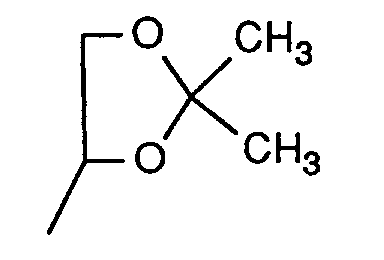
für eine Gruppe der Formel -NR¹⁷R¹⁸ steht,
worin - R¹⁷ und R¹⁸
- gleich oder verschieden sind und Wasserstoff oder geradkettiges oder verzweigtes Alkyl mit bis zu 6 Kohlenstoffatomen bedeuten, das gegebenenfalls bis zu 2-fach gleich oder verschieden durch Hydroxy oder durch geradkettiges oder verzweigtes Alkoxy mit bis zu 6 Kohlenstoffatomen substituiert ist,
oder - R⁶
- für einen Rest der Formel

worin - R¹⁹
- Wasserstoff oder geradkettiges oder verzweigtes Alkyl mit bis zu 4 Kohlenstoffatomen bedeutet,
und - D
- für Methyl, Vinyl, Phenyl oder Wasserstoff steht,
- Besonders bevorzugt sind Verbindungen der allgemeinen Formel (I),
in welcher - R¹
- für Wasserstoff, Fluor, Chlor, Brom oder Methyl steht,
- R²
- für Wasserstoff, Fluor oder Chlor steht,
- R³
- für einen Rest der Formel

worin - R⁹ und R¹⁰
- gleich oder verschieden sind und Wasserstoff, geradkettiges oder verzweigtes Alkyl mit bis zu 4 Kohlenstoffatomen bedeuten, oder einen Rest der Formel

worin - R¹¹, R¹² und R¹³
- gleich oder verschieden sind und Wasserstoff, Fluor, Chlor, Brom, Nitro, Hydroxy, Cyano, Phenylthio, geradkettiges oder verzweigtes Alkyl, Alkoxy, Acyl oder Alkylthio mit jeweils bis zu 3 Kohlenstoffatomen oder Trifluormethyl bedeuten,
- A
- für ein Stickstoffatom oder für die Gruppe der Formel -CR¹⁴ steht,
worin - R¹⁴
- Wasserstoff, Fluor oder Chlor bedeutet,
- R⁴
- für einen Rest der Formel

worin - R¹⁵ und R¹⁶
- gemeinsam mit dem Stickstoffatom einen Imidazolyl-, Pyrrolyl-, 1,2,3-Triazol-1-yl-, 1,2,3-Triazol-2-yl, 1,2,4-Triazol-1-yl- bzw. 1,2,4-Triazol-4-yl-Ring bilden,
- R⁵
- für Wasserstoff steht,
- R⁶
- für Hydroxy, Benzyloxy, Morpholino oder geradkettiges oder verzweigtes Alkoxy mit bis zu 4 Kohlenstoffatomen steht, wobei letzteres gegebenenfalls durch Fluor, Chlor, Brom, Hydroxy oder durch einen Rest der Formel

für eine Gruppe der Formel -NR¹⁷R¹⁸ steht,
worin - R¹⁷ und R¹⁸
- gleich oder verschieden sind und Wasserstoff oder geradkettiges oder verzweigtes Alkyl mit bis zu 4 Kohlenstoffatomen bedeuten, das gegebenenfalls bis zu 2-fach gleich oder verschieden durch Hydroxy oder durch geradkettiges oder verzweigtes Alkoxy mit bis zu 6 Kohlenstoffatomen substituiert ist,
oder - R⁶
- für einen Rest der Formel

worin - R¹⁹
- Wasserstoff oder geradkettiges oder verzweigtes Alkyl mit bis zu 3 Kohlenstoffatomen bedeutet,
und - D
- für Wasserstoff steht,
- Außerdem wurde ein Verfahren zur Herstellung der erfindungsgemäßen Verbindungen der allgemeinen Formel (I) gefunden, dadurch gekennzeichnet, daß man
Verbindungen der allgemeinen Formel (II)
in welcher - R¹, R², R⁴, R⁵, R⁶, A und D
- die oben angegebene Bedeutung haben
und - E
- für Halogen, vorzugsweise für Chlor und Fluor steht,
mit Verbindungen der allgemeinen Formel (III)
R³-H (III)
in welcher - R³
- die oben angegebene Bedeutung hat,
- Das erfindungsgemäße Verfahren kann durch folgendes Formelschema beispielhaft erläutert werden:


Als Lösemittel eignen sich für alle Verfahrensschritte die üblichen inerten Losemittel, die sich unter den Reaktionsbedingungen nicht verändern. Hierzu gehören bevorzugt organische Lösemittel wie Ether z.B. Diethylether, Dioxan oder Tetrahydrofuran, oder Kohlenwasserstoffe wie Benzol, Toluol, Xylol, Cyclohexan oder Erdölfraktionen oder Halogenkohlenwasserstoffe wie Methylenchlorid, Chloroform, Tetrachlorkohlenstoff, oder Dimethylsulfoxid, N,N-Dimethylformamid, Hexamethylphosphorsäuretriamid, Sulfolan, Essigester, Pyridin, Triethylamin, N-Methylpyrrolidon, Anisol oder Picolin. Ebenso ist es möglich, Gemische der genannten Lösemittel zu verwenden. Bevorzugt sind Dimethylsulfoxid, N,N-Dimethylformamid und N-Methylpyrrolidon. - Als Basen für einzelne Reaktionsschritte eignen sich die üblichen basischen Verbindungen. Hierzu gehören beispielsweise Alkali- oder Erdalkalihydroxide, Pyridin, Triethylamin, Diisopropylethylamin oder N-Methylpiperidin, oder bicyclische Amidine wie 1,4-Diazabicyclo[2,2,2]octan (DABCO), 1,5-Diazabicyclo[4,3,0]-non-5-ene (DBN) oder 1,8-Diazabicyclo[5.4.0]undec-5-ene (DBU). Bevorzugt sind Diisopropylethylamin und DABCO.
- Die Basen werden im allgemeinen in einer Menge von 1 bis 3 mol, bevorzugt von 1 bis 1,5 mol, bezogen auf 1 mol der entsprechenden Carbonsäure, eingesetzt.
- Das Verfahren wird im allgemeinen in einem Temperaturbereich von +0°C bis +160°C, bevorzugt von +0°C bis +140°C, durchgeführt.
- Im allgemeinen wird bei Normaldruck gearbeitet. Es ist aber auch möglich, das Verfahren bei Unterdruck oder bei Überdruck durchzuführen (z.B. in einem Bereich von 0,5 bis 5 bar).
- Als Lösemittel eignen sich für die Verseifung Wasser oder Wasser in Kombination mit einem üblichen organischen Lösemittel. Hierzu gehören bevorzugt Alkohole wie Methanol, Ethanol, Propanol, Isopropanol oder Butanol, oder Ether wie Tetrahydrofuran oder Dioxan, oder Dimethylformamid oder Dimethylsulfoxid. Besonders bevorzugt werden Alkohole wie Methanol, Ethanol, Propanol oder Isopropanol verwendet.
- Die Verseifung erfolgt mit Basen, beispielsweise Alkali- und Erdalkalihydroxiden, vorzugsweise Lithiumhydroxid oder Natriumhydroxid, in einem der oben aufgeführten Lösemittel, vorzugsweise Dimethylformamid, Tetrahydrofuran oder Ethanol in Kombination mit Wasser.
- Die Verseifung kann auch mit Säuren wie beispielsweise Essigsäure, Chlorwasserstoffsäure, Bromwasserstoffsäure, Methansulfonsäure, Schwefelsäure oder Perchlorsäure erfolgen.
- Die Verseifung wird im allgemeinen in einem Temperaturbereich von 0°C bis +130°C, bevorzugt von +20°C bis +110°C, durchgeführt.
- Im allgemeinen wird die Verseifung bei Normaldruck durchgeführt. Es ist aber auch möglich, bei Unterdruck oder bei Überdruck zu arbeiten (z.B. von 0,5 bis 5 bar).
- Bei der Durchführung der Verseifung wird die Säure im allgemeinen in einer Menge von 1 bis 3 mol, bevorzugt von 1 bis 1,5 mol, bezogen auf 1 mol des Esters, eingesetzt. Besonders bevorzugt verwendet man molare Mengen der Reaktanden.
- Die Verseifung von tert.Butylestern erfolgt im allgemeinen mit Säuren, wie beispielsweise Salzsäure oder Trifluoressigsäure, in Anwesenheit eines der oben angegebenen Lösemittel und/oder Wasser oder deren Gemische, vorzugsweise mit Dioxan oder Tetrahydrofuran.
- Die Veresterung der Säuren erfolgt
- a) nach üblicher Methode, indem man die Säuren gegebenenfalls in einem der oben aufgeführten Lösemittel in Anwesenheit eines Katalysators mit den entsprechenden Alkoholen umsetzt. Bevorzugt wird dann der entsprechende Alkohol auch als Lösemittel eingesetzt.
- b) Alternativ wird die Säure auch durch allgemein bekannte Methoden der organischen Chemie aktiviert und zum Beispiel mit Cl-CO₂C₂H₅ in das gemischte Anhydrid überführt, das nach a) in den Ester überführt wird.
- Als Katalysatoren für a) können anorganische Säuren, wie bespielsweise Schwefelsäure oder anorganische Säurechloride, wie beispielsweise Thionylchlorid, eingesetzt werden. Im Fall b) kann gegebenenfalls die Zugabe von einer der oben aufgeführten und unter den Reaktionsbedingungen inerten Basen, wie z.B. Triethylamin, Pyridin oder bicyclischen Amidinen erfolgen.
- Im allgemeinen setzt man im Fall a) 0,01 bis 1, bevorzugt 0,05 bis 0,5 mol Katalysator, im Fall b) 0,5 - 2, bevorzugt 1 - 1,5 mol Katalysator, jeweils bezogen auf 1 mol Reaktionspartner, ein.
- Die Amidierung erfolgt im allgemeinen in inerten Lösemitteln und gegebenenfalls in Anwesenheit einer der oben aufgeführten Basen und eines Dehydratisierungsmittels.
- Als Lösemittel eignen sich hierbei inerte organische Lösemittel, die sich unter den Reaktionsbedingungen nicht verändern. Hierzu gehören Halogenkohlenwasserstoffe wie Dichlormethan, Trichlormethan, Tetrachlormethan, 1,2-Dichlorethan, Trichlorethan, Tetrachlorethan oder Trichlorethylen, Kohlenwassserstoffe wie Benzol, Xylol, Toluol, Hexan, Cyclohexan, oder Erdölfraktionen, Nitromethan, Dimethylformamid, Acetonitril oder Hexamethylphosphorsäuretriamid. Ebenso ist es möglich, Gemische der Lösemittel einzusetzen. Besonders bevorzugt ist Dichlormethan.
- Die Amidierung wird im allgemeinen in einem Temperaturbereich von 0°C bis 150°C, bevorzugt bei 25°C bis 40°C, durchgeführt.
- Die Amidierung wird im allgemeinen bei Normaldruck durchgeführt. Es ist aber auch möglich, das Verfahren bei Unterdruck oder bei Überdruck durchzuführen (z.B. in einem Bereich von 0,5 bis 5 bar).
- Bei der Durchführung der Amidierung wird die Base im allgemeinen in einer Menge von 1 bis 3 Mol, bevorzugt von 1 bis 1,5 Mol, bezogen auf 1 Mol der Carbonsäure, eingesetzt.
- Die Verbindungen der allgemeinen Formel (II) sind neu und können hergestellt werden, indem man zunächst Verbindungen der allgemeinen Formel (IV)

in welcher - R¹, R², A und E
- die oben angegebene Bedeutung haben,
- L
- für Halogen, vorzugsweise für Chlor oder Fluor steht,
- R6'
- für C₁-C₄-Alkyl steht und
- R¹⁶
- für C₁-C₄-Alkoxy oder C₁-C₄-Dialkylamino steht,
- R⁴ und R⁵
- die oben angegebene Bedeutung haben,
- R¹, R², R⁴, R⁵, A, E, L und R6'
- die oben angegebene Bedeutung haben,
- Das Verfahren wird im allgemeinen in einem Temperaturbereich von +0°C bis +150°C, bevorzugt von +0°C bis +120°C, durchgeführt.
- Im allgemeinen wird bei Normaldruck gearbeitet. Es ist aber auch möglich, das Verfahren bei Unterdruck oder bei Überdruck durchzuführen (z.B. in einem Bereich von 0,5 bis 5 bar).
- Die Verbindungen der allgemeinen Formel (IV) und (V) sind an sich bekannt oder können nach publizierten Methoden hergestellt werden.
- Die Verbindungen der allgemeinen Formel (VI) sind neu und können dann beispielsweise wie oben beschrieben hergestellt werden.
- Überraschenderweise zeigten die erfindungsgemäßen Verbindungen Wirkung in Lentivirus infizierten Zellkulturen. Dies konnte am Beispiel des HIV-Virus gezeigt werden.
- Der HIV-Test wurde mit geringen Modifikationen nach der Methode von Pauwels et al. [vgl. Journal of Virological Methods 20, (1988), 309-321] durchgeführt.
- Normale menschliche Blutlymphozyten (PBL's) wurden über Ficoll-Hypaque angereichert und im RPMI 1640, 20% fötales Kälberserum mit Phythaemagglutinin (90 µg/ml) und Interleukin-2 (40 U/ml) stimuliert. Zur Infektion mit dem infektiösen HIV wurden PBL's pelletiert und das Zellpellet wurde anschließend in 1 ml HIV-Virusadsorptionslösung suspendiert und 1 Stunde bei 37°C inkubiert.
- Die Virusadsorptionslösung wurde zentrifugiert und das infizierte Zellpellet in Wachstumsmedium aufgenommen, so daß 1 x 10⁵ Zellen pro ml eingestellt waren. Die derart infizierten Zellen wurden zu 1 x 10⁴ Zellen/Napf in die Näpfe von 96er Mikrotiterplatten pipettiert.
- Die erste vertikale Reihe der Mikrotiterplatte enthielt nur Wachstumsmedium und Zellen, die nicht infiziert, aber ansonsten genauso wie oben beschrieben, behandelt worden waren (Zellkontrolle). Die zweite vertikale Reihe der Mikrotiterplatte erhielt nur HIV-infizierte Zellen (Viruskontrolle) in Wachstumsmedium. Die übrigen Näpfe enthielten die erfindungsgemäßen Verbindungen in unterschiedlichen Konzentrationen, ausgehend von den Näpfen der 3. vertikalen Reihe der Mikrotiterplatte, von der die Prüfsubstanzen in 2er Schritten 2¹⁰fach verdünnt wurden.
- Die Testansätze wurden so lange bei 37°C inkubiert, bis in der unbehandelten Viruskontrolle die für das HIV typische Syncytienbildung auftrat (zwischen Tag 3 und 6 nach Infektion), die dann mikroskopisch ausgewertet wurde. In der unbehandelten Viruskontrolle resultierten unter diesen Testbedingungen etwa 20 Syncytien, während die unbehandelte Zellkontrolle keine Syncytien aufwies.
- Die IC₅₀-Werte wurden als die Konzentration der erfindungsgemäßen Verbindungen ermittelt, bei der 50% (ca. 10 Syncytien) der virusinduzierten Syncytien durch die Behandlung mit der erfindungsgemäßen Verbindung unterdruckt waren.
- Es wurde nun gefunden, daß die erfindungsgemäßen Verbindungen HIV infizierte Zellen vor der virusinduzierten Zellzerstörung schützen.
Tabelle A Bsp.-Nr. IC₅₀ (uM) 8 3 14 0,7 20 0,2 23 0,4 31 0,7 39 0,25 50 0,5 51 0,2 69 0,7 92 0,6 113 2 146 0,7 - Die erfindungsgemäßen Verbindungen stellen wertvolle Wirkstoffe zur Behandlung und Prophylaxe von Erkrankungen, hervorgerufen durch Retroviren, in der Human- und Tiermedizin dar.
- Als Indikationsgebiete in der Humanmedizin können beispielsweise genannt werden:
- 1.) Die Behandlung und Prophylaxe von menschlichen Retrovirusinfektionen.
- 2.) Für die Behandlung oder Prophylaxe von HIV I (Virus der humanen Immundefizienz; früher HTLV III/LAV genannt) und HIV II verursachten Erkrankungen (AIDS) und den damit assoziierten Stadien wie ARC (AIDS related complex) und LAS (Lymphadenopathie-Syndrom) sowie der durch dieses Virus verursachten Immunschwäche und Encephalopathie.
- 3.) Für die Behandlung oder die Prophylaxe einer HTLV-I oder HTLV-II Infektion.
- 4.) Für die Behandlung oder die Prophylaxe des AIDS-carrier Zustandes (AIDS-Überträger-Zustand).
- Als Indikationen in der Tiermedizin können beispielsweise angeführt werden:
Infektionen mit - a) Maedvisna (bei Schafen und Ziegen)
- b) progressivem Pneumonievirus (PPV) (bei Schafen und Ziegen)
- c) caprine arthritis encephalitis Virus (bei Schafen und Ziegen)
- d) Zwoegersiekte Virus (bei Schafen)
- e) infektiösem Virus der Anämie (des Pferdes)
- f) Infektionen verursacht durch das Katzenleukämievirus
- g) Infektionen verursacht durch das Virus der Katzen-Immundefizienz (FIV)
- h) Infektionen verursacht durch das Virus der Affen-Immundefizienz (SIV)
- Zur vorliegenden Erfindung gehören pharmazeutische Zubereitungen, die neben nicht-toxischen, inerten pharmazeutisch geeigneten Trägerstoffen eine oder mehrere Verbindungen der Formel (I) enthalten oder die aus einem oder mehreren Wirkstoffen der Formel (I) bestehen, sowie Verfahren zur Herstellung dieser Zubereitungen.
- Die Wirkstoffe der Formel (I) sollen in den oben aufgeführten pharmazeutischen Zubereitungen, vorzugsweise in einer Konzentration von etwa 0,1 bis 99,5, vorzugsweise von etwa 0,5 bis 95 Gew.-% der Gesamtmischung vorhanden sein.
- Die oben aufgeführten pharmazeutischen Zubereitungen können außer den Verbindungen der Formel (I) auch weitere pharmazeutische Wirkstoffe enthalten.
- Die Herstellung der oben aufgeführten pharmazeutischen Zubereitungen erfolgt in üblicher Weise nach bekannten Methoden, z.B. durch Mischen des oder der Wirkstoffe mit dem oder den Trägerstoffen.
- Im allgemeinen hat es sich sowohl in der Human- als auch in der Veterinärmedizin als vorteilhaft erwiesen, den oder die erfindungsgemäßen Wirkstoffe in Gesamtmengen von etwa 0,5 bis etwa 500, vorzugsweise 1 bis 100 mg/kg Körpergewicht je 24 Stunden, gegebenenfalls in Form mehrerer Einzelgaben, zur Erzielung der gewünschten Ergebnisse zu verabreichen. Eine Einzelgabe enthält den oder die Wirkstoffe vorzugsweise in Mengen von etwa 1 bis etwa 80, insbesondere 1 bis 30 mg/kg Körpergewicht. Es kann jedoch erforderlich sein, von den genannten Dosierungen abzuweichen, und zwar in Abhängigkeit von der Art und dem Körpergewicht des zu behandelnden Objekts, der Art und der Schwere der Erkrankung, der Art der Zubereitung und der Applikation des Arzneimittels sowie dem Zeitraum bzw. Intervall, innerhalb welchem die Verabreichung erfolgt.
-

- 15,6 g (0,072 mol) 4-Nitrobenzylbromid werden mit 5,0 g (0,072 mol) 1,2,3-Triazol und 20,2 g (0,15 mol) Kaliumcarbonat in 70 ml Aceton sechs Stunden zum Rückfluß erhitzt. Nach dem Abkühlen wird filtriert und das Lösungsmittel im Vakuum entfernt. Das Rohprodukt wird durch Säulenchromatographie (Kieselgel, Methylenchlorid/Methanol 98/2) gereinigt.
Ausbeute: 3,87 g (26% der Theorie)
Schmelzpunkt: 96-100°C - 3,5 g (0,017 mol) 2-(4-Nitrobenzyl)-2H-1,2,3-triazol werden in 50 ml Essigester und 1 g Pd/C (10%) bei Normaldruck hydriert. Der Katalysator wird abfiltriert und gut mit Dimethylformamid nachgewaschen. Die Lösungsmittel werden im Vakuum entfernt.
Ausbeute: 2,1 g ( 72% der Theorie)
¹H-NMR (d₆-DMSO): s 5,4 (2H); d 6,5 (2H); d 7,0 (2H);s 7,7 (2H). -

- 12,3 g (0,072 mol) 3-Nitrobenzylchlorid und 5,0 g 1,2,3-Triazol werden mit 20,2 g (0,15 mol) Kaliumcarbonat in 70 ml Aceton sechs Stunden zum Rückfluß erhitzt. Der erkaltete Ansatz wird filtriert und das Lösungsmittel im Vakuum entfernt. Das Rohprodukt wird durch Säulenchromatographie (Kieselgel, Methylenchlorid/Methanol 96/4) getrennt.
Ausbeute: 4,1 g 1-(3-Nitrobenzyl)-1H-1,2,3-triazol (28% der Theorie)
Schmelzpunkt: 96-97°C
und
4,6 g 2-(3-Nitrobenzyl)-2H-1,2,3-triazol (31% der Theorie)
Schmelzpunkt: 91-93°C
4,1 g (0,02 mol) 1-(3-Nitrobenzyl)-1H-1,2,3-triazol werden in 100 ml Essigester mit 1 g Pd/C (10%) bei Normaldruck hydriert. Der Katalysator wird abfiltriert und mit Dimethylformamid gründlich nachgewaschen. Die Lösungsmittel werden im Vakuum entfernt.
Ausbeute: 3,2 g (94% der Theorie) (Beispiel II)
¹H-NMR (CDCl₃): s 5,4 (2H); m 6,5-6,7 (3H); t 7,15 (1H); s 7,50 (1H); s 7,70 (1H). - 4,6 g (0,023 mol) 2-(3-Nitrobenzyl)-2H-1,2,3-triazol werden analog zu Beispiel II hydriert.
Ausbeute: 3,9 g (97% der Theorie) (Beispiel III) -

- 15,5 g (0,072 mol) 2-Nitrobenzylbromid und 5,0 g (0,072 mol) 1,2,3-Triazol werden mit 20,2 g (0,15 mol) Kaliumcarbonat in 70 ml Aceton vier Stunden zum Rückfluß erhitzt. Der erkaltete Ansatz wird filtriert und das Lösungsmittel im Vakuum entfernt. Das Rohprodukt wird durch Säulenchromatographie (Kieselgel, Methylenchlorid/Methanol 96/4) getrennt.
Ausbeute: 3,0 g 2-(2-Nitrobenzyl)-2H-1,2,3-triazol
(20% der Theorie) Schmelzpunkt: 77-80°C
und
6,8 g 1-(2-Nitrobenzyl)-1H-1,2,3-triazol
(46% der Theorie)
Schmelzpunkt: 110-115°C - 6,8 g (0,033 mol) 1-(2-Nitrobenzyl)-1H-1,2,3-triazol werden in 100 ml Essigester mit 1 g Pd/C (10%) bei Normaldruck hydriert Der Katalysator wird abfiltriert und mit Dimethylformamid gründlich nachgewaschen. Die Lösungsmittel werden im Vakuum entfernt.
Ausbeute: 5,6 g (97% der Theorie)
¹H-NMR (CDCl₃): s 5,45 (2H); m 6,65-6,85 (2H); m 7,10-7,25 (2H); s 7,50 (1H); s 7,70 (1H). - 3,0 g (0,015 mol) 2-(2-Nitrobenzyl)-2H-1,2,3-triazol werden analog zu Beispiel b. hydriert.
Ausbeute: 2,4 g (91% der Theorie)
¹H-NMR (CDCl₃): s 5,50 (2H); m 6,60-6,85 (2H); m 7,05-7,35 (2H); s 7,55 (2H) -

- 11,5 g (0,038 mol) 3-Ethoxy-2-(2,4,5-trifluorbenzoyl)-acrylsäureethylester werden in 75 ml Ethanol vorgelegt und 6,7 g (0,038 mol) 1-(4-Aminobenzyl)-1H-1,2,3-triazol zugetropft. Man rührt 12 Stunden bei Raumtemperatur nach und entfernt das Lösungsmittel im Vakuum. Rohausbeute: 15,8 g
- 15 g (0,035 mol) des unter a. erhaltenen Produktes werden mit 5,7 g (0,041 mol) Kaliumcarbonat in 70 ml Dimethylformamid fünf Stunden auf 100°C erwärmt. Das Lösungsmittel wird im Vakuum entfernt und der Rückstand mit Wasser verrührt. Es wird bei ca. 100°C getrocknet.
Ausbeute: 13,2 g (92% der Theorie)
Schmelzpunkt: 183-185°C
10 g (24 mmol) des unter b. erhaltenen Esters werden mit 0,6 g (24 mmol) Lithiumhydroxid in einer Mischung aus 100 ml Tetrahydrofuran, 5 ml Dimethylformamid und 5 ml Wasser drei Tage bei Raumtemperatur gerührt. Anschließend wird abgesaugt, der Rückstand gründlich mit iso-Propanol verrührt und bei ca 100°C getrocknet.
Ausbeute: 8,2 g (89% der Theorie)
Schmelzpunkt: >280°C -

-
- 2,9 g (8,6 mmol) 3-Ethoxy-2-(2,5-dichlor-4-fluor-nicotinoyl)-acrylsäureethylester und 1,5 g (8,6 mmol) 1-(4-Aminobenzyl)-1H-1,2,3-triazol werden in 20 ml Ethanol 12 Stunden bei Raumtemperatur gerührt. Das Lösungsmittel wird im Vakuum entfernt.
Ausbeute: 3,65 g (91% der Theorie)
Schmelzpunkt: 153-158°C
3,5 g (7,5 mmol) des unter a. erhaltenen Produktes werden mit 1,3 g (9,4 mmol) Kaliumcarbonat in 20 ml Dimethylformamid fünf Stunden auf 120°C erwärmt. Der abgekühlte Ansatz wird auf Eiswasser gegeben und das ausgefallene Produkt isoliert. Es wird bei ca 100°C getrocknet. Ausbeute: 3,05 g (94% der Theorie)
Schmelzpunkt: 216-220°C -

- 3,6 g (0,012 mol) 3-Ethoxy-2-(2,4,5-trifluorbenzoyl)-acrylsäureethylester und 2,1 g (0,038 mol) 2-(4-Aminobenzyl)-2H-1,2,3-triazol werden in 25 ml Ethanol über Nacht bei Raumtemperatur gerührt. Alle flüchtigen Komponenten werden im Vakuum entfernt.
Ausbeute: 5,0 g (97% der Theorie)
Schmelzpunkt: 108-110°C
5,0 g (0,012 mol) des unter a. erhaltenen Produktes werden mit 1,9 g (0,014 mol) Kaliumcarbonat in 25 ml Dimethylformamid fünf Stunden auf 100°C erwärmt. Der abgekühlte Ansatz wird auf Eiswasser gegeben und das ausgefallene Produkt isoliert. Es wird bei ca 100°C getrocknet.
Ausbeute: 4,0 g (85% der Theorie)
Schmelzpunkt: 203-206°C -

- 17,2 g (0,052 mol) 3-Ethoxy-2-(2,4,5-trifluorbenzoyl)-acrylsäureethylester und 10,0 g (0,057 mol) 1-(4-Aminobenzyl)-1H-1,2,4-triazol werden in 100 ml Ethanol über Nacht bei Raumtemperatur gerührt. Das ausgefallene Produkt wird isoliert und mit Ethanol gewaschen.
Ausbeute: 20,2 g (82% der Theorie)
Schmelzpunkt: 137-139°C
4,5 g (0,011 mol) des unter a. erhaltenen Produktes werden mit 1,9 g (0,014 mol) Kaliumcarbonat in 25 ml Dimethylformamid sieben Stunden auf 100°C erwärmt. Der abgekühlte Ansatz wird auf Eiswasser gegeben und das ausgefallene Produkt isoliert. Es wird bei ca 100°C getrocknet.
Ausbeute: 2,94 g (68% der Theorie)
Schmelzpunkt: 226-228°C -

- 9,7 g (0,029 mol) 3-Ethoxy-2-(2,5-dichlor-4-fluor-nicotinoyl)-acrylsäureethylester und 5,0 g (0,029 mol) 1-(4-Aminobenzyl)-1H-1,2,4-triazol werden in 60 ml Ethanol drei Stunden bei Raumtemperatur gerührt. Das Lösungsmittel wird im Vakuum entfernt.
Ausbeute: 13,5 g Rohprodukt
13,3 g (28 mmol) des unter a. erhaltenen Produktes werden mit 5,0 g (36 mmol) Kaliumcarbonat in 70 ml Dimethylformamid vier Stunden auf 100°C erwärmt. Der abgekühlte Ansatz wird auf Eiswasser gegeben und das ausgefallene Produkt isoliert. Es wird bei ca 100°C getrocknet.
Ausbeute: 10,8 g (85% der Theorie)
Schmelzpunkt: 225-228°C -

- 17,2 g (0,057 mol) 3-Ethoxy-2-(2,4,5-trifluorbenzoyl)-acrylsäureethylester und 10,0 g (0,057 mol) N-(4-Aminobenzyl)-imidazol werden in 100 ml Ethanol über Nacht bei Raumtemperatur gerührt. Alle flüchtigen Komponenten werden im Vakuum entfernt.
Ausbeute: 24,0 g Rohprodukt -
- 24,0 g des unter a. erhaltenen Produktes werden mit 14,3 g (0,1 mol) Kaliumcarbonat in 200 ml Dimethylformamid sechs Stunden auf 100°C erwärmt. Alle flüchtigen Komponenten werden im Vakuum entfernt und der Rückstand durch Säulenchromatographie (Kieselgel, Methylenchlorid/Methanol 96/4) gereinigt
Ausbeute: 15,3 g (65% der Theorie über zwei Stufen)
Schmelzpunkt: 251-254°C
200 mg (0,49 mmol) des unter b. erhaltenen Esters werden in einer Mischung aus 1 ml Essigsäure, 1 ml Wasser und 0,1 ml konzentrierter Schwefelsäure zwei Stunden auf 80°C erwärmt. Nach dem Abkühlen wird auf wenig Eiswasser gegeben und das Produkt isoliert.
Ausbeute: 180 mg (96% der Theorie)
Schmelzpunkt: >280°C -

- 5,9 g (0,019 mol) 3-Ethoxy-2-(2,4,5-trifluorbenzoyl)-acrylsäureethylester und 3,4 g (0,019 mol) 1-(3-Aminobenzyl)-1H-1,2,3-triazol werden in 40 ml Ethanol über Nacht gerührt. Alle flüchtigen Komponenten werden im Vakuum entfernt.
Ausbeute: 7,8 g (92% der Theorie)
Schmelzpunkt: 126-128°C
7,7 g (0,018 mol) des unter a. erhaltenen Produktes werden mit 3,1 g (0,022 mol) Kaliumcarbonat in 45 ml Dimethylformamid vier Stunden auf 100°C erwärmt. Der abgekühlte Ansatz wird auf 180 ml Eiswasser gegeben und das ausgefallene Produkt isoliert. Es wird bei ca 100°C getrocknet
Ausbeute: 6,2 g (85% der Theorie)
Schmelzpunkt: 187-189°C -

- 4,0 g (0,013 mol) 3-Ethoxy-2-(2,4,5-trifluorbenzoyl)-acrylsäureethylester und 2,3 g (0,013 mol) 2-(3-Aminobenzyl)-2H-1,2,3-triazol werden in 25 ml Ethanol über Nacht gerührt. Alle flüchtigen Komponenten werden im Vakuum entfernt.
Ausbeute: 5,5 g Rohausbeute
5,5 g (0,013 mol) des unter a. erhaltenen Produktes werden mit 2,3 g (0,017 mol) Kaliumcarbonat in 30 ml Dimethylformamid vier Stunden auf 100°C erwärmt. Der abgekühlte Ansatz wird auf 180 ml Eiswasser gegeben und das ausgefallene Produkt isoliert. Es wird bei ca 100°C getrocknet.
Ausbeute: 4,5 g (86% der Theorie)
Schmelzpunkt: 144-146°C -

- 8,7 g (0,029 mol) 3-Ethoxy-2-(2,4,5-trifluorbenzoyl)-acrylsäureethylester und 5,0 g (0,029 mol) 1-(3-Aminobenzyl)-1H-1,2,4-triazol werden in 60 ml Ethanol über Nacht gerührt. Alle flüchtigen Komponenten werden im Vakuum entfernt.
Ausbeute: 12,4 g Rohausbeute
12,4 g (0,013 mol) des unter a. erhaltenen Produktes werden mit 5,4 g (0,039 mol) Kaliumcarbonat in 80 ml Dimethylformamid zwei Stunden auf 100°C erwärmt. Der abgekühlte Ansatz wird auf Eiswasser gegeben, mit Methylenchlorid extrahiert und das Lösungsmittel einrotiert. Es wird bei ca. 100°C getrocknet.
Ausbeute: 10,0 g (84% der Theorie)
Schmelzpunkt: 175-180°C -

- 5,7 g (0,017 mol) 3-Ethoxy-2-(2,5-dichlor-4-fluor-nicotinoyl)-acrylsäureethylester und 3,0 g (0,017 mol) 1-(3-Aminobenzyl)-1H-1,2,4-triazol werden in 35 ml Ethanol über Nacht bei Raumtemperatur gerührt. Das Lösungsmittel wird im Vakuum entfernt.
Ausbeute: 7,7 g Rohprodukt
7,7 g (16 mmol) des unter a. erhaltenen Produktes werden mit 3,4 g (24 mmol) Kaliumcarbonat in 50 ml Dimethylformamid zwei Stunden auf 100°C erwärmt. Der abgekühlte Ansatz wird auf Eiswasser gegeben, es wird mit Methylenchlorid extrahiert, die organische Phase wird über Natriumsulfat getrocknet und einrotiert. Es wird bei ca 100°C getrocknet.
Ausbeute: 4,9 g (67% der Theorie über zwei Stufen)
Schmelzpunkt: 186-189°C -

- 8,7 g (0,029 mol) 3-Ethoxy-2-(2,4,5-trifluorbenzoyl)-acrylsäureethylester und 5,0 g (0,029 mol) N-(3-Aminobenzyl)-imidazol werden in 60 ml Ethanol über Nacht bei Raumtemperatur gerührt. Alle flüchtigen Komponenten werden im Vakuum entfernt.
Ausbeute: 12,3 g Rohprodukt - 12,3 g des unter a. erhaltenen Produktes werden mit 5 g (0,036 mol) Kaliumcarbonat in 70 ml Dimethylformamid zwei Stunden auf 100°C erwärmt. Der abgekühlte Ansatz wird auf Eiswasser gegeben, mit Methylenchlorid extrahiert und einrotiert. Das Rohprodukt wird durch Säulenchromatographie (Kieselgel, Methylenchlorid/Methanol 96/4) gereinigt.
Ausbeute: 3,3 g (28% der Theorie über zwei Stufen)
Schmelzpunkt: 193-194°C
200 mg (0,49 mmol) des unter b. erhaltenen Esters werden in einer Mischung aus 1 ml Essigsäure, 1 ml Wasser und 0,1 ml konzentrierter Schwefelsäure zwei Stunden auf 80°C erwärmt. Nach dem Abkühlen wird auf wenig Eiswasser gegeben und das Produkt isoliert.
Ausbeute: 130 mg (68% der Theorie)
Schmelzpunkt: >280°C -

- 5,0 g (0,016 mol) 3-Ethoxy-2-(2,4,5-trifluorbenzoyl)-acrylsäureethylester und 2,8 g (0,016 mol) 1-(2-Aminobenzyl)-1H-1,2,3-triazol werden in 30 ml Ethanol über Nacht gerührt. Alle flüchtigen Komponenten werden im Vakuum entfernt.
Ausbeute: 6,4 g Rohprodukt
Schmelzpunkt: 124-126°C
6,0 g (0,014 mol) des unter a. erhaltenen Produktes werden mit 2,4 g (0,017 mol) Kaliumcarbonat in 35 ml Dimethylformamid vier Stunden auf 100°C erwärmt. Der abgekühlte Ansatz wird auf 180 ml Eiswasser gegeben und das ausgefallene Produkt isoliert. Es wird bei ca 100°C getrocknet.
Ausbeute: 3,9 g (68% der Theorie)
Schmelzpunkt: 224-226°C -

- 3,9 g (0,013 mol) 3-Ethoxy-2-(2,4,5-trifluorbenzoyl)-acrylsäureethylester und 2,3 g (0,013 mol) 2-(3-Aminobenzyl)-2H-1,2,3-triazol werden in 25 ml Ethanol über Nacht gerührt. Alle flüchtigen Komponenten werden im Vakuum entfernt.
Ausbeute: 4,9 g (89% der Theorie)
Schmelzpunkt: 98-99°C
4,5 g (0,011 mol) des unter a. erhaltenen Produktes werden mit 1,7 g (0,012 mol) Kaliumcarbonat in 25 ml Dimethylformamid vier Stunden auf 100°C erwärmt. Der abgekühlte Ansatz wird auf 180 ml Eiswasser gegeben und das ausgefallene Produkt isoliert. Es wird bei ca 100°C getrocknet.
Ausbeute: 3,7 g (88% der Theorie)
Schmelzpunkt: 144-145°C -

- 8,7 g (0,029 mol) 3-Ethoxy-2-(2,4,5-trifluorbenzoyl)-acrylsäureethylester und 5,0 g (0,029 mol) 1-(3-Aminobenzyl)-1H-1,2,4-triazol werden in 60 ml Ethanol über Nacht gerührt. Alle flüchtigen Komponenten werden im Vakuum entfernt.
Ausbeute: 14,3 g Rohausbeute
12,4 g des unter a. erhaltenen Produktes werden mit 5,7 g (0,04 mol) Kaliumcarbonat in 80 ml Dimethylformamid 3,5 Stunden auf 100°C erwärmt. Der abgekühlte Ansatz wird auf Eiswasser gegeben, mit Methylenchlorid extrahiert und das Lösungsmittel einrotiert. Das Rohprodukt wird durch Säulenchromatographie (Kieselgel, Methylenchlorid/Methanol 96/4) gereinigt.
Ausbeute: 6,5 g (54% der Theorie)
Schmelzpunkt: 214-216°C -

- 7,85 g (0,026 mol) 3-Ethoxy-2-(2,4,5-trifluorbenzoyl)-acrylsäureethylester und 4,5 g (0,026 mol) N-(2-Aminobenzyl)-imidazol werden in 50 ml Ethanol über Nacht bei Raumtemperatur gerührt. Alle flüchtigen Kmponenten werden im Vakuum entfernt und der Rückstand durch Chromatographie gereinigt.
Ausbeute: 7,87 g (70% der Theorie) - 7,8 g (0,018 mol) des unter a. erhaltenen Produktes werden mit 3,1 g (0,022 mol) Kaliumcarbonat in 45 ml Dimethylformamid 3,5 Stunden auf 100°C erwärmt. Der abgekühlte Ansatz wird auf Eiswasser gegeben, mit Methylenchlorid extrahiert und einrotiert. Das Rohprodukt wird durch Säulenchromatographie (Kieselgel, Methylenchlorid/Methanol 96/4) gereinigt.
Ausbeute: 4,7 g (64% der Theorie)
Schmelzpunkt: 225-227°C
200 mg (0,49 mmol) des unter b. erhaltenen Esters werden in einer Mischung aus 1 ml Essigsäure, 1 ml Wasser und 0,1 ml konzentrierter Schwefelsäure zwei Stunden auf 80°C erwärmt. Nach dem Abkühlen wird mit verdünnter Natronlauge neutralisiert, mit Methylenchlorid extrahiert und einrotiert.
Ausbeute: 67 mg (37% der Theorie)
Schmelzpunkt: 210-214°C (unter Zersetzung) -

- 12 g (0,069 mol) 1-(4-Aminobenzyl)-1H-1,2,3-triazol werden in 120 ml Ethanol vorgelegt und mit 22,0 g (0,069 mol) 3-Ethoxy-2-(2,3,4,5-tetrafluorbenzoyl)-acrylsäureethylester in 30 ml Methylenchlorid bei Raumtemperatur versetzt. Man rührt 12 Stunden bei Raumtemperatur nach und entfernt das Lösungsmittel im Vakuum.
Rohausbeute: 30,8 g - 30,8 g (0,069 mol) des unter a. erhaltenen Produktes werden mit 4,4 g (0,076 mol) Kaliumfluorid in 130 ml Dimethylformamid drei Stunden auf 90°C erwärmt. Das Lösungsmittel wird im Vakuum entfernt, der Rückstand in Methylenchlorid/Wasser aufgenommen. Nach Rückextraktion werden die vereinigten organischen Phasen mit Wasser neutral gewaschen und über Natriumsulfat getrocknet. Nach dem Entfernen des Lösungsmittels im Vakuum wird der Rückstand mit Essigester/Isooctan 1:1 verrührt.
Ausbeute: 23,2 g (79% der Theorie)
Schmelzpunkt: 170-172°C
23,2 g (54,2 mmol) des unter b. erhaltenen Esters werden mit 1,3 g (54,2 mmol) Lithiumhydroxid in einer Mischung aus 240 ml Tetrahydrofuran, 100 ml Dimethylformamid und 12 ml Wasser über Nacht bei Raumtemperatur gerührt. Nach Entfernen der Lösungsmittel im Vakuum wird das Rohprodukt durch Säulenchromatographie (Kieselgel, Methylenchlorid/Methanol 95/5) gereinigt.
Ausbeute: 10,7 g (89% der Theorie)
Schmelzpunkt: 170-172°C -

- 8 g (0,046 mol) 1-(4-Aminobenzyl)-1H-1,2,3-triazol werden in 80 ml Ethanol vorgelegt und mit 14,7 g (0,046 mol) 3-Ethoxy-2-(3-chlor-2,4,5-trifluorbenzoyl)-acrylsäureethylester in 4 ml Methylenchlorid bei Raumtemperatur versetzt. Man rührt 12 Stunden bei Raumtemperatur nach und entfernt das Losungsmittel im Vakuum.
Rohausbeute: 21,3 g - 21,3 g (0,069 mol) des unter a. erhaltenen Produktes werden mit 4,9 g (0,050 mol) Kaliumfluorid in 90 ml Dimethylformamid drei Stunden auf 90°C erwärmt. Das Lösungsmittel wird im Vakuum entfernt, der Rückstand in Methylenchlorid/Wasser aufgenommen. Nach Rückextraktion werden die vereinigten organischen Phasen mit Wasser neutralgewaschen und über Natriumsulfat getrocknet. Das Lösungsmittel wird im Vakuum entfernt.
Ausbeute: 12,2 g (60% der Theorie)
Schmelzpunkt: 120-122°C
12,0 g (27 mmol) des unter b. erhaltenen Esters werden mit 700 mg (27 mmol) Lithiumhydroxid in einer Mischung aus 120 ml Tetrahydrofuran, 50 ml Dimethylformamid und 6 ml Wasser drei Tage bei Raumtemperatur gerührt. Nach Entfernen der Lösungsmittel im Vakuum wird das Rohprodukt durch Säulenchromatographie (Kieselgel, Methylenchlorid/Methanol/Essigsäure 10/1/0,5) gereinigt.
Ausbeute: 9,4 g (84% der Theorie)
Schmelzpunkt: 201-203°C -

Analog zum Beispiel XXII wurde die Titelverbindung erhalten.
Schmelzpunkt: >250°C -

- 3,9 g (0,022 mol) 1-(4-Aminobenzyl)-1H-1,2,4-triazol werden in 40 ml Ethanol vorgelegt und mit 7,2 g (0,022 mol) 3-Ethoxy-2-(2,3,4,5-tetrafluorbenzoyl)-acrylsäureethylester in 2 ml Methylenchlorid bei Raumtemperatur versetzt. Man rührt 12 Stunden bei Raumtemperatur nach und entfernt das Lösungsmittel im Vakuum.
Rohausbeute: 10,0g -
- 10,0 g (0,022 mol) des unter a. erhaltenen Produktes werden mit 1,4 g (0,025 mol) Kaliumfluorid in 50 ml Dimethylformamid drei Stunden auf 90°C erwärmt. Das Lösungsmittel wird im Vakuum entfernt, der Rückstand in Methylenchlorid/Wasser aufgenommen. Nach Rückextraktion werden die vereinigten organischen Phasen mit Wasser neutralgewaschen und über Natriumsulfat getrocknet. Das Rohprodukt wird durch Säulenchromatographie (Kieselgel, Methylenchlorid/Methanol 95:5) gereinigt.
Ausbeute: 8,9 g (94% der Theorie)
Schmelzpunkt: 160-162°C
8,9 g (20,8 mmol) des unter b. erhaltenen Esters werden mit 500 mg (20,8 mmol) Lithiumhydroxid in einer Mischung aus 90 ml Tetrahydrofuran, 4,5 ml Dimethylformamid und 4,5 ml Wasser über Nacht bei Raumtemperatur gerührt. Nach Entfernen der Lösungsmittel im Vakuum wird das Rohprodukt durch Säulenchromatographie (Kieselgel, Methylenchlorid/Methanol 95/5) gereinigt.
Ausbeute: 6,2 g (75% der Theorie)
Schmelzpunkt: 256-258°C -

- Analog zum Beispiel XXIV wurde die Titelverbindung erhalten.
Schmelzpunkt: 232-234°C -

- 2,67 g (7,0 mmol) 6,7-Difluor-1,4-dihydro-4-oxo-1-[4-(1H-1,2,3-triazol-1-yl - methyl)-phenyl]-3-chinolincarbonsäure werden in 25 ml trockenen Toluol suspendiert und zur Trocknung am Wasserabscheider gekocht. Anschließend gibt man zur abgekühlten Suspension 0,55 ml (7,5 mmol) Thionylchlorid, kocht bis zum Ende der Gasentwicklung, gibt dann bei Raumtemperatur 1,3 ml (15 mmol) Isopropylamin zu und kocht zwei weitere Stunden. Zur Aufarbeitung rührt man die abgekühlte Lösung in 1N Salzsäure und extrahiert mit Methylenchlorid. Die vereinigten organischen Phasen werden mit gesättigter Natriumhydrogencarbonatlösung und gesättigter Natriumchloridlösung gewaschen. Die über Natriumsulfat getrocknete Lösung wird einrotiert und durch Säulenchromatographie (Kieselgel, Methylenchlorid/Methanol 9/1) gereinigt.
Ausbeute: 0,7 g (24% der Theorie)
Schmelzpunkt: 223-225°C -

- 0,95 g (2,5 mmol) 6,7-Difluor-1,4-dihydro-4-oxo-1-[4-(1H-1,2,3-triazol-1-yl-methyl)-phenyl]-3-chinolincarbonsäure werden in 10 ml Aceton bei 0°C mit 0,28 ml (2,7 mmol) Triethylamin versetzt. Anschließend tropft man bei dieser Temperatur innerhalb von 30 Minuten 0,38 ml (2,7 mmol) Chlorameisensäureethylester zu. Nach Zugabe von 0,38 ml (2,7 mmol) Diisopropylamin wird eine Stunde unter Rückfluß gekocht. Zur Aufarbeitung gibt man auf gesättigte Natriumhydrogencarbonatlösung und extrahiert mit Essigester. Die vereinigten organischen Phasen werden mit gesättigter Natriumchloridlösung gewaschen und über Natriumsulfat getrocknet.
Ausbeute: 1,1 g (95% der Theorie)
Schmelzpunkt: 85-87°C
Analog zum Beispiel XXVII werden die in Tabelle I aufgeführten Verbindungen erhalten:
-

- Man legt 7,21 g (0,075 mol) Magnesiumchlorid bei 0°C in 75 ml absolutem Acetonitril vor und tropft unter Eisbadkühlung 12,12 g (0,075 mol) Malonsäurediethylester zu. Anschließend werden 15,34 g (0,150 mol) Triethylamin bei 0°C zugetropft, nach 60 minütigem Nachrühren werden bei 0°C 17,0 g (0,075 mol) 2,6-Dichlornicotinsäurechlorid (Helvetica Chimica Acta 59, 222 (1976)) zugetropft und unter Erwärmung auf Raumtemperatur über Nacht nachgerührt. Es wird mit 80 ml 18%iger Salzsäure versetzt und mit Methyl-tert.burylether extrahiert, über Natriumsulfat getrocknet und im Vakuum eingeengt.
- Der rohe (2,6-Dichlornicotinoyl)-malonsäurediethylester wird in 45 ml Wasser mit 90 mg p-Toluolsulfonsäure 2 Stunden zum Rückfluß erhitzt. Es wird mit Methylenchlorid extrahiert, mit Wasser gewaschen, über Natriumsulfat getrocknet und im Vakuum eingeengt. Das Rohprodukt wird an Kieselgel (Laufmittel Dichlormethan) gereinigt.
Ausbeute: 14,2 g (72% d.Th. über zwei Schritte). - 43 g (0,162 mol) des Produktes von b. werden in 38,1 g (0,26 mol) Orthoameisensäureethylester und 42,4 g (0,42 mol) Essigsäureanhydrid zwei Stunden auf 150-160°C erwärmt. Alle leicht flüchtigen Bestandteile werden im Hochvakuum bei einer Badtemperatur bis 100°C abdestilliert und das Rohprodukt direkt weiter umgesetzt.
Rohausbeute: 50,5 g - 7 g (0,022 mol) des unter c. erhaltenen Produktes und 3,8 g (0,022 mol) 1-(4-Aminobenzyl)-1H-1,2,4-triazol werden in 40 ml Ethanol über Nacht bei Raumtemperatur gerührt. Das Lösemittel wird im Vakuum entfernt.
Ausbeute: 9,7 g Rohprodukt
26,0 g (0,058 mol) des bei d. erhaltenen Produktes werden mit 9,5 g (0,066 mol) Kaliumcarbonat in 140 ml Dimethylformamid vier Stunden auf 80°C erwärmt. Der abgekühlte Ansatz wird auf Eiswasser gegeben, das ausgefallene Produkt isoliert und bei ca. 100°C getrocknet.
Ausbeute: 18,7 g (78% d.Th.)
Schmp.: 253-256°C -

- 490 mg (1,2 mmol) 6,7-Difluor-1,4-dihydro-4-oxo-1-[4-(1H-1,2,3-triazol-1-yl-methyl)-phenyl]-3-chinolincarbonsäure-ethylester werden mit 650 mg (3,6 mmol) N-(4-Fluorphenyl)-piperazin in 12 ml N-Methylpyrrolidon acht Stunden auf 140°C erwärmt. Alle flüchtigen Komponenten werden im Hochvakuum entfernt, der Rückstand mit iso-Propanol verrührt und bei ca 100°C getrocknet.
Ausbeute: 580 mg (84% der Theorie)
Schmelzpunkt: 128-130°C -

- Analog zum Beispiel 1 erhält man bei der Umsetzung mit 3-Phenylpiperazin nach Verrühren in Acetonitril die Titelverbindung.
Schmelzpunkt: 219-221°C -

- 286 mg (0,75 mmol) 6,7-Difluor-1,4-dihydro-4-oxo-1-[4-(1H-1,2,3-triazol-1-yl-methyl)-phenyl]-3-chinolincarbonsäure und 364 mg (2,25 mmol) N-Phenylpiperazin werden in 7,5 ml N-Methylpyrrolidon eine Stunde auf 120°C erwärmt. Alle flüchtigen Bestandteile werden im Hochvakuum entfernt, der Rückstand mit Acetonitril verrührt und bei ca.100°C getrocknet.
Ausbeute: 150 mg (38% der Theorie)
Schmelzpunkt: >290°C - In Analogie zur Vorschrift des Beispiels 3 werden die in Tabelle 1 aufgeführten Verbindungen hergestellt:

-

- 286 mg (0,75 mmol) 6,7-Difluor-1,4-dihydro-4-oxo-1-[4-(1H-1,2,3-triazol-1-yl-methyl)-phenyl]-3-chinolincarbonsäure und 365 mg (2,25 mmol) 3-Phenylpiperazin werden in 7,5 ml N-Methylpyrrolidon eine Stunde auf 120°C erwärmt. Alle flüchtigen Komponenten werden im Vakuum entfernt, der Rückstand mit iso-Propanol verrührt und bei ca. 100°C getrocknet.
Ausbeute: 210 mg (53% der Theorie)
Schmelzpunkt: 163-165°C -

- 286 mg (0,75 mmol) 6,7-Difluor-1,4-dihydro-4-oxo-1-[4-(1H-1,2,3-triazol-1-yl-methyl)- phenyl]-3-chinolincarbonsäure werden mit 290 mg (0,86 mmol) N-(4-Hydroxyphenyl)- piperazin und 385 mg (3,4 mmol) Diazabicyclo[2.2.2]octan in 7,5 ml N-Methylpyrrolidon zwei Stunden auf 120°C erwärmt. Alle flüchtigen Komponenten werden im Hochvakuum entfernt, der Rückstand mit Wasser verrührt und bei ca. 100°C getrocknet.
Ausbeute: 390 mg (96% der Theorie)
Schmelzpunkt: 269-271°C
In Analogie zur Vorschrift des Beispiels 12 werden die in Tabelle 2 aufgeführten Verbindungen hergestellt:
-

- 0,5 g (1,2 mmol) 7-Chlor-6-fluor-1,4-dihydro-4-oxo-1-[4-(1H-1,2,3-triazol-1-yl-methyl)- phenyl]-1,8-naphthyridin-3-carbonsäureethylester werden mit 190 mg (1,2 mmol) N-Phenylpiperazin und 460 mg (4,1 mmol) Diazabicyclo[2.2.2]octan in 12 ml Dimethylsulfoxid vier Stunden auf 120°C erwärmt. Alle flüchtigen Komponenten werden im Hochvakuum entfernt, der Rückstand mit Wasser verrührt und bei ca 100°C getrocknet.
Ausbeute: 430 mg (66 % der Theorie)
Schmelzpunkt: 201-203°C
In Analogie zur Vorschrift des Beispiels 16 werden die in Tabelle 3 aufgeführten Verbindungen hergestellt:
-

- 300 mg (0,5 mmol) des Esters aus Beispiel 16 werden mit 1 ml 1 N Natronlauge in einem Gemisch aus 5 ml Ethanol und 5 ml Wasser 1,5 Stunden auf 50°C erwärmt. Es wird mit verdünnter Salzsäure neutralisiert, die Lösungsmittel werden im Vakuum entfernt. Der Rückstand wird durch Säulenchromatographie (Kieselgel, Methylenchlorid/Methanol 9/1) gereinigt.
Ausbeute: 240 mg (85% der Theorie)
Schmelzpunkt: 279-281°C (unter Zersetzung)
In Analogie zur Vorschrift des Beispiels 20 werden die in Tabelle 4 aufgeführten Verbindungen hergestellt:
-

- 0,5 g (1,2 mmol) 6,7-Difluor-1,4-dihydro-4-oxo-1-[4-(2H-1,2,3-triazol-2-yl-methyl)-phenyl]-3-chinolincarbonsäureethylester werden mit 190 mg (1,2 mmol) N-Phenylpiperazin und 460 mg (4,1 mmol) Diazabicyclo[2.2.2]octan in 12 ml Dimethylsulfoxid drei Stunden auf 120°C erwärmt. Alle flüchtigen Komponenten werden im Hochvakuum entfernt, der Rückstand mit Wasser verrührt und bei ca 100°C getrocknet.
Ausbeute: 580 mg (80 % der Theorie)
Schmelzpunkt: 230-232°C
In Analogie zur Vorschrift des Beispiels 24 werden die in Tabelle 5 aufgeführten Verbindungen hergestellt:
-

- 0,5 g (0,9 mmol) des im Beispiel 20 erhaltenen Esters werden mit 1,8 ml 1 N Natronlauge in einem Gemisch aus 9 ml Ethanol und 9 ml Wasser 1,5 Stunden auf 50°C erwärmt. Es wird mit verdünnter Salzsäure neutralisiert, die Lösungsmittel werden im Vakuum entfernt. Der Rückstand wird durch Säulenchromatographie (Kieselgel, Methylenchlorid/Methanol 9/1) gereinigt.
Ausbeute: 0,39 g (82% der Theorie)
Schmelzpunkt: 208-210°C
In Analogie zur Vorschrift des Beispiels 28 werden die in Tabelle 6 aufgeführten Verbindungen hergestellt:
-

- 0,5 g (1,2 mmol) 6,7-Difluor-1,4-dihydro-4-oxo-1-[4-(1H-1,2,4-triazol-1-yl-methyl)-phenyl]-3-chinolincarbonsäureethylester werden mit 190 mg (1,2 mmol) N-Phenylpiperazin und 460 mg (4,1 mmol) Diazabicyclo[2.2.2]octan in 12 ml Dimethylsulfoxid drei Stunden auf 120°C erwärmt. Alle flüchtigen Komponenten werden im Hochvakuum entfernt, der Rückstand mit Wasser verrührt und bei ca 100°C getrocknet.
Ausbeute: 600 mg (89 % der Theorie)
Schmelzpunkt: 217-218°C
In Analogie zur Vorschrift des Beispiels 32 werden die in Tabelle 7 aufgeführten Verbindungen hergestellt:
-

- 0,5 g (0,9 mmol) des im Beispiel 32 erhaltenen Esters werden mit 1,8 ml 1 N Natronlauge in einem Gemisch aus 9 ml Ethanol und 9 ml Wasser 1,5 Stunden auf 50°C erwärmt. Es wird mit verdünnter Salzsäure neutralisiert, die Lösungsmittel werden im Vakuum entfernt. Der Rückstand wird durch Säulenchromatographie (Kieselgel, Methylenchlorid/Methanol 9/1) gereinigt.
Ausbeute: 0,46 g (82% der Theorie)
Schmelzpunkt: 234-236°C
In Analogie zur Vorschrift des Beispiels 39 werden die in Tabelle 8 aufgeführten Verbindungen hergestellt:
-

- 0,5 g (1,2 mmol) 7-Chlor-6-fluor-1,4-dihyöro-4-oxo-1-[4-(1H-1,2,4-triazol-1-yl-methyl)-phenyl]-1,8-naphthyridin-3-carbonsäureethylester werden mit 190 mg (1,2 mmol) N-Phenylpiperazin und 460 mg (4,1 mmol) Diazabicyclo[2.2.2]octan in 12 ml Dimethylsulfoxid sechs Stunden auf 120°C erwärmt. Alle flüchtigen Komponenten werden im Hochvakuum entfernt. Der Rückstand wird mit Wasser verrührt und durch Säulenchromatographie (Kieselgel, Methylenchlorid/Methanol 96/4) gereinigt.
Ausbeute: 500 mg (78 % der Theorie)
Schmelzpunkt: 179-180°C
In Analogie zur Vorschrift des Beispiels 46 werden die in Tabelle 9 aufgeführten Verbindungen hergestellt: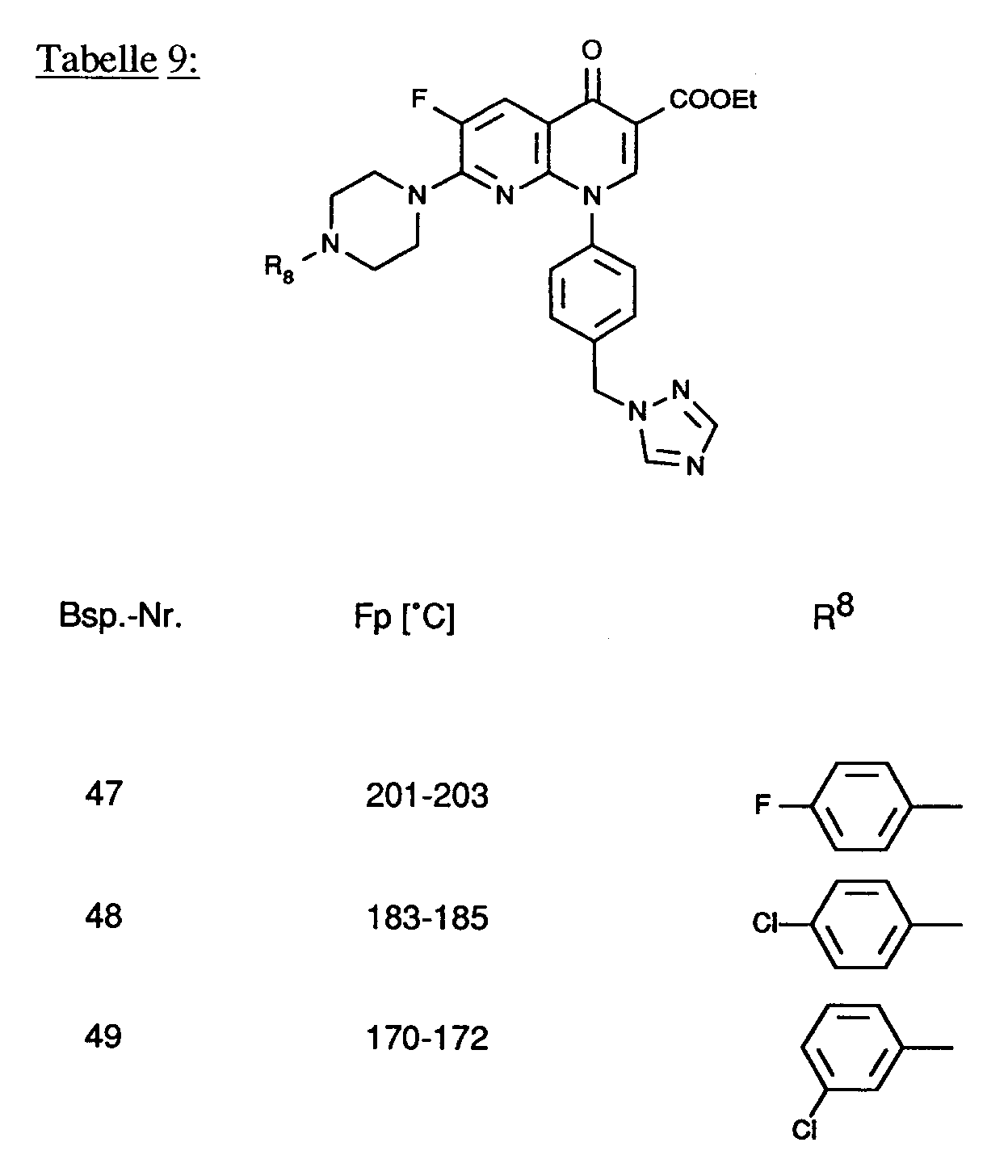
-

- 0,45 g (0,8 mmol) des Esters aus Beispiel 46 werden mit 1,6 ml 1 N Natronlauge in einem Gemisch aus 8 ml Ethanol und 8 ml Wasser 1,5 Stunden auf 50°C erwärmt. Es wird mit verdünnter Salzsäure neutralisiert, die Lösungsmittel werden im Vakuum entfernt. Der Rückstand wird durch Säulenchromatographie (Kieselgel, Methylenchlorid/Methanol 9/1) gereinigt.
Ausbeute: 0,39 mg (90% der Theorie)
Schmelzpunkt: 234-238°C (unter Zersetzung)
In Analogie zur Vorschrift des Beispiels 50 werden die in Tabelle 10 aufgeführten Verbindungen hergestellt:
-

- 0,5 g (1,2 mmol) 6,7-Difluor-1,4-dihydro-1-[4-(N-imidazolyl-methyl)-phenyl]-4-oxo-3-chinolincarbonsäureethylester werden mit 190 mg (1,2 mmol) N-Phenylpiperazin und 460 mg (4,1 mmol) Diazabicyclo[2.2.2]octan in 12 ml Dimethylsulfoxid fünf Stunden auf 120°C erwärmt. Alle flüchtigen Komponenten werden im Hochvakuum entfernt, der Rückstand mit Wasser verrührt und bei ca 100°C getrocknet.
Ausbeute: 580 mg (86 % der Theorie)
Schmelzpunkt: 130-133°C
In Analogie zur Vorschrift des Beispiels 54 werden die in Tabelle 11 aufgeführten Verbindungen hergestellt:
-

- 0,5 g (0,9 mmol) des im Beispiel 55 erhaltenen Esters werden mit 1,8 ml 1 N Natronlauge in einem Gemisch aus 9 ml Ethanol und 9 ml Wasser 1,5 Stunden auf 50°C erwärmt. Es wird mit verdünnter Salzsäure neutralisiert, die Lösungsmittel werden im Vakuum entfernt. Der Rückstand wird durch Säulenchromatographie (Kieselgel, Methylenchlorid/Methanol 9/1) gereinigt.
Ausbeute: 0,42 g (89% der Theorie)
Schmelzpunkt: 248-251°C
In Analogie zur Vorschrift des Beispiels 58 werden die in Tabelle 12 aufgeführten Verbindungen hergestellt:
-

- 0,5 g (1,2 mmol) 6,7-Difluor-1,4-dihydro-4-oxo-1-[3-(1H-1,2,3-triazol-1-yl-methyl)phenyl]-3-chinolincarbonsäureethylester werden mit 190 mg (1,2 mmol) N-Phenylpiperazin und 460 mg (4,1 mmol) Diazabicyclo[2.2.2]octan in 12 ml Dimethylsulfoxid drei Stunden auf 120°C erwärmt. Alle flüchtigen Komponenten werden im Hochvakuum entfernt, der Rückstand mit Wasser verrührt und bei ca 100°C getrocknet.
Ausbeute: 650 mg (97 % der Theorie)
Schmelzpunkt: 170-172°C - In Analogie zur Vorschrift des Beispiels 62 werden die in Tabelle 13 aufgeführten Verbindungen hergestellt:

-

- 0,55 g (0,9 mmol) des im Beispiel 62 erhaltenen Esters werden mit 1,8 ml 1 N Natronlauge in einem Gemisch aus 9 ml Ethanol und 9 ml Wasser 1,5 Stunden auf 50°C erwärmt. Es wird mit verdünnter Salzsäure neutralisiert, die Lösungsmittel werden im Vakuum entfernt. Der Rückstand wird durch Säulenchromatographie (Kieselgel, Methylenchlorid/Methanol 9/1) gereinigt.
Ausbeute: 0,31 g (64% der Theorie)
Schmelzpunkt: 243-245°C
In Analogie zur Vorschrift des Beispiels 66 werden die in Tabelle 14 aufgeführten Verbindungen hergestellt:
-

- 0,5 g (1,2 mmol) 6,7-Difluor-1,4-dihydro-4-oxo-1-[3-(2H-1,2,3-triazol-2-yl-methyl)-phenyl]-3-chinolincarbonsäureethylester werden mit 190 mg (1,2 mmol) N-Phenylpiperazin und 460 mg (4,1 mmol) Diazabicyclo[2.2.2]octan in 12 ml Dimethylsulfoxid drei Stunden auf 120°C erwärmt. Alle flüchtigen Komponenten werden im Hochvakuum entfernt, der Rückstand mit Wasser verrührt und bei ca 100°C getrocknet.
Ausbeute: 590 mg (89 % der Theorie)
Schmelzpunkt: 112-115°C
In Analogie zur Vorschrift des Beispiels 70 werden die in Tabelle 15 aufgeführten Verbindungen hergestellt:
-
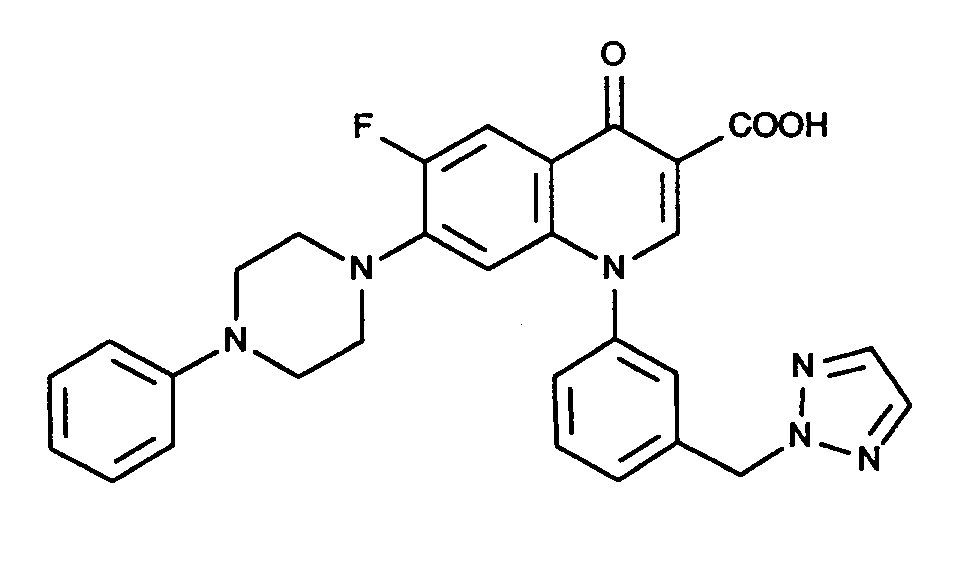
- 0,5 g (0,9 mmol) des im Beispiel 70 erhaltenen Esters werden mit 1,8 ml 1 N Natronlauge in einem Gemisch aus 9 ml Ethanol und 9 ml Wasser 1,5 Stunden auf 50°C erwärmt. Es wird mit verdünnter Salzsäure neutralisiert, die Lösungsmittel werden im Vakuum entfernt. Der Rückstand wird durch Säulenchromatographie (Kieselgel, Methylenchlorid/Methanol 9/1) gereinigt.
Ausbeute: 0,2 g (42% der Theorie)
Schmelzpunkt: 233-235°C
In Analogie zur Vorschrift des Beispiels 74 werden die in Tabelle 16 aufgeführten Verbindungen hergestellt:
-

- 0,5 g (1,2 mmol) 6,7-Difluor-1,4-dihydro-4-oxo-1-[3-(1H-1,2,4-triazol-1-yl-methyl)-phenyl]-3-chinolincarbonsäureethylester werden mit 190 mg (1,2 mmol) N-Phenylpiperazin und 460 mg (4,1 mmol) Diazabicyclo[2.2.2]octan in 12 ml Dimethylsulfoxid sechs Stunden auf 120°C erwärmt. Alle flüchtigen Komponenten werden im Hochvakuum entfernt, der Rückstand mit Wasser verrührt und bei ca 100°C getrocknet.
Ausbeute: 600 mg (89% der Theorie)
Schmelzpunkt: 160-162°C
In Analogie zur Vorschrift des Beispiels 78 werden die in Tabelle 17 aufgeführten Verbindungen hergestellt:
-

- 0,5 g (0,9 mmol) des im Beispiel 78 erhaltenen Esters werden mit 1,8 ml 1 N Natronlauge in einem Gemisch aus 9 ml Ethanol und 9 ml Wasser 1,5 Stunden auf 50°C erwärmt. Es wird mit verdünnter Salzsäure neutralisiert, die Lösungsmittel werden im Vakuum entfernt. Der Rückstand wird durch Säulenchromatographie (Kieselgel, Methylenchlorid/Methanol 9/1) gereinigt.
Ausbeute: 0,44 g (93% der Theorie)
Schmelzpunkt: 256-260°C
In Analogie zur Vorschrift des Beispiels 82 werden die in Tabelle 18 aufgeführten Verbindungen hergestellt:
-

- 0,5 g (1,2 mmol) 7-Chlor-6-fluor-1,4-dihydro-4-oxo-1-[3-(1H-1,2,4-triazol-1-yl-methyl)-phenyl]-1,8-naphthyridin-3-carbon-säureethylester werden mit 190 mg (1,2 mmol) N-Phenylpiperazin und 460 mg (4,1 mmol) Diazabicyclo[2.2.2]octan in 12 ml Dimethylsulfoxid vier Stunden auf 120°C erwärmt. Alle flüchtigen Komponenten werden im Hochvakuum entfernt. Der Rückstand wird mit Wasser verrührt und durch Säulenchromatographie (Kieselgel, Methylenchlorid/Methanol 9/1) gereinigt.
Ausbeute: 280 mg (43 % der Theorie)
Schmelzpunkt: 109-111°C
In Analogie zur Vorschrift des Beispiels 86 werden die in Tabelle 19 aufgeführten Verbindungen hergestellt:
-

- 0,25 g (0,4 mmol) des Esters aus Beispiel 46 werden mit 0,8 ml 1 N Natronlauge in einem Gemisch aus 4 ml Ethanol und 4 ml Wasser 1,5 Stunden auf 50°C erwärmt. Es wird mit verdünnter Salzsäure neutralisiert, die Losungsmittel werden im Vakuum entfernt. Der Rückstand wird durch Säulenchromatographie (Kieselgel, Methylenchlorid/Methanol 9/1) gereinigt.
Ausbeute: 0,21 mg (90% der Theorie)
Schmelzpunkt: 264-268°C (unter Zersetzung)
In Analogie zur Vorschrift des Beispiels 90 werden die in Tabelle 20 aufgeführten Verbindungen hergestellt:
-

- 0,5 g (1,2 mmol) 6,7-Difluor-1,4-dihydro-1-[3-(N-imidazolyl-methyl)-phenyl]-4-oxo-3-chinolincarbonsäureethylester werden mit 190 mg (1,2 mmol) N-Phenylpiperazin und 460 mg (4,1 mmol) Diazabicyclo[2.2.2]octan in 12 ml Dimethylsulfoxid vier Stunden auf 120°C erwärmt. Alle flüchtigen Komponenten werden im Hochvakuum entfernt, der Rückstand mit Wasser verrührt und bei ca 100°C getrocknet.
Ausbeute: 590 mg (88 % der Theorie)
Schmelzpunkt: 187-190°C
In Analogie zur Vorschrift des Beispiels 94 werden die in Tabelle 21 aufgeführten Verbindungen hergestellt:
-

- 0,5 g (0,9 mmol) des im Beispiel 95 erhaltenen Esters werden mit 1,8 ml 1 N Natronlauge in einem Gemisch aus 9 ml Ethanol und 9 ml Wasser 1,5 Stunden auf 50°C erwärmt. Es wird mit verdünnter Salzsäure neutralisiert, die Lösungsmittel werden im Vakuum entfernt. Der Rückstand wird durch Säulenchromatographie (Kieselgel, Methylenchlorid/Methanol 9/1) gereinigt.
Ausbeute: 0,45 g (95% der Theorie)
Schmelzpunkt: 207-210°C
In Analogie zur Vorschrift des Beispiels 98 werden die in Tabelle 22 aufgeführten Verbindungen hergestellt:
-

- 0,5 g (1,2 mmol) 6,7-Difluor-1,4-dihydro-4-oxo-1-[2-(1H-1,2,3-triazol-1-yl-methyl)-phenyl]-3-chinolincarbonsäureethylester werden mit 190 mg (1,2 mmol) N-Phenylpiperazin und 460 mg (4,1 mmol) Diazabicyclo[2.2.2]octan in 12 ml Dimethylsulfoxid drei Stunden auf 120°C erwärmt. Alle flüchtigen Komponenten werden im Hochvakuum entfernt, der Rückstand mit Wasser verrührt und bei ca 100°C getrocknet.
Ausbeute: 580 mg (86 % der Theorie)
Schmelzpunkt: 138-141°C
In Analogie zur Vorschrift des Beispiels 102 werden die in Tabelle 23 aufgeführten Verbindungen hergestellt:
-

- 0,5 g (0,9 mmol) des im Beispiel 102 erhaltenen Esters werden mit 1,8 ml 1 N Natronlauge in einem Gemisch aus 9 ml Ethanol und 9 ml Wasser 1,5 Stunden auf 50°C erwärmt. Es wird mit verdünnter Salzsäure neutralisiert, die Lösungsmittel werden im Vakuum entfernt. Der Rückstand wird durch Säulenchromatographie (Kieselgel, Methylenchlorid/Methanol 9/1) gereinigt.
Ausbeute: 83 mg (18% der Theorie)
Schmelzpunkt: 235-238°C
In Analogie zur Vorschrift des Beispiels 106 werden die in Tabelle 24 aufgeführten Verbindungen hergestellt:
-

- 0,5 g (1,2 mmol) 6,7-Difluor-1,4-dihydro-4-oxo-1-[2-(2H-1,2,3-triazol-2-yl-methyl)-phenyl]-3-chinolincarbonsäureethylester werden mit 190 mg (1,2 mmol) N-Phenylpiperazin und 460 mg (4,1 mmol) Diazabicyclo[2.2.2]octan in 12 ml Dimethylsulfoxid drei Stunden auf 120°C erwärmt. Alle flüchtigen Komponenten werden im Hochvakuum entfernt, der Rückstand mit Wasser verrührt und bei ca 100°C getrocknet.
Ausbeute: 590 mg (80 % der Theorie)
Schmelzpunkt: 198-200°C
In Analogie zur Vorschrift des Beispiels 110 werden die in Tabelle 25 aufgeführten Verbindungen hergestellt: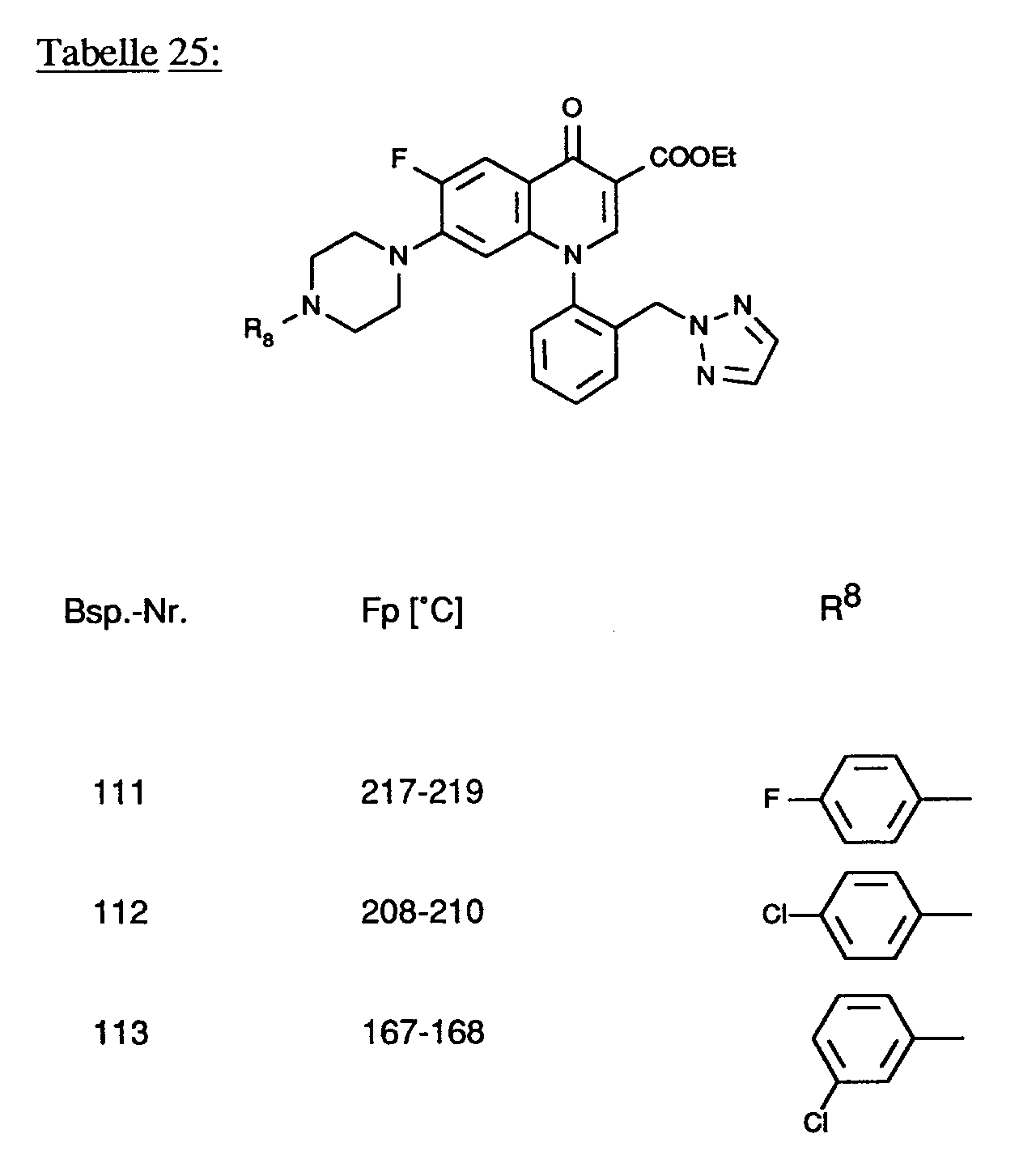
-

- 0,5 g (0,9 mmol) des im Beispiel 110 erhaltenen Esters werden mit 1,8 ml 1 N Natronlauge in einem Gemisch aus 9 ml Ethanol und 9 ml Wasser 1,5 Stunden auf 50°C erwärmt. Es wird mit verdünnter Salzsäure neutralisiert, die Losungsmittel werden im Vakuum entfernt. Der Rückstand wird durch Säulenchromatographie (Kieselgel, Methylenchlorid/Methanol 9/1) gereinigt.
Ausbeute: 280 mg (60% der Theorie)
Schmelzpunkt: 270-273°C
In Analogie zur Vorschrift des Beispiels 114 werden die in Tabelle 26 aufgeführten Verbindungen hergestellt:
-

- 0,5 g (1,2 mmol) 6,7-Difluor-1,4-dihydro-4-oxo-1-[2-(1H-1,2,4-triazol-1-yl-methyl)-phenyl]-3-chinolincarbonsäureethylester werden mit 190 mg (1,2 mmol) N-Phenylpiperazin und 460 mg (4,1 mmol) Diazabicyclo[2.2.2]octan in 12 ml Dimethylsulfoxid vier Stunden auf 120°C erwärmt. Alle flüchtigen Komponenten werden im Hochvakuum entfernt, der Rückstand mit Wasser verrührt und bei ca 100°C getrocknet.
Ausbeute: 420 mg (62 % der Theorie)
Schmelzpunkt: 214-217°C
In Analogie zur Vorschrift des Beispiels 118 werden die in Tabelle 27 aufgeführten Verbindungen hergestellt:
-

- 0,35 g (0,6 mmol) des im Beispiel 118 erhaltenen Esters werden mit 1,2 ml 1 N Natronlauge in einem Gemisch aus 6 ml Ethanol und 6 ml Wasser zwei Stunden auf 50°C erwärmt. Es wird mit verdünnter Salzsäure neutralisiert, die Lösungsmittel werden im Vakuum entfernt. Der Rückstand wird durch Säulenchromatographie (Kieselgel, Methylenchlorid/Methanol 9/1) gereinigt.
Ausbeute: 280 mg (89% der Theorie)
Schmelzpunkt: 270-274°C
In Analogie zur Vorschrift des Beispiels 122 werden die in Tabelle 28 aufgeführten Verbindungen hergestellt:
-

- 0,5 g (1,2 mmol) 6,7-Difluor-1,4-dihydro-1-[2-(N-imidazolyl-methyl)-phenyl]-4-oxo-3-chinolincarbonsäureethylester werden mit 190 mg (1,2 mmol) N-Phenylpiperazin und 460 mg (4,1 mmol) Diazabicyclo[2.2.2]octan in 12 ml Dimethylsulfoxid zwei Stunden auf 120°C erwärmt. Alle flüchtigen Komponenten werden im Hochvakuum entfernt, der Rückstand mit Wasser verrührt und bei ca 100°C getrocknet.
Ausbeute: 470 mg (71 % der Theorie)
Schmelzpunkt: 117-119°C
In Analogie zur Vorschrift des Beispiels 126 werden die in Tabelle 29 aufgeführten Verbindungen hergestellt:
-

- 0,4 g (0,7 mmol) des im Beispiel 126 erhaltenen Esters werden mit 1,4 ml 1 N Natronlauge in einem Gemisch aus 7 ml Ethanol und 7 ml Wasser 1,5 Stunden auf 50°C erwärmt. Es wird mit verdünnter Salzsäure neutralisiert, die Lösungsmittel werden im Vakuum entfernt. Der Rückstand wird durch Säulenchromatographie (Kieselgel, Methylenchlorid/Methanol 9/1) gereinigt.
Ausbeute: 0,29 g (79% der Theorie)
Schmelzpunkt: 260-263°C
In Analogie zur Vorschrift des Beispiels 130 werden die in Tabelle 30 aufgeführten Verbindungen hergestellt:
-

- 300 mg (0,75 mmol) 6,7,8-Trifluor-1,4-dihydro-4-oxo-1-[4-(1H-1,2,3-triazol-1-yl-methyl)-phenyl]-3-chinolincarbonsäure werden mit 410 mg (2,25 mmol) N-(4-Fluorphenyl)-piperazin in 8 ml DMSO auf 100°C erwärmt. Alle flüchtigen Komponenten werden im Hochvakuum entfernt, der Rückstand mit iso-Propanol verrührt und der anfallende Feststoff isoliert. Es wird nochmals mit iso-Propanol und Diethylether gewaschen und bei ca 100°C getrocknet.
Ausbeute: 387 mg (92% der Theorie)
Schmelzpunkt: 222-224°C
In Analogie zur Vorschrift des Beispiels 134 werden die in Tabelle 31 aufgeführten Verbindungen hergestellt:
-

- Analog zum Beispiel 134 wird bei der Umsetzung von 8-Chlor-6,7-difluor-1,4-dihydro-4-oxo-1-[4-(1H-1,2,3-triazol-1-yl-methyl)-phenyl]-3-chinolincarbonsäure mit N-(4-Fluorphenyl)-piperazin die Titelverbindung erhalten.
Schmelzpunkt: 128-130°C -

- Analog zum Beispiel 134 wird bei der Umsetzung von 8-Chlor-6,7-difluor-1,4-dihydro-4-oxo-1-[4-(1H-1,2,3-triazol-1-yl-methyl)-phenyl]-3-chinolincarbonsäure mit N-(2-Chlorphenyl)-piperazin die Titelverbindung erhalten.
Schmelzpunkt: 158-160°C -

- Analog zum Beispiel 134 wird bei der Umsetzung von 8-Chlor-6,7-difluor-1,4-dihydro-4-oxo-1-[4-(2H-1,2,3-triazol-2-yl-methyl)-phenyl]-3-chinolincarbonsäure mit N-(4-Fluorphenyl)-piperazin die Titelverbindung erhalten.
Schmelzpunkt: 213-215°C -

- Analog zum Beispiel 134 wird bei der Umsetzung von 8-Chlor-6,7-difluor-1,4-dihydro-4-oxo-1-[4-(2H-1,2,3-triazol-2-yl-methyl)-phenyl]-3-chinolincarbonsäure mit N-(2-Chlorphenyl)-piperazin die Titelverbindung erhalten.
Schmelzpunkt: 228-230°C (unter Zersetzung)
In Analogie zur Vorschrift des Beispiels 144 werden bei der Umsetzung von 6,7,8-Trifluor-1,4-dihydro-4-oxo-1-[4-(1H-1,2,4-triazol-1-yl-methyl)-phenyl]-3-chinolincarbonsäure die folgenden Produkte erhalten:
-

- Analog zum Beispiel 134 wird bei der Umsetzung von 8-Chlor-6,7-difluor-1,4-dihydro-4- oxo-1-[4-(1H-1,2,4-triazol-1-yl-methyl)-phenyl]-3-chinolincarbonsäure mit N-(4-Fluorphenyl)-piperazin die Titelverbindung erhalten.
Schmelzpunkt: 248-250°C -

- Analog zum Beispiel 134 wird bei der Umsetzung von 8-Chlor-6,7-difluor-1,4-dihydro-4-oxo-1-[4-(1H-1,2,4-triazol-1-yl-methyl)-phenyl]-3-chinolincarbonsäure mit N-(2-Chlorphenyl)-piperazin die Titelverbindung erhalten. Schmelzpunkt: 248-250°C
-

- 1,32 g (3 mmol) 6-Fluor-1,4-dihydro-4-oxo-7-[4-(4-fluorphenyl)-piperazin-1-yl]-1-[4-(1H-1,2,3-triazol-1-yl-methyl)-phenyl]-3-chinolincarbonsäure werden in 10 ml Aceton bei 0°C mit 0,46 ml (3,3 mmol) Triethylamin versetzt. Anschließend tropft man bei dieser Temperatur innerhalb von 30 Minuten 0,34 ml Chlorameisensäureethylester zu. Nach Zugabe von 0,30 ml (3,6 mmol) Propylamin wird 1,5 Stunden unter Rückfluß gekocht.
- Zur Aufarbeitung gibt man auf gesättigte Natriumhydrogencarbonatlösung, extrahiert mit Methylenchlorid und trocknet über Natriumsulfat. Das eingedampfte Rohprodukt wird an Kieselgel(Methylenchlorid/Methanol 96/4) chromatographiert
Ausbeute: 0,8 g (57% der Theorie)
Schmelzpunkt: 202-204°C - In Analogie zur Vorschrift des Beispiels 152 werden die in Tabelle 33 aufgeführten Verbindungen hergestellt:

-

- 0,44 g (1,0 mmol) 6-Fluor-1,4-dihydro-4-oxo-7-[4-(4-fluorphenyl)piperazin-1-yl]-1-[4-(1H-1,2,3-triazol-1-yl-methyl)-phenyl]-3-chinolincarbonsäure werden in 10 ml Aceton bei 0°C mit 0,14 ml (1,2 mmol) Triethylamin versetzt. Anschließend tropft man bei dieser Temperatur innerhalb von 30 Minuten 0,14 ml (1,2 mmol) Chlorameisensäureethylester zu. Nach Zugabe von 0,30 ml (3,6 mmol) Benzylalkohol wird 2 Stunden unter Rückfluß gekocht. Zur Aufarbeitung gibt man auf gesättigte Natriumhydrogencarbonatlösung und extrahiert mit Essigester. Die vereinigten organischen Phasen werden mit gesättigter Natriumchloridlösung gewaschen und über Natriumsulfat getrocknet. Das eingedampfte Rohprodukt wird an Kieselgel 60 (Laufmittel: Methylenchlorid/Methanol = 9/1) chromatographiert.
Ausbeute: 0,35 g (55% der Theorie)
Schmelzpunkt: 226-228°C
In Analogie zur Vorschrift des Beispiels 157 werden die in Tabelle 34 aufgeführten Verbindungen hergestellt:
-

- 0,5 g (1,2 mmol) 7-Chlor-1,4-dihydro-4-oxo-1-[4-(1H-1,2,4-triazol-1-yl-methyl)-phenyl]-1,8-naphthyridin-3-carbonsäureethylester werden mit 0,58 g (3,6 mmol) N-Methylpiperazin in 12 ml Dimethylsulfoxid über Nacht bei Raumtemperatur gerührt. Alle flüchtigen Komponenten werden im Hochvakuum entfernt. Der Rückstand wird auf Wasser gegeben und mit Dichlormethan extrahiert. Das nach dem Einrotieren erhaltene Rohprodukt wird an Kieselgel (Laufmittel Dichlormethan/Methanol 96/4) gereinigt.
Ausbeute: 475 mg (73% d.Th.)
Schmp.: 170-171°C -

- Analog zum Beispiel 162 wird bei der Umsetzung mit 1-(4-Fluorphenyl)piperazin die Titelverbindung erhalten.
Schmp.: 176-178°C -

- 0,45 g (0,84 mmol) des im Beispiel 162 erhaltenen Esters werden mit 1,68 ml 1 N Natronlauge in einem Gemisch aus 8 ml Ethanol und 8 ml Wasser eine Stunde bei 50°C gerührt. Es wird mit verdünnter Salzsäure neutralisiert und die Lösemittel im Vakuum entfernt. Der Rückstand wird an Kieselgel (Laufmittel Dichlormethan / Methanol 96/4) gereinigt.
Ausbeute: 158 mg (37% d.Th.)
Schmp.: 286-287°C -

- Analog zum Beispiel 164 wird bei der Umsetzung des Esters aus Beispiel 163 die Titelverbindung erhalten.
Schmp.: 284-285°C
worin
und im Fall der Säuren die Ester verseift,
und im Fall der Ester die Säuren nach üblichen Methoden mit den entsprechenden Alkoholen umsetzt,
und im Fall der Amide die Säuren, gegebenenfalls nach vorgeschalteter Aktivierung und in Anwesenheit einer Base und/oder Hilfsstoffes, amidiert.

in welcher
in die Verbindungen der allgemeinen Formel (VI)

in welcher
und im Fall D ≠ H, diese Substituenten nach üblichen Methoden variiert.
Claims (9)
- Chinolon- und Naphthyridoncarbonsäurederivate der allgemeinen Formel (I)
 R¹ für Wasserstoff, Hydroxy, Mercapto, Halogen, geradkettiges oder verzweigtes Alkyl mit bis zu 3 Kohlenstoffatomen, Perfluoralkyl mit bis zu 3 Kohlenstoffatomen, geradkettiges oder verzweigtes Alkoxy oder Alkylthio mit jeweils bis zu 6 Kohlenstoffatomen, Arylthio mit 6 bis 10 Kohlenstoffatomen oder
für die Gruppe der Formel -NR⁷R⁸ steht,
worinR⁷ und R⁸ gleich oder verschieden sind und Wasserstoff oder geradkettiges oder verzweigtes Alkyl mit bis zu 6 Kohlenstoffatomen bedeuten,R² für Wasserstoff, Nitro oder Halogen steht,R³ für einen Rest der Formel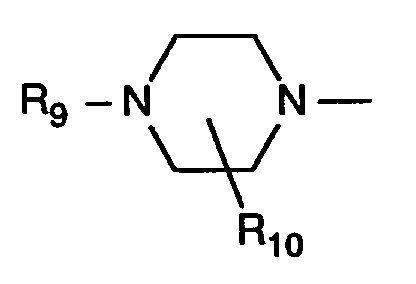
worinR⁹ und R¹⁰ gleich oder verschieden sind und Wasserstoff, geradkettiges oder verzweigtes Alkyl mit bis zu 6 Kohlenstoffatomen oder
einen Rest der Formel
worinR¹¹, R¹² und R¹³ gleich oder verschieden sind und Wasserstoff, Halogen, Nitro, Hydroxy, Cyano, Mercapto, Arylthlo mit 6 bis 10 Kohlenstoffatomen, geradkettiges oder verzweigtes Alkyl, Alkoxy, Acyl oder Alkylthio mit jeweils bis zu 6 Kohlenstoffatomen oder Perfluoralkyl mit bis zu 4 Kohlenstoffatomen bedeuten,A für ein Stickstoffatom oder für die Gruppe der Formel -CR¹⁴ steht,
worinR¹⁴ Wasserstoff, Halogen, Methyl, Hydroxy, Methoxy, Vinyl oder Alkinyl bedeutet,R⁴ für einen Rest der Formel
worina eine Zahl 1, 2, 3 oder 4 bedeutet,R¹⁵ und R¹⁶ gemeinsam mit dem Stickstoffatom einen Imidazolyl-, Pyrrolyl-, 1,2,3-Triazol-1-yl, 1,2,3-Triazol-2-yl, 1,2,4-Triazol-1-yl- bzw. 1,2,4-Triazol-4-yl- oder Tetrazolylring bilden,R⁵ für Wasserstoff, Hydroxy, Halogen oder für geradkettiges oder verzweigtes Alkyl oder Alkoxy mit jeweils bis zu 6 Kohlenstoffatomen steht,R⁶ für Hydroxy, Benzyloxy, Morpholino oder geradketttiges oder verzweigtes Alkoxy mit bis zu 6 Kohlenstoffatomen steht, wobei letzteres bis zu 3-fach gleich oder verschieden durch Halogen, Hydroxy oder durch einen heterocyclischen Rest der Formel
für eine Gruppe der Formel -NR¹⁷R¹⁸ steht,
worinR¹⁷ und R¹⁸ gleich oder verschieden sind und Wasserstoff oder geradkettiges oder verzweigtes Alkyl mit bis zu 8 Kohlenstoffatomen bedeuten, das gegebenenfalls bis zu 3-fach gleich oder verschieden durch Hydroxy oder durch geradkettiges oder verzweigtes Alkoxy mit bis zu 6 Kohlenstoffatomen substituiert ist,
oderR⁶ für einen Rest der Formel
worinR¹⁹ Wasserstoff oder geradkettiges oder verzweigtes Alkyl mit bis zu 4 Kohlenstoffatomen bedeutet,D für Wasserstoff, Amino, Phenyl, Cyano, Hydroxy oder für geradkettiges oder verzweigtes Alkenyl, Alkylthio oder Alkoxycarbonyl mit jeweils bis zu 6 Kohlenstoffatomen steht, oder für geradkettiges oder verzweigtes Alkyl mit bis zu 6 Kohlenstoffatomen steht, das gegebenenfalls durch geradkettiges oder verzweigtes Alkoxycarbonyl mit bis zu 4 Kohlenstoffatomen substituiert istund deren Hydrate und Salze, gegebenenfalls in einer isomeren Form. - Verbindungen der allgemeinen Formel (I) gemäß Anspruch 1,
in welcherR¹ für Wasserstoff, Hydroxy, Mercapto, Fluor, Chlor, Brom, geradkettiges oder verzweigtes Alkyl mit bis zu 3 Kohlenstoffatomen, Trifluormethyl, geradkettiges oder verzweigtes Alkoxy oder Alkylthio mit jeweils bis zu 4 Kohlenstoffatomen, Phenylthio oder für die Gruppe der Formel -NR⁷R⁸ steht,
worinR⁷ und R⁸ gleich oder verschieden sind und Wasserstoff oder geradkettiges oder verzweigtes Alkyl mit bis zu 4 Kohlenstoffatomen bedeuten,R² für Wasserstoff, Nitro, Fluor, Chlor oder Brom steht,R³ für einen Rest der Formel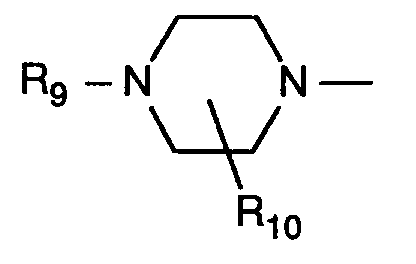
worinR⁹ und R¹⁰ gleich oder verschieden sind und Wasserstoff, geradkettiges oder verzweigtes Alkyl mit bis zu 4 Kohlenstoffatomen bedeuten, oder
einen Rest der Formel
worinR¹¹, R¹² und R¹³ gleich oder verschieden sind und Wasserstoff, Fluor, Chlor, Brom, Nitro, Hydroxy, Cyano, Phenylthio, geradkettiges oder verzweigtes Alkyl, Alkoxy, Acyl oder Alkylthio mit jeweils bis zu 4 Kohlenstoffatomen oder Trifluormethyl bedeuten,A für ein Stickstoffatom oder für die Gruppe der Formel -CR¹⁴ steht,
worinR¹⁴ Wasserstoff, Fluor, Chlor, Brom, Methyl, Hydroxy, Methoxy, Vinyl oder Alkinyl bedeutet,R⁴ für einen Rest der Formel
worina eine Zahl 1, 2 oder 3 bedeutet,R¹⁵ und R¹⁶ gemeinsam mit dem Stickstoffatom einen Imidazolyl-, Pyrrolyl-, 1,2,3-Triazol-1-yl-, 1,2,3-Triazol-2-yl, 1,2,4-Triazol-1-yl- bzw. 1,2,4-Triazol-4-yl- oder Tetrazolylring bilden,R⁵ für Wasserstoff, Hydroxy, Fluor, Chlor, Brom oder für geradkettiges oder verzweigtes Alkyl oder Alkoxy mit jeweils bis zu 4 Kohlenstoffatomen steht,R⁶ für Hydroxy, Benzyloxy, Morpholino oder geradketttiges oder verzweigtes Alkoxy mit bis zu 5 Kohlenstoffatomen steht, wobei letzteres bis zu 2-fach gleich oder verschieden durch Halogen, Hydroxy oder durch einen heterocyclischen Rest der Formel
worinR¹⁷ und R¹⁸ gleich oder verschieden sind und Wasserstoff oder geradkettiges oder verzweigtes Alkyl mit bis zu 6 Kohlenstoffatomen bedeuten, das gegebenenfalls bis zu 2-fach gleich oder verschieden durch Hydroxy oder durch geradkettiges oder verzweigtes Alkoxy mit bis zu 6 Kohlenstoffatomen substituiert ist,
oderR⁶ für einen Rest der Formel
worinR¹⁹ Wasserstoff oder geradkettiges oder verzweigtes Alkyl mit bis zu 4 Kohlenstoffatomen bedeutet,
undD für Methyl, Vinyl, Phenyl oder Wasserstoff steht,und deren Hydrate und Salze, gegebenenfalls in einer isomeren Form. - Verbindungen der allgemeinen Formel (I) gemäß Anspruch 1, in welcherR¹ für Wasserstoff, Fluor, Chlor, Brom oder Methyl steht,R² für Wasserstoff, Fluor oder Chlor steht,R³ für einen Rest der Formel

worinR⁹ und R¹⁰ gleich oder verschieden sind und Wasserstoff, geradkettiges oder verzweigtes Alkyl mit bis zu 4 Kohlenstoffatomen bedeuten, oder einen Rest der Formel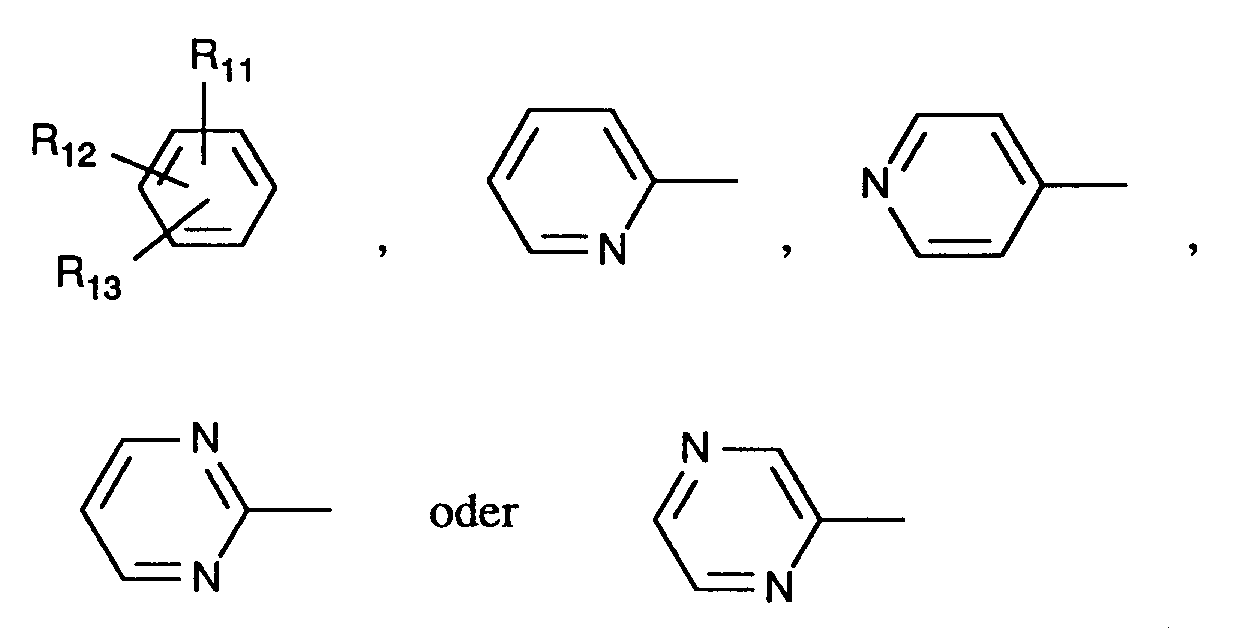
worinR¹¹, R¹² und R¹³ gleich oder verschieden sind und Wasserstoff, Fluor, Chlor, Brom, Nitro, Hydroxy, Cyano, Phenylthio, geradkettiges oder verzweigtes Alkyl, Alkoxy, Acyl oder Alkylthio mit jeweils bis zu 3 Kohlenstoffatomen oder Trifluormethyl bedeuten,A für ein Stickstoffatom oder für die Gruppe der Formel -CR¹⁴ steht,
worinR¹⁴ Wasserstoff, Fluor oder Chlor bedeutet,R⁴ für einen Rest der Formel
worinR¹⁵ und R¹⁶ gemeinsam mit dem Stickstoffatom einen Imidazolyl-, Pyrrolyl-, 1,2,3-Triazol-1-yl-, 1,2,3-Triazol-2-yl, 1,2,4-Triazol-1-yl- bzw. 1,2,4-Triazol-4-yl-Ring bilden,R⁵ für Wasserstoff steht,R⁶ für Hydroxy, Benzyloxy, Morpholino oder geradkettiges oder verzweigtes Alkoxy mit bis zu 4 Kohlenstoffatomen steht, wobei letzteres gegebenenfalls durch Fluor, Chlor, Brom, Hydroxy oder durch einen Rest der Formel
für eine Gruppe der Formel -NR¹⁷R¹⁸ steht,
worinR¹⁷ und R¹⁸ gleich oder verschieden sind und Wasserstoff oder geradkettiges oder verzweigtes Alkyl mit bis zu 4 Kohlenstoffatomen bedeuten, das gegebenenfalls bis zu 2-fach gleich oder verschieden durch Hydroxy oder durch geradkettiges oder verzweigtes Alkoxy mit bis zu 6 Kohlenstoffatomen substituiert ist,
oderR⁶ für einen Rest der Formel
worinR¹⁹ Wasserstoff oder geradkettiges oder verzweigtes Alkyl mit bis zu 3 Kohlenstoffatomen bedeutet,
undD für Wasserstoff steht,und deren Hydrate und Salze, gegebenenfalls in einer isomeren Form. - Verfahren zur Herstellung der Verbindungen der allgemeinen Formel (I) gemäß Anspruch 1, dadurch gekennzeichnet, daß man
Verbindungen der allgemeinen Formel (II) R¹, R², R⁴, R⁵, R⁶, A und D die oben angegebene Bedeutung haben
undE für Halogen, vorzugsweise für Chlor und Fluor steht,mit Verbindungen der allgemeinen Formel (III)
R³-H (III)
in welcherR³ die oben angegebene Bedeutung hat,in inerten Lösemitteln, gegebenenfalls in Anwesenheit von Säurefängern umsetzt,
und im Fall der Säuren die Ester verseift,
und im Fall der Ester die Säuren nach üblichen Methoden mit den entsprechenden Alkoholen umsetzt,
und im Fall der Amide die Säuren, gegebenenfalls nach vorgeschalteter Aktivierung und in Anwesenheit einer Base und/oder Hilfsstoffes, amidiert. - Arzneimittel enthaltend eine oder mehrere Verbindungen aus den Ansprüchen 1 bis 3.
- Verwendung der Verbindungen aus den Ansprüchen 1 bis 3 zur Herstellung von Arzneimitteln.
- Verbindungen der allgemeinen Formel (II)
 R¹, R², R⁴, R⁵, R⁶, A und D die in den Ansprüchen 1 bis 3 angegebene Bedeutung haben
undE für Halogen, vorzugsweise für Chlor und Fluor steht. - Verfahren zur Herstellung der Verbindungen der allgemeinen Formel (II), dadurch gekennzeichnet, daß man zunächst Verbindungen der allgemeinen Formel (IV)
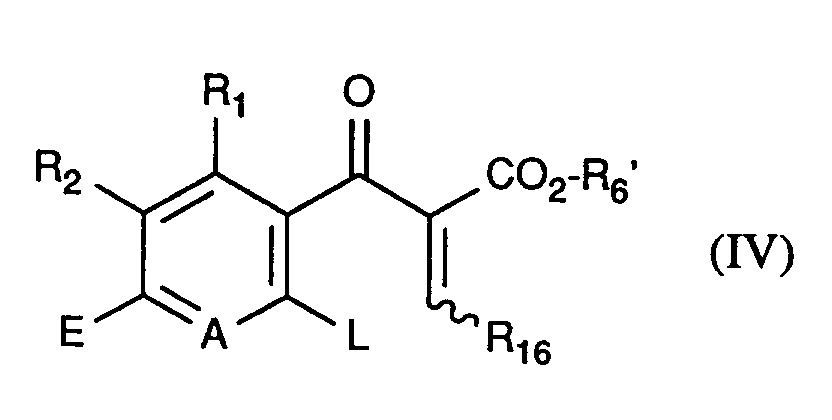 R¹, R², A und E die in Anspruch 7 angegebene Bedeutung haben,L für Halogen, vorzugsweise für Chlor oder Fluor steht,R6' für C₁-C₄-Alkyl stehtundR¹⁶ für C₁-C₄-Alkoxy oder C₁-C₄-Dialkylamino steht, durch Umsetzung mit Aminen der allgemeinen Formel (V)
 R⁴ und R⁵ die oben angegebene Bedeutung haben,in einem der oben aufgeführten Lösemittel, vorzugsweise Ethanol,
in die Verbindungen der allgemeinen Formel (VI) R¹, R², R⁴, R⁵, A, E, L und R6' die oben angegebene Bedeutung haben,überführt, und in einem letzten Schritt in einem der oben aufgeführten Lösemittel und einer dort genannten Base, vorzugsweise DMF und K₂CO₃/KF cyclisiert,
und im Fall D ≠ H, diese Substituenten nach üblichen Methoden variiert. - Verbindungen der allgemeinen Formel (VI)
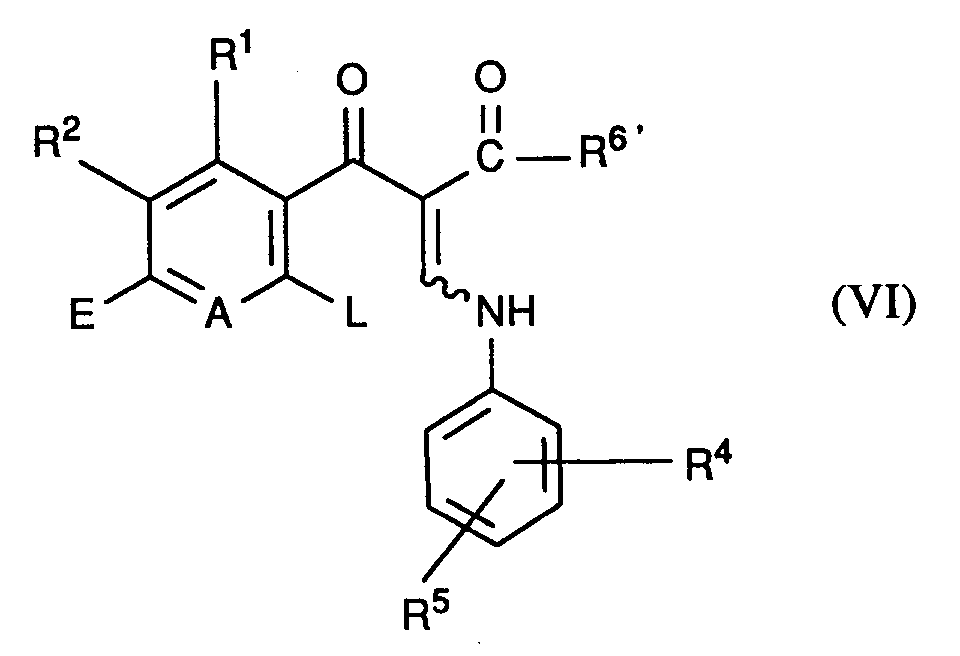 R¹, R², R⁴, R⁵, A, E, L und R6' die oben angegebene Bedeutung haben.
Applications Claiming Priority (2)
| Application Number | Priority Date | Filing Date | Title |
|---|---|---|---|
| DE4303657 | 1993-02-09 | ||
| DE4303657A DE4303657A1 (de) | 1993-02-09 | 1993-02-09 | Neue Chinolon- und Naphthyridoncarbonsäurederivate |
Publications (2)
| Publication Number | Publication Date |
|---|---|
| EP0612731A1 true EP0612731A1 (de) | 1994-08-31 |
| EP0612731B1 EP0612731B1 (de) | 1997-08-20 |
Family
ID=6479930
Family Applications (1)
| Application Number | Title | Priority Date | Filing Date |
|---|---|---|---|
| EP94101223A Expired - Lifetime EP0612731B1 (de) | 1993-02-09 | 1994-01-27 | Neue Chinolon- und Naphthyridoncarbonsäurederivate |
Country Status (15)
| Country | Link |
|---|---|
| EP (1) | EP0612731B1 (de) |
| JP (1) | JPH06271570A (de) |
| KR (1) | KR940019702A (de) |
| AT (1) | ATE157088T1 (de) |
| AU (1) | AU670470B2 (de) |
| CA (1) | CA2115021A1 (de) |
| DE (2) | DE4303657A1 (de) |
| DK (1) | DK0612731T3 (de) |
| ES (1) | ES2105362T3 (de) |
| GR (1) | GR3024686T3 (de) |
| HU (1) | HUT70044A (de) |
| IL (1) | IL108571A0 (de) |
| NZ (1) | NZ250823A (de) |
| TW (1) | TW248559B (de) |
| ZA (1) | ZA94841B (de) |
Cited By (10)
| Publication number | Priority date | Publication date | Assignee | Title |
|---|---|---|---|---|
| WO1997034894A1 (en) * | 1996-03-15 | 1997-09-25 | Biochem Pharma Inc. | Naphthyridine derivatives and their analogues inhibiting cytomegalovirus |
| US5939439A (en) * | 1996-12-30 | 1999-08-17 | Merck & Co., Inc. | Inhibitors of farnesyl-protein transferase |
| US5945431A (en) * | 1996-03-15 | 1999-08-31 | Biochem Therapeutics Incorporated | Cytomegalovirus inhibiting compounds |
| US6093737A (en) * | 1996-12-30 | 2000-07-25 | Merck & Co., Inc. | Inhibitors of farnesyl-protein transferase |
| US6127390A (en) * | 1997-10-02 | 2000-10-03 | Merck & Co., Inc. | Inhibitors of prenyl-protein transferase |
| US6653307B2 (en) | 2000-06-16 | 2003-11-25 | Pharmacia & Upjohn Company | 1-aryl-4-oxo-1,4-dihydro-3-quinolinecarboxamides as antiviral agents |
| US7109196B2 (en) | 2001-09-26 | 2006-09-19 | Bayer Pharmaceuticals Corporation | 1,8 Naphthyridine derivatives and their use to treat diabetes and related disorders |
| WO2007003308A1 (de) * | 2005-06-30 | 2007-01-11 | Aicuris Gmbh & Co. Kg | Substituierte chinolone ii |
| US7867992B2 (en) | 2004-07-21 | 2011-01-11 | Aicuris Gmbh & Co. Kg | Substituted quinolones |
| US7977349B2 (en) | 2006-02-09 | 2011-07-12 | Aicuris Gmbh & Co. Kg | Substituted quinolones III |
Families Citing this family (9)
| Publication number | Priority date | Publication date | Assignee | Title |
|---|---|---|---|---|
| SI9300097B (en) * | 1992-02-27 | 2001-12-31 | Janssen Pharmaceutica Nv | (benzodioxan, benzofuran or benzopyran) alkylamino) alkyl substituted guanidines |
| DE4425647A1 (de) * | 1994-07-20 | 1996-01-25 | Bayer Ag | Heterocyclyl-1-phenyl substituierte Chinoloncarbonsäuren |
| DE4425650A1 (de) * | 1994-07-20 | 1996-01-25 | Bayer Ag | Substituierte Triazolylmethylphenylnaphthyridone |
| DE4425659A1 (de) * | 1994-07-20 | 1996-01-25 | Bayer Ag | Neue N1-diverse 6-Fluor-8-difluormethoxy substituierte Chinoloncarbonsäuren |
| DE4425660A1 (de) * | 1994-07-20 | 1996-01-25 | Bayer Ag | 7-substituierte 1-[4-(1H-1,2,4-triazol-1-yl-methyl)phenyl] substituierte Chinoloncarbonsäuren |
| DE4425648A1 (de) * | 1994-07-20 | 1996-01-25 | Bayer Ag | Neue 6 und 6,8-substituierte 1-[4-(1H-1,2,4-triazol-l-yl-methyl)phenyl] Chinoloncarbonsäuren |
| DE4425649A1 (de) * | 1994-07-20 | 1996-01-25 | Bayer Ag | Neue 1-[4-(Aminomethyl)phenyl] substituierte Chinoloncarbonsäuren |
| WO1999042106A1 (fr) * | 1998-02-19 | 1999-08-26 | Sankyo Company, Limited | Agent anti-hcmv |
| ES2291642T3 (es) * | 2002-01-17 | 2008-03-01 | MERCK & CO., INC. | Hidroxinaftiridinoncarboxamidas utiles como inhibidores de la integrasa de vih. |
Citations (4)
| Publication number | Priority date | Publication date | Assignee | Title |
|---|---|---|---|---|
| EP0131839A1 (de) * | 1983-07-18 | 1985-01-23 | Abbott Laboratories | Antibakterielle Chinolin-Verbindungen |
| WO1990013542A1 (en) * | 1989-04-28 | 1990-11-15 | Daiichi Pharmaceutical Co., Ltd. | Anti-hiv drug |
| EP0422485A2 (de) * | 1989-10-12 | 1991-04-17 | Bayer Ag | Chinoloncarbonsäurederivate, Verfahren zu ihrer Herstellung sowie ihre Verwendung als antivirale Mittel |
| EP0523512A1 (de) * | 1991-07-19 | 1993-01-20 | Bayer Ag | 8-Vinyl- und 8-Ethinyl-chinoloncarbonsäuren |
-
1993
- 1993-02-09 DE DE4303657A patent/DE4303657A1/de not_active Withdrawn
-
1994
- 1994-01-12 AU AU53148/94A patent/AU670470B2/en not_active Ceased
- 1994-01-27 AT AT94101223T patent/ATE157088T1/de not_active IP Right Cessation
- 1994-01-27 DE DE59403757T patent/DE59403757D1/de not_active Expired - Fee Related
- 1994-01-27 EP EP94101223A patent/EP0612731B1/de not_active Expired - Lifetime
- 1994-01-27 ES ES94101223T patent/ES2105362T3/es not_active Expired - Lifetime
- 1994-01-27 DK DK94101223.9T patent/DK0612731T3/da active
- 1994-01-28 TW TW083100712A patent/TW248559B/zh active
- 1994-02-04 CA CA002115021A patent/CA2115021A1/en not_active Abandoned
- 1994-02-04 NZ NZ250823A patent/NZ250823A/en unknown
- 1994-02-04 JP JP6032000A patent/JPH06271570A/ja active Pending
- 1994-02-07 IL IL10857194A patent/IL108571A0/xx unknown
- 1994-02-08 HU HU9400352A patent/HUT70044A/hu unknown
- 1994-02-08 ZA ZA94841A patent/ZA94841B/xx unknown
- 1994-02-08 KR KR1019940002423A patent/KR940019702A/ko not_active Withdrawn
-
1997
- 1997-09-10 GR GR970402334T patent/GR3024686T3/el unknown
Patent Citations (4)
| Publication number | Priority date | Publication date | Assignee | Title |
|---|---|---|---|---|
| EP0131839A1 (de) * | 1983-07-18 | 1985-01-23 | Abbott Laboratories | Antibakterielle Chinolin-Verbindungen |
| WO1990013542A1 (en) * | 1989-04-28 | 1990-11-15 | Daiichi Pharmaceutical Co., Ltd. | Anti-hiv drug |
| EP0422485A2 (de) * | 1989-10-12 | 1991-04-17 | Bayer Ag | Chinoloncarbonsäurederivate, Verfahren zu ihrer Herstellung sowie ihre Verwendung als antivirale Mittel |
| EP0523512A1 (de) * | 1991-07-19 | 1993-01-20 | Bayer Ag | 8-Vinyl- und 8-Ethinyl-chinoloncarbonsäuren |
Cited By (13)
| Publication number | Priority date | Publication date | Assignee | Title |
|---|---|---|---|---|
| WO1997034894A1 (en) * | 1996-03-15 | 1997-09-25 | Biochem Pharma Inc. | Naphthyridine derivatives and their analogues inhibiting cytomegalovirus |
| GB2326412A (en) * | 1996-03-15 | 1998-12-23 | Iaf Biochem Int | Naphthyridine derivatives and their analogues inhibiting cytomegalovirus |
| US5945431A (en) * | 1996-03-15 | 1999-08-31 | Biochem Therapeutics Incorporated | Cytomegalovirus inhibiting compounds |
| US5939439A (en) * | 1996-12-30 | 1999-08-17 | Merck & Co., Inc. | Inhibitors of farnesyl-protein transferase |
| US6077853A (en) * | 1996-12-30 | 2000-06-20 | Merck & Co., Inc. | Inhibitors of farnesyl-protein transferase |
| US6093737A (en) * | 1996-12-30 | 2000-07-25 | Merck & Co., Inc. | Inhibitors of farnesyl-protein transferase |
| US6127390A (en) * | 1997-10-02 | 2000-10-03 | Merck & Co., Inc. | Inhibitors of prenyl-protein transferase |
| US6653307B2 (en) | 2000-06-16 | 2003-11-25 | Pharmacia & Upjohn Company | 1-aryl-4-oxo-1,4-dihydro-3-quinolinecarboxamides as antiviral agents |
| US7109196B2 (en) | 2001-09-26 | 2006-09-19 | Bayer Pharmaceuticals Corporation | 1,8 Naphthyridine derivatives and their use to treat diabetes and related disorders |
| US7867992B2 (en) | 2004-07-21 | 2011-01-11 | Aicuris Gmbh & Co. Kg | Substituted quinolones |
| WO2007003308A1 (de) * | 2005-06-30 | 2007-01-11 | Aicuris Gmbh & Co. Kg | Substituierte chinolone ii |
| US7569563B2 (en) | 2005-06-30 | 2009-08-04 | Aicuris Gmbh & Co. Hk | Substituted quinolones II |
| US7977349B2 (en) | 2006-02-09 | 2011-07-12 | Aicuris Gmbh & Co. Kg | Substituted quinolones III |
Also Published As
| Publication number | Publication date |
|---|---|
| ZA94841B (en) | 1994-09-05 |
| TW248559B (de) | 1995-06-01 |
| DE59403757D1 (de) | 1997-09-25 |
| HUT70044A (en) | 1995-09-28 |
| HU9400352D0 (en) | 1994-05-30 |
| IL108571A0 (en) | 1994-05-30 |
| CA2115021A1 (en) | 1994-08-10 |
| ATE157088T1 (de) | 1997-09-15 |
| JPH06271570A (ja) | 1994-09-27 |
| EP0612731B1 (de) | 1997-08-20 |
| GR3024686T3 (en) | 1997-12-31 |
| AU670470B2 (en) | 1996-07-18 |
| NZ250823A (en) | 1995-04-27 |
| KR940019702A (ko) | 1994-09-14 |
| DK0612731T3 (da) | 1998-03-23 |
| ES2105362T3 (es) | 1997-10-16 |
| DE4303657A1 (de) | 1994-08-11 |
| AU5314894A (en) | 1994-08-11 |
Similar Documents
| Publication | Publication Date | Title |
|---|---|---|
| EP0612731B1 (de) | Neue Chinolon- und Naphthyridoncarbonsäurederivate | |
| DE2265617C3 (de) | 5-Chlor-2- [3-(aminomethyl)-5-methyl-4H-1.2.4-triazol-4-yl]-benzophenone | |
| DE3705621C2 (de) | Heterocyclisch substituierte Chinoloncarbonsäurederivate | |
| US5252584A (en) | Hydroxyquinolone derivatives | |
| EP0041673B1 (de) | Imidazolderivate, deren Herstellung sowie diese enthaltende Präparate | |
| EP0098448A2 (de) | Neue Imidazolderivate, ihre Herstellung und diese Verbindungen enthaltende Arzneimittel | |
| NO154883B (no) | Analogifremgangsmaate ved fremstilling av nye, terapeutisk aktive 2-acylaminomethyl-1,4-benzodiazepiner. | |
| EP0299470A1 (de) | Imidazo[1,2-a]pyridine | |
| EP0221376B1 (de) | N-substituierte Diphenylpiperidine | |
| EP0607825A1 (de) | 6-H-4-Oxo-3-chinolinecarbonsäure und ihre Analoge als antibakterielle Mittel | |
| DE60307875T2 (de) | Imidazopyrin-derivate, verfahren zu ihrer herstellung und sie enthaltende pharmazeutische zusamensetzungen | |
| EP0216345B1 (de) | Chinolinderivate | |
| EP0387821B1 (de) | 2-Alkyl-4-arylmethylaminochinoline, ihre Verwendung und daraus hergestellte Arzneimittel | |
| US4732900A (en) | 1,2,4-triazolo-carbamates | |
| EP0563734A1 (de) | Neue 9-Fluor-7-oxo-7H-pyrido 1,2-3-de 1,4 benzoxazin-6-carbonsäuren und -ester und ihre Verwendung als antivirale Mittel | |
| WO1996002539A1 (de) | Substituierte triazolylmethylphenylnaphthyridone | |
| DE69816004T2 (de) | Pyrrolderivate, Verfahren zu ihrer Herstellung und diese enthaltende pharmazeutische Zusammensetzungen | |
| EP0148431A1 (de) | Neue Benzimidazole, ihre Herstellung und diese Verbindungen enthaltende Arzneimittel | |
| EP0072960B1 (de) | 1,5-Diphenylpyrazolin-3-on-Verbindungen sowie Verfahren und Zwischenprodukte zu ihrer Herstellung und diese Verbindungen enthaltende Arzneimittel | |
| EP0563732A1 (de) | 7-Oxo-7H-pyrido 1,2,3-de 1,4 benzoxazin-6-carbonsäuren und -ester und ihre Verwendung als antivirale Mittel | |
| EP0541757A1 (de) | NEUE HETARYLOXY-$g(b)-CARBOLINE, DEREN HERSTELLUNG UND VERWENDUNG IN ARZNEIMITTELN | |
| DE69227207T2 (de) | 1-Piperazinyl-2-butene und 2-butyne, Zwischenverbindungen, Verfahren zu ihrer Herstellung und ihre Verwendung als Arzneimittel | |
| EP0579968A1 (de) | 4-Iminochinoline, Verfahren zu ihrer Herstellung und ihre Verwendung | |
| EP0298921B1 (de) | 1,2-Benzisoxazole und 1,2-Benzisothiazole | |
| DE60129445T2 (de) | Quinolin-derivate als antientzündungsmittel |
Legal Events
| Date | Code | Title | Description |
|---|---|---|---|
| PUAI | Public reference made under article 153(3) epc to a published international application that has entered the european phase |
Free format text: ORIGINAL CODE: 0009012 |
|
| AK | Designated contracting states |
Kind code of ref document: A1 Designated state(s): AT BE CH DE DK ES FR GB GR IE IT LI LU MC NL PT SE |
|
| 17P | Request for examination filed |
Effective date: 19950119 |
|
| 17Q | First examination report despatched |
Effective date: 19950405 |
|
| GRAG | Despatch of communication of intention to grant |
Free format text: ORIGINAL CODE: EPIDOS AGRA |
|
| GRAH | Despatch of communication of intention to grant a patent |
Free format text: ORIGINAL CODE: EPIDOS IGRA |
|
| GRAH | Despatch of communication of intention to grant a patent |
Free format text: ORIGINAL CODE: EPIDOS IGRA |
|
| GRAA | (expected) grant |
Free format text: ORIGINAL CODE: 0009210 |
|
| AK | Designated contracting states |
Kind code of ref document: B1 Designated state(s): AT BE CH DE DK ES FR GB GR IE IT LI LU MC NL PT SE |
|
| REF | Corresponds to: |
Ref document number: 157088 Country of ref document: AT Date of ref document: 19970915 Kind code of ref document: T |
|
| REG | Reference to a national code |
Ref country code: CH Ref legal event code: EP |
|
| GBT | Gb: translation of ep patent filed (gb section 77(6)(a)/1977) |
Effective date: 19970820 |
|
| REG | Reference to a national code |
Ref country code: CH Ref legal event code: NV Representative=s name: E. BLUM & CO. PATENTANWAELTE |
|
| ITF | It: translation for a ep patent filed | ||
| REF | Corresponds to: |
Ref document number: 59403757 Country of ref document: DE Date of ref document: 19970925 |
|
| REG | Reference to a national code |
Ref country code: ES Ref legal event code: FG2A Ref document number: 2105362 Country of ref document: ES Kind code of ref document: T3 |
|
| ET | Fr: translation filed | ||
| REG | Reference to a national code |
Ref country code: GR Ref legal event code: FG4A Free format text: 3024686 |
|
| PGFP | Annual fee paid to national office [announced via postgrant information from national office to epo] |
Ref country code: DE Payment date: 19971212 Year of fee payment: 5 |
|
| PGFP | Annual fee paid to national office [announced via postgrant information from national office to epo] |
Ref country code: IE Payment date: 19971216 Year of fee payment: 5 |
|
| PGFP | Annual fee paid to national office [announced via postgrant information from national office to epo] |
Ref country code: SE Payment date: 19971219 Year of fee payment: 5 |
|
| PGFP | Annual fee paid to national office [announced via postgrant information from national office to epo] |
Ref country code: GR Payment date: 19971223 Year of fee payment: 5 |
|
| PGFP | Annual fee paid to national office [announced via postgrant information from national office to epo] |
Ref country code: FR Payment date: 19971224 Year of fee payment: 5 |
|
| PGFP | Annual fee paid to national office [announced via postgrant information from national office to epo] |
Ref country code: LU Payment date: 19980106 Year of fee payment: 5 |
|
| PGFP | Annual fee paid to national office [announced via postgrant information from national office to epo] |
Ref country code: MC Payment date: 19980115 Year of fee payment: 5 |
|
| PGFP | Annual fee paid to national office [announced via postgrant information from national office to epo] |
Ref country code: GB Payment date: 19980119 Year of fee payment: 5 |
|
| PGFP | Annual fee paid to national office [announced via postgrant information from national office to epo] |
Ref country code: AT Payment date: 19980120 Year of fee payment: 5 |
|
| PGFP | Annual fee paid to national office [announced via postgrant information from national office to epo] |
Ref country code: ES Payment date: 19980126 Year of fee payment: 5 |
|
| PGFP | Annual fee paid to national office [announced via postgrant information from national office to epo] |
Ref country code: DK Payment date: 19980127 Year of fee payment: 5 |
|
| PGFP | Annual fee paid to national office [announced via postgrant information from national office to epo] |
Ref country code: BE Payment date: 19980128 Year of fee payment: 5 |
|
| PGFP | Annual fee paid to national office [announced via postgrant information from national office to epo] |
Ref country code: CH Payment date: 19980129 Year of fee payment: 5 |
|
| PGFP | Annual fee paid to national office [announced via postgrant information from national office to epo] |
Ref country code: NL Payment date: 19980130 Year of fee payment: 5 |
|
| REG | Reference to a national code |
Ref country code: PT Ref legal event code: SC4A Free format text: AVAILABILITY OF NATIONAL TRANSLATION Effective date: 19971105 |
|
| REG | Reference to a national code |
Ref country code: DK Ref legal event code: T3 |
|
| PLBE | No opposition filed within time limit |
Free format text: ORIGINAL CODE: 0009261 |
|
| STAA | Information on the status of an ep patent application or granted ep patent |
Free format text: STATUS: NO OPPOSITION FILED WITHIN TIME LIMIT |
|
| PGFP | Annual fee paid to national office [announced via postgrant information from national office to epo] |
Ref country code: PT Payment date: 19980721 Year of fee payment: 5 |
|
| 26N | No opposition filed | ||
| PG25 | Lapsed in a contracting state [announced via postgrant information from national office to epo] |
Ref country code: LU Free format text: LAPSE BECAUSE OF NON-PAYMENT OF DUE FEES Effective date: 19990127 Ref country code: IE Free format text: LAPSE BECAUSE OF NON-PAYMENT OF DUE FEES Effective date: 19990127 Ref country code: GB Free format text: LAPSE BECAUSE OF NON-PAYMENT OF DUE FEES Effective date: 19990127 Ref country code: AT Free format text: LAPSE BECAUSE OF NON-PAYMENT OF DUE FEES Effective date: 19990127 |
|
| PG25 | Lapsed in a contracting state [announced via postgrant information from national office to epo] |
Ref country code: SE Free format text: LAPSE BECAUSE OF NON-PAYMENT OF DUE FEES Effective date: 19990128 Ref country code: ES Free format text: LAPSE BECAUSE OF NON-PAYMENT OF DUE FEES Effective date: 19990128 |
|
| PG25 | Lapsed in a contracting state [announced via postgrant information from national office to epo] |
Ref country code: LI Free format text: LAPSE BECAUSE OF NON-PAYMENT OF DUE FEES Effective date: 19990131 Ref country code: GR Free format text: LAPSE BECAUSE OF NON-PAYMENT OF DUE FEES Effective date: 19990131 Ref country code: CH Free format text: LAPSE BECAUSE OF NON-PAYMENT OF DUE FEES Effective date: 19990131 Ref country code: BE Free format text: LAPSE BECAUSE OF NON-PAYMENT OF DUE FEES Effective date: 19990131 |
|
| PG25 | Lapsed in a contracting state [announced via postgrant information from national office to epo] |
Ref country code: DK Free format text: LAPSE BECAUSE OF NON-PAYMENT OF DUE FEES Effective date: 19990202 |
|
| BERE | Be: lapsed |
Owner name: BAYER A.G. Effective date: 19990131 |
|
| PG25 | Lapsed in a contracting state [announced via postgrant information from national office to epo] |
Ref country code: PT Free format text: LAPSE BECAUSE OF NON-PAYMENT OF DUE FEES Effective date: 19990731 Ref country code: MC Free format text: LAPSE BECAUSE OF NON-PAYMENT OF DUE FEES Effective date: 19990731 |
|
| PG25 | Lapsed in a contracting state [announced via postgrant information from national office to epo] |
Ref country code: NL Free format text: LAPSE BECAUSE OF NON-PAYMENT OF DUE FEES Effective date: 19990801 |
|
| GBPC | Gb: european patent ceased through non-payment of renewal fee |
Effective date: 19990127 |
|
| REG | Reference to a national code |
Ref country code: CH Ref legal event code: PL |
|
| PG25 | Lapsed in a contracting state [announced via postgrant information from national office to epo] |
Ref country code: FR Free format text: LAPSE BECAUSE OF NON-PAYMENT OF DUE FEES Effective date: 19990930 |
|
| PG25 | Lapsed in a contracting state [announced via postgrant information from national office to epo] |
Ref country code: DE Free format text: LAPSE BECAUSE OF NON-PAYMENT OF DUE FEES Effective date: 19991103 |
|
| REG | Reference to a national code |
Ref country code: FR Ref legal event code: ST |
|
| REG | Reference to a national code |
Ref country code: PT Ref legal event code: MM4A Free format text: LAPSE DUE TO NON-PAYMENT OF FEES Effective date: 19990731 |
|
| REG | Reference to a national code |
Ref country code: DK Ref legal event code: EBP |
|
| REG | Reference to a national code |
Ref country code: ES Ref legal event code: FD2A Effective date: 20010503 |
|
| PG25 | Lapsed in a contracting state [announced via postgrant information from national office to epo] |
Ref country code: IT Free format text: LAPSE BECAUSE OF NON-PAYMENT OF DUE FEES Effective date: 20050127 |