EP0422485A2 - Chinoloncarbonsäurederivate, Verfahren zu ihrer Herstellung sowie ihre Verwendung als antivirale Mittel - Google Patents
Chinoloncarbonsäurederivate, Verfahren zu ihrer Herstellung sowie ihre Verwendung als antivirale Mittel Download PDFInfo
- Publication number
- EP0422485A2 EP0422485A2 EP90118898A EP90118898A EP0422485A2 EP 0422485 A2 EP0422485 A2 EP 0422485A2 EP 90118898 A EP90118898 A EP 90118898A EP 90118898 A EP90118898 A EP 90118898A EP 0422485 A2 EP0422485 A2 EP 0422485A2
- Authority
- EP
- European Patent Office
- Prior art keywords
- alkyl
- halogen
- hydrogen
- methyl
- compounds
- Prior art date
- Legal status (The legal status is an assumption and is not a legal conclusion. Google has not performed a legal analysis and makes no representation as to the accuracy of the status listed.)
- Granted
Links
- 0 C[*@]1C=*(*)C*C=C(*I)C[*@@](*)C(*(C=C2O)C(I(C)=C(C)C(*)=C3C=C)=C3C2=O)=C1 Chemical compound C[*@]1C=*(*)C*C=C(*I)C[*@@](*)C(*(C=C2O)C(I(C)=C(C)C(*)=C3C=C)=C3C2=O)=C1 0.000 description 4
- DHXVGJBLRPWPCS-UHFFFAOYSA-N C1CCOCC1 Chemical compound C1CCOCC1 DHXVGJBLRPWPCS-UHFFFAOYSA-N 0.000 description 1
Classifications
-
- C—CHEMISTRY; METALLURGY
- C07—ORGANIC CHEMISTRY
- C07D—HETEROCYCLIC COMPOUNDS
- C07D401/00—Heterocyclic compounds containing two or more hetero rings, having nitrogen atoms as the only ring hetero atoms, at least one ring being a six-membered ring with only one nitrogen atom
- C07D401/02—Heterocyclic compounds containing two or more hetero rings, having nitrogen atoms as the only ring hetero atoms, at least one ring being a six-membered ring with only one nitrogen atom containing two hetero rings
- C07D401/04—Heterocyclic compounds containing two or more hetero rings, having nitrogen atoms as the only ring hetero atoms, at least one ring being a six-membered ring with only one nitrogen atom containing two hetero rings directly linked by a ring-member-to-ring-member bond
-
- A—HUMAN NECESSITIES
- A61—MEDICAL OR VETERINARY SCIENCE; HYGIENE
- A61P—SPECIFIC THERAPEUTIC ACTIVITY OF CHEMICAL COMPOUNDS OR MEDICINAL PREPARATIONS
- A61P31/00—Antiinfectives, i.e. antibiotics, antiseptics, chemotherapeutics
- A61P31/12—Antivirals
-
- C—CHEMISTRY; METALLURGY
- C07—ORGANIC CHEMISTRY
- C07D—HETEROCYCLIC COMPOUNDS
- C07D215/00—Heterocyclic compounds containing quinoline or hydrogenated quinoline ring systems
- C07D215/02—Heterocyclic compounds containing quinoline or hydrogenated quinoline ring systems having no bond between the ring nitrogen atom and a non-ring member or having only hydrogen atoms or carbon atoms directly attached to the ring nitrogen atom
- C07D215/16—Heterocyclic compounds containing quinoline or hydrogenated quinoline ring systems having no bond between the ring nitrogen atom and a non-ring member or having only hydrogen atoms or carbon atoms directly attached to the ring nitrogen atom with hetero atoms or with carbon atoms having three bonds to hetero atoms with at the most one bond to halogen, e.g. ester or nitrile radicals, directly attached to ring carbon atoms
- C07D215/48—Carbon atoms having three bonds to hetero atoms with at the most one bond to halogen
- C07D215/54—Carbon atoms having three bonds to hetero atoms with at the most one bond to halogen attached in position 3
- C07D215/56—Carbon atoms having three bonds to hetero atoms with at the most one bond to halogen attached in position 3 with oxygen atoms in position 4
-
- C—CHEMISTRY; METALLURGY
- C07—ORGANIC CHEMISTRY
- C07D—HETEROCYCLIC COMPOUNDS
- C07D401/00—Heterocyclic compounds containing two or more hetero rings, having nitrogen atoms as the only ring hetero atoms, at least one ring being a six-membered ring with only one nitrogen atom
- C07D401/02—Heterocyclic compounds containing two or more hetero rings, having nitrogen atoms as the only ring hetero atoms, at least one ring being a six-membered ring with only one nitrogen atom containing two hetero rings
- C07D401/10—Heterocyclic compounds containing two or more hetero rings, having nitrogen atoms as the only ring hetero atoms, at least one ring being a six-membered ring with only one nitrogen atom containing two hetero rings linked by a carbon chain containing aromatic rings
-
- C—CHEMISTRY; METALLURGY
- C07—ORGANIC CHEMISTRY
- C07D—HETEROCYCLIC COMPOUNDS
- C07D401/00—Heterocyclic compounds containing two or more hetero rings, having nitrogen atoms as the only ring hetero atoms, at least one ring being a six-membered ring with only one nitrogen atom
- C07D401/14—Heterocyclic compounds containing two or more hetero rings, having nitrogen atoms as the only ring hetero atoms, at least one ring being a six-membered ring with only one nitrogen atom containing three or more hetero rings
-
- C—CHEMISTRY; METALLURGY
- C07—ORGANIC CHEMISTRY
- C07D—HETEROCYCLIC COMPOUNDS
- C07D471/00—Heterocyclic compounds containing nitrogen atoms as the only ring hetero atoms in the condensed system, at least one ring being a six-membered ring with one nitrogen atom, not provided for by groups C07D451/00 - C07D463/00
- C07D471/02—Heterocyclic compounds containing nitrogen atoms as the only ring hetero atoms in the condensed system, at least one ring being a six-membered ring with one nitrogen atom, not provided for by groups C07D451/00 - C07D463/00 in which the condensed system contains two hetero rings
- C07D471/04—Ortho-condensed systems
Definitions
- the present invention relates to new quinolonecarboxylic acid derivatives, processes for their preparation and their use as medicaments, in particular as antiviral agents.
- quinolonecarboxylic acid derivatives are known to have excellent antibacterial activity. Little is known about the antiviral effects of quinolones. For example, E. Ferrazzi et al. the antiviral activity of norfloxacin, coumermycin A 1 and nalidixic acid against BK viruses, which belong to the Papova viruses (Biochemical Pharmacology, Vol. 37, No. 9, pp. 1885-1886, 1986).
- amines used according to the invention are known or can be prepared by known processes (Beilsteins Handbuch der Organischen Chemie, Volumes 23 and 27, DE-OS 39 10 663).
- Piperazin 1-methylpiperazin, 1-ethylpiperazin, 1-propylpiperazin, 1-isopropylpiperazin, 1-cyclopropylpiperazin, 2-methylpiperazin, 3-ethylpiperazin, 2-cyclohexylpiperazin, 1,2-dimethylpiperazin, 2,2-dimethylpiperazin, 2,8- Dimethylpiperazine, 1- (2-hydroxyethyl) piperazine, 1-phenylpiperazine, 2-phenylpiperazine, morpholine, thiomorpholine, 2-methylmorpholine, 3-methylmorpholine, piperidine, 2-methylpiperidine, 3-methylpiperidine, 4-methylpiperidine, pyrrolidine, 3- ( tert-butoxycarbonylamino) pyrrolidine, 3-dimethylaminopyrrolidine, 4-amino-3-hydroxypyrrolidine, 3-hydroxy-4-methylaminopyrrolidine, 4-dimethylamino-3-hydroxypyrrolidine, 4-ethylamino-3
- the amines can be used as diastereomer mixtures, in diastereomerically pure form, as a racemate or as partially or completely enriched enantiomers.
- the reaction of (111) with (IV) according to Method A, in which the compounds (IV) can also be used in the form of their hydrochlorides, is preferably carried out in a diluent such as dimethyl sulfoxide, N, N-dimethylformamide, N-methylpyrrolidone, hexamethyl phosphoric acid trisamide, sulfolane, acetonitrile, water, an alcohol such as methanol, ethanol, n-propanol, isopropanol, glycol monomethyl ether or pyridine. Mixtures of these diluents can also be used.
- a diluent such as dimethyl sulfoxide, N, N-dimethylformamide, N-methylpyrrolidone, hexamethyl phosphoric acid trisamide, sulfolane, acetonitrile, water, an alcohol such as methanol, ethanol, n-propanol, isopropanol, glycol
- acid binders can be used as acid binders. These preferably include the alkali metal hydroxides, alkali metal carbonates, organic amines and amidines.
- triethylamine 1,4-diazabicyclo [2.2.2] octane (DABCO), 1,8-diazabicyclo [5.4.0] undec-7-ene (DBU) or excess amine (IV ).
- DABCO 1,4-diazabicyclo [2.2.2] octane
- DBU 1,8-diazabicyclo [5.4.0] undec-7-ene
- IV excess amine
- the reaction temperature is kept between 50 ° C. and 250 ° C., preferably between 100 ° C. and 180 ° C.
- the reaction can be carried out at normal pressure, but also at elevated pressure. Generally one works at pressures between 1 and 100 bar, preferably at 1 to 10 bar.
- the compounds according to the invention are also obtained by using compounds of the general formula (V) in which A, R, R 1 to R 9 have the meaning given above and X 'represents a halogen atom, with amines of the general formula (IV), if appropriate in the presence of diluents and if appropriate in the presence of acid binders (method B).
- the compounds of the general formula (V) are known or can be prepared by known methods (European patent applications 131 839, 154 780, 302 372).
- Examples include:
- the general formula (VII) is characterized in that secondary or primary amines are present in R 30 and in R 50 , only in R 30 or only in R 50 .
- the structures of R 30 and R 50 are determined by the representatives of the radicals R 3 and R 5 defined above, to which this criterion applies.
- Compounds of type (VII) can be prepared by methods A, B and C.
- Dimethyl sulfoxide, N, N-dimethylformamide, acetonitrile, pyridine or mixtures of these diluents are preferably used as diluents in the reaction of (VII) with (VIII).
- All customary inorganic and organic acid binders can be used as acid binders. These preferably include the alkali metal hydroxides, alkali metal carbonates, organic amines and amidines. The following may be mentioned as particularly suitable: triethylamine, 1,4-diazabicyclo [2.2.2] octane (DABCO), 1,8-diazabicyclo [5.4.0] undec-7-ene (DBU).
- the reaction is carried out in the temperature range between -100 ° C and 200 ° C, preferably between -20 ° C and 100 ° C.
- the reaction can be carried out at normal pressure, but also at elevated pressure. Generally one works at pressures between 1 and 100 bar, preferably at 1 to 10 bar.
- reaction of (VII) with (IX) according to method E is preferably carried out in a diluent such as dimethyl sulfoxide, N, N-dimethylformamide. N-methylpyrrolidone, hexamethyl-phosphoric acid trisamide, sulfolane, acetonitrile, water, an alcohol such as methanol, ethanol, n-propanol, isopropanol, glycol monomethyl ether or pyridine. Mixtures of these diluents can also be used.
- a diluent such as dimethyl sulfoxide, N, N-dimethylformamide. N-methylpyrrolidone, hexamethyl-phosphoric acid trisamide, sulfolane, acetonitrile, water, an alcohol such as methanol, ethanol, n-propanol, isopropanol, glycol monomethyl ether or pyridine. Mixtures of these diluents can also
- the reaction temperature is in the range between -100 C and 200 ° C, preferably between -20 ° C and 80 C.
- the reaction can be carried out at normal pressure, but also at elevated pressure. Generally one works at pressures between 1 and 100 bar, preferably at 1 to 10 bar.
- the reaction can be carried out at normal pressure, but also at elevated pressure. Generally one works at pressures between 1 and 100 bar, preferably at 1 to 10 bar.
- Compounds of type (X) are known (Beilstein, Volumes 2 and 3). Examples include: formic acid, acetic acid, propionic acid, isobutyric acid.
- the reaction from (VII) to (X) is preferably carried out in a diluent such as dimethyl sulfoxide, N, N-dimethylformamide, N-methylpyrrolidone, hexamethyl-phosphoric acid trisamide, sulfolane, acetonitrile, methylene chloride, benzene, toluene or pyridine. Mixtures of these diluents can also be used.
- a diluent such as dimethyl sulfoxide, N, N-dimethylformamide, N-methylpyrrolidone, hexamethyl-phosphoric acid trisamide, sulfolane, acetonitrile, methylene chloride, benzene, toluene or pyridine. Mixtures of these diluents can also be used.
- solvents such as methylene chloride, benzene or toluene, which form azeotropes with water but are not miscible with water, or compounds which react with water but not with the reactants, such as dicyclohexylcarbodiimide (DCC), are preferably used as dehydrating agents Question.
- DCC dicyclohexylcarbodiimide
- DMAP 4-N, N-dimethylaminopyridine
- the reaction temperature is in the range from -100 ° C. to 200 ° C., preferably in the range from 0 ° C. to 150 ° C.
- the acid addition salts of the compounds according to the invention are prepared in a customary manner, for example by dissolving the betaine in excess aqueous acid and precipitating the salt with a water-miscible organic solvent such as methanol, ethanol, acetone, acetonitrile. Equivalent amounts of betaine and acid can also be heated in water or an alcohol such as glycol monomethyl ether and then evaporated to dryness or the precipitated salt can be suctioned off.
- a water-miscible organic solvent such as methanol, ethanol, acetone, acetonitrile.
- Equivalent amounts of betaine and acid can also be heated in water or an alcohol such as glycol monomethyl ether and then evaporated to dryness or the precipitated salt can be suctioned off.
- Salts of hydrochloric acid sulfuric acid, acetic acid, glycolic acid, lactic acid, succinic acid, citric acid, tartaric acid, methanesulfonic acid, galacturonic acid, gluconic acid, embonic acid, glutamic acid or aspartic acid are to be understood as pharmaceutically acceptable salts.
- the alkali metal or alkaline earth metal salts of the carboxylic acids according to the invention are obtained, for example, by dissolving the betaine in a deficient alkali metal or alkaline earth metal solution, filtering off undissolved betaine and evaporating the filtrate to dryness.
- Pharmaceutically acceptable salts are sodium, potassium or calcium salts.
- the corresponding silver salts are obtained by reacting an alkali or alkaline earth metal salt with a suitable silver salt such as silver nitrate.
- the compounds listed by way of example in Table 1 can also be prepared, it being possible for these compounds to be present both as diastereomer mixtures and as diastereomerically pure or enantiomerically pure compounds.
- the compounds to be used according to the invention are valuable active substances for the treatment or prophylaxis of diseases caused by viruses in human and veterinary medicine.
- the active compounds according to the invention can also be used for the therapy and prophylaxis of diseases caused by influenza viruses.
- the present invention includes pharmaceutical preparations which, in addition to non-toxic, inert pharmaceutically suitable excipients, contain one or more compounds of the formula (I) or which consist of one or more active compounds of the formula (I), and processes for the preparation of these preparations.
- the present invention also includes pharmaceutical preparations in dosage units.
- the preparations in the form of individual parts e.g. Tablets, coated tablets, capsules, pills, suppositories and ampoules are present, the active ingredient content of which corresponds to a fraction or a multiple of a single dose.
- the dosage units can e.g. 1, 2, 3 or 4 single doses or 1/2, 1/3 or 1/4 of a single dose.
- a single dose preferably contains the amount of active ingredient which is administered in one application and which usually corresponds to a whole, a half or a third or a quarter of a daily dose.
- Non-toxic, inert pharmaceutically suitable carriers are to be understood as solid, semi-solid or liquid diluents, fillers and formulation auxiliaries of all kinds.
- the tablets, dragees, capsules, pills and granules can be provided with the customary coatings and casings, optionally containing opacifying agents, and can also be composed such that they release the active ingredient (s) only or preferably in a certain part of the intestinal tract, possibly with a delay, where as embedding compounds e.g. Polymer substances and waxes can be used.
- embedding compounds e.g. Polymer substances and waxes can be used.
- the active ingredient (s) can optionally also be in microencapsulated form with one or more of the above-mentioned excipients.
- suppositories can contain the customary water-soluble or water-insoluble carriers, for example polyethylene glycols, fats, for example cocoa fat and higher esters (for example C 4 alcohol with C16 fatty acid) or mixtures of these substances.
- customary water-soluble or water-insoluble carriers for example polyethylene glycols, fats, for example cocoa fat and higher esters (for example C 4 alcohol with C16 fatty acid) or mixtures of these substances.
- Ointments, fasting, creams and gels can contain the usual excipients in addition to the active ingredient (s), e.g. animal and vegetable fats, waxes, paraffins, starch, tragacanth, cellulose derivatives, polyethylene glycols, silicones, bentonites, silicic acid, talc and zinc oxide or mixtures of these substances.
- active ingredient e.g. animal and vegetable fats, waxes, paraffins, starch, tragacanth, cellulose derivatives, polyethylene glycols, silicones, bentonites, silicic acid, talc and zinc oxide or mixtures of these substances.
- powders and sprays can contain the usual carriers, for example milk sugar, talc, silica, aluminum hydroxide, calcium silicate and polyamide powder or mixtures of these.
- Sprays can also contain the usual blowing agents, such as chlorofluorocarbons ten.
- solutions and emulsions can contain the usual carriers such as solvents, solubilizers and emulsifiers, e.g. Water, ethyl alcohol, isopropyl alcohol, ethyl carbonate, ethyl acetate, benzyl alcohol, benzyl benzoate, propylene glycol, 1,3-butylene glycol, dimethylformamide, oils, especially cottonseed oil, peanut oil, corn oil, olive oil, castor oil and sesame oil, glycerin, glycerol formaldehyde, tetrahydrofuran fatty acid, tetrahydrofuran fatty acid, tetrahydrofuran fatty acid, tetrahydrofuran fatty acid, tetrahydrofuran fatty acid, tetrahydrofuran fatty acid, tetrahydrofuran fatty acid, tetrahydrofuran fatty acid, tetrahydrofuran fatty acid,
- solutions and emulsions can also be in sterile and blood isotonic form.
- suspensions can contain the usual carriers such as liquid diluents, e.g. Water, ethyl alcohol, propylene glycol, suspending agents e.g. ethoxylated isostearyl alcohols, polyoxyethylene sorbitol and sorbitan esters, microcrystalline cellulose, aluminum metahydroxide, bentonite, agar and tragacanth or mixtures of these substances.
- liquid diluents e.g. Water, ethyl alcohol, propylene glycol
- suspending agents e.g. ethoxylated isostearyl alcohols, polyoxyethylene sorbitol and sorbitan esters, microcrystalline cellulose, aluminum metahydroxide, bentonite, agar and tragacanth or mixtures of these substances.
- the formulation forms mentioned can also contain colorants, preservatives and additives which improve the smell and taste, e.g. Peppermint oil and eucalyptus oil and sweeteners, e.g. Saccharin.
- the active compounds of the formula (I) should be present in the pharmaceutical preparations listed above, preferably in a concentration of about 0.1 to 99.5, preferably of about 0.5 to 95% by weight of the total mixture.
- the pharmaceutical preparations listed above can also contain further active pharmaceutical ingredients.
- the pharmaceutical preparations listed above are prepared in a conventional manner by known methods, e.g. by mixing the active substance or substances with the carrier substance or substances.
- preparations mentioned can be used in humans and animals either orally, rectally, parenterally (intravenously, intramuscularly, subcutaneously), intracisternally, intravaginally, intraperitoneally, locally (powder, ointment, drops) and for the treatment of infections in cavities, body cavities.
- Suitable preparations are injection solutions, solutions and suspensions for oral therapy, gels, infusion formulations, emulsions, ointments or drops.
- ophthalmic and dermatological formulations silver and other salts, ear drops, eye ointments, powder or solutions can be used.
- suitable formulations can also be ingested through feed or drinking water.
- gels, powders, powders, tablets, prolonged-release tablets, premixes, concentrates, granules, pellets, tablets, boluses, capsules, aerosols, sprays, inhalants can be used in humans and animals.
- the compounds according to the invention can be incorporated into other carrier materials such as plastics, (plastic chains for local therapy), collagen or bone cement.
- the active compound (s) of the formula (I) in total amounts of about 0.5 to about 500, preferably 5 to 100 mg / kg of body weight per 24 hours , if necessary in the form of several single doses, to achieve the desired results.
- a single dose contains the active ingredient (s) preferably in amounts of about 1 to about 80, in particular 3 to 30 mg / kg body weight.
- the compounds to be used according to the invention can be given in the usual concentrations and preparations together with the feed or with feed preparations or with the drinking water.
- Example 14 Analogously to Example 14, the reaction is carried out with acrylonitrile.
- the compound of the general formula (I) to be used according to the invention has an extraordinarily potent activity against retroviruses. This is demonstrated by the test data given below, for example for the connection to the Visna virus in cell cultures.
- the Visna virus and the HIV virus both belong to the retrovirus subfamily of lentiviruses [Haase A.T. Nature (1986) 322, 130-136]. Both viruses have a similar genome organization and a complex transcription pattern compared to the other retroviruses [Sojijo P. et al., Cell (1985), 42, 369-382; Davis J.L. et al., Journal of Virology (1987) 61, (S) 1325-1331].
- the Visna virus test was carried out according to the method of O. Narayan et al., Journal of Infectious Diseases 135, 5, 1977, 800-806.
- IC 50 The inhibitory concentration was determined microscopically as the concentration at which the cytopathic effect was inhibited by 50% compared to the untreated virus control, which showed 100% cell destruction.
Landscapes
- Organic Chemistry (AREA)
- Chemical & Material Sciences (AREA)
- Health & Medical Sciences (AREA)
- Life Sciences & Earth Sciences (AREA)
- Nuclear Medicine, Radiotherapy & Molecular Imaging (AREA)
- General Health & Medical Sciences (AREA)
- Oncology (AREA)
- Chemical Kinetics & Catalysis (AREA)
- General Chemical & Material Sciences (AREA)
- Medicinal Chemistry (AREA)
- Virology (AREA)
- Pharmacology & Pharmacy (AREA)
- Animal Behavior & Ethology (AREA)
- Communicable Diseases (AREA)
- Public Health (AREA)
- Veterinary Medicine (AREA)
- Pharmaceuticals Containing Other Organic And Inorganic Compounds (AREA)
- Plural Heterocyclic Compounds (AREA)
- Nitrogen Condensed Heterocyclic Rings (AREA)
- Quinoline Compounds (AREA)
- Nitrogen And Oxygen Or Sulfur-Condensed Heterocyclic Ring Systems (AREA)
Abstract

Description
- Die vorliegende Erfindung betrifft neue Chinoloncarbonsäurederivate, Verfahren zu ihrer Herstellung sowie ihre Verwendung als Arzneimittel, insbesondere als antivirale Mittel.
- Es ist bekannt, daß manche Chinoloncarbonsäurederivate ausgezeichnete antibakterielle Wirksamkeit besitzen. Wenig ist bisher bekannt geworden über antivirale Wirkung von Chinolonen. So beschrieben E. Ferrazzi et al . die antivirale Wirkung von Norfloxacin, Coumermycin A1 und Nalidixinsäure gegen BK-Viren, die zu den Papova-Viren gehören (Biochemical Pharmacology, Vol. 37, No. 9, pp. 1885-1886, 1986).
- Auf der 5. AIDS-Konferenz in Montreal, Kanada, berichteten L. Gürtler et al . über die Inhibition der HIV-Reversen Transcriptase durch Ofloxacin, Ciprofloxacin und Norfloxacin (Abstract C. 624).
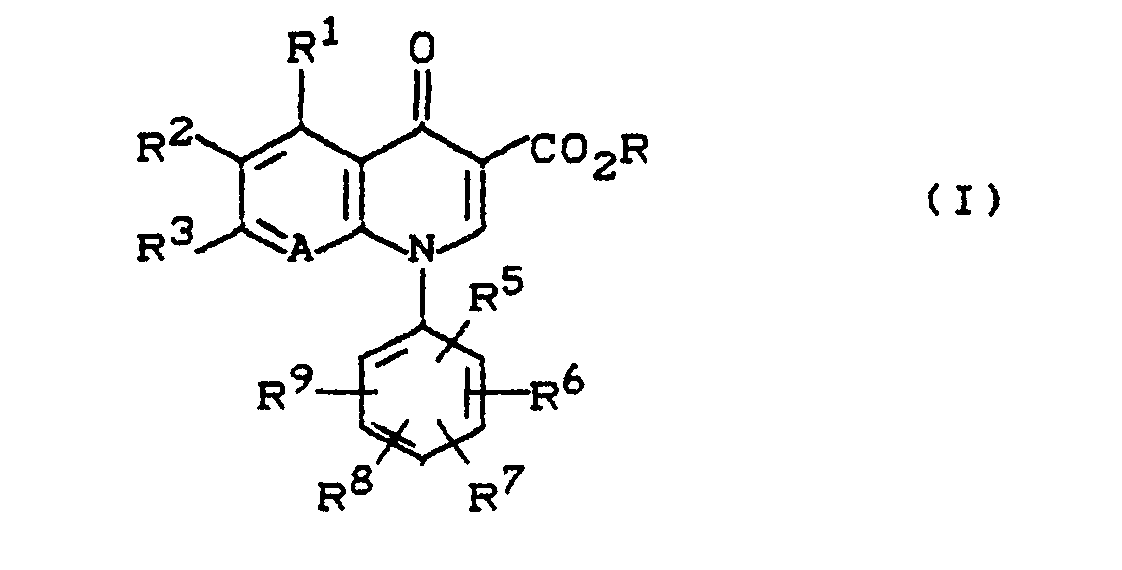
- Es wurde nun gefunden, daß Verbindungen der allgemeinen Formel (I)

- R für Wasserstoff oder Alkyl mit 1-4 Kohlenstoffatomen,
- R1 für Wasserstoff, Amino, Alkylamino mit 1 bis 4 Kohlenstoffatomen, Dialkylamino mit 1 bis 3 Kohlenstoffatomen je Alkylgruppe, Hydroxy, Alkoxy mit 1 bis 4 Kohlenstoffatomen, Mercapto, Alkylthio mit 1 bis 4 Kohlenstoffatomen, Arylthio, Halogen, Cyano oder Nitro,
- R2 für Wasserstoff, Nitro oder Halogen steht,
- R3 und R5 gleich oder verschieden sind und für NR25R26 stehen, worin R25 und R26 gleich oder verschieden sind und für Wasserstoff, C1-C20-Alkyl, gegebenenfalls substituiert durch ein oder mehrere Halogene, OH, O-Alkyl (C1-C6), Alkyl (C1-C4), CN, COO Alkyl (C1-C6),
- - Hydroxyl,
- - oder Amino, Alkylamino mit 1-4 Kohlenstoffatomen, Dialkylamino mit 1-3 Kohlenstoffatomen je Alkylgruppe oder gegebenenfalls durch Halogen substituiertes Phenyl stehen, oder
- für eine Gruppe mit der Formel (II)

- F O, S, N, NR18 oder CR19R20 bedeutet und
- R6, R7, R8 und R9 sind gleich oder verschieden und stehen für
- - Wasserstoff,
- - Methyl, Ethyl, Nitro, Amino, Monoalkylamino mit 1-3 C-Atomen, Dialkylamino mit 1-4 C-Atomen, Methoxy, Ethoxy, Thiomethyl, Thioethyl, Trifluormethyl, Cyano, Halogen,
- R18 für - H, (C1-C10)-Alkyl oder (C3-C6)-Cycloalkyl, gegebenenfalls substituiert mit einem oder mehreren Substituenten Hal, OH, CN, COOR, OR mit R = (C1-C7)-Alkyl,
- - Aryl(C6-C12), gegebenenfalls substituiert durch Halogen, -O-Alkyl(C1-C2) oder (C1-C4-)-Alkyl,
- - CN,
- - COOAlkyl(C1-C4),
- - C1-C4-Acyl oder
- - (C1-C4)-Sulfonyl steht,
- R10, R11, R12, R13, R14, R15, R16, R17, R19 und R20 gleich oder verschieden sind und stehen für
- - Wasserstoff,
- - C1-C3 Alkyl oder C3-C6-Cycloalkyl, gegebenenfalls substituiert durch ein oder mehrere Halogene, OH, 0-Alkyl (C1-C6), Alkyl (C1-C4), CN, COO Alkyl (C1-C6),
- - Hydroxyl,
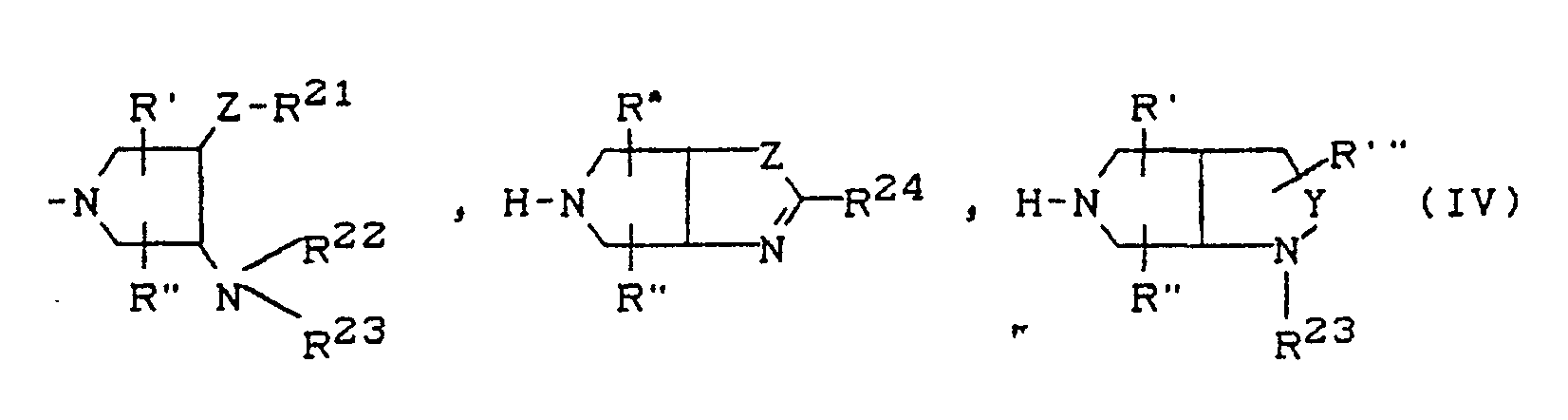
- - oder Amino, Alkylamino mit 1-4 Kohlenstoffatomen, Dialkylamino mit 1-3 Kohlenstoffatomen je Alkylgruppe oder gegebenenfalls durch Halogen substituiertes Phenyl. R3 und R5 können ferner für einen Rest der Struktur (IV) stehen,

- R21 für H, C1-C4-Alkyl, Aryl, C1-C4-Acyl,
- R22 für H, C1-C4-Alkyl, OH, OCH3, wobei R21 und R22 gemeinsam auch eine gegebenenfalls durch Methyl ein- oder zweifach substituierte C1-C3-Alkylenbrücke bedeuten kann,
- R23 für H, C1-C4-Alkyl, Aryl, Heteroaryl, Benzyl, C1-C4-Alkoxycarbonyl, C1-C4-Acyl oder (5-Methyl-2-oxo-1,3-dioxol-4-yl)-methyl,
- R24 für H oder C1-C4-Alkyl,
- R' für H, CH3 oder Phenyl,
- R" für H, CH3 oder Phenyl,
- R''' für H oder CH3,
- Y für 0, CH2, CH2CH2 oder CH2-O stehen kann, wobei die Verknüpfung der CH2-O-Gruppe zum Stickstoff sowohl über 0 als auch über CH2 erfolgen kann,
- Z für 0 oder S stehen kann,
- ZR21 für Wasserstoff stehen kann,
- A für N oder CR4 steht, wobei
- R4 für Wasserstoff, Halogen, Methyl, Cyano, Nitro, Methoxy oder Amin steht oder auch für eine über O, S oder CH2 Brücke, die mit der ortho-Position des Phenylrings an N-1 verbunden ist, steht.
- R6, R7, R8 und R9 können gleich oder verschieden sein und stehen für
- - Wasserstoff,
- - Alkyl mit 1 bis 5-Kohlenstoffatomen, Nitro, Amino, Monoalkylamino mit 1-3 C-Atomen, Dialkylamino mit 1-6 C-Atomen,
- O-Alkyl mit 1-5 Kohlenstoffatomen, S-Alkyl mit 1-5 Kohlenstoffatomen, Trifluormethyl, Cyano, Halogen.
- Bevorzugt sind hierbei Verbindungen der allgemeinen Formel (I)
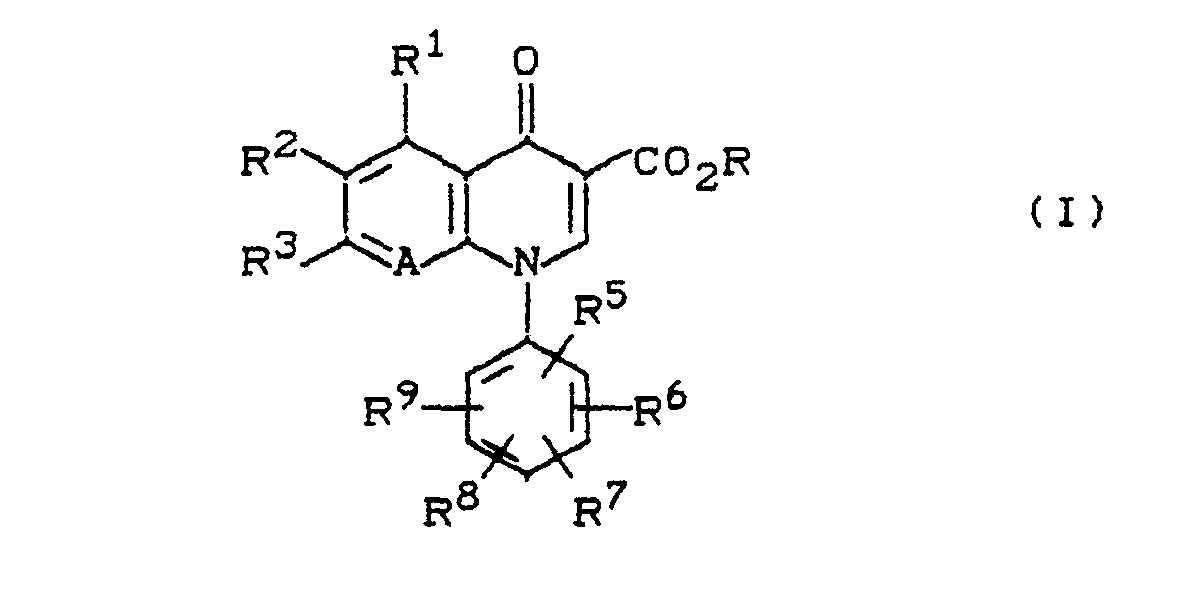
- R für Wasserstoff, Methyl oder Ethyl steht,
- R1 für Wasserstoff, Amino, Nitro, Methoxy, Methylthio, Cyano oder Halogen,
- R2 für Wasserstoff, Nitro oder Halogen steht,
- R3 und R5 gleich oder verschieden sind und für NR25R26 stehen, worin R25 und R26 gleich oder verschieden sind und Wasserstoff, C1-C20-Alkyl, gegebenenfalls substituiert durch ein oder mehrere Halogene, O-Alkyl (C1-C6), Alkyl (C1-C4), je Alkylgruppe oder gegebenenfalls durch Halogen substituiertes Phenyl stehen,
- oder für eine Gruppe mit der Formel (II)

- F Schwefel, Sauerstoff, Stickstoff, NR18 oder CR19R20 bedeutet
- und
- R18 für
- - H, (C1-C10)-Alkyl oder (C3-C6)-Cycloalkyl, gegebenenfalls substituiert mit einem oder mehreren Substituenten Hal, OH, CN, COOR, OR mit R = (C1-C7)-Alkyl,
- - Aryl(C6-C12), gegebenenfalls substituiert durch Halogen, -O-Alkyl(C1-C2) oder (C1-C4)-Alkyl,
- - CN,
- - COOAlkyl(C1-C4)
- - C1-C4-Acyl oder
- - C1-C4-Sulfonyl steht.
- R10, R11, R12, R13, R14, R15, R16, R17, R19, R20 sind gleich oder verschieden und stehen für
- - Wasserstoff,
- - C1-C3 Alkyl oder C3-C6 Cycloalkyl, gegebenenfalls substituiert durch ein oder mehrere Halogene, OH, Methoxy, Ethoxy, Methyl, Ethyl, Cyano, C02Me,
- - Hydroxyl,
- - oder Amino, Alkylamino mit 1-4 Kohlenstoffatomen, Dialkylamino mit 1-3 Kohlenstoffatomen je Alkylgruppe oder gegebenenfalls durch Halogen substituierter Phenyl,
- R3 und R5 können ferner für einen Rest der Strukturen

- R21 für H, C1-C4-Alkyl, Aryl, C1-C4-Acyl,
- R22 für H, C1-C4-Alkyl, OH, OCH3, wobei R21 und R22 gemeinsam auch eine gegebenenfalls durch Methyl ein- oder zweifach substituierte C1-C3-Alkylenbrücke bedeuten kann,
- R23 für H, C1-C4-Alkyl, Aryl, Heteroaryl, Benzyl, C1-C4-Alkoxycarbonyl, C1-C4-Acyl
- R 24 für H oder Cl-C4-Alkyl,
- Y für 0, CH2, CH2CH2 oder CH2-O stehen kann, wobei die Verknüpfung der CH2-O-Gruppe zum Stickstoff sowohl über 0 als auch über CH2 erfolgen kann,
- Z für 0 oder S stehen kann,
- ZR21 für Wasserstoff stehen kann,
- A für N oder CR4 steht, wobei
- R4 für Wasserstoff, Halogen, Methyl, Cyano, Nitro, Methoxy oder Amin steht oder auch für eine über 0, S oder CH2 Brücke, die mit der ortho-Position des Phenylrings an N-1 verbunden ist, steht.
- R6, R7, R8 und R9 sind gleich oder verschieden und stehen für
- - Wasserstoff,
- - Methyl, Ethyl, Nitro, Amino, Monoalkylamino mit 1-3 C-Atomen, Dialkylamino mit 1-4 C-Atomen, Methoxy, Ethoxy, Thiomethyl, Thioethyl, Trifluormethyl, Cyano, Halogen.
- Besonders bevorzugt sind hierbei Verbindungen der allgemeinen Formel (I)

- R für Wasserstoff, Methyl oder Ethyl steht,
- R1 für Wasserstoff, Halogen,
- R2 für Fluor, Nitro oder Wasserstoff steht,
- R3 und R5 gleich oder verschieden sind und für NR25R26 stehen, worin R25 und R26 gleich oder verschieden sind und für Wasserstoff, C1-C10-Alkyl, gegebenenfalls substituiert durch ein oder mehrere Halogene, O-Alkyl (C1-C6), Alkyl (C1-C4) je Alkylgruppe oder gegebenenfalls durch Halogen substituiertes Phenyl stehen,
- oder für eine Gruppe mit der Formel (II)

- F Schwefel, Sauerstoff, Stickstoff, NR18 oder CR19R20 bedeutet
- und
- R18 für
- - Wasserstoff,
- - Methyl, Ethyl, Propyl,
- - (C3-C6)-Cycloalkyl,
- - Phenyl, gegebenenfalls substituiert durch Halogen,
- - CN,
- - COO Alkyl (C1-C4),
- - C1-C4 Acyl oder
- - (C1-C4)-Sulfonyl steht,
- R10, R11, R17, R16 stehen für Wasserstoff.
- R12, R13, R14, R15, R19, R20 gleich oder verschieden sind und für
- - Wasserstoff,
- - C1-C3 Alkyl oder Ca-Cs Cycloalkyl, gegebenenfalls substituiert durch ein oder mehrere Halogene, OH, Methoxy, Ethoxy, Methyl, Ethyl, Cyano, CO2Me
- - Hydroxyl,
- - oder Amino, Alkylamino mit 1-4 Kohlenstoffatomen, Dialkylamino mit 1-3 Kohlenstoffatomen stehen, R3 und R5 sind gleich oder verschieden und können ebenfalls für eine Gruppe der Formel

- wobei
- R21 für Wasserstoff, Methyl, Ethyl, Phenyl, C1-C4 Acyl,
- R22 für Wasserstoff, Methyl, Ethyl, OH, OCH3, wobei R21 und R22 gemeinsam auch durch eine durch Methyl ein-oder zweifach substituierte C1-C3-Alkylenbrücke bedeuten kann,
- R23 für H, Methyl, Ethyl, Aryl, Benzyl, C1-C4- Alkoxycarbonyl, C1-C4 Acyl steht,
- Z für O oder S stehen kann,
- ZR21 für Wasserstoff stehen kann,
- A für N oder CR4 steht, wobei
- R4 für Wasserstoff oder Halogen steht.
- Weiterhin wurde gefunden, daß man erfindungsgemäße Verbindungen der Formel (I), in denen R3 und R6 gleich sind, erhält, wenn man Chinolone der allgemeinen Formel (III)


- Verwendet man beispielsweise 1-(2,4-Difluorphenyl)-6-fluor-7-chlor-1,4-dihydro-4-oxo-3-chinolincarbon- säure und 2-Methylpiperazin als Ausgangsstoffe, so kann der Reaktionsablauf durch das folgende Formelschema wiedergegeben werden:

- Ausgangsstoffe der allgemeinen Formel (111) sind bekannt oder können nach bekannten Verfahren hergestellt werden (Europäische Patentanmeldungen 131 839, 154 780, 302 372, Belgische Patentanmeldung 904 086).
-
- 1-(2,4-Difluorphenyl)-6-fluor-7-chlor-1,4-dihydro-4-oxo-3-chinolincarbonsäure,
- 1-(2,4-Difluorphenyl)-6,7-difluor-1,4-dihydro-4-oxo-3-chinolincarbonsäure,
- 1-(2,4-Difluorphenyl)-5,6,7-trifluor-1,4-dihydro-4-oxo-3-chinolincarbonsäure,
- 1-(2,4-Difluorphenyl)-6,7,8-trifluor-1,4-dihydro-4-oxo-3-chinolincarbonsäure,
- 1-(2,4-Difluorphenyl)-6,7-difluor-8-chlor-1,4-dihydro-4-oxo-3-chinolincarbonsäure,
- 1-(3,4-Difluorphenyl)-6,7-difluor-1,4-dihydro-4-oxo-3-chinolincarbonsäure,
- 1-(2-Chlor-4-fluorphenyl)-6,7-difluor-1,4-dihydro-4-oxo-3-chinolincarbonsäure,
- 1-(3-Chlor-4-fluorphenyl)-6,7-difluor-1,4-dihydro-4-oxo-3-chinolincarbonsäure,
- 1-(2,4-Difluorphenyl)-6-fluor-7-chlor-1,4-dihydro-4-oxo-3-chinolincarbonsäureethylester,
- 1-(2,4-Difluorphenyl)-6,7-difluor-1,4-dihydro-4-oxo-3-chinolincarbonsäureethylester,
- 1-(2,4-Difluorphenyl)-6,7-difluor-1,4-dihydro-4-oxo-3-chinolincarbonsäuremethylester,
- 7-Chlor-6-fluor-1-(2,4-difluorphenyl)-1,4-dihydro-4-oxo-1,8-naphthyridin-3-carbonsäure,
- 1-(2,3,4-Trifluorphenyl)-6-fluor-7-chlor-1,4-dihydro-4-oxo-3-chinolincarbonsäure,
- 1-(2,3,4-Trifluorphenyl)-6,7-difluor-1,4-dihydro-4-oxo-3-chinolincarbonsäure,
- 1-(2,3,4-Trifluorphenyl)-6,7,8-trifluor-1,4-dihydro-4-oxo-3-chinolincarobnsäure,
- 1-(3-Nitro-4-fluorphenyl)-6,7-difluor-1,4-dihydro-4-oxo-3-chinolincarbonsäure,
- 1-(3-Nitro-4-fluorphenyl)-6,7, 8-trifluor-1,4-dihyd ro-4-oxo-3-chinolincarbonsäure,
- 1-(3-Nitro-4-fluorphenyl)-6,7-difluor-8-chlor-1,4-dihydro-4-oxo-3-chinolincarbonsäure,
- 7-Chlor-6-fluor-1-(2,4-difluorphenyl)-1,4-dihydro-4-oxo-1,8-naphthyridin-3-carbonsäureethylester,
- 1-(4-Fluorphenyl)-6-fluor-7-chlor-1,4-dihydro-4-oxo-3-chinolincarbonsäure,
- 1-(4-Fluorphenyl)-6,7-difluor-1,4-dihydro-4-oxo-3-chinolincarbonsäure,
- 1-(4-Fluorphenyl)-6,7-difluor-8-chlor-1,4-dihydro-4-oxo-3-chinolincarbonsäure,
- 1-(2-Fluorphenyl)-6-fluor-7-chlor-1,4-dihydro-4-oxo-chinolincarbonsäure,
- 1-(2-Fluorphenyl)-6,7-difluor-1,4-dihydro-4-oxo-chinolincarbonsäure,
- 1-(2,4-Difluorphenyl)-7-fluor-1,4-dihydro-4-oxo-chinolincarbonsäure,
- 1-(4-Fluorphenyl)-7-fluor-1,4-dihydro-4-oxo-chinolincarbonsäure,
- 1-(2-Fluorphenyl)-7-fluor-1,4-dihydro-4-oxo-chinolincarbonsäure,
- 7-Chlor-6-fluor-1-(4-fluorphenyl)-1,4-dihydro-4-oxo-1,8-naphthyridin-3-carbonsäure.
- Die erfindungsgemäß verwendeten Amine sind bekannt oder können nach bekannten Verfahren hergestellt werden (Beilsteins Handbuch der Organischen Chemie, Bände 23 und 27, DE-OS 39 10 663).
- Beispiele derartiger Amine sind:
- Piperazin, 1-Methylpiperazin, 1-Ethylpiperazin, 1-Propylpiperazin, 1-Isopropylpiperazin, 1-Cyclopropylpiperazin, 2-Methylpiperazin, 3-Ethylpiperazin, 2-Cyclohexylpiperazin, 1,2-Dimethylpiperazin, 2,2-Dimethylpiperazin, 2,8-Dimethylpiperazin, 1-(2-Hydroxyethyl)piperazin, 1-Phenylpiperazin, 2-Phenylpiperazin, Morpholin, Thiomorpholin, 2-Methylmorpholin, 3-Methylmorpholin, Piperidin, 2-Methylpiperidin, 3-Methylpiperidin, 4-Methylpiperidin, Pyrrolidin, 3-(tert.-Butoxycarbonylamino)-pyrrolidin, 3-Dimethylaminopyrrolidin, 4-Amino-3-hydroxypyrrolidin, 3-Hydroxy-4-methylaminopyrrolidin, 4-Dimethylamino-3-hydroxypyrrolidin, 4-Ethylamino-3-hydroxypyrrolidin, 3-Amino-4-methoxypyrrolidin, 4-Methoxy-3-methylaminopyrrolidin, 3-Dimethylamino-4-methoxypyrrolidin, 3-Ethylamino-4-methoxypyrrolidin, 3-Amino-4-ethoxypyrrolidin, 4-Ethoxy-3-methylamino- pyrrolidin, 3-Dimethylamino-4-ethoxypyrrolidin, 4-Ethoxy-3-ethylaminopyrrolidin, 3-Hydroxy-4-hydroxyamino- pyrrolidin, 3-Hydroxy-4-methoxyaminopyrrolidin, 3-Hydroxyamino-4-methoxypyrrolidin, 4-Methoxy-3-me- thoxyaminopyrrolidin, 3-Benzylamino-4-methoxypyrrolidin, 4-Methoxy-3-(5-methyl-2-oxo-1,3-dioxol-4-yl)-methylamino)-pyrrolidin, 3-Amino-4-methylmercaptopyrrolidin, 3-Acetoxy-4-dimethylaminopyrrolidin, 3-Acetamido-4-methoxypyrrolidin, 4-Methoxy-3-methoxycarbonylaminopyrrolidin, 3-Formamido-4-methoxypyr- rolidin, 3-Amino-4-methoxy-2-methylpyrrolidin, 3-Amino-4-methoxy-5-methylpyrrolidin, 4-Methoxy-2-methyl-3-methylaminopyrrolidin, 4-Methoxy-5-methyl-3-methylaminopyrrolidin, 3-Amino-4-methoxy-2-phenylpyrroli- din, 4-Methoxy-3-methylamino-5-phenylpyrrolidin, 3-Methyl-2,7-diazabicyclo[3.3.0]octan, 4-Methyl-2,7-diazabicyclo[3.3.0]octan, 5-Methyl-2,7-diazabicyclo[3.3.0]octan, 3,5-Dimethyl-2,7-diazabicyclo[3.3.0]octan, 1,5-Dimethyl-2,7-diazabicyclo[3.3.0]octan, 2-Oxa-4,7-diazabicyclo[3.3.0]octan, 3,3-Dimethyl-2-oxa-4,7-diazabicyclo[3.3.0]octan, 3-Oxa-2,7-diazabicyclo[3.3.0]octan, 1,2-Dimethyl-3-oxa-2,7-diazabicyclo[3.3.0]-octan, 2,5-Dimethyl-3-oxa-2,7-diazabicyclo[3.3.0]octan, 2,8-Dimethyl-3-oxa-2,7-diazabicyclo[3.3.0]octan, 5-Methyl-3-oxa-2,7-diazabicyclo[3.3.0]octan, 2-Oxa-4,7-diazabicyclo[3.3.0]oct-3-en, 3-Methyl-2-oxa-4,7-diazabicyclo[3.3.0]oct-3-en, 3-Phenyl-2-oxa-4,7-diazabicyclo[3.3.0]-3-en, 6-Methyl-2-oxa-4,7-diazabicyclo-[3.3.0]oct-3-en, 8-Methyl-2-oxa-4,7-diazabicyclo[3.3.0]oct-3-en, 3-Methyl-2,8-diazabicyclo[4.3.0]nonan, 4-Methyl-2,8-diazabicyclo[4.3.0]nonan, 5-Methyl-2,8-diazabicyclo[4.3.0]nonan, 6-Methyl-2,8-diazabicyclo-[4.3.0]nonan, 3-Methyl-2-oxa-5,8-diazabicyclo[4.3.0]nonan, 4-Methyl-2-oxa-5,8-diazabicyclo[4.3.0]nonan, 1-Methyl-2-oxa-5,8-diazabicyclo[4.3.0]nonan, 3,5-Dimethyl-2-oxa-5,8-diazabicyclo[4.3.0]nonan, 2-Thia-5,8-diazabicyclo[4.3.0]nonan, 5-Methyl-2-thia-5,8-diazabicyclo[4.3.0]nonan, 3,5-Dimethyl-2-thia-5,8-diazabicyclo-[4.3.0]nonan, 3-Oxa-2,8-diazabiyclo[4.3.0]nonan, 2-Methyl-9-oxa-2,8-diazabicyclo[4.3.0]nonan, 4-Methyl-3-oxa-2,8-diazabicyclo[4.3.0]nonan, 2,5-Dimethyl-3-oxa-2,8-diazabicyclo[4.3.0]nonan, 3-Oxa-5,8-diazabicyclo-[4.3.Ö]nonan, 5-Methyl-3-oxa-5,8-diazabicyclo[4.3.0]nonan, 1,5-Dimethyl-3-oxa-5,8-diazabicyclo[4.3.0]nonan,
- Die Amine können als Diastereomerengemische, in diastereomerenreiner Form, als Racemat oder als teilweise oder vollständig angereicherte Enantiomere verwendet werden.
- Die Umsetzung von (111) mit (IV) gemäß Methode A, bei der die Verbindungen (IV) auch in Form ihrer Hydrochloride eingesetzt werden können, wird vorzugsweise in einem Verdünnungsmittel wie Dimethylsulfoxid, N,N-Dimethylformamid, N-Methylpyrrolidon, Hexamethyl-phosphor säuretrisamid, Sulfolan, Acetonitril, Wasser, einem Alkohol wie Methanol, Ethanol, n-Propanol, Isopropanol, Glykolmonomethylether oder Pyridin vorgenommen. Ebenso können Gemische dieser Verdünnungsmittel verwendet werden.
- Als Säurebinder können alle üblichen anorganischen und organischen Säurebindungsmittel verwendet werden. Hierzu gehören vorzugsweise die Alkalihydroxide, Alkalicarbonate, organische Amine und Amidine.
- Als besonders geeignet seien im einzelnen genannt: Triethylamin, 1,4-Diazabicyclo[2.2.2]octan (DABCO), 1,8-Diazabicyclo[5,4,0]undec-7-en (DBU) oder überschüssiges Amin (IV).
- Die Reaktionstemperatur wird zwischen 50 C und 250 C gehalten, vorzugsweise zwischen 100°C und 180° C.
- Die Reaktion kann bei Normaldruck, aber auch bei erhöhtem Druck durchgeführt werden. Im allgemeinen arbeitet man bei Drucken zwischen 1 und 100 bar, vorzugsweise bei 1 bis 10 bar.
- Bei der Durchführung des erfindungsgemäßen Verfahrens setzt man auf 1 mol einer Verbindung der allgemeinen Formel (111) 2 bis 10 Mol, vorzugsweise 3 bis 6 Mol einer Verbindung der allgemeinen Formel (IV) ein.
- Ferner erhält man die erfindungsgemäßen Verbindungen, indem man Verbindungen der allgemeinen Formel (V)

- Verwendet man beispielsweise 1-(2,4-Difluorphenyl)-6-fluor-7-(3-methylpiperazin-1-yl)-1,4-dihydro-4-oxo-3-chinolincarbonsäure und 1-Methylpiperazin als Ausgangsstoffe, so kann der Reaktionsablauf durch das folgende Formelschema wiedergegeben werden:

- Die Verbindungen der allgemeinen Formel (V) sind bekannt oder nach bekannten Methoden herstellbar (Europäische Patentanmeldungen 131 839, 154 780, 302 372).
- Als Beispiele seien genannt:
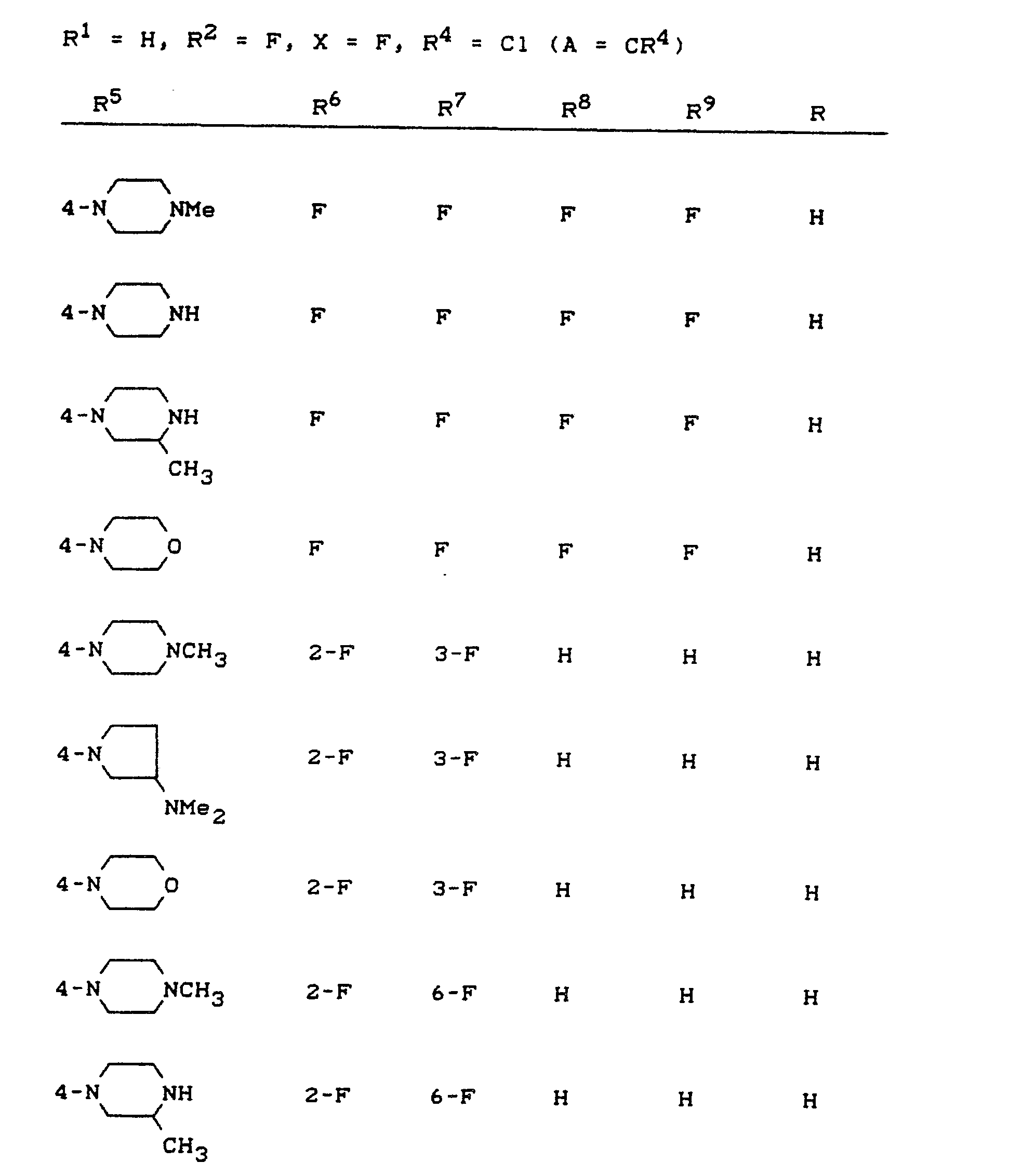
- Verbindungen der allgemeinen Formel (V) mit folgenden Resten (R7, R8, R9 sind Wasserstoff)


- Die erfindungsgemäßen Verbindungen werden außerdem erhalten, wenn man Chinolone der allgemeinen Formel (VI)

- in der A, R, R1 bis R9 und X die oben angegebene Bedeutung haben, mit Aminen der allgemeinen Formel (IV), gegebenenfalls in Gegenwart eines Verdünnungsmittels und gegebenenfalls eines Säurefängers umsetzt (Methode C).
- Verwendet man beispielsweise 1-[3-Chlor-4-(4-methylpiperazinyl)-phenyl]-7-chlor-6-fluor-1,4-dihydro-4-oxo-3-chinolincarbonsäure und 2-Methylpiperazin als Ausgangsstoffe, so kann der Reaktionsablauf durch das folgende Formelschema wiedergegeben werden.
- Reaktionsschema III:
-
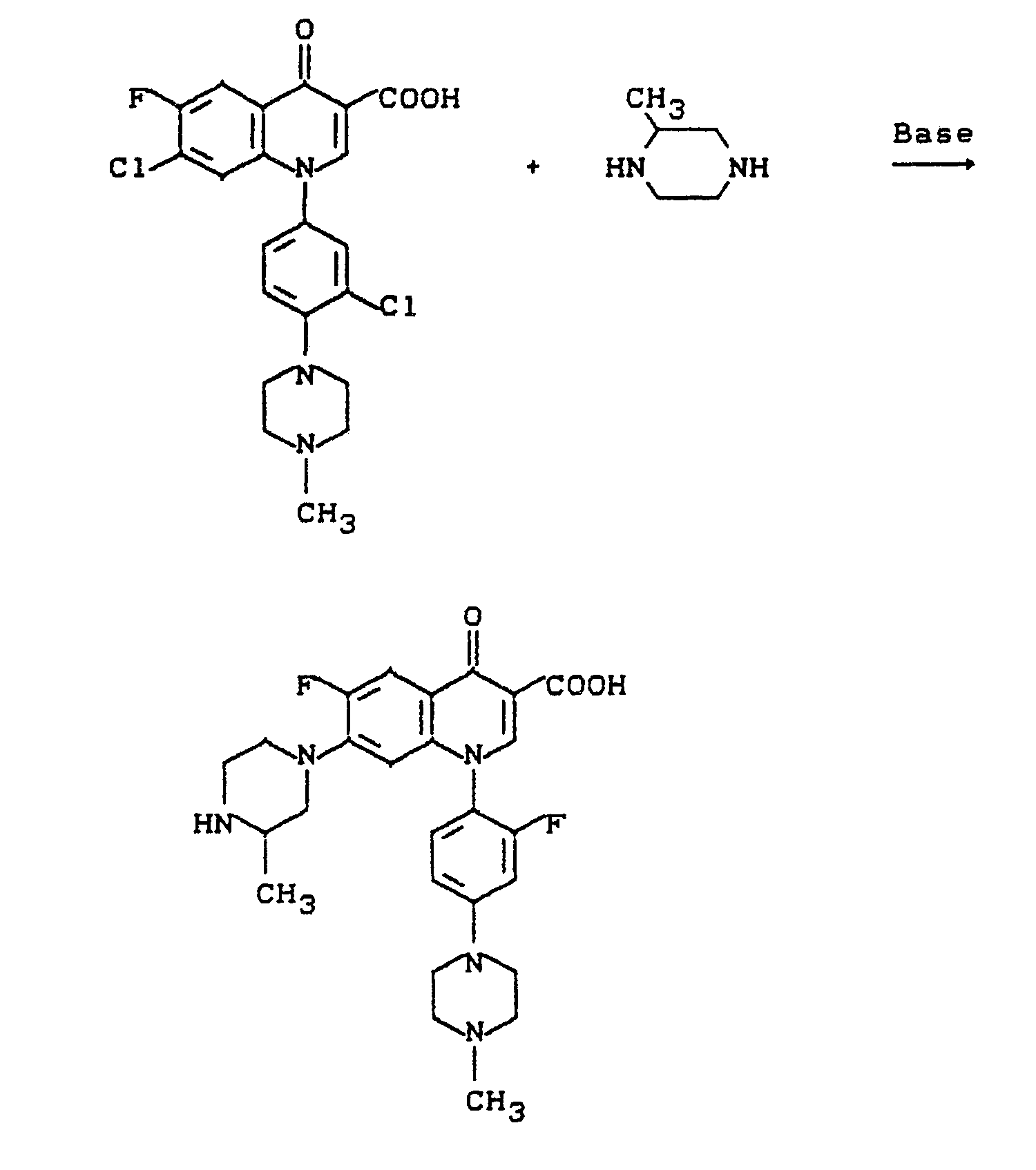
- Verbindungen des Typs (VI) sind bekannt oder nach bekannten Methoden herstellbar. Als Beispiele seinen genannt:
-


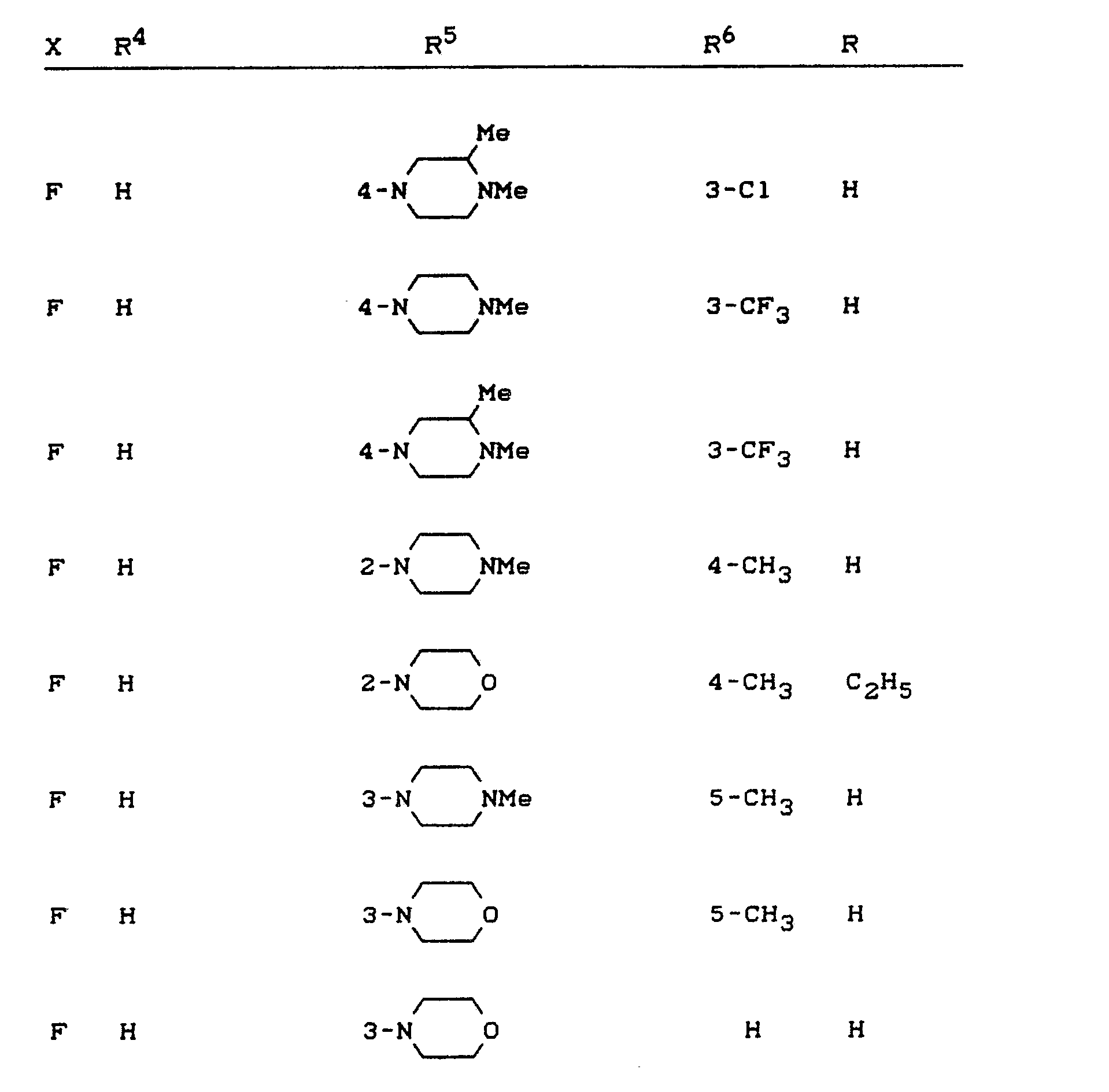


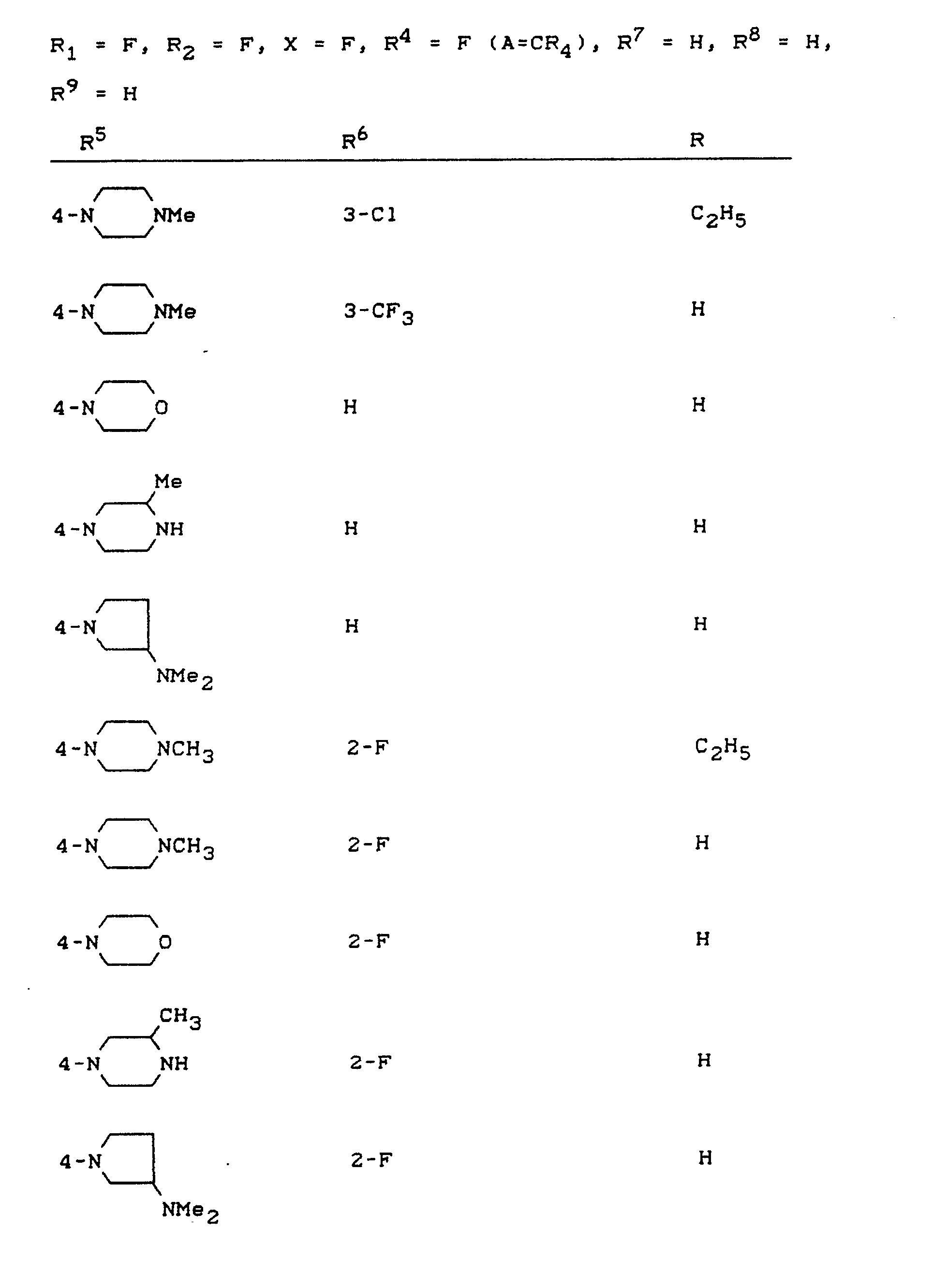


- Einige der erfindungsgemäßen Verbindungen erhält man, indem man von Verbindungen der allgemei- ben Formel

- Die allgemeine Formel (VII) zeichnet sich dadurch aus, daß in R30 und in R50, nur in R30 oder nur in R50 sekundäre oder primäre Amine vorhanden sind. Die Strukturen von R30 und R50 sind durch die Vertreter der oben definierten Reste R3 bzw. R5 bestimmt, auf die dieses Kriterium zutrifft.
- Diese werden mit Acylierungsmitteln oder Alkylierungsmitteln der allgemeinen Formel (VIII)

- in der W = - CN
- - (C2-C4)-Acyl, gegebenenfalls substituiert
- - (C1-C4)-Sulfonyl
- - (C1-C4)-Alkoxycarbonyl
- - (C1-C5)-Alkyl
und V eine Abgangsgruppe darstellt, wie - V = - Halogen
- - Trifluormethansulfonat
- - Mesylat
- - Tosylat
- - Acetat
- - Trihaloacetat
gegebenenfalls in Gegenwart von Verdünnungsmitteln und gegebenenfalls in Gegenwart von Säurebindern umgesetzt (Methode D). - Verwendet man beispielsweise 1-(2-Fluor-4-piperazinylphenyl)-6-fluor-7-piperazinyl-1,4-dihydro-4-oxo-3-chinolincarbonsäure und Methansulfonylchlorid als Ausgangsstoffe, so kann der Reaktionsablauf durch das folgende Formelschema wiedergegeben werden.
- Reaktionsschema IV:


- Verbindungen des Typs (VII) sind nach den Methoden A, B und C herstellbar.
- Verbindungen des Typs (VIII) sind bekannt (Beilsteins Handbuch der Organischen Chemie, Bände 2 und 3). Als Beispiele seien genannt: Bromcyan, Acetylchlorid, Propionylchlorid, Buttersäurechlorid, Methansulfonylchlorid. Anstelle von organischen Säurechloriden sind auch die entsprechenden Anhydride (z.B. Acetanhydrid) verwendbar.
- Als Verdünnungsmittel bei der Umsetzung von (VII) mit (VIII) werden vorzugsweise Dimethylsulfoxid, N,N-Dimethylformamid, Acetonitril, Pyridin oder Gemische dieser Verdünnungsmittel verwendet. Als Säurebinder können alle üblichen anorganischen und organischen Säurebindungsmittel verwendet werden. Hierzu gehören vorzugsweise die Alkalihydroxide, Alkalicarbonate, organische Amine und Amidine. Als besonders geeignet seien im einzelnen genannt: Triethylamin, 1,4-Diazabicyclo[2.2.2]octan (DABCO), 1,8-Diazabicyclo[5,4,0]undec-7-en (DBU).
- Die Umsetzung wird im Temperaturbereich zwischen -100°C und 200 °C, vorzugsweise zwischen -20 °C und 100 ° C durchgeführt.
- Die Reaktion kann bei Normaldruck, aber auch bei erhöhtem Druck durchgeführt werden. Im allgemeinen arbeitet man bei Drucken zwischen 1 und 100 bar, vorzugsweise bei 1 bis 10 bar.
- Bei der Durchführung des erfindungsgemäßen Verfahrens setzt man auf 1 Mol einer Verbindung der allgemeinen Formel (VII) 1 bis 10 Mol, vorzugsweise 2 bis 6 Mol einer Verbindung der allgemeinen Formel (VIII) ein.
- Weitere erfindungsgemäße Verbindungen erhält man, wenn man Verbindungen der allgemeinen Formel (VII) mit Verbindungen der allgemeinen Formel (IX),

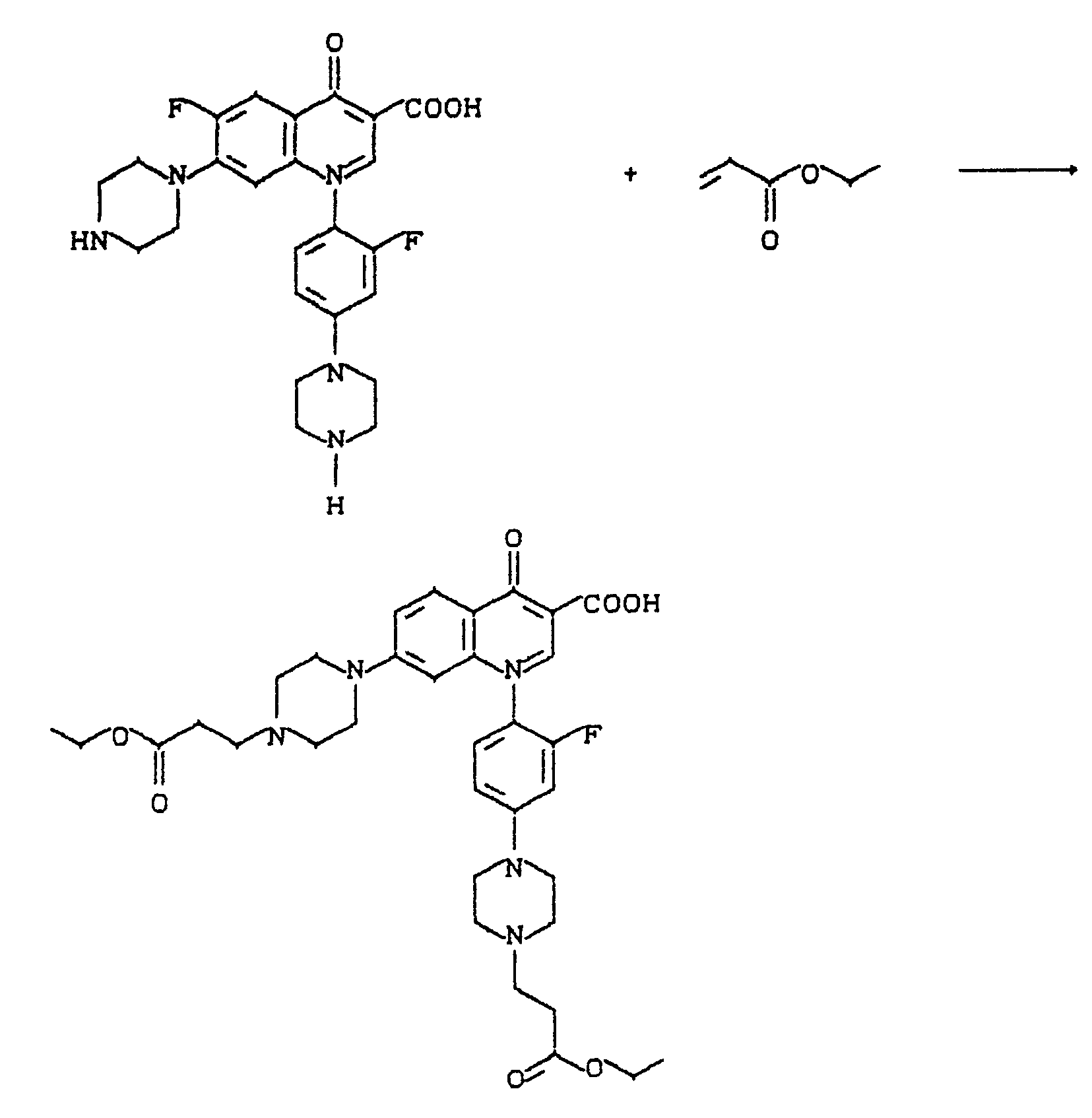
- Verwendet man beispielsweise 1-(2-Fluor-4-piperazinylphenyl)-6-fluor-7-piperazinyl-1,4-dihydro-4-oxo-3-chinolincarbonsäure und Acrylsäureethylester als Ausgangsstoffe, so kann der Reaktionsablauf durch das folgende Formelschema (V) wiedergegeben werden:
- Reaktionsschema V:
- Die Umsetzung von (VII) mit (IX) gemäß Methode E wird vorzugsweise in einem Verdünnungsmittel wie Dimethylsulfoxid, N,N-Dimethylformamid. N-Methylpyrrolidon, Hexamethyl-phosphorsäuretrisamid, Sulfolan, Acetonitril, Wasser, einem Alkohol wie Methanol, Ethanol, n-Propanol, Isopropanol, Glykolmonomethylether oder Pyridin vorgenommen. Ebenso können Gemische dieser Verdünnungsmittel verwendet werden.
- Die Reaktionstemperatur liegt im Bereich zwischen -100 C und 200° C, vorzugsweise zwischen -20° C und 80 C.
- Die Reaktion kann bei Normaldruck, aber auch bei erhöhtem Druck durchgeführt werden. Im allgemeinen arbeitet man bei Drucken zwischen 1 und 100 bar, vorzugsweise bei 1 bis 10 bar.
- Bei der Durchfürung des erfindungsgemäßen Verfahrens setzt man auf ein Mol einer Verbindung der allgemeinen Formel (VII) 1 bis 10 Mol, vorzugsweise 2 bis 6 Mol einer Verbindung der allgemeinen Formel (IX) ein.
- Erfindungsgemäße Verbindungen erhält man auch, wenn man Verbindungen der allgemeinen Formel (VII) mit Carbonsäuren der allgemeinen Formel (X),

- Verwendet man beispielsweise 1-(2-Fluor-4-piperazinylphenyl)-6-fluor-7-piperazinyl-1,4-dihydro-4-oxo-3-chinolincarbonsäure und Ameisensäure als Ausgangsstoffe, so kann der Reaktionsablauf durch das folgende Formelschema (VI) wiedergegeben werden.
- Reaktionsschema VI:
-

- Die Reaktion kann bei Normaldruck, aber auch bei erhöhtem Druck durchgeführt werden. Im allgemeinen arbeitet man bei Drucken zwischen 1 und 100 bar, vorzugsweise bei 1 bis 10 bar.
- Bei der Durchführung des erfindungsgemäßen Verfahrens setzt man auf 1 Mol einer Verbindung der allgemeinen Formel (VII) 1 bis 10 Mol, vorzugsweise 2 bis 6 Mol einer Verbindung der allgemeinen Formel (X) ein.
- Verbindungen des Typs (X) sind bekannt (Beilstein, Bände 2 und 3). Als Beispiele seien genannt: Ameisensäure, Essigsäure, Propionsäure, Isobuttersäure.
- Die Umsetzung von (VII) nach (X) wird vorzugsweise in einem Verdünnungsmittel wie Dimethylsulfoxid, N,N-Dimethylformamid, N-Methylpyrrolidon, Hexamethyl-phosphorsäuretrisamid, Sulfolan, Acetonitril, Methylenchlorid, Benzol, Toluol oder Pyridin vorgenommen. Ebenso können Gemische dieser Verdünnungsmittel verwendet werden.
- Als wasserentziehende Mittel kommen vorzugsweise Molekularsieb, Lösemittel wie Methylenchlorid, Benzol oder Toluol, die mit Wasser Azeotrope bilden, aber nicht mit Wasser mischbar sind, oder Verbindungen, die mit Wasser, nicht aber mit den Reaktionspartnern reagieren, wie zum Beispiel Dicyclohexylcarbodiimid (DCC) in Frage. Als Katalysator kann zum Beispiel 4-N,N-Dimethylaminopyridin (DMAP) dienen.
- Die Reaktionstemperatur liegt im Bereich von -100° C bis 200 C, vorzugsweise im Bereich von 0 C bis 150° C.
- Die Herstellung der Säureadditionssalze der erfindungsgemäßen Verbindungen erfolgt in üblicher Weise zum Beispiel durch Lösen des Betains in überschüssiger wäßriger Säure und Ausfällen des Salzes mit einem mit Wasser mischbaren organischen Lösungsmittel wie Methanol, Ethanol, Aceton, Acetonitril. Man kann auch äquivalente Mengen Betain und Säure in Wasser oder einem Alkohol wie Glykolmonomethylether erhitzen und anschließend bis zur Trockne eindampfen oder das ausgefallene Salz absaugen. Als pharmazeutisch verwendbare Salze sind beispielsweise die Salze von Salzsäure, Schwefelsäure, Essigsäure, Glykolsäure, Milchsäure, Bernsteinsäure, Zitronensäure, Weinsäure, Methansulfonsäure, Galacturonsäure, Gluconsäure, Embonsäure, Glutaminsäure oder Asparaginsäure zu verstehen.
- Die Alkali- oder Erdalkalisalze der erfindungsgemäßen Carbonsäuren werden beispielsweise durch Lösen des Betains in unterschüssiger Alkali- oder Erdalkalilauge, Abfiltrieren von ungelöstem Betain und Eindampfen des Filtrats bis zur Trockne erhalten. Pharmazeutisch geeignete Salze sind Natrium-, Kalium-oder Calciumsalze. Durch Umsetzung eines Alkali- oder Erdalkalisalzes mit einem geeigneten Silbersalz wie Silbernitrat werden die entsprechenden Silbersalze erhalten.
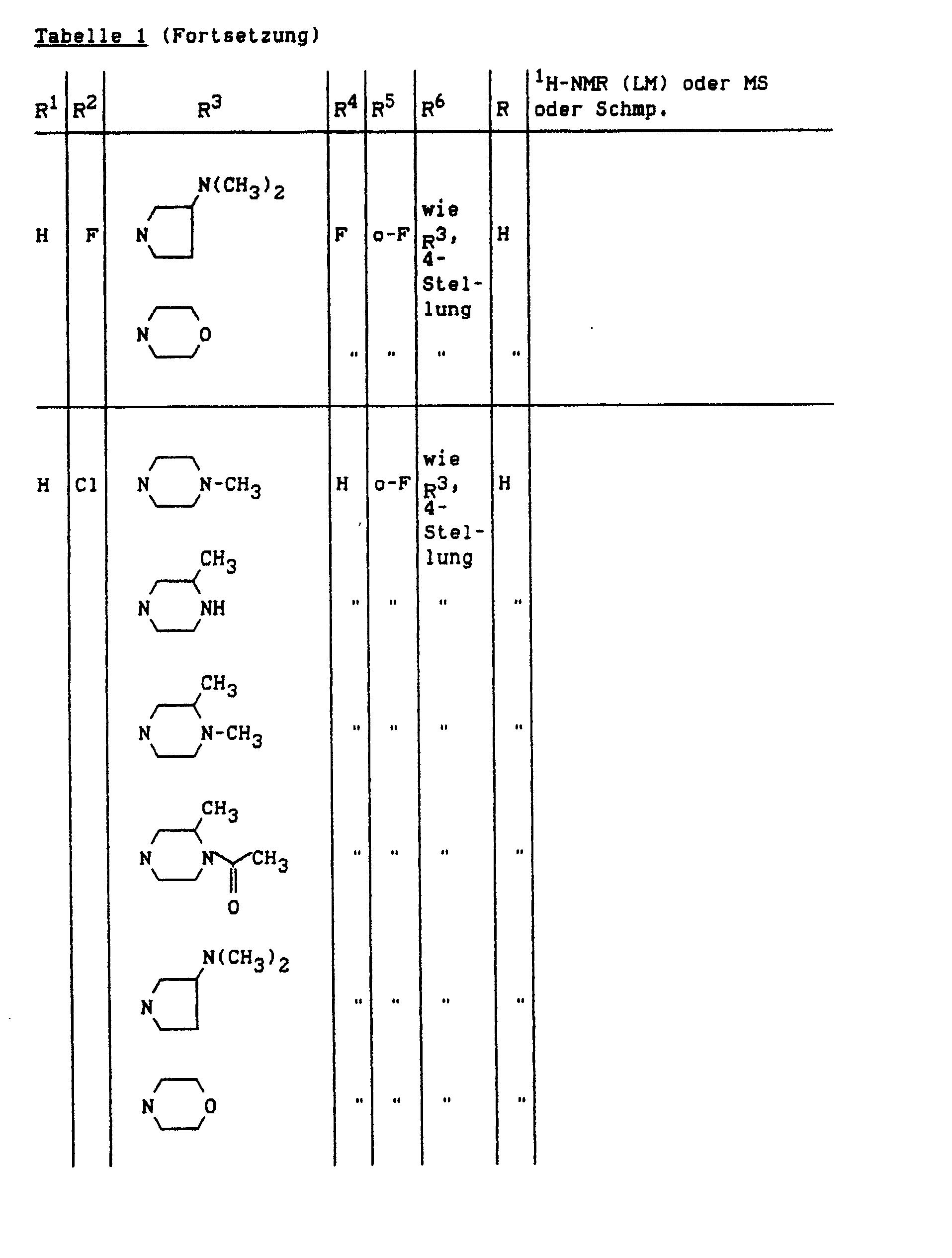
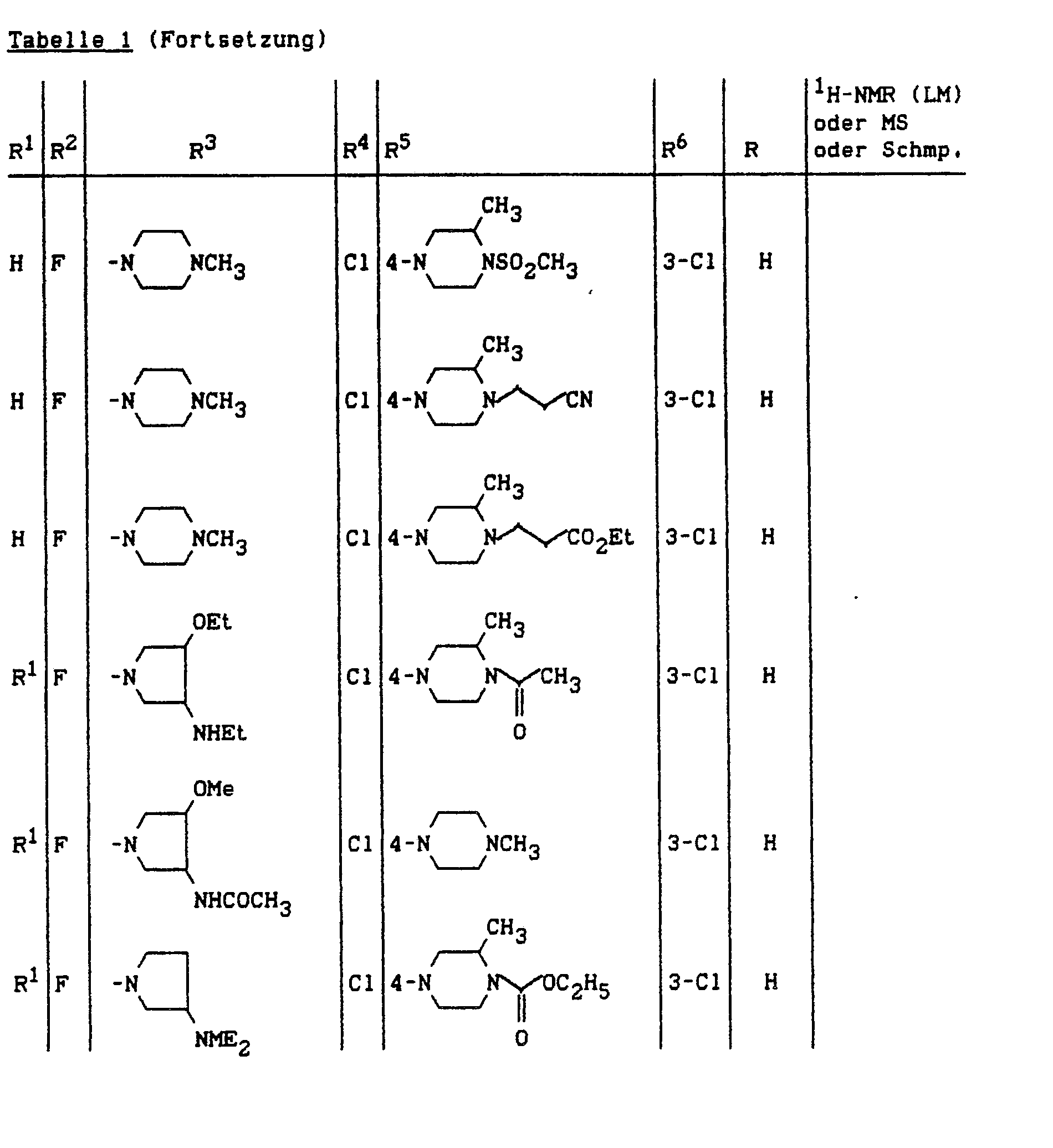
- Außer den in den Beispielen genannten Wirkstoffen können ebenfalls die in Tabelle 1 beispielhaft aufgeführten Verbindungen hergestellt werden, wobei diese Verbindungen sowohl als Diastereomerengemische als auch als diastereomerenreine oder enantiomerenreine Verbindungen vorliegen können.
-






- Die erfindungsgemäß zu verwendenden Verbindungen stellen wertvolle Wirkstoffe zur Behandlung oder Prophylaxe von Erkrankungen, hervorgerufen durch Viren, in der Human-und Tiermedizin dar.
- Als Indikationsgebiete in der Humanmedizin können beispielsweise genannt werden:
- 1. Die Behandlung oder Prophylaxe von menschlichen Virus- und Retrovirusinfektionen.
- 2. Für die Behandlung oder Prophylaxe von HIV (Virus der humanen Immundefiziens; früher HTLV III/LAV genannt) verursachten Erkrankungen (AIDS) und den damit assoziierten Stadien wie ARC (AIDS related complex) and LAS (Lymphadenopathie-Syndrom) sowie der durch dieses Virus verursachten Immunschwäche und Encephalopathie.
- 3. Für die Behandlung oder die Prophylaxe einer HTLV I- oder HTLV II-Infektion.
- 4. Für die Behandlung oder die Prophylaxe des AIDS-carrier Zustandes (AIDS-Überträger-Zustand).
- Als Indikationen in der Tiermedizin können beispielsweise angeführt werden:
Infektionen mit - a) Maedi-Visna (bei Schafen und Ziegen)
- b) progressives Pneumonievirus (PPV) (bei Schafen und Ziegen)
- c) caprine arthritis encephalitis Virus (bei Schafen und Ziegen)
- d) Zwoegerziekte Virus (bei Schafen)
- e) infektiöses Virus der Anämie (des Pferdes)
- f) Infektionen verursacht durch das Katzenleukämievirus.
- Die erfindungsgemäßen Wirkstoffe können auch zur Therapie und Prophylaxe von durch Influenza-Viren verursachten Krankheiten eingesetzt werden.
- Zur vorliegenden Erfindung gehören pharmazeutische Zubereitungen, die neben nicht-toxischen, inerten pharmazeutisch geeigneten Trägerstoffen eine oder mehrere Verbindungen der Formel (I) enthalten oder die aus einem oder mehreren Wirkstoffen der Formel (I) bestehen, sowie Verfahren zur Herstellung dieser Zubereitungen.
- Zur vorliegenden Erfindung gehören auch pharmazeutische Zubereitungen in Dosierungseinheiten. Dies bedeutet, daß die Zubereitungen in Form einzelner Teile, z.B. Tabletten, Dragees, Kapseln, Pillen, Suppositorien und Ampullen vorliegen, deren Wirkstoffgehalt einem Bruchteil oder einem Vielfachen einer Einzeldosis entsprechen. Die Dosierungseinheiten können z.B. 1, 2, 3 oder 4 Einzeldosen oder 1/2, 1/3 oder 1/4 einer Einzeldosis enthalten. Eine Einzeldosis enthält vorzugsweise die Menge Wirkstoff, die bei einer Applikation verabreicht wird und die gewöhnlich einer ganzen, einer halben oder einem Drittel oder einem Viertel einer Tagesdosis entspricht.
- Unter nicht-toxischen, inerten pharmazeutisch geeigneten Trägerstoffen sind feste, halbfeste oder flüssige Verdünnungsmittel, Füllstoffe und Formulierungshilfsmittel jeder Art zu verstehen.
- Als bevorzugte pharmazeutische Zubereitungen seien Tabletten, Dragees, Kapseln, Pillen, Granulate, Suppositorien, Lösungen, Suspensionen und Emulsionen, Pasten, Salben, Gele, Cremes, Lotions, Puder und Sprays genannt. Tabletten, Dragees, Kapseln, Pillen und Granulate können den oder die Wirkstoffe neben den üblichen Trägerstoffen enthalten, wie
- (a) Füll- und Streckmittel, z.B. Stärken, Milchzucker, Rohrzucker, Glukose, Mannit und Kieselsäure,
- (b) Bindemittel, z.B. Carboxymethylcellulose, Alginate, Gelatine, Polyvinylpyrrolidon,
- (c) Feuchthaltemittel, z.B. Glycerin,
- (d) Sprengmittel, z.B. Agar-Agar, Calciumcarbonat und Natriumcarbonat,
- (e) Lösungsverzögerer, z.B. Paraffin und
- (f) Resorptionsbeschleuniger, z.B. quarternäre Ammoniumverbindungen,
- (g) Netzmittel, z.B. Cetylalkohol, Glycerinmonostearat,
- (h) Adsorptionsmittel, z.B. Kaolin und Bentonit und
- (i) Gleitmittel, z.B. Talkum, Calcium- und Magnesiumstearat und feste Polyethylenglykole oder Gemische der unter (a) bis (i) aufgeführten Stoffe.
- Die Tabletten, Dragees, Kapseln, Pillen und Granulate können mit den üblichen, gegebenenfalls Opakisierungsmitteln enthaltenden, Überzügen und Hüllen versehen sein und auch so zusammengesetzt sein, daß sie den oder die Wirkstoffe nur oder bevorzugt in einem bestimmten Teil des Intestinaltraktes gegebenenfalls verzögert abgeben, wobei als Einbettungsmassen z.B. Polymersubstanzen und Wachse verwendet werden können.
- Der oder die Wirkstoffe können gegebenenfalls mit einem oder mehreren der oben angegebenen Trägerstoffe auch in mikroverkapselter Form vorliegen.
- Suppositorien können neben dem oder den Wirkstoffen die üblichen wasserlöslichen oder wasserunlöslichen Trägerstoffe enthalten, z.B. Polyethylenglykole, Fette, z.B. Kakaofett und höhere Ester (z.B. C,4-Alkohol mit C16-Fettsäure) oder Gemische dieser Stoffe.
- Salben, Fasten, Cremes und Gele können neben dem oder den Wirkstoffen die üblichen Trägerstoffe enthalten, z.B. tierische und pflanzliche Fette, Wachse, Paraffine, Stärke, Tragant, Cellulosederivate, Polyethylenglykole, Silikone, Bentonite, Kieselsäure, Talkum und Zinkoxid oder Gemische dieser Stoffe.
- Puder und Sprays können neben dem oder den Wirkstoffen die üblichen Trägerstoffe enthalten, z.B. Milchzucker, Talkum, Kieselsäure, Aluminiumhydroxid, Calciumsilikat und Polyamidpulver oder Gemische dieser Stoffe. Sprays können zusätzlich die üblichen Treibmittel, z.B. Chlorfluorkohlenwasserstoffe, enthalten.
- Lösungen und Emulsionen können neben dem oder den Wirkstoffen die üblichen Trägerstoffe wie Lösungsmittel, Lösungsvermittler und Emulgatoren, z.B. Wasser, Ethylalkohol, Isopropylalkohol, Ethylcarbonat, Ethylacetat, Benzylalkohol, Benzylbenzoat, Propylenglykol, 1,3-Butylenglykol, Dimethylformamid, Öle, insbesondere Baumwollsaatöl, Erdnußöl, Maiskeimöl, Olivenöl, Ricinusöl und Sesamöl, Glycerin, Glycerinformal, Tetrahydrofurfurylalkohol, Polyethylenglykole und Fettsäureester des Sorbitans oder Gemische dieser Stoffe enthalten.
- Zur parenteralen Applikation können die Lösungen und Emulsionen auch in steriler und blutisotonischer Form vorliegen.
- Suspensionen können neben dem oder den Wirkstoffen die üblichen Trägerstoffe wie flüssige Verdünnungsmittel, z.B. Wasser, Ethylalkohol, Propylenglykol, Suspendiermittel, z.B. ethoxylierte Isostearylalkohole, Polyoxyethylensorbit- und Sorbitan-Ester, mikrokristalline Cellulose, Aluminiummetahydroxid, Bentonit, Agar-Agar und Tragant oder Gemische dieser Stoffe enthalten.
- Die genannten Formulierungsformen können auch Färbemittel, Konservierungsstoffe sowie geruchs-und geschmacksverbesserte Zusätze, z.B. Pfefferminzöl und Eukalyptusöl und Süßmittel, z.B. Saccharin, enthalten.
- Die Wirkstoffe der Formel (I) sollen in den oben aufgeführten pharmazeutischen Zubereitungen, vorzugsweise in einer Konzentration von etwa 0,1 bis 99,5, vorzugsweise von etwa 0,5 bis 95 Gew.-%, der Gesamtmischung vorhanden sein.
- Die oben aufgeführten pharmazeutischen Zubereitungen können außer den Verbindungen der Formel (I) auch weitere pharmazeutische Wirkstoffe enthalten.
- Die Herstellung der oben aufgeführten pharmazeutischen Zubereitungen erfolgt in üblicher Weise nach bekannten Methoden, z.B. durch Mischen des oder der Wirkstoffe mit dem oder den Trägerstoffen.
- Die genannten Zubereitungen können bei Mensch und Tier entweder oral, rektal, parenteral (intravenös, intramuskulär, subkutan), intracisternal, intravaginal, intraperitoneal, lokal (Puder, Salbe, Tropfen) und zur Therapie von Infektionen in Hohlräumen, Körperhöhlen angewendet werden. Als geeignete Zubereitungen kommen Injektionslösungen, Lösungen und Suspensionen für die orale Therapie, Gele, Aufgußformulierungen, Emulsionen, Salben oder Tropfen in Frage. Zur lokalen Therapie können ophtalmologische und dermatologische Formulierungen, Silber- und andere Salze, Ohrentropfen, Augensalben, Puder oder Lösungen verwendet werden. Bei Tieren kann die Aufnahme auch über das Futter oder Trinkwasser in geeigneten Formulierungen erfolgen. Ferner können Gele, Pulver, Puder, Tabletten, Retard-Tabletten, Premixe, Konzentrate, Granulate, Pellets, Tabletten, Boli, Kapseln, Aerosole, Sprays, Inhalate bei Mensch und Tier angewendet werden. Ferner können die erfindungsgemäßen Verbindungen in andere Trägermaterialien wie zum Beispiel Kunststoffe, (Kunststoffketten zur lokalen Therapie), Kollagen oder Knochenzement eingearbeitet werden.
- Im allgemeinen hat es sich sowohl in der Human- als auch in der Veterinärmedizin als vorteilhaft erwiesen, den oder die Wirkstoffe der Formel (I) in Gesamtmengen von etwa 0,5 bis etwa 500, vorzugsweise 5 bis 100 mg/kg Körpergewicht je 24 Stunden, gegebenenfalls in Form mehrerer Einzelgaben, zur Erzielung der gewünschten Ergebnisse zu verabreichen. Eine Einzelgabe enthält den oder die Wirkstoffe vorzugsweise in Mengen von etwa 1 bis etwa 80, insbesondere 3 bis 30 mg/kg Körpergewicht. Es kann jedoch erforderlich sein, von den genannten Dosierungen abzuweichen, und zwar in Abhängigkeit von der Art und dem Körpergewicht des zu behandelnden Objekts, der Art und der Schwere der Erkrankung, der Art der Zubereitung und der Applikation des Arzneimittels sowie dem Zeitraum bzw. Intervall, innerhalb welchem die Verabreichung erfolgt.
- So kann es in einigen Fällen ausreichend sein, mit weniger als der obengenannten Menge Wirkstoff auszukommen, während in anderen Fällen die oben angeführte Wirkstoffmenge überschritten werden muß. Die Festlegung der jeweils erforderlichen optimalen Dosierung und Applikationsart der Wirkstoffe kann durch jeden Fachmann aufgrund seines Fachwissens leicht erfolgen.
- Die erfindungsgemäß zu verwendenden Verbindungen können in den üblichen Konzentrationen und Zubereitungen zusammen mit dem Futter bzw. mit Futterzubereitungen oder mit dem Trinkwasser gegeben werden.
- Die folgenden Beispiele erläutern die Erfindung.
-

-
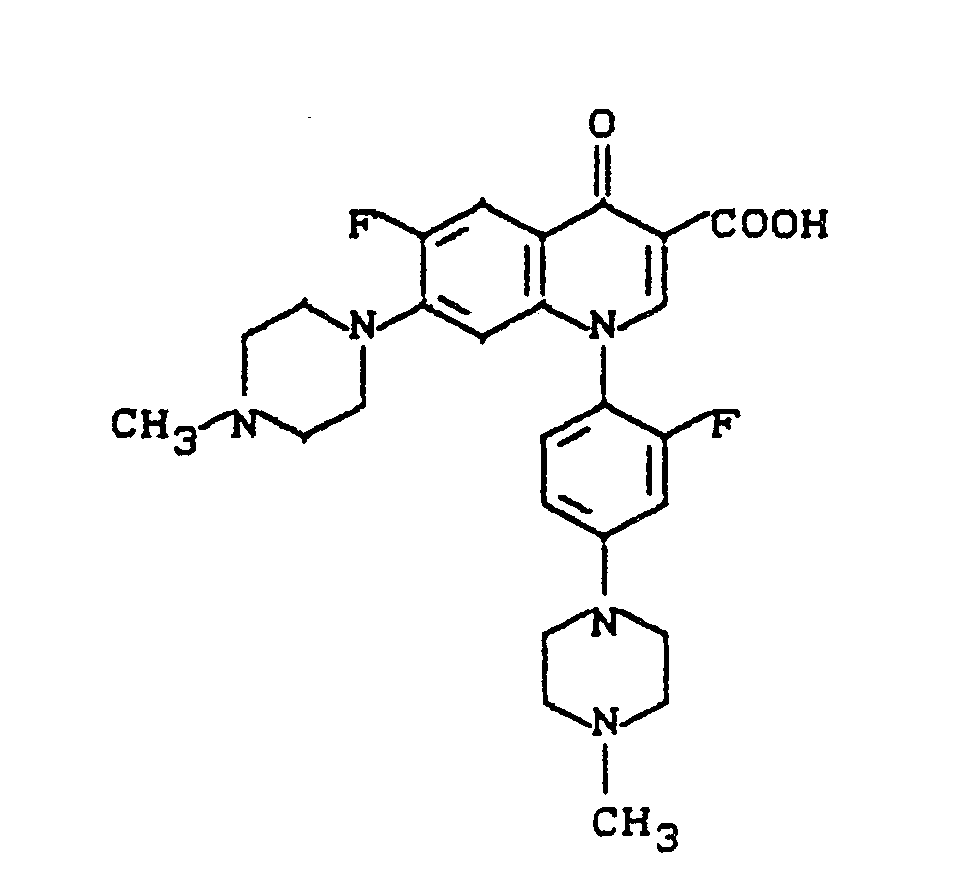
- Analog Beispiel 1 setzt man mit 1-Methylpiperazin um, nach Eindampfen des Reaktionsgemisches wird der Rückstand in Methylenchlorid gelöst und zweimal mit Wasser gewaschen, die organische Phase wird eingedampft und an 40 g Kieselgel chromatographiert. (Laufmittel: Acetonitril : Wasser : Eisessig = 5 : 1 : 1 (v : v : v)).
- Ausbeute:
- 190 mg (54 % der Theorie) 1-(2-Fluor-4-(4-methylpiperazinyl)-phenyl)-6-fluor-7-(4-methylpiperazinyl)-1,4-dihydro-4-oxo-3-chinolincarbonsäure
- 1H-NMR-Spektrum (CDCl3): 2,34 (S, 3H); 2,40 (S, 3H); 2,54 (T, 4H); 2,61 (T, 4H); 6,40 (D, 1H); 6,80 (M, 2H); 7,24 (T, 1 H); 8,07 (D, 1 H); 8,60 (S, 1 H) ppm
-

- Analog Beispiel 1 setzt man mit 2-Methylpiperazin um.
- Ausbeute:
- 291 mg (41 % der Theorie) 1-(2-Fluor-4-(3-methylpiperazinyl)-phenyl)-6-fluor-7-(3-methylpiperazinyl)-1,4-dihydro-4-oxo-3-chinolincarbonsäure
- Schmelzpunkt: 273 - 281 ° C (unter Zersetzung)
-

- Analog Beispiel 1 setzt man mit 1-Phenylpiperazin um. Nach Eindampfen des Reaktionsgemisches wird der Rückstand mit Toluol ausgekocht und filtriert, der Filterrückstand wird in Methylenchlorid gelöst, zweimal mit Wasser gewaschen, eingeengt und getrocknet.
- Ausbeute:
- 507 mg (58 % der Theorie) 1-(2-Fluor-4-(4-phenylpiperazinyl)-phenyl)-6-fluor-7-(4-phenylpiperazinyl)-1,4-dihydro-4-oxo-3-chinolincarbonsäure
- Schmelzpunkt: 138 - 140° C
-

- Analog Beispiel 1 wird mit Morpholin umgesetzt.
- Ausbeute:
- 402 mg (60 % der Theorie) 1-(2-Fluor-4-morpholinylphenyl)-6-fluor-7-morpholinyl-1,4-dihydro-4-oxo-3-chi- nolincarbonsäure
- Schmelzpunkt: 273 °C (Methylenchlorid, n-Hexan) (unter Zersetzung)
-

- Analog Beispiel 1 wird mit Piperidin umgesetzt.
- Ausbeute:
- 404 mg (61 % der Theorie) 1-(2-Fluor-4-piperidinylphenyl)-6-fluor-7-piperidinyl-1,4-dihydro-4-oxo-3-chinolin- carbonsäure
- Schmelzpunkt: 223 °C (Methylenchlorid, n-Hexan) (unter Zersetzung)
-

- Analog Beispiel 1 wird mit 3-Dimethylaminopyrrolidin umgesetzt.
- Nach Eindampfen des Reaktionsgemisches wird der Rückstand mit Toluol ausgekocht, die vereinigte Toluolphase dreimal mit Wasser gewaschen, eingedampft, in Methylenchlorid gelöst und durch Zugabe von n-Hexan gefällt.
- Ausbeute:
- 304 mg (41 % der Theorie) 1-(2-Fluor-4-(3-(dimethylamino)pyrrolidinyl)-phenyl)-6-fluor-7-(3-(dimethylamino)-pyrrolidinyl)-1,4-dihydro-4-oxo-3-chinolincarbonsäure
- schmelzpunkt: 190°C
-

- Ausbeute:
- 9,9 g (50 % der Theorie) 1-(2-Fluor-4-piperazinylphenyl)-6-fluor-7-piperazinyl-1,4-dihydro-4-oxo-3-chinol- incarbonsäure.
- Schmelzpunkt: 207 - 209° C.
- B) 500 mg (1,1 mol) des Produktes aus Stufe A werden in 5 ml 3N-Salzsäure gelöst, eingedampft, mit Ethanol verrieben, abgesaugt und getrocknet.
- Ausbeute: 325 mg (60 % der Theorie) 1-(2-Fluor-4-piperazinyl-phenyl)-6-fluor-7-piperazinyl-1,4-dihydro-4-oxo-3-chinolincarbonsäure-Dihydrochlorid.
- Schmelzpunkt: > 250 C (unter Zersetzung)
-
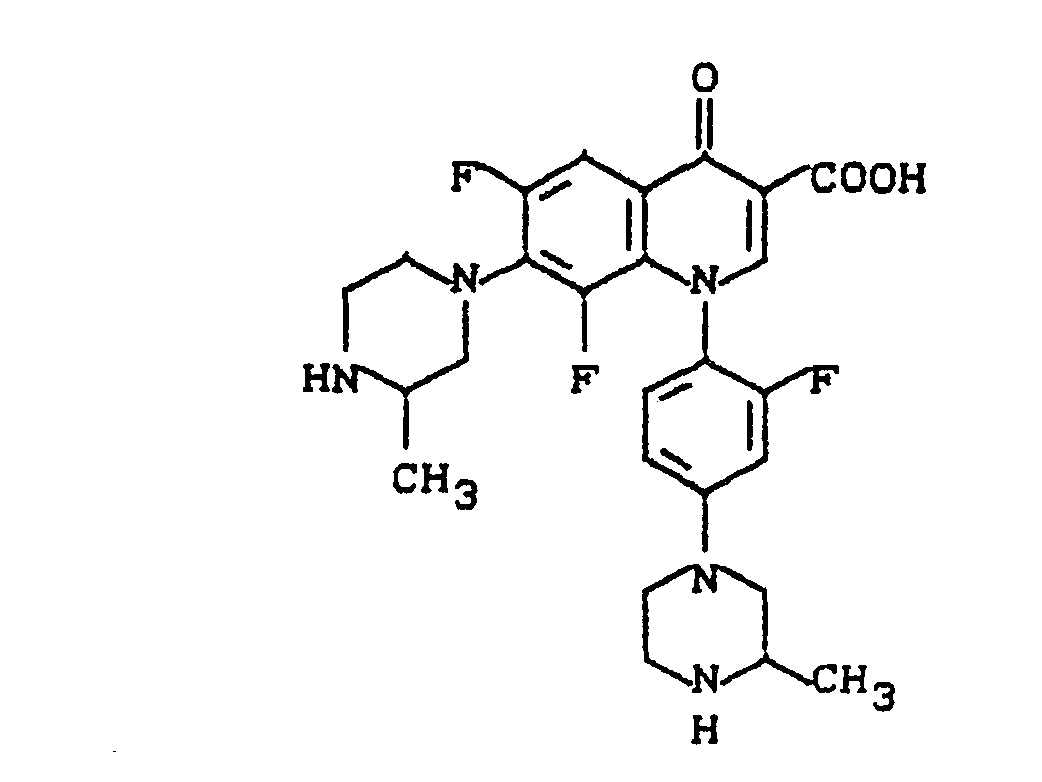
- Ausbeute:
- 104 mg (7 % der Theorie) 1-(2-Fluor-4-(3-methylpiperazinyl)-phenyl)-6,8-difluor-7-(3-methylpiperazinyl)-1,4-dihydro-4-oxo-3-chinolincarbonsäure
- Schmelzpunkt: 250 C (unter Zersetzung)
-

- 123 mg (25 % der Theorie) 1-(3-Chlor-4-(4-methylpiperazinyl)-phenyl)-6-fluor-7-piperazinyl)-1,4-dihydro-4-oxo-3-chinolincarbonsäure
- Schmelzpunkt: 230 C (unter Zersetzung)
-

- Ausbeute:
- 277 mg (95 % der Theorie) 1-(2-Fluor-4-(3-methyl-4-acetylpiperazinyl)-phenyl)-6-fluor-7-(3-methyl-4-acetyl- piperazinyl)-1,4-dihydro-4-oxo-3-chinolincarbonsäure
- RF: 0,23 (Kieselgel: Acetonitril : Wasser : Eisessig = 150 : 10 : 1)
-

- Ausbeute:
- 286 mg (89 % der Theorie) 1-(2-Fluor-4-(4-carbethoxypiperazinyl)-phenyl)-6-fluor-7-(4-carbethoxypiperazi- nyl)-1,4-dihydro-4-oxo-3-chinolincarbonsäureethylester
- Massenspektrum: m/e = 641 (M+) 569 (100 %, M+ -CO2C2H5), 467, 56, 29
-

- Analog Beispiel 11 werden 234 mg (0,5 mmol) 1-(2-Fluor-4-piperazinyl-phenyl)-6-fluor-7-piperazinyl-1,4-dihydro-4-oxo-3-chinolinsäure mit 286 mg (2,5 mmol) Methansulfonylchlorid umgesetzt.
- Ausbeute:
- 114 mg (36 % der Theorie) 1-(2-Fluor-4-(4-methylsulfonylpiperazinyl)-phenyl)-6-fluor-7-(4-methylsulfonylpi- perazinyl)-1,4-dihydro-4-oxo-3-chinolincarbonsäure
- Schmelzpunkt: 178° C (unter Zersetzung)
-

- Ausbeute:
- 445 mg (67 % der Theorie) 1-(2-Fluor-4-(4-carboxyeth-2-yl-piperazinyl)-phenyl)-6-fluor-7-(4-carboxyeth-2-yl- piperazinyl)-1,4-dihydro-4-oxo-3-chinolincarbonsäure
- 'H-NMR-Spektrum (CF3COOD): 1,37 (2T,3H); 3,16 (2T,4H); 3,16 (2T,4H); 3,56 (2T,8H); 3,77 (2T,4H); 4,06 (M, 8H); 4,37 (2Q,4H); 6,94 (D,1 H); 7,10 (M,2H); 7,60 (T,1 H); 8,40 (D, 1 H); 9,20 (S,1 H) ppm
-

- Analog Beispiel 14 wird mit Acrylnitril umgesetzt.
- Ausbeute:
- 396 mg (69 % der Theorie) 1-(2-Fluor-4-(4-cyanoeth-2-yl-piperazinyl)-phenyl)-6-fluor-7-(4-cyanoeth-2-yl- piperazinyl)-1,4-dihydro-4-oxo-3-chinolincarbonsäure
- 1H-NMR-Spektrum (CF3COOD): 3,30 (2T,3H); 3,60 (M,8H); 3,87 (2T,4H); 4,10 (M,8H); 6,97 (D,1H); 7,10 (M,2H); 7,60 (T,1 H); 8,40 (D,1 H); 9,20 (S,1 H) ppm
-

- Nach Eindampfen wird an 100 g Kieselgel chromatographiert (Laufmittel zunächst Toluol : Ethanol = 1 : 1, dann Ethanol : Toluol : Eisessig = 100 : 100 : 1). Die produkthaltigen Fraktionen wurden eingeengt und getrocknet.
- Ausbeute:
- 300 mg (42 % der Theorie) 1-(2-Fluor-4-(methylpiperazinyl)-phenyl)-6-fluor-7-(4-methylpiperazinyl)-1,4-dihydro-4-oxo-3-chinolincarbonsäureethylester, Essigsäuresalz.
- Schmelzpunkt: 580 C
- Es wurde im Rahmen von Untersuchungen, die zu der vorliegenden Erfindung führten, überraschend gefunden, daß die erfindungsgemäß zu verwendende Verbindung der allgemeinen Formel (I) eine außerordentlich starke Wirkung gegen Retroviren besitz. Dies wird durch die weiter unten angegebenen Versuchsdaten beispielhaft für die Verbindung am Visna-Virus in Zellkulturen belegt. Das Visna-Virus und das HIV-Virus (Virus der humanen Immundefiziens) gehören beide zu der Retrovirus-Subfamilie der Lentiviren [Haase A.T. Nature (1986) 322 , 130-136]. Beide Viren weisen eine ähnliche Genomorganisation und ein gegenüber den andern Retroviren komplexes Transkriptionsmuster auf [Sojijo P. et al., Cell (1985), 42 , 369 - 382; Davis J. L. et al., Journal of Virology (1987) 61 , (S) 1325 - 1331 ].
- Darüber hinaus wurde gezeigt [Frank, K.B., etal., Antimicrobial Agents and Chemotherapy (1987) 31 (9), S. 1369 - 1374], daß bekannte Inhibitoren des HIV auch das Visnavirus in vitro in vergleichbaren Konzentrationen hemmen; d.h., dieses Modell eignet sich für die Prüfung und Auffindung von Hemmstoffen des HIV.
- In Zellkulturen, die mit Visna-Virus infiziert sind, treten 5 bis 10 Tage nach der Infektion ausgeprägte virusinduzierte, zytopathische Effekte auf. Durch Behandlung der infizierten Zellkulturen mit der erfin dungsgemäßen Verbindung konnte das Auftreten dieser zytopathischen Effekte verhindert werden.
- Der Visna-Virus-Test wurde nach der Methode von O. Narayan et al., Journal of Infectious Diseases 135 , 5, 1977, 800 - 806 durchgeführt. Dazu wurde die erfindungsgemäße Verbindung im Kulturmedium in nicht zytotoxischen Konzentrationen in 96er Microtiterplatten verdünnt. Anschließend wurden Fibroblastenzellen vom Schaf (5 x 10⁴ Zellen pro Napf) in Produktionsmedium zu jedem Näpfchen zugeführt. Jedes Näpfchen erhielt dann 50 µl einer Visna-Viruslösung mit einer Titer von ca. 2,5 x 10⁴- TCID50 (TCID = tissue culture infectious dosis). Diese Virusdosis entspricht einer MOI (Multiplizität der Infektion) von ca. 0,05.
- Unter diesen Infektionsbedingungen resultierte zwischen Tag 5 und Tag 10 in einer Infektionskontrolle ohne Substanz ein virusinduzierter, zytopathischer Effekt. Die infizierten und behandelten Zellen und die Kontrollzellen wurden 7 Tage bei 370 C 5 % CO2 inkubiert.
- Bei Auftreten des virusinduzierten zytopathogenen Effektes in der unbehandelten Viruskontrolle wurden die Kulturen mit Formalin fixiert und anschließend mit einer Giemsa-Lösung gefärbt. Die inhibitorische Konzentration (IC50) wurde mikroskopisch als die Konzentration ermittelt, bei der der zytopathische Effekt um 50 % gehemmt wurde im Vergleich zur unbehandelten Viruskontrolle, die 100 % Zellzerstörung aufwies.
- Es wurde gefunden, daß mit den erfindungsgemäßen Verbindungen die Visna-Virus infizierten Zellen vor der virusinduzierten Zellzerstörung schützen. Dies wird anhand der Daten der folgenden Verbindungen exemplarisch gezeigt:


Claims (12)


und

wobei
stehen.

in der




und V eine Abgangsgruppe darstellt, wie
gegebenenfalls in Gegenwart von Verdünnungsmitteln und gegebenenfalls in Gegenwart von Säurebindern umgesetzt.




Applications Claiming Priority (2)
| Application Number | Priority Date | Filing Date | Title |
|---|---|---|---|
| DE3934082 | 1989-10-12 | ||
| DE3934082A DE3934082A1 (de) | 1989-10-12 | 1989-10-12 | Chinoloncarbonsaeurederivate, verfahren zu ihrer herstellung sowie ihre verwendung als antivirale mittel |
Publications (3)
| Publication Number | Publication Date |
|---|---|
| EP0422485A2 true EP0422485A2 (de) | 1991-04-17 |
| EP0422485A3 EP0422485A3 (en) | 1991-08-14 |
| EP0422485B1 EP0422485B1 (de) | 1996-04-03 |
Family
ID=6391329
Family Applications (1)
| Application Number | Title | Priority Date | Filing Date |
|---|---|---|---|
| EP90118898A Expired - Lifetime EP0422485B1 (de) | 1989-10-12 | 1990-10-03 | Chinoloncarbonsäurederivate, Verfahren zu ihrer Herstellung sowie ihre Verwendung als antivirale Mittel |
Country Status (9)
| Country | Link |
|---|---|
| US (2) | US5217972A (de) |
| EP (1) | EP0422485B1 (de) |
| JP (1) | JPH03133960A (de) |
| AT (1) | ATE136298T1 (de) |
| CA (1) | CA2027204A1 (de) |
| DE (2) | DE3934082A1 (de) |
| DK (1) | DK0422485T3 (de) |
| ES (1) | ES2086346T3 (de) |
| GR (1) | GR3019796T3 (de) |
Cited By (8)
| Publication number | Priority date | Publication date | Assignee | Title |
|---|---|---|---|---|
| EP0539180A1 (de) * | 1991-10-25 | 1993-04-28 | Sanwa Kagaku Kenkyusho Co., Ltd. | Antivirale Mittel |
| EP0612731A1 (de) * | 1993-02-09 | 1994-08-31 | Bayer Ag | Neue Chinolon- und Naphthyridoncarbonsäurederivate |
| AU656859B2 (en) * | 1992-05-27 | 1995-02-16 | Ube Industries, Ltd. | Aryl group- or aromatic heterocyclic group-substituted aminoquinolone derivatives and anti-HIV agent |
| WO1996002533A1 (de) * | 1994-07-20 | 1996-02-01 | Bayer Aktiengesellschaft | Neue 6 und 6,8-substituierte 1-[4-(1h-1,2,4-triazol-1-yl-methyl)phenyl] chinoloncarbonsäuren |
| WO1996002532A1 (de) * | 1994-07-20 | 1996-02-01 | Bayer Aktiengesellschaft | 7-substituierte 1-[4-(1h-1,2,4-triazol-1-yl-methyl)phenyl] substituierte chinoloncarbonsäuren als antivirale mittel |
| WO1996002540A1 (de) * | 1994-07-20 | 1996-02-01 | Bayer Aktiengesellschaft | Heterocyclyl-1-phenyl substituierte chinoloncarbonsäuren als antivirale mittel |
| WO1996002511A1 (de) * | 1994-07-20 | 1996-02-01 | Bayer Aktiengesellschaft | Neue n1-diverse 6-fluor-8-difluormethoxy substituierte chinoloncarbonsäuren |
| WO1996002539A1 (de) * | 1994-07-20 | 1996-02-01 | Bayer Aktiengesellschaft | Substituierte triazolylmethylphenylnaphthyridone |
Families Citing this family (14)
| Publication number | Priority date | Publication date | Assignee | Title |
|---|---|---|---|---|
| WO1993025545A1 (en) * | 1992-06-09 | 1993-12-23 | Korea Research Institute Of Chemical Technology | Novel quinoline derivatives and processes for preparing the same |
| DE69531305T2 (de) * | 1994-10-20 | 2004-05-13 | Wakunaga Seiyaku K.K. | Pyridoncarboxylat- derivate oder salze davon und antibakterielle zusammensetzungen die diese als aktiven bestandteil enthalten |
| KR100499366B1 (ko) * | 1995-01-30 | 2005-09-08 | 와쿠나가 세이야쿠 가부시키 가이샤 | 신규피리돈카르복실산유도체또는그염및그물질을유효성분으로하는항균제 |
| EP0945435B1 (de) * | 1996-11-28 | 2003-08-13 | Wakunaga Pharmaceutical Co., Ltd. | Pyridoncarbonsäurederivate oder ihre salze und diese als aktive bestandteile enthaltende medikamente |
| US6309662B1 (en) | 1999-09-23 | 2001-10-30 | Janet Buchanan | Use of anti-inflammatory drugs for treatment of dermatological conditions |
| DE10005280A1 (de) * | 2000-02-07 | 2001-08-09 | Bayer Ag | Partikuläre Zusammensetzung, Verfahren zu ihrer Herstellung und deren Verwendung |
| WO2004046115A1 (ja) * | 2002-11-20 | 2004-06-03 | Japan Tobacco Inc. | 4−オキソキノリン化合物及びそのhivインテグラーゼ阻害剤としての利用 |
| WO2005028467A1 (en) * | 2003-09-15 | 2005-03-31 | Anadys Pharmaceuticals, Inc. | Antibacterial 3,5-diaminopiperidine-substitute aromatic and heteroaromatic compounds |
| EP1730135B1 (de) * | 2004-03-10 | 2010-09-22 | The United States of America, represented by the Secretary, Department of Health and Human Services | Chinolin-4-one als inhibitoren der retroviralen integrase zur behandlung von hiv, aids und aids-related complex (arc) |
| WO2005113509A1 (en) * | 2004-05-20 | 2005-12-01 | Japan Tobacco Inc. | Novel 4-oxoquinoline compound and use thereof as hiv integrase inhibitor |
| IN2014CN00532A (de) * | 2006-03-06 | 2015-04-03 | Japan Tobacco Inc | |
| KR101023635B1 (ko) | 2006-03-06 | 2011-03-22 | 니뽄 다바코 산교 가부시키가이샤 | 4-옥소퀴놀린 화합물 제조 방법 |
| EP3183258A1 (de) * | 2014-08-19 | 2017-06-28 | Straitmark Holding AG | Verfahren zur synthese von heterocyclischem wasserstoffphosphinoxid |
| KR20190122762A (ko) | 2017-03-31 | 2019-10-30 | 후지필름 가부시키가이샤 | 4-피리돈 화합물 또는 그 염, 그것을 포함하는 의약 조성물 및 제 |
Family Cites Families (7)
| Publication number | Priority date | Publication date | Assignee | Title |
|---|---|---|---|---|
| NZ208470A (en) * | 1983-07-18 | 1988-06-30 | Abbott Lab | 6-fluoro-1,4-dihydro-4-oxo-quinoline-3-carboxylic acid derivatives and antibacterial compositions containing such |
| EP0154780B1 (de) * | 1984-01-26 | 1990-04-11 | Abbott Laboratories | Antibakterielle Chinolinderivate |
| JPS60228479A (ja) * | 1984-04-26 | 1985-11-13 | Toyama Chem Co Ltd | 1,4−ジヒドロ−4−オキソナフチリジン誘導体およびその塩 |
| US4851535A (en) * | 1985-01-23 | 1989-07-25 | Toyama Chemical Co., Ltd. | Nicotinic acid derivatives |
| AT392789B (de) * | 1985-01-23 | 1991-06-10 | Toyama Chemical Co Ltd | Verfahren zur herstellung von 1-substituierten aryl-1,4-dihydro-4-oxonaphthyridinderivaten |
| IE62600B1 (en) * | 1987-08-04 | 1995-02-22 | Abbott Lab | Naphtyridine antianaerobic compounds |
| US4920120A (en) * | 1988-01-25 | 1990-04-24 | Warner-Lambert Company | Antibacterial agents |
-
1989
- 1989-10-12 DE DE3934082A patent/DE3934082A1/de not_active Withdrawn
-
1990
- 1990-09-19 US US07/585,580 patent/US5217972A/en not_active Expired - Fee Related
- 1990-10-03 ES ES90118898T patent/ES2086346T3/es not_active Expired - Lifetime
- 1990-10-03 AT AT90118898T patent/ATE136298T1/de not_active IP Right Cessation
- 1990-10-03 DK DK90118898.7T patent/DK0422485T3/da active
- 1990-10-03 EP EP90118898A patent/EP0422485B1/de not_active Expired - Lifetime
- 1990-10-03 DE DE59010254T patent/DE59010254D1/de not_active Expired - Fee Related
- 1990-10-10 CA CA002027204A patent/CA2027204A1/en not_active Abandoned
- 1990-10-11 JP JP2270647A patent/JPH03133960A/ja active Pending
-
1992
- 1992-08-25 US US07/935,627 patent/US5300643A/en not_active Expired - Fee Related
-
1996
- 1996-04-29 GR GR960401176T patent/GR3019796T3/el unknown
Cited By (11)
| Publication number | Priority date | Publication date | Assignee | Title |
|---|---|---|---|---|
| EP0539180A1 (de) * | 1991-10-25 | 1993-04-28 | Sanwa Kagaku Kenkyusho Co., Ltd. | Antivirale Mittel |
| AU656859B2 (en) * | 1992-05-27 | 1995-02-16 | Ube Industries, Ltd. | Aryl group- or aromatic heterocyclic group-substituted aminoquinolone derivatives and anti-HIV agent |
| US5519016A (en) * | 1992-05-27 | 1996-05-21 | Ube Industries, Ltd. | Aryl group- or aromatic heterocyclic group-substituted aminoquinolone derivatives and anti-HIV agent |
| US5688791A (en) * | 1992-05-27 | 1997-11-18 | Ube Industries, Ltd. | Aryl group-or aromatic heterocyclic group-substituted aminoquinolone derivatives and anti-hiv agent |
| CN1042936C (zh) * | 1992-05-27 | 1999-04-14 | 宇部兴产株式会社 | 取代的氨基喹诺酮化合物,其用途和含有它的药物组合物 |
| EP0612731A1 (de) * | 1993-02-09 | 1994-08-31 | Bayer Ag | Neue Chinolon- und Naphthyridoncarbonsäurederivate |
| WO1996002533A1 (de) * | 1994-07-20 | 1996-02-01 | Bayer Aktiengesellschaft | Neue 6 und 6,8-substituierte 1-[4-(1h-1,2,4-triazol-1-yl-methyl)phenyl] chinoloncarbonsäuren |
| WO1996002532A1 (de) * | 1994-07-20 | 1996-02-01 | Bayer Aktiengesellschaft | 7-substituierte 1-[4-(1h-1,2,4-triazol-1-yl-methyl)phenyl] substituierte chinoloncarbonsäuren als antivirale mittel |
| WO1996002540A1 (de) * | 1994-07-20 | 1996-02-01 | Bayer Aktiengesellschaft | Heterocyclyl-1-phenyl substituierte chinoloncarbonsäuren als antivirale mittel |
| WO1996002511A1 (de) * | 1994-07-20 | 1996-02-01 | Bayer Aktiengesellschaft | Neue n1-diverse 6-fluor-8-difluormethoxy substituierte chinoloncarbonsäuren |
| WO1996002539A1 (de) * | 1994-07-20 | 1996-02-01 | Bayer Aktiengesellschaft | Substituierte triazolylmethylphenylnaphthyridone |
Also Published As
| Publication number | Publication date |
|---|---|
| DE59010254D1 (de) | 1996-05-09 |
| EP0422485B1 (de) | 1996-04-03 |
| ATE136298T1 (de) | 1996-04-15 |
| EP0422485A3 (en) | 1991-08-14 |
| CA2027204A1 (en) | 1991-04-13 |
| ES2086346T3 (es) | 1996-07-01 |
| DK0422485T3 (da) | 1996-08-19 |
| DE3934082A1 (de) | 1991-04-18 |
| JPH03133960A (ja) | 1991-06-07 |
| US5217972A (en) | 1993-06-08 |
| GR3019796T3 (en) | 1996-07-31 |
| US5300643A (en) | 1994-04-05 |
Similar Documents
| Publication | Publication Date | Title |
|---|---|---|
| EP0422485B1 (de) | Chinoloncarbonsäurederivate, Verfahren zu ihrer Herstellung sowie ihre Verwendung als antivirale Mittel | |
| EP0757990B1 (de) | 7-(1-Pyrrolidinyl)-3-chinolon- und -naphthyridoncarbonsäure-Derivate, Verfahren zu ihrer Herstellung sowie substituierte mono- und bicyclische Pyrrolidinderivate als Zwischenprodukte zu ihrer Herstellung, und sie enthaltende antibakterielle Mittel und Futterzusatzstoffe | |
| EP0391132A1 (de) | 5-Alkylchinoloncarbonsäuren | |
| EP0276700A1 (de) | 8-Cyano-1-cyclopropyl-1,4-dihydro-4-oxo-3-chinolincarbonsäuren, Verfahren zu ihrer Herstellung und diese enthaltende antibakterielle Mittel | |
| EP0187376B1 (de) | 6,7-Disubstituierte 1-Cyclopropyl-1,4-dihydro-4-oxo-1,8-naphthyridin-3-carbonsäuren | |
| DD266354A5 (de) | Verfahren zur herstellung von 1-tertiaeren alkylsubstituierten naphthyridin- und chinolinkarbonsaeuren als antibakterielle mittel | |
| DE4303657A1 (de) | Neue Chinolon- und Naphthyridoncarbonsäurederivate | |
| DE3601567A1 (de) | 7-(azabicycloalkyl)-chinoloncarbonsaeure- und -naphthyridon-carbonsaeure-derivate | |
| EP0449026A2 (de) | Neue Desoxynojirimycinderivate, Verfahren zu ihrer Herstellung und ihre Verwendung in Arzneimitteln | |
| DE3542002A1 (de) | 1-cyclopropyl-6-fluor-1,4-dihydro-4-oxo-7- (1-piperazinyl)-3-chinolincarbonsaeuren, verfahren zu ihrer herstellung sowie diese enthaltende antibakterielle mittel | |
| EP0326916A2 (de) | Chinolon- und Naphthyridoncarbonsäurederivate, Verfahren zu ihrer Herstellung und sie enthaltende antibakterielle Mittel und Futterzusatzstoffe | |
| DE4425650A1 (de) | Substituierte Triazolylmethylphenylnaphthyridone | |
| DE3606698A1 (de) | 7-(1-pyrrolidinyl)-chinoloncarbonsaeure -derivate | |
| EP1335720A1 (de) | Sulfonamiden zur behandlung von erkrankungen des zentralen nervensystems | |
| DE3686201T2 (de) | Benzo(i,j)chinolizin-2-carbonsaeurederivate, ihre salze und hydrate, diese enthaltende pharmazeutische zubereitungen und verfahren zu ihrer herstellung. | |
| EP0167045A1 (de) | Benzo (c)(1,8)naphthyridine, Verfahren zu ihrer Herstellung und ihre Verwendung sowie diese Verbindungen enthaltende Zubereitungen | |
| EP0254224A2 (de) | 1-substituierte 3-Aryl-7-chlor-3,4-dihydro(2H)-acridon-N-oxide, ein Verfahren zu ihrer Herstelllung und ihre Verwendung als Arzneimittel und Futtermittelzusatz | |
| DE4425647A1 (de) | Heterocyclyl-1-phenyl substituierte Chinoloncarbonsäuren | |
| DE4425649A1 (de) | Neue 1-[4-(Aminomethyl)phenyl] substituierte Chinoloncarbonsäuren | |
| EP0004904B1 (de) | 2-Amino-3a,4,5,6-tetrahydro-perimidin-Derivate, diese enthaltende Arzneimittel und Verfahren zu ihrer Herstellung | |
| DE3635218A1 (de) | 7-amino-1-cyclopropyl-8-chlor-6-fluor-1,4-dihydro-4-oxo-3-chinolincarbonsaeuren, verfahren zu ihrer herstellung sowie diese enthaltende antibakterielle mittel | |
| WO1996002511A1 (de) | Neue n1-diverse 6-fluor-8-difluormethoxy substituierte chinoloncarbonsäuren | |
| DD285601A5 (de) | Verfahren zur herstellung von 7-(1-pyrrolidinyl)-3-chinolon- und naphthyridoncarbonsaeure-derivaten | |
| DD224591A5 (de) | Verfahren zur herstellung von substituierten phenylalkyl-(piperazinyl oder homopiperazinyl)alkylthiolen | |
| DE4416620A1 (de) | 8-Amino-pyrido[1,2,3-d,e][1,3,4]benzoxadiazinderivate |
Legal Events
| Date | Code | Title | Description |
|---|---|---|---|
| PUAI | Public reference made under article 153(3) epc to a published international application that has entered the european phase |
Free format text: ORIGINAL CODE: 0009012 |
|
| 17P | Request for examination filed |
Effective date: 19901003 |
|
| AK | Designated contracting states |
Kind code of ref document: A2 Designated state(s): AT BE CH DE DK ES FR GB GR IT LI LU NL SE |
|
| PUAL | Search report despatched |
Free format text: ORIGINAL CODE: 0009013 |
|
| AK | Designated contracting states |
Kind code of ref document: A3 Designated state(s): AT BE CH DE DK ES FR GB GR IT LI LU NL SE |
|
| 17Q | First examination report despatched |
Effective date: 19931123 |
|
| GRAA | (expected) grant |
Free format text: ORIGINAL CODE: 0009210 |
|
| AK | Designated contracting states |
Kind code of ref document: B1 Designated state(s): AT BE CH DE DK ES FR GB GR IT LI LU NL SE |
|
| REF | Corresponds to: |
Ref document number: 136298 Country of ref document: AT Date of ref document: 19960415 Kind code of ref document: T |
|
| REG | Reference to a national code |
Ref country code: CH Ref legal event code: NV Representative=s name: E. BLUM & CO. PATENTANWAELTE |
|
| REF | Corresponds to: |
Ref document number: 59010254 Country of ref document: DE Date of ref document: 19960509 |
|
| ITF | It: translation for a ep patent filed | ||
| ET | Fr: translation filed | ||
| GBT | Gb: translation of ep patent filed (gb section 77(6)(a)/1977) |
Effective date: 19960507 |
|
| REG | Reference to a national code |
Ref country code: GR Ref legal event code: FG4A Free format text: 3019796 |
|
| REG | Reference to a national code |
Ref country code: ES Ref legal event code: FG2A Ref document number: 2086346 Country of ref document: ES Kind code of ref document: T3 |
|
| GRAH | Despatch of communication of intention to grant a patent |
Free format text: ORIGINAL CODE: EPIDOS IGRA |
|
| REG | Reference to a national code |
Ref country code: DK Ref legal event code: T3 |
|
| PLBE | No opposition filed within time limit |
Free format text: ORIGINAL CODE: 0009261 |
|
| STAA | Information on the status of an ep patent application or granted ep patent |
Free format text: STATUS: NO OPPOSITION FILED WITHIN TIME LIMIT |
|
| 26N | No opposition filed | ||
| PGFP | Annual fee paid to national office [announced via postgrant information from national office to epo] |
Ref country code: DE Payment date: 19970912 Year of fee payment: 8 |
|
| PGFP | Annual fee paid to national office [announced via postgrant information from national office to epo] |
Ref country code: SE Payment date: 19970923 Year of fee payment: 8 |
|
| PGFP | Annual fee paid to national office [announced via postgrant information from national office to epo] |
Ref country code: GR Payment date: 19970924 Year of fee payment: 8 Ref country code: GB Payment date: 19970924 Year of fee payment: 8 |
|
| PGFP | Annual fee paid to national office [announced via postgrant information from national office to epo] |
Ref country code: FR Payment date: 19970926 Year of fee payment: 8 |
|
| PGFP | Annual fee paid to national office [announced via postgrant information from national office to epo] |
Ref country code: ES Payment date: 19971013 Year of fee payment: 8 |
|
| PGFP | Annual fee paid to national office [announced via postgrant information from national office to epo] |
Ref country code: LU Payment date: 19971015 Year of fee payment: 8 |
|
| PGFP | Annual fee paid to national office [announced via postgrant information from national office to epo] |
Ref country code: DK Payment date: 19971023 Year of fee payment: 8 Ref country code: AT Payment date: 19971023 Year of fee payment: 8 |
|
| PGFP | Annual fee paid to national office [announced via postgrant information from national office to epo] |
Ref country code: BE Payment date: 19971029 Year of fee payment: 8 |
|
| PGFP | Annual fee paid to national office [announced via postgrant information from national office to epo] |
Ref country code: NL Payment date: 19971031 Year of fee payment: 8 |
|
| PGFP | Annual fee paid to national office [announced via postgrant information from national office to epo] |
Ref country code: CH Payment date: 19971113 Year of fee payment: 8 |
|
| PG25 | Lapsed in a contracting state [announced via postgrant information from national office to epo] |
Ref country code: LU Free format text: LAPSE BECAUSE OF NON-PAYMENT OF DUE FEES Effective date: 19981003 Ref country code: GB Free format text: LAPSE BECAUSE OF NON-PAYMENT OF DUE FEES Effective date: 19981003 Ref country code: DK Free format text: LAPSE BECAUSE OF NON-PAYMENT OF DUE FEES Effective date: 19981003 Ref country code: AT Free format text: LAPSE BECAUSE OF NON-PAYMENT OF DUE FEES Effective date: 19981003 |
|
| PG25 | Lapsed in a contracting state [announced via postgrant information from national office to epo] |
Ref country code: SE Free format text: LAPSE BECAUSE OF NON-PAYMENT OF DUE FEES Effective date: 19981004 Ref country code: ES Free format text: LAPSE BECAUSE OF NON-PAYMENT OF DUE FEES Effective date: 19981004 |
|
| PG25 | Lapsed in a contracting state [announced via postgrant information from national office to epo] |
Ref country code: LI Free format text: LAPSE BECAUSE OF NON-PAYMENT OF DUE FEES Effective date: 19981031 Ref country code: GR Free format text: LAPSE BECAUSE OF NON-PAYMENT OF DUE FEES Effective date: 19981031 Ref country code: CH Free format text: LAPSE BECAUSE OF NON-PAYMENT OF DUE FEES Effective date: 19981031 Ref country code: BE Free format text: LAPSE BECAUSE OF NON-PAYMENT OF DUE FEES Effective date: 19981031 |
|
| BERE | Be: lapsed |
Owner name: BAYER A.G. Effective date: 19981031 |
|
| PG25 | Lapsed in a contracting state [announced via postgrant information from national office to epo] |
Ref country code: NL Free format text: LAPSE BECAUSE OF NON-PAYMENT OF DUE FEES Effective date: 19990501 |
|
| GBPC | Gb: european patent ceased through non-payment of renewal fee |
Effective date: 19981003 |
|
| REG | Reference to a national code |
Ref country code: CH Ref legal event code: PL |
|
| EUG | Se: european patent has lapsed |
Ref document number: 90118898.7 |
|
| PG25 | Lapsed in a contracting state [announced via postgrant information from national office to epo] |
Ref country code: FR Free format text: LAPSE BECAUSE OF NON-PAYMENT OF DUE FEES Effective date: 19990630 |
|
| NLV4 | Nl: lapsed or anulled due to non-payment of the annual fee |
Effective date: 19990501 |
|
| REG | Reference to a national code |
Ref country code: FR Ref legal event code: ST |
|
| PG25 | Lapsed in a contracting state [announced via postgrant information from national office to epo] |
Ref country code: DE Free format text: LAPSE BECAUSE OF NON-PAYMENT OF DUE FEES Effective date: 19990803 |
|
| REG | Reference to a national code |
Ref country code: DK Ref legal event code: EBP |
|
| REG | Reference to a national code |
Ref country code: ES Ref legal event code: FD2A Effective date: 19991113 |
|
| PG25 | Lapsed in a contracting state [announced via postgrant information from national office to epo] |
Ref country code: IT Free format text: LAPSE BECAUSE OF NON-PAYMENT OF DUE FEES;WARNING: LAPSES OF ITALIAN PATENTS WITH EFFECTIVE DATE BEFORE 2007 MAY HAVE OCCURRED AT ANY TIME BEFORE 2007. THE CORRECT EFFECTIVE DATE MAY BE DIFFERENT FROM THE ONE RECORDED. Effective date: 20051003 |