EP0612876A1 - Revêtement de sol - Google Patents
Revêtement de sol Download PDFInfo
- Publication number
- EP0612876A1 EP0612876A1 EP94810004A EP94810004A EP0612876A1 EP 0612876 A1 EP0612876 A1 EP 0612876A1 EP 94810004 A EP94810004 A EP 94810004A EP 94810004 A EP94810004 A EP 94810004A EP 0612876 A1 EP0612876 A1 EP 0612876A1
- Authority
- EP
- European Patent Office
- Prior art keywords
- floor covering
- elevations
- floor
- needling
- knobs
- Prior art date
- Legal status (The legal status is an assumption and is not a legal conclusion. Google has not performed a legal analysis and makes no representation as to the accuracy of the status listed.)
- Granted
Links
- 239000008187 granular material Substances 0.000 claims abstract description 9
- 238000000034 method Methods 0.000 claims description 14
- 238000009408 flooring Methods 0.000 claims description 7
- 230000015572 biosynthetic process Effects 0.000 claims description 6
- 238000004519 manufacturing process Methods 0.000 claims description 6
- 239000000835 fiber Substances 0.000 claims description 5
- 230000000737 periodic effect Effects 0.000 claims description 2
- 241000446313 Lamella Species 0.000 claims 1
- 239000012790 adhesive layer Substances 0.000 claims 1
- 238000001556 precipitation Methods 0.000 claims 1
- XLYOFNOQVPJJNP-UHFFFAOYSA-N water Substances O XLYOFNOQVPJJNP-UHFFFAOYSA-N 0.000 abstract description 16
- 230000009286 beneficial effect Effects 0.000 abstract 1
- 238000003780 insertion Methods 0.000 description 3
- 230000037431 insertion Effects 0.000 description 3
- 239000007858 starting material Substances 0.000 description 3
- 230000000295 complement effect Effects 0.000 description 2
- 238000013016 damping Methods 0.000 description 2
- 230000003993 interaction Effects 0.000 description 2
- 239000004816 latex Substances 0.000 description 2
- 229920000126 latex Polymers 0.000 description 2
- 230000007774 longterm Effects 0.000 description 2
- 239000004033 plastic Substances 0.000 description 2
- 238000009825 accumulation Methods 0.000 description 1
- 239000000853 adhesive Substances 0.000 description 1
- 238000004026 adhesive bonding Methods 0.000 description 1
- 230000001070 adhesive effect Effects 0.000 description 1
- 230000032683 aging Effects 0.000 description 1
- 238000005056 compaction Methods 0.000 description 1
- 238000010276 construction Methods 0.000 description 1
- 229920001971 elastomer Polymers 0.000 description 1
- 239000004744 fabric Substances 0.000 description 1
- 239000004745 nonwoven fabric Substances 0.000 description 1
- 230000035699 permeability Effects 0.000 description 1
- 238000009420 retrofitting Methods 0.000 description 1
- 239000004753 textile Substances 0.000 description 1
Images

Classifications
-
- D—TEXTILES; PAPER
- D04—BRAIDING; LACE-MAKING; KNITTING; TRIMMINGS; NON-WOVEN FABRICS
- D04H—MAKING TEXTILE FABRICS, e.g. FROM FIBRES OR FILAMENTARY MATERIAL; FABRICS MADE BY SUCH PROCESSES OR APPARATUS, e.g. FELTS, NON-WOVEN FABRICS; COTTON-WOOL; WADDING ; NON-WOVEN FABRICS FROM STAPLE FIBRES, FILAMENTS OR YARNS, BONDED WITH AT LEAST ONE WEB-LIKE MATERIAL DURING THEIR CONSOLIDATION
- D04H1/00—Non-woven fabrics formed wholly or mainly of staple fibres or like relatively short fibres
- D04H1/40—Non-woven fabrics formed wholly or mainly of staple fibres or like relatively short fibres from fleeces or layers composed of fibres without existing or potential cohesive properties
- D04H1/44—Non-woven fabrics formed wholly or mainly of staple fibres or like relatively short fibres from fleeces or layers composed of fibres without existing or potential cohesive properties the fleeces or layers being consolidated by mechanical means, e.g. by rolling
- D04H1/46—Non-woven fabrics formed wholly or mainly of staple fibres or like relatively short fibres from fleeces or layers composed of fibres without existing or potential cohesive properties the fleeces or layers being consolidated by mechanical means, e.g. by rolling by needling or like operations to cause entanglement of fibres
-
- D—TEXTILES; PAPER
- D04—BRAIDING; LACE-MAKING; KNITTING; TRIMMINGS; NON-WOVEN FABRICS
- D04H—MAKING TEXTILE FABRICS, e.g. FROM FIBRES OR FILAMENTARY MATERIAL; FABRICS MADE BY SUCH PROCESSES OR APPARATUS, e.g. FELTS, NON-WOVEN FABRICS; COTTON-WOOL; WADDING ; NON-WOVEN FABRICS FROM STAPLE FIBRES, FILAMENTS OR YARNS, BONDED WITH AT LEAST ONE WEB-LIKE MATERIAL DURING THEIR CONSOLIDATION
- D04H18/00—Needling machines
- D04H18/02—Needling machines with needles
Definitions
- the invention relates to a floor covering according to the preamble of claim 1 and to a method for its production and to the use of such a floor covering.
- Floor coverings made of non-woven, textile fabrics are known in countless variants and embodiments. Likewise, various methods for producing such floor coverings and a wide variety of fields of application are known. A possible area of application for such floor coverings is tennis courts both indoors and outdoors, with additional requirements being placed on the flooring in the outdoor area.
- a needle fleece designed as a sports floor covering is known.
- the top of this sports floor covering is designed as a coarse-textured, loop-less needle felt. Rubber granules are introduced into and on this roughly structured upper side, so that such a floor covering can also be used as a tennis court covering.
- When laying this sports floor covering is glued to the underlay on its relatively flat, flat underside.
- a disadvantage of such a floor construction is that it can only be used in halls or covered areas, since in the event of a rain shower, the water does not run off can and the place is therefore unplayable for a long time.
- a tennis floor covering is known from EP 0 216 953 A3, the upper side of which is structured in a rib-like or waffle-like manner with elevations and depressions for receiving granular granules. From the drawing shown in section in this document and the associated description, it follows that the back of this tennis floor covering is designed to correspond to the top. However, in the case of a rib-shaped as well as a waffle-like configuration of the underside, such a tennis floor covering is not suitable for use outdoors.
- floor coverings are also known which have a multiplicity of grid-like plastic or latex knobs on their back.
- Such knobs can improve the outflow of water under the floor covering, but a floor covering provided with such knobs has other disadvantages which make the use of this floor covering unsuitable as a tennis or sports field covering.
- the plastic or latex knobs reduce that water permeable surface.
- such knobs and the connection between the floor covering and the knobs have only a low shear and tear resistance and are subject in particular to a certain aging due to the large temperature differences occurring outdoors, as a result of which the aforementioned shear and tear resistance decrease even further.
- such floor coverings are very expensive to manufacture, since the knobs must be applied in a separate operation and on a machine specially equipped for this purpose.
- Another object of the invention is to design a floor covering such that it has good drainage, in particular for rain water, and that it is also long-term resistant and can withstand high mechanical loads.
- Another object of the invention is to propose a method for its production and a use for such a floor covering.
- the floor covering In a preferred embodiment of the floor covering, it has a depression on the side opposite the elevations in the region of the elevations. This on the one hand increases the surface of the floor covering and on the other hand reduces its thickness in these areas. This helps to drain the water quickly from the top to the back of the flooring.
- Another preferred form of training of the floor covering provides for the elevations to be arranged in columns and rows.
- the installed floor covering has a networked duct system on its back so that water can drain off optimally.
- Fig. 1 shows schematically in a cross section a non-woven fabric formed as a floor covering 1.
- the floor covering 1 is shown in an enlarged, not to scale section.
- the floor covering 1 has elevations 4 in the form of ribs or velor, which complement one another to form a surface structure.
- Such surface structures can take on a wide variety of tasks. If the floor covering 1 is to be used, for example, as a tennis court covering, this structure is used to hold granules. These and other tasks of such structures are known, which is why they are not dealt with in more detail here.
- the floor covering 1 On its underside 3, the floor covering 1 has island-like and integrally formed knobs 5. These knobs 5 are preferably produced by needling and are by a Variety of individual fibers formed. The needling creates a depression 6 opposite the knobs 5. These depressions 6 on the one hand enlarge the surface of the floor covering 1 and on the other hand reduce the thickness of the floor covering 1 in the area of the knobs 5. This allows water falling on the floor covering 1 to pass through them more quickly flow in and out. The formation of the knobs 5 from individual, non-woven fibers also favors the rapid drainage of water. The direction of flow of the water through the floor covering 1 is indicated by arrows P.
- the knobs 5 are preferably arranged in rows and columns, as shown in FIG. 2, the knobs 5 themselves being able to have a size of approximately 5 ⁇ 10 mm and a height of approximately 3 mm.
- the distance between the knobs 5 is approximately 25 mm in the longitudinal direction of the knobs 5 and approximately 15 mm in the transverse direction. This information is only to be regarded as a guideline and can vary greatly depending on the expected load, type of load and location. Due to the relatively large distances between the individual knobs 5 and the space s remaining due to the height of the knobs 5, between the underside 3 of the floor covering and the actual sub-floor, the water can flow off quickly and without any appreciable resistance. It is irrelevant how and in which direction the underlay is inclined. To the floor covering 1 in the initial state to a distinctive appearance and to mark the side to be glued, the knobs 5 can also be highlighted in color compared to the rest of the flooring 1.
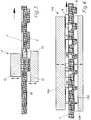
- FIG. 3 shows in a highly simplified representation a longitudinal section through the starting material 10 for the floor covering and a first needle chair 11 of a structural needle machine.
- the formation of a single elevation 4 in the form of a rib is shown in a snapshot.
- the method for forming such ribs 4, which complement one another to form a surface structure, is explained below with reference to this figure. Since such methods are known, the following explanations are limited to the essentials.
- the needle chair 11 itself essentially consists of a needle board 12 and a slatted frame 13 which has longitudinal slots 15 in the region of the elevations to be formed.
- Six needles 14 lying in a row are shown on the needle board 12. It goes without saying that further rows of needles are arranged in planes parallel to the plane of the drawing, offset to the rear, but for the sake of clarity they are not shown here. In order to create a certain surface structure, the distance between the individual rows of needles can be different.
- the arrangement of the needles 14 on the needle board 12 corresponds to the desired structure to be formed on the upper side of the starting material 10 or the floor covering.
- the needles 14 themselves have on their front preferably a U-shaped notch, which has been omitted in the drawing for clarity.
- a flat nonwoven is generally used as the starting material 10 for the floor covering.
- This flat fleece 10 is provided with a surface structure in a known manner by the interaction of the needle board 12 and the slatted frame 13 in this first step.
- the ribs 4 are formed by inserting the needles.
- the flat nonwoven 10 is continuously moved forward in the direction of the arrow. This creates ribs 4 that are slightly longer than the distance between the two outermost needles.
- the formation of the ribs 4 by means of needling creates recesses 7 on the side of the fleece opposite the formed ribs 4. Since a needle board 12 usually has several thousand needles 14, hundreds of ribs 4 are formed simultaneously.
- needle boards 12 can also be used, which have several groups of rows of needles one behind the other.
- FIG. 4 shows the second operation, to which the floor covering 1 formed according to the previous description is subjected. After retrofitting, this can be done both on the same structural needle machine as in the previous work step and on another similar or identical machine.
- the floor covering 1 and a needle chair 11A consisting of a needle board 12A and a slatted base 13A can be seen in longitudinal section, the slatted base 13A again having longitudinal slots 15A in the region of the knobs to be formed.
- the floor covering 1 is shown in this illustration, compared to FIG. 3, in a longitudinal section offset parallel to the plane of the drawing.
- the needle board 12A Six needles 14A lying in series are drawn on the needle board 12A, which in turn have a U-shaped recess (not shown) on their front side, the distance between the individual needles 14A being the same as the distance between the respective start of two neighboring ones to be formed Knobs 5.
- This needle board 12A also has further rows of needles in planes parallel to the plane of the drawing and offset to the rear.
- the floor covering 1 formed from the flat fleece is rotated for this second work step, so that it comes to lie with the ribs 4 upwards, and the knobs 5 can thereby be formed on the side opposite the ribs 4.
- knobs 5 are in turn formed by the interaction of the needle chair 12A with the slatted frame 13A, the formation of a single knob 5 being divided into six work steps.
- the floor covering 1 is continuously moved in the direction of the arrow to carry out this method.
- the needles 14A are inserted, there are individual ones Fibers from the upper area of the floor covering 1 are taken along by the needle and pulled down into the desired shape.
- a single knob 5 is produced in six working steps by successively inserting the six individual needles 14A lying in series, the floor covering 1 being continuously transported between the insertion of the first, leftmost needle and the respective subsequent insertion of the next needle, in each case by the amount of the distance between two needles.
- knobs 5 Due to the continuous transport of the floor covering 1 during the insertion of the needles 14A, an elongated configuration of the knobs 5 is achieved.
- the needles 14A are shown at the beginning of the piercing process. Instead of six needles 14A for the formation of the knobs 5, any other number of needles can of course also be selected. In this case, the number of operations for forming a single knob is again adjusted to the number of needles.
- This method in turn produces recesses 6 on the side of the floor covering 1 opposite the formed knobs 5. It goes without saying that several knobs 5 are also formed simultaneously in this method.
- the two-sided treatment of the floor covering 1 After the two-sided treatment of the floor covering 1, it is impregnated, for example, by means of a back splash process. Care is taken to ensure that the water permeability of the floor covering 1 remains guaranteed.
- the knobs 5 By forming the knobs 5 from individual fibers and the respective recesses 6 behind them, the outflow of water via the knobs 5 is also promoted.
- a floor covering 1 designed in this way can be used in a wide variety of areas, but due to its very good drainage properties it is preferably used in areas with periodic wetness. For example, it is ideal as an outdoor tennis court surface. In order to keep the loads, in particular on the joints of the tennis players, within limits, granules can be introduced into and onto the top 2 of the floor covering provided with a structure.
- such a floor covering 1 can also be used as a lawn carpet.
- Floor covering 1 is also ideal as a dirt lock in a wide variety of areas.
- such a floor covering 1 also has very good damping properties, which is reflected in a pleasant spring behavior when walking on the covering 1.
- the floor covering 1 has to withstand higher mechanical loads, for example when used as a tennis court covering, so he or the knobs 5 is generally glued to the sub-floor. In the outdoor area, such a sub-floor usually has a slight slope.
- the adhesive is applied in the form of a strip, in such a way that the grooves formed run parallel to the gradient of the underlay floor. As a result, the drainage properties of the floor covering 1 can be maintained.
- such a floor covering 1 through the integral design of the knobs 5, has a very high wear resistance, in particular with regard to acting thrust and shear forces, with very good drainage properties at the same time.
- the surface structure of the floor covering 1 can be chosen freely and adapted to individual needs.
- the surface can be designed to receive granules, so that such a floor covering 1 is suitable as a tennis court covering, in particular for the outdoor area.
- the floor covering 1 also has very pleasant damping properties.
Landscapes
- Engineering & Computer Science (AREA)
- Textile Engineering (AREA)
- Mechanical Engineering (AREA)
- Floor Finish (AREA)
- Noodles (AREA)
- Road Paving Structures (AREA)
Applications Claiming Priority (2)
| Application Number | Priority Date | Filing Date | Title |
|---|---|---|---|
| DE4305428A DE4305428C1 (de) | 1993-02-23 | 1993-02-23 | Bodenbelag |
| DE4305428 | 1993-02-23 |
Publications (2)
| Publication Number | Publication Date |
|---|---|
| EP0612876A1 true EP0612876A1 (fr) | 1994-08-31 |
| EP0612876B1 EP0612876B1 (fr) | 1996-05-08 |
Family
ID=6481060
Family Applications (1)
| Application Number | Title | Priority Date | Filing Date |
|---|---|---|---|
| EP94810004A Expired - Lifetime EP0612876B1 (fr) | 1993-02-23 | 1994-01-05 | Revêtement de sol |
Country Status (3)
| Country | Link |
|---|---|
| EP (1) | EP0612876B1 (fr) |
| AT (1) | ATE137818T1 (fr) |
| DE (2) | DE4305428C1 (fr) |
Cited By (1)
| Publication number | Priority date | Publication date | Assignee | Title |
|---|---|---|---|---|
| US6677257B2 (en) | 1999-12-24 | 2004-01-13 | Milliken Industrials Limited | Fabric for tennis ball covering and method for manufacturing the same |
Families Citing this family (3)
| Publication number | Priority date | Publication date | Assignee | Title |
|---|---|---|---|---|
| DE10134934A1 (de) | 2001-07-18 | 2003-02-20 | Hp Chem Pelzer Res & Dev Ltd | Flachgenadeltes Nadelvlies aus Natur- und/oder Synthetikfasern |
| DE102008030434B4 (de) * | 2008-06-26 | 2010-06-10 | Kramski Putter Gmbh | Golfspielunterlage |
| CN114470727A (zh) * | 2022-01-24 | 2022-05-13 | 安徽师范大学 | 多功能体育训练场 |
Citations (6)
| Publication number | Priority date | Publication date | Assignee | Title |
|---|---|---|---|---|
| AT322870B (de) * | 1972-02-24 | 1975-06-10 | Angleitner Otto Dr | Maschine zum vernadeln von faservlies od.dgl. |
| FR2264117A1 (fr) | 1974-03-12 | 1975-10-10 | Zocher Josef | |
| FR2265895A1 (en) * | 1974-03-29 | 1975-10-24 | Balamundi France | Needling fibre mat to produce relief pattern by locally moving mat - to vary penetration depth of needles |
| EP0055362A1 (fr) * | 1980-12-23 | 1982-07-07 | Breveteam S.A. | Procédé de fabrication d'un produit textile plat ainsi que le produit textile ainsi fabriqué |
| EP0088213A2 (fr) * | 1982-03-05 | 1983-09-14 | Johann Borgers GmbH. & Co. KG | Procédé de fabrication d'une étoffe à poil non-tissée par aiguilletage |
| EP0216953A2 (fr) | 1985-04-12 | 1987-04-08 | Jeschke & Hübner OHG | Revêtement de sol pour tennis |
Family Cites Families (3)
| Publication number | Priority date | Publication date | Assignee | Title |
|---|---|---|---|---|
| DE6903789U (de) * | 1969-02-01 | 1970-01-29 | Borgers Johann Kg | Nadelfilz mit unebener flaeche |
| DE3129837C2 (de) * | 1981-07-15 | 1984-09-20 | Otto 4408 Dülmen Bager jun. | Tennisbodenbelag |
| DE9109798U1 (de) * | 1991-08-07 | 1991-09-19 | Forbo-Glawo GmbH, 5632 Wermelskirchen | Polvlies für Tennishallenbelag |
-
1993
- 1993-02-23 DE DE4305428A patent/DE4305428C1/de not_active Expired - Fee Related
-
1994
- 1994-01-05 AT AT94810004T patent/ATE137818T1/de not_active IP Right Cessation
- 1994-01-05 EP EP94810004A patent/EP0612876B1/fr not_active Expired - Lifetime
- 1994-01-05 DE DE59400256T patent/DE59400256D1/de not_active Expired - Lifetime
Patent Citations (6)
| Publication number | Priority date | Publication date | Assignee | Title |
|---|---|---|---|---|
| AT322870B (de) * | 1972-02-24 | 1975-06-10 | Angleitner Otto Dr | Maschine zum vernadeln von faservlies od.dgl. |
| FR2264117A1 (fr) | 1974-03-12 | 1975-10-10 | Zocher Josef | |
| FR2265895A1 (en) * | 1974-03-29 | 1975-10-24 | Balamundi France | Needling fibre mat to produce relief pattern by locally moving mat - to vary penetration depth of needles |
| EP0055362A1 (fr) * | 1980-12-23 | 1982-07-07 | Breveteam S.A. | Procédé de fabrication d'un produit textile plat ainsi que le produit textile ainsi fabriqué |
| EP0088213A2 (fr) * | 1982-03-05 | 1983-09-14 | Johann Borgers GmbH. & Co. KG | Procédé de fabrication d'une étoffe à poil non-tissée par aiguilletage |
| EP0216953A2 (fr) | 1985-04-12 | 1987-04-08 | Jeschke & Hübner OHG | Revêtement de sol pour tennis |
Non-Patent Citations (3)
| Title |
|---|
| DIPL.-ING.J.PH.DILO,EBERBACH: "HERSTELLUNG STRUKTURIERTER NADELVLIESSTOFFE", CHEMIEFASERN-TEXTILINDUSTRIE, vol. 83, no. 9, September 1981 (1981-09-01), FRANKFURT A/M,DEUTSCHLAND, pages 674 - 679 * |
| H.SCMID,LINZ/OSTERREICH: "Textil Bodenbelage Strukturvernadelung von Faservlies", CHEMIEFASERN-TEXTILINDUSTRIE, vol. 83, no. 10, October 1981 (1981-10-01), FRANKFURT A/MAIN, pages 752 - 756 * |
| ING.M.KAPELLER,LINZ/OSTERREICH: "MUSTERUNG VON NADELVLIESEN", CHEMIEFASERN/TEXTILINDUSTRIE, vol. 40, no. 7/8, August 1990 (1990-08-01), FRANKFURT/MAIN, pages 719 - 721, XP000147503 * |
Cited By (1)
| Publication number | Priority date | Publication date | Assignee | Title |
|---|---|---|---|---|
| US6677257B2 (en) | 1999-12-24 | 2004-01-13 | Milliken Industrials Limited | Fabric for tennis ball covering and method for manufacturing the same |
Also Published As
| Publication number | Publication date |
|---|---|
| EP0612876B1 (fr) | 1996-05-08 |
| ATE137818T1 (de) | 1996-05-15 |
| DE4305428C1 (de) | 1994-07-28 |
| DE59400256D1 (de) | 1996-06-13 |
Similar Documents
| Publication | Publication Date | Title |
|---|---|---|
| DE3878780T2 (de) | Saum-draen. | |
| DE69331918T2 (de) | Bodenoberfläche zur Benutzung beim Sport und zu ähnlichem | |
| DE3535632C2 (fr) | ||
| DE60027721T2 (de) | Bodenbelag, giessform und verfahren zur herstellung derselben | |
| EP0062738A2 (fr) | Procédé de dépôt de tissu de revêtement de sol et dispositif pour la mise en oeuvre du procédé | |
| DE4106295A1 (de) | Nadelvlies | |
| EP1115314B1 (fr) | Systeme de pose de tapis de sol | |
| DE3339553C2 (de) | Bodenbelag für Tennisplätze | |
| EP0612876B1 (fr) | Revêtement de sol | |
| DE8911056U1 (de) | Samenmatte aus mindestens zwei Vliesen aus Naturfasern | |
| DE2648716C3 (de) | Teppichzwischenlage | |
| DE2935387A1 (de) | Wasserdurchlaessiger bodenbelag | |
| WO2002054852A9 (fr) | Tapis et dispositif de production d'un tapis | |
| CH674383A5 (en) | Mat underlay for gravel paths - is flexible permeable sheet of textile with perforated pipes inserted in sleeves along edges | |
| DE8807142U1 (de) | Vorgefertigtes flächiges bahnenförmiges Textil-Bauelement | |
| DE3814142A1 (de) | Tragschicht fuer die dachbegruenung | |
| EP0112795B1 (fr) | Tapis de sol en caoutchouc ou plastique pour véhicules automobiles | |
| EP2248947B1 (fr) | Bande de gazon synthétique et procédé pour construire une ligne de gazon synthétique | |
| EP0054686B1 (fr) | Procédé de fabrication d'un voile textile non-tissé ainsi que le voile textile non-tissé | |
| EP0620879B1 (fr) | Revetement de sol pour terrains de sport | |
| DE10318432A1 (de) | Durch Formen erhaltener Träger mit mindestens einem selbsthaftenden Band und Verfahren zur Herstellung eines solchen Trägers | |
| EP0880336B1 (fr) | Materiau de revetement de sol en non-tisse | |
| EP0059327B1 (fr) | Revêtement de sol pour espaces libres et son procédé de fabrication | |
| DE10139841B4 (de) | Textilrücken für Teppichboden | |
| DE9109798U1 (de) | Polvlies für Tennishallenbelag |
Legal Events
| Date | Code | Title | Description |
|---|---|---|---|
| PUAI | Public reference made under article 153(3) epc to a published international application that has entered the european phase |
Free format text: ORIGINAL CODE: 0009012 |
|
| AK | Designated contracting states |
Kind code of ref document: A1 Designated state(s): AT BE CH DE DK ES FR GB GR IE IT LI LU MC NL PT SE |
|
| 17P | Request for examination filed |
Effective date: 19941019 |
|
| GBC | Gb: translation of claims filed (gb section 78(7)/1977) |
Free format text: 941116 |
|
| 17Q | First examination report despatched |
Effective date: 19950112 |
|
| GRAH | Despatch of communication of intention to grant a patent |
Free format text: ORIGINAL CODE: EPIDOS IGRA |
|
| GRAA | (expected) grant |
Free format text: ORIGINAL CODE: 0009210 |
|
| AK | Designated contracting states |
Kind code of ref document: B1 Designated state(s): AT BE CH DE DK ES FR GB GR IE IT LI LU MC NL PT SE |
|
| PG25 | Lapsed in a contracting state [announced via postgrant information from national office to epo] |
Ref country code: IT Free format text: LAPSE BECAUSE OF FAILURE TO SUBMIT A TRANSLATION OF THE DESCRIPTION OR TO PAY THE FEE WITHIN THE PRE;WARNING: LAPSES OF ITALIAN PATENTS WITH EFFECTIVE DATE BEFORE 2007 MAY HAVE OCCURRED AT ANY TIME BEFORE 2007. THE CORRECT EFFECTIVE DATE MAY BE DIFFERENT FROM THE ONE RECORDED.SCRIBED TIME-LIMIT Effective date: 19960508 Ref country code: GR Free format text: LAPSE BECAUSE OF FAILURE TO SUBMIT A TRANSLATION OF THE DESCRIPTION OR TO PAY THE FEE WITHIN THE PRESCRIBED TIME-LIMIT Effective date: 19960508 Ref country code: ES Free format text: THE PATENT HAS BEEN ANNULLED BY A DECISION OF A NATIONAL AUTHORITY Effective date: 19960508 Ref country code: DK Effective date: 19960508 |
|
| REF | Corresponds to: |
Ref document number: 137818 Country of ref document: AT Date of ref document: 19960515 Kind code of ref document: T |
|
| REG | Reference to a national code |
Ref country code: CH Ref legal event code: NV Representative=s name: ROTTMANN, ZIMMERMANN + PARTNER AG |
|
| REG | Reference to a national code |
Ref country code: IE Ref legal event code: FG4D Free format text: 68289 |
|
| REF | Corresponds to: |
Ref document number: 59400256 Country of ref document: DE Date of ref document: 19960613 |
|
| ET | Fr: translation filed | ||
| GBT | Gb: translation of ep patent filed (gb section 77(6)(a)/1977) |
Effective date: 19960613 |
|
| PG25 | Lapsed in a contracting state [announced via postgrant information from national office to epo] |
Ref country code: SE Effective date: 19960808 Ref country code: PT Effective date: 19960808 |
|
| PG25 | Lapsed in a contracting state [announced via postgrant information from national office to epo] |
Ref country code: LU Free format text: LAPSE BECAUSE OF NON-PAYMENT OF DUE FEES Effective date: 19970131 |
|
| PLBE | No opposition filed within time limit |
Free format text: ORIGINAL CODE: 0009261 |
|
| STAA | Information on the status of an ep patent application or granted ep patent |
Free format text: STATUS: NO OPPOSITION FILED WITHIN TIME LIMIT |
|
| 26N | No opposition filed | ||
| PG25 | Lapsed in a contracting state [announced via postgrant information from national office to epo] |
Ref country code: MC Effective date: 19970731 |
|
| REG | Reference to a national code |
Ref country code: GB Ref legal event code: IF02 |
|
| PGFP | Annual fee paid to national office [announced via postgrant information from national office to epo] |
Ref country code: IE Payment date: 20080218 Year of fee payment: 15 |
|
| REG | Reference to a national code |
Ref country code: CH Ref legal event code: PFA Owner name: SETPOINT INTERNATIONAL AG Free format text: SETPOINT AG#BAHNHOFSTRASSE 15#CH-8808 PFAEFFIKON (CH) -TRANSFER TO- SETPOINT INTERNATIONAL AG#INDUSTRIESTRASSE#9475 SEVELEN (CH) |
|
| REG | Reference to a national code |
Ref country code: IE Ref legal event code: MM4A |
|
| PG25 | Lapsed in a contracting state [announced via postgrant information from national office to epo] |
Ref country code: IE Free format text: LAPSE BECAUSE OF NON-PAYMENT OF DUE FEES Effective date: 20090105 |
|
| PGFP | Annual fee paid to national office [announced via postgrant information from national office to epo] |
Ref country code: GB Payment date: 20100121 Year of fee payment: 17 Ref country code: DE Payment date: 20100121 Year of fee payment: 17 Ref country code: AT Payment date: 20100114 Year of fee payment: 17 |
|
| PGFP | Annual fee paid to national office [announced via postgrant information from national office to epo] |
Ref country code: NL Payment date: 20100118 Year of fee payment: 17 |
|
| REG | Reference to a national code |
Ref country code: NL Ref legal event code: V1 Effective date: 20110801 |
|
| REG | Reference to a national code |
Ref country code: CH Ref legal event code: PFA Owner name: SETPOINT INTERNATIONAL AG Free format text: SETPOINT INTERNATIONAL AG#INDUSTRIESTRASSE#9475 SEVELEN (CH) -TRANSFER TO- SETPOINT INTERNATIONAL AG#INDUSTRIESTRASSE#9475 SEVELEN (CH) |
|
| GBPC | Gb: european patent ceased through non-payment of renewal fee |
Effective date: 20110105 |
|
| PG25 | Lapsed in a contracting state [announced via postgrant information from national office to epo] |
Ref country code: GB Free format text: LAPSE BECAUSE OF NON-PAYMENT OF DUE FEES Effective date: 20110105 Ref country code: AT Free format text: LAPSE BECAUSE OF NON-PAYMENT OF DUE FEES Effective date: 20110105 |
|
| REG | Reference to a national code |
Ref country code: DE Ref legal event code: R119 Ref document number: 59400256 Country of ref document: DE Effective date: 20110802 |
|
| PG25 | Lapsed in a contracting state [announced via postgrant information from national office to epo] |
Ref country code: NL Free format text: LAPSE BECAUSE OF NON-PAYMENT OF DUE FEES Effective date: 20110801 |
|
| PGFP | Annual fee paid to national office [announced via postgrant information from national office to epo] |
Ref country code: FR Payment date: 20120206 Year of fee payment: 19 |
|
| PGFP | Annual fee paid to national office [announced via postgrant information from national office to epo] |
Ref country code: BE Payment date: 20120117 Year of fee payment: 19 |
|
| PGFP | Annual fee paid to national office [announced via postgrant information from national office to epo] |
Ref country code: CH Payment date: 20121205 Year of fee payment: 20 |
|
| PG25 | Lapsed in a contracting state [announced via postgrant information from national office to epo] |
Ref country code: DE Free format text: LAPSE BECAUSE OF NON-PAYMENT OF DUE FEES Effective date: 20110802 |
|
| BERE | Be: lapsed |
Owner name: *SETPOINT A.G. Effective date: 20130131 |
|
| REG | Reference to a national code |
Ref country code: FR Ref legal event code: ST Effective date: 20130930 |
|
| PG25 | Lapsed in a contracting state [announced via postgrant information from national office to epo] |
Ref country code: BE Free format text: LAPSE BECAUSE OF NON-PAYMENT OF DUE FEES Effective date: 20130131 |
|
| PG25 | Lapsed in a contracting state [announced via postgrant information from national office to epo] |
Ref country code: FR Free format text: LAPSE BECAUSE OF NON-PAYMENT OF DUE FEES Effective date: 20130131 |
|
| REG | Reference to a national code |
Ref country code: CH Ref legal event code: PL |