EP0613480B1 - Procede de preparation de derives de cephem - Google Patents
Procede de preparation de derives de cephem Download PDFInfo
- Publication number
- EP0613480B1 EP0613480B1 EP92919241A EP92919241A EP0613480B1 EP 0613480 B1 EP0613480 B1 EP 0613480B1 EP 92919241 A EP92919241 A EP 92919241A EP 92919241 A EP92919241 A EP 92919241A EP 0613480 B1 EP0613480 B1 EP 0613480B1
- Authority
- EP
- European Patent Office
- Prior art keywords
- formula
- mixture
- derivative
- give
- methyl
- Prior art date
- Legal status (The legal status is an assumption and is not a legal conclusion. Google has not performed a legal analysis and makes no representation as to the accuracy of the status listed.)
- Expired - Lifetime
Links
- 0 CCOC(*C(CSC(C1[*+])NC1=O)N)=O Chemical compound CCOC(*C(CSC(C1[*+])NC1=O)N)=O 0.000 description 3
- WBUGFHBOUPAYMG-UHFFFAOYSA-N CCS/C(/N)=N\C(\C(O)=O)=N\OC Chemical compound CCS/C(/N)=N\C(\C(O)=O)=N\OC WBUGFHBOUPAYMG-UHFFFAOYSA-N 0.000 description 1
Classifications
-
- C—CHEMISTRY; METALLURGY
- C07—ORGANIC CHEMISTRY
- C07D—HETEROCYCLIC COMPOUNDS
- C07D501/00—Heterocyclic compounds containing 5-thia-1-azabicyclo [4.2.0] octane ring systems, i.e. compounds containing a ring system of the formula:, e.g. cephalosporins; Such ring systems being further condensed, e.g. 2,3-condensed with an oxygen-, nitrogen- or sulfur-containing hetero ring
- C07D501/02—Preparation
- C07D501/04—Preparation from compounds already containing the ring or condensed ring systems, e.g. by dehydrogenation of the ring, by introduction, elimination or modification of substituents
- C07D501/06—Acylation of 7-aminocephalosporanic acid
-
- C—CHEMISTRY; METALLURGY
- C07—ORGANIC CHEMISTRY
- C07D—HETEROCYCLIC COMPOUNDS
- C07D501/00—Heterocyclic compounds containing 5-thia-1-azabicyclo [4.2.0] octane ring systems, i.e. compounds containing a ring system of the formula:, e.g. cephalosporins; Such ring systems being further condensed, e.g. 2,3-condensed with an oxygen-, nitrogen- or sulfur-containing hetero ring
-
- A—HUMAN NECESSITIES
- A61—MEDICAL OR VETERINARY SCIENCE; HYGIENE
- A61P—SPECIFIC THERAPEUTIC ACTIVITY OF CHEMICAL COMPOUNDS OR MEDICINAL PREPARATIONS
- A61P31/00—Antiinfectives, i.e. antibiotics, antiseptics, chemotherapeutics
- A61P31/04—Antibacterial agents
Definitions
- the present invention relates to a novel process for preparing ⁇ -lactam derivatives, which are a useful antibiotic, having the formula (I): wherein R 1 represents hydrogen or a metal salt; and R 2 represents hydrogen, acetoxy methyl, (2,5-dihydro-2-methyl-6-hydroxy-5-oxo-as-triazin-3-yl)thiomethyl or (1-methyl-1H-tetrazol-5-yl)thiomethyl.
- an acylated compound of the formula (I) above can be prepared by converting an amino-protected organic acid of the formula (II): wherein R 3 is an amino-protecting group, into its activated derivatives, and then by acylating 7-ADCA (7-aminodesacetoxycephalosporanic acid), 7-ACA (7-aminocephalosporanic acid) or its derivatives with the activated derivatives.
- the activated derivatives of the compound of the formula (II) may include an acid chloride, an acid anhydride, an activated ester, an activated amide, an activated amide solvate, and so forth.
- the organic acid (II) is reacted with thionyl chloride (SOCl 2 ), phosphorous trichloride (PCl 3 ), phosphorous pentachloride (PCl 5 ), or phosphorous oxychloride (POCl 3 ).
- SOCl 2 thionyl chloride
- PCl 3 phosphorous trichloride
- PCl 5 phosphorous pentachloride
- POCl 3 phosphorous oxychloride
- the resulting acid chloride is acylated with 7-ADCA, 7-ACA or its derivatives followed by removing the protecting R 3 group to give a compound of the formula (I): see Japanese Patent Application Kokai No. 52-102,096; 53-34,795; 53-68,796; 54-52,096 ; and 54-157,596; as well as British Patent No. 2,025,933.
- 2-pyridinethioester, 2-benzothiazole ester, or 1-hydroxy benzotriazole ester is synthesized from an organic acid of the formula (III): and then the resulting ester is acylated with 7-ADCA, 7-ACA or its derivatives to give a compound of the formula (I): see Japanese Patent Application Kokai No. 52-102,293; 54-95,593; and 56-152,488.
- this process shows relatively low yields due to a side reaction accompanied when preparing the activated esters. And the process must be carried out at a high reaction temperature for a long period of reaction time during the acylation step, and requires a step of removing the by-products resulted from the process.
- an activated amide solvate of a compound of the formula (III) is isolated from an organic solvent, and then is acylated with 7-ACA or its derivatives to give a compound of the formula (I): see European Patent No. 175,814.
- this process has the disadvantages that it is difficult to isolate the activated amide solvate from the organic solvent used, and that it must be carried out under the substantially similar reaction conditions to those in the cases involving an activated ester or an activated amide, requiring a high reaction temperature and a long period of reaction time.
- GB 2 022 090 and EP 0 399 094 describe processes for the preparation of cephem derivatives. These documents disclose the N-acylation step of 7-aminocephalosporanic acid (7-ACA) or its derivatives with an activated derivative of 2-(2-aminothiazol-4-yl)-2-methoxyimino acetic acid.
- the present inventors have studied a process for preparing ⁇ -lactam derivatives of the formula (I) , and discovered that an acyloxyphosphonium chloride derivative obtained from an aminothiazole derivative of the organic acid (III) makes it possible that the acylation of 7-ACA or its derivatives with organic acid can be proceeded without the isolation of the acyloxyphosphonium chloride to give the final product, ⁇ -lactam derivative, in good purity and high yield. Based on the above discovery, the inventors have now completed the present invention.
- an object of the present invention is to provide a new process for preparing ⁇ -lactam derivative of the formula (I) above, by which the disadvantages of the prior art processes have been eliminated.
- Another object of the present invention is to provide a novel process for preparing more economically and simply a compound of the formula (I) above in higher yields and purity as compared with the prior art processes.
- the acyloxyphosphonium chloride derivative can be synthesized by first reacting triphenylphosphine with hexachloroethane or carbon tetrachloride in an organic solvent to give dichlorotriphenylphosphoran, which is then reacted with an aminothiazole derivative of the formula (III).
- the acyloxyphosphonium chloride synthesized For identifying the acyloxyphosphonium chloride synthesized, a number of attempts to isolate it, such as flash column chromatography and crystallization in a nonpolar solvent, etc., have been made. However, since the acyloxyphosphonium chloride compound is unstable and easily decomposable, its isolation could not be achieved. Thus, the acyloxyphosphonium chloride derivative is synthesized using CDCl 3 as a solvent, and then directly sampled followed by identification of its chemical structure by means of the 1 H-NMR spectra.
- Organic solvents for the above reaction may preferably include tetrahydrofuran, dichloromethane and acetonitrile, etc., and most preferably dichloromethane.
- Triphenylphosphine and hexachloroethane or carbon tetrachloride are each preferably used in amounts of 1.0-1.3 equivalents to an organic acid of the formula (III).
- the reaction for preparing the acyloxyphosphonium chloride is carried out at 0-30°C. After 0.5-3.0 hours, the acyloxyphosphonium chloride derivative of the formula (IV) is obtained.
- Organic solvents for silylation of the compound of the formula (V) may include tetrahydrofuran, dichloromethane, and acetonitrile, etc., and most preferably dichloromethane.
- Silylation agents may include dichlorodimethylsilane, chlorotrimethylsilane, hexamethyldisilazane, and N,O-bis-trimethylsilylacetamide, etc. The silylation agents are used in amounts of 2.0-4.0 equivalents to the compound of the formula (V).
- triethylamine, pyridine and N,N-dimethylaniline, etc. may be preferably used as the base.
- the silylation reaction is preferably carried out at 10-45°C for 0.5-2.0 hours.
- the acylation reaction to prepare ⁇ -lactam derivatives of the formula (I) is appropriately carried out between -5 °C and 40°C for 1-3 hours. This reaction is carried out stoichiometrically.
- a base such as triethylamine and sodium bicarbonate, and water are added to the reaction mixture, and two layers are then separated. Then, a mixture of organic solvents is added to the aqueous layer, and then the pH of the aqueous layer is adjusted to an isoelectric point to give the final product, ⁇ -lactam derivatives of the formula (I), in precipitate form.
- EXAMPLE 1 7- [[2-(2-AMINOTHIAZOL-4-YL)-2- SYN -METHOXYIMINO]-ACETAMIDO]CEPHALOSPORANIC ACID
- Step A Into a 3-neck flask, 12.14 g of triphenylphosphine, 10.96 g of hexachloroethane and 150.0 ml of dichloromethane were placed. The resulting mixture was stirred for 1 hour at about 20°C. Then, to the mixture, 8.88 g of 2-(2-aminothiazol-4-yl)-2- syn -methoxyiminoacetic acid was added. The resulting mixture was further stirred for 1.5 hours at 20°C to give a reaction mixture.
- Step B Into a 3-neck flask, 10.0 g of 7-aminocephalosporanic acid, 150.0 ml of dichloromethane and 12.32 g of N,O-bis-trimethylsilylacetamide were added. The resulting mixture was stirred for 1 hour at about 30°C. To the mixture, the reaction mixture obtained from Step A was added dropwise at 20°C. The resulting mixture was stirred for 1 hour. Upon completion of the reaction, 14.0 g of sodium bicarbonate and 180.0 ml of water were added to the reaction mixture which was then stirred to separate a water layer.
- Step A The same procedure as in Example 1, Step A was repeated to give a reaction mixture.
- Step B Into a 3-neck flask, 10.0 g of 7-aminocephalosporanic acid, 150.0 ml of dichloromethane and 9.28 g of triethylamine were placed. To the mixture, 9.97 g of chlorotrimethylsilane was added dropwise at 15°C. The resulting mixture was stirred for 1.5 hours, to which the reaction mixture obtained from Step A was then added. After stirring for 1 hour at 20°C, 16.0 g of sodium bicarbonate and 200.0 ml of water were added to the mixture which was then stirred again to separate the water layer.
- Example 2 The same procedure as in Example 1 was repeated, except that tetrahydrofuran in the same amount was used in place of dichloromethane. Then, 14.0 g of sodium bicarbonate and 180.0 ml of water were added to the resulting mixture. After the mixture was saturated with NaCl while stirring, the water layer was separated. 90.0 Ml of a mixture solvent of ethyl acetate and n-butanol (8:2) was added to the water layer, which was then adjusted to a pH of about 2.6 to precipitate white crystals. The resulting crystals were filtered out and dried to give 13.97 g (83.7%) of the title compound.
- Example 2 The same procedure as in Example 1 was repeated, except that acetonitrile in the same amount was used in place of dichloromethane. Then, the resulting mixture were treated in the same manner as described in Example 3 to give 14.10 g (84.5%) of the title compound.
- Example 2 The procedure similar to that described in Example 1 was carried out using 9.77 g of hexamethyldisilazane in place of N,O-bis-trimethylsilyl acetamide. Then, the resulting mixture was treated in the same manner as described in Example 3 to give 14.49 g (86.8%) of the title compound.
- Step A The same procedure as in Example 1 was repeated to give a reaction mixture.
- Step B Into a 3-neck flask, 10.0 g of 7-aminocephalosporanic acid, 150.0 ml of dichloromethane and 9.56 g of N,N-dimethyl aniline were placed. To the mixture, 9.47 g of dichlorodimethylsilane was then added dropwise at 15°C. The resulting mixture was stirred for 1.5 hours. To this mixture, the reaction mixture obtained from Step A was added. After stirring at 20°C for 1 hour, 17.0 g of sodium bicarbonate and 200.0 ml of water were added to the reaction mixture. The mixture was stirred again, and a water layer was separated therefrom.
- EXAMPLE 7 7-[[2-(2-AMINOTHIAZOL-4-YL)-2- SYN -METHOXYIMINO]-ACETAMIDO]-3-[(1-METHYL-lH-TETRAZOL-5-YL)THIOMETHYL]-3-CEPHEM-4-CARBOXYLIC ACID
- Step A Into a 3-neck flask, 12.14 g of triphenylphosphine, 10.96 g of hexachloroethane and 180.0 ml of dichloromethane were placed. The mixture was stirred for 1 hour at 20°C, to which 8.88 g of 2-(2-aminothiazol-4-yl)-2-syn-methoxyimino acetic acid was added. The resulting mixture was stirred for 1.5 hours at 20°C to give a reaction mixture.
- Step B Into a 3-neck flask, 12.05 g of 7-amino-[3-(1-methyl-1H-tetrazol-5-yl)thiomethyl]-3-cephem-4-carboxylic acid, 180.0 ml of dichloromethane and 12.32 g of N,O-bis-trimethylsilyl acetamide were placed. The mixture was stirred for 1 hour at 30°C. To the mixture, was added dropwise the reaction mixture obtained from Step A at 20°C. The resulting mixture was then stirred for 1.5 hours. After completion of the reaction, 13.0 g of sodium bicarbonate and 180.0 ml of water were added to the reaction mixture. After the mixture was stirred, the water layer was separated.
- EXAMPLE 8 7-[2-(2-AMINOTHIAZOL-4-YL)-2- SYN -METHOXYIMINO]-ACETAMIDO]-3-[(1-METHYL-1H-TETRAZOL-5-YL)THIOMETHYL]-3-CEPHEM-4-CARBOXYLIC ACID
- Example 7 The same procedure as in Example 7 was repeated, except that acetonitrile in the same amount was used in place of dichloromethane. Then, 13.0 g of sodium bicarbonate and 170.0 ml of water were added to the resulting reaction mixture. After the reaction mixture was saturated with NaCl while stirring, a water layer was separated by extracting with 150 ml of dichloromethane. 80.0 Ml of a mixture solvent of ethyl acetate and n-butanol (8:2) was added to the water layer which was then adjusted to a pH of about 2.8 to precipitate crystals. The resulting crystals were filtered out and dried to give 15.90 g(84.7%) of the title compound.
- Step A Into a 3-neck flask, 12.14 g of triphenylphosphine, 10.96 g of hexachloroethane and 170.0 ml of dichloromethane were placed. The mixture was stirred for 1 hour at about 20°C, to which 8.88 g of 2-(2-aminothiazol-4-yl)-2-syn-methoxyimino acetic acid was added. The mixture was stirred for 1.5 hours at 20°C to give a reaction mixture.
- Step B Into a 3-neck flask, 7.35 g of 7-amino-3-cephem-4-carboxylic acid, 170.0 ml of dichloromethane and 7.84 g of pyridine were placed. To the mixture, 11.84 g of dichlorodimethylsilane was added dropwise at 10°C. The resulting mixture was stirred for 1.5 hours at 20°C. To this mixture, the reaction mixture obtained from Step A was added, and then the resulting mixture was stirred for 1.5 hours at 10°C. After completion of the reaction, 16.5 g of sodium bicarbonate and 210.0 ml of water were added to the mixture. The mixture was stirred, and then a water layer was separated.
- EXAMPLE 10 7-[[2-(2-AMINOTHIAZOL-4-YL)-2- SYN -METHOXYIMINO]-OXO-AS-TRIAZIN-3-YL)THIOMETHYL]-3-CEPHEM-4-CARBOXYLIC ACID
- Step A Into a 3-neck flask, 12.14 g of triphenylphosphine, 10.96 g of hexachloroethane and 150.0 ml of dichloromethane were placed. The mixture was stirred for 1 hour at about 20°C, to which 8.88 g of 2-(2-aminothiazol-4-yl)-2-syn-methoxyimino acetic acid was added. The mixture was stirred for 1.5 hours at 20°C to give a reaction mixture.
- Step B Into a 3-neck flask, 13.62 g of 7-[amino-3-(2,5-dihydro-2-methyl-6-hydroxy-5-oxo-as-triazin-3-yl)thiomethyl]-3-cephem-4-carboxylic acid, 200 ml of dichloromethane and 26.13 g of N,O-bis-trimethylsilylacetamide were placed. The mixture was stirred for 1 hour at about 30°C. To the resulting mixture, was added dropwise the reaction mixture obtained from Step A at 10°C. The resulting mixture was then stirred for 1 hour. After completion of the reaction, 16.0 g of sodium bicarbonate and 180.0 ml of water were added to the reaction mixture.
- EXAMPLE 11 7-[[2-(2-AMINOTHIAZOL-4-YL)-2- SYN -METHOXYIMINO]-ACETAMIDO]-3-[(2.5-DIHYDRO-6-HYDROXY-2-METHYL-5-OXO-AS-TRIAZIN-3-YL)THIOMETHYL]-3-CEPHEM-4-CARBOXYLIC ACID
- Example 10 The same procedure as in Example 10 was repeated, except that acetonitrile in the same amount was used in place of dichloromethane. Then, the resulting reaction mixture was treated in the same manner as described in Example 3 and adjusted to a pH of about 3.1 to precipitate crystals. The resulting crystals were filtered out and dried to give 17.53 g (86.1%) of the title compound.
- EXAMPLE 12 7-[[2-(2-AMINOTHIAZOL-4-YL)-2- SYN -METHOXYIMINO]-ACETAMIDO]-3-[(2,5-DIHYDRO-6-HYDROXY-2-METHYL-5-OXO-AS-TRIAZIN-3-YL)THIOMETHYL]-3-CEPHEM-4-CARBOXYLIC ACID
- Step A The same procedure as in Example 10 was repeated to give a reaction mixture.
- Step B Into a 3-neck flask, 13.62 g of 7-[amino-3-(2,5-dihydro-2-methyl-6-hydroxy-5-oxo-as-triazin-3-yl)thiomethyl]-3-cephem-4-carboxylic acid, 200.0 ml of dichloromethane and 14.84 g of triethylamine were placed. To the mixture, 16.58 g of dichlorodimethylsilane was added dropwise at 15°C. The resulting mixture was stirred for 1 hour, to which the reaction mixture obtained from Step A was then added, and the resulting mixture was stirred for 1 hour at 10°C.
- Example 2 The same procedure as in Example 1 was repeated, except that carbon tetrachloride in the same equivalent was used in place of hexachloroethane. Then, the resulting reaction mixture was treated in the same manner as described in Example 1 to give 14.67 g (87.9%) of the title compound.
- EXAMPLE 14 7-[[2-2-AMINOTHIAZOL-4-YL)-2- SYN -METHOXYIMINO]-ACETAMIDO]-3-[(2,5-DIHYDRO-6-HYDROXY-2-METHYL-5-OXO-AS-TRIAZIN-3-YL)THIOMETHYL]-3-CEPHEM-4-CARBOXYLIC ACID
- Example 10 The same procedure as in Example 10 was repeated, except that carbon tetrachloride in the same equivalent was used in place of hexachloroethane. Then, the resulting reaction mixture was treated in the same manner as described in Example 10 to give 17.8 g (87.4%) of the title compound.
- the present invention is featured by removing the steps of protecting and deprotecting the amino group in the aminothiazole derivative (III). Also, the subsequent acylation step can be carried out without isolation of the acyloxyphosphonium chloride of the formula (IV). Furthermore, the reactions involved may be carried out at near room temperature in a relatively short reaction time.
- ⁇ -lactam derivatives which are a useful antibiotic, of the formula (I) above and prepared more economically and simply in high yields and purity.
Landscapes
- Chemical & Material Sciences (AREA)
- Organic Chemistry (AREA)
- Health & Medical Sciences (AREA)
- Communicable Diseases (AREA)
- Oncology (AREA)
- Chemical Kinetics & Catalysis (AREA)
- General Chemical & Material Sciences (AREA)
- Medicinal Chemistry (AREA)
- Nuclear Medicine, Radiotherapy & Molecular Imaging (AREA)
- Pharmacology & Pharmacy (AREA)
- Life Sciences & Earth Sciences (AREA)
- Animal Behavior & Ethology (AREA)
- General Health & Medical Sciences (AREA)
- Public Health (AREA)
- Veterinary Medicine (AREA)
- Cephalosporin Compounds (AREA)
- Pharmaceuticals Containing Other Organic And Inorganic Compounds (AREA)
Abstract
Claims (6)
- Procédé pour la préparation d'un composé de formule :dans laquelle R1 représente l'hydrogène ; et R2 représente l'hydrogène, un groupe acétoxyméthyle, (1-méthyl-1H-tétrazole-5-yl)thiométhyle ou (2,5-dihydro-2-méthyl-6-hydroxy-5-oxo-as-triazine-3-yl)thiométhyle,

procédé qui comprend les étapes consistant :(a) à faire réagir un mélange de triphénylphosphine (Ph3P) et d'hexachloréthane (C2Cl6) ou de tétrachlorure de carbone (CCl4) avec un acide organique de formule :dans un solvant organique, ce qui donne un dérivé de chlorure d'acide acyloxyphosphonium de formule : et
et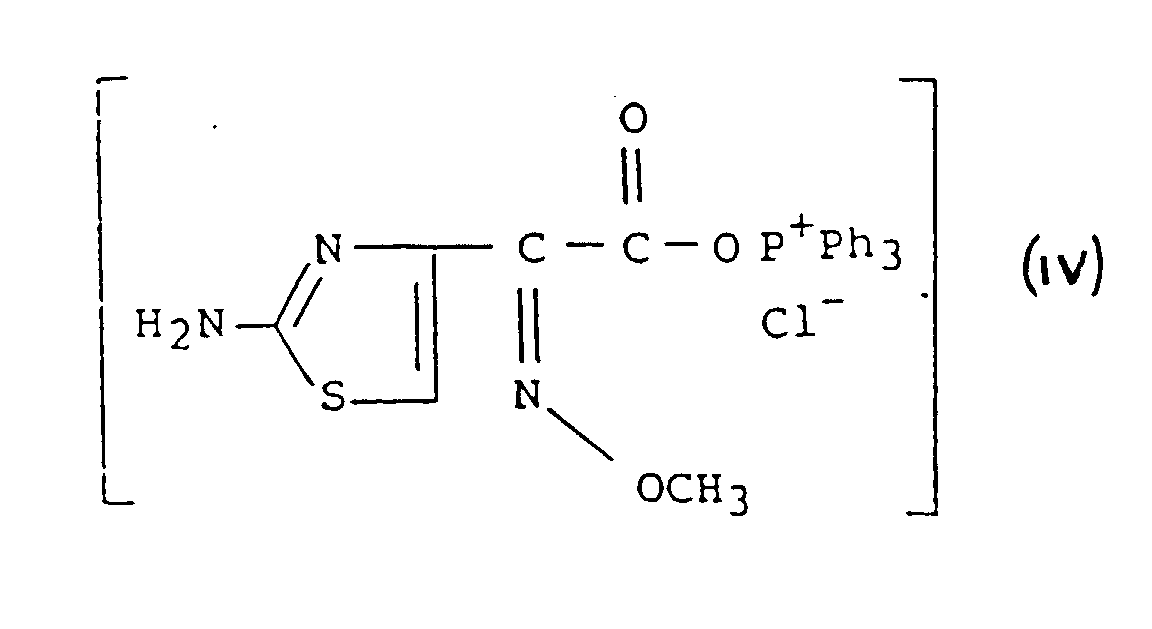 (b) à acyler un dérivé de 7-ACA de formule (V) :dans laquelle R2 répond à la définition précitée, qui a été préalablement silylé avec un agent de silylation dans un solvant organique en la présence ou en l'absence d'une base, avec le dérivé de chlorure d'acyloxyphosphonium de formule IV, sans son isolement.
- Procédé suivant la revendication 1, dans lequel le solvant organique est choisi dans le groupe consistant en dichlorométhane, acétonitrile et tétrahydrofuranne.
- Procédé suivant la revendication 1, dans lequel le dérivé silylé est préparé par silylation de 7-ACA ou de son dérivé de formule (V) avec un agent de silylation choisi dans le groupe consistant en dichlorodiméthylsilane, chlorotriméthylsilane, hexaméthyldisilazane et N,O-bis-triméthylsilylacétamide dans un solvant organique en la présence ou en l'absence d'une base.
- Procédé suivant la revendication 3, dans lequel la base est choisie dans le groupe consistant en triéthylamine, pyridine et N,N-diméthylaniline.
- Procédé suivant la revendication 1, dans lequel la réaction d'acylation est conduite pendant un temps de 1 à 3 heures à une température de -5°C à 40°C.
- Procédé suivant la revendication 1, dans lequel de la triphénylphosphine et de l'hexachloréthane ou du tétrachlorure de carbone sont utilisés en des quantités de 1,0 à 1,3 équivalent par rapport à l'acide organique de formule (III).
Applications Claiming Priority (3)
| Application Number | Priority Date | Filing Date | Title |
|---|---|---|---|
| KR1019910020505A KR950014571B1 (ko) | 1991-11-18 | 1991-11-18 | 세펨 유도체의 제조방법 |
| KR9120505 | 1991-11-18 | ||
| PCT/KR1992/000041 WO1993010123A1 (fr) | 1991-11-18 | 1992-09-04 | Procede de preparation de derives de cephem |
Publications (2)
| Publication Number | Publication Date |
|---|---|
| EP0613480A1 EP0613480A1 (fr) | 1994-09-07 |
| EP0613480B1 true EP0613480B1 (fr) | 1999-03-31 |
Family
ID=19322986
Family Applications (1)
| Application Number | Title | Priority Date | Filing Date |
|---|---|---|---|
| EP92919241A Expired - Lifetime EP0613480B1 (fr) | 1991-11-18 | 1992-09-04 | Procede de preparation de derives de cephem |
Country Status (13)
| Country | Link |
|---|---|
| US (1) | US5317099A (fr) |
| EP (1) | EP0613480B1 (fr) |
| JP (1) | JPH0811755B2 (fr) |
| KR (1) | KR950014571B1 (fr) |
| AT (1) | AT403048B (fr) |
| CH (1) | CH684091A5 (fr) |
| DE (2) | DE4293959C2 (fr) |
| DK (1) | DK56694A (fr) |
| ES (1) | ES2070101B1 (fr) |
| GB (1) | GB2275927B (fr) |
| NL (1) | NL9220025A (fr) |
| SE (1) | SE505050C2 (fr) |
| WO (1) | WO1993010123A1 (fr) |
Families Citing this family (6)
| Publication number | Priority date | Publication date | Assignee | Title |
|---|---|---|---|---|
| US5402609A (en) * | 1992-08-13 | 1995-04-04 | Kelley, Jr.; Michael L. | Concrete building block system |
| TW369530B (en) * | 1993-06-10 | 1999-09-11 | Lucky Ltd | Process for preparing cephalosporin compounds from reactive organic acid derivatives |
| KR100197788B1 (ko) * | 1995-06-30 | 1999-06-15 | 김충환 | 세펨 유도체의 제조방법 |
| IN181459B (fr) * | 1995-12-26 | 1998-06-20 | Lupin Lab Ltd | |
| EP1704153A2 (fr) * | 2004-01-16 | 2006-09-27 | Wockhardt Limited | Procede ameliore pour l'elaboration de sodium de cefotaxime |
| CN108383857B (zh) * | 2018-05-04 | 2021-02-05 | 山东四环药业股份有限公司 | 一种盐酸头孢甲肟的制备方法 |
Family Cites Families (16)
| Publication number | Priority date | Publication date | Assignee | Title |
|---|---|---|---|---|
| DE2760123C2 (de) * | 1976-01-23 | 1986-04-30 | Roussel-Uclaf, Paris | 7-Aminothiazolyl-syn-oxyiminoacetamidocephalosporansäuren, ihre Herstellung und sie enthaltende pharmazeutische Zusammensetzungen |
| US4196205A (en) * | 1976-01-23 | 1980-04-01 | Roussel Uclaf | 3-Acetoxymethyl-7-(iminoacetamido)-cephalosporanic acid derivatives |
| US4166115A (en) * | 1976-04-12 | 1979-08-28 | Fujisawa Pharmaceutical Co., Ltd. | Syn 7-oxoimino substituted derivatives of cephalosporanic acid |
| US4331664A (en) * | 1976-04-12 | 1982-05-25 | Fujisawa Pharmaceutical Co., Ltd. | Syn isomer of 7-[2-cyclo(lower) alkoxyimino-2-(2-amino-or substituted aminothiazol-4-yl)acetamido]-3-lower alkanoyloxymethyl or heterocyclicthiomethyl-3-cephem-4-carboxylic acid compounds |
| US4304770A (en) * | 1976-04-12 | 1981-12-08 | Fujisawa Pharmaceutical Co., Ltd. | Syn-isomer of 3,7-disubstituted-3-cephem-4-carboxylic acid compounds and processes for the preparation thereof |
| DE2760484C2 (fr) * | 1976-04-14 | 1992-12-03 | Takeda Chemical Industries, Ltd., Osaka, Jp | |
| US4370326A (en) * | 1977-09-13 | 1983-01-25 | Fujisawa Pharmaceutical Co., Ltd. | Cephem compounds and composition |
| DE2758000A1 (de) * | 1977-12-24 | 1979-07-05 | Hoechst Ag | Verfahren zur herstellung von penicillinen und cephalosporinen |
| CH641468A5 (de) * | 1978-05-30 | 1984-02-29 | Hoffmann La Roche | Cephemderivate. |
| MC1259A1 (fr) * | 1978-05-30 | 1980-01-14 | Hoffmann La Roche | Derives acyles |
| GB2025933B (en) * | 1978-06-13 | 1982-10-27 | Fujisawa Pharmaceutical Co | Cephem and cepham compounds |
| FR2462439A1 (fr) * | 1979-07-26 | 1981-02-13 | Roussel Uclaf | Nouveau procede de preparation de produits derives de l'acide 7-/(2-aryl) 2-hydroxyimino acetamido/cephalosporanique |
| EP0037380B1 (fr) * | 1980-03-28 | 1984-09-12 | BIOCHEMIE Gesellschaft m.b.H. | Procédé pour la production d'antibiotiques du type céphalosporine, intermédiaires pour utilisation dans ce procédé et leur production |
| KR870001332B1 (ko) * | 1984-09-27 | 1987-07-18 | 한미약품공업 주식회사 | 세펨 유도체의 간단한 제조방법 |
| DE68929368T2 (de) * | 1988-03-16 | 2002-08-14 | Eisai Co., Ltd. | Cephemderivate und Verfahren zu ihrer Herstellung |
| IT1234385B (it) * | 1989-05-23 | 1992-05-18 | Sbd Synthetic And Biolog Devel | Procedimento migliorato per la produzione di una sostanza antibiotica appartenente al gruppo delle cefalosporine |
-
1991
- 1991-11-18 KR KR1019910020505A patent/KR950014571B1/ko not_active Expired - Fee Related
-
1992
- 1992-09-04 WO PCT/KR1992/000041 patent/WO1993010123A1/fr not_active Ceased
- 1992-09-04 GB GB9409758A patent/GB2275927B/en not_active Expired - Fee Related
- 1992-09-04 JP JP5509158A patent/JPH0811755B2/ja not_active Expired - Fee Related
- 1992-09-04 AT AT0903092A patent/AT403048B/de not_active IP Right Cessation
- 1992-09-04 DE DE4293959A patent/DE4293959C2/de not_active Expired - Fee Related
- 1992-09-04 EP EP92919241A patent/EP0613480B1/fr not_active Expired - Lifetime
- 1992-09-04 DE DE4293959T patent/DE4293959T1/de active Pending
- 1992-09-04 NL NL9220025A patent/NL9220025A/nl not_active Application Discontinuation
- 1992-09-04 CH CH2208/93A patent/CH684091A5/de not_active IP Right Cessation
- 1992-10-13 US US07/959,359 patent/US5317099A/en not_active Expired - Lifetime
-
1993
- 1993-07-16 ES ES09350013A patent/ES2070101B1/es not_active Expired - Fee Related
-
1994
- 1994-05-18 SE SE9401706A patent/SE505050C2/sv not_active IP Right Cessation
- 1994-05-18 DK DK056694A patent/DK56694A/da not_active Application Discontinuation
Also Published As
| Publication number | Publication date |
|---|---|
| NL9220025A (nl) | 1994-12-01 |
| DK56694A (da) | 1994-05-18 |
| CH684091A5 (de) | 1994-07-15 |
| WO1993010123A1 (fr) | 1993-05-27 |
| GB9409758D0 (en) | 1994-07-20 |
| EP0613480A1 (fr) | 1994-09-07 |
| AT403048B (de) | 1997-10-27 |
| SE505050C2 (sv) | 1997-06-16 |
| SE9401706D0 (sv) | 1994-05-18 |
| DE4293959C2 (de) | 1996-08-29 |
| KR950014571B1 (ko) | 1995-12-08 |
| JPH0811755B2 (ja) | 1996-02-07 |
| JPH07501072A (ja) | 1995-02-02 |
| DE4293959T1 (de) | 1995-01-26 |
| KR930010043A (ko) | 1993-06-21 |
| ES2070101B1 (es) | 1996-02-16 |
| ATA903092A (de) | 1997-03-15 |
| ES2070101A1 (es) | 1995-05-16 |
| GB2275927B (en) | 1995-10-04 |
| SE9401706L (sv) | 1994-07-07 |
| US5317099A (en) | 1994-05-31 |
| GB2275927A (en) | 1994-09-14 |
Similar Documents
| Publication | Publication Date | Title |
|---|---|---|
| US6388070B1 (en) | Thioester derivatives of thiazolyl acetic acid and their use in the preparation of cephalosporin compounds | |
| HU191683B (en) | Process for production of cefem compounds | |
| EP0842937A2 (fr) | Procédé pour la préparation de cefotaxime et ceftriaxone, des dérivés de la cephalosporine | |
| EP1068211B1 (fr) | Procede de purification d'un derive de cephalosporine | |
| EP0613480B1 (fr) | Procede de preparation de derives de cephem | |
| EP0175814B1 (fr) | Procédé pour la préparation de dérivés céphem | |
| WO2002083634A2 (fr) | Procede de preparation d'acide de cefpodoxime | |
| US6610845B1 (en) | Thioester derivatives of thiazolyl acetic acid and their use in the preparation of cephalosporin compounds | |
| US5739346A (en) | Dimethyl formiminium chloride chlorosulphate derivatives useful as intermediates for producing cephalosporins | |
| US6713625B2 (en) | Process for the preparation of cefditoren using the thioester of thiazolylacetic acid | |
| KR0129567B1 (ko) | 반응성 유기산 유도체로부터 세팔로스포린 화합물의 제조방법 | |
| EP0791597A1 (fr) | Procédé pour la préparation de céphalosporines et d'intermédiaires | |
| EP0791596A1 (fr) | Procédé de préparation de céphalosporines et ses intermédiaires | |
| US5138049A (en) | Cephalosporin derivative | |
| KR0125806B1 (ko) | (6R,7R)-7-[(Z)-2(2-아미노티아졸-4-일)-2-(2-t-부톡시카르보닐프로프-2-옥시이미노)아세트아미도]-3-(1-피리디늄메틸)-3-세펨-4-카르복실레이트의 제조방법 | |
| KR0139590B1 (ko) | 세펨 유도체의 제조방법 | |
| KR100377556B1 (ko) | 세픽심 제조에 유용한 중간체의 제조방법 | |
| KR950013571B1 (ko) | (6r, 7r)-7-[(z)-2-(2-아미노티아졸-4-일)-2-(2-카르복시프로프-2-옥시이미노)아세트아미도]-3-(1-피리디늄메틸)세프-3-엠-4-카르복실레이트 이염산염의 제조방법 | |
| KR810000635B1 (ko) | 세팔로스포린 화합물의 제조법 | |
| AU2002307885A1 (en) | Process for the preparation of cefpodoxime acid | |
| KR20010002706A (ko) | 티아졸 초산 반응성 포스페이트 유도체를 이용한 세팔로스포린화합물의 제조방법 | |
| KR20010002705A (ko) | 신규 티아졸 초산의 반응성 포스페이트 유도체의 제조방법 | |
| HK1034078B (en) | Process for purification of a cephalosporin derivative |
Legal Events
| Date | Code | Title | Description |
|---|---|---|---|
| PUAI | Public reference made under article 153(3) epc to a published international application that has entered the european phase |
Free format text: ORIGINAL CODE: 0009012 |
|
| 17P | Request for examination filed |
Effective date: 19940608 |
|
| AK | Designated contracting states |
Kind code of ref document: A1 Designated state(s): FR IT |
|
| 17Q | First examination report despatched |
Effective date: 19970421 |
|
| GRAG | Despatch of communication of intention to grant |
Free format text: ORIGINAL CODE: EPIDOS AGRA |
|
| GRAG | Despatch of communication of intention to grant |
Free format text: ORIGINAL CODE: EPIDOS AGRA |
|
| GRAH | Despatch of communication of intention to grant a patent |
Free format text: ORIGINAL CODE: EPIDOS IGRA |
|
| GRAH | Despatch of communication of intention to grant a patent |
Free format text: ORIGINAL CODE: EPIDOS IGRA |
|
| GRAA | (expected) grant |
Free format text: ORIGINAL CODE: 0009210 |
|
| RAP1 | Party data changed (applicant data changed or rights of an application transferred) |
Owner name: CHEIL JEDANG CORPORATION |
|
| AK | Designated contracting states |
Kind code of ref document: B1 Designated state(s): FR IT |
|
| ET | Fr: translation filed | ||
| ITF | It: translation for a ep patent filed | ||
| PLBE | No opposition filed within time limit |
Free format text: ORIGINAL CODE: 0009261 |
|
| 26N | No opposition filed | ||
| PGFP | Annual fee paid to national office [announced via postgrant information from national office to epo] |
Ref country code: IT Payment date: 20080926 Year of fee payment: 17 Ref country code: FR Payment date: 20080915 Year of fee payment: 17 |
|
| REG | Reference to a national code |
Ref country code: FR Ref legal event code: ST Effective date: 20100531 |
|
| PG25 | Lapsed in a contracting state [announced via postgrant information from national office to epo] |
Ref country code: FR Free format text: LAPSE BECAUSE OF NON-PAYMENT OF DUE FEES Effective date: 20090930 |
|
| PG25 | Lapsed in a contracting state [announced via postgrant information from national office to epo] |
Ref country code: IT Free format text: LAPSE BECAUSE OF NON-PAYMENT OF DUE FEES Effective date: 20090904 |