EP0614218A1 - Verfahren zur Herstellung eines Kondensators und eines MIS-Transistors - Google Patents
Verfahren zur Herstellung eines Kondensators und eines MIS-Transistors Download PDFInfo
- Publication number
- EP0614218A1 EP0614218A1 EP94301461A EP94301461A EP0614218A1 EP 0614218 A1 EP0614218 A1 EP 0614218A1 EP 94301461 A EP94301461 A EP 94301461A EP 94301461 A EP94301461 A EP 94301461A EP 0614218 A1 EP0614218 A1 EP 0614218A1
- Authority
- EP
- European Patent Office
- Prior art keywords
- forming
- layer
- capacitor
- forming area
- mis transistor
- Prior art date
- Legal status (The legal status is an assumption and is not a legal conclusion. Google has not performed a legal analysis and makes no representation as to the accuracy of the status listed.)
- Withdrawn
Links
Images



Classifications
-
- H—ELECTRICITY
- H10—SEMICONDUCTOR DEVICES; ELECTRIC SOLID-STATE DEVICES NOT OTHERWISE PROVIDED FOR
- H10B—ELECTRONIC MEMORY DEVICES
- H10B12/00—Dynamic random access memory [DRAM] devices
- H10B12/01—Manufacture or treatment
- H10B12/02—Manufacture or treatment for one transistor one-capacitor [1T-1C] memory cells
- H10B12/03—Making the capacitor or connections thereto
- H10B12/033—Making the capacitor or connections thereto the capacitor extending over the transistor
-
- H—ELECTRICITY
- H10—SEMICONDUCTOR DEVICES; ELECTRIC SOLID-STATE DEVICES NOT OTHERWISE PROVIDED FOR
- H10D—INORGANIC ELECTRIC SEMICONDUCTOR DEVICES
- H10D84/00—Integrated devices formed in or on semiconductor substrates that comprise only semiconducting layers, e.g. on Si wafers or on GaAs-on-Si wafers
- H10D84/80—Integrated devices formed in or on semiconductor substrates that comprise only semiconducting layers, e.g. on Si wafers or on GaAs-on-Si wafers characterised by the integration of at least one component covered by groups H10D12/00 or H10D30/00, e.g. integration of IGFETs
- H10D84/811—Combinations of field-effect devices and one or more diodes, capacitors or resistors
- H10D84/813—Combinations of field-effect devices and capacitor only
Definitions
- the present invention relates to a method for manufacturing a semiconductor device, and more particularly, to a method for manufacturing a capacitor and a metal oxide semiconductor (MOS, broadly, a metal insulating semiconductor (MIS)) transistor on the same semiconductor substrate.
- MOS metal oxide semiconductor
- MIS metal insulating semiconductor
- a capacitor including lower and upper electrodes and a dielectric layer therebetween is formed on a thick insulating layer, i.e., a so-called field insulating layer which defines a field area, to thereby increase the capacity of the capacitor.
- a MOS transistor is formed on an active area where the field insulating layer is not formed.
- the lower electrode is formed; the dielectric layer is formed; and afterwards, the upper electrode is formed simultaneously with a gate electrode of the MIS transistor. Thereafter, impurities are doped by an ion implantation into a semiconductor substrate to form source and drain regions within the semiconductor substrate.
- the upper electrode of the capacitor is covered with a photoresist layer, thus avoiding the introduction of impurities into the upper electrode. If such impurities are doped into the upper electrode, the impurities may reach an interface between the upper electrode and the dielectric layer, to thereby reduce the duration of the capacitor and increase the leakage current of the capacitor, thus deteriorating the reliability of the semiconductor device.
- the concentration of impurities in the upper electrode which is made of polycrystalline silicon, for example, is quite low, a depletion region may appear within the upper electrode in response to a voltage applied thereto. As a result, a capacity resulting from this depletion region is connected in series to an original capacity of the dielectric layer, to thereby substantially reduce the capacity of the capacitor.
- the capacity of the capacitor manufactured by the prior art method has a dependency on voltage applied thereto, and also it is difficult to suppress the voltage dependency below a level such as 0.05%/V required in a highly-defined analog circuit.
- impurity ions are introduced by ion implantation into the upper electrode, as well as into a gate electrode of the MIS transistor.
- a depletion region is hardly generated within the upper electrode, and therefore, the capacitor has no dependency on voltage applied thereto.
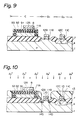
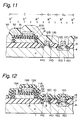
- Figs. 1 through 14 are cross-sectional views for explaining an embodiment of the method for manufacturing a capacitor, an N-channel MOS transistor and a P-channel MOS transistor according to the present invention.
- a reference C designates a capacitor forming area
- Q n designates an N-channel MOS transistor forming area
- Q p designates a P-channel MOS transistor forming area.
- a P-type monocrystalline silicon substrate 1 is prepared, and the silicon substrate 1 is oxidized in a steam atmosphere at a temperature of about 980°C to form an approximately 480 nm thick silicon oxide layer 2. Then, a part of the silicon oxide layer 2 at the P-channel MOS transistor area Q p is etched out by using a photolithography process, and afterward, the silicon substrate 1 is grown thermally at a temperature of about 950°C. to thereby form an approximately 45 nm thick silicon oxide layer 3.
- N-type impurity ions such as phosphorus ions/cm2 at an energy of 150keV are doped by an ion implantation process to form an N-type well 4 within the silicon substrate 1.
- the silicon oxide layers 2 and 3 are etched out.
- the silicon substrate 1 is again grown thermally at a temperature of about 950°C. to form an approximately 60 nm thick silicon oxide layer 5.
- an approximately 120 nm thick silicon nitride layer 6 is formed by a chemical vapor deposition(CVD) process, and the silicon nitride layer 6 is etched out by a photolithography process, so that the silicon nitride layer 6 remains only on the N-channel MOS transistor forming area Q n and the P-channel MOS transistor forming area Q p which are so-called active areas.
- CVD chemical vapor deposition
- LOCS local oxidation of silicon
- the silicon nitride layer 6 is removed.
- an approximately 400 nm thick polycrystalline silicon layer is formed by a CVD process, and a heat operation is carried out, to dope N-type impurities such as phosphorus thereinto, so that the sheet resistance thereof is about 40 ⁇ / ⁇ .
- the phosphorus doped polycrystalline silicon layer is patterned by a photolithography process, to obtain a capacitor lower electrode 8.
- an approximately 17 nm thick silicon oxide layer 91 is formed by thermally growing the capacitor lower electrode (polycrystalline silicon) 8. Then, an approximately 20 nm thick silicon nitride layer 92 is formed on the entire surface by a CVD process, and the silicon nitride layer 92 is oxidized to grow a several nm thick silicon oxide layer 93 thereon.
- the silicon oxide layer 93 and the silicon nitride layer 92 are patterned by a photolithography process, to form a capacitor dielectric layer of a triple layer configuration including the silicon oxide layer 91, the silicon nitride layer 92 and the silicon oxide layer 93. Then, the silicon oxide layer 5 is removed, and an approximately 16 nm thick silicon oxide layer 10 is again formed by thermally growing the MOS transistor forming areas Q n and Q p of the silicon substrate 1.
- an approximately 150 nm thick polycrystalline silicon layer 11 is formed on the entire surface by a CVD process, and a heat operation is carried out to dope N-type impurities such as phosphorus thereinto, so that the sheet resistance thereof is about 40 ⁇ / ⁇ . Also, in order to enhance the operation speed of the transistors, an approximately 150 nm thick tungsten silicide layer 12 is formed on the entire surface by a sputtering process.
- the polycrystalline silicon layer 11 and the tungsten silicide layer 12 are patterned by a photolithography process, to obtain a polycrystalline silicon layer 11A and a tungsten silicide layer 12A for a capacitor upper electrode in the capacitor forming area C, a polycrystalline silicon layer 11B and a tungsten silicide layer 12B for a gate electrode in the N-channel MOS transistor forming area Q n , and a polycrystalline silicon layer 11C and a tungsten silicide layer 12C for a gate electrode in the P-channel MOS transistor forming area Q p .
- the resistance of these gate electrodes is made low by a double layer configuration comprised of polycrystalline silicon and tungsten silicide.
- the P-channel MOS transistor forming area Q p is covered with a photoresist pattern 13.
- 1015 N-type impurity ions, such as arsenic ions, per cm2 at an energy of 70 keV are doped into the silicon substrate 1, to form a source region 14S and a drain region 14D within the silicon substrate 1.
- the source region 14S and the drain region 14D have an impurity concentration of about 1020 arsenic ions/cm3.
- impurity ions are doped into the tungsten silicide layer 12A and the polycrystalline silicon layer 11A as well as the tungsten silicide layer 12B and the polycrystalline silicon layer 11B.
- the photoresist pattern 13 is removed.
- the capacitor forming area C and the N-channel MOS transistor forming area Q n are covered with another photoresist pattern 15.
- 5 ⁇ 1015 P-type impurity ions, such as boron ions, per cm2 at an energy of 30 keV are doped into the silicon substrate 1, to form a source region 16S and a drain region 16D within the silicon substrate 1.
- the source region 16S and the drain region 16D have an impurity concentration of about 5x ⁇ 1020 boron ions/cm3.
- a heating or annealling process is carried out under an atmosphere of nitrogen at a temperature of about 950°C for approximately 30 minutes.
- the doped impurity ions are more deeply penetrated into the polycrystalline silicon layers 11A, 11B and 11C as well as the regions 14S, 14D, 16S and 16D.
- the lattice arrangement of polycrystalline silicon and monocrystalline silicon damaged by the above-mentioned implantation of ions is repaired, and also, the doped ions are arranged uniformly within the polycrystalline silicon and monocrystalline silicon to activate them. Note that this heating or annealling process contributes to enhancement of the concentration of impurities within the capacitor upper electrode formed by the polycrystalline silicon layer 11A and the tungsten silicide layer 12A.
- an approximately 150 nm thick silicon oxide layer 17 is formed by a CVD process on the entire surface, and an approximately 650 nm thick boron-doped phospho-silicated glass(BPSG) layer 18 is formed by a CVD process.
- a heating process is carried out in an atmosphere of nitrogen at a temperature of about 900°C to improve the coverage characteristics of the silicon oxide layer 17 and the BPSG layer 18.
- contact holes 19A, 19B, 19C and 19D are provided for ohmic contact with connection lines (not shown) made of aluminium and tungsten silicide.
- Figs. 13 and 14 which are modifications of Figs. 10 and 11, respectively, photoresist patterns 13' and 15' are provided instead of the photoresist patterns 13 and 15. That is, the photoresist pattern 13' covers the capacitor upper electrode formed by the polycrystalline silicon layer 11A and the tungsten silicide layer 12A as illustrated in Fig. 13, while the photoresist pattern 15' does not cover the capacitor upper electrode formed by the polycrystalline silicon layer 11A and the tungsten silicide layer 12A as illustrated in Fig. 14. Therefore, the P-type impurity ions such as boron ions are doped by ion implantation into the capacitor upper electrode.
- the P-type impurity ions such as boron ions are doped by ion implantation into the capacitor upper electrode.
- the type of impurity ions doped by ion implantation depends upon the direction of a bias voltage applied to the capacitor. For example, if a negative voltage is applied to the capacitor upper electrode and a positive voltage is applied to the capacitor lower electrode, N-type impurity ions are implanted into the capacitor upper electrode. Conversely, if a positive voltage is applied to the capacitor upper electrode and a negative voltage is applied to the capacitor lower electrode, P-type impurity ions are implanted into the capacitor upper electrode.
- the silicon oxide layer 93 obtained by thermally growing the silicon nitride layer 92 improves the property of the silicon nitride layer 92, so as to enhance the duration of the capacitor dielectric layer and reduce the leakage current therethrough.
- the introduction of impurities by ion implantation into the capacitor upper electrode neither deteriorates the property of the capacitor dielectric layer, nor increases the leakage current therethrough.
- the duration of the capacitor dielectric layer is higher than 20V, and the leakage current therethrough is less than 1 nA.
- the capacitor dielectric layer is not reduced in reliability.
- a capacitor manufactured by the present invention has a capacity of about 10 nF in the case of an area of 3.5mm2. Also, in a range of 0 to 5V, the voltage dependency, i.e., the difference in capacity between each voltage and a zero bias voltage is about 0.01%/V according to the present invention, while 0.04%/V in the prior art. That is, the voltage dependency obtained by using the manufacturing method according to the present invention can satisfy the specification 0.05%/V required in a highly defined analog circuit.
Landscapes
- Engineering & Computer Science (AREA)
- Manufacturing & Machinery (AREA)
- Semiconductor Integrated Circuits (AREA)
Applications Claiming Priority (2)
| Application Number | Priority Date | Filing Date | Title |
|---|---|---|---|
| JP40801/93 | 1993-03-02 | ||
| JP5040801A JPH06252345A (ja) | 1993-03-02 | 1993-03-02 | 半導体集積回路の製造方法 |
Publications (1)
| Publication Number | Publication Date |
|---|---|
| EP0614218A1 true EP0614218A1 (de) | 1994-09-07 |
Family
ID=12590741
Family Applications (1)
| Application Number | Title | Priority Date | Filing Date |
|---|---|---|---|
| EP94301461A Withdrawn EP0614218A1 (de) | 1993-03-02 | 1994-03-01 | Verfahren zur Herstellung eines Kondensators und eines MIS-Transistors |
Country Status (2)
| Country | Link |
|---|---|
| EP (1) | EP0614218A1 (de) |
| JP (1) | JPH06252345A (de) |
Cited By (1)
| Publication number | Priority date | Publication date | Assignee | Title |
|---|---|---|---|---|
| DE19506155A1 (de) * | 1994-03-01 | 1995-09-07 | Mitsubishi Electric Corp | Halbleitervorrichtung und Verfahren zur Herstellung derselben |
Families Citing this family (4)
| Publication number | Priority date | Publication date | Assignee | Title |
|---|---|---|---|---|
| CN1112731C (zh) * | 1997-04-30 | 2003-06-25 | 三星电子株式会社 | 制造用于模拟功能的电容器的方法 |
| JP3419660B2 (ja) * | 1997-10-01 | 2003-06-23 | 沖電気工業株式会社 | 半導体装置の容量部形成方法、および半導体装置の容量部およびゲート部形成方法 |
| KR100258203B1 (ko) | 1997-12-29 | 2000-06-01 | 김영환 | 아날로그 반도체 소자의 제조방법 |
| JP2015195337A (ja) * | 2014-03-28 | 2015-11-05 | ローム株式会社 | ディスクリートキャパシタおよびその製造方法 |
Citations (4)
| Publication number | Priority date | Publication date | Assignee | Title |
|---|---|---|---|---|
| US4249194A (en) * | 1977-08-29 | 1981-02-03 | Texas Instruments Incorporated | Integrated circuit MOS capacitor using implanted region to change threshold |
| US4419812A (en) * | 1982-08-23 | 1983-12-13 | Ncr Corporation | Method of fabricating an integrated circuit voltage multiplier containing a parallel plate capacitor |
| EP0435534A2 (de) * | 1989-12-14 | 1991-07-03 | STMicroelectronics S.r.l. | Integrierte Schaltung und Herstellungsverfahren dafür |
| US5171699A (en) * | 1990-10-03 | 1992-12-15 | Texas Instruments Incorporated | Vertical DMOS transistor structure built in an N-well CMOS-based BiCMOS process and method of fabrication |
Family Cites Families (1)
| Publication number | Priority date | Publication date | Assignee | Title |
|---|---|---|---|---|
| JPH02213158A (ja) * | 1989-02-13 | 1990-08-24 | Nec Corp | 半導体装置の製造方法 |
-
1993
- 1993-03-02 JP JP5040801A patent/JPH06252345A/ja active Pending
-
1994
- 1994-03-01 EP EP94301461A patent/EP0614218A1/de not_active Withdrawn
Patent Citations (4)
| Publication number | Priority date | Publication date | Assignee | Title |
|---|---|---|---|---|
| US4249194A (en) * | 1977-08-29 | 1981-02-03 | Texas Instruments Incorporated | Integrated circuit MOS capacitor using implanted region to change threshold |
| US4419812A (en) * | 1982-08-23 | 1983-12-13 | Ncr Corporation | Method of fabricating an integrated circuit voltage multiplier containing a parallel plate capacitor |
| EP0435534A2 (de) * | 1989-12-14 | 1991-07-03 | STMicroelectronics S.r.l. | Integrierte Schaltung und Herstellungsverfahren dafür |
| US5171699A (en) * | 1990-10-03 | 1992-12-15 | Texas Instruments Incorporated | Vertical DMOS transistor structure built in an N-well CMOS-based BiCMOS process and method of fabrication |
Cited By (3)
| Publication number | Priority date | Publication date | Assignee | Title |
|---|---|---|---|---|
| DE19506155A1 (de) * | 1994-03-01 | 1995-09-07 | Mitsubishi Electric Corp | Halbleitervorrichtung und Verfahren zur Herstellung derselben |
| US5736776A (en) * | 1994-03-01 | 1998-04-07 | Mitsubishi Denki Kabushiki Kaisha | Semiconductor device and method of manufacturing the same |
| US6096619A (en) * | 1994-03-01 | 2000-08-01 | Mitsubishi Denki Kabushiki Kaisha | Method of manufacturing a semiconductor device comprising a capacitor with an intrinsic polysilicon electrode |
Also Published As
| Publication number | Publication date |
|---|---|
| JPH06252345A (ja) | 1994-09-09 |
Similar Documents
| Publication | Publication Date | Title |
|---|---|---|
| US4422885A (en) | Polysilicon-doped-first CMOS process | |
| US4918026A (en) | Process for forming vertical bipolar transistors and high voltage CMOS in a single integrated circuit chip | |
| US5424572A (en) | Spacer formation in a semiconductor structure | |
| US4764480A (en) | Process for making high performance CMOS and bipolar integrated devices on one substrate with reduced cell size | |
| US5065208A (en) | Integrated bipolar and CMOS transistor with titanium nitride interconnections | |
| US5573963A (en) | Method of forming self-aligned twin tub CMOS devices | |
| US5538913A (en) | Process for fabricating MOS transistors having full-overlap lightly-doped drain structure | |
| EP0387999B1 (de) | Verfahren zum Herstellen von Hochspannungs- und Niederspannungs-CMOS-Transistoren in einem einzigen integrierten Schaltungs-Chip | |
| US4757032A (en) | Method for DMOS semiconductor device fabrication | |
| US5294822A (en) | Polycide local interconnect method and structure | |
| US4874714A (en) | Method of making laterally oriented Schottky diode | |
| US5970329A (en) | Method of forming power semiconductor devices having insulated gate electrodes | |
| US6261932B1 (en) | Method of fabricating Schottky diode and related structure | |
| EP0278619B1 (de) | Verfahren zum Herstellen integrierter Strukturen aus bipolaren und CMOS-Transistoren | |
| US4507846A (en) | Method for making complementary MOS semiconductor devices | |
| US6461925B1 (en) | Method of manufacturing a heterojunction BiCMOS integrated circuit | |
| US5045493A (en) | Semiconductor device and method of manufacturing the same | |
| US6767797B2 (en) | Method of fabricating complementary self-aligned bipolar transistors | |
| JP2004006821A (ja) | バイポーラ・トランジスタ | |
| US4877748A (en) | Bipolar process for forming shallow NPN emitters | |
| EP0337823A2 (de) | MOS-Feldeffekttransistor mit hoher Durchbruchspannung | |
| KR100221064B1 (ko) | 반도체장치의 제조방법 | |
| US7148096B2 (en) | Method of manufacturing a semiconductor device having a gate electrode containing polycrystalline silicon-germanium | |
| US5059546A (en) | BICMOS process for forming shallow NPN emitters and mosfet source/drains | |
| EP0614218A1 (de) | Verfahren zur Herstellung eines Kondensators und eines MIS-Transistors |
Legal Events
| Date | Code | Title | Description |
|---|---|---|---|
| PUAI | Public reference made under article 153(3) epc to a published international application that has entered the european phase |
Free format text: ORIGINAL CODE: 0009012 |
|
| 17P | Request for examination filed |
Effective date: 19940602 |
|
| AK | Designated contracting states |
Kind code of ref document: A1 Designated state(s): DE FR GB |
|
| 17Q | First examination report despatched |
Effective date: 19941021 |
|
| STAA | Information on the status of an ep patent application or granted ep patent |
Free format text: STATUS: THE APPLICATION IS DEEMED TO BE WITHDRAWN |
|
| 18D | Application deemed to be withdrawn |
Effective date: 19960227 |