EP0614617A2 - Procédé de stérilisation de conserves en boîte - Google Patents
Procédé de stérilisation de conserves en boîte Download PDFInfo
- Publication number
- EP0614617A2 EP0614617A2 EP94108678A EP94108678A EP0614617A2 EP 0614617 A2 EP0614617 A2 EP 0614617A2 EP 94108678 A EP94108678 A EP 94108678A EP 94108678 A EP94108678 A EP 94108678A EP 0614617 A2 EP0614617 A2 EP 0614617A2
- Authority
- EP
- European Patent Office
- Prior art keywords
- cans
- temperature
- sterilizer
- products
- product
- Prior art date
- Legal status (The legal status is an assumption and is not a legal conclusion. Google has not performed a legal analysis and makes no representation as to the accuracy of the status listed.)
- Withdrawn
Links
Images





Classifications
-
- A—HUMAN NECESSITIES
- A23—FOODS OR FOODSTUFFS; TREATMENT THEREOF, NOT COVERED BY OTHER CLASSES
- A23B—PRESERVATION OF FOODS, FOODSTUFFS OR NON-ALCOHOLIC BEVERAGES; CHEMICAL RIPENING OF FRUIT OR VEGETABLES
- A23B2/00—Preservation of foods or foodstuffs, in general
-
- A—HUMAN NECESSITIES
- A23—FOODS OR FOODSTUFFS; TREATMENT THEREOF, NOT COVERED BY OTHER CLASSES
- A23B—PRESERVATION OF FOODS, FOODSTUFFS OR NON-ALCOHOLIC BEVERAGES; CHEMICAL RIPENING OF FRUIT OR VEGETABLES
- A23B2/00—Preservation of foods or foodstuffs, in general
- A23B2/20—Preservation of foods or foodstuffs, in general by heating materials in packages which are progressively transported, continuously or stepwise, through the apparatus
-
- A—HUMAN NECESSITIES
- A23—FOODS OR FOODSTUFFS; TREATMENT THEREOF, NOT COVERED BY OTHER CLASSES
- A23B—PRESERVATION OF FOODS, FOODSTUFFS OR NON-ALCOHOLIC BEVERAGES; CHEMICAL RIPENING OF FRUIT OR VEGETABLES
- A23B2/00—Preservation of foods or foodstuffs, in general
- A23B2/20—Preservation of foods or foodstuffs, in general by heating materials in packages which are progressively transported, continuously or stepwise, through the apparatus
- A23B2/22—Preservation of foods or foodstuffs, in general by heating materials in packages which are progressively transported, continuously or stepwise, through the apparatus with packages on endless chain or band conveyors
- A23B2/225—Preservation of foods or foodstuffs, in general by heating materials in packages which are progressively transported, continuously or stepwise, through the apparatus with packages on endless chain or band conveyors transported in a hydrostatic chamber
Definitions
- the present invention relates to a process for thermally processing canned food products.
- Hydromatic is an automatic continuous sterilizer available from Stork. It typically includes a first heat-up tower, followed by a pair of sterilizing towers, a cooling leg tower, a pair of spray-cooling towers, and a drying section tower to prevent recontamination.
- the cans are fed into the towers by an automatic feed and are carried through the system by a can holder chain arrangement and fed out of the system by an automatic discharge.
- This sterilizer can handle vegetables, meats, baby foods, corn, fruits, soups, milk, cream, milk drinks, and evaporated milks in almost any shape of today's cans.
- Heavy insulation and all-weather aluminum coverings allow the Hydromatic to be placed outdoors.
- a centralized drive can be positioned on the top of the cooker, such as above the final drying leg tower, and the shafts and wheels thereof allow the chain to reverse its direction of travel.
- the chains are constructed to be sturdy and to resist the risk of breakage through corrosion from the system's steam and water.
- the carriers are open, acting as bucket elevators, and thus the cans can be fed in along any point of the full length or height of the preheating tower and discharged at any point between the top and the bottom of the last cooling tower. Thus, one or even several feeder lines can be connected to the cooker at any height.
- Special carriers can be used to handle cans of unusual shapes or sizes.
- the sterilizer uses the hydrostatic principal wherein steam pressure in the sterilizing section is balanced by water columns on either side thereof.
- the height of the columns depends on the required steam pressure, that is on the temperature.
- the hydrostatic head can be adjusted through overflow valves so that the sterilizing temperature can be varied within set limits.
- the general concept of the cooker or sterilizer can thus be demonstrated by taking two bell jars, inverting one inside of the other and filling them with water. The inner one is then pressurized, and the water is pushed down and into the legs on either side of the space between the two bell jars.
- the columns of water on the outside add reverse pressure in the opposite direction and balance out at the pressure in the inside of the inner jar or steam dome.
- the can carriers of the hydromatic are fixed between a pair of endless conveyor chains which traverse the entire unit and take the cans through the preheating tower, the steam tower and the several cooling towers.
- the average temperature in the preheating column is close to the boiling point, and the cans which are filled at, eg. 71.1°C (160°F) are gradually heated as they pass through it.
- the sterilizing tower contains saturated steam and a number of up and down passages through this steam. The number of passages depends on the sterilizing time required. Since the chain speed and the water columns are variable, a wide variety of time-temperature combinations are possible.
- the cans After sterilizing, the cans are rapidly cooled in the cooling section by a counter current flow of cooling water.
- the cooling water after being heated by the cans, is transferred to the preheating section where it is used to warm the incoming cans.
- the pressure and temperature drop in the first cooling leg are gradual to reduce leakage in the seams of the can.
- the cans can also be rotated throughout the preheating, sterilizing and cooling towers at a rate of, for example, from zero to twelve rotations per minute.
- the open carriers automatically pick up the cans which are waiting in rows for pickup. This open can carrier design allows for easy unloading since the cans are simply guided into a curve which causes them to slide out.
- the cans after discharge can be conveyed laying on their sides to a labelling machine.
- cans from the filler lines are passed into the hydrostatic cooker/sterilizer for processing.
- the steam is introduced into the hydrostatic sterilizer at a fixed temperature, and the dwell time of the product in the sterilizer is adjusted by adjusting the conveyor chains that carry the product through the sterilizer.
- Different products require different processing conditions in the sterilizer.
- a novel process for sterilizing packaged products such as canned soups is herein disclosed.
- the cans In the past (as stated above) after the cans had been filled and sealed they typically were conveyed through a tall (six or so story) hydrostatic sterilizer for approximately an hour to sterilize the products therein and thereby improve their keeping qualities.
- Different canned products have different sterilizing requirements (temperatures and/or dwell times). however.
- the sterilizer had to be first emptied and adjusted, resulting in expensive down time and delays.
- the present process reduces significantly, if not eliminates, this down time by running the sterilizer at a constant line speed providing, for example a fifty minute dwell time, and temperature, for example at 121.1°C (250°F) for all canned products.
- a constant line speed providing, for example a fifty minute dwell time, and temperature, for example at 121.1°C (250°F) for all canned products.
- temperature for example at 121.1°C (250°F) for all canned products.
- at least one of the different products is preheated significantly before entering the sterilizer, for example so that its internal temperature is raised 21.1°C (70°F).
- This preheating is accomplished by conveying the product through a preheating vessel generally separate from the sterilizer. If both different products are preheated, they are preheated to different temperatures, either in separate vessels or in the same vessel, after adjustment thereof.
- the temperature and/or dwell time of the preheating vessel can be adjusted for a different canned product in ten, fifteen or twenty minutes compared with the hour or two required for the much larger sterilizer.
- the temperature can be varied (from 104.4° to 129.4°C (220° to 265°F), for example) within a short fifteen to twenty-minute period, thereby allowing a standard line speed to be maintained through the entire cooker for different products.
- a preferred preheating vessel used in the process of the present invention comprises a steam dome having its own infeed and exit steam legs. Since the products, which are to be preheated, can now be filled in the cans at colder temperatures, even ambient temperature, product degradation is also no longer a problem.
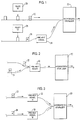
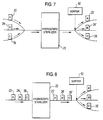
- Figures 1, 2, 3, 4, 5, 6, 7 and 8 are diagrammatic views of first, second, third, fourth, fifth, sixth, seventh and eighth systems of the present invention.
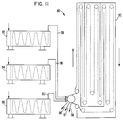
- Figures 9, 10, 11 and 12 are side schematic views of first, second, third and fourth apparatuses of the present invention.
- Figure 13 sets forth in tabular form the carrier arrangement for the apparatus of Figure 12.
- FIGs 1-8 a number of variations of the present invention are illustrated.
- the underlying concept of all of them though is that to accommodate the different heating requirements of different canned products, so that they can both pass through the same hydrostatic sterilizer shown generally at 20 under the same conditions and at the same rate, that one of the canned products is preheated a significant amount before being passed through the sterilizer. If both are preheated, they are preheated differently.
- the different canned products are shown in Figures 1-8 by reference numerals 22 and 24 (and letters A and B) after filling by fillers 26 and 28, respectively, and after sterilization in the hydrostatic sterilizer 20 are designated by the same letters and reference numerals followed by a prime (') designation.
- the cans (or other sealed packages) of the products and the equipment of the fillers 26 and 28 are conventional and known in the art, and thus no additional disclosure is herein provided for them.
- Various ways of preheating the products 22, 24, conveying them through the hydrostatic sterilizer 20, and separating them after sterilization are new though and are illustrated in the drawings and are described herebelow.
- the product typically moves through the preheater or preheat vessel 30 at a constant rate.
- product 22 is introduced into the preheater 30 and heated to a temperature of 123°C (255° F), and after four hours, a decision is made to switch over to product 24.
- the feed of product 22 is then stopped, but the sterilizer 20 continues to operate.
- the temperature in the preheater 30 is adjusted to the appropriate temperature for product 24, such as a lower 118.3°C (245° F).
- product 24 is fed into the preheater 30 and then into the sterilizer 20, as shown in Figure 2.
- two preheaters 32, 34 are used in a single system, as depicted in Figure 3, two products can be fed at the same time, as alternating cans of product 22 and product 24, for example, or for three products, as products 22, 24 and 36 (product C), as shown in Figure 8.
- two different products 22, 24 can be continuously and simultaneously fed into the sterilizer, one on each side of the conveyor chain 36, as depicted schematically in Figure 6.
- Two separate discharge paths 38, 40 can then be used, one for the cans on each side of the chain 36.
- three of four products can be run through the sterilizer at one time, as depicted in Figure 8 by reference numerals 22, 24 and 36, by operation of suitable (rotary) preheaters.
- the discharge would have to make the appropriate selection to separate the cans.
- One method is to use photoelectric, readable bar codes and a suitable reader shown schematically and generically at 42 at the discharge end of the sterilizer 20 to separate the products 22, 24. 36 on the basis of bar codes thereon. With this arrangement, the order of feed into the sterilizer 20 is not critical. Thus, various combinations of both the number of preheaters and the type of preheaters (agitating or non-agitating) can be used in combination with a single hydrostatic sterilizer 20. This greatly improves the efficiency of the sterilizer 20 and reduces the amount of product inventories resulting.
- Some products such as bean and pasta products, must be agitated to prevent unattractive clumping of their ingredients.
- some other products are damaged by excessive agitation: for example, cream soups tend to separate and delicate ingredients tend to break apart.
- This invention easily handles these different agitation requirements by providing a number of different preheaters. For example, one product can be fed through an agitating pre-heater set at one temperature, a second run through a non-agitating preheater set at another temperature, and a third whose processing parameters do not require preheating can be fed directly into the hydrostatic cooker or sterilizer.
- the choice of agitating or non-agitating preheaters is related to the products being processed.
- FIG. 9 a first rotary pre-heat hydrostatic system, including a non-agitating rotary preheat 52 vessel feeding the cans through an infeed 54 into a hydrostatic sterilizer 56 and then out a discharge 58, is illustrated generally at 60.
- Figure 10 shows another system at 62 including an agitating rotary pre-heat vessel 64.
- the system 80 of Figure 11 has two non-agitating rotary pre-heat vessels 82, 84, an agitating rotary pre-heat vessel 86, three infeeds 88, 90, 92, a hydrostatic sterilizer 94 and three discharges 96, 97, 98.
- cans are processed in cookers for fifty, sixty or eighty minutes or whatever is needed at 104.4 to 121.1°C (220 to 250°F) with 115.5 to 121.1°C (240 or 250°F) being common.
- This invention standardizes the line speed at, for example, forty-five or fifty minutes at 121.1°C (250°F) by preheating the cans up to a temperature of, for example, 93.3°C (200°F).
- the sealed containers first pass through a preheat vessel in which any heating not capable of being supplied by those fixed conditions is provided. Considerable savings are possible since it only takes about ten minutes to adjust the operating conditions of the preheater to accommodate different products.
- a preferred system for use in the process of this invention is shown in Figure 12 generally at 100.
- the first tower system 100 shown generally at 102 is the infeed section to the preheat tower.
- the preheat leg 102 is not significantly different from the other legs, except it may be a little taller in order to handle the higher pressure needed at the higher temperatures.
- the cans are transferred through the hydrostatic leg into the preheat section, the second tower shown generally at 106.
- the third tower shown generally at 108 is the transfer section.
- the cans pass through the two hydrostatic legs, one of which maintains the steam pressure in the preheat tower and the other of which maintains the stream pressure in the processing tower.
- the fourth and fifth towers 110 and 112 are the actual processing sections of the system.
- the sixth tower 114 is another transfer section.
- the cans pass through another hydrostatic leg and into the last two towers 116 and 118 - the cooling sections.
- Saturated steam is used for product sterilization, and steam (or a steam-air mixture) is used for preheating in the system 100.
- steam or a steam-air mixture
- the sterilizing media is saturated steam such as is currently used for the sterilization of metal cans, using super-heated water is also within the scope of the invention.
- the capacity of system 100 is eight hundred cans per minute, the sterilizing time is fifty minutes, the sterilizing temperature is 121.1°C (250°F), the preheating time is ten minutes, the preheating temperatures are between 104.4°C and 132.2°C (220°F and 270°F), and the cooling time is sixty minutes.
- the flexibility is from 104.4°C to 129.4°C (220 to 265°F), and this accommodates both ten-ounce and nineteen-ounce cans.
- Differences in product heating rates and initial product temperatures are compensated for by regulating the process temperature in the preheating section 102.
- Steam or steam/air mixture is the medium in the preheat tower 102.
- a temperature of 132.2°C (270°F) represents a vapor pressure of forty-two psi.
- the total pressure is a standard pressure corresponding with twenty-four meters of water, or forty-nine psi, which results in an over pressure for the air of a minimum of seven psi. Due to the high pressure of the twenty-four meters of water built into one leg, the system 100 of Figure 12 is about twenty feet higher than conventional 132.2°C (250°F) processors.
- the main chain is sturdier than prior art chains due to this additional height and has a 70 x 70 design.
- the length of the carriers is two centimeters or 8/10 of an inch shorter than standard to accommodate the wider chain and to be able to apply standard drives, shafts and other components.
- the carrier lay-out is set forth in Figure 13.
- the system 100 preferably has a carrier monitoring system and an automated start-up system since changeovers have to be made quickly and bringing two pressure chambers up manually is difficult.
- a system for use in the process of this invention can have a single infeed system with a maximum capacity of eight hundred and fifty cans per minute and a cycle time of 2.4 seconds, and a nominal capacity of eight hundred cans per minute at fifty minutes and a 2.55 seconds per cycle time.
- An alternative system can have a larger pitch of the main chain and a double infeed and discharge due to the increased nominal cycle time and can also handle a 303 x 500 can size.
- a one hundred and fifty-two millimeter chain pitch in the first machine instead of one hundred and twenty millimeters can be used without lowering the height of the sterilizing section and the cooling section.
- the nominal speed for 211 x 400 cans becomes six hundred and thirty-one cans per minute instead of eight hundred cans per minute, however.
- the height of the sterilizing and cooling sections can be lowered step by step with each step representing a capacity drop of about fifty cans per minute.
- the products were typically filled at an elevated temperature to shorten their residence time in the cooker. Since the products can now be filled at ambient temperature, the problem of maintaining the products at the elevated initial temperature is eliminated.
- the preheat leg 102 allows the products to be filled at colder temperatures thereby eliminating the problems of product degradation in the blending facilities and then in the can itself. Starches, condiments and garnishes need not be held at, for example, 87.8°C (190°F) for an additional time.
- the temperature loss was significant due to its temperature difference with the environment.
- the product is only 26.7°C (80°F) then the loss of temperature is much slower because it is almost at equilibrium. Longer downtimes can thus be tolerated since the products are colder.
- the products need not be heated before being filled in the container.
- the additional heat can be pulsed for about ten minutes into the can in the preheater 102 and then sent to the final portion of the cooker 120 for the final sterilization. This pulse of heat is at a higher temperature than that of the cooker processor 120. In other words, the initial temperature is set for entry into the final sterilization mode.
- the cold blending technique of this invention has further advantages.
- Industrial scale blending or cooking of the food, or more particularly soup is in large hatches. In other words, it is blended in a large kettle because to blend it in a number of small kettles would be inefficient. Some period of time on the order of a half an hour is required though to fill the individual cans and thereby completely empty the kettle.
- the soup has been sitting for a while in the kettle, its heavier components, its vegetables and meat and so forth. sink to the bottom.
- the individual cans have different concentrations of meat and liquid depending on when they are filled.
- One known solution is to add starch to the mixture to make it thicker and to prevent the heavier components from settling.
- the starch selected depends not only on its capabilities for suspending the garnishes and other components of the soup, but also for the mouthfeel, texture, appearance and taste it adds.
- the soup can remain in the kettle longer during the filling operations, since overheating is not a problem, and thus larger batches can be more economically made. While filling previously had to be completed in twenty or thirty minutes, a two hour period appears to be available now. Thus, 20,000 as opposed to 5,000 pound batches are possible.
- the technique of the present invention wherein the food product is cold blended at a temperature of between 21.1°-54.4°C (70-130°F) and preferably between 21.1°-26.7°C (70 and 80°F) or room temperature, filled cold in the cans, passed through the preheater where significant preheating is done, and then passed preheated to and through the hydrostatic cooker at approximately 121.1°C (250°F) and for a fifty-five minute process time has a number of advantages. It is not commercially practical though to cold blend the soup and pass it cold directly into the hydrostatic cooker. This is because an additional ten to fifteen minutes would be needed in the existing cookers and the throughput or cans per minute would be reduced by ten to twenty percent.
- Bean and bacon soup though blended at the same temperature as cream of mushroom, heats differently. If it heats slower, that means that without the preheat leg 102 the process time would have to be increased.
- the present invention allows the temperature to be raised so that the initial temperature of the product is sufficient to provide a fifty-minute final sterilization time for a commercially sterile product.
- the process speed design is based upon an internal temperature of 65.5°C (150°F).
- the product would be pulsed through the preheater for a fixed time of, for example, ten minutes.
- the temperature would be changed to 129.4°C (265°F) which would raise the temperature at the center of the can entering into the preheat from 26.7°C to an effective temperature of 65.5°C (80°F to 150°F) or a (plus) 38.8°C (70°F) change.
- the system does not handle conventional glass container products well because glass cannot handle the rapid changes in temperature involved herein.
- Some plastics can be kept from deforming by changing the amount of overpressure added into the preheat. For example, polypropylene at above 76.7°C (170°F) starts to become fluid. Thus, since the modulus of the structure does not hold up well, the internal pressures need to be balanced.
- the system can be incorporated in either a single unit along with the sterilizer, which is more likely when a new system is to he built as shown by 100 in Figure 12, or as a separate unit integrated with a sterilizer unit which can give more flexibility.
- a determining factor is which produces more products on a continuous basis.
- Two existing pieces of equipment - a (an agitating) rotary cooker and a hydrostatic sterilizer - can be integrated to solve the problem in the canned thermally processed food industry.
- Agitating rotary cookers are used to produce thin products that lend themselves to agitating once when you rotate them through the cooker. They are horizontal cookers through which the cans spiral. As the cans spiral, they come down on the bottom arc of the circle, drop out of a sleeve and roll onto the bottom of the cooker so that the can spins itself.
- the sleeve is slotted which allows each can to have its own individual slot to move through as it travels through the cooker.
- the outer shell of the cooker has riflings which allow the can to spiral through the cooker and come out the other end and thereby delines a continuous cooker.
- the cans From the top or the twelve o'clock position the cans swing clockwise, and when they reach the four o'clock position, they fall out of the sleeve and onto the wall or shell of the cooker.
- the sleeve though still contacts the cans and pushes them across the wall or shell or the bottom of the are of the circle from the four o'clock all the way to the eight o'clock position. While it is pushing them, the cans are spinning, and once they come up on the other side, they are picked up by the sleeve again and stop spinning. Thus, they are not spinning through three-quarters of the arc of the circle, they are just spiraling through the cooker. On the bottom, however, they are not only spiraling but also rotating.
- the AB cooker for example, is a very short cooker and economically priced when compared with the stationary hydrostatic cooker, which is six or seven stories high.
- the spiraled shell of the preheater allows more cans to be processed in a smaller space. For example, five hundred and fifty-two ten-ounce cans can be accommodated in a thirty foot preheater on a continuous basis. In contrast, a straight track for that many cans would be eight hundred feet long.
- the temperature range is from 93.3°C (200°F) approximately to 132.2°C (270°F) which provides good flexibility to pulse a lot of heat into the products as needed and less heat as needed to satisfy a common line speed.
- the rotary cooker has a cooking shell and a cooling shell -- two horizontal shells that are hooked together in tandem through a transfer valve.
- the cooking shell can be disconnected and removed for the two-piece embodiment of this invention.
- the temperature can be quickly changed in five minutes. If the preheater were incorporated in the cooker, changing the temperature in the preheater would require more time, around twenty-five or thirty minutes, since it depends on hydrostatic water columns or hydrostatic pressure generated by the water columns. Thus, additional changeover time is required. However, from a maintenance and a functionality standpoint, it is easier to operate.
- the pressure conditions of the rotary preheater and the hydrostatic sterilizer are whatever the saturated steam pressure is; the pressure is not controlled.
- steam has a certain pressure at whatever temperature it is being run at, 121.1°C (250°F) it is 15.1 pounds gauge pressure and at 126.7°C (260°F) it is generally twenty pounds.
- the temperature in the preheat leg is thus adjusted to provide a certain pressure.
- the external pressure cannot be too much greater than the internal pressure of the container, and the hotter the product in the container, the greater the internal pressure.
- the external and internal pressures of the container must be matched, so that the container is not damaged or fail.
- the thermal process is based on a certain temperature that the can achieves after a given time.
- the temperature at which the can goes into the cooker determines how long it has to spend in the cooker to achieve its final temperature.
- the amount of time that the can must stay in the sterilizer is shortened and the line speed can thereby be increased.
Landscapes
- Life Sciences & Earth Sciences (AREA)
- Engineering & Computer Science (AREA)
- Wood Science & Technology (AREA)
- Zoology (AREA)
- Chemical & Material Sciences (AREA)
- Food Science & Technology (AREA)
- Polymers & Plastics (AREA)
- Food Preservation Except Freezing, Refrigeration, And Drying (AREA)
- Seeds, Soups, And Other Foods (AREA)
Applications Claiming Priority (3)
| Application Number | Priority Date | Filing Date | Title |
|---|---|---|---|
| US470601 | 1990-01-26 | ||
| US07/470,601 US5160755A (en) | 1990-01-26 | 1990-01-26 | Canned product sterilizing process |
| EP90313578A EP0438885B1 (fr) | 1990-01-26 | 1990-12-13 | Système et procédé de stérilisation de conserves en boîte |
Related Parent Applications (1)
| Application Number | Title | Priority Date | Filing Date |
|---|---|---|---|
| EP90313578.8 Division | 1990-12-13 |
Publications (2)
| Publication Number | Publication Date |
|---|---|
| EP0614617A2 true EP0614617A2 (fr) | 1994-09-14 |
| EP0614617A3 EP0614617A3 (fr) | 1994-10-12 |
Family
ID=23868255
Family Applications (2)
| Application Number | Title | Priority Date | Filing Date |
|---|---|---|---|
| EP19940108678 Withdrawn EP0614617A3 (fr) | 1990-01-26 | 1990-12-13 | Procédé de stérilisation de conserves en boîte. |
| EP90313578A Expired - Lifetime EP0438885B1 (fr) | 1990-01-26 | 1990-12-13 | Système et procédé de stérilisation de conserves en boîte |
Family Applications After (1)
| Application Number | Title | Priority Date | Filing Date |
|---|---|---|---|
| EP90313578A Expired - Lifetime EP0438885B1 (fr) | 1990-01-26 | 1990-12-13 | Système et procédé de stérilisation de conserves en boîte |
Country Status (8)
| Country | Link |
|---|---|
| US (2) | US5160755A (fr) |
| EP (2) | EP0614617A3 (fr) |
| JP (1) | JPH04211346A (fr) |
| AT (1) | ATE122210T1 (fr) |
| AU (1) | AU637184B2 (fr) |
| CA (1) | CA2031920C (fr) |
| DE (1) | DE69019332T2 (fr) |
| MX (1) | MX173072B (fr) |
Cited By (1)
| Publication number | Priority date | Publication date | Assignee | Title |
|---|---|---|---|---|
| WO1996009507A3 (fr) * | 1994-09-22 | 1996-08-01 | Scottish & Newcastle Plc | Recipient a boissons |
Families Citing this family (19)
| Publication number | Priority date | Publication date | Assignee | Title |
|---|---|---|---|---|
| US5160755A (en) * | 1990-01-26 | 1992-11-03 | Campbell Soup Company | Canned product sterilizing process |
| US5218829A (en) * | 1992-03-10 | 1993-06-15 | Campbell Soup Company | Flexible hydrostatic cooling tower for continuous cooker |
| US5355991A (en) * | 1992-05-05 | 1994-10-18 | Campbell Soup Co. | Container toppling system |
| US5546849A (en) * | 1995-03-06 | 1996-08-20 | North Carolina State University | Hydrostatic heating apparatus |
| DE19730901C2 (de) * | 1997-07-18 | 1999-05-06 | Fresenius Ag | Verfahren zum Sterilisieren von in flexiblen Folienverpackungen befindlichem Sterilisiergut und Vorrichtung zur Durchführung des Verfahrens |
| US20030200876A1 (en) * | 2002-04-24 | 2003-10-30 | Mars Incorporated | Method and apparatus for continuous thermal processing of packaged products |
| EP1462010A1 (fr) * | 2003-03-27 | 2004-09-29 | Nisshin Foods Inc. | Procédé de préparation de nouilles cuites |
| US20060286226A1 (en) * | 2005-06-07 | 2006-12-21 | Kraft Foods Holdings, Inc. | In-package hydration, cooking, and pasteurization |
| US10252852B2 (en) | 2011-04-22 | 2019-04-09 | Jbt Food & Dairy Systems B.V. | Adaptive packaging for food processing systems |
| US9241510B2 (en) | 2011-04-23 | 2016-01-26 | Ics Solutions B.V. | Apparatus and method for optimizing and controlling food processing system performance |
| US8893518B2 (en) | 2011-04-25 | 2014-11-25 | Ics Solutions B.V. | Accelerating, optimizing and controlling product cooling in food processing systems |
| US9955711B2 (en) * | 2011-05-20 | 2018-05-01 | Jbt Food & Dairy Systems B.V. | Method and apparatus for increased product throughput capacity, improved quality and enhanced treatment and product packaging flexibility in a continuous sterilizing system |
| US8974844B2 (en) | 2011-08-29 | 2015-03-10 | Del Monte Foods, Inc. | Methods for sterilizing, stabilizing and packaging harvested produce |
| US9131729B2 (en) | 2011-09-28 | 2015-09-15 | Ics Solutions B.V. | Safe and efficient thermal transfer media for processing of food and drink products |
| US20140348988A1 (en) * | 2011-12-12 | 2014-11-27 | Bühler Barth Gmbh | Method and Device for the Pasteurization and/or Sterilization of a Food |
| EP3106037B1 (fr) | 2014-02-13 | 2018-08-01 | Surdry, S.L. | Équipement de stérilisation en continu |
| WO2016019068A1 (fr) * | 2014-07-30 | 2016-02-04 | Silgan Containers Llc | Système de chauffage par induction de récipients métalliques au moyen d'un traitement discontinu |
| US20200297003A1 (en) * | 2017-10-13 | 2020-09-24 | National Presto Industries, Inc. | Electric pressure canner with digital control |
| KR102221497B1 (ko) * | 2019-09-27 | 2021-03-02 | 농업회사법인 주식회사 정푸드코리아 | 광펄스를 이용한 통조림 캔 살균장치 |
Family Cites Families (48)
| Publication number | Priority date | Publication date | Assignee | Title |
|---|---|---|---|---|
| US865645A (en) * | 1906-12-26 | 1907-09-10 | George E Stocking | Agitating cooker and processer. |
| US1082743A (en) * | 1911-11-28 | 1913-12-30 | Frederick Gettelman | Pasteurizing. |
| US1577219A (en) * | 1925-03-11 | 1926-03-16 | Nelson H Fooks | Apparatus for cooking and cooling in sealed receptacles |
| US2025990A (en) * | 1930-06-04 | 1935-12-31 | Kokemper Bernardo | Pasteurizing and sterilizing device |
| US1987414A (en) * | 1931-11-13 | 1935-01-08 | Omsted Kaare | Apparatus for pressure cooking and subsequent cooling of hermetically sealed cans |
| GB654468A (en) * | 1946-11-18 | 1951-06-20 | Continental Can Co | Improvements in the treatment of food products in sealed containers |
| US3165055A (en) * | 1959-05-02 | 1965-01-12 | Stork & Co Nv | Apparatus for the continuous sterilization or pasteurization of foodstuffs packed incontainers |
| US3169874A (en) * | 1960-09-07 | 1965-02-16 | Thomas D Birchall | Food canning system and process |
| GB1000175A (en) * | 1962-09-11 | 1965-08-04 | Stork & Co Nv | An apparatus for the sterilization or pasteurization of commodities in containers and a carrying element to be applied in such device |
| BE649640A (fr) * | 1963-06-26 | |||
| FR1391729A (fr) * | 1963-10-01 | 1965-03-12 | Procédé et appareillages de traitement thermique en continu de produits placés enrécipients étanches | |
| US3252405A (en) * | 1964-06-03 | 1966-05-24 | Int Machinery Corp Sa | Hydrostatic cooking apparatus |
| GB1082838A (en) * | 1964-09-11 | 1967-09-13 | Stork & Co Nv | A device for the heating under pressure of commodities packed in containers |
| NL6414570A (fr) * | 1964-12-15 | 1966-06-16 | ||
| US3536225A (en) * | 1965-07-19 | 1970-10-27 | Fmc Corp | Article confining capsule |
| US3473934A (en) * | 1965-07-19 | 1969-10-21 | Fmc Corp | Method of processing food products in glass containers |
| FR1454040A (fr) * | 1965-08-20 | 1966-07-22 | Perfectionnements aux appareils stérilisateurs-refroidisseurs continus opérant sous pression hydrostatique | |
| NO122406L (fr) * | 1966-01-14 | 1900-01-01 | ||
| US3340791A (en) * | 1966-02-25 | 1967-09-12 | Int Machinery Corp Sa | Hydrostatic cooker with horizontal processing chamber |
| US3532215A (en) * | 1967-05-22 | 1970-10-06 | James P Davidson | Can sorting machine and method |
| US3469988A (en) * | 1967-06-21 | 1969-09-30 | Fmc Corp | Continuous process for cooking food contained in hermetically sealed glass containers |
| US3511168A (en) * | 1968-04-22 | 1970-05-12 | Fmc Corp | Apparatus for processing products in sealed containers |
| CH502230A (de) * | 1968-08-14 | 1971-01-31 | Ursina Ag | Vorrichtung zum Sterilisieren von mit Gut, insbesondere Lebens- oder Genussmitteln, gefüllten, druckempfindliche Verschlüsse aufweisenden Packungen, sowie Verfahren zum Betrieb der Vorrichtung |
| US3545985A (en) * | 1969-02-20 | 1970-12-08 | Int Machinery Corp | Double chain hydrostatic cooker and sterilizing process |
| GB1277813A (en) * | 1969-03-11 | 1972-06-14 | Peter Richard Graham Young | Improvements relating to the processing of canned foods and other perishable products |
| US3615725A (en) * | 1970-03-02 | 1971-10-26 | Stork & Co Nv | Method and apparatus for the thermal treatment under pressure of commodities packed in containers |
| US3818818A (en) * | 1970-04-08 | 1974-06-25 | Vari Phase Inc | Apparatus for processing food |
| SE352229B (fr) * | 1970-09-08 | 1972-12-27 | Alfa Laval Ab | |
| CH539397A (de) * | 1971-09-28 | 1973-07-31 | Hero Conserven | Anlage zum Sterilisieren von mit Gut, insbesondere mit Lebens- oder Genussmitteln, gefüllten Packungen |
| NL173913C (nl) * | 1973-07-10 | 1984-04-02 | Stork Amsterdam | Installatie voor het thermisch behandelen van in houders verpakte waren. |
| DE2339226A1 (de) * | 1973-08-02 | 1975-02-13 | Stork Amsterdam | Verfahren und einrichtung zur thermischen behandlung von in behaelter verpackten waren |
| NL7315470A (nl) * | 1973-11-12 | 1975-05-14 | Stork Amsterdam | Werkwijze en inrichting voor het steriliseren of pasteuriseren van produkten verpakt in houders. |
| US3959514A (en) * | 1974-05-28 | 1976-05-25 | A. E. Staley Manufacturing Company | Single step filling method for retortable canned food products |
| US4169408A (en) * | 1977-02-10 | 1979-10-02 | Fmc Corporation | Continuous pressure cooker and cooler with controlled liquid flow |
| US4248389A (en) * | 1979-01-15 | 1981-02-03 | Thompson Fremont G | Container sorting and handling system |
| DE3167303D1 (en) * | 1980-07-19 | 1985-01-03 | Lan Maschf Bv | Device for sterilizing holders containing products |
| JPS5930384B2 (ja) * | 1981-12-01 | 1984-07-26 | 東洋製罐株式会社 | ホツトベンダ−用コ−ンポタ−ジユス−プ |
| JPS6024700B2 (ja) * | 1982-11-22 | 1985-06-14 | 定夫 早川 | 缶詰の殺菌処理装置 |
| JPS59118072A (ja) * | 1982-12-25 | 1984-07-07 | Mitsubishi Heavy Ind Ltd | 密封缶詰体の殺菌処理装置 |
| US4604948A (en) * | 1983-06-07 | 1986-08-12 | Campbell Soup Company | Continuous food sterilization system with hydrostatic sealed treatment chamber |
| US4646629A (en) * | 1984-02-10 | 1987-03-03 | Fmc Corporation | Sterilizing apparatus |
| DE3604808C1 (de) * | 1986-02-15 | 1987-08-06 | Nordischer Maschinenbau | Vorrichtung zur kontinuierlichen Garung und/oder Entwaesserung von Nahrungsmitteln |
| US4797300A (en) * | 1987-04-10 | 1989-01-10 | The Procter & Gamble Company | Compositions containing novel solid, nondigestible, fat-like compounds |
| NL8701199A (nl) * | 1987-05-19 | 1988-12-16 | Stork Amsterdam | Sterilisatie-inrichting met doorgangstijdbewaking. |
| US4773321A (en) * | 1987-08-20 | 1988-09-27 | Fmc Corporation | Universal sterilizing apparatus |
| US5143199A (en) * | 1989-09-29 | 1992-09-01 | Don Evans And Associates, Inc. | Hydrostatic cooker infeed |
| US5161457A (en) * | 1989-12-18 | 1992-11-10 | Don Evans & Associates, Inc. | Hydrostatic cooker discharge |
| US5160755A (en) * | 1990-01-26 | 1992-11-03 | Campbell Soup Company | Canned product sterilizing process |
-
1990
- 1990-01-26 US US07/470,601 patent/US5160755A/en not_active Expired - Lifetime
- 1990-12-10 CA CA002031920A patent/CA2031920C/fr not_active Expired - Fee Related
- 1990-12-13 EP EP19940108678 patent/EP0614617A3/fr not_active Withdrawn
- 1990-12-13 EP EP90313578A patent/EP0438885B1/fr not_active Expired - Lifetime
- 1990-12-13 AT AT90313578T patent/ATE122210T1/de not_active IP Right Cessation
- 1990-12-13 DE DE69019332T patent/DE69019332T2/de not_active Expired - Fee Related
- 1990-12-26 MX MX023915A patent/MX173072B/es unknown
-
1991
- 1991-01-22 JP JP3005807A patent/JPH04211346A/ja active Pending
- 1991-01-25 AU AU69985/91A patent/AU637184B2/en not_active Ceased
- 1991-10-28 US US07/784,670 patent/US5301603A/en not_active Expired - Lifetime
Cited By (1)
| Publication number | Priority date | Publication date | Assignee | Title |
|---|---|---|---|---|
| WO1996009507A3 (fr) * | 1994-09-22 | 1996-08-01 | Scottish & Newcastle Plc | Recipient a boissons |
Also Published As
| Publication number | Publication date |
|---|---|
| EP0438885B1 (fr) | 1995-05-10 |
| US5301603A (en) | 1994-04-12 |
| CA2031920C (fr) | 1997-05-27 |
| ATE122210T1 (de) | 1995-05-15 |
| US5160755A (en) | 1992-11-03 |
| EP0438885A1 (fr) | 1991-07-31 |
| JPH04211346A (ja) | 1992-08-03 |
| DE69019332T2 (de) | 1995-09-28 |
| MX173072B (es) | 1994-01-31 |
| CA2031920A1 (fr) | 1991-07-27 |
| EP0614617A3 (fr) | 1994-10-12 |
| DE69019332D1 (de) | 1995-06-14 |
| AU637184B2 (en) | 1993-05-20 |
| AU6998591A (en) | 1991-08-08 |
Similar Documents
| Publication | Publication Date | Title |
|---|---|---|
| US5160755A (en) | Canned product sterilizing process | |
| US5320856A (en) | Method of making complex food articles having prolonged shelf-life | |
| EP0680697B1 (fr) | Dispositif destine a produire une multiplicite de sortes d'aliments | |
| US5436432A (en) | Microwave autoclave apparatus | |
| US20170311634A1 (en) | Microwave retort system, a process for heating food products using a microwave retort system, and food products formulated for microwave retort | |
| US4805524A (en) | Process for preparing elaborated food products and installation for carrying out the process | |
| Teixeira | Thermal food preservation techniques (pasteurization, sterilization, canning and blanching) | |
| US5277923A (en) | Process for preparing food products | |
| EP0570122A2 (fr) | Procédé pour emballer de façon aseptique un produit alimentaire composé | |
| US20120294998A1 (en) | Method and Apparatus for increased product throughput capacity, improved quality and enhanced treatment and product packaging flexibility in a continuous sterilizing system | |
| NO177584B (no) | Apparat og fremgangsmåte for kontinuerlig oppvarming og pakking av pumpbart matvareprodukt | |
| US5860356A (en) | System for production of sterile-packed rice | |
| US4929463A (en) | Process for aseptic preparation of particulate food products | |
| Hedayati et al. | Cooking equipment for the food industry | |
| JP3248909B2 (ja) | 生鮮食品の処理方法及び処理装置 | |
| EP0592710B1 (fr) | Méthode de production d'articles alimentaires complexes prêts à la consommation et avec une durée de conservation prolongée | |
| KR20140079564A (ko) | 상온멸균 및 냉장 식품의 가열 초고압 살균방법 | |
| WO1990004928A1 (fr) | Procede et installation de cuisson d'aliments emballes | |
| JPH11155535A (ja) | 無菌液体調理ソースの製造方法及び装置 | |
| Zahorulko et al. | Improvement of the method for producing confitures | |
| NO882704L (no) | Fremgangsmaate til fremstilling av ferdig saus paa forseglede beholdere. | |
| Reuter | Process and equipment for UHT and HTST pre-sterilization | |
| KR100581973B1 (ko) | 멸균된 액체 조리용 소스의 제조방법 및 장치 | |
| EP3949752A1 (fr) | Procédé d'obtention d'un traitement de fruits et/ou de légumes à durabilité élevée | |
| RU1829915C (ru) | Лини дл производства консервов из овощей и фруктов |
Legal Events
| Date | Code | Title | Description |
|---|---|---|---|
| PUAI | Public reference made under article 153(3) epc to a published international application that has entered the european phase |
Free format text: ORIGINAL CODE: 0009012 |
|
| PUAL | Search report despatched |
Free format text: ORIGINAL CODE: 0009013 |
|
| 17P | Request for examination filed |
Effective date: 19940701 |
|
| AC | Divisional application: reference to earlier application |
Ref document number: 438885 Country of ref document: EP |
|
| AK | Designated contracting states |
Kind code of ref document: A2 Designated state(s): AT BE CH DE DK ES FR GB GR IT LI LU NL SE |
|
| AK | Designated contracting states |
Kind code of ref document: A3 Designated state(s): AT BE CH DE DK ES FR GB GR IT LI LU NL SE |
|
| 17Q | First examination report despatched |
Effective date: 19960731 |
|
| STAA | Information on the status of an ep patent application or granted ep patent |
Free format text: STATUS: THE APPLICATION IS DEEMED TO BE WITHDRAWN |
|
| 18D | Application deemed to be withdrawn |
Effective date: 19980331 |