EP0617035A1 - Hetero-tricyclisch-substituierte Phenyl-cyclohexan-carbonsäurederivate - Google Patents
Hetero-tricyclisch-substituierte Phenyl-cyclohexan-carbonsäurederivate Download PDFInfo
- Publication number
- EP0617035A1 EP0617035A1 EP94103448A EP94103448A EP0617035A1 EP 0617035 A1 EP0617035 A1 EP 0617035A1 EP 94103448 A EP94103448 A EP 94103448A EP 94103448 A EP94103448 A EP 94103448A EP 0617035 A1 EP0617035 A1 EP 0617035A1
- Authority
- EP
- European Patent Office
- Prior art keywords
- carbon atoms
- straight
- chain
- branched alkyl
- hydrogen
- Prior art date
- Legal status (The legal status is an assumption and is not a legal conclusion. Google has not performed a legal analysis and makes no representation as to the accuracy of the status listed.)
- Granted
Links
- QXXHHHWXFHPNOS-UHFFFAOYSA-N 1-phenylcyclohexane-1-carboxylic acid Chemical class C=1C=CC=CC=1C1(C(=O)O)CCCCC1 QXXHHHWXFHPNOS-UHFFFAOYSA-N 0.000 title claims abstract description 13
- 125000000169 tricyclic heterocycle group Chemical group 0.000 title 1
- 150000001875 compounds Chemical class 0.000 claims abstract description 56
- 239000003814 drug Substances 0.000 claims abstract description 8
- 239000004480 active ingredient Substances 0.000 claims abstract description 6
- 125000000217 alkyl group Chemical group 0.000 claims description 65
- 125000004432 carbon atom Chemical group C* 0.000 claims description 57
- 229910052739 hydrogen Inorganic materials 0.000 claims description 46
- 239000001257 hydrogen Substances 0.000 claims description 46
- 125000001997 phenyl group Chemical group [H]C1=C([H])C([H])=C(*)C([H])=C1[H] 0.000 claims description 41
- UFHFLCQGNIYNRP-UHFFFAOYSA-N Hydrogen Chemical compound [H][H] UFHFLCQGNIYNRP-UHFFFAOYSA-N 0.000 claims description 34
- 150000002431 hydrogen Chemical class 0.000 claims description 27
- 238000000034 method Methods 0.000 claims description 25
- 125000002496 methyl group Chemical group [H]C([H])([H])* 0.000 claims description 22
- 125000002023 trifluoromethyl group Chemical group FC(F)(F)* 0.000 claims description 21
- VEXZGXHMUGYJMC-UHFFFAOYSA-N Hydrochloric acid Chemical compound Cl VEXZGXHMUGYJMC-UHFFFAOYSA-N 0.000 claims description 20
- -1 nitro, hydroxy Chemical group 0.000 claims description 20
- WKBOTKDWSSQWDR-UHFFFAOYSA-N Bromine atom Chemical group [Br] WKBOTKDWSSQWDR-UHFFFAOYSA-N 0.000 claims description 17
- 150000003839 salts Chemical class 0.000 claims description 17
- 239000002253 acid Substances 0.000 claims description 15
- 125000003545 alkoxy group Chemical group 0.000 claims description 15
- GDTBXPJZTBHREO-UHFFFAOYSA-N bromine Chemical group BrBr GDTBXPJZTBHREO-UHFFFAOYSA-N 0.000 claims description 15
- 229910052794 bromium Inorganic materials 0.000 claims description 15
- ZAMOUSCENKQFHK-UHFFFAOYSA-N Chlorine atom Chemical group [Cl] ZAMOUSCENKQFHK-UHFFFAOYSA-N 0.000 claims description 13
- 125000000113 cyclohexyl group Chemical group [H]C1([H])C([H])([H])C([H])([H])C([H])(*)C([H])([H])C1([H])[H] 0.000 claims description 13
- 125000001511 cyclopentyl group Chemical group [H]C1([H])C([H])([H])C([H])([H])C([H])(*)C1([H])[H] 0.000 claims description 13
- 125000001559 cyclopropyl group Chemical group [H]C1([H])C([H])([H])C1([H])* 0.000 claims description 13
- 229910052736 halogen Inorganic materials 0.000 claims description 13
- 150000002367 halogens Chemical group 0.000 claims description 13
- 230000008569 process Effects 0.000 claims description 13
- DTQVDTLACAAQTR-UHFFFAOYSA-N Trifluoroacetic acid Chemical compound OC(=O)C(F)(F)F DTQVDTLACAAQTR-UHFFFAOYSA-N 0.000 claims description 12
- 239000000460 chlorine Chemical group 0.000 claims description 12
- 229910052801 chlorine Inorganic materials 0.000 claims description 12
- 125000003831 tetrazolyl group Chemical group 0.000 claims description 12
- 125000002221 trityl group Chemical group [H]C1=C([H])C([H])=C([H])C([H])=C1C([*])(C1=C(C(=C(C(=C1[H])[H])[H])[H])[H])C1=C([H])C([H])=C([H])C([H])=C1[H] 0.000 claims description 12
- 125000004453 alkoxycarbonyl group Chemical group 0.000 claims description 11
- PXGOKWXKJXAPGV-UHFFFAOYSA-N Fluorine Chemical compound FF PXGOKWXKJXAPGV-UHFFFAOYSA-N 0.000 claims description 9
- 150000007513 acids Chemical class 0.000 claims description 9
- 125000003178 carboxy group Chemical group [H]OC(*)=O 0.000 claims description 9
- 125000000753 cycloalkyl group Chemical group 0.000 claims description 9
- 229910052731 fluorine Inorganic materials 0.000 claims description 9
- 239000011737 fluorine Substances 0.000 claims description 9
- 230000007062 hydrolysis Effects 0.000 claims description 9
- 238000006460 hydrolysis reaction Methods 0.000 claims description 9
- 125000002887 hydroxy group Chemical group [H]O* 0.000 claims description 9
- AFVFQIVMOAPDHO-UHFFFAOYSA-N Methanesulfonic acid Chemical compound CS(O)(=O)=O AFVFQIVMOAPDHO-UHFFFAOYSA-N 0.000 claims description 7
- 125000001797 benzyl group Chemical group [H]C1=C([H])C([H])=C(C([H])=C1[H])C([H])([H])* 0.000 claims description 7
- 125000004076 pyridyl group Chemical group 0.000 claims description 7
- RYHBNJHYFVUHQT-UHFFFAOYSA-N 1,4-Dioxane Chemical compound C1COCCO1 RYHBNJHYFVUHQT-UHFFFAOYSA-N 0.000 claims description 6
- 150000001412 amines Chemical class 0.000 claims description 6
- 125000003118 aryl group Chemical group 0.000 claims description 6
- 125000001037 p-tolyl group Chemical group [H]C1=C([H])C(=C([H])C([H])=C1*)C([H])([H])[H] 0.000 claims description 6
- 238000002360 preparation method Methods 0.000 claims description 6
- 125000000876 trifluoromethoxy group Chemical group FC(F)(F)O* 0.000 claims description 6
- 150000001735 carboxylic acids Chemical class 0.000 claims description 5
- 125000004093 cyano group Chemical group *C#N 0.000 claims description 5
- 150000003536 tetrazoles Chemical class 0.000 claims description 5
- 125000003342 alkenyl group Chemical group 0.000 claims description 4
- 239000012298 atmosphere Substances 0.000 claims description 4
- PXBRQCKWGAHEHS-UHFFFAOYSA-N dichlorodifluoromethane Chemical compound FC(F)(Cl)Cl PXBRQCKWGAHEHS-UHFFFAOYSA-N 0.000 claims description 4
- 239000012442 inert solvent Substances 0.000 claims description 4
- 125000000951 phenoxy group Chemical group [H]C1=C([H])C([H])=C(O*)C([H])=C1[H] 0.000 claims description 4
- 125000004454 (C1-C6) alkoxycarbonyl group Chemical group 0.000 claims description 3
- 201000001320 Atherosclerosis Diseases 0.000 claims description 3
- 230000004913 activation Effects 0.000 claims description 3
- 125000001495 ethyl group Chemical group [H]C([H])([H])C([H])([H])* 0.000 claims description 3
- 125000001153 fluoro group Chemical group F* 0.000 claims description 3
- PNDPGZBMCMUPRI-UHFFFAOYSA-N iodine Chemical compound II PNDPGZBMCMUPRI-UHFFFAOYSA-N 0.000 claims description 3
- 238000004519 manufacturing process Methods 0.000 claims description 3
- KJUGUADJHNHALS-UHFFFAOYSA-N 1H-tetrazole Substances C=1N=NNN=1 KJUGUADJHNHALS-UHFFFAOYSA-N 0.000 claims description 2
- 208000037849 arterial hypertension Diseases 0.000 claims description 2
- 239000000969 carrier Substances 0.000 claims description 2
- 239000012024 dehydrating agents Substances 0.000 claims description 2
- 239000007789 gas Substances 0.000 claims description 2
- 230000001681 protective effect Effects 0.000 claims description 2
- JOXIMZWYDAKGHI-UHFFFAOYSA-N toluene-4-sulfonic acid Chemical compound CC1=CC=C(S(O)(=O)=O)C=C1 JOXIMZWYDAKGHI-UHFFFAOYSA-N 0.000 claims description 2
- 125000004435 hydrogen atom Chemical group [H]* 0.000 claims 3
- 125000001995 cyclobutyl group Chemical group [H]C1([H])C([H])([H])C([H])(*)C1([H])[H] 0.000 claims 1
- 125000000582 cycloheptyl group Chemical group [H]C1([H])C([H])([H])C([H])([H])C([H])([H])C([H])(*)C([H])([H])C1([H])[H] 0.000 claims 1
- AQYSYJUIMQTRMV-UHFFFAOYSA-N hypofluorous acid Chemical group FO AQYSYJUIMQTRMV-UHFFFAOYSA-N 0.000 claims 1
- 230000001225 therapeutic effect Effects 0.000 claims 1
- 150000002391 heterocyclic compounds Chemical class 0.000 abstract description 2
- 150000005379 cyclohexanecarboxylic acid derivatives Chemical class 0.000 abstract 1
- YMWUJEATGCHHMB-UHFFFAOYSA-N Dichloromethane Chemical compound ClCCl YMWUJEATGCHHMB-UHFFFAOYSA-N 0.000 description 88
- RTZKZFJDLAIYFH-UHFFFAOYSA-N Diethyl ether Chemical compound CCOCC RTZKZFJDLAIYFH-UHFFFAOYSA-N 0.000 description 61
- OKKJLVBELUTLKV-UHFFFAOYSA-N Methanol Chemical compound OC OKKJLVBELUTLKV-UHFFFAOYSA-N 0.000 description 57
- XEKOWRVHYACXOJ-UHFFFAOYSA-N Ethyl acetate Chemical compound CCOC(C)=O XEKOWRVHYACXOJ-UHFFFAOYSA-N 0.000 description 51
- HEMHJVSKTPXQMS-UHFFFAOYSA-M Sodium hydroxide Chemical compound [OH-].[Na+] HEMHJVSKTPXQMS-UHFFFAOYSA-M 0.000 description 29
- ZMANZCXQSJIPKH-UHFFFAOYSA-N Triethylamine Chemical compound CCN(CC)CC ZMANZCXQSJIPKH-UHFFFAOYSA-N 0.000 description 29
- YXFVVABEGXRONW-UHFFFAOYSA-N Toluene Chemical compound CC1=CC=CC=C1 YXFVVABEGXRONW-UHFFFAOYSA-N 0.000 description 26
- ZMXDDKWLCZADIW-UHFFFAOYSA-N N,N-Dimethylformamide Chemical compound CN(C)C=O ZMXDDKWLCZADIW-UHFFFAOYSA-N 0.000 description 22
- WYURNTSHIVDZCO-UHFFFAOYSA-N Tetrahydrofuran Chemical compound C1CCOC1 WYURNTSHIVDZCO-UHFFFAOYSA-N 0.000 description 20
- 239000002904 solvent Substances 0.000 description 20
- 239000000203 mixture Substances 0.000 description 19
- 239000002585 base Substances 0.000 description 17
- 239000003208 petroleum Substances 0.000 description 16
- XLYOFNOQVPJJNP-UHFFFAOYSA-N water Substances O XLYOFNOQVPJJNP-UHFFFAOYSA-N 0.000 description 15
- 239000000243 solution Substances 0.000 description 14
- KWYUFKZDYYNOTN-UHFFFAOYSA-M Potassium hydroxide Chemical compound [OH-].[K+] KWYUFKZDYYNOTN-UHFFFAOYSA-M 0.000 description 12
- QAOWNCQODCNURD-UHFFFAOYSA-N Sulfuric acid Chemical compound OS(O)(=O)=O QAOWNCQODCNURD-UHFFFAOYSA-N 0.000 description 12
- BWHMMNNQKKPAPP-UHFFFAOYSA-L potassium carbonate Chemical compound [K+].[K+].[O-]C([O-])=O BWHMMNNQKKPAPP-UHFFFAOYSA-L 0.000 description 12
- 239000000126 substance Substances 0.000 description 12
- 229950006323 angiotensin ii Drugs 0.000 description 11
- GQHTUMJGOHRCHB-UHFFFAOYSA-N 2,3,4,6,7,8,9,10-octahydropyrimido[1,2-a]azepine Chemical compound C1CCCCN2CCCN=C21 GQHTUMJGOHRCHB-UHFFFAOYSA-N 0.000 description 10
- 102000005862 Angiotensin II Human genes 0.000 description 10
- 101800000733 Angiotensin-2 Proteins 0.000 description 10
- CZGUSIXMZVURDU-JZXHSEFVSA-N Ile(5)-angiotensin II Chemical compound C([C@@H](C(=O)N[C@@H]([C@@H](C)CC)C(=O)N[C@@H](CC=1NC=NC=1)C(=O)N1[C@@H](CCC1)C(=O)N[C@@H](CC=1C=CC=CC=1)C([O-])=O)NC(=O)[C@@H](NC(=O)[C@H](CCCNC(N)=[NH2+])NC(=O)[C@@H]([NH3+])CC([O-])=O)C(C)C)C1=CC=C(O)C=C1 CZGUSIXMZVURDU-JZXHSEFVSA-N 0.000 description 10
- YLQBMQCUIZJEEH-UHFFFAOYSA-N tetrahydrofuran Natural products C=1C=COC=1 YLQBMQCUIZJEEH-UHFFFAOYSA-N 0.000 description 10
- OZAIFHULBGXAKX-UHFFFAOYSA-N 2-(2-cyanopropan-2-yldiazenyl)-2-methylpropanenitrile Chemical compound N#CC(C)(C)N=NC(C)(C)C#N OZAIFHULBGXAKX-UHFFFAOYSA-N 0.000 description 8
- PMZURENOXWZQFD-UHFFFAOYSA-L Sodium Sulfate Chemical compound [Na+].[Na+].[O-]S([O-])(=O)=O PMZURENOXWZQFD-UHFFFAOYSA-L 0.000 description 8
- 230000000694 effects Effects 0.000 description 8
- 239000012074 organic phase Substances 0.000 description 8
- 229910052938 sodium sulfate Inorganic materials 0.000 description 8
- 235000011152 sodium sulphate Nutrition 0.000 description 8
- DLYUQMMRRRQYAE-UHFFFAOYSA-N tetraphosphorus decaoxide Chemical compound O1P(O2)(=O)OP3(=O)OP1(=O)OP2(=O)O3 DLYUQMMRRRQYAE-UHFFFAOYSA-N 0.000 description 8
- CDBYLPFSWZWCQE-UHFFFAOYSA-L Sodium Carbonate Chemical compound [Na+].[Na+].[O-]C([O-])=O CDBYLPFSWZWCQE-UHFFFAOYSA-L 0.000 description 7
- 238000006243 chemical reaction Methods 0.000 description 7
- 230000005764 inhibitory process Effects 0.000 description 7
- 239000002244 precipitate Substances 0.000 description 7
- VZGDMQKNWNREIO-UHFFFAOYSA-N tetrachloromethane Chemical compound ClC(Cl)(Cl)Cl VZGDMQKNWNREIO-UHFFFAOYSA-N 0.000 description 7
- QTBSBXVTEAMEQO-UHFFFAOYSA-N Acetic acid Chemical compound CC(O)=O QTBSBXVTEAMEQO-UHFFFAOYSA-N 0.000 description 6
- LFQSCWFLJHTTHZ-UHFFFAOYSA-N Ethanol Chemical compound CCO LFQSCWFLJHTTHZ-UHFFFAOYSA-N 0.000 description 6
- DGAQECJNVWCQMB-PUAWFVPOSA-M Ilexoside XXIX Chemical compound C[C@@H]1CC[C@@]2(CC[C@@]3(C(=CC[C@H]4[C@]3(CC[C@@H]5[C@@]4(CC[C@@H](C5(C)C)OS(=O)(=O)[O-])C)C)[C@@H]2[C@]1(C)O)C)C(=O)O[C@H]6[C@@H]([C@H]([C@@H]([C@H](O6)CO)O)O)O.[Na+] DGAQECJNVWCQMB-PUAWFVPOSA-M 0.000 description 6
- WMFOQBRAJBCJND-UHFFFAOYSA-M Lithium hydroxide Chemical compound [Li+].[OH-] WMFOQBRAJBCJND-UHFFFAOYSA-M 0.000 description 6
- PCLIMKBDDGJMGD-UHFFFAOYSA-N N-bromosuccinimide Chemical compound BrN1C(=O)CCC1=O PCLIMKBDDGJMGD-UHFFFAOYSA-N 0.000 description 6
- KDLHZDBZIXYQEI-UHFFFAOYSA-N Palladium Chemical compound [Pd] KDLHZDBZIXYQEI-UHFFFAOYSA-N 0.000 description 6
- JUJWROOIHBZHMG-UHFFFAOYSA-N Pyridine Chemical compound C1=CC=NC=C1 JUJWROOIHBZHMG-UHFFFAOYSA-N 0.000 description 6
- 239000000556 agonist Substances 0.000 description 6
- KRKNYBCHXYNGOX-UHFFFAOYSA-N citric acid Chemical compound OC(=O)CC(O)(C(O)=O)CC(O)=O KRKNYBCHXYNGOX-UHFFFAOYSA-N 0.000 description 6
- MTHSVFCYNBDYFN-UHFFFAOYSA-N diethylene glycol Chemical compound OCCOCCO MTHSVFCYNBDYFN-UHFFFAOYSA-N 0.000 description 6
- 229910000027 potassium carbonate Inorganic materials 0.000 description 6
- 239000000047 product Substances 0.000 description 6
- PAMIQIKDUOTOBW-UHFFFAOYSA-N 1-methylpiperidine Chemical compound CN1CCCCC1 PAMIQIKDUOTOBW-UHFFFAOYSA-N 0.000 description 5
- QIGBRXMKCJKVMJ-UHFFFAOYSA-N Hydroquinone Chemical compound OC1=CC=C(O)C=C1 QIGBRXMKCJKVMJ-UHFFFAOYSA-N 0.000 description 5
- 241000700159 Rattus Species 0.000 description 5
- PXIPVTKHYLBLMZ-UHFFFAOYSA-N Sodium azide Chemical compound [Na+].[N-]=[N+]=[N-] PXIPVTKHYLBLMZ-UHFFFAOYSA-N 0.000 description 5
- 210000004027 cell Anatomy 0.000 description 5
- 230000008602 contraction Effects 0.000 description 5
- IJKVHSBPTUYDLN-UHFFFAOYSA-N dihydroxy(oxo)silane Chemical compound O[Si](O)=O IJKVHSBPTUYDLN-UHFFFAOYSA-N 0.000 description 5
- 239000012528 membrane Substances 0.000 description 5
- QGZKDVFQNNGYKY-UHFFFAOYSA-N Ammonia Chemical compound N QGZKDVFQNNGYKY-UHFFFAOYSA-N 0.000 description 4
- 0 BCC1C=CC(C2C(*)CCCC2)=CC1 Chemical compound BCC1C=CC(C2C(*)CCCC2)=CC1 0.000 description 4
- KFZMGEQAYNKOFK-UHFFFAOYSA-N Isopropanol Chemical compound CC(C)O KFZMGEQAYNKOFK-UHFFFAOYSA-N 0.000 description 4
- NBIIXXVUZAFLBC-UHFFFAOYSA-N Phosphoric acid Chemical compound OP(O)(O)=O NBIIXXVUZAFLBC-UHFFFAOYSA-N 0.000 description 4
- UIIMBOGNXHQVGW-UHFFFAOYSA-M Sodium bicarbonate Chemical compound [Na+].OC([O-])=O UIIMBOGNXHQVGW-UHFFFAOYSA-M 0.000 description 4
- 150000001340 alkali metals Chemical class 0.000 description 4
- 239000008346 aqueous phase Substances 0.000 description 4
- 230000036772 blood pressure Effects 0.000 description 4
- 230000037396 body weight Effects 0.000 description 4
- 238000009835 boiling Methods 0.000 description 4
- 229950005499 carbon tetrachloride Drugs 0.000 description 4
- 150000007942 carboxylates Chemical class 0.000 description 4
- MVPPADPHJFYWMZ-UHFFFAOYSA-N chlorobenzene Chemical compound ClC1=CC=CC=C1 MVPPADPHJFYWMZ-UHFFFAOYSA-N 0.000 description 4
- 238000001816 cooling Methods 0.000 description 4
- CTSLXHKWHWQRSH-UHFFFAOYSA-N oxalyl chloride Chemical compound ClC(=O)C(Cl)=O CTSLXHKWHWQRSH-UHFFFAOYSA-N 0.000 description 4
- 238000010992 reflux Methods 0.000 description 4
- 239000011734 sodium Substances 0.000 description 4
- 229910052708 sodium Inorganic materials 0.000 description 4
- 229910000029 sodium carbonate Inorganic materials 0.000 description 4
- 238000012360 testing method Methods 0.000 description 4
- BMYNFMYTOJXKLE-UHFFFAOYSA-N 3-azaniumyl-2-hydroxypropanoate Chemical compound NCC(O)C(O)=O BMYNFMYTOJXKLE-UHFFFAOYSA-N 0.000 description 3
- CSCPPACGZOOCGX-UHFFFAOYSA-N Acetone Chemical compound CC(C)=O CSCPPACGZOOCGX-UHFFFAOYSA-N 0.000 description 3
- WEVYAHXRMPXWCK-UHFFFAOYSA-N Acetonitrile Chemical compound CC#N WEVYAHXRMPXWCK-UHFFFAOYSA-N 0.000 description 3
- 102000015427 Angiotensins Human genes 0.000 description 3
- 108010064733 Angiotensins Proteins 0.000 description 3
- UHOVQNZJYSORNB-UHFFFAOYSA-N Benzene Chemical compound C1=CC=CC=C1 UHOVQNZJYSORNB-UHFFFAOYSA-N 0.000 description 3
- KAKZBPTYRLMSJV-UHFFFAOYSA-N Butadiene Chemical compound C=CC=C KAKZBPTYRLMSJV-UHFFFAOYSA-N 0.000 description 3
- 206010020772 Hypertension Diseases 0.000 description 3
- ZLMJMSJWJFRBEC-UHFFFAOYSA-N Potassium Chemical compound [K] ZLMJMSJWJFRBEC-UHFFFAOYSA-N 0.000 description 3
- KEAYESYHFKHZAL-UHFFFAOYSA-N Sodium Chemical compound [Na] KEAYESYHFKHZAL-UHFFFAOYSA-N 0.000 description 3
- 229910052783 alkali metal Inorganic materials 0.000 description 3
- 229910052784 alkaline earth metal Inorganic materials 0.000 description 3
- 229910001860 alkaline earth metal hydroxide Inorganic materials 0.000 description 3
- 230000009435 amidation Effects 0.000 description 3
- 238000007112 amidation reaction Methods 0.000 description 3
- 230000031709 bromination Effects 0.000 description 3
- 238000005893 bromination reaction Methods 0.000 description 3
- 150000001732 carboxylic acid derivatives Chemical class 0.000 description 3
- 239000003054 catalyst Substances 0.000 description 3
- 239000003153 chemical reaction reagent Substances 0.000 description 3
- WRJWRGBVPUUDLA-UHFFFAOYSA-N chlorosulfonyl isocyanate Chemical compound ClS(=O)(=O)N=C=O WRJWRGBVPUUDLA-UHFFFAOYSA-N 0.000 description 3
- 208000037265 diseases, disorders, signs and symptoms Diseases 0.000 description 3
- 239000000706 filtrate Substances 0.000 description 3
- 238000009472 formulation Methods 0.000 description 3
- 125000000623 heterocyclic group Chemical group 0.000 description 3
- 238000011534 incubation Methods 0.000 description 3
- 150000007529 inorganic bases Chemical class 0.000 description 3
- 238000011835 investigation Methods 0.000 description 3
- 210000003734 kidney Anatomy 0.000 description 3
- QARBMVPHQWIHKH-UHFFFAOYSA-N methanesulfonyl chloride Chemical compound CS(Cl)(=O)=O QARBMVPHQWIHKH-UHFFFAOYSA-N 0.000 description 3
- VLKZOEOYAKHREP-UHFFFAOYSA-N n-Hexane Chemical compound CCCCCC VLKZOEOYAKHREP-UHFFFAOYSA-N 0.000 description 3
- 150000007530 organic bases Chemical class 0.000 description 3
- 239000003960 organic solvent Substances 0.000 description 3
- 229910052763 palladium Inorganic materials 0.000 description 3
- 239000011591 potassium Substances 0.000 description 3
- 229910052700 potassium Inorganic materials 0.000 description 3
- LPNYRYFBWFDTMA-UHFFFAOYSA-N potassium tert-butoxide Chemical compound [K+].CC(C)(C)[O-] LPNYRYFBWFDTMA-UHFFFAOYSA-N 0.000 description 3
- UMJSCPRVCHMLSP-UHFFFAOYSA-N pyridine Natural products COC1=CC=CN=C1 UMJSCPRVCHMLSP-UHFFFAOYSA-N 0.000 description 3
- 239000011541 reaction mixture Substances 0.000 description 3
- 230000035484 reaction time Effects 0.000 description 3
- 210000000329 smooth muscle myocyte Anatomy 0.000 description 3
- 239000012312 sodium hydride Substances 0.000 description 3
- 229910000104 sodium hydride Inorganic materials 0.000 description 3
- 239000000725 suspension Substances 0.000 description 3
- LMYRWZFENFIFIT-UHFFFAOYSA-N toluene-4-sulfonamide Chemical compound CC1=CC=C(S(N)(=O)=O)C=C1 LMYRWZFENFIFIT-UHFFFAOYSA-N 0.000 description 3
- IMNIMPAHZVJRPE-UHFFFAOYSA-N triethylenediamine Chemical compound C1CN2CCN1CC2 IMNIMPAHZVJRPE-UHFFFAOYSA-N 0.000 description 3
- JBWKIWSBJXDJDT-UHFFFAOYSA-N triphenylmethyl chloride Chemical compound C=1C=CC=CC=1C(C=1C=CC=CC=1)(Cl)C1=CC=CC=C1 JBWKIWSBJXDJDT-UHFFFAOYSA-N 0.000 description 3
- IJXJGQCXFSSHNL-MRVPVSSYSA-N (2s)-2-amino-2-phenylethanol Chemical compound OC[C@@H](N)C1=CC=CC=C1 IJXJGQCXFSSHNL-MRVPVSSYSA-N 0.000 description 2
- VHYFNPMBLIVWCW-UHFFFAOYSA-N 4-Dimethylaminopyridine Chemical compound CN(C)C1=CC=NC=C1 VHYFNPMBLIVWCW-UHFFFAOYSA-N 0.000 description 2
- HBAQYPYDRFILMT-UHFFFAOYSA-N 8-[3-(1-cyclopropylpyrazol-4-yl)-1H-pyrazolo[4,3-d]pyrimidin-5-yl]-3-methyl-3,8-diazabicyclo[3.2.1]octan-2-one Chemical class C1(CC1)N1N=CC(=C1)C1=NNC2=C1N=C(N=C2)N1C2C(N(CC1CC2)C)=O HBAQYPYDRFILMT-UHFFFAOYSA-N 0.000 description 2
- PQSUYGKTWSAVDQ-ZVIOFETBSA-N Aldosterone Chemical compound C([C@@]1([C@@H](C(=O)CO)CC[C@H]1[C@@H]1CC2)C=O)[C@H](O)[C@@H]1[C@]1(C)C2=CC(=O)CC1 PQSUYGKTWSAVDQ-ZVIOFETBSA-N 0.000 description 2
- PQSUYGKTWSAVDQ-UHFFFAOYSA-N Aldosterone Natural products C1CC2C3CCC(C(=O)CO)C3(C=O)CC(O)C2C2(C)C1=CC(=O)CC2 PQSUYGKTWSAVDQ-UHFFFAOYSA-N 0.000 description 2
- 102000008873 Angiotensin II receptor Human genes 0.000 description 2
- 108050000824 Angiotensin II receptor Proteins 0.000 description 2
- IJGRMHOSHXDMSA-UHFFFAOYSA-N Atomic nitrogen Chemical compound N#N IJGRMHOSHXDMSA-UHFFFAOYSA-N 0.000 description 2
- 241000283690 Bos taurus Species 0.000 description 2
- 208000014644 Brain disease Diseases 0.000 description 2
- VTYYLEPIZMXCLO-UHFFFAOYSA-L Calcium carbonate Chemical compound [Ca+2].[O-]C([O-])=O VTYYLEPIZMXCLO-UHFFFAOYSA-L 0.000 description 2
- OKTJSMMVPCPJKN-UHFFFAOYSA-N Carbon Chemical compound [C] OKTJSMMVPCPJKN-UHFFFAOYSA-N 0.000 description 2
- ZLWQHIQNOCASNW-UHFFFAOYSA-N Cc1c(c(CCCC2)c2[nH]2)c2nc(C)c1 Chemical compound Cc1c(c(CCCC2)c2[nH]2)c2nc(C)c1 ZLWQHIQNOCASNW-UHFFFAOYSA-N 0.000 description 2
- QOSSAOTZNIDXMA-UHFFFAOYSA-N Dicylcohexylcarbodiimide Chemical compound C1CCCCC1N=C=NC1CCCCC1 QOSSAOTZNIDXMA-UHFFFAOYSA-N 0.000 description 2
- IAZDPXIOMUYVGZ-UHFFFAOYSA-N Dimethylsulphoxide Chemical compound CS(C)=O IAZDPXIOMUYVGZ-UHFFFAOYSA-N 0.000 description 2
- QUSNBJAOOMFDIB-UHFFFAOYSA-N Ethylamine Chemical compound CCN QUSNBJAOOMFDIB-UHFFFAOYSA-N 0.000 description 2
- VZCYOOQTPOCHFL-OWOJBTEDSA-N Fumaric acid Chemical compound OC(=O)\C=C\C(O)=O VZCYOOQTPOCHFL-OWOJBTEDSA-N 0.000 description 2
- 206010019280 Heart failures Diseases 0.000 description 2
- VQTUBCCKSQIDNK-UHFFFAOYSA-N Isobutene Chemical compound CC(C)=C VQTUBCCKSQIDNK-UHFFFAOYSA-N 0.000 description 2
- TWRXJAOTZQYOKJ-UHFFFAOYSA-L Magnesium chloride Chemical compound [Mg+2].[Cl-].[Cl-] TWRXJAOTZQYOKJ-UHFFFAOYSA-L 0.000 description 2
- CSNNHWWHGAXBCP-UHFFFAOYSA-L Magnesium sulfate Chemical compound [Mg+2].[O-][S+2]([O-])([O-])[O-] CSNNHWWHGAXBCP-UHFFFAOYSA-L 0.000 description 2
- 241001465754 Metazoa Species 0.000 description 2
- 239000012359 Methanesulfonyl chloride Substances 0.000 description 2
- YNAVUWVOSKDBBP-UHFFFAOYSA-N Morpholine Chemical compound C1COCCN1 YNAVUWVOSKDBBP-UHFFFAOYSA-N 0.000 description 2
- LRHPLDYGYMQRHN-UHFFFAOYSA-N N-Butanol Chemical compound CCCCO LRHPLDYGYMQRHN-UHFFFAOYSA-N 0.000 description 2
- 241000283973 Oryctolagus cuniculus Species 0.000 description 2
- 108090000783 Renin Proteins 0.000 description 2
- 102100028255 Renin Human genes 0.000 description 2
- FAPWRFPIFSIZLT-UHFFFAOYSA-M Sodium chloride Chemical compound [Na+].[Cl-] FAPWRFPIFSIZLT-UHFFFAOYSA-M 0.000 description 2
- WQDUMFSSJAZKTM-UHFFFAOYSA-N Sodium methoxide Chemical compound [Na+].[O-]C WQDUMFSSJAZKTM-UHFFFAOYSA-N 0.000 description 2
- 206010041277 Sodium retention Diseases 0.000 description 2
- IQFYYKKMVGJFEH-XLPZGREQSA-N Thymidine Chemical compound O=C1NC(=O)C(C)=CN1[C@@H]1O[C@H](CO)[C@@H](O)C1 IQFYYKKMVGJFEH-XLPZGREQSA-N 0.000 description 2
- 239000007983 Tris buffer Substances 0.000 description 2
- FZNCGRZWXLXZSZ-CIQUZCHMSA-N Voglibose Chemical compound OCC(CO)N[C@H]1C[C@](O)(CO)[C@@H](O)[C@H](O)[C@H]1O FZNCGRZWXLXZSZ-CIQUZCHMSA-N 0.000 description 2
- 235000011054 acetic acid Nutrition 0.000 description 2
- 210000004404 adrenal cortex Anatomy 0.000 description 2
- 210000004100 adrenal gland Anatomy 0.000 description 2
- 150000001298 alcohols Chemical class 0.000 description 2
- 229960002478 aldosterone Drugs 0.000 description 2
- 229910000288 alkali metal carbonate Inorganic materials 0.000 description 2
- 150000008041 alkali metal carbonates Chemical class 0.000 description 2
- 150000008044 alkali metal hydroxides Chemical class 0.000 description 2
- 229910000147 aluminium phosphate Inorganic materials 0.000 description 2
- 229910021529 ammonia Inorganic materials 0.000 description 2
- 150000003863 ammonium salts Chemical class 0.000 description 2
- 230000003276 anti-hypertensive effect Effects 0.000 description 2
- 210000000709 aorta Anatomy 0.000 description 2
- 230000004872 arterial blood pressure Effects 0.000 description 2
- RQPZNWPYLFFXCP-UHFFFAOYSA-L barium dihydroxide Chemical compound [OH-].[OH-].[Ba+2] RQPZNWPYLFFXCP-UHFFFAOYSA-L 0.000 description 2
- 229910001863 barium hydroxide Inorganic materials 0.000 description 2
- WPYMKLBDIGXBTP-UHFFFAOYSA-N benzoic acid Chemical compound OC(=O)C1=CC=CC=C1 WPYMKLBDIGXBTP-UHFFFAOYSA-N 0.000 description 2
- 230000027455 binding Effects 0.000 description 2
- 239000011230 binding agent Substances 0.000 description 2
- 210000004369 blood Anatomy 0.000 description 2
- 239000008280 blood Substances 0.000 description 2
- CODNYICXDISAEA-UHFFFAOYSA-N bromine monochloride Chemical compound BrCl CODNYICXDISAEA-UHFFFAOYSA-N 0.000 description 2
- 239000007853 buffer solution Substances 0.000 description 2
- 239000012043 crude product Substances 0.000 description 2
- JHIVVAPYMSGYDF-UHFFFAOYSA-N cyclohexanone Chemical compound O=C1CCCCC1 JHIVVAPYMSGYDF-UHFFFAOYSA-N 0.000 description 2
- 239000012973 diazabicyclooctane Substances 0.000 description 2
- XBDQKXXYIPTUBI-UHFFFAOYSA-N dimethylselenoniopropionate Natural products CCC(O)=O XBDQKXXYIPTUBI-UHFFFAOYSA-N 0.000 description 2
- 208000035475 disorder Diseases 0.000 description 2
- 231100000673 dose–response relationship Toxicity 0.000 description 2
- 229940079593 drug Drugs 0.000 description 2
- 238000001035 drying Methods 0.000 description 2
- 150000002170 ethers Chemical class 0.000 description 2
- 238000010438 heat treatment Methods 0.000 description 2
- 238000010348 incorporation Methods 0.000 description 2
- 238000001802 infusion Methods 0.000 description 2
- JVTAAEKCZFNVCJ-UHFFFAOYSA-N lactic acid Chemical compound CC(O)C(O)=O JVTAAEKCZFNVCJ-UHFFFAOYSA-N 0.000 description 2
- 229940098779 methanesulfonic acid Drugs 0.000 description 2
- YLGXILFCIXHCMC-JHGZEJCSSA-N methyl cellulose Chemical compound COC1C(OC)C(OC)C(COC)O[C@H]1O[C@H]1C(OC)C(OC)C(OC)OC1COC YLGXILFCIXHCMC-JHGZEJCSSA-N 0.000 description 2
- 125000001570 methylene group Chemical group [H]C([H])([*:1])[*:2] 0.000 description 2
- 150000007522 mineralic acids Chemical class 0.000 description 2
- 235000015097 nutrients Nutrition 0.000 description 2
- VLTRZXGMWDSKGL-UHFFFAOYSA-N perchloric acid Chemical compound OCl(=O)(=O)=O VLTRZXGMWDSKGL-UHFFFAOYSA-N 0.000 description 2
- 239000012071 phase Substances 0.000 description 2
- RPDAUEIUDPHABB-UHFFFAOYSA-N potassium ethoxide Chemical compound [K+].CC[O-] RPDAUEIUDPHABB-UHFFFAOYSA-N 0.000 description 2
- BDAWXSQJJCIFIK-UHFFFAOYSA-N potassium methoxide Chemical compound [K+].[O-]C BDAWXSQJJCIFIK-UHFFFAOYSA-N 0.000 description 2
- 230000035755 proliferation Effects 0.000 description 2
- BDERNNFJNOPAEC-UHFFFAOYSA-N propan-1-ol Chemical compound CCCO BDERNNFJNOPAEC-UHFFFAOYSA-N 0.000 description 2
- 230000002285 radioactive effect Effects 0.000 description 2
- 102000005962 receptors Human genes 0.000 description 2
- 108020003175 receptors Proteins 0.000 description 2
- QZAYGJVTTNCVMB-UHFFFAOYSA-N serotonin Chemical compound C1=C(O)C=C2C(CCN)=CNC2=C1 QZAYGJVTTNCVMB-UHFFFAOYSA-N 0.000 description 2
- 210000002966 serum Anatomy 0.000 description 2
- 229910000030 sodium bicarbonate Inorganic materials 0.000 description 2
- 235000017557 sodium bicarbonate Nutrition 0.000 description 2
- 239000007858 starting material Substances 0.000 description 2
- KZNICNPSHKQLFF-UHFFFAOYSA-N succinimide Chemical compound O=C1CCC(=O)N1 KZNICNPSHKQLFF-UHFFFAOYSA-N 0.000 description 2
- FYSNRJHAOHDILO-UHFFFAOYSA-N thionyl chloride Chemical compound ClS(Cl)=O FYSNRJHAOHDILO-UHFFFAOYSA-N 0.000 description 2
- 229940104230 thymidine Drugs 0.000 description 2
- VZCYOOQTPOCHFL-UHFFFAOYSA-N trans-butenedioic acid Natural products OC(=O)C=CC(O)=O VZCYOOQTPOCHFL-UHFFFAOYSA-N 0.000 description 2
- ILWRPSCZWQJDMK-UHFFFAOYSA-N triethylazanium;chloride Chemical compound Cl.CCN(CC)CC ILWRPSCZWQJDMK-UHFFFAOYSA-N 0.000 description 2
- LENZDBCJOHFCAS-UHFFFAOYSA-N tris Chemical compound OCC(N)(CO)CO LENZDBCJOHFCAS-UHFFFAOYSA-N 0.000 description 2
- SFLSHLFXELFNJZ-QMMMGPOBSA-N (-)-norepinephrine Chemical compound NC[C@H](O)C1=CC=C(O)C(O)=C1 SFLSHLFXELFNJZ-QMMMGPOBSA-N 0.000 description 1
- YCXVXDHGVDFQGB-KBPBESRZSA-N (1r,2r)-2-(4-methylphenyl)cyclohexane-1-carbonitrile Chemical compound C1=CC(C)=CC=C1[C@H]1[C@H](C#N)CCCC1 YCXVXDHGVDFQGB-KBPBESRZSA-N 0.000 description 1
- RATGULGAYZCBBP-QWHCGFSZSA-N (1r,2r)-2-(4-methylphenyl)cyclohexane-1-carboxylic acid Chemical compound C1=CC(C)=CC=C1[C@H]1[C@H](C(O)=O)CCCC1 RATGULGAYZCBBP-QWHCGFSZSA-N 0.000 description 1
- OYNQAAFHKZKESD-QWHCGFSZSA-N (1r,6r)-6-(4-methylphenyl)cyclohex-3-ene-1-carboxylic acid Chemical compound C1=CC(C)=CC=C1[C@H]1[C@H](C(O)=O)CC=CC1 OYNQAAFHKZKESD-QWHCGFSZSA-N 0.000 description 1
- NWZSZGALRFJKBT-KNIFDHDWSA-N (2s)-2,6-diaminohexanoic acid;(2s)-2-hydroxybutanedioic acid Chemical compound OC(=O)[C@@H](O)CC(O)=O.NCCCC[C@H](N)C(O)=O NWZSZGALRFJKBT-KNIFDHDWSA-N 0.000 description 1
- FCIFAGOIDKXWDJ-UHFFFAOYSA-N (4,6-dimethylpyridin-2-yl)hydrazine Chemical compound CC1=CC(C)=NC(NN)=C1 FCIFAGOIDKXWDJ-UHFFFAOYSA-N 0.000 description 1
- BDNKZNFMNDZQMI-UHFFFAOYSA-N 1,3-diisopropylcarbodiimide Chemical compound CC(C)N=C=NC(C)C BDNKZNFMNDZQMI-UHFFFAOYSA-N 0.000 description 1
- LBLYYCQCTBFVLH-UHFFFAOYSA-N 2-Methylbenzenesulfonic acid Chemical compound CC1=CC=CC=C1S(O)(=O)=O LBLYYCQCTBFVLH-UHFFFAOYSA-N 0.000 description 1
- JKMHFZQWWAIEOD-UHFFFAOYSA-N 2-[4-(2-hydroxyethyl)piperazin-1-yl]ethanesulfonic acid Chemical compound OCC[NH+]1CCN(CCS([O-])(=O)=O)CC1 JKMHFZQWWAIEOD-UHFFFAOYSA-N 0.000 description 1
- COVGXNSRDOYAJD-UHFFFAOYSA-N 2-chloro-4,6-dimethylpyridine Chemical compound CC1=CC(C)=NC(Cl)=C1 COVGXNSRDOYAJD-UHFFFAOYSA-N 0.000 description 1
- YOETUEMZNOLGDB-UHFFFAOYSA-N 2-methylpropyl carbonochloridate Chemical compound CC(C)COC(Cl)=O YOETUEMZNOLGDB-UHFFFAOYSA-N 0.000 description 1
- LWAPPZORAPLZLW-UHFFFAOYSA-M 2h-benzotriazol-4-yloxy-tris(dimethylamino)phosphanium;fluoro(hexoxy)phosphinate Chemical compound CCCCCCOP([O-])(F)=O.CN(C)[P+](N(C)C)(N(C)C)OC1=CC=CC2=C1N=NN2 LWAPPZORAPLZLW-UHFFFAOYSA-M 0.000 description 1
- FPQQSJJWHUJYPU-UHFFFAOYSA-N 3-(dimethylamino)propyliminomethylidene-ethylazanium;chloride Chemical compound Cl.CCN=C=NCCCN(C)C FPQQSJJWHUJYPU-UHFFFAOYSA-N 0.000 description 1
- HVCNXQOWACZAFN-UHFFFAOYSA-N 4-ethylmorpholine Chemical compound CCN1CCOCC1 HVCNXQOWACZAFN-UHFFFAOYSA-N 0.000 description 1
- LWSXWPOHUFPOKF-IOWSJCHKSA-N 5-[(1r,2r)-2-(4-methylphenyl)cyclohexyl]-2-trityltetrazole Chemical compound C1=CC(C)=CC=C1[C@H]1[C@H](C2=NN(N=N2)C(C=2C=CC=CC=2)(C=2C=CC=CC=2)C=2C=CC=CC=2)CCCC1 LWSXWPOHUFPOKF-IOWSJCHKSA-N 0.000 description 1
- RAYYESXMXRFPEP-QWHCGFSZSA-N 5-[(1r,2r)-2-(4-methylphenyl)cyclohexyl]-2h-tetrazole Chemical compound C1=CC(C)=CC=C1[C@H]1[C@H](C=2NN=NN=2)CCCC1 RAYYESXMXRFPEP-QWHCGFSZSA-N 0.000 description 1
- MYYVWAWTFJLVER-IOWSJCHKSA-N 5-[(1r,2r)-2-[4-(bromomethyl)phenyl]cyclohexyl]-2-trityltetrazole Chemical compound C1=CC(CBr)=CC=C1[C@H]1[C@H](C2=NN(N=N2)C(C=2C=CC=CC=2)(C=2C=CC=CC=2)C=2C=CC=CC=2)CCCC1 MYYVWAWTFJLVER-IOWSJCHKSA-N 0.000 description 1
- 241000251468 Actinopterygii Species 0.000 description 1
- 101800000734 Angiotensin-1 Proteins 0.000 description 1
- 102400000344 Angiotensin-1 Human genes 0.000 description 1
- 102000004881 Angiotensinogen Human genes 0.000 description 1
- 108090001067 Angiotensinogen Proteins 0.000 description 1
- 239000004475 Arginine Substances 0.000 description 1
- 239000005711 Benzoic acid Substances 0.000 description 1
- OMPJBNCRMGITSC-UHFFFAOYSA-N Benzoylperoxide Chemical compound C=1C=CC=CC=1C(=O)OOC(=O)C1=CC=CC=C1 OMPJBNCRMGITSC-UHFFFAOYSA-N 0.000 description 1
- DWRXFEITVBNRMK-UHFFFAOYSA-N Beta-D-1-Arabinofuranosylthymine Natural products O=C1NC(=O)C(C)=CN1C1C(O)C(O)C(CO)O1 DWRXFEITVBNRMK-UHFFFAOYSA-N 0.000 description 1
- TYULWZPGFCWVAF-UHFFFAOYSA-N CS(=O)C.ClC1=C(C=CC(=C1)N)C1=CC=C(N)C=C1 Chemical compound CS(=O)C.ClC1=C(C=CC(=C1)N)C1=CC=C(N)C=C1 TYULWZPGFCWVAF-UHFFFAOYSA-N 0.000 description 1
- UXVMQQNJUSDDNG-UHFFFAOYSA-L Calcium chloride Chemical compound [Cl-].[Cl-].[Ca+2] UXVMQQNJUSDDNG-UHFFFAOYSA-L 0.000 description 1
- VEXZGXHMUGYJMC-UHFFFAOYSA-M Chloride anion Chemical compound [Cl-] VEXZGXHMUGYJMC-UHFFFAOYSA-M 0.000 description 1
- HEDRZPFGACZZDS-UHFFFAOYSA-N Chloroform Chemical compound ClC(Cl)Cl HEDRZPFGACZZDS-UHFFFAOYSA-N 0.000 description 1
- XDTMQSROBMDMFD-UHFFFAOYSA-N Cyclohexane Chemical compound C1CCCCC1 XDTMQSROBMDMFD-UHFFFAOYSA-N 0.000 description 1
- FEWJPZIEWOKRBE-JCYAYHJZSA-N Dextrotartaric acid Chemical compound OC(=O)[C@H](O)[C@@H](O)C(O)=O FEWJPZIEWOKRBE-JCYAYHJZSA-N 0.000 description 1
- XBPCUCUWBYBCDP-UHFFFAOYSA-N Dicyclohexylamine Chemical compound C1CCCCC1NC1CCCCC1 XBPCUCUWBYBCDP-UHFFFAOYSA-N 0.000 description 1
- XTHFKEDIFFGKHM-UHFFFAOYSA-N Dimethoxyethane Chemical compound COCCOC XTHFKEDIFFGKHM-UHFFFAOYSA-N 0.000 description 1
- 108090000790 Enzymes Proteins 0.000 description 1
- 102000004190 Enzymes Human genes 0.000 description 1
- PIICEJLVQHRZGT-UHFFFAOYSA-N Ethylenediamine Chemical compound NCCN PIICEJLVQHRZGT-UHFFFAOYSA-N 0.000 description 1
- WQZGKKKJIJFFOK-GASJEMHNSA-N Glucose Natural products OC[C@H]1OC(O)[C@H](O)[C@@H](O)[C@@H]1O WQZGKKKJIJFFOK-GASJEMHNSA-N 0.000 description 1
- 239000007995 HEPES buffer Substances 0.000 description 1
- 208000001953 Hypotension Diseases 0.000 description 1
- 239000007836 KH2PO4 Substances 0.000 description 1
- ODKSFYDXXFIFQN-BYPYZUCNSA-P L-argininium(2+) Chemical compound NC(=[NH2+])NCCC[C@H]([NH3+])C(O)=O ODKSFYDXXFIFQN-BYPYZUCNSA-P 0.000 description 1
- ZDXPYRJPNDTMRX-VKHMYHEASA-N L-glutamine Chemical compound OC(=O)[C@@H](N)CCC(N)=O ZDXPYRJPNDTMRX-VKHMYHEASA-N 0.000 description 1
- 229930182816 L-glutamine Natural products 0.000 description 1
- KDXKERNSBIXSRK-YFKPBYRVSA-N L-lysine Chemical compound NCCCC[C@H](N)C(O)=O KDXKERNSBIXSRK-YFKPBYRVSA-N 0.000 description 1
- KDXKERNSBIXSRK-UHFFFAOYSA-N Lysine Natural products NCCCCC(N)C(O)=O KDXKERNSBIXSRK-UHFFFAOYSA-N 0.000 description 1
- 239000004472 Lysine Substances 0.000 description 1
- FYYHWMGAXLPEAU-UHFFFAOYSA-N Magnesium Chemical compound [Mg] FYYHWMGAXLPEAU-UHFFFAOYSA-N 0.000 description 1
- WJAJPNHVVFWKKL-UHFFFAOYSA-N Methoxamine Chemical compound COC1=CC=C(OC)C(C(O)C(C)N)=C1 WJAJPNHVVFWKKL-UHFFFAOYSA-N 0.000 description 1
- NQTADLQHYWFPDB-UHFFFAOYSA-N N-Hydroxysuccinimide Chemical compound ON1C(=O)CCC1=O NQTADLQHYWFPDB-UHFFFAOYSA-N 0.000 description 1
- PHSPJQZRQAJPPF-UHFFFAOYSA-N N-alpha-Methylhistamine Chemical compound CNCCC1=CN=CN1 PHSPJQZRQAJPPF-UHFFFAOYSA-N 0.000 description 1
- UEEJHVSXFDXPFK-UHFFFAOYSA-N N-dimethylaminoethanol Chemical compound CN(C)CCO UEEJHVSXFDXPFK-UHFFFAOYSA-N 0.000 description 1
- CTQNGGLPUBDAKN-UHFFFAOYSA-N O-Xylene Chemical compound CC1=CC=CC=C1C CTQNGGLPUBDAKN-UHFFFAOYSA-N 0.000 description 1
- 206010030113 Oedema Diseases 0.000 description 1
- 239000008118 PEG 6000 Substances 0.000 description 1
- QGMRQYFBGABWDR-UHFFFAOYSA-M Pentobarbital sodium Chemical compound [Na+].CCCC(C)C1(CC)C(=O)NC(=O)[N-]C1=O QGMRQYFBGABWDR-UHFFFAOYSA-M 0.000 description 1
- CWRVKFFCRWGWCS-UHFFFAOYSA-N Pentrazole Chemical compound C1CCCCC2=NN=NN21 CWRVKFFCRWGWCS-UHFFFAOYSA-N 0.000 description 1
- 108091005804 Peptidases Proteins 0.000 description 1
- 102000035195 Peptidases Human genes 0.000 description 1
- OAICVXFJPJFONN-UHFFFAOYSA-N Phosphorus Chemical compound [P] OAICVXFJPJFONN-UHFFFAOYSA-N 0.000 description 1
- 229920002584 Polyethylene Glycol 6000 Polymers 0.000 description 1
- OFOBLEOULBTSOW-UHFFFAOYSA-N Propanedioic acid Natural products OC(=O)CC(O)=O OFOBLEOULBTSOW-UHFFFAOYSA-N 0.000 description 1
- 241000700157 Rattus norvegicus Species 0.000 description 1
- 206010038378 Renal artery stenosis Diseases 0.000 description 1
- BQCADISMDOOEFD-UHFFFAOYSA-N Silver Chemical compound [Ag] BQCADISMDOOEFD-UHFFFAOYSA-N 0.000 description 1
- 229930006000 Sucrose Natural products 0.000 description 1
- CZMRCDWAGMRECN-UGDNZRGBSA-N Sucrose Chemical compound O[C@H]1[C@H](O)[C@@H](CO)O[C@@]1(CO)O[C@@H]1[C@H](O)[C@@H](O)[C@H](O)[C@@H](CO)O1 CZMRCDWAGMRECN-UGDNZRGBSA-N 0.000 description 1
- DPQAXNSOFFYKDS-UHFFFAOYSA-N Talipexole dihydrochloride Chemical compound Cl.Cl.C1CN(CC=C)CCC2=C1N=C(N)S2 DPQAXNSOFFYKDS-UHFFFAOYSA-N 0.000 description 1
- FEWJPZIEWOKRBE-UHFFFAOYSA-N Tartaric acid Natural products [H+].[H+].[O-]C(=O)C(O)C(O)C([O-])=O FEWJPZIEWOKRBE-UHFFFAOYSA-N 0.000 description 1
- IUJDSEJGGMCXSG-UHFFFAOYSA-N Thiopental Chemical compound CCCC(C)C1(CC)C(=O)NC(=S)NC1=O IUJDSEJGGMCXSG-UHFFFAOYSA-N 0.000 description 1
- GSEJCLTVZPLZKY-UHFFFAOYSA-N Triethanolamine Chemical compound OCCN(CCO)CCO GSEJCLTVZPLZKY-UHFFFAOYSA-N 0.000 description 1
- 206010047139 Vasoconstriction Diseases 0.000 description 1
- 230000009471 action Effects 0.000 description 1
- 230000001464 adherent effect Effects 0.000 description 1
- 239000000443 aerosol Substances 0.000 description 1
- 239000003513 alkali Substances 0.000 description 1
- 229910000272 alkali metal oxide Inorganic materials 0.000 description 1
- 150000001342 alkaline earth metals Chemical class 0.000 description 1
- 150000001408 amides Chemical class 0.000 description 1
- ORWYRWWVDCYOMK-HBZPZAIKSA-N angiotensin I Chemical compound C([C@@H](C(=O)N[C@@H]([C@@H](C)CC)C(=O)N[C@@H](CC=1NC=NC=1)C(=O)N1[C@@H](CCC1)C(=O)N[C@@H](CC=1C=CC=CC=1)C(=O)N[C@@H](CC=1NC=NC=1)C(=O)N[C@@H](CC(C)C)C(O)=O)NC(=O)[C@@H](NC(=O)[C@H](CCCN=C(N)N)NC(=O)[C@@H](N)CC(O)=O)C(C)C)C1=CC=C(O)C=C1 ORWYRWWVDCYOMK-HBZPZAIKSA-N 0.000 description 1
- 150000008064 anhydrides Chemical class 0.000 description 1
- 230000000879 anti-atherosclerotic effect Effects 0.000 description 1
- 230000001028 anti-proliverative effect Effects 0.000 description 1
- 210000002376 aorta thoracic Anatomy 0.000 description 1
- 238000013459 approach Methods 0.000 description 1
- 239000011260 aqueous acid Substances 0.000 description 1
- ODKSFYDXXFIFQN-UHFFFAOYSA-N arginine Natural products OC(=O)C(N)CCCNC(N)=N ODKSFYDXXFIFQN-UHFFFAOYSA-N 0.000 description 1
- 238000003556 assay Methods 0.000 description 1
- 235000015278 beef Nutrition 0.000 description 1
- SRSXLGNVWSONIS-UHFFFAOYSA-N benzenesulfonic acid Chemical compound OS(=O)(=O)C1=CC=CC=C1 SRSXLGNVWSONIS-UHFFFAOYSA-N 0.000 description 1
- 229940092714 benzenesulfonic acid Drugs 0.000 description 1
- 235000010233 benzoic acid Nutrition 0.000 description 1
- 235000019400 benzoyl peroxide Nutrition 0.000 description 1
- IQFYYKKMVGJFEH-UHFFFAOYSA-N beta-L-thymidine Natural products O=C1NC(=O)C(C)=CN1C1OC(CO)C(O)C1 IQFYYKKMVGJFEH-UHFFFAOYSA-N 0.000 description 1
- 238000009530 blood pressure measurement Methods 0.000 description 1
- 239000004044 bronchoconstricting agent Substances 0.000 description 1
- 230000002741 bronchospastic effect Effects 0.000 description 1
- 125000000484 butyl group Chemical group [H]C([*])([H])C([H])([H])C([H])([H])C([H])([H])[H] 0.000 description 1
- 229910000019 calcium carbonate Inorganic materials 0.000 description 1
- 239000001110 calcium chloride Substances 0.000 description 1
- 235000011148 calcium chloride Nutrition 0.000 description 1
- 229910001628 calcium chloride Inorganic materials 0.000 description 1
- 159000000007 calcium salts Chemical class 0.000 description 1
- 238000004364 calculation method Methods 0.000 description 1
- 239000002775 capsule Substances 0.000 description 1
- 150000001718 carbodiimides Chemical class 0.000 description 1
- 150000001728 carbonyl compounds Chemical class 0.000 description 1
- PFKFTWBEEFSNDU-UHFFFAOYSA-N carbonyldiimidazole Chemical compound C1=CN=CN1C(=O)N1C=CN=C1 PFKFTWBEEFSNDU-UHFFFAOYSA-N 0.000 description 1
- 210000004413 cardiac myocyte Anatomy 0.000 description 1
- 239000012876 carrier material Substances 0.000 description 1
- 238000005119 centrifugation Methods 0.000 description 1
- 230000008859 change Effects 0.000 description 1
- 239000003610 charcoal Substances 0.000 description 1
- 239000003795 chemical substances by application Substances 0.000 description 1
- 210000000038 chest Anatomy 0.000 description 1
- 229960001701 chloroform Drugs 0.000 description 1
- 238000004587 chromatography analysis Methods 0.000 description 1
- 235000015165 citric acid Nutrition 0.000 description 1
- 238000004590 computer program Methods 0.000 description 1
- 210000002808 connective tissue Anatomy 0.000 description 1
- 239000000470 constituent Substances 0.000 description 1
- 208000029078 coronary artery disease Diseases 0.000 description 1
- 150000001934 cyclohexanes Chemical class 0.000 description 1
- 229960002887 deanol Drugs 0.000 description 1
- 230000018044 dehydration Effects 0.000 description 1
- 238000006297 dehydration reaction Methods 0.000 description 1
- 230000001419 dependent effect Effects 0.000 description 1
- HPNMFZURTQLUMO-UHFFFAOYSA-N diethylamine Chemical compound CCNCC HPNMFZURTQLUMO-UHFFFAOYSA-N 0.000 description 1
- BGRWYRAHAFMIBJ-UHFFFAOYSA-N diisopropylcarbodiimide Natural products CC(C)NC(=O)NC(C)C BGRWYRAHAFMIBJ-UHFFFAOYSA-N 0.000 description 1
- 239000003085 diluting agent Substances 0.000 description 1
- 201000010099 disease Diseases 0.000 description 1
- 239000002270 dispersing agent Substances 0.000 description 1
- 239000008298 dragée Substances 0.000 description 1
- 239000003995 emulsifying agent Substances 0.000 description 1
- 239000000839 emulsion Substances 0.000 description 1
- 230000032050 esterification Effects 0.000 description 1
- 238000005886 esterification reaction Methods 0.000 description 1
- 150000002148 esters Chemical class 0.000 description 1
- CCIVGXIOQKPBKL-UHFFFAOYSA-M ethanesulfonate Chemical compound CCS([O-])(=O)=O CCIVGXIOQKPBKL-UHFFFAOYSA-M 0.000 description 1
- 238000001704 evaporation Methods 0.000 description 1
- 230000008020 evaporation Effects 0.000 description 1
- 210000001105 femoral artery Anatomy 0.000 description 1
- 210000003191 femoral vein Anatomy 0.000 description 1
- 239000001530 fumaric acid Substances 0.000 description 1
- 235000011087 fumaric acid Nutrition 0.000 description 1
- 239000003457 ganglion blocking agent Substances 0.000 description 1
- 238000003304 gavage Methods 0.000 description 1
- 229940052308 general anesthetics halogenated hydrocarbons Drugs 0.000 description 1
- 239000003365 glass fiber Substances 0.000 description 1
- 239000008103 glucose Substances 0.000 description 1
- 239000008187 granular material Substances 0.000 description 1
- 150000004820 halides Chemical class 0.000 description 1
- 150000008282 halocarbons Chemical class 0.000 description 1
- IKDUDTNKRLTJSI-UHFFFAOYSA-N hydrazine monohydrate Substances O.NN IKDUDTNKRLTJSI-UHFFFAOYSA-N 0.000 description 1
- 150000007857 hydrazones Chemical class 0.000 description 1
- 150000004678 hydrides Chemical class 0.000 description 1
- 229930195733 hydrocarbon Natural products 0.000 description 1
- 150000002430 hydrocarbons Chemical class 0.000 description 1
- 238000005984 hydrogenation reaction Methods 0.000 description 1
- QWMUDOFWQWBHFI-UHFFFAOYSA-N hydroxy-imino-diphenoxy-$l^{5}-phosphane Chemical compound C=1C=CC=CC=1OP(=O)(N)OC1=CC=CC=C1 QWMUDOFWQWBHFI-UHFFFAOYSA-N 0.000 description 1
- 230000001631 hypertensive effect Effects 0.000 description 1
- 208000021822 hypotensive Diseases 0.000 description 1
- 230000001077 hypotensive effect Effects 0.000 description 1
- 238000001727 in vivo Methods 0.000 description 1
- 229910052500 inorganic mineral Inorganic materials 0.000 description 1
- 230000003993 interaction Effects 0.000 description 1
- 239000000543 intermediate Substances 0.000 description 1
- 238000001990 intravenous administration Methods 0.000 description 1
- 229910052740 iodine Inorganic materials 0.000 description 1
- 230000000302 ischemic effect Effects 0.000 description 1
- 238000002955 isolation Methods 0.000 description 1
- CTAPFRYPJLPFDF-UHFFFAOYSA-N isoxazole Chemical class C=1C=NOC=1 CTAPFRYPJLPFDF-UHFFFAOYSA-N 0.000 description 1
- 239000004310 lactic acid Substances 0.000 description 1
- 235000014655 lactic acid Nutrition 0.000 description 1
- 239000007788 liquid Substances 0.000 description 1
- 210000004072 lung Anatomy 0.000 description 1
- 239000011777 magnesium Substances 0.000 description 1
- 229910052749 magnesium Inorganic materials 0.000 description 1
- 229910001629 magnesium chloride Inorganic materials 0.000 description 1
- 229910052943 magnesium sulfate Inorganic materials 0.000 description 1
- 235000019341 magnesium sulphate Nutrition 0.000 description 1
- VZCYOOQTPOCHFL-UPHRSURJSA-N maleic acid Chemical compound OC(=O)\C=C/C(O)=O VZCYOOQTPOCHFL-UPHRSURJSA-N 0.000 description 1
- 239000011976 maleic acid Substances 0.000 description 1
- 238000002844 melting Methods 0.000 description 1
- 230000008018 melting Effects 0.000 description 1
- 230000028161 membrane depolarization Effects 0.000 description 1
- 229910052751 metal Inorganic materials 0.000 description 1
- 239000002184 metal Substances 0.000 description 1
- 229960005192 methoxamine Drugs 0.000 description 1
- 235000010755 mineral Nutrition 0.000 description 1
- 239000011707 mineral Substances 0.000 description 1
- 238000002156 mixing Methods 0.000 description 1
- 229910000402 monopotassium phosphate Inorganic materials 0.000 description 1
- 235000019796 monopotassium phosphate Nutrition 0.000 description 1
- 210000000663 muscle cell Anatomy 0.000 description 1
- PSHKMPUSSFXUIA-UHFFFAOYSA-N n,n-dimethylpyridin-2-amine Chemical compound CN(C)C1=CC=CC=N1 PSHKMPUSSFXUIA-UHFFFAOYSA-N 0.000 description 1
- YZMHQCWXYHARLS-UHFFFAOYSA-N naphthalene-1,2-disulfonic acid Chemical compound C1=CC=CC2=C(S(O)(=O)=O)C(S(=O)(=O)O)=CC=C21 YZMHQCWXYHARLS-UHFFFAOYSA-N 0.000 description 1
- 229940105631 nembutal Drugs 0.000 description 1
- 229910052757 nitrogen Inorganic materials 0.000 description 1
- 239000012299 nitrogen atmosphere Substances 0.000 description 1
- LYGJENNIWJXYER-UHFFFAOYSA-N nitromethane Chemical compound C[N+]([O-])=O LYGJENNIWJXYER-UHFFFAOYSA-N 0.000 description 1
- 231100000252 nontoxic Toxicity 0.000 description 1
- 230000003000 nontoxic effect Effects 0.000 description 1
- 229960002748 norepinephrine Drugs 0.000 description 1
- SFLSHLFXELFNJZ-UHFFFAOYSA-N norepinephrine Natural products NCC(O)C1=CC=C(O)C(O)=C1 SFLSHLFXELFNJZ-UHFFFAOYSA-N 0.000 description 1
- 210000000056 organ Anatomy 0.000 description 1
- 230000020477 pH reduction Effects 0.000 description 1
- 239000012188 paraffin wax Substances 0.000 description 1
- HSMKTIKKPMTUQH-WBPXWQEISA-L pentolinium tartrate Chemical compound OC(=O)[C@H](O)[C@@H](O)C([O-])=O.OC(=O)[C@H](O)[C@@H](O)C([O-])=O.C1CCC[N+]1(C)CCCCC[N+]1(C)CCCC1 HSMKTIKKPMTUQH-WBPXWQEISA-L 0.000 description 1
- 229950008637 pentolonium Drugs 0.000 description 1
- 230000002093 peripheral effect Effects 0.000 description 1
- 239000000546 pharmaceutical excipient Substances 0.000 description 1
- 230000000144 pharmacologic effect Effects 0.000 description 1
- 239000011574 phosphorus Substances 0.000 description 1
- 229910052698 phosphorus Inorganic materials 0.000 description 1
- UHZYTMXLRWXGPK-UHFFFAOYSA-N phosphorus pentachloride Chemical compound ClP(Cl)(Cl)(Cl)Cl UHZYTMXLRWXGPK-UHFFFAOYSA-N 0.000 description 1
- FAIAAWCVCHQXDN-UHFFFAOYSA-N phosphorus trichloride Chemical compound ClP(Cl)Cl FAIAAWCVCHQXDN-UHFFFAOYSA-N 0.000 description 1
- 239000006187 pill Substances 0.000 description 1
- GNSKLFRGEWLPPA-UHFFFAOYSA-M potassium dihydrogen phosphate Chemical compound [K+].OP(O)([O-])=O GNSKLFRGEWLPPA-UHFFFAOYSA-M 0.000 description 1
- 230000001737 promoting effect Effects 0.000 description 1
- 235000019260 propionic acid Nutrition 0.000 description 1
- 102000004169 proteins and genes Human genes 0.000 description 1
- 108090000623 proteins and genes Proteins 0.000 description 1
- 238000000746 purification Methods 0.000 description 1
- ZZYXNRREDYWPLN-UHFFFAOYSA-N pyridine-2,3-diamine Chemical compound NC1=CC=CN=C1N ZZYXNRREDYWPLN-UHFFFAOYSA-N 0.000 description 1
- IUVKMZGDUIUOCP-BTNSXGMBSA-N quinbolone Chemical compound O([C@H]1CC[C@H]2[C@H]3[C@@H]([C@]4(C=CC(=O)C=C4CC3)C)CC[C@@]21C)C1=CCCC1 IUVKMZGDUIUOCP-BTNSXGMBSA-N 0.000 description 1
- 150000003254 radicals Chemical class 0.000 description 1
- 239000002287 radioligand Substances 0.000 description 1
- 239000000376 reactant Substances 0.000 description 1
- 238000001953 recrystallisation Methods 0.000 description 1
- 210000002254 renal artery Anatomy 0.000 description 1
- 230000036454 renin-angiotensin system Effects 0.000 description 1
- 210000002345 respiratory system Anatomy 0.000 description 1
- 229940076279 serotonin Drugs 0.000 description 1
- 229910052709 silver Inorganic materials 0.000 description 1
- 239000004332 silver Substances 0.000 description 1
- 239000011780 sodium chloride Substances 0.000 description 1
- QDRKDTQENPPHOJ-UHFFFAOYSA-N sodium ethoxide Chemical compound [Na+].CC[O-] QDRKDTQENPPHOJ-UHFFFAOYSA-N 0.000 description 1
- 230000009870 specific binding Effects 0.000 description 1
- 238000001228 spectrum Methods 0.000 description 1
- 238000003756 stirring Methods 0.000 description 1
- 229960002317 succinimide Drugs 0.000 description 1
- 239000005720 sucrose Substances 0.000 description 1
- 150000003460 sulfonic acids Chemical class 0.000 description 1
- 210000002820 sympathetic nervous system Anatomy 0.000 description 1
- 230000001360 synchronised effect Effects 0.000 description 1
- 239000006188 syrup Substances 0.000 description 1
- 235000020357 syrup Nutrition 0.000 description 1
- 239000003826 tablet Substances 0.000 description 1
- 239000011975 tartaric acid Substances 0.000 description 1
- 235000002906 tartaric acid Nutrition 0.000 description 1
- VLKJJJUJOJNSKE-JKSUJKDBSA-N tert-butyl (1r,2r)-2-(4-methylphenyl)cyclohexane-1-carboxylate Chemical compound C1=CC(C)=CC=C1[C@H]1[C@H](C(=O)OC(C)(C)C)CCCC1 VLKJJJUJOJNSKE-JKSUJKDBSA-N 0.000 description 1
- 125000000999 tert-butyl group Chemical group [H]C([H])([H])C(*)(C([H])([H])[H])C([H])([H])[H] 0.000 description 1
- 229960003279 thiopental Drugs 0.000 description 1
- 210000001519 tissue Anatomy 0.000 description 1
- 238000011144 upstream manufacturing Methods 0.000 description 1
- 208000019553 vascular disease Diseases 0.000 description 1
- 230000025033 vasoconstriction Effects 0.000 description 1
- 239000005526 vasoconstrictor agent Substances 0.000 description 1
- 238000010792 warming Methods 0.000 description 1
- 238000005406 washing Methods 0.000 description 1
- 239000008096 xylene Substances 0.000 description 1
Classifications
-
- C—CHEMISTRY; METALLURGY
- C07—ORGANIC CHEMISTRY
- C07D—HETEROCYCLIC COMPOUNDS
- C07D471/00—Heterocyclic compounds containing nitrogen atoms as the only ring hetero atoms in the condensed system, at least one ring being a six-membered ring with one nitrogen atom, not provided for by groups C07D451/00 - C07D463/00
- C07D471/02—Heterocyclic compounds containing nitrogen atoms as the only ring hetero atoms in the condensed system, at least one ring being a six-membered ring with one nitrogen atom, not provided for by groups C07D451/00 - C07D463/00 in which the condensed system contains two hetero rings
- C07D471/04—Ortho-condensed systems
-
- A—HUMAN NECESSITIES
- A61—MEDICAL OR VETERINARY SCIENCE; HYGIENE
- A61P—SPECIFIC THERAPEUTIC ACTIVITY OF CHEMICAL COMPOUNDS OR MEDICINAL PREPARATIONS
- A61P43/00—Drugs for specific purposes, not provided for in groups A61P1/00-A61P41/00
-
- A—HUMAN NECESSITIES
- A61—MEDICAL OR VETERINARY SCIENCE; HYGIENE
- A61P—SPECIFIC THERAPEUTIC ACTIVITY OF CHEMICAL COMPOUNDS OR MEDICINAL PREPARATIONS
- A61P9/00—Drugs for disorders of the cardiovascular system
- A61P9/10—Drugs for disorders of the cardiovascular system for treating ischaemic or atherosclerotic diseases, e.g. antianginal drugs, coronary vasodilators, drugs for myocardial infarction, retinopathy, cerebrovascula insufficiency, renal arteriosclerosis
-
- A—HUMAN NECESSITIES
- A61—MEDICAL OR VETERINARY SCIENCE; HYGIENE
- A61P—SPECIFIC THERAPEUTIC ACTIVITY OF CHEMICAL COMPOUNDS OR MEDICINAL PREPARATIONS
- A61P9/00—Drugs for disorders of the cardiovascular system
- A61P9/12—Antihypertensives
-
- C—CHEMISTRY; METALLURGY
- C07—ORGANIC CHEMISTRY
- C07D—HETEROCYCLIC COMPOUNDS
- C07D209/00—Heterocyclic compounds containing five-membered rings, condensed with other rings, with one nitrogen atom as the only ring hetero atom
- C07D209/56—Ring systems containing three or more rings
- C07D209/80—[b, c]- or [b, d]-condensed
- C07D209/82—Carbazoles; Hydrogenated carbazoles
- C07D209/86—Carbazoles; Hydrogenated carbazoles with only hydrogen atoms, hydrocarbon or substituted hydrocarbon radicals, directly attached to carbon atoms of the ring system
Definitions
- the invention relates to hetero-tricyclic-substituted phenyl-cyclohexane-carboxylic acid derivatives, processes for their preparation and their use in medicaments, in particular as hypotensive and anti-atherosclerotic agents.
- renin a proteolytic enzyme, cleaves the decapeptide angiotensin I from the angiotensinogen in vivo, which in turn is broken down in the lungs, kidneys or other tissues to form the blood pressure-increasing octapeptide angiotensin II.
- angiotensin II such as vasoconstriction, Na+ retention in the kidney, aldosterone release in the adrenal gland and tone increase in the sympathetic nervous system act synergistically in the sense of an increase in blood pressure.
- angiotensin II has the property of promoting the growth and multiplication of cells, such as cardiac muscle cells and smooth muscle cells, which grow and proliferate in various disease states (e.g. hypertension, atherosclerosis and heart failure).
- a possible approach to intervene in the renin-angiotensin system is in addition to the inhibition of renin activity, the inhibition of the activity of the angiotensin conversion enzyme (ACE) and the blockade of angiotensin II receptors.
- RAS renin-angiotensin system
- the compounds of the general formula (I) according to the invention can also be present in the form of their salts.
- salts with organic or inorganic bases or acids may be mentioned here.
- Physiologically acceptable salts are preferred in the context of the present invention.
- Physiologically acceptable salts of the new hetero-tricyclically substituted phenyl-cyclohexane-1-carboxylic acids and carboxylic acid derivatives can be salts of the substances according to the invention with mineral acids, carboxylic acids or sulfonic acids.
- Physiologically acceptable salts can also be metal or ammonium salts of the compounds according to the invention which have a free carboxyl group.
- metal or ammonium salts of the compounds according to the invention which have a free carboxyl group.
- Sodium, potassium, magnesium or calcium salts and ammonium salts derived from ammonia, or organic amines such as ethylamine, di- or triethylamine, di- or triethanolamine, dicyclohexylamine, dimethylaminoethanol, arginine, lysine or ethylenediamine.
- the compounds according to the invention can exist in stereoisomeric forms which either behave like image and mirror image (enantiomers) or do not behave like image and mirror image (diastereomers).
- the invention relates to both the enantiomers or diastereomers or their respective mixtures. Like the diastereomers, the racemic forms can be separated into the stereoisomerically uniform constituents in a known manner [cf. E.L. Eliel, Stereochemistry of Carbon Compounds, McGraw Hill, 1962].
- Customary organic solvents which do not change under the reaction conditions are suitable as solvents for the process.
- These preferably include ethers such as diethyl ether, dioxane, tetrahydrofuran, glycol dimethyl ether, or hydrocarbons such as benzene, toluene, xylene, hexane, cyclohexane or petroleum fractions, or halogenated hydrocarbons such as dichloromethane, trichloromethane, tetrachloromethane, dichlorethylene, trichlorethylene, or chlorobenzene, chlorobenzene, chloro-benzidine Dimethyl sulfoxide, dimethylformamide, hexamethyl phosphorus acid triamide, acetonitrile, acetone or nitromethane. It is also possible to use mixtures of the solvents mentioned. Dimethylformamide and tetrahydrofuran are preferred.
- inorganic or organic bases can be used as bases for the process according to the invention.
- bases preferably include alkali metal hydroxides such as sodium hydroxide or potassium hydroxide, alkaline earth metal hydroxides such as barium hydroxide, alkali metal carbonates such as sodium carbonate or potassium carbonate, alkaline earth metal carbonates such as calcium carbonate, or alkali metal or alkaline earth metal alcoholates such as sodium or potassium methoxide, sodium or potassium ethanolate or potassium tert or butyl organic amines (trialkyl (C1-C6) amines) such as triethylamine, or heterocycles such as 1,4-diazabicyclo [2.2.2] octane (DABCO), 1,8-diazabicyclo [5.4.0] undec-7-ene (DBU) , Pyridine, diaminopyridine, methylpiperidine or morpholine.
- alkali metal hydroxides such as sodium hydroxide or potassium hydroxide
- alkali metals such as sodium or their hydrides such as sodium hydride as bases.
- Sodium hydride, potassium carbonate, triethylamine, pyridine and potassium tert-butoxide, DBU or DABCO are preferred.
- the base is used in an amount of 0.05 mol to 10 mol, preferably 1 mol to 2 mol, based on 1 mol of the compound of the formula (III).
- the process according to the invention is generally carried out in a temperature range from -30 ° C. to + 100 ° C., preferably from -10 ° C. to + 60 ° C.
- the process according to the invention is generally carried out at normal pressure. However, it is also possible to carry out the process under overpressure or under underpressure (e.g. in a range from 0.5 to 5 bar).
- the usual inorganic bases are suitable as bases for the hydrolysis.
- bases for the hydrolysis preferably include alkali metal hydroxides or alkaline earth metal hydroxides such as, for example, lithium hydroxide, sodium hydroxide, potassium hydroxide or barium hydroxide, or alkali metal carbonates such as sodium or potassium carbonate or sodium hydrogen carbonate, or alkali alcoholates such as sodium methoxide, sodium ethoxide, potassium methoxide, potassium ethoxide or potassium tert-butoxide.
- Lithium hydroxide, sodium hydroxide or potassium hydroxide are particularly preferably used.
- Suitable solvents for the hydrolysis are water or the organic solvents customary for hydrolysis. These preferably include alcohols such as methanol, ethanol, propanol, isopropanol or butanol, or ethers such as tetrahydrofuran or dioxane, or dimethylformamide, or dimethyl sulfoxide. Alcohols such as methanol, ethanol, propanol or isopropanol are particularly preferably used. It is also possible to use mixtures of the solvents mentioned.
- the hydrolysis can also be carried out with aqueous acids such as, for example, trifluoroacetic acid, acetic acid, hydrochloric acid, hydrobromic acid, methanesulfonic acid, sulfuric acid or perchloric acid, preferably with trifluoroacetic acid.
- aqueous acids such as, for example, trifluoroacetic acid, acetic acid, hydrochloric acid, hydrobromic acid, methanesulfonic acid, sulfuric acid or perchloric acid, preferably with trifluoroacetic acid.
- the hydrolysis is generally carried out in a temperature range from 0 ° C. to + 100 ° C., preferably from + 20 ° C. to + 80 ° C.
- the hydrolysis is carried out at normal pressure. But it is also possible to work under negative pressure or overpressure (e.g. from 0.5 to 5 bar).
- the base When carrying out the hydrolysis, the base is generally used in an amount of 1 to 3 mol, preferably 1 to 1.5 mol, based on 1 mol of the ester. Molar amounts of the reactants are particularly preferably used.
- the carboxylates of the compounds according to the invention are formed in the first step as intermediates which can be isolated.
- the acids according to the invention are obtained by treating the carboxylates with customary inorganic acids. These preferably include acids such as hydrochloric acid, hydrobromic acid, sulfuric acid, phosphoric acid or trifluoroacetic acid. It has proven to be advantageous here in the preparation of the carboxylic acids that the basic reaction mixture Acidification in a second step without isolation of the carboxylates. The acids can then be isolated in the usual way.
- the salts of the heterocycles with the inorganic acids can also be obtained by treating the solutions of the carboxylates with the acids listed above.
- the compounds of the general formula (IV) are generally amidated in one of the solvents listed above, preferably in tetrahydrofuran or dichloromethane.
- the amidation is generally carried out in a temperature range from -80 ° C to + 80 ° C, preferably from -30 ° C to + 30 ° C and normal pressure.
- suitable bases are preferably triethylamine and / or dimethylaminopyridine, DBU or DABCO.
- the base is used in an amount of 0.5 mol to 10 mol, preferably 1 mol to 5 mol, based on 1 mol of the compounds of the general formulas (IV) and (V).
- alkali metal or alkaline earth metal carbonates such as sodium carbonate, potassium carbonate, alkali metal or alkaline earth metal hydroxides such as sodium or potassium hydroxide, or organic bases such as pyridine, triethylamine, N-methylpiperidine, or bicyclic amidines such as 1,5-diazabicyclo [3.4 .0] -nonene-5 (DBN) or 1,5-diazabicyclo [3.4.0] undecene-5 (DBU) can be used.
- potassium carbonate such as sodium carbonate, potassium carbonate, alkali metal or alkaline earth metal hydroxides such as sodium or potassium hydroxide, or organic bases such as pyridine, triethylamine, N-methylpiperidine, or bicyclic amidines such as 1,5-diazabicyclo [3.4 .0] -nonene-5 (DBN) or 1,5-diazabicyclo [3.4.0] undecene-5 (DBU)
- DBN 1,5-diazabicyclo
- Suitable dehydrating reagents are carbodiimides such as, for example, diisopropylcarbodiimide, dicyclohexylcarbodiimide or N- (3-dimethylaminopropyl) -N'-ethylcarbodiimide hydrochloride or carbonyl compounds such as carbonyldiimidazole or 1,2-oxazolium compounds such as 2-ethyl-5-phenolium-1,2-oxylol-1,2- 3-sulphonate, or propanephosphoric anhydride or isobutyl chloroformate or benzotriazolyloxy-tris- (dimethylamino) phosphonium hexylfluorophosphat or diphenyl phosphoramidate or methanesulphonyl chloride, optionally in the presence of bases such as triethylamine or N-ethylmorpholine or N-methylpiperidine or dicyclohexylcarbodiimide and N-hydroxysuccin
- the acid-binding agents and dehydration reagents are generally used in an amount of 0.5 to 3 mol, preferably 1 to 1.5 mol, based on 1 mol of the corresponding carboxylic acids.
- the double bond is reduced in a temperature range from 0 ° C. to + 40 ° C., preferably at + 20 ° C. and a pressure of 1 bar.
- the esterification is carried out in one of the abovementioned solvents, preferably toluene and tetrahydrofuran, after the upstream activation of the corresponding carboxylic acid described above, preferably via the carboxylic acid chlorides, and subsequent reaction with the corresponding alcoholates, in a temperature range from 0 ° C. to + 60 ° C, preferably at + 10 ° C to + 35 ° C and normal pressure.
- solvents preferably toluene and tetrahydrofuran
- the reactions to the cyano compounds and the tetrazolyl compounds are generally carried out at the boiling point of the particular solvent and normal pressure.
- the triphenylmethyl group is generally introduced into the tetrazolyl ring at 0 ° C.
- the bromination is generally carried out in a temperature range from + 40 ° C to 100 ° C, preferably from + 60 ° C to + 90 ° C and normal pressure. It is carried out in one of the solvents mentioned above, preferably with carbon tetrachloride and with N-bromosuccinimide.
- Suitable starters (catalysts) for the bromination are, for example, azobisisobutyronitrile, dibenzoyl peroxide, preferably azobisisobutyronitrile, the starter being present in an amount of from 0.01 mol to 0.1 mol, preferably from 0.01 mol to 0.05 mol, based on 1 mol of the compound of general formula (VII) is used.
- the compounds of the general formula (VIII) are known per se or can be prepared by customary methods.
- the compounds of the general formula (III) are likewise known per se or can be prepared by a customary method.
- the amines of the general formula (V) are known or can be prepared by known processes.
- the compounds according to the invention have a specific A II-antagonistic effect, since they competitively bind the angiotensin II to the Inhibit receptors. They suppress the vasoconstrictor and aldosterone secretion-stimulating effects of angiotensin II. In addition, they inhibit the proliferation of smooth muscle cells.
- They can therefore be used in medicines to treat arterial hypertension and atherosclerosis.
- they can be used to treat coronary heart diseases, heart failure, brain disorders, ischemic brain diseases, peripheral circulatory disorders, functional disorders of the kidneys and adrenal glands, bronchospastic and vascular diseases of the respiratory tract, sodium retention and edema.
- Rabbits of both sexes are anesthetized by blows to the neck and bled, or occasionally anesthetized with nembutal (approx. 60 - 80 mg / kg IV) and killed by opening the thorax.
- the thoracic aorta is removed, adherent connective tissue is removed, divided into 1.5 mm wide ring segments and individually under an initial load of approx.
- the contractions are recorded isometrically by Statham UC2 cells via bridge amplifiers (ifd Mülheim or DSM Aalen) and digitized and evaluated using an A / D converter (System 570, Keithley Kunststoff).
- the agonist dose response curves (DWK) are carried out every hour. With each DWK, 3 or 4 individual concentrations are applied to the baths every 4 minutes. After the end of the DWK and the subsequent wash-out cycles (16 times approx. 5 sec / min each with the above-mentioned nutrient solution), there is a 28-minute rest or incubation phase during which the contractions usually return to the initial value.
- the level of the 3rd DWK is normally used as a reference value for evaluating the test substance to be examined in further runs, which is applied to the subsequent DWKs in increasing doses at the beginning of the incubation period in the baths.
- Each aortic ring is stimulated with the same agonist all day.
- the effect at the 3rd submaximal agonist concentration is taken as a basis.
- the compounds according to the invention inhibit the contraction of the isolated rabbit aorta induced by angiotensin II in a dose-dependent manner.
- the contraction induced by potassium depolarization or other agonists was not inhibited or only weakly inhibited in high concentrations.
- mice Male Wistar rats (Moellegaard, Copenhagen, Denmark) with a body weight of 300-350 g are anesthetized with thiopental (100 mg / kg ip).
- a catheter for measuring blood pressure is inserted in the femoral artery and a catheter for angiotensin in the femoral veins II infusion and a catheter for substance administration introduced.
- the ganglion blocker Pentolinium 5 mg / kg iv
- the angiotensin II infusion 0.3 ⁇ g / kg / min
- the test substances are administered orally either intravenously or as a suspension or solution in 0.5% tylose.
- the blood pressure changes under the influence of the substance are given as mean values ⁇ SEM in the table.
- the oral antihypertensive activity of the compounds according to the invention was tested on awake rats with surgically induced unilateral renal artery stenosis.
- the right renal artery was narrowed with a silver clip of 0.18 mm inside diameter.
- the plasma arena activity is increased in the first six weeks after the procedure.
- the arterial blood pressure of these animals was measured without blood at defined time intervals after administration of substance with the "tail cuff".
- the substances to be tested were suspended in a tylose suspension intragastral ("oral") by gavage in various doses.
- the compounds according to the invention lower the arterial blood pressure of the high pressure rats in a clinically relevant dosage.
- the compounds according to the invention inhibit the specific binding of radioactive angiotensin II in a concentration-dependent manner.
- Bovine adrenal cortex which has been freshly removed and carefully removed from capsule pulp, is dissolved in sucrose solution (0.32 M) using a Ultra-Turrax (Janke & Kunkel, Staufen iB) crushed into coarse membrane homogenate and partially purified to membrane fractions in two centrifugation steps.
- the investigations on receptor binding are carried out on partially purified membrane fractions of bovine NNR with radioactive angiotensin II in an assay volume of 0.25 ml, which in detail contains the partially purified membranes (50 - 80 ⁇ g), 3 H-angiotensin II (3- 5 nM), test buffer solution (50 mM Tris, pH 7.2, 5 mM MgCl2 and the substances to be examined.
- the unbound radioactivity of the samples is moistened with a moistened glass fiber filter (Whatman GF / C ) and the bound radioactivity was measured spectrophotometrically in a scintillation cocktail after washing the protein with ice-cold buffer solution (50 mM Tris / HCl, pH 7.4, 5% PEG 6000).
- the raw data were analyzed with computer programs on K i - or .
- IC50 values K i : IC50 values corrected for the radioactivity used; IC50 values: concentration at which the substance to be examined has a 50% inhibition of the speci fish binding of the radioligand causes).
- smooth muscle cells are used, which are obtained from the aorta of rats by the media explant technique [R. Ross, J. Cell. Biol. 50 , 172, 1971].
- the cells are sown in suitable culture dishes, usually 96-well plates, and for 2-3 days in medium 199 with 7.5% FCS and 7.5% NCS, 2 mM L-glutamine and 15 mM HEPES, pH 7.4 cultured in 5% CO2 at 37 ° C.
- the cells are then synchronized by serum withdrawal for 2-3 days and then stimulated to grow with serum or other factors.
- test compounds are added.
- the new active compounds can be converted in a known manner into the customary formulations, such as tablets, dragées, pills, granules, aerosols, syrups, emulsions, suspensions and solutions, using inert, non-toxic, pharmaceutically suitable excipients or solvents.
- the therapeutically active compound should in each case be present in a concentration of about 0.5 to 90% by weight of the total mixture, i.e. in amounts sufficient to achieve the dosage range indicated.
- the formulations are prepared, for example, by stretching the active ingredients with solvents and / or carriers, optionally using emulsifiers and / or dispersants, e.g. in the case of the use of water as a diluent, organic solvents can optionally be used as auxiliary solvents.
- the application is carried out in the usual way, preferably orally or parenterally, in particular perlingually or intravenously.
- solutions of the active ingredient can be used using suitable liquid carrier materials.
- racemic 275 g (1.695 mol) of 3-E- (4-tolyl) acrylic acid (commercially available) is obtained by a known method (Eur.J. Med. Chem. 11 , 493 (1976)) in 480 ml of toluene with 580 ml of 1.3 -Butadiene (measured in condensed form) with the addition of 3 g of hydroquinone for 22 h at about 200 ° C. and about 20 bar.
- the crude mixture is diluted with toluene and extracted with 0.5 M aqueous sodium hydroxide solution.
- the aqueous phases are acidified with 1 M hydrochloric acid and extracted with ether.
- racemic 427 mg (1.03 mmol) of the compound from Example 14 are reacted at -20 ° C. in 20 ml of anhydrous tetrahydrofuran with 622 ⁇ l (4.51 mmol) of triethylamine and 87.2 ⁇ l (1.13 mmol) of mesyl chloride. After 2 hours, 500 mg (4.1 mmol) of 4- (N, N-dimethylamino) pyridine and 211 mg (1.23 mmol) of 4-toluenesulfonic acid amide are added and the mixture is stirred for 18 hours while heating to 20 ° C.
Landscapes
- Chemical & Material Sciences (AREA)
- Organic Chemistry (AREA)
- Health & Medical Sciences (AREA)
- Engineering & Computer Science (AREA)
- Bioinformatics & Cheminformatics (AREA)
- Public Health (AREA)
- Animal Behavior & Ethology (AREA)
- Veterinary Medicine (AREA)
- General Health & Medical Sciences (AREA)
- Chemical Kinetics & Catalysis (AREA)
- General Chemical & Material Sciences (AREA)
- Medicinal Chemistry (AREA)
- Nuclear Medicine, Radiotherapy & Molecular Imaging (AREA)
- Pharmacology & Pharmacy (AREA)
- Life Sciences & Earth Sciences (AREA)
- Cardiology (AREA)
- Heart & Thoracic Surgery (AREA)
- Vascular Medicine (AREA)
- Urology & Nephrology (AREA)
- Pharmaceuticals Containing Other Organic And Inorganic Compounds (AREA)
- Organic Low-Molecular-Weight Compounds And Preparation Thereof (AREA)
- Pyridine Compounds (AREA)
- Low-Molecular Organic Synthesis Reactions Using Catalysts (AREA)
- Acyclic And Carbocyclic Compounds In Medicinal Compositions (AREA)
- Indole Compounds (AREA)
- Heterocyclic Compounds Containing Sulfur Atoms (AREA)
- Plural Heterocyclic Compounds (AREA)
- Nitrogen Condensed Heterocyclic Rings (AREA)
Abstract
Description
- Die Erfindung betrifft hetero-tricyclisch-substituierte Phenyl-cyclohexan-carbonsäurederivate, Verfahren zu ihrer Herstellung sowie ihre Verwendung in Arzneimitteln, insbesondere als blutdrucksenkende und antiatherosklerotische Mittel.
- Es ist bekannt daß Renin, ein proteolytisches Enzym, in vivo vom Angiotensinogen das Dekapeptid Angiotensin I abspaltet, welches wiederum in der Lunge, den Nieren oder anderen Geweben zu dem blutdrucksteigerndes Oktapeptid Angiotensin II abgebaut wird. Die verschiedenen Effekte des Angiotensin II, wie beispielsweise Vasokonstriktion, Na⁺-Retention in der Niere, Aldosteronfreisetzung in der Nebenniere und Tonuserhöhung des sympathischen Nervensystems wirken synergistisch im Sinne einer Blutdruckerhöhung.
- Darüberhinaus besitzt Angiotensin II die Eigenschaft, das Wachstum und die Vermehrung von Zellen wie beispielsweise von Herzmuskelzellen und glatten Muskelzellen zu fördern, wobei diese bei verschiedenen Krankheitszuständen (z.B. Hypertonie, Atherosklerose und Herzinsuffizienz) vermehrt wachsen und proliferieren.
- Ein möglicher Ansatz zum Eingriff in das Renin-Angiotensin-System (RAS) ist neben der Inhibierung der Reninaktivität die Hemmung der Aktivität des Angiotensin-Konversionsenzyms (ACE) sowie die Blockade von Angiotensin II-Rezeptoren.
- Außerdem sind aus den Publikationen EP 407 102, EP 399 731, EP 399 732, EP 324 377 und EP 253 310 heterocyclische Verbindungen mit A II-antagonistischer Wirkung bekannt. Die Erfindung betrifft jetzt hetero-tricyclisch-substituierte Phenyl-cyclohexancarbonsäurederivate der allgemeinen Formel (I)

in welcher - A und B
- gemeinsam einen Rest der Formel

- D und E
- gemeinsam einen Rest der Formel

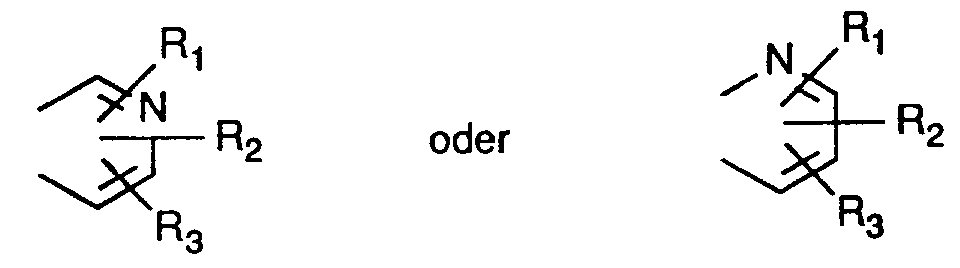
- R¹, R² und R³
- gleich oder verschieden sind und Wasserstoff oder für Aryl mit 6 bis 10 Kohlenstoffatomen bedeuten, das gegebenenfalls durch Hydroxy, Halogen, Trifluormethyl oder durch geradkettiges oder verzweigtes Alkyl oder Alkoxy mit jeweils bis zu 6 Kohlenstoffatomen substiutiert ist, oder
geradkettiges oder verzweigtes Alkyl oder Alkenyl mit jeweils bis zu 8 Kohlenstoffatomen bedeuten, oder
Cycloalkyl mit 3 bis 8 Kohlenstoffatomen bedeuten, oder Halogen bedeuten, - L
- für Wasserstoff, Halogen, Nitro, Hydroxy, Trifluormethyl, Trifluormethoxy, geradkettiges oder verzweigtes Alkyl, Alkoxy oder Alkoxycarbonyl mit jeweils bis zu 6 Kohlenstoffatomen, Cyano oder Carboxy steht,
- T
- für einen Rest der Formel -CO₂R⁴ , -CO-NR⁵SO₂R⁶ oder

- R⁴
- Wasserstoff, geradkettiges oder verzweigtes Alkyl mit bis zu 8 Kohlenstoffatomen, Cycloalkyl mit 3 bis 7 Kohlenstoffatomen oder Phenyl bedeutet,
- R⁵ und R⁷
- gleich oder verschieden sind und Wasserstoff oder geradkettiges oder verzweigtes Alkyl mit bis zu 6 Kohlenstoffatomen bedeuten,
- R⁶
- Trifluormethyl oder geradkettiges oder verzweigtes Alkyl mit bis zu 6 Kohlenstoffatomen, Benzyl oder Phenyl bedeutet, die gegebenenfalls durch geradkettiges Alkyl mit bis zu 6 Kohlerstoffatomen substituiert sind,
- R⁸
- Aryl mit 6 bis 10 Kohlenstoffatomen bedeutet, das gegebenenfalls bis zu 2-fach gleich oder verschieden durch Halogen, Hydroxy, geradkettiges oder verzweigtes Alkyl, Alkoxy oder Alkoxycarbonyl mit jeweils bis zu 6 Kohlenstoffatomen, Carboxy, Phenoxy oder C₃-C₆-Cycloalkyloxy substituiert ist,
- R⁹
- eine Gruppe der Formel -CH₂-OR¹⁰, -CO₂R¹¹, -CO-NR¹²R¹³ oder Pyridyl bedeutet,
worin - R¹⁰
- Wasserstoff oder geradkettiges oder verzweigtes Alkyl mit bis zu 8 Kohlenstoffatomen bedeutet,
- R¹¹
- Wasserstoff, geradkettiges oder verzweigtes Alkyl mit bis zu 8 Kohlenstoffatomen, Phenyl oder Cycloalkyl mit 3 bis 6 Kohlenstoffatomen bedeutet,
- R¹² und R¹³
- gleich oder verschieden sind und Wasserstoff, geradkettiges oder verzweigtes Alkyl mit bis zu 8 Kohlenstoffatomen oder Phenyl bedeuten,
- T
- für Tetrazolyl steht, das gegebenenfalls durch geradkettiges oder verzweigtes Alkyl mit bis zu 4 Kohlenstoffatomen oder durch die Triphenylmethylgruppe substituiert ist,
- Die erfindungsgemäßen Verbindungen der allgemeinen Formel (I) können auch in Form ihrer Salze vorliegen. Im allgemeinen seien hier Salze mit organischen oder anorganischen Basen oder Säuren genannt.
- Im Rahmen der vorliegenden Erfindung werden physiologisch unbedenkliche Salze bevorzugt. Physiologisch unbedenkliche Salze der neuen hetero-tricyclisch substituierten Phenyl-cyclohexan-1-carbonsäuren und -carbonsäurederivate können Salze der erfindungsgemäßen Stoffe mit Mineralsäuren, Carbonsäuren oder Sulfonsäuren sein. Besonders bevorzugt sind z.B. Salze mit Chlorwasserstoffsäure, Bromwasserstoffsäure, Schwefelsäure, Phosphorsäure, Methansulfonsäure, Ethansulfonsäure, Toluolsulfonsäure, Benzolsulfonsäure, Naphthalindisulfonsäure, Essigsäure, Propionsäure, Milchsäure, Weinsäure, Zitronensäure, Fumarsäure, Maleinsäure oder Benzoesäure.
- Physiologisch unbedenkliche Salze können ebenso Metall- oder Ammoniumsalze der erfindungsgemäßen Verbindungen sein, welche eine freie Carboxylgruppe besitzen. Besonders bevorzugt sind z.B. Natrium-, Kalium-, Magnesium- oder Calciumsalze, sowie Ammoniumsalze, die abgeleitet sind von Ammoniak, oder organischen Aminen wie beispielsweise Ethylamin, Di- bzw. Triethylamin, Di- bzw. Triethanolamin, Dicyclohexylamin, Dimethylaminoethanol, Arginin, Lysin oder Ethylendiamin.
- Die erfindungsgemäßen Verbindungen können in stereoisomeren Formen, die sich entweder wie Bild und Spiegelbild (Enantiomere), oder die sich nicht wie Bild und Spiegelbild (Diastereomere) verhalten, existieren. Die Erfindung betrifft sowohl die Enantiomeren oder Diastereomeren oder deren jeweiligen Mischungen. Die Racemformen lassen sich ebenso wie die Diastereomeren in bekannter Weise in die stereoisomer einheitlichen Bestandteile trennen [vgl. E.L. Eliel, Stereochemistry of Carbon Compounds, McGraw Hill, 1962].
- Bevorzugt sind Verbindungen der allgemeinen Formel (I),
in welcher - A und B
- gemeinsam einen Rest der Formel

- D und E
- gemeinsam einen Rest der Formel


- R¹, R² und R³
- gleich oder verschieden sind und Wasserstoff oder für Phenyl bedeuten, das gegebenenfalls durch Hydroxy, Fluor, Chlor, Brom, Trifluormethyl oder durch geradkettiges oder verzweigtes Alkyl oder Alkoxy mit jeweils bis zu 4 Kohlenstoffatomen substituiert ist, oder
geradkettiges oder verzweigtes Alkyl oder Alkenyl mit jeweils bis zu 6 Kohlenstoffatomen bedeuten, oder
Cyclopropyl, Cyclobutyl, Cyclopentyl, Cyclohexyl oder Cycloheptyl bedeuten, oder
Fluor, Chlor oder Brom bedeuten, - L
- für Wasserstoff, Fluor, Chlor, Brom, Trifluormethyl, Carboxy oder geradkettiges oder verzweigtes Alkyl, Alkoxy oder Alkoxycarbonyl mit jeweils bis zu 4 Kohlenstoffatomen steht,
- T
- für einen Rest der Formel -CO₂R⁴ , -CO-NR⁵SO₂R⁶ oder

worin - R⁴
- Wasserstoff, geradkettiges oder verzweigtes Alkyl mit bis zu 6 Kohlenstoffatomen, Cyclopropyl, Cyclopentyl, Cyclohexyl oder Phenyl bedeutet,
- R⁵ und R⁷
- gleich oder verschieden sind und Wasserstoff oder geradkettiges oder verzweigtes Alkyl mit bis zu 4 Kohlenstoffatomen bedeuten,
- R⁶
- Trifluormethyl oder geradkettiges oder verzweigtes Alkyl mit bis zu 4 Kohlenstoffatomen, Benzyl oder Phenyl bedeutet, die gegebenenfalls durch geradkettiges oder verzweigtes Alkyl mit bis zu 4 Kohlenstoffatomen substituiert sind,
- R⁸
- Phenyl bedeutet, das gegebenenfalls durch Fluor, Chlor, Brom, Hydroxy, geradkettiges oder verzweigtes Alkyl, Alkoxy oder Alkoxycarbonyl mit jeweils bis zu 4 Kohlenstoffatomen, Carboxy oder Phenoxy substituiert ist,
- R⁹
- eine Gruppe der Formel -CH₂-OR¹⁰, -CO₂R¹¹, -CO-NR¹²R¹³ oder Pyridyl bedeutet,
worin - R¹⁰
- Wasserstoff oder geradkettiges oder verzweigtes Alkyl mit bis zu 6 Kohlenstoffatomen bedeutet,
- R¹¹
- Wasserstoff, geradkettiges oder verzweigtes Alkyl mit bis zu 6 Kohlenstoffatomen, Phenyl, Cyclopropyl, Cyclopentyl oder Cyclohexyl bedeutet,
- R¹² und R¹³
- gleich oder verschieden sind und Wasserstoff, geradkettiges oder verzweigtes Alkyl mit bis zu 6 Kohlenstoffatomen, Cyclopropyl, Cylcopentyl, Cylcohexyl oder Phenyl bedeuten,
- T
- für Tetrazolyl steht, das gegebenenfalls durch Methyl oder die Triphenylmethylgruppe substituiert ist
- Besonders bevorzugt sind Verbindungen der allgemeinen Formel (I),
in welcher - A und B
- gemeinsam einen Rest der Formel

- D und E
- gemeinsam einen Rest der Formel


- R¹, R² und R³
- gleich oder verschieden sind und Wasserstoff, Methyl, Fluor, Chlor oder Brom bedeuten,
- L
- für Wasserstoff, Fluor, Chlor, Brom, Trifluormethyl, Trifluormethoxy oder Methyl steht,
- T
- für einen Rest der Formel -CO₂R⁴ , -CO-NR⁵SO₂R⁶ oder

worin - R⁴
- Wasserstoff, geradkettiges oder verzweigtes Alkyl mit bis zu 4 Kohlenstoffatomen, Cyclopropyl, Cyclopentyl, Cyclohexyl oder Phenyl bedeutet,
- R⁵ und R⁷
- gleich oder verschieden sind und Wasserstoff oder Methyl bedeuten,
- R⁶
- Trifluormethyl oder Methyl, Ethyl, Benzyl, p-Tolyl oder Phenyl bedeutet,
- R⁸
- Phenyl bedeutet, das gegebenenfalls durch Fluor, Chlor, Brom, Hydroxy, geradkettiges oder verzweigtes Alkyl, Alkoxy oder Alkoxycarbonyl mit jeweils bis zu 3 Kohlenstoffatomen, Carboxy oder Phenoxy substituiert ist,
- R⁹
- eine Gruppe der Formel -CH₂-OR¹⁰, -CO₂-R¹¹, -CO-NR¹²R¹³ oder Pyridyl bedeutet,
worin - R¹⁰
- Wasserstoff oder geradkettiges oder verzweigtes Alkyl mit bis zu 4 Kohlenstoffatomen bedeutet,
- R¹¹
- Wasserstoff, geradkettiges oder verzweigtes Alkyl mit bis zu 4 Kohlenstoffatomen, Phenyl, Cyclopropyl, Cyclopentyl oder Cyclohexyl bedeutet,
- R¹² und R¹³
- gleich oder verschieden sind und Wasserstoff, geradkettiges oder verzweigtes Alkyl mit bis zu 4 Kohlenstoffatomen, Cyclopropyl, Cyclopentyl, Cyclohexyl oder Phenyl bedeuten,
- T
- für Tetrazolyl steht, das gegebenenfalls durch Methyl oder die Triphenylmethylgruppe substituiert ist
- Besonders bevorzugt sind Verbindungen der allgemeinen Formel (I),
in welcher - A und B
- gemeinsam einen Rest der Formel

- D und E
- gemeinsam einen Rest der Formel


- R¹, R² und R³
- gleich oder verschieden sind und Wasserstoff, oder Methyl stehen,
- L
- für Wasserstoff steht,
- T
- für einen Rest der Formel -CO₂R⁴ , -CO-NR⁵SO₂R⁶ oder

worin - R⁴
- Wasserstoff, geradkettiges oder verzweigtes Alkyl mit bis zu 4 Kohlenstoffatomen bedeutet,
- R⁵ und R⁷
- Wasserstoff bedeuten,
- R⁶
- Trifluormethyl, Methyl oder p-Tolyl bedeutet,
- R⁸
- Phenyl bedeutet,
- R⁹
- eine Gruppe der Formel -CH₂OH bedeutet,
- T
- für Tetrazolyl steht, das gegebenenfalls durch Triphenylmethyl substituiert ist
- Außerdem wurde ein Verfahren zur Herstellung der erfindungsgemäßen Verbindungen der allgemeinen Formel (I) gefunden, dadurch gekennzeichnet, daß man
Verbindungen der allgemeinen Formel (II)
in welcher - L
- die oben angegebene Bedeutung hat,
- W
- für eine typische Abgangsgruppe wie beispielsweise Chlor, Brom, Jod, Tosylat oder Mesylat, vorzugsweise für Brom steht
- X
- für C₁-C₆-Alkoxycarbonyl oder für die Triphenylmethyl-tetrazolyl-1-yl-Gruppe steht,
- A, B, D und E
- die oben angegebene Bedeutung haben,
- A, B, D, E, L und X
- die oben angegebene Bedeutung haben,
- R⁶, R⁷, R⁸, R⁹ und R¹⁰
- die oben angegebene Bedeutung haben,
- Das erfindungsgemäße Verfahren kann durch folgendes Formelschema beispielhaft erläutert werden:

Als Lösemittel für das Verfahren eignen sich übliche organische Lösemittel, die sich unter den Reaktionsbedingungen nicht verändern. Hierzu gehören bevorzugt Ether wie Diethylether, Dioxan, Tetrahydrofuran, Glykoldimethylether, oder Kohlenwasserstoffe wie Benzol, Toluol, Xylol, Hexan, Cyclohexan oder Erdölfraktionen, oder Halogenkohlenwasserstoffe wie Dichlormethan, Trichlormethan, Tetrachlormethan, Dichlorethylen, Trichlorethylen oder Chlorbenzol, oder Essigester, Triethylamin, Pyridin, Dimethylsulfoxid, Dimethylformamid, Hexamethylphosphor säuretriamid, Acetonitril, Aceton oder Nitromethan. Ebenso ist es möglich, Gemische der genannten Lösemittel zu verwenden. Bevorzugt sind Dimethylformamid und Tetrahydrofuran. - Als Basen für das erfindungsgemäße Verfahren können im allgemeinen anorganische oder organische Basen eingesetzt werden. Hierzu gehören vorzugsweise Alkalihydroxide wie zum Beispiel Natriumhydroxid oder Kaliumhydroxid, Erdalkalihydroxide wie zum Beispiel Bariumhydroxid, Alkalicarbonate wie Natriumcarbonat oder Kaliumcarbonat, Erdalkalicarbonate wie Calciumcarbonat, oder Alkali- oder Erdalkalialkoholate wie Natrium- oder Kaliummethanolat, Natrium- oder Kaliumethanolat oder Kalium-tert.butylat, oder organische Amine (Trialkyl(C₁-C₆)amine) wie Triethylamin, oder Heterocyclen wie 1,4-Diazabicyclo[2.2.2]octan (DABCO), 1,8-Diazabicyclo[5.4.0]undec-7-en (DBU), Pyridin, Diaminopyridin, Methylpiperidin oder Morpholin. Es ist auch möglich als Basen Alkalimetalle wie Natrium oder deren Hydride wie Natriumhydrid einzusetzen. Bevorzugt sind Natriumhydrid, Kaliumcarbonat, Triethylamin, Pyridin und Kalium-tert.butylat, DBU oder DABCO.
- Im allgemeinen setzt man die Base in einer Menge von 0,05 mol bis 10 mol, bevorzugt von 1 mol bis 2 mol, bezogen auf 1 mol der Verbindung der Formel (III), ein.
- Das erfindungsgemäße Verfahren wird im allgemeinen in einem Temperaturbereich von -30°C bis +100°C, bevorzugt von -10°C bis +60°C, durchgeführt.
- Das erfindungsgemäße Verfahren wird im allgemeinen bei Normaldruck durchgeführt. Es ist aber auch möglich, das Verfahren bei Überdruck oder bei Unterdruck durchzuführen (z.B. in einem Bereich von 0,5 bis 5 bar).
- Als Basen eignen sich für die Hydrolyse die üblichen anorganischen Basen. Hierzu gehören bevorzugt Alkalihydroxide oder Erdalkalihydroxide wie beispielsweise Lithiumhydroxid, Natriumhydroxid, Kaliumhydroxid oder Bariumhydroxid, oder Alkalicarbonate wie Natrium- oder Kaliumcarbonat oder Natriumhydrogencarbonat, oder Alkalialkoholate wie Natriummethanolat, Natriumethanolat, Kaliummethanolat, Kaliumethanolat oder Kalium-tert.butanolat. Besonders bevorzugt werden Lithiumhydroxid, Natriumhydroxid oder Kaliumhydroxid eingesetzt.
- Als Lösemittel eignen sich für die Hydrolyse Wasser oder die für eine Hydrolyse üblichen organischen Lösemittel. Hierzu gehören bevorzugt Alkohole wie Methanol, Ethanol, Propanol, Isopropanol oder Butanol, oder Ether wie Tetrahydrofuran oder Dioxan, oder Dimethylformamid, oder Dimethylsulfoxid. Besonders bevorzugt werden Alkohole wie Methanol, Ethanol, Propanol oder Isopropanol verwendet. Ebenso ist es möglich, Gemische der genannten Lösemittel einzusetzen.
- Die Hydrolyse kann auch mit wäßrigen Säuren wie beispielsweise Trifluoressigsäure, Essigsäure, Chlorwasserstoffsäure, Bromwasserstoffsäure, Methansulfonsäure, Schwefelsäure oder Perchlorsäure, bevorzugt mit Trifluoressigsäure erfolgen.
- Die Hydrolyse wird im allgemeinen in einem Temperaturbereich von 0°C bis +100°C, bevorzugt von +20°C bis +80°C durchgeführt.
- Im allgemeinen wird die Hydrolyse bei Normaldruck durchgeführt. Es ist aber auch möglich, bei Unterdruck oder bei Überdruck zu arbeiten (z.B. von 0,5 bis 5 bar).
- Bei der Durchführung der Hydrolyse wird die Base im allgemeinen in einer Menge von 1 bis 3 mol, bevorzugt von 1 bis 1,5 mol bezogen auf 1 mol des Esters, eingesetzt. Besonders bevorzugt verwendet man molare Mengen der Reaktanden.
- Bei der Durchführung der Reaktion entstehen im ersten Schritt die Carboxylate der erfindungsgemäßen Verbindungen als Zwischenprodukte, die isoliert werden können. Die erfindungsgemäßen Säuren erhält man durch Behandeln der Carboxylate mit üblichen anorganischen Säuren. Hierzu gehören bevorzugt Säuren wie beispielsweise Chlorwasserstoffsäure, Bromwasserstoffsäure, Schwefelsäure, Phosphorsäure oder Trifluoressigsäure. Es hat sich bei der Herstellung der Carbonsäuren hierbei als vorteilhaft erwiesen, die basische Reaktionsmischung der Verseifung in einem zweiten Schritt ohne Isolierung der Carboxylate anzusäuern. Die Säuren können dann in üblicher Weise isoliert werden. Im Fall der basischen Heterocyclen können durch das Behandeln der Lösungen der Carboxylate mit den oben aufgeführten Säuren auch die Salze der Heterocyclen mit den anorganischen Säuren gewonnen werden.
- Die Amidierung der Verbindungen der allgemeinen Formel (IV) erfolgt im allgemeinen in einem der oben aufgeführten Lösemitteln, vorzugsweise in Tetrahydrofuran oder Dichlormethan.
- Die Amidierung kann gegebenenfalls über die aktivierte Stufe der Säurehalogenide [(IV) Y = Halogen], die aus den entsprechenden Säuren durch Umsetzung mit Thionylchlorid, Phosphortrichlorid, Phosphorpentachlorid, Phosphortribromid oder Oxalylchlorid hergestellt werden können, verlaufen.
- Die Amidierung erfolgt im allgemeinen in einem Temperaturbereich von -80°C bis +80°C, vorzugsweise von -30°C bis +30°C und Normaldruck.
- Als Basen eignen sich dafür neben den oben aufgeführten Basen vorzugsweise Triethylamin und/oder Dimethylaminopyridin, DBU oder DABCO.
- Die Base wird in einer Menge von 0,5 mol bis 10 mol, bevorzugt von 1 mol bis 5 mol, bezogen auf 1 mol der Verbindungen der allgemeinen Formeln (IV) und (V) eingesetzt.
- Als säurebindende Mittel für die Amidierung können Alkali- oder Erdalkalicarbonate wie Natriumcarbonat, Kaliumcarbonat, Alkali- oder Erdalkalihydroxide wie beispielsweise Natrium- oder Kaliumhydroxid, oder organische Basen wie Pyridin, Triethylamin, N-Methylpiperidin, oder bicyclische Amidine wie 1,5-Diazabicyclo[3.4.0]-nonene-5 (DBN) oder 1,5-Diazabicyclo[3.4.0]undecene-5 (DBU) eingesetzt werden. Bevorzugt ist Kaliumcarbonat.
- Als Dehydratisierungsreagenzien eignen sich Carbodiimide wie beispielsweise Diisopropylcarbodiimid, Dicyclohexylcarbodiimid oder N-(3-Dimethylaminopropyl)-N'-ethylcarbodiimid-Hydrochlorid oder Carbonylverbindungen wie Carbonyldiimidazol oder 1,2-Oxazoliumverbindungen wie 2-Ethyl-5-phenyl-1,2-oxazolium-3-sulfonat oder Propanphosphorsäureanhydrid oder Isobutylchloroformat oder Benzotriazolyloxy-tris-(dimethylamino)phosphonium-hexylfluorophosphat oder Phosphonsäurediphenylesteramid oder Methansulfonsäurechlorid, gegebenenfalls in Anwesenheit von Basen wie Triethylamin oder N-Ethylmorpholin oder N-Methylpiperidin oder Dicyclohexylcarbodiimid und N-Hydroxysuccinimid.
- Die säurebindenden Mittel und Dehydratisierungsreagenzien werden im allgemeinen in einer Menge von 0,5 bis 3 mol, bevorzugt von 1 bis 1,5 mol, bezogen auf 1 mol der entsprechenden Carbonsäuren eingesetzt.
- Die Cyclohexan-Verbindungen der allgemeinen Formel (II) sind größtenteils neu und können hergestellt werden, indem man Verbindungen der allgemeinen Formel (VI)

in welcher - L
- die oben angegebene Bedeutung hat,
- L
- die oben angegebene Bedeutung hat,
- Die Reduktion der Doppelbindung erfolgt in einem Temperaturbereich von 0°C bis +40°C, vorzugsweise bei +20°C und einem Druck von 1 bar.
- Die Veresterung erfolgt in einem der oben angegebenen Lösemitteln, vorzugsweise Toluol und Tetrahydrofuran, nach der oben bereits beschriebenen vorgeschalteten Aktivierung der entsprechenden Carbonäsure, vorzugsweise über die Carbonsäurechloride, und nachträglicher Umsetzung mit dem entsprechenden Alkoholaten, in einem Temperaturbereich von 0°C bis +60°C, vorzugsweise bei +10°C bis +35°C und Normaldruck.
- Die Umsetzungen zu den Cyanoverbindungen und den Tetrazolylverbindungen werden im allgemeinen bei der Siedetemperatur des jeweiligen Lösemittels und Normaldruck durchgeführt.
- Die Einführung der Triphenylmethylgruppe in den Tetrazolylring erfolgt im allgemeinen bei 0°C.
- Die Bromierung wird im allgemeinen in einem Temperaturbereich von +40°C bis 100°C, vorzugsweise von +60°C bis +90°C und Normaldruck durchgeführt. Sie erfolgt in einem der oben angegebenen Lösemitteln, vorzugsweise mit Tetrachlorkohlenstoff, und mit N-Bromsuccinimid.
- Als Starter (Katalysator) für die Bromierung eignen sich beispielsweise Azobisisobutyronitril, Dibenzoylperoxid, vorzugsweise Azobisisobutyronitril, wobei der Starter in einer Menge von 0,01 mol bis 0,1 mol, bevorzugt von 0,01 mol bis 0,05 mol, bezogen auf 1 mol der Verbindung der allgemeinen Formel (VII), eingesetzt wird.
- Die Verbindungen der allgemeinen Formel (VI) sind ebenfalls neu und können beispielsweise hergestellt werden, indem man Verbindungen der allgemeinen Formel (VIII)

in welcher - L
- die oben angegebene Bedeutung hat,
- Die Verbindungen der allgemeinen Formel (VIII) sind an sich bekannt oder können nach üblichen Methoden hergestellt werden.
- Die Verbindungen der allgemeinen Formeln (IV) und (VII) sind neu und können beispielsweise nach den oben beschriebenen Verfahren hergestellt werden
- Ebenso sind die Verbindungen der allgemeinen Formel (III) an sich bekannt oder können nach üblicher Methode hergestellt werden.
- Die Amine der allgemeinen Formel (V) sind bekannt oder können nach bekannten Verfahren hergestellt werden.
- Die erfindungsgemäßen Verbindungen der allgemeinen Formel (I) zeigen ein nicht vorhersehbares, wertvolles pharmakologisches Wirkspektrum.
- Die erfindungsgemäßen Verbindungen besitzen eine spezifische A II-antagonistische Wirkung, da sie kompetitiv die Bindung von Angiotensin II an die Rezeptoren hemmen. Sie unterdrücken die vasokonstriktorischen und Aldosteronsekretions-stimulierenden Effekte des Angiotensin II. Darüberhinaus inhibieren sie die Proliferation von glatten Muskelzellen.
- Sie können deshalb in Arzneimitteln zur Behandlung der arteriellen Hypertonie und Atherosklerose eingesetzt werden. Darüberhinaus können sie zur Behandlung von coronaren Herzerkrankungen, Herzinsuffizienz, Störungen der Hirnleistung, ischämischen Gehirnerkrankungen, peripherer Durchblutungsstörungen, Funktionsstörungen der Niere und Nebenniere, bronchospastischen und vaskulär bedingten Erkrankungen der Atemwege, Natriumretention und Ödemen eingesetzt werden.
- Kaninchen beiderlei Geschlechts werden durch Nackenschlag betäubt und entblutet, oder fallweise mit Nembutal (ca. 60 - 80 mg/kg i.v.) narkotisiert und durch Öffnung des Thorax getötet. Die Thoraxaorta wird entnommen, von anhaftendem Bindegewebe befreit, in 1,5 mm breite Ringsegmente geteilt und einzeln unter einer Anfangsbelastung von ca. 3,5 g in 10 ml Organbäder mit auf 37°C temperierter, Carbogen-begaster Krebs-Henseleit-Nährlösung folgender Zusammensetzung: 119 mmol/l NaCl; 2,5 mmol/l CaCl₂ x 2 H₂O; 1,2 mmol/l KH₂PO₄; 10 mmol/l Glucose; 4,8 mmol/l KCl; 1,4 mmol/l MgSO₄ x 7 H₂O und 25 mmol/l NaHCO₃ verbracht.
- Die Kontraktionen werden isometrisch durch Statham UC2-Zellen über Brückenverstärker (ifd Mülheim bzw. DSM Aalen) erfaßt und mittels A/D-Wandler (System 570, Keithley München) digitalisiert sowie ausgewertet. Die Durchführung von Agonistdosiswirkungskurven (DWK) erfolgt stündlich. Mit jeder DWK werden 3 bzw. 4 Einzelkonzentrationen im 4 min-Abstand in die Bäder appliziert. Nach Ende der DWK und darauffolgender Auswaschzyklen (16 mal jeweils ca. 5 sec/min mit der o.a. Nährlösung) schließt sich eine 28-minütige Ruhe- bzw. Inkubationsphase an, innerhalb derer die Kontraktionen in der Regel wieder den Ausgangswert erreichen.
- Die Höhe der im Normalfall 3. DWK wird als Bezugsgröße für die Bewertung der in weiteren Durchgängen zu untersuchenden Testsubstanz verwendet, die bei den nachfolgenden DWK's in jeweils steigender Dosierung mit Beginn der Inkubationszeit in die Bäder appliziert wird. Jeder Aortenring wird dabei ganztägig mit immer dem gleichen Agonisten stimuliert.
-
KCl 22,7;32,7;42,7;52,7 mmol/l 1 Noradrenalin 3x10⁻⁹;3x10⁻⁸;3x10⁻⁷;3x10⁻⁶ g/ml Serotonin 10⁻⁸;10⁻⁷;10⁻⁶;10⁻⁵ g/ml B-HT 920 10⁻⁷;10⁻⁶;10⁻⁵ g/ml Methoxamin 10⁻⁷;10⁻⁶;10⁻⁵ g/ml Angiotensin II 3x10⁻⁹;10⁻⁸;3x10⁻⁸;10⁻⁷ g/ml - Für die Berechnung der IC₅₀ (Konzentration bei der die zu untersuchende Substanz eine 50%ige Hemmung verursacht) wird der Effekt jeweils an der 3. = submaximalen Agonistkonzentration zugrundegelegt.
- Die erfindungsgemäßen Verbindungen hemmen die durch Angiotensin II induzierte Kontraktion der isolierten Kaninchenaorta dosenabhängig. Die durch Kalium-Depolarisation oder andere Agonisten induzierte Kontraktion wurde nicht oder in hohen Konzentrationen nur schwach gehemmt.
- Männliche Wistar Ratten (Moellegaard, Kopenhagen, Dänemark) mit einem Körpergewicht von 300 - 350 g, werden mit Thiopental (100 mg/kg i.p.) anästhesiert. Nach Tracheotomie wird in die Femoralarterie ein Katheter zur Blutdruckmessung und in die Femoralvenen ein Katheter für die Angiotensin II-Infusion und ein Katheter für die Substanzverabreichung eingeführt. Nach Gabe des Ganglienblockers Pentolinium (5 mg/kg i.v.) wird die Angiotensin II-Infusion (0,3 µg/kg/min) gestartet. Sobald die Blutdruckwerte ein stabiles Plateau erreicht haben, werden die Testsubstanzen entweder intravenös oder als Suspension bzw. Lösung in 0,5% Tylose oral verabreicht. Die Blutdruckveränderungen unter Substanzeinfluß sind als Mittelwerte ± SEM in der Tabelle angegeben.
- Die orale antihypertensive Wirksamkeit der erfindungsgemäßen Verbindungen wurde an wachen Ratten mit chirurgisch induzierter unilateraler Nierenarterienstenose geprüft. Dazu wurde die rechte Nierenarterie mit einem Silberclip von 0,18 mm lichter Weite eingeengt. Bei dieser Hypertonieform ist die Plasmareninaktivität in den ersten sechs Wochen nach dem Eingriff erhöht. Der arterielle Blutdruck diese Tiere wurde in definierten Zeitabständen nach Substanzgabe mit der "Schwanzmanschette" unblutig gemessen. Die zu prüfenden Substanzen wurden aufgeschwemmt in einer Tylosesuspension intragastral ("oral") per Schlundsonde in verschiedenen Dosen appliziert. Die erfindungsgemäßen Verbindungen senken den arteriellen Blutdruck der Hochdruckratten in klinisch relevanter Dosierung.
- Außerdem hemmen die erfindungsgemäßen Verbindungen die spezifische Bindung von radioaktivem Angiotensin II konzentrationsabhängig.
- Nebennierenrinden vom Rind (NNR), die frisch entnommen und sorgfältig von Mark von Kapsel befreit sind, werden in Sucrose-Lösung (0,32 M) mit Hilfe eines Ultra-Turrax (Janke & Kunkel, Staufen i.B.) zu grobem Membran-Homogenat zerkleinert und in zwei Zentrifugationsschritten zu Membranfraktionen partiell aufgereinigt.
Die Untersuchungen zur Rezeptor-Bindung werden an partiell gereinigten Membranfraktionen boviner NNR mit radioaktivem Angiotensin II in einem Assay-Volumen von 0,25 ml durchgeführt, das im einzelnen die partiell gereinigten Membranen (50 - 80 µg), ³H-Angiotensin II (3-5 nM), Test-Pufferlösung (50 mM Tris, pH 7,2, 5 mM MgCl₂ sowie die zu untersuchenden Substanzen enthält. Nach einer Inkubationszeit von 60 min bei Raumtemperatur wird die nicht gebundene Radioaktivität der Proben mittels angefeuchteter Glasfaserfilter (Whatman GF/C) separiert und die gebundene Radioaktivität nach Waschung des Proteins mit eiskalter Pufferlösung (50 mM Tris/HCl, pH 7,4, 5% PEG 6000) in einem Szintillationscocktail spektrophotometrisch gemessen. Die Analyse der Rohdaten erfolgte mit Computer-Programmen zu Ki- bzw. IC₅₀-Werten (Ki: für die verwendete Radioaktivität korrigierte IC₅₀-Werte; IC₅₀-Werte: Konzentration bei der die zu untersuchende Substanz eine 50%ige Hemmung der spezifischen Bindung des Radioliganden bewirkt). - Zur Feststellung der antiproliferativen Wirkung der Verbindungen werden glatte Muskelzellen verwendet, die aus den Aorten von Ratten durch die Media-Explantat-Technik gewonnen werden [R. Ross, J. Cell. Biol. 50, 172, 1971]. Die Zellen werden in geeigneten Kulturschalen, in der Regel 96-Loch-Platten, ausgesät und für 2 - 3 Tage in Medium 199 mit 7,5% FCS und 7,5% NCS, 2 mM L-Glutamin und 15 mM HEPES, pH 7,4 in 5% CO₂ bei 37°C kultiviert. Danach werden die Zellen durch Serumentzug für 2 - 3 Tage synchronisiert und sodann mit Serum oder anderen Faktoren zum Wachstum angeregt. Gleichzeitig werden Testverbindungen zugesetzt. Nach 16 - 20 Stunden wird 1 µCi ³H-Thymidin zugefügt und nach weiteren 4 Stunden der Einbau dieser Substanz in die TCA-präzipitierbare DNA der Zellen bestimmt. Zur Bestimmung der IC₅₀-Werte wird die Wirkstoffkonzentration errechnet, die bei sequentieller Verdünnung des Wirkstoffes halbmaximale Hemmung der durch 10% FCS hervorgerufene Thymidininkorporation bewirkt.
Tabelle A Bsp.-Nr. IC₅₀ [nM] 27 580 30 0,1 32 2,0 50 0,9 - Die neuen Wirkstoffe können in bekannter Weise in die üblichen Formulierungen überführt werden, wie Tabletten, Dragees, Pillen, Granulate, Aerosole, Sirupe, Emulsionen, Suspensionen und Lösungen, unter Verwendung inerter, nichttoxischer, pharmazeutisch geeigneter Trägerstoffe oder Lösemittel. Hierbei soll die therapeutisch wirksame Verbindung jeweils in einer Konzentration von etwa 0,5 bis 90-Gew.-% der Gesamtmischung vorhanden sein, d.h. in Mengen, die ausreichend sind, um den angegebenen Dosierungsspielraum zu erreichen.
- Die Formulierungen werden beispielsweise hergestellt durch Verstrecken der Wirkstoffe mit Lösemitteln und/oder Trägerstoffen, gegebenenfalls unter Verwendung von Emulgiermitteln und/oder Dispergiermitteln, wobei z.B. im Fall der Benutzung von Wasser als Verdünnungsmittel gegebenenfalls organische Lösemittel als Hilfslösermittel verwendet werden können.
- Die Applikation erfolgt in üblicher Weise, vorzugsweise oral oder parenteral, insbesondere perlingual oder intravenös.
- Für den Fall der parenteralen Anwendung können Lösungen des Wirkstoffs unter Verwendung geeigneter flüssiger Trägermaterialien eingesetzt werden.
- Im allgemeinen hat es sich als vorteilhaft erwiesen, bei intravenöser Applikation Mengen von etwa 0,001 bis 1 mg/kg, vorzugsweise etwa 0,01 bis 0,5 mg/kg Körpergewicht zur Erzielung wirksamer Ergebnisse zu verabreichen, und bei oraler Applikation beträgt die Dosierung etwa 0,01 bis 20 mg/kg, vorzugsweise 0,1 bis 10 mg/kg Körpergewicht.
- Trotzdem kann es gegebenenfalls erforderlich sein, von den genannten Mengen abzuweichen, und zwar in Abhängigkeit vom Körpergewicht bzw. der Art des Applikationsweges, vom individuellen Verhalten gegenüber dem Medikament, der Art von dessen Formulierung und dem Zeitpunkt bzw. Intervall, zu welchem die Verabreichung erfolgt. So kann es in einigen Fällen ausreichend sein, mit weniger als der vorgenannten Mindestmenge auszukommen, während in anderen Fällen die genannte obere Grenze überschritten werden muß. Im Falle der Applikation größerer Mengen kann es empfehlenswert sein, diese in mehreren Einzelgaben über den Tag zu verteilen.
-
- A
- Petrolether: Essigester = 1:1
- B
- Dichlormethan: Methanol = 50:1
- C
- Petrolether: Essigester = 5:1
- D
- Dichlormethan
- E
- Petrolether : Dichlormethan = 3:1
- F
- Dichlormethan: Methanol = 20:1
- G
- Dichlormethan: Methanol = 10:1
- H
- Dichlormethan: Essigester = 1:1
- I
- Dichlormethan: Essigester = 2:1
- J
- Dichlormethan: Methanol: konz. wäß. Ammoniak = 200:20:1
- K
- Petrolether: Essigester = 4:1
- L
- Dichlormethan: Essigester = 10:1
- M
- Petrolether: Essigester = 10:1
- N
- Dichlormethan : Methanol = 7:1
-

racemisch
275 g (1,695mol) 3-E-(4-Tolyl)acrylsäure (käuflich) wird nach einem bekannten Verfahren (Eur.J. Med. Chem. 11, 493 (1976)) in 480 ml Toluol mit 580 ml 1,3-Butadien (in kondensierter Form abgemessen) unter Zugabe von 3 g Hydrochinon 22 h bei ca 200°C und ca 20 bar umgesetzt. Das Rohgemisch wird mit Toluol verdünnt und mit 0,5 M wäßriger Natronlauge extrahiert. Darauf werden die wäßrigen Phasen mit 1 M Salzsäure angesäuert und mit Ether extrahiert. Die etherischen Lösungen werden mit Natriumsulfat getrocknet, eingedampft und wiederum in Toluol gelöst. Nach 15 minütigem Kochen mit 5g Aktivkohle saugt man heiß ab und dampft das Lösemittel bis auf ca 120 - 160 ml ab; bei 0 - 4°C kristallisieren 124 g (573 mmol) Produkt aus. Das Filtrat wird etwas weiter eingeengt und zum Nachkristallisieren wieder abgekühlt. Bei Wiederholung dieses Vorgangs fallen insgesamt weitere 42g (194 mmol) Produkt an.
Rf = 0,39 (Dichlormethan: Methanol = 10:1) -

racemisch
155 g (717 mmol) der Verbindung aus Beispiel I werden in 1 l Methanol gelöst und an 10 g Palladium (10% auf Tierkohle) bei 20°C und Wassestoffatmosphäre von ca 1 bar umgestzt. Nach einer Reaktionszeit von insgesamt 16 h wird der Katalysator abfiltriert und das Lösemittel - zuletzt im Vakuum - abgedampft.
Ausbeute: 153 g (701 mmol)
Rf= 0,38 (Dichlormethan: Methanol = 10:1) -

racemisch - 45,8 g (184 mmol) der Verbindung aus Beispiel II werden in 600 ml Toluol gelöst und unter Rückfluß mit 49,5 ml (387 mmol) Oxalylchlorid zur Reaktion gebracht. Nach 2 h dampft man das Lösemittel mit überschüssigem Reagenz ab, dazu muß das rohe Carbonsäurechlorid gegebenenfalls wiederholt in Toluol aufgenommen und noch einmal abrotiert werden. Das so gewonnene Produkt wird in 500 ml Tetrahydrofuran gelöst, mit 24,8 g (221 mmol) Kalium-tert.butanolat bei 0°C verrührt und 20 h nachgerührt (bei 20°C). Darauf werden Wasser und Ether zugesetzt und mehrfach extrahiert. Die organische Phase wird mit Natriumsulfat getrocknet, eingedampft und der Rückstand an Kieselgel 60 (Merck, Petrolether : Essigester = 20:1) chromatographisch gereinigt.
Ausbeute: 39,6 g (130 mmol)
Rf = 0,47 (Petrolether: Essigester = 10:1) - 20,0 g (91,6 mmol) der Verbindung aus Beispiel II werden in 7 ml konz. Schwefelsäure in 100 ml Ether suspendiert und bei -30°C mit 80 ml (713 mmol) Isobuten versetzt (Druckapparatur). Das Gemisch wird in dem verschlossenen Gefäß auf 20°C erwärmt und über 20 Stunden umgesetzt. Darauf kühlt man wieder auf -30°C ab, öffnet die Apparatur und rührt das Reaktionsgemisch bei 20°C in 300 ml 3 M Natronlauge / 400 ml Ether ein. Die wäßrige Phase wird mit Ether nachextrahiert, die organische Lösung mit Natriumsulfat getrocknet und eingedampft
Ausbeute: 23,3 g (84,9 mmol). -

racemisch
11,70 g (42,6 mmol) der Verbindung aus Beispiel III werden unter Rückfluß in 100 ml Tetrachlormethan mit 7,59 g (42,6 mmol) N-Bromsuccinimid und 1,4 g Azobisisobutyronitril umgesetzt. Nach einer Reaktionszeit von 4 h wird die Mischung abgekühlt, der angefallene Succinimidniederschlag abgesaugt und das Filtrat eingedampft.
Ausbeute: 14,2 g (40,2 mmol)
Rf = 0,48(Petrolether:Essigester = 10:1) -

37,0g (260 mmol) 2-Chlor-4,6-dimethyl-pyridin (US 36 32 807) werden 15 Stunden unter Rückfluß mit 67 ml Hydrazinhydrat in 200 ml Diethylenglykol gekocht. Nach dem Abkühlen auf Raumtemperatur extrahiert man mit Wasser und Ether/Dichlormethan, trocknet die organischen Phasen mit Natriumsulfat und dampft ein. Das rohe Produkt kann direkt weiter umgesetzt werden.
Rf = 0,18 (Dichlormethan: Methanol = 10:1) -

1,08 g (7,7 mmol) der Verbindung aus Beispiel V werden bei 20°C mit 0,86 ml (8,3 mmol) Cyclohexanon verrührt, und das nach einer Stunde erhaltene rohe Hydrazon ohne Reinigung weiter umgesetzt, indem es 20 Stunden in 30 ml Diethlyenglycol unter Rückfluß gekocht wird. Beim Abkühlen auf -10°C fällt ein Niederschlag aus, der abgesaugt und mit wenig gekühltem Methanol gewaschen wird. Nach Trocknen der Substanz im Hochvakuum über Phosphorpentoxid erhält man 0,32 g (1,6 mmol) Produkt.
Rf = 0,41 (Petrolether : Essigester = 1:1)
In Analogie zur Vorschrift des Beispiels VI werden die in Tabelle I aufgeführten Verbindungen hergestellt:
-

racemisch
100,0 g (458,0 mmol) der Verbindung aus Beispiel II werden in 1 l Dichlormethan in der Siedetemperatur mit 84,3 g (595,5 mmol) Chlorsulfonylisocyanat in 100 ml Dichlormethan über 1 h umgesetzt. Darauf tropft man 72 ml (938,9 mmol) N,N-Dimethylformamid in das sich abkühlende Reaktionsgemisch und rührt 18 h nach. Man gießt auf 350 g Eis, trennt die Phasen nach dem Schmelzen und extrahiert mit Dichlormethan. Die mit Kaliumcarbonat getrockneten organischen Phasen werden eingedampft und der Rückstand destilliert. Es fallen 57,8 g (290,2 mmol) Produkt an.
Kochpunkt: 122-131°C (0,2 mbar)
Rf = 0,81 (Dichlormethan) -

racemisch
15,34 g (69,6 mmol) der Verbindung aus Beispiel IX werden in 230 ml wasserfreiem N,N-Dimethylformamid mit 22,6 g (348 mol) Natriumazid und 47,9 g (348 mmol) Triethylammmoniumchlorid unter Stickstoff in der Siedehitze zur Reaktion gebracht. Nach 20 h gießt man nach Abkühlung auf Ether und 1 M Schwefelsäure, wäscht die organische Phase mit 1 M Schwefelsäure und extrahiert dann mit 10%iger Natronlauge. Die wäßrige Phase wird bei 0°C mit 1 M Salzsäure auf pH = 1,5 gestellt und der anfallende Niederschlag abgesaugt, mit Wasser gewaschen und im Hochvakuuum über Phosphorpentoxid und Natriumhydroxid getrocknet.
Ausbeute: 11,2 g (46,2 mmol)
Rf = 0,23 (Dichlormethan : Methanol = 20:1) -

racemisch
11,0 g (45,7 mmol) der Verbindung aus Beipiel X werden in 170 ml Dichlormethan mit 13,4 g (48,2 mmol) Triphenylmethylchlorid und 7,57 ml (54,6 mmol) Triehylamin bei 0°C zur Reaktion gebracht. Man rührt unter Erwärmung auf Raumtemperatur ca 20 h nach und extrahiert dann mit Ether und wäßriger Zitronensäure. Die organischen Phasen werden mit Natriumsulfat getrocknet und eingedampft.
Ausbeute: 22,1 g (45,5 mmol)
Rf = 0,67 (Petrolether : Essigester = 5:1) -

racemisch
22,1 g (45,5 mmol) der Verbindung aus Beispiel XI werden in 300 ml Tetrachlormethan mit 8,1 g (45,5 mmol) N-Bromsuccinimid und 0,3 g Azobisisobutyronitril unter Rückfluß umgestezt. Nach 3 stündiger Reaktionszeit kühlt man auf Raumtemperatur und später auf 0°C ab und saugt den Niederschlag ab. Das Filtrat wird eingedampft und man erhält rohes Produkt (26,2 g), das ohne weitere Aufarbeitung weiter umgesetzt wird.
Rf = 0,47 (Petrolether : Essigester = 10:1) - trans-2-{4-[2,4-Dimethyl-5,6,7,8-tetrahydro-α-carbolin-9-yl-methyl]phenyl}-cyclohexan-1-carbonsäure-tert.butylester

racemisch
1,98 g (9,9 mmol) der Verbindung aus Beispiel VI werden in 70 ml wasserfreiem Dimethylformamid mit 298 mg (9,9 mmol) Natriumhydrid (80%ig, stabilisiert mit Paraffin) umgesetzt (0°C) und nach beendeter Wasserstoffentwicklung 20 Stunden bei 25°C mit 3,5 g (9,9 mmol) der Verbindung aus Beispiel IV gerührt. Nach Wasserzugabe extrahiert man mehrfach mit Ether, trocknet die vereinigten organischen Phasen mit Natriumsulfat und chroamatographiert den beim Eindampfen erhaltenen Rückstand (Kieselgel 60, Merck, Petrolether : Essigester von 20:1 bis 10:1).
Ausbeute: 2,31 g (4,9 mmol).
Rf = 0,49 (Petrolether : Essigester = 10:1)
In Analogie zur Vorschrift des Beispiels 1 werden die in Tabelle 1 aufgeführten Verbindungen hergestellt:

-

racemisch
1,50g (3,2 mmol) der Verbindung aus Beispiel 14 werden bei 20°C in 10 ml Dioxan mit 3 ml 37%iger Salzsäure zur Reaktion gebracht. Nach 3 Stunden setzt man Ether und Wasser zu und stellt mit Natriumcarbonatlösung auf pH = 8. Der anfallende Niederschlag wird abgesaugt, mit Wasser und Ether gewaschen und nach Trocknung im Hochvakuum über Phosphorpentoxid chromatographisch an Kieselgel 60 (Merck, Dichlormethan : Methanol = 50:1) gereinigt.
Ausbeute: 0,44g (1,1 mmol)
Rf = 0,63 (Dichlormethan : Methanol = 10.1)
In Analogie zur Vorschrift des Beispiels 14 werden die in Tabelle 2 aufgeführten Verbindungen hergestellt:

-

racemisch
427 mg (1,03 mmol) der Verbindung aus Beispiel 14 werden bei -20°C in 20 ml wasserfreiem Tetrahydrofuran mit 622 µl (4,51 mmol) Triethylamin und 87,2 µl (1,13 mmol) Mesylchlorid umgesetzt. Nach 2 Stunden werden 500 mg (4,1 mmol) 4-(N,N-Diemthylamino)pyridin und 211 mg (1,23 mmol) 4-Toluolsulfonsäureamid zugegeben und unter Erwärmung auf 20°C 18 Stunden nachgerührt. Man gießt auf Wasser und extrahiert mehrfach mit Ether; die vereinigten organischen Phasen werden mit Natriumsulat getrocknet, eingeengt und an Kieselgel 60 (Merck, Petrolether / Essigester = 2:1 bis 1:1) gereinigt.
Ausbeute: 0,38 g (0,69 mmol)
Rf = 0,46(Dichlormethan : Methanol = 10:1) -

427 mg (1,03 mmol) der Verbindung aus Beispiel 14 werden bei -30°C in 20 ml wasserfreiem Tetrahydrofuran mit 288 µl (2,10 mmol) Triethylamin und 87 µl (1,13 mmol) Mesylchlorid umgesetzt. Nach 30 Minuten gibt man 169 mg (1,23 mmol) (S)-Phenylglycinol und 126 mg (1,03 mmol) 4-(N,N-Dimethylamino)pyridin in 15 ml wasserfreiem Tetrahydrofuran zu und rührt unter Erwärmung auf 20°C 20 Stunden nach. Man setzt Wasser zu und extrahiert mehrfach mit Ether. Die organische Phase wird mit Natriumsulfat getrocknet und eingedampft; darauf wird das Rohprodukt an Kieselgel 60 (Merck, Petrolether : Essigester 2:1 bis 1:1) gereinigt.
Ausbeuten:
110 mg (0,21 mmol) Diastereomer A (Beispiel 27); Rf= 0,29 (A)
40 mg (0,07 mmol) Diasteromer B (Beispiel 28); Rf= 0,15 (A)
In Analogie zu den Vorschriften der Beispiele 27 und 28 werden die in Tabelle 3 aufgeführten Verbindungen hergestellt:


-
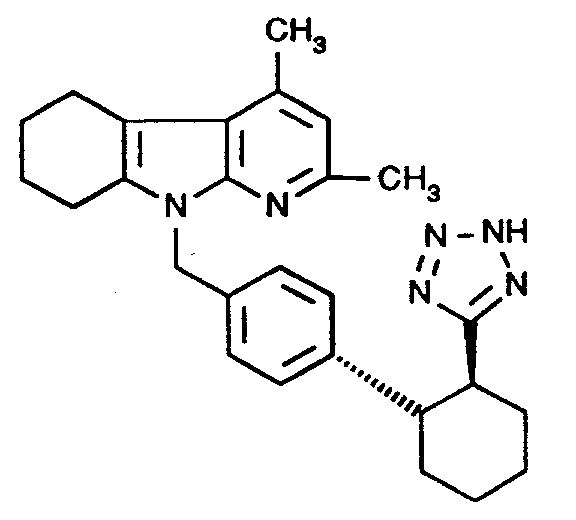
racemisch
0,12 g (0,2 mmol) der Verbindung aus Beispiel 8 werden in 3 ml Tetrahydrofuran gelöst und 2 Stunden bei 20°C mit 0,5 ml Wasser und 0,5 ml Trifluoressigsäure umgesetzt. Darauf setzt man Ether zu, extrahiert mit wäßriger Natronlauge (pH = 13,5) und stellt die wäßrige Phase mit 1 M Salzsäure auf pH = 3-4. Der ausfallende Niederschlag wird abgesaugt, mit Wasser gewaschen und im Hochvakuum über Phosphorpentoxid und Natriumhydroxid getrocknet.
Ausbeute: 0,05 g (0,1 mmol).
Rf = 0,38 (Dichlormethan : Methanol 20:1)

in welcher

in welcher
HNR⁶-SO₂-R⁷ (V)
oder

in welchen
und im Fall der freien Tetrazole, gegebenenfalls die Triphenylmethylgruppe nach üblichen Methoden mit Säuren, vorzugsweise mit Trifluoressigsäure oder Salzsäure in Dioxan, abspaltet,
und gegebenenfalls die Isomeren trennt, und im Fall der Herstellung der Salze mit einer entsprechenden Base oder Säure umsetzt.

in welcher
in einem zweiten Schritt, im Fall, daß T ≠ Tetrazol, nach üblichen Methoden verestert,
und im Fall, daß T für den Tetrazolylrest steht, mit Chlorsulfonylisocyanat in Dichlormethan zu den entsprechenden Cyanoverbindungen umsetzt, anschließend mit Natriumazid / Triethylammoniumchlorid, in Anwesenheit einer der oben aufgeführten Basen, vorzugsweise N,N-Dimethylformamid, unter Stickstoffatmosphäre die Tetzazolylgruppe einführt, durch weitere Umsetzung mit Triphenylmethylchlorid in Anwesenheit eines der oben aufgeführten Lösemittel und Basen, vorzugsweise Dichlormethan und Triethylamin, die Triphenylmethylgruppe einführt,
und in einem letzten Schritt an der Methylengruppe eine Bromierung, gegebenenfalls in Anwesenheit eines Katalysators, durchführt.
Claims (10)
- Hetero-tricyclisch-substituierte Phenyl-cyclohexan-carbonsäurederivate der allgemeinen Formel
 A und B gemeinsam einen Rest der Formel
 D und E gemeinsam einen Rest der Formel
 R¹, R² und R³ gleich oder verschieden sind und Wasserstoff oder für Aryl mit 6 bis 10 Kohlenstoffatomen bedeuten, das gegebenenfalls durch Hydroxy, Halogen, Trifluormethyl oder durch geradkettiges oder verzweigtes Alkyl oder Alkoxy mit jeweils bis zu 6 Kohlenstoffatomen substiutiert ist, oder
geradkettiges oder verzweigtes Alkyl oder Alkenyl mit jeweils bis zu 8 Kohlenstoffatomen bedeuten, oder
Cycloalkyl mit 3 bis 8 Kohlenstoffatomen bedeuten, oder Halogen bedeuten,L für Wasserstoff, Halogen, Nitro, Hydroxy, Trifluormethyl, Trifluormethoxy, geradkettiges oder verzweigtes Alkyl, Alkoxy oder Alkoxycarbonyl mit jeweils bis zu 6 Kohlenstoffatomen, Cyano oder Carboxy steht,T für einen Rest der Formel -CO₂R⁴, -CO-NR⁵SO₂R⁶ oder
worinR⁴ Wasserstoff, geradkettiges oder verzweigtes Alkyl mit bis zu 8 Kohlenstoffatomen, Cycloalkyl mit 3 bis 7 Kohlenstoffatomen oder Phenyl bedeutet,R⁵ und R⁷ gleich oder verschieden sind und Wasserstoff oder geradkettiges oder verzweigtes Alkyl mit bis zu 6 Kohlenstoffatomen bedeuten,R⁶ Trifluormethyl oder geradkettiges oder verzweigtes Alkyl mit bis zu 6 Kohlenstoffatomen, Benzyl oder Phenyl bedeutet, die gegebenenfalls durch geradkettiges Alkyl mit bis zu 6 Kohlenstoffatomen substituiert sind,R⁸ Aryl mit 6 bis 10 Kohlenstoffatomen bedeutet, das gegebenenfalls bis zu 2-fach gleich oder verschieden durch Halogen, Hydroxy, geradkettiges oder verzweigtes Alkyl, Alkoxy oder Alkoxycarbonyl mit jeweils bis zu 6 Kohlenstoffatomen, Carboxy, Phenoxy oder C₃-C₆-Cycloalkyloxy substituiert ist,R⁹ eine Gruppe der Formel -CH₂-OR¹⁰, -CO₂R¹¹, -CO-NR¹²R¹³ oder Pyridyl bedeutet,
worinR¹⁰ Wasserstoff oder geradkettiges oder verzweigtes Alkyl mit bis zu 8 Kohlenstoffatomen bedeutet,R¹¹ Wasserstoff, geradkettiges oder verzweigtes Alkyl mit bis zu 8 Kohlenstoffatomen, Phenyl oder Cycloalkyl mit 3 bis 6 Kohlenstoffatomen bedeutet,R¹² und R¹³ gleich oder verschieden sind und Wasserstoff, geradkettiges oder verzweigtes Alkyl mit bis zu 8 Kohlenstoffatomen oder Phenyl bedeuten,oderT für Tetrazolyl steht, das gegebenenfalls durch geradkettiges oder verzweigtes Alkyl mit bis zu 4 Kohlenstoffatomen oder durch die Triphenylmethylgruppe substituiert ist,gegebenenfalls in einer isomeren Form, und deren Salze. - Hetero-tricyclisch-substituierte Phenyl-cyclohexan-carbonsäurederivate nach Anspruch 1
wobeiA und B gemeinsam einen Rest der Formel D und E gemeinsam einen Rest der Formel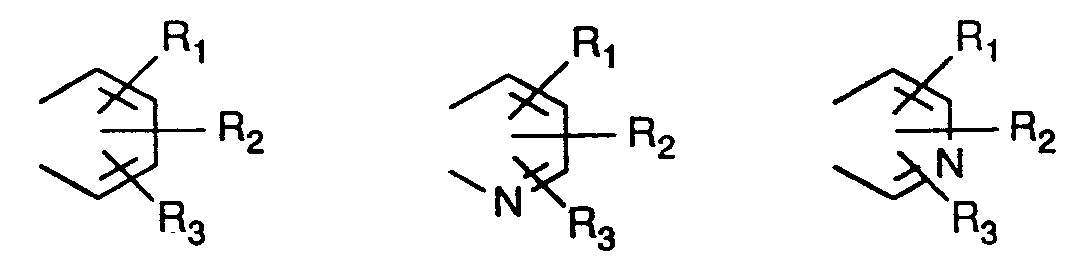
 R¹, R² und R³ gleich oder verschieden sind und Wasserstoff oder für Phenyl bedeuten, das gegebenenfalls durch Hydroxy, Fluor, Chlor, Brom, Trifluormethyl oder durch geradkettiges oder verzweigtes Alkyl oder Alkoxy mit jeweils bis zu 4 Kohlenstoffatomen substituiert ist, oder
geradkettiges oder verzweigtes Alkyl oder Alkenyl mit jeweils bis zu 6 Kohlenstoffatomen bedeuten, oder
Cyclopropyl, Cyclobutyl, Cyclopentyl, Cyclohexyl oder Cycloheptyl bedeuten, oder
Fluor, Chlor oder Brom bedeuten,L für Wasserstoff, Fluor, Chlor, Brom, Trifluormethyl, Carboxy oder geradkettiges oder verzweigtes Alkyl, Alkoxy oder Alkoxycarbonyl mit jeweils bis zu 4 Kohlenstoffatomen steht,T für einen Rest der Formel -CO₂R⁴, -CO-NR⁵SO₂R⁶ oder
worinR⁴ Wasserstoff, geradkettiges oder verzweigtes Alkyl mit bis zu 6 Kohlenstoffatomen, Cyclopropyl, Cyclopentyl, Cyclohexyl oder Phenyl bedeutet,R⁵ und R⁷ gleich oder verschieden sind und Wasserstoff oder geradkettiges oder verzweigtes Alkyl mit bis zu 4 Kohlenstoffatomen bedeuten,R⁶ Trifluormethyl oder geradkettiges oder verzweigtes Alkyl mit bis zu 4 Kohlenstoffatomen, Benzyl oder Phenyl bedeutet, die gegebenenfalls durch geradkettiges oder verzweigtes Alkyl mit bis zu 4 Kohlenstoffatomen substituiert sind,R⁸ Phenyl bedeutet, das gegebenenfalls durch Fluor, Chlor, Brom, Hydroxy, geradkettiges oder verzweigtes Alkyl, Alkoxy oder Alkoxycarbonyl mit jeweils bis zu 4 Kohlenstoffatomen, Carboxy oder Phenoxy substituiert ist,R⁹ eine Gruppe der Formel -CH₂-OR¹⁰, -CO₂R¹¹, -CO-NR¹²R¹³ oder Pyridyl bedeutet,
worinR¹⁰ Wasserstoff oder geradkettiges oder verzweigtes Alkyl mit bis zu 6 Kohlenstoffatomen bedeutet,R¹¹ Wasserstoff, geradkettiges oder verzweigtes Alkyl mit bis zu 6 Kohlenstoffatomen, Phenyl, Cyclopropyl, Cyclopentyl oder Cyclohexyl bedeutet,R¹² und R¹³ gleich oder verschieden sind und Wasserstoff, geradkettiges oder verzweigtes Alkyl mit bis zu 6 Kohlenstoffatomen, Cyclopropyl, Cylcopentyl, Cylcohexyl oder Phenyl bedeuten,
oderT für Tetrazolyl steht, das gegebenenfalls durch Methyl oder die Triphenylmethylgruppe substituiert istgegebenenfalls in einer isomeren Form, und deren Salze. - Hetero-tricyclisch-substituierte Phenyl-cyclohexan-carbonsäurederivate nach Anspruch 1
wobeiA und B gemeinsam einen Rest der Formel D und E gemeinsam einen Rest der Formel
 R¹, R² und R³ gleich oder verschieden sind und Wasserstoff, Methyl, Fluor, Chlor oder Brom bedeuten,L für Wasserstoff, Fluor, Chlor, Brom, Trifluormethyl, Trifluormethoxy oder Methyl steht,T für einen Rest der Formel
-CO₂R⁴, -CO-NR⁵SO₂R⁶ oder
worinR⁴ Wasserstoff, geradkettiges oder verzweigtes Alkyl mit bis zu 4 Kohlenstoffatomen, Cyclopropyl, Cyclopentyl, Cyclohexyl oder Phenyl bedeutet,R⁵ und R⁷ gleich oder verschieden sind und Wasserstoff oder Methyl bedeuten,R⁶ Trifluormethyl oder Methyl, Ethyl, Benzyl, p-Tolyl oder Phenyl bedeutet,R⁸ Phenyl bedeutet, das gegebenenfalls durch Fluor, Chlor, Brom, Hydroxy, geradkettiges oder verzweigtes Alkyl, Alkoxy oder Alkoxycarbonyl mit jeweils bis zu 3 Kohlenstoffatomen, Carboxy oder Phenoxy substituiert ist,R⁹ eine Gruppe der Formel -CH₂-OR¹⁰, -CO₂-R¹¹, -CO-NR¹²R¹³ oder Pyridyl bedeutet,
worinR¹⁰ Wasserstoff oder geradkettiges oder verzweigtes Alkyl mit bis zu 4 Kohlenstoffatomen bedeutet,R¹¹ Wasserstoff, geradkettiges oder verzweigtes Alkyl mit bis zu 4 Kohlenstoffatomen, Phenyl, Cyclopropyl, Cyclopentyl oder Cyclohexyl bedeutet,R¹² und R¹³ gleich oder verschieden sind und Wasserstoff, geradkettiges oder verzweigtes Alkyl mit bis zu 4 Kohlenstoffatomen, Cyclopropyl, Cyclopentyl, Cyclohexyl oder Phenyl bedeuten,oderT für Tetrazolyl steht, das gegebenenfalls durch Methyl oder die Triphenylmethylgruppe substituiert istgegebenenfalls in einer isomeren Form, und deren Salze. - Hetero-tricyclisch-substituierte Phenylcyclohexan-carbonsäurederivate nach Anspruch 1
worinA und B gemeinsam einen Rest der Formel D und E gemeinsam einen Rest der Formel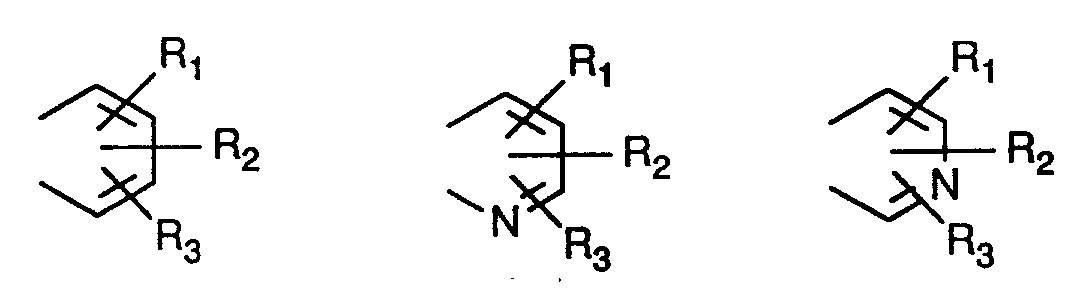
 R¹, R² und R³ gleich oder verschieden sind und für Wasserstoff, Brom oder Methyl stehen,L für Wasserstoff steht,T für einen Rest der Formel
-CO₂R⁴ , -CO-NR⁵SO₂R⁶ oder
worinR⁴ Wasserstoff oder geradkettiges oder verzweigtes Alkyl mit bis zu 4 Kohlenstoffatomen bedeutet,R⁵ und R⁷ Wasserstoff bedeutet,R⁶ Trifluormethyl, Methyl oder p-Tolyl bedeutet,R⁸ Phenyl bedeutet,R⁹ eine Gruppe -CH₂OH bedeutet,oderT für Tetrazolyl steht, das gegebenenfalls durch Triphenylmethylgruppe substituiert ist,gegebenenfalls in einer isomeren Form, und deren Salze. - Hetero-tricyclisch-substituierte Phenyl-cyclohexan-carbonsäurederivate nach den Ansprüchen 1 bis 4 zur therapeutischen Anwendung.
- Verfahren zur Herstellung von hetero-tricyclisch-substituierten Phenyl-cyclohexan-carbonsäurederivaten nach den Ansprüchen 1 bis 4, dadurch gekennzeichnet, daß man
Verbindungen der allgemeinen Formel (II) L die oben angegebene Bedeutung hat,W für eine typische Abgangsgruppe wie beispielsweise Chlor, Brom, Jod, Tosylat oder Mesylat, vorzugsweise für Brom stehtundX für C₁-C₆-Alkoxycarbonyl oder für die Triphenylmethyl-tetrazolyl-1-yl-Gruppe steht,zunächst mit Verbindungen der allgemeinen Formel (III)
 A, B, D und E die oben angegebene Bedeutung haben,in inerten Lösemitteln, gegebenenfalls in Anwesenheit einer Base und gegebenenfalls unter Schutzgasatmosphäre zu Verbindungen der allgemeinen Formel (IV)
 A, B, D, E, L und X die oben angegebene Bedeutung haben,umsetzt, und gegebenenfalls ausgehend von den entsprechenden Carbonsäuren, nach vorgeschalteter Hydrolyse und/oder Aktivierung, anschließend mit Sulfonaminen oder Aminen der allgemeinen Formeln (V) und (Va)
HNR⁶-SO₂-R⁷ (V)
oder R⁶, R⁷, R⁸, R⁹ und R¹⁰ die oben angegebene Bedeutung haben,gegebenenfalls in Anwesenheit einer Base und/oder eines Hilfsmittels, beispielsweise eines Dehydratisierungsmittels, in inerten Lösemitteln amidiert oder sulfonamidiert,
und im Fall der freien Tetrazole, gegebenenfalls die Triphenylmethylgruppe nach üblichen Methoden mit Säuren, vorzugsweise mit Trifluoressigsäure oder Salzsäure in Dioxan, abspaltet,
und gegebenenfalls die Isomeren trennt, und im Fall der Herstellung der Salze mit einer entsprechenden Base oder Säure umsetzt. - Arzneimittel enthaltend mindestens ein hetero-tricyclisch-substituiertes Phenyl-cyclohexan-carbonsäurederivat nach Anspruch 1 bis 4.
- Arzneimittel nach Anspruch 7 zur Behandlung von arteriellem Bluthochdruck und Atherosklerose.
- Verfahren zur Herstellung eines Arzneimittels nach Anspruch 7 dadurch gekennzeichnet, daß man die Wirkstoffe gegebenenfalls mit Hilfe von geeigneten Hilfs- und Trägerstoffen in eine geeignete Applikationsform überführt.
- Verwendung von hetero-tricyclisch-substituierten Phenyl-cyclohexan-carbonsäurederivaten nach Ansprüchen 1 bis 4 zur Herstellung von Arzneimitteln.
Priority Applications (1)
| Application Number | Priority Date | Filing Date | Title |
|---|---|---|---|
| SI9430094T SI0617035T1 (en) | 1993-03-18 | 1994-03-07 | Heterotricyclic substituted phenylcyclohexanecarboxylic acid derivatives |
Applications Claiming Priority (2)
| Application Number | Priority Date | Filing Date | Title |
|---|---|---|---|
| DE4308788 | 1993-03-18 | ||
| DE4308788A DE4308788A1 (de) | 1993-03-18 | 1993-03-18 | Hetero-tricyclisch-substituierte Phenyl-cyclohexan-carbonsäurederivate |
Publications (2)
| Publication Number | Publication Date |
|---|---|
| EP0617035A1 true EP0617035A1 (de) | 1994-09-28 |
| EP0617035B1 EP0617035B1 (de) | 1997-11-12 |
Family
ID=6483216
Family Applications (1)
| Application Number | Title | Priority Date | Filing Date |
|---|---|---|---|
| EP94103448A Expired - Lifetime EP0617035B1 (de) | 1993-03-18 | 1994-03-07 | Hetero-tricyclisch-substituierte Phenyl-cyclohexan-carbonsäurederivate |
Country Status (23)
| Country | Link |
|---|---|
| US (3) | US5478836A (de) |
| EP (1) | EP0617035B1 (de) |
| JP (1) | JPH07165710A (de) |
| CN (1) | CN1097756A (de) |
| AT (1) | ATE160146T1 (de) |
| AU (1) | AU670487B2 (de) |
| CA (1) | CA2119095A1 (de) |
| CZ (1) | CZ62494A3 (de) |
| DE (2) | DE4308788A1 (de) |
| DK (1) | DK0617035T3 (de) |
| ES (1) | ES2109530T3 (de) |
| FI (1) | FI941230L (de) |
| GR (1) | GR3025817T3 (de) |
| HU (1) | HU216829B (de) |
| IL (1) | IL108997A (de) |
| NO (1) | NO301826B1 (de) |
| NZ (1) | NZ260096A (de) |
| PL (1) | PL175560B1 (de) |
| RU (1) | RU2125990C1 (de) |
| SI (1) | SI0617035T1 (de) |
| SK (1) | SK32194A3 (de) |
| TW (1) | TW241264B (de) |
| ZA (1) | ZA941878B (de) |
Cited By (4)
| Publication number | Priority date | Publication date | Assignee | Title |
|---|---|---|---|---|
| EP0665227A1 (de) * | 1994-01-31 | 1995-08-02 | Eli Lilly And Company | Polyhydronorharmane als synthase Inhibitoren |
| EP0705831A3 (de) * | 1994-10-04 | 1997-01-22 | Bayer Ag | Cycloalkano-indol- und -azaindol-derivate |
| WO1999051598A1 (en) * | 1998-04-02 | 1999-10-14 | Neurogen Corporation | SUBSTITUTED 9H-PYRIDINO[2,3-b]INDOLE AND 9H-PYRIMIDINO[4,5-b]INDOLE DERIVATIVES: SELECTIVE NEUROPEPTIDE y RECEPTOR LIGANDS |
| EP0667347B1 (de) * | 1994-01-24 | 2001-11-21 | Eli Lilly And Company | Beta-Carbolin Thromboxansynthase Inhibitoren |
Families Citing this family (5)
| Publication number | Priority date | Publication date | Assignee | Title |
|---|---|---|---|---|
| HRP960015B1 (en) * | 1995-02-01 | 2000-12-31 | Bayer Ag | Substituted indole derivatives |
| DE19525028A1 (de) * | 1995-07-10 | 1997-01-16 | Bayer Ag | Amide und Sulfonamide von heterocyclisch substituierten Benzylaminen |
| WO1998045263A1 (en) * | 1997-04-07 | 1998-10-15 | Georgetown University | Analogs of cocaine |
| TW200305632A (en) * | 2002-03-25 | 2003-11-01 | Idemitsu Kosan Co | Material for organic electroluminescent element and organic electroluminescent element employing the same |
| US8507559B2 (en) * | 2008-07-16 | 2013-08-13 | Bristol-Myers Squibb Company | Cyclohexenyl modulators of chemokine receptor activity |
Citations (12)
| Publication number | Priority date | Publication date | Assignee | Title |
|---|---|---|---|---|
| EP0217737A2 (de) * | 1985-10-04 | 1987-04-08 | Schering Aktiengesellschaft | Tetrahydro-beta-carboline, Verfahren zu ihrer Herstellung und ihre Verwendung als Arzneimittel |
| EP0218541A2 (de) * | 1985-10-04 | 1987-04-15 | Schering Aktiengesellschaft | 3-Vinyl- und 3-Ethinyl-beta-carbolinderivate, ihre Herstellung und ihre Verwendung als Arzneimittel |
| EP0249301A1 (de) * | 1986-01-11 | 1987-12-16 | Beecham Group Plc | Pyrido[2,3-b]indole |
| US4719211A (en) * | 1984-05-01 | 1988-01-12 | American Home Products Corporation | 2,3,4,9-tetrahydro-2-heteroarylalkyl-1H-pyrido(3,4-B)indoles having antihypertensive properties |
| EP0253310A2 (de) * | 1986-07-11 | 1988-01-20 | E.I. Du Pont De Nemours And Company | Angiotensin II-Rezeptorblockierende Imidazole |
| EP0324377A2 (de) * | 1988-01-07 | 1989-07-19 | E.I. Du Pont De Nemours And Company | Angiotensin-II-Rezeptor blockende Imidazole und deren Kombinationen mit Diuretica und NSAids |
| EP0399731A1 (de) * | 1989-05-23 | 1990-11-28 | Zeneca Limited | Azaindene |
| EP0399732A1 (de) * | 1989-05-23 | 1990-11-28 | Zeneca Limited | Benzimidazole Derivate |
| EP0407102A1 (de) * | 1989-07-03 | 1991-01-09 | Merck & Co. Inc. | Substituierte imidazo-kondensierte fünfgliedrige Heterozyklen als Angiotensin-II-Antagonisten |
| EP0497516A1 (de) * | 1991-01-30 | 1992-08-05 | Merck & Co. Inc. | Substituierte, pyrrolokondensierte, sechsgliedrige Heterocyclen als Angiotensin-II-Antagonisten |
| EP0511791A2 (de) * | 1991-04-30 | 1992-11-04 | Zeneca Limited | Pyrrolopyridinderivate als Angiotensininhibitoren |
| US5212195A (en) * | 1992-05-13 | 1993-05-18 | Syntex (U.S.A.) Inc. | Substituted indole antagonists derivatives which are angiotensin II |
Family Cites Families (4)
| Publication number | Priority date | Publication date | Assignee | Title |
|---|---|---|---|---|
| CH501623A (de) * | 1967-12-18 | 1971-01-15 | Ruetgerswerke Ag | Verfahren zur Herstellung von 2-Chlorpyridin und seinen Derivaten |
| FR2672598A1 (fr) * | 1991-02-11 | 1992-08-14 | Adir | Nouveaux inhibiteurs de n-myristoyltransferase, leur procede de preparation et les compositions pharmaceutiques qui les contiennent. |
| DE4118741A1 (de) * | 1991-06-05 | 1992-12-10 | Schering Ag | Neue hetaryloxy-(beta)-carboline, deren herstellung und verwendung in arzneimitteln |
| TW281667B (de) * | 1994-02-03 | 1996-07-21 | Synthelabo |
-
1993
- 1993-03-18 DE DE4308788A patent/DE4308788A1/de not_active Withdrawn
-
1994
- 1994-03-07 DE DE59404557T patent/DE59404557D1/de not_active Expired - Fee Related
- 1994-03-07 EP EP94103448A patent/EP0617035B1/de not_active Expired - Lifetime
- 1994-03-07 DK DK94103448T patent/DK0617035T3/da active
- 1994-03-07 AT AT94103448T patent/ATE160146T1/de not_active IP Right Cessation
- 1994-03-07 ES ES94103448T patent/ES2109530T3/es not_active Expired - Lifetime
- 1994-03-07 SI SI9430094T patent/SI0617035T1/xx unknown
- 1994-03-11 US US08/212,609 patent/US5478836A/en not_active Expired - Fee Related
- 1994-03-14 JP JP6068993A patent/JPH07165710A/ja active Pending
- 1994-03-15 NZ NZ260096A patent/NZ260096A/en unknown
- 1994-03-15 CA CA002119095A patent/CA2119095A1/en not_active Abandoned
- 1994-03-16 FI FI941230A patent/FI941230L/fi unknown
- 1994-03-16 IL IL108997A patent/IL108997A/xx not_active IP Right Cessation
- 1994-03-16 PL PL94302644A patent/PL175560B1/pl unknown
- 1994-03-17 SK SK321-94A patent/SK32194A3/sk unknown
- 1994-03-17 HU HU9400784A patent/HU216829B/hu not_active IP Right Cessation
- 1994-03-17 AU AU57885/94A patent/AU670487B2/en not_active Ceased
- 1994-03-17 RU RU94008857A patent/RU2125990C1/ru active
- 1994-03-17 NO NO940966A patent/NO301826B1/no unknown
- 1994-03-17 ZA ZA941878A patent/ZA941878B/xx unknown
- 1994-03-17 CZ CZ94624A patent/CZ62494A3/cs unknown
- 1994-03-18 TW TW083172345A patent/TW241264B/zh active
- 1994-03-18 CN CN94102927A patent/CN1097756A/zh active Pending
-
1995
- 1995-09-08 US US08/525,933 patent/US5708003A/en not_active Expired - Fee Related
-
1997
- 1997-07-08 US US08/889,683 patent/US5834481A/en not_active Expired - Fee Related
- 1997-12-30 GR GR970403467T patent/GR3025817T3/el unknown
Patent Citations (12)
| Publication number | Priority date | Publication date | Assignee | Title |
|---|---|---|---|---|
| US4719211A (en) * | 1984-05-01 | 1988-01-12 | American Home Products Corporation | 2,3,4,9-tetrahydro-2-heteroarylalkyl-1H-pyrido(3,4-B)indoles having antihypertensive properties |
| EP0217737A2 (de) * | 1985-10-04 | 1987-04-08 | Schering Aktiengesellschaft | Tetrahydro-beta-carboline, Verfahren zu ihrer Herstellung und ihre Verwendung als Arzneimittel |
| EP0218541A2 (de) * | 1985-10-04 | 1987-04-15 | Schering Aktiengesellschaft | 3-Vinyl- und 3-Ethinyl-beta-carbolinderivate, ihre Herstellung und ihre Verwendung als Arzneimittel |
| EP0249301A1 (de) * | 1986-01-11 | 1987-12-16 | Beecham Group Plc | Pyrido[2,3-b]indole |
| EP0253310A2 (de) * | 1986-07-11 | 1988-01-20 | E.I. Du Pont De Nemours And Company | Angiotensin II-Rezeptorblockierende Imidazole |
| EP0324377A2 (de) * | 1988-01-07 | 1989-07-19 | E.I. Du Pont De Nemours And Company | Angiotensin-II-Rezeptor blockende Imidazole und deren Kombinationen mit Diuretica und NSAids |
| EP0399731A1 (de) * | 1989-05-23 | 1990-11-28 | Zeneca Limited | Azaindene |
| EP0399732A1 (de) * | 1989-05-23 | 1990-11-28 | Zeneca Limited | Benzimidazole Derivate |
| EP0407102A1 (de) * | 1989-07-03 | 1991-01-09 | Merck & Co. Inc. | Substituierte imidazo-kondensierte fünfgliedrige Heterozyklen als Angiotensin-II-Antagonisten |
| EP0497516A1 (de) * | 1991-01-30 | 1992-08-05 | Merck & Co. Inc. | Substituierte, pyrrolokondensierte, sechsgliedrige Heterocyclen als Angiotensin-II-Antagonisten |
| EP0511791A2 (de) * | 1991-04-30 | 1992-11-04 | Zeneca Limited | Pyrrolopyridinderivate als Angiotensininhibitoren |
| US5212195A (en) * | 1992-05-13 | 1993-05-18 | Syntex (U.S.A.) Inc. | Substituted indole antagonists derivatives which are angiotensin II |
Non-Patent Citations (1)
| Title |
|---|
| M. LANGLOIS ET AL., EUR. J. MED. CHEM. - CHIMICA THERAPEUTICA, vol. 11, no. 6, 1976, pages 493 - 499 * |
Cited By (10)
| Publication number | Priority date | Publication date | Assignee | Title |
|---|---|---|---|---|
| EP0667347B1 (de) * | 1994-01-24 | 2001-11-21 | Eli Lilly And Company | Beta-Carbolin Thromboxansynthase Inhibitoren |
| EP0665227A1 (de) * | 1994-01-31 | 1995-08-02 | Eli Lilly And Company | Polyhydronorharmane als synthase Inhibitoren |
| EP0705831A3 (de) * | 1994-10-04 | 1997-01-22 | Bayer Ag | Cycloalkano-indol- und -azaindol-derivate |
| US5684014A (en) * | 1994-10-04 | 1997-11-04 | Bayer Aktiengesellschaft | Cycloalkano-indole and -azaindole derivatives |
| US6245775B1 (en) | 1994-10-04 | 2001-06-12 | Bayer Aktiengesellschaft | Cycloalkano-indole and -azaindole derivatives |
| US6265431B1 (en) | 1994-10-04 | 2001-07-24 | Bayer Aktiengesellschaft | Cycloalkano-indole and -azaindole derivatives |
| US6479503B2 (en) | 1994-10-04 | 2002-11-12 | Bayer Aktiengesellschaft | Cycloalkano-indole and -azaindole derivatives |
| US6858622B2 (en) | 1994-10-04 | 2005-02-22 | Bayer Aktiengesellschaft | Cycloalkano-indole and -azaindole derivatives |
| WO1999051598A1 (en) * | 1998-04-02 | 1999-10-14 | Neurogen Corporation | SUBSTITUTED 9H-PYRIDINO[2,3-b]INDOLE AND 9H-PYRIMIDINO[4,5-b]INDOLE DERIVATIVES: SELECTIVE NEUROPEPTIDE y RECEPTOR LIGANDS |
| US6221875B1 (en) | 1998-04-02 | 2001-04-24 | Neurogen Corporation | Substituted 9H-pyridino [2,3-B]indole and 9H-pyrimidino [4,5-B]indole derivatives: selective neuropeptide Y receptor ligands |
Also Published As
| Publication number | Publication date |
|---|---|
| TW241264B (de) | 1995-02-21 |
| PL175560B1 (pl) | 1999-01-29 |
| IL108997A0 (en) | 1994-06-24 |
| JPH07165710A (ja) | 1995-06-27 |
| US5478836A (en) | 1995-12-26 |
| NO940966L (no) | 1994-09-19 |
| NO301826B1 (no) | 1997-12-15 |
| DK0617035T3 (da) | 1998-07-27 |
| IL108997A (en) | 1997-04-15 |
| SK32194A3 (en) | 1994-12-07 |
| SI0617035T1 (en) | 1998-02-28 |
| NO940966D0 (no) | 1994-03-17 |
| AU5788594A (en) | 1994-09-22 |
| HUT67040A (en) | 1995-01-30 |
| NZ260096A (en) | 1996-02-27 |
| HU216829B (hu) | 1999-09-28 |
| CN1097756A (zh) | 1995-01-25 |
| CA2119095A1 (en) | 1994-09-19 |
| US5834481A (en) | 1998-11-10 |
| US5708003A (en) | 1998-01-13 |
| ZA941878B (en) | 1994-10-18 |
| CZ62494A3 (en) | 1994-10-19 |
| RU2125990C1 (ru) | 1999-02-10 |
| EP0617035B1 (de) | 1997-11-12 |
| FI941230A0 (fi) | 1994-03-16 |
| HU9400784D0 (en) | 1994-06-28 |
| ES2109530T3 (es) | 1998-01-16 |
| DE59404557D1 (de) | 1997-12-18 |
| FI941230A7 (fi) | 1994-09-19 |
| ATE160146T1 (de) | 1997-11-15 |
| AU670487B2 (en) | 1996-07-18 |
| GR3025817T3 (en) | 1998-03-31 |
| FI941230L (fi) | 1994-09-19 |
| DE4308788A1 (de) | 1994-09-22 |
Similar Documents
| Publication | Publication Date | Title |
|---|---|---|
| EP0611767B1 (de) | Heterocyclisch substituierte Phenyl-cyclohexan-carbonsäurederivate als Angiotensin II Antagonisten | |
| EP0624583B1 (de) | Substituierte Pyridylmethylpyridone als Angiotensin II Antagonisten | |
| EP0542059A1 (de) | Substituierte Biphenylpyridone als Angiotensin II Antagonisten | |
| DE4206045A1 (de) | Sulfonylbenzyl substituierte pyridone | |
| EP0569795B1 (de) | Sulfonylbenzyl-substituierte Benzo- und Pyridopyridone | |
| EP0560163A1 (de) | Imidazolylmethyl-substituierte Phenylessigsäureamide, Verfahren zu ihrer Herstellung und ihre Verwendung in Arzneimitteln | |
| EP0539713A1 (de) | Substituierte Imidazolylpropensäurederivate als Angiotensin II Inhibitoren | |
| EP0535465A1 (de) | Cyclisch substituierte Imidazolyl Propensäurederivate als Angiotensin Antagonisten | |
| EP0610698A2 (de) | Substituierte Imidazo(4,5-b)pyridine und Benzimidazole als Angiotensin II Antagoniste | |
| EP0569794A1 (de) | Biphenylmethyl-substituierte Pyridone mit einer Angiotensin II-antagonistische Wirkung | |
| EP0617035B1 (de) | Hetero-tricyclisch-substituierte Phenyl-cyclohexan-carbonsäurederivate | |
| EP0560162A1 (de) | Imidazolylmethyl-substituierte Phenylessigsäureamide, Verfahren zu ihrer Herstellung und ihre Verwendung in Arzneimitteln | |
| EP0610697B1 (de) | Imidazolyl-substituierte Phenylessigsäureprolinamide | |
| EP0535463A1 (de) | Imidazolyl-propensäurederivate als Angiotensin II Antagonisten | |
| EP0608709A1 (de) | 2-Oxochinolin-l-yl-methyl-phenylessigsäurederivate als Angiotensin II Antagonisten | |
| EP0578002A1 (de) | Imidazolyl-substituierte Phenylpropion- und Zimtsäurederivate | |
| EP0630896A1 (de) | Substituierte Mono- und Bipyridylmethylderivate als Angiotensin II Antagonist | |
| EP0581003B1 (de) | Imidazolyl-substituierte Cyclohexanderivate | |
| EP0565986A2 (de) | Propenoyl-imidazolderivate, ihre Herstellung und ihre Verwendung als Medikamente mit Angiotensin II-antagonistischer Wirkung | |
| EP0622358A1 (de) | Phenylglycinamide von 4-Imidazolylmethyl-Phenylessigsäuren und ihre Verwendung gegen Bluthochdruck und Atherosklerose | |
| EP0623610A1 (de) | Substituierte Pyridine und 2-Oxo-1,2-dihydropyridine als Angiotensin II Antagonisten | |
| EP0594022A1 (de) | Alkoxymethylsubstituierte Pyridonbiphenyle, als Angiotensin II Antagonisten | |
| EP0557842A2 (de) | Sulfonylbenzyl-substituierte Imidazolylpropensäurederivate | |
| EP0564788A2 (de) | Sulfonylbenzyl substituierte Imidazopyridine als A II-antagonisten | |
| EP0563705A2 (de) | Cycloalkyl- und Heterocyclyl substituierte Imidazolylpropensäurederivate |
Legal Events
| Date | Code | Title | Description |
|---|---|---|---|
| PUAI | Public reference made under article 153(3) epc to a published international application that has entered the european phase |
Free format text: ORIGINAL CODE: 0009012 |
|
| AK | Designated contracting states |
Kind code of ref document: A1 Designated state(s): AT BE CH DE DK ES FR GB GR IE IT LI LU MC NL PT SE |
|
| RAX | Requested extension states of the european patent have changed |
Free format text: SI PAYMENT 940517 |
|
| 17P | Request for examination filed |
Effective date: 19950223 |
|
| 17Q | First examination report despatched |
Effective date: 19960118 |
|
| GRAG | Despatch of communication of intention to grant |
Free format text: ORIGINAL CODE: EPIDOS AGRA |
|
| GRAH | Despatch of communication of intention to grant a patent |
Free format text: ORIGINAL CODE: EPIDOS IGRA |
|
| GRAH | Despatch of communication of intention to grant a patent |
Free format text: ORIGINAL CODE: EPIDOS IGRA |
|
| GRAA | (expected) grant |
Free format text: ORIGINAL CODE: 0009210 |
|
| AK | Designated contracting states |
Kind code of ref document: B1 Designated state(s): AT BE CH DE DK ES FR GB GR IE IT LI LU MC NL PT SE |
|
| AX | Request for extension of the european patent |
Free format text: SI PAYMENT 940517 |
|
| REF | Corresponds to: |
Ref document number: 160146 Country of ref document: AT Date of ref document: 19971115 Kind code of ref document: T |
|
| REG | Reference to a national code |
Ref country code: CH Ref legal event code: NV Representative=s name: E. BLUM & CO. PATENTANWAELTE Ref country code: CH Ref legal event code: EP |
|
| GBT | Gb: translation of ep patent filed (gb section 77(6)(a)/1977) |
Effective date: 19971114 |
|
| ITF | It: translation for a ep patent filed | ||
| REF | Corresponds to: |
Ref document number: 59404557 Country of ref document: DE Date of ref document: 19971218 |
|
| REG | Reference to a national code |
Ref country code: ES Ref legal event code: FG2A Ref document number: 2109530 Country of ref document: ES Kind code of ref document: T3 |
|
| ET | Fr: translation filed | ||
| PGFP | Annual fee paid to national office [announced via postgrant information from national office to epo] |
Ref country code: IE Payment date: 19980216 Year of fee payment: 5 |
|
| PGFP | Annual fee paid to national office [announced via postgrant information from national office to epo] |
Ref country code: SE Payment date: 19980218 Year of fee payment: 5 |
|
| PGFP | Annual fee paid to national office [announced via postgrant information from national office to epo] |
Ref country code: MC Payment date: 19980220 Year of fee payment: 5 |
|
| PGFP | Annual fee paid to national office [announced via postgrant information from national office to epo] |
Ref country code: GR Payment date: 19980225 Year of fee payment: 5 |
|
| PGFP | Annual fee paid to national office [announced via postgrant information from national office to epo] |
Ref country code: PT Payment date: 19980304 Year of fee payment: 5 |
|
| PGFP | Annual fee paid to national office [announced via postgrant information from national office to epo] |
Ref country code: AT Payment date: 19980312 Year of fee payment: 5 |
|
| PGFP | Annual fee paid to national office [announced via postgrant information from national office to epo] |
Ref country code: LU Payment date: 19980317 Year of fee payment: 5 |
|
| PGFP | Annual fee paid to national office [announced via postgrant information from national office to epo] |
Ref country code: CH Payment date: 19980318 Year of fee payment: 5 |
|
| PGFP | Annual fee paid to national office [announced via postgrant information from national office to epo] |
Ref country code: BE Payment date: 19980325 Year of fee payment: 5 |
|
| PGFP | Annual fee paid to national office [announced via postgrant information from national office to epo] |
Ref country code: DK Payment date: 19980326 Year of fee payment: 5 |
|
| PGFP | Annual fee paid to national office [announced via postgrant information from national office to epo] |
Ref country code: NL Payment date: 19980331 Year of fee payment: 5 |
|
| REG | Reference to a national code |
Ref country code: PT Ref legal event code: SC4A Free format text: AVAILABILITY OF NATIONAL TRANSLATION Effective date: 19980122 |
|
| REG | Reference to a national code |
Ref country code: DK Ref legal event code: T3 |
|
| PLBE | No opposition filed within time limit |
Free format text: ORIGINAL CODE: 0009261 |
|
| STAA | Information on the status of an ep patent application or granted ep patent |
Free format text: STATUS: NO OPPOSITION FILED WITHIN TIME LIMIT |
|
| 26N | No opposition filed | ||
| PG25 | Lapsed in a contracting state [announced via postgrant information from national office to epo] |
Ref country code: LU Free format text: LAPSE BECAUSE OF NON-PAYMENT OF DUE FEES Effective date: 19990307 Ref country code: IE Free format text: LAPSE BECAUSE OF NON-PAYMENT OF DUE FEES Effective date: 19990307 Ref country code: AT Free format text: LAPSE BECAUSE OF NON-PAYMENT OF DUE FEES Effective date: 19990307 |
|
| PG25 | Lapsed in a contracting state [announced via postgrant information from national office to epo] |
Ref country code: SE Free format text: LAPSE BECAUSE OF NON-PAYMENT OF DUE FEES Effective date: 19990308 |
|
| PG25 | Lapsed in a contracting state [announced via postgrant information from national office to epo] |
Ref country code: LI Free format text: LAPSE BECAUSE OF NON-PAYMENT OF DUE FEES Effective date: 19990331 Ref country code: GR Free format text: LAPSE BECAUSE OF NON-PAYMENT OF DUE FEES Effective date: 19990331 Ref country code: DK Free format text: LAPSE BECAUSE OF NON-PAYMENT OF DUE FEES Effective date: 19990331 Ref country code: CH Free format text: LAPSE BECAUSE OF NON-PAYMENT OF DUE FEES Effective date: 19990331 Ref country code: BE Free format text: LAPSE BECAUSE OF NON-PAYMENT OF DUE FEES Effective date: 19990331 |
|
| BERE | Be: lapsed |
Owner name: BAYER A.G. Effective date: 19990331 |
|
| PG25 | Lapsed in a contracting state [announced via postgrant information from national office to epo] |
Ref country code: PT Free format text: LAPSE BECAUSE OF NON-PAYMENT OF DUE FEES Effective date: 19990930 Ref country code: MC Free format text: LAPSE BECAUSE OF NON-PAYMENT OF DUE FEES Effective date: 19990930 |
|
| PG25 | Lapsed in a contracting state [announced via postgrant information from national office to epo] |
Ref country code: NL Free format text: LAPSE BECAUSE OF NON-PAYMENT OF DUE FEES Effective date: 19991001 |
|
| EUG | Se: european patent has lapsed |
Ref document number: 94103448.0 |
|
| REG | Reference to a national code |
Ref country code: CH Ref legal event code: PL |
|
| NLV4 | Nl: lapsed or anulled due to non-payment of the annual fee |
Effective date: 19991001 |
|
| EUG | Se: european patent has lapsed |
Ref document number: 94103448.0 |
|
| REG | Reference to a national code |
Ref country code: PT Ref legal event code: MM4A Free format text: LAPSE DUE TO NON-PAYMENT OF FEES Effective date: 19990930 |
|
| REG | Reference to a national code |
Ref country code: DK Ref legal event code: EBP |
|
| PGFP | Annual fee paid to national office [announced via postgrant information from national office to epo] |
Ref country code: DE Payment date: 20010214 Year of fee payment: 8 |
|
| PGFP | Annual fee paid to national office [announced via postgrant information from national office to epo] |
Ref country code: FR Payment date: 20010220 Year of fee payment: 8 |
|
| PGFP | Annual fee paid to national office [announced via postgrant information from national office to epo] |
Ref country code: GB Payment date: 20010307 Year of fee payment: 8 |
|
| PGFP | Annual fee paid to national office [announced via postgrant information from national office to epo] |
Ref country code: ES Payment date: 20010320 Year of fee payment: 8 |
|
| REG | Reference to a national code |
Ref country code: GB Ref legal event code: IF02 |
|
| PG25 | Lapsed in a contracting state [announced via postgrant information from national office to epo] |
Ref country code: GB Free format text: LAPSE BECAUSE OF NON-PAYMENT OF DUE FEES Effective date: 20020307 |
|
| PG25 | Lapsed in a contracting state [announced via postgrant information from national office to epo] |
Ref country code: ES Free format text: LAPSE BECAUSE OF NON-PAYMENT OF DUE FEES Effective date: 20020308 |
|
| PG25 | Lapsed in a contracting state [announced via postgrant information from national office to epo] |
Ref country code: DE Free format text: LAPSE BECAUSE OF NON-PAYMENT OF DUE FEES Effective date: 20021001 |
|
| GBPC | Gb: european patent ceased through non-payment of renewal fee |
Effective date: 20020307 |
|
| PG25 | Lapsed in a contracting state [announced via postgrant information from national office to epo] |
Ref country code: FR Free format text: LAPSE BECAUSE OF NON-PAYMENT OF DUE FEES Effective date: 20021129 |
|
| REG | Reference to a national code |
Ref country code: FR Ref legal event code: ST |
|
| REG | Reference to a national code |
Ref country code: ES Ref legal event code: FD2A Effective date: 20030410 |
|
| PG25 | Lapsed in a contracting state [announced via postgrant information from national office to epo] |
Ref country code: IT Free format text: LAPSE BECAUSE OF NON-PAYMENT OF DUE FEES;WARNING: LAPSES OF ITALIAN PATENTS WITH EFFECTIVE DATE BEFORE 2007 MAY HAVE OCCURRED AT ANY TIME BEFORE 2007. THE CORRECT EFFECTIVE DATE MAY BE DIFFERENT FROM THE ONE RECORDED. Effective date: 20050307 |