EP0618631A1 - Faserförmiger, fester Elektrolyt, seine Verwendung in einer elektrochemischer Zelle und Verfahren zur Herstellung dieses Elektrolyten - Google Patents
Faserförmiger, fester Elektrolyt, seine Verwendung in einer elektrochemischer Zelle und Verfahren zur Herstellung dieses Elektrolyten Download PDFInfo
- Publication number
- EP0618631A1 EP0618631A1 EP94103693A EP94103693A EP0618631A1 EP 0618631 A1 EP0618631 A1 EP 0618631A1 EP 94103693 A EP94103693 A EP 94103693A EP 94103693 A EP94103693 A EP 94103693A EP 0618631 A1 EP0618631 A1 EP 0618631A1
- Authority
- EP
- European Patent Office
- Prior art keywords
- solid electrolyte
- lithium
- ion conductive
- fibrous
- mole
- Prior art date
- Legal status (The legal status is an assumption and is not a legal conclusion. Google has not performed a legal analysis and makes no representation as to the accuracy of the status listed.)
- Granted
Links
Images
Classifications
-
- H—ELECTRICITY
- H01—ELECTRIC ELEMENTS
- H01M—PROCESSES OR MEANS, e.g. BATTERIES, FOR THE DIRECT CONVERSION OF CHEMICAL ENERGY INTO ELECTRICAL ENERGY
- H01M6/00—Primary cells; Manufacture thereof
- H01M6/14—Cells with non-aqueous electrolyte
- H01M6/18—Cells with non-aqueous electrolyte with solid electrolyte
-
- C—CHEMISTRY; METALLURGY
- C03—GLASS; MINERAL OR SLAG WOOL
- C03C—CHEMICAL COMPOSITION OF GLASSES, GLAZES OR VITREOUS ENAMELS; SURFACE TREATMENT OF GLASS; SURFACE TREATMENT OF FIBRES OR FILAMENTS MADE FROM GLASS, MINERALS OR SLAGS; JOINING GLASS TO GLASS OR OTHER MATERIALS
- C03C13/00—Fibre or filament compositions
- C03C13/003—Conducting or semi-conducting fibres
-
- C—CHEMISTRY; METALLURGY
- C03—GLASS; MINERAL OR SLAG WOOL
- C03C—CHEMICAL COMPOSITION OF GLASSES, GLAZES OR VITREOUS ENAMELS; SURFACE TREATMENT OF GLASS; SURFACE TREATMENT OF FIBRES OR FILAMENTS MADE FROM GLASS, MINERALS OR SLAGS; JOINING GLASS TO GLASS OR OTHER MATERIALS
- C03C4/00—Compositions for glass with special properties
- C03C4/18—Compositions for glass with special properties for ion-sensitive glass
-
- C—CHEMISTRY; METALLURGY
- C04—CEMENTS; CONCRETE; ARTIFICIAL STONE; CERAMICS; REFRACTORIES
- C04B—LIME, MAGNESIA; SLAG; CEMENTS; COMPOSITIONS THEREOF, e.g. MORTARS, CONCRETE OR LIKE BUILDING MATERIALS; ARTIFICIAL STONE; CERAMICS; REFRACTORIES; TREATMENT OF NATURAL STONE
- C04B30/00—Compositions for artificial stone, not containing binders
- C04B30/02—Compositions for artificial stone, not containing binders containing fibrous materials
-
- Y—GENERAL TAGGING OF NEW TECHNOLOGICAL DEVELOPMENTS; GENERAL TAGGING OF CROSS-SECTIONAL TECHNOLOGIES SPANNING OVER SEVERAL SECTIONS OF THE IPC; TECHNICAL SUBJECTS COVERED BY FORMER USPC CROSS-REFERENCE ART COLLECTIONS [XRACs] AND DIGESTS
- Y02—TECHNOLOGIES OR APPLICATIONS FOR MITIGATION OR ADAPTATION AGAINST CLIMATE CHANGE
- Y02E—REDUCTION OF GREENHOUSE GAS [GHG] EMISSIONS, RELATED TO ENERGY GENERATION, TRANSMISSION OR DISTRIBUTION
- Y02E60/00—Enabling technologies; Technologies with a potential or indirect contribution to GHG emissions mitigation
- Y02E60/10—Energy storage using batteries
Definitions
- the present invention relates to a fibrous solid electrolyte for use in solid electrochemical elements including a solid cell, a shaped product thereof and a process for forming the fibrous solid electrolyte, and more particularly to a fibrous lithium ion conductive solid electrolyte having the best ion conductivity, when its ion conductive species is lithium ions.
- lithium cells have been extensively studied in various fields as cells capable of giving a high energy density, because lithium is a substance having a small atomic weight and a large ionization energy.
- the cells so far used in these fields are based substantially on a liquid electrolyte and thus it has been impossible to eliminate such problems as leakage of liquid electrolyte, etc.
- attempts for replacing the liquid electrolyte with a solid electrolyte and making an entirely solid cell have been extensively made in various fields.
- Lithium halide, lithium nitride, oxy acid salts of lithium, and their derivatives are known as solid electrolytes for use in such a cell.
- sulfide glassy solid electrolytes such as Li2S-SiS2, Li2S-P2S5, Li2S-S2S3, etc.
- lithium ion conductive solid electrolytes prepared by doping the above-mentioned glassy solid electrolytes with a lithium halide such as LiI, etc., or with an oxy acid salt of lithium such as Li3PO4, etc., particularly on their physical properties have been made in the world owing to their high ion conductivity such as 10 ⁇ 4 to 10 ⁇ 3 S/cm.
- the surfaces of solid electrolyte powders are coated by an elastic polymer dissolved in an organic solvent and then the resulting mixture of particles of the solid electrolyte powders are bonded to one particle to another by press molding, followed by removal of the organic solvent from the shaped product by evaporation.
- a bulk electroconductivity-dominating solid electrolyte such as a glassy solid electrolyte
- the ion conductivity will be lowered to the extreme, and thus it has been difficult to use this process.
- An object of the present invention is to solve the above-mentioned problems and provide a fibrous solid electrolyte having a distinguished ion conductivity and a shaped product thereof and a process for producing the fibrous solid electrolyte.
- a fibrous ion conductive solid electrolyte can be produced as a fibrous glassy solid electrolyte from a molten glass or glass rod by a centrifugal method, a blowing method, a rod method or a pot method. Furthermore, the thus obtained fibrous solid electrolyte can be molded into a shaped solid electrolyte product in the form of a woven fabric or non-woven fabric. Furthermore, a thermoplastic structural member is filled in clearances in the fibrous glassy solid electrolyte or thermoplastic fibers ate provided into the fibrous glassy solid electrolyte to prepare a woven fabric, and then a shaped solid electrolyte product is made therefrom.
- the present fibrous ion conductive glassy solid electrolyte can take an ion conductive species selected from the group consisting of silver ions, copper ions, lithium ions and proton, and when the ion conductive species is lithium ions, the present fibrous ion conductive glassy solid electrolyte can have the best ion conductivity.
- the present invention will be described below, referring to a fibrous lithium ion conductive glassy solid electrolyte as a typical mode of the present invention.
- the lithium ion conductive glassy solid electrolyte is either a sulfide-based one synthesized from a plurality of compounds including lithium sulfide at least or an oxide-based one synthesized from a plurality of compounds including lithium orthosilicate at least.
- a plurality of the compounds including lithium sulfide at least are preferably a combination of lithium sulfide and at least one member selected from the group consisting of silicon disulfide, diphosphorus pentasulfide and boron sulfide.
- a plurality of the compound including lithium sulfide at least can further contain at least one member selected from the group consisting of lithium phosphate and lithium sulfate.
- Still furthermore a plurality of the compounds including lithium sulfide at least can contain at least one of lithium halides.
- a plurality of the compounds including lithium orthosilicate at least are a combination of lithium orthosilicate and at least one member selected from the group consisting of lithium phosphate, lithium zirconate and lithium borate.
- the lithium ion conductive glassy solid electrolyte is synthesized from a combination of lithium sulfide, at least one member selected from the group consisting of silicon disulfide, diphosphorus pentasulfide and boron sulfide and at least one member selected from the group consisting of lithium phosphate, lithium sulfate, lithium orthosilicate and lithium oxide.
- a fibrous lithium ion conductive solid electrolyte comprises an ion conductive glassy solid electrolyte synthesized from 45 to 70% by mole of lithium sulfide and 55 to 30% by mole of silicon disulfide.
- a fibrous lithium ion conductive solid electrolyte comprises an ion conductive glassy solid electrolyte synthesized from a mixture consisting of 36 to 70% by mole of lithium sulfide, 24 to 55% by mole of silicon disulfide and 0.005 to 20% by mole of lithium phosphate, total being 100% by mole.
- a fibrous lithium ion conductive solid electrolyte comprises an ion conductive glassy solid electrolyte synthesized from a mixture consisting of 36 to 70% by mole of lithium sulfide, 24 to 55% by mole of silicon disulfide and 0.005 to 20% by mole of lithium oxide, total being 100% by mole.
- a fibrous lithium ion conductive solid electrolyte comprises an ion conductive glassy solid electrolyte synthesized from a mixture consisting of 27 to 70% by mole of lithium sulfide, 24 to 55% by mole of silicon disulfide and 0.005 to 20% by mole of lithium iodide, total being 100% by mole.
- a fibrous lithium ion conductive solid electrolyte comprises an ion conductive glassy solid electrolyte, synthesized from 80 to 40% by mole of lithium orthosilicate and 20 to 60% by mole of lithium phosphate, total being 100% by mole.
- the solid electrolyte is made into a glassy fibrous form, and thus the solid electrolyte can be molded into a shaped solid electrolyte product with less grain boundaries and a high ion conductivity near to a bulk conductivity. Furthermore, glassy fibers of the solid electrolyte are entangled with one another, while maintaining a high ion conductivity near to the bulk conductivity, and thus the shaped solid electrolyte product can have sufficient mechanical strength and flexibility.
- thermoplastic structural member is filled into clearances in the fibrous glassy solid electrolyte, thereby much improving the mechanical strength of the shaped solid electrolyte product against bending and stretching. Furthermore, the thermoplastic structural member can be filled without any solvent, because the solid electrolyte is in a fibrous state. Thus, it is particularly preferable in the production of a shaped solid electrolyte product to fill the thermoplastic structural member into clearances in the fibrous glassy solid electrolyte.
- a lithium ion conductive solid electrolyte for example, Li2S-SiS2; a silver ion conductive solid electrolyte, for example, AgIAg2MoO4; a copper ion conductive solid electrolyte, for example, CuI-Cu2O-MoO3; and a proton conductive solid electrolyte, for example BaO-P2O5, can be enumerated, but a solid electrolyte for the fibrous glassy solid electrolyte is preferably such a solid electrolyte material that can be melted at a low temperature and produce a molten liquid having a low viscosity, and has a large difference between the glass transition temperature (Tg) and the crystallization temperature (Tc), i.e.
- Tg glass transition temperature
- Tc crystallization temperature
- Tc-Tg as an indicator of glass stability and a high ion conductivity at room temperature.
- the electrolyte can have a particularly high ion conductivity.
- these latter combinations are particularly preferable.
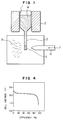
- Fig. 1 is a schematic view showing the working principle of an apparatus for producing a fibrous solid electrolyte according to one embodiment of the present invention.
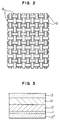
- Fig. 2 is a schematic view of a woven fabric of a fibrous solid electrolyte and a fibrous thermoplastic resin according to another embodiment of the present invention.
- Fig. 3 is a structural view of a lithium cell using a shaped fibrous solid electrolyte according to another embodiment of the present invention.
- Fig. 4 is a diagram showing a discharge curve of a lithium cell using a shaped fibrous electrolyte according to a further embodiment of the present invention.
- Example 1 The present invention will be described in detail below, referring to Examples of the present invention, where all the operations were carried out in a dry box filled with an inert gas.
- Example 1 The present invention will be described in detail below, referring to Examples of the present invention, where all the operations were carried out in a dry box filled with an inert gas.
- a fibrous glassy solid electrolyte was synthesized from a lithium ion conductive solid electrolyte represented by 0.5Li2S-0.5SiS2 by a blowing method. Details of the synthesis will be explained below, referring to Fig. 1.
- a lithium ion conductive solid electrolyte represented by 0.5Li2S-0.5SiS2 was prepared in the following manner.
- lithium sulfide (Li2S) and silicon disulfide (SiS2) was mixed together in a molar ratio of 0.5 : 0.5, and the resulting mixture was placed in a glassy carbon crucible 1. Then, the crucible 1 was placed in a vertical type, electric furnace 2 and heated in an argon gas stream up to 900°C to melt the mixture.
- a molten glass 4 as a liquid melt was made to flow downwards through a crucible nozzle 3 to its end and a molten glass drop 5 at the nozzle end was blown by a high pressure liquid nitrogen 7 from an injection nozzle 6 to form a lithium ion conductive fibrous glassy solid electrolyte 8 represented by 0.5Li2S-0.5SiS2.
- the thus obtained fibrous glassy solid electrolyte was made into a non-woven fabric having a thickness of 150 ⁇ m by press molding.
- the ion conductivity of the shaped solid electrolyte product was determined by an AC impedance method, as will be described below.
- the thus obtained non-woven fabric sheet of shaped solid electrolyte product was cut into a disk having a diameter of 10 mm, Pt plates having a diameter of 10 mm each were provided in contact with both sides of the disk under pressure to serve as electrodes for impedance measurement, thereby making a cell for the ion conductivity determination.
- a bending test was carried out by winding the shaped solid electrolyte product around a stainless steel bar having a diameter of 50 mm and visually inspecting the state of wound product. It was found that the shaped solid electrolyte product had no abnormal appearance in the bending test, and thus had a good flexibility. After the bending test, the ion conductivity of the shaped product was again determined, and no change was found in the ion conductivity in the shaped product before and after the bending test.
- Example 1 The molten glass (liquid melt) of Example 1 was put into liquid nitrogen to rapidly quench it in place of blowing the molten glass, thereby forming a bulky solid electrolyte for comparison.
- the resulting bulky solid electrolyte was ground to 100 mesh and less in a mortar and shaped into a disk having a diameter of 10 mm and a thickness of 0.2 mm by press molding under a pressure of 10 t/cm2.
- the ion conductivity of the shaped product was determined in the same manner as in Example 1 and found to be 1.0 ⁇ 10 ⁇ 4 S/cm, which was about a half of that of the shaped fibrous glassy solid electrolyte product.
- the shaped product is in a pellet state and thus was very brittle, and could not be subjected to a bending test.
- a fibrous glassy solid electrolyte was prepared from a silver ion conductive solid electrolyte represented by 0.75 AgI-0.25Ag2MoO4 in place of the lithium ion conductive solid electrolyte represented by 0.5Li2S-0.5SiS2 used in Example 1. Process for producing the silver ion conductive fibrous glassy solid electrolyte will be explained below:
- Silver iodide (AgI) and silver molybdate (Ag2MoO4) were mixed in a molar ratio of 0.75 : 0.25, and the resulting mixture was placed in a glassy carbon crucible. Then, the crucible was placed in a vertical type furnace and heated in an argon gas stream up to 500°C to melt the mixture. After the heating for 12 hours, a silver ion conductive fibrous glassy solid electrolyte represented by 0.75AgI-0.25Ag2MoO4 was obtained by blowing drops of the molten glass with a high pressure liquid nitrogen.
- a shaped fibrous glassy solid electrolyte product was formed from the thus obtained fibrous glassy solid electrolyte in the same manner as in Example 1.
- the ion conductivity of the shaped solid electrolyte product was determined in the same manner as in Example 1 and found to be 2 ⁇ 10 ⁇ 2 S/cm.
- Example 2 In a bending test carried out in the same manner as in Example 1, no abnormal appearance was observed. After the bending test, the ion conductivity was again determined, and it was found that no change was observed in the ion conductivity of the shaped product before and after the bending test and that the shaped product had a high flexibility.
- Example 2 The molten glass (liquid melt) of Example 2 was put into liquid nitrogen to rapidly quench it in place of blowing the molten glass, thereby forming a bulky solid electrolyte for comparison.
- the resulting bulky solid electrolyte was ground to 100 mesh and less in a mortar and shaped into a disk having a diameter of 10 mm and a thickness of 0.2 mm by press molding under a pressure of 10 t/cm2.
- the ion conductivity of the shaped product was determined in the same manner as in Example 1 and found to be 7.5 ⁇ 10 ⁇ 3 S/cm, which was lower than that of the shaped fibrous glassy solid electrolyte product of Example 2.
- the shaped product was in a pellet state and thus was very brittle, and could not be subjected to a bending test, as in Comparative Example 1.
- a fibrous glassy solid electrolyte was prepared from a copper ion conductive solid electrolyte represented by 0.3CuI-0.35Cu2O-0.35MoO3 in place of the lithium ion conductive solid electrolyte represented by 0.5Li2S-0.5SiS2 used in Example 1. Process for producing the copper ion conductive fibrous glassy solid electrolyte will be explained below:
- Copper iodide (CuI), Cuprous oxide (Cu2O) and molybdic acid (MoO3) were mixed in a molar ratio of 0.3 : 0.35 : 0.35, and the resulting mixture was placed in a glassy carbon crucible. Then, the crucible was placed in a vertical type furnace and heated in an argon gas stream up to 700°C to melt the mixture. After the heating for 3 hours, a copper ion conductive fibrous glassy solid electrolyte represented by 0.3CuI-0.35Cu2O-0.35MoO3, was obtained by blowing drops of the molten glass with a high pressure liquid nitrogen.
- a shaped fibrous glassy solid electrolyte product was formed from the thus obtained fibrous glassy solid electrolyte in the same manner as in Example 1.
- the ion conductivity of the shaped solid electrolyte product was determined in the same manner as in Example 1 and found to be 1.5 ⁇ 10 ⁇ 3 S/cm.
- Example 2 In a bending test carried out in the same manner as in Example 1, no abnormal appearance was observed. After the bending test, the ion conductivity was again determined, and it was found that no change was observed in the ion conductivity of the shaped product before and after the bending test and that the shaped product had a high flexibility.
- the molten glass (liquid melt) of Example 3 was put into liquid nitrogen to rapidly quench it in place of blowing the molten glass, thereby forming a bulky solid electrolyte for comparison.
- the resulting bulky solid electrolyte was ground to 100 mesh and less in a mortar and shaped into a disk having a diameter of 10 mm and a thickness of 0.2 mm by press molding under a pressure of 10 t/cm2.
- the ion conductivity of the shaped product was determined in the same manner as in Example 1 and found to be 7.0 ⁇ 10 ⁇ 4 S/cm, which was lower than that of the shaped fibrous glassy solid electrolyte product of Example 3.
- the shaped product was in a pellet state and thus was very brittle, and could not be subjected to a bending test.
- a fibrous glassy solid electrolyte was prepared from a proton conductive solid electrolyte represented by 0.45BaO-0.55P2O5 in place of the lithium ion conductive solid electrolyte represented by 0.5Li2S-0.5SiS2 used in Example 1. Process for producing the proton conductive fibrous glassy solid electrolyte will be explained below:
- Barium carbonate (BaCO3) and orthophosphoric acid (H3PO4) were mixed in a molar ratio of 0.45 : 0.275, and the resulting mixture was placed in a glassy carbon crucible. Then, the crucible was placed in a vertical type furnace and heated in an argon gas stream up to 500°C to melt the mixture. After the heating for 3 hours, a proton conductive fibrous glassy solid electrolyte represented by 0.45BaO-0.55P2O5 was obtained by blowing drops of the molten glass by blowing with a high pressure liquid nitrogen.
- a shaped fibrous glassy solid electrolyte product was formed from the thus obtained fibrous glassy solid electrolyte in the same manner as in Example 1.
- the proton conductivity of the shaped solid electrolyte product at 150°C was determined in the same manner as in Example 1 and found to be 6 ⁇ 10 ⁇ 11 S/cm.
- the molten glass (liquid melt) of Example 4 was put into liquid nitrogen to rapidly quench it in place of blowing the molten glass, thereby forming a bulky solid electrolyte for comparison.
- the resulting bulky solid electrolyte was ground to 100 mesh and less in a mortar and shaped into a disk having a diameter of 10 mm and a thickness of 0.2 mm by press molding under a pressure of 10 t/cm2.
- the proton conductivity of the shaped product at 150°C was determined in the same manner as in Example 1 and found to be 8.0 ⁇ 10 ⁇ 12 S/cm, which was lower than that of the shaped fibrous glassy solid electrolyte product.
- the shaped product was in a pellet state and thus was very brittle, and could not be subjected to a bending test.
- a shaped solid electrolyte product was prepared in the same manner as in Example 1, except that a fibrous glassy solid electrolyte obtained by a centrifugal method, that is, by dropping the molten glass obtained in Example 1 onto a rotating scattering disk in place of the blowing method of Example 1 and scattering the drops of molten glass by a predetermined centrifugal force.
- the ion conductivity of the shaped solid electrolyte product was determined in the same manner as in Example 1 and found to be 1.9 ⁇ 10 ⁇ 4 S/cm.
- a fibrous glassy solid electrolyte was prepared by a rod method, that is, shaping the molten glass of Example 1 into a rod and withdrawing the resulting solid electrolyte in place of the blowing method of Example 1. Its detail is given below:
- a lithium ion conductive glassy solid electrolyte represented by 0.03Li3PO4-0.59Li2S-0.38SiS2 was synthesized as a solid electrolyte in the following manner.
- a glassy solid electrolyte represented by 0.61Li2S-0.3ASiS2 was obtained in the same manner as in Example 1 except that the molar ratio of lithium sulfide (Li2S): Silicon sulfide (SiS2) was changed to 0.61 : 0.39.
- the thus obtained glassy solid electrolyte was used as a glass matrix, and pulverized, and admixed with lithium phosphate so as to obtain a composition of 0.03Li3PO4-0.59Li2S-0.38SiS2.
- Example 2 the mixture was again heated and melted in the same manner as in Example 1, and the resulting molten glass was poured into a stainless steel pipe, 5 mm in inner diameter, 50 mm in outer diameter and 15 cm in length, thoroughly cooled with liquid nitrogen to prepare a lithium ion conductive glassy solid electrolyte rod. Then, the glassy rod was heated to 350°C and withdrawn, thereby making the lithium ion conductive glassy solid electrolyte represented by 0.03L3PO4-0.59Li2S-0.38SiS2 into a long fiber. A fabric is woven from the thus obtained fibrous glassy solid electrolyte to obtain a shaped solid electrolyte product.
- the ion conductivity of the shaped solid electrolyte product was determined in the same manner as in Example 1 and found to be 9.0 ⁇ 10 ⁇ 5 S/cm.
- a shaped fibrous glassy solid electrolyte was obtained from a lithium ion conductive solid electrolyte represented by 0.03Li2O-0.59Li2S-0.38SiS2 in place of the lithium ion conductive solid electrolyte represented by 0.5Li2S-0.5SiS2 used in Example 1.
- Process for producing a fibrous glassy lithium ion conductive solid electrolyte represented by 0.03Li2O-0.59Li2S -0.38SiS2 is given below:
- a glass matrix for synthesizing a glassy solid electrolyte was synthesized. That is, a glassy solid electrolyte represented by 0.61Li2S-0.39SiS2 was obtained in the same manner as in Example 1 except that the molar ratio of lithium sulfide (Li2S): silicon disulfide (SiS2) was changed to 0.61 : 0.39.
- the resulting glassy solid electrolyte was used as a glass matrix and pulverized, and then admixed with lithium oxide so as to obtain a composition of 0.03Li2O-0.59Li2S-0.38SiS2.
- the mixture was again heated and melted in the same manner as in Example 1 and a shaped fibrous glassy solid electrolyte product was obtained in the same manner as in Example 1.
- Ion conductivity of the shaped solid electrolyte product was determined in the same manner as in Example 1 and found to be 1.2 ⁇ 10 ⁇ 4 S/cm.
- a shaped solid electrolyte product was prepared from the fibrous glassy solid electrolyte represented by 0.5Li2S-0.5SiS2 of Example 1 and a thermoplastic structural member of polystyrene.
- the fibrous glassy solid electrolyte was mixed with 2% by weight of polystyrene powder on the basis of the fibrous glassy solid electrolyte and the resulting mixture was passed through a hot roller press at a temperature of 250°C to form a shaped solid electrolyte product in a sheet form having a thickness of 150 ⁇ m.
- the ion conductivity of the product was determined in the same manner as in Example 1 and found to be 7.0 ⁇ 10 ⁇ 5 S/cm.
- a shaped solid electrolyte product was obtained in the same manner as in Example 7 except that 1,2-polybutadiene was used as a thermoplastic structural member in place of the polystyrene powder of Example 7.
- a fibrous glassy solid electrolyte of 0.5Li2S-0.5SiS2 obtained in Example 1 was mixed with 3% by weight of 1,2-polybutadiene powder on the basis of the fibrous glassy solid electrolyte, and the resulting mixture was passed through a hot roller press at a temperature of 250°C to form a shaped solid electrolyte product in a sheet form having a thickness of 150 ⁇ m.
- the ion conductivity of the shaped solid electrolyte product was determined in the same manner as in Example 1 and found to be 7.5 ⁇ 10 ⁇ 5 S/cm.
- 0.5Li2O-0.5SiS2 used as a lithium ion conductive solid electrolyte in Example 1 was made into long fibers by a pot method, that is, by melting the solid electrolyte and making the melt to flow out of nozzles at the bottom of a crucible, followed by rapid quenching, and winding the resulting filaments around a drum.
- a fabric was woven from the resulting long fibrous glassy solid electrolyte to obtain a shaped solid electrolyte product.
- the ion conductivity of the shaped solid electrolyte product was determined in the same manner as in Example 1 and found to be 8.0 ⁇ 10 ⁇ 5 S/cm.
- the ion conductivity of the shaped solid electrolyte product was determined in the same manner as in Example 1 and found to be 7.2 ⁇ 10 ⁇ 5 S/cm.
- Example 10 The shaped solid electrolyte product obtained in Example 10 was heated to 250°C in an inert atmosphere to improve the bonding between the solid electrolyte fibers. It was found that the ion conductivity and flexibility of the resulting shaped solid electrolyte product were the same as in Example 11.
- a solid electrolyte represented by 0.3LiI-0.35Li2S-0.35SiS2 was made into glassy fibers by the same blowing method as in Example 1, and a shaped solid electrolyte product was made from the resulting glassy fibers and polystyrene as a plastic structural member. Detail of the process will be given below:
- a lithium ion conductive glassy solid electrolyte represented by 0.3LiI-0.35Li2S-0.35SiS2 was synthesized in the following manner.
- the resulting solid electrolyte was made in a shaped solid electrolyte product in the same manner as in Example 8, except that 3.0% by weight of polystyrene was used as a thermoplastic structural member on the basis of the solid electrolyte in place of 2% by weight of Example 8.
- the ion conductivity of the shaped solid electrolyte product was determined in the same manner as in Example 1 and found to be 5.5 ⁇ 10 ⁇ 4 S/cm, and that of the fibrous glassy solid electrolyte alone was also determined in the same manner as in Example 1 and found to be 8 ⁇ 10 ⁇ 4 S/cm.
- a bending test carried out in the same manner as in Example 1 no abnormal change was observed in the appearance, and it had a high flexibility.
- a lithium ion conductive fibrous glassy solid electrolyte represented by 0.5Li2S-0.5P2S5 was made into glassy fibers by the same blowing method as in Example 1, and a shaped solid electrolyte product was made from the resulting glassy fibers and polystyrene as a plastic structural member. Detail of the process will be given below: At first, a lithium ion conductive glassy solid electrolyte represented by 0.5Li2S-0.5P2S5 in a molar ratio was synthesized from lithium sulfide (Li2S) and diphosphorus pentasulfide (P2S5) as the starting materials for the solid electrolyte.
- Li2S lithium sulfide
- P2S5 diphosphorus pentasulfide
- the resulting solid electrolyte was made in a shaped solid electrolyte product in the same manner as in Example 8, except that 3.0% by weight of polystyrene was used as a thermoplastic structural member on the basis of the solid electrolyte in place of 2% by weight of
- the ion conductivities of the shaped solid electrolyte product and the fibrous glassy solid electrolyte were determined in the same manner as in Example 1 and it was found that the ion conductivity of the shaped solid electrolyte product was 1.8 ⁇ 10 ⁇ 4 S/cm and that of the fibrous glassy solid electrolyte containing no thermoplastic structural member was 3.2 ⁇ 10 ⁇ 4 S/cm. In a bending test carried out in the same manner as in Example 1, no abnormal change was observed in the appearance, and it had a high flexibility.
- a shaped solid electrolyte product was made from a lithium ion conductive fibrous glassy solid electrolyte represented by 0.6Li2S-0.4B2S3 as a solid electrolyte and polystyrene as a thermoplastic structural member. Detail of the process will be given below.
- a glassy solid electrolyte represented by 0.6Li2S-0.4B2S3 was synthesized in the same manner as in Example 1, except that a mixture of lithium sulfide (Li2S) and boron sulfide (B2S3) in a molar ratio of 0.6 : 0.4 as starting materials for the solid electrolyte was used.
- Li2S lithium sulfide
- B2S3 boron sulfide
- a shaped solid electrolyte product was prepared in the same manner as in Example 8, except that 0.3% by weight of polystyrene as a thermoplastic structural member is added to the resulting solid electrolyte on the basis of the solid electrolyte.
- the ion conductivities of the shaped solid electrolyte product and fibrous glassy solid electrolyte were determined in the same manner as in Example 1, and it was found that the ion conductivity of the shaped solid electrolyte product was 1.5 ⁇ 10 ⁇ 4 S/cm and that of the fibrous glassy solid electrolyte containing no thermoplastic structural member was 2.8 ⁇ 10 ⁇ 4 S/cm. In a bending test carried out in the same manner as in Example 1, no abnormal change was observed in the appearance, and it had a high flexibility.
- a shaped fibrous glassy solid electrolyte product was made from 0.4Li3PO4-0.6Li4SiO4 as a lithium ion conductive solid electrolyte by a blowing method. Detail of the process will be given below:
- a lithium ion conductive fibrous glassy solid electrolyte was synthesized from 0.4Li3PO4-0.6Li4SiO4 as a solid electrolyte in the following manner:
- lithium phosphate (Li3PO4) and lithium silicate (Li4SiO4) were mixed together in a molar ratio of 0.4 : 0.6, and then the resulting mixture was placed in a glassy carbon crucible. Then, the crucible was placed in a vertical type, electric furnace and heated in an argon gas stream up to 1,300°C to melt the mixture. After the heating for 2 hours, a molten glass was made to flow downwards through a crucible nozzle to its end and a molten glass drop at the nozzle end was blown by a high pressure liquid nitrogen to form a lithium ion conductive fibrous glassy solid electrolyte represented by 0.4Li3PO4-0.6Li4SiO4.
- a lithium cell was prepared with the shaped fibrous glassy solid electrolyte product obtained in Example 13. Detail of the process will be given below, referring to Fig. 3.
- Titanium disulfide (TiS2) and the shaped fibrous glass solid electrolyte product obtained in Example 13 were mixed together in a weight ratio of 1 : 1 and molded by pressing into a positive pole 10, 0.1 mm thick and 10 mm ⁇ 13 mm square.
- the shaped fibrous glassy solid electrolyte product obtained in Example 13 was shaped into a sheet, 0.2 mm thick and 10 mm x 30 mm square and used as an electrolyte 12.
- the electrolyte 12 was sandwiched between the positive pole and the negative pole and then carbon pastes 13 and 13' were provided at the outsides of the positive pole 10 and the negative pole 11, respectively, to serve as terminals.
- carbon pastes 13 and 13' were provided at the outsides of the positive pole 10 and the negative pole 11, respectively, to serve as terminals.
- An open circuit voltage of the entirely solid lithium secondary cell was 2.8 V, and a short circuit current was 700 ⁇ A/cm2.
- a discharge curve as shown in Fig. 4 was obtained.
- the cell was bent to an angle of 30°C along a stainless steel rod, 50 mm in diameter, 5 times, and it was found that the bending gave no influence on the initial characteristics of the charging and discharging of the cell.
- a charge-discharge cycle test of the cell was conducted at a discharge end voltage of 1.9 V and a current density of 100 ⁇ A/cm2, both selected in view of a relatively stable voltage range, and it was found that the charge-discharge curve was not changed at all even after 300 cycles and no change was observed in the short circuit current. Thus, the cell worked stably.
- thermoplastic structural member has been made only on polystyrene, 1,2-polybutadiene and polyethylene, but other resins such as styrene-ethylene-butadiene block copolymer, etc. can be also effectively employed as the thermoplastic structural member, and thus the thermoplastic structural member is not limited only to the above-mentioned three resins.
- lithium ion conductive sulfide-based solid electrolyte has been made on 0.5Li2S-0.5SiS2, 0.03Li3PO4-0.5-Li2S-0.38SiS2, 0.5Li2S-0.5P2S5, and 0.6Li2S-0.4B2S3; that of lithium ion conductive oxide-based solid electrolyte on 0.4Li3PO4-0.6Li4SiO4; that of silver ion conductive solid electrolyte on 0.75AgI-0.25Ag2MoO4; that of copper ion conductive solid electrolyte on 0.3CuI-0.35Cu2O-0.35MoO3; and that of proton conductive solid electrolyte on 0.45BaO-0.55P2O2 , but other solid electrolyte capable of forming a glassy solid electrolyte can be also employed, and the present invention is not limited to the above-menti
- Example 18 a mixture of titanium disulfide as an active substance and fibrous glassy solid electrolyte of 0.03Li3PO4-0.59Li2S-0.38SiS2 was used as a positive pole of the entirely solid lithium secondary cell, but the above-mentioned solid electrolytes and other active substances for the positive pole such as chalcogen intercolation compounds such as tantalum disulfide or transition metal oxides in place of the titanium disulfide can be also effectively employed. That is, the present lithium cell is not limited only to the abovementioned mixture of the active substance for the positive pole and the fibrous glassy solid electrolyte.
- Example 18 description of shaped fibrous glassy solid electrolyte product layer in the entirely solid lithium cell has been made on the shaped product of lithium ion conductive glassy solid electrolyte represented by 0.03Li3PO4-0.59Li2S-0.38SiS2, but any other lithium ion conductive solid electrolyte capable of forming a glassy solid electrolyte can be also employed.
- Example 18 a Li sheet was employed as a negative pole material in the entirely solid lithium cell, but any other lithium alloy can be also effectively employed, and thus the present invention is not limited only to the Li sheet.
- a shaped solid electrolyte product having a high conductivity near to the bulk conductivity can be obtained by making the glassy solid electrolyte fibrous and shaping the resulting fibrous glassy solid electrolyte.
- a shaped solid electrolyte product having a high ion conductivity can be readily obtained by making a lithium ion conductive solid electrolyte synthesized from a plurality of sulfide-based compounds including lithium sulfide at least into a glassy, fibrous state, as compared with oxide-based lithium ion conductive solid electrolyte.
- a shaped solid electrolyte product having a high ion conductivity and a good processability can be obtained by filling a thermoplastic structural member into clearances in the shaped fibrous glassy solid electrolyte product.
- a lithium cell or a solid electrochemical sensor having a good flexibility and a low internal resistance can be obtained from the above-mentioned fibrous glassy solid electrolyte product.
Landscapes
- Chemical & Material Sciences (AREA)
- Engineering & Computer Science (AREA)
- Materials Engineering (AREA)
- Chemical Kinetics & Catalysis (AREA)
- General Chemical & Material Sciences (AREA)
- Organic Chemistry (AREA)
- Geochemistry & Mineralogy (AREA)
- Life Sciences & Earth Sciences (AREA)
- Ceramic Engineering (AREA)
- Manufacturing & Machinery (AREA)
- Electrochemistry (AREA)
- Structural Engineering (AREA)
- Conductive Materials (AREA)
- Secondary Cells (AREA)
Applications Claiming Priority (2)
| Application Number | Priority Date | Filing Date | Title |
|---|---|---|---|
| JP61640/93 | 1993-03-22 | ||
| JP5061640A JP3070328B2 (ja) | 1993-03-22 | 1993-03-22 | 繊維状固体電解質成形体 |
Publications (2)
| Publication Number | Publication Date |
|---|---|
| EP0618631A1 true EP0618631A1 (de) | 1994-10-05 |
| EP0618631B1 EP0618631B1 (de) | 1997-08-06 |
Family
ID=13177017
Family Applications (1)
| Application Number | Title | Priority Date | Filing Date |
|---|---|---|---|
| EP94103693A Expired - Lifetime EP0618631B1 (de) | 1993-03-22 | 1994-03-10 | Faserförmiger, fester Elektrolyt, seine Verwendung in einer elektrochemischer Zelle und Verfahren zur Herstellung dieses Elektrolyten |
Country Status (4)
| Country | Link |
|---|---|
| US (1) | US5589296A (de) |
| EP (1) | EP0618631B1 (de) |
| JP (1) | JP3070328B2 (de) |
| DE (1) | DE69404715T2 (de) |
Cited By (1)
| Publication number | Priority date | Publication date | Assignee | Title |
|---|---|---|---|---|
| EP0829913A3 (de) * | 1996-09-13 | 2002-12-04 | Matsushita Electric Industrial Co., Ltd. | Aufladbare Lithium enthaltende Feststoffbatterie, Batteriezusammenbau und Verfahren zu seiner Ladung |
Families Citing this family (21)
| Publication number | Priority date | Publication date | Assignee | Title |
|---|---|---|---|---|
| US6824920B1 (en) | 1997-06-03 | 2004-11-30 | Matsushita Electric Industrial Co., Ltd. | Non-aqueous electrolyte secondary battery comprising composite particles |
| KR100378004B1 (ko) * | 1997-06-10 | 2003-06-09 | 삼성에스디아이 주식회사 | 유리-고분자복합전해질및그제조방법 |
| US6653019B1 (en) | 1998-06-03 | 2003-11-25 | Matsushita Electric Industrial Co., Ltd. | Non-aqueous electrolyte secondary cell |
| US6821675B1 (en) * | 1998-06-03 | 2004-11-23 | Matsushita Electric Industrial Co., Ltd. | Non-Aqueous electrolyte secondary battery comprising composite particles |
| US6605386B1 (en) | 1998-12-02 | 2003-08-12 | Matsushita Electric Industrial Co., Ltd. | Non-aqueous electrolyte secondary battery comprising composite particles |
| DE69938822D1 (de) | 1998-12-02 | 2008-07-10 | Matsushita Electric Industrial Co Ltd | Sekundärzelle mit nichtwässrigem elektrolyten und vefahren zu dessen aufladung |
| US6270651B1 (en) * | 2000-02-04 | 2001-08-07 | Abetif Essalik | Gas component sensor |
| JP5110850B2 (ja) * | 2006-10-31 | 2012-12-26 | 株式会社オハラ | リチウムイオン伝導性固体電解質およびその製造方法 |
| US9246188B2 (en) | 2011-02-14 | 2016-01-26 | Los Alamos National Security, Llc | Anti-perovskite solid electrolyte compositions |
| KR101440886B1 (ko) * | 2011-06-22 | 2014-09-18 | 삼성에스디아이 주식회사 | 고체 전해질, 그 제조방법 및 이를 채용한 리튬 전지 |
| US11888149B2 (en) | 2013-03-21 | 2024-01-30 | University Of Maryland | Solid state battery system usable at high temperatures and methods of use and manufacture thereof |
| EP3529847B1 (de) | 2016-10-21 | 2025-09-24 | QuantumScape Battery, Inc. | Elektrolytseparatoren umfassend lithiumborhydrid und kompositelektrolytseparatoren von lithiumgefülltem granat und lithiumborhydrid |
| KR102699849B1 (ko) * | 2017-03-29 | 2024-08-29 | 유니버시티 오브 매릴랜드, 칼리지 파크 | 고체 상태 하이브리드 전해질, 이의 제조 방법 및 이의 용도 |
| CN111886090B (zh) | 2018-02-15 | 2023-07-04 | 马里兰大学派克分院 | 有序多孔固态电解质结构、具有该结构的电化学装置、制造该结构的方法 |
| US10957937B2 (en) | 2019-03-07 | 2021-03-23 | International Business Machines Corporation | Three-terminal copper-driven neuromorphic device |
| US11569527B2 (en) | 2019-03-26 | 2023-01-31 | University Of Maryland, College Park | Lithium battery |
| TWI738280B (zh) * | 2019-04-12 | 2021-09-01 | 康那香企業股份有限公司 | 可捲繞軟式高分子基材固態電解質之二次電池結構及其製備方法 |
| CN112670559A (zh) | 2019-10-15 | 2021-04-16 | 通用汽车环球科技运作有限责任公司 | 固态电解质和制备其的方法 |
| KR20230004718A (ko) | 2020-04-30 | 2023-01-06 | 고에이 가가쿠 가부시키가이샤 | 블록 폴리이소시아네이트 조성물, 열경화성 수지 조성물, 경화물 및 그 제조 방법 |
| DE102020125123B4 (de) | 2020-09-25 | 2022-06-30 | GM Global Technology Operations LLC | Verfahren zur Herstellung eines Festkörperelektrolyten |
| CN115882077B (zh) * | 2022-12-27 | 2025-07-29 | 合肥国轩高科动力能源有限公司 | 一种锂镧锆氧固态电解质材料及其制备方法、固态电解质、固态锂离子电池 |
Citations (8)
| Publication number | Priority date | Publication date | Assignee | Title |
|---|---|---|---|---|
| CH450507A (de) * | 1965-07-01 | 1968-01-31 | Vnii Steklyznnogo Volokna | Verfahren zur Herstellung von Bändern mit Halbleitereigenschaften |
| US3829331A (en) * | 1971-12-30 | 1974-08-13 | Dow Chemical Co | Sodium borate glass compositions and batteries containing same |
| JPS5227827A (en) * | 1975-08-27 | 1977-03-02 | Matsushita Electric Ind Co Ltd | Process for producing fibrous materials based on alkali titanates |
| US4164610A (en) * | 1977-05-23 | 1979-08-14 | Corning Glass Works | Glasses exhibiting high lithium ion mobility |
| JPS60134026A (ja) * | 1983-12-16 | 1985-07-17 | Nippon Muki Zairyo Kk | 耐熱性無機繊維 |
| JPH01148812A (ja) * | 1988-09-30 | 1989-06-12 | Mitsubishi Mining & Cement Co Ltd | 無機ファイバーの製造方法 |
| JPH03222206A (ja) * | 1990-01-26 | 1991-10-01 | Matsushita Electric Ind Co Ltd | 固体電解質膜 |
| JPH04243932A (ja) * | 1991-01-29 | 1992-09-01 | Nitto Boseki Co Ltd | 電磁波シールド用無機繊維 |
Family Cites Families (6)
| Publication number | Priority date | Publication date | Assignee | Title |
|---|---|---|---|---|
| JPS5777038A (en) * | 1980-10-28 | 1982-05-14 | Asahi Glass Co Ltd | Manufacture of crystallized glass from phosphate glass |
| JPS61110317A (ja) * | 1984-11-01 | 1986-05-28 | Sanyo Electric Co Ltd | 磁気ヘツド |
| CA1306904C (en) * | 1985-10-09 | 1992-09-01 | Tetsumi Suzuki | Electrically conductive material and secondary battery using the electrically conductive material |
| US4810599A (en) * | 1987-03-27 | 1989-03-07 | Japan Synthetic Rubber Co., Ltd. | Structure suitable for solid electrochemical elements |
| US5217826A (en) * | 1990-07-31 | 1993-06-08 | Matsushita Electric Industrial Co., Ltd. | Lithium-ion conducting solid electrolyte |
| US5130039A (en) * | 1991-05-20 | 1992-07-14 | General Motors Corporation | Anhydrous electrorheological compositions including Liy Si1-x Ax O4 |
-
1993
- 1993-03-22 JP JP5061640A patent/JP3070328B2/ja not_active Expired - Fee Related
-
1994
- 1994-03-03 US US08/205,109 patent/US5589296A/en not_active Expired - Lifetime
- 1994-03-10 DE DE69404715T patent/DE69404715T2/de not_active Expired - Fee Related
- 1994-03-10 EP EP94103693A patent/EP0618631B1/de not_active Expired - Lifetime
Patent Citations (8)
| Publication number | Priority date | Publication date | Assignee | Title |
|---|---|---|---|---|
| CH450507A (de) * | 1965-07-01 | 1968-01-31 | Vnii Steklyznnogo Volokna | Verfahren zur Herstellung von Bändern mit Halbleitereigenschaften |
| US3829331A (en) * | 1971-12-30 | 1974-08-13 | Dow Chemical Co | Sodium borate glass compositions and batteries containing same |
| JPS5227827A (en) * | 1975-08-27 | 1977-03-02 | Matsushita Electric Ind Co Ltd | Process for producing fibrous materials based on alkali titanates |
| US4164610A (en) * | 1977-05-23 | 1979-08-14 | Corning Glass Works | Glasses exhibiting high lithium ion mobility |
| JPS60134026A (ja) * | 1983-12-16 | 1985-07-17 | Nippon Muki Zairyo Kk | 耐熱性無機繊維 |
| JPH01148812A (ja) * | 1988-09-30 | 1989-06-12 | Mitsubishi Mining & Cement Co Ltd | 無機ファイバーの製造方法 |
| JPH03222206A (ja) * | 1990-01-26 | 1991-10-01 | Matsushita Electric Ind Co Ltd | 固体電解質膜 |
| JPH04243932A (ja) * | 1991-01-29 | 1992-09-01 | Nitto Boseki Co Ltd | 電磁波シールド用無機繊維 |
Non-Patent Citations (6)
| Title |
|---|
| D CHAKRAVORTY: "ELECTRICAL CONDUCTION IN GLASS FIBRES SUBJECTED TO A SODIUM -SILVER EXCHANGE TREATMENT", JOURNAL OF PHYSICS D. APPLIED PHYSICS, no. 19, 1986, LETCHWORTH GB, pages 2185 - 2195, XP020013268, DOI: doi:10.1088/0022-3727/19/11/015 * |
| DATABASE WPI Derwent World Patents Index; AN 77-27803Y, MATSUSHITA: "ALKALI METAL TITANATE GLASS FIBRE" * |
| PATENT ABSTRACTS OF JAPAN vol. 13, no. 408 (C - 634) 8 September 1989 (1989-09-08) * |
| PATENT ABSTRACTS OF JAPAN vol. 15, no. 506 (E - 1148) 20 December 1991 (1991-12-20) * |
| PATENT ABSTRACTS OF JAPAN vol. 17, no. 17 (C - 1016) 13 January 1993 (1993-01-13) * |
| PATENT ABSTRACTS OF JAPAN vol. 9, no. 293 (C - 315) 20 November 1985 (1985-11-20) * |
Cited By (2)
| Publication number | Priority date | Publication date | Assignee | Title |
|---|---|---|---|---|
| EP0829913A3 (de) * | 1996-09-13 | 2002-12-04 | Matsushita Electric Industrial Co., Ltd. | Aufladbare Lithium enthaltende Feststoffbatterie, Batteriezusammenbau und Verfahren zu seiner Ladung |
| EP1515388A1 (de) * | 1996-09-13 | 2005-03-16 | Matsushita Electric Industrial Co., Ltd. | Aufladbare Lithium enthaltende Feststoffbatterie |
Also Published As
| Publication number | Publication date |
|---|---|
| DE69404715T2 (de) | 1998-02-19 |
| EP0618631B1 (de) | 1997-08-06 |
| US5589296A (en) | 1996-12-31 |
| JP3070328B2 (ja) | 2000-07-31 |
| DE69404715D1 (de) | 1997-09-11 |
| JPH06275311A (ja) | 1994-09-30 |
Similar Documents
| Publication | Publication Date | Title |
|---|---|---|
| US5589296A (en) | Fibrous solid electrolyte, cell using the electrolyte and process for producing the electrolyte | |
| KR100332080B1 (ko) | 고형전해질과전지 | |
| JP3433173B2 (ja) | 硫化物系結晶化ガラス、固体型電解質及び全固体二次電池 | |
| KR100942477B1 (ko) | 리튬 이온 2차 전지 및 고체 전해질 | |
| JP7075760B2 (ja) | ナトリウムイオン二次電池用正極活物質 | |
| KR101130123B1 (ko) | 완전 고체형 리튬 이온 2차 전지 및 고체 전해질 | |
| DE69936092T2 (de) | Geformter fester elektrolyt, geformte elektrode und elektrochemisches element | |
| CN1949569B (zh) | 锂离子导电性固体电解质和制造它的方法 | |
| KR100513726B1 (ko) | 고체 전해질, 이를 채용한 전지 및 그 고체 전해질의 제조방법 | |
| CN101174698B (zh) | 锂离子传导性固体电解质及其制造方法 | |
| US11515534B2 (en) | Positive electrode active material for sodium-ion secondary battery | |
| JPWO2000028608A1 (ja) | リチウム二次電池 | |
| CN106935903A (zh) | 复合电解质膜及其制备方法和应用 | |
| JPH1186899A (ja) | 固体電解質成型体、電極成型体および電気化学素子 | |
| JPH05306117A (ja) | 非晶質リチウムイオン伝導性固体電解質並びにその合成法 | |
| Liang et al. | High lithium-ion conductivity in all-solid-state lithium batteries by Sb doping LLZO | |
| Temeche et al. | Solid electrolytes for Li–S batteries: solid solutions of poly (ethylene oxide) with LixPON-and LixSiPON-based polymers | |
| US20240429435A1 (en) | Composite Particulates for Lithium Batteries | |
| JP2759479B2 (ja) | 全固態リチウム二次電池 | |
| EP3709425A1 (de) | Polymerelektrolyt und verfahren zur herstellung davon | |
| JP7523659B2 (ja) | 固体電解質製造用組成物、これを用いる固体電解質及びリチウム二次電池 | |
| CN101000956A (zh) | 锂二次电池银复合电极材料及其低温制备方法 | |
| CN113336453B (zh) | 改性磷酸盐玻璃及制备方法与其在电化学器件中的应用 | |
| CN120015903A (zh) | 复合固态电解质及其制备方法和应用 | |
| KR20230083218A (ko) | 고체 전해질 및 이를 포함하는 전고체 전지 |
Legal Events
| Date | Code | Title | Description |
|---|---|---|---|
| PUAI | Public reference made under article 153(3) epc to a published international application that has entered the european phase |
Free format text: ORIGINAL CODE: 0009012 |
|
| 17P | Request for examination filed |
Effective date: 19940310 |
|
| AK | Designated contracting states |
Kind code of ref document: A1 Designated state(s): DE FR GB |
|
| 17Q | First examination report despatched |
Effective date: 19951205 |
|
| GRAG | Despatch of communication of intention to grant |
Free format text: ORIGINAL CODE: EPIDOS AGRA |
|
| GRAH | Despatch of communication of intention to grant a patent |
Free format text: ORIGINAL CODE: EPIDOS IGRA |
|
| GRAH | Despatch of communication of intention to grant a patent |
Free format text: ORIGINAL CODE: EPIDOS IGRA |
|
| GRAA | (expected) grant |
Free format text: ORIGINAL CODE: 0009210 |
|
| AK | Designated contracting states |
Kind code of ref document: B1 Designated state(s): DE FR GB |
|
| REF | Corresponds to: |
Ref document number: 69404715 Country of ref document: DE Date of ref document: 19970911 |
|
| ET | Fr: translation filed | ||
| PLBE | No opposition filed within time limit |
Free format text: ORIGINAL CODE: 0009261 |
|
| STAA | Information on the status of an ep patent application or granted ep patent |
Free format text: STATUS: NO OPPOSITION FILED WITHIN TIME LIMIT |
|
| 26N | No opposition filed | ||
| REG | Reference to a national code |
Ref country code: GB Ref legal event code: IF02 |
|
| PGFP | Annual fee paid to national office [announced via postgrant information from national office to epo] |
Ref country code: GB Payment date: 20070307 Year of fee payment: 14 |
|
| PGFP | Annual fee paid to national office [announced via postgrant information from national office to epo] |
Ref country code: DE Payment date: 20070308 Year of fee payment: 14 |
|
| PGFP | Annual fee paid to national office [announced via postgrant information from national office to epo] |
Ref country code: FR Payment date: 20070308 Year of fee payment: 14 |
|
| GBPC | Gb: european patent ceased through non-payment of renewal fee |
Effective date: 20080310 |
|
| REG | Reference to a national code |
Ref country code: FR Ref legal event code: ST Effective date: 20081125 |
|
| PG25 | Lapsed in a contracting state [announced via postgrant information from national office to epo] |
Ref country code: DE Free format text: LAPSE BECAUSE OF NON-PAYMENT OF DUE FEES Effective date: 20081001 |
|
| PG25 | Lapsed in a contracting state [announced via postgrant information from national office to epo] |
Ref country code: FR Free format text: LAPSE BECAUSE OF NON-PAYMENT OF DUE FEES Effective date: 20080331 |
|
| PG25 | Lapsed in a contracting state [announced via postgrant information from national office to epo] |
Ref country code: GB Free format text: LAPSE BECAUSE OF NON-PAYMENT OF DUE FEES Effective date: 20080310 |