EP0618722B1 - Verfahren und Einrichtung zur Dekodierung von komprimierten Bildern - Google Patents
Verfahren und Einrichtung zur Dekodierung von komprimierten Bildern Download PDFInfo
- Publication number
- EP0618722B1 EP0618722B1 EP94200805A EP94200805A EP0618722B1 EP 0618722 B1 EP0618722 B1 EP 0618722B1 EP 94200805 A EP94200805 A EP 94200805A EP 94200805 A EP94200805 A EP 94200805A EP 0618722 B1 EP0618722 B1 EP 0618722B1
- Authority
- EP
- European Patent Office
- Prior art keywords
- frames
- decoded
- frame
- decoding
- images
- Prior art date
- Legal status (The legal status is an assumption and is not a legal conclusion. Google has not performed a legal analysis and makes no representation as to the accuracy of the status listed.)
- Expired - Lifetime
Links
- 238000000034 method Methods 0.000 title claims description 33
- 230000015654 memory Effects 0.000 claims description 96
- 230000002457 bidirectional effect Effects 0.000 claims description 21
- 230000006835 compression Effects 0.000 claims description 8
- 238000007906 compression Methods 0.000 claims description 8
- 230000008569 process Effects 0.000 description 14
- 239000004020 conductor Substances 0.000 description 6
- 241000135309 Processus Species 0.000 description 5
- 238000010586 diagram Methods 0.000 description 5
- 238000000638 solvent extraction Methods 0.000 description 3
- 230000002123 temporal effect Effects 0.000 description 3
- 230000008901 benefit Effects 0.000 description 2
- 238000004364 calculation method Methods 0.000 description 2
- 230000006837 decompression Effects 0.000 description 2
- 238000012163 sequencing technique Methods 0.000 description 2
- 230000003044 adaptive effect Effects 0.000 description 1
- 230000003111 delayed effect Effects 0.000 description 1
- 235000021183 entrée Nutrition 0.000 description 1
- 230000006870 function Effects 0.000 description 1
- 230000008520 organization Effects 0.000 description 1
- 238000013139 quantization Methods 0.000 description 1
- 230000033764 rhythmic process Effects 0.000 description 1
- 238000005070 sampling Methods 0.000 description 1
- 230000009466 transformation Effects 0.000 description 1
- 239000013598 vector Substances 0.000 description 1
Images


Classifications
-
- H—ELECTRICITY
- H04—ELECTRIC COMMUNICATION TECHNIQUE
- H04N—PICTORIAL COMMUNICATION, e.g. TELEVISION
- H04N5/00—Details of television systems
- H04N5/76—Television signal recording
- H04N5/907—Television signal recording using static stores, e.g. storage tubes or semiconductor memories
-
- H—ELECTRICITY
- H04—ELECTRIC COMMUNICATION TECHNIQUE
- H04N—PICTORIAL COMMUNICATION, e.g. TELEVISION
- H04N19/00—Methods or arrangements for coding, decoding, compressing or decompressing digital video signals
- H04N19/42—Methods or arrangements for coding, decoding, compressing or decompressing digital video signals characterised by implementation details or hardware specially adapted for video compression or decompression, e.g. dedicated software implementation
- H04N19/423—Methods or arrangements for coding, decoding, compressing or decompressing digital video signals characterised by implementation details or hardware specially adapted for video compression or decompression, e.g. dedicated software implementation characterised by memory arrangements
-
- H—ELECTRICITY
- H04—ELECTRIC COMMUNICATION TECHNIQUE
- H04N—PICTORIAL COMMUNICATION, e.g. TELEVISION
- H04N19/00—Methods or arrangements for coding, decoding, compressing or decompressing digital video signals
- H04N19/42—Methods or arrangements for coding, decoding, compressing or decompressing digital video signals characterised by implementation details or hardware specially adapted for video compression or decompression, e.g. dedicated software implementation
- H04N19/423—Methods or arrangements for coding, decoding, compressing or decompressing digital video signals characterised by implementation details or hardware specially adapted for video compression or decompression, e.g. dedicated software implementation characterised by memory arrangements
- H04N19/426—Methods or arrangements for coding, decoding, compressing or decompressing digital video signals characterised by implementation details or hardware specially adapted for video compression or decompression, e.g. dedicated software implementation characterised by memory arrangements using memory downsizing methods
- H04N19/427—Display on the fly, e.g. simultaneous writing to and reading from decoding memory
-
- H—ELECTRICITY
- H04—ELECTRIC COMMUNICATION TECHNIQUE
- H04N—PICTORIAL COMMUNICATION, e.g. TELEVISION
- H04N19/00—Methods or arrangements for coding, decoding, compressing or decompressing digital video signals
- H04N19/60—Methods or arrangements for coding, decoding, compressing or decompressing digital video signals using transform coding
- H04N19/61—Methods or arrangements for coding, decoding, compressing or decompressing digital video signals using transform coding in combination with predictive coding
-
- H—ELECTRICITY
- H04—ELECTRIC COMMUNICATION TECHNIQUE
- H04N—PICTORIAL COMMUNICATION, e.g. TELEVISION
- H04N5/00—Details of television systems
- H04N5/76—Television signal recording
- H04N5/91—Television signal processing therefor
- H04N5/92—Transformation of the television signal for recording, e.g. modulation, frequency changing; Inverse transformation for playback
- H04N5/926—Transformation of the television signal for recording, e.g. modulation, frequency changing; Inverse transformation for playback by pulse code modulation
- H04N5/9261—Transformation of the television signal for recording, e.g. modulation, frequency changing; Inverse transformation for playback by pulse code modulation involving data reduction
Definitions
- the present invention relates to a method for decoding coded images. digitally with compression, the number of pixels to be processed per unit of time being fixed, an image being divided into blocks each comprising several pixels in each of the horizontal and vertical directions, and said compression being based on processing by transmitted blocks sequentially, these images being each displayed in the form of two frames, and may be at least three types, namely images say "intra”, coded in absolute that is to say without reference to to other images, so-called “predicted” images, coded by reference to a previous intra or predicted image, and type images said "bidirectional" coded from at least two other images each intra or predicted, some couples of an intra or predicted image and of a bidirectional type image being such as an intra or predicted is used for encoding or decoding the bidirectional image to be displayed before it, and a memory space is provided for there store images newly decoded or being decoded. It also relates to a device for implementing this method. It applies in digital television, whether in definition standard or high definition.
- the invention takes advantage of the fact that the number of pixels to be processed per unit of time is fixed. A direct consequence is that the number of pixels to be coded in an image, and consequently the number of memory words necessary for the storage of images, is limited, and the image compression algorithms are based on block processing, transmitted sequentially .
- the invention also takes advantage of the fact that the image compression algorithms operate on images themselves made up of 2 frames (even and odd).
- the invention provides an economical method, at overall cost of the decoder and of the memory, which makes it possible to store the decoded images in a minimum memory size without overly complicating the management of this memory, taking into account the types of memory available. It thus solves the problem of the increase in the number of memory boxes intended for the storage of decoded images.
- said memory space is organized into five pages, of which four pages are used to each store an image frame of intra or predicted type and the fifth is divided into fractional zones each having a capacity of whole fraction of a frame, areas which are used to each store a frame fraction of a bidirectional type image, fraction representing a horizontal band having the same width as that of the image and, the bidirectional type images being decoded in successive stages of a fraction of frame or image at a time, the fractions newly decoded or in the process of decoding are placed progressively each time at the address, in the fifth page, of a fractional zone whose content has already been displayed.
- a good compromise for the size of the fractional zones is obtained when the said fractional zones are “block line” zones each having a capacity of a line of blocks (that is to say the quantity of blocks which, side by side, occupy the width of a line of image) and, the images of bidirectional type being decoded by successive stages of a line of blocks at the same time, said lines of blocks newly decoded or in the course of decoding are placed at the progressively each time to the address, on the fifth page, of a line of blocks zone whose content has already been displayed.
- management by fractional zones is also carried out for intra or predicted images, management by which any fractional zone used by a part of frame is re-allocated to store a part of frame newly decoded or in the process of decoding if its content has already has been displayed and if it is no longer used as a reference for motion compensation.
- the basic idea of the invention is to store the intra and predicted images entirely in frames, both in luminance and in chrominance, and to store bidirectional images by block lines, in luminance and in chrominance.
- the motion compensations for all the frames are made from I or P frames and that the amplitude of the motion vectors is not limited.
- the number of frames of delay between the start of the decoding of a frame and the start of its display is preferably three, whereas in the case of images at 24 frames per second to be displayed at 60 frames per second, the number of frames of delay between the start of the decoding of an intra frame and the start of its display is preferably four.
- a device for implementing the above method is remarkable in that it comprises a memory shared in four pages capable of each containing a frame and in a fifth page divided into fractional zones (a fractional zone being able to contain a whole fraction of a frame) and having a size greater than the size of a frame plus the size of two fractional zones, and in that it further comprises a manager element provided with means for managing the display of decoded frame fractions , for bidirectional type images, to re-allocate any fractional area in order to record therein a fraction of frame newly decoded or in the process of decoding if the content of this area has already been displayed, and of means for providing the decoding element the memory addresses where to write the start of each fraction of frame newly decoded or in the process of decoding.
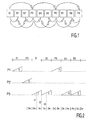
- FIG. 1 illustrates the coding of the images in relation to the other.
- Figure 2 is a timing diagram in a method of the art prior.
- FIG. 3 is a timing diagram in the method of the invention.
- Figure 4 illustrates the management of part of a memory page containing lines of type B image blocks.
- FIG. 5 is a diagram of the times in the method of the invention, in the case of cinema images at 24 frames per second, to be displayed by frames at 60 frames per second.
- FIG. 6 schematically represents the partitioning of a decompression and decoding device according to the invention, with a memory divided into pages P1 to P4 and PB.
- FIG. 7 schematically shows the constitution of element 2 of Figure 6.
- the predictions used for the B images always come from the adjacent I or P images.
- the images I and P play a particular role, since they serve as reference images for the motion compensations.
- An example of a sequence of images before coding is as follows, the top line indicating the type of image, I, P or B which will be produced by the coder from the incoming images which of course, before coding, are all defined without reference to other images, and the bottom line indicates the order of arrival of these images: type: IBBPBBPB B ... order of arrival: 0 1 2 3 4 5 6 7 8 ...
- Figure 1 illustrates from which images the others are generated.
- Image P3 is generated from image I0, images B1 and B2 are generated from images I0 and P3, image P6 is generated from image P3, images B4 and B5 are generated from images P3 and P6, image P9 is generated from image P6, images B7 and B8 are generated from images P6 and P9, etc.
- the third image P3 is created in the coder from the first image I0, it therefore leaves the coder after the latter, the first and second type B images are created from the images I0 and P3, they therefore leave the coder after them, the image P6 is created from the image P3, and so on, and the images of the example above leave the encoder (and therefore arrive at the decoder) in the following order: type: IPBBPB B ...
- the horizontal and vertical dimensions of an image are called DIMH and DIMV.
- the type of coding can be performed either in image mode, in which case the image is sent in the form of a DIMH x DIMV format table, or in frame mode, in which case the image is sent in two successive frames of DIMH x DIMV / 2 dimension.
- Each image (or frame) is cut into blocks whose horizontal and vertical dimensions are respectively H and V. Usually, H and V are worth 8 pixels or 16 pixels.
- FIG. 2 illustrates an example of a timing diagram for managing image memory in a decoder of the prior art using 3 pages of memory, denoted respectively P1, P2, P3, each of which can contain an image.
- two reference images are stored on the one hand, which corresponds to four pages each containing a frame, denoted P1, P2, P3, P4, used for the storage of I or P frames, and on the other hand, block lines are stored in a page denoted PB which is divided into “block line zones”, and which contains the block lines of the decoded B images.
- PB page denoted into “block line zones”, and which contains the block lines of the decoded B images.
- Called "block line area” a memory space which can contain a line of blocks originating from a frame, that is to say containing V lines of each DIMH pixels, for the luminance. Such a space contains for example 720 ⁇ 16 pixels, in standard definition.
- the decoding time of an image is at most equal to Timage, Timage being equal to 40 ms in a 50 Hz system or 33 ms in a 60 Hz system.
- the decoding time of a line of blocks depends on the content of the image to be coded, and moreover is bounded.
- the decoding time of a block line therefore follows a complex probability law. It is assumed that the decoding time is linear, that is to say that the decoding time of a block line is approximately equal to (V / DIMV) * Tdec.
- the devices necessary in the case where the decoding is early or late compared to the model used.
- the time diagram of the decoding process is shown in Figure 3.
- This sequencing corresponds to the case where the images are displayed at a rate twice that compared to that at which they are decoded. This corresponds to the cases of coding at 30 Hz and a display at 60 Hz, or a coding at 25 Hz and a display at 50 Hz. The case where the coding and display rhythms are different is discussed below.
- the page PB contains the odd frame of B1.
- the image B2 can be written provided that the size of the page PB is greater than the size of a frame plus the size of a line of blocks in the case of coding in frame mode and of two lines of blocks. in image mode.
- TailleminE (DIMH x DIMV / 2) + (2 x V x DIMH).
- DIMV / 2xV block line areas were released by the display process. During this period, these memory areas could have been used by the decoding process to store the second part of the decoded image B1 there.
- FIG. 4 represents a state of a part of the page PB, each rectangle representing a line of blocks area. This is the state at time t2 in FIG.
- the indication "B2 n ° p + 1”, for example, means that the block line area in question contains the line of blocks number "p + 1" in picture B number 2.
- a block line between "B1 n ° n-2" and "B1 n ° n" has already been displayed and the memory area is therefore free.
- This type of management allows the use for the PB page of a memory space between the minimum size, (DIMH x DIMV / 2) + (2 x V x DIMH) and the maximum size, DIMH x DIMV.
- the size required for the PB page is 2/3 x DIMH x DIMV.
- the principle described above applies in the same way to a 60 Hz system, the pages P1, P2, P3, P4, PB being always managed by block lines.
- FIG. 5 represents the sequencing of the decoding at 24 Hz and the display at 60 Hz.
- the coding rate is 24 Hz, that is to say that the images to be decoded arrive every 1/24 th of a second.
- every two images a frame is displayed twice (here: 1st displayed again after 1o, 3o displayed again after 3rd, etc.
- the next frame must be odd causing to display its result 2o and non 2e).
- a 60 Hz decoder must be able to decode a sequence of coded sequences either at 30 Hz or 24 Hz, and the number of frames of delay between display and decoding must be constant. Consequently, in 60 Hz the delay between decoding and display is always fixed at four frames. This is a significant difference from a 50 Hz system in which the number of delay frames between the first decoded frame and the first displayed frame is three.
- the page PB In the case of the decoding of a sequence coded at 30 Hz and displayed at 60 Hz, that is to say a decoding at 60 Hz, so that the start of the decoding of image 2 is not delayed, the page PB must contain a complete image (to store the entire image B1) and two lines of blocks to store the first line of blocks resulting from the decoding of the image B2.
- the minimum size in 60 Hz for E is (DIMH x DIMV) + (2 x V x DIMH).
Landscapes
- Engineering & Computer Science (AREA)
- Multimedia (AREA)
- Signal Processing (AREA)
- Compression Or Coding Systems Of Tv Signals (AREA)
- Compression, Expansion, Code Conversion, And Decoders (AREA)
- Image Processing (AREA)
Claims (8)
- Verfahren zum Dekodieren kodierter digitaler komprimierter Bilder, wobei die Anzahl zu verarbeitender Pixel pro Zeiteinheit fest ist, ein Bild in Blöcke mit jeweils mehreren Pixeln in jeweils die horizontale und vertikale Richtung unterteilt wird und die besagte Komprimierung auf einer Verarbeitung nach sequentiell übertragenen Blöcken gründet, diese Bilder jeweils in der Form von zwei Rastern angezeigt werden und mindestens drei verschiedener Typen sein können, d.h. sogenannte "Intra"-Bilder, absolut kodiert, also ohne Bezugnahme auf andere Bilder, sogenannte "Prognose"-Bilder, kodiert unter Bezugnahme auf ein vorhergehendes Intra- oder Prognosebild, und Bilder des sogenannten "Zweirichtungs"-Typs, kodiert anhand von mindestens zwei anderen jeweiligen Intra- oder Prognosebildern, wobei gewisse Paare eines Intra- oder Prognosebilds und eines Bilds vom Zweirichtungstyp derart sind, daß ein Intra- oder Prognosebild der Kodierung oder Dekodierung des Bildes vom Zweirichtungstyps dient, das vor ihm anzuzeigen ist, und ein Speicherplatz vorgesehen ist, um neu dekodierte oder in Dekodierung befindliche Bilder zu speichern, dadurch gekennzeichnet, daß der besagte Speicherplatz auf fünf Seiten organisiert wird, wovon vier Seiten zur jeweiligen Speicherung eines Bildrasters vom Intra- oder Prognosetyp verwendet werden und die fünfte in fraktionelle Zonen mit einer jeweiligen Kapazität einer ganzen Rasterfraktion unterteilt wird, während die Zonen zum jeweiligen Speichern einer Rasterfraktion eines Bilds vom Zweirichtungstyp verwendet werden, die Fraktion ein horizontales Band selber Breite wie die des Bildes darstellt und die Bilder vom Zweirichtungstyp in aufeinanderfolgenden Etappen jeweils einer Raster- oder Bildfraktion dekodiert werden, die neu dekodierten oder in Dekodierung befindlichen Fraktionen nach und nach jeweils an die Adresse in der fünften Seite einer fraktionellen Zone gebracht werden, deren Inhalt bereits angezeigt wurde.
- Verfahren nach dem vorhergehenden Anspruch, dadurch gekennzeichnet, daß die besagten fraktionellen Zonen "Blockzeilen"-Zonen mit einer jeweiligen Kapazität einer Blockzeile sind, d.h. die Anzahl Blöcke, die aneinandergereiht die Breite einer Bildzeile einnimmt, und die Bilder vom Zweirichtungstyp in aufeinanderfolgenden Etappen jeweils einer Bildzeile dekodiert werden, die besagten neu dekodierten oder in Dekodierung befindlichen Blockzeilen nach und nach jeweils an die Adresse in der fünften Seite einer Blockzeilenzone gebracht werden, deren Inhalt bereits angezeigt wurde.
- Verfahren nach einem der Ansprüche 1 oder 2, dadurch gekennzeichnet, daß eine vorteilhafte Verwaltung nach fraktionellen Zonen auch für Intra- oder Prognosebilder vorgenommen wird, wobei für diese Verwaltung jede von einem Teilraster verwendete Zone neu zugeteilt wird, um ein neu dekodiertes oder in Dekodierung befindliches Teilraster zu speichern, wenn sein Inhalt bereits angezeigt wurde und es nicht mehr als Bezugnahme für Bewegungskompensationen verwendet wird.
- Verfahren nach einem beliebigen der Ansprüche 1 bis 3 für die Dekodierung von Bildern mit Standardqualität zu 25 Bildern pro Sekunde, dadurch gekennzeichnet, daß alle Bilder in denselben Speicherplatz einer Kapazität von sechzehn Megabits gebracht werden, und die zur Dekodierung ankommenden Bilder werden ebenfalls in den verbleibenden Speicher desselben Platzes gebracht.
- Verfahren nach einem beliebigen der Ansprüche 1 bis 4 für die Dekodierung von Bildern mit Standardqualität zu 25 Bildern pro Sekunde, dadurch gekennzeichnet, daß für die Bilder vom Intratyp die Anzahl Verzögerungsraster zwischen dem Anfang der Dekodierung eines Rasters und dem Anfang seiner Anzeige drei ist.
- Verfahren nach einem beliebigen der Ansprüche 1 bis 3, im Falle Bilder zu 24 Bildern pro Sekunde mit 60 Rastern pro Sekunde angezeigt werden müssen, dadurch gekennzeichnet, daß für die Bilder vom Intratyp die Anzahl Verzögerungsraster zwischen dem Anfang der Dekodierung eines Rasters und dem Anfang seiner Anzeige vier ist.
- Verfahren zum Dekodieren kodierter digitaler komprimierter Bilder, wobei die Anzahl zu verarbeitender Pixel pro Zeiteinheit fest ist, ein Bild in Blöcke unterteilt wird, die jeweils eine Bildfraktion darstellen, die Bild-Komprimierungsalgorithmen auf einer Verarbeitung nach sequentiell übertragenen Blöcken gründet, diese Bilder jeweils in der Form von zwei Rastern kodiert werden und mindestens drei verschiedener Typen sein können, d.h. sogenannte "Intra"-Bilder, absolut kodiert, also ohne Bezugnahme auf andere Bilder, sogenannte "Prognose"-Bilder, kodiert unter Bezugnahme auf ein vorhergehendes Intra- oder Prognosebild, und Bilder des sogenannten "Zweirichtungs"-Typs, kodiert anhand von mindestens zwei anderen jeweiligen Intra- oder Prognosebildern, wobei mindestens ein Paar eines Intra- oder Prognosebilds und eines Bilds vom Zweirichtungstyp derart ist, daß das nachher anzuzeigende Intra- oder Prognosebild der Kodierung des Bildes vom Zweirichtungstyps dient, das vorher anzuzeigen ist, versehen mit einem Speicher, der neu dekodierte oder in Dekodierung befindliche Bilder enthält, und einem Dekodierelement, mit der Dekodierung der Bilder beauftragt, die es in komprimierter Form erhält, und dem Eintragen der dekodierten oder in Dekodierung befindlichen Bilder in den Speicher, dadurch gekenzeichnet, daß dieser Speicher in vier Seiten geteilt ist, jeweils dazu in der Lage, ein Raster und eine fünfte, in fraktionelle Zonen unterteilte Seite zu enthalten, während eine fraktionelle Zone eine vollständige Fraktion eines Rasters enthalten kann, mit einer über der Größe eines Rasters liegenden Größe plus der Größe zweier fraktioneller Zonen, es zudem ein Verwaltungselement enthält, versehen mit Mitteln zum Verwalten der Anzeige der dekodierten Rasterfraktionen oder Bilder für Bilder vom Zweirichtungstyp, um eine gesamte fraktionelle Zone neu zuzuteilen, um darin eine neu dekodierte oder in Dekodierung befindliche Rasterfraktion aufzuzeichnen, wenn der Inhalt dieser Zone bereits angezeigt wurde, und Mittel, um dem Dekodierelement die Speicheradressen zu liefern, an die der Anfang jeder neu dekodierten oder in Dekodierung befindlichen Rasterfraktion oder jedes entsprechenden Bildes einzutragen ist.
- Einrichtung nach einem der vorhergehenden Ansprüche, dadurch gekennzeichnet, daß sie zudem mit Verwaltungsmitteln pro fraktioneller Zone für die Seiten eins bis vier versehen ist, wobei diese Mittel zum Speichern einer neu dekodierten oder in Dekodierung befindlichen neuen Rasterfraktion eine gesamte fraktionelle Zone neu zuteilen, wenn ihr Inhalt bereits angezeigt wurde und sie nicht mehr als Bezugnahme für die Bewegungskompensationen verwendet wird.
Applications Claiming Priority (2)
| Application Number | Priority Date | Filing Date | Title |
|---|---|---|---|
| FR9303778 | 1993-03-31 | ||
| FR9303778A FR2703535A1 (fr) | 1993-03-31 | 1993-03-31 | Procédé et dispositif pour décoder des images comprimées. |
Publications (2)
| Publication Number | Publication Date |
|---|---|
| EP0618722A1 EP0618722A1 (de) | 1994-10-05 |
| EP0618722B1 true EP0618722B1 (de) | 1998-07-22 |
Family
ID=9445587
Family Applications (1)
| Application Number | Title | Priority Date | Filing Date |
|---|---|---|---|
| EP94200805A Expired - Lifetime EP0618722B1 (de) | 1993-03-31 | 1994-03-25 | Verfahren und Einrichtung zur Dekodierung von komprimierten Bildern |
Country Status (5)
| Country | Link |
|---|---|
| US (1) | US5561465A (de) |
| EP (1) | EP0618722B1 (de) |
| JP (1) | JP3623980B2 (de) |
| DE (1) | DE69411791T2 (de) |
| FR (1) | FR2703535A1 (de) |
Families Citing this family (42)
| Publication number | Priority date | Publication date | Assignee | Title |
|---|---|---|---|---|
| US5768629A (en) * | 1993-06-24 | 1998-06-16 | Discovision Associates | Token-based adaptive video processing arrangement |
| DE69420116T2 (de) * | 1993-06-28 | 2000-02-10 | Sony Corp., Tokio/Tokyo | Einrichtung zum dekodieren eines sich zeitlich ändernden bildes |
| EP0710028A3 (de) * | 1994-10-28 | 2000-01-19 | Kabushiki Kaisha Toshiba | Vorrichtung zur Bilddekodierung |
| FR2728092A1 (fr) * | 1994-12-07 | 1996-06-14 | Philips Electronique Lab | Procede pour le decodage d'images comprimees |
| JP3694912B2 (ja) * | 1995-02-23 | 2005-09-14 | 株式会社日立製作所 | メモリ制御方法及び画像復号装置 |
| FR2731864B1 (fr) * | 1995-03-14 | 1997-06-06 | Sgs Thomson Microelectronics | Decodeur mpeg a capacite memoire reduite |
| JPH08275170A (ja) * | 1995-03-30 | 1996-10-18 | Canon Inc | 画像処理装置 |
| JPH08289302A (ja) * | 1995-04-14 | 1996-11-01 | Toshiba Corp | 画像復号化装置 |
| GB2301973B (en) * | 1995-06-06 | 1999-10-20 | Sony Uk Ltd | Motion compensated video processing |
| JPH0974566A (ja) * | 1995-09-04 | 1997-03-18 | Sony Corp | 圧縮符号化装置及び圧縮符号化データの記録装置 |
| US6057893A (en) * | 1995-12-28 | 2000-05-02 | Sony Corporation | Picture encoding method, picture encoding apparatus, picture transmitting method and picture recording medium |
| JP3535297B2 (ja) * | 1996-01-26 | 2004-06-07 | ローム株式会社 | 画像データ復号方法およびこの方法を用いた画像データ復号装置 |
| KR100215824B1 (ko) * | 1996-04-09 | 1999-08-16 | 구자홍 | 엠펙 디코더의 프레임 메모리 및 영상 데이타 디코딩방법 |
| US6125146A (en) * | 1996-06-05 | 2000-09-26 | U.S. Philips Corporation | Method and device for decoding coded digital video signals |
| EP0825781B1 (de) * | 1996-08-22 | 2004-10-27 | Matsushita Electric Industrial Co., Ltd. | Bildverarbeitungsvorrichtung |
| KR100198541B1 (ko) * | 1996-08-26 | 1999-06-15 | 구자홍 | 영상 프레임 데이터를 일 메모리에 저장하는 방법 |
| US5870087A (en) * | 1996-11-13 | 1999-02-09 | Lsi Logic Corporation | MPEG decoder system and method having a unified memory for transport decode and system controller functions |
| GB9704027D0 (en) * | 1997-02-26 | 1997-04-16 | Discovision Ass | Memory manager for mpeg decoder |
| US6128340A (en) * | 1997-03-14 | 2000-10-03 | Sony Corporation | Decoder system with 2.53 frame display buffer |
| AU7796998A (en) * | 1997-05-30 | 1998-12-30 | Sony Electronics Inc. | Two pass decoding of mpeg b pictures for memory storage reduction |
| US5903311A (en) * | 1997-05-30 | 1999-05-11 | Sony Corporation | Run level pair buffering for fast variable length decoder circuit |
| KR100269111B1 (ko) * | 1997-06-27 | 2000-10-16 | 윤종용 | 비디오 디코딩과 출력 타이밍 제어방법 및 그 장치 |
| US6198773B1 (en) | 1997-12-18 | 2001-03-06 | Zoran Corporation | Video memory management for MPEG video decode and display system |
| US6765625B1 (en) * | 1998-03-09 | 2004-07-20 | Divio, Inc. | Method and apparatus for bit-shuffling video data |
| JP3120773B2 (ja) * | 1998-04-06 | 2000-12-25 | 日本電気株式会社 | 画像処理装置 |
| FR2780185B1 (fr) * | 1998-06-23 | 2000-08-11 | St Microelectronics Sa | Procede et dispositif de traitement d'images, comprimees notamment selon les normes mpeg |
| US6970176B1 (en) | 1998-06-23 | 2005-11-29 | Van Der Meulen Pieter Sierd | Video processing in PC uses statistically tuned color cube |
| EP1758403A3 (de) * | 1998-12-23 | 2007-09-26 | Zoran Corporation | Videospeicherverwaltung für MPEG-Videodekodierungs- und Anzeige-system |
| JP4486755B2 (ja) * | 1998-12-23 | 2010-06-23 | ゾラン コーポレイション | Mpegビデオ復号・表示システムのためのビデオメモリ管理 |
| US6658056B1 (en) | 1999-03-30 | 2003-12-02 | Sony Corporation | Digital video decoding, buffering and frame-rate converting method and apparatus |
| US6246720B1 (en) * | 1999-10-21 | 2001-06-12 | Sony Corporation Of Japan | Flexible software-based decoding system with decoupled decoding timing and output timing |
| KR20010101566A (ko) * | 1999-11-17 | 2001-11-14 | 요트.게.아. 롤페즈 | Mpeg 비디오 스트림의 역방향 재생 |
| WO2002028097A2 (en) * | 2000-09-27 | 2002-04-04 | The Regents Of The University Of California | Client-based interactive digital television architecture |
| KR100750096B1 (ko) * | 2001-04-19 | 2007-08-21 | 삼성전자주식회사 | 효율적인 영상 처리를 위한 전/후처리 방법 및 그를적용한 전/후 처리 시스템 |
| CN1666532A (zh) * | 2002-07-02 | 2005-09-07 | 松下电器产业株式会社 | 图像编码方法和图像解码方法 |
| JP2004159191A (ja) * | 2002-11-07 | 2004-06-03 | Seiko Epson Corp | 画像データに応じたフレームレートの変換 |
| US20040179610A1 (en) * | 2003-02-21 | 2004-09-16 | Jiuhuai Lu | Apparatus and method employing a configurable reference and loop filter for efficient video coding |
| KR100693669B1 (ko) * | 2003-03-03 | 2007-03-09 | 엘지전자 주식회사 | 피일드 매크로 블록의 레퍼런스 픽쳐 결정 방법 |
| TWI244339B (en) * | 2004-10-20 | 2005-11-21 | Sunplus Technology Co Ltd | Memory managing method and video data decoding method |
| CN101502096B (zh) * | 2006-08-10 | 2013-06-26 | 佳能株式会社 | 图像解码设备 |
| JP4799504B2 (ja) * | 2006-08-10 | 2011-10-26 | キヤノン株式会社 | 画像復号化装置及びその制御方法 |
| KR101187530B1 (ko) * | 2011-03-02 | 2012-10-02 | 한국과학기술원 | 모노스코픽, 스테레오 스코픽 및 멀티뷰를 위한 렌더링 방법, 시스템 및 이를 위한 기록매체 |
Family Cites Families (6)
| Publication number | Priority date | Publication date | Assignee | Title |
|---|---|---|---|---|
| FR2653629B1 (fr) * | 1989-10-20 | 1995-07-07 | Europ Rech Electr Lab | Dispositif de compensation de mouvement et recepteur de television comportant un tel dispositif. |
| US5175618A (en) * | 1990-10-31 | 1992-12-29 | Victor Company Of Japan, Ltd. | Compression method for interlace moving image signals |
| US5168356A (en) * | 1991-02-27 | 1992-12-01 | General Electric Company | Apparatus for segmenting encoded video signal for transmission |
| US5317397A (en) * | 1991-05-31 | 1994-05-31 | Kabushiki Kaisha Toshiba | Predictive coding using spatial-temporal filtering and plural motion vectors |
| JPH05137131A (ja) * | 1991-11-13 | 1993-06-01 | Sony Corp | フレーム間動き予測方法 |
| US5293229A (en) * | 1992-03-27 | 1994-03-08 | Matsushita Electric Corporation Of America | Apparatus and method for processing groups of fields in a video data compression system |
-
1993
- 1993-03-31 FR FR9303778A patent/FR2703535A1/fr active Pending
-
1994
- 1994-03-25 DE DE69411791T patent/DE69411791T2/de not_active Expired - Fee Related
- 1994-03-25 EP EP94200805A patent/EP0618722B1/de not_active Expired - Lifetime
- 1994-03-30 US US08/221,148 patent/US5561465A/en not_active Expired - Lifetime
- 1994-03-31 JP JP06293194A patent/JP3623980B2/ja not_active Expired - Lifetime
Also Published As
| Publication number | Publication date |
|---|---|
| FR2703535A1 (fr) | 1994-10-07 |
| JP3623980B2 (ja) | 2005-02-23 |
| DE69411791T2 (de) | 1999-02-25 |
| US5561465A (en) | 1996-10-01 |
| DE69411791D1 (de) | 1998-08-27 |
| JPH0723399A (ja) | 1995-01-24 |
| EP0618722A1 (de) | 1994-10-05 |
Similar Documents
| Publication | Publication Date | Title |
|---|---|---|
| EP0618722B1 (de) | Verfahren und Einrichtung zur Dekodierung von komprimierten Bildern | |
| EP0558377B1 (de) | Videocodec, insbesondere für ein Bildtelefon | |
| EP0626653B1 (de) | Bildverarbeitungssystem | |
| EP0626642B1 (de) | Multitasking-Prozessorarchitektur | |
| FR2760580A1 (fr) | Systeme de codage et decodage mpeg pour des applications multimedia | |
| US7130347B2 (en) | Method for compressing and decompressing video data in accordance with a priority array | |
| US8660181B2 (en) | Method of compressing video data and a media player for implementing the method | |
| EP0716395B1 (de) | Verfahren zum Dekodieren komprimierter Bilder | |
| EP0598444B1 (de) | Gerät zur Verarbeitung von kodierten digitalen Signalen variabler Länge und entsprechendes Gerät zur umgekehrten Verarbeitung | |
| EP0793391B1 (de) | Speicherbereichadressierung in einem MPEG-Dekodierer | |
| EP0969672A1 (de) | Verfahren und Gerät für die Dekodierung eines MPEG komprimierten Bildes, insbesondere ein bidirektional kodiertes Bild | |
| FR2752654A1 (fr) | Procede pour enregistrer des donnees d'image video dans une memoire | |
| EP0613605B1 (de) | Verfahren zur Synchronisation der Ablenkung in einem Bildwiedergabeapparat | |
| EP0967576A1 (de) | Speicheradressierung in einem MPEG-Dekodierer | |
| FR2823050A1 (fr) | Dispositif implementant conjointement un post-traitement et un decodage de donnees | |
| EP0651579A1 (de) | Verarbeitungsvorrichtung für Bilder mit hoher Auflösung | |
| EP0675654B1 (de) | Schaltung zur Bildkompression | |
| FR2927758A1 (fr) | Procede et dispositif de codage-decodage d'images video successives selon un flux video principal en pleine resolution et selon un flux video secondaire en qualite reduite | |
| FR2503966A1 (fr) | Procede de transmission d'une image, a debit reduit; systeme de transmission pour la mise en oeuvre de ce procede | |
| EP0747856B1 (de) | MPEG Dekoder | |
| FR2987213A1 (fr) | Systeme video pour representer des donnees d'image et son procede d'application | |
| EP0431699B1 (de) | Verfahren und Einrichtung zur Bewegtbilddecodierung | |
| EP0668557B1 (de) | Datenreorganisationsschaltung und Verfahren | |
| FR2943877A1 (fr) | Procede et dispositif de stockage d'une partie d'un flux video | |
| EP0967577B1 (de) | Verfahren und Vorrichtung zur Verarbeitung von MPEG-Bildern |
Legal Events
| Date | Code | Title | Description |
|---|---|---|---|
| PUAI | Public reference made under article 153(3) epc to a published international application that has entered the european phase |
Free format text: ORIGINAL CODE: 0009012 |
|
| AK | Designated contracting states |
Kind code of ref document: A1 Designated state(s): DE FR GB |
|
| 17P | Request for examination filed |
Effective date: 19950405 |
|
| RAP1 | Party data changed (applicant data changed or rights of an application transferred) |
Owner name: PHILIPS ELECTRONICS N.V. Owner name: LABORATOIRES D'ELECTRONIQUE PHILIPS S.A.S. |
|
| GRAG | Despatch of communication of intention to grant |
Free format text: ORIGINAL CODE: EPIDOS AGRA |
|
| 17Q | First examination report despatched |
Effective date: 19970926 |
|
| GRAG | Despatch of communication of intention to grant |
Free format text: ORIGINAL CODE: EPIDOS AGRA |
|
| GRAH | Despatch of communication of intention to grant a patent |
Free format text: ORIGINAL CODE: EPIDOS IGRA |
|
| GRAH | Despatch of communication of intention to grant a patent |
Free format text: ORIGINAL CODE: EPIDOS IGRA |
|
| GRAA | (expected) grant |
Free format text: ORIGINAL CODE: 0009210 |
|
| AK | Designated contracting states |
Kind code of ref document: B1 Designated state(s): DE FR GB |
|
| RAP4 | Party data changed (patent owner data changed or rights of a patent transferred) |
Owner name: KONINKLIJKE PHILIPS ELECTRONICS N.V. Owner name: LABORATOIRES D'ELECTRONIQUE PHILIPS S.A.S. |
|
| REF | Corresponds to: |
Ref document number: 69411791 Country of ref document: DE Date of ref document: 19980827 |
|
| GBT | Gb: translation of ep patent filed (gb section 77(6)(a)/1977) |
Effective date: 19981002 |
|
| PLBE | No opposition filed within time limit |
Free format text: ORIGINAL CODE: 0009261 |
|
| STAA | Information on the status of an ep patent application or granted ep patent |
Free format text: STATUS: NO OPPOSITION FILED WITHIN TIME LIMIT |
|
| 26N | No opposition filed | ||
| REG | Reference to a national code |
Ref country code: FR Ref legal event code: TP |
|
| REG | Reference to a national code |
Ref country code: GB Ref legal event code: IF02 |
|
| PGFP | Annual fee paid to national office [announced via postgrant information from national office to epo] |
Ref country code: FR Payment date: 20040329 Year of fee payment: 11 |
|
| PGFP | Annual fee paid to national office [announced via postgrant information from national office to epo] |
Ref country code: GB Payment date: 20040331 Year of fee payment: 11 |
|
| PGFP | Annual fee paid to national office [announced via postgrant information from national office to epo] |
Ref country code: DE Payment date: 20040514 Year of fee payment: 11 |
|
| PG25 | Lapsed in a contracting state [announced via postgrant information from national office to epo] |
Ref country code: GB Free format text: LAPSE BECAUSE OF NON-PAYMENT OF DUE FEES Effective date: 20050325 |
|
| PG25 | Lapsed in a contracting state [announced via postgrant information from national office to epo] |
Ref country code: DE Free format text: LAPSE BECAUSE OF NON-PAYMENT OF DUE FEES Effective date: 20051001 |
|
| GBPC | Gb: european patent ceased through non-payment of renewal fee |
Effective date: 20050325 |
|
| PG25 | Lapsed in a contracting state [announced via postgrant information from national office to epo] |
Ref country code: FR Free format text: LAPSE BECAUSE OF NON-PAYMENT OF DUE FEES Effective date: 20051130 |
|
| REG | Reference to a national code |
Ref country code: FR Ref legal event code: ST Effective date: 20051130 |