EP0620035A1 - Procédé d'adsorption/désorption à pression alternée avec plusieurs étages de dépressuration à contre-courant - Google Patents
Procédé d'adsorption/désorption à pression alternée avec plusieurs étages de dépressuration à contre-courant Download PDFInfo
- Publication number
- EP0620035A1 EP0620035A1 EP93302966A EP93302966A EP0620035A1 EP 0620035 A1 EP0620035 A1 EP 0620035A1 EP 93302966 A EP93302966 A EP 93302966A EP 93302966 A EP93302966 A EP 93302966A EP 0620035 A1 EP0620035 A1 EP 0620035A1
- Authority
- EP
- European Patent Office
- Prior art keywords
- pressure
- component
- desorption
- adsorption
- countercurrent
- Prior art date
- Legal status (The legal status is an assumption and is not a legal conclusion. Google has not performed a legal analysis and makes no representation as to the accuracy of the status listed.)
- Withdrawn
Links
- 238000000034 method Methods 0.000 title claims abstract description 65
- 230000008569 process Effects 0.000 title claims abstract description 64
- 238000002336 sorption--desorption measurement Methods 0.000 title 1
- 238000003795 desorption Methods 0.000 claims abstract description 128
- 238000010926 purge Methods 0.000 claims abstract description 84
- 238000001179 sorption measurement Methods 0.000 claims abstract description 68
- 238000004891 communication Methods 0.000 claims abstract description 8
- VNWKTOKETHGBQD-UHFFFAOYSA-N methane Chemical group C VNWKTOKETHGBQD-UHFFFAOYSA-N 0.000 claims description 26
- 239000001257 hydrogen Substances 0.000 claims description 24
- 229910052739 hydrogen Inorganic materials 0.000 claims description 24
- IJGRMHOSHXDMSA-UHFFFAOYSA-N Atomic nitrogen Chemical compound N#N IJGRMHOSHXDMSA-UHFFFAOYSA-N 0.000 claims description 22
- CURLTUGMZLYLDI-UHFFFAOYSA-N Carbon dioxide Chemical compound O=C=O CURLTUGMZLYLDI-UHFFFAOYSA-N 0.000 claims description 20
- QGZKDVFQNNGYKY-UHFFFAOYSA-N Ammonia Chemical compound N QGZKDVFQNNGYKY-UHFFFAOYSA-N 0.000 claims description 14
- 229910052757 nitrogen Inorganic materials 0.000 claims description 12
- 229910002092 carbon dioxide Inorganic materials 0.000 claims description 10
- NNPPMTNAJDCUHE-UHFFFAOYSA-N isobutane Chemical group CC(C)C NNPPMTNAJDCUHE-UHFFFAOYSA-N 0.000 claims description 8
- 239000003463 adsorbent Substances 0.000 claims description 7
- 239000001569 carbon dioxide Substances 0.000 claims description 7
- UGFAIRIUMAVXCW-UHFFFAOYSA-N Carbon monoxide Chemical compound [O+]#[C-] UGFAIRIUMAVXCW-UHFFFAOYSA-N 0.000 claims description 6
- 229910021529 ammonia Inorganic materials 0.000 claims description 6
- 229910002091 carbon monoxide Inorganic materials 0.000 claims description 6
- RWSOTUBLDIXVET-UHFFFAOYSA-N Dihydrogen sulfide Chemical compound S RWSOTUBLDIXVET-UHFFFAOYSA-N 0.000 claims description 4
- 239000001282 iso-butane Substances 0.000 claims description 4
- IJDNQMDRQITEOD-UHFFFAOYSA-N sec-butylidene Natural products CCCC IJDNQMDRQITEOD-UHFFFAOYSA-N 0.000 claims description 4
- OTMSDBZUPAUEDD-UHFFFAOYSA-N Ethane Chemical compound CC OTMSDBZUPAUEDD-UHFFFAOYSA-N 0.000 claims description 3
- 230000000274 adsorptive effect Effects 0.000 claims description 3
- QVGXLLKOCUKJST-UHFFFAOYSA-N atomic oxygen Chemical group [O] QVGXLLKOCUKJST-UHFFFAOYSA-N 0.000 claims description 3
- 229910000037 hydrogen sulfide Inorganic materials 0.000 claims description 3
- 239000001301 oxygen Substances 0.000 claims description 3
- 229910052760 oxygen Inorganic materials 0.000 claims description 3
- 230000003252 repetitive effect Effects 0.000 claims description 3
- XLYOFNOQVPJJNP-UHFFFAOYSA-N water Substances O XLYOFNOQVPJJNP-UHFFFAOYSA-N 0.000 claims description 3
- 229910001868 water Inorganic materials 0.000 claims description 3
- QJGQUHMNIGDVPM-UHFFFAOYSA-N nitrogen group Chemical group [N] QJGQUHMNIGDVPM-UHFFFAOYSA-N 0.000 claims 3
- 125000004435 hydrogen atom Chemical group [H]* 0.000 claims 1
- 239000007789 gas Substances 0.000 abstract description 102
- 238000011084 recovery Methods 0.000 abstract description 6
- 230000009467 reduction Effects 0.000 abstract description 4
- UFHFLCQGNIYNRP-UHFFFAOYSA-N Hydrogen Chemical compound [H][H] UFHFLCQGNIYNRP-UHFFFAOYSA-N 0.000 description 21
- 239000002156 adsorbate Substances 0.000 description 21
- 238000000926 separation method Methods 0.000 description 12
- VYPSYNLAJGMNEJ-UHFFFAOYSA-N Silicium dioxide Chemical compound O=[Si]=O VYPSYNLAJGMNEJ-UHFFFAOYSA-N 0.000 description 8
- 238000000746 purification Methods 0.000 description 8
- 239000002737 fuel gas Substances 0.000 description 7
- 239000010457 zeolite Substances 0.000 description 6
- 238000004088 simulation Methods 0.000 description 5
- 229910021536 Zeolite Inorganic materials 0.000 description 4
- 230000015572 biosynthetic process Effects 0.000 description 4
- HNPSIPDUKPIQMN-UHFFFAOYSA-N dioxosilane;oxo(oxoalumanyloxy)alumane Chemical compound O=[Si]=O.O=[Al]O[Al]=O HNPSIPDUKPIQMN-UHFFFAOYSA-N 0.000 description 4
- 229930195733 hydrocarbon Natural products 0.000 description 4
- 150000002430 hydrocarbons Chemical class 0.000 description 4
- 239000012535 impurity Substances 0.000 description 4
- 239000002808 molecular sieve Substances 0.000 description 4
- 239000000377 silicon dioxide Substances 0.000 description 4
- URGAHOPLAPQHLN-UHFFFAOYSA-N sodium aluminosilicate Chemical compound [Na+].[Al+3].[O-][Si]([O-])=O.[O-][Si]([O-])=O URGAHOPLAPQHLN-UHFFFAOYSA-N 0.000 description 4
- 238000003786 synthesis reaction Methods 0.000 description 4
- OKKJLVBELUTLKV-UHFFFAOYSA-N Methanol Chemical compound OC OKKJLVBELUTLKV-UHFFFAOYSA-N 0.000 description 3
- 238000010586 diagram Methods 0.000 description 3
- 230000009977 dual effect Effects 0.000 description 3
- 238000012545 processing Methods 0.000 description 3
- XKRFYHLGVUSROY-UHFFFAOYSA-N Argon Chemical compound [Ar] XKRFYHLGVUSROY-UHFFFAOYSA-N 0.000 description 2
- VGGSQFUCUMXWEO-UHFFFAOYSA-N Ethene Chemical compound C=C VGGSQFUCUMXWEO-UHFFFAOYSA-N 0.000 description 2
- 239000005977 Ethylene Substances 0.000 description 2
- PNEYBMLMFCGWSK-UHFFFAOYSA-N aluminium oxide Inorganic materials [O-2].[O-2].[O-2].[Al+3].[Al+3] PNEYBMLMFCGWSK-UHFFFAOYSA-N 0.000 description 2
- 150000001768 cations Chemical class 0.000 description 2
- 238000006243 chemical reaction Methods 0.000 description 2
- 238000013461 design Methods 0.000 description 2
- 239000012530 fluid Substances 0.000 description 2
- 150000002431 hydrogen Chemical class 0.000 description 2
- 230000006872 improvement Effects 0.000 description 2
- 238000011068 loading method Methods 0.000 description 2
- 238000004519 manufacturing process Methods 0.000 description 2
- 238000002156 mixing Methods 0.000 description 2
- 239000000203 mixture Substances 0.000 description 2
- 239000003345 natural gas Substances 0.000 description 2
- 238000003860 storage Methods 0.000 description 2
- 239000000126 substance Substances 0.000 description 2
- OKTJSMMVPCPJKN-UHFFFAOYSA-N Carbon Chemical compound [C] OKTJSMMVPCPJKN-UHFFFAOYSA-N 0.000 description 1
- XSQUKJJJFZCRTK-UHFFFAOYSA-N Urea Chemical compound NC(N)=O XSQUKJJJFZCRTK-UHFFFAOYSA-N 0.000 description 1
- 230000002378 acidificating effect Effects 0.000 description 1
- 230000002411 adverse Effects 0.000 description 1
- 239000003570 air Substances 0.000 description 1
- 150000001298 alcohols Chemical class 0.000 description 1
- 150000001299 aldehydes Chemical class 0.000 description 1
- JYIBXUUINYLWLR-UHFFFAOYSA-N aluminum;calcium;potassium;silicon;sodium;trihydrate Chemical compound O.O.O.[Na].[Al].[Si].[K].[Ca] JYIBXUUINYLWLR-UHFFFAOYSA-N 0.000 description 1
- 150000001412 amines Chemical class 0.000 description 1
- 229910052786 argon Inorganic materials 0.000 description 1
- 239000001273 butane Substances 0.000 description 1
- UNYSKUBLZGJSLV-UHFFFAOYSA-L calcium;1,3,5,2,4,6$l^{2}-trioxadisilaluminane 2,4-dioxide;dihydroxide;hexahydrate Chemical compound O.O.O.O.O.O.[OH-].[OH-].[Ca+2].O=[Si]1O[Al]O[Si](=O)O1.O=[Si]1O[Al]O[Si](=O)O1 UNYSKUBLZGJSLV-UHFFFAOYSA-L 0.000 description 1
- 239000004202 carbamide Substances 0.000 description 1
- 229910052799 carbon Inorganic materials 0.000 description 1
- 239000003054 catalyst Substances 0.000 description 1
- 230000003197 catalytic effect Effects 0.000 description 1
- 238000004517 catalytic hydrocracking Methods 0.000 description 1
- 229910052676 chabazite Inorganic materials 0.000 description 1
- 230000008859 change Effects 0.000 description 1
- 229910001603 clinoptilolite Inorganic materials 0.000 description 1
- 230000006835 compression Effects 0.000 description 1
- 238000007906 compression Methods 0.000 description 1
- 238000005094 computer simulation Methods 0.000 description 1
- 239000012141 concentrate Substances 0.000 description 1
- 229910052593 corundum Inorganic materials 0.000 description 1
- 230000003247 decreasing effect Effects 0.000 description 1
- 230000001419 dependent effect Effects 0.000 description 1
- 238000007599 discharging Methods 0.000 description 1
- 230000000694 effects Effects 0.000 description 1
- 229910052675 erionite Inorganic materials 0.000 description 1
- 150000002170 ethers Chemical class 0.000 description 1
- 239000012013 faujasite Substances 0.000 description 1
- 229910001657 ferrierite group Inorganic materials 0.000 description 1
- 239000003502 gasoline Substances 0.000 description 1
- 239000000499 gel Substances 0.000 description 1
- 239000000463 material Substances 0.000 description 1
- 229910052680 mordenite Inorganic materials 0.000 description 1
- OFBQJSOFQDEBGM-UHFFFAOYSA-N n-pentane Natural products CCCCC OFBQJSOFQDEBGM-UHFFFAOYSA-N 0.000 description 1
- JCXJVPUVTGWSNB-UHFFFAOYSA-N nitrogen dioxide Inorganic materials O=[N]=O JCXJVPUVTGWSNB-UHFFFAOYSA-N 0.000 description 1
- 229910000069 nitrogen hydride Inorganic materials 0.000 description 1
- 238000005086 pumping Methods 0.000 description 1
- 238000002407 reforming Methods 0.000 description 1
- 238000012546 transfer Methods 0.000 description 1
- 239000011800 void material Substances 0.000 description 1
- 239000002912 waste gas Substances 0.000 description 1
- 239000002699 waste material Substances 0.000 description 1
- 229910001845 yogo sapphire Inorganic materials 0.000 description 1
Images

Classifications
-
- B—PERFORMING OPERATIONS; TRANSPORTING
- B01—PHYSICAL OR CHEMICAL PROCESSES OR APPARATUS IN GENERAL
- B01D—SEPARATION
- B01D53/00—Separation of gases or vapours; Recovering vapours of volatile solvents from gases; Chemical or biological purification of waste gases, e.g. engine exhaust gases, smoke, fumes, flue gases, aerosols
- B01D53/02—Separation of gases or vapours; Recovering vapours of volatile solvents from gases; Chemical or biological purification of waste gases, e.g. engine exhaust gases, smoke, fumes, flue gases, aerosols by adsorption, e.g. preparative gas chromatography
- B01D53/04—Separation of gases or vapours; Recovering vapours of volatile solvents from gases; Chemical or biological purification of waste gases, e.g. engine exhaust gases, smoke, fumes, flue gases, aerosols by adsorption, e.g. preparative gas chromatography with stationary adsorbents
- B01D53/047—Pressure swing adsorption
-
- B—PERFORMING OPERATIONS; TRANSPORTING
- B01—PHYSICAL OR CHEMICAL PROCESSES OR APPARATUS IN GENERAL
- B01D—SEPARATION
- B01D2256/00—Main component in the product gas stream after treatment
- B01D2256/10—Nitrogen
-
- B—PERFORMING OPERATIONS; TRANSPORTING
- B01—PHYSICAL OR CHEMICAL PROCESSES OR APPARATUS IN GENERAL
- B01D—SEPARATION
- B01D2256/00—Main component in the product gas stream after treatment
- B01D2256/16—Hydrogen
-
- B—PERFORMING OPERATIONS; TRANSPORTING
- B01—PHYSICAL OR CHEMICAL PROCESSES OR APPARATUS IN GENERAL
- B01D—SEPARATION
- B01D2256/00—Main component in the product gas stream after treatment
- B01D2256/24—Hydrocarbons
-
- B—PERFORMING OPERATIONS; TRANSPORTING
- B01—PHYSICAL OR CHEMICAL PROCESSES OR APPARATUS IN GENERAL
- B01D—SEPARATION
- B01D2257/00—Components to be removed
- B01D2257/10—Single element gases other than halogens
- B01D2257/102—Nitrogen
-
- B—PERFORMING OPERATIONS; TRANSPORTING
- B01—PHYSICAL OR CHEMICAL PROCESSES OR APPARATUS IN GENERAL
- B01D—SEPARATION
- B01D2257/00—Components to be removed
- B01D2257/30—Sulfur compounds
- B01D2257/304—Hydrogen sulfide
-
- B—PERFORMING OPERATIONS; TRANSPORTING
- B01—PHYSICAL OR CHEMICAL PROCESSES OR APPARATUS IN GENERAL
- B01D—SEPARATION
- B01D2257/00—Components to be removed
- B01D2257/40—Nitrogen compounds
- B01D2257/406—Ammonia
-
- B—PERFORMING OPERATIONS; TRANSPORTING
- B01—PHYSICAL OR CHEMICAL PROCESSES OR APPARATUS IN GENERAL
- B01D—SEPARATION
- B01D2257/00—Components to be removed
- B01D2257/50—Carbon oxides
- B01D2257/502—Carbon monoxide
-
- B—PERFORMING OPERATIONS; TRANSPORTING
- B01—PHYSICAL OR CHEMICAL PROCESSES OR APPARATUS IN GENERAL
- B01D—SEPARATION
- B01D2257/00—Components to be removed
- B01D2257/50—Carbon oxides
- B01D2257/504—Carbon dioxide
-
- B—PERFORMING OPERATIONS; TRANSPORTING
- B01—PHYSICAL OR CHEMICAL PROCESSES OR APPARATUS IN GENERAL
- B01D—SEPARATION
- B01D2257/00—Components to be removed
- B01D2257/70—Organic compounds not provided for in groups B01D2257/00 - B01D2257/602
- B01D2257/702—Hydrocarbons
- B01D2257/7022—Aliphatic hydrocarbons
-
- B—PERFORMING OPERATIONS; TRANSPORTING
- B01—PHYSICAL OR CHEMICAL PROCESSES OR APPARATUS IN GENERAL
- B01D—SEPARATION
- B01D2257/00—Components to be removed
- B01D2257/70—Organic compounds not provided for in groups B01D2257/00 - B01D2257/602
- B01D2257/702—Hydrocarbons
- B01D2257/7022—Aliphatic hydrocarbons
- B01D2257/7025—Methane
-
- B—PERFORMING OPERATIONS; TRANSPORTING
- B01—PHYSICAL OR CHEMICAL PROCESSES OR APPARATUS IN GENERAL
- B01D—SEPARATION
- B01D2257/00—Components to be removed
- B01D2257/80—Water
-
- B—PERFORMING OPERATIONS; TRANSPORTING
- B01—PHYSICAL OR CHEMICAL PROCESSES OR APPARATUS IN GENERAL
- B01D—SEPARATION
- B01D2259/00—Type of treatment
- B01D2259/40—Further details for adsorption processes and devices
- B01D2259/40011—Methods relating to the process cycle in pressure or temperature swing adsorption
- B01D2259/40013—Pressurization
- B01D2259/40015—Pressurization with two sub-steps
-
- B—PERFORMING OPERATIONS; TRANSPORTING
- B01—PHYSICAL OR CHEMICAL PROCESSES OR APPARATUS IN GENERAL
- B01D—SEPARATION
- B01D2259/00—Type of treatment
- B01D2259/40—Further details for adsorption processes and devices
- B01D2259/40011—Methods relating to the process cycle in pressure or temperature swing adsorption
- B01D2259/40028—Depressurization
- B01D2259/4003—Depressurization with two sub-steps
-
- B—PERFORMING OPERATIONS; TRANSPORTING
- B01—PHYSICAL OR CHEMICAL PROCESSES OR APPARATUS IN GENERAL
- B01D—SEPARATION
- B01D2259/00—Type of treatment
- B01D2259/40—Further details for adsorption processes and devices
- B01D2259/40011—Methods relating to the process cycle in pressure or temperature swing adsorption
- B01D2259/40028—Depressurization
- B01D2259/40033—Depressurization with more than three sub-steps
-
- B—PERFORMING OPERATIONS; TRANSPORTING
- B01—PHYSICAL OR CHEMICAL PROCESSES OR APPARATUS IN GENERAL
- B01D—SEPARATION
- B01D2259/00—Type of treatment
- B01D2259/40—Further details for adsorption processes and devices
- B01D2259/40011—Methods relating to the process cycle in pressure or temperature swing adsorption
- B01D2259/40035—Equalization
- B01D2259/40037—Equalization with two sub-steps
-
- B—PERFORMING OPERATIONS; TRANSPORTING
- B01—PHYSICAL OR CHEMICAL PROCESSES OR APPARATUS IN GENERAL
- B01D—SEPARATION
- B01D2259/00—Type of treatment
- B01D2259/40—Further details for adsorption processes and devices
- B01D2259/40011—Methods relating to the process cycle in pressure or temperature swing adsorption
- B01D2259/40035—Equalization
- B01D2259/40041—Equalization with more than three sub-steps
-
- B—PERFORMING OPERATIONS; TRANSPORTING
- B01—PHYSICAL OR CHEMICAL PROCESSES OR APPARATUS IN GENERAL
- B01D—SEPARATION
- B01D2259/00—Type of treatment
- B01D2259/40—Further details for adsorption processes and devices
- B01D2259/40011—Methods relating to the process cycle in pressure or temperature swing adsorption
- B01D2259/40043—Purging
- B01D2259/4005—Nature of purge gas
- B01D2259/40052—Recycled product or process gas
-
- B—PERFORMING OPERATIONS; TRANSPORTING
- B01—PHYSICAL OR CHEMICAL PROCESSES OR APPARATUS IN GENERAL
- B01D—SEPARATION
- B01D2259/00—Type of treatment
- B01D2259/40—Further details for adsorption processes and devices
- B01D2259/40011—Methods relating to the process cycle in pressure or temperature swing adsorption
- B01D2259/40058—Number of sequence steps, including sub-steps, per cycle
- B01D2259/40066—Six
-
- B—PERFORMING OPERATIONS; TRANSPORTING
- B01—PHYSICAL OR CHEMICAL PROCESSES OR APPARATUS IN GENERAL
- B01D—SEPARATION
- B01D2259/00—Type of treatment
- B01D2259/40—Further details for adsorption processes and devices
- B01D2259/40011—Methods relating to the process cycle in pressure or temperature swing adsorption
- B01D2259/40058—Number of sequence steps, including sub-steps, per cycle
- B01D2259/40067—Seven
-
- B—PERFORMING OPERATIONS; TRANSPORTING
- B01—PHYSICAL OR CHEMICAL PROCESSES OR APPARATUS IN GENERAL
- B01D—SEPARATION
- B01D2259/00—Type of treatment
- B01D2259/40—Further details for adsorption processes and devices
- B01D2259/40011—Methods relating to the process cycle in pressure or temperature swing adsorption
- B01D2259/40058—Number of sequence steps, including sub-steps, per cycle
- B01D2259/40069—Eight
-
- B—PERFORMING OPERATIONS; TRANSPORTING
- B01—PHYSICAL OR CHEMICAL PROCESSES OR APPARATUS IN GENERAL
- B01D—SEPARATION
- B01D2259/00—Type of treatment
- B01D2259/40—Further details for adsorption processes and devices
- B01D2259/40011—Methods relating to the process cycle in pressure or temperature swing adsorption
- B01D2259/40058—Number of sequence steps, including sub-steps, per cycle
- B01D2259/40075—More than ten
-
- B—PERFORMING OPERATIONS; TRANSPORTING
- B01—PHYSICAL OR CHEMICAL PROCESSES OR APPARATUS IN GENERAL
- B01D—SEPARATION
- B01D2259/00—Type of treatment
- B01D2259/40—Further details for adsorption processes and devices
- B01D2259/40011—Methods relating to the process cycle in pressure or temperature swing adsorption
- B01D2259/40077—Direction of flow
- B01D2259/40079—Co-current
-
- B—PERFORMING OPERATIONS; TRANSPORTING
- B01—PHYSICAL OR CHEMICAL PROCESSES OR APPARATUS IN GENERAL
- B01D—SEPARATION
- B01D2259/00—Type of treatment
- B01D2259/40—Further details for adsorption processes and devices
- B01D2259/40011—Methods relating to the process cycle in pressure or temperature swing adsorption
- B01D2259/40077—Direction of flow
- B01D2259/40081—Counter-current
-
- B—PERFORMING OPERATIONS; TRANSPORTING
- B01—PHYSICAL OR CHEMICAL PROCESSES OR APPARATUS IN GENERAL
- B01D—SEPARATION
- B01D2259/00—Type of treatment
- B01D2259/40—Further details for adsorption processes and devices
- B01D2259/404—Further details for adsorption processes and devices using four beds
-
- B—PERFORMING OPERATIONS; TRANSPORTING
- B01—PHYSICAL OR CHEMICAL PROCESSES OR APPARATUS IN GENERAL
- B01D—SEPARATION
- B01D2259/00—Type of treatment
- B01D2259/40—Further details for adsorption processes and devices
- B01D2259/406—Further details for adsorption processes and devices using more than four beds
- B01D2259/4067—Further details for adsorption processes and devices using more than four beds using ten beds
-
- B—PERFORMING OPERATIONS; TRANSPORTING
- B01—PHYSICAL OR CHEMICAL PROCESSES OR APPARATUS IN GENERAL
- B01D—SEPARATION
- B01D2259/00—Type of treatment
- B01D2259/40—Further details for adsorption processes and devices
- B01D2259/406—Further details for adsorption processes and devices using more than four beds
- B01D2259/4068—Further details for adsorption processes and devices using more than four beds using more than ten beds
-
- B—PERFORMING OPERATIONS; TRANSPORTING
- B01—PHYSICAL OR CHEMICAL PROCESSES OR APPARATUS IN GENERAL
- B01D—SEPARATION
- B01D53/00—Separation of gases or vapours; Recovering vapours of volatile solvents from gases; Chemical or biological purification of waste gases, e.g. engine exhaust gases, smoke, fumes, flue gases, aerosols
- B01D53/02—Separation of gases or vapours; Recovering vapours of volatile solvents from gases; Chemical or biological purification of waste gases, e.g. engine exhaust gases, smoke, fumes, flue gases, aerosols by adsorption, e.g. preparative gas chromatography
- B01D53/04—Separation of gases or vapours; Recovering vapours of volatile solvents from gases; Chemical or biological purification of waste gases, e.g. engine exhaust gases, smoke, fumes, flue gases, aerosols by adsorption, e.g. preparative gas chromatography with stationary adsorbents
- B01D53/047—Pressure swing adsorption
- B01D53/0476—Vacuum pressure swing adsorption
-
- B—PERFORMING OPERATIONS; TRANSPORTING
- B01—PHYSICAL OR CHEMICAL PROCESSES OR APPARATUS IN GENERAL
- B01D—SEPARATION
- B01D53/00—Separation of gases or vapours; Recovering vapours of volatile solvents from gases; Chemical or biological purification of waste gases, e.g. engine exhaust gases, smoke, fumes, flue gases, aerosols
- B01D53/26—Drying gases or vapours
- B01D53/261—Drying gases or vapours by adsorption
-
- Y—GENERAL TAGGING OF NEW TECHNOLOGICAL DEVELOPMENTS; GENERAL TAGGING OF CROSS-SECTIONAL TECHNOLOGIES SPANNING OVER SEVERAL SECTIONS OF THE IPC; TECHNICAL SUBJECTS COVERED BY FORMER USPC CROSS-REFERENCE ART COLLECTIONS [XRACs] AND DIGESTS
- Y02—TECHNOLOGIES OR APPLICATIONS FOR MITIGATION OR ADAPTATION AGAINST CLIMATE CHANGE
- Y02C—CAPTURE, STORAGE, SEQUESTRATION OR DISPOSAL OF GREENHOUSE GASES [GHG]
- Y02C20/00—Capture or disposal of greenhouse gases
- Y02C20/20—Capture or disposal of greenhouse gases of methane
-
- Y—GENERAL TAGGING OF NEW TECHNOLOGICAL DEVELOPMENTS; GENERAL TAGGING OF CROSS-SECTIONAL TECHNOLOGIES SPANNING OVER SEVERAL SECTIONS OF THE IPC; TECHNICAL SUBJECTS COVERED BY FORMER USPC CROSS-REFERENCE ART COLLECTIONS [XRACs] AND DIGESTS
- Y02—TECHNOLOGIES OR APPLICATIONS FOR MITIGATION OR ADAPTATION AGAINST CLIMATE CHANGE
- Y02C—CAPTURE, STORAGE, SEQUESTRATION OR DISPOSAL OF GREENHOUSE GASES [GHG]
- Y02C20/00—Capture or disposal of greenhouse gases
- Y02C20/40—Capture or disposal of greenhouse gases of CO2
Definitions
- the present invention generally relates to pressure swing adsorption (PSA) processes and more particularly to improved PSA processes for the separation or purification of gases wherein multiple countercurrent depressurization steps are employed in conjunction with a countercurrent purge step.
- PSA pressure swing adsorption
- PSA processes provide an efficient and economical means for separating a multi-component gas stream containing at least two gases having different adsorption characteristics.
- the more strongly adsorbed gas can be an impurity which is removed from the less strongly adsorbed gas which is taken off as product, or, the more strongly adsorbed gas can be the desired product which is separated from the less strongly adsorbed gas.
- carbon monoxide and light hydrocarbons can be removed from a hydrogen-containing feedstream to produce a purified (99+ %) hydrogen stream for a hydrocracking or other catalytic process where these impurities could adversely affect the catalyst or the reaction.
- more strongly adsorbed gases, such as ethylene can be recovered from a feedstream to produce an ethylene-rich product.
- a multi component gas is typically passed to at least one of a plurality of adsorption zones at an elevated pressure effective to adsorb at least one component, i.e. the more strongly adsorbed components, while at least one other component passes through, i.e. the less strongly adsorbed components.
- the passing of feedstream to the adsorber is terminated and the adsorption zone is depressurized by one or more cocurrent depressurization steps wherein the pressure is reduced to a defined level which permits the separated, less strongly adsorbed component or components remaining in the adsorption zone to be drawn off without significant concentration of the more strongly adsorbed components.
- the adsorption zone is depressurized by a countercurrent depressurization step wherein the pressure in the adsorption zone is further reduced by withdrawing desorbed gas countercurrently to the direction of the feedstream. Finally, the adsorption zone is purged and repressurized.
- PSA processing is disclosed in US-A-3,430,418; US-A-3,564,816 and in US-A-3,986,849 and described in these patents, the contents of which are incorporated herein by reference, the PSA process is generally carried out in a sequential processing cycle that includes each bed of the PSA system.
- the more strongly adsorbed components i.e., the adsorbate
- the more strongly adsorbed components are removed from the adsorber bed by countercurrently depressurizing the adsorber bed to a desorption pressure.
- Lower desorption pressures are preferred in order to provide more complete removal of the adsorbate during the desorption step.
- Lower desorption pressures can also provide a greater capacity differential between adsorption and desorption conditions and thus increase the capacity of the process.
- very low desorption pressures i.e., below atmospheric pressure, are not often used because of the technical complexities and cost associated therewith, e.g., vacuum pumping and the like.
- the desorption effluent stream also known as tail gas
- a pressure suitable for feeding into a fuel gas header e.g., 20-100 psia (138 to 690 kPa).
- the discharge pressure is typically maintained at or higher than the fuel gas pressure.
- PSA hydrogen processes typically employ a desorption pressure of greater than or equal to the fuel gas pressure.
- EP-B-15413 discloses a pressure swing adsorption process which employes a two stage countercurtent desorption step for the removal of adsorbed components which can achieve sub-atmospheric pressure.
- the patent discloses that the desorption pressures are produced with the aid of jet devices, i.e., ejectors, and that gas or gas mixtures which have pressures higher than the desorption pressure and which are formed in the course of the process are used as drive means, i.e., motive gas, for the jet devices.
- the drive means include: the adsorption effluent, the feedstream and the effluent from the first countercurrent desorption step.
- US-A-4,813,980 discloses a multi-column pressure swing adsorption process for simultaneous production of ammonia synthesis gas and carbon dioxide from a reformer off gas having hydrogen, nitrogen and carbon dioxide as major components accompanied by minor quantities of methane, carbon monoxide and argon as impurities.
- the PSA system features two groups of adsorber beds in which CO2 is adsorbed in the adsorbers of the first group, i.e., the A beds, the essentially CO2-free effluent being charged to an adsorber of the second group, i.e., the B beds, for removal of minor impurities while discharging an effluent gas having an H2/N2 content stoichiometric for NH3 synthesis.
- the CO2 recovered from the first group of adsorbers is available at a high purity for reaction with the ammonia product for production of urea.
- the first group of adsorber beds employ a two-stage countercurrent desorption step wherein during the first stage the adsorber bed is depressurized by the discharge of the contained gas to near ambient pressure. During the second desorption step the adsorber bed evacuated to sub-atmospheric level with further removal of the CO2 rich effluent.
- One problem with the two stage desorption steps of the prior art is that no provision is made for a countercurrent purge step to be used in conjunction with the two desorption steps.
- the two countercurtent desorption steps are functionally similar to one continuous countercurtent desorption step.
- Countercurrent purge steps are often employed in PSA processes to further desorb adsorbate from the adsorber bed and additionally remove adsorbate remaining in the void spaces of the adsorber bed after the countercurrent desorption step.
- PSA adsorption cycles that employ a countercurrent desorption step with a countercurrent purge step typically provide enhanced purity, capacity and recovery as compared to PSA adsorption cycles that do not employ a countercurrent purge step.
- US-A-3,430,418 and US-A-3,986,849 disclose the use of countercurrent purge steps in PSA adsorption cycles.
- US-A-4,813,980 which discloses two countercurrent desorption steps in the A beds, also discloses the use of a countercurrent purge step but only in conjunction with the single stage countercurrent desorption step in the B beds.
- improved PSA processes which employ multiple desorption steps in addition to a countercurrent purge step wherein the first countercurrent depressurization step can be conducted at above-atmospheric pressure.
- Improved processes are further sought wherein the countercurrent purge step is conducted at or near the adsorption temperature and further that the tail gas obtained from the process be available at a tail gas pressure that is sufficient for use as a fuel gas.
- PSA processes suitable for separating or purifying feedstreams which employ multiple countercurrent desorption steps in addition to a countercurrent purge step.
- the processes can provide enhanced recovery of the non-adsorbed components and capacity for the adsorbate components.
- Preferably two countercurrent desorption steps are employed with a countercurrent purge step between the two desorption steps.
- the first countercurrent desorption step is conducted at above atmospheric pressure and at about the temperature at which the adsorption step is conducted.
- the desorption effluent stream from the first desorption step is used as a motive gas to drive an ejector in operative communication with another adsorber bed undergoing the second desorption step in order to provide a tail gas stream at a tail gas pressure that is intermediate between the first and second desorption pressures.
- a PSA process for separating a first component from a feedstream comprising said first component and at least one other component wherein a plurality of adsorber beds are employed and each of said adsorber beds is subjected to a repetitive cycle comprising the steps of: (a) passing the feedstream to a first adsorber bed containing adsorbent having adsorptive capacity for the other component at effective adsorption conditions including an adsorption pressure and temperature, and withdrawing a product stream enriched in said first component relative to the feedstream from the first adsorber bed; (b) cocurrently depressurizing the first adsorber bed to an equalization pressure that is lower than the adsorption pressure and passing the effluent therefrom to a second adsorber bed being repressurized; (c) countercurrently depressurizing the first adsorber bed to a first desorption pressure that is above atmospheric pressure and lower than the equalization pressure and effective to desorb the other component and withdrawing a first de
- a PSA process for separating a first component from a feedstream comprising said first component and at least one other component, wherein a plurality of adsorber beds having a feed end and a product end are employed and each of said adsorber beds is subjected to a repetitive cycle comprising the steps of: (a) passing the feedstream to the feed end of a first adsorber bed containing adsorbent having adsorptive capacity for the other component at effective adsorption conditions including an adsorption pressure and temperature, and withdrawing a product stream enriched in the first component, relative to the feedstream, from the product end of the first adsorber bed; (b) cocurrently depressurizing the first adsorber bed to an equalization pressure that is lower than the adsorption pressure and passing the effluent therefrom to the product end of a second adsorber bed being repressurized; (c) countercurrently depressurizing the first adsorber bed to a first desorption pressure that is above
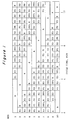
- Figure 1 illustrates an adsorption cycle diagram for a 10 adsorber bed PSA process in accordance with the present invention.
- Figure 2 illustrates an adsorption cycle diagram of a 4 adsorber bed PSA process in accordance with the present invention.
- Figure 3 illustrates the flow connections between the adsorber beds at a particular time during the cycle illustrated in Figure 2.
- the present invention is directed to PSA processes for the separation of a first component from feedstreams comprising said first component and at least one other component.
- first component denotes a non-adsorbed or less strongly adsorbed component in the feedstream.
- other component denotes an adsorbate, i.e., more strongly adsorbed component in the feedstream.
- Suitable feedstreams are those which are gaseous at the adsorption conditions.
- suitable feedstreams are those which contain a hydrogen concentration preferably in the range of from 10 to 90 mol.%.
- Adsorbates, i.e., other components which are present in the feedstream typically include one or more of the following, for example, light hydrocarbons such as methane and ethane, carbon monoxide, carbon dioxide, water, hydrogen sulfide, ammonia, nitrogen and oxygen.
- the feedstream may occasionally comprise other adsorbates such as hydrocarbons in the C3-C6 carbon range, alcohols, ethers, amines, mercaptans, aldehydes, keytones and the like.
- the first component will be determined based upon the other components present in the feed, the adsorption conditions and the adsorbent employed. Thus, there can be instances when the above-described adsorbates can be characterized as the first component. For example, in the separation of nitrogen from methane, nitrogen is the adsorbate and methane is recovered as the non-adsorbed product. In contrast, in hydrogen purification processes, methane is often an adsorbate.
- the processes of the present invention are not limited to particular feedstreams and can be employed to practice a variety of separations such as, for example; the separation of hydrogen from feedstreams comprising hydrogen, methane, carbon monoxide and nitrogen, wherein hydrogen is not adsorbed; the separation of air into nitrogen and oxygen by adsorption of the nitrogen; the separation of carbon dioxide from non-acidic gases such as nitrogen, hydrogen and methane by adsorbing carbon dioxide and the separation of normal butane from isobutane by adsorbing normal butane.
- separations such as, for example; the separation of hydrogen from feedstreams comprising hydrogen, methane, carbon monoxide and nitrogen, wherein hydrogen is not adsorbed; the separation of air into nitrogen and oxygen by adsorption of the nitrogen; the separation of carbon dioxide from non-acidic gases such as nitrogen, hydrogen and methane by adsorbing carbon dioxide and the separation of normal butane from isobutane by adsorbing normal butane.
- Typical feedstreams for processing in accordance with the present invention are derived from refineries, natural gas, air and chemical plants.
- feed sources include reformer off gas from the reforming of light hydrocarbons or methanol, synthesis gas and natural gas.
- a PSA hydrogen process can be operated to provide very high purity hydrogen, e.g., 99+ mol.% for use as a chemical feedstock.
- the process can provide a certain adsorbate concentration in the hydrogen product stream, such as when providing an ammonia synthesis gas having 3 moles of hydrogen per mole of nitrogen, e.g., the product would contain about 75 mol.% hydrogen.
- the isobutane can be used, for example, as alkylate feed or as a gasoline blending component.
- the invention can be carried out using virtually any adsorbent material in the adsorber beds that has capacity for the adsorbate components.
- Suitable adsorbents known in the art and commercially available include crystalline molecular sieves, activated carbons, activated clays, silica gels, activated aluminas and the like.
- the molecular sieves include, for example, the various forms of silicoaluminophosphates and aluminophosphates disclosed in US-A-4,440,871; US-A-4,310,440 and US-A-4,567,027, hereby incorporated by reference as well as zeolitic molecular sieves.
- Zeolitic molecular sieves in the calcined form may be represented by the general formula; Me2O:Al2O3:xSiO2:yH20 where Me is a cation, x has a value from about 2 to infinity, n is the cation valence and y has a value of from about 2 to 10.
- Typical well-known zeolites which may be used include, chabazite, also referred to as Zeolite D, clinoptilolite, erionite, faujasite, also referred to as Zeolite X and Zeolite Y, ferrierite, mordenite, Zeolite A, and Zeolite P.
- Other zeolites suitable for use according to the present invention are those having a high silica content, i.e., those having silica to alumina ratios greater than 10 and typically greater than 100.
- One such high silica zeolite is silicalite, as the term used herein includes both the silicapolymorph of US-A-4,061,724 and also the F-silicate of US-A-4,073,865.
- the PSA cycle of the present invention includes the well known cycle steps of adsorption, one or more equalization steps, countercurrent desorption, purge and repressurization.
- the cycle steps are typically described with reference to their direction relative to the adsorption step.
- cycle steps wherein the gas flow is in a concurrent direction to the adsorption step are known as "cocurrent” steps.
- cycle steps wherein the gas flow is countercurrent to the adsorption step are known as "countercurrent” steps.
- the feedstream is passed to the adsorber bed at an elevated adsorption pressure in order to cause the adsorption of the adsorbate and provide a product stream enriched in the first component relative to feedstream.
- the pressure in the depressurizing bed is released preferably cocurrently and the effluent obtained therefrom, which is preferably rich in the first component, is passed in a countercurrent direction to another adsorber undergoing repressurization.
- a provide-purge-gas step is initiated wherein the adsorber bed is further cocurrently depressurized to provide a purge gas that is relatively impure with respect to the first component and thus is suitable for use as a purge gas.
- a portion of the product gas or gas obtained from one of the equalization steps can be used to supply the purge gas.
- the adsorber bed Upon completion of the provide-purge-gas step, if employed, the adsorber bed is countercurrently depressurized to a desorption pressure in order to desorb the adsorbate. Upon completion of the desorption step the adsorber bed is purged countercurrently with purge gas obtained from another adsorber bed. Finally the adsorber bed is repressurized, first, with equalization gas from other adsorber beds and then with feed or product gas to adsorption pressure. Other additional steps known to those skilled in the art, such as for example, a copurge step wherein the adsorber bed is cocurrently purged at an elevated pressure such as the adsorption pressure with a purge stream comprising the adsorbate, can be employed.
- the present invention is directed to an improvement to the basic PSA cycle sequence described above wherein an additional countercurtent desorption step, i.e., depressurization, is included in the cycle.
- the second countercurrent desorption step is conducted by depressurizing the bed in a countercurrent direction to a second desorption pressure that is lower than the pressure at the end of the first desorption step, i.e., first desorption pressure.
- the countercurtently purging step is performed prior to, or simultaneously with, the second countercurrent desorption step.
- the countercurrently purging step will be completed before the second countercurrent desorption step begins.
- at least a portion of the countercurrently purging step will occur simultaneously with the second countercurrent desorption step. It is of course possible to conduct the countercurrently purging step subsequently to the second countercurrent desorption step.
- the countercurrently purging step is conducted subsequently to the first countercurrent desorption step, this purge helps to sharpen the adsorbate front within the adsorber bed and concentrate the adsorbate at the feed end of the adsorber bed, i.e., where the feedstream is introduced. Accordingly, when the second countercurrent desorption step is then conducted more adsorbate is removed than when no countercurrently purging step is included.
- an effective quantity of purge gas is provided during the countercurrently purging to provide a increased concentration of the adsorbate component in the feed end of the adsorber bed relative to the product end. Even more preferably the effective quantity of purge gas is from 0.5 to 2 volumes of purge gas per volume of feedstream, and even more preferably from 0.5 to 1 volumes of purge gas per volume of feed.
- the pressure reduction during the second countercurrently depressurizing step can be achieved by any means such as a vacuum pump, but preferably in accordance with the present invention the second countercurrently depressurizing step is accomplished with the use of an ejector.
- Suitable ejectors for use in accordance with the present invention are also known in the art as, for example, jet pumps or fluid entrainment pumps, all of which operate according to the following principle: a motive gas stream under an elevated pressure is depressurized through a nozzle where the molecules in the motive gas experience an increase in velocity and thus in momentum. Molecules in the motive gas accelerated in this way then entrain molecules of the medium drawn in as intake by transfer of the momentum within the mixing space.
- the kinetic energy is partially converted back to compression energy in a diffuser so the result is a mixed stream whose pressure is between the original pressure of the motive gas and that of the intake medium.
- the details concerning the design and operation of ejectors is well known to those skilled in the art.
- the motive gas which is used to drive the ejector and create the suction required to achieve the second desorption pressure can be any fluid stream available in the process plant whether it is derived from the PSA process or from another process.
- the motive gas is derived from the PSA process, and even more preferably, comprises the countercurrent desorption effluent from the first desorption step and/or the purge gas feed or effluent from another adsorber bed undergoing said steps simultaneously with the second countercurrent desorption step. This is not to say that the step which supplies the motive gas must be completely simultaneous with the second desorption step, but rather only a portion must be conducted simultaneously.
- motive gas from two or more process steps, or beds can be used to drive the ejector during a single second desorption step.
- motive gas streams that can be used include the feedstream, the adsorption effluent product stream and cocurrent depressurization effluent streams used for equalization.
- a vessel is provided for storing and delivering the ejectors suction benefits at the appropriate time in the PSA cycle.
- the suction side of the ejector is connected to the vessel and thus reduces the pressure therein when the motive gas is available.
- the vessel is connected to said bed undergoing the second stage of desorption to draw it down in pressure causing a rise in pressure in the storage vessel. Still later in the cycle or in a subsequent cycle the ejector again reduces the pressure in the storage vessel.
- the effluent from the ejector i.e., the tail gas
- the effluent from the ejector comprises the desorption effluent streams from the first and second countercurrent desorption effluent streams and will be provided at a tail gas pressure that is sufficient to permit introduction into a fuel gas header.
- Typical fuel gas, and hence tail gas, pressures will be in the range of from 20 to 100 psia (138 to 690 kPa) and preferably from 20 to 50 psia (138 to 345 kPa).
- the temperatures used in the adsorption processs of the present invention are not critical and are dependent on the feedstream and desired separation, although in general the process is substantially isothermal. Typical temperatures range between about -100 to 700° F (-73 to 371 o C), and preferably within the range of 50 to 200° F (10 to 93 o C), and even more preferably from about 50 to 150° F (10 to 66 o C) for hydrogen purification.
- the countercurrently purging step described above is to be performed at about the same temperature as the adsorption step, preferably within 50° F (10 oC) and more preferably within 20° F (-6.7 o C). It is to be understood, however, that even though the process is generally isothermal, there is to be expected a certain degree of temperature increase and decrease associated with the thermal effects of the heats of adsorption and desorption.
- the absolute pressure levels employed during the PSA process are not critical provided that the pressure differential between the adsorption and desorption steps is sufficient to cause a change in the adsorbate fraction loading on the adsorbent thereby providing a delta loading effective for separating the feedstream.
- Typical pressure levels range from 100 to 2000 psia (6980 to 13790 kPa), more preferably from 200 to 1000 psia (1396 to 6895 kPa), and even more preferably from 400 to 1000 psia (2758 to 6895 kPa), during the adsorption step; and from 1 to 500 psia (6.9 to 3448 kPa), more about 5 to 50 psia (34 to 345 kPa), at the end of the second desorption step.
- the pressures during the equalization steps provide purge step first countercurrent desorption step and countercurrent purge step are intermediate between the adsorption and second desorption steps.
- the pressure at the end of the first desorption step is above atmospheric pressure.
- the second desorption pressure be selected in combination with the first desorption pressure to provide the desired tail gas pressure.
- the second desorption pressure can either bed above or below atmospheric pressure. For example, if the first desorption step is initiated at a relatively high pressure and the first desorption effluent is used as motive gas in the ejector, then it will be possible to obtain a lower pressure at the end of the second desorption step and still provide a tail gas pressure intermediate between the starting motive gas pressure and the ending second desorption pressure, and still sufficiently high to be passed through a fuel gas header.
- the total cycle time that is, the time required to perform all the individual steps in the PSA cycle ranges from 3 to 30 minutes, and more preferably within the range of 4 to 20 minutes.
- At least two adsorber beds are required in order to perform each equalization step and typically at least four adsorber beds are required in order to provide a constant source of product gas.
- Preferably from about 4 to 14 adsorber beds are employed, more preferably from about 7 to 14, and most preferably from about 10 to 12 in accordance with the present invention.
- a PSA process having 10 adsorber beds with three adsorbers on an adsorption step at any given time, and three equalization steps was simulated using a computer simulation model routinely used for designing commercial PSA processes.
- the basis for the simulation was that the above-described PSA process would be capable of treating 60 MMSCFD (1.7 x10⁶m3) of a feedstream at 600 psia (4137 kPa) having a composition of 20 mole % methane with the balance hydrogen.
- the cycle comprised the steps of adsorption at 600 psia (4137 kPa), three equalization steps, and a provide-purge-gas step with the pressure at the end of the provide-purge-gas step at 145 psia (1000 kPa), followed by a countercurrent desorption step to a pressure of 25 psia (172 kPa), a countercurrently purging step with a purge quantity of about 0.6 volumes of purge gas per volume of feed, followed by a repressurization with equalization gas and product gas.
- a second simulation was performed on a cycle similar to that described above with the exception that no provide-purge-gas or countercurrently purging steps were included.
- the process was simulated to provide a pressure at the end of the first desorption step of 25 psia (172 kPa).
- a second desorption step was included whereby an ejector was employed to reduce the pressure during the second desorption step to 11 psia (76 kPa).
- the motive gas used to drive the ejector was obtained from another adsorber bed undergoing the first desorption step.
- the ejector performance was simulated based on conventional single stage ejector performance charts for a throat to nozzle area ratio of 10 with an additional 25% contingency to account for the non-steady state operation and non-optimum area ratios at the beginning and the end of the first countercurrent desorption step.
- FIG. 1 illustrates a 10 bed PSA cycle that employes the process of the present invention wherein two countercurrent desorption steps are provided in conjunction with a countercurrently purging step.
- the cycle sequence is similar to that described to Examples 1 and 2.
- bed (1) first undergoes an adsorption step which is then followed by three equalization steps, wherein the effluent obtained therefrom is passed to adsorber beds 5, 6 and 7 respectively, each of which are labeled E1, E2 and E3 during the appropriate time frame.
- Bed (1) then undergoes a series of provide purge steps labeled PP1, H and PP2, which are analogous to a single provide-purge-gas step in the cycle described in Example 1.
- the effluent obtained is passed to bed 9, undergoing a first purging step.
- the time period labeled H represents a hold period wherein the bed is isolated.
- the effluent obtained therefrom is passed to bed 9 during the time frame labeled PR.
- the valves on the feed end of bed 9 are closed in order to begin the repressurization sequence.
- a valve on the feed end of bed 9 could left open in order to provide a second purge step during this time frame.
- the decision to purge or repressurize during the second provide purge step is not critical to the present invention and can be made by one skilled in the art.
- adsorber bed (1) is depressurized countercurrently during the time period labeled D1 to a pressure of 25 psia (172 kPa).
- adsorber bed (1) is purged countercurrently during the time period labeled P1 with provide purge gas obtained from adsorber bed (3) undergoing the first provide-purge-gas step.
- bed (1) is further countercurrently depressurized to about 11 psia (76 kPa). This second pressure reduction is accomplished by the use of an ejector which is operative communication with adsorber bed (2) undergoing the first depressurization stage.
- adsorber bed (1) is repressurized during the time periods PR, E3, E2, E1 and R with effluent gas obtained from adsorber beds (3), (5), (6), (7) and the effluent product gas from at least one of adsorber beds (8), (9) or (10).
- adsorber bed (1) could alternately be purged a second time.
- the time period corresponding to P1, D2 and PR, in Figure 1, is analogous to the time period wherein the adsorber bed is purged in Example 1.
- FIG. 2 illustrates an adsorption cycle diagram for a PSA process in accordance with the present invention having four adsorber beds.
- the second countercurrent desorption step is conducted simultaneously with the countercurrent purge step.
- the adsorber bed that is undergoing the first countercurrent desorption step which preferably provides the motive gas to drive an ejector, is simultaneously cocurrently depressurized to provide purge gas.
- This type of step is known in the PSA art as a dual-ended depressurization.
- the cycle comprises an adsorption step labeled A, followed by an equalization step during time period E1, wherein the effluent gas is passed to adsorber bed (3) undergoing equalization.
- the bed is depressurized both cocurrently and countercurrently to provide the purge gas and the first desorption effluent gas.
- the bed is further countercurrently depressurized and simultaneously countercurrently purged during the time period labeled D2/P.
- the adsorber bed is repressurized during the E1 and R time periods.
- FIG 3 illustrates the flow connections between adsorber beds at a time period during the adsorption cycle shown in Figure 2 at about 3 minutes. It can be seen that bed (1) is undergoing the adsorption step wherein a feedstream is passed to the feed end of the adsorber bed and an effluent stream is withdrawn from the product end of the adsorber bed. A portion of the effluent stream is withdrawn as product and the remaining portion is passed to adsorber bed (2) undergoing repressurization. Adsorber bed (3) is simultaneously being countercurrently purged and countercurrently depressurized to the second desorption pressure. The pressure reduction is accomplished by passing the second desorption effluent stream labeled "D2 gas" to the suction side of an ejector.
- D2 gas the second desorption effluent stream labeled "D2 gas"
- Purge gas obtained from the product end of bed (4) is used to countercurrently purge adsorber bed (3).
- Adsorber bed (4) is undergoing a dual ended depressurization step in order to provide purge gas for purging adsorber bed (3) and the first desorption effluent gas labeled "D1 gas" which is used as a motive gas to drive the ejector.
- a tail gas stream comprising the first and second desorption effluent streams is withdrawn from the ejector and removed from the process.
- the feedstream can be used as a motive gas to drive the ejector which is in operative communication with a bed undergoing the countercurrent desorption step.
- the effluent from the ejector can be returned to the feed side of another adsorber bed as copurge gas.
- more than two countercurrent desorption steps can be employed within the process of the present invention. In such cases it is preferred to perform the countercurrent purge step prior to the final countercurrent desorption step. It is to be further noted that all references to patents and publicationS not specifically incorporated by reference are hereby incorporated by reference herein.
Landscapes
- Chemical & Material Sciences (AREA)
- Engineering & Computer Science (AREA)
- Analytical Chemistry (AREA)
- General Chemical & Material Sciences (AREA)
- Oil, Petroleum & Natural Gas (AREA)
- Chemical Kinetics & Catalysis (AREA)
- Separation Of Gases By Adsorption (AREA)
Priority Applications (2)
| Application Number | Priority Date | Filing Date | Title |
|---|---|---|---|
| US07/839,846 US5203888A (en) | 1990-11-23 | 1992-02-21 | Pressure swing adsorption process with multiple desorption steps |
| EP93302966A EP0620035A1 (fr) | 1992-02-21 | 1993-04-16 | Procédé d'adsorption/désorption à pression alternée avec plusieurs étages de dépressuration à contre-courant |
Applications Claiming Priority (2)
| Application Number | Priority Date | Filing Date | Title |
|---|---|---|---|
| US07/839,846 US5203888A (en) | 1990-11-23 | 1992-02-21 | Pressure swing adsorption process with multiple desorption steps |
| EP93302966A EP0620035A1 (fr) | 1992-02-21 | 1993-04-16 | Procédé d'adsorption/désorption à pression alternée avec plusieurs étages de dépressuration à contre-courant |
Publications (1)
| Publication Number | Publication Date |
|---|---|
| EP0620035A1 true EP0620035A1 (fr) | 1994-10-19 |
Family
ID=26134271
Family Applications (1)
| Application Number | Title | Priority Date | Filing Date |
|---|---|---|---|
| EP93302966A Withdrawn EP0620035A1 (fr) | 1990-11-23 | 1993-04-16 | Procédé d'adsorption/désorption à pression alternée avec plusieurs étages de dépressuration à contre-courant |
Country Status (2)
| Country | Link |
|---|---|
| US (1) | US5203888A (fr) |
| EP (1) | EP0620035A1 (fr) |
Cited By (14)
| Publication number | Priority date | Publication date | Assignee | Title |
|---|---|---|---|---|
| EP0864351A3 (fr) * | 1997-02-26 | 1998-12-09 | The BOC Group plc | Séparation de l'air |
| EP0864350A3 (fr) * | 1997-02-26 | 1998-12-09 | The BOC Group plc | Séparation de gaz |
| EP1101731A1 (fr) * | 1999-11-19 | 2001-05-23 | Krupp Uhde GmbH | Procédé pour la production de gaz de synthèse combiné avec un dispositif d'adsorption à pression alternée |
| WO2007126946A1 (fr) * | 2006-04-03 | 2007-11-08 | Praxair Technology, Inc. | Procédé d'extraction de dioxyde de carbone de pureté moyenne |
| EP1564184A3 (fr) * | 2004-02-12 | 2008-05-14 | Honda Motor Co., Ltd. | Dispositif pour la production de gaz combustible riche en hydrogène |
| US7740688B2 (en) | 2006-09-26 | 2010-06-22 | Praxair Technology, Inc. | Process and apparatus for carbon dioxide recovery |
| US7927573B2 (en) | 2008-09-26 | 2011-04-19 | Praxair Technology, Inc. | Multi-stage process for purifying carbon dioxide and producing acid |
| WO2012096815A1 (fr) * | 2011-01-11 | 2012-07-19 | Praxair Technology, Inc. | Procédé d'adsorption modulée en pression à dix lits fonctionnant en modes normal et à débit moyen |
| NL2007218C2 (en) * | 2011-08-03 | 2013-02-05 | Stichting Energie | Regeneration of gas adsorbents. |
| US8491704B2 (en) | 2011-01-11 | 2013-07-23 | Praxair Technology, Inc. | Six bed pressure swing adsorption process operating in normal and turndown modes |
| US8496733B2 (en) | 2011-01-11 | 2013-07-30 | Praxair Technology, Inc. | Large scale pressure swing adsorption systems having process cycles operating in normal and turndown modes |
| US8535417B2 (en) | 2008-07-29 | 2013-09-17 | Praxair Technology, Inc. | Recovery of carbon dioxide from flue gas |
| US8551217B2 (en) | 2011-01-11 | 2013-10-08 | Praxair Technology, Inc. | Six bed pressure swing adsorption process operating in normal and turndown modes |
| JP2020025957A (ja) * | 2018-08-14 | 2020-02-20 | エア プロダクツ アンド ケミカルズ インコーポレイテッドAir Products And Chemicals Incorporated | 多層急速サイクル反応速度的psa |
Families Citing this family (42)
| Publication number | Priority date | Publication date | Assignee | Title |
|---|---|---|---|---|
| US5203888A (en) * | 1990-11-23 | 1993-04-20 | Uop | Pressure swing adsorption process with multiple desorption steps |
| US5294247A (en) * | 1993-02-26 | 1994-03-15 | Air Products And Chemicals, Inc. | Adsorption process to recover hydrogen from low pressure feeds |
| US5968232A (en) * | 1993-03-08 | 1999-10-19 | Whitlock; David R. | Method for ammonia production |
| CN1040844C (zh) * | 1993-04-19 | 1998-11-25 | 环球油品公司 | 带有多个逆流减压步骤的变压吸附/解吸方法 |
| US5540758A (en) * | 1994-02-03 | 1996-07-30 | Air Products And Chemicals, Inc. | VSA adsorption process with feed/vacuum advance and provide purge |
| FR2718056B1 (fr) * | 1994-03-30 | 1996-05-03 | Air Liquide | Procédé de production d'un gaz par adsorption. |
| US5411578A (en) * | 1994-05-10 | 1995-05-02 | Air Products And Chemicals, Inc. | Vacuum swing adsorption process with mixed repressurization and provide product depressurization |
| US5441558A (en) * | 1994-08-09 | 1995-08-15 | Air Products And Chemicals, Inc. | High purity nitrogen PSA utilizing controlled internal flows |
| JP3309197B2 (ja) * | 1995-03-02 | 2002-07-29 | 住友精化株式会社 | 濃縮酸素の回収方法 |
| US5669960A (en) * | 1995-11-02 | 1997-09-23 | Praxair Technology, Inc. | Hydrogen generation process |
| US5656068A (en) * | 1996-02-29 | 1997-08-12 | Praxair Technology, Inc. | Large capacity vacuum pressure swing adsorption process and system |
| FR2749004B1 (fr) * | 1996-05-24 | 1998-07-10 | Air Liquide | Procede pour la purification de melanges gazeux a base d'hydrogene utilisant une zeolithe x echangee au lithium |
| US5827358A (en) * | 1996-11-08 | 1998-10-27 | Impact Mst, Incorporation | Rapid cycle pressure swing adsorption oxygen concentration method and apparatus |
| US6080226A (en) * | 1998-09-30 | 2000-06-27 | Uop Llc | Nitrous oxide purification by pressure swing adsorption |
| US6083299A (en) * | 1999-01-21 | 2000-07-04 | The Boc Group, Inc. | High pressure purge pressure swing adsorption process |
| US6113672A (en) * | 1999-01-21 | 2000-09-05 | The Boc Group, Inc. | Multiple equalization pressure swing adsorption process |
| US6210466B1 (en) * | 1999-08-10 | 2001-04-03 | Uop Llc | Very large-scale pressure swing adsorption processes |
| US6379431B1 (en) * | 2000-01-20 | 2002-04-30 | Air Products And Chemicals, Inc. | Pressure swing adsorption process with multiple beds on purge and/or with ten beds and four pressure equalization steps |
| US6428607B1 (en) | 2000-06-26 | 2002-08-06 | Air Products And Chemicals, Inc. | Pressure swing adsorption process which provides product gas at decreasing bed pressure |
| US6565628B2 (en) | 2001-07-23 | 2003-05-20 | Air Products And Chemicals, Inc. | Pressure swing adsorption process with reduced pressure equalization time |
| US6576043B2 (en) * | 2001-10-12 | 2003-06-10 | Air Products And Chemicals, Inc. | Recovery of nitrogen and light hydrocarbons from polyalkene purge gas |
| FR2836061B1 (fr) * | 2002-02-15 | 2004-11-19 | Air Liquide | Procede de traitement d'un melange gazeux comprenant de l'hydrogene et du sulfure d'hydrogene |
| US6641645B1 (en) * | 2002-06-13 | 2003-11-04 | Air Products And Chemicals, Inc. | Vacuum swing adsorption process with controlled waste gas withdrawal |
| GB0216914D0 (en) * | 2002-07-19 | 2002-08-28 | Air Prod & Chem | Process and apparatus for treating a feed gas |
| JP4898194B2 (ja) * | 2005-11-14 | 2012-03-14 | 大陽日酸株式会社 | 圧力変動吸着式ガス分離方法及び分離装置 |
| US7396387B2 (en) * | 2005-11-01 | 2008-07-08 | Praxair Technology, Inc. | Pressure swing adsorption process for large capacity oxygen production |
| US7651549B2 (en) * | 2006-06-13 | 2010-01-26 | Air Products And Chemicals, Inc. | Pressure swing adsorption process with improved recovery of high-purity product |
| US7695545B2 (en) | 2007-03-14 | 2010-04-13 | Air Products And Chemicals, Inc. | Adsorption process to recover hydrogen from feed gas mixtures having low hydrogen concentration |
| US20090090049A1 (en) * | 2007-10-09 | 2009-04-09 | Chevron U.S.A. Inc. | Process for producing liqefied natural gas from high co2 natural gas |
| DE102008012735B4 (de) * | 2008-03-05 | 2013-05-08 | Thyssenkrupp Uhde Gmbh | Verfahren und Vorrichtung zur Abscheidung von Fremdgasen aus einem reduzierenden Nutzgas durch dampfbetriebene Druckwechseladsorption |
| US7909913B2 (en) * | 2008-07-17 | 2011-03-22 | Air Products And Chemicals, Inc. | Gas purification by adsorption of hydrogen sulfide |
| US8007761B2 (en) * | 2008-12-24 | 2011-08-30 | Praxair Technology, Inc. | Carbon dioxide emission reduction method |
| FR2962993B1 (fr) * | 2010-07-23 | 2013-11-01 | IFP Energies Nouvelles | Procede de production d'hydrogene avec purge a pression intermediaire |
| CN103223288B (zh) * | 2013-04-08 | 2015-01-21 | 河南心连心化肥有限公司 | 变压吸附脱碳装置及工艺 |
| US9518239B2 (en) * | 2014-07-29 | 2016-12-13 | Uop Llc | Process for removing sulfur compounds from natural gas streams |
| US10252242B2 (en) | 2017-03-17 | 2019-04-09 | Air Products And Chemicals, Inc. | Alkali-promoted activated alumina adsorbent |
| EP3375517B1 (fr) | 2017-03-17 | 2023-03-08 | Air Products And Chemicals, Inc. | Adsorbant d'alumine activée amélioré aux alcalis |
| US20180264433A1 (en) | 2017-03-17 | 2018-09-20 | Air Products And Chemicals, Inc. | Alkali-Promoted Activated Alumina Adsorbent |
| CN111918711A (zh) | 2018-03-29 | 2020-11-10 | 普莱克斯技术有限公司 | 用于氮气与甲烷的速率选择性分离的可调式吸附剂的特性 |
| JP7067411B2 (ja) * | 2018-10-16 | 2022-05-16 | トヨタ自動車株式会社 | 蒸発燃料処理装置 |
| US11717786B2 (en) * | 2020-05-08 | 2023-08-08 | University Of South Carolina | Extremely large pressure swing adsorption processes for flue gas treatment |
| CN114736722A (zh) * | 2022-05-26 | 2022-07-12 | 上海科利蓝环境科技有限公司 | 一种焦炉煤气吸附净化与吸附剂再生处理系统及工艺 |
Citations (10)
| Publication number | Priority date | Publication date | Assignee | Title |
|---|---|---|---|---|
| US4070164A (en) * | 1976-02-18 | 1978-01-24 | Toray Industries, Inc. | Adsorption-desorption pressure swing gas separation |
| US4077779A (en) * | 1976-10-15 | 1978-03-07 | Air Products And Chemicals, Inc. | Hydrogen purification by selective adsorption |
| EP0015413A1 (fr) * | 1979-02-16 | 1980-09-17 | Linde Aktiengesellschaft | Procédé d'adsorption à pression alternée pour la décomposition ou la purification de mélanges de gaz |
| US4589888A (en) * | 1984-10-05 | 1986-05-20 | Union Carbide Corporation | Pressure swing adsorption process |
| US4608061A (en) * | 1985-06-28 | 1986-08-26 | Union Carbide Corporation | Normal butane/iso-butane separation |
| EP0212494A1 (fr) * | 1985-08-12 | 1987-03-04 | Linde Aktiengesellschaft | Procédé d'adsorption par pression alternée |
| US4723966A (en) * | 1986-12-11 | 1988-02-09 | Union Carbide Corporation | Gas separation by pressure swing adsorption |
| US4761165A (en) * | 1987-09-01 | 1988-08-02 | Union Carbide Corporation | Pressure swing adsorption control method and apparatus |
| EP0291975A1 (fr) * | 1987-05-20 | 1988-11-23 | Bergwerksverband GmbH | Procédé d'enrichissement d'hélium |
| US5203888A (en) * | 1990-11-23 | 1993-04-20 | Uop | Pressure swing adsorption process with multiple desorption steps |
Family Cites Families (27)
| Publication number | Priority date | Publication date | Assignee | Title |
|---|---|---|---|---|
| US3141748A (en) * | 1961-11-20 | 1964-07-21 | Exxon Research Engineering Co | Hydrogen purification process |
| US3430418A (en) * | 1967-08-09 | 1969-03-04 | Union Carbide Corp | Selective adsorption process |
| US3564816A (en) * | 1968-12-30 | 1971-02-23 | Union Carbide Corp | Selective adsorption process |
| US3696588A (en) * | 1970-12-07 | 1972-10-10 | Ingersoll Rand Co | Gas drying apparatus and method |
| US3934989A (en) * | 1973-03-12 | 1976-01-27 | Ingersoll-Rand Company | Gas drying apparatus |
| US3834136A (en) * | 1973-04-10 | 1974-09-10 | Ingersoll Rand Co | Gas drying apparatus and method |
| US4061724A (en) * | 1975-09-22 | 1977-12-06 | Union Carbide Corporation | Crystalline silica |
| US3986849A (en) * | 1975-11-07 | 1976-10-19 | Union Carbide Corporation | Selective adsorption process |
| US4073865A (en) * | 1976-09-27 | 1978-02-14 | Union Carbide Corporation | Silica polymorph and process for preparing same |
| US4171207A (en) * | 1978-08-21 | 1979-10-16 | Air Products And Chemicals, Inc. | Separation of multicomponent gas mixtures by pressure swing adsorption |
| US4375363A (en) * | 1978-12-05 | 1983-03-01 | Union Carbide Corporation | Selective adsorption process for production of ammonia synthesis gas mixtures |
| US4261716A (en) * | 1979-06-08 | 1981-04-14 | John Zink Company | Apparatus for recovering hydrocarbons from air-hydrocarbon vapor mixtures |
| US4331456A (en) * | 1979-06-08 | 1982-05-25 | John Zink Company | Process for recovering hydrocarbons with air-hydrocarbon vapor mixtures |
| US4310440A (en) * | 1980-07-07 | 1982-01-12 | Union Carbide Corporation | Crystalline metallophosphate compositions |
| US4440871A (en) * | 1982-07-26 | 1984-04-03 | Union Carbide Corporation | Crystalline silicoaluminophosphates |
| US4539020A (en) * | 1983-07-10 | 1985-09-03 | Kawasaki Steel Corporation | Methods for obtaining high-purity carbon monoxide |
| LU84923A1 (fr) * | 1983-07-19 | 1985-04-17 | Metallurgie Hoboken | Procede pour defluorer une solution acide de sulfate |
| US4726816A (en) * | 1983-11-08 | 1988-02-23 | Union Carbide Corporation | Reformer-pressure swing adsorption process for the production of carbon monoxide |
| US4512780A (en) * | 1983-11-08 | 1985-04-23 | Union Carbide Corporation | Pressure swing adsorption with intermediate product recovery |
| DE3346032A1 (de) * | 1983-12-20 | 1985-06-20 | Linde Ag, 6200 Wiesbaden | Druckwechseladsorptionsverfahren |
| US4755361A (en) * | 1984-02-07 | 1988-07-05 | Union Carbide Corporation | Apparatus for ammonia synthesis gas production |
| US4755396A (en) * | 1984-12-10 | 1988-07-05 | Geisler Thomas C | Image receiving element for thermal printers |
| US4650500A (en) * | 1985-02-22 | 1987-03-17 | Union Carbide Corporation | Enhanced pressure swing adsorption process and system |
| JPS63166702A (ja) * | 1986-12-26 | 1988-07-09 | Osaka Oxygen Ind Ltd | 酸素ガス濃縮法 |
| US4813980A (en) * | 1987-10-16 | 1989-03-21 | Air Products And Chemicals, Inc. | Recovery of nitrogen, hydrogen and carbon dioxide from hydrocarbon reformate |
| US4915711A (en) * | 1989-05-18 | 1990-04-10 | Air Products And Chemicals, Inc. | Adsorptive process for producing two gas streams from a gas mixture |
| US4964889A (en) * | 1989-12-04 | 1990-10-23 | Uop | Selective adsorption on magnesium-containing clinoptilolites |
-
1992
- 1992-02-21 US US07/839,846 patent/US5203888A/en not_active Expired - Fee Related
-
1993
- 1993-04-16 EP EP93302966A patent/EP0620035A1/fr not_active Withdrawn
Patent Citations (10)
| Publication number | Priority date | Publication date | Assignee | Title |
|---|---|---|---|---|
| US4070164A (en) * | 1976-02-18 | 1978-01-24 | Toray Industries, Inc. | Adsorption-desorption pressure swing gas separation |
| US4077779A (en) * | 1976-10-15 | 1978-03-07 | Air Products And Chemicals, Inc. | Hydrogen purification by selective adsorption |
| EP0015413A1 (fr) * | 1979-02-16 | 1980-09-17 | Linde Aktiengesellschaft | Procédé d'adsorption à pression alternée pour la décomposition ou la purification de mélanges de gaz |
| US4589888A (en) * | 1984-10-05 | 1986-05-20 | Union Carbide Corporation | Pressure swing adsorption process |
| US4608061A (en) * | 1985-06-28 | 1986-08-26 | Union Carbide Corporation | Normal butane/iso-butane separation |
| EP0212494A1 (fr) * | 1985-08-12 | 1987-03-04 | Linde Aktiengesellschaft | Procédé d'adsorption par pression alternée |
| US4723966A (en) * | 1986-12-11 | 1988-02-09 | Union Carbide Corporation | Gas separation by pressure swing adsorption |
| EP0291975A1 (fr) * | 1987-05-20 | 1988-11-23 | Bergwerksverband GmbH | Procédé d'enrichissement d'hélium |
| US4761165A (en) * | 1987-09-01 | 1988-08-02 | Union Carbide Corporation | Pressure swing adsorption control method and apparatus |
| US5203888A (en) * | 1990-11-23 | 1993-04-20 | Uop | Pressure swing adsorption process with multiple desorption steps |
Cited By (26)
| Publication number | Priority date | Publication date | Assignee | Title |
|---|---|---|---|---|
| EP0864350A3 (fr) * | 1997-02-26 | 1998-12-09 | The BOC Group plc | Séparation de gaz |
| EP0864351A3 (fr) * | 1997-02-26 | 1998-12-09 | The BOC Group plc | Séparation de l'air |
| EP1101731A1 (fr) * | 1999-11-19 | 2001-05-23 | Krupp Uhde GmbH | Procédé pour la production de gaz de synthèse combiné avec un dispositif d'adsorption à pression alternée |
| EP1564184A3 (fr) * | 2004-02-12 | 2008-05-14 | Honda Motor Co., Ltd. | Dispositif pour la production de gaz combustible riche en hydrogène |
| US7427304B2 (en) | 2004-02-12 | 2008-09-23 | Honda Motor Co., Ltd. | Fuel gas manufacturing apparatus |
| WO2007126946A1 (fr) * | 2006-04-03 | 2007-11-08 | Praxair Technology, Inc. | Procédé d'extraction de dioxyde de carbone de pureté moyenne |
| US7618478B2 (en) | 2006-04-03 | 2009-11-17 | Praxair Technology, Inc. | Process and apparatus to recover medium purity carbon dioxide |
| EP2374522A1 (fr) * | 2006-04-03 | 2011-10-12 | Praxair Technology, Inc. | Procédé pour récupérer un dioxyde de carbone de moyenne pureté |
| US7740688B2 (en) | 2006-09-26 | 2010-06-22 | Praxair Technology, Inc. | Process and apparatus for carbon dioxide recovery |
| US8535417B2 (en) | 2008-07-29 | 2013-09-17 | Praxair Technology, Inc. | Recovery of carbon dioxide from flue gas |
| US7927573B2 (en) | 2008-09-26 | 2011-04-19 | Praxair Technology, Inc. | Multi-stage process for purifying carbon dioxide and producing acid |
| CN103458993A (zh) * | 2011-01-11 | 2013-12-18 | 普莱克斯技术有限公司 | 以正常和调低模式操作的十床变压吸附工艺 |
| WO2012096815A1 (fr) * | 2011-01-11 | 2012-07-19 | Praxair Technology, Inc. | Procédé d'adsorption modulée en pression à dix lits fonctionnant en modes normal et à débit moyen |
| US8435328B2 (en) | 2011-01-11 | 2013-05-07 | Praxair Technology, Inc. | Ten bed pressure swing adsorption process operating in normal and turndown modes |
| US8491704B2 (en) | 2011-01-11 | 2013-07-23 | Praxair Technology, Inc. | Six bed pressure swing adsorption process operating in normal and turndown modes |
| US8496733B2 (en) | 2011-01-11 | 2013-07-30 | Praxair Technology, Inc. | Large scale pressure swing adsorption systems having process cycles operating in normal and turndown modes |
| CN103458993B (zh) * | 2011-01-11 | 2016-03-30 | 普莱克斯技术有限公司 | 以正常和调低模式操作的十床变压吸附工艺 |
| US8551217B2 (en) | 2011-01-11 | 2013-10-08 | Praxair Technology, Inc. | Six bed pressure swing adsorption process operating in normal and turndown modes |
| WO2013019116A1 (fr) * | 2011-08-03 | 2013-02-07 | Stichting Energieonderzoek Centrum Nederland | Régénération d'adsorbants de gaz |
| US9056306B2 (en) | 2011-08-03 | 2015-06-16 | Stichting Energieonderzoek Centrum Nederland | Regeneration of gas adsorbents |
| NL2007218C2 (en) * | 2011-08-03 | 2013-02-05 | Stichting Energie | Regeneration of gas adsorbents. |
| JP2020025957A (ja) * | 2018-08-14 | 2020-02-20 | エア プロダクツ アンド ケミカルズ インコーポレイテッドAir Products And Chemicals Incorporated | 多層急速サイクル反応速度的psa |
| CN110813022A (zh) * | 2018-08-14 | 2020-02-21 | 气体产品与化学公司 | 多床快速循环动力学psa |
| KR20200019570A (ko) * | 2018-08-14 | 2020-02-24 | 에어 프로덕츠 앤드 케미칼스, 인코오포레이티드 | 멀티-베드 급속 사이클 동적 psa |
| EP3613492A1 (fr) * | 2018-08-14 | 2020-02-26 | Air Products And Chemicals, Inc. | Psa cinétique à cycle rapide multilits |
| US10744450B2 (en) | 2018-08-14 | 2020-08-18 | Air Products And Chemicals, Inc. | Multi-bed rapid cycle kinetic PSA |
Also Published As
| Publication number | Publication date |
|---|---|
| US5203888A (en) | 1993-04-20 |
Similar Documents
| Publication | Publication Date | Title |
|---|---|---|
| US5203888A (en) | Pressure swing adsorption process with multiple desorption steps | |
| KR100254295B1 (ko) | 단일 흡착 베드를 이용한 압력 스윙 흡착 방법 | |
| US6245127B1 (en) | Pressure swing adsorption process and apparatus | |
| EP0092153B1 (fr) | Système d'adsorption par pression oscillante | |
| US6210466B1 (en) | Very large-scale pressure swing adsorption processes | |
| AU646704B2 (en) | Hydrogen and carbon monoxide production by hydrocarbon steam reforming and pressure swing adsorption purification | |
| US4070164A (en) | Adsorption-desorption pressure swing gas separation | |
| EP0008512B1 (fr) | Séparation de mélanges gazeux à composants multiples | |
| US5234472A (en) | Separation of gas mixtures including hydrogen | |
| US4915711A (en) | Adsorptive process for producing two gas streams from a gas mixture | |
| US4790858A (en) | Fractionation of multicomponent gas mixtures by pressure swing adsorption | |
| US5174796A (en) | Process for the purification of natural gas | |
| EP1101522B1 (fr) | Procédé d'adsorption à pression alternée | |
| US4359328A (en) | Inverted pressure swing adsorption process | |
| EP0327732A1 (fr) | Séparation par adsorption en utilisant plusieurs lits d'adsorption | |
| EP0667178A1 (fr) | Procédé d'adsorption VSA à opération continue | |
| EP0278437A2 (fr) | Production d'un mélange de gaz à une certaine composition par adsorption alternée | |
| KR100278323B1 (ko) | 압력스윙흡착방법및장치 | |
| CN1984705A (zh) | 连续送进三床变压吸附系统 | |
| EP0271356A2 (fr) | Séparation et purification de gaz | |
| WO1987001611A1 (fr) | Procede de separation d'un gaz de purete elevee dans un melange de gaz | |
| JPH08224428A (ja) | 圧力スイング吸着によってガス混合物の成分を分離するための連続法 | |
| US5993517A (en) | Two stage pressure swing adsorption process | |
| AU578807B2 (en) | Enhanced pressure swing adsorption process and system | |
| EP1228799B1 (fr) | Procédés d'adsorption à pression alternée à très grande échelle |
Legal Events
| Date | Code | Title | Description |
|---|---|---|---|
| PUAI | Public reference made under article 153(3) epc to a published international application that has entered the european phase |
Free format text: ORIGINAL CODE: 0009012 |
|
| AK | Designated contracting states |
Kind code of ref document: A1 Designated state(s): BE DE ES FR GB IT NL |
|
| STAA | Information on the status of an ep patent application or granted ep patent |
Free format text: STATUS: THE APPLICATION IS DEEMED TO BE WITHDRAWN |
|
| 18D | Application deemed to be withdrawn |
Effective date: 19950420 |