EP0620211A1 - Azomethine, ein Verfahren zu ihrer Herstellung, sowie deren Verwendung zur Herstellung azomethinhaltigen Polyurethanen - Google Patents
Azomethine, ein Verfahren zu ihrer Herstellung, sowie deren Verwendung zur Herstellung azomethinhaltigen Polyurethanen Download PDFInfo
- Publication number
- EP0620211A1 EP0620211A1 EP94102103A EP94102103A EP0620211A1 EP 0620211 A1 EP0620211 A1 EP 0620211A1 EP 94102103 A EP94102103 A EP 94102103A EP 94102103 A EP94102103 A EP 94102103A EP 0620211 A1 EP0620211 A1 EP 0620211A1
- Authority
- EP
- European Patent Office
- Prior art keywords
- azomethines
- preparation
- alkyl
- radical
- alkyl radical
- Prior art date
- Legal status (The legal status is an assumption and is not a legal conclusion. Google has not performed a legal analysis and makes no representation as to the accuracy of the status listed.)
- Withdrawn
Links
- 238000000034 method Methods 0.000 title claims abstract description 12
- 238000002360 preparation method Methods 0.000 title claims abstract description 12
- 150000001875 compounds Chemical class 0.000 title claims description 8
- 239000007858 starting material Substances 0.000 title description 2
- 229920002635 polyurethane Polymers 0.000 title 1
- 239000004814 polyurethane Substances 0.000 title 1
- 125000005442 diisocyanate group Chemical group 0.000 claims abstract description 15
- 239000000203 mixture Substances 0.000 claims abstract description 10
- 150000001728 carbonyl compounds Chemical class 0.000 claims abstract description 9
- 229920000343 polyazomethine Polymers 0.000 claims abstract description 6
- 229920005862 polyol Polymers 0.000 claims abstract description 6
- 150000003077 polyols Chemical class 0.000 claims abstract description 6
- CIUQDSCDWFSTQR-UHFFFAOYSA-N [C]1=CC=CC=C1 Chemical class [C]1=CC=CC=C1 CIUQDSCDWFSTQR-UHFFFAOYSA-N 0.000 claims abstract description 5
- 239000002262 Schiff base Substances 0.000 claims description 20
- 150000004753 Schiff bases Chemical class 0.000 claims description 19
- 125000002887 hydroxy group Chemical group [H]O* 0.000 claims description 9
- 238000004519 manufacturing process Methods 0.000 claims description 6
- 125000001931 aliphatic group Chemical group 0.000 claims description 3
- 229920000728 polyester Polymers 0.000 claims description 3
- 239000013638 trimer Substances 0.000 claims description 3
- 150000001414 amino alcohols Chemical class 0.000 claims description 2
- 125000004432 carbon atom Chemical group C* 0.000 claims description 2
- RTZKZFJDLAIYFH-UHFFFAOYSA-N ether Substances CCOCC RTZKZFJDLAIYFH-UHFFFAOYSA-N 0.000 claims description 2
- YXFVVABEGXRONW-UHFFFAOYSA-N Toluene Chemical compound CC1=CC=CC=C1 YXFVVABEGXRONW-UHFFFAOYSA-N 0.000 description 27
- 239000007795 chemical reaction product Substances 0.000 description 14
- XLYOFNOQVPJJNP-UHFFFAOYSA-N water Chemical compound O XLYOFNOQVPJJNP-UHFFFAOYSA-N 0.000 description 13
- 150000001412 amines Chemical class 0.000 description 12
- 239000012948 isocyanate Substances 0.000 description 12
- 150000002513 isocyanates Chemical class 0.000 description 12
- CSCPPACGZOOCGX-UHFFFAOYSA-N Acetone Chemical compound CC(C)=O CSCPPACGZOOCGX-UHFFFAOYSA-N 0.000 description 8
- ZWEHNKRNPOVVGH-UHFFFAOYSA-N 2-Butanone Chemical compound CCC(C)=O ZWEHNKRNPOVVGH-UHFFFAOYSA-N 0.000 description 6
- 238000006243 chemical reaction Methods 0.000 description 6
- 239000005058 Isophorone diisocyanate Substances 0.000 description 5
- -1 alkyl radical Chemical class 0.000 description 5
- NIMLQBUJDJZYEJ-UHFFFAOYSA-N isophorone diisocyanate Chemical compound CC1(C)CC(N=C=O)CC(C)(CN=C=O)C1 NIMLQBUJDJZYEJ-UHFFFAOYSA-N 0.000 description 5
- AMIMRNSIRUDHCM-UHFFFAOYSA-N Isopropylaldehyde Chemical compound CC(C)C=O AMIMRNSIRUDHCM-UHFFFAOYSA-N 0.000 description 4
- 239000000047 product Substances 0.000 description 4
- 238000010992 reflux Methods 0.000 description 4
- 239000002904 solvent Substances 0.000 description 4
- LYCAIKOWRPUZTN-UHFFFAOYSA-N Ethylene glycol Chemical compound OCCO LYCAIKOWRPUZTN-UHFFFAOYSA-N 0.000 description 3
- NTIZESTWPVYFNL-UHFFFAOYSA-N Methyl isobutyl ketone Chemical compound CC(C)CC(C)=O NTIZESTWPVYFNL-UHFFFAOYSA-N 0.000 description 3
- UIHCLUNTQKBZGK-UHFFFAOYSA-N Methyl isobutyl ketone Natural products CCC(C)C(C)=O UIHCLUNTQKBZGK-UHFFFAOYSA-N 0.000 description 3
- 125000002915 carbonyl group Chemical group [*:2]C([*:1])=O 0.000 description 3
- 150000002576 ketones Chemical class 0.000 description 3
- 238000005829 trimerization reaction Methods 0.000 description 3
- WYURNTSHIVDZCO-UHFFFAOYSA-N Tetrahydrofuran Chemical compound C1CCOC1 WYURNTSHIVDZCO-UHFFFAOYSA-N 0.000 description 2
- 230000015572 biosynthetic process Effects 0.000 description 2
- 150000002009 diols Chemical class 0.000 description 2
- 238000004821 distillation Methods 0.000 description 2
- 239000007789 gas Substances 0.000 description 2
- 150000002924 oxiranes Chemical class 0.000 description 2
- 229920000768 polyamine Polymers 0.000 description 2
- 229920000570 polyether Polymers 0.000 description 2
- 229920000909 polytetrahydrofuran Polymers 0.000 description 2
- NNOZGCICXAYKLW-UHFFFAOYSA-N 1,2-bis(2-isocyanatopropan-2-yl)benzene Chemical compound O=C=NC(C)(C)C1=CC=CC=C1C(C)(C)N=C=O NNOZGCICXAYKLW-UHFFFAOYSA-N 0.000 description 1
- OITMBHSFQBJCFN-UHFFFAOYSA-N 2,5,5-trimethylcyclohexan-1-one Chemical compound CC1CCC(C)(C)CC1=O OITMBHSFQBJCFN-UHFFFAOYSA-N 0.000 description 1
- PTTPXKJBFFKCEK-UHFFFAOYSA-N 2-Methyl-4-heptanone Chemical compound CC(C)CC(=O)CC(C)C PTTPXKJBFFKCEK-UHFFFAOYSA-N 0.000 description 1
- IAYPIBMASNFSPL-UHFFFAOYSA-N Ethylene oxide Chemical compound C1CO1 IAYPIBMASNFSPL-UHFFFAOYSA-N 0.000 description 1
- 239000005057 Hexamethylene diisocyanate Substances 0.000 description 1
- AVXURJPOCDRRFD-UHFFFAOYSA-N Hydroxylamine Chemical class ON AVXURJPOCDRRFD-UHFFFAOYSA-N 0.000 description 1
- 239000002841 Lewis acid Substances 0.000 description 1
- 238000005684 Liebig rearrangement reaction Methods 0.000 description 1
- CTQNGGLPUBDAKN-UHFFFAOYSA-N O-Xylene Chemical compound CC1=CC=CC=C1C CTQNGGLPUBDAKN-UHFFFAOYSA-N 0.000 description 1
- NBIIXXVUZAFLBC-UHFFFAOYSA-N Phosphoric acid Chemical compound OP(O)(O)=O NBIIXXVUZAFLBC-UHFFFAOYSA-N 0.000 description 1
- 239000004721 Polyphenylene oxide Substances 0.000 description 1
- GOOHAUXETOMSMM-UHFFFAOYSA-N Propylene oxide Chemical compound CC1CO1 GOOHAUXETOMSMM-UHFFFAOYSA-N 0.000 description 1
- AWMVMTVKBNGEAK-UHFFFAOYSA-N Styrene oxide Chemical compound C1OC1C1=CC=CC=C1 AWMVMTVKBNGEAK-UHFFFAOYSA-N 0.000 description 1
- ZJCCRDAZUWHFQH-UHFFFAOYSA-N Trimethylolpropane Chemical compound CCC(CO)(CO)CO ZJCCRDAZUWHFQH-UHFFFAOYSA-N 0.000 description 1
- 239000002253 acid Substances 0.000 description 1
- 238000004220 aggregation Methods 0.000 description 1
- 230000002776 aggregation Effects 0.000 description 1
- 150000001298 alcohols Chemical class 0.000 description 1
- 239000000010 aprotic solvent Substances 0.000 description 1
- 150000004945 aromatic hydrocarbons Chemical class 0.000 description 1
- 230000001588 bifunctional effect Effects 0.000 description 1
- 238000012769 bulk production Methods 0.000 description 1
- 239000006227 byproduct Substances 0.000 description 1
- 239000003054 catalyst Substances 0.000 description 1
- 238000009833 condensation Methods 0.000 description 1
- 230000005494 condensation Effects 0.000 description 1
- 125000004122 cyclic group Chemical group 0.000 description 1
- MTHSVFCYNBDYFN-UHFFFAOYSA-N diethylene glycol Chemical compound OCCOCCO MTHSVFCYNBDYFN-UHFFFAOYSA-N 0.000 description 1
- 125000000524 functional group Chemical group 0.000 description 1
- 125000000623 heterocyclic group Chemical group 0.000 description 1
- ACCCMOQWYVYDOT-UHFFFAOYSA-N hexane-1,1-diol Chemical compound CCCCCC(O)O ACCCMOQWYVYDOT-UHFFFAOYSA-N 0.000 description 1
- 125000004435 hydrogen atom Chemical group [H]* 0.000 description 1
- 230000007062 hydrolysis Effects 0.000 description 1
- 238000006460 hydrolysis reaction Methods 0.000 description 1
- 150000007517 lewis acids Chemical class 0.000 description 1
- 238000002844 melting Methods 0.000 description 1
- 230000008018 melting Effects 0.000 description 1
- 239000000178 monomer Substances 0.000 description 1
- SLCVBVWXLSEKPL-UHFFFAOYSA-N neopentyl glycol Chemical compound OCC(C)(C)CO SLCVBVWXLSEKPL-UHFFFAOYSA-N 0.000 description 1
- 150000002917 oxazolidines Chemical class 0.000 description 1
- 235000011007 phosphoric acid Nutrition 0.000 description 1
- 229920002857 polybutadiene Polymers 0.000 description 1
- 229920001470 polyketone Polymers 0.000 description 1
- 238000006116 polymerization reaction Methods 0.000 description 1
- 229920001451 polypropylene glycol Polymers 0.000 description 1
- 150000003141 primary amines Chemical class 0.000 description 1
- 150000003254 radicals Chemical class 0.000 description 1
- 239000007787 solid Substances 0.000 description 1
- YLQBMQCUIZJEEH-UHFFFAOYSA-N tetrahydrofuran Natural products C=1C=COC=1 YLQBMQCUIZJEEH-UHFFFAOYSA-N 0.000 description 1
- ZIBGPFATKBEMQZ-UHFFFAOYSA-N triethylene glycol Chemical compound OCCOCCOCCO ZIBGPFATKBEMQZ-UHFFFAOYSA-N 0.000 description 1
- 239000008096 xylene Substances 0.000 description 1
Classifications
-
- C—CHEMISTRY; METALLURGY
- C08—ORGANIC MACROMOLECULAR COMPOUNDS; THEIR PREPARATION OR CHEMICAL WORKING-UP; COMPOSITIONS BASED THEREON
- C08G—MACROMOLECULAR COMPOUNDS OBTAINED OTHERWISE THAN BY REACTIONS ONLY INVOLVING UNSATURATED CARBON-TO-CARBON BONDS
- C08G18/00—Polymeric products of isocyanates or isothiocyanates
- C08G18/06—Polymeric products of isocyanates or isothiocyanates with compounds having active hydrogen
- C08G18/28—Polymeric products of isocyanates or isothiocyanates with compounds having active hydrogen characterised by the compounds used containing active hydrogen
- C08G18/30—Low-molecular-weight compounds
- C08G18/32—Polyhydroxy compounds; Polyamines; Hydroxyamines
- C08G18/3271—Hydroxyamines
- C08G18/3296—Hydroxyamines being in latent form
-
- C—CHEMISTRY; METALLURGY
- C07—ORGANIC CHEMISTRY
- C07C—ACYCLIC OR CARBOCYCLIC COMPOUNDS
- C07C251/00—Compounds containing nitrogen atoms doubly-bound to a carbon skeleton
- C07C251/02—Compounds containing nitrogen atoms doubly-bound to a carbon skeleton containing imino groups
- C07C251/04—Compounds containing nitrogen atoms doubly-bound to a carbon skeleton containing imino groups having carbon atoms of imino groups bound to hydrogen atoms or to acyclic carbon atoms
- C07C251/06—Compounds containing nitrogen atoms doubly-bound to a carbon skeleton containing imino groups having carbon atoms of imino groups bound to hydrogen atoms or to acyclic carbon atoms to carbon atoms of a saturated carbon skeleton
- C07C251/08—Compounds containing nitrogen atoms doubly-bound to a carbon skeleton containing imino groups having carbon atoms of imino groups bound to hydrogen atoms or to acyclic carbon atoms to carbon atoms of a saturated carbon skeleton being acyclic
-
- C—CHEMISTRY; METALLURGY
- C07—ORGANIC CHEMISTRY
- C07D—HETEROCYCLIC COMPOUNDS
- C07D251/00—Heterocyclic compounds containing 1,3,5-triazine rings
- C07D251/02—Heterocyclic compounds containing 1,3,5-triazine rings not condensed with other rings
- C07D251/12—Heterocyclic compounds containing 1,3,5-triazine rings not condensed with other rings having three double bonds between ring members or between ring members and non-ring members
- C07D251/26—Heterocyclic compounds containing 1,3,5-triazine rings not condensed with other rings having three double bonds between ring members or between ring members and non-ring members with only hetero atoms directly attached to ring carbon atoms
- C07D251/30—Only oxygen atoms
- C07D251/34—Cyanuric or isocyanuric esters
-
- C—CHEMISTRY; METALLURGY
- C08—ORGANIC MACROMOLECULAR COMPOUNDS; THEIR PREPARATION OR CHEMICAL WORKING-UP; COMPOSITIONS BASED THEREON
- C08G—MACROMOLECULAR COMPOUNDS OBTAINED OTHERWISE THAN BY REACTIONS ONLY INVOLVING UNSATURATED CARBON-TO-CARBON BONDS
- C08G18/00—Polymeric products of isocyanates or isothiocyanates
- C08G18/06—Polymeric products of isocyanates or isothiocyanates with compounds having active hydrogen
- C08G18/08—Processes
- C08G18/10—Prepolymer processes involving reaction of isocyanates or isothiocyanates with compounds having active hydrogen in a first reaction step
-
- C—CHEMISTRY; METALLURGY
- C07—ORGANIC CHEMISTRY
- C07C—ACYCLIC OR CARBOCYCLIC COMPOUNDS
- C07C2601/00—Systems containing only non-condensed rings
- C07C2601/12—Systems containing only non-condensed rings with a six-membered ring
- C07C2601/14—The ring being saturated
Definitions
- the present invention relates to new azomethines, a process for their preparation and their use.
- Azomethines are usually produced by the condensation of primary amines and carbonyl compounds: If the H2O is removed from the equilibrium, the azomethine can be obtained in almost quantitative yield.
- Primary 2-hydroxyamines merge with carbonyl compounds into a mixture of Schiff bases and oxazolidines (A. Paquin, B. 82, 316 (1949)), the two reaction products being in equilibrium with one another: Analogously, 3- or 4-hydroxyamines react with carbonyl compounds to form 6- or. 7-link ring systems.
- the compounds according to the invention are low-viscosity products with a Gardner color number ⁇ 1 and an amine content of 2 to 5 mmol / g and an OH number (mg KOH / g) of 100 to 280.
- the preparation can take place in solution as well as solvent-free. If the reaction is carried out in solution, preference is given to using toluene or xylene as the (inert) solvent. By adding 0.01-0.1% by weight of acid, such as. B. H3PO4, the azomethine formation can be accelerated. This is expedient if the reaction components are inert, as is the case with sterically hindered amines and ketones. IPAA and toluene are mixed at room temperature and the carbonyl compound is added in a molar ratio. The concentration of the toluene is approximately 50 to 80% by weight. The solution is then slowly heated to reflux and further heated on the water separator until the calculated amount of H2O has been distilled off.
- acid such as. B. H3PO4
- the toluene is then distilled off in vacuo.
- the concentration of the Schiff bases produced in this way is ⁇ 99% (area% in the gas chromatogram). As a rule, this purity is sufficient for the further reaction of the Schiff bases with NCO prepolymers to form poly-Schiff bases.
- IPAA and the carbonyl component are mixed in a molar ratio at room temperature and slowly until reflux heated and heated until the calculated amount of H2O is distilled off. It has proven to be very advantageous to add the carbonyl component in an excess of 10 to 30%. After the water of reaction and the excess carbonyl component have been separated off by distillation, a vacuum is briefly applied.
- the process product according to the invention thus produced has a purity of ⁇ 99% and generally does not need to be further cleaned.
- the polyazomethines according to the invention are prepared by reacting diisocyanates or their adducts of the following composition: with the azomethines according to the invention of the general composition: wherein R, R1, R2 and R3 have the meaning given above in the NCO: OH equivalence ratio of 1: 1.
- the reaction is carried out in bulk or in aprotic solvents at temperatures of 20 to 80 ° C.
- Solvents can be dispensed with in the case of low-viscosity NCO prepolymers; in the case of highly viscous and solid NCO prepolymers, on the other hand, a solution must be used. In principle, all solvents which do not contain any functional groups which are reactive toward NCO groups are suitable as solvents.
- Ketones such as. As acetone, methyl ethyl ketone and aromatic hydrocarbons, such as. B. toluene.
- the isocyanate prepolymers (Ia; IIa) used for the process according to the invention are prepared by methods known per se by reacting polyhydroxyl compounds with diisocyanates or by trimerization of diisocyanates.
- polyhydroxyl compounds come polyols with a molecular weight of 60 to 600, such as.
- B. ethylene glycol, hexanediol, di- and triethylene glycol, neopentyl glycol, trimethylolpropane, octanedecanediol, C36-diol, in question.
- Polyether polyols with a molecular weight of 200-5000, with 2-5, preferably 2-3, hydroxyl groups are preferred.
- the polyethers according to the invention which have OH groups are those of the type known per se and are known, for. B.
- epoxides such as ethylene oxide, propylene oxide, tetrahydrofuran, styrene oxide with itself, for. B. in the presence of Lewis acids, such as. B. BF3, or by the addition of these epoxides, optionally in a mixture or in succession to starter components with reactive hydrogen atoms, such as H2O, alcohols and amines.
- Lewis acids such as. B. BF3
- starter components with reactive hydrogen atoms such as H2O, alcohols and amines.
- Polybutadienes containing OH groups are also used for the isocyanate prepolymers, and polyesters and polyketones containing hydroxyl groups are used.
- Suitable starting components for the preparation of the isocyanate prepolymers (Ia, IIa) required for the process according to the invention are (cyclo) aliphatic, araliphatic, aromatic diisocyanates, as described, for. B. by W. Siefken in Justus Liebigs Annalen der Chemie, Vol. 562, pp.
- 75-136 are described, for example 1.6-hexamethylene diisocyanate, 2-methylpentamethylene diisocyanate-1.5, 1.12-dodecane diisocyanate, isophorone diisocyanate, tetramethylxylylene diisocyanate, 2.4- and 2.6-tolylene diisocyanate and diphenylmethane-2.4'- and / or 4.4'-diisocyanate.
- the isocyanate prepolymers are generally prepared in such a way that 2 NCO equivalents of the diisocyanate are reacted with one another in a known manner per 1 OH equivalent of the polyol. Depending on the molecular weight, the isocyanate prepolymers prepared in this way still contain approx. 2-8% free diisocyanate. In some cases it has proven expedient to use isocyanate prepolymers with a diisocyanate content of ⁇ 0.5% for the process according to the invention.
- Such "low-monomer” isocyanate prepolymers are prepared in such a way that the diisocyanate is reacted with the polyol in a large excess in a first stage, and in a second stage the unreacted diisocyanate is separated from the reaction product by thin-layer distillation.
- the isocyanate prepolymers prepared in this way contain, regardless of their molecular weight, ⁇ 0.5% diisocyanate.
- the isocyanate prepolymers II a used for the process according to the invention are prepared in a known manner by trimerization of the diisocyanates already listed for the preparation of the isocyanate prepolymers I a.
- the trimerization catalysts described in DE-PS 26 44 684 and DE-PS 29 16 201 have proven to be advantageous.
- the azomethines (Sch-B) according to the invention are used as the reaction component for the diisocyanates and the isocyanate prepolymers (I a, II a) according to the inventive method.
- the products of the process according to the invention are outstandingly suitable for the simple production of polyamines which cannot be produced in any other way or only with difficulty.
- IPAA 342 wt. IPAA were with 260 wt. Methyl isobutyl ketone (MIBK) mixed at room temperature and slowly heated to reflux on a water separator and then heated further at this temperature (approx. 130 ° C) until 36 parts by weight. H2O and the excess MIBK were distilled off. The reaction product was then distilled in a water jet vacuum (2% distillate). The reaction product thus produced could be used for the production of poly-Schiff bases without further rectification.
- the amine content of the reaction product was 3.89 mmol NH2 / g; its viscosity (23 ° C) was 2 610 mPa ⁇ s.
- IPAA 342 wt. IPAA were with 180 Gew.-T. Methyl ethyl ketone implemented analogously to Example 1.
- the reaction product had a basic amine content of 4.3 mmol NH2 / g and a viscosity at 23 ° C of 2 130 mPa ⁇ s.
- IPAA 342 parts by weight
- Diisobutyl ketone implemented analogously to Example 1.
- the reaction product had a basic amine content of 3.25 mmol NH2 / g and a viscosity at 23 ° C of 15 300 mPa ⁇ s.
- IPAA 342 parts by weight IPAA and 180 parts by weight Isobutyraldehyde was mixed with 500 parts by weight. Toluene mixed at room temperature and slowly heated to reflux on a water separator and held at this temperature until 36% by weight. H2O were distilled off. Most of the toluene (and the unreacted isobutyraldehyde) was distilled off under normal pressure. To remove the residual amount of toluene, the reaction product was briefly heated further in a water jet vacuum.
- the azomethine thus produced had a degree of purity of> 99% (area% in the gas chromatogram), a basic amine content of 4.3 mmol NH2 / g and a viscosity at 23 ° C of 1 320 mPa ⁇ s.
- the Schiff base example A. 1 and 560 Gew.-T. an NCO prepolymer which is known from 444 parts by weight.
- IPDI and 650 wt. of a polytetrahydrofuran diol with an average molecular weight of 650 were heated together at 50 ° C. until no more NCO could be detected (approx. 20 h).
- the reaction product had a basic amine content of 1.2 mmol NH2 / g and a viscosity at 23 ° C of 750 ⁇ 103 mPa ⁇ s.
- the reaction product had a basic amine content of 0.6 mmol NH2 / g and a viscosity at 23 ° C of 67 ⁇ 103 mPa ⁇ s.
- trimer IPDI with 17.2% NCO (VESTANAT T 1890, sales product of Hüls AG) was obtained in 300 parts by weight. Dissolved acetone and with 253 parts by weight. the Schiff base A. 1 heated at 50 ° C until the NCO content was ⁇ 0.1%. The acetone was then distilled off under normal pressure. To completely remove the acetone, the reaction product was further heated at 120 ° C. in a water jet vacuum. The reaction product had a basic amine content of 1.2 mmol NH2 / g and a melting range of 165-169 ° C.
Landscapes
- Chemical & Material Sciences (AREA)
- Organic Chemistry (AREA)
- Health & Medical Sciences (AREA)
- Chemical Kinetics & Catalysis (AREA)
- Medicinal Chemistry (AREA)
- Polymers & Plastics (AREA)
- Polyurethanes Or Polyureas (AREA)
- Organic Low-Molecular-Weight Compounds And Preparation Thereof (AREA)
Abstract
Die Erfindung betrifft neue Azomethine (Schiffsche Basen) folgender Zusammensetzung: <IMAGE> wobei: R¹:: H, C1-14-Alkyl-Rest, der gegebenenfalls verzweigt ist, und; R²:: C1-14-Alkyl-Rest, der gegebenenfalls verzweigt ist und alkylsubstituierter Phenyl-Rest bedeuten. Sie betrifft ferner ein Verfahren zur Herstellung der Azomethine, wobei <IMAGE> mit den entsprechenden Carbonylverbindungen <IMAGE> umgesetzt wird. Weiterhin betrifft die Erfindung die Verwendung der Azomethine zur Herstellung von bestimmten Polyazomethinen (Poly-Schiffschen Basen), wobei die Azomethine mit Diisocyanaten oder deren Addukten mit Polyolen oder deren Trimerisate umgesetzt werden.
Description
- Vorliegende Erfindung betrifft neue Azomethine, ein Verfahren zu ihrer Herstellung sowie deren Verwendung.
- Azomethine, bekannter unter der Bezeichnung Schiffsche Basen, werden in der Regel durch Kondensation primärer Amine und Carbonylverbindungen hergestellt:

Wird das H₂O aus dem Gleichgewicht entfernt, kann das Azomethin in nahezu quantitativer Ausbeute erhalten werden. Primäre 2-Hydroxyamine gehen mit Carbonylverbindungen in ein Gemisch von Schiffschen Basen und Oxazolidinen über (A. Paquin, B. 82, 316 (1949)), wobei die beiden Reaktionsprodukte miteinander im Gleichgewicht stehen:
Analog reagieren 3- bzw. 4-Hydroxyamine mit Carbonylverbindungen zu 6-bzw. 7gliedrigen Ringsystemen. - Aus einem 4-Hydroxyamin und einer Carbonylverbindung - Aldehyd oder Keton- kann die Schiffsche Base nach Gleichung I nur im Gemisch mit einem 7-Ring-N,O-Heterocyclus hergestellt werden. Eine Schiffsche Base aus einem 4-Hydroxyamin wäre zur Herstellung von Poly-Schiffschen Basen von großem Interesse, da durch Hydrolyse dann auf einfache Weise Polyamine erhalten werden, die auf andere Weise nicht bzw. nur sehr schwierig zugänglich sind.
- So war es Aufgabe der Erfindung, nach 4-Hydroxyaminen zu suchen, die mit Carbonylverbindungen auf einfache Weise und ohne Nebenproduktbildung zu Azomethinen führen, deren OH-Gruppen in δ-Stellung zum N der Azomethingruppe steht.
- Gelöst wurde diese Aufgabe durch Einsatz von Hydroxyaminen der allgemeinen Formel:

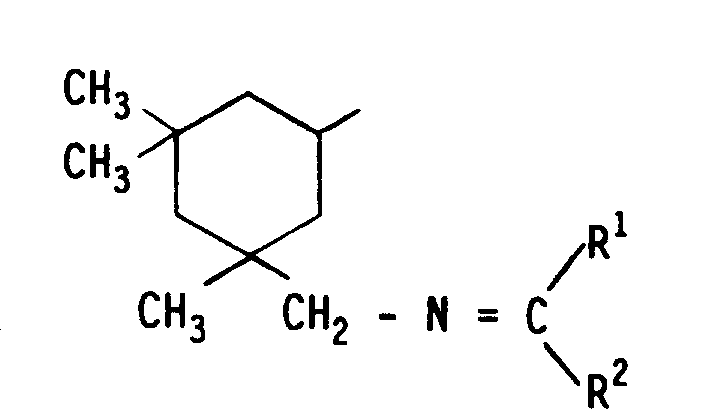
Gegenstand der vorliegenden Erfindung sind daher Azomethine (Schiffsche Basen) der allgemeinen Zusammensetzung:
wobei: - R¹:
- H, C₁₋₁₄-Alkyl-Rest, der gegebenenfalls verzweigt ist, und
- R²:
- C₁₋₁₄-Alkyl-Rest, der gegebenenfalls verzweigt ist und alkylsubstituierter Phenyl-Rest
- Bei den erfindungsgemäßen Verbindungen handelt es sich um niedrigviskose Produkte mit einer Farbzahl nach Gardner < 1, und einem Amingehalt von 2 bis 5 mmol/g und einer OH-Zahl (mg KOH/g) von 100 bis 280.
- Ein weiterer Gegenstand der vorliegenden Erfindung ist ein Verfahren zur Herstellung der Azomethine nach Anspruch 1, welches dadurch gekennzeichnet ist, daß folgender Aminoalkohol:

mit folgenden Carbonylverbindungen:
wobei: - R¹:
- H; C₁₋₁₄-Alkyl-Rest, der gegebenenfalls verzweigt ist
- R²:
- C₁₋₁₄-Alkyl-Rest, der gegebenenfalls verzweigt ist und alkylsubstituierter Phenylrest
- Die Herstellung kann sowohl in Lösung als auch lösungsmittelfrei erfolgen. Wird die Reaktion in Lösung durchgeführt, arbeitet man bevorzugt mit Toluol oder Xylol als (inerte) Lösungsmittel. Durch Zusatz von 0,01 - 0,1 Gew.-% an Säure, wie z. B. H₃PO₄, kann die Azomethinbildung beschleunigt werden. Dies ist dann zweckmäßig, wenn es sich um träge Reaktionskomponenten, wie dies bei sterisch gehinderten Aminen und Ketonen der Fall ist, handelt. IPAA und Toluol werden bei Raumtemperatur gemischt und mit der Carbonylverbindung im molaren Verhältnis versetzt. Die Konzentration des Toluols beträgt ca. 50 bis 80 Gew.-%. Die Lösung wird dann langsam bis zum Rückfluß erhitzt und so lange am Wasserabscheider weiter erhitzt, bis die berechnete H₂O-Menge abdestilliert ist. Danach wird das Toluol im Vakuum abdestilliert. Die Konzentration der so hergestellten Schiffschen Basen beträgt ≧ 99 % (Flächen-% im Gaschromatogramm). In der Regel ist diese Reinheit für die Weiterreaktion der Schiffschen Basen mit NCO-Präpolymeren zur Bildung von Poly-Schiffschen Basen ausreichend.
- Bei der Herstellung in Substanz werden IPAA und die Carbonylkomponente im molaren Verhältnis bei Raumtemperatur gemischt und langsam bis zum Rückfluß erhitzt und so lange weiter erhitzt, bis die berechnete H₂O-Menge abdestilliert ist. Es hat sich als sehr vorteilhaft erwiesen, die Carbonylkomponente im Überschuß von 10 bis 30 % zuzugeben. Nach der destillativen Abtrennung des Reaktionswassers und der überschüssigen Carbonylkomponente wird kurzzeitig Vakuum angelegt. Das so hergestellte erfindungsgemäße Verfahrensprodukt hat eine Reinheit von ≧ 99 % und braucht in der Regel nicht mehr weiter gereinigt zu werden.
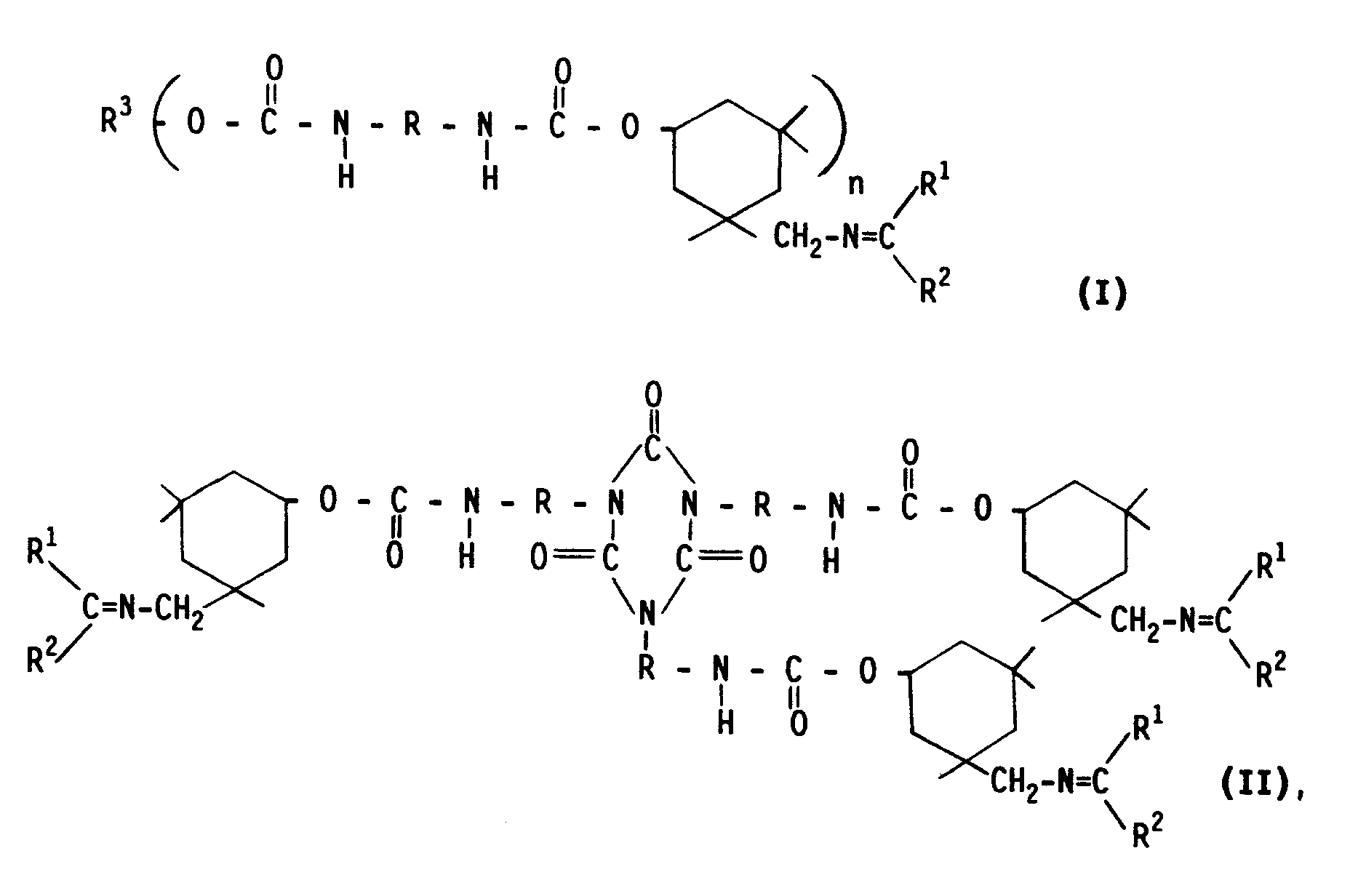
- Ein weiterer Gegenstand der vorliegenden Erfindung betrifft die Verwendung der erfindungsgemäßen Azomethine zur Herstellung von Polyazomethinen (Poly-Schiffschen Basen) folgender Zusammensetzung:

wobei 1 ≦ n ≦ 6 ist, - R:
- den KW-Rest eines (cyclo)aliphatischen oder aromatischen Diisocyanates mit 6 - 20 C-Atomen oder deren Trimerisaten,
- R³:
- wenn 2 ≦ n ≦ 6, einen n-wertigen organischen Rest, wie er durch Entfernung von n OH-Gruppen aus einer gegebenenfalls Ethersauerstoffatome enthaltenden Polyhydroxylverbindung oder einer hydroxylhaltigen Polyesterverbindung mit einem durchschnittlichen Molgewicht zwischen 40 und 5 000 entsteht, wenn n = 1,
- Die Herstellung der erfindungsgemäßen Polyazomethine erfolgt durch Umsetzung von Diisocyanaten bzw. deren Addukten folgender Zusammensetzung:

mit den erfindungsgemäßen Azomethinen der allgemeinen Zusammensetzung: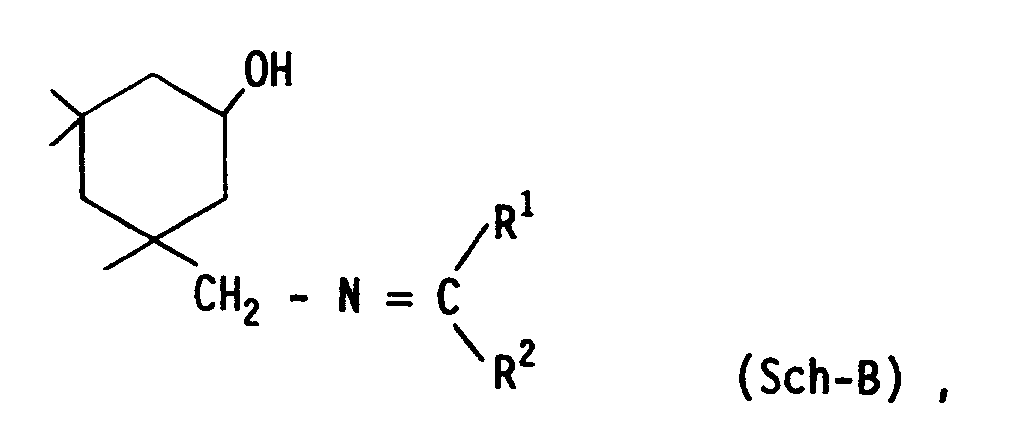
wobei R, R¹, R² und R³ die vorstehend genannte Bedeutung besitzen
im NCO : OH-Äquivalzenzverhältnis von 1 : 1. - Die Umsetzung erfolgt je nach Aggregatzustand des eingesetzten Diisocyanats bzw. NCO-Präpolymeren in Substanz oder in aprotischen Lösungsmitteln bei Temperaturen von 20 bis 80 °C.
- Bei niedrigviskosen NCO-Präpolymeren kann auf Lösungsmittel verzichtet werden; bei hochviskosen und festen NCO-Präpolymeren muß dagegen in Lösung gearbeitet werden. Als Lösungsmittel kommen im Prinzip alle in Frage, die keine gegenüber NCO-Gruppen reaktiven funktionellen Gruppen enthalten. Besonders geeignet haben sich Ketone, wie z. B. Aceton, Methylethylketon und aromatische Kohlenwasserstoffe, wie z. B. Toluol, erwiesen.
- Die für das erfindungsgemäße Verfahren eingesetzten Isocyanatpräpolymeren (Ia; IIa) werden nach an sich bekannten Methoden durch Umsetzung von Polyhydroxylverbindungen mit Diisocyanaten bzw. durch Trimerisierung von Diisocyanaten hergestellt.
- Als Polyhydroxylverbindungen kommen Polyole mit einem Molgewicht von 60 bis 600, wie z. B. Ethylenglykol, Hexandiol, Di- und Triethylenglykol, Neopentylglykol, Trimethylolpropan, Octandecandiol, C₃₆-Diol, in Frage. Bevorzugt eignen sich Polyetherpolyole mit einem Molgewicht von 200 - 5 000, mit 2 - 5, vorzugsweise 2 -3 Hydroxylgruppen. Die erfindungsgemäß in Frage kommenden OH-Gruppen aufweisenden Polyether sind solche der an sich bekannten Art und werden z. B. durch Polymerisation von Epoxiden, wie Ethylenoxid, Propylenoxid, Tetrahydrofuran, Styroloxid mit sich selbst, z. B. in Gegenwart von Lewis-Säuren, wie z. B. BF₃, oder durch Anlagerung dieser Epoxide, gegebenenfalls im Gemisch oder nacheinander an Starterkomponenten mit reaktionsfähigen Wasserstoffatomen, wie H₂O, Alkohole und Amine, hergestellt. Weiterhin werden OH-Gruppen enthaltende Polybutadiene für die Isocyanatpräpolymeren eingesetzt sowie hydroxylgruppenhaltige Polyester und Polyketone.
- Als Ausgangskomponente zur Herstellung der für das erfindungsgemäße Verfahren benötigten Isocyanatpräpolymeren (Ia, IIa) kommen (cyclo)aliphatische, araliphatische, aromatische Diisocyanate in Betracht, wie sie z. B. von W. Siefken in Justus Liebigs Annalen der Chemie, Bd. 562, S. 75-136, beschrieben werden, beispielsweise 1.6-Hexamethylendiisocyanat, 2-Methylpentamethylendiisocyanat-1.5, 1.12-Dodecandiisocyanat, Isophorondiisocyanat, Tetramethylxylylendiisocyanat, 2.4- und 2.6-Toluylendiisocyanat und Diphenylmethan-2.4'- und/oder 4.4'-diisocyanat.
- Die Isocyanatpräpolymeren werden in der Regel so hergestellt, daß auf 1 OH-Äquivalent des Polyols 2 NCO-Äquivalente des Diisocyanats in bekannter Weise miteinander umgesetzt werden. Die so hergestellten Isocyanatpräpolymeren enthalten je nach Molgewicht noch ca. 2 - 8 % freies Diisocyanat. In manchen Fällen hat es sich als zweckmäßig erwiesen, Isocyanatpräpolymere mit einem Diisocyanatgehalt < 0,5 % für das erfindungsgemäße Verfahren einzusetzen. Solche "monomerarmen" Isocyanatpräpolymeren werden so hergestellt, daß in einer 1. Stufe das Diisocyanat in großem Überschuß mit dem Polyol zur Reaktion gebracht, und in einer 2. Stufe das nicht umgesetzte Diisocyanat durch Dünnschichtdestillation vom Reaktionsprodukt abgetrennt wird. Die so hergestellten Isocyanatpräpolymeren enthalten, unabhängig von ihrem Molgewicht, < 0,5 % Diisocyanat.
- Die für das erfindungsgemäße Verfahren eingesetzten Isocyanatpräpolymeren II a werden in bekannter Weise durch Trimerisierung der bereits für die Herstellung der Isocyanatpräpolymeren I a aufgezählten Diisocyanate hergestellt. Als Trimerisierungskatalysatoren haben sich die in der DE-PS 26 44 684 und DE-PS 29 16 201 beschriebenen als vorteilhaft erwiesen.
- Als Reaktionskomponente für die Diisocyanate und die Isocyanatpräpolymeren (I a, II a) werden nach den erfindungsgemäßen Verfahren die erfindungsgemäßen Azomethine (Sch-B) eingesetzt.
- Die erfindungsgemäßen Verfahrensprodukte eignen sich in hervorragender Weise zur einfachen Herstellung von Polyaminen, die auf andere Weise nicht oder nur schwierig hergestellt werden können.
- 342 Gew. -T. IPAA wurden mit 260 Gew. -T. Methyl-iso-butylketon (MIBK) bei Raumtemperatur gemischt und langsam bis zum Rückfluß am Wasserabscheider erhitzt und anschließend so lange bei dieser Temperatur (ca. 130 °C) weiter erhitzt, bis 36 Gew.-T. H₂O und das überschüssige MIBK abdestilliert wurden. Danach wurde das Reaktionsprodukt im Wasserstrahlvakuum andestilliert (2 % Destillat). Das so hergestellte Reaktionsprodukt konnte ohne weitere Rektifizierung zur Herstellung von Poly-Schiffschen Basen eingesetzt werden. Der Amin-Gehalt des Reaktionsproduktes betrug 3,89 mmol NH₂/g; seine Viskosität (23 °C) lag bei 2 610 mPa·s.
- 342 Gew. -T. IPAA wurden mit 180 Gew.-T. Methylethylketon analog Beispiel 1 umgesetzt.
Das Reaktionsprodukt hatte einen basischen Amingehalt von 4,3 mmol NH₂/g und eine Viskosität bei 23 °C von 2 130 mPa·s. - 342 Gew.-T. IPAA wurden mit 300 Gew.-T. Diisobutylketon analog Beispiel 1 umgesetzt.
Das Reaktionsprodukt hatte einen basischen Amingehalt von 3,25 mmol NH₂/g und eine Viskosität bei 23 °C von 15 300 mPa·s. - 342 Gew.-T. IPAA und 180 Gew.-T. Isobutyraldehyd wurden mit 500 Gew.-T. Toluol bei Raumtemperatur gemischt und langsam am Wasserabscheider bis zum Rückfluß erhitzt und so lange bei dieser Temperatur gehalten, bis 36 Gew.-T. H₂O abdestilliert waren. Die Hauptmenge Toluol (und der nicht umgesetzte Isobutyraldehyd) wurde bei Normaldruck abdestilliert. Zur Beseitigung der Restmenge Toluol wurde das Reaktionsprodukt noch kurzzeitig im Wasserstrahlvakuum weiter erhitzt.
- Das so hergestellte Azomethin hatte einen Reinheitsgrad von > 99 % (Flächen-% im Gaschromatogramm), einen basischen Amingehalt von 4,3 mmol NH₂/g und eine Viskosität bei 23 °C von 1 320 mPa·s.
- 342 Gew. -T. IPAA und 285 Gew. -T. 3.5.5-Trimethylcyclohexanon wurden mit 500 Gew.-T. Toluol analog Beispiel 4 umgesetzt.
Das Reaktionsprodukt hatte einen basischen Amingehalt von 3,39 mmol NH₂/g und eine Viskosität von 31 600 mPa·s. - 253 Gew.-T. der Schiffschen Base Beispiel A. 1 und 560 Gew.-T. eines NCO-Präpolymeren, das nach bekanntem Verfahren aus 444 Gew.-T. IPDI und 650 Gew.-T. eines Polytetrahydrofurandiols mit durchschnittlichem Molgewicht von 650 hergestellt wurde, wurden bei 50 °C so lange zusammen erhitzt, bis kein NCO mehr nachgewiesen werden konnte (ca. 20 h).
Das Reaktionsprodukt hatte einen basischen Amingehalt von 1,2 mmol NH₂/g und eine Viskosität bei 23 °C von 750·10³ mPa·s. - 225 Gew.-T. der Schiffschen Base Beispiel A. 2 und 737 Gew.-T. eines NCO-Präpolymeren, das nach bekanntem Verfahren aus 444 Gew.-T. IPDI und 1000 Gew.-T. eines Polytetrahydrofurandiols mit durchschnittlichem Molgewicht von 1 000 hergestellt wurde, wurden analog Beispiel 1 umgesetzt.
Das Reaktionsprodukt hatte einen basischen Amingehalt von 1,03 mmol/NH₂/g und eine Viskosität bei 23 °C von 810·10³ mPa·s. - 295 Gew.-T. der Schiffschen Base Beispiel A. 3 und 1 313 Gew.-T. eines Isocyanatpräpolymeren, das nach bekanntem Verfahren aus 444 Gew.-T. IPDI und 2 000 Gew.-T. eines bifunktionellen Polypropylenglykols mit einem durchschnittlichen Molgewicht von 2 000 hergestellt wurde, wurden analog Beispiel 1 umgesetzt.
- Das Reaktionsprodukt hatte einen basischen Amingehalt von 0,6 mmol NH₂/g und eine Viskosität bei 23 °C von 67·10³ mPa·s.
- 244 Gew.-T. trimeres IPDI mit 17,2 % NCO (VESTANAT T 1890, Verkaufsprodukt der Hüls AG) wurden in 300 Gew.-T. Aceton gelöst und mit 253 Gew.-T. der Schiffschen Base A. 1 bei 50 °C so lange erhitzt, bis der NCO-Gehalt < 0,1 % betrug. Anschließend wurde das Aceton unter Normaldruck abdestilliert. Zur vollständigen Entfernung des Acetons wurde das Reaktionsprodukt noch im Wasserstrahlvakuum bei 120 °C weiter erhitzt.
Das Reaktionsprodukt hatte einen basischen Amingehalt von 1,2 mmol NH₂/g und einen Schmelzbereich von 165 - 169 °C.
im Molverhältnis 1 : 1 - 1,3 bei Temperaturen von 60 bis 140 °C in bekannter Weise umgesetzt wird.
Claims (4)
- Neue Azomethine (Schiffsche Basen) folgender Zusammensetzung:
 R¹: H, C₁₋₁₄-Alkyl-Rest, der gegebenenfalls verzweigt ist, undR²: C₁₋₁₄-Alkyl-Rest, der gegebenenfalls verzweigt ist und alkylsubstituierter Phenyl-Restbedeuten.
 - Verfahren zur Herstellung der Azomethine gemäß Anspruch 1,
dadurch gekennzeichnet,
daß folgender Aminoalkohol:
 R¹: H; C₁₋₁₄-Alkyl-Rest, der gegebenenfalls verzweigt istR²: C₁₋₁₄-Alkyl-Rest, der gegebenenfalls verzweigt ist und alkylsubstituierter Phenylrestbedeuten,
im Molverhältnis 1 : 1 - 1,3 bei Temperaturen von 60 bis 140 °C in bekannter Weise umgesetzt wird. - Verwendung der Azomethine nach Anspruch 1 zur Herstellung von Polyazomethinen (Poly-Schiffschen Basen) folgender Zusammensetzung:
 R: den KW-Rest eines (cyclo)aliphatischen oder aromatischen Diisocyanates mit 6 - 20 C-Atomen oder deren Trimerisaten,R³: wenn 2 ≦ n ≦ 6, einen n-wertigen organischen Rest, wie er durch Entfernung von n OH-Gruppen aus einer gegebenenfalls Ethersauerstoffatome enthaltenden Polyhydroxylverbindung oder einer hydroxylhaltigen Polyesterverbindung mit einem durchschnittlichen Molgewicht zwischen 40 und 5 000 entsteht,
wenn n = 1,
- Verwendung der Azomethine nach Anspruch 1 zur Herstellung von Polyazomethinen (Poly-Schiffschen Basen) nach Anspruch 3,
dadurch gekennzeichnet,
daß die Azomethine gemäß Anspruch 1 mit Diisocyanaten oder deren Addukten mit Polyolen (I a) oder deren Trimerisate (II a)
Applications Claiming Priority (2)
| Application Number | Priority Date | Filing Date | Title |
|---|---|---|---|
| DE4311901A DE4311901A1 (de) | 1993-04-10 | 1993-04-10 | Neue Azeomethine, ein Verfahren zu ihrer Herstellung sowie deren Verwendung |
| DE4311901 | 1993-04-10 |
Publications (1)
| Publication Number | Publication Date |
|---|---|
| EP0620211A1 true EP0620211A1 (de) | 1994-10-19 |
Family
ID=6485276
Family Applications (1)
| Application Number | Title | Priority Date | Filing Date |
|---|---|---|---|
| EP94102103A Withdrawn EP0620211A1 (de) | 1993-04-10 | 1994-02-11 | Azomethine, ein Verfahren zu ihrer Herstellung, sowie deren Verwendung zur Herstellung azomethinhaltigen Polyurethanen |
Country Status (4)
| Country | Link |
|---|---|
| US (1) | US5449827A (de) |
| EP (1) | EP0620211A1 (de) |
| JP (1) | JPH0770031A (de) |
| DE (1) | DE4311901A1 (de) |
Families Citing this family (2)
| Publication number | Priority date | Publication date | Assignee | Title |
|---|---|---|---|---|
| RU2232782C1 (ru) * | 2002-11-04 | 2004-07-20 | Волгоградский государственный технический университет | 1,3-бис-[2-n-n-метоксибензилиденамино)этил]адамантан в качестве противостарителя вулканизации каучуков |
| JP5140924B2 (ja) * | 2005-12-22 | 2013-02-13 | 横浜ゴム株式会社 | 湿気硬化性樹脂組成物 |
Citations (4)
| Publication number | Priority date | Publication date | Assignee | Title |
|---|---|---|---|---|
| US3352913A (en) * | 1961-10-18 | 1967-11-14 | Scholven Chemie Ag | 3-aminomethyl-3, 5, 5-trialky-1-cyclohexylamine and cyclohexanol compounds |
| DE2356213A1 (de) * | 1973-11-10 | 1975-05-15 | Schering Ag | Neue ketimingruppen enthaltende prepolymere |
| FR2328006A1 (fr) * | 1975-10-17 | 1977-05-13 | Bayer Ag | Polyamines a haut poids moleculaire, leur preparation et leur utilisation comme produits de depart dans la preparation de resines synthetiques de polyurethannes |
| FR2362171A1 (fr) * | 1976-08-18 | 1978-03-17 | Bayer Ag | Procede de preparation de polyurethanne-urees |
Family Cites Families (11)
| Publication number | Priority date | Publication date | Assignee | Title |
|---|---|---|---|---|
| US714931A (en) * | 1900-07-07 | 1902-12-02 | Hoechst Ag | Hydrobenzaldehyde and process of making same. |
| US1864067A (en) * | 1930-03-06 | 1932-06-21 | Naugatuck Chem Co | Treatment of rubber |
| US2027902A (en) * | 1933-04-20 | 1936-01-14 | Du Pont | Production of n-substituted aminophenols |
| US2155356A (en) * | 1937-06-17 | 1939-04-18 | Dow Chemical Co | N-substituted-2-amino nitro-phenols |
| US2220065A (en) * | 1938-10-29 | 1940-11-05 | Du Pont | Aminophenols and their preparation |
| US2424061A (en) * | 1944-06-29 | 1947-07-15 | Lilly Co Eli | 9-amino-alkyl-amino-substituted acridine derivatives |
| NL6511116A (de) * | 1964-08-26 | 1966-02-28 | ||
| DE1814832B2 (de) * | 1968-12-14 | 1979-02-08 | Bayer Ag, 5090 Leverkusen | Verfahren zur Herstellung von Hydroxymethyl-Gruppen aufweisenden Ketiminen |
| ZA814307B (en) * | 1980-07-01 | 1983-02-23 | Nat Res Dev | Prostaglandins |
| FR2563216B1 (fr) * | 1984-04-24 | 1986-05-30 | Centre Nat Rech Scient | Composes imines de synthese contenant un atome de carbone quaternaire chiral, leur preparation et leur utilisation |
| US4783468A (en) * | 1986-04-30 | 1988-11-08 | Ciba-Geigy Corporation | Insecticidal 5-pyrimidine carbonitriles |
-
1993
- 1993-04-10 DE DE4311901A patent/DE4311901A1/de not_active Withdrawn
-
1994
- 1994-02-11 EP EP94102103A patent/EP0620211A1/de not_active Withdrawn
- 1994-03-07 US US08/206,860 patent/US5449827A/en not_active Expired - Fee Related
- 1994-04-08 JP JP6071028A patent/JPH0770031A/ja not_active Withdrawn
Patent Citations (4)
| Publication number | Priority date | Publication date | Assignee | Title |
|---|---|---|---|---|
| US3352913A (en) * | 1961-10-18 | 1967-11-14 | Scholven Chemie Ag | 3-aminomethyl-3, 5, 5-trialky-1-cyclohexylamine and cyclohexanol compounds |
| DE2356213A1 (de) * | 1973-11-10 | 1975-05-15 | Schering Ag | Neue ketimingruppen enthaltende prepolymere |
| FR2328006A1 (fr) * | 1975-10-17 | 1977-05-13 | Bayer Ag | Polyamines a haut poids moleculaire, leur preparation et leur utilisation comme produits de depart dans la preparation de resines synthetiques de polyurethannes |
| FR2362171A1 (fr) * | 1976-08-18 | 1978-03-17 | Bayer Ag | Procede de preparation de polyurethanne-urees |
Non-Patent Citations (1)
| Title |
|---|
| "Houben-Weyl; Methoden der Organischen Chemie Bd. 11/2, 4. Auflage", E. MÜLLER, STUTTGART (DE) 1958 * |
Also Published As
| Publication number | Publication date |
|---|---|
| JPH0770031A (ja) | 1995-03-14 |
| DE4311901A1 (de) | 1994-10-13 |
| US5449827A (en) | 1995-09-12 |
Similar Documents
| Publication | Publication Date | Title |
|---|---|---|
| EP0585835B1 (de) | Verfahren zur Herstellung von niedrigviskosen Isocyanurat- und Urethangruppen enthaltenden Polyisocyanatmischungen | |
| EP0339396B1 (de) | Verfahren zur Herstellung von Isocyanuratgruppen aufweisenden Polyisocyanaten | |
| EP0682012B1 (de) | Verfahren zur Herstellung von Allophanatgruppen aufweisenden lichtechten Polyisocyanaten | |
| EP3247732B1 (de) | Kristallisationsstabile polyesterprepolymere | |
| DE2948419A1 (de) | Verfahren zur herstellung von polyaminen und deren verwendung in einem verfahren zur herstellung von polyurethankunststoffen | |
| DE1174759B (de) | Verfahren zur Herstellung von Polyisocyanaten mit Biuretstruktur | |
| EP1735363B1 (de) | Verfärbungsstabile polyetherallophanate | |
| EP0465900B1 (de) | Im wesentlichen aus Bisoxazolanen bestehende Oxazolangemische, ein Verfahren zu deren Herstellung und ihre Verwendung als Härter für Isocyanatgruppen aufweisende Kunststoffvorläufer | |
| EP0193828A1 (de) | Isocyanuratgruppen aufweisende Polyisocyanate, ein Verfahren zu ihrer Herstellung und ihre Verwendung als Isocyanatkomponente in Polyurethanlacken | |
| EP0099537A2 (de) | Einstufenverfahren zur Herstellung von Polyaminen aus NCO-Prepolymeren | |
| EP2890725B1 (de) | Isocyanatfunktionelle cyclische carbonate | |
| EP1735273A1 (de) | Verfahren zur herstellung von polyetherallophanaten unter verwendung von zink-verbindungen als katalysatoren | |
| EP0703230A1 (de) | 1,3-Dioxan-2-on-Gruppen enthaltende Oligourethane | |
| EP0033898A1 (de) | Verfahren zur Herstellung von wässrigen Polyurethandispersionen | |
| DE69016072T2 (de) | Isocyanatprepolymer und Verfahren zu seiner Herstellung. | |
| DE3144874A1 (de) | Verfahren zur herstellung von polyaminen aus n-monoaryl-n', n'-dialkylharnstoff-verbindungen und ihre verwendung zum aufbau von polyurethanen | |
| EP0195917B1 (de) | Verfahren zur Herstellung von Additionsverbindungen aus 1 Mol dimerisiertem oder niedrig-oligodimerisiertem 4,4'-Diisocyanatodiphenylmethan und 2 bis 3 Mol 4,4'-Diisocyanatodiphenylmethan, entsprechende Additionsverbindungen und ihre Verwendung zur Polyurethanherstellung | |
| WO2005097865A1 (de) | Verfahren zur herstellung von polyisocyanat-prepolymeren mit allophanat-struktureinheiten | |
| EP0620212A1 (de) | Polyamine, Verfahren zu ihrer Herstellung sowie ihre Verwendung als Epoxidharzhärter | |
| DE4311901A1 (de) | Neue Azeomethine, ein Verfahren zu ihrer Herstellung sowie deren Verwendung | |
| EP0320703B1 (de) | Verfahren zur Herstellung von Biuretpolyisocyanaten, die nach diesem Verfahren erhaltenen Verbindungen und ihre Verwendung | |
| DE3739477C2 (de) | Verfahren zur Herstellung von monoblockierten (cyclo)-aliphatischen Diisocyanaten | |
| EP1765899B1 (de) | Verfahren zur herstellung aminofunktioneller polyurethan-prepolymere | |
| DE3610198A1 (de) | Polyisocyanat-zubereitungen, ein verfahren zu ihrer herstellung und ihrer verwendung zur herstellung von polyurethan-kunststoffen oder als lufttrocknende beschichtungs- oder klebemittel | |
| AT390960B (de) | Verfahren zur herstellung von kathodisch abscheidbaren, selbstvernetzenden lackbindemittelnund deren verwendung |
Legal Events
| Date | Code | Title | Description |
|---|---|---|---|
| PUAI | Public reference made under article 153(3) epc to a published international application that has entered the european phase |
Free format text: ORIGINAL CODE: 0009012 |
|
| 17P | Request for examination filed |
Effective date: 19940804 |
|
| AK | Designated contracting states |
Kind code of ref document: A1 Designated state(s): CH DE FR GB IT LI NL |
|
| 17Q | First examination report despatched |
Effective date: 19960124 |
|
| STAA | Information on the status of an ep patent application or granted ep patent |
Free format text: STATUS: THE APPLICATION HAS BEEN WITHDRAWN |
|
| 18W | Application withdrawn |
Withdrawal date: 19961218 |