EP0620536A1 - Etiquette résonante magnétostrictive - Google Patents
Etiquette résonante magnétostrictive Download PDFInfo
- Publication number
- EP0620536A1 EP0620536A1 EP94201036A EP94201036A EP0620536A1 EP 0620536 A1 EP0620536 A1 EP 0620536A1 EP 94201036 A EP94201036 A EP 94201036A EP 94201036 A EP94201036 A EP 94201036A EP 0620536 A1 EP0620536 A1 EP 0620536A1
- Authority
- EP
- European Patent Office
- Prior art keywords
- strip
- label
- type
- segments
- magnetic field
- Prior art date
- Legal status (The legal status is an assumption and is not a legal conclusion. Google has not performed a legal analysis and makes no representation as to the accuracy of the status listed.)
- Withdrawn
Links
Images
Classifications
-
- G—PHYSICS
- G08—SIGNALLING
- G08B—SIGNALLING SYSTEMS, e.g. PERSONAL CALLING SYSTEMS; ORDER TELEGRAPHS; ALARM SYSTEMS
- G08B13/00—Burglar, theft or intruder alarms
- G08B13/22—Electrical actuation
- G08B13/24—Electrical actuation by interference with electromagnetic field distribution
- G08B13/2402—Electronic Article Surveillance [EAS], i.e. systems using tags for detecting removal of a tagged item from a secure area, e.g. tags for detecting shoplifting
- G08B13/2405—Electronic Article Surveillance [EAS], i.e. systems using tags for detecting removal of a tagged item from a secure area, e.g. tags for detecting shoplifting characterised by the tag technology used
- G08B13/2422—Electronic Article Surveillance [EAS], i.e. systems using tags for detecting removal of a tagged item from a secure area, e.g. tags for detecting shoplifting characterised by the tag technology used using acoustic or microwave tags
-
- G—PHYSICS
- G06—COMPUTING OR CALCULATING; COUNTING
- G06K—GRAPHICAL DATA READING; PRESENTATION OF DATA; RECORD CARRIERS; HANDLING RECORD CARRIERS
- G06K19/00—Record carriers for use with machines and with at least a part designed to carry digital markings
- G06K19/06—Record carriers for use with machines and with at least a part designed to carry digital markings characterised by the kind of the digital marking, e.g. shape, nature, code
-
- G—PHYSICS
- G08—SIGNALLING
- G08B—SIGNALLING SYSTEMS, e.g. PERSONAL CALLING SYSTEMS; ORDER TELEGRAPHS; ALARM SYSTEMS
- G08B13/00—Burglar, theft or intruder alarms
- G08B13/22—Electrical actuation
- G08B13/24—Electrical actuation by interference with electromagnetic field distribution
- G08B13/2402—Electronic Article Surveillance [EAS], i.e. systems using tags for detecting removal of a tagged item from a secure area, e.g. tags for detecting shoplifting
- G08B13/2428—Tag details
- G08B13/2437—Tag layered structure, processes for making layered tags
- G08B13/2442—Tag materials and material properties thereof, e.g. magnetic material details
Definitions
- the invention relates to a magnetostrictively resonating label for use in a detection or identification system, provided with at least one strip of a first type which comprises magnetostrictive material and responds to an electromagnetic field upon the generation of a bias magnetic field in the strip of the first type, and at least one strip of a second type which comprises hardmagnetic material and whereby a bias magnetic field can be generated in the strip of the first type upon magnetization of the strip of the second type.
- European patent application 0352936 Such a system is disclosed in, inter alia, European patent application 0352936.
- the label according to the European patent application comprises a separate strip, the strip of the first type being capable of being brought into an active or inactive mode through demagnetization or magnetization of this separate strip.
- Efforts are directed to constructing these detection systems so as to be as selective as possible, in order to prevent "false alarm” as much as possible.
- one of the possibilities is, for instance, to design a system wherein, instead of going from an active to an inactive mode, the labels, which should be activatable and deactivatable, go from one detectable mode to another detectable mode or from a mode having a combination of several detectable components to an inactive mode.
- activatable and deactivatable labels are used only once and are not removed after the sale of the article in question, but deactivated, so that no alarm is generated at the exit of a shop.
- the label By providing several detectable components in the labels, it is also possible to design an identification system wherein the different labels in the system can be distinguished from each other.
- One of the conditions for such a system is that the label should be capable of being switched from one active mode to the other active or inactive mode in a very simple manner.
- the different labels should be programmable in a very simple manner, without the mechanical tolerances being too critical or the movement of a magnetic read-write head being too precise.
- the object of the present invention is to provide a solution to this and is characterized in that strip of the second type is built up of at least two segments of material having mutually different coercivity and capable of being polarized independently of each other, so that depending on the respective polarization directions of the segments, a fundamental tone or a dominant tone is generated by the strip of the first type upon being irradiated by the electromagnetic field.
- the invention also relates to a system for detecting and/or identifying a label or group of labels, wherein the system comprises a transmitting unit for generating an electromagnetic interrogation field and a detection unit for detecting resonance effects caused by a label located within the interrogation field.
- the invention relates to a method for coding a label, wherein by means of a magnetic field of a first strength, segments of the label having a coercivity smaller than or equal to a first value are polarized in the same predetermined first direction.
- a label according to the invention makes use of the magnetostrictive effect, i.e., a label is used that is built up of a strip or filament of amorphous magnetic material, here also referred to as a strip of the first type, having the characteristic that a deformation of the material occurs in a magnetic field.
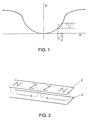
- Fig. 1 shows a diagram wherein this extension l of a strip of magnetostrictive material having a length l is plotted out against the field strength H wherein this strip is located.
- This curve indicates that the extension of a stip of magnetostrictive material is limited independently of the increase of the field strength. It is also shown that an extension also occurs if the applied field becomes negative.
- a so-called bias magnetic field is applied, which is a permanent magnetic field having a field strength such that without an externally applied alternating magnetic field, the point of rest shifts for instance to point (1) in Fig. 1.
- a strip or filament of hardmagnetic material is arranged directly opposite the strip of magnetostrictive material and this hardmagnetic strip is permanent magnetized such that the above-mentioned condition is satisfied.
- these mechanical oscillations in the strip are resonant. Detection thereof is possible, as, for instance, upon interruption of the alternating magnetic field, the strip will continue to oscillate, which yields a detectable magnetic alternating field.
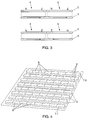
- a permanent bias magnetic field is arranged in the hardmagnetic strip (2) (strip of the second type), as indicated in Fig. 2, with the polarity of the magnetic field having changed direction within the bias field, under the influence of an alternating magnetic field extension takes place within the amorphous magnetostrictive strip (3) (strip of the first type) under one area, while at the same time shortening takes place under the other area, so that, in the case of two areas, a mechanical oscillation occurs which is the second dominant tone of the above-described fundamental oscillation.
- PCT WO 92/12401 and PCT WO 92/12402 to Andrew Dames e.a. describe a system wherein different magnetostrictive sections of material are used, moved under one hardmagnetic bias material, so that different resonance frequencies are formed enabling the different sections to be distinguished from each other.
- a hardmagnetic bias material is used, locally magnetic areas or patterns being present having different polarization directions, so that several dominant tones are formed and can be detected.
- a drawback of this method is that it is very hard to apply the varying magnetization of the bias field in the hardmagnetic material. This requires moving a magnetizing head directly above the relevant hardmagnetic material in order to apply the magnetization.
- a strip is used consisting of segments or portions of different materials having varying coercivity, because this offers the possibility of modifying or influencing the magnetization of the bias field locally even at a greater distance without requiring an accurate positioning of the magnetizing head.
- Fig. 3 schematically shows a label according to the invention, programmed in two states. Opposite a strip of amorphous magnetostrictive material (3), a second strip (2) is arranged, having for instance two portions or areas (segments) consisting of different materials of different coercivity (4) and (5). Portion (4) has for instance a relatively high coercivity and has been premagnetized by means of a strong magnet or an electromagnetic write head. Portion (5) has a lower coercivity.
- the low-coercive material can, depending on the polarization direction, be polarized magnetically equal or opposite to the polarization direction of the high-coercive material.
- the magnetostrictive strip (3) starts resonating at the mechanical fundamental frequency in the case of equal polarization and at the second dominant tone thereof in the case of opposite polarization. In this manner, two different oscillation modes can be programmed without displacing the label or the magnetic field, which modes can clearly be distinguished from each other in a detection or identification system.
- the strips (2) and (3) are mounted such that the magnetostrictive strip (3) can oscillate freely.
- different oscillation modes (codes) of the amorphous magnetostrictive strip (3) can be programmed in a statically arranged electromagnetic field, starting with the material of the highest coercivity and ending with the material of the lowest coercivity. For instance, in a hardmagnetic strip (2) consisting of eight such areas, the fundamental frequency, the second, the fourth and the eighth dominant tone can be programmed.
- the uneven dominant tones can be programmed as well, but these tones give a somewhat damped course of oscillation in the strip.
- the polarization directions of the segments extend in the longitudinal direction of the segments.
- a label according to the invention may also consist of a plurality of combinations, arranged side by side, of amorphous magnetostrictive strips (3) and hardmagnetic strips (2) built up of material segments (6) of different coercivity, while the different segments (6) of all strips of hardmagnetic material may have corresponding coercivity.
- the construction is such that these strips are located in cells within the label or card, so that they can oscillate freely.
- the fundamental frequencies of the different magnetostrictive strips (3) varies per strip by selecting a slightly different length for each strip.
- a plurality of oscillation modes may be programmed per strip through the individual presentation, per hardmagnetic strip (2), of the magnetic field required for programming, by means of several electromagnets or by means of a moving electromagnet, the polarity of the different segments in each strip being determined by optionally reversing the direction of current in the electromagnet while the relevant segment is selected, through variation of the amplitude of the electromagnetic field.
- the identification systems according to the present invention can be used for identifying persons, animals or articles, for instance for controlling logistic processes during this identification or as a result thereof, or for establishing the presence of a label in a specific area, by means of an interrogation field.
- the segments are arranged relative to each other in the longitudinal direction of the strip of the second type (2), as shown in Fig. 4.
- a segment (6) extends in the longitudinal direction of the strip of the second type (2).
- a strip of the first type (3) is at least practically parallel to an associated strip of the second type (2).
- the label according to Fig. 4 comprises a plurality of strips of the first type (3) each having a different length so that resonance frequencies of these strips of the first type are also different from each other. Consequently, this involves that the resonance frequencies of the fundamental tones and the dominant tones of the last-mentioned strips are different from each other.
- the label comprises a plurality of combinations (7.1-7.8) of coacting strips of the first and second type.
- a combination (7) may for instance consist of one strip of the first and one of the second type, as shown in Fig. 4.
- the labels may be used in a detection system as well as in an identification system.
- a detection system may for instance be used for combatting shoplifting.
- a label in a system for the identification of persons, for instance for permitting access to areas, buildings, vehicles or computer systems, for the identification of animals, for instance for the purpose of feeding, and for the identification of articles, for instance for the purpose of controlling logistic processes.
Landscapes
- Physics & Mathematics (AREA)
- Engineering & Computer Science (AREA)
- General Physics & Mathematics (AREA)
- Automation & Control Theory (AREA)
- Computer Security & Cryptography (AREA)
- Electromagnetism (AREA)
- Acoustics & Sound (AREA)
- Theoretical Computer Science (AREA)
- Burglar Alarm Systems (AREA)
Applications Claiming Priority (2)
| Application Number | Priority Date | Filing Date | Title |
|---|---|---|---|
| NL9300628A NL9300628A (nl) | 1993-04-14 | 1993-04-14 | Magnetorestrictief resonerende labels ten behoeve van een detectie- of identificatiesysteem. |
| NL9300628 | 1993-04-14 |
Publications (1)
| Publication Number | Publication Date |
|---|---|
| EP0620536A1 true EP0620536A1 (fr) | 1994-10-19 |
Family
ID=19862277
Family Applications (1)
| Application Number | Title | Priority Date | Filing Date |
|---|---|---|---|
| EP94201036A Withdrawn EP0620536A1 (fr) | 1993-04-14 | 1994-04-14 | Etiquette résonante magnétostrictive |
Country Status (2)
| Country | Link |
|---|---|
| EP (1) | EP0620536A1 (fr) |
| NL (1) | NL9300628A (fr) |
Cited By (4)
| Publication number | Priority date | Publication date | Assignee | Title |
|---|---|---|---|---|
| WO1998013946A3 (fr) * | 1996-09-23 | 1998-06-18 | Carl Tyren | Etiquette permettant de marquer des objets et de les detecter a distance |
| ES2123438A1 (es) * | 1996-11-14 | 1999-01-01 | Socimag Sa | Etiqueta de seguridad aplicable a articulos comerciales. |
| RU2126553C1 (ru) * | 1994-06-30 | 1999-02-20 | Сенсормэтик Электроникс Корпорейшн | Маркер для использования в магнитомеханической системе электронного контроля товаров, способ его изготовления и система для его использования |
| EP0899702A3 (fr) * | 1997-08-29 | 2000-03-01 | Matsushita Electric Industrial Co., Ltd | Résonateur magnétostrictif, route dans laquelle le résonateur est enterrée et méthode de pose du résonateur |
Citations (3)
| Publication number | Priority date | Publication date | Assignee | Title |
|---|---|---|---|---|
| US4510490A (en) * | 1982-04-29 | 1985-04-09 | Allied Corporation | Coded surveillance system having magnetomechanical marker |
| EP0352936A2 (fr) * | 1988-07-26 | 1990-01-31 | Security Tag Systems, Inc. | Transpondeur à division de fréquence en forme d'étiquette désactivable |
| JPH02145989A (ja) * | 1988-11-26 | 1990-06-05 | Fuji Electric Co Ltd | 磁気マーカー |
-
1993
- 1993-04-14 NL NL9300628A patent/NL9300628A/nl not_active Application Discontinuation
-
1994
- 1994-04-14 EP EP94201036A patent/EP0620536A1/fr not_active Withdrawn
Patent Citations (3)
| Publication number | Priority date | Publication date | Assignee | Title |
|---|---|---|---|---|
| US4510490A (en) * | 1982-04-29 | 1985-04-09 | Allied Corporation | Coded surveillance system having magnetomechanical marker |
| EP0352936A2 (fr) * | 1988-07-26 | 1990-01-31 | Security Tag Systems, Inc. | Transpondeur à division de fréquence en forme d'étiquette désactivable |
| JPH02145989A (ja) * | 1988-11-26 | 1990-06-05 | Fuji Electric Co Ltd | 磁気マーカー |
Non-Patent Citations (1)
| Title |
|---|
| PATENT ABSTRACTS OF JAPAN vol. 14, no. 385 (P - 1094) 20 August 1990 (1990-08-20) * |
Cited By (5)
| Publication number | Priority date | Publication date | Assignee | Title |
|---|---|---|---|---|
| RU2126553C1 (ru) * | 1994-06-30 | 1999-02-20 | Сенсормэтик Электроникс Корпорейшн | Маркер для использования в магнитомеханической системе электронного контроля товаров, способ его изготовления и система для его использования |
| WO1998013946A3 (fr) * | 1996-09-23 | 1998-06-18 | Carl Tyren | Etiquette permettant de marquer des objets et de les detecter a distance |
| ES2123438A1 (es) * | 1996-11-14 | 1999-01-01 | Socimag Sa | Etiqueta de seguridad aplicable a articulos comerciales. |
| EP0899702A3 (fr) * | 1997-08-29 | 2000-03-01 | Matsushita Electric Industrial Co., Ltd | Résonateur magnétostrictif, route dans laquelle le résonateur est enterrée et méthode de pose du résonateur |
| US6407676B1 (en) * | 1997-08-29 | 2002-06-18 | Matsushita Electric Industrial Co., Ltd. | Magnetostrictive resonator, road in which the resonator is buried and method of burying the resonator |
Also Published As
| Publication number | Publication date |
|---|---|
| NL9300628A (nl) | 1994-11-01 |
Similar Documents
| Publication | Publication Date | Title |
|---|---|---|
| US5831532A (en) | Identification tags using amorphous wire | |
| EP0352936B1 (fr) | Transpondeur à division de fréquence en forme d'étiquette désactivable | |
| US5563583A (en) | Multibit magnetic radio frequency tag using micromechanics | |
| KR100204747B1 (ko) | 원격 감지용 자기 태그 및 객체 인식 시스템 | |
| CA2290410C (fr) | Desactivateur d'etiquettes de systeme electronique de surveillance d'articles avec mise hors fonction biplanaire | |
| EP3304429B1 (fr) | Etiquettes rfid autodétachables | |
| US5565849A (en) | Self-biased magnetostrictive element for magnetomechanical electronic article surveillance systems | |
| US6054924A (en) | Magnetic markers | |
| NZ304922A (en) | The use of a passive data tag system which employs small amounts of very high permeability magnetic material and a scanned magnetic field for interrogation | |
| JP3417617B2 (ja) | 周波数分割型トランスポンダータグ | |
| CN1228862A (zh) | 具有低矫顽磁力特性的偏磁元件的磁力式电子货品监视用标识器 | |
| WO2002007083A2 (fr) | Procede et dispositif d'attachage et de detachage d'un appareil de communication sans fil | |
| KR100356092B1 (ko) | 원격식별시스템 | |
| EP0405764B1 (fr) | Conversion d'une bande prémagnétisée en une bande à trois pôles dans une étiquette transpondeur à division de fréquence pour désactiver celle-ci | |
| NL9300628A (nl) | Magnetorestrictief resonerende labels ten behoeve van een detectie- of identificatiesysteem. | |
| JPH08185496A (ja) | データキャリアとその識別方法および識別装置 | |
| GB2322048A (en) | Circuit for Interrogating Magnetic Tags | |
| JPH10509820A (ja) | アモルファス磁石弾性テープを有するラベルの検出方法 | |
| EP1671161A1 (fr) | Etiquetage magnetique | |
| AU738833B2 (en) | Apparatus for interrogating magnetic tags | |
| CA2319237C (fr) | Marqueurs ou etiquettes magnetiques | |
| CA2149380C (fr) | Marqueur a frequence de resonance accordable pour la surveillance magnetomecanique d'articles | |
| HK1028126A (en) | Deactivation device with biplanar deactivation | |
| KR20020006170A (ko) | 초소형 셀프 바이어스형 물류 구별 자성박막 센서 소자 및그의 제조방법 | |
| AU1759700A (en) | Magnetic coding of articles |
Legal Events
| Date | Code | Title | Description |
|---|---|---|---|
| PUAI | Public reference made under article 153(3) epc to a published international application that has entered the european phase |
Free format text: ORIGINAL CODE: 0009012 |
|
| 17P | Request for examination filed |
Effective date: 19940810 |
|
| AK | Designated contracting states |
Kind code of ref document: A1 Designated state(s): DE FR GB NL |
|
| STAA | Information on the status of an ep patent application or granted ep patent |
Free format text: STATUS: THE APPLICATION HAS BEEN WITHDRAWN |
|
| 18W | Application withdrawn |
Withdrawal date: 19950717 |