EP0620936B1 - Travail en collaboration dans un reseau - Google Patents
Travail en collaboration dans un reseau Download PDFInfo
- Publication number
- EP0620936B1 EP0620936B1 EP93924738A EP93924738A EP0620936B1 EP 0620936 B1 EP0620936 B1 EP 0620936B1 EP 93924738 A EP93924738 A EP 93924738A EP 93924738 A EP93924738 A EP 93924738A EP 0620936 B1 EP0620936 B1 EP 0620936B1
- Authority
- EP
- European Patent Office
- Prior art keywords
- application
- data
- channel
- port
- sending
- Prior art date
- Legal status (The legal status is an assumption and is not a legal conclusion. Google has not performed a legal analysis and makes no representation as to the accuracy of the status listed.)
- Expired - Lifetime
Links
Images






Classifications
-
- G—PHYSICS
- G06—COMPUTING OR CALCULATING; COUNTING
- G06F—ELECTRIC DIGITAL DATA PROCESSING
- G06F9/00—Arrangements for program control, e.g. control units
- G06F9/06—Arrangements for program control, e.g. control units using stored programs, i.e. using an internal store of processing equipment to receive or retain programs
- G06F9/46—Multiprogramming arrangements
- G06F9/54—Interprogram communication
- G06F9/546—Message passing systems or structures, e.g. queues
Definitions
- This invention relates to collaborative working in a network and more specifically to a programmable workstation and a method for use in such a collaborative working environment.
- Personal computers are now widespread throughout the business community and many are able to intercommunicate, either through fixed connections e.g. local area networks, or through dynamically established links e.g. ISDN or async lines over the public switched telephone network.
- these connected personal computers can be used to enhance collaborative working between remote individuals; a typical example being the use of desk top conferencing software.
- Successful collaborative work generally requires more than a simple data link between the participants; voice capabilities are normally essential and video links are frequently required.
- remote collaborative working can often be regarded as an extension to the traditional telephone call - it being enhanced with the data and programs available at the desktop via the personal computer - and, on occasions, enriched with video services.
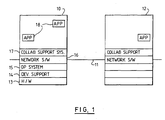
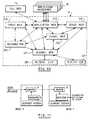
- An application programming interface 20 allows applications 18 to request support services.
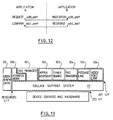
- a device driver interface 21 allows the system to support an extensible range of software and hardware communications subsystems through device drivers such as token ring driver 25, ISDN driver 26, RS232 driver 27 and other device drivers 28.
- Link support modules 228, 229 interface with the device drivers. These are replaceable, ( Figure 10 shows only a possible selection) depending on the hardware options available at the workstation, and serve to isolate the support system from needing to know precisely which hardware is present.
- an implicit resources interface (not illustrated) details of the communications network, such as node addresses and directory data may be requested by both the support system, the applications and the device drivers from resource files 29.
- Nodes can contain logical devices 30.
- a logical device is a software extension to the support system that allows an application to manipulate or manage software or equipment, in a manner consistent with other entities in the architecture. There is an extensive range of possible logical devices including: presentation windows, printers, disk drives, modems, and application programs.
- the support software 17 may request that the resources of one node are made available for communication between two other nodes; this is termed passive operation and permission is controlled by the call manager at the passive node.
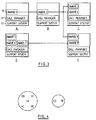
- passive operation As an example, consider two nodes A and B on a LAN, with a third node C connected to B by an asynchronous communications link. If applications at A and C wish to communicate, the traffic will need to be routed via B. The consent of the call manager at B is required for this use of its node.
- Figure 3 shows a number of applications A-E sharing. This results in two sharing sets, irrespective of the order in which the shares were requested, as illustrated in Figure 4.
- channels such as 43 and 44 are logically dedicated and uni-directional pipes, with application specified transmission characteristics.
- a channel is always defined by the sending application and it goes from a sending application to a receiving application.
- the ends of channels are known as ports; thus all channels have one sending port and one receiving port.
- a sending port such as 45 sends data packets down the channel; a receiving port such as 46 receives data packets from the channel in the order in which they were sent.
- Channels can be explicitly created by an API call to the support system, specifying the required channel characteristics, and new channels can also be added to an existing port.
- the latter mechanism allows a port to be shared across channels belonging to different channel sets; for example data can be sent from a single port to one set of destinations belonging to a merged channel set, and to a second set of destinations belonging to a serialised channel set.
- Digital channels and analog channels cannot be members of the same channel set.
- a channel can be deleted, the channel being uniquely identified by specifying its sending and receiving ports.
- Channels can be implicitly created as a consequence of an application being, or becoming, a member of an application sharing set. For example, if unshared applications already ahve a merged or serialized channel, and the channel set name iused is identical across these applications, then when the applications share with each other, the additional channels required will be created automatically. Applications are notified of channels implicitly created in this way.
- User exits can be optionally associated with ports. This allows monitoring or manipulation of the data, after it has been supplied to a sending port, or before being presented by a receiving port. In the case of synchronised channels, synchronisation is performed from after the data leaves the sending port user exit, and up to the data being presented to the receiving port user exit.
- ports and channels can be changed after they have been initially established; for example, quality of service, data class and compression hints. This provides the flexibility for an application to modify its communications usage during execution; an example being the temporary degradation of video quality to improve file exchange performance.
- Ports can be connected together to establish extended communication links, so that an application may route its inputs through to another application for processing. When ports are connected in this way, and providing user exits have not been established, no further application involvement is required after the routing has been established. This allows the streaming of data between applications and devices. Connection is permitted between channels in different channel sets, of different types, having different quality of service characteristics, of different data class or different connect types (unless one of the ports is null), provided only that one port is sending and one port is receiving. Connected ports can also be welded, so that the connection is permanent and persists even when the local application has terminated. The channel behaves in all respects as though it had been originally created from its source directly to its destination. Any user exits which may be present are removed.
- Device ports cannot be welded to channel ports, since this would allow a device to exist outside the control of a local application.
- Logical devices are permitted to issue API calls to the support system, and in this regard act on behalf of the owning application (ie the application which opened the device). Devices for example can cause their owning application to share with other applications, create channels, and send or receive data.
- Potential devices include:
- the system clipboard device may be opened by an application to provide a sending and a receiving port, giving access to the windowing system clipboard data at that node. Only one sending port may exist at any time, but any application at that node may open receiving ports. Through the use of channels, system clipboard data from one node, can be simply routed across to other members of an application sharing set.
- the shared clipboard is provided to ease data sharing. It is unique to a sharing set; only one sending port is allowed but multiple receiving ports are supported. Apart from these distinctions, it behaves in a similar manner to the system clipboard and provides a simple mechanism for applications to share common data.
- the window device allows a window, defined on the screen, to be associated with a sending or a receiving port (or in some circumstances both).
- the sending port can be connected to a channel port and data can be streamed to the window and displayed.
- a variety of data formats are supported.
- the DDE device can be opened to provide sending and receiving ports which are coupled to the dynamic data exchange mechanism. Through this device an aware application can control an application that supports DDE, or be itself controlled. Moreover, by establishing the appropriate channels, two remote DDF. applications can be linked together.
- the printer device allows data to be sent to the system printer; only a single sending port is permitted.
- the asynchronous serial device supports one sending port and multiple receiving ports and interfaces to RS232, RS422 and other serial communications.
- video and audio devices exist including: the video display and playback devices (supporting IBM/Intel ActionMedia II Adapter/A); the video capture device (supporting IBM M-Video Capture Adapter/A); the audio capture and playback devices (supporting IBM M-Audio Capture and Playback Adapter/A); and other specialised audio/video devices (such as H320 compliant codecs).
- a number of aware applications are shipped as system utilities, and take advantage of these devices to offer general purpose end user functions, for collaborative working over a network.
- Customisation information for the support system 17 is stored in an appropriate platform-designated repository; for Windows and OS/2 these are the files called LAKES.INI and LAKESQOS.INI, formatted as a standard ASCII file, containing sections headed by an identifier, where keywords and their values are kept. Applications may also have their own additional initialisation filed.
- LAKES.INI contains standard section including information on configuration and start-up options, aware applications, devices and physical communications link; additionally application sections containing data specific to those applications may be present.
- LAKEQOS.INI contains quality of service information relating to physical links and data classes. Calls to access and update these files are provided in the API.
- resources owned by a node can be shared with other nodes.
- Such resources are considered to be global resources and access is controlled through global tokens.
- Other resources are local to application sharing set, for example a shared pointer, and access to these is managed through application tokens.
- a token owner determines the significance of a token and allocates it on request. At the discretion of the owner, queued requests may be permitted, and more than one concurrent holder of a particular token may be allowed. Token owners can optionally force holders to hand back tokens.
- Global tokens share a common name space throughout the network, but since applications are expected to know the location of a globally available resource that they require, duplicate global token names are permitted. Facilities for the broadcasting of availability information are not provided; Instead, the call manager at the node with the global resource is responsible for resource management and therefore holds any global tokens.
- Global tokens may be held by an application instance on an exclusive or shared basis; token ownership, however, cannot be transferred to an application. Requests for a global token may be queued, with the queue being held above the API and managed by the node call manager. Access to global tokens is not restricted to a sharing application set.
- Application token name space is restricted to the application sharing set. Tokens may be owned by any member application and ownership can be transferred. Application tokens may be held on an exclusive or shared basis and requests for tokens queued, with the queue being held above the API, and managed by the current application token owner.
- Aware applications can be initiated, either by the usual operating system procedures, such as a double click on an icon, or by a "launch" command.
- the application will register with the support system, and in the return data receive its application and node handles.
- the call manager is notified of this registration, and supplied a handle to the application.
- the launching application is returned a handle to the application; this is only valid in very restricted circumstances until the launched application has registered with the support system.
- the return data provides the launched application with its application and node handles. Both the call manager and the application that specified the launch (if different) are notified accordingly.
- Applications may revert to unaware application status by de-registering, the call manager being notified. All tokens held are released and the token owners are notified; all tokens owned become invalid. If the application is a member of an application sharing set it is removed and the other members notified of its departure. All ports created by the application are destoyed and the other applications owning ports to the affected channels are notified. All channels connected by the terminating application are welded and appropriate events raised at the end channel ports. Appropriate events are raised is necessary to the local call manager, plus the call managers of any nodes supporting a welded channel on behalf of the deregistering application. All open logical devices are closed; if any of the logical devices are connected to ports, destroyed as part of the de-registration process, then the whole connected channel is destroyed and the appropriate events raised.
- a shutdown request can be issued by an application to close down the support system at a node in an orderly manner. This raises an event in the local call manager, and if the call manager accepts the request, corresponding shutdown events are raised at the other applications. These then prepare to close down and de-register, each de-registration being notified to the call manager. After the call manager has been notified that all the applications have de-registered, it too de-registers, to complete the shutdown.
- the normal operation of the support system depends on the presence of the call manager. It is possible to replace the existing call manager with another, but the existing call manager may reject the request to do so.
- Apps may join other applications in a sharing set by issuing the "share_app" request and naming an application sharing set; the normal case being where the target application and node are both specified by name. If an application at one node wants to share, by name, with an already existing instance of an application at another node, then the procedure is as follows. App 1 at node 1 issues the "share_app" request, specifying its own applciation and node handles as the source, and the names of app 2 and node 2 as the target. After verification with the call manager at node 1, an appropriate request is sent by the support system to the call manager at node 2. Providing this call manager accepts the request, this is then passed onto app 2, which can return a confirmation, assuming that it wishes to accept the share. This scheme provides for considerable flexibility in application sharing. Each call manager is aware of the share activity at its node, whether applications are the source or target of "share_app" requests.
- a call manager has the following options on receipt of a share request: (i) handle the share itself (ii) transfer the share request (iii) reject the share (iv) launch a new application to handle the share (v) change the application and node name.
- An application is not a member of an application sharing set when launched.
- the source application issues a "share_app" request it has the option of naming the resulting sharing set; if it does not name the sharing set then the target must supply the name.
- both the target and the source join a new sharing set with this name. If either the source and/or the target were already members of a sharing set with this same name, then those sharing sets are merged with the newly created sharing set.
- Applications can leave a sharing set using the "unshare_app" request.
- Resource set identifiers are local to an application instance and contain resources appropriate to one particular quality of service.
- An application can specify quality of service characteristics when creating a channel or when reserving resource for later allocation to channels.
- Channels are mapped onto physical links; the data pacekts sent by applications over logical channels being implemented as data frames sent over links.
- Link descriptions are stored in a link data base external to the support system. Defaults for the quality of service information are contained in the initialisation files.
- the data base is accessed by an installation supplied executable, which is called by the support program.
- the quality of service parameters relevant to digital links are: throughput, latency, jitter, frame size, frame error rate, frame re-transmission time, compression hints, encryption.
- the key parameters used to characterise the quality of service required by applications over logical channels are: througput, latency, jitter, packet size, packert error rate, encryption, compression hints, priority. Most of these mirror their link counterparts with the exception of channel priority, which specifies the order in which the support system will attempt to service data tranmissions over all the channels at that node, assuming that there is resource contention between the channels, and packet error rate, which specifies an acceptable random proportion of packets that need not be delivered due to loss or error in transmission (there is no guaranteee that the support system will conform to such a limitation; specifying zero here results in the application being notified of any failures).
- the above information is used to determine what links to use for application to application communication.
- a data base containing information such as type of link and service characteristics can be accessed via the resources interface, whilst the channel information is obtained from the application.
- the support system selects an appropriate link to use based upon matching the fully resolved channel requirements with the fully resolved available links information, taking account of (a) the need to exchange control information between the support systems at different nodes, and (b) the order values associated with the links.
- the RLI calls used to retrieve link information also supply all the required channel quality of service characteristics.
- an external routine can itself determine the appropriate route and return that route to the support system. An example of the need for this might be that transmission costs vary with the time of day.
- a channel between nodes may be realised over a single physical link, or over multiple, serially connected links.
- the physical connection existing between two nodes is termed a route.
- the support system supports analogue communications in a very similar way to digital communications, in those situations where:
- Analogue channels are logically dedicated uni-directional communication links established by the sending application, and they may terminate in more than one receiving application. They may be distinguished from digital channels by their quality of service characteristics. Ports terminating these analogue channels have a null connect type since they cannot supply or receive data from applications. Only standard or merged channels may be established; serialising and synchronising channel sets are not permitted.
- Logical devices can present analogue ports when opened; thus a video player device can be used as a source of analogue video and may be connected to an analogue channel through an API command.
- the direct connection of analogue and digital channels is not permitted; however certain devices e.g. a codec device provide both analogue and digital ports when opened and can be used to effect such a coupling.
- Switched digital networks can be used by the support system for inter-node communication without exposing the switched nature of the connection.
- Information accessed via the resources interface is used by the system to decide when to terminate an inactive switched connection.
- Potentially active multi-point control units which dynamically modify data or routing, for example, an MCU implementing the CCITT recommendations for audio-visual communication, may also appear as devices to applications.
- Analogue telephones and other equipment, attached to the public switched network may be accessed in a similar manner to digital telephones, ec either as a virtual phone application executing at a virtual node, or through a logical device.
- a PSTN telephone logical device can be opened to present a port, with a null connect type i.e. it cannot supply or receive data from an application.
- "Signal_port" commands are used to control the device.
- First party connection can be implemented through a modem injecting dialling tones into the local line; third party connection, and multi-way calls through commands to the local switch.
- the support system provides facilities which permit unaware applications to be used for collaborative working.
- An aware application supplies the user interface dialogue and interacts with the particular unaware application via virtual devices. This same aware application then communicates with a related aware application at the remote node to pass the information to the remote user.
- Several such applications are included as general purpose utilities.
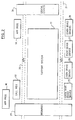
- a common requirement is for an application window of an unaware application to be displayed at a remote node as illustrated in Figure 11.
- the implementation is as follows: an aware application A X at node X dialogues with the user to identify the window required, assumed here to be the unaware application U X .
- a X then opens a window display logical device, with the appropriate parameters, the effect of which is to generate a port through which copies of the window data are made available.
- a X connects this to a port on a channel leading to an aware application A Y at the destination node Y.
- a Y then opens a real window logical device, and connects the port created to the receiving channel port.
- Data flows between the nodes, and is displayed at Y, without the further intervention of either application A X or A Y .
- Options available on the windows logical device open request allow the application to specify such parameters as bits/pixel, frequency of update and data format (e.g. text, bit map and option of included pointer position).
- Remote pointers over the shared window of the unaware application U X can be handled by A X and A Y setting up a channel suitable for the interactive data class.
- the real pointer on each node is then used for identifying features in the shared window; this can be achieved with an algorithm such as: each user wishing to point moves his pointer into the shared window; when pointers are in the shared window their co-ordinates are transmitted to the sharing applications.
- the combined co-ordinates are then used to control the pointers; the effect is that whoever moves the cursor last, positions all the linked pointers.
- Program calls to the API generally result in a request, indication, response, confirm sequence.
- An application A requiring a service, requests that service, supplying the appropriate parameters.
- the request usually requires another application B being made aware of that request; the mechanism for this is an unsolicited event which appears as an indication at the application B.
- the action taken by B to the indication event is given to the support system as a response, with appropriate data.
- the system passes the information back to application A as a confirm event. This is illustrated in Figure 12 using the example of the sequence involved in adding a port to a channel (for simplicity no parameters are shown).
- An API call may be either synchronous or asynchronous, depending upon the particular function; a synchronous call returns control when the request is complete, an asynchronous call returns control immediately.
- these calls contain a reference identifier. This identifier is valid until the request has been satisfied and queries can be issued to obtain status; this same identifier can also be used to cancel a pending request. All calls pass back a return code denoting call status.
- An application requests addressability to nodes by using the node name.
- This name is first passed to the locak call manager which has the option to modify it.
- the resultant name is then used by the support system to determine connectivity information, this requires access to the externally held network and user data base, using the resources interface.
- the support system determines physical addressability for that name through queries to the network configuration via the resources interface 29, Fig. 2.
- a node handle is returned to the application to reflect this resolution of the node name.
- Addressability from one application to another application requires the resolution of an application name. If both applications are at the same node, the local call manager can perform this resolution, else both call managers must be involved. This resolution results in the target application being identified to the source application by an application handle. Calls using application names are always passed to the call manager for resolution; calls using application handles go direct to the specified application.
- API requests are provided to assist with event and call control.
- a "begin_monitor” request allows an application to monitor requests and events at a node, the scope of the monitoring being controlled by the choice of monitor class from one of the following:
- the scope of the monitoring is controlled at the event or API class level. Events can be monitored with or without data. Monitoring is terminated with an "end_monitor” command. Applications can also use the "enable_events” and “disable_events” commands to determine which events they are to receive.
- the valid event classes are:
- a default event handler generates responses for all events not explicitly handled via an applications. Events are handled by registered event handles: four types can exist in aware applications:
- All channel ports can be associated with a user exit to monitor data traffic or process data.
- the user exit is invoked immediately prior to the data being transmitted to the receiving nodes; for a receiving port, the user exit is invoked immediately the data arrives at the receiving port but prior to the data being presented to the receiving application.
- Specification of a user exit routine on ports which have been connected may impact performance because the data must be surfaced to the user exit.
- Application program debugging can be simplified by initially running collaborating applications at a single node; this avoiding physical networks being required during initial stages of program development.
- a number of pre-programmed utilities are provided in order to immediately provide useful function to end users and reduce the programming effort required to develop new collaborative applications, by providing common functions accessible through a command interface.
- the address book utility 100 allows an end user to add, delete and update directory and connectivity information.
- the data is stored in a simple file structure which is easily edited by standard programs, although a mechanism is provided to interface with other potentially more extensive and complex address data-bases.
- User data can be grouped into logical collections known as phone books.
- the utility interfaces directly to the call manager; it also responds to queries through the resources interface.
- This utility implements the following functions for users in a call:
- the chalkboard 103 implements a common drawing area with two image planes, which is accessible to all users in a call.
- the background plane can be loaded from bit-map files, the system clipboard, or from the contents of an application window.
- the foreground plane can be used for interactive annotation using a range of simple text and graphics tools. Remote pointers over the chalkboard are also supported.
- File transfer 104 allows the transmission of files between users in a call. One or more files can be transferred, the files can be sent with comments, and the original file names are made available to the destination.
- the receiving node is in full control of file receipt and file naming.
- Message line 105 provides immediate sharing of text data between users in a call. Multiple simultaneous users are permitted; each participant sees all the exchanged messages, and in the same sequence.
- the message utility also logs activity during the call; such as calls set-up and terminated, and files transferred. In an actual embodiment this utility is provided as part of the call manager.
- This utility 106 allows the establishment of video and voice links between users in a call. The precise function available is dependent upon the capabilities of the physical network and the workstation hardware support. ]
- the overall architecture is intended to support a broad range of collaborative applications.
- the interface is set at as high a level as possible, consistent with not imposing any significant restraints on the range of application models that may be implemented.
- the nature of the transport networks involved are totally hidden below the API. This means that an application is completely unaware of the network routing (eg direct or indirect), and the network types involved (eg single or multiple links, switched or fixed connections).
- a consequence of this approach is that the applications must be written expecting that requests, for example for a particular communications quality of service, may fail, since the underlying network may not have the required capability.
- Connections and welding of channels allows the transport of data to drop below the API so that the application is no longer involved in moving the data.
- the support system has the option, in some cases, of effecting the connection, either at a very low level at that node, or re-routing the flow away from that node.
- the support system architecture is designed to permit inter-working between different computer platforms, operate over varied communications networks, and support relevant communication and data standards.
- the separation of data traffic into logical uni-directional flows of homogeneous data simplifies the mapping on to a mixed network and allows the use of multiple physical links, of different capabilities, between the nodes.
- Data multiplexing is handled below the application and can be implemented in different ways depending upon the underlying transport mechanism, e.g. by a combination of: allocating each logical flow to an individual physical link; multiplexing all the data in the support layer; or by leaving aspects of the multiplexing to a device driver.
- voice, video and data traffic for instance, can be sent over multiple channels, over iso-LAN or iso-Ethernet, or over ISDN using the CCITT H320 recommendations.
- the quality of service requirements impose conditions on the required transport facilities; thus voice and video typically require dedicated physical links or shared links with isochronous capability, implemented through schemes involving priority and bandwidth management.
- the system also provides a separate data class for the interactive objects commonly used in collaborative applications, such as remote pointers, cursors and gestures.
- the following parameters are associated with a channel and are established on the creat_channel and add_channel requests.
- the following quality of service parameters are associated with a physical link and are specified in the network data base accessed via the link locator, or obtained as defaults from the LAKESQOS.INI file.
- the application manager 223 acts as an interface to the rest of the support system, providing an entry point for all the API calls which are then distributed to the appropriate component after a certain amount of parameter verification. It is also used to scan incoming calls/outgoing events if monitoring is required (see below).
- the application manager is responsible for calling back the application at the event handler specified when a channel is created.
- the events will be those raised at the sending port if the local application created the channel, or then receiving port if the remote application created the channel.
- the application manager passes the address of an event queue handler which will handle all the events for a particular application and place them in a queue. Then, some mechanism such as a dispatch thread continuously reading the event queue sends the event to the application's event handler.
- the channel manager 227 has five sub-components: a channel supervisor, responsible for starting and shutting down all the other components; a control channel sub-component, which handles control channel communications between support systems at different nodes; a data channel sub-component, which handles all other non-control channel data communications; a node manager, which creates, destroys, and maintains node handles and sets of node handles; and a port manager, which creates, destroys, and manipulates ports and does port query functions.
- a channel supervisor responsible for starting and shutting down all the other components
- a control channel sub-component which handles control channel communications between support systems at different nodes
- a data channel sub-component which handles all other non-control channel data communications
- a node manager which creates, destroys, and maintains node handles and sets of node handles
- a port manager which creates, destroys, and manipulates ports and does port query functions.
- the resource manager 225 is the first component in the support system to get control. It is responsible for initialising all the other components, as well as interfacing to any address book or route selection facilities.
- the token manager 224 as its name suggests, is responsible for the logging and management of tokens, both global and application tokens (global tokens are owned by the respective call manager components; by contrast application tokens are owned by a node in a sharing set).
- the device manager 224 is responsible for interactions between the support system and devices, and in particular performs the following functions:
- Sending ports specify these parameters on the "create_channel" request, receiving ports on the response.
- the create_channel function creates a channel with specified characteristics from the issuing application to the target application.
- Return Codes from the create-channel/function include RC_OK indicating that the operation completed successfully and a number of failure codes.
- This function call is used to create a unidirectional logical channel.
- the channel is created between the issuing application and the target_application.
- a sending port is created in the issuing application and a receiving port is created in the target application (ref. Fig. 8).
- the remote application will get a PORT_REQUEST event raised through its initialise event handler, at which point it can accept or reject the request.
- a CHANNEL_CONFIRMED event is raised through the applications initialise event handler giving the PORT_REQUEST response.
- the channel_type defines the four types of channels described earlier, namely, Standard, Merged, Serialised and Synchronised.
- the async_id parameter value is application defined, (it may be used by the cancel function call) and is returned at the local end on the CHANNEL_CONFIRMED or CHANNEL_REJECTED event.
- the PORT_REQUEST, CHANNEL_CONFIRMED or CHANNEL_REJECTED events at the remote end will have an async_id value of zero.
- channel_set_id is a user defined identifier that informs the system that a logical channel belongs to a set of channels.
- the channel_set_id must be unique within an application sharing set, any channel that is to be part of the set must specify the same identifier. This may only be null if the channel_type is specified as STANDARD.
- the quality of service parameter is a structure containing the identifier of a resource set and the desired quality of service resources. If the resource set identifier is not null then the specified resources will be obtained from this set. If the resource set identifier is null then the resources will be obtained from the system available resources. For a discussion of setting up a resource set see the definition of the reserve_resource function call.
- the connect_type parameter specifies how the data is to be given to or received from the system i.e. Null, Event or Buffered, as described earlier.
- a Logical Channel has been defined to consist of a uni-directional data pipe with a sending port at one end and a receiving port at the other. Data always flows from the sending port to the receiving port. Notationally this is indicated by [Sending port: Receiving Port].
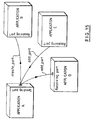
- Channels may be established so that one sending port may be associated with many receiving ports, that is, data sent through the single sending port will be delivered at all the receiving ports. This is illustrated in Figure 15, and is Notationally indicated by [SP: RP1, RP2,....RPn].
- Logical channels may also be associated into named channel Sets of different types; notationally indicated as CSname[SP:RP1,RP2....RPn]type.
- the merged type of channel set is one in which the multiple sending ports all send data to a single receiving port.
- Two or more applications may define a merged channel set using the same channel set name consisting of different sending and receiving ports.
- application A may defined a merged channel set, CS1[SPa : RPb,RPc] merged and application B may defined a merged channel set CS1[SPd : RPe,RPf] merged .
- applications establish a collaborative session by referring to application names not by referring to the data channels established by these applications, i.e. by using the share_command.
- the process is for each potential member application of a collaborative working group to establish a merged channel set consisting of a sending port associated with a receiving port both defined in the same application and using an agreed channel set name. That is, each potential application establishes a channel set such as CS1[SPa : RPa] merged .
- CS1 channel set
- two or more applications e.g. applications, A, B, C
- CS1 merged set
- two or more applications e.g. applications, A, B, C
- the different definitions of CS1 are combined to form the following merged set CS1[SPa,SPb,SPc : RPa,RPb,RPc] merged
- two or more applications may define a serialised channel set using the same channel set name consisting of different sending ports but with potentially common receiving ports.
- application A may defined a serialised channel set, CS1[SPa : RPb] serialised and application C may defined a serialised channel set CS1[SPc : RPd] serialised .
- the process is for each potential member application of a collaborative working group to establish a serialised channel set consisting of a sending port associated with a receiving port both defined in the same application and using an agreed channel set name. That is, each potential application establishes a channel set such a CS1[SPa : RPa] serialised .
- CS1 serialised set
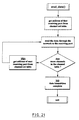
- the subsystem 17 In order to implement a merged channel which is, of course, only a model for programming purposes, the subsystem 17 maintains a channel set table for each merged channel which contains at least the addresses of the receiving ports. As shown in the flow diagram of Figure 21, in response to a send_data command to send data to a specified buffered receiving port which is part of a merged channel set, the subsystem sends the data in turn to each receiving port in the channel set until it has exhausted the table.
- the subsystem uses a similar technique of establishing a channel set table with the addresses of all receiving ports. However, it also needs to maintain a serialising queue for the channel in which the data items to be serialised are loaded from the sending ports and held in the order in which it is desired to transmit them to all receiving ports.
- Synchronising of the channels of a channel set is also provided when the channel type is "synchronised". For example, it is often necessary to establish n-way communication between members of a group such that multiple types of data (e.g. audio, video, keystrokes or mouse pointings ) sent by one (or possible more than one) member of the group is delivered in a synchronised fashion at all the receiving members of the group.
- the synchronisation of the data packets is undertaken by the underlying system with minimal involvement of the individual participants.
- This type of channel set is one in which a source application is sending different types of data such as audio and video through separate data channels to a target application.
- a source application is sending different types of data such as audio and video through separate data channels to a target application.
- a target application typically there is a single source application and a single target application.
- a single source application may send to multiple target applications, or multiple source applications may send to multiple target applications provided that in this case the synchronised receiving channels are in the same application. The typical case is illustrated below.
- the data is transmitted through a named channel set which has the property of synchronising the data packets from the sending port of inserting synchronising pulses in to the data stream as the data is transmitted.
- a synchronising pulse arrives at the receiving end of one of the associated channels the data on that channel is held up until a matching synchronising pulse arrives on all the other channels.
- all synchronising pulses have arrived the data is allowed to flow through all the channels until the next synchronising pulse arrives on one of the channels.
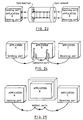
- the synchronising pulses are removed by the underlying system before the data is presented. This is illustrated in Figure 23 and expression notationally as CSname ⁇ [SP1 : RP1],[SP2 : RP2],... ⁇ synchronised
- the underlying system will send the appropriate control signals to the sending ports requesting the relevant ports to speed up or slow down.
- an application can transfer most (or even all) of the work involved in acting as a link in the transmission of data between two remote workstations onto the underlying system 17. Once the links have been established, the application can reduce its involvement in transmitting data by providing a means by which the data streaming can be carried out entirely by the underlying system.
- the application also has to provide an event handler which will be notified of various events.
- System defined events include acknowledgement of data receipt and transmission errors.
- a function is provided to allow the application at either end to send an application-defined string to the other end. This signal function raises a signal event at the other end.
- the application can now provide a user exit which is invoked as the data is about to be sent.
- This user exit acts as a filter - it can insert, delete and modify the data as it wishes.
- the tasks that might be assigned to a user exit are compression and encryption (with the corresponding decompression or decryption taking place in the user exit at the receiving port.
- ports of the type may surface within the same application.
- An application which has one port of each type may act a simple intermediary by merely sending every data packet received at the receiving port onward through the sending port.
- a program to perform this function while conceptually very simple, nevertheless involves considerable overhead, since each data packet has to be read, the data moved from the receiving buffer to a transmitting buffer and then written.
- Two functions, connect and weld are provided by the underlying system to allow this overhead to be reduced.
- the first function Connect effectively glues a receiving port to a sending port so that, although the two ports may still be referenced by the application, data flows automatically across the connection, as shown in Figure 24.
- This streaming of data reduces the overhead involved, since the application no longer has to receive, move and then send each data packet. As is clear from the diagram, only one queue now needs to be maintained by the underlying system.
Landscapes
- Engineering & Computer Science (AREA)
- Software Systems (AREA)
- Theoretical Computer Science (AREA)
- Physics & Mathematics (AREA)
- General Engineering & Computer Science (AREA)
- General Physics & Mathematics (AREA)
- Computer And Data Communications (AREA)
- Information Transfer Between Computers (AREA)
Claims (22)
- Station de travail programmable (10) destinée à un travail en collaboration dans un réseau, de stations de travail formant les noeuds du réseau, le réseau étant connecté par des liaisons physiques (11) en vue de la transmission des données entre les noeuds,la station de travail comprenant un système d'exploitation (15),une couche de programme de commande de réseau (16) s'exécutant sur le système d'exploitation, afin de commander l'acheminement physique des données entre les noeuds, etune couche de programme de support d'application en collaboration (1) destinée à réaliser une interface avec des programmes d'applications (18) s'exécutant sur la station de travail et répondant à des appels de programmes d'applications prédéterminés afin de créer un modèle de réseau logique d'un environnement de collaboration dans lequel lesdits appels de programmes d'applications peuvent spécifier un partage des ensembles de programmes d'applications, qui partagent des données de ressources à l'intérieur et entre les noeuds, et des canaux de données spécialisés logiques reliant des éléments d'un ensemble de partage de programmes d'applications, chaque canal de données (43) étant défini par un port d'émission (45) et un port de réception (46), chacun étant associé à un programme d'application, la couche de programme support d'application en collaboration étant conçue pour coopérer avec la couche de programme de commande de réseau afin d'établir les liaisons physiques nécessaires pour mettre en oeuvre le modèle de réseau logique dans un réseau physique, de façon transparente pour les programmes d'applications.
- Station de travail selon la revendication 1, dans laquelle les canaux de données logiques comportent à la fois un type de canal et un nom d'ensemble de canaux, des canaux du même type et un nom d'ensemble dans le même ensemble de partage d'applications formant un ensemble de canaux (59) dans lequel des données reçues sur un canal quelconque de l'ensemble dépendent des données sur d'autres canaux de l'ensemble conformément à des propriétés prédéterminées associées au type de canal.
- Station de travail selon la revendication 2, dans laquelle un type de canal fusionné est défini, dont les propriétés prédéterminées sont que des données provenant des ports d'émission de canaux d'un ensemble de canaux fusionnés sont fusionnées et délivrées à au moins un port de réception à une application cible sous forme d'un seul flux de données.
- Station de travail selon la revendication 3, dans laquelle dans un ensemble de canaux fusionnés comprenant des ports d'émission et de réception multiples, des canaux de données sont créés par le système de support entre toutes les connexions croisées des ports d'émission et des ports de réception.
- Station de travail selon la revendication 2, dans laquelle un type de canal série est défini dont les propriétés prédéterminées sont que des données provenant des ports d'émission d'un ensemble de canaux mis en série sont combinées et délivrées à chacun des multiples ports de réception dans l'ensemble de canaux dans le même ordre en série.
- Station de travail selon la revendication 4 ou la revendication 5 dans laquelle, dans le cas où des ensembles de partages multiples de programmes d'applications, comprenant chacun des ensembles de canaux fusionnés ou série du même nom, sont eux-mêmes combinés pour former un ensemble de partage plus grand, des canaux de données non créés explicitement par les applications de partage sont créés par le système de support entre toutes les connexions croisées de tous les ports d'émission et de réception.
- Station de travail selon la revendication 6, dans laquelle un programme d'application peut établir une communication bidirectionnelle avec tous les éléments d'un ensemble de partage existant dont les éléments sont reliés par un ensemble de canaux fusionnés ou mis en série en joignant l'ensemble et en créant un seul canal fusionné du même nom d'ensemble de canaux entre ses propres ports d'émission et de réception.
- Station de travail selon la revendication 2, dans laquelle un type de canal synchronisé est défini dont les propriétés prédéterminées sont que des données sur les différents canaux d'un ensemble de canaux synchronisés sont synchronisés dans le temps au niveau de chaque port de réception de l'ensemble de canaux.
- Station de travail selon la revendication 8, dans laquelle une synchronisation est obtenue grâce à une insertion de signaux de synchronisation au niveau de chaque port d'émission et la suppression des signaux de synchronisation au niveau de chaque port de réception de l'ensemble de canaux synchronisés.
- Station de travail selon la revendication 1, dans laquelle, en réponse à un appel de programme prédéterminé par un premier programme d'application par l'intermédiaire duquel des données sont en cours de transfert, par l'intermédiaire des ports de réception et d'émission de la première application, entre deux autres applications, le port de réception de la première application est relié directement de façon réversible à son port d'émission de sorte que le transfert de données contourne le premier programme d'application.
- Station de travail selon la revendication 1, dans laquelle en réponse à un appel de programme prédéterminé par un premier programme d'application par l'intermédiaire duquel des données sont en cours de transfert, par l'intermédiaire des ports de réception et d'émission de la première application, entre deux autres applications, le port de réception de la première application est connecté directement de façon permanente à son port d'émission de sorte qu'un canal de données direct, dans lequel la première application ne joue aucun autre rôle, est créé entre les deux autres applications.
- Procédé de travail en collaboration dans un réseau de stations de travail programmables (10, 12) formant les noeuds d'un réseau relié par des liaisons physiques (11) en vue de la transmission de données entre des noeuds, le procédé comprenant les étapes consistant à :en réponse à des appels prédéterminés provenant de programmes d'applications s'exécutant sur la station de travail, créer un modèle de réseau logique d'un environnement de travail en collaboration en vue d'une utilisation par les programmes d'application (18) dans lesquels des appels prédéterminés peuvent spécifier un partage des ensembles de programmes d'applications, qui partagent des données et des ressources à l'intérieur et entre des noeuds, et des canaux de données spécialisés logiques reliant des éléments d'un ensemble de partage de programmes d'applications, chaque canal de données (43) étant défini par un port d'émission (45) et un port de réception (46), chacun associé à un programme d'application, et établir les liaisons physiques nécessaires pour mettre en oeuvre le modèle de réseau logique dans un réseau physique, de façon transparente pour les programmes d'applications.
- Procédé selon la revendication 12, dans lequel des canaux de données logiques comportent à la fois un type de canal et un nom d'ensemble de canaux, des canaux de même type et de même nom d'ensemble dans le même ensemble de partage d'applications formant un ensemble de canaux (59) dans lequel des données reçues sur un canal quelconque de l'ensemble dépendent de données sur d'autres canaux de l'ensemble conformément à des propriétés prédéterminées associées au type de canal.
- Procédé selon la revendication 13, dans lequel un type de canal fusionné est défini dont les propriétés prédéterminées sont que des données provenant des ports d'émission des canaux d'un ensemble de canaux fusionnés sont fusionnées et délivrées à au moins un port de réception au niveau d'une application cible sous forme d'un seul flux de données.
- Procédé selon la revendication 14, dans lequel, dans un ensemble de canaux fusionnés comprenant des ports d'émission et de réception multiples, des canaux de données sont créés par le système de support entre toutes les connexions croisées des ports d'émission et des ports de réception.
- Procédé selon la revendication 13, dans lequel un type de canal mis en série est défini dont les propriétés prédéterminées sont que des données provenant des ports d'émission d'un ensemble de canaux mis en série sont combinées et délivrées à chacun des multiples ports de réception dans l'ensemble de canaux dans. le même ordre en série.
- Procédé selon la revendication 15 ou la revendication 16, dans lequel, dans le cas où des ensembles de partage multiples de programmes d'applications, chacun comprenant des ensembles de canaux fusionnés ou mis en série de même nom, sont eux-mémes combinés afin de former un ensemble de partage plus grand, les canaux de données non explicitement créés par les applications de partage sont créés par le système de support entre toutes les connexions croisées de tous les ports d'émission et de réception.
- Procédé selon la revendication 17, dans lequel un programme d'application peut établir une communication bidirectionnelle avec tous les éléments d'un ensemble de partage existant dont les éléments sont reliés par un ensemble de canaux fusionnés ou mis en série en joignant l'ensemble et en créant un seul canal fusionné de même nom d'ensemble de canaux entre ses propres ports d'émission et de réception.
- Procédé selon la revendication 13, dans lequel un type de canal synchronisé est défini dont les propriétés prédéterminées sont que des données sur les différents canaux d'un ensemble de canaux synchronisés sont synchronisées dans le temps au niveau de chaque port de réception de l'ensemble de canaux.
- Procédé selon la revendication 19, dans lequel une synchronisation est obtenue grâce à l'insertion de signaux de synchronisation au niveau de chaque port d'émission et la suppression des signaux de synchronisation au niveau de chaque port de réception de l'ensemble de canaux synchronisés.
- Procédé selon la revendication 12, dans lequel, en réponse à un appel de programme prédéterminé par un premier programme d'application par l'intermédiaire duquel des données sont en cours de transfert, par l'intermédiaire des ports de réception et d'émission de la première application, entre deux autres applications, le port de réception de la première application est connecté directement de façon réversible à son port d'émission de sorte que le transfert de données contourne le premier programme d'application.
- Procédé selon la revendication 12, dans lequel, en réponse à un appel de programme prédéterminé par un premier programme d'application par l'intermédiaire duquel des données sont en cours de transfert, par l'intermédiaire des ports de réception et d'émission de la première application, entre deux autres applications, le port de réception de la première application est connecté directement de façon permanente à son port d'émission de sorte qu'un canal de données direct, dans lequel la première application ne joue aucun autre rôle, est créé entre les deux autres applications.
Applications Claiming Priority (3)
| Application Number | Priority Date | Filing Date | Title |
|---|---|---|---|
| GB9223521 | 1992-11-10 | ||
| GB9223521A GB2272312A (en) | 1992-11-10 | 1992-11-10 | Collaborative working in a network. |
| PCT/GB1993/002315 WO1994011814A1 (fr) | 1992-11-10 | 1993-11-10 | Travail en collaboration dans un reseau |
Publications (2)
| Publication Number | Publication Date |
|---|---|
| EP0620936A1 EP0620936A1 (fr) | 1994-10-26 |
| EP0620936B1 true EP0620936B1 (fr) | 2002-03-06 |
Family
ID=10724821
Family Applications (1)
| Application Number | Title | Priority Date | Filing Date |
|---|---|---|---|
| EP93924738A Expired - Lifetime EP0620936B1 (fr) | 1992-11-10 | 1993-11-10 | Travail en collaboration dans un reseau |
Country Status (6)
| Country | Link |
|---|---|
| US (1) | US5649105A (fr) |
| EP (1) | EP0620936B1 (fr) |
| JP (1) | JP2544905B2 (fr) |
| DE (1) | DE69331660T2 (fr) |
| GB (1) | GB2272312A (fr) |
| WO (1) | WO1994011814A1 (fr) |
Families Citing this family (120)
| Publication number | Priority date | Publication date | Assignee | Title |
|---|---|---|---|---|
| JPH08153076A (ja) | 1994-11-30 | 1996-06-11 | Canon Inc | 協調作業支援方法及びその装置 |
| US5799318A (en) * | 1993-04-13 | 1998-08-25 | Firstfloor Software | Method and apparatus for collecting and displaying information from diverse computer resources |
| JP3326292B2 (ja) * | 1994-05-24 | 2002-09-17 | 株式会社東芝 | 通信機器及びその通信方法 |
| US6021444A (en) * | 1994-11-30 | 2000-02-01 | Canon Kabushiki Kaisha | Information processing system |
| US5854898A (en) | 1995-02-24 | 1998-12-29 | Apple Computer, Inc. | System for automatically adding additional data stream to existing media connection between two end points upon exchange of notifying and confirmation messages therebetween |
| US7079177B2 (en) * | 1995-02-27 | 2006-07-18 | Canon Kabushiki Kaisha | Remote control system and access control method for information input apparatus with limitation by user for image access and camemremote control |
| JPH0934843A (ja) * | 1995-07-18 | 1997-02-07 | Canon Inc | 処理システム及び処理装置 |
| US6301339B1 (en) | 1995-11-15 | 2001-10-09 | Data Race, Inc. | System and method for providing a remote user with a virtual presence to an office |
| US5960173A (en) * | 1995-12-22 | 1999-09-28 | Sun Microsystems, Inc. | System and method enabling awareness of others working on similar tasks in a computer work environment |
| US7100069B1 (en) * | 1996-02-16 | 2006-08-29 | G&H Nevada-Tek | Method and apparatus for controlling a computer over a wide area network |
| US9094384B2 (en) * | 1996-02-16 | 2015-07-28 | Reference Ltd., Limited Liability Company | TCP/IP protocol network with satellite nodes |
| US7130888B1 (en) * | 1996-02-16 | 2006-10-31 | G&H Nevada-Tek | Method and apparatus for controlling a computer over a TCP/IP protocol network |
| US6173332B1 (en) | 1996-03-06 | 2001-01-09 | Paul L. Hickman | Method and apparatus for computing over a wide area network |
| US5933597A (en) * | 1996-04-04 | 1999-08-03 | Vtel Corporation | Method and system for sharing objects between local and remote terminals |
| JPH09274607A (ja) * | 1996-04-08 | 1997-10-21 | Hitachi Ltd | コンピュータ・システムおよびその運用方法 |
| US5857189A (en) * | 1996-05-08 | 1999-01-05 | Apple Computer, Inc. | File sharing in a teleconference application |
| US7167897B2 (en) * | 1996-05-08 | 2007-01-23 | Apple Computer, Inc. | Accessories providing a telephone conference application one or more capabilities independent of the teleconference application |
| US5799149A (en) * | 1996-06-17 | 1998-08-25 | International Business Machines Corporation | System partitioning for massively parallel processors |
| US5862346A (en) * | 1996-06-28 | 1999-01-19 | Metadigm | Distributed group activity data network system and corresponding method |
| US6920507B1 (en) * | 1996-06-28 | 2005-07-19 | Metadigm Llc | System and corresponding method for providing redundant storage of a data file over a computer network |
| US8145701B2 (en) * | 1996-06-28 | 2012-03-27 | Jordaan Consulting Ltd. Iii, Llc | Methods and systems for providing storage of a data file over a computer network |
| US5862330A (en) * | 1996-07-16 | 1999-01-19 | Lucent Technologies Inc. | Technique for obtaining and exchanging information on wolrd wide web |
| US6104802A (en) | 1997-02-10 | 2000-08-15 | Genesys Telecommunications Laboratories, Inc. | In-band signaling for routing |
| US6480600B1 (en) | 1997-02-10 | 2002-11-12 | Genesys Telecommunications Laboratories, Inc. | Call and data correspondence in a call-in center employing virtual restructuring for computer telephony integrated functionality |
| US7031442B1 (en) | 1997-02-10 | 2006-04-18 | Genesys Telecommunications Laboratories, Inc. | Methods and apparatus for personal routing in computer-simulated telephony |
| US6704785B1 (en) * | 1997-03-17 | 2004-03-09 | Vitria Technology, Inc. | Event driven communication system |
| US6122631A (en) * | 1997-03-28 | 2000-09-19 | International Business Machines Corporation | Dynamic server-managed access control for a distributed file system |
| JPH10283293A (ja) * | 1997-03-31 | 1998-10-23 | Nec Corp | アプリケーション共有システム及びプログラムを記録した機械読み取り可能な記録媒体 |
| US6061741A (en) * | 1997-05-28 | 2000-05-09 | International Business Machines Corporation | Method and apparatus for synchronization of connectionless applications across a network by using simple encryption tokens |
| US6182146B1 (en) * | 1997-06-27 | 2001-01-30 | Compuware Corporation | Automatic identification of application protocols through dynamic mapping of application-port associations |
| US6985943B2 (en) | 1998-09-11 | 2006-01-10 | Genesys Telecommunications Laboratories, Inc. | Method and apparatus for extended management of state and interaction of a remote knowledge worker from a contact center |
| US6711611B2 (en) | 1998-09-11 | 2004-03-23 | Genesis Telecommunications Laboratories, Inc. | Method and apparatus for data-linking a mobile knowledge worker to home communication-center infrastructure |
| USRE46528E1 (en) | 1997-11-14 | 2017-08-29 | Genesys Telecommunications Laboratories, Inc. | Implementation of call-center outbound dialing capability at a telephony network level |
| US7907598B2 (en) | 1998-02-17 | 2011-03-15 | Genesys Telecommunication Laboratories, Inc. | Method for implementing and executing communication center routing strategies represented in extensible markup language |
| US6138139A (en) * | 1998-10-29 | 2000-10-24 | Genesys Telecommunications Laboraties, Inc. | Method and apparatus for supporting diverse interaction paths within a multimedia communication center |
| US6332154B2 (en) | 1998-09-11 | 2001-12-18 | Genesys Telecommunications Laboratories, Inc. | Method and apparatus for providing media-independent self-help modules within a multimedia communication-center customer interface |
| US6173287B1 (en) * | 1998-03-11 | 2001-01-09 | Digital Equipment Corporation | Technique for ranking multimedia annotations of interest |
| USRE46153E1 (en) | 1998-09-11 | 2016-09-20 | Genesys Telecommunications Laboratories, Inc. | Method and apparatus enabling voice-based management of state and interaction of a remote knowledge worker in a contact center environment |
| US6295535B1 (en) | 1998-11-13 | 2001-09-25 | Board Of Trustees Operating Michigan State University | Method and system for creating designs using internet-based agents |
| US7043529B1 (en) * | 1999-04-23 | 2006-05-09 | The United States Of America As Represented By The Secretary Of The Navy | Collaborative development network for widely dispersed users and methods therefor |
| US6853651B1 (en) | 1999-06-17 | 2005-02-08 | Cingular Wireless Ii, Inc. | System and method for outbox-capable wireless transmission |
| US7929978B2 (en) | 1999-12-01 | 2011-04-19 | Genesys Telecommunications Laboratories, Inc. | Method and apparatus for providing enhanced communication capability for mobile devices on a virtual private network |
| US6658498B1 (en) * | 1999-12-08 | 2003-12-02 | International Business Machines Corporation | Method, system, program, and data structures for reconfiguring output devices in a network system |
| WO2001069384A2 (fr) * | 2000-03-14 | 2001-09-20 | Buzzpad, Inc. | Procede et appareil permettant de former des groupes multiutilisateur lies d'applications logicielles partagees |
| AU2001247462A1 (en) * | 2000-03-15 | 2001-09-24 | Quaadros Technologies, Inc. | Method and system for linked communication between client stations |
| US7571244B2 (en) * | 2000-07-15 | 2009-08-04 | Filippo Costanzo | Audio-video data switching and viewing system |
| US6934766B1 (en) | 2000-11-02 | 2005-08-23 | Cisco Technology, Inc. | Method and apparatus for exchanging event information between computer systems that reduce perceived lag times by subtracting actual lag times from event playback time |
| US7000011B1 (en) * | 2000-11-06 | 2006-02-14 | Hewlett-Packard Development Company, Lp. | Designing interconnect fabrics |
| US20020065874A1 (en) * | 2000-11-29 | 2002-05-30 | Andrew Chien | Method and process for virtualizing network interfaces |
| US8751571B2 (en) * | 2001-02-27 | 2014-06-10 | Verizon Data Services Llc | Methods and systems for CPN triggered collaboration |
| US8488766B2 (en) * | 2001-02-27 | 2013-07-16 | Verizon Data Services Llc | Methods and systems for multiuser selective notification |
| US8503650B2 (en) | 2001-02-27 | 2013-08-06 | Verizon Data Services Llc | Methods and systems for configuring and providing conference calls |
| US8488761B2 (en) | 2001-02-27 | 2013-07-16 | Verizon Data Services Llc | Methods and systems for a call log |
| US8774380B2 (en) | 2001-02-27 | 2014-07-08 | Verizon Patent And Licensing Inc. | Methods and systems for call management with user intervention |
| US8750482B2 (en) | 2001-02-27 | 2014-06-10 | Verizon Data Services Llc | Methods and systems for preemptive rejection of calls |
| US8873730B2 (en) | 2001-02-27 | 2014-10-28 | Verizon Patent And Licensing Inc. | Method and apparatus for calendared communications flow control |
| US8472931B2 (en) | 2002-11-25 | 2013-06-25 | Telesector Resources Group, Inc. | Methods and systems for automatic communication line management based on device location |
| US8472428B2 (en) | 2001-02-27 | 2013-06-25 | Verizon Data Services Llc | Methods and systems for line management |
| US8472606B2 (en) | 2001-02-27 | 2013-06-25 | Verizon Data Services Llc | Methods and systems for directory information lookup |
| US8494135B2 (en) | 2001-02-27 | 2013-07-23 | Verizon Data Services Llc | Methods and systems for contact management |
| US8503639B2 (en) | 2001-02-27 | 2013-08-06 | Verizon Data Services Llc | Method and apparatus for adaptive message and call notification |
| US8467502B2 (en) | 2001-02-27 | 2013-06-18 | Verizon Data Services Llc | Interactive assistant for managing telephone communications |
| US8761363B2 (en) | 2001-02-27 | 2014-06-24 | Verizon Data Services Llc | Methods and systems for automatic forwarding of communications to a preferred device |
| US8798251B2 (en) | 2001-02-27 | 2014-08-05 | Verizon Data Services Llc | Methods and systems for computer enhanced conference calling |
| DE10114208A1 (de) * | 2001-03-23 | 2002-05-08 | Trw Automotive Safety Sys Gmbh | Gassack-Modul |
| WO2003009126A1 (fr) * | 2001-07-19 | 2003-01-30 | Digeo, Inc. | Systeme et procede de gestion de programmes televises a l'interieur d'un systeme de divertissement |
| US20030018970A1 (en) * | 2001-07-19 | 2003-01-23 | Digeo, Inc. | Object representation of television programs within an interactive television system |
| US20030061349A1 (en) * | 2001-09-24 | 2003-03-27 | George Lo | Method and system for collaboratively developing programming code for programmable controllers |
| US20030088875A1 (en) * | 2001-11-08 | 2003-05-08 | Gay Lance J | Simultaneous viewing of video files on networked computer systems |
| US7644144B1 (en) | 2001-12-21 | 2010-01-05 | Microsoft Corporation | Methods, tools, and interfaces for the dynamic assignment of people to groups to enable enhanced communication and collaboration |
| US20030145294A1 (en) * | 2002-01-25 | 2003-07-31 | Ward Julie Ann | Verifying interconnect fabric designs |
| US9009004B2 (en) * | 2002-01-31 | 2015-04-14 | Hewlett-Packasrd Development Comany, L.P. | Generating interconnect fabric requirements |
| US9392120B2 (en) | 2002-02-27 | 2016-07-12 | Verizon Patent And Licensing Inc. | Methods and systems for call management with user intervention |
| US7509577B2 (en) * | 2002-03-08 | 2009-03-24 | Toshiba Corp Oration | Method and system for implementing a clipboard |
| US20030195994A1 (en) * | 2002-04-16 | 2003-10-16 | International Business Machines Corporation | Online collaboration method and system |
| US8489742B2 (en) * | 2002-10-10 | 2013-07-16 | Convergys Information Management Group, Inc. | System and method for work management |
| US7302674B1 (en) * | 2002-11-26 | 2007-11-27 | Unisys Corporation | Automating document reviews in a project management system |
| US7743022B2 (en) | 2003-02-28 | 2010-06-22 | Microsoft Corporation | Method and system for synchronizing data shared among peer computing devices |
| US7640324B2 (en) * | 2003-04-15 | 2009-12-29 | Microsoft Corporation | Small-scale secured computer network group without centralized management |
| US20040210846A1 (en) * | 2003-04-21 | 2004-10-21 | Olsen Gregory P. | Transparent network clipboard sharing |
| US7640506B2 (en) * | 2003-06-27 | 2009-12-29 | Microsoft Corporation | Method and apparatus for viewing and managing collaboration data from within the context of a shared document |
| US20050010386A1 (en) * | 2003-06-30 | 2005-01-13 | Mvalent, Inc. | Method and system for dynamically modeling resources |
| US7685598B1 (en) * | 2003-12-23 | 2010-03-23 | The Weather Channel, Inc. | Desktop application framework |
| EP1560137A1 (fr) * | 2004-01-30 | 2005-08-03 | Sap Ag | Technique de confirmation de messages fiable |
| US7895020B2 (en) * | 2004-04-01 | 2011-02-22 | General Dynamics Advanced Information Systems, Inc. | System and method for multi-perspective collaborative modeling |
| US7818679B2 (en) * | 2004-04-20 | 2010-10-19 | Microsoft Corporation | Method, system, and apparatus for enabling near real time collaboration on an electronic document through a plurality of computer systems |
| US20050265359A1 (en) * | 2004-05-13 | 2005-12-01 | Drew Julie W | Optimizing switch port assignments |
| JP4626322B2 (ja) * | 2005-02-03 | 2011-02-09 | 富士ゼロックス株式会社 | プログラム |
| US8155014B2 (en) * | 2005-03-25 | 2012-04-10 | Cisco Technology, Inc. | Method and system using quality of service information for influencing a user's presence state |
| US8015403B2 (en) | 2005-03-28 | 2011-09-06 | Cisco Technology, Inc. | Method and system indicating a level of security for VoIP calls through presence |
| US7920847B2 (en) * | 2005-05-16 | 2011-04-05 | Cisco Technology, Inc. | Method and system to protect the privacy of presence information for network users |
| US7764699B2 (en) * | 2005-05-16 | 2010-07-27 | Cisco Technology, Inc. | Method and system using shared configuration information to manage network access for network users |
| US8079062B2 (en) * | 2005-05-16 | 2011-12-13 | Cisco Technology, Inc. | Method and system using presence information to manage network access |
| US7424670B2 (en) * | 2005-09-09 | 2008-09-09 | Microsoft Corporation | Annotating documents in a collaborative application with data in disparate information systems |
| US7870493B2 (en) | 2005-10-03 | 2011-01-11 | Microsoft Corporation | Distributed clipboard |
| US8332470B2 (en) * | 2005-11-30 | 2012-12-11 | Oracle International Corporation | Methods and apparatus providing collaborative access to applications |
| US9008075B2 (en) | 2005-12-22 | 2015-04-14 | Genesys Telecommunications Laboratories, Inc. | System and methods for improving interaction routing performance |
| US7614060B2 (en) * | 2006-04-28 | 2009-11-03 | Microsoft Corporation | Unified concept of presence |
| US20070297332A1 (en) * | 2006-06-22 | 2007-12-27 | James Andrew Broberg | Distributed resource allocation in stream processing systems |
| US20080052355A1 (en) * | 2006-08-25 | 2008-02-28 | Lance John M | Method, system, and program product for organizing the contributions of each of a plurality of participants to an electronic communication |
| US7852783B2 (en) * | 2006-12-07 | 2010-12-14 | Cisco Technology, Inc. | Identify a secure end-to-end voice call |
| US7979550B2 (en) * | 2007-05-24 | 2011-07-12 | Sihai Xiao | Methods and apparatuses for adjusting bandwidth allocation during a collaboration session |
| US8108777B2 (en) | 2008-08-11 | 2012-01-31 | Microsoft Corporation | Sections of a presentation having user-definable properties |
| US20100077057A1 (en) * | 2008-09-23 | 2010-03-25 | Telefonaktiebolaget Lm Ericsson (Publ) | File Transfer in Conference Services |
| FR2936628B1 (fr) * | 2008-09-26 | 2011-04-01 | Vincent Garnier | Plate-forme de reseau informatique |
| US8046417B2 (en) * | 2009-05-12 | 2011-10-25 | At&T Intellectual Property I, L.P. | System and method for quality of presence |
| US8838694B2 (en) * | 2009-06-19 | 2014-09-16 | Futurewei Technologies, Inc. | System and method for shared multimedia experiences across multiple subscriptions |
| US9092115B2 (en) * | 2009-09-23 | 2015-07-28 | Microsoft Technology Licensing, Llc | Computing system with visual clipboard |
| US9659265B2 (en) * | 2009-10-12 | 2017-05-23 | Oracle International Corporation | Methods and systems for collecting and analyzing enterprise activities |
| US20130151970A1 (en) * | 2011-06-03 | 2013-06-13 | Maha Achour | System and Methods for Distributed Multimedia Production |
| USD669487S1 (en) * | 2011-09-12 | 2012-10-23 | Microsoft Corporation | Display screen with user interface |
| USD670722S1 (en) * | 2011-09-12 | 2012-11-13 | Microsoft Corporation | Display screen with user interface |
| USD670721S1 (en) * | 2011-09-12 | 2012-11-13 | Microsoft Corporation | Display screen with user interface |
| US9888568B2 (en) | 2012-02-08 | 2018-02-06 | Crane Electronics, Inc. | Multilayer electronics assembly and method for embedding electrical circuit components within a three dimensional module |
| JP5962493B2 (ja) * | 2012-12-20 | 2016-08-03 | 富士通株式会社 | プログラム、情報処理装置およびオブジェクト送信方法 |
| US10933209B2 (en) | 2013-11-01 | 2021-03-02 | Georama, Inc. | System to process data related to user interactions with and user feedback of a product while user finds, perceives, or uses the product |
| US9230726B1 (en) | 2015-02-20 | 2016-01-05 | Crane Electronics, Inc. | Transformer-based power converters with 3D printed microchannel heat sink |
| US10015230B1 (en) | 2016-02-09 | 2018-07-03 | Robert Buergi | Copying and pasting among networked devices |
| US10939872B2 (en) | 2017-06-01 | 2021-03-09 | Stryker Corporation | Patient care devices with network variables |
| US10916073B2 (en) | 2018-05-01 | 2021-02-09 | Ford Global Technologies, Llc | Vehicle network data streaming system |
Family Cites Families (9)
| Publication number | Priority date | Publication date | Assignee | Title |
|---|---|---|---|---|
| EP0201065A3 (fr) * | 1985-05-06 | 1989-08-16 | Computer X, Inc. | Machine virtuelle unique à boucle logique, avec des interruptions physiques et des conditions d'exceptions de processeur du type message |
| GB8814633D0 (en) * | 1987-11-18 | 1988-07-27 | Ibm | Bus flow control mechanism |
| US5008853A (en) * | 1987-12-02 | 1991-04-16 | Xerox Corporation | Representation of collaborative multi-user activities relative to shared structured data objects in a networked workstation environment |
| JP2791146B2 (ja) * | 1989-11-15 | 1998-08-27 | 株式会社日立製作所 | データ処理装置 |
| JP2793308B2 (ja) * | 1989-12-21 | 1998-09-03 | 株式会社日立製作所 | 対話システム |
| US5195086A (en) * | 1990-04-12 | 1993-03-16 | At&T Bell Laboratories | Multiple call control method in a multimedia conferencing system |
| JP2865827B2 (ja) * | 1990-08-13 | 1999-03-08 | 株式会社日立製作所 | 会議システムにおけるデータ蓄積方法 |
| JP3161725B2 (ja) * | 1990-11-21 | 2001-04-25 | 株式会社日立製作所 | ワークステーションおよび共同情報処理システム |
| FR2683938B1 (fr) * | 1991-11-20 | 1993-12-31 | Gec Alsthom Sa | Disjoncteur-auto sectionneur a hexafluorure de soufre et applications aux cellules et aux postes et sous-stations prefabriques. |
-
1992
- 1992-11-10 GB GB9223521A patent/GB2272312A/en not_active Withdrawn
-
1993
- 1993-11-10 JP JP6511850A patent/JP2544905B2/ja not_active Expired - Fee Related
- 1993-11-10 EP EP93924738A patent/EP0620936B1/fr not_active Expired - Lifetime
- 1993-11-10 US US08/256,211 patent/US5649105A/en not_active Expired - Lifetime
- 1993-11-10 DE DE69331660T patent/DE69331660T2/de not_active Expired - Lifetime
- 1993-11-10 WO PCT/GB1993/002315 patent/WO1994011814A1/fr not_active Ceased
Also Published As
| Publication number | Publication date |
|---|---|
| JPH07503569A (ja) | 1995-04-13 |
| GB2272312A (en) | 1994-05-11 |
| EP0620936A1 (fr) | 1994-10-26 |
| WO1994011814A1 (fr) | 1994-05-26 |
| DE69331660T2 (de) | 2003-02-06 |
| US5649105A (en) | 1997-07-15 |
| DE69331660D1 (de) | 2002-04-11 |
| GB9223521D0 (en) | 1992-12-23 |
| JP2544905B2 (ja) | 1996-10-16 |
Similar Documents
| Publication | Publication Date | Title |
|---|---|---|
| EP0620936B1 (fr) | Travail en collaboration dans un reseau | |
| EP0620935B1 (fr) | Gestion d'appel dans un reseau fonctionnant en collaboration | |
| US5652866A (en) | Collaborative working method and system for a telephone to interface with a collaborative working application | |
| US5719942A (en) | System and method for establishing a communication channel over a heterogeneous network between a source node and a destination node | |
| KR970007047B1 (ko) | 멀티미디어 세션을 스케줄링하는 장치 및 방법 | |
| US6658477B1 (en) | Improving the control of streaming data through multiple processing modules | |
| US7167897B2 (en) | Accessories providing a telephone conference application one or more capabilities independent of the teleconference application | |
| EP0497022B1 (fr) | Système de conférence | |
| US5448734A (en) | Selective distribution of messages using named pipes | |
| US5748618A (en) | Multilevel arbitration in a data conference | |
| JPH09269931A (ja) | 協調作業環境構築システム、その方法及び媒体 | |
| US5740384A (en) | Interactive multimedia system using active backplane having programmable interface to reconfigure the media stream produced by each component | |
| EP0650278A2 (fr) | Gestion d'appels dans un réseau | |
| Blair et al. | A network interface unit to support continuous media | |
| KR100339374B1 (ko) | 분산처리시스템에서의멀티미디어미들웨어 | |
| Aldred et al. | An application programming interface for collaborative working | |
| Retz | Operating system design considerations for the packet-switching environment | |
| Herrtwich et al. | A system software structure for distributed multimedia systems | |
| Aldred et al. | Community networking-a LAKES approach | |
| Aldred et al. | Connection Management in a Lakes environment | |
| JPH1188375A (ja) | 管理ソフトウエアを有する伝送システム | |
| Herrtwich | from the HeiProjects | |
| Herrtwich | Distributed Multimedia Solutions from the HeiProjects | |
| Mukhopadhyay | An approach to realizing interoperability using APPC | |
| Baugher | Media transports and distributed multimedia flows |
Legal Events
| Date | Code | Title | Description |
|---|---|---|---|
| PUAI | Public reference made under article 153(3) epc to a published international application that has entered the european phase |
Free format text: ORIGINAL CODE: 0009012 |
|
| 17P | Request for examination filed |
Effective date: 19940727 |
|
| AK | Designated contracting states |
Kind code of ref document: A1 Designated state(s): DE FR GB |
|
| 17Q | First examination report despatched |
Effective date: 19990628 |
|
| GRAG | Despatch of communication of intention to grant |
Free format text: ORIGINAL CODE: EPIDOS AGRA |
|
| GRAG | Despatch of communication of intention to grant |
Free format text: ORIGINAL CODE: EPIDOS AGRA |
|
| GRAH | Despatch of communication of intention to grant a patent |
Free format text: ORIGINAL CODE: EPIDOS IGRA |
|
| GRAH | Despatch of communication of intention to grant a patent |
Free format text: ORIGINAL CODE: EPIDOS IGRA |
|
| REG | Reference to a national code |
Ref country code: GB Ref legal event code: IF02 |
|
| GRAA | (expected) grant |
Free format text: ORIGINAL CODE: 0009210 |
|
| AK | Designated contracting states |
Kind code of ref document: B1 Designated state(s): DE FR GB |
|
| PG25 | Lapsed in a contracting state [announced via postgrant information from national office to epo] |
Ref country code: FR Free format text: LAPSE BECAUSE OF FAILURE TO SUBMIT A TRANSLATION OF THE DESCRIPTION OR TO PAY THE FEE WITHIN THE PRESCRIBED TIME-LIMIT Effective date: 20020306 |
|
| REF | Corresponds to: |
Ref document number: 69331660 Country of ref document: DE Date of ref document: 20020411 |
|
| EN | Fr: translation not filed | ||
| PLBE | No opposition filed within time limit |
Free format text: ORIGINAL CODE: 0009261 |
|
| STAA | Information on the status of an ep patent application or granted ep patent |
Free format text: STATUS: NO OPPOSITION FILED WITHIN TIME LIMIT |
|
| 26N | No opposition filed |
Effective date: 20021209 |
|
| REG | Reference to a national code |
Ref country code: GB Ref legal event code: 746 Effective date: 20071007 |
|
| PGFP | Annual fee paid to national office [announced via postgrant information from national office to epo] |
Ref country code: DE Payment date: 20121127 Year of fee payment: 20 |
|
| PGFP | Annual fee paid to national office [announced via postgrant information from national office to epo] |
Ref country code: GB Payment date: 20121123 Year of fee payment: 20 |
|
| REG | Reference to a national code |
Ref country code: DE Ref legal event code: R071 Ref document number: 69331660 Country of ref document: DE |
|
| REG | Reference to a national code |
Ref country code: DE Ref legal event code: R071 Ref document number: 69331660 Country of ref document: DE |
|
| REG | Reference to a national code |
Ref country code: GB Ref legal event code: PE20 Expiry date: 20131109 |
|
| PG25 | Lapsed in a contracting state [announced via postgrant information from national office to epo] |
Ref country code: DE Free format text: LAPSE BECAUSE OF EXPIRATION OF PROTECTION Effective date: 20131112 Ref country code: GB Free format text: LAPSE BECAUSE OF EXPIRATION OF PROTECTION Effective date: 20131109 |