EP0621041A1 - Polymères absorbant l'eau ayant une force de gel augmentée - Google Patents
Polymères absorbant l'eau ayant une force de gel augmentée Download PDFInfo
- Publication number
- EP0621041A1 EP0621041A1 EP94106332A EP94106332A EP0621041A1 EP 0621041 A1 EP0621041 A1 EP 0621041A1 EP 94106332 A EP94106332 A EP 94106332A EP 94106332 A EP94106332 A EP 94106332A EP 0621041 A1 EP0621041 A1 EP 0621041A1
- Authority
- EP
- European Patent Office
- Prior art keywords
- highly water
- absorptive polymer
- group
- absorptive
- crosslinked
- Prior art date
- Legal status (The legal status is an assumption and is not a legal conclusion. Google has not performed a legal analysis and makes no representation as to the accuracy of the status listed.)
- Granted
Links
Images

Classifications
-
- C—CHEMISTRY; METALLURGY
- C08—ORGANIC MACROMOLECULAR COMPOUNDS; THEIR PREPARATION OR CHEMICAL WORKING-UP; COMPOSITIONS BASED THEREON
- C08K—Use of inorganic or non-macromolecular organic substances as compounding ingredients
- C08K5/00—Use of organic ingredients
- C08K5/04—Oxygen-containing compounds
- C08K5/09—Carboxylic acids; Metal salts thereof; Anhydrides thereof
- C08K5/092—Polycarboxylic acids
-
- A—HUMAN NECESSITIES
- A61—MEDICAL OR VETERINARY SCIENCE; HYGIENE
- A61L—METHODS OR APPARATUS FOR STERILISING MATERIALS OR OBJECTS IN GENERAL; DISINFECTION, STERILISATION OR DEODORISATION OF AIR; CHEMICAL ASPECTS OF BANDAGES, DRESSINGS, ABSORBENT PADS OR SURGICAL ARTICLES; MATERIALS FOR BANDAGES, DRESSINGS, ABSORBENT PADS OR SURGICAL ARTICLES
- A61L15/00—Chemical aspects of, or use of materials for, bandages, dressings or absorbent pads
- A61L15/16—Bandages, dressings or absorbent pads for physiological fluids such as urine or blood, e.g. sanitary towels, tampons
- A61L15/42—Use of materials characterised by their function or physical properties
- A61L15/60—Liquid-swellable gel-forming materials, e.g. super-absorbents
-
- C—CHEMISTRY; METALLURGY
- C08—ORGANIC MACROMOLECULAR COMPOUNDS; THEIR PREPARATION OR CHEMICAL WORKING-UP; COMPOSITIONS BASED THEREON
- C08K—Use of inorganic or non-macromolecular organic substances as compounding ingredients
- C08K3/00—Use of inorganic substances as compounding ingredients
- C08K3/18—Oxygen-containing compounds, e.g. metal carbonyls
- C08K3/20—Oxides; Hydroxides
- C08K3/22—Oxides; Hydroxides of metals
-
- C—CHEMISTRY; METALLURGY
- C08—ORGANIC MACROMOLECULAR COMPOUNDS; THEIR PREPARATION OR CHEMICAL WORKING-UP; COMPOSITIONS BASED THEREON
- C08K—Use of inorganic or non-macromolecular organic substances as compounding ingredients
- C08K3/00—Use of inorganic substances as compounding ingredients
- C08K3/30—Sulfur-, selenium- or tellurium-containing compounds
-
- C—CHEMISTRY; METALLURGY
- C08—ORGANIC MACROMOLECULAR COMPOUNDS; THEIR PREPARATION OR CHEMICAL WORKING-UP; COMPOSITIONS BASED THEREON
- C08K—Use of inorganic or non-macromolecular organic substances as compounding ingredients
- C08K5/00—Use of organic ingredients
- C08K5/04—Oxygen-containing compounds
- C08K5/09—Carboxylic acids; Metal salts thereof; Anhydrides thereof
- C08K5/098—Metal salts of carboxylic acids
Definitions
- This invention relates to highly water-absorptive polymers having enhanced gel strength. More particularly, this invention relates to highly water-absorptive polymer compositions exhibiting enhanced strength and stability of a gel impregnated with water, especially with a body fluid such as urine, and a method for producing highly water-absorptive polymers having such excellent gel properties.
- sanitary goods such as sanitary napkins, disposable paper diapers and pads for those who are suffering from incontinence have been improved in a feeling upon use due to improvements in the materials used, various types of gathers, and the like. Therefore, the time during which the sanitary goods can be comfortably used is becoming longer. Also, a case where the highly water-absorptive polymers are used under extremely severe conditions is now being increased in the fields of industrial materials, agriculture and horticulture.
- a highly water-absorptive polymer takes the form of a gel when it absorbs body fluids such as urine, menstrual blood and sweat.
- a gel deteriorates and decomposes with time and loses its strength, and, at the same time, the surface and inner part of the gel become sticky. Namely, the liquid-retaining properties of the gel become worse with time.
- Such problems caused by this that a liquid runs out without being absorbed in a sanitary good upon use, and that a feeling upon use of a sanitary good becomes worse with time, are becoming more serious as the time during which a sanitary good is used is now becoming longer.
- Japanese Patent Kokai Publication No. 63-118375 proposes a method in which an oxygen-containing reducing inorganic salt and/or an organic antioxidant is incorporated into a polymer;
- Japanese Patent Kokai Publication No. 63-153060 proposes a method in which an oxidizing agent is incorporated into a polymer;
- Japanese Patent Kokai Publication No. 63-127754 proposes a method in which an antioxidant is incorporated into a polymer;
- Japanese Patent Kokai Publication No. 63-272349 proposes a method in which a sulfur-containing reducing agent is incorporated into a polymer; Japanese Patent Kokai Publication No.
- 63-146964 proposes a method in which a metal chelating agent is incorporated into a polymer
- Japanese Patent Kokai Publication No. 63-15266 proposes a method in which a radical chain inhibitor is incorporated into a polymer
- Japanese Patent Kokai Publication No. 1-275661 proposes a method in which a phosphinic acid group- or phosphonic acid group-containing amine compound or a salt thereof is incorporated into a polymer
- Japanese Patent Kokai Publication No. 64-29257 proposes a method in which a polyvalent metal oxide is incorporated into a polymer
- Japanese Patent Kokai Publications Nos proposes a method in which a metal chelating agent is incorporated into a polymer
- Japanese Patent Kokai Publication No. 63-15266 proposes a method in which a radical chain inhibitor is incorporated into a polymer
- Japanese Patent Kokai Publication No. 1-275661 proposes a method in which a phosphinic acid
- 2-255804 and 3-179008 propose a method in which a water-soluble chain transfer agent is allowed to coexist when polymerization is conducted.
- all of the above-enumerated methods have problems such that the deterioration of a gel cannot be sufficiently prevented, or that an effect on preventing the deterioration of a gel is largely dependent upon individuals' differences in body fluids.
- the gel strength is hardly improved when any of the above methods is employed.
- an object of the present invention is to provide highly water-absorptive polymers which are improved both in the strength and stability of a gel after when water, in particular, a body fluid such as urine which is very different between individuals, is absorbed therein, without the water absorption capacity inherent in highly water-absorptive polymers being impaired.
- the present inventors have found that the above object can be attained by incorporating a specific additive into a highly water-absorptive polymer, or by treating a highly water-absorptive polymer with a specific compound.
- the present invention provides, in a first embodiment thereof, a highly water-absorptive polymer composition
- a highly water-absorptive polymer composition comprising:
- the present invention provides, in a second embodiment thereof, a method for producing a highly water-absorptive polymer having enhanced gel strength, which comprises treating with an alkoxytitanium a highly water-absorptive polymer having a crosslinked structure, comprising as its constituent a carboxyl group and/or a carboxylate group.
- the highly water-absorptive polymer compositions according to the present invention, and the highly water-absorptive polymers obtained by the method of the present invention are simultaneously improved in the gel strength, the stability of gel for a long time and "stickiness" on the surface of the gel, especially for the gel swollen with body fluids such as human urine or with an electrolytic solution, without the water absorption capacity inherent in highly water-absorptive polymers being impaired. Therefore, they can be advantageously used, in particular, in the fields of sanitary goods, and industrial, agricultural and horticultural materials for disposing strong electrolytic solutions.
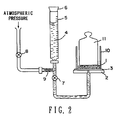
- reference numeral 1 indicates a highly water-absorptive polymer (composition) (1 g); reference numeral 2, a support plate with a small hole; reference numeral 3, a nonwoven fabric; reference numeral 4, artificial urine; reference numeral 5, a burette; reference numeral 6, a rubber stopper; reference numerals 7 and 8, valves; reference numeral 9, an air inlet; reference numeral 10, a guide; and reference numeral 11, a weight.
- Any highly water-absorptive polymer can be used, irrespective of the type of the polymer and the polymerization method for preparing the polymer, as the highly water-absorptive polymer for use in the present invention, as long as it has a crosslinked structure, and comprises as its constituent a carboxyl group and/or carboxylate group.
- Such a polymer include a crosslinked polyacrylic acid salt, a crosslinked graft copolymer of starch and an acrylic acid salt, a saponified product of a crosslinked starch-acrylonitrile graft copolymer, a saponified product of a crosslinked acrylic ester-vinyl acetate copolymer, a crosslinked acrylic acid salt-acrylamide copolymer, and a saponified product of a crosslinked polyacrylonitrile.
- polyethylene oxide crosslinked with acrylic acid a crosslinked sodium carboxymethyl cellulose, a crosslinked copolymer of a salt of maleic anhydride and isobutylene, and a copolymer of an acrylic acid salt and a comonomer such as a maleic acid salt, an itaconic acid salt, a salt of 2-acrylamide-2-methylsulfonate, 2-acryloylethanesulfonic acid or 2-hydroxyethyl acrylate
- the carboxylate group contained in the highly water-absorptive polymer may be of the type of an alkali metal salt, an alkaline earth metal salt, an ammonium salt, or the like. Of these, an alkali metal salt is preferred.
- the above-described highly water-absorptive polymer can be obtained, in general, by polymerizing a polymerizable monomer having a carboxyl group and/or a carboxylate group, such as acrylic acid (or a salt thereof) or maleic anhydride (or a salt thereof) in the presence or absence of water, a radical polymerization initiator and a crosslinking agent by a known method such as an aqueous solution polymerization method, a solution polymerization method, or a reverse-phase suspension polymerization method.
- the polymer can be obtained by any one of the methods described in Japanese Patent Kokoku Publication No. 60-25045, Japanese Patent Application No. 59-210198, Japanese Patent Kokai Publications Nos.
- the crosslinking conducted during the polymerization is the internal crosslinking of the highly water-absorptive polymer, and it is different from the crosslinking which will be described later in the surface treatment of the polymer in both the operation and the nature.
- the internal crosslinking is to uniformly crosslink the inner portion of the polymer by uniformly dispersing a crosslinking agent in the monomer or polymer either before or during the polymerization.
- crosslinking agent use may be made of a compound which has two or more double bonds in its molecule and is copolymerizable with the polymerizable monomer; or a compound which has two or more functional groups in its molecule, which groups can react with a functional group such as a carboxyl group and/or carboxylate group contained in the polymerizable monomer, during the polymerization or in the treatment after the polymerization such as drying of the polymer.
- Examples of a crosslinking agent of the former type include N,N-methylene-bis(meth)acrylamide, ethylene glycol di(meth)acrylate, diethylene glycol di(meth)acrylate, polyethylene glycol di(meth)acrylate, propylene glycol di(meth)acrylate, polypropylene glycol di(meth)acrylate, diallyl phthalate, diallyl maleate, diallyl terephthalate, triallyl cyanurate, triallyl isocyanurate and triallyl phosphate.
- crosslinking agent of the latter type examples include ethylene glycol diglycidyl ether, polyethylene glycol glycidyl ether, and a di- or polyglycidyl ether of an aliphatic polyhydric alcohol.
- N-methylol acrylamide and glycidyl (meth)acrylate can be mentioned as crosslinking agents which have the functions both of the former and the latter types.
- the above-described highly water-absorptive polymer is, in general, obtained as a water-containing gel.
- This water-containing gel is usually dehydrated as it is, or by azeotropy with an inert solvent, and finally dried.
- the resultant is subjected, according to necessity, to pulverization, classification or the like to obtain a final product.
- the highly water-absorptive polymer for use in the present invention may be one which has undergone a surface crosslinking or modification treatment during the above-described production processes, or after the final product is obtained.
- Any crosslinking agent can be used for the surface crosslinking of the highly water-absorptive polymer as long as it has two or more functional groups which can react with a carboxyl group and/or a carboxylate group.
- a polydiglycidyl ether compound, a haloepoxy compound, an aldehyde compound, an isocyanate compound or the like can be used as the crosslinking agent, and a polydiglycidyl ether compound is commonly used.
- the amount of the crosslinking agent used In general, however, it is used in the range of 0.005 to 5.0% by weight based on the polymer.
- silane compound represented by the following general formula: X(R) m Si(Y) 3-m wherein X represents a functional group which can react with the carboxyl group and/or the carboxylate group contained in the highly water-absorptive polymer, R represents a hydrocarbon group, Y represents a hydrolyzable group, and m is 0, 1 or 2.
- silane compound having the above formula examples include ⁇ -glycidoxypropyltrimethoxysilane, ⁇ -glycidoxypropylmethyldiethoxysilane, ⁇ -(3,4-epoxycyclohexyl)ethyltrimethoxysilane, ⁇ -(2-aminoethyl)aminopropyltrimethoxysilane, ⁇ -(2-aminoethyl)aminopropylmethyldimethoxysilane, ⁇ -aminopropyltriethoxysilane, N-phenyl- ⁇ -aminopropyltrimethoxysilane, ⁇ -mercaptopropyltrimethoxysilane, ⁇ -mercaptopropylmethyldimethoxysilane, ⁇ -chloropropyltrimethoxysilane, ⁇ -chloropropylmethyldimethoxysilane and octadecyldimethyl[3
- the mean particle diameter of the highly water-absorptive polymer for use in the present invention is, in general, from 10 to 2,000 ⁇ m, preferably from 50 to 1,000 ⁇ m.
- Oxalic acid, or any metallic salt, double salt or organic compound based on oxalic acid can be used as the oxalic acid (salt) compound for use in the present invention.
- a compound include oxalic acid, sodium oxalate, ammonium oxalate, zinc oxalate, potassium zinc oxalate, aluminum oxalate, ammonium aluminum oxalate, sodium aluminum oxalate, potassium antimony oxalate, uranyl oxalate, ammonium uranyl oxalate, potassium uranyl oxalate, calcium oxalate, silver oxalate, chromium oxalate, potassium chromium oxalate, cobalt oxalate, zirconium oxalate, mercury oxalate, ammonium mercury oxalate, ammonium hydrogenoxalate, potassium hydrogenoxalate, sodium hydrogenoxalate,
- oxalic acid (salt) compounds can be used either singly or in combination of two or more.
- oxalic acid, potassium oxalate, sodium oxalate, potassium oxalate titanate, sodium oxalate titanate and ammonium oxalate titanate are particularly preferred.
- the amount of the oxalic acid (salt) compound used varies depending upon the type, properties and mean particle diameter of the highly water-absorptive polymer used. However, in general, it is from 0.05 to 10 parts by weight, preferably from 0.1 to 5 parts by weight per 100 parts by weight of the highly water-absorptive polymer.
- the oxalic acid (salt) compound is used in combination with a polyvalent metal compound as described later, the total amount of the two should fall within the above ranges. In the case where the above amount is less than 0.05 parts by weight, the intended effects cannot be sufficiently attained. On the other hand, the use of an amount in excess of 10 parts by weight will not appreciably increase the intended effects,
- oxalic acid (salt) compounds are in the state of powder at room temperature under normal pressure.
- the mean particle diameter thereof be as small as 10 ⁇ m or less, particularly 1 ⁇ m or less.
- any metallic salt, double salt or organic compound based on a metal having a valence of 2 or more can be used as the polyvalent metal compound.
- the polyvalent metal compound when used in the present invention, it should be used together with the above oxalic acid (salt) compound.
- oxides and sulfates are preferred.
- Such compounds include silicon oxide, magnesium oxide, aluminum oxide, calcium oxide, titanium oxide, vanadium oxide, chromium oxide, manganese oxide, iron oxide, nickel oxide, cobalt oxide, copper oxide, zinc oxide, zirconium oxide, tungsten oxide, magnesium sulfate, calcium sulfate, aluminum sulfate, barium sulfate, titanium sulfate, titanyl sulfate, zirconium sulfate, vanadium sulfate, vanadyl sulfate, chromium sulfate, manganese sulfate, iron sulfate, cobalt sulfate, nickel sulfate, copper sulfate, zinc sulfate and aluminum sulfate.
- oxides and sulfates of a metal selected from silicon, titanium, zirconium and vanadium such as silicon oxide, titanium oxide, vanadium oxide, zirconium oxide, titanium sulfate, titanyl sulfate, zirconium sulfate and vanadyl sulfate are particularly preferred in the present invention.
- the above polyvalent metal compound is used in such an amount that the total amount of the polyvalent metal compound and the oxalic acid (salt) compound is from 0.05 to 10 parts by weight, preferably from 0.1 to 5 parts by weight per 100 parts by weight of the highly water-absorptive polymer.
- the blend ratio (weight basis) of the oxalic acid (salt) compound to the polyvalent metal compound is from 10:90 to 90:10, preferably from 30:70 to 70:30.
- the mean particle diameter of the powder be as small as 10 ⁇ m or less, particularly 1 ⁇ m or less.
- the metal sulfate for use in the present invention is a sulfate of a metal selected from titanium, zirconium and vanadium. Specific examples include titanium sulfate, titanyl sulfate, zirconium sulfate and vanadyl sulfate. Sulfates of a polyvalent metal other than the above-mentioned ones, for example, a divalent metal such as magnesium, calcium, barium or zinc, or a trivalent metal such as aluminum or iron can only produce very small effects, so that they cannot attain the object of the present invention.
- the amount of the metal sulfate to be used varies depending upon the type, properties, and mean particle diameter of the highly water-absorptive polymer used. However, it is generally from 0.05 to 10 parts by weight, preferably from 0.1 to 5 parts by weight per 100 parts by weight of the highly water-absorptive polymer. When the amount is less than 0.05 parts by weight, the intended effects cannot be attained sufficiently. On the other hand, even when the amount is in excess of 10 parts by weight, the effects attained are not significantly enhanced.
- the mean particle diameter be as small as 10 ⁇ m or less, particularly 1 ⁇ m or less.
- the high-purity particulate titania for use in the present invention is limited to one having a specified large specific surface area, being noncrystalline or having a specific crystal structure.
- the high-purity particulate titania is one having a mean particle diameter of 1 ⁇ m or less, preferably 0.01 to 0.1 ⁇ m, and a specific surface area of 10 m2/g or more, preferably 30 m2/g or more as determined by the Brunauer-Emmett-Teller method, being a crystalline compound having a crystal structure of a mixed type of rutile and anatase, or a noncrystalline compound.
- the constitution ratio (weight basis) of the rutile type to the anatase type be from 90/10 to 10/90, particularly from 80/20 to 20/80.
- the term "high-purity" used with respect to the titania means that the pure titania content is 99% or more.
- the highly water-absorptive polymer composition of the present invention may be produced in such a manner that a predetermined amount of the oxalic acid (salt) compound, a mixture of the oxalic acid (salt) compound and the polyvalent metal compound, the metal sulfate, or the high-purity particulate titania is added to and uniformly mixed with the highly water-absorptive polymer.
- the mixing may be conducted by any conventionally known method or means. It can be readily conducted by using a mixing apparatus that is usually employed for the mixing of powders, for example, a tank-type mixer having agitation elements, a fluid mixer, an air stream-type mixer, a vibrating mixer or a high-speed rotary paddle agitator.
- the above additive can be added to and dispersed in the highly water-absorptive polymer during the step of polymerization, aging, dehydration, surface modification or granulation of the polymer.
- the temperature at which the polymer and the additive are mixed is, in general, from room temperature to 150°C, preferably from room temperature to 50°C.
- Any organic titanium compound having a reactive alkoxy group in its molecule can be used as the alkoxytitanium for use in the method of the present invention.
- alkoxytitanium examples include tetramethoxytitanium, tetraethoxytitanium, tetraisopropoxytitanium, tetrabutoxytitanium, tetrakis(2-ethylhexyloxy)titanium, tetrastearyloxytitanium, a tetraisopropoxytitanium polymer, a tetrabutoxytitanium polymer, diisopropoxybis(acetylacetonat)titanium, dibutoxybis(triethanolaminat)titanium, tributoxytitanium stearate, dihydroxybis(lactat)titanium and diisopropoxytitanium distearate. These compounds can be used either singly or in combination of two or more. Of these compounds, tetraisopropoxytitanium and dibutoxybis(triethanolaminat)titanium are preferred.
- the amount of the alkoxytitanium used in the present invention varies depending upon the type of the polymer used. However, it is generally from 0.001 to 10% by weight, preferably from 0.05 to 3% by weight based on the polymer. When this amount is less than 0.001%, the stability of the highly water-absorptive polymer gel to body fluids cannot be sufficiently improved. On the other hand, when the amount is in excess of 10% by weight, the water absorption capacity of the highly water-absorptive polymer is impaired.
- the treatment of a highly water-absorptive polymer with an alkoxytitanium according to the method of the present invention can be conducted in various manners. For example, it can be conducted by a wet method in which an alkoxytitanium is added to a slurry of a highly water-absorptive polymer in a solvent, or by a dry method in which an alkoxytitanium is sprayed with dry air or nitrogen gas over a highly water-absorptive polymer while forcedly stirring the polymer.
- Any inert solvent selected from hydrocarbons, alcohols and ethers can be used as the solvent for use in the above-described wet method.
- the treatment with an alkoxytitanium according to the present invention is generally conducted to a water-containing polymer, it can also be conducted to a dry polymer.
- the treatment temperature is, in general, from 10 to 180°C, preferably from 80 to 120°C.
- a highly water-absorptive polymer (composition) 1 was placed on a nonwoven fabric 3 spread over a support plate 2 having a small hole, and brought into contact with the above-described artificial urine as shown in Fig. 1.
- the rate of water absorption was determined as the amount of the artificial urine absorbed in the highly water-absorptive polymer 1 for the first 10 minutes.
- Measurement was carried out by using the device shown in Fig. 2.
- 1.0 g of a highly water-absorptive polymer (composition) 1 was placed on a nonwoven fabric 3 spread over a support plate 2 having a small hole, and a guide 10 was provided around the sample polymer.
- a weight 11 (corresponding to 12 g/cm2) was placed on the highly water-absorptive polymer 1.
- the polymer 1 was brought into contact with the above-described artificial urine as shown in Fig. 2.
- the rate of water absorption (under pressure) was determined as the amount of the artificial urine absorbed in the highly water-absorptive polymer 1 for the first 10 minutes.
- the content of the 2000 ml beaker was added to the content of the four-necked round flask, followed by mixing under agitation.
- the internal temperature of the flask was raised in an oil bath while bubbling nitrogen gas. After the internal temperature reached approximately 60°C, it rose rapidly and finally reached 75°C after several tens of minutes. While the internal temperature of the flask was maintained at 60 to 65°C, reaction was carried out for 3 hours with stirring at 145 rpm. When the stirring was stopped, wet polymer particles settled down on the bottom of the round flask. These particles could be easily separated from the cyclohexane phase by decantation.
- the separated wet polymer was transferred into a vacuum dryer, and heated to a temperature of 90°C to remove the extraneous cyclohexane and water therefrom, whereby 400 g of a highly water-absorptive polymer was obtained as a dry powder.
- a crosslinked polyacrylic acid salt "Alialic CAW-4" manufactured by Nippon Shokubai Kagaku Kogyo Co., Ltd., was used as the highly water-absorptive polymer (D).
- High-purity particulate titania was added to and uniformly mixed with each of the above-described highly water-absorptive polymers (A), (B), (C) and (D), thereby obtaining highly water-absorptive polymer compositions.
- the types of the polymers used, and the results of the measurements are shown in Tables I-2 and I-3, respectively.
- a metal sulfate was added to and uniformly mixed with each of the above-described highly water-absorptive polymers (A), (B), (C) and (D) in a twin-cylinder mixer (Model "S-5", manufactured by Tsutsui Rikagaku Kikai Co., Ltd.) at room temperature for 30 minutes, whereby highly water-absorptive polymer compositions were obtained.
- An oxalic acid (salt) compound and a polyvalent metal compound were added to and uniformly mixed with each of the above-described highly water-absorptive polymers (A), (B), (C) and (D) in a twin-cylinder mixer (Model "S-5", manufactured by Tsutsui Rikagaku Kikai Co., Ltd.) at room temperature for 30 minutes, whereby highly water-absorptive polymer compositions were obtained.
- Titania 1 "Titanium Oxide P-25" manufactured by Nippon Aerosil Co., Ltd., having a mean particle diameter of 0.021 ⁇ m and a specific surface area of 50 m2/g.
- Titania 2 “Taipake R-780" manufactured by Ishihara Kogyo Co., Ltd., having a mean particle diameter of 0.25 ⁇ m.
- Titania 3 "Kronos KR-460" manufactured by Titan Kogyo Kabushiki Kaisha, having a mean particle diameter of 0.2 to 0.4 ⁇ m.
- Silica 1 "Aerosil #380" manufactured by Nippon Aerosil Co., Ltd., having a mean particle diameter of 0.007 ⁇ m and a specific surface area of 380 m2/g.
- Silica 2 “Silysia #770" manufactured by Fuji-silysia Chemical, Ltd., having a mean particle diameter of 6.0 ⁇ m and a specific surface area of 700 m2/g.
- Silica 3) "Carplex CS-500" manufactured by Shionogi & Co., Ltd., having a mean particle diameter of 2.1 ⁇ m.
- Zirconium oxide 1 Zirconium oxide manufactured by Nippon Aerosil Co., Ltd., having a mean particle diameter of 0.03 ⁇ m and a specific surface area of 40 m2/g.
- Zirconium oxide 2 Guaranteed reagent manufactured by Wako Pure Chemical Industries, Ltd.
- Alumina 1 "Aluminum Oxide C” manufactured by Nippon Aerosil Co., Ltd., having a mean particle diameter of 0.013 ⁇ m and a specific surface area of 100 m2/g.
- Alumina 2 Guaranteed reagent manufactured by Wako Pure Chemical Industries, Ltd.
- tetraisopropoxytitanium was added to a slurry consisting of 100 g of the highly water-absorptive polymer (A) and 100 g of cyclohexane at a temperature of 10°C with stirring, followed by mixing for 30 minutes. Subsequently, the resulting mixture was dried at a bath temperature of 105°C under reduced pressure for 30 minutes to obtain a highly water-absorptive polymer.
- tetraisopropoxytitanium was added to a slurry consisting of 100 g of the highly water-absorptive polymer (A) and 100 g of cyclohexane at a temperature of 10°C with stirring, followed by mixing for 30 minutes. Subsequently, the resulting mixture was dried at a bath temperature of 105°C under reduced pressure for 30 minutes to obtain a highly water-absorptive polymer.
- tetraisopropoxytitanium was added to a slurry consisting of 100 g of the highly water-absorptive polymer (B) and 100 g of cyclohexane at a temperature of 10°C with stirring, followed by mixing for 30 minutes. Subsequently, the resulting mixture was dried at a bath temperature of 105°C under reduced pressure for 30 minutes to obtain a highly water-absorptive polymer.
Landscapes
- Chemical & Material Sciences (AREA)
- Health & Medical Sciences (AREA)
- Chemical Kinetics & Catalysis (AREA)
- Organic Chemistry (AREA)
- Polymers & Plastics (AREA)
- Medicinal Chemistry (AREA)
- Engineering & Computer Science (AREA)
- Life Sciences & Earth Sciences (AREA)
- Animal Behavior & Ethology (AREA)
- General Health & Medical Sciences (AREA)
- Public Health (AREA)
- Veterinary Medicine (AREA)
- Epidemiology (AREA)
- Materials Engineering (AREA)
- Hematology (AREA)
- Dispersion Chemistry (AREA)
- Compositions Of Macromolecular Compounds (AREA)
- Absorbent Articles And Supports Therefor (AREA)
Applications Claiming Priority (15)
| Application Number | Priority Date | Filing Date | Title |
|---|---|---|---|
| JP12067893 | 1993-04-23 | ||
| JP12067893A JP3281110B2 (ja) | 1993-04-23 | 1993-04-23 | 高吸水性ポリマー組成物 |
| JP120678/93 | 1993-04-23 | ||
| JP213928/93 | 1993-08-30 | ||
| JP21392893A JP3330689B2 (ja) | 1993-08-30 | 1993-08-30 | ゲル強度の改良された高吸水性ポリマーの製造方法 |
| JP21392893 | 1993-08-30 | ||
| JP289699/93 | 1993-10-15 | ||
| JP28969993 | 1993-10-15 | ||
| JP28969993A JP3340821B2 (ja) | 1993-10-15 | 1993-10-15 | 高吸水性ポリマー組成物 |
| JP28270893 | 1993-11-11 | ||
| JP282708/93 | 1993-11-11 | ||
| JP28270893A JPH07145326A (ja) | 1993-11-11 | 1993-11-11 | 体液吸収後のゲルの安定性が改善された高吸水性ポリマー組成物 |
| JP1967794 | 1994-02-16 | ||
| JP01967794A JP3330716B2 (ja) | 1994-02-16 | 1994-02-16 | 高吸水性ポリマー組成物 |
| JP19677/94 | 1994-02-16 |
Publications (2)
| Publication Number | Publication Date |
|---|---|
| EP0621041A1 true EP0621041A1 (fr) | 1994-10-26 |
| EP0621041B1 EP0621041B1 (fr) | 2002-09-11 |
Family
ID=27520161
Family Applications (1)
| Application Number | Title | Priority Date | Filing Date |
|---|---|---|---|
| EP94106332A Expired - Lifetime EP0621041B1 (fr) | 1993-04-23 | 1994-04-22 | Polymères absorbant l'eau ayant une force de gel augmentée |
Country Status (4)
| Country | Link |
|---|---|
| US (1) | US5973042A (fr) |
| EP (1) | EP0621041B1 (fr) |
| CN (1) | CN1074018C (fr) |
| DE (1) | DE69431321T2 (fr) |
Cited By (13)
| Publication number | Priority date | Publication date | Assignee | Title |
|---|---|---|---|---|
| EP0856528A1 (fr) * | 1997-01-31 | 1998-08-05 | Kao Corporation | Compositon de résine superabsorbante et son procédé de fabrication |
| US5849816A (en) * | 1994-08-01 | 1998-12-15 | Leonard Pearlstein | Method of making high performance superabsorbent material |
| EP0889063A1 (fr) * | 1997-07-03 | 1999-01-07 | Kao Corporation | Composition de résine superabsorbante |
| EP1090943A3 (fr) * | 1999-10-08 | 2002-04-24 | Atofina Chemicals, Inc. | Préparation de polyesters par polycondensation ou par d'autres procédés d'estérification en utilisant des titanyloxalates comme catalyseur |
| WO2005108472A1 (fr) * | 2004-05-07 | 2005-11-17 | Nippon Shokubai Co., Ltd. | Agent d'absorption d'eau et procédé de fabrication de celui-ci |
| WO2006058683A3 (fr) * | 2004-11-30 | 2007-01-25 | Basf Ag | Sulfates metalliques insolubles contenus dans des particules polymeres absorbant l'eau |
| US7169843B2 (en) | 2003-04-25 | 2007-01-30 | Stockhausen, Inc. | Superabsorbent polymer with high permeability |
| EP1132431A4 (fr) * | 1998-11-13 | 2007-05-02 | Mitsui Chemicals Inc | Dispersion aqueuse d'un polymere organique et de fines particules inorganiques, ayant une excellente stabilite de dispersion, et utilisation correspondante |
| US8952116B2 (en) | 2009-09-29 | 2015-02-10 | Nippon Shokubai Co., Ltd. | Particulate water absorbent and process for production thereof |
| US9062140B2 (en) | 2005-04-07 | 2015-06-23 | Nippon Shokubai Co., Ltd. | Polyacrylic acid (salt) water-absorbent resin, production process thereof, and acrylic acid used in polymerization for production of water-absorbent resin |
| US9090718B2 (en) | 2006-03-24 | 2015-07-28 | Nippon Shokubai Co., Ltd. | Water-absorbing resin and method for manufacturing the same |
| WO2016154205A1 (fr) * | 2015-03-24 | 2016-09-29 | Dura Chemicals, Inc. | Siccatifs, compositions comprenant des siccatifs et procédés de fabrication et d'utilisation associés |
| US9926449B2 (en) | 2005-12-22 | 2018-03-27 | Nippon Shokubai Co., Ltd. | Water-absorbent resin composition, method of manufacturing the same, and absorbent article |
Families Citing this family (19)
| Publication number | Priority date | Publication date | Assignee | Title |
|---|---|---|---|---|
| US6887559B1 (en) * | 1999-10-01 | 2005-05-03 | Cabot Corporation | Recording medium |
| US7732050B2 (en) * | 2001-05-16 | 2010-06-08 | Kao Corporation | Silicone-modified water-absorbing polymer particles and method for producing the same |
| JP4060167B2 (ja) * | 2002-11-14 | 2008-03-12 | 花王株式会社 | 化粧料組成物 |
| JP4776969B2 (ja) * | 2004-05-07 | 2011-09-21 | 株式会社日本触媒 | 吸水剤およびその製造方法 |
| US20050288182A1 (en) * | 2004-06-18 | 2005-12-29 | Kazushi Torii | Water absorbent resin composition and production method thereof |
| DE102005018924A1 (de) * | 2005-04-22 | 2006-10-26 | Stockhausen Gmbh | Wasserabsorbierende Polymergebilde mit verbesserten Absorptionseigenschaften |
| JP5222721B2 (ja) * | 2005-04-22 | 2013-06-26 | エフォニック ストックハウゼン ゲーエムベーハー | 高吸収性を有する吸水性ポリマー構造体 |
| DE102006019157A1 (de) * | 2006-04-21 | 2007-10-25 | Stockhausen Gmbh | Herstellung von hochpermeablen, superabsorbierenden Polymergebilden |
| US8907017B2 (en) | 2006-04-21 | 2014-12-09 | Evonik Degussa Gmbh | Water-absorbing polymer structure having improved permeability and absorption under pressure |
| WO2008009612A1 (fr) * | 2006-07-19 | 2008-01-24 | Basf Se | Procédé de production de particules absorbant l'eau présentant une perméabilité élevée grâce à la polymérisation de goutellettes d'une solution monomère |
| US8613834B2 (en) | 2008-04-03 | 2013-12-24 | Basf Se | Paper coating or binding formulations and methods of making and using same |
| US8648018B2 (en) * | 2009-03-12 | 2014-02-11 | Conocophillips Company | Crosslinked swellable polymer |
| MX2011013343A (es) * | 2009-06-10 | 2012-04-30 | Conocophillips Company Ip Services Group | Polimero expandible con sitios anionicos. |
| WO2010147901A1 (fr) * | 2009-06-15 | 2010-12-23 | Conocophillips Company-Ip Services Group | Polymère gonflable, comportant des sites cationiques |
| KR20150064649A (ko) | 2013-12-03 | 2015-06-11 | 주식회사 엘지화학 | 고흡수성 수지의 제조방법 |
| EP3078679B1 (fr) * | 2013-12-03 | 2022-08-17 | LG Chem, Ltd. | Polymère superabsorbant et procédé de préparation |
| KR101680830B1 (ko) | 2013-12-06 | 2016-11-29 | 주식회사 엘지화학 | 고흡수성 수지 및 이의 제조방법 |
| TWI745755B (zh) * | 2019-09-27 | 2021-11-11 | 臺灣塑膠工業股份有限公司 | 吸水性樹脂組成物、吸水性樹脂及其製造方法 |
| CN114940775B (zh) * | 2022-06-30 | 2023-05-26 | 广州工程技术职业学院 | 丙烯酸盐聚合物材料的修复方法 |
Citations (5)
| Publication number | Priority date | Publication date | Assignee | Title |
|---|---|---|---|---|
| US4286082A (en) * | 1979-04-06 | 1981-08-25 | Nippon Shokubai Kagaku Kogyo & Co., Ltd. | Absorbent resin composition and process for producing same |
| FR2559158A1 (fr) * | 1984-02-04 | 1985-08-09 | Arakawa Chem Ind | Procede de preparation de resines absorbant l'eau et possedant des proprietes ameliorees a cet egard |
| JPS63105064A (ja) * | 1986-10-22 | 1988-05-10 | Nippon Synthetic Chem Ind Co Ltd:The | 高吸水性樹脂組成物 |
| US4954562A (en) * | 1986-04-21 | 1990-09-04 | American Colloid Company | Water absorbent resins |
| EP0521355A1 (fr) * | 1991-06-20 | 1993-01-07 | Mitsubishi Chemical Corporation | Procédé pour la production de polymères à absorption d'eau élevée |
Family Cites Families (28)
| Publication number | Priority date | Publication date | Assignee | Title |
|---|---|---|---|---|
| US3178389A (en) * | 1962-04-19 | 1965-04-13 | Goodrich Co B F | Non-scorching curable carboxylic polymer compositions |
| US3402137A (en) * | 1966-02-01 | 1968-09-17 | Union Oil Co | Method of preparing aqueous polymer solutions |
| US3790514A (en) * | 1966-04-29 | 1974-02-05 | American Cyanamid Co | Amphoteric strengthening agents for paper |
| US3660134A (en) * | 1969-10-30 | 1972-05-02 | Freeport Sulphur Co | Inorganic materials surface reacted with organo titanium compounds |
| US3781948A (en) * | 1971-11-01 | 1974-01-01 | W Pitt | Split lid casket |
| US3948841A (en) * | 1972-05-22 | 1976-04-06 | Karel Dusek | Process for producing transparent gels with improved mechanical and sorption properties from copolymers of 2-hydroxyethyl methacrylate and amides of acrylic or methacrylic acid |
| US3867329A (en) * | 1972-08-25 | 1975-02-18 | Polysciences Inc | Composition for a hydrogel dilator article of manufacture and method for making same |
| US4090013A (en) * | 1975-03-07 | 1978-05-16 | National Starch And Chemical Corp. | Absorbent composition of matter |
| US4043952A (en) * | 1975-05-09 | 1977-08-23 | National Starch And Chemical Corporation | Surface treatment process for improving dispersibility of an absorbent composition, and product thereof |
| US4025483A (en) * | 1975-10-06 | 1977-05-24 | Scm Corporation | Stabilizing aqueous titanium dioxide pigment slurries by blending therewith plastic particles |
| US4137182A (en) * | 1977-06-20 | 1979-01-30 | Standard Oil Company (Indiana) | Process for fracturing well formations using aqueous gels |
| US4250070A (en) * | 1978-01-26 | 1981-02-10 | Basf Aktiengesellschaft | Aqueous dispersions, containing hydrazine derivatives, of carbonyl-containing copolymers |
| US4283387A (en) * | 1979-11-08 | 1981-08-11 | Young, Prussin, Mgk, J.V. | Adherent controlled release pesticide |
| DE3103463A1 (de) * | 1981-02-02 | 1982-08-26 | Basf Ag, 6700 Ludwigshafen | Verwendung von emulsionscopolymerisaten auf basis von acrylaten als alleiniges bindemittel fuer papierstreichmassen |
| US4407991A (en) * | 1981-05-20 | 1983-10-04 | The Dow Chemical Company | Oxalic acid stabilized thermosettable vinyl ester resins |
| US4552938A (en) * | 1981-10-26 | 1985-11-12 | American Colloid Company | Process for preparing dry solid water absorbing polyacrylate resin |
| US4525527A (en) * | 1982-01-25 | 1985-06-25 | American Colloid Company | Production process for highly water absorbable polymer |
| US4539348A (en) * | 1982-12-16 | 1985-09-03 | Celanese Corporation | Water-swellable crosslinked polymeric microgel particles and aqueous dispersions of organic film-forming resins containing the same |
| US4863989A (en) * | 1986-06-04 | 1989-09-05 | Seitetsu Kagaku Co., Ltd. | Water-absorbent resin composition |
| US4753829A (en) * | 1986-11-19 | 1988-06-28 | Basf Corporation | Opalescent automotive paint compositions containing microtitanium dioxide pigment |
| US5013769A (en) * | 1988-08-22 | 1991-05-07 | Medipro Sciences Limited | Method of making a hydrogel-forming wound dressing or skin coating material |
| US4917186A (en) * | 1989-02-16 | 1990-04-17 | Phillips Petroleum Company | Altering subterranean formation permeability |
| IL93620A0 (en) * | 1989-03-09 | 1990-12-23 | Butterfly Srl | Biodegradable articles based on starch and process for producing them |
| JPH0710922B2 (ja) * | 1989-04-26 | 1995-02-08 | 日本合成化学工業株式会社 | 高吸水性樹脂の造粒方法 |
| US5082056A (en) * | 1990-10-16 | 1992-01-21 | Marathon Oil Company | In situ reversible crosslinked polymer gel used in hydrocarbon recovery applications |
| JPH0521355A (ja) * | 1991-07-09 | 1993-01-29 | Toshiba Corp | 気相成長方法 |
| CA2074235C (fr) * | 1991-07-18 | 2000-02-08 | Hiroshi Itoh | Composition durcissable, gel aqueux et leurs applications |
| GB9127293D0 (en) * | 1991-12-23 | 1992-02-19 | Ici Plc | Coating pigment particles with polymers |
-
1994
- 1994-04-22 EP EP94106332A patent/EP0621041B1/fr not_active Expired - Lifetime
- 1994-04-22 DE DE69431321T patent/DE69431321T2/de not_active Expired - Lifetime
- 1994-04-23 CN CN94105154A patent/CN1074018C/zh not_active Expired - Lifetime
-
1996
- 1996-06-11 US US08/664,311 patent/US5973042A/en not_active Expired - Lifetime
Patent Citations (5)
| Publication number | Priority date | Publication date | Assignee | Title |
|---|---|---|---|---|
| US4286082A (en) * | 1979-04-06 | 1981-08-25 | Nippon Shokubai Kagaku Kogyo & Co., Ltd. | Absorbent resin composition and process for producing same |
| FR2559158A1 (fr) * | 1984-02-04 | 1985-08-09 | Arakawa Chem Ind | Procede de preparation de resines absorbant l'eau et possedant des proprietes ameliorees a cet egard |
| US4954562A (en) * | 1986-04-21 | 1990-09-04 | American Colloid Company | Water absorbent resins |
| JPS63105064A (ja) * | 1986-10-22 | 1988-05-10 | Nippon Synthetic Chem Ind Co Ltd:The | 高吸水性樹脂組成物 |
| EP0521355A1 (fr) * | 1991-06-20 | 1993-01-07 | Mitsubishi Chemical Corporation | Procédé pour la production de polymères à absorption d'eau élevée |
Non-Patent Citations (1)
| Title |
|---|
| DATABASE WPI Week 8824, Derwent World Patents Index; AN 88-165812 * |
Cited By (22)
| Publication number | Priority date | Publication date | Assignee | Title |
|---|---|---|---|---|
| US5849816A (en) * | 1994-08-01 | 1998-12-15 | Leonard Pearlstein | Method of making high performance superabsorbent material |
| EP0856528A1 (fr) * | 1997-01-31 | 1998-08-05 | Kao Corporation | Compositon de résine superabsorbante et son procédé de fabrication |
| US6448320B1 (en) | 1997-01-31 | 2002-09-10 | Kao Corporation | Superabsorbent resin composition and method for producing the same |
| EP0889063A1 (fr) * | 1997-07-03 | 1999-01-07 | Kao Corporation | Composition de résine superabsorbante |
| US6313231B1 (en) | 1997-07-03 | 2001-11-06 | Kao Corporation | Superabsorbent resin composition |
| SG86324A1 (en) * | 1997-07-03 | 2002-02-19 | Kao Corp | Superabsorbent resin composition |
| EP1132431A4 (fr) * | 1998-11-13 | 2007-05-02 | Mitsui Chemicals Inc | Dispersion aqueuse d'un polymere organique et de fines particules inorganiques, ayant une excellente stabilite de dispersion, et utilisation correspondante |
| EP1090943A3 (fr) * | 1999-10-08 | 2002-04-24 | Atofina Chemicals, Inc. | Préparation de polyesters par polycondensation ou par d'autres procédés d'estérification en utilisant des titanyloxalates comme catalyseur |
| US7169843B2 (en) | 2003-04-25 | 2007-01-30 | Stockhausen, Inc. | Superabsorbent polymer with high permeability |
| US7795345B2 (en) | 2003-04-25 | 2010-09-14 | Evonik Stockhausen, Llc | Superabsorbent polymer with high permeability |
| WO2005108472A1 (fr) * | 2004-05-07 | 2005-11-17 | Nippon Shokubai Co., Ltd. | Agent d'absorption d'eau et procédé de fabrication de celui-ci |
| US8846823B2 (en) | 2004-05-07 | 2014-09-30 | Nippon Shokubai Co., Ltd. | Water absorbing agent and production method thereof |
| CN102875944B (zh) * | 2004-05-07 | 2015-07-08 | 株式会社日本触媒 | 一种吸水剂及其制备方法 |
| US7947771B2 (en) | 2004-11-30 | 2011-05-24 | Basf Aktiengesellschaft | Insoluble metal sulfates in water absorbing polymeric particles |
| WO2006058683A3 (fr) * | 2004-11-30 | 2007-01-25 | Basf Ag | Sulfates metalliques insolubles contenus dans des particules polymeres absorbant l'eau |
| US9062140B2 (en) | 2005-04-07 | 2015-06-23 | Nippon Shokubai Co., Ltd. | Polyacrylic acid (salt) water-absorbent resin, production process thereof, and acrylic acid used in polymerization for production of water-absorbent resin |
| US9926449B2 (en) | 2005-12-22 | 2018-03-27 | Nippon Shokubai Co., Ltd. | Water-absorbent resin composition, method of manufacturing the same, and absorbent article |
| US10358558B2 (en) | 2005-12-22 | 2019-07-23 | Nippon Shokubai Co., Ltd. | Water-absorbent resin composition, method of manufacturing the same, and absorbent article |
| US9090718B2 (en) | 2006-03-24 | 2015-07-28 | Nippon Shokubai Co., Ltd. | Water-absorbing resin and method for manufacturing the same |
| US9775927B2 (en) | 2009-09-29 | 2017-10-03 | Nippon Shokubai Co., Ltd. | Particulate water absorbent and process for production thereof |
| US8952116B2 (en) | 2009-09-29 | 2015-02-10 | Nippon Shokubai Co., Ltd. | Particulate water absorbent and process for production thereof |
| WO2016154205A1 (fr) * | 2015-03-24 | 2016-09-29 | Dura Chemicals, Inc. | Siccatifs, compositions comprenant des siccatifs et procédés de fabrication et d'utilisation associés |
Also Published As
| Publication number | Publication date |
|---|---|
| CN1074018C (zh) | 2001-10-31 |
| DE69431321D1 (de) | 2002-10-17 |
| CN1098727A (zh) | 1995-02-15 |
| US5973042A (en) | 1999-10-26 |
| EP0621041B1 (fr) | 2002-09-11 |
| DE69431321T2 (de) | 2003-05-22 |
Similar Documents
| Publication | Publication Date | Title |
|---|---|---|
| EP0621041A1 (fr) | Polymères absorbant l'eau ayant une force de gel augmentée | |
| EP0999238B1 (fr) | Résine absorbant l'eau et procédé pour sa fabrication | |
| AU2005226426B2 (en) | Particulate water absorbing agent with water-absorbing resin as main component | |
| JP5451173B2 (ja) | 吸水剤、並びに、衛生材料 | |
| US6586549B1 (en) | Water-absorbing composition and its use | |
| EP0521355A1 (fr) | Procédé pour la production de polymères à absorption d'eau élevée | |
| JP3494401B2 (ja) | 吸水剤及び吸収性物品 | |
| JP3330716B2 (ja) | 高吸水性ポリマー組成物 | |
| JPH10265582A (ja) | 吸水剤およびその製造方法 | |
| EP0945143A2 (fr) | Agent absorbant l'eau et son procédé de fabrication et utilisation | |
| JPH07145326A (ja) | 体液吸収後のゲルの安定性が改善された高吸水性ポリマー組成物 | |
| JPH09309916A (ja) | 吸水性樹脂の製造方法 | |
| JP3325806B2 (ja) | 吸水剤およびその製造方法 | |
| JP5008790B2 (ja) | 表面架橋吸水性樹脂および吸水性樹脂の表面架橋方法 | |
| JP2944447B2 (ja) | 吸水剤およびその製造方法 | |
| JP3281110B2 (ja) | 高吸水性ポリマー組成物 | |
| JP4860019B2 (ja) | 吸水剤とその製造方法および用途 | |
| JP3335721B2 (ja) | 高吸水性ポリマー組成物 | |
| EP1298162A1 (fr) | Agent de reticulation destine a une resine absorbant l'eau et materiau absorbant l'eau obtenu au moyen de cette resine | |
| JPH10298442A (ja) | 高吸水性ポリマー組成物 | |
| JP3340821B2 (ja) | 高吸水性ポリマー組成物 | |
| JPH11148023A (ja) | 高吸水性ポリマー組成物 | |
| JPH07228790A (ja) | 高吸水性ポリマーの対体液安定性を向上させる方法 | |
| JP4727005B2 (ja) | 吸水剤の製造方法 | |
| JP3375673B2 (ja) | 吸水性樹脂組成物およびその製造方法 |
Legal Events
| Date | Code | Title | Description |
|---|---|---|---|
| PUAI | Public reference made under article 153(3) epc to a published international application that has entered the european phase |
Free format text: ORIGINAL CODE: 0009012 |
|
| AK | Designated contracting states |
Kind code of ref document: A1 Designated state(s): DE GB |
|
| RAP1 | Party data changed (applicant data changed or rights of an application transferred) |
Owner name: MITSUBISHI PETROCHEMICAL COMPANY LIMITED |
|
| 17P | Request for examination filed |
Effective date: 19941208 |
|
| RAP1 | Party data changed (applicant data changed or rights of an application transferred) |
Owner name: MITSUBISHI CHEMICAL CORPORATION |
|
| 17Q | First examination report despatched |
Effective date: 19981104 |
|
| GRAG | Despatch of communication of intention to grant |
Free format text: ORIGINAL CODE: EPIDOS AGRA |
|
| GRAG | Despatch of communication of intention to grant |
Free format text: ORIGINAL CODE: EPIDOS AGRA |
|
| GRAH | Despatch of communication of intention to grant a patent |
Free format text: ORIGINAL CODE: EPIDOS IGRA |
|
| GRAH | Despatch of communication of intention to grant a patent |
Free format text: ORIGINAL CODE: EPIDOS IGRA |
|
| GRAA | (expected) grant |
Free format text: ORIGINAL CODE: 0009210 |
|
| AK | Designated contracting states |
Kind code of ref document: B1 Designated state(s): DE GB |
|
| REG | Reference to a national code |
Ref country code: GB Ref legal event code: FG4D |
|
| REF | Corresponds to: |
Ref document number: 69431321 Country of ref document: DE Date of ref document: 20021017 |
|
| PLBE | No opposition filed within time limit |
Free format text: ORIGINAL CODE: 0009261 |
|
| STAA | Information on the status of an ep patent application or granted ep patent |
Free format text: STATUS: NO OPPOSITION FILED WITHIN TIME LIMIT |
|
| 26N | No opposition filed |
Effective date: 20030612 |
|
| PGFP | Annual fee paid to national office [announced via postgrant information from national office to epo] |
Ref country code: GB Payment date: 20040421 Year of fee payment: 11 |
|
| PG25 | Lapsed in a contracting state [announced via postgrant information from national office to epo] |
Ref country code: GB Free format text: LAPSE BECAUSE OF NON-PAYMENT OF DUE FEES Effective date: 20050422 |
|
| GBPC | Gb: european patent ceased through non-payment of renewal fee |
Effective date: 20050422 |
|
| PGFP | Annual fee paid to national office [announced via postgrant information from national office to epo] |
Ref country code: DE Payment date: 20130508 Year of fee payment: 20 |
|
| REG | Reference to a national code |
Ref country code: DE Ref legal event code: R071 Ref document number: 69431321 Country of ref document: DE |
|
| REG | Reference to a national code |
Ref country code: DE Ref legal event code: R071 Ref document number: 69431321 Country of ref document: DE |
|
| PG25 | Lapsed in a contracting state [announced via postgrant information from national office to epo] |
Ref country code: DE Free format text: LAPSE BECAUSE OF EXPIRATION OF PROTECTION Effective date: 20140423 |