EP0621122A1 - Procede de recyclage pour produit moule a base de particules de mousse - Google Patents
Procede de recyclage pour produit moule a base de particules de mousse Download PDFInfo
- Publication number
- EP0621122A1 EP0621122A1 EP94906732A EP94906732A EP0621122A1 EP 0621122 A1 EP0621122 A1 EP 0621122A1 EP 94906732 A EP94906732 A EP 94906732A EP 94906732 A EP94906732 A EP 94906732A EP 0621122 A1 EP0621122 A1 EP 0621122A1
- Authority
- EP
- European Patent Office
- Prior art keywords
- expanded particles
- expanded
- particles
- moldings
- resin
- Prior art date
- Legal status (The legal status is an assumption and is not a legal conclusion. Google has not performed a legal analysis and makes no representation as to the accuracy of the status listed.)
- Granted
Links
Images

Classifications
-
- B—PERFORMING OPERATIONS; TRANSPORTING
- B29—WORKING OF PLASTICS; WORKING OF SUBSTANCES IN A PLASTIC STATE IN GENERAL
- B29B—PREPARATION OR PRETREATMENT OF THE MATERIAL TO BE SHAPED; MAKING GRANULES OR PREFORMS; RECOVERY OF PLASTICS OR OTHER CONSTITUENTS OF WASTE MATERIAL CONTAINING PLASTICS
- B29B17/00—Recovery of plastics or other constituents of waste material containing plastics
- B29B17/02—Separating plastics from other materials
-
- B—PERFORMING OPERATIONS; TRANSPORTING
- B29—WORKING OF PLASTICS; WORKING OF SUBSTANCES IN A PLASTIC STATE IN GENERAL
- B29B—PREPARATION OR PRETREATMENT OF THE MATERIAL TO BE SHAPED; MAKING GRANULES OR PREFORMS; RECOVERY OF PLASTICS OR OTHER CONSTITUENTS OF WASTE MATERIAL CONTAINING PLASTICS
- B29B13/00—Conditioning or physical treatment of the material to be shaped
- B29B13/02—Conditioning or physical treatment of the material to be shaped by heating
- B29B13/022—Melting the material to be shaped
-
- B—PERFORMING OPERATIONS; TRANSPORTING
- B29—WORKING OF PLASTICS; WORKING OF SUBSTANCES IN A PLASTIC STATE IN GENERAL
- B29B—PREPARATION OR PRETREATMENT OF THE MATERIAL TO BE SHAPED; MAKING GRANULES OR PREFORMS; RECOVERY OF PLASTICS OR OTHER CONSTITUENTS OF WASTE MATERIAL CONTAINING PLASTICS
- B29B13/00—Conditioning or physical treatment of the material to be shaped
- B29B13/10—Conditioning or physical treatment of the material to be shaped by grinding, e.g. by triturating; by sieving; by filtering
-
- C—CHEMISTRY; METALLURGY
- C08—ORGANIC MACROMOLECULAR COMPOUNDS; THEIR PREPARATION OR CHEMICAL WORKING-UP; COMPOSITIONS BASED THEREON
- C08J—WORKING-UP; GENERAL PROCESSES OF COMPOUNDING; AFTER-TREATMENT NOT COVERED BY SUBCLASSES C08B, C08C, C08F, C08G or C08H
- C08J11/00—Recovery or working-up of waste materials
- C08J11/04—Recovery or working-up of waste materials of polymers
- C08J11/06—Recovery or working-up of waste materials of polymers without chemical reactions
-
- C—CHEMISTRY; METALLURGY
- C08—ORGANIC MACROMOLECULAR COMPOUNDS; THEIR PREPARATION OR CHEMICAL WORKING-UP; COMPOSITIONS BASED THEREON
- C08J—WORKING-UP; GENERAL PROCESSES OF COMPOUNDING; AFTER-TREATMENT NOT COVERED BY SUBCLASSES C08B, C08C, C08F, C08G or C08H
- C08J11/00—Recovery or working-up of waste materials
- C08J11/04—Recovery or working-up of waste materials of polymers
- C08J11/06—Recovery or working-up of waste materials of polymers without chemical reactions
- C08J11/08—Recovery or working-up of waste materials of polymers without chemical reactions using selective solvents for polymer components
-
- B—PERFORMING OPERATIONS; TRANSPORTING
- B29—WORKING OF PLASTICS; WORKING OF SUBSTANCES IN A PLASTIC STATE IN GENERAL
- B29C—SHAPING OR JOINING OF PLASTICS; SHAPING OF MATERIAL IN A PLASTIC STATE, NOT OTHERWISE PROVIDED FOR; AFTER-TREATMENT OF THE SHAPED PRODUCTS, e.g. REPAIRING
- B29C35/00—Heating, cooling or curing, e.g. crosslinking or vulcanising; Apparatus therefor
- B29C35/02—Heating or curing, e.g. crosslinking or vulcanizing during moulding, e.g. in a mould
- B29C35/04—Heating or curing, e.g. crosslinking or vulcanizing during moulding, e.g. in a mould using liquids, gas or steam
- B29C35/049—Heating or curing, e.g. crosslinking or vulcanizing during moulding, e.g. in a mould using liquids, gas or steam using steam or damp
-
- B—PERFORMING OPERATIONS; TRANSPORTING
- B29—WORKING OF PLASTICS; WORKING OF SUBSTANCES IN A PLASTIC STATE IN GENERAL
- B29K—INDEXING SCHEME ASSOCIATED WITH SUBCLASSES B29B, B29C OR B29D, RELATING TO MOULDING MATERIALS OR TO MATERIALS FOR MOULDS, REINFORCEMENTS, FILLERS OR PREFORMED PARTS, e.g. INSERTS
- B29K2023/00—Use of polyalkenes or derivatives thereof as moulding material
- B29K2023/04—Polymers of ethylene
- B29K2023/06—PE, i.e. polyethylene
-
- B—PERFORMING OPERATIONS; TRANSPORTING
- B29—WORKING OF PLASTICS; WORKING OF SUBSTANCES IN A PLASTIC STATE IN GENERAL
- B29K—INDEXING SCHEME ASSOCIATED WITH SUBCLASSES B29B, B29C OR B29D, RELATING TO MOULDING MATERIALS OR TO MATERIALS FOR MOULDS, REINFORCEMENTS, FILLERS OR PREFORMED PARTS, e.g. INSERTS
- B29K2025/00—Use of polymers of vinyl-aromatic compounds or derivatives thereof as moulding material
-
- B—PERFORMING OPERATIONS; TRANSPORTING
- B29—WORKING OF PLASTICS; WORKING OF SUBSTANCES IN A PLASTIC STATE IN GENERAL
- B29K—INDEXING SCHEME ASSOCIATED WITH SUBCLASSES B29B, B29C OR B29D, RELATING TO MOULDING MATERIALS OR TO MATERIALS FOR MOULDS, REINFORCEMENTS, FILLERS OR PREFORMED PARTS, e.g. INSERTS
- B29K2105/00—Condition, form or state of moulded material or of the material to be shaped
- B29K2105/04—Condition, form or state of moulded material or of the material to be shaped cellular or porous
-
- C—CHEMISTRY; METALLURGY
- C08—ORGANIC MACROMOLECULAR COMPOUNDS; THEIR PREPARATION OR CHEMICAL WORKING-UP; COMPOSITIONS BASED THEREON
- C08J—WORKING-UP; GENERAL PROCESSES OF COMPOUNDING; AFTER-TREATMENT NOT COVERED BY SUBCLASSES C08B, C08C, C08F, C08G or C08H
- C08J2201/00—Foams characterised by the foaming process
- C08J2201/02—Foams characterised by the foaming process characterised by mechanical pre- or post-treatments
- C08J2201/026—Crosslinking before of after foaming
-
- C—CHEMISTRY; METALLURGY
- C08—ORGANIC MACROMOLECULAR COMPOUNDS; THEIR PREPARATION OR CHEMICAL WORKING-UP; COMPOSITIONS BASED THEREON
- C08J—WORKING-UP; GENERAL PROCESSES OF COMPOUNDING; AFTER-TREATMENT NOT COVERED BY SUBCLASSES C08B, C08C, C08F, C08G or C08H
- C08J2201/00—Foams characterised by the foaming process
- C08J2201/02—Foams characterised by the foaming process characterised by mechanical pre- or post-treatments
- C08J2201/034—Post-expanding of foam beads or sheets
-
- C—CHEMISTRY; METALLURGY
- C08—ORGANIC MACROMOLECULAR COMPOUNDS; THEIR PREPARATION OR CHEMICAL WORKING-UP; COMPOSITIONS BASED THEREON
- C08J—WORKING-UP; GENERAL PROCESSES OF COMPOUNDING; AFTER-TREATMENT NOT COVERED BY SUBCLASSES C08B, C08C, C08F, C08G or C08H
- C08J2203/00—Foams characterized by the expanding agent
- C08J2203/14—Saturated hydrocarbons, e.g. butane; Unspecified hydrocarbons
- C08J2203/142—Halogenated saturated hydrocarbons, e.g. H3C-CF3
-
- C—CHEMISTRY; METALLURGY
- C08—ORGANIC MACROMOLECULAR COMPOUNDS; THEIR PREPARATION OR CHEMICAL WORKING-UP; COMPOSITIONS BASED THEREON
- C08J—WORKING-UP; GENERAL PROCESSES OF COMPOUNDING; AFTER-TREATMENT NOT COVERED BY SUBCLASSES C08B, C08C, C08F, C08G or C08H
- C08J2323/00—Characterised by the use of homopolymers or copolymers of unsaturated aliphatic hydrocarbons having only one carbon-to-carbon double bond; Derivatives of such polymers
- C08J2323/02—Characterised by the use of homopolymers or copolymers of unsaturated aliphatic hydrocarbons having only one carbon-to-carbon double bond; Derivatives of such polymers not modified by chemical after treatment
- C08J2323/04—Homopolymers or copolymers of ethene
-
- C—CHEMISTRY; METALLURGY
- C08—ORGANIC MACROMOLECULAR COMPOUNDS; THEIR PREPARATION OR CHEMICAL WORKING-UP; COMPOSITIONS BASED THEREON
- C08J—WORKING-UP; GENERAL PROCESSES OF COMPOUNDING; AFTER-TREATMENT NOT COVERED BY SUBCLASSES C08B, C08C, C08F, C08G or C08H
- C08J2423/00—Characterised by the use of homopolymers or copolymers of unsaturated aliphatic hydrocarbons having only one carbon-to-carbon double bond; Derivatives of such polymers
- C08J2423/02—Characterised by the use of homopolymers or copolymers of unsaturated aliphatic hydrocarbons having only one carbon-to-carbon double bond; Derivatives of such polymers not modified by chemical after treatment
- C08J2423/04—Homopolymers or copolymers of ethene
-
- C—CHEMISTRY; METALLURGY
- C08—ORGANIC MACROMOLECULAR COMPOUNDS; THEIR PREPARATION OR CHEMICAL WORKING-UP; COMPOSITIONS BASED THEREON
- C08J—WORKING-UP; GENERAL PROCESSES OF COMPOUNDING; AFTER-TREATMENT NOT COVERED BY SUBCLASSES C08B, C08C, C08F, C08G or C08H
- C08J9/00—Working-up of macromolecular substances to porous or cellular articles or materials; After-treatment thereof
- C08J9/16—Making expandable particles
- C08J9/18—Making expandable particles by impregnating polymer particles with the blowing agent
-
- C—CHEMISTRY; METALLURGY
- C08—ORGANIC MACROMOLECULAR COMPOUNDS; THEIR PREPARATION OR CHEMICAL WORKING-UP; COMPOSITIONS BASED THEREON
- C08J—WORKING-UP; GENERAL PROCESSES OF COMPOUNDING; AFTER-TREATMENT NOT COVERED BY SUBCLASSES C08B, C08C, C08F, C08G or C08H
- C08J9/00—Working-up of macromolecular substances to porous or cellular articles or materials; After-treatment thereof
- C08J9/22—After-treatment of expandable particles; Forming foamed products
- C08J9/224—Surface treatment
-
- C—CHEMISTRY; METALLURGY
- C08—ORGANIC MACROMOLECULAR COMPOUNDS; THEIR PREPARATION OR CHEMICAL WORKING-UP; COMPOSITIONS BASED THEREON
- C08J—WORKING-UP; GENERAL PROCESSES OF COMPOUNDING; AFTER-TREATMENT NOT COVERED BY SUBCLASSES C08B, C08C, C08F, C08G or C08H
- C08J9/00—Working-up of macromolecular substances to porous or cellular articles or materials; After-treatment thereof
- C08J9/22—After-treatment of expandable particles; Forming foamed products
- C08J9/228—Forming foamed products
- C08J9/232—Forming foamed products by sintering expandable particles
-
- Y—GENERAL TAGGING OF NEW TECHNOLOGICAL DEVELOPMENTS; GENERAL TAGGING OF CROSS-SECTIONAL TECHNOLOGIES SPANNING OVER SEVERAL SECTIONS OF THE IPC; TECHNICAL SUBJECTS COVERED BY FORMER USPC CROSS-REFERENCE ART COLLECTIONS [XRACs] AND DIGESTS
- Y02—TECHNOLOGIES OR APPLICATIONS FOR MITIGATION OR ADAPTATION AGAINST CLIMATE CHANGE
- Y02W—CLIMATE CHANGE MITIGATION TECHNOLOGIES RELATED TO WASTEWATER TREATMENT OR WASTE MANAGEMENT
- Y02W30/00—Technologies for solid waste management
- Y02W30/50—Reuse, recycling or recovery technologies
- Y02W30/62—Plastics recycling; Rubber recycling
Definitions
- the present invention relates to a process for recovering recyclable expanded particles from expanded particle moldings comprising expanded particles coated with specific interfacial material.
- the expanded particles comprise polyolefin and the like.
- Recyclable expanded particles are recovered from moldings produced thereof by the steps comprising melting, softening or dissolving the interfacial material and separating into individual particles.
- Expanded particles of synthetic resins such as polystyrene, polyethylene and polypropylene are molded in various forms and widely used as packing medium, cushioning medium and insulation. After being used, expanded particle moldings are generally crushed with a crusher and then burnt up or buried under the ground. When the resins are burnt up, environmentally harmful gases such as carbon monoxide and carbon dioxide are generated in a large amount, and resins including chloride and nitrogen generate various types of gases poisonous to living things. Also, it is necessary to secure land to bury crushed resins under the ground. For the purpose of recycling the crushed resins, expanded particle moldings produced from the same resin must be collected. It requires a great deal of labor to select resins.
- Japanese Patent Application Laid-Open Nos. 83145/1988 and 119687/1977 disclose a process for recovering recyclable resin chips from expanded particle moldings.
- the process comprises crushing expanded particle moldings comprising, for example, polystyrene or polyethylene, heat-melting the crushed expanded particle moldings to remove gas generated from the particles presenting in the melted resin, extruding the melted resin in a filament form and cutting the extruded resin into proper sizes.
- the recovered resin chips however, have the drawbacks in that moldings of good quality cannot be produced therefrom because the resin chips have lost, in the recovering process, their suitable properties for expansion due to deterioration during heating and mixing of foreign substances therewith.
- An object of the present invention is to solve the above problems and to provide a process for recovering recyclable expanded particles from used expanded particle moldings comprising synthetic resin, without producing bad effects on the environment.
- the present invention relates to a process for recovering expanded particles from expanded particle moldings comprising expanded particles of a synthetic resin coated with a thermoplastic resin (interfacial material) whose melting point is lower than that of the synthetic resin of expanded particles or whose solubility is different from that of the synthetic resin of expanded particles, which process comprises the steps of softening or melting the interfacial material by heating or dissolving it with a solvent, and separating into individual particles by applying a shearing force under circumstances such that the bond strength among the expanded particles is weakened.
- a thermoplastic resin interfacial material
- the resin suitable for recyclable expanded particles recovered from expanded particle moldings include:
- the synthetic resins used for the expanded particles in the present invention include polyolefin, copolymer of olefin and vinyl monomer, vinyl polymer, vinylidene polymer and diene polymer.
- the polyolefin includes, for example, low density polyethylene, medium density polyethylene, high density polyethylene, low density linear polyethylene, ultralow density linear polyethylene and polypropylene.
- the copolymer of olefin and vinyl monomer includes, for example, ethylene-vinyl acetate copolymer, ethylene-vinyl chloride copolymer, ethylene-ethylacrylate copolymer, ethylene-methylacrylate copolymer, propylene-ethylene copolymer, propylene-butene copolymer and propylene-1,4-methyl-pentene copolymer.
- the vinyl polymer includes, for example, polyvinyl chloride and its copolymer, polystyrene and its copolymer, and acrylonitrile-butadiene-styrene copolymer.
- the vinylidene polymer includes, for example, polyvinylidene chloride and its copolymer.
- the diene polymer includes, for example, polybutadiene and its copolymer.
- amorphous vinylidene chloride copolymers which comprise vinylidene chloride and at least one type of copolymerizable vinyl monomers with vinylidene chloride, contain 30 wt. % or more of vinylidene chloride and have a glass transition temperature of 85° C are preferred.
- the synthetic resin may be cross-linked.
- Representative examples of the cross-linked resins are cross-linked polyolefins. Of these, polyolefins satisfying condition (1) and polyvinylidene chlorides satisfying condition (2) are preferred.
- the interfacial material used in the present invention is a thermoplastic resin whose melting point or softening point is lower than that of the synthetic resin of the expanded particles or a thermoplastic resin whose solubility is different from that of the synthetic resin.
- the interfacial material preferably has a lower melting point than that of the resin of the expanded particles lower by 5° to 30° C.
- the difference in the melting point is less than 5° C, the expanded particles themselves are apt to partially melt upon the melting or softening the interfacial material. As a result, the recovered expanded particles tend to be deteriorated.
- the difference in the melting point is more than 30° C, the bond strength between the expanded particles and the interfacial material is apt to lower.
- Preferred combinations of the expanded particles and the interfacial material include low density polyethylene and an interfacial material having a lower melting point than that of the low density polyethylene by 5° to 30° C; polypropyrene and an interfacial material having a lower melting point than that of the polypropyrene by 5° to 30° C; and a random or block copolymer of propylene/vinyl monomer and an interfacial material having a lower melting point than that of the copolymer by 5° to 30° C.
- a combination of the interfacial material, the resin of expanded particles and a solvent has to be selected so as to dissolve or swell the interfacial material but not the resin of the expanded particles.
- Preferable combinations include a combination of cross-linked polyethylene, a polyurethane resin adhesive and toluene as an expanded particle, an interfacial material and a solvent, respectively; and a combination of the resin comprising vinylidene chloride, acrylonitrile and styrene in a ratio of 45/45/10 or 50/30/20 (mole %) as an expanded particle and 5 wt.
- %-methylethylketone solution of vinyl chloride (RM-5201; manufactured by Chisso Co., Ltd.), 5 wt. %-toluene solution of polymethyl methacrylate (Delpet 560F; manufactured by Asahi Chemical Industry Co., Ltd.) or acrylic aqueous emulsion (solids content of 56 wt. %) (SP210; manufactured by Konishi Co., Ltd.) as the interfacial material.
- the amount of the interfacial material based on the weight of the expanded particles is preferably in the range of 0.05 to 20 wt. %, more preferably 3 to 20 wt. %. When it is under 0.05 wt. %, it is not always sufficient to weaken the bond strength among the expanded particles. When it is over 20 wt. %, the expanded particles coated with interfacial material readily adhere each other. As a result, it is apt to be difficult to handle the particles since the expanded particles aggregate.
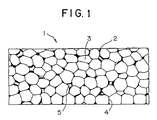
- FIG. 1 One of the expanded particle moldings used in the present invention is shown in Fig. 1.
- the expanded particles 3 coated with an interfacial material 2 form the expanded particle moldings 1 by bonding each other through the interfacial material. It is not necessary to coat the whole surface of the expanded particles with the interfacial material. There remains a portion 4 where the expanded particles directly bond each other in the expanded particle moldings.
- Void 5 is formed among the expanded particles in the moldings when there is a portion where the interfacial material is not adhered to the surface of the expanded particles.
- the void will be a path for a heating medium or a solvent when the interfacial material is softened, melted or dissolved.
- the ratio of void occupying in the expanded particle moldings is preferably in the range of 0.5 to 40 %, more preferably 3 to 30 %. When it is under 0.5 %, steam and solvents do not easily infiltrate into the inside of the moldings. When it is over 40 %, the strength of the moldings tends to lower.
- Recyclable expanded particles can be recovered from the expanded particle moldings used for packing mediums, cushioning mediums and the like according to the following method.
- the expanded particle moldings used in the present invention are composed of the expanded particles coated with interfacial material.
- shearing force is applyed to the expanded particle moldings to mechanically separate individual particles under circumstances such that the interfacial material is softened or melted by heating or dissolved with a solvent capable of dissolving the interfacial material but not the resin of the expanded particles.
- the conditions at which the interfacial material are softened, melted or dissolved are different, according to the combination of the resin of expanded particles and the interfacial material.
- the interfacial material is softened or melted, the interfacial material is preliminarily melted at various temperatures to decide a temperature at which expanded particles are separated by shearing force without mechanical damage. Melting or softening the interfacial material is preferably carried out at or below the melting point of the resin of expanded particles. Steam is preferably used as a heating medium. The steam rapidly enters the inside of the expanded particle moldings along voids therein. As a result, the interfacial material becomes soft and the bond strength among the expanded particles is weakened.
- the interfacial material When the interfacial material is dissolved, it is also necessary to preliminarily dissolve the interfacial material with various kinds of solvents and select a solvent suitable for separating the individual expanded particles.
- the interfacial material is dissolved so as to separate individual expanded particles without mechanical damage when the shearing force is applyed.
- the solvent follows along the voids in the moldings to weaken the bond strength among the expanded particles with the infiltration of the solvent.
- a melting or softening method with heat is preferred to a dissolving method with a solvent since the melting or softening method does not require waste disposal of used solvents.
- Shearing force is applyed to the expanded particle moldings whose bond strength is weakened.
- the expanded particles are separated from the surface of the expanded particle moldings one after another by touching rotating rotors or rotary brushes.
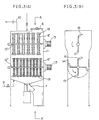
- Fig. 2 gives an example of apparatuses for separating expanded particles from expanded particle moldings by softening or melting the interfacial material.
- the expanded particle moldings are provided from a supply port 6.
- a tank 11 is heated by supplying steam from a steam tube 9.
- an agitator 12 equipped with plural propellers 8 composed of metal wings is started with a motor 13.
- An interval between the propellers near the supply port, i.e., in the upper part of the tank, is big, and the one in the lower part is small.
- Expanded particles are separated from the surface of expanded particle moldings one after another upon touching the rotating propellers.
- many projections 14 may be set up on the inside wall of the tank, or sticks 15 may be set up so as not to touch the propellers.
- the volume of the expanded particle moldings decreases gradually.
- the moldings move towards the bottom of the tank, then expanded particles are separated by rotors set up at small intervals.
- the separated expanded particles are taken out from an outlet 7.
- the outlet 7 is opened and shut by cylinder.
- the thus obtained expanded particles are put through a sieve in a receptacle 16, then moved to the next step by a transport blower 17.
- a line 20 is for introducing air to blow away the residual particles in the tank.
- the tank is preferably equipped with a thermal detector and a pressure detector to control the conditions for separation.
- the rotating speed of an agitator may be decided according to the material of the expanded particles. Preferably, it is in the range of 25 to 500 r.p.m.
- the moldings should be heated by supplying steam into the tank before the agitator is started.
- a stirring period is preferably from 2 to 10 minutes. When it is under 2 minutes, separation is apt to insufficient. When it is over 10 minutes, the separated particles tend to shrink.
- Fig. 3(A) and 3(B) show another apparatus for separation which is used in the present invention.
- Agitators 12' and 12'' with propellers 8' and 8'' composed of metal brushes are set up horizontally in a tank.
- the propeller 8'' is composed of brushes having higher density than those of the propeller 8'.
- the propellers have bow plates 18 at their ends to improve separate efficiency.
- the bow plate of the propeller 8'' is used for separating aggregations of the expanded particles by rubbing them against a mesh plate shaped into a circular arc 19.
- the separated expanded particles pass through the mesh plate and fall on the bottom of the tank.
- projections 14 may be set up on the inside wall of the tank.
- This type of apparatus is preferably used for separation of the moldings in which the bond strength among the expanded particles is so strong that it is rather difficult to separate the expanded particles.
- the moldings When expanded particles are separated from expanded particle moldings by dissolving the interfacial material with a solvent, the moldings are first sprayed or wetted with the solvent and provided in an apparatus as described in Fig. 3(A) to separate particles by rotating an agitator.
- separation can be conducted at room temperature. If necessary, it may be conducted under heating.
- the thus obtained recycled expanded particles according to the process of the present invention are rarely damaged and have a similar expansion ratio to the virgin expanded particles. Accordingly, they can be molded into expanded particle moldings as well as ordinary expanded particles.
- the ratio S of the expansion ratio of the recycled expanded particles to that of the virgin expanded particles is preferably 0.7 ⁇ S ⁇ 1.3, more preferably 0.85 ⁇ S ⁇ 1.15. Moldings having substantially the same quality as those made of the virgin expanded particles can be produced by using the recycled particles with the virgin particles. When the difference between these ratios is too large, appearance of the moldings becomes poor due to the difference in diameters of both the particles.
- each side of expanded particle moldings having a size of about 10 cm ⁇ about 10 cm ⁇ about 5 cm was measured to the one hundredth's place by using vernier calipers, and apparent volume was calculated by using the obtained length.
- 500 cm3 of water was put in a measuring water tank graduated in 0.1 cm having exact inner measures of 12 cm ⁇ 6 cm (base) ⁇ 20 cm (height) and 1 cm3 of surfactant (manufactured by Kao Corporation) was added to the water tank. Then, a wire netting press plate having a diameter of about 5 cm with 15 to 30 cm wire standing erect on the center of the press plate was sunk into the water to give a measured water level C1 (cm).
- Percentage of closed cells was measured by using an air pycnometer according to ASTM D-2856.
- Expansion ratio (S) was calculated by using true density of the recycled expanded particles and virgin expanded particles obtained in (1).
- S ⁇ B/ ⁇ A wherein ⁇ A and ⁇ B represent true density of the virgin expanded particles and the recycled expanded particles, respectively.
- the ratio of the total weight of aggregated expanded particles composed of 4 expanded particles, or more, which appeared upon recovering recycled expanded particles to the total weight of the expanded particles was evaluated by the following standard:
- the expanded particles were placed in Henschel mixer FM-20B (manufactured by Mitsui Miike Kakoki Co., Ltd.) and their surface temperature was adjusted to be between 112° C to 114° C under stirring with high shearing force (1400 r.p.m., wind velocity of 19.4 m/sec.).
- As an interfacial material 6 wt. % of powder polyethylene (manufactured by Asahi Chemical Industry Co., Ltd.
- the resultant expanded particles were placed in a pressure vessel to provide expandability by treating at 80° C for 8 hours under nitrogen gas of 15 kg/cm2G.
- the obtained particles were charged into an expanding tank, and expanded with a steam of 0.65 kg/cm2G for 20 seconds to obtain expanded particles having a true density of 0.066 g/cm3. Further, the thus obtained particles were charged into a pressure vessel, and provided expandability by treating at 80° C for 8 hours under nitrogen gas of 15 kg/cm2G.
- the obtained particles were charged into an expanding tank, and expanded with a steam of 0.65 kg/cm2G for 12 seconds to obtain expanded particles having a true density of 0.035 g/cm3.
- the resultant expanded particles were placed in a pressure vessel to compress them to 70 % of their bulk volume (compressibility of 30 %) with cold compressed air. While keeping this compression, the compressed expanded particles were press-charged into a known mold for expanded particles having inner measures of 100 mm ⁇ 100 mm ⁇ 50 mm and the pressure was released. Then, the particles in the vessel were preheated with a steam of 0.2 kg/cm2G for 10 seconds and heated with a steam of 1.0 kg/cm2G for 5 seconds with releasing pressure to fuse expanded particles. After cooling, expanded particle moldings were taken out of the mold. The moldings were aged in a thermostatic chamber at 75° C for 6 hours and allowed to stand at room temperature for 3 days. The resultant expanded particle moldings had a bulk density of 0.034 g/cm3 and a void volume of 7 %.
- Expanded particles were prepared by the same method as described in Example 1 except that polyethylenes having melting points of 113° and 85° C, respectively were used as the interfacial material.
- the polyethylene having a melting point of 113° C was contacted with base expanded particles at 115° C so that the base expanded particles shrinked.
- the bond strength among the expanded particles of moldings was not satisfied due to insufficient fusion between the interfacial material and the base expanded particles.
- expanded particle moldings were obtained by the same method as described in Example 1 under conditions shown in Table 1. Then, recycled expanded particles were obtained from the moldings. The characteristics of the resultant particles are shown in Table 1.
- Recyclable expanded particles were recovered by the same method as described in Example 1 except that 25 wt. % of interfacial material was used. The characteristics of the obtained particles are shown in Table 1.
- Expanded particles having a true density of 0.032 g/cm3 were recovered by the same method as described in Example 1 except that interfacial material was not used.
- the obtained expanded particles were molded by the same method as described in Example 1 except that a steam of 1.2 kg/cm2G was used.
- the obtained expanded particle moldings had a bulk density of 0.034 g/cm3 and a void volume of 0.4 %.
- expanded cross-linked polyethylene particles having a true density of 0.25 kg/cm3 were produced by the same method as described in Example 1.
- the obtained expanded particles were charged into a pressure vessel to provide expandability by treating at 80° C for 8 hours under nitrogen gas of 15 kg/cm2G.
- the above-treated particles were further charged into an expanding tank and expanded under a steam of 0.65 kg/cm2G for 20 seconds to obtain expanded particles having a true density of 0.066 kg/cm3.
- the particles having a true density of 0.066 kg/cm3 were charged into a pressure vessel to provide expandability by treating at 80° C for 8 hours under nitrogen gas of 15 kg/cm2G.
- the particles having expandability were charged into an expanding tank, and expanded with a steam of 0.65 kg/cm2G for 12 seconds to obtain expanded particles having a true density of 0.035 kg/cm3.
- a bulk volume of 50 liters of the resultant expanded particles was placed in a stirring mixer (manufactured by Pacific Machinery & Engineering Co., Ltd. under the trade name of Plow Share Mixer WB-75 type) having inner volume of 80 liters with plural rotors in the form of a plow.
- the mixer was adjusted so that the surface temperature of the expanded particles was in the range of 100° to 102° C.
- the obtained expanded particles were molded in a mold by the same method as described in Example 1 to obtain expanded particle moldings having a bulk density of 0.040 g/cm3 and a void volume of 5 %.
- the blocks of the obtained moldings were heated at 98°, 105° and 112° C, respectively, for 2 minutes with stirring at 30 r.p.m. by using the same apparatus employed in Example 1 to separate and recover the expanded particles from the moldings.
- the characteristics of the recycled expanded particles are shown in Table 2.
- the recycled expanded particles were as moldable as virgin expanded particles.
- the above obtained expanded particles were charged into a pressure vessel and allowed to stand at 95° C for 8 hours under nitrogen gas of 15 kg/cm2G to provide expandability.
- the particles having expandability were charged into an expanding tank and heated with a steam of 1.9 kg/cm2G for 20 seconds to obtain expanded particles having a true density of 0.080 kg/cm3.
- the resultant expanded particles were put in the plow share mixer used in Example 4.
- the mixer was adjusted so that the surface temperature of the expanded particles was in the range of 127° to 129° C.
- the resultant expanded particles were molded in a mold by the same method as described in Example 1 to obtain expanded particle moldings having a bulk density of 0.034 g/cm3 and a void volume of 5 %.
- Example 2 Using the same apparatus employed in Example 1, the blocks of the obtained moldings were heated at 128° C and 132° C for 2 minutes with stirring at 100 r.p.m. to separate and recover expanded particles from the moldings. The characteristics of the resultant recycled expanded particles are shown in Table 2. The recycled expanded particles were as moldable by the same method as virgin expanded particles.
- Moldings comprising expanded particles of polystyrene having a bulk density of 0.025 kg/cm3 were produced by the same method as described in Example 4 except that expanded particles of polystyrene having a true density of 0.03 kg/cm3 (manufactured by Sekisui Plastics Co., Ltd.; Vicat softening point: 105° C) and polystyrene having Vicat softening point of 95° C (manufactured by Sekisui Plastics Co., Ltd.) were used as the base expanded particles and interfacial material, respectively. From the obtained moldings, recyclable expanded particles could be recovered by the same method as described in Example 1.
- the obtained expanded particles were molded in a mold having a size of 100 mm ⁇ 100 mm ⁇ 50 mm and heated with a steam of 0.2 kg/cm2G for 30 seconds to obtain expanded particle moldings having a bulk density of 0.03 kg/cm2 and a void volume of 18 %.
- Example 2 Immediately after the obtained moldings were sprayed with 1-toluene, five of them were placed in the autoclave used in Example 1 and stirred at 300 r.p.m. for 2 minutes to separate and recover recycled expanded particles from the surface of the moldings.
- the recycled expanded particles contained a blowing agent. They were moldable by the same method already described in the present Example.
- Example 2 expanded particles of cross-linked polyethylene were produced by the same method as described in Example 1. Then, they were treated by the same method as described in Example 4 to obtain expanded particles having a true density of 0.035 g/cm3.
- a bulk volume of 50 liters of the obtained expanded particles were placed in the stirring mixer which was used in Example 4.
- 150 g of a polyurethane resin adhesive manufactured by Sanyo Chemical Industries, Ltd. under the trade name of Unoflex; solid content of 55 wt. %) having viscosity of 100 cps at 20° C was added to the mixer and stirred at 60 r.p.m. for 2 minutes to coat the surface of the expanded particles with the adhesive to an approximately uniform thickness.
- a bulk volume of 600 cm3 of the coated expanded particles was immediately charged into a mold with 1 mm diameter vent holes in 5 mm pitches, and pressed with a face of the mold so that the bulk volume of the expanded particles was reduced to 70 %.
- the particles were cured at room temperature for 24 hours to obtain moldings having a size of about 100 mm ⁇ 100 mm ⁇ 50 mm.
- the obtained expanded particle moldings had a bulk density of 0.034 g/cm3 and a void volume of 10 %.
- recyclable expanded particles can be recovered readily and with a high degree of conversion of moldings into particles.
- the recovered expanded particles are hardly damaged, show high anti-blocking, and have a similar expansion ratio to virgin expanded particles so that they can be used as materials for expanded particle moldings by mixing with virgin particles.
- moldings having a high percentage of closed cells can be also produced. Therefore, the process of the present invention makes recycling expanded particle moldings easy, and reduces the need to dispose of and bury moldings.
- the present invention provides a process for easily recovering expanded particles from expanded particle moldings with low energy and cost. Moreover, these are excellent advantages from the standpoint of recycling natural resources and protecting the environment.
Landscapes
- Engineering & Computer Science (AREA)
- Chemical & Material Sciences (AREA)
- Mechanical Engineering (AREA)
- Sustainable Development (AREA)
- Health & Medical Sciences (AREA)
- Chemical Kinetics & Catalysis (AREA)
- Medicinal Chemistry (AREA)
- Polymers & Plastics (AREA)
- Organic Chemistry (AREA)
- Life Sciences & Earth Sciences (AREA)
- Physics & Mathematics (AREA)
- Thermal Sciences (AREA)
- Environmental & Geological Engineering (AREA)
- Manufacture Of Porous Articles, And Recovery And Treatment Of Waste Products (AREA)
- Separation, Recovery Or Treatment Of Waste Materials Containing Plastics (AREA)
- Processing And Handling Of Plastics And Other Materials For Molding In General (AREA)
Abstract
Applications Claiming Priority (3)
| Application Number | Priority Date | Filing Date | Title |
|---|---|---|---|
| JP23262892 | 1992-08-10 | ||
| JP232628/92 | 1992-08-10 | ||
| PCT/JP1993/001121 WO1994003323A1 (fr) | 1992-08-10 | 1993-08-10 | Procede de recyclage pour produit moule a base de particules de mousse |
Publications (3)
| Publication Number | Publication Date |
|---|---|
| EP0621122A1 true EP0621122A1 (fr) | 1994-10-26 |
| EP0621122A4 EP0621122A4 (fr) | 1995-02-15 |
| EP0621122B1 EP0621122B1 (fr) | 1997-12-03 |
Family
ID=16942301
Family Applications (1)
| Application Number | Title | Priority Date | Filing Date |
|---|---|---|---|
| EP19940906732 Expired - Lifetime EP0621122B1 (fr) | 1992-08-10 | 1993-08-10 | Procede de recyclage pour produit moule a base de particules de mousse |
Country Status (7)
| Country | Link |
|---|---|
| US (1) | US5462233A (fr) |
| EP (1) | EP0621122B1 (fr) |
| JP (2) | JP3381240B2 (fr) |
| KR (1) | KR970011574B1 (fr) |
| CA (1) | CA2115661C (fr) |
| DE (1) | DE69315556T2 (fr) |
| WO (1) | WO1994003323A1 (fr) |
Cited By (2)
| Publication number | Priority date | Publication date | Assignee | Title |
|---|---|---|---|---|
| DE19514744A1 (de) * | 1995-04-20 | 1996-10-24 | Chang Ching Bing | Verfahren zum Recyceln eines Abfall-Polyurethan-Schaumartikels |
| CN111791431A (zh) * | 2020-07-27 | 2020-10-20 | 黄笃莲 | 一种注塑模具 |
Families Citing this family (10)
| Publication number | Priority date | Publication date | Assignee | Title |
|---|---|---|---|---|
| JP4410867B2 (ja) * | 1999-02-12 | 2010-02-03 | 三菱電機株式会社 | 成形パネルの製造方法 |
| JP4280947B2 (ja) * | 1999-02-24 | 2009-06-17 | 三菱電機株式会社 | 成形パネルとその製造方法および解体方法 |
| US6467706B1 (en) | 1999-11-29 | 2002-10-22 | Xerox Corporation | Method for recycling expanded polymers |
| US7067613B2 (en) | 2004-06-04 | 2006-06-27 | Chemical Products Corporation | Separation of polyolefins from nylons |
| JP4688519B2 (ja) * | 2005-02-21 | 2011-05-25 | 日東電工株式会社 | ポリオレフィン系樹脂発泡体の製造方法 |
| JP4729315B2 (ja) * | 2005-03-11 | 2011-07-20 | 株式会社ブリヂストン | 安全タイヤ用中空粒子の分別方法 |
| US20080312283A1 (en) * | 2005-05-26 | 2008-12-18 | Othera Pharmaceuticals, Inc. | Use of Hydroxylamine Derivates for Inhibiting Vitrectomy-Induced Cataracts |
| JP5621515B2 (ja) * | 2009-11-06 | 2014-11-12 | 株式会社カネカ | 空隙を有する発泡成形体の製造方法 |
| MY156843A (en) * | 2011-06-16 | 2016-03-31 | Sumitomo Metal Mining Co | Silver powder and method for producing same |
| CN113348203A (zh) * | 2019-01-31 | 2021-09-03 | 株式会社钟化 | 发泡颗粒的脱水装置及脱水方法、以及它们的利用 |
Family Cites Families (18)
| Publication number | Priority date | Publication date | Assignee | Title |
|---|---|---|---|---|
| US4028159A (en) * | 1974-06-19 | 1977-06-07 | Champion International Corporation | Resin reclamation in carpet manufacture |
| DE2462040A1 (de) | 1974-12-17 | 1976-06-24 | Joerg Udo Patzke | Polystyrol-hartschaumabfaelle, aufbereitung, verarbeitung, verfahrenstechnik und maschinelle einrichtung |
| US4003881A (en) * | 1975-02-24 | 1977-01-18 | Monsanto Company | Polyester polymer recovery from dyed polyester fabrics |
| JPS5230431A (en) | 1975-09-03 | 1977-03-08 | Hideyo Kobayashi | Photograph printing device for printing a picture on a curve plate |
| JPS5843608B2 (ja) | 1975-09-29 | 1983-09-28 | トキコ株式会社 | アクチユエ−タ |
| JPS52119687A (en) * | 1976-04-02 | 1977-10-07 | Tomoo Kinoshita | Apparatus for processing disposed foamed thermoplastic synthetic resin |
| SU654641A1 (ru) * | 1977-10-07 | 1979-03-30 | Сызранский Завод Пластических Масс | Способ регенерации отходов термопластов |
| US4839392A (en) * | 1986-09-10 | 1989-06-13 | United Technologies Corporation | Method for recovering a solid flowable polymer medium |
| JPS6383145A (ja) | 1986-09-29 | 1988-04-13 | Sanwa Kako Kk | 架橋ポリオレフイン発泡体より再生ポリオレフインを製造する方法 |
| JPS63170433A (ja) | 1987-01-09 | 1988-07-14 | Asahi Chem Ind Co Ltd | 耐熱性の発泡性塩化ビニリデン系樹脂粒子 |
| US5198471A (en) * | 1989-09-11 | 1993-03-30 | Rensselaer Polytechnic Institute | Polymer recycling by selective dissolution |
| DE3939810A1 (de) * | 1989-12-01 | 1991-06-06 | Hoechst Ag | Verfahren zur herstellung von rieselfaehigen mischungen von mit klebstoff beschichteten kunststoffabfaellen und derartige mischungen |
| JP2518713B2 (ja) * | 1990-03-28 | 1996-07-31 | 株式会社フォーミングカキヌマ | 発泡スチロ―ル廃棄物の再生方法 |
| DE4037562C1 (fr) * | 1990-11-26 | 1992-08-27 | Wnc-Nitrochemie Gmbh, 8261 Aschau, De | |
| US5217660A (en) * | 1991-07-01 | 1993-06-08 | Hewlett-Packard Company | Method for manufacturing expanded polystyrene foam components from used polystyrene materials |
| JP2899727B2 (ja) * | 1991-07-05 | 1999-06-02 | トヨタ自動車株式会社 | 塗膜付きプラスチック廃品の再生処理方法 |
| DE4125909A1 (de) * | 1991-08-05 | 1993-02-11 | H P Chemie Pelzer Res & Dev | Aufbereitung und verwendung von lackschlamm |
| US5286424A (en) * | 1992-11-09 | 1994-02-15 | Mobil Oil Corporation | Recycling polyolefins coated with chlorine-containing polymer |
-
1993
- 1993-08-09 JP JP21482593A patent/JP3381240B2/ja not_active Expired - Lifetime
- 1993-08-09 JP JP21482693A patent/JPH06155471A/ja not_active Withdrawn
- 1993-08-10 US US08/193,005 patent/US5462233A/en not_active Expired - Lifetime
- 1993-08-10 WO PCT/JP1993/001121 patent/WO1994003323A1/fr not_active Ceased
- 1993-08-10 CA CA 2115661 patent/CA2115661C/fr not_active Expired - Fee Related
- 1993-08-10 EP EP19940906732 patent/EP0621122B1/fr not_active Expired - Lifetime
- 1993-08-10 KR KR1019940700688A patent/KR970011574B1/ko not_active Expired - Fee Related
- 1993-08-10 DE DE69315556T patent/DE69315556T2/de not_active Expired - Lifetime
Cited By (3)
| Publication number | Priority date | Publication date | Assignee | Title |
|---|---|---|---|---|
| DE19514744A1 (de) * | 1995-04-20 | 1996-10-24 | Chang Ching Bing | Verfahren zum Recyceln eines Abfall-Polyurethan-Schaumartikels |
| DE19514744C2 (de) * | 1995-04-20 | 1999-03-18 | Chang Ching Bing | Verfahren zum Recyceln eines Abfall-Polyurethan-Schaumartikels |
| CN111791431A (zh) * | 2020-07-27 | 2020-10-20 | 黄笃莲 | 一种注塑模具 |
Also Published As
| Publication number | Publication date |
|---|---|
| JPH06155471A (ja) | 1994-06-03 |
| WO1994003323A1 (fr) | 1994-02-17 |
| CA2115661C (fr) | 1997-07-15 |
| CA2115661A1 (fr) | 1994-02-17 |
| DE69315556D1 (de) | 1998-01-15 |
| JP3381240B2 (ja) | 2003-02-24 |
| EP0621122B1 (fr) | 1997-12-03 |
| US5462233A (en) | 1995-10-31 |
| EP0621122A4 (fr) | 1995-02-15 |
| JPH06155470A (ja) | 1994-06-03 |
| KR970011574B1 (ko) | 1997-07-12 |
| DE69315556T2 (de) | 1998-06-25 |
Similar Documents
| Publication | Publication Date | Title |
|---|---|---|
| EP0621122A1 (fr) | Procede de recyclage pour produit moule a base de particules de mousse | |
| AU600569B2 (en) | Moldable silane-crosslinked polyolefin foam beads | |
| US5605937A (en) | Moldable thermoplastic polymer foam beads | |
| US4870111A (en) | Moldable silane-crosslinked polyolefin foam beads | |
| EP0415744B1 (fr) | Procédé de préparation de particules expansibles de polyoléfines | |
| CA2230093A1 (fr) | Mousse polyolefine microcellulaire | |
| JPH0313057B2 (fr) | ||
| US3351569A (en) | Process for the preparation of expandable polymeric products | |
| JPH06104749B2 (ja) | モールド成型可能な収縮した熱可塑性ポリマー発泡ビーズ | |
| Xin et al. | Expanded waste ground rubber tire powder/polypropylene composites: Processing-structure relationships | |
| EP0280993B1 (fr) | Sphères expansées de polyoléfine moulable réticulées par du silane | |
| JP2006116818A (ja) | 廃発泡ポリオレフィン系樹脂成形体を利用した発泡ポリオレフィン系樹脂成形体の製造方法及びその成形体 | |
| JP2798572B2 (ja) | 再生発泡ポリスチレン系樹脂成形体の製造方法 | |
| SU1004414A1 (ru) | Способ переработки отходов пластмасс в пеноматериал | |
| JP2007203559A (ja) | 廃発泡ポリオレフィン系樹脂成形体から得られる塊を利用した発泡ポリオレフィン系樹脂成形体の製造方法 | |
| JPH10273551A (ja) | 型内成形体、該成形体と熱硬化性樹脂との積層体、及び該積層体の製造方法 | |
| Nakajima et al. | Homogenization in mechanical mixing involving polyvinyl chloride. I. Skin removal and breakdown of PVC particulate structure during mixing with miscible polymer | |
| JPH05156060A (ja) | 発泡性熱可塑性樹脂組成物 | |
| JPH03166238A (ja) | 重合体発泡粒子の製造法 | |
| JPS641496B2 (fr) | ||
| AU6123500A (en) | Microcellular foam plank |
Legal Events
| Date | Code | Title | Description |
|---|---|---|---|
| PUAI | Public reference made under article 153(3) epc to a published international application that has entered the european phase |
Free format text: ORIGINAL CODE: 0009012 |
|
| 17P | Request for examination filed |
Effective date: 19940223 |
|
| AK | Designated contracting states |
Kind code of ref document: A1 Designated state(s): DE FR GB IT NL |
|
| A4 | Supplementary search report drawn up and despatched | ||
| AK | Designated contracting states |
Kind code of ref document: A4 Designated state(s): DE FR GB IT NL |
|
| 17Q | First examination report despatched |
Effective date: 19960304 |
|
| GRAG | Despatch of communication of intention to grant |
Free format text: ORIGINAL CODE: EPIDOS AGRA |
|
| GRAG | Despatch of communication of intention to grant |
Free format text: ORIGINAL CODE: EPIDOS AGRA |
|
| GRAG | Despatch of communication of intention to grant |
Free format text: ORIGINAL CODE: EPIDOS AGRA |
|
| GRAH | Despatch of communication of intention to grant a patent |
Free format text: ORIGINAL CODE: EPIDOS IGRA |
|
| GRAH | Despatch of communication of intention to grant a patent |
Free format text: ORIGINAL CODE: EPIDOS IGRA |
|
| GRAA | (expected) grant |
Free format text: ORIGINAL CODE: 0009210 |
|
| AK | Designated contracting states |
Kind code of ref document: B1 Designated state(s): DE FR GB IT NL |
|
| REF | Corresponds to: |
Ref document number: 69315556 Country of ref document: DE Date of ref document: 19980115 |
|
| ITF | It: translation for a ep patent filed | ||
| ET | Fr: translation filed | ||
| PLBE | No opposition filed within time limit |
Free format text: ORIGINAL CODE: 0009261 |
|
| STAA | Information on the status of an ep patent application or granted ep patent |
Free format text: STATUS: NO OPPOSITION FILED WITHIN TIME LIMIT |
|
| 26N | No opposition filed | ||
| REG | Reference to a national code |
Ref country code: GB Ref legal event code: IF02 |
|
| PGFP | Annual fee paid to national office [announced via postgrant information from national office to epo] |
Ref country code: NL Payment date: 20040803 Year of fee payment: 12 |
|
| PGFP | Annual fee paid to national office [announced via postgrant information from national office to epo] |
Ref country code: GB Payment date: 20040804 Year of fee payment: 12 |
|
| PG25 | Lapsed in a contracting state [announced via postgrant information from national office to epo] |
Ref country code: GB Free format text: LAPSE BECAUSE OF NON-PAYMENT OF DUE FEES Effective date: 20050810 |
|
| PG25 | Lapsed in a contracting state [announced via postgrant information from national office to epo] |
Ref country code: NL Free format text: LAPSE BECAUSE OF NON-PAYMENT OF DUE FEES Effective date: 20060301 |
|
| GBPC | Gb: european patent ceased through non-payment of renewal fee |
Effective date: 20050810 |
|
| NLV4 | Nl: lapsed or anulled due to non-payment of the annual fee |
Effective date: 20060301 |
|
| PGFP | Annual fee paid to national office [announced via postgrant information from national office to epo] |
Ref country code: FR Payment date: 20090814 Year of fee payment: 17 |
|
| PGFP | Annual fee paid to national office [announced via postgrant information from national office to epo] |
Ref country code: DE Payment date: 20090806 Year of fee payment: 17 |
|
| PGFP | Annual fee paid to national office [announced via postgrant information from national office to epo] |
Ref country code: IT Payment date: 20090814 Year of fee payment: 17 |
|
| REG | Reference to a national code |
Ref country code: FR Ref legal event code: ST Effective date: 20110502 |
|
| PG25 | Lapsed in a contracting state [announced via postgrant information from national office to epo] |
Ref country code: IT Free format text: LAPSE BECAUSE OF NON-PAYMENT OF DUE FEES Effective date: 20100810 |
|
| REG | Reference to a national code |
Ref country code: DE Ref legal event code: R119 Ref document number: 69315556 Country of ref document: DE Effective date: 20110301 |
|
| PG25 | Lapsed in a contracting state [announced via postgrant information from national office to epo] |
Ref country code: DE Free format text: LAPSE BECAUSE OF NON-PAYMENT OF DUE FEES Effective date: 20110301 Ref country code: FR Free format text: LAPSE BECAUSE OF NON-PAYMENT OF DUE FEES Effective date: 20100831 |