EP0622801A2 - Hierarchische Bitleitung-Speicher-Architektur - Google Patents
Hierarchische Bitleitung-Speicher-Architektur Download PDFInfo
- Publication number
- EP0622801A2 EP0622801A2 EP94302350A EP94302350A EP0622801A2 EP 0622801 A2 EP0622801 A2 EP 0622801A2 EP 94302350 A EP94302350 A EP 94302350A EP 94302350 A EP94302350 A EP 94302350A EP 0622801 A2 EP0622801 A2 EP 0622801A2
- Authority
- EP
- European Patent Office
- Prior art keywords
- local
- bitline
- master
- bitlines
- memory array
- Prior art date
- Legal status (The legal status is an assumption and is not a legal conclusion. Google has not performed a legal analysis and makes no representation as to the accuracy of the status listed.)
- Withdrawn
Links
Images









Classifications
-
- G—PHYSICS
- G11—INFORMATION STORAGE
- G11C—STATIC STORES
- G11C7/00—Arrangements for writing information into, or reading information out from, a digital store
- G11C7/18—Bit line organisation; Bit line lay-out
-
- G—PHYSICS
- G11—INFORMATION STORAGE
- G11C—STATIC STORES
- G11C7/00—Arrangements for writing information into, or reading information out from, a digital store
- G11C7/12—Bit line control circuits, e.g. drivers, boosters, pull-up circuits, pull-down circuits, precharging circuits, equalising circuits, for bit lines
Definitions
- the present invention relates generally to integrated circuits, including hierarchical bitline memory architecture and interface circuitry within the hierarchical bitline memory architecture which provides gain and/or isolation characteristics.
- bitline capacitance In recent years, high density memories such as SRAMs, DRAMs, EPROMs, and EEPROMs have dramatically increased the level of bitline capacitance which must be driven by memory cells in the memory array. As high speed memories have increased in density, efforts have been made to carefully partition the memory array to reduce the burden on the memory cell for driving large bitline capacitances. For example, memory arrays have gone to four times the number of columns as rows to reduce bitline capacitance. In addition, the rows are sometimes bisected by the sensing and column decode circuitry to further reduce bitline capacitance. In spite of the advances made in careful partitioning of the memory array, bitline capacitance can still be prohibitively large, having an adverse affect on device speed and signal integrity. As a result, better methods for reducing the bitline capacitance as seen by memory cells while using minimum layout area are needed and appropriate.
- a hierarchical bitline configuration is utilized such that a number of local bitlines are connected to a master bitline through interface circuitry which connects a local bitline to the master bitline.
- Local select signals when set to the appropriate voltage level, couple a local bitline to the master bitline.
- the hierarchical configuration may provide layout area savings as well.
- Interface circuitry is modified to provide voltage and signal gain and/or provide isolation between the local bitlines and the master bitlines, thereby reducing the amount of capacitance which must be driven by memory cells and the amount of time required to develop differential signals on the master bitlines.
- a partitioned memory array comprising a plurality of master bitlines, a plurality of local bitlines connected to a plurality of memory cells, a plurality of interface circuits, which connects each master bitline to at least two of the local bitlines, and a plurality of local select signals, each capable of selecting a corresponding local bitline to be coupled to its corresponding master bitline.
- the interface circuitry may be comprised of an n-channel transistor.
- the gate of the n-channel transistor is connected to a local select signal.
- the local select signals are bootstrapped above a first supply voltage.
- the first supply voltage is V cc .
- the n-channel transistor has a lower V T such that the voltage drop across it is minimized.
- the well in which the n-channel transistor resides is pumped to a lower voltage which is less than a second supply voltage.
- the second supply voltage is V ss .
- the interface circuitry may be comprised of a full CMOS transmission gate having an n-channel transistor and a p-channel transistor.
- the gate of the n-channel transistor is connected to a local select signal and the gate of the p-channel transistor is connected to the complement of the local select signal.
- Each local bitline may be connected to a loading element such that it is tied to a predetermined voltage level.
- the loading element may be a high value resistor.
- the high value resistor is formed in a polysilicon layer.
- the high value resistor is formed in an active diffusion region.
- the loading element may be a pullup transistor.
- the memory array may be formed using a first metal layer, a second metal layer, and a third metal layer.
- the master bitlines may be formed on top of the local bitlines.
- the master bitlines may be formed at an offset from the local bitlines.
- a metal layer which contains the master bitlines may be above a metal layer which contains the local bitlines.
- the master bitlines may reside in the third metal layer and the local bitlines reside in the second metal layer.
- the master bitlines may reside in the second metal layer and the local bitlines reside in the first metal layer.
- the partitioned memory array may be suitable for use in SRAM, DRAM, EPROM and EEPROM memories.
- the memory array is an SRAM and each local bitline is a local bitline pair and the master bitline is a master bitline pair.
- a 4 Megabit SRAM is comprised of four local bitline pairs connected to a master bitline pair, each bitline pair having 128 memory cells.
- the local bitlines may be recovered when its local select signal is selected while its corresponding master bitline is being recovered.
- each local bitline has an equilibrate device which is controlled by an equilibration signal.
- the equilibration signal is decoded based on its corresponding local select signal.
- each local bitline has a precharge device which is controlled by a precharge signal.
- the precharge signal is decoded based on its corresponding local select signal.
- a partitioned memory array comprising a plurality of master bitlines, a plurality of local bitlines connected to a plurality of memory cells, a plurality of interface circuits, which connects each master bitline to at least two of the local bitlines and which provides for gain of a signal on the local bitlines or isolation of the capacitance of the local bitlines from the capacitance of the master bitlines, and a plurality of local select signals, each capable of selecting a corresponding local bitline to be coupled to its corresponding master bitline.
- the local bitline may be connected to the master bitline through at least one select transistor and isolation of the capacitance of the local bitlines from the capacitance of the master bitlines is provided by at least one source-follower transistor.
- the source of an n-channel select transistor may be connected to the master bitline, the gate is connected to a corresponding local select signal, and the drain is connected to an n-channel source follower transistor whose drain is connected to a supply voltage and whose gate is connected to the local bitline.
- the supply voltage is V cc .
- the drain of a p-channel select transistor may be connected to the master bitline, the gate is connected to a corresponding local select signal, and the source is connected to an n-channel source follower transistor whose drain is connected to a supply voltage and whose gate is connected to the local bitline.
- At least two local bitlines share a select transistor.
- the gate of the source follower transistor may be controlled by a pull-down transistor to ground and a pass gate which in turn is controlled by the local select signal, such that if the pass gate is not on, the source follower transistor is turned off, and if the pass gate is on, the source follower transistor is turned on.
- a first local bitline and a second local bitline share a source follower transistor.
- a first local bitline and a second local bitline may share a local select signal which provides a path to ground, with each local bitline having a transistor as its interface circuit.
- the first local bitline and the second local bitline form a local bitline pair.
- the transistors may be connected to one another serially or in parallel.
- a local bitline is selected when its corresponding local select signal is set to a first voltage level and is not selected when its corresponding local select signal is set to a second voltage level.
- the first voltage level is a logic high and the second voltage level is a logic low.
- the local bitline signal may be amplified through source follower transistors.
- the voltage level of the local bitline signal may be amplified.
- the current level of the local bitline signal may be amplified.
- the interface circuit may provide for the current differential of a selected memory cell to be amplified.
- the current differential of a selected memory cell is amplified by a plurality of source follower transistors.
- the current differential on a master bitline which is caused by source follower transistors is due to the resultant voltage differential on a corresponding local bitline when a memory cell is selected.
- a cascode current sense amp may provide a virtual short across a local bitline pair, having a first local bitline and a second local bitline, such that the first local bitline and the second local bitline operate at the same voltage potential.
- the first local bitline and the second local bitline may each have a first p-channel transistor whose gate is cross-coupled to the other local bitline and whose drain is connected to the source of a second p-channel transistor whose gate is connected to the local select signal and whose drain is connected to the master bitline.
- the interface circuit of a local bitline which is not selected to be coupled to its corresponding master bitline may act as a load device for its corresponding master bitline.
- Local bitline capacitance may be isolated from master bitline capacitance by clocking the source of a plurality of corresponding select transistors with the corresponding local select signal.
- the source of a p-channel select transistor may be clocked by a local select signal, the gate is connected to the local bitline, and the drain is connected to the master bitline.
- Isolation between a local bitline and a master bitline may be provided by a corresponding local select signal which is clocked to ground and acts as a current source when the local bitline is selected.
- the gate of a transistor may be connected to the local bitline, the drain is connected to the master bitline and the source is connected to the local select signal.
- At least two local bitlines share a dynamic sense amp, share a local select signal which clocks the dynamic sense amp, with each local bitline having an isolate signal to isolate the capacitance of the local bitline from the capacitance of the master bitline, and wherein the dynamic sense amp controls transistors connected to the master bitline.
- the local bitline is isolated, and when the isolate signal is a second predetermined voltage level, the local bitline is not isolated.
- the first predetermined voltage level is V cc and the second predetermined voltage level is 0 volts.
- the interface circuit by which a local bitline is connected to its corresponding master bitline may have an n-channel pass gate.
- the n-channel pass gate is driven by a write local select signal such that the pass gate conducts only during a write cycle.
- an inverter connected to a master bitline may cause a local bitline to be pulled to a predetermined voltage if its corresponding master bitline is at the predetermined voltage when the local bitline is selected.
- the master bitlines may each have a load device which is connected to a supply voltage.
- the load device is controlled by a column decode signal.
- a bias signal controlled by the column decode signal controls the load device such that only selected columns draw current.
- a master bitline pair has a first master bitline and a second master bitline each of which has a transistor as its load device, wherein the gate of the first master bitline transistor is connected to the second master bitline and the gate of the second master bitline transistor is connected to the first master bitline.
- the first master bitline and the second master bitline are connected to the load device which in turn is connected to a transistor which is controlled by a column decode signal and connected to a supply voltage.
- the supply voltage is one of ground or V cc .
- FIG. 1 a block diagram of a partitioned memory array 10 according to the prior art is shown.
- high speed memories such as SRAMs
- bitline pair 18 which must be driven by memory cells in the array.
- memory array partitioning has increased in size and complexity.
- memory arrays have increased the number of columns to four times the number of rows in an effort to reduce bitline capacitance.
- Figure 1 where there are 4096 columns to 1024 rows, a configuration which is representative of a 4 Megabit SRAM.
- column decoding and sense amp circuitry 14 into two row sections 12 and 16, each having 512 rows. While this methodology does yield a decrease in bitline capacitance, it may not be sufficient for memories of very high density and/or high speed.
- FIG. 2 a schematic diagram of a portion of a partitioned memory array 20 according to the present invention is shown.
- a hierarchical bitline configuration is employed, whereby local bitline pairs, such as 22, 24, 26, and 28 are connected to master bitline 30 and its complement, master bitline ⁇ 32.
- Local bitline pairs are composed of two bitlines which are the complement of each other, as is well understood in the art.
- master bitline 30 and master bitline ⁇ 32 together form a master bitline pair.
- the 512 cell bitline of Figure 1 is divided into four local bitline pairs 22, 24, 26, and 28 of 128 cells each.
- Each local bitline pair is separated from the other three local bitline pairs by interface circuitry 50 which is passive circuitry that connects a local bitline to master bitline 30 and master bitline ⁇ 32.
- Local select signals 34, 36, 38, and 40 each couple an associated local bitline to master bitline 30 and master bitline ⁇ 32.
- local select signal 34 couples its local bitline 22 to master bitline 30 and 32.
- three metal layers may be utilized to achieve layout savings and to render local and master bitlines and wordline control.
- Master bitlines can be placed on top of local bitlines or at an offset from local bitlines such that layout area is conserved and local bitline capacitance is reduced.
- a master bitline in M3 could be placed directly on top of its associated local bitline which resides in M2.
- the master bitline capacitance is primarily bussing capacitance of the highest level conductor, in this case M3, with virtually no junction capacitance except at interface circuitry 50.
- pitch control may not be as readily available for the third metal layer as for the first and second metal layers.
- master and sub-master wordlines typically do not require as much pitch control as master and local bitlines, an alternate utilization of metal layers is to place local bitlines in M1, master bitlines in M2 and master and sub-master wordlines in M3. This arrangement of metal layers may make the manufacturing process easier to control.
- Local bitlines which are not selected by their respective local select signals should not be allowed to float at an undetermined voltage level for an indefinite period of time.
- a bitline pull-up transistor may be placed on each local bitline, but this solution requires a good amount of layout area, area which would be desirable to conserve as much as possible.
- a high value resistor may be formed in polysilicon 1, 2, or 3 layers, or in the active diffusion region to serve as a maintaining current source at the chosen voltage level, typically V cc or V cc - V T .
- High value resistors in the local bitlines may greatly reduce the layout area required for high density devices and prevent local bitlines from floating at undetermined voltage levels.
- the master bitline may also have its own load device for facilitating read and write operations, whereby writing is performed using conventional methods and sensing may be accomplished using conventional voltage or current sensing techniques.
- Interface circuity 50 may be implemented a variety of ways but it must allow the reading and writing of memory cells.
- FIGs 3a and 3b a schematic diagram of a full CMOS transmission gate and an n-channel transistor, respectively, are illustrated as interface circuitry according to a first and a second preferred embodiment of the present invention.
- the full CMOS transmission gate of Figure 3a has an n-channel transistor 62 and a p-channel transistor 64 which together connect the master bitline (MBL) to the local bitline (LBL).
- MBL master bitline
- LBL local bitline
- the gate of an n-channel transistor 62 is connected to local select signal LS
- the gate of p-channel transistor 64 is connected to the complement of the local select signal, LS n .
- CMOS transmission gate 60 An advantage of CMOS transmission gate 60 is the ease of reading and writing of memory cells it provides, especially when the LBL is biased at the supply voltage, usually V cc . On the other hand, since CMOS transmission gate 60 is composed of two transistors, more layout area is required than if only a single transistor were used.
- Figure 3b shows a second preferred embodiment of interface circuitry 66, using only a single n-channel transistor 68.
- An obvious advantage of n-channel transistor 68 is that only one transistor, not two, is used and thus less layout area is required.
- bootstrapping of the local select signal, LS n may be required, especially if local bitline are biased at V cc in order to avoid a V T drop across n-channel transistor 68. It may be possible to obviate the need for bootstrapping if n-channel transistor 68 has a natural V T (without implant) of 0.3. volts rather than a normal V T of approximately 0.65 volts and an n-channel pullup is used on the local bitline. Additionally, utilizing a pumped well in order to reduce body effect may also make bootstrapping unnecessary. It will be understood by one skilled in the art that, while a pumped well and a natural V T are not necessary, they are enhancements that may or may not be made.
- FIG. 4 shown is a schematic diagram of a partitioned memory array 70 having n-channel transistor interface circuitry 84 and local bitline high value resistors 86 such that local bitlines do not float. .
- local bitline pairs 72 and 74 For simplicity, only two of the four local bitlines required for the 4 Megabit example are shown: local bitline pairs 72 and 74.
- Local bitline pairs 72 and 74 have high value resistors 86 which tie the local bitline pair to V cc such that it does not float.
- a typical value for high value resistor 86 is 1 Megohm.
- the local bitline pairs are connected to master bitline 76 and master bitline 78 by n-channel transistors 84, comprising the interface circuitry 84.
- Local select signals 80 and 82 couple local bitlines 72 and 74, respectively, to master bitline 76 and master bitline 78.
- the use of n-channel transistor interface circuitry 84 and resistive load 86 greatly decreases the level of bitline capacitance which must be driven by memory cells 88 and ties the local bitlines to a predetermined voltage.
- the recovery of local bitlines through precharge and/or equilibrate can be accomplished by leaving local select signals on while the master bitline pair is being recovered.
- local bitline pairs could have their own equilibrate and/or precharge devices, such as a p-channel or other shorting transistor, where equilibrate is decoded based on local select signals.
- multiple wordlines associated with different local bitlines could be selected at the same time, if advantageous. This would allow independent development of signals on each local bitline, where the clocking of local select signals are performed at the appropriate time. This would, of course, increase the power consumption level.
- signal swing on the local bitlines is reduced, equilibrate and/or precharge may be avoided entirely, except at the end of a write cycle. Thus, circuitry needed for equilibrate and/or precharge functions would be reduced or eliminated.
- Interface circuitry may be implemented a variety of ways but it must allow for the reading and writing of memory cells. Additionally, it is desirable to explore interface circuitry options which provide voltage gain and/or isolation while connecting local bitlines to master bitlines.
- Figures 5-18 schematic diagrams illustrating alternate preferred embodiments of interface circuitry necessary for performing a read, according to the present invention, are shown.
- Local bitline pair LBL n and LBL n are connected to master bitline pair MBL and MBL ⁇ via source follower transistors 102 and select transistors 104. While the select transistors 104 are shown as n-channel devices, they could also be p-channel transistors.
- the local select signal LS n is used to select one local bitline pair to control the master bitline pair. This option works particularly well when local bitlines are biased at V cc .
- Source follower transistors 102 are advantageous in that they provide a shifting mechanism for MBL and MBL ⁇ which allows an optimum common mode voltage for sensing MBL and MBL ⁇ to be provided. Master bitline pair MBL and MBL ⁇ are then sensed by a separate sense amplifier.
- the gain provided by source follower transistors 102 may be close to unity, depending on the master bitline load used, but a high current drive or transconductance may be instead achieved, which is desirable when driving large capacitances.
- interface circuitry for an active hierarchical bitline structure is comprised of active components which amplify the local bitline voltage or current differential developed by the selected memory cell.
- the local bitline capacitance is isolated from the master bitline capacitance.
- the local bitline capacitance is basically the only capacitance the memory cell must drive.
- the local bitline signal does not go through passgates which can retard signal development.
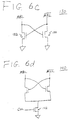
- FIGS 6a-6d illustrate load devices which offer varying degrees of gain which may be achieved. These load devices may be controlled by a column decode signal.
- the master bitline pair has as load devices n-channel transistors 112. N-channel transistors 112 are controlled by the Bias signal and are biased at a DC voltage above a threshold voltage level.
- the Bias signal may be a column decode signal, such that only selected columns draw current. In this way, current and therefore power dissipation is greatly reduced.
- An additional advantage of load device 110 is that few transistors are used. For simplicity, column decode control circuitry is not shown.
- Figure 6b illustrates n-channel load transistors 122, the gate of which is tied to the master bitline. Unlike the load device 110 of Figure 6a, no biasing is provided and gain may be reduced.
- Figure 6c a third type of master bitline loading device 130 is shown. The gates of N-channel load transistors 132 are tied to the opposite master bitline as shown. This configuration offers greater gain than the load devices of Figures 6a and 6b, but does introduce feedback which may result in varying degrees of device latching.
- a similar load device 140 with column decode control is shown. MBL and MBL ⁇ are tied to n-channel transistor 142 which has column decode signal COL has its gate input.
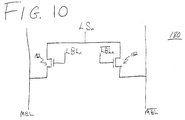
- the circuitry 150 of Figure 7 connects two different local bitlines LBL m and LBL n to master bitline pair MBL and MBL ⁇ by combining interface circuitry. Adjacent interface circuitry, n-channel transistors 152, is utilized to minimize transistor count. Even though both local bitline LBL m and local bitline LBL n will affect master bitline pair MBL and MBL ⁇ at the same time, only column m or n will have a voltage differential from the supply voltage, which is typically 5 volts. Therefore, the current differential of n-channel source follower transistors 154 is comparable to that of source-follower transistors 102 of Figure 5. However, the current differential expressed as a percent of total source-follower current is half that of Figure 5.
- Interface circuitry 160 of Figure 8 uses one less transistor than circuitry 100 of Figure 5-Two select transistors have been replaced by n-channel select transistor 162, the gate of which is connected to local select signal LS n .
- Select transistor 162 and source-follower transistors 164 are n-channel, but may also be p-channel transistors.
- Master bitline pair MBL and MBL ⁇ may get clamped by unselected local bitline transistors, depending on the voltage of the master bitline pair.
- Figure 9 illustrates interface circuitry 170 in which only one local bitline will have a voltage differential from the supply voltage. This is similar to the voltage differential discussed in Figure 7. Again, only one local bitline will have a voltage differential, and the total current differential on the master bitline pair caused by source follower transistors 172 is due to the resultant voltage differential when a memory cell is selected. The differential expressed as a percentage of total current may be reduced depending on the number of local bitline segments that exist. Thus, the percentage may be lower than that possible with the Figure 7 option. Additionally, during write cycles, source follower transistors 172 must be weak enough to be initially overcome; in the other interface circuitry option previously discussed, it is permissible to have the transistors turned off during a write cycle. A advantage of interface circuitry 170 is the small number of transistors required.
- a major advantage of the interface circuitry 180 of Figure 15 is that local bitline pairs, such as LBL n and LBL n ⁇ , which are not selected by local select signal LS n are not isolated from the master bitline pair MBL and MBL ⁇ but instead form the loads for the master bitline pair.
- the drain of local bitline transistors 182 are clocked. A local bitline is selected when local select signal LS is high and is deselected when it is low.
- interface circuitry option 190 is shown. As in Figure 7, interface circuitry is combined for two adjacent local bitline pair segments: LBL m and LBL n . This approach results in fewer transistors being used than if the two adjacent local bitline pair segments did not share interface circuitry. Master bitline pair MBL and MBL ⁇ has no series devices on source follower transistors 192, but the memory cell sees a pass gate. When selecting a local bitline, the appropriate local select signal goes to a logic low voltage level.
- the local bitline pair LBL n and LBL n ⁇ it is necessary for the local bitline pair LBL n and LBL n ⁇ to be biased below V cc -
- the sources of local bitline p-channel transistors 202 are clocked such that the selected local bitline segment has local select signal LS high and the deselected local bitline segment has local select signal LS low.
- the unselected segments will be isolated from the master bitline pair.
- V cc is the supply voltage
- V Tp-body and V Tn-body are the body effect threshold voltages of p-channel and n-channel transistors, respectively.
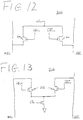
- interface circuitry 210 connects local bitline pair LBL n and LBL n to master bitline pair MBL and MBL but is biased to ground as shown.
- Source coupled n-channel transistors 212 are used to interface local bitlines to the master bitline; local bitline pair LBL n and LBL n is selected when LS n is a logic high voltage level.
- Local bitlines may be biased at V cc ⁇ V Tn with the master bitline load devices, examples shown in Figure 14, such as high value resistors or p-channel transistors, connected to V cc .
- the master bitline pair has as load devices p-channel transistors 222.
- P-channel transistors 222 are controlled by the Bias signal and are biased at a DC voltage below V cc -
- the Bias signal may be a column decode signal, such that only selected columns draw current.
- the Bias signal is a logic high voltage level when the column is unselected. In this way, current and therefore power dissipation is greatly reduced.
- An additional advantage of load device 220 is that few transistors are used. For simplicity, column decode control circuitry is not shown.
- Figure 14b illustrates p-channel load transistors 232, the gate of which is tied to the master bitline. Unlike the circuitry 220 of Figure 14a, no biasing is provided and gain may be relatively small.
- Figure 14c a third type of master bitline loading device 240 is shown. The gates of p-channel load transistors 242 are tied to the opposite master bitline as shown. This configuration offers greater gain than the load devices of Figures 14a-14b, but also introduces feedback which may result in varying degrees of device latching.
- a similar load device 250 with column decode control is shown.
- P-channel transistor 254 has column decode signal COL as its gate input. Resistors, biased to V cc , could also be used as master bitline load devices.
- the current source transistor used in other interface circuits is not included to minimize transistors used. Instead the local select signal LS n , which is clocked to ground, acts as a current source.
- Local bitline pair LBL n and LBL n ⁇ are connected to local bitline transistors 262 which are connected to master bitline pair MBL and MBL. ⁇
- An advantage of this interface circuitry is that the transistor count is low.
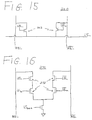
- FIG 15 illustrates interface circuitry 270 which is similar to that shown in Figure 13 but that adjacent local bitline segments combine interface circuitry in order to save on transistor count.
- Interface circuitry 270 connects local bitline pairs LBL n , LBL n ⁇ , LBL m , and LBL m ⁇ to master bitline pair MBL and MBL ⁇ but is biased to ground as shown.
- N-channel transistors 272 are used to interface local bitlines to the master bitline. While transistors 272 are connected serially, they may also be placed in parallel to each other. Local bitlines may be biased at V cc - V Tn with the master bitline loads such as high value resistors or p-channel transistors, connected to V cc .
- Local bitline segments which are not selected by local select signal LS m+n will have no differential voltage from ground, such that the differential voltage on the master bitline pair will be due to the differential which exists at the local bitline pair which is selected.
- adjacent local bitline segments LBL m and LBL n share a dynamic sense amp, comprised of n-channel transistors 282, clocked by local select signal LS m+n .
- a dynamic sense amp comprised of n-channel transistors 282, clocked by local select signal LS m+n .
- the sharing of interface circuitry allows transistor count to be minimized.
- having one local select signal LS m+n means less signals are needed.
- P-channel transistors 284 may be replaced by n-channel devices if sense nodes 286 are inverted.
- Isolation input signals ISO m and ISO n allow local bitline LBL m or LBL n to be isolated.
- ISO m By setting ISO m to a logic high voltage level such as 5 volts, local bitline pair LBL m and LBL m ⁇ are effectively isolated from other device circuitry; similarly, when ISO n is set to a logic low voltage level such as 0 volts, local bitline pair LBL n and LBL n ⁇ are not isolated from the dynamic sense amplifier. For example, LS m+n is clocked low to sense data and ISO n is then clocked high to isolate the sense amplifier from local bitline LBL n .
- Figure 18 illustrates interface circuitry 290 which employs a cascode current sense amp to provide a virtual short across local bitline pair LBL n and LBL n ⁇ if p-channel transistors 292 are biased properly, i.e. at saturation.
- the current difference between the series paths formed by p-channel transistors 292 and 294 is the memory cell current.
- various load devices such as those shown in Figures 6a-6d may be utilized.
- interface circuitry discussed in Figure 18 it is possible to use other forms of cascade and/or cascode voltage and current sensing to achieve voltage gain. Another option which may enhance manufacturability is to lay interface circuitry out on multiple column pitch with multiple local select signals decoded by column addresses.
- n-channel passgate 302 conducts only during a write cycle.
- Write local select signal WLS n will go to a logic high voltage level only during a write cycle and only if the row address points to a row associated with that particular local bitline, in this case LBL n .
- a memory cell is written by driving the appropriate master bitline pair low and turning on the write local select n-channel transistors 302 such that the local bitline may be pulled to a low logic level.
- recovery through precharging of the local bitlines may be achieved by precharing the master bitline pair and pulsing the write local select signal WLS n to connect the local bitline pair to its associated master bitline pair. Also, it may be necessary to have an equilibrate device on the local bitline pair in order to short together the two local bitlines comprising a bitline pair: for instance, LBL n and LBL n ⁇ . If any equilibrate signal is required, it could be decoded using a local select signal.
- Local bitlines which are not selected during a write cycle can not be allowed to float for an indefinite period of time.
- a pull-up transistor or high value resistor may be required for each local bitline.
- an interface circuitry option calling for biasing of the local bitlines to V cc - V T may utilize a high value resistor which is also connected to a V cc - V T level.
- a pull-up transistor which is strong enough to clamp the local bitline voltage differential to a small value is used, recovery of the line through equilibration may not be required between read cycles even though recovery may be required after a write cycle.
- FIG. 20 Another option for write circuitry is shown in Figure 20.
- Local bitline transistors 312 control local bitline pair LBL n and LBL n ⁇ .
- Circuitry 310 performs such that the master bitline pair is at or near V cc during a read cycle. However, during a write cycle, inverters 314 cause either LBL or LBL ⁇ to be pulled to ground through local select transistor 316 based on either MBL or MBL ⁇ being at ground.
- An advantage of this circuitry over that of Figure 19 is that a separate write local select signal WLS n is not required.
- the hierarchical bitline memory architecture described above is useful for asynchronous, synchronous and pipelined memory devices such as SRAMs, DRAMs, EPROMs and EEPROMs. It is particularly useful on high density, high performance devices such as the 4 Megabit SRAM, 16 Megabit SRAM and larger devices, to reduce the effective bitline capacitance a memory cell must drive.
- the speed advantage which could be realized with the hierarchical memory architecture would depend on the density of the device and the number of partitions of the bitline into local bitlines (at the expense of area) but could be on the order of several nanoseconds.
- the ability to choose various kinds of interface circuitry for use in hierarchical bitline memory architecture allows for the control of characteristics such as voltage gain and/or isolation. Control of these characteristics allows for an active hierarchical bitline memory architecture. control of characteristics such as voltage gain and/or isolation. Control of these characteristics allows for an active hierarchical bitline memory architecture.
Landscapes
- Dram (AREA)
- Static Random-Access Memory (AREA)
- Read Only Memory (AREA)
Applications Claiming Priority (4)
| Application Number | Priority Date | Filing Date | Title |
|---|---|---|---|
| US40664 | 1979-05-21 | ||
| US4066693A | 1993-03-31 | 1993-03-31 | |
| US08/040,664 US5457647A (en) | 1993-03-31 | 1993-03-31 | Passive hierarchical bitline memory architecture which resides in metal layers of a SRAM array |
| US40666 | 1998-03-18 |
Publications (2)
| Publication Number | Publication Date |
|---|---|
| EP0622801A2 true EP0622801A2 (de) | 1994-11-02 |
| EP0622801A3 EP0622801A3 (de) | 1996-01-31 |
Family
ID=26717279
Family Applications (1)
| Application Number | Title | Priority Date | Filing Date |
|---|---|---|---|
| EP94302350A Withdrawn EP0622801A3 (de) | 1993-03-31 | 1994-03-31 | Hierarchische Bitleitung-Speicher-Architektur. |
Country Status (2)
| Country | Link |
|---|---|
| EP (1) | EP0622801A3 (de) |
| JP (1) | JPH07141881A (de) |
Cited By (1)
| Publication number | Priority date | Publication date | Assignee | Title |
|---|---|---|---|---|
| US9754664B2 (en) | 2014-03-20 | 2017-09-05 | Kabushiki Kaisha Toshiba | Semiconductor memory |
Families Citing this family (7)
| Publication number | Priority date | Publication date | Assignee | Title |
|---|---|---|---|---|
| JPH10162580A (ja) * | 1996-11-29 | 1998-06-19 | Mitsubishi Electric Corp | スタティック型半導体記憶装置とその動作方法 |
| JP3812805B2 (ja) | 2001-01-16 | 2006-08-23 | 日本電気株式会社 | トンネル磁気抵抗素子を利用した半導体記憶装置 |
| KR100487417B1 (ko) * | 2001-12-13 | 2005-05-03 | 주식회사 하이닉스반도체 | 불휘발성 강유전체 메모리 장치 및 그를 이용한멀티플-비트 데이타의 라이트 및 리드 방법 |
| JP4074279B2 (ja) * | 2003-09-22 | 2008-04-09 | 株式会社東芝 | 半導体集積回路装置、デジタルカメラ、デジタルビデオカメラ、コンピュータシステム、携帯コンピュータシステム、論理可変lsi装置、icカード、ナビゲーションシステム、ロボット、画像表示装置、光ディスク記憶装置 |
| JP2008103055A (ja) * | 2006-04-26 | 2008-05-01 | Sanyo Electric Co Ltd | メモリ |
| JP4954161B2 (ja) * | 2008-08-20 | 2012-06-13 | ルネサスエレクトロニクス株式会社 | 半導体記憶装置 |
| JP5703200B2 (ja) * | 2011-12-01 | 2015-04-15 | 株式会社東芝 | 半導体記憶装置 |
Family Cites Families (2)
| Publication number | Priority date | Publication date | Assignee | Title |
|---|---|---|---|---|
| NL8602450A (nl) * | 1986-09-29 | 1988-04-18 | Philips Nv | Geintegreerde geheugenschakeling met een enkelvoudige-schrijfbus circuit. |
| JP2845414B2 (ja) * | 1992-09-18 | 1999-01-13 | シャープ株式会社 | 半導体読み出し専用メモリ |
-
1994
- 1994-03-31 JP JP6367494A patent/JPH07141881A/ja active Pending
- 1994-03-31 EP EP94302350A patent/EP0622801A3/de not_active Withdrawn
Cited By (1)
| Publication number | Priority date | Publication date | Assignee | Title |
|---|---|---|---|---|
| US9754664B2 (en) | 2014-03-20 | 2017-09-05 | Kabushiki Kaisha Toshiba | Semiconductor memory |
Also Published As
| Publication number | Publication date |
|---|---|
| EP0622801A3 (de) | 1996-01-31 |
| JPH07141881A (ja) | 1995-06-02 |
Similar Documents
| Publication | Publication Date | Title |
|---|---|---|
| US5986914A (en) | Active hierarchical bitline memory architecture | |
| US7639549B2 (en) | Very small swing high performance asynchronous CMOS static memory (multi-port register file) with power reducing column multiplexing scheme | |
| US4953127A (en) | Semiconductor memory having different read and write word line voltage levels | |
| US8189369B2 (en) | Semiconductor device | |
| US6891745B2 (en) | Design concept for SRAM read margin | |
| JPH11353880A (ja) | 高密度記憶装置に適用するsramセルの非対象デザイン | |
| JPH0713858B2 (ja) | 半導体記憶装置 | |
| US7760575B2 (en) | Memory leakage control circuit and method | |
| US6608780B2 (en) | High performance semiconductor memory devices | |
| US7161868B2 (en) | Multiport semiconductor memory device capable of sufficiently steadily holding data and providing a sufficient write margin | |
| US5671188A (en) | Random access memory having selective intra-bank fast activation of sense amplifiers | |
| US6549470B2 (en) | Small signal, low power read data bus driver for integrated circuit devices incorporating memory arrays | |
| US7286425B2 (en) | System and method for capacitive mis-match bit-line sensing | |
| US4630240A (en) | Dynamic memory with intermediate column derode | |
| JPH03192596A (ja) | 不揮発性半導体メモリ | |
| US4380055A (en) | Static RAM memory cell | |
| US5457647A (en) | Passive hierarchical bitline memory architecture which resides in metal layers of a SRAM array | |
| JPH07141881A (ja) | 階層的ビットラインメモリアーキテクチュア | |
| EP0166642A2 (de) | Blockunterteiltes Halbleiterspeichergerät mit unterteilten Bitzeilen | |
| US20040119105A1 (en) | Ferroelectric memory | |
| US6327215B1 (en) | Local bit switch decode circuit and method | |
| WO1985002314A2 (en) | Semiconductor memory | |
| JPH041957B2 (de) | ||
| US6515926B1 (en) | Shared sense amplifier driver technique for dynamic random access memories exhibiting improved write recovery time | |
| JP3298123B2 (ja) | マルチポートsram |
Legal Events
| Date | Code | Title | Description |
|---|---|---|---|
| PUAI | Public reference made under article 153(3) epc to a published international application that has entered the european phase |
Free format text: ORIGINAL CODE: 0009012 |
|
| AK | Designated contracting states |
Kind code of ref document: A2 Designated state(s): DE FR GB IT |
|
| PUAL | Search report despatched |
Free format text: ORIGINAL CODE: 0009013 |
|
| AK | Designated contracting states |
Kind code of ref document: A3 Designated state(s): DE FR GB IT |
|
| 17P | Request for examination filed |
Effective date: 19960722 |
|
| RAP3 | Party data changed (applicant data changed or rights of an application transferred) |
Owner name: STMICROELECTRONICS, INC. |
|
| STAA | Information on the status of an ep patent application or granted ep patent |
Free format text: STATUS: THE APPLICATION HAS BEEN WITHDRAWN |
|
| 17Q | First examination report despatched |
Effective date: 20000124 |
|
| 18W | Application withdrawn |
Withdrawal date: 20000118 |