EP0624016A2 - Verfahren und Vorrichtung zur Steuerung von Informationsübertragung - Google Patents
Verfahren und Vorrichtung zur Steuerung von Informationsübertragung Download PDFInfo
- Publication number
- EP0624016A2 EP0624016A2 EP94302733A EP94302733A EP0624016A2 EP 0624016 A2 EP0624016 A2 EP 0624016A2 EP 94302733 A EP94302733 A EP 94302733A EP 94302733 A EP94302733 A EP 94302733A EP 0624016 A2 EP0624016 A2 EP 0624016A2
- Authority
- EP
- European Patent Office
- Prior art keywords
- rate
- data utilization
- data
- information transfer
- packets
- Prior art date
- Legal status (The legal status is an assumption and is not a legal conclusion. Google has not performed a legal analysis and makes no representation as to the accuracy of the status listed.)
- Withdrawn
Links
Images






Classifications
-
- H—ELECTRICITY
- H04—ELECTRIC COMMUNICATION TECHNIQUE
- H04L—TRANSMISSION OF DIGITAL INFORMATION, e.g. TELEGRAPHIC COMMUNICATION
- H04L47/00—Traffic control in data switching networks
- H04L47/10—Flow control; Congestion control
- H04L47/35—Flow control; Congestion control by embedding flow control information in regular packets, e.g. piggybacking
-
- H—ELECTRICITY
- H04—ELECTRIC COMMUNICATION TECHNIQUE
- H04L—TRANSMISSION OF DIGITAL INFORMATION, e.g. TELEGRAPHIC COMMUNICATION
- H04L47/00—Traffic control in data switching networks
- H04L47/10—Flow control; Congestion control
-
- H—ELECTRICITY
- H04—ELECTRIC COMMUNICATION TECHNIQUE
- H04L—TRANSMISSION OF DIGITAL INFORMATION, e.g. TELEGRAPHIC COMMUNICATION
- H04L47/00—Traffic control in data switching networks
- H04L47/10—Flow control; Congestion control
- H04L47/13—Flow control; Congestion control in a LAN segment, e.g. ring or bus
-
- H—ELECTRICITY
- H04—ELECTRIC COMMUNICATION TECHNIQUE
- H04L—TRANSMISSION OF DIGITAL INFORMATION, e.g. TELEGRAPHIC COMMUNICATION
- H04L47/00—Traffic control in data switching networks
- H04L47/10—Flow control; Congestion control
- H04L47/26—Flow control; Congestion control using explicit feedback to the source, e.g. choke packets
- H04L47/263—Rate modification at the source after receiving feedback
-
- H—ELECTRICITY
- H04—ELECTRIC COMMUNICATION TECHNIQUE
- H04L—TRANSMISSION OF DIGITAL INFORMATION, e.g. TELEGRAPHIC COMMUNICATION
- H04L47/00—Traffic control in data switching networks
- H04L47/10—Flow control; Congestion control
- H04L47/28—Flow control; Congestion control in relation to timing considerations
- H04L47/283—Flow control; Congestion control in relation to timing considerations in response to processing delays, e.g. caused by jitter or round trip time [RTT]
Definitions
- the present invention relates to data communication generally and more particularly to data networks.
- Bolot et al discusses a phenomenon of state of the art rate-based flow control mechanisms, namely, the occurrence of rate oscillations which result in disadvantageous alternating occurrences of over-utilization and under-utilization of the path, as illustrated, e.g. in Figs. 2, 3(a), 3(b), 4(a) and 4(b) of the Bolot et al article.
- the present invention seeks to provide an improved data network.
- apparatus for governing information transfer among a plurality of data utilization elements, without rate oscillation which apparatus is operative according to a rate based transport protocol having apparatus for determining the rate of information transfer between data utilization elements.
- apparatus for governing information transfer among a plurality of data utilization elements which apparatus is operative according to a rate based transport protocol and including apparatus for determining the rate of information transfer between data utilization elements based at least in part on selecting a number of packets that is transmitted by a transmitting data utilization element without feedback from a receiving data utilization element and measuring the actual rate at which the packets are transmitted.
- apparatus for governing information transfer between a plurality of data utilization elements which apparatus is operative according to a rate based transport protocol and includes apparatus for determining an information transfer rate by measuring the actual rate of receipt at a receiving data utilization element.
- apparatus for governing information transfer between a plurality of data utilization elements which apparatus is operative to transmit a first echo request packet and to cause a first plurality of packets to be transmitted by a transmitting data utilization element without regard to whether an echo return responsive to the echo request packet is received from a receiving data utilization element, and thereafter, if an echo return has not been received, subsequent to the first echo request packet, not to transmit any further data packets until receipt of an echo return.
- apparatus for governing information transfer between the plurality of data utilization elements which apparatus is operative to govern the rate of data transmission by a transmitting data utilization element by non-continuously causing the rate of data transmission to increase such that the rate at which the data is received by a receiving data utilization element, also increases.
- apparatus for governing information transfer between the plurality of data utilization elements which apparatus is operative to govern the rate of data transmission by a data utilization element and includes apparatus operative to transmit a first echo request packet and to cause a first plurality of packets to be transmitted by a transmitting data utilization element without regard to whether an echo return responsive to the echo request packet is received from a receiving data utilization element, and thereafter, if an echo return has not been received, subsequent to the first echo request packet, not to transmit any further data packets until receipt of an echo return, apparatus responsive to the time duration between transmission of an echo request packet and receipt of an echo return corresponding thereto for increasing the rate of transmission by the transmitting data utilization element above the rate at which the receiving data utilization element receives the data, and apparatus for comparing the rate at which the receiving data utilization element receives transmissions in response to an increased rate of transmission of the transmitting data utilization element with the rate at which the receiving data utilization element received transmissions prior to increasing the rate of transmission.
- apparatus for governing information transfer between a plurality of data utilization elements which apparatus is operative to govern the data transmission rate of a transmitting data utilization element and includes apparatus for sensing the time duration between transmission of data packets by the transmitting data utilization element and receipt of the data packets by a receiving data utilization element, and apparatus operative to non-continuously respond to the extent of the time duration by increasing the data transmission rate above the current rate of reception of the receiving data utilization element.
- apparatus for governing information transfer between a plurality of data utilization elements including apparatus for governing a flow of data in accordance with a protocol containing separate error control and flow control mechanisms, including the transmission of echo request packets for queue control purposes.
- apparatus for governing information transfer among a plurality of data utilization elements connected together by a network which apparatus is operative to cause transmission of a selected number of data packets in a generally unarrested sequence and wherein the number of packets in the sequence is selected based at least in part on the round trip delay in the network.
- a data network including a plurality of data utilization elements, interconnection apparatus for interconnecting the plurality of data utilization elements, and apparatus for governing information transfer among the plurality of data utilization elements, without rate oscillation, which apparatus is operative according to a rate based transport protocol having apparatus for determining the rate of information transfer between data utilization elements.
- a data network including a plurality of data utilization elements, interconnection apparatus for interconnecting the plurality of data utilization elements, and apparatus for governing information transfer among the plurality of data utilization elements, which apparatus is operative according to a rate based transport protocol having apparatus for determining the rate of information transfer between data utilization elements based at least in part on selecting a number of packets that is transmitted by a transmitting data utilization element without feedback from a receiving data utilization element and measuring the actual rate at which the packets are transmitted.
- a data network including a plurality of data utilization elements, interconnection apparatus for interconnecting the plurality of data utilization elements, and apparatus for governing information transfer between the plurality of data utilization elements, which apparatus is operative according to a rate based transport protocol having apparatus for determining an information transfer rate by measuring the actual rate of receipt at a receiving data utilization element.
- a data network including a plurality of data utilization elements, interconnection apparatus for interconnecting the plurality of data utilization elements, and apparatus for governing information transfer between the plurality of data utilization elements, which apparatus is operative to transmit a first echo request packet and to cause a first plurality of packets to be transmitted by a transmitting data utilization element without regard to whether an echo return responsive to the echo request packet is received from a receiving data utilization element, and thereafter, if an echo return has not been received, subsequent to the first echo request packet, not to transmit any further data packets until receipt of an echo return.
- a data network including a plurality of data utilization elements, interconnection apparatus for interconnecting the plurality of data utilization elements, a sensor for sensing the rate at which a data utilization element receives data packets, and apparatus for governing information transfer between the plurality of data utilization elements, which apparatus is operative to govern the rate of data transmission by a transmitting data utilization element by non-continuously causing the rate of data transmission to increase such that the rate at which the data is received by a receiving data utilization element, also increases.
- the apparatus for governing information transfer also includes apparatus responsive to the time elapsed between transmission of data by the transmitting data utilization element and receipt of such data by the receiving data utilization element for non-continuously increasing the rate of transmission by the transmitting data utilization element above the rate at which the receiving data utilization element currently receives the data.
- a data network including a plurality of data utilization elements, interconnection apparatus for interconnecting the plurality of data utilization elements, a sensor for sensing the rate at which a data utilization element receives data packets, and apparatus for governing information transfer between the plurality of data utilization elements, which apparatus is operative to govern the rate of data transmission by a data utilization element and includes apparatus operative to transmit a first echo request packet and to cause a first plurality of packets to be transmitted by a transmitting data utilization element without regard to whether an echo return responsive to the echo request packet is received from a receiving data utilization element, and thereafter, if an echo return has not been received, subsequent to the first echo request packet, not to transmit any further data packets until receipt of an echo return, apparatus responsive to the time duration between transmission of an echo request packet and receipt of an echo return corresponding thereto for increasing the rate of transmission by the transmitting data utilization element above the rate at which the receiving data utilization element receives the data, and apparatus responsive to the sensor for comparing
- the data network also includes apparatus responsive to a sensed increased rate of receiving transmissions which are transmitted at an increased rate, for causing the transmitting data utilization element to increase the rate of data packet transmission.
- a data network including a plurality of data utilization elements, interconnection apparatus for interconnecting the plurality of data utilization elements, a sensor for sensing a data receiving rate at which a data utilization element receives data packets, and apparatus for governing information transfer between the plurality of data utilization elements, which apparatus is operative to govern the data transmission rate of a transmitting data utilization element and includes apparatus for sensing the time duration between transmission of data packets by the transmitting data utilization element and receipt of the data packets by a receiving data utilization element, apparatus responsive to the extent of the time duration for non-continuously increasing the data transmission rate above the current rate of reception of the receiving data utilization element, apparatus responsive to the sensor for comparing the rate at which the receiving data utilization element receives transmissions in response to an increased rate of transmission of the transmitting data utilization element with the rate at which the receiving data utilization element received transmissions prior to increasing the rate of transmission and providing an output indication if the rate of reception increased as the result of the increased rate of transmission, and apparatus responsive
- a data network including a plurality of data utilization elements, interconnection apparatus for interconnecting the plurality of data utilization elements, and apparatus for governing information transfer among a plurality of data utilization elements, which apparatus is operative to cause transmission of a selected number of data packets in a generally unarrested sequence according to a rate based transport protocol and wherein the number of packets in the sequence is selected based at least in part on the round trip delay in the network.
- the number of packets that is selected is selected based at least in part on the round trip delay in the network.
- a data network including a plurality of data utilization elements, interconnection apparatus for interconnecting the plurality of data utilization elements, and apparatus for governing information transfer among a plurality of data utilization elements, which apparatus is operative to cause transmission of a selected number of data packets in an unarrested sequence according to a rate based transport protocol and wherein the number of packets in the sequence is selected based at least in part on the round trip delay in the network.
- the generally unarrested sequence includes a sequence of packets unarrested by echo return packets.
- the generally unarrested sequence is included in a chunk of packets which is uninterrupted by error correction activity.
- the number of packets in the chunk is based on the bandwidth of the network.
- the apparatus for governing information also includes apparatus for sensing a number of packets which is transmitted by a transmitting data utilization element prior to receipt of a queue clear indication from a receiving data utilization element.
- a data communication method useful with a network including a plurality of data utilization elements and interconnection apparatus for interconnecting the plurality of data utilization elements and including the step of governing information transfer among the plurality of data utilization elements, without rate oscillation, according to a rate based transport protocol and including the step of determining the rate of information transfer between data utilization elements.
- a data communication method useful with a network including a plurality of data utilization elements and interconnection apparatus for interconnecting the plurality of data utilization elements and including the step of governing information transfer among the plurality of data utilization elements according to a rate based transport protocol and including the step of determining the rate of information transfer between data utilization elements based at least in part on selecting a number of packets that is transmitted by a transmitting data utilization element without feedback from a receiving data utilization element and measuring the actual rate at which the packets are transmitted.
- a data communication method useful with a network including a plurality of data utilization elements and interconnection apparatus for interconnecting the plurality of data utilization elements including the step of governing information transfer between the plurality of data utilization elements according to a rate based transport protocol, wherein the step of governing includes the step of determining an information transfer rate by measuring the actual rate of receipt at a receiving data utilization element.
- a data communication method useful with a network including a plurality of data utilization elements and interconnection apparatus for interconnecting the plurality of data utilization elements and including the step of governing information transfer between the plurality of data utilization elements including the steps of transmitting a first echo request packet, causing a first plurality of packets to be transmitted by a transmitting data utilization element without regard to whether an echo return responsive to the echo request packet is received from a receiving data utilization element, and thereafter, if an echo return has not been received, subsequent to the first echo request packet, refraining from transmitting any further data packets until receipt of an echo return.
- a data communication method useful with a network including a plurality of data utilization elements, interconnection apparatus for interconnecting the plurality of data utilization elements and a sensor for sensing the rate at which a data utilization element receives data packets, the method including the step of governing information transfer between the plurality of data utilization elements by non-continuously causing the rate of data transmission to increase such that the rate at which the data is received by a receiving data utilization element, also increases.
- the step of governing information transfer includes non-continuously increasing the rate of transmission by the transmitting data utilization element above the rate at which the receiving data utilization element currently receives the data, responsive to the time elapsed between transmission of data by the transmitting data utilization element and receipt of such data by the receiving data utilization element.
- a data communication method useful with a network including a plurality of data utilization elements, interconnection apparatus for interconnecting the plurality of data utilization elements and a sensor for sensing the rate at which a data utilization element receives data packets
- the method including the step of governing information transfer between the plurality of data utilization elements including the steps of governing the rate of data transmission by a data utilization element and including transmitting a first echo request packet and to cause a first plurality of packets to be transmitted by a transmitting data utilization element without regard to whether an echo return responsive to the echo request packet is received from a receiving data utilization element, and thereafter, if an echo return has not been received, subsequent to the first echo request packet, refraining from transmitting any further data packets until receipt of an echo return, increasing the rate of transmission by the transmitting data utilization element above the rate at which the receiving data utilization element receives the data, responsive to the time duration between transmission of an echo request packet and receipt of an echo return corresponding thereto, and comparing the
- the method also includes the step of causing the transmitting data utilization element to increase the rate of data packet transmission, responsive to a sensed increased rate of receiving transmissions which are transmitted at an increased rate.
- a data communication method useful with a network including a plurality of data utilization elements, interconnection apparatus for interconnecting the plurality of data utilization elements and a sensor for sensing the rate at which a data utilization element receives data packets
- the method including the step of governing information transfer between the plurality of data utilization elements including the steps of governing the data transmission rate of a transmitting data utilization element and including sensing the time duration between transmission of data packets by the transmitting data utilization element and receipt of the data packets by a receiving data utilization element, responsive to the extent of the time duration, non-continuously increasing the data transmission rate above the current rate of reception of the receiving data utilization element, responsive to the sensor, comparing the rate at which the receiving data utilization element receives transmissions in response to an increased rate of transmission of the transmitting data utilization element with the rate at which the receiving data utilization element received transmissions prior to increasing the rate of transmission and providing an output indication if the rate of reception increased as the result of the increased rate of transmission, and responsive to
- a data communication method useful with a network including a plurality of data utilization elements and interconnection apparatus for interconnecting the plurality of data utilization elements including the step of governing information transfer among a plurality of data utilization elements connected together by a network, including causing transmission of a selected number of data packets in a generally unarrested sequence according to a rate based transport protocol and wherein the number of packets in the sequence is selected based at least in part on the round trip delay in the network.
- a data communication method useful with a network including a plurality of data utilization elements and interconnection apparatus for interconnecting the plurality of data utilization elements including the step of governing information transfer between the plurality of data utilization elements including causing the transmission of a first multiplicity of data packets from a transmitter to a receiver without interrupting transmission due to missing, corrupted or duplicate packets or packets received out of order, causing the transmission of a second multiplicity of data packets from the transmitter to the receiver, without first requesting retransmission of packets from the first multiplicity of data packets and without interrupting transmission due to missing, corrupted or duplicate packets or packets received out of order in the second multiplicity of data packets, and requesting retransmission of packets from the first multiplicity of data packets only after at least part of the transmission of the second multiplicity of data packets.
- the number of packets that is selected is selected based at least in part on the round trip delay in the network.
- a data communication method useful with a network including a plurality of data utilization elements and interconnection apparatus for interconnecting the plurality of data utilization elements including the step of governing information transfer among a plurality of data utilization elements, including the step of causing transmission of a selected number of data packets in an unarrested sequence according to a rate based transport protocol and wherein the number of packets in the sequence is selected based at least in part on the round trip delay in the network.
- the generally unarrested sequence includes a sequence of packets uninterrupted by echo request packets.
- the generally unarrested sequence includes a chunk of packets, uninterrupted by error correction activity.
- the number of packets in the sequence is selected also based on the bandwidth of the network.
- the step of governing information also includes sensing a number of packets which is transmitted by a transmitting data utilization element prior to receipt of a queue clear indication from a receiving data utilization element.
- a method for governing information transfer across a path including a transmitter, a receiver and an interconnecting network portion, the method including the steps of monitoring the instantaneous throughput of the path, upon detection of a non-instantaneous occurrence of underutilized path availability, determining a new rate of information transfer which increases path utilization without overloading the path, and transmitting information at the new rate.
- a method for governing information transfer across a path including a transmitter, a receiver and an interconnecting network portion, the method including the steps of transmitting information at a first rate, monitoring the instantaneous throughput of the path, upon detection of an occurrence of reduced effective path throughput, ceasing information transmission for a first time period and subsequently resuming information transmission at the first rate.
- the step of monitoring includes the steps of transmitting an echo request, and, without waiting for an echo return, transmitting an information backlog including at least a predetermined amount of information, and wherein the step of ceasing and resuming is carried out if no echo return has been received responsive to the echo request during transmittal of the information backlog.
- the step of monitoring includes the steps of transmitting an echo request, and transmitting further information without waiting for an echo return, and wherein the step of ceasing and resuming is carried out if no echo return has been received responsive to the echo request during transmittal of the further information.
- the step of resuming includes the step of resuming information transmission after receipt of the echo return.
- apparatus for governing information transfer including an information transfer governing network interface card operative to govern information transfer between a plurality of data utilization elements.
- the apparatus for governing information transfer includes an information transfer governing network interface card operative to govern information transfer between a plurality of data utilization elements.
- the information transfer governing network interface card is operative to determine a rate at which information is transferred between the plurality of data utilization elements.
- the information transfer governing network interface card is operative to change, at least once, the rate at which information is transferred between the plurality of data utilization elements.
- a method for governing information transfer including the step of providing an information transfer governing network interface card operative to govern information transfer between a plurality of data utilization elements.
- a method for governing information transfer including the step of employing an information transfer governing network interface card to govern information transfer between a plurality of data utilization elements.
- apparatus for governing information transfer between a plurality of data utilization elements and including apparatus for governing a flow of data by transmitting echo request packets for queue control purposes.
- the transmission of the selected number of data packets is carried out according to a rate based transport protocol.
- apparatus for governing information transfer across a path including a transmitter, a receiver and an interconnecting network portion, the apparatus including an instantaneous path throughput monitoring unit, and information transfer rate determining apparatus operative, upon detection of a non-instantaneous occurrence of under-utilized path availability, to determine a new rate of information transfer which increases path utilization without overloading the path.
- apparatus for governing information transfer across a path including a transmitter transmitting information at a first rate, a receiver and an interconnecting network portion, the apparatus including apparatus for monitoring the instantaneous throughput of the path, and information transmission control apparatus operative, upon detection of an occurrence of reduced effective path throughput, to cause information transmission to be terminated for a first time period and to subsequently be resumed at the first rate.
- the apparatus for monitoring includes apparatus for transmitting an echo request, and apparatus causing an information backlog including at least a predetermined amount of information to be transmitted without waiting for an echo return, and wherein information transmission control apparatus is operative to terminate and to resume if no echo return has been received responsive to the echo request during transmittal of the information backlog.
- the apparatus for monitoring includes apparatus for transmitting an echo request, and apparatus for transmitting further information without waiting for an echo return, and wherein information transmission control apparatus is operative to terminate and to resume if no echo return has been received responsive to the echo request during transmittal of the further information.
- the information transmission control apparatus is operative to cause information transmission to be resumed after receipt of the echo return.
- the information transmission control apparatus is operative to cause information transmission to be resumed after receipt of the echo return.
- a data network including a plurality of data utilization elements, interconnection apparatus for interconnecting the plurality of data utilization elements, and apparatus for governing information transfer across a path including a transmitter, a receiver and an interconnecting network portion, the apparatus including an instantaneous path throughput monitoring unit, and information transfer rate determining apparatus operative, upon detection of a non-instantaneous occurrence of underutilized path availability, to determine a new rate of information transfer which increases path utilization without overloading the path.
- a data network including a plurality of data utilization elements, interconnection apparatus for interconnecting the plurality of data utilization elements, and apparatus for governing information transfer across a path including a transmitter transmitting information at a first rate, a receiver and an interconnecting network portion, the apparatus including apparatus for monitoring the instantaneous throughput of the path, and information transmission control apparatus operative, upon detection of an occurrence of reduced effective path throughput, to cause information transmission to be terminated for a first time period and to subsequently be resumed at the first rate.
- the apparatus for monitoring includes apparatus for transmitting an echo request, and apparatus causing an information backlog including at least a predetermined amount of information to be transmitted without waiting for an echo return, and wherein information transmission control apparatus is operative to terminate and to resume if no echo return has been received responsive to the echo request during transmittal of the information backlog.
- the apparatus for monitoring includes apparatus for transmitting an echo request, and apparatus for transmitting further information without waiting for an echo return, and wherein information transmission control apparatus is operative to terminate and to resume if no echo return has been received responsive to the echo request during transmittal of the further information.
- the information transmission control apparatus is operative to cause information transmission to be resumed after receipt of the echo return.
- the information transmission control apparatus is operative to cause information transmission to be resumed after receipt of the echo return.
- the apparatus is operative according to a rate based transport protocol.
- apparatus for governing information transfer among a plurality of data utilization elements, without rate oscillation which apparatus is operative according to a rate based transport protocol.
- apparatus for governing information transfer among a plurality of data utilization elements which apparatus is operative according to a rate based transport protocol having apparatus for automatically determining the rate of information transfer between data utilization elements.
- a data network including a plurality of data utilization elements, interconnection apparatus for interconnecting the plurality of data utilization elements, and apparatus for governing information transfer among a plurality of data utilization elements, without rate oscillation, which apparatus is operative according to a rate based transport protocol.
- a data network including a plurality of data utilization elements, interconnection apparatus for interconnecting the plurality of data utilization elements, and apparatus for governing information transfer among a plurality of data utilization elements, which apparatus is operative according to a rate based transport protocol having apparatus for automatically determining the rate of information transfer between data utilization elements.
- a data communication method including the step of governing information transfer among a plurality of data utilization elements, without rate oscillation, the method being operative according to a rate based transport protocol.
- a data communication method including the step of governing information transfer among a plurality of data utilization elements, which step is operative according to a rate based transport protocol, and including the step of automatically determining the rate of information transfer between data utilization elements.
- the generally uninterrupted sequence is a sequence of packets uninterrupted by echo request packets.
- the generally uninterrupted sequence is a chunk of packets, uninterrupted by error correction activity.
- the number of packets in the sequence is selected also based on the bandwidth of the network.
- Appendix A is a netlist and a parts list for a preferred embodiment of a network interface card
- Appendix B is a listing of software resident in the network interface card described with specificity in Appendix A
- Appendix C is a listing of software which is resident in the data utilization element in which the network interface card of Appendix A is located
- Appendix D is a listing of software for a software-only embodiment of the invention.
- echo request or "echo request packet” - a packet which, upon receipt thereof by a receiver, causes the receiver to send an echo return packet back to the same transmitter
- echo return or "echo return packet” - a packet sent from a receiver to a transmitter which is an indication that, at the time the echo return packet was sent, the receiver queue was clear of data packets received prior to the arrival of the echo request packet.
- the echo request and echo return packets may have any suitable format and may be "piggybacked" with data which is irrelevant to the echo requesting and returning functions.
- the protocol may be such that a certain number n of data packets received by a receiver results in an eventual echo return back to the transmitter, in which case the n'th data packet comprises an echo request packet even though no echo request data is actually included in the n'th data packet.
- rate based transport protocol a data transfer protocol which governs the rate at which a transmitter transmits data in order to achieve enhanced performance and avoid congestion.
- FIG. 1 illustrates a typical data network environment in which the present invention is useful.
- a plurality of data utilization elements 20, such as computers, computer terminals, facsimile machines, printing and pre-press apparatus, scanners, data storage devices, data storage and transmission devices and the like, are interconnected by means of a network 30.
- Network 30 may be any suitable type of network, such as a local area network, a wide area network, a metropolitan area network, serial communication link, public telephone system and a satellite communication network.
- the terms “receiver” and “transmitter”, as used hereinbelow, refer to a pair of data utilization elements 20 which are communicating via the network 30.
- the transmitter transmits data to the receiver, which receives the data, however, the receiver is typically capable of transmitting, and the transmitter is typically capable of receiving, control messages.
- an individual data utilization element 20 may function as a receiver to another data utilization element functioning as a transmitter and also as a transmitter to a third data utilization element functioning as a receiver. Furthermore, an individual data utilization element 20 may function as a receiver and/or as a transmitter to a plurality of data utilization elements 20 functioning as transmitters or receivers. Certain data utilization elements are capable of functioning only as a receiver or only as a transmitter, apart from transmission or receipt of control messages. For example, most conventional printer units are capable of functioning only as a receiver and most conventional scanning units are capable of functioning only as a transmitter.
- the network 30 typically comprises a plurality of routers 32.
- the data may be carried over public or private dedicated lines or a combination thereof.
- the network 30 is typically characterized in that it has inherent constraints in terms of available bandwidth. It is also characterized by congestion and resulting delays between transmission and receipt which vary over time. Delays may be inherent in the distances across which transmission occurs and in the routers, bridges, repeaters and other network devices. Additional delays are produced by the operation of the data utilization elements 20.
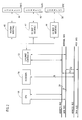
- FIG. 2 is a block diagram illustration of a network interface card constructed and operative in accordance with a preferred embodiment of the present invention and which is designed to reside within a data utilization element 20.
- a network interface card may be provided for connection external to the data utilization element 20.
- the network interface card comprises a plurality of electrical interfaces 40, 42 and 44, each arranged in association with a corresponding mechanical connector 46, 48 and 50. All of the electrical interfaces 40, 42 and 44 are interconnected with a conventional commercially available Ethernet controller 52 which communicates via an address bus and a data bus with the remaining elements of the card and via a host bus with the data utilization element.
- the network interface card also comprises a CPU 56 and a plurality of registers 58 which are employed in communication with the data utilization element.
- a netlist and a parts list for a preferred embodiment of an Ethernet interface card are set forth in Appendix A.
- the Ethernet interface card of Appendix A interfaces via a NuBus to a Macintosh computer.
- a listing of software resident in the Ethernet interface card described with specificity in Appendix A is set forth in Appendix B.
- a listing of software which is resident in the data utilization element in which the Ethernet interface card of Appendix A is located is set forth in Appendix C.
- the embodiment of Appendices A, B and C is operative in conjunction with Macintosh computers, running Operating System 7, serving as receivers and transmitters.
- the apparatus of the present invention in either or both of the receiver and the transmitter, may be implemented entirely in software resident in the receiver and/or the transmitter, rather than being implemented in the network interface card of the receiver and/or transmitter.
- a listing of such software which is particularly suitable for utilization in a Macintosh computer, running Operating System 7, is set forth in Appendix D.
- a particular advantage of the first smart card-residing implementation of Appendices A, B and C, relative to the second data utilization element-residing implementation of Appendix D is that the following three entities operate independently, such that serial delays therebetween do not occur within chunks:
- Appendices A, B, C and D are attached herewith merely to provide an extremely detailed disclosure of two preferred embodiments of the present invention and are not, however, intended to limit the invention.
- Fig. 3 is a generalized flowchart illustrating an overall file transfer operation according to a preferred embodiment of the present invention.
- a unit of data transfer for error correction purposes is referred to as a chunk, i.e. a multiplicity of packets that is to be sent in one continuous uninterrupted sequence.
- the chunk is uninterrupted by error correction activity, although echo request packets are transmitted and echo return packets are received during the course of transmission of the chunk.
- Data transfer normally begins with data transfer rate determination (step 70) or with a decision not to employ rate determination.
- a preferred technique for data transfer rate determination is described hereinbelow in greater detail with reference to Figs. 6A, 6B and 7.
- the first chunk is loaded from storage in the data utilization element to a buffer which normally is part of the main memory of the data utilization element.
- the first chunk is transmitted along the network 30 (step 80).
- a check is made (step 90) to determine whether any errors occurred in the transmission of the first chunk to the receiver. If no errors are detected, a check is made whether any chunks remain in the file to be transmitted. If any chunks remain, they are sequentially loaded and transmitted, as described hereinabove with reference to step 80.
- a retransmission chunk containing only missing or corrupted packets is prepared and subsequently transmitted (step 100). A further error check is carried out and retransmission occurs until an error-free chunk transmission is realized.
- error checks are carried out only after completion of the transmission of a chunk and not during its transmission and the error check takes place only after at least a portion of a subsequent chunk is transmitted.
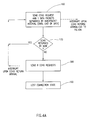
- FIGs. 4A and 4B illustrate a preferred embodiment of the flow control operation of the invention.
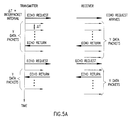
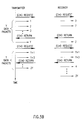
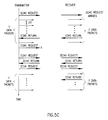
- Preferred timing diagrams for three different types of instances are provided in Figs. 5A - 5C.
- a transmitter initially sends an echo request packet which is a request for an echo return packet.
- the echo return packet when received back at the transmitter, functions as a previous data queue clear indication.
- Transmission of the initial echo request packet is followed by transmission of a plurality of Y data packets regardless of whether or not an echo return packet has been received (step 160).
- 2Y is the maximum queue of data packets which may accumulate for any given path and under any circumstances.
- Y is selected such that:
- the Y data packets are transmitted with a predetermined time separation therebetween, termed hereinbelow "the interpacket interval".
- the interpacket interval is preferably determined as described hereinbelow with reference to Fig. 6A, 6B and 7.
- the time separation between each of the Y data packets is not predetermined and is determined by the transmitting data utilization element.
- a check is made to determine whether an echo return packet in respect of the above-mentioned echo request packet has been received. If so, a further transmission of an echo request packet followed by Y data packets takes place and so on.
- step 180 further echo request packets are transmitted (step 180), such as a predetermined number R of echo request packets each separated by a predetermined time interval such as 10 interpacket intervals, until an echo return packet in respect of either the initial echo request packet or the further echo request packets is received. Thereupon normal operation of the apparatus and transmission of data packets resumes.
- R may be any suitable integer such as 20.
- the receiver is initially in an idle state (step 110) and is interrupted upon receipt of a packet (step 120). If (step 130) the received packet is an echo request packet, the receiver sends back an echo return packet to the transmitter of the echo request packet (step 140). If the received packet is not an echo request packet, the receiver stores the received packet in a prenumbered buffer (step 150).
- Fig. 5A illustrates the behavior of the apparatus in a case in which no errors are encountered and the echo return packets are received before the end of the transmission of the Y data packets.
- Fig. 5B illustrates behavior of the apparatus in a case in which data packet omissions and out of order receipt of data packets are encountered. As shown, no error correction procedure is initiated since the end of the chunk has not yet occurred.
- Fig. 5C illustrates behavior of the apparatus in a case in which echo return omissions are encountered.
- An echo request which is not received, for example, due to transmission failure, is designated by an "x".
- an echo return omission unlike a data packet omission, does result in a corrective procedure in which an additional echo request is transmitted.
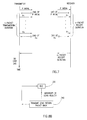
- Figs. 6A and 6B illustrate steps in the operation of a transmitter and a receiver respectively.
- the transmitter transmits an initial packet (step 200) and measures the elapsed time from the end of transmission of the initial packet (step 210).
- a plurality of packets comprising a predetermined number, n, of packets such as 2 - 8 packets, is then transmitted as fast as possible, i.e. without intentionally introducing delays (step 220).
- the total elapsed time until completion of transmission of the last of the n packets is measured (step 230). This total elapsed time is termed hereinbelow "the n-packet transmission duration”.
- the transmitter then remains in an idle state until it is interrupted by receipt of a data packet which contains information as to the measured elapsed time between end of receipt of the initial packet, i.e. the packet sent before the plurality of n packets, and end of receipt of the last of the n packets, which time interval is termed herein "the n-packet receipt duration”.
- the n-packet transmission duration and the n-packet receipt duration are compared (step 240). If the n-packet receipt duration is longer than the n-packet transmission duration, or the n-packet transmission duration is longer than a reference value which represents the n-packet transmission duration when the transmitter is not loaded, then the n-packet receipt duration is divided by n to compute a new interpacket interval for subsequent transmissions of data packets (step 250).
- the interpacket interval is not set, but rather determined by the transmitting data utilization element, independently of the receiving data utilization element (step 246).
- a particular feature of the method of Fig. 6A is that a new rate of information transfer is normally determined or computed which increases path utilization without overloading the path.
- the receiver is in an idle state (step 260) until interrupted by receipt of the initial packet.
- a time measurement is initiated upon termination of this receipt (step 270) and the receiver returns to an idle state (step 280).
- the receiver is interrupted from time to time by receipt of the plurality of n packets.
- the receiver measures the elapsed time from the end of receipt of the initial packet to the end of receipt of the last of the n packets, i.e. the n-packet receipt duration (step 300).
- the receiver then verifies the content, identity and number of the n packets (step 310). If all n packets are found to be valid, the receiver provides to the transmitter, the aforesaid data packet which contains information as to the n-packet receipt duration (step 320).
- Fig. 7 illustrates in even greater detail the time relationship of the communication of packets and the elapsed time measurements.
- Figs. 8A, 8B and 9 illustrate a preferred method for selection of a value for Y.
- An echo request packet is transmitted by the transmitter and a time measurement is started at as nearly as possible the same time (step 350).
- the transmitter then goes into an idle state (step 360) until interrupted by a received echo return packet.
- the elapsed time between transmission of the echo request packet and the receipt of the echo return packet is measured (step 370). This elapsed time is termed herein "the round-trip delay”.
- the minimal round-trip delay is then divided (step 400) by the interpacket interval which is determined as described hereinabove.
- the resulting quotient is added (step 410) to a typically predetermined number Z of packets, to provide a corrected number of packets, Y, which is transmitted between successive echo requests.
- Z corresponds to the maximum number of packets which it is safe to assign to receipt of data from the transmitter.
- Z typically depends on the packet size, the size of the input buffer of the individual receiver or of elements in the network en route between the individual receiver and the individual transmitter, and the maximum proportion of the available input buffer space which may be dedicated to reception of data from the individual transmitter.
- a preferred method for determining Z on an empirical basis is as follows:
- the receiver remains idle until interrupted by a received echo request packet.
- the receiver Upon receipt of the echo request packet, the receiver transmits an echo return packet.
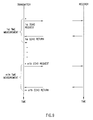
- Fig. 9 illustrates in even greater detail the time relationship of the communication of echo request and return packets and the elapsed time measurements between transmission of echo request packets and receipt of echo return packets.
- each arrow in the transmitter column indicates the point in time at which transmission of a particular packet begins. The point in time at which transmission of each packet ends is not indicated.
- each arrow in the receiver column indicates the point in time at which receipt of a particular packet begins. The point in time at which receipt of each packet ends is not indicated.
- the point in time at which a particular packet is received is shown to be identical to the point in time at which the same packet is transmitted.
- there is always a delay between transmittal and receipt which typically varies in length as a function of congestion, distance between transmitter and receiver, the load on the transmitter, the receiver, and on routers, bridges, repeaters and other network devices situated en route, and other factors, as explained above.
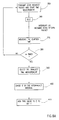
- Figs. 10A and 10B taken together, are a simplified flowchart of a preferred rate monitoring method which may be employed upon arrival of an echo return (step 420) to identify noninstantaneous underutilization which may justify increasing the rate of information transmission.
- step 422 If (step 422) the current interpacket interval has been selected to be as small as possible, as described above with reference to step 246 of Fig. 6A, the method of Fig. 10A is terminated by a return to Fig. 4A to complete step 160 where it was left off.
- step 426 if (step 426) at least one of the last Y packets sent thus far in the course of carrying out step 160 was not sent on time, i.e. if, at least once in the course of carrying out step 160, the interpacket interval exceeded that computed in step 250 of Fig. 6A, then zero an underutilization counter (step 428).
- step 430 If all of the last Y packets were sent on time, then the round trip time is measured (step 430). If the round trip time is large, e.g. relative to a predetermined threshold, then underutilization is not occurring and therefore (step 450) the underutilization counter is zeroed.
- step 460 the underutilization counter is incremented.
- step 470 If (step 470) the underutilization counter is less than a predetermined value such as 3, no further action is taken and the method returns to Fig. 4A to complete step 160 where it was left off. If the underutilization counter reaches the predetermined value, such as 3, the method of Fig. 6A is carried out (step 480), in which it is determined the current situation justifies an increase in the transmission rate and, if so, to what level.
- a predetermined value such as 3
- step 490 if the interpacket interval computed in step 480 is found to be smaller than the previously employed interpacket interval, then the previously employed interpacket interval is used for the next Y data packets (step 520). Otherwise (step 500), the newly computed interpacket interval is used for the next Y data packets.
- step 510 a new level is determined for Y which is employed (step 540) if (step 530) the new level of Y is smaller than the old level of Y. If the old level of Y is smaller, the old level of Y is employed (step 550).
- the method of Fig. 10B eventually returns to the method of Fig. 4A and completes step 160, the interruption of which instigated the method of Fig. 10B.
- a particular feature of the apparatus and methods shown and described hereinabove is that data transmission substantially without rate oscillation is provided.
Landscapes
- Engineering & Computer Science (AREA)
- Computer Networks & Wireless Communication (AREA)
- Signal Processing (AREA)
- Data Exchanges In Wide-Area Networks (AREA)
- Communication Control (AREA)
Applications Claiming Priority (2)
| Application Number | Priority Date | Filing Date | Title |
|---|---|---|---|
| US08/058,975 US5631935A (en) | 1993-05-06 | 1993-05-06 | Method and apparatus for governing information transfer using an efficient transport protocol |
| US58975 | 1998-04-13 |
Publications (2)
| Publication Number | Publication Date |
|---|---|
| EP0624016A2 true EP0624016A2 (de) | 1994-11-09 |
| EP0624016A3 EP0624016A3 (de) | 1995-03-01 |
Family
ID=22020051
Family Applications (1)
| Application Number | Title | Priority Date | Filing Date |
|---|---|---|---|
| EP94302733A Withdrawn EP0624016A3 (de) | 1993-05-06 | 1994-04-18 | Verfahren und Vorrichtung zur Steuerung von Informationsübertragung. |
Country Status (2)
| Country | Link |
|---|---|
| US (1) | US5631935A (de) |
| EP (1) | EP0624016A3 (de) |
Cited By (1)
| Publication number | Priority date | Publication date | Assignee | Title |
|---|---|---|---|---|
| US6273622B1 (en) | 1997-04-15 | 2001-08-14 | Flash Networks, Ltd. | Data communication protocol for maximizing the performance of IP communication links |
Families Citing this family (10)
| Publication number | Priority date | Publication date | Assignee | Title |
|---|---|---|---|---|
| JP2882545B2 (ja) * | 1993-10-23 | 1999-04-12 | インターナシヨナル・ビジネス・マシーンズ・コーポレーシヨン | 情報ネットワーク用の選択的混雑制御機構 |
| US5901140A (en) * | 1993-10-23 | 1999-05-04 | International Business Machines Corporation | Selective congestion control mechanism for information networks |
| US5815667A (en) * | 1995-11-28 | 1998-09-29 | Ncr Corporation | Circuits and methods for intelligent acknowledgement based flow control in a processing system network |
| US6477143B1 (en) | 1998-01-25 | 2002-11-05 | Dror Ginossar | Method and apparatus for packet network congestion avoidance and control |
| ATE326802T1 (de) * | 2000-11-28 | 2006-06-15 | Flash Networks Ltd | System und verfahren für eine übertragungsratensteuerung |
| JP3733943B2 (ja) * | 2002-10-16 | 2006-01-11 | 日本電気株式会社 | データ転送速度調停システム及びそれに用いるデータ転送速度調停方法 |
| KR100832537B1 (ko) * | 2006-12-01 | 2008-05-27 | 한국전자통신연구원 | 네트워크 대역폭 상태에 따라 전송량을 가변하는멀티미디어 데이터 스트리밍 서버 및 방법 |
| US8185678B1 (en) * | 2009-06-19 | 2012-05-22 | Xilinx, Inc. | Method and apparatus for controlling a data bus |
| US8565081B1 (en) * | 2011-02-23 | 2013-10-22 | Google Inc. | Rate adaptation in a communication system |
| CN103428011B (zh) * | 2012-05-16 | 2016-03-09 | 深圳市腾讯计算机系统有限公司 | 一种分布式系统中的节点状态探测方法、系统和装置 |
Family Cites Families (95)
| Publication number | Priority date | Publication date | Assignee | Title |
|---|---|---|---|---|
| GB1581136A (en) * | 1976-07-20 | 1980-12-10 | Post Office | Information handling system and terminal apparatus therefor |
| US4161778A (en) * | 1977-07-19 | 1979-07-17 | Honeywell Information Systems, Inc. | Synchronization control system for firmware access of high data rate transfer bus |
| US4270205A (en) * | 1979-02-27 | 1981-05-26 | Phillips Petroleum Company | Serial line communication system |
| DE2939159C3 (de) * | 1979-09-27 | 1982-03-25 | Siemens AG, 1000 Berlin und 8000 München | Verfahren zur Synchronisierung von Schlüsselgeräten, die im Rahmen eines Paketnetzes betrieben werden |
| DE3069762D1 (en) * | 1980-08-26 | 1985-01-17 | Ibm | System for the retransmission of incorrectly received numbered frames in a data transmission system |
| US4475192A (en) * | 1982-02-16 | 1984-10-02 | At&T Bell Laboratories | Data packet flow control scheme for switching networks |
| JPS58219847A (ja) * | 1982-06-14 | 1983-12-21 | Ricoh Co Ltd | 再送要求機能付データ通信方式 |
| US4485438A (en) * | 1982-06-28 | 1984-11-27 | Myrmo Erik R | High transfer rate between multi-processor units |
| US4707693A (en) * | 1984-06-13 | 1987-11-17 | Hewlett-Packard Company | Through-traffic priority protocol in a communications system |
| US4882674A (en) * | 1985-03-05 | 1989-11-21 | Wang Laboratories, Inc. | Apparatus and method for control of one computer system by another computer system |
| US4852127A (en) * | 1985-03-22 | 1989-07-25 | American Telephone And Telegraph Company, At&T Bell Laboratories | Universal protocol data receiver |
| US4967344A (en) * | 1985-03-26 | 1990-10-30 | Codex Corporation | Interconnection network for multiple processors |
| US4809212A (en) * | 1985-06-19 | 1989-02-28 | Advanced Micro Devices, Inc. | High throughput extended-precision multiplier |
| US4875161A (en) * | 1985-07-31 | 1989-10-17 | Unisys Corporation | Scientific processor vector file organization |
| US4703478A (en) * | 1985-08-02 | 1987-10-27 | Gte Laboratories Incorporated | Burst-switching method for an integrated communications system |
| US4677616A (en) * | 1985-09-11 | 1987-06-30 | At&T Company | Flow control scheme for a switching network |
| JPH0831876B2 (ja) * | 1985-09-20 | 1996-03-27 | 株式会社日立製作所 | パケツト交換網におけるル−チング制御方式 |
| US4897835A (en) * | 1985-11-27 | 1990-01-30 | At&E Corporation | High capacity protocol with multistation capability |
| US4845656A (en) * | 1985-12-12 | 1989-07-04 | Kabushiki Kaisha Toshiba | System for transferring data between memories in a data-processing apparatus having a bitblt unit |
| US4727537A (en) * | 1985-12-24 | 1988-02-23 | American Telephone And Telegraph Company | Flow control arrangement for the transmission of data packets to a communication network |
| US4712214A (en) * | 1986-01-10 | 1987-12-08 | International Business Machines Corporation | Protocol for handling transmission errors over asynchronous communication lines |
| US4862461A (en) * | 1987-01-12 | 1989-08-29 | International Business Machines Corp. | Packet switch network protocol |
| US4888684A (en) * | 1986-03-28 | 1989-12-19 | Tandem Computers Incorporated | Multiprocessor bus protocol |
| JPS62243057A (ja) * | 1986-04-16 | 1987-10-23 | Hitachi Ltd | フアイル転送管理方式 |
| US4860193A (en) * | 1986-05-22 | 1989-08-22 | International Business Machines Corporation | System for efficiently transferring data between a high speed channel and a low speed I/O device |
| GB8618118D0 (en) * | 1986-07-24 | 1986-09-03 | British Telecomm | Communications system |
| US4845664A (en) * | 1986-09-15 | 1989-07-04 | International Business Machines Corp. | On-chip bit reordering structure |
| US4745593A (en) * | 1986-11-17 | 1988-05-17 | American Telephone And Telegraph Company, At&T Bell Laboratories | Arrangement for testing packet switching networks |
| GB8628821D0 (en) * | 1986-12-02 | 1987-01-07 | Plessey Co Plc | Data transmission systems |
| US4851990A (en) * | 1987-02-09 | 1989-07-25 | Advanced Micro Devices, Inc. | High performance processor interface between a single chip processor and off chip memory means having a dedicated and shared bus structure |
| US5113494A (en) * | 1987-02-27 | 1992-05-12 | Eastman Kodak Company | High speed raster image processor particularly suited for use in an image management system |
| US4726036A (en) * | 1987-03-26 | 1988-02-16 | Unisys Corporation | Digital adaptive filter for a high throughput digital adaptive processor |
| US4855905A (en) * | 1987-04-29 | 1989-08-08 | International Business Machines Corporation | Multiprotocol I/O communications controller unit including emulated I/O controllers and tables translation of common commands and device addresses |
| EP0293517B1 (de) * | 1987-06-02 | 1992-11-25 | Deutsche ITT Industries GmbH | Steuerprozessor |
| US4839891A (en) * | 1987-07-24 | 1989-06-13 | Nec Corporation | Method for controlling data flow |
| EP0303751B1 (de) * | 1987-08-20 | 1992-05-20 | International Business Machines Corporation | Schnittstellenmechanismus für Informationsübertragungssteuerung zwischen zwei Vorrichtungen |
| US5109515A (en) * | 1987-09-28 | 1992-04-28 | At&T Bell Laboratories | User and application program transparent resource sharing multiple computer interface architecture with kernel process level transfer of user requested services |
| US5062044A (en) * | 1987-09-29 | 1991-10-29 | Western Digital Corporation | Temporary bus master for use in a digital system having asynchronously communicating sub-systems |
| US4965794A (en) * | 1987-10-05 | 1990-10-23 | Dallas Semiconductor Corporation | Telecommunications FIFO |
| US4887076A (en) * | 1987-10-16 | 1989-12-12 | Digital Equipment Corporation | Computer interconnect coupler for clusters of data processing devices |
| US4888812A (en) * | 1987-12-18 | 1989-12-19 | International Business Machines Corporation | Document image processing system |
| US4908828A (en) * | 1987-12-29 | 1990-03-13 | Indesys, Inc. | Method for error free message reception |
| US5121479A (en) * | 1988-01-27 | 1992-06-09 | Storage Technology Corporation | Early start mode data transfer apparatus |
| EP0328100B1 (de) * | 1988-02-10 | 1995-06-21 | Nec Corporation | Kommunikationsverfahren und System mit hohem Durchsatz für eine digitale mobile Station beim Überfahren einer Zonengrenze während einer Verbindung |
| JP2540930B2 (ja) * | 1988-02-19 | 1996-10-09 | 日本電気株式会社 | 輻輳制御装置 |
| GB8807050D0 (en) * | 1988-03-24 | 1988-04-27 | British Telecomm | Communication system |
| US4977498A (en) * | 1988-04-01 | 1990-12-11 | Digital Equipment Corporation | Data processing system having a data memory interlock coherency scheme |
| US4992926A (en) * | 1988-04-11 | 1991-02-12 | Square D Company | Peer-to-peer register exchange controller for industrial programmable controllers |
| US4864567A (en) * | 1988-05-04 | 1989-09-05 | The United States Of America As Represented By The Secretary Of The Navy | High throughput data communication system |
| FR2635243B1 (fr) * | 1988-08-05 | 1994-01-14 | Lmt Radio Professionnelle | Commutateur de paquets pour un transfert de donnees en mode asynchrone dans un reseau de transmission numerique |
| US4951278A (en) * | 1988-08-31 | 1990-08-21 | Telenet Communications Corporation | High-level data link control packet assembler/disassembler |
| US5103447A (en) * | 1988-09-02 | 1992-04-07 | Hitachi, Ltd. | High-speed ring LAN system |
| US5058005A (en) * | 1988-09-09 | 1991-10-15 | Compaq Computer Corporation | Computer system with high speed data transfer capabilities |
| JPH0286245A (ja) * | 1988-09-21 | 1990-03-27 | Hitachi Ltd | データリンクレイヤ処理方式 |
| US5065314A (en) * | 1988-09-23 | 1991-11-12 | Allen-Bradley Company, Inc. | Method and circuit for automatically communicating in two modes through a backplane |
| US4905282A (en) * | 1988-10-19 | 1990-02-27 | Hayes Microcomputer Products, Inc. | Feature negotiation protocol and dynamically adjustable retraining sequence for a high speed half duplex modem |
| US5119367A (en) * | 1988-10-28 | 1992-06-02 | Oki Electric Industry Co., Ltd. | Method and a node circuit for routing bursty data |
| US4929939A (en) * | 1988-10-31 | 1990-05-29 | International Business Machines Corporation | High-speed switching system with flexible protocol capability |
| US5008879B1 (en) * | 1988-11-14 | 2000-05-30 | Datapoint Corp | Lan with interoperative multiple operational capabilities |
| JPH04502991A (ja) * | 1988-11-14 | 1992-05-28 | データーポイント・コーポレーション | 動的に選択可能な多重操作性を備えたローカル・エリア・ネットワーク |
| US4927288A (en) * | 1988-11-25 | 1990-05-22 | Subhash Raswant | Road traffic network |
| US5010553A (en) * | 1988-12-05 | 1991-04-23 | Compuquest, Inc. | High speed, error-free data transmission system and method |
| FR2640449B1 (fr) * | 1988-12-14 | 1991-05-31 | Abiven Jacques | Procede et systemes de communication a cryptage de l'information |
| US5109490A (en) * | 1989-01-13 | 1992-04-28 | International Business Machines Corporation | Data transfer using bus address lines |
| US4930159A (en) * | 1989-01-18 | 1990-05-29 | International Business Machines Corporation | Netbios name authentication |
| US5073821A (en) * | 1989-01-30 | 1991-12-17 | Matsushita Electric Industrial Co., Ltd. | Orthogonal transform coding apparatus for reducing the amount of coded signals to be processed and transmitted |
| US5303344A (en) * | 1989-03-13 | 1994-04-12 | Hitachi, Ltd. | Protocol processing apparatus for use in interfacing network connected computer systems utilizing separate paths for control information and data transfer |
| JP2986802B2 (ja) * | 1989-03-13 | 1999-12-06 | 株式会社日立製作所 | プロトコル高速処理方法 |
| US5124991A (en) * | 1989-03-30 | 1992-06-23 | Photonics Corporation | Error correction for infrared data communication |
| US5036316A (en) * | 1989-04-03 | 1991-07-30 | Honeywell Inc. | Method and apparatus for high speed linear shading in a raster graphics system |
| US5063494A (en) * | 1989-04-12 | 1991-11-05 | Unisys Corporation | Programmable data communications controller |
| US5056088A (en) * | 1989-05-01 | 1991-10-08 | At&T Bell Laboratories | Apparatus and method for efficiently coupling digital signals to a communications medium in information packets |
| US5058110A (en) * | 1989-05-03 | 1991-10-15 | Ultra Network Technologies | Protocol processor |
| US5084877A (en) * | 1989-05-05 | 1992-01-28 | At&T Bell Laboratories | High speed transport protocol |
| US5077677A (en) * | 1989-06-12 | 1991-12-31 | Westinghouse Electric Corp. | Probabilistic inference gate |
| JP3085391B2 (ja) * | 1989-06-19 | 2000-09-04 | 株式会社日立製作所 | 通信装置 |
| EP0405042B1 (de) * | 1989-06-29 | 1994-09-14 | International Business Machines Corporation | Schnelles, digitales Paketvermittlungssystem |
| US5121216A (en) * | 1989-07-19 | 1992-06-09 | Bell Communications Research | Adaptive transform coding of still images |
| US5107493A (en) * | 1989-08-02 | 1992-04-21 | At&T Bell Laboratories | High-speed packet data network using serially connected packet and circuit switches |
| US5113514A (en) * | 1989-08-22 | 1992-05-12 | Prime Computer, Inc. | System bus for multiprocessor computer system |
| US5193151A (en) * | 1989-08-30 | 1993-03-09 | Digital Equipment Corporation | Delay-based congestion avoidance in computer networks |
| US5179661A (en) * | 1989-10-30 | 1993-01-12 | Hayes Microcomputer Products, Inc. | Method and apparatus for serial data flow control |
| US5053987A (en) * | 1989-11-02 | 1991-10-01 | Zoran Corporation | Arithmetic unit in a vector signal processor using pipelined computational blocks |
| US5115432A (en) * | 1989-12-12 | 1992-05-19 | At&T Bell Laboratories | Communication architecture for high speed networking |
| JP2881886B2 (ja) * | 1989-12-30 | 1999-04-12 | ソニー株式会社 | 映像信号符号化方法及びその装置 |
| US5224095A (en) * | 1990-01-30 | 1993-06-29 | Johnson Service Company | Network control system and method |
| US5121390A (en) * | 1990-03-15 | 1992-06-09 | International Business Machines Corporation | Integrated data link controller with synchronous link interface and asynchronous host processor interface |
| US5089982A (en) * | 1990-05-24 | 1992-02-18 | Grumman Aerospace Corporation | Two dimensional fast Fourier transform converter |
| US5136584A (en) * | 1990-07-11 | 1992-08-04 | At&T Bell Laboratories | Hardware interface to a high-speed multiplexed link |
| US5115429A (en) * | 1990-08-02 | 1992-05-19 | Codex Corporation | Dynamic encoding rate control minimizes traffic congestion in a packet network |
| US5097331A (en) * | 1990-08-24 | 1992-03-17 | Bell Communications Research, Inc. | Multiple block-size transform video coding using an asymmetric sub-band structure |
| US5115431A (en) * | 1990-09-28 | 1992-05-19 | Stratacom, Inc. | Method and apparatus for packet communications signaling |
| US5124941A (en) * | 1990-11-01 | 1992-06-23 | Vlsi Technology Inc. | Bit-serial multipliers having low latency and high throughput |
| US5122685A (en) * | 1991-03-06 | 1992-06-16 | Quicklogic Corporation | Programmable application specific integrated circuit and logic cell therefor |
| DE69330661T2 (de) * | 1992-04-27 | 2002-06-27 | Nippon Telegraph And Telephone Corp., Tokio/Tokyo | Paketnetzwerk und Verfahren zur Vermeidung von Überlastung eines solchen Netzwerks |
-
1993
- 1993-05-06 US US08/058,975 patent/US5631935A/en not_active Expired - Lifetime
-
1994
- 1994-04-18 EP EP94302733A patent/EP0624016A3/de not_active Withdrawn
Cited By (1)
| Publication number | Priority date | Publication date | Assignee | Title |
|---|---|---|---|---|
| US6273622B1 (en) | 1997-04-15 | 2001-08-14 | Flash Networks, Ltd. | Data communication protocol for maximizing the performance of IP communication links |
Also Published As
| Publication number | Publication date |
|---|---|
| US5631935A (en) | 1997-05-20 |
| EP0624016A3 (de) | 1995-03-01 |
Similar Documents
| Publication | Publication Date | Title |
|---|---|---|
| US5095444A (en) | System and method for measuring inter-nodal transmission delays in a communications network | |
| US6477143B1 (en) | Method and apparatus for packet network congestion avoidance and control | |
| US8233483B2 (en) | Communication apparatus, communication system, absent packet detecting method and absent packet detecting program | |
| US5163055A (en) | Communications system using a fault tolerant protocol | |
| US5384770A (en) | Packet assembler | |
| US5631935A (en) | Method and apparatus for governing information transfer using an efficient transport protocol | |
| US4896151A (en) | Simultaneous communication method and system | |
| EP1467525B1 (de) | Verfahren zur steuerung des flusses der ethernet-daten in einem synchronen übertragungsnetz mit datenhierarchie | |
| US6622172B1 (en) | Dynamically delayed acknowledgement transmission system | |
| US20020131425A1 (en) | Packet fragmentation with nested interruptions | |
| EP1206062A2 (de) | Datenübertragungssystem, Datenübertragungsverfahren, und Aufnahmemedium mit darauf aufgenommen ein Datenübertragungsprogram | |
| CA2023553A1 (en) | Delay-based congestion avoidance in computer networks | |
| JPH09205458A (ja) | 処理システムネットワークにおける知的応答ベースのフロー制御のための回路と方法 | |
| US5056088A (en) | Apparatus and method for efficiently coupling digital signals to a communications medium in information packets | |
| US20050071451A1 (en) | Background transport service | |
| US5923840A (en) | Method of reporting errors by a hardware element of a distributed computer system | |
| US6700876B1 (en) | Congestion monitoring and message flow control in a blocking network | |
| US11463339B2 (en) | Device and method for delivering acknowledgment in network transport protocols | |
| US5717862A (en) | Method and system for message status reporting in a multi-node network | |
| US6614755B1 (en) | Method for controlling congestion from a terminal in a frame relay network | |
| US6570852B1 (en) | Relay communication system | |
| JPH1056470A (ja) | ネットワーク通信制御装置 | |
| JP2964937B2 (ja) | 適応クレジット制御型転送方法 | |
| JPH0779250A (ja) | パケット通信の遅延制御システム | |
| Bux et al. | Data link-control performance: Results comparing HDLC operational modes |
Legal Events
| Date | Code | Title | Description |
|---|---|---|---|
| PUAI | Public reference made under article 153(3) epc to a published international application that has entered the european phase |
Free format text: ORIGINAL CODE: 0009012 |
|
| AK | Designated contracting states |
Kind code of ref document: A2 Designated state(s): DE FR GB |
|
| PUAL | Search report despatched |
Free format text: ORIGINAL CODE: 0009013 |
|
| AK | Designated contracting states |
Kind code of ref document: A3 Designated state(s): DE FR GB |
|
| 17P | Request for examination filed |
Effective date: 19950825 |
|
| STAA | Information on the status of an ep patent application or granted ep patent |
Free format text: STATUS: THE APPLICATION HAS BEEN WITHDRAWN |
|
| 18W | Application withdrawn |
Withdrawal date: 19980216 |