EP0624657A1 - Pièce coulissante en alliage d'aluminium - Google Patents
Pièce coulissante en alliage d'aluminium Download PDFInfo
- Publication number
- EP0624657A1 EP0624657A1 EP94105795A EP94105795A EP0624657A1 EP 0624657 A1 EP0624657 A1 EP 0624657A1 EP 94105795 A EP94105795 A EP 94105795A EP 94105795 A EP94105795 A EP 94105795A EP 0624657 A1 EP0624657 A1 EP 0624657A1
- Authority
- EP
- European Patent Office
- Prior art keywords
- alumina
- short fibers
- wearing
- mullite particles
- alumina short
- Prior art date
- Legal status (The legal status is an assumption and is not a legal conclusion. Google has not performed a legal analysis and makes no representation as to the accuracy of the status listed.)
- Granted
Links
- 229910000838 Al alloy Inorganic materials 0.000 title claims abstract description 23
- PNEYBMLMFCGWSK-UHFFFAOYSA-N aluminium oxide Inorganic materials [O-2].[O-2].[O-2].[Al+3].[Al+3] PNEYBMLMFCGWSK-UHFFFAOYSA-N 0.000 claims abstract description 119
- 239000000835 fiber Substances 0.000 claims abstract description 92
- 239000002245 particle Substances 0.000 claims abstract description 75
- KZHJGOXRZJKJNY-UHFFFAOYSA-N dioxosilane;oxo(oxoalumanyloxy)alumane Chemical compound O=[Si]=O.O=[Si]=O.O=[Al]O[Al]=O.O=[Al]O[Al]=O.O=[Al]O[Al]=O KZHJGOXRZJKJNY-UHFFFAOYSA-N 0.000 claims abstract description 73
- 229910052863 mullite Inorganic materials 0.000 claims abstract description 73
- VYPSYNLAJGMNEJ-UHFFFAOYSA-N Silicium dioxide Chemical compound O=[Si]=O VYPSYNLAJGMNEJ-UHFFFAOYSA-N 0.000 claims abstract description 41
- 239000000377 silicon dioxide Substances 0.000 claims abstract description 15
- 239000012779 reinforcing material Substances 0.000 claims abstract description 14
- 239000000203 mixture Substances 0.000 claims abstract description 11
- 239000002131 composite material Substances 0.000 description 66
- 230000013011 mating Effects 0.000 description 39
- 239000011159 matrix material Substances 0.000 description 10
- 229910001018 Cast iron Inorganic materials 0.000 description 9
- 239000013078 crystal Substances 0.000 description 8
- 229920000049 Carbon (fiber) Polymers 0.000 description 7
- 239000004917 carbon fiber Substances 0.000 description 7
- 238000000465 moulding Methods 0.000 description 5
- 239000000919 ceramic Substances 0.000 description 4
- 238000005121 nitriding Methods 0.000 description 4
- 239000010935 stainless steel Substances 0.000 description 4
- 229910001220 stainless steel Inorganic materials 0.000 description 4
- 229910045601 alloy Inorganic materials 0.000 description 3
- 239000000956 alloy Substances 0.000 description 3
- 238000011156 evaluation Methods 0.000 description 3
- 238000004519 manufacturing process Methods 0.000 description 3
- 238000000034 method Methods 0.000 description 3
- 230000003014 reinforcing effect Effects 0.000 description 3
- MCMNRKCIXSYSNV-UHFFFAOYSA-N Zirconium dioxide Chemical compound O=[Zr]=O MCMNRKCIXSYSNV-UHFFFAOYSA-N 0.000 description 2
- 239000011230 binding agent Substances 0.000 description 2
- 239000008119 colloidal silica Substances 0.000 description 2
- 238000010276 construction Methods 0.000 description 2
- 125000004122 cyclic group Chemical group 0.000 description 2
- 230000001788 irregular Effects 0.000 description 2
- 239000010705 motor oil Substances 0.000 description 2
- QNRATNLHPGXHMA-XZHTYLCXSA-N (r)-(6-ethoxyquinolin-4-yl)-[(2s,4s,5r)-5-ethyl-1-azabicyclo[2.2.2]octan-2-yl]methanol;hydrochloride Chemical group Cl.C([C@H]([C@H](C1)CC)C2)CN1[C@@H]2[C@H](O)C1=CC=NC2=CC=C(OCC)C=C21 QNRATNLHPGXHMA-XZHTYLCXSA-N 0.000 description 1
- VYZAMTAEIAYCRO-UHFFFAOYSA-N Chromium Chemical compound [Cr] VYZAMTAEIAYCRO-UHFFFAOYSA-N 0.000 description 1
- 238000000889 atomisation Methods 0.000 description 1
- 238000005266 casting Methods 0.000 description 1
- 238000004512 die casting Methods 0.000 description 1
- 238000006073 displacement reaction Methods 0.000 description 1
- 230000000694 effects Effects 0.000 description 1
- 239000002657 fibrous material Substances 0.000 description 1
- 239000003365 glass fiber Substances 0.000 description 1
- 239000000314 lubricant Substances 0.000 description 1
- 238000003754 machining Methods 0.000 description 1
- 238000003825 pressing Methods 0.000 description 1
- 231100000241 scar Toxicity 0.000 description 1
- HBMJWWWQQXIZIP-UHFFFAOYSA-N silicon carbide Chemical compound [Si+]#[C-] HBMJWWWQQXIZIP-UHFFFAOYSA-N 0.000 description 1
- 229910010271 silicon carbide Inorganic materials 0.000 description 1
- 239000011856 silicon-based particle Substances 0.000 description 1
- 239000012798 spherical particle Substances 0.000 description 1
Images


Classifications
-
- C—CHEMISTRY; METALLURGY
- C22—METALLURGY; FERROUS OR NON-FERROUS ALLOYS; TREATMENT OF ALLOYS OR NON-FERROUS METALS
- C22C—ALLOYS
- C22C49/00—Alloys containing metallic or non-metallic fibres or filaments
- C22C49/14—Alloys containing metallic or non-metallic fibres or filaments characterised by the fibres or filaments
-
- C—CHEMISTRY; METALLURGY
- C22—METALLURGY; FERROUS OR NON-FERROUS ALLOYS; TREATMENT OF ALLOYS OR NON-FERROUS METALS
- C22C—ALLOYS
- C22C49/00—Alloys containing metallic or non-metallic fibres or filaments
- C22C49/02—Alloys containing metallic or non-metallic fibres or filaments characterised by the matrix material
- C22C49/04—Light metals
- C22C49/06—Aluminium
-
- F—MECHANICAL ENGINEERING; LIGHTING; HEATING; WEAPONS; BLASTING
- F16—ENGINEERING ELEMENTS AND UNITS; GENERAL MEASURES FOR PRODUCING AND MAINTAINING EFFECTIVE FUNCTIONING OF MACHINES OR INSTALLATIONS; THERMAL INSULATION IN GENERAL
- F16C—SHAFTS; FLEXIBLE SHAFTS; ELEMENTS OR CRANKSHAFT MECHANISMS; ROTARY BODIES OTHER THAN GEARING ELEMENTS; BEARINGS
- F16C33/00—Parts of bearings; Special methods for making bearings or parts thereof
- F16C33/02—Parts of sliding-contact bearings
- F16C33/04—Brasses; Bushes; Linings
- F16C33/06—Sliding surface mainly made of metal
- F16C33/12—Structural composition; Use of special materials or surface treatments, e.g. for rust-proofing
- F16C33/121—Use of special materials
-
- F—MECHANICAL ENGINEERING; LIGHTING; HEATING; WEAPONS; BLASTING
- F05—INDEXING SCHEMES RELATING TO ENGINES OR PUMPS IN VARIOUS SUBCLASSES OF CLASSES F01-F04
- F05C—INDEXING SCHEME RELATING TO MATERIALS, MATERIAL PROPERTIES OR MATERIAL CHARACTERISTICS FOR MACHINES, ENGINES OR PUMPS OTHER THAN NON-POSITIVE-DISPLACEMENT MACHINES OR ENGINES
- F05C2201/00—Metals
- F05C2201/02—Light metals
- F05C2201/021—Aluminium
-
- Y—GENERAL TAGGING OF NEW TECHNOLOGICAL DEVELOPMENTS; GENERAL TAGGING OF CROSS-SECTIONAL TECHNOLOGIES SPANNING OVER SEVERAL SECTIONS OF THE IPC; TECHNICAL SUBJECTS COVERED BY FORMER USPC CROSS-REFERENCE ART COLLECTIONS [XRACs] AND DIGESTS
- Y10—TECHNICAL SUBJECTS COVERED BY FORMER USPC
- Y10T—TECHNICAL SUBJECTS COVERED BY FORMER US CLASSIFICATION
- Y10T428/00—Stock material or miscellaneous articles
- Y10T428/12—All metal or with adjacent metals
- Y10T428/12458—All metal or with adjacent metals having composition, density, or hardness gradient
-
- Y—GENERAL TAGGING OF NEW TECHNOLOGICAL DEVELOPMENTS; GENERAL TAGGING OF CROSS-SECTIONAL TECHNOLOGIES SPANNING OVER SEVERAL SECTIONS OF THE IPC; TECHNICAL SUBJECTS COVERED BY FORMER USPC CROSS-REFERENCE ART COLLECTIONS [XRACs] AND DIGESTS
- Y10—TECHNICAL SUBJECTS COVERED BY FORMER USPC
- Y10T—TECHNICAL SUBJECTS COVERED BY FORMER US CLASSIFICATION
- Y10T428/00—Stock material or miscellaneous articles
- Y10T428/12—All metal or with adjacent metals
- Y10T428/12486—Laterally noncoextensive components [e.g., embedded, etc.]
Definitions
- the present invention relates to a slide member made of an aluminum alloy, and more particularly, to a slide member made of an aluminum alloy and compositely reinforced at a sliding surface portion thereof by a reinforcing material.
- slide members made of an aluminum alloy and compositely reinforced at a sliding surface portion thereof by a reinforcing material is known from, for example, Japanese Patent Publication 3-71939 (1991), to comprise a reinforcing material made of a mixture of 8-20 vol.% alumina short fibers and 3-12 vol.% carbon fibers.
- a reinforcing material made of a mixture of 8-20 vol.% alumina short fibers and 3-12 vol.% carbon fibers.
- the combination of the alumina short fibers having a high hardness and the carbon fibers having a self-wettability furnishes the sliding surface portion of the slide member with an improved anti-wearing performance as compared with a slide member comprising a reinforcing material made of only the alumina short fibers.
- the alumina short fibers and the carbon fibers are both relatively expensive, and therefore, the slide member reinforced by the combination of these fiber materials is expensive. Further, such a relatively high volumetric percentage of the hard alumina short fibers as 8-20 tends to increase the wearing of a mating member which slides against the slide member. Therefore, such a known slide member is not always most desirable for various purposes.
- the above-mentioned object is accomplished by a slide member made of an aluminum alloy and compositely reinforced at a sliding surface portion thereof by a reinforcing material, wherein said reinforcing material comprises a mixture of alumina short fibers consisting of not less than 80 wt.% alumina and the remainder silica and having 5-60 wt.% alpha alumina content, and non-spherical mullite particles consisting of 40-86 wt.% alumina and the remainder silica and having 3-60 microns mean diameter, the volumetric percentages of said alumina short fibers and said non-spherical mullite particles being 2-12% and 5-25%, respectively, on the basis of the volume of the reinforced portion.
- alumina short fibers consisting of not less than 80 wt.% alumina and the remainder silica and having 5-60 wt.% alpha alumina content
- non-spherical mullite particles consisting of 40-86 wt.% alumina and
- the alumina short fibers having a high hardness provided by not less than 80 wt.% alumina with the alpha alumina content in a range of 5-60 wt.%, and the mullite particles of 3-60 microns mean diameter consisting of 40-86 wt.% alumina and the remainder silica provide, in combination, and based upon such volumetric percentages as 2-12 and 5-25, respectively, an appropriately high hardness of the slide member itself, without increasing the wearing of a mating member, and further, since the non-spherical mullite particles are firmly held in the aluminum alloy matrix, a further improved anti-wearing performance of the slide member is available, together with an improvement of the wearing performance of a mating member, as compared with the prior art in which the reinforcing material is a combination of the alumina short fibers and the carbon fibers, as will be appreciated from the detailed descriptions made hereinbelow.
- the slide member can be manufactured at a lower cost than the above-mentioned prior art slide member.
- the total volumetric percentage of the alumina short fibers and the non-spherical mullite particles is made to be not less than 9 %, not only the anti-wearing performance of the slide member and the wearing performance of a mating member are improved, but also the anti-scuffing performance of the slide member is improved, as described in detail hereinbelow.
- the alumina-silica fibers are classified into alumina fibers, alumina-silica fibers and glass fibers according to the content of alumina, and although the borders between them are not very definite, it is generally admitted in this art that the alumina short fibers are alumina-silica fibers containing not less than 80 wt.% alumina.
- the condition "not less than 80 wt.% alumina" referred to in the present specification with respect to the alumina short fibers means that the alumina short fibers in the present invention contains 80 wt.% or more alumina as is generally admitted in this art.
- the crystal of mullite is rhombic, and particularly a needle crystal. Therefore, when the mullite is mechanically pulverized, the needle crystal is torn off at a middle portion of its elongated shape, to produce irregular pieces having sharp edges quite different from the spherical or an ovally spherical shape of the particles produced by the atomization method or the like.
- non-spherical mullite particles in the present specification refers to such angularly edged pieces each having at least one mechanically torn off surface, different from the spherical or ovally spherical particles.
- the theoretical composition of the mullite is 71.8 wt.% A1 2 0 3 - 28.2 wt.% Si0 2 (3AI 2 0 3 -2SiO 2 ), and when the composition of the mullite particles deviates from such a theoretical composition, alumina crystals and/or silica crystals are generated in the mullite particles, in addition to the mullite crystals.
- the mullite particles used in the present invention contain 40-86 wt.% alumina, and therefore, the mullite crystals used in the present invention will include alumina and/or silica crystals to a certain corresponding extent.
- the mullite particles used in the present invention are non-spherical, and so it is difficult to express the size thereof by the diameter. Therefore, the "mean diameter" with respect to the mullite particles described in the present specification is the conventional equivalent, corresponding to the diameter of a particle having the same volume as such an irregular mullite particle.
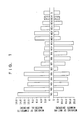
- Ceramic fibers F1-F5 such as shown in Table 1 and ceramic particles P1-P7 such as shown in Table 2 had been prepared, and, according to the art of vacuum molding, preforms were produced from those fibers or a uniform mixture of those fibers and particles, with colloidal silica being added as a binder, to have such volumetric percentages of the fibers and the particles as shown in Table 3, wherein the preforms had a shape of 100x100x20 mm, with the fibers being randomly oriented with respect to two dimensions in a plane of 100x100 mm.
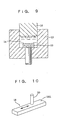
- Fig. 8 is a microscopic photograph of the non-spherical mullite particles listed as P7 in Table 2, obtained by a scanning type electronic microscope, and showing the particles by 140 times magnification.
- the non-spherical mullite particles have angular shapes bordered by flat torn off surfaces.
- Each of the preforms having been preheated up to approximately 450 ° C for about 30 minutes, was placed in a high pressure casting mold 12 warmed up to 250 ° C as shown by 10 in Fig. 9, and immediately thereafter a molten aluminum alloy (JIS ADC12) of about 700 ° C was poured into the mold as shown by 14, and then the molten alloy 14 was pressurized by a plunger 16 up to about 850 kg/cm 2. The pressurized condition was maintained until the molten alloy solidified.
- JIS ADC12 molten aluminum alloy
- test piece having a shape of elongated plate such as 95x20x5 mm and comprising a composite structure in which the aluminum alloy was reinforced by the ceramic fibers or a combination of the ceramic fibers and particles.
- a series of test piece composite materials M1-M6 are shown in Table 3 with the volumetric percentages of the fibers and/or the particles.
- a pin was prepared from a nitriding stainless steel (JIS SUS440B) conventionally used for the piston rings of the engines, to have a diameter of 5mm and a length of 15mm with a hemispherically rounded tip. Then, as shown in Fig. 10, the hemispherically rounded tip of the pin 20 was pressed against a plane surface 18A of 95x20 mm of each test piece 18 under the pressing force of 3kg, and the two members were relatively reciprocated for a stoke of 50mm at a cycle of 5Hz, to test the wearing performance.
- JIS SUS440B nitriding stainless steel
- the composite materials M1-M3 reinforced by the alumina-silica short fibers (F1) are, even when the fiber content is so high as 20 vol.% (M3), much inferior to cast iron (X) in the anti-wearing performance;
- the composite material M4 reinforced by the zirconia short fibers (F2) and the composite material M5 reinforced by the alumina-silica-boria short fibers (F3) are also inferior to cast iron in the anti-wearing performance; and with respect to the composite materials M2-M5, the wearing of the pin, mating member, is also high.
- the anti-wearing performance of the composite material is improved according to increase of the volumetric percentage of the alumina short fibers, the wearing of the mating member also increases.
- the composite material M8 reinforced by the alumina short fibers (F5) and the carbon fibers (F4) has an anti-wearing performance comparable with cast iron X, the wearing of the mating member is high. Therefore, if the cylinder bore of the engine is made of these composite materials, to operate with a piston ring made of the nitriding stainless steel, the piton ring will wear soon, causing an increase of engine oil consumption.
- the composite material M10 reinforced by the alumina short fibers (F5) and the silicon carbide particles (P1) and the composite material M11 reinforced by the alumina short fibers and the chrome particles (P2) are both sufficient in the anti-wearing performance, but these composite materials are highly abrasive to the mating member.
- the composite material M12 reinforced by the alumina short fibers (F5) and the silica particles (P3) and the composite material M13 reinforced by the alumina short fibers (F5) and the zirconia- silica particles (P4) are both insufficient in the anti-wearing performance.
- the composite material M14 reinforced by the alumina short fibers (F5) and the silicon particles (P5) is slightly inferior to cast iron in the anti-wearing performance.
- the composite material M15 reinforced by the alumina short fibers (F5) and the spherical mullite particles (P6) is insufficient in the anti-wearing performance and is nevertheless relatively abrasive to the mating member.
- the reason for this composite material being insufficient in the anti-wearing performance of itself and being nevertheless relatively abrasive to the mating member is in that the mullite particles are spherical and are apt to drop off from the matrix, such dropped off mullite particles causing the wearing of both the composite material and the mating member.
- the embodiment of the present invention i.e. the composite material M16, reinforced by the alumina short fibers (F5) and the non-spherical mullite particles (P7) has a superior anti-wearing performance comparable with cast iron, and also shows a low abrasiveness to the mating member comparable with cast iron.
- the reason for the composite material according to the present invention being superior in both the anti-wearing performance of itself and the abrasiveness to the mating member is in that the mullite particles are non-spherical and hardly drop off from the matrix of the composite material.
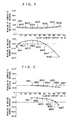
- the hardness of the alumina short fibers varies according to the alpha alumina content, it was contemplated that the anti-wearing performance and the abrasiveness to the mating member of the composite material reinforced by the alumina short fibers and the non-spherical mullite particles will be influenced by the alpha alumina content. Therefore, it was investigated what range of the alpha alumina content is desirable for the alumina short fibers in the slide member of the composite material according to the present invention.
- Fig. 2 it will be understood that, when the alpha alumina content of the alumina short fibers is in a range of about 2-85 wt.%, the wearing of the composite material is kept to be lower than a target wearing (shown by a phantom line in Fig. 2; the same in the below-mentioned Figs. 3-6) obtained by the actual engine evaluation test.
- the wearing of the pin, mating member is kept to be lower than the target wearing when the alpha alumina content is in a range of about 5-60 wt.%.
- the alpha alumina content of the alumina short fibers in the slide member according to the present invention should be maintained in a range of 5-60 wt.%.
- the hardness of the mullite particles varies according to the alumina content thereof, it was contemplated that the alumina content of the mullite particles will influence the anti-wearing performance and the abrasiveness to the mating member of the composite material. Therefore, it was investigated what range of the alumina content is desirable for the mullite particles in the slide member of the composite material according to the present invention.
- seven composite materials MB1-MB7 were prepared such that the matrix of an aluminum alloy (JIS ADC12) was reinforced by 5 vol.% alumina short fibers (97wt.% A1 2 0 3 - 3wt.% Si0 2 , 32 wt.% alpha alumina content, 3 microns mean diameter, 60 microns mean length) and 10 vol.% non-spherical mullite particles (28 microns mean diameter), wherein the alumina content of the mullite particles was varied to seven different levels as shown in the table. Then, test plate pieces were cut out from these composite materials to have the same dimensions as in Embodiment 1, and the wearing tests were carried out with respect to those test pieces in the same manner as in Embodiment 1. The results are shown in Fig. 3.
- the wearing of the composite material is kept to be lower than the target wearing amount when the alumina content of the mullite particles is not less than about 40 wt.%.
- the wearing of the pin, mating member is kept to be lower than the target wearing when the alumina content of the mullite is not more than about 86 wt.%. Therefore, in order to keep the wearing of the composite material itself and also the wearing of the mating member to be desirably low, the alumina content of the mullite particles in the slide member according to the present invention should be maintained in a range of 40-86 wt.%.
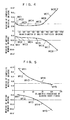
- the size of the mullite particles will influence the anti-wearing performance of the composite material reinforced by the alumina short fibers and the non-spherical mullite particles, it was investigated what range of the mean diameter is desirable for the mullite particles in the slide member of the composite material according to the present invention.
- the wearing of the composite material is kept to be lower than the target wearing when the mean diameter of the mullite particles is in a range of about 3-60 microns.
- the wearing of the pin, mating member is kept to be lower than the target wearing when the mean diameter of the mullite particles is not more than about 65 microns. Therefore, in order to keep the wearing of the composite material itself and also the wearing of the mating member to be desirably low, the mean diameter of the mullite particles in the slide member according to the present invention should be maintained in a range of 3-60 microns.
- a series of similar wearing tests were carried out with respect to the similar composite materials by changing the mean diameter and the mean length of the alumina short fibers to observe the changes in the ant-wearing performance and the abrasiveness to the mating member of the composite material.
- the ant-wearing performance and the abrasiveness to the mating member of the composite material change little according to the mean diameter and the mean length of the alumina short fibers. Therefore, it was confirmed that the mean diameter and the mean length of the alumina short fibers need not be particularly specified.
- volumetric percentages of the alumina short fibers and the non-spherical mullite particles will influence the anti-wearing performance and the abrasiveness to the mating member of the composite material reinforced by the alumina short fibers and the non-spherical mullite particles, it was investigated what ranges of the volumetric percentage are desirable for the alumina short fibers and the non-spherical mullite particles in the slide member of the composite material according to the present invention.
- the wearing of the pin, mating member is kept to be lower than the target wearing obtained from the actual engine evaluation test when the volumetric percentage of the alumina short fibers is not higher than about 12%.
- the volumetric percentage of the alumina short fibers is substantially not less than 2 vol.%. Therefore, the volumetric percentage of the alumina short fibers in the slide member according to the present invention needs to be in a range of 2-12 vol.%.
- five composite materials MD1-MD5 were prepared such that the matrix of an aluminum alloy (JIS ADC12) was reinforced by 2 vol.% alumina short fibers (95wt.% A1 2 0 3 - 5wt.% Si0 2 , 36 wt.% alpha alumina content, 3 microns mean diameter, 60 microns mean length) and such volumetric percentages of non-spherical mullite particles (79wt.% A1 2 0 3 - 21wt.% Si0 2 , 30.6 microns mean diameter) as shown in Table 8, and also five composite materials ME1-ME5 were prepared such that the matrix of an aluminum alloy (JIS ADC12) was reinforced by 12 vol.% of the same alumina short fibers and such volumetric percentages of the same non-spherical mullite particles as shown in Table 9. Then, test plate pieces were cut out from these composite materials to have the same dimensions as in Embodiment 1, and the wearing tests
- the wearing of the composite material is kept to be lower than the target wearing when the volumetric percentage of the mullite is not less than about 5% if the volumetric percentage of the alumina short fibers is 2%, while the wearing of the composite material is kept to be lower than the target wearing when the volumetric percentage of the mullite is not less than about 3% if the volumetric percentage of the alumina short fibers is 12%.
- the wearing of the pin, mating member is kept to be lower than the target wearing regardless of the volumetric percentage of the mullite particles if the volumetric percentage of the alumina short fibers is 2%, while the wearing of the pin, mating member, is kept to be lower than the target wearing when the volumetric percentage of the mullite particles is not higher than about 25% if the volumetric percentage of the alumina short fibers is 12%. Therefore, in order to decrease the wearing of the composite material itself and also the wearing of the mating member, the volumetric percentages of the alumina short fibers and the non-spherical mullite particles in the slide member of the composite material according to the present invention should be maintained in ranges of 2-12 and 5-25 wt.%, respectively.
- the volumetric percentages of the alumina short fibers and the non-spherical mullite particles should desirably be 2-12 % and 5-20 %, respectively, it was investigated in what range the total volumetric percentage of the alumina short fibers and the mullite particles should desirably be.
- preforms F1-F9 each having 10mm outer diameter, 80mm inner diameter and 120mm length, of the reinforcing material were prepared by uniformly mixing alumina short fibers (97 wt.% A1 2 0 3 - 3 wt.% Si0 2 , 32 wt.% alpha alumina content, 3 microns mean diameter, 60 microns mean length) and non-spherical mullite particles (78 wt.% A1 2 0 3 - 22 wt.% Si0 2 , 29.4 microns mean diameter) at such volumetric percentages as shown in Table 10, with colloidal silica being added as a binding agent, and drawing the mixtures under vacuum, wherein the alumina short fibers were randomly oriented in two dimensions along a cylindrical surface.
- composite material MF1-MF9 having the same shape and size as the preforms were produced according to the pressure molding in the same manner as in the above-mentioned embodiments such that each of the preform was infiltrated with the matrix of aluminum alloy (JIS ADC12).
- the inner cylindrical surfaces of the composite materials were finished by boring and horning processes in the same manner as in the actual engine cylinders. Then, test pieces were cut out therefrom to have a length of 60mm along the axis of the cylinder and a width of 40mm along the circumference of the cylinder.
- a piston ring made of a nitriding stainless steel JIS SUS440B was pressed thereon at a load of 3kg and reciprocated relative to the test piece in the axial directions thereof for a stoke of 30mm at a speed of 30mm/sec in the atmosphere of 100 ° C, to test the scuffing performance.
- the scuffing test was carried out such that the time was counted from the start of the reciprocation until a scar was generated on the test surface due to an increase of the friction coefficient.
- the test results are shown in Fig. 7, wherein the ordinate represents the time counts, while the abscissa represents the total volumetric percentage of the alumina short fibers and the mullite particles.
- the slide member according to the present invention was incorporated into the cylinder bore of an actual engine in the following manner, and the engine was tested for a continuous duration.
- Cylindrical reinforcing preforms having an outer diameter of 82mm, an inner diameter of 73mm and a length of 150mm were prepared from the alumina short fibers and the non-spherical mullite particles mixed at such volumetric percentages as shown in Table 11. Then, after having been heated to a temperature of about 400 ° C for 30 minutes in an electric furnace, the reinforcing preforms were each set to a core for forming a cylinder bore of a horizontal die casting mold adapted to cast a cylinder block of a four cylinder engine of a total displacement of 1600cc, and a cylinder block was cast.
- Two of the preforms of type G1 were set to the cores for forming the cylinder bores of first and third cylinders, while two of the preforms of type G2 were set to the cores for forming the cylinder bores of second and fourth cylinders.
- the aluminum alloy JIS ADC12
- JIS ADC12 was heated to 630 °C, and infiltrated into the preforms under pressure, such that the cylinder bores were each reinforced by a layer of a composite material comprising the alumina short fibers and the non-spherical mullite particles.
- the cylinder block thus molded was finished by the required machining processes, and the cylinder heads, pistons and other engine parts were assembled thereto.
- the engine thus assembled was operated at 6000 rpm for 200 hours to test its continuous duration performance.
- the engine was disassembled, and the wearing of a portion of the cylinder bore stroked by the top ring of the piston was measured.
- the wearing of said portions of the first and third cylinders reinforced by the preforms G1 was 2.2 microns
- the wearing of said portions of the second and fourth cylinders reinforced by the preforms G2 was 2.0 microns.
- the wearing of the piston ring was also small.
- a cylinder block constructed according to the same process as in Embodiment 7 was assembled in an engine, and the engine was operated in an atmosphere of -15 °C in such a cyclic manner that its rotation speed was raised from 3000 rpm to 6000 rpm and immediately thereafter lowered to 3000 rpm to make one cycle of a duration of 3 seconds, such a cycle having been repeated 70 times.
- a cyclic operation it was confirmed that the cylinder bores show no practical problem with respect to the anti-scuffing performance even when the engine is operated at a very low temperature such as -15°C.
- the slide member constructed according to the present invention as defined by claim 1 shows an improved performance in its anti-wearing performance and also in its abrasiveness to a mating member as compared with the conventional slide member reinforced by a combination of alumina short fibers and carbon fibers, with simultaneous reduction of its manufacturing costs.
- the slide member is constructed so as not only to provide improvements in its anti-wearing performance and its abrasiveness to a mating member but also to improve its anti-scuffing performance, with simultaneous reduction of its manufacturing costs.
- a slide member is made of an aluminum alloy and compositely reinforced at its sliding surface by a reinforcing material.
- the reinforcing material is a mixture of alumina short fibers consisting of not less than 80 wt.% alumina and the remainder silica and having 5-60 wt.% alpha alumina content, and non-spherical mullite particles consisting of 40-86 wt.% alumina and the remainder silica and having 3-60 microns mean diameter.
- the volumetric percentages of the alumina short fibers and the mullite particles are 2-12% and 5-25%, respectively, on the basis of the volume of the reinforced portion.
Landscapes
- Chemical & Material Sciences (AREA)
- Engineering & Computer Science (AREA)
- Mechanical Engineering (AREA)
- Materials Engineering (AREA)
- Metallurgy (AREA)
- Organic Chemistry (AREA)
- General Engineering & Computer Science (AREA)
- Manufacture Of Alloys Or Alloy Compounds (AREA)
- Pistons, Piston Rings, And Cylinders (AREA)
- Cylinder Crankcases Of Internal Combustion Engines (AREA)
- Sliding-Contact Bearings (AREA)
Applications Claiming Priority (2)
| Application Number | Priority Date | Filing Date | Title |
|---|---|---|---|
| JP05135477A JP3102205B2 (ja) | 1993-05-13 | 1993-05-13 | アルミニウム合金製摺動部材 |
| JP135477/93 | 1993-05-13 |
Publications (2)
| Publication Number | Publication Date |
|---|---|
| EP0624657A1 true EP0624657A1 (fr) | 1994-11-17 |
| EP0624657B1 EP0624657B1 (fr) | 1997-07-16 |
Family
ID=15152634
Family Applications (1)
| Application Number | Title | Priority Date | Filing Date |
|---|---|---|---|
| EP94105795A Expired - Lifetime EP0624657B1 (fr) | 1993-05-13 | 1994-04-14 | Pièce coulissante en alliage d'aluminium |
Country Status (7)
| Country | Link |
|---|---|
| US (1) | US6358628B1 (fr) |
| EP (1) | EP0624657B1 (fr) |
| JP (1) | JP3102205B2 (fr) |
| KR (1) | KR0128259B1 (fr) |
| AU (1) | AU667159B2 (fr) |
| CA (1) | CA2120998C (fr) |
| DE (1) | DE69404213T2 (fr) |
Cited By (2)
| Publication number | Priority date | Publication date | Assignee | Title |
|---|---|---|---|---|
| FR2755981A1 (fr) * | 1996-11-21 | 1998-05-22 | Aisin Seiki | Composite de metal resistant a l'usure |
| EP1190997A1 (fr) * | 2000-09-21 | 2002-03-27 | Mazda Motor Corporation | Procédé de fabrication d'une préforme |
Families Citing this family (7)
| Publication number | Priority date | Publication date | Assignee | Title |
|---|---|---|---|---|
| SE0002173L (sv) * | 2000-06-09 | 2001-12-10 | Haestens Saengar Ab | Anordning vid en sängstomme |
| JP2008095966A (ja) * | 2007-12-17 | 2008-04-24 | Teikoku Piston Ring Co Ltd | シリンダとピストンリングの組合わせ |
| WO2013166275A1 (fr) | 2012-05-02 | 2013-11-07 | Intellectual Property Holdings, Llc | Préforme de céramique et procédé |
| CN107000249A (zh) | 2014-10-20 | 2017-08-01 | 知识产权控股有限责任公司 | 陶瓷预制件和方法 |
| EP3397873B1 (fr) | 2015-12-31 | 2022-09-07 | Intellectual Property Holdings, LLC | Procédé de fabrication d'un élément rotatif de disque de frein à ventilation fait d'un matériau composite à matrice métallique |
| WO2017136810A1 (fr) | 2016-02-04 | 2017-08-10 | Intellectual Property Holdings, Llc | Dispositif et procédé pour former une pièce de véhicule composite à matrice métallique |
| US10830296B2 (en) | 2017-04-21 | 2020-11-10 | Intellectual Property Holdings, Llc | Ceramic preform and method |
Citations (2)
| Publication number | Priority date | Publication date | Assignee | Title |
|---|---|---|---|---|
| JPS60106942A (ja) * | 1983-11-14 | 1985-06-12 | Isolite Babcock Taika Kk | 繊維強化軽金属 |
| EP0213528A2 (fr) * | 1985-09-02 | 1987-03-11 | Toyota Jidosha Kabushiki Kaisha | Matériau composite contenant des fibres courtes d'alumine-silice comme matériau de renforcement et avec une matrice en alliage d'aluminium contenant du cuivre avec une corrélation entre les différentes teneurs |
Family Cites Families (18)
| Publication number | Priority date | Publication date | Assignee | Title |
|---|---|---|---|---|
| US4152149A (en) * | 1974-02-08 | 1979-05-01 | Sumitomo Chemical Company, Ltd. | Composite material comprising reinforced aluminum or aluminum-base alloy |
| JPS5893840A (ja) * | 1981-11-30 | 1983-06-03 | Toyota Motor Corp | 摺動用部材 |
| JPS5893841A (ja) * | 1981-11-30 | 1983-06-03 | Toyota Motor Corp | 繊維強化金属型複合材料 |
| JPS5893839A (ja) * | 1981-11-30 | 1983-06-03 | Toyota Motor Corp | 摺動用部材 |
| KR920008955B1 (ko) | 1984-10-25 | 1992-10-12 | 도요다 지도오샤 가부시끼가이샤 | 결정질 알루미나 실리카 섬유강화 금속복합재료 |
| JPH0696188B2 (ja) * | 1985-01-21 | 1994-11-30 | トヨタ自動車株式会社 | 繊維強化金属複合材料 |
| JPS61194132A (ja) | 1985-02-22 | 1986-08-28 | Isolite Babcock Taika Kk | 結晶質アルミナ−シリカ繊維強化金属複合材料 |
| JPS61253334A (ja) * | 1985-03-01 | 1986-11-11 | Toyota Motor Corp | アルミナ繊維及び鉱物繊維強化金属複合材料 |
| CA1287240C (fr) | 1985-09-14 | 1991-08-06 | Hideaki Ushio | Support en alliage d'aluminium pour organe coulissant |
| JPH0680179B2 (ja) | 1985-12-12 | 1994-10-12 | トヨタ自動車株式会社 | ムライト結晶含有アルミナ短繊維強化金属複合材料 |
| JPH066764B2 (ja) | 1985-12-12 | 1994-01-26 | トヨタ自動車株式会社 | ムライト結晶含有アルミナ連続繊維強化金属複合材料 |
| CA1335044C (fr) * | 1986-01-31 | 1995-04-04 | Masahiro Kubo | Materiau composite constitue d'un materiau de renforcement de fibres courtes d'alumine-silice et d'une matrice metallique en alliage d'aluminium comprenant du cuivre et du magnesium en faible teneur |
| JPS62297427A (ja) | 1986-06-17 | 1987-12-24 | Isolite Babcock Taika Kk | 繊維強化金属用補強体の製造方法 |
| JPS6417831A (en) | 1987-07-14 | 1989-01-20 | Ube Industries | Production of fiber reinforced metallic pre-impregnated sheet |
| JPH0371939A (ja) | 1989-08-12 | 1991-03-27 | Shimonaka Shoji Kk | 角缶及びその製造法 |
| ES2056394T3 (es) * | 1989-12-22 | 1994-10-01 | Comalco Alu | Microesferas ceramicas. |
| DE4009714A1 (de) | 1990-03-27 | 1991-10-02 | Kolbenschmidt Ag | Einzelzylinder bzw. mehrzylinderblock |
| JP6150130B2 (ja) | 2014-01-30 | 2017-06-21 | ソニー株式会社 | 内視鏡システム、内視鏡画像処理装置、画像処理方法、およびプログラム |
-
1993
- 1993-05-13 JP JP05135477A patent/JP3102205B2/ja not_active Expired - Fee Related
-
1994
- 1994-03-31 US US08/220,707 patent/US6358628B1/en not_active Expired - Fee Related
- 1994-04-06 AU AU59290/94A patent/AU667159B2/en not_active Ceased
- 1994-04-11 CA CA002120998A patent/CA2120998C/fr not_active Expired - Fee Related
- 1994-04-14 EP EP94105795A patent/EP0624657B1/fr not_active Expired - Lifetime
- 1994-04-14 DE DE69404213T patent/DE69404213T2/de not_active Expired - Fee Related
- 1994-05-13 KR KR1019940010628A patent/KR0128259B1/ko not_active Expired - Fee Related
Patent Citations (2)
| Publication number | Priority date | Publication date | Assignee | Title |
|---|---|---|---|---|
| JPS60106942A (ja) * | 1983-11-14 | 1985-06-12 | Isolite Babcock Taika Kk | 繊維強化軽金属 |
| EP0213528A2 (fr) * | 1985-09-02 | 1987-03-11 | Toyota Jidosha Kabushiki Kaisha | Matériau composite contenant des fibres courtes d'alumine-silice comme matériau de renforcement et avec une matrice en alliage d'aluminium contenant du cuivre avec une corrélation entre les différentes teneurs |
Non-Patent Citations (1)
| Title |
|---|
| CHEMICAL ABSTRACTS, vol. 103, no. 26, 30 December 1985, Columbus, Ohio, US; abstract no. 219592y * |
Cited By (4)
| Publication number | Priority date | Publication date | Assignee | Title |
|---|---|---|---|---|
| FR2755981A1 (fr) * | 1996-11-21 | 1998-05-22 | Aisin Seiki | Composite de metal resistant a l'usure |
| US5989729A (en) * | 1996-11-21 | 1999-11-23 | Aisin Seiki Kabushiki Kaisha | Wear resistant metal composite |
| EP1190997A1 (fr) * | 2000-09-21 | 2002-03-27 | Mazda Motor Corporation | Procédé de fabrication d'une préforme |
| US6571858B2 (en) | 2000-09-21 | 2003-06-03 | Mazda Motor Corporation | Method of manufacturing preform for compounding use |
Also Published As
| Publication number | Publication date |
|---|---|
| EP0624657B1 (fr) | 1997-07-16 |
| US6358628B1 (en) | 2002-03-19 |
| AU5929094A (en) | 1994-11-17 |
| CA2120998C (fr) | 2004-11-30 |
| JP3102205B2 (ja) | 2000-10-23 |
| DE69404213D1 (de) | 1997-08-21 |
| KR0128259B1 (ko) | 1998-04-16 |
| JPH06322459A (ja) | 1994-11-22 |
| AU667159B2 (en) | 1996-03-07 |
| DE69404213T2 (de) | 1998-01-29 |
| CA2120998A1 (fr) | 1994-11-14 |
Similar Documents
| Publication | Publication Date | Title |
|---|---|---|
| AU615265B2 (en) | Aluminum alloy composite material with intermetallic compound finely dispersed in matrix among reinforcing elements | |
| CA1212561A (fr) | Materiau composite et procede de fabrication | |
| CA1255554A (fr) | Pistons renforces | |
| EP0432810B1 (fr) | Piston à métal léger, coulé sur pression, pour un moteur à combustion interne | |
| JPH04224071A (ja) | 単シリンダ又は多シリンダブロック | |
| EP0080562A1 (fr) | Piston avec un renforcement local en fibres inorganiques | |
| JPH0696188B2 (ja) | 繊維強化金属複合材料 | |
| EP0624657A1 (fr) | Pièce coulissante en alliage d'aluminium | |
| US6318330B1 (en) | Dual phase graphite cylinder liner and method of making the same | |
| CN1080153C (zh) | 汽缸体 | |
| CA2229456A1 (fr) | Piston et cylindre/chemise composites faits d'une matrice de ceramique renforcee par des fibres et destines a un moteur a combustion interne | |
| US20190225546A1 (en) | Machinable metal matrix composite and method for making the same | |
| JPS6150129B2 (fr) | ||
| JPS6150130B2 (fr) | ||
| EP0424109A2 (fr) | Matrice composite en alliage d'aluminium pour moteur à combustion interne | |
| Yamauchi | Development of SiC whiskers reinforced piston | |
| JP3323396B2 (ja) | シリンダライナ及びシリンダブロック並びにそれらの製造方法 | |
| JP2826751B2 (ja) | 内燃機関用アルミニウム合金複合部材 | |
| JP3577748B2 (ja) | 金属基複合体およびその製造方法 | |
| KR0122468B1 (ko) | 세라믹섬유강화 금속복합재료의 제조방법 | |
| JPH0230791B2 (fr) | ||
| JPH0330710B2 (fr) | ||
| JPH068473B2 (ja) | 摺動用部材 | |
| Lee et al. | Characterization of high temperature properties in al matrix composite fabricated by the low pressure squeeze infiltration process | |
| JPH0684527B2 (ja) | 摺動用部材 |
Legal Events
| Date | Code | Title | Description |
|---|---|---|---|
| PUAI | Public reference made under article 153(3) epc to a published international application that has entered the european phase |
Free format text: ORIGINAL CODE: 0009012 |
|
| AK | Designated contracting states |
Kind code of ref document: A1 Designated state(s): DE FR GB |
|
| 17P | Request for examination filed |
Effective date: 19941124 |
|
| 17Q | First examination report despatched |
Effective date: 19950516 |
|
| GRAG | Despatch of communication of intention to grant |
Free format text: ORIGINAL CODE: EPIDOS AGRA |
|
| GRAH | Despatch of communication of intention to grant a patent |
Free format text: ORIGINAL CODE: EPIDOS IGRA |
|
| GRAH | Despatch of communication of intention to grant a patent |
Free format text: ORIGINAL CODE: EPIDOS IGRA |
|
| GRAA | (expected) grant |
Free format text: ORIGINAL CODE: 0009210 |
|
| AK | Designated contracting states |
Kind code of ref document: B1 Designated state(s): DE FR GB |
|
| ET | Fr: translation filed | ||
| REF | Corresponds to: |
Ref document number: 69404213 Country of ref document: DE Date of ref document: 19970821 |
|
| PLBE | No opposition filed within time limit |
Free format text: ORIGINAL CODE: 0009261 |
|
| STAA | Information on the status of an ep patent application or granted ep patent |
Free format text: STATUS: NO OPPOSITION FILED WITHIN TIME LIMIT |
|
| 26N | No opposition filed | ||
| REG | Reference to a national code |
Ref country code: GB Ref legal event code: IF02 |
|
| REG | Reference to a national code |
Ref country code: GB Ref legal event code: 746 Effective date: 20021008 |
|
| REG | Reference to a national code |
Ref country code: FR Ref legal event code: D6 |
|
| PGFP | Annual fee paid to national office [announced via postgrant information from national office to epo] |
Ref country code: DE Payment date: 20070412 Year of fee payment: 14 |
|
| PGFP | Annual fee paid to national office [announced via postgrant information from national office to epo] |
Ref country code: GB Payment date: 20070411 Year of fee payment: 14 |
|
| PGFP | Annual fee paid to national office [announced via postgrant information from national office to epo] |
Ref country code: FR Payment date: 20070411 Year of fee payment: 14 |
|
| GBPC | Gb: european patent ceased through non-payment of renewal fee |
Effective date: 20080414 |
|
| PG25 | Lapsed in a contracting state [announced via postgrant information from national office to epo] |
Ref country code: DE Free format text: LAPSE BECAUSE OF NON-PAYMENT OF DUE FEES Effective date: 20081101 |
|
| REG | Reference to a national code |
Ref country code: FR Ref legal event code: ST Effective date: 20081231 |
|
| PG25 | Lapsed in a contracting state [announced via postgrant information from national office to epo] |
Ref country code: FR Free format text: LAPSE BECAUSE OF NON-PAYMENT OF DUE FEES Effective date: 20080430 |
|
| PG25 | Lapsed in a contracting state [announced via postgrant information from national office to epo] |
Ref country code: GB Free format text: LAPSE BECAUSE OF NON-PAYMENT OF DUE FEES Effective date: 20080414 |