EP0625314A2 - Prozess mit alternierendem Fluss zur Verbesserung des Flüssigkeitsaustausch in Nahrungsmitteln, sowie Vorrichtung zur Ausführung dieses Prozesses - Google Patents
Prozess mit alternierendem Fluss zur Verbesserung des Flüssigkeitsaustausch in Nahrungsmitteln, sowie Vorrichtung zur Ausführung dieses Prozesses Download PDFInfo
- Publication number
- EP0625314A2 EP0625314A2 EP94500071A EP94500071A EP0625314A2 EP 0625314 A2 EP0625314 A2 EP 0625314A2 EP 94500071 A EP94500071 A EP 94500071A EP 94500071 A EP94500071 A EP 94500071A EP 0625314 A2 EP0625314 A2 EP 0625314A2
- Authority
- EP
- European Patent Office
- Prior art keywords
- food
- vacuum
- water
- food products
- exchanges
- Prior art date
- Legal status (The legal status is an assumption and is not a legal conclusion. Google has not performed a legal analysis and makes no representation as to the accuracy of the status listed.)
- Withdrawn
Links
Images




Classifications
-
- A—HUMAN NECESSITIES
- A23—FOODS OR FOODSTUFFS; TREATMENT THEREOF, NOT COVERED BY OTHER CLASSES
- A23B—PRESERVATION OF FOODS, FOODSTUFFS OR NON-ALCOHOLIC BEVERAGES; CHEMICAL RIPENING OF FRUIT OR VEGETABLES
- A23B7/00—Preservation of fruit or vegetables; Chemical ripening of fruit or vegetables
- A23B7/08—Preserving with sugars
-
- A—HUMAN NECESSITIES
- A23—FOODS OR FOODSTUFFS; TREATMENT THEREOF, NOT COVERED BY OTHER CLASSES
- A23B—PRESERVATION OF FOODS, FOODSTUFFS OR NON-ALCOHOLIC BEVERAGES; CHEMICAL RIPENING OF FRUIT OR VEGETABLES
- A23B2/00—Preservation of foods or foodstuffs, in general
- A23B2/10—Preservation of foods or foodstuffs, in general by treatment with pressure variation, shock, acceleration or shear stress
- A23B2/103—Preservation of foods or foodstuffs, in general by treatment with pressure variation, shock, acceleration or shear stress using sub- or super-atmospheric pressures, or pressure variations transmitted by a liquid or gas
-
- A—HUMAN NECESSITIES
- A23—FOODS OR FOODSTUFFS; TREATMENT THEREOF, NOT COVERED BY OTHER CLASSES
- A23B—PRESERVATION OF FOODS, FOODSTUFFS OR NON-ALCOHOLIC BEVERAGES; CHEMICAL RIPENING OF FRUIT OR VEGETABLES
- A23B2/00—Preservation of foods or foodstuffs, in general
- A23B2/90—Preservation of foods or foodstuffs, in general by drying or kilning; Subsequent reconstitution
-
- A—HUMAN NECESSITIES
- A23—FOODS OR FOODSTUFFS; TREATMENT THEREOF, NOT COVERED BY OTHER CLASSES
- A23B—PRESERVATION OF FOODS, FOODSTUFFS OR NON-ALCOHOLIC BEVERAGES; CHEMICAL RIPENING OF FRUIT OR VEGETABLES
- A23B2/00—Preservation of foods or foodstuffs, in general
- A23B2/90—Preservation of foods or foodstuffs, in general by drying or kilning; Subsequent reconstitution
- A23B2/91—Preservation of foods or foodstuffs, in general by drying or kilning; Subsequent reconstitution with addition of chemicals before or during drying
-
- A—HUMAN NECESSITIES
- A23—FOODS OR FOODSTUFFS; TREATMENT THEREOF, NOT COVERED BY OTHER CLASSES
- A23B—PRESERVATION OF FOODS, FOODSTUFFS OR NON-ALCOHOLIC BEVERAGES; CHEMICAL RIPENING OF FRUIT OR VEGETABLES
- A23B4/00—Preservation of meat, sausages, fish or fish products
- A23B4/03—Drying; Subsequent reconstitution
- A23B4/031—Apparatus for drying
-
- A—HUMAN NECESSITIES
- A23—FOODS OR FOODSTUFFS; TREATMENT THEREOF, NOT COVERED BY OTHER CLASSES
- A23B—PRESERVATION OF FOODS, FOODSTUFFS OR NON-ALCOHOLIC BEVERAGES; CHEMICAL RIPENING OF FRUIT OR VEGETABLES
- A23B4/00—Preservation of meat, sausages, fish or fish products
- A23B4/03—Drying; Subsequent reconstitution
- A23B4/033—Drying; Subsequent reconstitution with addition of chemicals
-
- A—HUMAN NECESSITIES
- A23—FOODS OR FOODSTUFFS; TREATMENT THEREOF, NOT COVERED BY OTHER CLASSES
- A23B—PRESERVATION OF FOODS, FOODSTUFFS OR NON-ALCOHOLIC BEVERAGES; CHEMICAL RIPENING OF FRUIT OR VEGETABLES
- A23B7/00—Preservation of fruit or vegetables; Chemical ripening of fruit or vegetables
- A23B7/02—Dehydrating; Subsequent reconstitution
- A23B7/0205—Dehydrating; Subsequent reconstitution by contact of the material with fluids, e.g. drying gas or extracting liquids
-
- A—HUMAN NECESSITIES
- A23—FOODS OR FOODSTUFFS; TREATMENT THEREOF, NOT COVERED BY OTHER CLASSES
- A23B—PRESERVATION OF FOODS, FOODSTUFFS OR NON-ALCOHOLIC BEVERAGES; CHEMICAL RIPENING OF FRUIT OR VEGETABLES
- A23B7/00—Preservation of fruit or vegetables; Chemical ripening of fruit or vegetables
- A23B7/02—Dehydrating; Subsequent reconstitution
- A23B7/022—Dehydrating; Subsequent reconstitution with addition of chemicals before or during drying, e.g. semi-moist products
Definitions
- the object of the present invention is, by means of a controlled alternating change of pressures, to improve the exchanges of water and solutes between the food and a surrounding liquid medium.
- a vacuum 50 to 150 mbar absolute
- the change in pressure is used as a means of pumping the solution inside the pore, it being possible to carry out said pumping once (in general in the case of preserves) or repeatedly (in the case of salting food).
- the repetition of the cycle causes the solution contained within the pore, which is made more dilate by the osmotic effect, to be replaced by the concentrated solution which surrounds it.
- the saline concentration of the solution has a limit of solubility, it is possible to achieve similar levels of salting to those obtained by conventional salting methods in times of the order of 10 times less.
- the duration of each vacuum pulse is 1/2 or less than the duration of the process, which is between 1 and 10 hours depending on the characteristics of the food and the treatment which is carried out (dehydration or salting).
- the invention also includes a description of the equipment necessary to carry out the process.
- the porous nature of food plays a fundamental part in the transfer of mass which takes place during the vacuum operations.
- the presence of pores in the food may be due to a number of factors.
- the presence of intercellular spaces are characteristics of the soft tissue [Trakoontivakorn G., Patterson M.E. and Swnasoo B.G. "Scanning Electron Microscopy of Cellular Structure of Granny Smith and Red Delicious Apples". Food Microstructure 7;205-212 (1988)]. This type of study has been carried out on different kinds fruit in which the relationship between structure, structural parameters and operational variables has been examined.
- the depth of penetration of the of the liquid inside the pore is expressed as a function of the fraction of the volume of the pore, x v , which is occupied by the liquid.
- the value of x can be adjusted for each type food by means of an empirical equation of the following type: which enables two characteristic parameters K and x o to be defined for each of them.
- Table 1 shows their values for the following types of fruit: papaya, mango, peach, apricot, banana, pear, pineapple and apple.
- the table also gives the experimental value, x atm , of x which corresponds to the fruit at atmospheric pressure.
- Figure 2 shows the value of ⁇ e for the above mentioned fruits for values of p1 of less than 600 mbar. Only in the case of mango and peach (curves C and E) is an increase in the value of the porosity ⁇ e' observed as the pressure is reduced. This may possibly be due to the loss of native liquid during the stage of expansion and discharge of gas contained within the pores. Such a loss gives rise to an increase in the internal volume of pores available for the gas phase.
- Figure 3 shows schematically the process which takes place inside a pore of the food (simplified to a cylinder) during the above mentioned phases.
- the second stage (C and D) first causes the gas contained in the pores to expand. It is possible for some of the natural liquid of the food to leave (if there is any).
- osmotic dehydration is produced and which now, according to the equation [11] and assuming a working pressure of 100 mbar, results in a value of x v of 0.15. It is important to observe that a reduction in the working pressure gives rise to more than a tenfold increase in the value of x v . This is the state of the system during the third stage, although the situation is frequently complicated by the structural changes which take place during the process: the reduction in size and the resulting change in structure.
- the principal advantage of pulsed vacuum osmotic dehydration compared with osmotic dehydration at atmospheric pressure is the transfer of mass due to the hydrodynamic process and the corresponding increase in the solid/liquid interface surface which is produced.
- the disadvantage is basically the higher cost of the equipment.
- the present invention proposes that the process of osmotic dehydration be carried out in pulsed vacuum conditions. In this way, whilst the product is submerged in the osmotic solution. it is subjected to short period of vacuum (for example 5 minutes). Afterwards, the material undergoes normal osmotic dehydration at atmospheric pressure. In this way the pores of the food are refilled with the same osmotic solution which was used at the beginning of the treatment, giving rise to many advantages over osmotic dehydration in vacuum. Among them it is worth mentioning the significant saving in the time during which the equipment is at vacuum, with the corresponding saving in equipment and the fact that the food is not "torn" by uselessly subjecting it to prolonged conditions of vacuum.
- Figure 5 shows the results obtained with apricot at different temperatures and pressures. It is interesting to compare the results of loss of water loss and gain in solute at 40°C and at a vacuum of 70 mbar.
- the results obtained according to the present invention using 5 minute pulses at 70 mbar followed by the rest of the treatment at atmospheric pressure are only slightly lower than those obtained by the procedure of osmotic dehydration at vacuum, but much greater than those obtained atmospheric pressure. It is possible to use temperatures between 8 and 20°C lower and times of 2 to 4 times shorter than in the case of conventional osmotic dehydration.
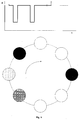
- the upper part of figure 6 shows the pressure/time cycle during an alternating flow cycle.
- the lower part of the figure shows the application of this cycle to a chain (represented by the broken line) of dehydration tanks (represented by the circles) which move in the plane of the paper in the direction indicated by the arrow; the different types of shading represent each of the functions which are carried out during the process (in order to simplify the drawing only two positions of atmospheric pressure are shown for each position of vacuum, although it is understood that this proportion will be different depending on the type of operation to be carried out).
- Figure 7 shows schematically the arrangement of the equipment used: the osmotic solution crosses a bed consisting of the food to be dehydrated, such that the water eliminated by the food is swept along by said solution which becomes diluted.
- a heat exchanger [2] which provides the energy necessary to keep temperature constant.
- the solution returns to the region [4] of the tank [3] which is not occupied by the liquid [5].
- the water to be eliminated from the solution can be removed (if necessary) by conventional methods (evaporation, reverse osmosis, dialysis, etc.) in [7].
- a stage of sterilization of the solution can be included in [6].
- the water contained by the pores has to be renewed, for which it is necessary to periodically repeat the vacuum pulses.
- the changes between vacuum and atmospheric pressure which correspond to the object of the present invention are produced by means of a timed system which operates a three-way valve [6].
- the vapour produced during the periods of vacuum (and which contributes to the concentration of the solution) is extracted by [9] after having passed through a cooled condenser [8] which separates the condensate [10].
- Example 1 Pulsed osmotic dehydration equipment.
- Figure 8 shows the full system for a piece of equipment capable of treating 10 to 20 kg of food. Given that it refers to an experimental installation only one fixed piece of equipment has been assembled.
- the tank [1] consists basically if a cylinder which is 35 cm in diameter and 81 cm in height. In it are positioned 16 baskets [2] for holding the food, each of them with an internal diameter of 30 cm, 3.5 cm in height and with a stainless steel mesh.
- the flowing osmotic solution which is heated by means of a heat exchanger [3] provided with a 4 kW electric heating element.
- the osmotic solution is made to flow by means of an 8 to 10 m3 /h pump, whose rate of flow is measured by [7] and regulated by the valve [6]; the solution can be discharged by means of the valve [8].
- the system is evacuated by means of a water ring pump [10] (positioned after the surface condenser [12]) which extracts the vapours and enables the condensate to be discharged through [13].
- a refrigerating liquid provided by a refrigerating installation [9] is made to flow through the condenser coil by means of the pump [14].
- a suitable automatic device enables the reactor [1] to be periodically depressurized by means of the valve [11], at the same time closing the valve [16].
- the system is controlled by adjusting the resistance [3] and the valve [15] by means of the pressure sensor P and temperature sensor T (which operate the corresponding servomechanisms).
- the equipment automatically regulates the concentration of the solution since if it should become more dilute due to the water which is extracted, its vapour pressure increases and therefore, as the fixed external pressure is lower, the solution boils and the water is eliminated.
- Example 2 Obtaining pineapple preserve.
- This product is mixed at a temperature of 20 - 25°C (room temperature) adding, as well as the 70 °Brix sugar solution (6.5 kg of sugar and 2.8 kg of water), a solution which contains: 0.1 kg of pectin, 2.1 kg of sugar, 0.01 kg of citric acid and 0.5 kg water.
- Example 3 Obtaining strawberry preserve .
- Example 3 Curing cheese.
- Figure 1 Hydrodynamic model of an ideal pore.
- the upper figure represents the situation at the start of the process (t-0).
- the initial pressure of the gas inside the pore is, p i0 , is lower than the external pressure of the liquid, p e , which in turn is the sum of the system pressure p2 and the capillary pressure p c .
- Y-axis Effective porosity, e e .
- X-axis Pressure in mbar at which e e was measured.
- Figure 3 Typical stages during the operation of transfer of mass between a pore of food submerged in a liquid under conditions of vacuum. Situation of an ideal pore.
- Figure 4 Loss of water by osmotic dehydration in slices of apple at 50°C .
- Y axis kg of water per kg of dry matter.
- X-axis Time in hours. ⁇ At atmospheric pressure ⁇ Having previously produced a vacuum pulse for 5 minutes.
- Figure 5 Loss of water from chopped pineapple under different conditions.
- FIG. 7 Block diagram of the pulsed vacuum osmotic dehydration device.
- Figure 8 Flow diagram of the pulsed vacuum osmotic dehydration device.
Landscapes
- Engineering & Computer Science (AREA)
- Life Sciences & Earth Sciences (AREA)
- Chemical & Material Sciences (AREA)
- Polymers & Plastics (AREA)
- Zoology (AREA)
- Food Science & Technology (AREA)
- Wood Science & Technology (AREA)
- Chemical Kinetics & Catalysis (AREA)
- General Chemical & Material Sciences (AREA)
- General Preparation And Processing Of Foods (AREA)
- Jellies, Jams, And Syrups (AREA)
- Preparation Of Fruits And Vegetables (AREA)
- Storage Of Fruits Or Vegetables (AREA)
- Coloring Foods And Improving Nutritive Qualities (AREA)
Applications Claiming Priority (2)
| Application Number | Priority Date | Filing Date | Title |
|---|---|---|---|
| ES09300805A ES2069467B1 (es) | 1993-04-20 | 1993-04-20 | Procedimiento de flujo alternado para favorecer los intercambios liquidos de productos alimenticios y equipo para realizarlo. |
| ES9300805 | 1993-04-20 |
Publications (2)
| Publication Number | Publication Date |
|---|---|
| EP0625314A2 true EP0625314A2 (de) | 1994-11-23 |
| EP0625314A3 EP0625314A3 (de) | 1994-12-07 |
Family
ID=8281504
Family Applications (1)
| Application Number | Title | Priority Date | Filing Date |
|---|---|---|---|
| EP9494500071A Withdrawn EP0625314A3 (de) | 1993-04-20 | 1994-04-19 | Prozess mit alternierendem Fluss zur Verbesserung des Flüssigkeitsaustausch in Nahrungsmitteln, sowie Vorrichtung zur Ausführung dieses Prozesses |
Country Status (2)
| Country | Link |
|---|---|
| EP (1) | EP0625314A3 (de) |
| ES (2) | ES2069467B1 (de) |
Cited By (1)
| Publication number | Priority date | Publication date | Assignee | Title |
|---|---|---|---|---|
| DE10029079A1 (de) * | 2000-06-13 | 2002-01-03 | Masterfoods Gmbh | Probiotische Mikroorganismen enthaltendes Nahrungsmittelerzeugnis |
Families Citing this family (1)
| Publication number | Priority date | Publication date | Assignee | Title |
|---|---|---|---|---|
| ES2397904B1 (es) * | 2011-08-10 | 2014-01-22 | Fermín Posada González De Sarralde | Procedimiento para salado de quesos al vacío. |
Family Cites Families (20)
| Publication number | Priority date | Publication date | Assignee | Title |
|---|---|---|---|---|
| US687120A (en) * | 1901-03-22 | 1901-11-19 | James J Callender | Harrow-tooth fastening. |
| US1861307A (en) * | 1927-07-25 | 1932-05-31 | Gernhardt Berthold | Apparatus for the automatic production of inspissated sugar fruits |
| DE504704C (de) * | 1927-09-26 | 1930-08-07 | Jacques Duprat | Vorrichtung zum Einmachen von Obst mit Sirup |
| FR653038A (fr) * | 1927-09-26 | 1929-03-15 | Appareil à confire les fruits et à concentrer les solutions | |
| FR668796A (fr) * | 1928-05-18 | 1929-11-06 | H Barrielle Aine Ets | Perfectionnements apportés à la fabrication des fruits confits |
| US1906265A (en) * | 1929-08-12 | 1933-05-02 | Frederic W Hild | Blow-out preventer for rotary drilling |
| FR687121A (fr) * | 1929-09-23 | 1930-08-05 | Dispositif pour l'évaporation dans le vide dans les appareils pour fruits confits | |
| FR971781A (fr) * | 1948-07-23 | 1951-01-22 | Appareil de confisage rapide de tous fruits sous vide | |
| FR1002771A (fr) * | 1948-12-16 | 1952-03-10 | Motta Societa Per Azioni | Procédé pour candir rapidement les fruits et matériel correspondant |
| US3476078A (en) * | 1966-07-20 | 1969-11-04 | Bahnson Co | Vacuum impregnating apparatus |
| US4183963A (en) * | 1976-02-02 | 1980-01-15 | Societe D'assistance Technique Pour Produits Nestle S.A. | Continuous food impregnation |
| US4350711A (en) * | 1977-01-28 | 1982-09-21 | Rich Products Corporation | Methods of infusing fruits |
| FR2504783A1 (fr) * | 1981-05-04 | 1982-11-05 | Roquette Freres | Sirop de confisage, le procede et les moyens pour sa preparation, sa mise en oeuvre et les produits ainsi obtenus |
| US4551348A (en) * | 1983-02-15 | 1985-11-05 | Rich Products Corporation | Sugar infusion of fruit |
| DD227039A1 (de) * | 1984-10-09 | 1985-09-11 | Inst Getreide Verarbeitung | Verfahren zur herstellung eines trockenfruchtproduktes |
| ZA858921B (en) * | 1984-11-21 | 1986-07-30 | Syrinx Res Pty Ltd | Osmotic concentration by membrane |
| JP2610297B2 (ja) * | 1988-04-15 | 1997-05-14 | 新化食品株式会社 | 果実加工品及びその製造方法 |
| NL8900387A (nl) * | 1989-02-16 | 1990-09-17 | Florigo Ind | Inrichting voor het drogen van fruit- of groenteschijfjes of -stukjes. |
| EP0401450A1 (de) * | 1989-06-08 | 1990-12-12 | C.E.E.M.A.T.- Centre D'etudes Et D'experimentation Du Machinisme Agricole Tropical | Herstellungsverfahren für halbkandierte Scheiben von Kiwi-Früchten |
| JPH04144640A (ja) * | 1990-10-08 | 1992-05-19 | Samuson:Kk | 煮豆類の自動蜜漬け装置 |
-
1993
- 1993-04-20 ES ES09300805A patent/ES2069467B1/es not_active Expired - Fee Related
-
1994
- 1994-04-19 EP EP9494500071A patent/EP0625314A3/de not_active Withdrawn
-
1998
- 1998-04-06 ES ES009800733A patent/ES2151386B1/es not_active Expired - Fee Related
Cited By (2)
| Publication number | Priority date | Publication date | Assignee | Title |
|---|---|---|---|---|
| DE10029079A1 (de) * | 2000-06-13 | 2002-01-03 | Masterfoods Gmbh | Probiotische Mikroorganismen enthaltendes Nahrungsmittelerzeugnis |
| DE10029079B4 (de) * | 2000-06-13 | 2006-04-20 | Mars Inc. | Probiotische Mikroorganismen enthaltendes Nahrungsmittelerzeugnis |
Also Published As
| Publication number | Publication date |
|---|---|
| ES2069467A1 (es) | 1995-05-01 |
| EP0625314A3 (de) | 1994-12-07 |
| ES2069467B1 (es) | 1996-01-01 |
| ES2151386B1 (es) | 2001-07-01 |
| ES2151386A1 (es) | 2000-12-16 |
Similar Documents
| Publication | Publication Date | Title |
|---|---|---|
| Shi et al. | Influence of vacuum treatment on mass transfer during osmotic dehydration of fruits | |
| Rastogi et al. | Recent developments in osmotic dehydration: methods to enhance mass transfer | |
| Zhao et al. | Practical applications of vacuum impregnation in fruit and vegetable processing | |
| US3843810A (en) | Process of air evacuation of foods under ultra-low pressure | |
| Bekele et al. | Going beyond conventional osmotic dehydration for quality advantage and energy savings | |
| US3677024A (en) | Preservation and storage of biologic materials | |
| Falade et al. | Osmotic dehydration of tropical fruits and vegetables | |
| US3219461A (en) | Process for partially dehydrating, impregnating and freezing food products | |
| Derossi et al. | The application of vacuum impregnation techniques in food industry | |
| Shi et al. | Application and development of osmotic dehydration technology in food processing | |
| Salvatori et al. | Structural changes and mass transfer during glucose infusion of apples as affected by blanching and process variables | |
| US4735813A (en) | Process for bleaching mushrooms and other vegetables | |
| Brochier et al. | Study of osmotic dehydration of kiwi fruit using sucrose solution | |
| US4379796A (en) | Method of concentrating fresh fruits | |
| US2899319A (en) | Dehydration of cherries | |
| GB2227162A (en) | Vacuum frying apparatus | |
| İspir et al. | The influence of application of pretreatment on the osmotic dehydration of apricots | |
| US3219463A (en) | Process of dehydrofreezing foods | |
| Joardder et al. | Bound water removal techniques | |
| US3010831A (en) | Process for treating food products | |
| Malakar et al. | Osmotic dehydration in food processing | |
| Shi | Osmotic dehydration of foods | |
| Li et al. | Osmotic dehydration | |
| US666413A (en) | Method of candying fruit. | |
| VALDEZ‐FRAGOSO et al. | Pilot plant for osmotic dehydration of fruits: Design and evaluation |
Legal Events
| Date | Code | Title | Description |
|---|---|---|---|
| PUAI | Public reference made under article 153(3) epc to a published international application that has entered the european phase |
Free format text: ORIGINAL CODE: 0009012 |
|
| PUAL | Search report despatched |
Free format text: ORIGINAL CODE: 0009013 |
|
| AK | Designated contracting states |
Kind code of ref document: A2 Designated state(s): AT BE CH DE DK FR GB GR IE IT LI LU NL PT |
|
| AK | Designated contracting states |
Kind code of ref document: A3 Designated state(s): AT BE CH DE DK FR GB GR IE IT LI LU NL PT |
|
| RIN1 | Information on inventor provided before grant (corrected) |
Inventor name: GRAU, ANA ANDRES Inventor name: PASTOR DEL CASTILLO, MARY ANN RITA Inventor name: QUAN, SHI XIAN Inventor name: MATA MONTESDEOCA, MIGUEL Inventor name: SERRA BELENGUER, JUAN ANTONIO Inventor name: CHIRALT BOIX, AMPARO Inventor name: FITO MAUPOEY, PEDRO |
|
| 17P | Request for examination filed |
Effective date: 19950522 |
|
| 17Q | First examination report despatched |
Effective date: 19970916 |
|
| STAA | Information on the status of an ep patent application or granted ep patent |
Free format text: STATUS: THE APPLICATION HAS BEEN WITHDRAWN |
|
| 18W | Application withdrawn |
Withdrawal date: 19980119 |