EP0626437A1 - Matériau luminescent à base de gadolinate de barium activé au terbium et/ou samarium - Google Patents
Matériau luminescent à base de gadolinate de barium activé au terbium et/ou samarium Download PDFInfo
- Publication number
- EP0626437A1 EP0626437A1 EP94107848A EP94107848A EP0626437A1 EP 0626437 A1 EP0626437 A1 EP 0626437A1 EP 94107848 A EP94107848 A EP 94107848A EP 94107848 A EP94107848 A EP 94107848A EP 0626437 A1 EP0626437 A1 EP 0626437A1
- Authority
- EP
- European Patent Office
- Prior art keywords
- phosphor
- radiation
- wavelength
- phosphors
- bagd2o4
- Prior art date
- Legal status (The legal status is an assumption and is not a legal conclusion. Google has not performed a legal analysis and makes no representation as to the accuracy of the status listed.)
- Withdrawn
Links
Images


Classifications
-
- G—PHYSICS
- G21—NUCLEAR PHYSICS; NUCLEAR ENGINEERING
- G21K—HANDLING OF PARTICLES OR IONISING RADIATION NOT OTHERWISE PROVIDED FOR; IRRADIATION DEVICES; GAMMA RAY OR X-RAY MICROSCOPES
- G21K4/00—Conversion screens for the conversion of the spatial distribution of X-rays or particle radiation into visible images, e.g. fluoroscopic screens
-
- C—CHEMISTRY; METALLURGY
- C09—DYES; PAINTS; POLISHES; NATURAL RESINS; ADHESIVES; COMPOSITIONS NOT OTHERWISE PROVIDED FOR; APPLICATIONS OF MATERIALS NOT OTHERWISE PROVIDED FOR
- C09K—MATERIALS FOR MISCELLANEOUS APPLICATIONS, NOT PROVIDED FOR ELSEWHERE
- C09K11/00—Luminescent materials, e.g. electroluminescent or chemiluminescent
- C09K11/08—Luminescent materials, e.g. electroluminescent or chemiluminescent containing inorganic luminescent materials
- C09K11/77—Luminescent materials, e.g. electroluminescent or chemiluminescent containing inorganic luminescent materials containing rare earth metals
- C09K11/7766—Luminescent materials, e.g. electroluminescent or chemiluminescent containing inorganic luminescent materials containing rare earth metals containing two or more rare earth metals
- C09K11/7767—Chalcogenides
- C09K11/7768—Chalcogenides with alkaline earth metals
-
- G—PHYSICS
- G21—NUCLEAR PHYSICS; NUCLEAR ENGINEERING
- G21K—HANDLING OF PARTICLES OR IONISING RADIATION NOT OTHERWISE PROVIDED FOR; IRRADIATION DEVICES; GAMMA RAY OR X-RAY MICROSCOPES
- G21K4/00—Conversion screens for the conversion of the spatial distribution of X-rays or particle radiation into visible images, e.g. fluoroscopic screens
- G21K2004/06—Conversion screens for the conversion of the spatial distribution of X-rays or particle radiation into visible images, e.g. fluoroscopic screens with a phosphor layer
Definitions
- the present invention relates to storage phosphors which are useful in X-ray imaging plates.
- Phosphor materials have been used in the past, in a variety of forms, to help in alleviating the exposure of patients to X-rays during X-radiation diagnoses.
- Storage phosphors or photostimulable phosphors, have the ability to store some of the X-ray energy and emit longer wavelength radiation when exposed to (excited by) visible light, infrared rays, heat, and so forth.
- the secondary excitation needed to cause the emission of longer wavelength radiation in storage phosphors is commonly referred to as stimulation radiation.
- Storage phosphors are typically used in imaging plates to acquire images in a digital format and to produce images which may be electronically displayed on a CRT, or printed to a suitable hardcopy medium such as photographic film.
- the storage phosphors are incorporated into a binder which is applied to a suitable support, such as polyethylene terephthalate (PET), and a protective overcoat material is applied over the phosphor containing binder layer.
- a suitable support such as polyethylene terephthalate (PET)
- PET polyethylene terephthalate
- the photostimulable phosphors employed in imaging plates emit light at as high a luminescence intensity as possible due to exposure to stimulating radiation after exposure to ionizing radiation so that the dose of ionizing radiations to which the body must be exposed can be reduced.
- many different and photostimulable phosphor compositions known many fail to satisfy the practical demands of medical imaging applications by failing to generate sufficient or photostimulated emission intensity for the desired radiation dose. It is therefore desirable to identify storage phosphors which are capable of producing high photostimulated emission intensities.
- Phosphors typically consist of a host compound, which is often combined with a small amount of an activator element to change the hue and/or improve the efficiency of fluorescence.
- US-A-4,959,174; US-A-4,829,188; and US-A-4,857,741 disclose phosphors in which gadolinium may be combined with at least one divalent metal selected from the group consisting of Be, Mg, Ca, Sr, Ba, Zn and Cd. However, these phosphors also include either or both of Ta and Nb.
- a phosphor which is capable of absorbing X-radiation and emitting longer wavelength radiation, the phosphor comprising an activated gadolinate host consisting essentially of oxygen and combined elements satisfying the relationship BaGd2:xLn, wherein Ln represents at least one of terbium or samarium activator(s) and x is an amount sufficient to produce a phosphor which exhibits a higher luminescence emission intensity than said phosphor absent the Ln activator when, after first being exposed to X-radiation, the phosphor is stimulated by light of a wavelength ranging from 600 to 1200 nm.
- BaGd2O4 when activated by Sm and/or Tb, BaGd2O4 acts as a storage phosphor.
- Particularly preferred BaGd2O4 storage phosphors are those which are doubly activated by both Tb and Sm.
- a method for storing an image produced by X-radiation exposure and releasing the stored image in this storage phosphor comprising imagewise exposing a storage screen to radiation of a first wavelength, said storage screen comprised of a storage phosphor consisting essentially of oxygen and combined elements satisfying the relationship BaGd2:xLn wherein Ln represents at least one of terbium or samarium activator in an amount sufficient to produce a phosphor exhibiting a higher luminescence intensity than said phosphor absent the Ln activator, thereby storing an image pattern in the storage screen.
- the storage screen is exposed to radiation of a second wavelength, thereby stimulating the phosphor to emit radiation of a third wavelength. This emitted radiation of the third wavelength is then collected and used to produce an image representative of the image pattern initially stored on the image screen.
- a mixture containing Ba, Gd, and at least one of Tb and Sm is heated under an atmosphere which is at least partially reducing, thereby reducing at least a portion of the Tb and/or Sm activator(s).
- the relatively high density of the BaGd2O4 lattice results in a relatively high X-ray absorption, which potentially results in high image storage efficiency.
- the stimulation band is in the infrared, allowing these materials to be efficiently stimulated with conventional laser diodes or LED's, thereby simplifying scanner design.
- the stimulated emission spectra of the storage phosphors of the present invention are located in a region of the visible spectrum where binders do not exhibit appreciable absorption. Consequently, the stimulated emission of these phosphors can be more efficiently collected for imaging.
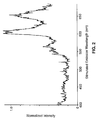
- Figure 1 is a graph illustrating the stimulated emission spectrum (900 nm stimulation) of X-ray excited BaGd2O4 activated by 0.1 mole percent terbium.
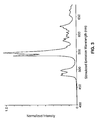
- Figure 2 is a graph illustrating the stimulated emission spectrum (900 nm stimulation) of X-ray excited BaGd2O4 activated by 1.0 mole percent samarium.
- Figure 3 is a graph illustrating the stimulated emission spectrum (900 nm stimulation) of X-ray excited BaGd2O4 doubly-activated by 0.1 mole percent terbium and 1.0 mole percent samarium.
- Figure 4 is a graph illustrating the stimulation spectrum of BaGd2O4 doubly-activated by 0.1 mole percent terbium and 1.0 mole percent samarium, illustrating the characteristic stimulation band centered at 900 nm.
- a storage phosphor consisting essentially of a BaGd2O4 host activated by terbium and/or samarium.
- the terbium and/or samarium activator is provided in an amount sufficient to produce a phosphor which exhibits a higher luminescence intensity than the phosphor defined above absent the Ln activator when, after first being exposed to X-radiation, the phosphor is then stimulated by light of a wavelength ranging from 600 to 1200 nm.
- the terbium and/or samarium activators are provided, alone or in combination, in the range of from 0.001 to 6 mole percent of the phosphor. It should be noted that, as discussed herein, each molar quantity of activator replaces an equal molar quantity of gadolinium.
- the concentration range is preferably from 0.001 to 1, more preferably from 0.01 to 1, and most preferably 0.1 mole percent.
- the concentration range is preferably from 0.001 to 5, more preferably 0.01 to 3, and most preferably 1.0 mole percent.
- the BaGd2O4 host phosphor is activated by both terbium and samarium.
- Such doubly activated storage phosphors exhibit photostimulable luminescent properties which are greatly superior to those of either of the singly activated phosphors BaGd2O4:Tb or BaGd2O4:Sm.
- the photostimulated emission intensity of doubly activated BaGd204:Tb,Sm phosphors was found to typically be an order of magnitude greater than was observed for BaGd2O4 activated by Tb or Sm alone. Consequently, there is an advantage to having both Tb and Sm present.
- BaGd2O4 is activated by both terbium and samarium such that the terbium and samarium activators are present together in total in a range of from 0.001 to 6.0, more preferably from 0.01 to 4.0, and most preferably from 0.1 to 2.0 mole percent.
- the quantity of samarium is preferably greater than the quantity of terbium activator.
- the BaGd2O4 host phosphor is activated by 1.0 mole percent samarium and about 0.1 mole percent terbium.
- the phosphors of the present invention generally have crystal sizes in the range from 1 to 50 microns, with a size range of from 10 to 25 microns being preferred.
- a quantity of Sm(NO3)3 ⁇ 6H2O is mixed with a quantity of Tb(NO3)3 ⁇ 6H2O and Gd2O3.
- This mixture is then slowly brought (that is, over a period of several hours) to a temperature between 200 and 1400°C, preferably 700°C, after which the mixture is calcined for about 1 hour at 700°C and cooled to room temperature.
- a quantity of the resultant material is then mixed with a quantity of barium hydroxide, and this mixture is heated to a temperature of between 500 and 1700°C, preferably 135 ⁇ C for an extended period, such as, for example, 8 hours.
- the sample is then reheated for a period of time under a reducing atmosphere, such as, for example, 10% hydrogen/80% nitrogen for 3 hours at 600°C.
- a reducing atmosphere such as, for example, 10% hydrogen/80% nitrogen for 3 hours at 600°C.
- the phosphors of the present invention be exposed to a reducing atmosphere at some point during fabrication to reduce the activator(s) from a +4 to a +3 oxidation state. Samples that were exposed to a reducing atmosphere during their production exhibited extremely high luminescence emission intensities.
- X-ray powder diffraction analyses indicate that samples made using this method consist primarily of BaGd2O4:Tb,Sm crystallized in a Eu3O4 type crystal structure.
- this strong stimulation band which is centered at 900 nm, is absent from either of the singly activated BaGd2O4 phosphors of the present invention, this stimulation band seems to be a signature of doubly activated BaGd2O4.
- a stimulation band at 900 nm is advantageous because at this wavelength, laser diodes and IR emitting LED's may be utilized as stimulation sources for these phosphors.
- the density of a material can affect the ability of that material to absorb X-rays. Since luminescent materials used for imaging high energy radiation should preferably be capable of absorbing as much of the incident radiation as possible, it is also preferable that the density of the phosphor be as high as possible.
- the density of BaGd2O4 is a relatively high 7.58g/cc, suggesting that the lattice of this phosphor will be a very efficient absorber of incident radiation.
- an imaging plate which consists of a support and a fluorescent layer containing a terbium and samarium activated BaGd2O4 storage phosphor.
- the imaging plate is excited by a pattern of radiation of a first wavelength, such as, for example, X-radiation, which has first been transmitted through a human patient. After passing through the patient, the radiation impinges upon the imaging plate and is absorbed by the phosphor layer in proportion to the intensity of the radiation.
- the phosphor is then exposed to radiation of a second wavelength, causing the storage medium to emit a third wavelength of radiation having an intensity pattern representative of the stored image.
- This third wavelength of radiation is then efficiently collected by a photomultiplier tube or other collection device having appropriate optics or photoreceptors which respond efficiently to the radiation of the third wavelength.
- Screens of this type are particularly useful for radiography and other applications in which a pattern of high energy radiation of a first wavelength is absorbed by the phosphor, after which a corresponding pattern of radiation of a second wavelength is released using a suitable method.
- the method used to release the radiation is not critical, and can be any method known in the art, such as, for example, by scanning the screen with a laser beam that has a wavelength of a second wavelength which is appropriate to cause the phosphor to emit radiation of a third wavelength.
- the light released from the phosphor due to excitation by the laser is then typically collected by an appropriate photosensor, and so forth.
- the signal is then typically amplified, digitized, stored, manipulated using various image processing algorithms, and then displayed on a cathode ray tube or recorded on an image recording medium to form the image.
- the initial radiation used to produce the image pattern is not limited to X-radiation and may instead include ultraviolet radiation.
- the crystalline phosphors once formed to satisfy the compositional requirements of the invention, can be employed to form an imaging screen of any otherwise conventional type.
- the imaging plate is comprised of a support onto which is coated a fluorescent layer containing the crystalline phosphor in particulate form and a binder for the phosphor particles.
- the phosphors can be used in the fluorescent layer in any conventional particle size range and distribution. It is generally appreciated that sharper images are realized with smaller mean particle sizes.
- the phosphor particles can be blended with other photostimulable phosphor particles, if desired, to form an imaging plate having optimum properties for a particular application.
- Imaging plate constructions containing more than one phosphor containing layer are also possible, with a crystalline phosphor of the type described above being present in one or more of the phosphor containing layers.
- the photostimulable layer contains sufficient binder to impart structural coherence.
- the binders employed in the photostimulable layers can be identical to those conventionally employed in fluorescent screens. Such binders are generally chosen from organic polymers which are transparent to X-radiation, stimulating radiation, and photostimulated luminescent radiation, and include, for example, sodium o-sulfobenzaldehyde acetal of poly(vinyl alcohol); chlorosulfonated poly(ethylene); a mixture of macromolecular bisphenol carbonates and poly(alkylene oxides); aqueous ethanol soluble nylons; poly(alkyl acrylates and methacrylates) and copolymers of alkyl acrylates and methacrylates with acrylic and methacrylic acid; poly(vinyl butyral); and poly(urethane) elastomers.
- imaging plate binders are poly(urethanes), such as those which are commercially available under the trademarks Estane (from Goodrich Chemical Co.), Permuthane (from the Permuthane Division of ICI, Ltd.), and Cargill (from Cargill, Inc).
- the support onto which the photostimulable layer is coated can be on any conventional type and can be either rigid or flexible. Most commonly, the support is a film support. For highest levels of image sharpness the support is typically black or transparent with black backing and mounted in a cassette for exposure. For the highest attainable speeds a white support, such as a titania or barium sulfate loaded or coated support, is employed.
- the phosphors can be employed for their prompt emission following exposure to X-radiation, they are more preferably employed as storage phosphors - that is, for their ability to emit electromagnetic radiation in a chosen wavelength range after being exposed to X-radiation and then stimulated by exposure to radiation in a third spectral region.
- the phosphors of this invention can be employed in imaging systems of the type disclosed in US-A-3,859,527.
- the refractive incises of the phosphor and binder are preferably approximately matched, as disclosed in US-A-4,637,898.
- the packed powder samples were exposed for 1 minute to unfiltered X-radiation from a tungsten target X-ray tube operated at 70 kVp and 30 mA. After a delay of several minutes, the samples were then loaded into a spectrofluorometer, where they were exposed to 900 nm stimulation radiation from a xenon arc lamp which had passed through a monochromator and a Schott RG9 bandpass filter was used as the stimulating radiation. The bandwidth of the stimulating radiation used was 8 nm.
- the photostimulated emission from each sample was passed through a Corning CS3-75 order-sorting filter and detected by a spectrometer.
- the spectrometer had previously been calibrated to within ⁇ 1 nm and had a resolution of approximately 4 nm (full width at half maximum).
- the intensity calibration of the spectrometer was performed using two NIST-traceable sources and yielded an arbitrary intensity scale proportional to Watts/nm/cm2.
- the spectra of the photostimulated emission was then corrected for the emission filter transmission and spectrometer sensitivity.
- Stimulation spectra were obtained by exposing the samples for 1 minute to unfiltered X-radiation from a tungsten target X-ray tube operated at 70 kVp, 30 mA. After a delay of several minutes each sample was placed in a stimulation apparatus, and subjected to sequential 15 ms long pulses of weak stimulation light.
- the stimulation radiation used here had a bandpass of 8 nm and was provided by light from a tungsten-halogen lamp which had passed through a monochromator and an order-sorting filter. Stimulation measurements were taken every 10 nm.
- a Schott RG695 filter was used for stimulation wavelengths shorter than 1200 nm, and a Schott RG850 filter was used for stimulation wavelengths greater than or equal to 1200 nm.
- the stimulated emission was collected and detected by an Hamamatsu R928 photomultiplier tube after passing through a Corning CS4-96 band pass filter. The spectral correction curve was obtained under these conditions with an NIST-traceable radiometer detector.
- the purpose of this example is to show that the host lattice alone does not exhibit photostimulable luminescence.
- Example 1 showed photostimulated luminescence.
- the integrated photostimulated luminescence of Comparative Example 1 was given an arbitrary unit value of 1.
- the purpose of this example is to show that photostimulable phosphors can be prepared from BaGd2O4 using Tb3+ as an activator.
- Terbium activated Gd2O3 was prepared by mixing 0.0453 grams of Tb(NO3)3 ⁇ 6H2O with 18.1067 grams of Gd2O3. The mixture was brought to 700°C over a period of 4 hours, then calcined for 1 hour at 700°C, and cooled to room temperature. 3.6250 grams of the resulting Tb-activated Gd2O3 was tumbled together with 3.1548 grams of barium hydroxide for 1 hour, and then placed in an alumina crucible and heated to 1350°C for 8 hours. The sample was then reheated under a controlled atmosphere of 20% hydrogen/80% nitrogen for 3 hours at 600°C.
- the stimulated emission spectrum of BaGd2O4:Tb demonstrates that BaGd2O4:Tb is a photostimulable phosphor.
- the fact that 550 nm is the center of the most intense emission indicates that Tb3+ is the emitting center in the stimulated emission for this phosphor.
- Relative to Comparative Example 1, which was assigned an arbitrary value of 1 the integrated intensity of the photostimulated luminescence of Example 1, as illustrated in Figure 2, is 3.4 arbitrary units.
- the purpose of this example is to show that a photostimulable phosphor can be prepared from BaGd2O4 using Sm3+ as an activator.
- Samarium activated Gd2O3 was prepared by adding 0.4445 grams of Sm(NO3)3 ⁇ 6H2O to 17.9436 grams of Gd2O3. The mixture was brought up to 700°C from room temperature over a period of about 4 hours, calcined for 1 hour at 700°C, and then cooled to room temperature. 3.6236 grams of the Sm-activated Gd2O3 was mixed with 3.1548 grams of barium hydroxide for 1 hour and then placed in an alumina crucible and heated to 1350°C for 8 hours.
- the stimulated emission spectrum of BaGd2O4:Sm is shown in Figure 3. Although the intensity of the spectrum is weak, the peak of about 610 nm indicates that Sm3+ is the emitting center in the stimulated emission, and that BaGd2O4:Sm shows minimal photostimulable luminescence. Compared to Comparative Example 1, the integrated photostimulable luminescent intensity of Example 2, illustrated in Figure 3, is about 1.0.
- This example describes the preparation of BaGd2O4:Tb,Sm (Sample # BB1384-21C).
- the purpose of this example is to show that photostimulable phosphors can be prepared from BaGd2O4 using two activators - Sm3+ and Tb3+ and that these phosphors are superior to photostimulable phosphors prepared using only one activator.
- the stimulated emission spectrum of BaGd204:Tb,Sm is shown in Figure 4.
- the primary emission is from Tb3+, although there is some lower intensity emission from the Sm3+ as well.
- the intensity of the photostimulated emission of the doubly activated BaGd204:Tb,Sm phosphor is almost an order of magnitude more intense than the photostimulated emission observed with either Tb3+ or Sm3+ alone.
- the stimulation response spectrum of BaGd204:Tb,Sm, illustrated in Figure 8, indicates a discrete peak centered around 900 nm. This peak appears to be a signature of the doubly activated phosphor. Because of the enhanced stimulation efficiency of the doubly activated storage phosphor, BaGd204:Tb,Sm, at 900 nm, laser diodes and IR emitting LED's may be utilized as stimulation sources for these phosphors.
- the purpose of this example is to demonstrate the effect of using a reducing atmosphere in preparing BaGd2O4:Tb,Sm storage phosphors.
- a BaGd2O4 stock phosphor material doubly activated by 0.1 mole % Tb and 1 mole % Sm, was prepared as follows: .0135 g of Tb4O7 and .1255 g of Sm2O3 were dissolved in 6 ml of concentrated nitric acid then added to 12.9063 g of Gd2O3 and the mixture evaporated to dryness. The resulting powder was then calcined for 1 hr at 600°C in air, after which 10.871 g of the powder was mixed with 9.464 g of Ba(OH)2 ⁇ 8H2O for 1 hr. This mixture was then heated for 8 hrs in air at 1350°C.
- Example 4c The same procedure as that in Example 4c was followed, with the exception that nitrogen was used instead of argon.
- the nitrogen flow was 1.5 liters/min.
- a screen of BaGd2O4:Tb,Sm with an inorganic phosphoric acid based binder was prepared according to the procedure described in J Vac Sci. Technology section A, Vol 10, No. 6, Nov/Dec, 1992, pages 3595-3596.
- a sample of phosphor was prepared as described in Example 4c.
- the substrate used was a quartz plate which was cleaned with a combination of KOH and ethanol to thoroughly degrease the surfaces for coating.
- the coating was prepared according to the procedure described in the reference given except that 3 mm yttria stabilized zirconia beads and the coating was heated to 200°C in argon instead of in air. Argon was used to prevent oxidation of the BaGd2O4:Tb,Sm phosphor during curing of the coating. Two screens were fabricated using this method.
- the two screens were erased by exposing them to light from a 250 W GE infrared reflector lamp for 3 minutes. A razor blade was set on top of one of the screens and the screens were then exposed to 15 sec X-irradiation from an unfiltered tungsten source operating at 70 kVp, 30 mA. After exposure the photostimulated emission from each of the two screens was evaluated by viewing each screen under infrared light from a 25 W. tungsten lamp filtered through a Corning CS 7-56 filter. The screen which was uniformly X-irradiated showed uniform green colored photostimulated emission over the entire screen area.
- the screen which had a razor blade placed on top of it showed dark areas which correspond to the regions where the razor blade had blocked the x-ray beam from exposing the phosphor.
- details such as holes in the razor blade and different thickness of metal making up the razor blade were clearly visible to the unaided human eye during the viewing of the photostimulated emission under infrared irradiation.
Landscapes
- Chemical & Material Sciences (AREA)
- Engineering & Computer Science (AREA)
- Physics & Mathematics (AREA)
- General Engineering & Computer Science (AREA)
- High Energy & Nuclear Physics (AREA)
- Inorganic Chemistry (AREA)
- Materials Engineering (AREA)
- Organic Chemistry (AREA)
- Conversion Of X-Rays Into Visible Images (AREA)
- Luminescent Compositions (AREA)
Applications Claiming Priority (2)
| Application Number | Priority Date | Filing Date | Title |
|---|---|---|---|
| US08/065,268 US5391884A (en) | 1993-05-24 | 1993-05-24 | Barium gadolinate phosphor activated by terbium and/or samarium |
| US65268 | 1993-05-24 |
Publications (1)
| Publication Number | Publication Date |
|---|---|
| EP0626437A1 true EP0626437A1 (fr) | 1994-11-30 |
Family
ID=22061526
Family Applications (1)
| Application Number | Title | Priority Date | Filing Date |
|---|---|---|---|
| EP94107848A Withdrawn EP0626437A1 (fr) | 1993-05-24 | 1994-05-20 | Matériau luminescent à base de gadolinate de barium activé au terbium et/ou samarium |
Country Status (3)
| Country | Link |
|---|---|
| US (1) | US5391884A (fr) |
| EP (1) | EP0626437A1 (fr) |
| JP (1) | JPH06346053A (fr) |
Cited By (1)
| Publication number | Priority date | Publication date | Assignee | Title |
|---|---|---|---|---|
| EP0846962A1 (fr) | 1996-12-04 | 1998-06-10 | Agfa-Gevaert N.V. | Détecteur d'images radiologiques et de traitement d'image |
Families Citing this family (4)
| Publication number | Priority date | Publication date | Assignee | Title |
|---|---|---|---|---|
| US6315923B1 (en) | 1998-11-12 | 2001-11-13 | Symyx Technologies, Inc | Storage phosphors |
| JP3770524B2 (ja) * | 1998-12-08 | 2006-04-26 | 富士写真フイルム株式会社 | テルビウム、サマリウム共付活アルカリ土類金属希土類酸化物蛍光体 |
| DE19859880A1 (de) * | 1998-12-23 | 2000-07-06 | Duerr Dental Gmbh Co Kg | Flächiges Speicherelement für ein Röntgenbild |
| US6483122B1 (en) * | 1999-09-29 | 2002-11-19 | Konica Corporation | Radiation image conversion panel and stimulable phosphor |
Citations (2)
| Publication number | Priority date | Publication date | Assignee | Title |
|---|---|---|---|---|
| EP0202875A2 (fr) * | 1985-05-18 | 1986-11-26 | Nichia Kagaku Kogyo K.K. | Matières luminescentes pour rayons X et procédé pour les préparer |
| EP0240272A2 (fr) * | 1986-03-31 | 1987-10-07 | Kabushiki Kaisha Toshiba | Ecran renforçateur de rayons-X |
Family Cites Families (7)
| Publication number | Priority date | Publication date | Assignee | Title |
|---|---|---|---|---|
| BE793365A (fr) * | 1971-12-27 | 1973-06-27 | Philips Nv | Procede permettant de preparer un oxyde d'yttrium et/ou de lanthane et/ou des lanthanides |
| US3878119A (en) * | 1972-12-26 | 1975-04-15 | Gen Electric | Preparation of rare-earth oxysulfide phosphors |
| JPS598379B2 (ja) * | 1978-02-03 | 1984-02-24 | 化成オプトニクス株式会社 | 着色螢光体およびその製造方法 |
| JPS5944334B2 (ja) * | 1978-12-21 | 1984-10-29 | 富士写真フイルム株式会社 | 螢光体 |
| US4959174A (en) * | 1985-05-18 | 1990-09-25 | Nichia Kagaku Kogyo K.K. | Phosphor which emits light by the excitation of X-ray |
| JPH0662943B2 (ja) * | 1986-10-06 | 1994-08-17 | 日亜化学工業株式会社 | 放射線増感紙用螢光体 |
| US4783596A (en) * | 1987-06-08 | 1988-11-08 | General Electric Company | Solid state scintillator and treatment therefor |
-
1993
- 1993-05-24 US US08/065,268 patent/US5391884A/en not_active Expired - Lifetime
-
1994
- 1994-05-20 EP EP94107848A patent/EP0626437A1/fr not_active Withdrawn
- 1994-05-23 JP JP6108037A patent/JPH06346053A/ja active Pending
Patent Citations (2)
| Publication number | Priority date | Publication date | Assignee | Title |
|---|---|---|---|---|
| EP0202875A2 (fr) * | 1985-05-18 | 1986-11-26 | Nichia Kagaku Kogyo K.K. | Matières luminescentes pour rayons X et procédé pour les préparer |
| EP0240272A2 (fr) * | 1986-03-31 | 1987-10-07 | Kabushiki Kaisha Toshiba | Ecran renforçateur de rayons-X |
Cited By (1)
| Publication number | Priority date | Publication date | Assignee | Title |
|---|---|---|---|---|
| EP0846962A1 (fr) | 1996-12-04 | 1998-06-10 | Agfa-Gevaert N.V. | Détecteur d'images radiologiques et de traitement d'image |
Also Published As
| Publication number | Publication date |
|---|---|
| US5391884A (en) | 1995-02-21 |
| JPH06346053A (ja) | 1994-12-20 |
Similar Documents
| Publication | Publication Date | Title |
|---|---|---|
| EP1203394B1 (fr) | Procede de preparation de luminophores photostimulables csx et luminophores ainsi obtenus | |
| US4297584A (en) | Rare earth phosphors and phosphor screens | |
| US4225653A (en) | X-ray intensifying screen based on rare earth tantalate | |
| US5698857A (en) | (Barium hafnate: Cu) phosphors and phosphor screens | |
| US5786600A (en) | (Barium hafnate:Ti, Ce, Pb) phosphors phosphor screens and phosphor preparation methods | |
| EP1217633B1 (fr) | Matériau luminescent à base de bromide de césium avec un spectre d'émission étroit par excitation UV | |
| EP0011909B1 (fr) | Ecran renforçateur d'images à rayons-X à base d'un tantalate luminescent et procédé de fabrication de ce matériau luminescent | |
| US5549843A (en) | Annealed alkaline earth metal fluorohalide storage phosphor, preparation method, and radiation image storage panel | |
| EP0345903B1 (fr) | Phosphore photostimulable | |
| JPS5956479A (ja) | 放射線像変換方法 | |
| JPS5869281A (ja) | オキシハライド螢光体 | |
| EP0712917B1 (fr) | Matériau luminescent pour enregistrement à base fluorohalogénures d'alcalino-terreux recuits, méthode de préparation et panneau d'enregistrement pour image obtenue par rayonnement | |
| US5391884A (en) | Barium gadolinate phosphor activated by terbium and/or samarium | |
| US5554319A (en) | Phosphor | |
| EP0381231B1 (fr) | Ecran intensificateur pour rayons x | |
| US5003182A (en) | Phosphor, radiation image recording and reproducing method and radiation image storage panel employing the same | |
| US4488983A (en) | Preparation of lanthanum bismuth oxychloride phosphors | |
| US5132192A (en) | Ordered corundum magnesium tantalum niobium oxide x-ray intensifying screens | |
| JPS5822063B2 (ja) | X線強化スクリ−ン用燐光体 | |
| EP1391895A2 (fr) | Ecran à conversion d'image de radiation et sa méthode de fabrication | |
| JPH06235799A (ja) | 照射画像を記録および複製するための方法、この方法を用いる装置、照射画像を保存するためのパネルおよび光刺激性ホスファー | |
| JPH032473B2 (fr) | ||
| JP3813794B2 (ja) | アルカリハライド系蛍光体および放射線像変換パネル | |
| JPH0718958B2 (ja) | 放射線画像変換パネル | |
| EP0484255B1 (fr) | Ecrans intensificateurs de rayons X à base d'oxydes ordonnés de corindon, magnesium, tantale et niobium |
Legal Events
| Date | Code | Title | Description |
|---|---|---|---|
| PUAI | Public reference made under article 153(3) epc to a published international application that has entered the european phase |
Free format text: ORIGINAL CODE: 0009012 |
|
| AK | Designated contracting states |
Kind code of ref document: A1 Designated state(s): DE FR GB |
|
| 17P | Request for examination filed |
Effective date: 19941108 |
|
| 17Q | First examination report despatched |
Effective date: 19970123 |
|
| STAA | Information on the status of an ep patent application or granted ep patent |
Free format text: STATUS: THE APPLICATION IS DEEMED TO BE WITHDRAWN |
|
| 18D | Application deemed to be withdrawn |
Effective date: 19970603 |