EP0626780A2 - Procédé et appareil de traitement d'images - Google Patents
Procédé et appareil de traitement d'images Download PDFInfo
- Publication number
- EP0626780A2 EP0626780A2 EP94303669A EP94303669A EP0626780A2 EP 0626780 A2 EP0626780 A2 EP 0626780A2 EP 94303669 A EP94303669 A EP 94303669A EP 94303669 A EP94303669 A EP 94303669A EP 0626780 A2 EP0626780 A2 EP 0626780A2
- Authority
- EP
- European Patent Office
- Prior art keywords
- pixel data
- data
- error
- transformation
- transforming
- Prior art date
- Legal status (The legal status is an assumption and is not a legal conclusion. Google has not performed a legal analysis and makes no representation as to the accuracy of the status listed.)
- Granted
Links
Images


Classifications
-
- H—ELECTRICITY
- H04—ELECTRIC COMMUNICATION TECHNIQUE
- H04N—PICTORIAL COMMUNICATION, e.g. TELEVISION
- H04N1/00—Scanning, transmission or reproduction of documents or the like, e.g. facsimile transmission; Details thereof
- H04N1/40—Picture signal circuits
- H04N1/405—Halftoning, i.e. converting the picture signal of a continuous-tone original into a corresponding signal showing only two levels
- H04N1/4051—Halftoning, i.e. converting the picture signal of a continuous-tone original into a corresponding signal showing only two levels producing a dispersed dots halftone pattern, the dots having substantially the same size
- H04N1/4052—Halftoning, i.e. converting the picture signal of a continuous-tone original into a corresponding signal showing only two levels producing a dispersed dots halftone pattern, the dots having substantially the same size by error diffusion, i.e. transferring the binarising error to neighbouring dot decisions
-
- H—ELECTRICITY
- H04—ELECTRIC COMMUNICATION TECHNIQUE
- H04N—PICTORIAL COMMUNICATION, e.g. TELEVISION
- H04N5/00—Details of television systems
- H04N5/14—Picture signal circuitry for video frequency region
- H04N5/21—Circuitry for suppressing or minimising disturbance, e.g. moiré or halo
- H04N5/213—Circuitry for suppressing or minimising impulsive noise
Definitions
- This invention relates to an image processing method and apparatus for processing image data.
- the number of gray levels of each color in a color image is transformed (by a level-number transformation) to two or a prescribed number while half tones are maintained in a half-tone image output of an image recording apparatus or the like.
- the error-diffusion method or a mean-error minimization method which is substantially the same as the error-diffusion method, is employed as the method of transforming the number of gray levels of image data.
- a concern of the present invention is to provide an image processing method and apparatus in which it is possible to prevent an increase in random noise and the like produced by distributing an error, which is produced at the time of a gray-level transformation, to unprocessed pixel data.
- an image processing apparatus comprises input means for entering pixel data constituting image data, accumulating means for accumulating an error, which is produced when the pixel data is subjected to a level-number transformation, as error data for distributing the error to an unprocessed plurality of items of pixel data, transforming means for performing transformation of the number of levels of the pixel data based upon the entered pixel data and the error data accumulated by the accumulating means, and updating means for updating the error data, which has been accumulated by the accumulating means, to a prescribed value when a prescribed quantity of the pixel data has been transformed by the transforming means.
- an image processing method comprises an input step of entering pixel data constituting image data, an accumulating step of accumulating an error, which is produced when the pixel data is subjected to a level-number transformation, as error data for distributing the error to an unprocessed plurality of items of pixel data, a transforming step of performing transformation of the number of levels of the pixel data based upon the entered pixel data and the error data accumulated at the accumulating step, and an updating step of updating the error data, which has been accumulated at the accumulating step, to a prescribed value when a prescribed quantity of the pixel data has been transformed at the transforming step.
- An embodiment of the present invention provides an image processing method and apparatus in which it is possible to execute the level transformation of pixel data at high speed by using a table in the transforming means, wherein the table stores values of pixel data after conversion at memory addresses specified based upon values of pixel data before conversion.
- An embodiment of the present invention provides an image processing method and apparatus in which it is possible to eliminate noise contained in entered moving-picture data and output the noise to a processor of a succeeding stage.
- An embodiment of the present invention provides an image processing method and apparatus in which one frame of pixel data outputted to a succeeding processor is held and compared with newly entered pixel data, wherein when the amount of change between the newly entered pixel data and the pixel data of the preceding frame is less than a predetermined value, the amount of change is processed as noise.
- Another embodiment of the present invention provides an image processing method and apparatus in which it is possible to eliminate noise contained in entered moving-picture data before the data is outputted to a level transforming unit, thereby reducing the effects of noise in level-transformation processing of moving-picture data.
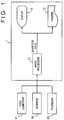
- Fig. 1 is a diagram illustrating the general construction of an image forming apparatus according to a first embodiment of the invention.
- Numeral 1 in Fig. 1 denotes the main body of an image forming apparatus for applying quantization processing to image data, which has been entered from an external device, to display or record a visible image.
- the apparatus 1 includes an image processor 11 for quantizing the image data, which has entered from an external device, to binarized data.
- the image processor 11 is connected to a display unit 12, which displays the quantized data outputted by the processor 11.
- the display unit 12 presents a binary display for each pixel.
- An example of such a display unit is a ferrodielectric liquid-crystal display device (FLCD).
- FLCD ferrodielectric liquid-crystal display device
- the apparatus 1 further includes a printing unit 13 for performing printing on a recording medium based upon the quantized data outputted by the image processor 11.
- the printing unit 13 is a printer which performs binary printing for each pixel.
- An example of such a printer is a laser-beam printer or ink-jet printer.
- External devices connected to the image forming apparatus are a host computer 21, a scanner 22 and a television camera 23.
- these external devices output analog RGB data to the image forming apparatus 1 as image data.
- the analog RGB data mentioned here is an image signal outputted in the form of an analog signal for each of the colors R, G, B.
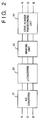
- Fig. 2 is a block diagram showing the functional construction of the image processor 11.
- the image processor includes an A/D converter 31 for converting the analog RGB data, which has entered from an external device, into digital RGB data.
- the A/D converter 31 converts analog data into eight-bit digital data, as a result of which 256 gray-level digital RGB data is obtained.
- a ⁇ -converter 32 applies a gamma correction to the digital RGB data that has entered from the A/D converter 31.
- a masking unit 33 applies a color correction to the digital RGB data obtained by the gamma correction.
- a level-number transformation unit 34 applies a level-number transformation to the digital RGB data that has entered from the masking unit 33.
- a color correction is applied to the digital RGB data by the masking unit 33.
- level-number transformation unit 34 performs a level-number transformation from the eight-bit digital RGB data of each color to one-bit RGB data of each color.
- the level-number transformation unit 34 will now be described in detail with reference to Figs. 3 and 4.
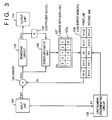
- Fig. 3 is a block diagram representing the general construction of the level-number transformation unit 34.
- an input unit 101 enters digital RGB data from the masking unit 33, separates the RGB data into data (F mn ) of each color and delivers the data F mn to an adder 102. Further, when the scanning of one line of the original picture ends, the input unit 101 sends a line-number discriminating circuit 109 a signal (a scan-complete signal) indicative of this fact.
- the data F mn is density data of a pixel whose coordinates are (m,n).
- the adder 102 adds the data F mn outputted by the input unit 101 to a cumulative error X n obtained from a line buffer memory 108.
- the cumulative error Xn represents cumulative error at the coordinates (m,n).
- the data G mn outputted by the adder 102 is F mn + X n , which enters a binarizing circuit 103.
- the latter compares the value of G mn with a threshold level V and outputs 1 as pixel data D mn when G mn ⁇ V th holds and 0 as the pixel data when G mn ⁇ V th holds.
- the pixel data D mn is data which has undergone the level-number transformation.
- An output unit 104 on/off controls a dot in dependence upon the value (0 or 1) of D mn , thereby outputting the transformed data.
- a coefficient device 105 multiplies the output D mn of the binarizing circuit 103 by K and outputs the product to an error arithmetic unit 106.
- the coefficient K is decided by the number of bits of the digital RGB data inputted to the input unit 101 and the number of bits to which the digital RGB data is transformed by the level-number transformation. In a case where eight-bit data is entered by the input unit 101 and is transformed to one bit, as in this embodiment, the maximum density value of one dot is 255 and the value of the coefficient K in the coefficient device 105 is 255.
- the error diffusion unit 107 applies a predetermined weight to the transformation error E n using a diffusion matrix 107a and distributes this as the cumulative error of each pixel stored in a line buffer memory 108, thereby accumulating the error.
- the line buffer memory 108 stores the cumulative error pixel by pixel in two lines, namely a line (first line) currently being scanned and a line (second line) scanned next.
- the transformation error weighted in accordance with the diffusion matrix 107a is cumulatively added to the cumulative error already stored pixel by pixel, and the results are stored in the line buffer memory 108.
- the cumulative error of each pixel is updated as follows by processing in the error diffusion unit 107: X n+1 ⁇ X n+1 + 2/8 x E n X n+2 ⁇ X n+2 + 1/8 x E n X' n-2 ⁇ X' n-2 + 1/8 x E n X' n-1 ⁇ X' n-1 + 1/8 x E n X' n ⁇ X' n + 2/8 x E n X' n+1 ⁇ X' n+1 + 1/8 x E n where the weighting of the error E n is in accordance with the diffusion matrix 107a.
- the new cumulative error X n+1 is used at the time of the level-number transformation of the pixel at the next coordinate position (m,n+1).
- the line-number discriminating circuit 109 judges whether the number of lines whose processing has ended is a multiple of a predetermined value. If the number of lines is a multiple of the predetermined value, the data of the first and second lines of the line buffer memory 108 is cleared. On the other hand, if the number of lines whose processing has ended is not a multiple of the predetermined value, the data of the second line is stored in the first line of the line buffer memory 108 and the second line is cleared to 0.
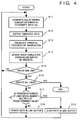
- the adder 102 adds the data F mn and the cumulative error X n to generate the data G mn .
- the binarizing circuit 103 executes binarizing processing by comparing the data G mn with the threshold level V th and outputs the binarized data D mn to the output unit 104.
- the error arithmetic unit 106 performs the calculation K x D mn - G mn at step S13, thereby calculating the transformation error E n produced by the binarizing processing of the preceding step S12.
- step S14 at which the error diffusion unit 107 weights the transformation error E n by the diffusion matrix 107a and uses this value to update each cumulative error in the line buffer memory 108.
- step S15 by checking whether the scan-complete signal has been outputted by the input unit 101, it is determined at step S15 whether one line of processing of the original image has been completed. If one line of processing has not been completed, the program returns to step S11 and the foregoing processing is repeated. If one line of processing has ended, on the other hand, the program proceeds to step S16, where it is determined whether scanning has ended for all lines of the original image. Processing is terminated if the processing regarding all lines has ended. If processing regarding all lines has not ended, the program proceeds to step S17, at which it is determined whether the number of lines for which line-number transformation processing has ended is a whole-number multiple of a predetermined value.
- step S18 the program proceeds to step S18, at which the content of the first line of buffer memory 108 is rewritten by the content of the second line and the content of the second line is cleared to zero. If it is found at step S17 that the number of processed lines is a whole-number multiple of a predetermined value, the program proceeds to step S19, at which the contents of the first and second lines of line buffer 108 are cleared to zero.
- Binarization processing is performed by repeating execution of the processing procedure set forth above.
- an increase in random noise is prevented.
- an image forming apparatus is described in which an increase in random noise is prevented in circuitry ahead of the level-number transformation unit 34 when the number of levels of a moving picture is transformed.
- the general construction of the image forming apparatus according to the second embodiment is in line with Fig. 1 of the first embodiment and need not be described again.
- numeral 51 denotes a noise cutting unit for eliminating noise components contained in analog RGB data from digital RGB data that has entered from the masking unit 33.
- the level-number transformation unit 34 transforms eight-bit digital RGB data of each color outputted by the noise cutting unit 51 to one-bit RGB data of each color.
- the level-number transformation unit 34 has been described in detail in the first embodiment and need not be described again. The noise cutting unit 51 will now be described.
- the noise cutting unit 51 compares the digital RGB data of the present frame with the digital RGB data of the preceding frame with regard to each pixel in the picture. When the difference between the compared data is less than a threshold value, it is judged that the amount of change is a noise component and this component is cut to eliminate it.
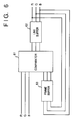
- Fig. 6 is a block diagram illustrating the construction of the noise cutting unit 51.
- the latter includes a comparator for comparing newly entered digital RGB data (data of the present frame) and digital RGB data (data of the preceding frame) in a frame buffer 63.
- a line buffer 62 temporarily stores one line of RGB data.
- the frame buffer 63 stores the contents of the line buffer 62 line by line.
- step S21 in Fig. 7 one line of digital RGB data (RGB data of the present frame) that has been subjected to an A/D conversion, a ⁇ correction and masking processing successively enters the comparator 61.
- step S22 at which one line of RGB data of the preceding frame stored in the frame buffer 63 successively enters the comparator 61.
- the one line of RGB data of the present frame and the one line of RGB data of the preceding frame that enter the comparator 61 represent data having the same position in the picture.
- the comparator 61 obtains the difference between the RGB data of the present frame and the RGB data of the preceding frame with regard to each pixel of the entered lines and judges whether the difference is greater than or less than a predetermined threshold value TH (step S23).
- the judgment as to whether an RGB value has changes is performed as follows: If any of the R, G, B values is equal to or greater than the predetermined threshold value TH, for example, then it is judged that the particular RGB value has changed. Alternatively, if the sum total of the amount of change in each of the R, G, B values is equal to or greater than a predetermined value, then it is judged that an RGB value has changed. Furthermore, if either of these two criteria is satisfied, it may be judged than an RGB value has changed. Thus, various methods can be applied to make this judgment.
- step S25 the RGB data of the present frame corresponding to the position of this pixel is written in the line buffer 62. If the aforementioned difference is less than the predetermined threshold value TH, on the other hand, it is judged that the change is ascribable to a noise component rather than a change in the data. Accordingly, the program proceeds to step S24, where the RGB data of the preceding frame is written in the line buffer 62. This is followed by step S26, at which it is judged whether processing regarding each pixel of one line has been concluded.
- step S21 if processing has not been concluded and to step S26 if processing has been concluded.
- the processing of steps S21 to S25 is executed with regard to each pixel.
- step S26 the program proceeds from step S26 to step S27, at which the RGB data is transferred to the level-number transformation unit 34, where the data is subjected to binarizing processing.
- the contents of the relevant line of the frame buffer 63 is updated at step S28. It is then determined at step S29 whether the processing of one frame has been completed. The processing described above is repeated for an amount of data equivalent to one frame.
- pixel data to be processed is saved in the frame memory 63 in the quantization of moving-picture data containing random noise, the pixel data of the preceding frame and the pixel data of the present frame are compared and the amount of change in the pixel data is detected. If the amount of change is equal to or greater than a predetermined value, a decision is rendered to the effect that the pixel data has changed. The content of the relevant pixel data in the frame memory 63 is then updated by the pixel data of the present frame and the resulting pixel data is subjected to the level-number transformation.
- the amount of change between the pixel data of the present frame and the pixel data of the preceding frame is less than the predetermined value, a decision is rendered to the effect that the pixel data has not changed and, as a result, the pixel data of the preceding frame is subjected to the level-number transformation. In this case the data in the frame buffer 63 is not updated. Thus, the amount of change in pixel data due to noise is detected and removed. This makes it possible to obtain a moving picture in which an increase in noise is suppressed.
- noise is eliminated from the pixel data before it enters the level-number transformation unit 34. This prevents a decline in picture quality due to the level-number transformation.
- removal of noise prior to execution of the level-number transformation is effective in preventing a decline in picture quality.
- the level-number transformation unit 34 described in the first embodiment use is made of the level-number transformation unit 34 described in the first embodiment. Since noise is reduced in the stage ahead of the level-number transformation unit 34, an increase in noise is prevented in the level-number transformation so that it is possible to prevent a deterioration in picture quality ascribable to quantization and level-number transformation of the moving picture.
- the noise removal method illustrated in the second embodiment eliminates noise on a real-time basis owing to comparison between the entered pixel data and the pixel data of the preceding frame. As a result, this method is well suited to processing of moving-picture data.
- a processor for a binary-output device is taken as an example.
- the invention is applicable to a multiple-value output device as well.
- a minimum of n-1 comparison operations is required.
- D mn tbl[input] where tbl is the array name, D mn the transformed multiple-value data, and input the input data.
- This table has the structure of a one-dimensional array and is formed in n-bit units. Transformed multiple-value data is entered in each unit. That is, transformed data of n values corresponding to input data is inputted in the table beforehand at addresses indicated by the input data.
- the size of the error-diffusion matrix 107a is 5 x 2, though this does not impose a limitation upon the invention. Further, the values of the elements in the matrix are not limited to those of the foregoing embodiments. Furthermore, an example is described in which the pixel data prior to the level-number transformation is eight-bit data in each of the foregoing embodiments. However, this also does not impose a limitation upon the invention. In addition, though use is made of a 3 x 3 linear transformation in each of the embodiments with regard to masking processing, the transformation may be of multiple degree, such as a second-degree (quadratic) or third-degree (cubic) transformation.
- the present invention can be applied to a system comprising either a plurality of units or to a single unit. It goes without saying that the invention is applicable also to a case which can be attained by supplying programs which execute the process defined by the present system or invention.
- an image processing method and apparatus for preventing an increase in random noise and the like caused by distributing transformation error, which is produced when a level-number transformation is performed, to pixel data not yet processed.
Landscapes
- Engineering & Computer Science (AREA)
- Multimedia (AREA)
- Signal Processing (AREA)
- Image Processing (AREA)
- Facsimile Image Signal Circuits (AREA)
- Controls And Circuits For Display Device (AREA)
Applications Claiming Priority (3)
| Application Number | Priority Date | Filing Date | Title |
|---|---|---|---|
| JP121211/93 | 1993-05-24 | ||
| JP12121193A JP3171993B2 (ja) | 1993-05-24 | 1993-05-24 | 画像処理方法及び装置 |
| JP12121193 | 1993-05-24 |
Publications (3)
| Publication Number | Publication Date |
|---|---|
| EP0626780A2 true EP0626780A2 (fr) | 1994-11-30 |
| EP0626780A3 EP0626780A3 (fr) | 1995-07-19 |
| EP0626780B1 EP0626780B1 (fr) | 1999-11-03 |
Family
ID=14805633
Family Applications (1)
| Application Number | Title | Priority Date | Filing Date |
|---|---|---|---|
| EP94303669A Expired - Lifetime EP0626780B1 (fr) | 1993-05-24 | 1994-05-23 | Procédé et appareil de traitement d'images |
Country Status (4)
| Country | Link |
|---|---|
| US (2) | US5463478A (fr) |
| EP (1) | EP0626780B1 (fr) |
| JP (1) | JP3171993B2 (fr) |
| DE (1) | DE69421448T2 (fr) |
Cited By (2)
| Publication number | Priority date | Publication date | Assignee | Title |
|---|---|---|---|---|
| EP0717391A1 (fr) * | 1994-11-17 | 1996-06-19 | Fujitsu General Limited | Circuit à variance d'erreur pour améliorer un signal d'image |
| US6069610A (en) * | 1994-11-25 | 2000-05-30 | Fujitsu General Limited | Drive for a display device |
Families Citing this family (11)
| Publication number | Priority date | Publication date | Assignee | Title |
|---|---|---|---|---|
| US5739808A (en) * | 1994-10-28 | 1998-04-14 | Canon Kabushiki Kaisha | Display control method and apparatus |
| JP3651941B2 (ja) * | 1994-11-28 | 2005-05-25 | キヤノン株式会社 | 画像再生装置 |
| US5710836A (en) * | 1994-12-01 | 1998-01-20 | Xerox Corporation | System and apparatus for tonal reproduction adjustment in an error diffusion process |
| KR100337866B1 (ko) * | 1995-09-06 | 2002-11-04 | 삼성에스디아이 주식회사 | 매트릭스형 액정 표시 소자의 다계조 표시 구동 방법 |
| JP3397059B2 (ja) * | 1996-11-07 | 2003-04-14 | セイコーエプソン株式会社 | 印刷装置および画像記録方法 |
| JP3644183B2 (ja) * | 1997-03-17 | 2005-04-27 | 富士ゼロックス株式会社 | 画像処理装置 |
| US6201582B1 (en) * | 1997-09-19 | 2001-03-13 | Philips Electronics North America Corporation | Circuit for moiré suppression |
| JP3700357B2 (ja) | 1997-11-25 | 2005-09-28 | コニカミノルタビジネステクノロジーズ株式会社 | 画像処理装置 |
| US7428011B1 (en) | 1999-09-02 | 2008-09-23 | Fujifilm Corporation | Wide dynamic range electronic image recording and reproducing system |
| US6697169B1 (en) | 1999-12-08 | 2004-02-24 | Sharp Laboratories Of America, Inc. | Enhanced error diffusion using a correlated chromatic noise pattern |
| JP6770828B2 (ja) * | 2016-05-19 | 2020-10-21 | オリンパス株式会社 | 顕微鏡 |
Family Cites Families (14)
| Publication number | Priority date | Publication date | Assignee | Title |
|---|---|---|---|---|
| US4823194A (en) * | 1986-08-01 | 1989-04-18 | Hitachi, Ltd. | Method for processing gray scale images and an apparatus thereof |
| US4680645A (en) * | 1986-08-25 | 1987-07-14 | Hewlett-Packard Company | Method for rendering gray scale images with variable dot sizes |
| US5252986A (en) * | 1987-05-20 | 1993-10-12 | Canon Kabushiki Kaisha | Image processing method for superposing plural dots on a recording medium at a predetermined interval and apparatus utilizing same |
| US4924322A (en) * | 1988-03-18 | 1990-05-08 | Matsushita Electric Industrial Co., Ltd. | Bi-level image display signal processing apparatus |
| JPH0220185A (ja) * | 1988-07-08 | 1990-01-23 | Ricoh Co Ltd | 動画像伝送方式 |
| JPH03129987A (ja) * | 1989-10-14 | 1991-06-03 | Sony Corp | 映像信号符号化装置及び映像信号符号化方法 |
| US5025316A (en) * | 1989-11-06 | 1991-06-18 | North American Philips Corporation | Video noise reduction system with measured noise input |
| JP2581341B2 (ja) * | 1991-04-26 | 1997-02-12 | 日本ビクター株式会社 | 高能率符号化装置及び復号化装置 |
| US5262878A (en) * | 1991-06-14 | 1993-11-16 | General Instrument Corporation | Method and apparatus for compressing digital still picture signals |
| US5243443A (en) * | 1991-12-06 | 1993-09-07 | Xerox Corporation | Halftoning with error feedback and image dependent enhancement |
| US5245678A (en) * | 1991-12-20 | 1993-09-14 | Xerox Corporation | Image conversion with lossy adaptive error diffusion |
| US5337160A (en) * | 1992-07-01 | 1994-08-09 | Hewlett-Packard | Error diffusion processor and method for converting a grey scale pixel image to a binary value pixel image |
| JP3177543B2 (ja) * | 1992-07-22 | 2001-06-18 | トウシバビデオプロダクツ プライベート リミテッド | 映像信号のノイズ低減装置 |
| US5353127A (en) * | 1993-12-15 | 1994-10-04 | Xerox Corporation | Method for quantization gray level pixel data with extended distribution set |
-
1993
- 1993-05-24 JP JP12121193A patent/JP3171993B2/ja not_active Expired - Fee Related
-
1994
- 1994-05-17 US US08/243,929 patent/US5463478A/en not_active Expired - Fee Related
- 1994-05-23 DE DE69421448T patent/DE69421448T2/de not_active Expired - Fee Related
- 1994-05-23 EP EP94303669A patent/EP0626780B1/fr not_active Expired - Lifetime
-
1995
- 1995-06-05 US US08/464,367 patent/US5621476A/en not_active Expired - Fee Related
Cited By (2)
| Publication number | Priority date | Publication date | Assignee | Title |
|---|---|---|---|---|
| EP0717391A1 (fr) * | 1994-11-17 | 1996-06-19 | Fujitsu General Limited | Circuit à variance d'erreur pour améliorer un signal d'image |
| US6069610A (en) * | 1994-11-25 | 2000-05-30 | Fujitsu General Limited | Drive for a display device |
Also Published As
| Publication number | Publication date |
|---|---|
| EP0626780B1 (fr) | 1999-11-03 |
| JP3171993B2 (ja) | 2001-06-04 |
| JPH06332396A (ja) | 1994-12-02 |
| EP0626780A3 (fr) | 1995-07-19 |
| DE69421448T2 (de) | 2000-05-04 |
| US5463478A (en) | 1995-10-31 |
| US5621476A (en) | 1997-04-15 |
| DE69421448D1 (de) | 1999-12-09 |
Similar Documents
| Publication | Publication Date | Title |
|---|---|---|
| EP0659012B1 (fr) | Procédé de quantification de données d'images à niveaux de gris avec un ensemble étendu de distribution | |
| US4955065A (en) | System for producing dithered images from continuous-tone image data | |
| EP0576786B1 (fr) | Processeur de diffusion d'erreurs et procédé pour la conversion d'une image à élémwents à échelle de gris dans une image à éléments de valeur binaire | |
| JP4100782B2 (ja) | 誤差拡散値の処理方法 | |
| EP0626780B1 (fr) | Procédé et appareil de traitement d'images | |
| EP0757331A2 (fr) | Appareil et méthode de traitement d'image | |
| JPH05219377A (ja) | 画像内画素値量子化方法 | |
| EP0696133B1 (fr) | Système et procédé pour la rédistribution des valeurs d'erreurs dans un procédé de diffusion d'erreurs | |
| EP0454495A1 (fr) | Système de traitement d'images en demi-teintes | |
| EP0525359B1 (fr) | Système pour le traitement d'images | |
| JPH06332395A (ja) | 画像処理方法及び装置 | |
| EP0786741B1 (fr) | Méthode et appareil pour le codage binaire de données d'image | |
| JPH0846784A (ja) | 画像処理装置 | |
| JP2927155B2 (ja) | 画像処理装置 | |
| US5481293A (en) | Image processing device for correcting an error in a multilevel image signal and for printing the image | |
| US6181827B1 (en) | Image processing method and apparatus | |
| EP0604759B1 (fr) | Procédé et appareil pour traiter des données digitales d'image | |
| JPH05183737A (ja) | 画像処理装置 | |
| KR0150164B1 (ko) | 화상 처리장치에 있어서 오차 확산 방법에 의한 양자화 방법 및 장치 | |
| JPH0668250A (ja) | 画像処理装置 | |
| JPH0318177A (ja) | 画像処理装置 | |
| JP2702593B2 (ja) | 孤立点除去装置 | |
| JP2851661B2 (ja) | 画像処理装置 | |
| JP3475425B2 (ja) | 画像処理装置及びその画像処理方法並びに画像処理プログラムを記録した記録媒体 | |
| JPH09205547A (ja) | データ処理装置 |
Legal Events
| Date | Code | Title | Description |
|---|---|---|---|
| PUAI | Public reference made under article 153(3) epc to a published international application that has entered the european phase |
Free format text: ORIGINAL CODE: 0009012 |
|
| AK | Designated contracting states |
Kind code of ref document: A2 Designated state(s): DE ES FR GB IT NL SE |
|
| PUAL | Search report despatched |
Free format text: ORIGINAL CODE: 0009013 |
|
| AK | Designated contracting states |
Kind code of ref document: A3 Designated state(s): DE ES FR GB IT NL SE |
|
| 17P | Request for examination filed |
Effective date: 19951129 |
|
| 17Q | First examination report despatched |
Effective date: 19980416 |
|
| GRAG | Despatch of communication of intention to grant |
Free format text: ORIGINAL CODE: EPIDOS AGRA |
|
| GRAG | Despatch of communication of intention to grant |
Free format text: ORIGINAL CODE: EPIDOS AGRA |
|
| GRAG | Despatch of communication of intention to grant |
Free format text: ORIGINAL CODE: EPIDOS AGRA |
|
| GRAH | Despatch of communication of intention to grant a patent |
Free format text: ORIGINAL CODE: EPIDOS IGRA |
|
| GRAH | Despatch of communication of intention to grant a patent |
Free format text: ORIGINAL CODE: EPIDOS IGRA |
|
| GRAA | (expected) grant |
Free format text: ORIGINAL CODE: 0009210 |
|
| AK | Designated contracting states |
Kind code of ref document: B1 Designated state(s): DE ES FR GB IT NL SE |
|
| PG25 | Lapsed in a contracting state [announced via postgrant information from national office to epo] |
Ref country code: SE Free format text: THE PATENT HAS BEEN ANNULLED BY A DECISION OF A NATIONAL AUTHORITY Effective date: 19991103 Ref country code: NL Free format text: LAPSE BECAUSE OF FAILURE TO SUBMIT A TRANSLATION OF THE DESCRIPTION OR TO PAY THE FEE WITHIN THE PRESCRIBED TIME-LIMIT Effective date: 19991103 Ref country code: IT Free format text: LAPSE BECAUSE OF FAILURE TO SUBMIT A TRANSLATION OF THE DESCRIPTION OR TO PAY THE FEE WITHIN THE PRESCRIBED TIME-LIMIT;WARNING: LAPSES OF ITALIAN PATENTS WITH EFFECTIVE DATE BEFORE 2007 MAY HAVE OCCURRED AT ANY TIME BEFORE 2007. THE CORRECT EFFECTIVE DATE MAY BE DIFFERENT FROM THE ONE RECORDED. Effective date: 19991103 Ref country code: ES Free format text: THE PATENT HAS BEEN ANNULLED BY A DECISION OF A NATIONAL AUTHORITY Effective date: 19991103 |
|
| REF | Corresponds to: |
Ref document number: 69421448 Country of ref document: DE Date of ref document: 19991209 |
|
| ET | Fr: translation filed | ||
| NLV1 | Nl: lapsed or annulled due to failure to fulfill the requirements of art. 29p and 29m of the patents act | ||
| PLBE | No opposition filed within time limit |
Free format text: ORIGINAL CODE: 0009261 |
|
| STAA | Information on the status of an ep patent application or granted ep patent |
Free format text: STATUS: NO OPPOSITION FILED WITHIN TIME LIMIT |
|
| 26N | No opposition filed | ||
| REG | Reference to a national code |
Ref country code: GB Ref legal event code: IF02 |
|
| PGFP | Annual fee paid to national office [announced via postgrant information from national office to epo] |
Ref country code: GB Payment date: 20030509 Year of fee payment: 10 |
|
| PGFP | Annual fee paid to national office [announced via postgrant information from national office to epo] |
Ref country code: DE Payment date: 20030521 Year of fee payment: 10 |
|
| PGFP | Annual fee paid to national office [announced via postgrant information from national office to epo] |
Ref country code: FR Payment date: 20030526 Year of fee payment: 10 |
|
| PG25 | Lapsed in a contracting state [announced via postgrant information from national office to epo] |
Ref country code: GB Free format text: LAPSE BECAUSE OF NON-PAYMENT OF DUE FEES Effective date: 20040523 |
|
| PG25 | Lapsed in a contracting state [announced via postgrant information from national office to epo] |
Ref country code: DE Free format text: LAPSE BECAUSE OF NON-PAYMENT OF DUE FEES Effective date: 20041201 |
|
| GBPC | Gb: european patent ceased through non-payment of renewal fee |
Effective date: 20040523 |
|
| PG25 | Lapsed in a contracting state [announced via postgrant information from national office to epo] |
Ref country code: FR Free format text: LAPSE BECAUSE OF NON-PAYMENT OF DUE FEES Effective date: 20050131 |
|
| REG | Reference to a national code |
Ref country code: FR Ref legal event code: ST |