EP0627480A1 - Organophiler Ton als Verdickungsmittel, kompatibel mit dem zu verdickenden System - Google Patents
Organophiler Ton als Verdickungsmittel, kompatibel mit dem zu verdickenden System Download PDFInfo
- Publication number
- EP0627480A1 EP0627480A1 EP94106443A EP94106443A EP0627480A1 EP 0627480 A1 EP0627480 A1 EP 0627480A1 EP 94106443 A EP94106443 A EP 94106443A EP 94106443 A EP94106443 A EP 94106443A EP 0627480 A1 EP0627480 A1 EP 0627480A1
- Authority
- EP
- European Patent Office
- Prior art keywords
- naturally occurring
- clay
- oil
- organophilic clay
- smectite
- Prior art date
- Legal status (The legal status is an assumption and is not a legal conclusion. Google has not performed a legal analysis and makes no representation as to the accuracy of the status listed.)
- Withdrawn
Links
- 239000002562 thickening agent Substances 0.000 title claims abstract description 25
- 239000004927 clay Substances 0.000 claims abstract description 111
- 150000002892 organic cations Chemical class 0.000 claims abstract description 27
- 238000005341 cation exchange Methods 0.000 claims abstract description 8
- 239000007795 chemical reaction product Substances 0.000 claims abstract description 7
- 239000000203 mixture Substances 0.000 claims description 49
- 239000003921 oil Substances 0.000 claims description 41
- 235000019198 oils Nutrition 0.000 claims description 41
- 239000000976 ink Substances 0.000 claims description 21
- 239000012530 fluid Substances 0.000 claims description 17
- 150000003839 salts Chemical class 0.000 claims description 15
- 239000002002 slurry Substances 0.000 claims description 14
- 244000068988 Glycine max Species 0.000 claims description 13
- 235000010469 Glycine max Nutrition 0.000 claims description 13
- 125000004432 carbon atom Chemical group C* 0.000 claims description 12
- -1 stevensite Inorganic materials 0.000 claims description 10
- 235000012424 soybean oil Nutrition 0.000 claims description 9
- 125000003118 aryl group Chemical group 0.000 claims description 7
- 229910000278 bentonite Inorganic materials 0.000 claims description 6
- 239000000440 bentonite Substances 0.000 claims description 6
- SVPXDRXYRYOSEX-UHFFFAOYSA-N bentoquatam Chemical compound O.O=[Si]=O.O=[Al]O[Al]=O SVPXDRXYRYOSEX-UHFFFAOYSA-N 0.000 claims description 6
- 125000001797 benzyl group Chemical group [H]C1=C([H])C([H])=C(C([H])=C1[H])C([H])([H])* 0.000 claims description 6
- 150000001875 compounds Chemical class 0.000 claims description 6
- 150000002891 organic anions Chemical class 0.000 claims description 6
- 125000001997 phenyl group Chemical group [H]C1=C([H])C([H])=C(*)C([H])=C1[H] 0.000 claims description 6
- 239000003549 soybean oil Substances 0.000 claims description 6
- 125000000217 alkyl group Chemical group 0.000 claims description 5
- 238000004519 manufacturing process Methods 0.000 claims description 5
- 125000001931 aliphatic group Chemical group 0.000 claims description 4
- 150000003242 quaternary ammonium salts Chemical class 0.000 claims description 4
- 239000002966 varnish Substances 0.000 claims description 4
- UFHFLCQGNIYNRP-UHFFFAOYSA-N Hydrogen Chemical compound [H][H] UFHFLCQGNIYNRP-UHFFFAOYSA-N 0.000 claims description 3
- 235000019482 Palm oil Nutrition 0.000 claims description 3
- 235000019485 Safflower oil Nutrition 0.000 claims description 3
- 125000003710 aryl alkyl group Chemical group 0.000 claims description 3
- 235000005687 corn oil Nutrition 0.000 claims description 3
- 239000002285 corn oil Substances 0.000 claims description 3
- 238000005553 drilling Methods 0.000 claims description 3
- 229910000271 hectorite Inorganic materials 0.000 claims description 3
- KWLMIXQRALPRBC-UHFFFAOYSA-L hectorite Chemical compound [Li+].[OH-].[OH-].[Na+].[Mg+2].O1[Si]2([O-])O[Si]1([O-])O[Si]([O-])(O1)O[Si]1([O-])O2 KWLMIXQRALPRBC-UHFFFAOYSA-L 0.000 claims description 3
- 229910052739 hydrogen Inorganic materials 0.000 claims description 3
- 239000001257 hydrogen Substances 0.000 claims description 3
- 239000003973 paint Substances 0.000 claims description 3
- 239000002540 palm oil Substances 0.000 claims description 3
- 235000005713 safflower oil Nutrition 0.000 claims description 3
- 239000003813 safflower oil Substances 0.000 claims description 3
- RWSOTUBLDIXVET-UHFFFAOYSA-N Dihydrogen sulfide Chemical class S RWSOTUBLDIXVET-UHFFFAOYSA-N 0.000 claims description 2
- NINIDFKCEFEMDL-UHFFFAOYSA-N Sulfur Chemical group [S] NINIDFKCEFEMDL-UHFFFAOYSA-N 0.000 claims description 2
- 239000000853 adhesive Substances 0.000 claims description 2
- 230000001070 adhesive effect Effects 0.000 claims description 2
- VNSBYDPZHCQWNB-UHFFFAOYSA-N calcium;aluminum;dioxido(oxo)silane;sodium;hydrate Chemical compound O.[Na].[Al].[Ca+2].[O-][Si]([O-])=O VNSBYDPZHCQWNB-UHFFFAOYSA-N 0.000 claims description 2
- 239000002537 cosmetic Substances 0.000 claims description 2
- 210000003298 dental enamel Anatomy 0.000 claims description 2
- 239000003599 detergent Substances 0.000 claims description 2
- GUJOJGAPFQRJSV-UHFFFAOYSA-N dialuminum;dioxosilane;oxygen(2-);hydrate Chemical compound O.[O-2].[O-2].[O-2].[Al+3].[Al+3].O=[Si]=O.O=[Si]=O.O=[Si]=O.O=[Si]=O GUJOJGAPFQRJSV-UHFFFAOYSA-N 0.000 claims description 2
- 239000003822 epoxy resin Substances 0.000 claims description 2
- 239000004519 grease Substances 0.000 claims description 2
- LNEPOXFFQSENCJ-UHFFFAOYSA-N haloperidol Chemical compound C1CC(O)(C=2C=CC(Cl)=CC=2)CCN1CCCC(=O)C1=CC=C(F)C=C1 LNEPOXFFQSENCJ-UHFFFAOYSA-N 0.000 claims description 2
- BHEPBYXIRTUNPN-UHFFFAOYSA-N hydridophosphorus(.) (triplet) Chemical group [PH] BHEPBYXIRTUNPN-UHFFFAOYSA-N 0.000 claims description 2
- 125000002768 hydroxyalkyl group Chemical group 0.000 claims description 2
- 229910052901 montmorillonite Inorganic materials 0.000 claims description 2
- 229910052757 nitrogen Inorganic materials 0.000 claims description 2
- IJGRMHOSHXDMSA-UHFFFAOYSA-N nitrogen Substances N#N IJGRMHOSHXDMSA-UHFFFAOYSA-N 0.000 claims description 2
- QJGQUHMNIGDVPM-UHFFFAOYSA-N nitrogen group Chemical group [N] QJGQUHMNIGDVPM-UHFFFAOYSA-N 0.000 claims description 2
- 229910000273 nontronite Inorganic materials 0.000 claims description 2
- QIQXTHQIDYTFRH-UHFFFAOYSA-N octadecanoic acid Chemical compound CCCCCCCCCCCCCCCCCC(O)=O QIQXTHQIDYTFRH-UHFFFAOYSA-N 0.000 claims description 2
- 150000004714 phosphonium salts Chemical class 0.000 claims description 2
- 229920000647 polyepoxide Polymers 0.000 claims description 2
- 229920000728 polyester Polymers 0.000 claims description 2
- 229910000275 saponite Inorganic materials 0.000 claims description 2
- 229910000276 sauconite Inorganic materials 0.000 claims description 2
- 239000000565 sealant Substances 0.000 claims description 2
- 229910052717 sulfur Inorganic materials 0.000 claims description 2
- 239000011593 sulfur Substances 0.000 claims description 2
- 235000015112 vegetable and seed oil Nutrition 0.000 claims description 2
- 239000008158 vegetable oil Substances 0.000 claims description 2
- 239000001993 wax Substances 0.000 claims description 2
- IPCSVZSSVZVIGE-UHFFFAOYSA-N hexadecanoic acid Chemical compound CCCCCCCCCCCCCCCC(O)=O IPCSVZSSVZVIGE-UHFFFAOYSA-N 0.000 claims 2
- KDYFGRWQOYBRFD-UHFFFAOYSA-N succinic acid Chemical compound OC(=O)CCC(O)=O KDYFGRWQOYBRFD-UHFFFAOYSA-N 0.000 claims 2
- FEWJPZIEWOKRBE-JCYAYHJZSA-N Dextrotartaric acid Chemical compound OC(=O)[C@H](O)[C@@H](O)C(O)=O FEWJPZIEWOKRBE-JCYAYHJZSA-N 0.000 claims 1
- 235000021314 Palmitic acid Nutrition 0.000 claims 1
- 235000021355 Stearic acid Nutrition 0.000 claims 1
- FEWJPZIEWOKRBE-UHFFFAOYSA-N Tartaric acid Natural products [H+].[H+].[O-]C(=O)C(O)C(O)C([O-])=O FEWJPZIEWOKRBE-UHFFFAOYSA-N 0.000 claims 1
- 239000004922 lacquer Substances 0.000 claims 1
- 230000001050 lubricating effect Effects 0.000 claims 1
- WQEPLUUGTLDZJY-UHFFFAOYSA-N n-Pentadecanoic acid Natural products CCCCCCCCCCCCCCC(O)=O WQEPLUUGTLDZJY-UHFFFAOYSA-N 0.000 claims 1
- OQCDKBAXFALNLD-UHFFFAOYSA-N octadecanoic acid Natural products CCCCCCCC(C)CCCCCCCCC(O)=O OQCDKBAXFALNLD-UHFFFAOYSA-N 0.000 claims 1
- 150000007524 organic acids Chemical class 0.000 claims 1
- 239000008117 stearic acid Substances 0.000 claims 1
- 239000001384 succinic acid Substances 0.000 claims 1
- 235000011044 succinic acid Nutrition 0.000 claims 1
- 235000002906 tartaric acid Nutrition 0.000 claims 1
- 239000011975 tartaric acid Substances 0.000 claims 1
- XLYOFNOQVPJJNP-UHFFFAOYSA-N water Substances O XLYOFNOQVPJJNP-UHFFFAOYSA-N 0.000 description 16
- 239000003349 gelling agent Substances 0.000 description 15
- 238000009472 formulation Methods 0.000 description 12
- 239000007787 solid Substances 0.000 description 11
- 239000006185 dispersion Substances 0.000 description 9
- NLXLAEXVIDQMFP-UHFFFAOYSA-N Ammonia chloride Chemical class [NH4+].[Cl-] NLXLAEXVIDQMFP-UHFFFAOYSA-N 0.000 description 8
- 150000001768 cations Chemical class 0.000 description 8
- 238000000034 method Methods 0.000 description 7
- 238000002360 preparation method Methods 0.000 description 7
- 230000000052 comparative effect Effects 0.000 description 6
- 125000002496 methyl group Chemical group [H]C([H])([H])* 0.000 description 6
- 239000000047 product Substances 0.000 description 6
- 238000006243 chemical reaction Methods 0.000 description 5
- 239000012535 impurity Substances 0.000 description 5
- DGAQECJNVWCQMB-PUAWFVPOSA-M Ilexoside XXIX Chemical group C[C@@H]1CC[C@@]2(CC[C@@]3(C(=CC[C@H]4[C@]3(CC[C@@H]5[C@@]4(CC[C@@H](C5(C)C)OS(=O)(=O)[O-])C)C)[C@@H]2[C@]1(C)O)C)C(=O)O[C@H]6[C@@H]([C@H]([C@@H]([C@H](O6)CO)O)O)O.[Na+] DGAQECJNVWCQMB-PUAWFVPOSA-M 0.000 description 4
- KFZMGEQAYNKOFK-UHFFFAOYSA-N Isopropanol Chemical compound CC(C)O KFZMGEQAYNKOFK-UHFFFAOYSA-N 0.000 description 4
- 150000001450 anions Chemical class 0.000 description 4
- WSFSSNUMVMOOMR-UHFFFAOYSA-N Formaldehyde Chemical compound O=C WSFSSNUMVMOOMR-UHFFFAOYSA-N 0.000 description 3
- OKKJLVBELUTLKV-UHFFFAOYSA-N Methanol Chemical compound OC OKKJLVBELUTLKV-UHFFFAOYSA-N 0.000 description 3
- 229920003171 Poly (ethylene oxide) Polymers 0.000 description 3
- YXFVVABEGXRONW-UHFFFAOYSA-N Toluene Chemical compound CC1=CC=CC=C1 YXFVVABEGXRONW-UHFFFAOYSA-N 0.000 description 3
- 238000005119 centrifugation Methods 0.000 description 3
- 238000001035 drying Methods 0.000 description 3
- 230000000694 effects Effects 0.000 description 3
- 239000012065 filter cake Substances 0.000 description 3
- 239000000463 material Substances 0.000 description 3
- 230000004048 modification Effects 0.000 description 3
- 238000012986 modification Methods 0.000 description 3
- 238000010008 shearing Methods 0.000 description 3
- 229910021647 smectite Inorganic materials 0.000 description 3
- 239000002904 solvent Substances 0.000 description 3
- 239000000126 substance Substances 0.000 description 3
- CSCPPACGZOOCGX-UHFFFAOYSA-N Acetone Chemical compound CC(C)=O CSCPPACGZOOCGX-UHFFFAOYSA-N 0.000 description 2
- 239000012190 activator Substances 0.000 description 2
- 239000003125 aqueous solvent Substances 0.000 description 2
- 125000004429 atom Chemical group 0.000 description 2
- 239000011248 coating agent Substances 0.000 description 2
- 238000000576 coating method Methods 0.000 description 2
- 125000000118 dimethyl group Chemical group [H]C([H])([H])* 0.000 description 2
- NLYAJNPCOHFWQQ-UHFFFAOYSA-N kaolin Chemical compound O.O.O=[Al]O[Si](=O)O[Si](=O)O[Al]=O NLYAJNPCOHFWQQ-UHFFFAOYSA-N 0.000 description 2
- 238000005259 measurement Methods 0.000 description 2
- 150000002894 organic compounds Chemical class 0.000 description 2
- 239000011368 organic material Substances 0.000 description 2
- 239000006254 rheological additive Substances 0.000 description 2
- 239000003760 tallow Substances 0.000 description 2
- 125000000954 2-hydroxyethyl group Chemical group [H]C([*])([H])C([H])([H])O[H] 0.000 description 1
- QTBSBXVTEAMEQO-UHFFFAOYSA-M Acetate Chemical compound CC([O-])=O QTBSBXVTEAMEQO-UHFFFAOYSA-M 0.000 description 1
- USFZMSVCRYTOJT-UHFFFAOYSA-N Ammonium acetate Chemical compound N.CC(O)=O USFZMSVCRYTOJT-UHFFFAOYSA-N 0.000 description 1
- 239000005695 Ammonium acetate Substances 0.000 description 1
- CPELXLSAUQHCOX-UHFFFAOYSA-M Bromide Chemical compound [Br-] CPELXLSAUQHCOX-UHFFFAOYSA-M 0.000 description 1
- VEXZGXHMUGYJMC-UHFFFAOYSA-M Chloride anion Chemical compound [Cl-] VEXZGXHMUGYJMC-UHFFFAOYSA-M 0.000 description 1
- LFQSCWFLJHTTHZ-UHFFFAOYSA-N Ethanol Chemical compound CCO LFQSCWFLJHTTHZ-UHFFFAOYSA-N 0.000 description 1
- VPWFPZBFBFHIIL-UHFFFAOYSA-L Lithol Rubine Chemical compound OC=1C(=CC2=CC=CC=C2C1N=NC1=C(C=C(C=C1)C)S(=O)(=O)[O-])C(=O)[O-].[Na+].[Na+] VPWFPZBFBFHIIL-UHFFFAOYSA-L 0.000 description 1
- IOVCWXUNBOPUCH-UHFFFAOYSA-M Nitrite anion Chemical compound [O-]N=O IOVCWXUNBOPUCH-UHFFFAOYSA-M 0.000 description 1
- CTQNGGLPUBDAKN-UHFFFAOYSA-N O-Xylene Chemical compound CC1=CC=CC=C1C CTQNGGLPUBDAKN-UHFFFAOYSA-N 0.000 description 1
- 235000019483 Peanut oil Nutrition 0.000 description 1
- 230000002411 adverse Effects 0.000 description 1
- 125000002723 alicyclic group Chemical group 0.000 description 1
- 125000003545 alkoxy group Chemical group 0.000 description 1
- 229940043376 ammonium acetate Drugs 0.000 description 1
- 235000019257 ammonium acetate Nutrition 0.000 description 1
- 235000019270 ammonium chloride Nutrition 0.000 description 1
- 230000009286 beneficial effect Effects 0.000 description 1
- RBRXPPLNXDVMKG-GMFCBQQYSA-M bis(2-hydroxyethyl)-methyl-[(z)-octadec-9-enyl]azanium;chloride Chemical compound [Cl-].CCCCCCCC\C=C/CCCCCCCC[N+](C)(CCO)CCO RBRXPPLNXDVMKG-GMFCBQQYSA-M 0.000 description 1
- SUZSZZWHCFLFSP-UHFFFAOYSA-M bis(2-hydroxyethyl)-methyl-octadecylazanium;chloride Chemical compound [Cl-].CCCCCCCCCCCCCCCCCC[N+](C)(CCO)CCO SUZSZZWHCFLFSP-UHFFFAOYSA-M 0.000 description 1
- 239000004359 castor oil Substances 0.000 description 1
- 235000019438 castor oil Nutrition 0.000 description 1
- 125000002091 cationic group Chemical group 0.000 description 1
- 239000003795 chemical substances by application Substances 0.000 description 1
- 239000002734 clay mineral Substances 0.000 description 1
- 239000003240 coconut oil Substances 0.000 description 1
- 235000019864 coconut oil Nutrition 0.000 description 1
- 235000012343 cottonseed oil Nutrition 0.000 description 1
- 239000002385 cottonseed oil Substances 0.000 description 1
- 239000002270 dispersing agent Substances 0.000 description 1
- 230000007613 environmental effect Effects 0.000 description 1
- 238000002474 experimental method Methods 0.000 description 1
- 230000002349 favourable effect Effects 0.000 description 1
- 238000001914 filtration Methods 0.000 description 1
- ZEMPKEQAKRGZGQ-XOQCFJPHSA-N glycerol triricinoleate Natural products CCCCCC[C@@H](O)CC=CCCCCCCCC(=O)OC[C@@H](COC(=O)CCCCCCCC=CC[C@@H](O)CCCCCC)OC(=O)CCCCCCCC=CC[C@H](O)CCCCCC ZEMPKEQAKRGZGQ-XOQCFJPHSA-N 0.000 description 1
- 238000000227 grinding Methods 0.000 description 1
- IPCSVZSSVZVIGE-UHFFFAOYSA-M hexadecanoate Chemical compound CCCCCCCCCCCCCCCC([O-])=O IPCSVZSSVZVIGE-UHFFFAOYSA-M 0.000 description 1
- XMBWDFGMSWQBCA-UHFFFAOYSA-N hydrogen iodide Chemical compound I XMBWDFGMSWQBCA-UHFFFAOYSA-N 0.000 description 1
- 238000005984 hydrogenation reaction Methods 0.000 description 1
- 125000002887 hydroxy group Chemical group [H]O* 0.000 description 1
- 239000004615 ingredient Substances 0.000 description 1
- 229910052500 inorganic mineral Inorganic materials 0.000 description 1
- 238000005342 ion exchange Methods 0.000 description 1
- 150000002576 ketones Chemical class 0.000 description 1
- 239000003446 ligand Substances 0.000 description 1
- 239000000944 linseed oil Substances 0.000 description 1
- 235000021388 linseed oil Nutrition 0.000 description 1
- 235000010187 litholrubine BK Nutrition 0.000 description 1
- 239000000314 lubricant Substances 0.000 description 1
- WCYWZMWISLQXQU-UHFFFAOYSA-N methyl Chemical compound [CH3] WCYWZMWISLQXQU-UHFFFAOYSA-N 0.000 description 1
- CXKWCBBOMKCUKX-UHFFFAOYSA-M methylene blue Chemical compound [Cl-].C1=CC(N(C)C)=CC2=[S+]C3=CC(N(C)C)=CC=C3N=C21 CXKWCBBOMKCUKX-UHFFFAOYSA-M 0.000 description 1
- 229960000907 methylthioninium chloride Drugs 0.000 description 1
- 239000011707 mineral Substances 0.000 description 1
- 150000002825 nitriles Chemical class 0.000 description 1
- 239000003960 organic solvent Substances 0.000 description 1
- 239000000312 peanut oil Substances 0.000 description 1
- 239000003208 petroleum Substances 0.000 description 1
- 239000003209 petroleum derivative Substances 0.000 description 1
- RUOJZAUFBMNUDX-UHFFFAOYSA-N propylene carbonate Chemical compound CC1COC(=O)O1 RUOJZAUFBMNUDX-UHFFFAOYSA-N 0.000 description 1
- 238000011084 recovery Methods 0.000 description 1
- 238000005932 reductive alkylation reaction Methods 0.000 description 1
- 238000011160 research Methods 0.000 description 1
- 229920006395 saturated elastomer Polymers 0.000 description 1
- 150000003335 secondary amines Chemical class 0.000 description 1
- RYYKJJJTJZKILX-UHFFFAOYSA-M sodium octadecanoate Chemical compound [Na+].CCCCCCCCCCCCCCCCCC([O-])=O RYYKJJJTJZKILX-UHFFFAOYSA-M 0.000 description 1
- 235000015096 spirit Nutrition 0.000 description 1
- 125000001424 substituent group Chemical group 0.000 description 1
- KDYFGRWQOYBRFD-UHFFFAOYSA-L succinate(2-) Chemical compound [O-]C(=O)CCC([O-])=O KDYFGRWQOYBRFD-UHFFFAOYSA-L 0.000 description 1
- 150000003512 tertiary amines Chemical class 0.000 description 1
- 238000012360 testing method Methods 0.000 description 1
- 239000002383 tung oil Substances 0.000 description 1
- 238000005406 washing Methods 0.000 description 1
- 239000008096 xylene Substances 0.000 description 1
Images

Classifications
-
- C—CHEMISTRY; METALLURGY
- C10—PETROLEUM, GAS OR COKE INDUSTRIES; TECHNICAL GASES CONTAINING CARBON MONOXIDE; FUELS; LUBRICANTS; PEAT
- C10M—LUBRICATING COMPOSITIONS; USE OF CHEMICAL SUBSTANCES EITHER ALONE OR AS LUBRICATING INGREDIENTS IN A LUBRICATING COMPOSITION
- C10M113/00—Lubricating compositions characterised by the thickening agent being an inorganic material
- C10M113/16—Inorganic material treated with organic compounds, e.g. coated
-
- C—CHEMISTRY; METALLURGY
- C01—INORGANIC CHEMISTRY
- C01B—NON-METALLIC ELEMENTS; COMPOUNDS THEREOF; METALLOIDS OR COMPOUNDS THEREOF NOT COVERED BY SUBCLASS C01C
- C01B33/00—Silicon; Compounds thereof
- C01B33/20—Silicates
- C01B33/36—Silicates having base-exchange properties but not having molecular sieve properties
- C01B33/38—Layered base-exchange silicates, e.g. clays, micas or alkali metal silicates of kenyaite or magadiite type
- C01B33/44—Products obtained from layered base-exchange silicates by ion-exchange with organic compounds such as ammonium, phosphonium or sulfonium compounds or by intercalation of organic compounds, e.g. organoclay material
-
- C—CHEMISTRY; METALLURGY
- C09—DYES; PAINTS; POLISHES; NATURAL RESINS; ADHESIVES; COMPOSITIONS NOT OTHERWISE PROVIDED FOR; APPLICATIONS OF MATERIALS NOT OTHERWISE PROVIDED FOR
- C09K—MATERIALS FOR MISCELLANEOUS APPLICATIONS, NOT PROVIDED FOR ELSEWHERE
- C09K8/00—Compositions for drilling of boreholes or wells; Compositions for treating boreholes or wells, e.g. for completion or for remedial operations
- C09K8/02—Well-drilling compositions
- C09K8/32—Non-aqueous well-drilling compositions, e.g. oil-based
-
- C—CHEMISTRY; METALLURGY
- C10—PETROLEUM, GAS OR COKE INDUSTRIES; TECHNICAL GASES CONTAINING CARBON MONOXIDE; FUELS; LUBRICANTS; PEAT
- C10M—LUBRICATING COMPOSITIONS; USE OF CHEMICAL SUBSTANCES EITHER ALONE OR AS LUBRICATING INGREDIENTS IN A LUBRICATING COMPOSITION
- C10M2201/00—Inorganic compounds or elements as ingredients in lubricant compositions
- C10M2201/14—Inorganic compounds or elements as ingredients in lubricant compositions inorganic compounds surface treated with organic compounds
-
- C—CHEMISTRY; METALLURGY
- C10—PETROLEUM, GAS OR COKE INDUSTRIES; TECHNICAL GASES CONTAINING CARBON MONOXIDE; FUELS; LUBRICANTS; PEAT
- C10M—LUBRICATING COMPOSITIONS; USE OF CHEMICAL SUBSTANCES EITHER ALONE OR AS LUBRICATING INGREDIENTS IN A LUBRICATING COMPOSITION
- C10M2201/00—Inorganic compounds or elements as ingredients in lubricant compositions
- C10M2201/14—Inorganic compounds or elements as ingredients in lubricant compositions inorganic compounds surface treated with organic compounds
- C10M2201/145—Inorganic compounds or elements as ingredients in lubricant compositions inorganic compounds surface treated with organic compounds used as thickening agents
-
- C—CHEMISTRY; METALLURGY
- C10—PETROLEUM, GAS OR COKE INDUSTRIES; TECHNICAL GASES CONTAINING CARBON MONOXIDE; FUELS; LUBRICANTS; PEAT
- C10M—LUBRICATING COMPOSITIONS; USE OF CHEMICAL SUBSTANCES EITHER ALONE OR AS LUBRICATING INGREDIENTS IN A LUBRICATING COMPOSITION
- C10M2215/00—Organic non-macromolecular compounds containing nitrogen as ingredients in lubricant Compositions
- C10M2215/02—Amines, e.g. polyalkylene polyamines; Quaternary amines
-
- C—CHEMISTRY; METALLURGY
- C10—PETROLEUM, GAS OR COKE INDUSTRIES; TECHNICAL GASES CONTAINING CARBON MONOXIDE; FUELS; LUBRICANTS; PEAT
- C10M—LUBRICATING COMPOSITIONS; USE OF CHEMICAL SUBSTANCES EITHER ALONE OR AS LUBRICATING INGREDIENTS IN A LUBRICATING COMPOSITION
- C10M2219/00—Organic non-macromolecular compounds containing sulfur, selenium or tellurium as ingredients in lubricant compositions
- C10M2219/04—Organic non-macromolecular compounds containing sulfur, selenium or tellurium as ingredients in lubricant compositions containing sulfur-to-oxygen bonds, i.e. sulfones, sulfoxides
-
- C—CHEMISTRY; METALLURGY
- C10—PETROLEUM, GAS OR COKE INDUSTRIES; TECHNICAL GASES CONTAINING CARBON MONOXIDE; FUELS; LUBRICANTS; PEAT
- C10M—LUBRICATING COMPOSITIONS; USE OF CHEMICAL SUBSTANCES EITHER ALONE OR AS LUBRICATING INGREDIENTS IN A LUBRICATING COMPOSITION
- C10M2219/00—Organic non-macromolecular compounds containing sulfur, selenium or tellurium as ingredients in lubricant compositions
- C10M2219/04—Organic non-macromolecular compounds containing sulfur, selenium or tellurium as ingredients in lubricant compositions containing sulfur-to-oxygen bonds, i.e. sulfones, sulfoxides
- C10M2219/042—Sulfate esters
-
- C—CHEMISTRY; METALLURGY
- C10—PETROLEUM, GAS OR COKE INDUSTRIES; TECHNICAL GASES CONTAINING CARBON MONOXIDE; FUELS; LUBRICANTS; PEAT
- C10M—LUBRICATING COMPOSITIONS; USE OF CHEMICAL SUBSTANCES EITHER ALONE OR AS LUBRICATING INGREDIENTS IN A LUBRICATING COMPOSITION
- C10M2223/00—Organic non-macromolecular compounds containing phosphorus as ingredients in lubricant compositions
-
- C—CHEMISTRY; METALLURGY
- C10—PETROLEUM, GAS OR COKE INDUSTRIES; TECHNICAL GASES CONTAINING CARBON MONOXIDE; FUELS; LUBRICANTS; PEAT
- C10M—LUBRICATING COMPOSITIONS; USE OF CHEMICAL SUBSTANCES EITHER ALONE OR AS LUBRICATING INGREDIENTS IN A LUBRICATING COMPOSITION
- C10M2223/00—Organic non-macromolecular compounds containing phosphorus as ingredients in lubricant compositions
- C10M2223/06—Organic non-macromolecular compounds containing phosphorus as ingredients in lubricant compositions having phosphorus-to-carbon bonds
-
- C—CHEMISTRY; METALLURGY
- C10—PETROLEUM, GAS OR COKE INDUSTRIES; TECHNICAL GASES CONTAINING CARBON MONOXIDE; FUELS; LUBRICANTS; PEAT
- C10M—LUBRICATING COMPOSITIONS; USE OF CHEMICAL SUBSTANCES EITHER ALONE OR AS LUBRICATING INGREDIENTS IN A LUBRICATING COMPOSITION
- C10M2223/00—Organic non-macromolecular compounds containing phosphorus as ingredients in lubricant compositions
- C10M2223/06—Organic non-macromolecular compounds containing phosphorus as ingredients in lubricant compositions having phosphorus-to-carbon bonds
- C10M2223/061—Metal salts
-
- Y—GENERAL TAGGING OF NEW TECHNOLOGICAL DEVELOPMENTS; GENERAL TAGGING OF CROSS-SECTIONAL TECHNOLOGIES SPANNING OVER SEVERAL SECTIONS OF THE IPC; TECHNICAL SUBJECTS COVERED BY FORMER USPC CROSS-REFERENCE ART COLLECTIONS [XRACs] AND DIGESTS
- Y10—TECHNICAL SUBJECTS COVERED BY FORMER USPC
- Y10S—TECHNICAL SUBJECTS COVERED BY FORMER USPC CROSS-REFERENCE ART COLLECTIONS [XRACs] AND DIGESTS
- Y10S507/00—Earth boring, well treating, and oil field chemistry
- Y10S507/901—Organically modified inorganic solid
Definitions
- the present invention relates to organophilic clay thickeners which are dispersible in non-aqueous fluids to thicken such fluids by forming a gel therein or otherwise modifying the viscosity of such fluids.
- the invention also pertains to a process for preparing these organophilic clay gellants, and to non-aqueous fluid compositions including the same.
- organophilic clays can be used to modify the viscosity (thicken) of a variety of organic compositions including inks, greases, drilling fluids, paints and other similar products. See for example, U.S. Patent No. 2,966,506 and the book Clay Mineralogy , 2nd Ed., 1968, R.E. Grim (McGraw Hill Book Company).
- organophilic clays can be further improved by adding a low molecular weight polar organic material to the composition.
- polar organic materials have been called dispersants, dispersion aids, solvating agents and the like.
- the most efficient polar materials for use as such have been found to be low molecular weight alcohol and ketones, particularly methanol and acetone. See for example U.S. Patent Nos. 2,677,661, 2,704,276, 2,833,720, 2,879,229 and 3,294,683.
- the use of such dispersion aids has in other situations been found to be unnecessary when using specially designed organoclays. See U.S. Patent Nos. 4,105,578 and 4,208,218.
- U.S. Patent Nos. 3,977,897, 4,382,868 and 4,464,274 describe the preparation of preactivated organophilic clay gellants, used to thicken organic compositions wherein the activators are admixed with the organophilic clays.
- organophilic clay gellants which are the reaction products of smectite-type clays with organic cations and organic anion combinations. These gellants have the advantage of being effectively dispersible in particular organic compositions.
- An illustrative patent which describes such improved organophilic clay gellants is U.S. Patent No. 4,412,018.
- organoclay compositions are needed to impart the required viscosity in such systems, especially in those containing natural occurring oils. It is therefore an objective of this invention to provide an efficient thickener to impart the required viscosity to non-aqueous coating systems, and in particular, to systems based on naturally occurring oils.
- the instant invention is based on the unexpected discovery that an organophilic clay made in whole on in part with an organic cation containing ligands or moyeties derived from a specific naturally occurring oil imparts a better viscosity to systems utilizing the same or similar natural oil as a solvent than is achieved by conventional organophilic clay gellants.
- organophilic clay thickener A new type of organophilic clay thickener has therefore been discovered which thickens coating systems comprised of or containing naturally occurring oils including vegetable oils. It has been unexpectedly discovered that these special organophilic clays are very efficient without affecting the other properties required from the system.
- an organophilic clay thickener which comprises the reaction product of a smectite type clay and an organic cation containing a naturally occurring oil residue in an amount of from 75% to about 150% of the cation exchange capacity of the smectite type clay.
- the organophilic clay may contain several such organic cations as well as cations of other types and in addition various anions. Such cations may contain aliphatic, aromatic or alkoxylated quaternary salts.
- the present invention also contemplates a process for preparing an organophilic clay thickener for a naturally occurring oil which comprises:
- the first and other organic cations may be added to the clay slurry separately in any order or simultaneously.
- the invention also provides non-aqueous solvent compositions thickened with the above-indicated organophilic clay thickeners.
- one aspect of the present invention relates to an improved, more efficient organophilic clay thickener for naturally occurring oil systems.
- the organophilic clay is prepared by reacting a smectite-type clay with an organic cation derived from a selected compatible naturally occurring oil residue, and optionally with other organic cations such as alkoxylated quaternary ammonium salts.
- organic cations such as alkoxylated quaternary ammonium salts.
- the combination of a special designed compatible organoclay having a specific cation component, to match and thicken the naturally occurring fluid is believed to be unique.
- an organophilic clay thickener which comprises the reaction product of a smectite-type clay and an organic cation containing a naturally occurring oil residue in an amount of from about 75% to about 150% of the cation exchange capacity of the smectite-type clay.
- the preferred clay which is used in the present invention is a smectite-type clay having a cationic exchange capacity of at least 75 milliequivalents per 100 grams of clay as determined by the well-known ammonium acetate or methylene blue methods.
- Smectite-type clays are well known in the art and are commercially available from a variety of sources. Prior to use in the formulations of the instant invention, the clays are preferably converted to the sodium form if they are not already in this form. Smectite-type clays prepared synthetically may also be used to prepare the novel organic clay complexes of the invention.
- smectite-type clays useful in accordance with the present invention are the following: montmorillonite, bentonite, beidellite, hectorite, saponite, stevensite, sauconite, nontronite and the like and mixtures thereof. Both processed and unprocessed clays can be used.
- the preferred clays used in the present invention are bentonite and hectorite.
- smectite-type clays which have been subjected to the application of shear may also be used.
- the clay is typically dispersed in water at a concentration of from about 0.5 to about 80% by weight.
- the slurry may optionally be first centrifuged to remove non-clay impurities which constitute about 10% to about 50% of the starting clay composition.
- the treated clay can be formed into a slurry and subjected to shear conditions.
- Shear can be imparted to the smectite-type clay slurry by means of commercially available equipment that is known to impart high shear to the material. Representative processes for shearing smectite clay are described in U.S. Patents No. 4,695,402 and 4,743,098.
- the organic salts which are useful in this invention may be selected from a variety of materials that are capable of forming an organoclay by exchange of cations with the smectite-type clay.
- the organic cations which are reacted with the smectite-type clay have a positive charge localized on a single atom or on a small group of atoms within the compound.
- the cation may be provided by a compound selected from the group consisting of quaternary ammonium salts, phosphonium salts, sulfonium salts and mixtures thereof.
- the organic cation should contain at least one residue of a naturally occurring oil.
- the remaining groups of the cation may be selected from the group consisting of (a) linear or branched aliphatic, alicyclic or aromatic groups having 1 to 22 carbon atoms; (b) aralkyl groups which are benzyl and substituted benzyl moieties including fused ring moieties having linear or branches 1 to 22 carbon atoms in the alkyl portion of the structure; (c) aryl groups such as phenyl and substituted phenyl including fused ring aromatic substituents; (d) beta, gamma-unsaturated groups having six or less carbon atoms or hydroxyalkyl groups having 2 to 6 carbon atoms; and (e) hydrogen.
- the naturally occurring oil residue may be derived from naturally occurring oils such as corn oil, coconut oil, soybean oil, cottonseed oil, castor oil, linseed oil, safflower oil, palm oil, peanut oil, tung oil and the like.
- the oil may be of natural sources or a synthetic version of same or modifications of a naturally occurring oil using known techniques.
- the organic cation can be provided by a compound selected from the group consisting of at least one of the following formulae: wherein X is nitrogen or phosphorous, Y is sulfur, R1 is a linear or branched, saturated or unsaturated residue of a natural oil and R2, R3 and R4 are independently selected from the group consisting of (a) linear or branched alkyl groups having 1 to 22 carbon atoms; (b) aralkyl groups which are benzyl and substituted benzyl moieties including fused ring moieties having linear chains or branches of 1 to 22 carbon atoms in the alkyl portion of the structure; (c) aryl groups such as phenyl and substituted phenyl including fused ring aromatic substituents; (d) beta, gamma unsaturated groups having six or less carbon atoms or hydroxyalkyol groups having 2 to 6 carbon atoms; and (e) hydrogen. It should be understood that R2, R3, or R4 can also be the residues of natural
- the anion which will normally accompany the organic cation is typically one that will not adversely affect the reaction product.
- Such anions include, for example, chloride, bromide, iodide, hydroxyl, nitrite and acetate.
- the preparation of the organic salt can be achieved by techniques well-known in the art. For example, when preparing a quaternary ammonium salt, one skilled in the art would prepare a dialkyl secondary amine, for example, by the hydrogenation of nitriles, and then form the methyl dialkyl tertiary amine by reductive alkylations using formaldehyde as a source of the methyl radical.
- organic cations utilized in the products of the invention comprise quaternary salts which contain aliphatic, aromatic or alkoxy moieties.
- alkoxylated quaternary ammonium chloride compounds include those available under the tradename Ethoquad from Akzo Chemicals, namely, methyl bis(2-hydroxyethyl)cocoalkyl ammonium chloride, methyl bis(polyoxyethylene (15)) cocoalkyl quaternary ammonium chloride, methyl bis(2-hydroxyethyl) oleyl ammonium chloride, methyl bis(polyoxyethylene (15)) oleyl quaternary ammonium chloride, methyl bis(2-hydroxyethyl) octadecyl ammonium chloride, and methyl bis(polyoxyethylene (15)) octadecyl quaternary ammonium chloride.
- the present invention also contemplates a process for preparing an organophilic clay thickener for a naturally occurring oil which comprises:
- the organoclays of this invention may be prepared by admixing the clay, organic salts and water together, preferably at temperatures within the range from 20°C to 100°C, and most preferably from 35°C to 80°C for a period of time sufficient for the organic compounds to react with the clay. The reaction is followed by filtering, washing, drying and grinding.
- the organic salts may be added simultaneously or at separate intervals.
- the amount of organic salts added to the clay for purposes of this invention must be sufficient to impart to the clay the improved gelling and dispersion characteristics. This amount is defined as the milliequivalent ratio, which is the number of milliequivalents (m.e.) of the organic salt in the organoclay per 100 grams of clay, 100% active clay basis.
- a mixture of organic salts can be utilized including a mixture of a quaternary compatible with the system to be thickened with a quaternary which is not so compatible.
- a soya oil based ink can be thickened using an organoclay made with a soya based quaternary and a non soya based quaternary.
- organophilic clay gellants prepared according to this invention may be used as rheological additives in non-aqueous compositions such as inks, paints, varnishes, enamels, waxes, paint-varnish, oil base drilling fluids, lubricants and grease, polyesters, epoxy resins, adhesives, sealants, cosmetics, detergents, and the like. Consequently, the invention also provides non-aqueous solvent compositions thickened with the above-indicated organophilic clay thickener.
- the organophilic clay complexes of the invention are added to the non-aqueous compositions in amounts sufficient to obtain the desired rheological properties. Amounts of the organophilic clay complexes in the non-aqueous compositions are from about 0.01% to 15%, preferably from about 0.3% to 5%, based on the total weight of the non-aqueous fluid system.
- This example illustrates the preparation of an organophilic clay gellant composition according to the present invention.
- Example 1 For comparative purposes, the procedure of Example 1 is repeated, except that dimethyl dihydrogenated tallow quaternary ammonium chloride is the organic salt used.
- This Example illustrates the preparation of an organophilic clay gellant containing two types of organic salts according to the present invention.
- a red soya news ink formulation is prepared according to Formulation 1.
- Soya News Red Ink Formula Ingredient Generic Name Manufacturer Formulation (parts by wt.) LR 6247 SB Lithol Rubine Flushed Color Magruder Color 26.25 Special T Blown Soya Oil Oxidized Soya Bean Oil Z2-Z4 Spencer-Kellogg Div. Reichhold Chemicals 40.27 Mix at 8000 rpm until uniform, then add: Polar Activator Propylene Carbonate/Water 0.76 Rheological Additive 3.78 Disperse at 8000 rpm for 20 minutes, then add as letdown: Superior Soya Oil Highly Refined Soybean Oil A Spencer-Kellogg Div. Reichhold Chemicals 28.94 Total 100.0 ⁇ 0
- a red ink is prepared according to Formulation 1.
- the ink is allowed to equilibrate at room temperature for 24 hours.
- Tack and misting are measured with a Thwing-Albert Inkometer operating at 1200 rpm and 90°F.
- Tack is measured according to ASTM Method D4361-84 entitled "Apparent Tack of Printing Inks by the Inkometer.”
- NPIRI National Printing Ink Research Institute grind values are measured to evaluate dispersion according to ASTM Method D1316-68 entitled "Fineness of Grind of Printing Inks by the Production Grindometer.” Viscosity for the ink formulations are determined using a Brookfield RVT Viscometer with a No. 15 spindle. Dispersion measurements, Brookfield viscosities, tack, and misting are presented in Table 1.
- the high efficiency of the organophilic clay of the invention is demonstrated in Figure 1.
- the graph shows viscosity profiles (viscosity as a function of shear rate) of two soya bean oil based inks. It is obvious that the efficiency of the ink containing the organophilic clay of the invention (example 1) is superior to that exhibited by an ink system containing the same amount of comparative example A.
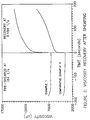
- Figure 2 shows the recovery of viscosity after shearing the ink at high shear rates. In this experiment, an ink composition according to Formulation 1 is sheared at a shear rate of 184 1/S for 180 seconds and then the increase in viscosity is monitored at a shear rate of 0.184 1/S as a function of time.
- This Example illustrates the preparation of an organophilic clay gellant containing an organic cation and an organic anion.
- the mixture is stirred for 1 hour at 70°C and then filtered through a Buchner funnel to collect the solids.
- the wet solids are reslurried in 1500 grams of water at 70°C for 20 minutes and then re-collected on a Buchner funnel.
- the filtercake is dried at 60°C in an oven for 16 hours.
- Example 1 illustrates the effect of drying conditions on the properties provided when the organophilic clay gellants in Example 1 and Comparative Example A are used in a soya bean oil based ink formulation. Dispersion measurements, Brookfield viscosity, tack and misting are presented in Table 2. Table 2 Ex. Drying Method Temperature Grind Tack Misting Brookfield Visc.
- organophilic clay compositions provided by the invention are highly effective in improving the rheological properties of non-aqueous systems.
Landscapes
- Chemical & Material Sciences (AREA)
- Organic Chemistry (AREA)
- Oil, Petroleum & Natural Gas (AREA)
- Inorganic Chemistry (AREA)
- Life Sciences & Earth Sciences (AREA)
- Materials Engineering (AREA)
- General Chemical & Material Sciences (AREA)
- General Health & Medical Sciences (AREA)
- Health & Medical Sciences (AREA)
- General Life Sciences & Earth Sciences (AREA)
- Engineering & Computer Science (AREA)
- Chemical Kinetics & Catalysis (AREA)
- Silicates, Zeolites, And Molecular Sieves (AREA)
- Inks, Pencil-Leads, Or Crayons (AREA)
- Adhesives Or Adhesive Processes (AREA)
- Lubricants (AREA)
- Compositions Of Macromolecular Compounds (AREA)
- Paints Or Removers (AREA)
Applications Claiming Priority (2)
| Application Number | Priority Date | Filing Date | Title |
|---|---|---|---|
| US66773 | 1993-05-07 | ||
| US08/066,773 US6130256A (en) | 1993-05-07 | 1993-05-07 | Organoclay thickener compatible with system to be thickened |
Publications (1)
| Publication Number | Publication Date |
|---|---|
| EP0627480A1 true EP0627480A1 (de) | 1994-12-07 |
Family
ID=22071596
Family Applications (1)
| Application Number | Title | Priority Date | Filing Date |
|---|---|---|---|
| EP94106443A Withdrawn EP0627480A1 (de) | 1993-05-07 | 1994-04-25 | Organophiler Ton als Verdickungsmittel, kompatibel mit dem zu verdickenden System |
Country Status (4)
| Country | Link |
|---|---|
| US (1) | US6130256A (de) |
| EP (1) | EP0627480A1 (de) |
| JP (1) | JP2988826B2 (de) |
| CA (1) | CA2122808A1 (de) |
Cited By (4)
| Publication number | Priority date | Publication date | Assignee | Title |
|---|---|---|---|---|
| EP1138740A1 (de) * | 2000-03-27 | 2001-10-04 | Elementis Specialties, Inc. | Organophile Tonadditive und sie enthaltende Bohrflüssigkeiten mit rheologischen Eigenschaften , die eine geringere Temperaturabhängigkeit aufweisen |
| EP0639615B1 (de) * | 1993-08-16 | 2003-01-22 | Rheox International, Inc. | Mit organischen Verbindungen modifizierte Tone als Additive für hochviskose Systeme |
| EP1674547A1 (de) * | 2004-12-23 | 2006-06-28 | Muylle-Facon N.V. | Leim zur Kaltverklebung von Bauelementen |
| US7867614B2 (en) | 2003-06-12 | 2011-01-11 | Rockwood Clay Additives, Gmbh | Method for producing nanocomposite additives with improved delamination in polymers |
Families Citing this family (14)
| Publication number | Priority date | Publication date | Assignee | Title |
|---|---|---|---|---|
| AU3411800A (en) * | 1999-03-16 | 2000-10-04 | Technology Partners International Llc | High solids bentonite slurries and method for preparing same |
| US7504451B1 (en) | 1999-04-30 | 2009-03-17 | Rockwood Clay Additives, Gmbh | Fire retardant compositions |
| JP4799718B2 (ja) * | 1999-08-11 | 2011-10-26 | コープケミカル株式会社 | 有機マイカ |
| TW587096B (en) * | 2000-08-11 | 2004-05-11 | Nihon Parkerizing | Greases component containing in aqueous composition for forming protective membranes |
| US6660768B2 (en) | 2001-02-08 | 2003-12-09 | Schering-Plough Animal Health Corporation | Parasiticidal compositions and methods of use |
| KR100431438B1 (ko) * | 2001-03-12 | 2004-05-14 | 주식회사 엘지화학 | 전이금속 착화합물의 형성을 이용한 유기점토 조성물 및그 제조방법 |
| WO2004010960A1 (en) * | 2002-07-25 | 2004-02-05 | Amcol International Corporation | Viscous compositions containing hydrophobic liquids |
| US7528191B2 (en) * | 2003-01-08 | 2009-05-05 | Rockwood Clay Additives, Gmbh | Composition based on pre-exfoliated nanoclay and use thereof |
| DE102004039451A1 (de) * | 2004-08-13 | 2006-03-02 | Süd-Chemie AG | Polymerblend aus nicht verträglichen Polymeren |
| US20060118002A1 (en) * | 2004-12-03 | 2006-06-08 | Sud-Chemie Inc. | Organoclay composition containing quat mixtures |
| TWI435695B (zh) * | 2010-06-04 | 2014-05-01 | Univ Nat Taiwan | 應用於抑制微生物、病毒或植物蟲害生長之脫層黏土/界面活性劑錯合物 |
| US11091684B2 (en) | 2016-04-29 | 2021-08-17 | Byk Usa Inc. | Organoclay compositions and oil-based drilling fluid comprising the clays |
| US10662365B2 (en) | 2018-06-06 | 2020-05-26 | Elementis Specialties, Inc. | Oil based drilling fluids useful having reduced change in high shear viscosity over a wide temperature range |
| CN114106912B (zh) * | 2021-10-26 | 2022-08-16 | 北京中铁新材料技术有限公司 | 一种生态友好型盾尾密封油脂及其制备方法和应用 |
Citations (5)
| Publication number | Priority date | Publication date | Assignee | Title |
|---|---|---|---|---|
| GB2090584A (en) * | 1980-11-17 | 1982-07-14 | Nl Industries Inc | Organophilic organic-clay complexes |
| EP0160514A2 (de) * | 1984-04-27 | 1985-11-06 | Southern Clay Products, Inc. | Organo-Tone |
| US4695402A (en) * | 1985-08-20 | 1987-09-22 | Nl Chemicals, Inc. | Organophilic clay gellants and process for preparation |
| EP0265101A2 (de) * | 1986-10-24 | 1988-04-27 | Rheox International, Inc. | Biozider Verdickungszusatz für eine organische Zusammensetzung |
| EP0542266A2 (de) * | 1991-11-14 | 1993-05-19 | Rheox International, Inc. | Organotonzusammensetzungen, hergestellt aus einer Mischung von zwei organischen Kationen sowie ihre Verwendung in nichtwässrigen Systemen |
Family Cites Families (11)
| Publication number | Priority date | Publication date | Assignee | Title |
|---|---|---|---|---|
| US2622987A (en) * | 1951-04-10 | 1952-12-23 | Nat Lead Co | Coating composition and the vehicle therefor containing a compound of a clay and an onium base |
| US2859234A (en) * | 1956-12-07 | 1958-11-04 | American Colloid Co | Chemical compounds and the production thereof |
| US4105578A (en) * | 1976-12-10 | 1978-08-08 | N L Industries, Inc. | Organophilic clay having enhanced dispersibility |
| US4193806A (en) * | 1977-06-27 | 1980-03-18 | N L Industries, Inc. | Viscosity increasing additive for printing inks |
| US4208218A (en) * | 1978-03-27 | 1980-06-17 | Nl Industries, Inc. | Viscosity increasing additive for non-aqueous fluid systems |
| US4450095A (en) * | 1980-11-17 | 1984-05-22 | Nl Industries, Inc. | Organophilic clay gellant having enhanced dispersibility |
| US4410364A (en) * | 1980-11-17 | 1983-10-18 | Nl Industries, Inc. | Printing ink compositions |
| US4434075A (en) * | 1981-10-19 | 1984-02-28 | Nl Industries, Inc. | Anionically modified organophilic clays and their preparation |
| US4664820A (en) * | 1985-10-28 | 1987-05-12 | Nl Industries, Inc. | Preactivated organophilic clay gellant lubricating grease thickened with preactivated organophilic clay gellant and process for preparing preactivated organophilic clay gellants |
| US5186747A (en) * | 1991-03-28 | 1993-02-16 | United Catalysts Inc. | Organophilic clays preactivated with propylene carbonate |
| US5178672A (en) * | 1991-04-08 | 1993-01-12 | Canadian Fine Color Company Limited | Printing compositions |
-
1993
- 1993-05-07 US US08/066,773 patent/US6130256A/en not_active Expired - Fee Related
-
1994
- 1994-04-25 EP EP94106443A patent/EP0627480A1/de not_active Withdrawn
- 1994-05-03 CA CA002122808A patent/CA2122808A1/en not_active Abandoned
- 1994-05-06 JP JP6094130A patent/JP2988826B2/ja not_active Expired - Fee Related
Patent Citations (6)
| Publication number | Priority date | Publication date | Assignee | Title |
|---|---|---|---|---|
| GB2090584A (en) * | 1980-11-17 | 1982-07-14 | Nl Industries Inc | Organophilic organic-clay complexes |
| US4412018A (en) * | 1980-11-17 | 1983-10-25 | Nl Industries, Inc. | Organophilic clay complexes, their preparation and compositions comprising said complexes |
| EP0160514A2 (de) * | 1984-04-27 | 1985-11-06 | Southern Clay Products, Inc. | Organo-Tone |
| US4695402A (en) * | 1985-08-20 | 1987-09-22 | Nl Chemicals, Inc. | Organophilic clay gellants and process for preparation |
| EP0265101A2 (de) * | 1986-10-24 | 1988-04-27 | Rheox International, Inc. | Biozider Verdickungszusatz für eine organische Zusammensetzung |
| EP0542266A2 (de) * | 1991-11-14 | 1993-05-19 | Rheox International, Inc. | Organotonzusammensetzungen, hergestellt aus einer Mischung von zwei organischen Kationen sowie ihre Verwendung in nichtwässrigen Systemen |
Cited By (5)
| Publication number | Priority date | Publication date | Assignee | Title |
|---|---|---|---|---|
| EP0639615B1 (de) * | 1993-08-16 | 2003-01-22 | Rheox International, Inc. | Mit organischen Verbindungen modifizierte Tone als Additive für hochviskose Systeme |
| EP1138740A1 (de) * | 2000-03-27 | 2001-10-04 | Elementis Specialties, Inc. | Organophile Tonadditive und sie enthaltende Bohrflüssigkeiten mit rheologischen Eigenschaften , die eine geringere Temperaturabhängigkeit aufweisen |
| US7867614B2 (en) | 2003-06-12 | 2011-01-11 | Rockwood Clay Additives, Gmbh | Method for producing nanocomposite additives with improved delamination in polymers |
| EP1674547A1 (de) * | 2004-12-23 | 2006-06-28 | Muylle-Facon N.V. | Leim zur Kaltverklebung von Bauelementen |
| BE1016393A5 (nl) * | 2004-12-23 | 2006-10-03 | Muylle Facon N V | Lijm voor het koud verlijmen van bouwmaterialen. |
Also Published As
| Publication number | Publication date |
|---|---|
| JP2988826B2 (ja) | 1999-12-13 |
| JPH07188642A (ja) | 1995-07-25 |
| CA2122808A1 (en) | 1994-11-08 |
| US6130256A (en) | 2000-10-10 |
Similar Documents
| Publication | Publication Date | Title |
|---|---|---|
| EP0542266B1 (de) | Organotonzusammensetzungen, hergestellt aus einer Mischung von zwei organischen Kationen sowie ihre Verwendung in nichtwässrigen Systemen | |
| CA2148396C (en) | Organoclay compositions containing two or more cations and one or more organic anions, their preparation and use in non-aqueous systems | |
| US6130256A (en) | Organoclay thickener compatible with system to be thickened | |
| CA2220453C (en) | Improved organoclay products containing a branched chain alkyl quaternary ammonium ion | |
| EP0798267B1 (de) | Organoton-Zusammensetzungen, hergestellt mit Hilfe von quaternären Ammoniumverbindungen, welche von Estern abgeleitet sind, die Derivate von organischen Säuren darstellen, sowie ihre Herstellung und nicht-wässrige flüssige Systeme, die diese Zusammensetzungen enthalten | |
| US4695402A (en) | Organophilic clay gellants and process for preparation | |
| CA1258670A (en) | Preactivated organophilic clay gellant for lubricating greases, lubricating grease thickened with preactivated organophilic clay gellant, process for preparing preactivated organophilic clay gellants and preactivated organophilic clay gellants thus | |
| US4742098A (en) | Organophilic clay gellants and process for preparation | |
| CA1105798A (en) | Organophilic clays and thixotropic polyester compositions containing the same | |
| US4116866A (en) | Organophilic clay gellant | |
| US4450095A (en) | Organophilic clay gellant having enhanced dispersibility | |
| CA1128954A (en) | Viscosity increasing additive for non-aqueous fluid systems | |
| US4081496A (en) | Thixotropic polyester compositions containing an organophilic clay gellant | |
| CA1076448A (en) | Organophilic clay having enhanced dispersibility | |
| EP0160514B1 (de) | Organo-Tone | |
| CA2230585A1 (en) | Formulations including improved organoclay compositions | |
| CA2987856C (en) | ORGANOPHILIC CLAYS AND DRILLING LIQUIDS CONTAINING THEM | |
| GB1602187A (en) | Method of increasing the viscosity of liquid organic systems and organophilic clay having enhanced dispersibility therein | |
| WO1997031873A1 (en) | High performance dry process organoclay compositions, and methods of use therefor | |
| EP0161411B1 (de) | Organophiles Tongeliermittel und Verfahren zur Herstellung | |
| MXPA97002348A (en) | Novedos organogenic compositions manufactured with quaternary ammonium compounds derived from organic acids, its preparation and non-aqueous fluid systems containing such composition |
Legal Events
| Date | Code | Title | Description |
|---|---|---|---|
| PUAI | Public reference made under article 153(3) epc to a published international application that has entered the european phase |
Free format text: ORIGINAL CODE: 0009012 |
|
| AK | Designated contracting states |
Kind code of ref document: A1 Designated state(s): BE CH DE DK FR GB IT LI NL SE |
|
| 17P | Request for examination filed |
Effective date: 19950428 |
|
| STAA | Information on the status of an ep patent application or granted ep patent |
Free format text: STATUS: THE APPLICATION IS DEEMED TO BE WITHDRAWN |
|
| 18D | Application deemed to be withdrawn |
Effective date: 19961101 |