EP0627646A2 - Progressive Multifokallinse - Google Patents
Progressive Multifokallinse Download PDFInfo
- Publication number
- EP0627646A2 EP0627646A2 EP94108367A EP94108367A EP0627646A2 EP 0627646 A2 EP0627646 A2 EP 0627646A2 EP 94108367 A EP94108367 A EP 94108367A EP 94108367 A EP94108367 A EP 94108367A EP 0627646 A2 EP0627646 A2 EP 0627646A2
- Authority
- EP
- European Patent Office
- Prior art keywords
- horizontal
- horizontal section
- nearsight
- progressive multifocal
- multifocal lens
- Prior art date
- Legal status (The legal status is an assumption and is not a legal conclusion. Google has not performed a legal analysis and makes no representation as to the accuracy of the status listed.)
- Granted
Links
- 230000000750 progressive effect Effects 0.000 title claims abstract description 38
- 230000003247 decreasing effect Effects 0.000 claims abstract description 17
- 230000007423 decrease Effects 0.000 claims abstract description 16
- 230000002123 temporal effect Effects 0.000 claims description 7
- 230000004438 eyesight Effects 0.000 description 13
- 230000000007 visual effect Effects 0.000 description 4
- 230000004308 accommodation Effects 0.000 description 3
- 230000004075 alteration Effects 0.000 description 1
- 238000011156 evaluation Methods 0.000 description 1
Images

Classifications
-
- G—PHYSICS
- G02—OPTICS
- G02C—SPECTACLES; SUNGLASSES OR GOGGLES INSOFAR AS THEY HAVE THE SAME FEATURES AS SPECTACLES; CONTACT LENSES
- G02C7/00—Optical parts
- G02C7/02—Lenses; Lens systems ; Methods of designing lenses
- G02C7/06—Lenses; Lens systems ; Methods of designing lenses bifocal; multifocal ; progressive
- G02C7/061—Spectacle lenses with progressively varying focal power
- G02C7/063—Shape of the progressive surface
-
- G—PHYSICS
- G02—OPTICS
- G02C—SPECTACLES; SUNGLASSES OR GOGGLES INSOFAR AS THEY HAVE THE SAME FEATURES AS SPECTACLES; CONTACT LENSES
- G02C7/00—Optical parts
- G02C7/02—Lenses; Lens systems ; Methods of designing lenses
- G02C7/06—Lenses; Lens systems ; Methods of designing lenses bifocal; multifocal ; progressive
- G02C7/061—Spectacle lenses with progressively varying focal power
Definitions
- the present invention relates to a progressive multifocal lens used to assist an accommodation power of an eye.
- a progressive multifocal lens of this type has a "farsight portion", a “nearsight portion” and a progressive region (referred to as an "intermediate portion” hereinafter) which is located between the above two portions in which a refracting power is continuously changed.
- the farsight portion becomes an upper portion while the nearsight portion becomes a lower portion.
- upper portion is used to point positions of the progressive multifocal lens in the state that it is actually worn by the user.
- the lower portion of the farsight portion is a position within the farsight portion close to the intermediate portion.
- the difference between the nearsight refracting power and the farsight refracting power is called an additional power.
- a progressive multifocal lens of this type in general, when wide distinct vision areas (ranges with an astigmatic difference of 0.5 diopter or less) of the farsight and nearsight portions are kept and coupled by the progressive power range, lens aberrations are concentrated on side regions of the progressive power range. As a result, blurring and distortion of an image occur in these side portions. Therefore, when a user wears spectacles formed of these multifocal lenses and shifts his eyes laterally, he perceives the distortion of an image as the fluctuation of the image and has an unpleasant feeling.
- an intersecting line (principal meridional curve) defined by a section extending along a vertical meridian vertically passing through substantially the center of a lens surface and an object-side lens surface is used as a reference curve for expressing specifications such as an additional power of a lens, and is also used as an important reference curve in a lens design.
- a progressive multifocal lens (hereinafter referred to as an asymmetrical progressive multifocal lens) has been proposed in which an intermediate portion P and a nearsight portion N are asymmetrically arranged in consideration of the fact that a nearsight eye point (not shown) of the nearsight portion N is slightly displaced from the center toward a nasal side when the lens is worn.
- a center line MM' consisting of an intersecting line of an object-side lens surface and a section passing the center OF of a farsight portion F, a farsight eye point E and the center of the nearsight portion N is used as a reference line.
- These reference lines will be referred to as "principal meridional curves" in the present invention.
- the width of a distinct vision area is enlarged by lessening the rates of changes of curvatures of horizontal crossing curves in farsight and nearsight portions toward the upper and lower regions of the lens.
- the gradient of an astigmatic difference becomes steep especially in the nearsight portion and the reduction of a maximum astigmatic difference is not achieved.
- a horizontal sectional shape of a refracting surface of a lower portion of the farsight portion defines a non-circular arc in which a horizontal section curvature is increased and then decreased as being away from an intersecting point with the principal meridional curve along a horizontal crossing curve
- a horizontal sectional shape of a refracting surface of an upper portion of the nearsight portion defines a non-circular arc in which a horizontal section curvature is increased and then made approximately constant as being away from an intersecting point with the meridional curve along a horizontal crossing curve
- a horizontal sectional shape of a refracting surface from a lower portion of said intermediate portion to the upper portion of said nearsight portion defines a non-circular arc in which a horizontal section curvature is decreased and then made approximately constant as being away from an intersecting point with said principal meridional curve.
- a gradient of a decrease of a horizontal section curvature is larger in said nasal portion from said intermediate portion to said nearsight portion than in said temporal portion.
- the horizontal sectional shape of the refracting surface of the lower portion of the farsight portion F is the non-circular arc such that the horizontal section curvature is increased and then decreased as being away from the principal meridional curve. Therefore, while obtaining a sufficiently wider distinct vision area around the eye point E of the farsight portion F, the connection between the intermediate portion P and the farsight portion F can be performed smoothly.
- the center of the intermediate portion P has the non-circular arc shape in section and the rate of the decrease of the horizontal section curvature is increased as approaching the nearsight portion N, so that a distinct vision area can be widened.
- the upper portion of the nearsight portion N has the non-circular arc shape such that the horizontal section curvature is increased and then made approximately constant. Therefore, a distinct vision area in the vicinity of a nearsight eye point can be widened and the concentration of an astigmatic difference can be mitigated in side regions.
- the rate of the decrease of the horizontal section curvature is kept approximately constant from the upper portion to the lower portion of the nearsight portion N, it is possible to reduce a maximum astigmatic difference and the gradient of the astigmatic difference can be made gentle.
- the distortion and fluctuation of an image in the side regions can be preferably eliminated, making it possible to eliminate uncomfortable feeling at the time of use as spectacles.
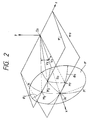
- Fig. 2 is a perspective view for explaining a horizontal crossing curve with respect to a refracting surface ⁇ of the progressive multifocal lens.
- the geometric center of the lens is O G and the center of curvature of the refracting surface ⁇ at the geometric center O G is O0.
- An axis passing the geometric center O G and the center O0 of curvature is made as an X-axis.
- a spherical surface drawn by a radius R0 of curvature of the refracting surface ⁇ at the geometric center O G is made as a reference spherical surface. Therefore, the reference spherical surface is in contact with the refracting surface ⁇ of the lens at the geometric center O G .
- Y- and Z-axes are respectively plotted in the vertical and horizontal directions with the center O0 of the reference spherical surface as an origin.
- the "horizontal crossing curve” is an intersecting line of the plane ⁇ j and the refracting surface ⁇ and expressed as the horizontal intersection line ⁇ j.
- a section of the lens cut horizontally by the plane ⁇ j including the horizontal crossing curve is called a "horizontal section”.
- Fig. 3 shows the position of the horizontal intersecting line ⁇ j projected to a yz plane of Fig. 2 and, i.e., shows the position of the horizontal intersecting line ⁇ j on the refracting surface of the lens flatly.
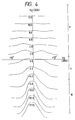
- Fig. 4 shows the change of the curvature of the refracting surface of the progressive multifocal lens of this embodiment and shows specifically the changes of the curvatures of the refracting surface along the horizontal intersecting lines ⁇ 6 - ⁇ 6.
- curvatures of the refracting surface along the respective horizontal crossing curves are called "horizontal section curvatures”.
- an intersecting point of the plane ⁇ j including a point Mj on the refracting surface and an intersecting line of the x-y plane and the refracting surface ⁇ is made as My and an angle Vy formed by the X-axis and a segment connecting the point My and the center O0 of curvature is represented by a vertical axis.
- a point on the horizontal intersecting line ⁇ 0 having the same Z-axis element as the point Mj on the refracting surface is made as Mz and an angle Vz formed by the X-axis and a segment connecting the point Mz and the center O0 of curvature is represented by a horizontal axis.
- Fig. 4 shows changes of horizontal section curvatures of 13 representative horizontal sections intersecting the principal meridional curve MM'. More specifically, in the respective horizontal sections for which the angle Vy is changed by 2° in the range of +12° to -12°, changes of horizontal section curvatures at respective positions for which the angle Vz is changed by 2° in the range of +12° to -12° are represented by changes with respect to respective horizontal section curvatures at intersecting points with the principal meridional curve MM'. That is, in Fig. 4, the angles Vy and Vz are represented respectively by the vertical and horizontal axes. And, in one of those, states where the changes of the horizontal section curvatures at the respective positions are increased with respect to reference horizontal section curvatures are indicated by upward curves. On the other hand, the opposite states are indicated by downward curves.
- the farsight portion F corresponds to the upper range having the angle Vy of about +1° or more while the nearsight portion N corresponds to the lower range having the angle Vy of about -6° or less.
- the progressive multifocal lens of this embodiment is the asymmetrical progressive multifocal lens in which the average refracting power (base curve) of the farsight portion F is 3.50 diopter and the additional power is 2.5 diopter.
- the left-hand side corresponds to a nasal side portion and the right-hand side corresponds to a temporal side portion.
- the horizontal sectional shape of the lower portion (Vy: +4° to +2°) of the farsight portion F is a non-circular arc such that the horizontal section curvatures are increased and then decreased as being away from the respective intersecting points with the principal meridional curve MM'.
- the horizontal sectional shape of the center (Vy: -2°) of the intermediate portion P is a non-circular arc such that the horizontal section curvature is decreased as being away from the intersecting point with the principal meridional curve MM'.
- the upper portion (Vy: -6° to -8°) of the nearsight portion N is a non-circular arc such that the horizontal section curvatures are decreased and then made approximately constant as being away from the intersecting points with the principal meridional curve MM' and the rates of the horizontal section curvatures are kept approximately constant from the upper portion to the lower portion.
- the horizontal section curvatures of the side regions of the lower portion of the farsight portion F are increased and decreased respectively within about 10% with respect to the respective horizontal section curvatures at the intersecting points of the corresponding horizontal sections and the principal meridional curve.
- the horizontal section curvatures of the side regions of the center of the intermediate portion P are decreased within about 40% with respect to the respective horizontal section curvature at the intersecting point of the corresponding horizontal section and the principal meridional curve.
- the horizontal section curvatures of the side regions of the upper portion of the nearsight portion N are decreased within about 45% with respect to the respective horizontal section curvatures at the intersecting points of the corresponding horizontal sections and the principal meridional curves.
- the gradients of the maximum decreases of the horizontal section curvatures from approximately the center (Vy: -2°) of the intermediate portion P to the lower portion (Vy: -12°) of the nearsight portion N are respectively about 5% in the horizontal section having the angle Vy of -2°, about 14% in the horizontal section having the angle Vy of -4%, about 19% in the horizontal section having the angle of -6°, about 20% in the horizontal section having the angle of -8°, about 18% in the horizontal section having the angle of -10° and about 17% in the horizontal section having the angle of -12°.
- those are respectively about 12% in the horizontal section having the angle Vy of -2°, about 19% in the horizontal section having the angle Vy of -4%, about 23% in the horizontal section having the angle of -6°, about 24% in the horizontal section having the angle of -8°, about 24% in the horizontal section having the angle of -10° and about 21% in the horizontal section having the angle of -12°.
- the gradients of the decreases of are approximately constant in the region from the angle Vy of -6° to the angle of -12°, the gradients of the decreases of the horizontal section curvatures are larger in the nasal side portion than in the temporal side portion.
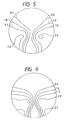
- Fig. 5 is a graph showing astigmatic difference curves of the progressive multifocal lens of this embodiment. The astigmatic difference curves are shown by 0.5 diopter.
- astigmatic difference curves of a conventional progressive multifocal lens having the additional power of 2.5 are shown by 0.5 diopter in Fig. 6.
- the value of the maximum astigmatic difference is 2.5 diopter and the absolute amount and gradient of the astigmatic difference are steep.
- the value of the maximum astigmatic difference is reduced to be 2.0 diopter.
- the density of the astigmatic difference is largely reduced to make the gradient of the astigmatic difference gentle.
- the progressive multifocal lens of the present invention can have the wider and stable distinct vision areas of the intermediate and nearsight portions while securing the sufficiently wider distinct vision area of the farsight portion for practical use. Also, the value of the maximum astigmatic difference is reduced and the density of the astigmatic difference is largely reduced to make the gradient of the astigmatic difference gentle. Therefore, the distortion of an image is lessened and then, even though the user shifts his eyes laterally, he will not feel unpleasant due to the fluctuation of an image in the side regions.
Landscapes
- Health & Medical Sciences (AREA)
- Ophthalmology & Optometry (AREA)
- Physics & Mathematics (AREA)
- General Health & Medical Sciences (AREA)
- General Physics & Mathematics (AREA)
- Optics & Photonics (AREA)
- Eyeglasses (AREA)
Applications Claiming Priority (3)
| Application Number | Priority Date | Filing Date | Title |
|---|---|---|---|
| JP14973193A JP3381306B2 (ja) | 1993-05-31 | 1993-05-31 | 累進焦点レンズ |
| JP149731/93 | 1993-05-31 | ||
| JP14973193 | 1993-05-31 |
Publications (3)
| Publication Number | Publication Date |
|---|---|
| EP0627646A2 true EP0627646A2 (de) | 1994-12-07 |
| EP0627646A3 EP0627646A3 (de) | 1995-09-27 |
| EP0627646B1 EP0627646B1 (de) | 2003-03-05 |
Family
ID=15481586
Family Applications (1)
| Application Number | Title | Priority Date | Filing Date |
|---|---|---|---|
| EP94108367A Expired - Lifetime EP0627646B1 (de) | 1993-05-31 | 1994-05-31 | Progressive Multifokallinse |
Country Status (4)
| Country | Link |
|---|---|
| US (1) | US5523807A (de) |
| EP (1) | EP0627646B1 (de) |
| JP (1) | JP3381306B2 (de) |
| DE (1) | DE69432201T2 (de) |
Cited By (2)
| Publication number | Priority date | Publication date | Assignee | Title |
|---|---|---|---|---|
| EP0724179A3 (de) * | 1994-12-27 | 1996-09-25 | Seiko Epson Corp | Gleitschichtlinse und Brillenlinse |
| EP1154303A3 (de) * | 2000-05-10 | 2003-08-27 | Nikon-Essilor Co., Ltd. | Multifokale Linse mit progressiver Brechkraft |
Families Citing this family (4)
| Publication number | Priority date | Publication date | Assignee | Title |
|---|---|---|---|---|
| JP3605281B2 (ja) * | 1998-03-18 | 2004-12-22 | ペンタックス株式会社 | 累進多焦点レンズ |
| WO1999064919A1 (en) * | 1998-06-12 | 1999-12-16 | Seiko Epson Corporation | Progressive refractive power lens |
| US8256895B2 (en) * | 2008-02-20 | 2012-09-04 | Swissphonics Sa | Progressive multifocal ophthalmic lenses identically optimized over a wide range of refractive indices, base curves, and additions |
| US9028063B2 (en) * | 2011-08-26 | 2015-05-12 | Johnson & Johnson Vision Care, Inc. | Translating presbyopic contact lens pair |
Family Cites Families (3)
| Publication number | Priority date | Publication date | Assignee | Title |
|---|---|---|---|---|
| SE423451B (sv) * | 1980-09-15 | 1982-05-03 | Philips Svenska Ab | Sett for samarbete mellan projektiler och malfoljande projektil for genomforande av settet vid bekempning av mal |
| US5000559A (en) * | 1988-02-29 | 1991-03-19 | Nikon Corporation | Ophthalmic lenses having progressively variable refracting power |
| US5048945A (en) * | 1989-07-14 | 1991-09-17 | Nikon Corporation | Progressive power lens |
-
1993
- 1993-05-31 JP JP14973193A patent/JP3381306B2/ja not_active Expired - Lifetime
-
1994
- 1994-05-27 US US08/249,962 patent/US5523807A/en not_active Expired - Lifetime
- 1994-05-31 EP EP94108367A patent/EP0627646B1/de not_active Expired - Lifetime
- 1994-05-31 DE DE69432201T patent/DE69432201T2/de not_active Expired - Lifetime
Cited By (3)
| Publication number | Priority date | Publication date | Assignee | Title |
|---|---|---|---|---|
| EP0724179A3 (de) * | 1994-12-27 | 1996-09-25 | Seiko Epson Corp | Gleitschichtlinse und Brillenlinse |
| US5745211A (en) * | 1994-12-27 | 1998-04-28 | Seiko Epson Corporation | Progressive power lens and eye glass lens |
| EP1154303A3 (de) * | 2000-05-10 | 2003-08-27 | Nikon-Essilor Co., Ltd. | Multifokale Linse mit progressiver Brechkraft |
Also Published As
| Publication number | Publication date |
|---|---|
| JP3381306B2 (ja) | 2003-02-24 |
| DE69432201D1 (de) | 2003-04-10 |
| EP0627646A3 (de) | 1995-09-27 |
| EP0627646B1 (de) | 2003-03-05 |
| DE69432201T2 (de) | 2003-09-04 |
| JPH06337382A (ja) | 1994-12-06 |
| US5523807A (en) | 1996-06-04 |
Similar Documents
| Publication | Publication Date | Title |
|---|---|---|
| US4762408A (en) | Progressive multifocal lens and spectacles using same | |
| US5812238A (en) | Progressive multifocal ophthalmic lens pair | |
| JP2854234B2 (ja) | 眼科用累進多焦点レンズ | |
| US4592630A (en) | Ophthalmic lenses | |
| EP1835329A2 (de) | Gruppe multifokaler Gleitsichtlinsen | |
| US5864380A (en) | Progressive power lens | |
| EP0702257B1 (de) | Progressive, Presbyopie-korrigierende Brillengläser | |
| US5048945A (en) | Progressive power lens | |
| US4988182A (en) | Ophthalmic lenses having a progressively variable focal power | |
| US5892565A (en) | Progressive multifocal lens | |
| EP0627647B1 (de) | Progressive Multifokallinse | |
| US5523807A (en) | Progressive multifocal lens | |
| EP0632307B1 (de) | Linse mit progressiver Brechkraft | |
| JP4024851B2 (ja) | 一組のプログレッシヴ眼用レンズ | |
| EP1429172A1 (de) | Progressive Brillenlinse | |
| JPH08234146A (ja) | 累進多焦点レンズおよび眼鏡レンズ | |
| EP0627645A2 (de) | Progressive Multifokallinse | |
| US5805265A (en) | Progressive lens | |
| JP3611155B2 (ja) | 累進多焦点レンズ | |
| JPH07294859A (ja) | 累進多焦点レンズ | |
| JP2503665B2 (ja) | 累進焦点レンズ | |
| JPH0581886B2 (de) | ||
| JP3601724B2 (ja) | 累進焦点レンズ | |
| JP3611153B2 (ja) | 累進多焦点レンズ | |
| JP2503664B2 (ja) | 累進焦点レンズ |
Legal Events
| Date | Code | Title | Description |
|---|---|---|---|
| PUAI | Public reference made under article 153(3) epc to a published international application that has entered the european phase |
Free format text: ORIGINAL CODE: 0009012 |
|
| AK | Designated contracting states |
Kind code of ref document: A2 Designated state(s): DE FR |
|
| PUAL | Search report despatched |
Free format text: ORIGINAL CODE: 0009013 |
|
| AK | Designated contracting states |
Kind code of ref document: A3 Designated state(s): DE FR |
|
| 17P | Request for examination filed |
Effective date: 19960229 |
|
| 17Q | First examination report despatched |
Effective date: 19990617 |
|
| GRAG | Despatch of communication of intention to grant |
Free format text: ORIGINAL CODE: EPIDOS AGRA |
|
| GRAG | Despatch of communication of intention to grant |
Free format text: ORIGINAL CODE: EPIDOS AGRA |
|
| GRAH | Despatch of communication of intention to grant a patent |
Free format text: ORIGINAL CODE: EPIDOS IGRA |
|
| GRAH | Despatch of communication of intention to grant a patent |
Free format text: ORIGINAL CODE: EPIDOS IGRA |
|
| GRAA | (expected) grant |
Free format text: ORIGINAL CODE: 0009210 |
|
| AK | Designated contracting states |
Designated state(s): DE FR |
|
| REF | Corresponds to: |
Ref document number: 69432201 Country of ref document: DE Date of ref document: 20030410 Kind code of ref document: P |
|
| ET | Fr: translation filed | ||
| PLBE | No opposition filed within time limit |
Free format text: ORIGINAL CODE: 0009261 |
|
| STAA | Information on the status of an ep patent application or granted ep patent |
Free format text: STATUS: NO OPPOSITION FILED WITHIN TIME LIMIT |
|
| 26N | No opposition filed |
Effective date: 20031208 |
|
| PGFP | Annual fee paid to national office [announced via postgrant information from national office to epo] |
Ref country code: DE Payment date: 20130529 Year of fee payment: 20 |
|
| PGFP | Annual fee paid to national office [announced via postgrant information from national office to epo] |
Ref country code: FR Payment date: 20130531 Year of fee payment: 20 |
|
| REG | Reference to a national code |
Ref country code: DE Ref legal event code: R071 Ref document number: 69432201 Country of ref document: DE |
|
| PG25 | Lapsed in a contracting state [announced via postgrant information from national office to epo] |
Ref country code: DE Free format text: LAPSE BECAUSE OF EXPIRATION OF PROTECTION Effective date: 20140603 |