EP0628412A2 - Système de commande de buses et procédé d'impression par jet d'encre - Google Patents
Système de commande de buses et procédé d'impression par jet d'encre Download PDFInfo
- Publication number
- EP0628412A2 EP0628412A2 EP94202383A EP94202383A EP0628412A2 EP 0628412 A2 EP0628412 A2 EP 0628412A2 EP 94202383 A EP94202383 A EP 94202383A EP 94202383 A EP94202383 A EP 94202383A EP 0628412 A2 EP0628412 A2 EP 0628412A2
- Authority
- EP
- European Patent Office
- Prior art keywords
- ink
- nozzle
- droplets
- value
- printing
- Prior art date
- Legal status (The legal status is an assumption and is not a legal conclusion. Google has not performed a legal analysis and makes no representation as to the accuracy of the status listed.)
- Granted
Links
Images
Classifications
-
- B—PERFORMING OPERATIONS; TRANSPORTING
- B41—PRINTING; LINING MACHINES; TYPEWRITERS; STAMPS
- B41J—TYPEWRITERS; SELECTIVE PRINTING MECHANISMS, i.e. MECHANISMS PRINTING OTHERWISE THAN FROM A FORME; CORRECTION OF TYPOGRAPHICAL ERRORS
- B41J2/00—Typewriters or selective printing mechanisms characterised by the printing or marking process for which they are designed
- B41J2/005—Typewriters or selective printing mechanisms characterised by the printing or marking process for which they are designed characterised by bringing liquid or particles selectively into contact with a printing material
- B41J2/01—Ink jet
- B41J2/015—Ink jet characterised by the jet generation process
- B41J2/02—Ink jet characterised by the jet generation process generating a continuous ink jet
-
- B—PERFORMING OPERATIONS; TRANSPORTING
- B41—PRINTING; LINING MACHINES; TYPEWRITERS; STAMPS
- B41J—TYPEWRITERS; SELECTIVE PRINTING MECHANISMS, i.e. MECHANISMS PRINTING OTHERWISE THAN FROM A FORME; CORRECTION OF TYPOGRAPHICAL ERRORS
- B41J2/00—Typewriters or selective printing mechanisms characterised by the printing or marking process for which they are designed
- B41J2/005—Typewriters or selective printing mechanisms characterised by the printing or marking process for which they are designed characterised by bringing liquid or particles selectively into contact with a printing material
- B41J2/01—Ink jet
- B41J2/07—Ink jet characterised by jet control
- B41J2/12—Ink jet characterised by jet control testing or correcting charge or deflection
Definitions
- This invention relates to ink jet printing systems and similar drop marking systems in which a supply of electrically conductive ink is provided to a nozzle.
- the ink is forced through a nozzle orifice while at the same time an exciting voltage is applied to the nozzle to cause the stream of ink to break into droplets which can be charged and deflected onto a substrate to be marked.
- Such ink jet technology is well known and, for example, see U.S. Patent Nos. 4,727,379 and 4,555,712.
- the exciting energy or voltage applied to the nozzle must be properly set during operation of the system.
- most ink jet printers require manual setting of the energy applied to the ink stream as it exits the nozzle.
- the appropriate value is either empirically determined by comparing what is seen to an existing diagram or by determining the drop separation point and comparing it with machine specifications. In either case, the resulting print quality varies.
- a system control microprocessor receives the digital ink jet current signal from the electrometer and is programmed to control the gain of a stimulation amplifier, of which the output is applied to the piezoelectric transducer on the ink jet printing head, by providing a reference signal to an automatic gain control circuit.
- the stimulation amplitude is initially adjusted to a low level to allow the length of the ink filament to approach its natural unstimulated length.
- the stimulation amplitude is then monotonically increased whilst the charge imparted to the ink jet is monitored by the electrometer.
- the ink filament becomes shorter and the ink drop separation approaches the narrow charging electrode. In this manner the ink jet current registered by the electrometer provides a signal that is proportional to the length of the ink filament.
- the system control microprocessor is used to increase the stimulation reference signal in increments whilst monitoring the jet current signal provided by the electrometer.
- the jet current signal is recorded and a peak is detected representing the entry into overdrive, that is a region of stimulation above the minimum filament length in which satellite drops are produced and drop deflection is stated as being difficult to control.
- the stimulation amplitude is then set at some predetermined point below the peak that is found to provide reliable stimulation by computing the reference level as a function of the reference level at the peak. It is suggested that the reference level may be set to the stimulation amplitude at the peak minus 25mV, that is a constant offset from the stimulation amplitude at peak.
- U.S. Patent No. 4,638,325 accordingly teaches that the stimulation amplitude applied to the nozzle of an ink jet printer may be set by a control circuit which includes detecting means (in the form of a piezoelectric feedback transducer) for determining the value of the stimulation amplitude as its magnitude is slowly increased from a minimum value and for detecting the value of the stimulation amplitude at which droplet formation occurs closest to the nozzle (that is the peak representing entry into overdrive).
- detecting means in the form of a piezoelectric feedback transducer
- What is desired is a system which can determine a range of proper printing nozzle drive voltages and then compute a satisfactory intermediate value within said range.
- Such a system should be temperature independent over a wide range of operating temperatures to result in a significantly better control system.
- a control circuit for determing the magnitude of the exciting voltage to be applied to the nozzle of an ink jet printer to break a stream of ink into droplets for printing, including:
- a method of determining the exciting voltage to be applied to the nozzle of an ink jet printer to break a stream of ink into droplets for printing including
- the present invention enables a nozzle control system to monitor the condition of the satellite drops and the drop breakoff point accurately and to compute therefrom a satisfactory range of nozzle drive voltages for operating an ink jet printer.
- a further advantage of the present invention is that it enables automation of the nozzle voltage for best quality printing using a continuous ink jet printer regardless of ink type and temperature. Problems can also be avoided with recombining satellites that occur when holding the drop speparation point constant while ink type and temperature vary. These cause unwanted charge variations because a satellite which carries part of the charge of its parent charged drop will transfer that charge to the drop following when merging occurs.
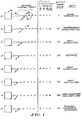
- FIG 1 illustrates the principles of ink jet drop formation useful in understanding the present invention.
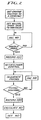
- Figure 2 is a software flow diagram illustrating the manner in which the processor of the present invention operates.
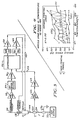
- Figure 3 is a circuit diagram illustrating the control circuit according to the present invention.
- Figure 4 is a graph useful in explaining the operation of the present invention.
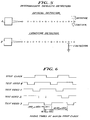
- Figure 5 illustrates the manner in which intermediate satellites may be detected.
- Figure 6 is a timing diagram useful in explaining the test pattern used for detecting the upper cardinal points.
- the nozzle 10 emits therefrom a stream of ink 12.
- a nozzle drive voltage is applied which voltage causes the stream to break up into a series of discrete drops 14.
- Smaller drops known in this art as satellites, form between the drops 14.
- the satellites 16 behave in a manner which is a function of the energy applied to the nozzle (measured in terms of the nozzle voltage).
- C(L) As the drive to the nozzle is increased, a point, designated herein as C(L), will occur. This term refers to a lower cardinal point. Cardinal is a term borrowed from optics terminology where it denotes a important point of a lens system, i.e., a focal point, a nodal point, or a principal point.
- C(L) is an important point because it represents the point at which the satellites separate from the leading and the following drops at the same time (see Figure 1D). Surface tension forces pull these satellites forward and backward with equal force. The result is that the satellites stay at a mid or intermediate point between the drops as they travel through space.
- C(L) It is this condition, referred to as C(L), that can be detected at a downstream point by detecting the satellites and the drops. At the point C(L) there will be a doubling of the normal drop frequency which can be detected. In all other cases, the satellites will have merged with either the leading or the trailing drops.
- Appropriate detectors are illustrated and described in connection with Figure 5 of this disclosure.
- the point C(L) can be detected by frequency doubling as the power to the nozzle drive is increased from a low level to a level just adequate to form intermediate satellites.
- an appropriate test signal is placed on a charging electrode so that both the drops ad the intermediate satellites will be charged.
- the sensed drop frequency will double when intermediate satellites are present and pass the sensor.
- an optical detector may be employed which does not require charging of the drops and satellites but will detect a doubling in the number of drops passing the detector.
- the detector is positioned a sufficient distance downstream from the nozzle orifice to permit the satellites to merge.
- V(calc) Values of V(calc) calculated from the foregoing equation are plotted in Figure 4. These values of V(calc) all lie within the cross hatched area of the graph and represent nozzle drive voltages that produce quality printing.
- E is a voltage empirically determined from the good printing range of a particular ink.
- v(calc) is about 25 volts and C(H) about 45 volts. Therefore if E is selected as 20 volts it will reliably approximate v(calc) when used within equation 2.
- VH will lie within the cross-hatched area on the graph in Figure 4.
- the nozzle 10 is connected to an ink supply 32 via an ink conduit 34.
- the ink stream is grounded intermediate the ink supply ad nozzle 36.
- the nozzle has an acoustic energy applied to it, as for example, by means of a piezoelectric device as disclosed in the aforementioned U.S. patent 4,727,379.
- the drive voltage for the piezoelectric device is provided from a nozzle drive amplifier 38 via line 40.
- the amplifier is controlled by a processor 42, such as a microcomputer, via a digital to analog converter (D/A) 44.
- the controller 42 also operates charge amplifier 44 via D/A 46 to control the voltage applied to the charge tunnel 48.
- the charge tunnel 48 is disposed downstream of the nozzle 10 in the region where the drops are intended to form as the stream of ink breaks up into drops and satellites. In this manner selected drops can be charged for deflection onto a substrate or, if left uncharged, returned by way of a gutter to the ink supply 32.
- the controller 42 receives input signals from a capacitive pickup 50 downstream of the charge tunnel.
- the signal from the pickup 50 is provided to a preamplifier 52 and to a band pass filter 54 (a notch filter designed to pass a frequency equal to twice the normal drop frequency of the ink jet system).
- the capacitive pickup 50 detects the point C(L) in which the drop frequency has doubled due to the presence of intermediate satellites ( Figure 1B). That signal, analogue in nature, is passed by the filter 54 to a comparator 56 which provides a digital output when the input exceeds a threshold. This signals the controller that C(L) has been detected.
- the controller thus stores the corresponding nozzle drive voltage value.
- the second input of interest to controller 42 provides a signal indicating the occurrence of C(H), the fold back point illustrated in Figure 1G.
- This signal is produced on line 58 from a pickup 60 in electrical communication with the electrically conductive ink stream.
- the output of pickup 60 is provided to an integrating preamplifier 62 which, in turn, is provided to a comparator 64. As will be described, if the charge on the capacitor associated with preamplifier 62 exceeds a threshold set for comparator 64, a digital output is provided on line 58 to the controller.
- test signals are placed on the charge tunnel 48 for a period equal to 30 drop times.
- the wave form illustrated in Figure 6 is referenced to the drop clock wave form which may be, for example, 66 kilohertz.
- the charge tunnel 48 attempts to apply a charge to each ink drop formed as the droplets break off from the ink stream.
- the pickup 60 will detect whether or not the drops are successfully charged. For each drop which is charged an incremental charge is stored on the capacitor associated with the preamplifier 62.
- test video signals 1, 2 and 3 all of which are illustrated in Figure 6.
- Each test pattern is a quarter lambda out of phase from the preceding test pattern (where lambda is the droplet spacing). As a result, it is possible to accurately determine the location (in quarter lambdas, for example) of the droplet breakoff point relative to the positions of the two cardinal points.
- test video 1 and test video 2 are digital ones, while test video 0 and test video 3 are zero indicating that the latter two test videos did not result in charging of the droplets (this is due to the phase of the test video signals relative to the drop clock).
- the pattern of the successfully charged drops changes as indicated in Figure 1 in a predictable sequence based upon the phasing of the test video signals.
- C(H) there is a first phase reversal (additional phase reversals may occur at higher drive voltages). That is, instead of the expected phase pattern 1001 for Figure 1H, the pattern 0110 is observed, which pattern is exactly the same as Figure 1F.
- the circuit accurately detects C(H) the first fold back point where drop breakoff within the charge tunnel 48 is at a minimum distance from the nozzle.
- the comparator 64 is preferably sampled only once, at about 15 drop times after the start of each test video signal.
- the output from the comparator is one or zero indicating that the drops were or were not successfully charged.
- test video signals have a pulse width of approximately 66% of the drop time ad that each test video signal is one-quarter drop time out of phase with every other test video signal.
- the phasing sequence ends after the output of the comparator is recorded for the four video test signals.
- the drop separation point occurs earlier (nearer to the nozzle) as nozzle voltage increases. This is recognized by the detector as indicated by the pattern of ones marching from right to left in Figures A through G (and wrapping around). This continues until the fold back point, C(H) where the sequencing reverses itself and the detector signals this voltage value to the controller.
- the capacitive pickup 50 can be used for both purposes. That is, the pickup 50 can detect the C(L) value and, by connecting preamp 62 and comparator 64 to the capacitive pickup, it can also detect C(H). Thus, it is not necessary to use a separate pickup 60 behind the nozzle since the capacitive pickup 50 downstream of the charge tunnel can, if desired, perform both functions.
- FIG. 2 illustrates a software flow diagram suitable for performing the calculations according to the present invention. It is important to note that knowledge of the ink temperature is not necessary for a determination of a proper nozzle drive voltage.
- the controller 42 in the case where a capacitive pickup is utilized, sets the charge tunnel voltage to a constant value. It then sets the nozzle drive voltage to a minimum value via line 40. Nozzle drive voltage is slowly increased and the capacitive pickup is checked to determine if frequency doubling has occurred. If not, voltage increases, in small increments, until frequency doubling is detected. As indicated previously, frequency doubling indicates the condition where intermediate satellites, which are not merging, are being formed. When frequency doubling is detected, the value of the nozzle drive voltage is recorded as C(L).
- the controller then initiates the phase control portion of its routine to detect C(H).
- the test video signals shown in Figure 6 are applied to the charge tunnel electrode.
- the sensor 60 or alternatively the capacitive pickup 50, is monitored to detect whether drops have been successfully charged for each of the four test signals.
- the software then checks to detect whether or not phase reversal has occurred. If not, the nozzle drive voltage is increased, in small increments, until phase reversal is detected. Upon detection, the nozzle drive voltage is recorded as C(H).
- V(calc) Upon obtaining values of C(H) and C(L), the value V(calc) is computed.
- This value V(calc), which is shown in Figure 4 is in the middle of the desirable operating range of the system and is thereafter used as the nozzle drive voltage. In summary form, this operation may be stated as follows:
- V(calc) requires a value alpha be specified which is ink dependent.
Landscapes
- Particle Formation And Scattering Control In Inkjet Printers (AREA)
- Ink Jet (AREA)
- Recording Measured Values (AREA)
Applications Claiming Priority (3)
| Application Number | Priority Date | Filing Date | Title |
|---|---|---|---|
| US33200989A | 1989-03-31 | 1989-03-31 | |
| EP19900303101 EP0390427B1 (fr) | 1989-03-31 | 1990-03-22 | Système de commande de buses et procédé d'impression à jet d'encre |
| US332009 | 1994-10-31 |
Related Parent Applications (1)
| Application Number | Title | Priority Date | Filing Date |
|---|---|---|---|
| EP90303101.1 Division | 1990-03-22 |
Publications (3)
| Publication Number | Publication Date |
|---|---|
| EP0628412A2 true EP0628412A2 (fr) | 1994-12-14 |
| EP0628412A3 EP0628412A3 (fr) | 1995-06-07 |
| EP0628412B1 EP0628412B1 (fr) | 1997-09-10 |
Family
ID=23296316
Family Applications (2)
| Application Number | Title | Priority Date | Filing Date |
|---|---|---|---|
| EP94202383A Expired - Lifetime EP0628412B1 (fr) | 1989-03-31 | 1990-03-22 | Système de commande de buses et procédé d'impression par jet d'encre |
| EP19900303101 Expired - Lifetime EP0390427B1 (fr) | 1989-03-31 | 1990-03-22 | Système de commande de buses et procédé d'impression à jet d'encre |
Family Applications After (1)
| Application Number | Title | Priority Date | Filing Date |
|---|---|---|---|
| EP19900303101 Expired - Lifetime EP0390427B1 (fr) | 1989-03-31 | 1990-03-22 | Système de commande de buses et procédé d'impression à jet d'encre |
Country Status (6)
| Country | Link |
|---|---|
| EP (2) | EP0628412B1 (fr) |
| JP (1) | JP2858833B2 (fr) |
| AU (1) | AU620941B2 (fr) |
| CA (1) | CA2001041C (fr) |
| DE (2) | DE69031431T2 (fr) |
| ES (2) | ES2069681T3 (fr) |
Families Citing this family (3)
| Publication number | Priority date | Publication date | Assignee | Title |
|---|---|---|---|---|
| US5396274A (en) * | 1992-05-20 | 1995-03-07 | Videojet Systems International, Inc. | Variable frequency ink jet printer |
| CN101909892B (zh) * | 2007-11-10 | 2013-02-13 | 录象射流技术公司 | 用于喷墨打印的机电转换器 |
| GB2602051B (en) * | 2020-12-16 | 2024-09-25 | Domino Uk Ltd | Dynamic modulating voltage adjustment |
Family Cites Families (10)
| Publication number | Priority date | Publication date | Assignee | Title |
|---|---|---|---|---|
| JPS5655268A (en) * | 1979-10-11 | 1981-05-15 | Sharp Corp | Controller for particle of ink in ink jet printer |
| JPS604065A (ja) * | 1983-06-23 | 1985-01-10 | Hitachi Ltd | インクジエツト記録装置 |
| JPH0829590B2 (ja) * | 1985-03-04 | 1996-03-27 | 株式会社日立製作所 | インクジエツト記録装置 |
| US4631549A (en) * | 1985-08-15 | 1986-12-23 | Eastman Kodak Company | Method and apparatus for adjusting stimulation amplitude in continuous ink jet printer |
| US4638325A (en) * | 1985-09-09 | 1987-01-20 | Eastman Kodak Company | Ink jet filament length and stimulation amplitude assessment system |
| JPH0684076B2 (ja) * | 1986-02-19 | 1994-10-26 | 株式会社日立製作所 | インクジエツト記録装置 |
| US4688047A (en) * | 1986-08-21 | 1987-08-18 | Eastman Kodak Company | Method and apparatus for sensing satellite ink drop charge and adjusting ink pressure |
| GB8708885D0 (en) * | 1987-04-14 | 1987-05-20 | Domino Printing Sciences Plc | Ink jet printing |
| GB8725465D0 (en) * | 1987-10-30 | 1987-12-02 | Linx Printing Tech | Ink jet printers |
| US4878064A (en) * | 1988-10-31 | 1989-10-31 | Eastman Kodak Company | Continuous ink jet stimulation adjustment based on overdrive detection |
-
1989
- 1989-10-19 CA CA 2001041 patent/CA2001041C/fr not_active Expired - Fee Related
- 1989-11-17 AU AU45302/89A patent/AU620941B2/en not_active Ceased
- 1989-12-21 JP JP1332523A patent/JP2858833B2/ja not_active Expired - Fee Related
-
1990
- 1990-03-22 DE DE1990631431 patent/DE69031431T2/de not_active Expired - Fee Related
- 1990-03-22 ES ES90303101T patent/ES2069681T3/es not_active Expired - Lifetime
- 1990-03-22 EP EP94202383A patent/EP0628412B1/fr not_active Expired - Lifetime
- 1990-03-22 EP EP19900303101 patent/EP0390427B1/fr not_active Expired - Lifetime
- 1990-03-22 ES ES94202383T patent/ES2106440T3/es not_active Expired - Lifetime
- 1990-03-22 DE DE1990617931 patent/DE69017931T2/de not_active Expired - Fee Related
Also Published As
| Publication number | Publication date |
|---|---|
| DE69031431T2 (de) | 1998-01-22 |
| EP0628412B1 (fr) | 1997-09-10 |
| CA2001041A1 (fr) | 1990-09-30 |
| JP2858833B2 (ja) | 1999-02-17 |
| EP0390427A1 (fr) | 1990-10-03 |
| ES2106440T3 (es) | 1997-11-01 |
| AU4530289A (en) | 1990-10-04 |
| DE69031431D1 (de) | 1997-10-16 |
| CA2001041C (fr) | 1994-03-08 |
| EP0628412A3 (fr) | 1995-06-07 |
| JPH02274556A (ja) | 1990-11-08 |
| AU620941B2 (en) | 1992-02-27 |
| EP0390427B1 (fr) | 1995-03-22 |
| ES2069681T3 (es) | 1995-05-16 |
| DE69017931T2 (de) | 1995-07-20 |
| DE69017931D1 (de) | 1995-04-27 |
Similar Documents
| Publication | Publication Date | Title |
|---|---|---|
| US5196860A (en) | Ink jet droplet frequency drive control system | |
| US3769630A (en) | Ink jet synchronization and failure detection system | |
| US4417256A (en) | Break-off uniformity maintenance | |
| US3969733A (en) | Sub-harmonic phase control for an ink jet recording system | |
| US4047183A (en) | Method and apparatus for controlling the formation and shape of droplets in an ink jet stream | |
| WO1987001075A1 (fr) | Methode et appareil pour detecter et regler les phases dans des imprimantes a jets d'encre | |
| US4435720A (en) | Deflection control type ink jet printing apparatus | |
| EP0039772A1 (fr) | Enregistreur à jet d'encre à plusieurs tuyères et procédé pour faire manoeuvrer cet enregistreur | |
| EP0323991B1 (fr) | Procede et appareil d'enregistrement a jet d'encre | |
| EP0628412B1 (fr) | Système de commande de buses et procédé d'impression par jet d'encre | |
| US4994821A (en) | Continuous ink jet printer apparatus having improved short detection construction | |
| US4612553A (en) | Method for operational status checks of an ink jet printer | |
| EP0197663B1 (fr) | Méthode et appareil de contrôle pour détecteur de distorsion de bimorphe | |
| US5523778A (en) | Segmented charge tunnel for drop charging in a printhead | |
| JP2891439B2 (ja) | 連続噴射型インクジェット記録装置および そのインクジェット飛翔軸自動調整方法 | |
| US4638325A (en) | Ink jet filament length and stimulation amplitude assessment system | |
| JPS6280053A (ja) | マルチノズルインクジエツト記録装置 | |
| EP0744292B1 (fr) | Procédé et appareil de réglage automatique de la tension de commande des buses dans une imprimante à jet d'encre | |
| US5502474A (en) | Print pulse phase control | |
| JP2663548B2 (ja) | インクジェット記録装置 | |
| EP0318503A1 (fr) | Commande d'un jet d'encre dans une impression a jet d'encre continu | |
| JP2727571B2 (ja) | インキジェットプリンタ | |
| EP0652831A1 (fr) | Imprimantes a jet d'encre et leurs procedes d'exploitation. | |
| US12485671B2 (en) | Inkjet recording device and inkjet recording method | |
| JPS60112454A (ja) | インクジエツト記録装置 |
Legal Events
| Date | Code | Title | Description |
|---|---|---|---|
| PUAI | Public reference made under article 153(3) epc to a published international application that has entered the european phase |
Free format text: ORIGINAL CODE: 0009012 |
|
| AC | Divisional application: reference to earlier application |
Ref document number: 390427 Country of ref document: EP |
|
| AK | Designated contracting states |
Kind code of ref document: A2 Designated state(s): CH DE ES FR GB IT LI NL SE |
|
| PUAL | Search report despatched |
Free format text: ORIGINAL CODE: 0009013 |
|
| AK | Designated contracting states |
Kind code of ref document: A3 Designated state(s): CH DE ES FR GB IT LI NL SE |
|
| RHK1 | Main classification (correction) |
Ipc: B41J 2/115 |
|
| 17P | Request for examination filed |
Effective date: 19951204 |
|
| GRAG | Despatch of communication of intention to grant |
Free format text: ORIGINAL CODE: EPIDOS AGRA |
|
| 17Q | First examination report despatched |
Effective date: 19961104 |
|
| GRAH | Despatch of communication of intention to grant a patent |
Free format text: ORIGINAL CODE: EPIDOS IGRA |
|
| GRAH | Despatch of communication of intention to grant a patent |
Free format text: ORIGINAL CODE: EPIDOS IGRA |
|
| GRAA | (expected) grant |
Free format text: ORIGINAL CODE: 0009210 |
|
| AC | Divisional application: reference to earlier application |
Ref document number: 390427 Country of ref document: EP |
|
| AK | Designated contracting states |
Kind code of ref document: B1 Designated state(s): CH DE ES FR GB IT LI NL SE |
|
| REG | Reference to a national code |
Ref country code: CH Ref legal event code: NV Representative=s name: JOHN P. MUNZINGER INGENIEUR-CONSEIL Ref country code: CH Ref legal event code: EP |
|
| ITF | It: translation for a ep patent filed | ||
| REF | Corresponds to: |
Ref document number: 69031431 Country of ref document: DE Date of ref document: 19971016 |
|
| REG | Reference to a national code |
Ref country code: ES Ref legal event code: FG2A Ref document number: 2106440 Country of ref document: ES Kind code of ref document: T3 |
|
| ET | Fr: translation filed | ||
| PGFP | Annual fee paid to national office [announced via postgrant information from national office to epo] |
Ref country code: FR Payment date: 19980209 Year of fee payment: 9 |
|
| PGFP | Annual fee paid to national office [announced via postgrant information from national office to epo] |
Ref country code: GB Payment date: 19980213 Year of fee payment: 9 |
|
| PGFP | Annual fee paid to national office [announced via postgrant information from national office to epo] |
Ref country code: SE Payment date: 19980217 Year of fee payment: 9 |
|
| PGFP | Annual fee paid to national office [announced via postgrant information from national office to epo] |
Ref country code: DE Payment date: 19980225 Year of fee payment: 9 |
|
| PGFP | Annual fee paid to national office [announced via postgrant information from national office to epo] |
Ref country code: CH Payment date: 19980226 Year of fee payment: 9 |
|
| PGFP | Annual fee paid to national office [announced via postgrant information from national office to epo] |
Ref country code: NL Payment date: 19980228 Year of fee payment: 9 |
|
| PGFP | Annual fee paid to national office [announced via postgrant information from national office to epo] |
Ref country code: ES Payment date: 19980311 Year of fee payment: 9 |
|
| PLBE | No opposition filed within time limit |
Free format text: ORIGINAL CODE: 0009261 |
|
| STAA | Information on the status of an ep patent application or granted ep patent |
Free format text: STATUS: NO OPPOSITION FILED WITHIN TIME LIMIT |
|
| 26N | No opposition filed | ||
| PG25 | Lapsed in a contracting state [announced via postgrant information from national office to epo] |
Ref country code: GB Free format text: LAPSE BECAUSE OF NON-PAYMENT OF DUE FEES Effective date: 19990322 |
|
| PG25 | Lapsed in a contracting state [announced via postgrant information from national office to epo] |
Ref country code: SE Free format text: LAPSE BECAUSE OF NON-PAYMENT OF DUE FEES Effective date: 19990323 Ref country code: ES Free format text: LAPSE BECAUSE OF EXPIRATION OF PROTECTION Effective date: 19990323 |
|
| PG25 | Lapsed in a contracting state [announced via postgrant information from national office to epo] |
Ref country code: LI Free format text: LAPSE BECAUSE OF NON-PAYMENT OF DUE FEES Effective date: 19990331 Ref country code: CH Free format text: LAPSE BECAUSE OF NON-PAYMENT OF DUE FEES Effective date: 19990331 |
|
| PG25 | Lapsed in a contracting state [announced via postgrant information from national office to epo] |
Ref country code: NL Free format text: LAPSE BECAUSE OF NON-PAYMENT OF DUE FEES Effective date: 19991001 |
|
| EUG | Se: european patent has lapsed |
Ref document number: 94202383.9 |
|
| GBPC | Gb: european patent ceased through non-payment of renewal fee |
Effective date: 19990322 |
|
| REG | Reference to a national code |
Ref country code: CH Ref legal event code: PL |
|
| PG25 | Lapsed in a contracting state [announced via postgrant information from national office to epo] |
Ref country code: FR Free format text: LAPSE BECAUSE OF NON-PAYMENT OF DUE FEES Effective date: 19991130 |
|
| NLV4 | Nl: lapsed or anulled due to non-payment of the annual fee |
Effective date: 19991001 |
|
| EUG | Se: european patent has lapsed |
Ref document number: 94202383.9 |
|
| REG | Reference to a national code |
Ref country code: FR Ref legal event code: ST |
|
| PG25 | Lapsed in a contracting state [announced via postgrant information from national office to epo] |
Ref country code: DE Free format text: LAPSE BECAUSE OF NON-PAYMENT OF DUE FEES Effective date: 20000101 |
|
| REG | Reference to a national code |
Ref country code: ES Ref legal event code: FD2A Effective date: 20010601 |
|
| PG25 | Lapsed in a contracting state [announced via postgrant information from national office to epo] |
Ref country code: IT Free format text: LAPSE BECAUSE OF NON-PAYMENT OF DUE FEES Effective date: 20050322 |