EP0628547A1 - Verfahren zur Herstellung von N-Aminopyridonen - Google Patents
Verfahren zur Herstellung von N-Aminopyridonen Download PDFInfo
- Publication number
- EP0628547A1 EP0628547A1 EP94108435A EP94108435A EP0628547A1 EP 0628547 A1 EP0628547 A1 EP 0628547A1 EP 94108435 A EP94108435 A EP 94108435A EP 94108435 A EP94108435 A EP 94108435A EP 0628547 A1 EP0628547 A1 EP 0628547A1
- Authority
- EP
- European Patent Office
- Prior art keywords
- optionally substituted
- alkyl
- formula
- alkanoyl
- hydrogen
- Prior art date
- Legal status (The legal status is an assumption and is not a legal conclusion. Google has not performed a legal analysis and makes no representation as to the accuracy of the status listed.)
- Granted
Links
- 238000000034 method Methods 0.000 title claims abstract description 24
- 238000002360 preparation method Methods 0.000 title claims abstract description 14
- JADBQNNRRQRIFM-UHFFFAOYSA-N 1-aminopyridin-2-one Chemical class NN1C=CC=CC1=O JADBQNNRRQRIFM-UHFFFAOYSA-N 0.000 title description 2
- -1 cyano, carbamoyl Chemical group 0.000 claims abstract description 51
- 125000001997 phenyl group Chemical group [H]C1=C([H])C([H])=C(*)C([H])=C1[H] 0.000 claims abstract description 12
- 239000001257 hydrogen Substances 0.000 claims abstract description 11
- 229910052739 hydrogen Inorganic materials 0.000 claims abstract description 11
- 125000003236 benzoyl group Chemical group [H]C1=C([H])C([H])=C(C([H])=C1[H])C(*)=O 0.000 claims abstract description 10
- 150000001728 carbonyl compounds Chemical class 0.000 claims abstract description 9
- UBQKCCHYAOITMY-UHFFFAOYSA-N pyridin-2-ol Chemical class OC1=CC=CC=N1 UBQKCCHYAOITMY-UHFFFAOYSA-N 0.000 claims abstract description 9
- 239000003085 diluting agent Substances 0.000 claims abstract description 7
- 229910052757 nitrogen Inorganic materials 0.000 claims abstract description 5
- 125000004433 nitrogen atom Chemical group N* 0.000 claims abstract description 5
- 125000004191 (C1-C6) alkoxy group Chemical group 0.000 claims abstract description 4
- 125000004454 (C1-C6) alkoxycarbonyl group Chemical group 0.000 claims abstract description 4
- 125000004169 (C1-C6) alkyl group Chemical group 0.000 claims abstract description 4
- 125000003178 carboxy group Chemical group [H]OC(*)=O 0.000 claims abstract description 4
- 229910052736 halogen Inorganic materials 0.000 claims abstract description 4
- 150000002367 halogens Chemical class 0.000 claims abstract description 4
- 125000001841 imino group Chemical group [H]N=* 0.000 claims abstract description 4
- 125000000449 nitro group Chemical group [O-][N+](*)=O 0.000 claims abstract description 4
- 239000001301 oxygen Substances 0.000 claims abstract description 4
- 229910052760 oxygen Inorganic materials 0.000 claims abstract description 4
- QVGXLLKOCUKJST-UHFFFAOYSA-N atomic oxygen Chemical group [O] QVGXLLKOCUKJST-UHFFFAOYSA-N 0.000 claims abstract description 3
- 150000002431 hydrogen Chemical class 0.000 claims abstract description 3
- XLYOFNOQVPJJNP-UHFFFAOYSA-N water Substances O XLYOFNOQVPJJNP-UHFFFAOYSA-N 0.000 claims description 21
- OAKJQQAXSVQMHS-UHFFFAOYSA-N Hydrazine Chemical compound NN OAKJQQAXSVQMHS-UHFFFAOYSA-N 0.000 claims description 9
- 125000000229 (C1-C4)alkoxy group Chemical group 0.000 claims description 8
- 125000004178 (C1-C4) alkyl group Chemical group 0.000 claims description 7
- 238000006243 chemical reaction Methods 0.000 claims description 7
- PASDCCFISLVPSO-UHFFFAOYSA-N benzoyl chloride Chemical compound ClC(=O)C1=CC=CC=C1 PASDCCFISLVPSO-UHFFFAOYSA-N 0.000 claims description 6
- 125000004435 hydrogen atom Chemical group [H]* 0.000 claims description 6
- 238000002955 isolation Methods 0.000 claims description 6
- LVWZTYCIRDMTEY-UHFFFAOYSA-N metamizole Chemical compound O=C1C(N(CS(O)(=O)=O)C)=C(C)N(C)N1C1=CC=CC=C1 LVWZTYCIRDMTEY-UHFFFAOYSA-N 0.000 claims description 6
- HPHBOJANXDKUQD-UHFFFAOYSA-N 2-cyanoacetohydrazide Chemical compound NNC(=O)CC#N HPHBOJANXDKUQD-UHFFFAOYSA-N 0.000 claims description 5
- 125000003170 phenylsulfonyl group Chemical group C1(=CC=CC=C1)S(=O)(=O)* 0.000 claims description 5
- 125000005544 phthalimido group Chemical group 0.000 claims description 5
- 125000005400 pyridylcarbonyl group Chemical group N1=C(C=CC=C1)C(=O)* 0.000 claims description 5
- HCXJFMDOHDNDCC-UHFFFAOYSA-N 5-$l^{1}-oxidanyl-3,4-dihydropyrrol-2-one Chemical group O=C1CCC(=O)[N]1 HCXJFMDOHDNDCC-UHFFFAOYSA-N 0.000 claims description 4
- CRWTVBDMMPXXMI-UHFFFAOYSA-N n-(2-cyanoacetyl)benzohydrazide Chemical compound N#CCC(=O)N(N)C(=O)C1=CC=CC=C1 CRWTVBDMMPXXMI-UHFFFAOYSA-N 0.000 claims description 4
- 239000003444 phase transfer catalyst Substances 0.000 claims description 4
- 239000012429 reaction media Substances 0.000 claims description 4
- 239000007853 buffer solution Substances 0.000 claims description 3
- 125000004093 cyano group Chemical group *C#N 0.000 claims description 3
- 125000001589 carboacyl group Chemical group 0.000 claims 1
- UFHFLCQGNIYNRP-UHFFFAOYSA-N Hydrogen Chemical compound [H][H] UFHFLCQGNIYNRP-UHFFFAOYSA-N 0.000 abstract description 4
- 125000003917 carbamoyl group Chemical group [H]N([H])C(*)=O 0.000 abstract 1
- LFQSCWFLJHTTHZ-UHFFFAOYSA-N Ethanol Chemical compound CCO LFQSCWFLJHTTHZ-UHFFFAOYSA-N 0.000 description 21
- HEMHJVSKTPXQMS-UHFFFAOYSA-M sodium hydroxide Inorganic materials [OH-].[Na+] HEMHJVSKTPXQMS-UHFFFAOYSA-M 0.000 description 17
- OKKJLVBELUTLKV-UHFFFAOYSA-N Methanol Chemical compound OC OKKJLVBELUTLKV-UHFFFAOYSA-N 0.000 description 15
- VEXZGXHMUGYJMC-UHFFFAOYSA-N Hydrochloric acid Chemical compound Cl VEXZGXHMUGYJMC-UHFFFAOYSA-N 0.000 description 13
- 239000000203 mixture Substances 0.000 description 13
- QTBSBXVTEAMEQO-UHFFFAOYSA-N Acetic acid Chemical compound CC(O)=O QTBSBXVTEAMEQO-UHFFFAOYSA-N 0.000 description 12
- 239000002585 base Substances 0.000 description 12
- 150000001875 compounds Chemical class 0.000 description 12
- 238000004458 analytical method Methods 0.000 description 11
- KFZMGEQAYNKOFK-UHFFFAOYSA-N Isopropanol Chemical compound CC(C)O KFZMGEQAYNKOFK-UHFFFAOYSA-N 0.000 description 8
- ZXEKIIBDNHEJCQ-UHFFFAOYSA-N isobutanol Chemical compound CC(C)CO ZXEKIIBDNHEJCQ-UHFFFAOYSA-N 0.000 description 8
- 238000001816 cooling Methods 0.000 description 7
- 238000002844 melting Methods 0.000 description 7
- 230000008018 melting Effects 0.000 description 7
- 239000000047 product Substances 0.000 description 7
- WQDUMFSSJAZKTM-UHFFFAOYSA-N Sodium methoxide Chemical compound [Na+].[O-]C WQDUMFSSJAZKTM-UHFFFAOYSA-N 0.000 description 6
- 239000011541 reaction mixture Substances 0.000 description 6
- 238000010992 reflux Methods 0.000 description 6
- YEJRWHAVMIAJKC-UHFFFAOYSA-N 4-Butyrolactone Chemical compound O=C1CCCO1 YEJRWHAVMIAJKC-UHFFFAOYSA-N 0.000 description 5
- 239000000543 intermediate Substances 0.000 description 5
- 239000000155 melt Substances 0.000 description 5
- ANGDWNBGPBMQHW-UHFFFAOYSA-N methyl cyanoacetate Chemical compound COC(=O)CC#N ANGDWNBGPBMQHW-UHFFFAOYSA-N 0.000 description 5
- 239000000243 solution Substances 0.000 description 5
- KWYUFKZDYYNOTN-UHFFFAOYSA-M Potassium hydroxide Chemical compound [OH-].[K+] KWYUFKZDYYNOTN-UHFFFAOYSA-M 0.000 description 4
- 230000015572 biosynthetic process Effects 0.000 description 4
- 125000002496 methyl group Chemical group [H]C([H])([H])* 0.000 description 4
- DGAQECJNVWCQMB-PUAWFVPOSA-M Ilexoside XXIX Chemical compound C[C@@H]1CC[C@@]2(CC[C@@]3(C(=CC[C@H]4[C@]3(CC[C@@H]5[C@@]4(CC[C@@H](C5(C)C)OS(=O)(=O)[O-])C)C)[C@@H]2[C@]1(C)O)C)C(=O)O[C@H]6[C@@H]([C@H]([C@@H]([C@H](O6)CO)O)O)O.[Na+] DGAQECJNVWCQMB-PUAWFVPOSA-M 0.000 description 3
- WHXSMMKQMYFTQS-UHFFFAOYSA-N Lithium Chemical compound [Li] WHXSMMKQMYFTQS-UHFFFAOYSA-N 0.000 description 3
- WRQNANDWMGAFTP-UHFFFAOYSA-N Methylacetoacetic acid Chemical compound COC(=O)CC(C)=O WRQNANDWMGAFTP-UHFFFAOYSA-N 0.000 description 3
- ZMXDDKWLCZADIW-UHFFFAOYSA-N N,N-Dimethylformamide Chemical compound CN(C)C=O ZMXDDKWLCZADIW-UHFFFAOYSA-N 0.000 description 3
- 238000001035 drying Methods 0.000 description 3
- 238000003756 stirring Methods 0.000 description 3
- 125000001424 substituent group Chemical group 0.000 description 3
- MILPTZJEXYXOLP-UHFFFAOYSA-N (4-aminobenzoyl)oxymethyl 4-aminobenzoate Chemical compound C1=CC(N)=CC=C1C(=O)OCOC(=O)C1=CC=C(N)C=C1 MILPTZJEXYXOLP-UHFFFAOYSA-N 0.000 description 2
- HRMGWGRHXGTQLO-ARJAWSKDSA-N (z)-3-amino-2-methylbut-2-enoic acid Chemical compound C\C(N)=C(/C)C(O)=O HRMGWGRHXGTQLO-ARJAWSKDSA-N 0.000 description 2
- CSCPPACGZOOCGX-UHFFFAOYSA-N Acetone Chemical compound CC(C)=O CSCPPACGZOOCGX-UHFFFAOYSA-N 0.000 description 2
- LRHPLDYGYMQRHN-UHFFFAOYSA-N N-Butanol Chemical compound CCCCO LRHPLDYGYMQRHN-UHFFFAOYSA-N 0.000 description 2
- AMQJEAYHLZJPGS-UHFFFAOYSA-N N-Pentanol Chemical compound CCCCCO AMQJEAYHLZJPGS-UHFFFAOYSA-N 0.000 description 2
- 239000003513 alkali Substances 0.000 description 2
- 125000003277 amino group Chemical group 0.000 description 2
- KXHPPCXNWTUNSB-UHFFFAOYSA-M benzyl(trimethyl)azanium;chloride Chemical compound [Cl-].C[N+](C)(C)CC1=CC=CC=C1 KXHPPCXNWTUNSB-UHFFFAOYSA-M 0.000 description 2
- 125000000484 butyl group Chemical group [H]C([*])([H])C([H])([H])C([H])([H])C([H])([H])[H] 0.000 description 2
- 229910052799 carbon Inorganic materials 0.000 description 2
- 239000013078 crystal Substances 0.000 description 2
- ZPWVASYFFYYZEW-UHFFFAOYSA-L dipotassium hydrogen phosphate Chemical compound [K+].[K+].OP([O-])([O-])=O ZPWVASYFFYYZEW-UHFFFAOYSA-L 0.000 description 2
- 150000002168 ethanoic acid esters Chemical class 0.000 description 2
- 125000001495 ethyl group Chemical group [H]C([H])([H])C([H])([H])* 0.000 description 2
- 125000001449 isopropyl group Chemical group [H]C([H])([H])C([H])(*)C([H])([H])[H] 0.000 description 2
- WMFOQBRAJBCJND-UHFFFAOYSA-M lithium hydroxide Inorganic materials [Li+].[OH-] WMFOQBRAJBCJND-UHFFFAOYSA-M 0.000 description 2
- XKORCTIIRYKLLG-ARJAWSKDSA-N methyl (z)-3-aminobut-2-enoate Chemical compound COC(=O)\C=C(\C)N XKORCTIIRYKLLG-ARJAWSKDSA-N 0.000 description 2
- BWHMMNNQKKPAPP-UHFFFAOYSA-L potassium carbonate Chemical compound [K+].[K+].[O-]C([O-])=O BWHMMNNQKKPAPP-UHFFFAOYSA-L 0.000 description 2
- 239000002244 precipitate Substances 0.000 description 2
- BDERNNFJNOPAEC-UHFFFAOYSA-N propan-1-ol Chemical compound CCCO BDERNNFJNOPAEC-UHFFFAOYSA-N 0.000 description 2
- 125000001436 propyl group Chemical group [H]C([*])([H])C([H])([H])C([H])([H])[H] 0.000 description 2
- 150000003254 radicals Chemical class 0.000 description 2
- 239000011734 sodium Substances 0.000 description 2
- 239000000725 suspension Substances 0.000 description 2
- NHGXDBSUJJNIRV-UHFFFAOYSA-M tetrabutylammonium chloride Chemical compound [Cl-].CCCC[N+](CCCC)(CCCC)CCCC NHGXDBSUJJNIRV-UHFFFAOYSA-M 0.000 description 2
- NWZSZGALRFJKBT-KNIFDHDWSA-N (2s)-2,6-diaminohexanoic acid;(2s)-2-hydroxybutanedioic acid Chemical compound OC(=O)[C@@H](O)CC(O)=O.NCCCC[C@H](N)C(O)=O NWZSZGALRFJKBT-KNIFDHDWSA-N 0.000 description 1
- NDRIQFKRWKJOMS-UHFFFAOYSA-N 1-[(2-cyanoacetyl)amino]-3-phenylurea Chemical compound N#CCC(=O)NNC(=O)NC1=CC=CC=C1 NDRIQFKRWKJOMS-UHFFFAOYSA-N 0.000 description 1
- RAZDINHHMXKPBQ-UHFFFAOYSA-N 1-butyl-3-[(2-cyanoacetyl)amino]urea Chemical compound CCCCNC(=O)NNC(=O)CC#N RAZDINHHMXKPBQ-UHFFFAOYSA-N 0.000 description 1
- QBPNVHJGABGQCQ-UHFFFAOYSA-N 2-cyano-n'-(2-phenylacetyl)acetohydrazide Chemical compound N#CCC(=O)NNC(=O)CC1=CC=CC=C1 QBPNVHJGABGQCQ-UHFFFAOYSA-N 0.000 description 1
- 125000004204 2-methoxyphenyl group Chemical group [H]C1=C([H])C(*)=C(OC([H])([H])[H])C([H])=C1[H] 0.000 description 1
- ICPWFHKNYYRBSZ-UHFFFAOYSA-M 2-methoxypropanoate Chemical compound COC(C)C([O-])=O ICPWFHKNYYRBSZ-UHFFFAOYSA-M 0.000 description 1
- 125000005916 2-methylpentyl group Chemical group 0.000 description 1
- 125000003903 2-propenyl group Chemical group [H]C([*])([H])C([H])=C([H])[H] 0.000 description 1
- 125000001999 4-Methoxybenzoyl group Chemical group [H]C1=C([H])C(=C([H])C([H])=C1OC([H])([H])[H])C(*)=O 0.000 description 1
- WDJHALXBUFZDSR-UHFFFAOYSA-N Acetoacetic acid Natural products CC(=O)CC(O)=O WDJHALXBUFZDSR-UHFFFAOYSA-N 0.000 description 1
- WKBOTKDWSSQWDR-UHFFFAOYSA-N Bromine atom Chemical compound [Br] WKBOTKDWSSQWDR-UHFFFAOYSA-N 0.000 description 1
- 0 CC(C(C(N1*)=O)=C(C)C=C1O)=O Chemical compound CC(C(C(N1*)=O)=C(C)C=C1O)=O 0.000 description 1
- ZAMOUSCENKQFHK-UHFFFAOYSA-N Chlorine atom Chemical compound [Cl] ZAMOUSCENKQFHK-UHFFFAOYSA-N 0.000 description 1
- MYMOFIZGZYHOMD-UHFFFAOYSA-N Dioxygen Chemical compound O=O MYMOFIZGZYHOMD-UHFFFAOYSA-N 0.000 description 1
- PXGOKWXKJXAPGV-UHFFFAOYSA-N Fluorine Chemical compound FF PXGOKWXKJXAPGV-UHFFFAOYSA-N 0.000 description 1
- GKDTUAQRLUQTGK-UHFFFAOYSA-N O=C1C(C#N)=C(C)C=C(O)N1NC(=O)C1=CC=CC=C1 Chemical compound O=C1C(C#N)=C(C)C=C(O)N1NC(=O)C1=CC=CC=C1 GKDTUAQRLUQTGK-UHFFFAOYSA-N 0.000 description 1
- LGRFSURHDFAFJT-UHFFFAOYSA-N Phthalic anhydride Natural products C1=CC=C2C(=O)OC(=O)C2=C1 LGRFSURHDFAFJT-UHFFFAOYSA-N 0.000 description 1
- YFHNDHXQDJQEEE-UHFFFAOYSA-N acetic acid;hydrazine Chemical class NN.CC(O)=O YFHNDHXQDJQEEE-UHFFFAOYSA-N 0.000 description 1
- 125000002777 acetyl group Chemical group [H]C([H])([H])C(*)=O 0.000 description 1
- 239000002253 acid Substances 0.000 description 1
- 150000007513 acids Chemical class 0.000 description 1
- 125000002252 acyl group Chemical group 0.000 description 1
- 150000001298 alcohols Chemical class 0.000 description 1
- 229910001854 alkali hydroxide Inorganic materials 0.000 description 1
- 150000008044 alkali metal hydroxides Chemical class 0.000 description 1
- 125000003545 alkoxy group Chemical group 0.000 description 1
- 125000000217 alkyl group Chemical group 0.000 description 1
- GDTBXPJZTBHREO-UHFFFAOYSA-N bromine Substances BrBr GDTBXPJZTBHREO-UHFFFAOYSA-N 0.000 description 1
- 229910052794 bromium Inorganic materials 0.000 description 1
- JHIWVOJDXOSYLW-UHFFFAOYSA-N butyl 2,2-difluorocyclopropane-1-carboxylate Chemical compound CCCCOC(=O)C1CC1(F)F JHIWVOJDXOSYLW-UHFFFAOYSA-N 0.000 description 1
- 125000004744 butyloxycarbonyl group Chemical group 0.000 description 1
- 229930188620 butyrolactone Natural products 0.000 description 1
- 125000004063 butyryl group Chemical group O=C([*])C([H])([H])C([H])([H])C([H])([H])[H] 0.000 description 1
- 239000006227 byproduct Substances 0.000 description 1
- 150000004649 carbonic acid derivatives Chemical class 0.000 description 1
- 230000003197 catalytic effect Effects 0.000 description 1
- 239000000460 chlorine Substances 0.000 description 1
- 229910052801 chlorine Inorganic materials 0.000 description 1
- 238000002425 crystallisation Methods 0.000 description 1
- 230000008025 crystallization Effects 0.000 description 1
- 125000001995 cyclobutyl group Chemical group [H]C1([H])C([H])([H])C([H])(*)C1([H])[H] 0.000 description 1
- 125000000582 cycloheptyl group Chemical group [H]C1([H])C([H])([H])C([H])([H])C([H])([H])C([H])(*)C([H])([H])C1([H])[H] 0.000 description 1
- 125000000113 cyclohexyl group Chemical group [H]C1([H])C([H])([H])C([H])([H])C([H])(*)C([H])([H])C1([H])[H] 0.000 description 1
- 125000001511 cyclopentyl group Chemical group [H]C1([H])C([H])([H])C([H])([H])C([H])(*)C1([H])[H] 0.000 description 1
- 125000001559 cyclopropyl group Chemical group [H]C1([H])C([H])([H])C1([H])* 0.000 description 1
- 238000010790 dilution Methods 0.000 description 1
- 239000012895 dilution Substances 0.000 description 1
- BEPAFCGSDWSTEL-UHFFFAOYSA-N dimethyl malonate Chemical compound COC(=O)CC(=O)OC BEPAFCGSDWSTEL-UHFFFAOYSA-N 0.000 description 1
- 239000000975 dye Substances 0.000 description 1
- 150000002148 esters Chemical class 0.000 description 1
- HHFAWKCIHAUFRX-UHFFFAOYSA-N ethoxide Chemical compound CC[O-] HHFAWKCIHAUFRX-UHFFFAOYSA-N 0.000 description 1
- 125000003754 ethoxycarbonyl group Chemical group C(=O)(OCC)* 0.000 description 1
- XYIBRDXRRQCHLP-UHFFFAOYSA-N ethyl acetoacetate Chemical compound CCOC(=O)CC(C)=O XYIBRDXRRQCHLP-UHFFFAOYSA-N 0.000 description 1
- 125000004494 ethyl ester group Chemical group 0.000 description 1
- 125000006125 ethylsulfonyl group Chemical group 0.000 description 1
- 229910052731 fluorine Inorganic materials 0.000 description 1
- 239000011737 fluorine Substances 0.000 description 1
- 125000002485 formyl group Chemical group [H]C(*)=O 0.000 description 1
- 125000000268 heptanoyl group Chemical group O=C([*])C([H])([H])C([H])([H])C([H])([H])C([H])([H])C([H])([H])C([H])([H])[H] 0.000 description 1
- 125000003104 hexanoyl group Chemical group O=C([*])C([H])([H])C([H])([H])C([H])([H])C([H])([H])C([H])([H])[H] 0.000 description 1
- 125000004051 hexyl group Chemical group [H]C([H])([H])C([H])([H])C([H])([H])C([H])([H])C([H])([H])C([H])([H])* 0.000 description 1
- 229940042795 hydrazides for tuberculosis treatment Drugs 0.000 description 1
- IKDUDTNKRLTJSI-UHFFFAOYSA-N hydrazine monohydrate Substances O.NN IKDUDTNKRLTJSI-UHFFFAOYSA-N 0.000 description 1
- 150000002440 hydroxy compounds Chemical class 0.000 description 1
- 239000005457 ice water Substances 0.000 description 1
- 229910052500 inorganic mineral Inorganic materials 0.000 description 1
- 125000000959 isobutyl group Chemical group [H]C([H])([H])C([H])(C([H])([H])[H])C([H])([H])* 0.000 description 1
- 125000001972 isopentyl group Chemical group [H]C([H])([H])C([H])(C([H])([H])[H])C([H])([H])C([H])([H])* 0.000 description 1
- 125000005928 isopropyloxycarbonyl group Chemical group [H]C([H])([H])C([H])(OC(*)=O)C([H])([H])[H] 0.000 description 1
- 229910052744 lithium Inorganic materials 0.000 description 1
- 229910052808 lithium carbonate Inorganic materials 0.000 description 1
- 125000005394 methallyl group Chemical group 0.000 description 1
- 125000001160 methoxycarbonyl group Chemical group [H]C([H])([H])OC(*)=O 0.000 description 1
- 125000004170 methylsulfonyl group Chemical group [H]C([H])([H])S(*)(=O)=O 0.000 description 1
- 239000011707 mineral Substances 0.000 description 1
- OEZXGJNHAQBFQC-UHFFFAOYSA-N n-(3-oxobutanoyl)benzohydrazide Chemical compound CC(=O)CC(=O)N(N)C(=O)C1=CC=CC=C1 OEZXGJNHAQBFQC-UHFFFAOYSA-N 0.000 description 1
- 125000001971 neopentyl group Chemical group [H]C([*])([H])C(C([H])([H])[H])(C([H])([H])[H])C([H])([H])[H] 0.000 description 1
- 125000003261 o-tolyl group Chemical group [H]C1=C([H])C(*)=C(C([H])=C1[H])C([H])([H])[H] 0.000 description 1
- 125000002801 octanoyl group Chemical group C(CCCCCCC)(=O)* 0.000 description 1
- 238000005580 one pot reaction Methods 0.000 description 1
- 230000020477 pH reduction Effects 0.000 description 1
- 125000001147 pentyl group Chemical group C(CCCC)* 0.000 description 1
- 239000008363 phosphate buffer Substances 0.000 description 1
- 229910000027 potassium carbonate Inorganic materials 0.000 description 1
- BDAWXSQJJCIFIK-UHFFFAOYSA-N potassium methoxide Chemical compound [K+].[O-]C BDAWXSQJJCIFIK-UHFFFAOYSA-N 0.000 description 1
- 125000001501 propionyl group Chemical group O=C([*])C([H])([H])C([H])([H])[H] 0.000 description 1
- 125000004742 propyloxycarbonyl group Chemical group 0.000 description 1
- 125000004076 pyridyl group Chemical group 0.000 description 1
- 150000003839 salts Chemical class 0.000 description 1
- 125000002914 sec-butyl group Chemical group [H]C([H])([H])C([H])([H])C([H])(*)C([H])([H])[H] 0.000 description 1
- 229910052708 sodium Inorganic materials 0.000 description 1
- CDBYLPFSWZWCQE-UHFFFAOYSA-L sodium carbonate Substances [Na+].[Na+].[O-]C([O-])=O CDBYLPFSWZWCQE-UHFFFAOYSA-L 0.000 description 1
- 229910000029 sodium carbonate Inorganic materials 0.000 description 1
- QDRKDTQENPPHOJ-UHFFFAOYSA-N sodium ethoxide Chemical compound [Na+].CC[O-] QDRKDTQENPPHOJ-UHFFFAOYSA-N 0.000 description 1
- 239000007787 solid Substances 0.000 description 1
- 239000002904 solvent Substances 0.000 description 1
- 125000000547 substituted alkyl group Chemical group 0.000 description 1
- 125000001973 tert-pentyl group Chemical group [H]C([H])([H])C([H])([H])C(*)(C([H])([H])[H])C([H])([H])[H] 0.000 description 1
- 125000003944 tolyl group Chemical group 0.000 description 1
- 125000003774 valeryl group Chemical group O=C([*])C([H])([H])C([H])([H])C([H])([H])C([H])([H])[H] 0.000 description 1
Classifications
-
- C—CHEMISTRY; METALLURGY
- C07—ORGANIC CHEMISTRY
- C07D—HETEROCYCLIC COMPOUNDS
- C07D213/00—Heterocyclic compounds containing six-membered rings, not condensed with other rings, with one nitrogen atom as the only ring hetero atom and three or more double bonds between ring members or between ring members and non-ring members
- C07D213/02—Heterocyclic compounds containing six-membered rings, not condensed with other rings, with one nitrogen atom as the only ring hetero atom and three or more double bonds between ring members or between ring members and non-ring members having three double bonds between ring members or between ring members and non-ring members
- C07D213/89—Heterocyclic compounds containing six-membered rings, not condensed with other rings, with one nitrogen atom as the only ring hetero atom and three or more double bonds between ring members or between ring members and non-ring members having three double bonds between ring members or between ring members and non-ring members with hetero atoms directly attached to the ring nitrogen atom
Definitions
- the present invention relates to a new process for the preparation of N-amino-substituted 6-hydroxypyrid-2-ones by reacting acylated acetic acid hydrazines or esters with derivatives of acetic acid esters or hydrazides.
- the object of the present invention was to provide a new process for the preparation of such N-amino-substituted 6-hydroxypyrid-2-ones in which the amino group is acylated, the acyl group should be present before the pyridone formation, i.e. not be subsequently introduced into the finished pyridone ring.
- the substituents e.g. Cyano, phenyl, tolyl, C1-C4-alkoxy, C1-C4-alkanoyloxy, C1-C4-alkoxycarbonyl or C1-C4-alkoxycarbonyloxy, in which case the alkoxy group can be substituted by phenyl or C1-C4-alkoxy come.
- R1 are e.g. Methyl, ethyl, propyl, isopropyl, butyl, isobutyl, sec-butyl, pentyl, isopentyl, neopentyl, tert-pentyl, hexyl, 2-methylpentyl, allyl, methallyl, cyclopropyl, cyclobutyl, cyclopentyl, cyclohexyl, methylcyclohexyl, cycloheptyl, phenyl, 2-methylphenyl, 2,4-dimethylphenyl, 2-methoxyphenyl or 2,4-dimethoxyphenyl.
- R2 and R4 are e.g. Formyl, acetyl, propionyl, butyryl, isobutyryl, pentanoyl, hexanoyl, heptanoyl, octanoyl, 2-ethylhexanoyl, 2-methoxyacetyl, benzoyl, 2-, 3- or 4-methylbenzoyl, 2-, 3- or 4-methoxybenzoyl, methoxycarbonyl, Ethoxycarbonyl, propoxycarbonyl, isopropoxycarbonyl or butoxycarbonyl.
- Residues R2 are further e.g. Fluorine, chlorine or bromine.
- Residues R4 are still e.g. Methylsulfonyl, ethylsulfonyl, propylsulfonyl, isopropylsulfonyl, butylsulfonyl, cyclopentylsulfonyl, cyclohexylsulfonyl, Cycloheptylsulfonyl, phenylsulfonyl, tolylsulfonyl, pyridylsulfonyl, thien-2-ylcarbonyl, thien-3-ylcarbonyl, methylcarbamoyl, ethylcarbamoyl, propylcarbamoyl, isopropylcarbamoyl, butylcarbamoyl, phenylcarbamoyl or tolylcarbamoyl.
- Preferred is a process for the preparation of pyridones of the formula I in which R1 is hydrogen or C1-C4-alkyl, in particular methyl.
- R2 is cyano, C1-C4alkoxycarbonyl or C2-C4alkanoyl, which is optionally substituted by phenyl or C1-C4alkoxy, in particular cyano.
- pyridones of the formula I in which R3 is hydrogen and R4 C1-C8-alkanoyl, which is optionally substituted by C1-C4-alkoxy or phenyl, C1-C8-monoalkylcarbamoyl, monophenylcarbamoyl, C1-C8- Alkylsulfonyl, phenylsulfonyl, tolylsulfonyl, pyridylsulfonyl, benzoyl, methylbenzoyl, pyridylcarbonyl or thienylcarbonyl or R3 and R4 together with the nitrogen atom connecting them mean succinimido or phthalimido.
- Particularly preferred is a process for the preparation of pyridones of the formula I in which R3 is hydrogen and R4 C1-C8-alkanoyl, which is optionally substituted by C1-C4-alkoxy or phenyl, C1-C8-monoalkylcarbamoyl, monophenylcarbamoyl, benzoyl, methylbenzoyl or Thienylcarbonyl mean.
- Suitable diluents which can be used in the process according to the invention are e.g. Water or alcohols, such as methanol, ethanol, propanol, isopropanol, butanol or isobutanol.
- Suitable bases which can be used in the process according to the invention are e.g. Alkali hydroxides, such as lithium, sodium or potassium hydroxide, alkali carbonates, such as lithium, sodium or potassium carbonate, or alkali alkanolates, such as lithium, sodium or potassium methoxide, ethanolate or propanolate.
- Alkali hydroxides such as lithium, sodium or potassium hydroxide
- alkali carbonates such as lithium, sodium or potassium carbonate
- alkali alkanolates such as lithium, sodium or potassium methoxide, ethanolate or propanolate.
- the carbonyl compounds of the formulas II and III are generally used in a molar ratio of 1: 1 to 1: 3, preferably 1: 1 to 1: 2 and in particular 1: 1 to 1: 1.2.
- 100 to 1000% by weight, preferably 200 to 500% by weight, of diluent and, if appropriate, 10 to 500% by weight, preferably 50 to 250% by weight, are generally used. , on bases.
- the process according to the invention which is usually carried out under atmospheric pressure, is generally carried out at a temperature of 0 to 150 ° C., preferably 20 to 100 ° C.
- the new process is advantageously carried out in such a way that the carbonyl compounds of the formulas II and III are initially introduced together with diluent, the base is then optionally added and the mixture is subsequently stirred at the temperature mentioned above. (It is also possible to initially introduce a carbonyl compound together with the diluent and, if appropriate, the base and to add the other carbonyl compound, on the shelf the hydrazide).
- the reaction is generally complete after 2 to 20 hours and the target product can be separated off, washed and dried as a precipitate, optionally after dilution with water and acidification of the reaction mixture.
- 1-benzoylamino-3-cyano-4-methyl-6-hydroxypyrid-2-one is prepared in a one-pot process in water as the reaction medium.
- Suitable C1-C4 alkyl cyanoacetates or C1-C4 alkyl acetoacetates are e.g. the methyl, ethyl, propyl, isopropyl, butyl or isobutyl ester. The use of the respective methyl or ethyl ester is preferred.
- the 1st step is generally carried out at a temperature of 0 to 50 ° C., preferably 20 to 30 ° C.
- C1-C4 alkyl cyanoacetate and hydrazine are generally used in a molar ratio of 1: 1 to 1: 3, preferably 1: 1 to 1: 2 and in particular 1: 1 to 1: 1.1.
- C1-C4 alkyl cyanoacetate Based on the weight of C1-C4 alkyl cyanoacetate, 100 to 300% by weight, preferably 200 to 250% by weight, of water is usually used as the reaction medium.
- the treatment with benzoyl chloride is carried out without intermediate isolation of the hydrazide. This usually takes place at a temperature of 0 to 50 ° C, preferably 20 to 30 ° C, and in the presence of a buffer system, e.g. a phosphate buffer based on dipotassium hydrogen phosphate instead.
- a buffer system e.g. a phosphate buffer based on dipotassium hydrogen phosphate instead.
- Step 1 Per mole of C1-C4 alkyl cyanoacetate (in step 1), 1 to 1.5 mol, preferably 1 to 1.1 mol, of benzoyl chloride is usually used.
- the reaction with acetoacetic acid C1-C4-alkyl ester takes place without intermediate isolation of the N-benzoylcyanoacetic acid hydrazide.
- This usually takes place at a temperature of 0 to 50 ° C, preferably 20 to 30 ° C, in the presence of a phase transfer catalyst, e.g. Trimethylbenzylammonium chloride or tetrabutylammonium chloride, instead.
- the reaction is continued in the presence of a base, advantageously maintaining a pH of 9.5 to 10 in the reaction mixture.
- a base advantageously maintaining a pH of 9.5 to 10 in the reaction mixture.
- Suitable bases are e.g. the above.
- the use of 20 to 50% by weight sodium hydroxide solution or potassium hydroxide solution is preferred.
- C1-C4 alkyl cyanoacetate per mole, 1 to 3 mol, preferably 1 to 2 mol, of C1-C4 alkyl acetoacetate are generally used.
- the phase transfer catalyst comes in catalytic amounts, e.g. 0.01 to 0.2 mol, based on 1 mol of C1-C4 alkyl cyanoacetate (in step 1), for use.
- pyridones of the formula I are valuable intermediates for the preparation of pyridone dyes, as are described, for example, in WO-A-92/19684.
- Example 1 methyl cyanoacetate was replaced by an equivalent amount of dimethyl malonate, and 199 g of the compound of the formula were obtained
- a sample recrystallized from acetic acid shows a melting point of 212 to 213 ° C and the following analysis values: C15H14N2O5 (302) about: C 59.6 H 4.7 N 9.3 O 26.5 found: 59.8 4.8 9.1 26.9
- Example 1 methyl cyanoacetate was replaced by an equivalent amount of methyl acetoacetate, and 228 g of the compound of the formula were obtained from the melting point of 239 to 249 ° C (from acetic acid). Analysis values: C15H14N2O4 (286) about: C 62.9 H 4.9 N 9.8 O 22.3 found: 62.9 5.0 9.6 22.2
- Example 1 methyl cyanoacetate was replaced by an equivalent amount of methyl methoxyacetate, and 187 g of the compound of the formula were obtained
Landscapes
- Chemical & Material Sciences (AREA)
- Organic Chemistry (AREA)
- Pyridine Compounds (AREA)
- Low-Molecular Organic Synthesis Reactions Using Catalysts (AREA)
- Plural Heterocyclic Compounds (AREA)
Abstract
Description
- Die vorliegende Erfindung betrifft ein neues Verfahren zur Herstellung von N-aminosubstituierten 6-Hydroxypyrid-2-onen durch Umsetzung von acylierten Essigsäurehydrazinen oder -estern mit Derivaten von Essigsäureestern oder -hydraziden.
- Aus Polish J. Chem., Band 58, Seiten 85 bis 95, 1984, ist die Herstellung von N-aminosubstituierten 6-Hydroxypyrid-2-onen, die keine Substituenten an der Aminogruppe aufweisen, durch Umsetzung von acylierten Essigsäureestern mit Cyanacethydrazid bekannt.
- Aufgabe der vorliegenden Erfindung war es, ein neues Verfahren zur Herstellung von solchen N-aminosubstituierten 6-Hydroxypyrid-2-onen bereitzustellen, in denen die Aminogruppe acyliert ist, dabei sollte die Acylgruppe schon vor der Pyridonbildung vorhanden sein, d.h. nicht nachträglich in den fertigen Pyridonring eingeführt werden.
- Es wurde nun gefunden, daß die Herstellung von Pyridonen der Formel I

in der - R¹
- Wasserstoff, C₁-C₆-Alkyl, C₃-C₇-Cycloalkyl, C₃-C₄-Alkenyl oder gegebenenfalls substituiertes Phenyl,
- R²
- Cyano, Carbamoyl, Carboxyl, C₁-C₆-Alkoxycarbonyl, gegebenenfalls substituiertes C₁-C₆-Alkanoyl, gegebenenfalls substituiertes Benzoyl, Halogen oder Nitro,
- R³
- Wasserstoff und
- R⁴
- gegebenenfalls substituiertes C₁-C₁₂-Alkanoyl, C₁-C₁₂-Alkoxycarbonyl, C₁-C₁₂-Monoalkylcarbamoyl, gegebenenfalls substituiertes Monophenylcarbamoyl, gegebenenfalls substituiertes C₁-C₁₂-Alkylsulfonyl, C₅-C₇-Cycloalkylsulfonyl, gegebenenfalls substituiertes Phenylsulfonyl, gegebenenfalls substituiertes Pyridylsulfonyl, gegebenenfalls substituiertes Benzoyl, Pyridylcarbonyl oder Thienylcarbonyl oder R³ und R⁴ zusammen mit dem sie verbindenden Stickstoffatom gegebenenfalls durch C₁-C₄-Alkyl substituiertes Succinimido oder gegebenenfalls durch C₁-C₄-Alkyl substituiertes Phthalimido bedeuten,
- Die obengenannten Formeln umfassen selbstverständlich auch die entsprechenden tautomeren Formen der einzelnen Verbindungen. Beispielhaft seien dafür aufgeführt:

Alle in den obengenannten Formeln auftretenden Alkylgruppen können sowohl geradkettig als auch verzweigt sein. - Wenn in den obengenannten Formeln substituierte Alkylgruppen auftreten, so können als Substituenten z.B. Cyano, Phenyl, Tolyl, C₁-C₄-Alkoxy, C₁-C₄-Alkanoyloxy, C₁-C₄-Alkoxycarbonyl oder C₁-C₄-Alkoxycarbonyloxy, wobei im letzten Fall die Alkoxygruppe durch Phenyl oder C₁-C₄-Alkoxy substituiert sein kann, in Betracht kommen.
- Wenn in den obengenannten Formeln substituierte Phenyl- oder Pyridylgruppen auftreten, so können als Substituenten z.B. C₁-C₄-Alkyl- oder C₁-C₄-Alkoxy in Betracht kommen.
- Reste R¹ sind z.B. Methyl, Ethyl, Propyl, Isopropyl, Butyl, Isobutyl, sec-Butyl, Pentyl, Isopentyl, Neopentyl, tert-Pentyl, Hexyl, 2-Methylpentyl, Allyl, Methallyl, Cyclopropyl, Cyclobutyl, Cyclopentyl, Cyclohexyl, Methylcyclohexyl, Cycloheptyl, Phenyl, 2-Methylphenyl, 2,4-Dimethylphenyl, 2-Methoxyphenyl oder 2,4-Dimethoxyphenyl.
- Reste R² und R⁴ sind z.B. Formyl, Acetyl, Propionyl, Butyryl, Isobutyryl, Pentanoyl, Hexanoyl, Heptanoyl, Octanoyl, 2-Ethylhexanoyl, 2-Methoxyacetyl, Benzoyl, 2-, 3- oder 4-Methylbenzoyl, 2-, 3- oder 4-Methoxybenzoyl, Methoxycarbonyl, Ethoxycarbonyl, Propoxycarbonyl, Isopropoxycarbonyl oder Butoxycarbonyl.
- Reste R² sind weiterhin z.B. Fluor, Chlor oder Brom.
- Reste R⁴ sind weiterhin z.B. Methylsulfonyl, Ethylsulfonyl, Propylsulfonyl, Isopropylsulfonyl, Butylsulfonyl, Cyclopentylsulfonyl, Cyclohexylsulfonyl, Cycloheptylsulfonyl, Phenylsulfonyl, Tolylsulfonyl, Pyridylsulfonyl, Thien-2-ylcarbonyl, Thien-3-yl-carbonyl, Methylcarbamoyl, Ethylcarbamoyl, Propylcarbamoyl, Isopropylcarbamoyl, Butylcarbamoyl, Phenylcarbamoyl oder Tolylcarbamoyl.
- Bevorzugt ist ein Verfahren zur Herstellung von Pyridonen der Formel I, in der R¹ Wasserstoff oder C₁-C₄-Alkyl, insbesondere Methyl, bedeutet.
- Weiterhin bevorzugt ist ein Verfahren zur Herstellung von Pyridonen der Formel I, in der R² Cyano, C₁-C₄-Alkoxycarbonyl oder C₂-C₄-Alkanoyl, das gegebenenfalls durch Phenyl oder C₁-C₄-Alkoxy substituiert ist, insbesondere Cyano, bedeutet.
- Bevorzugt ist weiterhin ein Verfahren zur Herstellung von Pyridonen der Formel I, in der R³ Wasserstoff und R⁴ C₁-C₈-Alkanoyl, das gegebenenfalls durch C₁-C₄-Alkoxy oder Phenyl substituiert ist, C₁-C₈-Monoalkylcarbamoyl, Monophenylcarbamoyl, C₁-C₈-Alkylsulfonyl, Phenylsulfonyl, Tolylsulfonyl, Pyridylsulfonyl, Benzoyl, Methylbenzoyl, Pyridylcarbonyl oder Thienylcarbonyl oder R³ und R⁴ zusammen mit dem sie verbindenden Stickstoffatom Succinimido oder Phthalimido bedeuten.
- Besonders bevorzugt ist ein Verfahren zur Herstellung von Pyridonen der Formel I, in der R³ Wasserstoff und R⁴ C₁-C₈-Alkanoyl, das gegebenenfalls durch C₁-C₄-Alkoxy oder Phenyl substituiert ist, C₁-C₈-Monoalkylcarbamoyl, Monophenylcarbamoyl, Benzoyl, Methylbenzoyl oder Thienylcarbonyl bedeuten.
- Geeignete Verdünnungsmittel, die im erfindungsgemäßen Verfahren zur Anwendung kommen können, sind z.B. Wasser oder Alkohole, wie Methanol, Ethanol, Propanol, Isopropanol, Butanol oder Isobutanol.
- Geeignete Basen, die im erfindungsgemäßen Verfahren zur Anwendung kommen können, sind z.B. Alkalihydroxide, wie Lithium-, Natrium- oder Kaliumhydroxid, Alkalicarbonate, wie Lithium-, Natrium- oder Kaliumcarbonat, oder Alkalialkanolate, wie Lithium-, Natrium- oder Kaliummethanolat, -ethanolat oder -propanolat.
- Im erfindungsgemäßen Verfahren kommen die Carbonylverbindungen der Formel II und III im allgemeinen im Molverhältnis 1:1 bis 1:3, vorzugsweise 1:1 bis 1:2 und insbesondere 1:1 bis 1:1,2, zur Anwendung.
- Bezogen auf das Gewicht der Carbonylverbindungen II und III verwendet man in der Regel 100 bis 1000 Gew.-%, vorzugsweise 200 bis 500 Gew.-%, Verdünnungsmittel und gegebenenfalls 10 bis 500 Gew.-%, vorzugsweise 50 bis 250 Gew.-%, an Basen.
- Das erfindungsgemäße Verfahren, das üblicherweise unter atmosphärischem Druck vorgenommen wird, wird im allgemeinen bei einer Temperatur von 0 bis 150°C, vorzugsweise 20 bis 100°C, durchgeführt.
- Im erfindungsgemäßen Verfahren kommen bevorzugt Wasser oder C₁-C₄-Alkanole, dabei insbesondere Methanol, Ethanol, Isopropanol oder Isobutanol, als Lösungsmittel zur Anwendung.
- Wenn das erfindungsgemäße Verfahren in Gegenwart einer Base durchgeführt wird, so kommen bevorzugt Natriumhydroxid, Natriummethanolat oder Natriumethanolat als Base zur Anwendung.
- Das neue Verfahren wird zweckmäßig so durchgeführt, daß man die Carbonylverbindungen der Formel II und III zusammen mit Verdünnungsmittel vorlegt, gegebenenfalls anschließend die Base zugibt und danach bei der obengenannten Temperatur nachrührt. (Es ist auch möglich, zunächst eine Carbonylverbindung zusammen mit dem Verdünnungsmittel und gegebenenfalls der Base vorzulegen und dazu die andere Carbonylverbindung, in der Regal das Hydrazid, zu geben).
- Nach 2 bis 20 Stunden ist die Umsetzung in der Regel beendet und man kann das Zielprodukt, gegebenenfalls nach Verdünnen mit Wasser und Ansäuern des Reaktionsgemisches, als Niederschlag abtrennen, waschen und trocknen.
- In einer besonderen Ausführungsform des neuen Verfahrens wird 1-Benzoylamino-3-cyano-4-methyl-6-hydroxypyrid-2-on, ausgehend von Cyanessigsäure-C₁-C₄-alkylester und Hydrazin, im Eintopfverfahren in Wasser als Reaktionsmedium hergestellt.
- Es wurde nämlich weiterhin gefunden, daß die Herstellung des Pyridons der Formel IV

vorteilhaft gelingt, wenn man - a) in einem 1. Schritt Cyanessigsäure-C₁-C₄-alkylester mit Hydrazin in Wasser als Reaktionsmedium umsetzt, anschließend das resultierende Cyanessigsäurehydrazid ohne Zwischenisolierung
- b) in einem 2. Schritt in Gegenwart eines Puffersystems mit Benzoylchlorid behandelt und das resultierende N-Benzoylcyanessigsäurehydrazid danach ohne Zwischenisolierung
- c) in einem 3. Schritt in Gegenwart einer Base und eines Phasentransferkatalysators mit Acetessigsäure-C₁-C₄-alkylester umsetzt.
- Geeignete Cyanessigsäure-C₁-C₄-alkylester oder Acetessigsäure-C₁-C₄-alkylester sind z.B. die Methyl-, Ethyl-, Propyl-, Isopropyl-, Butyl- oder Isobutylester. Die Anwendung der jeweiligen Methyl- oder Ethylester ist bevorzugt.
- Der 1. Schritt wird im allgemeinen bei einer Temperatur von 0 bis 50°C, vorzugsweise 20 bis 30°C, durchgeführt.
- Cyanessigsäure-C₁-C₄-alkylester und Hydrazin kommen dabei in der Regel im Molverhältnis 1:1 bis 1:3, vorzugsweise 1:1 bis 1:2 und insbesondere 1:1 bis 1:1,1 zur Anwendung.
- Bezogen auf das Gewicht von Cyanessigsäure-C₁-C₄-alkylester wendet man üblicherweise 100 bis 300 Gew.-%, vorzugsweise 200 bis 250 Gew.-%, Wasser als Reaktionsmedium an.
- Nach Bildung des Cyanessigsäurehydrazids, was im allgemeinen ca. 8 Stunden in Anspruch nimmt, erfolgt ohne Zwischenisolierung des Hydrazids die Behandlung mit Benzoylchlorid. Diese findet in der Regel bei einer Temperatur von 0 bis 50°C, vorzugsweise 20 bis 30°C, und in Gegenwart eines Puffersystems, z.B. eines Phosphatpuffers auf Basis von Dikaliumhydrogenphosphat, statt.
- Je mol Cyanessigsäure-C₁-C₄-alkylester (in Schritt 1) wendet man üblicherweise 1 bis 1,5 mol, vorzugsweise 1 bis 1,1 mol, Benzoylchlorid an.
- Nach Bildung des N-Benzoylcyanessigsäurehydrazids, was im allgemeinen 5 bis 10 Stunden beansprucht, erfolgt ohne Zwischenisolierung des N-Benzoylcyanessigsäurehydrazids die Umsetzung mit Acetessigsäure-C₁-C₄-alkylester. Diese findet in der Regel bei einer Temperatur von 0 bis 50°C, vorzugsweise 20 bis 30°C, in Gegenwart eines Phasentransferkatalysators, z.B. Trimethylbenzylammoniumchlorid oder Tetrabutylammoniumchlorid, statt.
- Man arbeitet dabei weiterhin in Gegenwart einer Base, wobei man vorteilhaft einen pH-Wert des Reaktionsgemisches von 9,5 bis 10 einhält. Geeignete Basen sind z.B. die oben genannten. Die Verwendung von 20 bis 50 gew.-%iger Natronlauge oder Kalilauge ist bevorzugt.
- Je mol Cyanessigsäure-C₁-C₄-alkylester (in Schritt 1) wendet man in der Regel 1 bis 3 mol, vorzugsweise 1 bis 2 mol, Acetessigsäure-C₁-C₄-alkylester an.
- Der Phasentransferkatalysator kommt in katalytischen Mengen, das sind z.B. 0,01 bis 0,2 mol, bezogen auf 1 mol Cyanessigsäure-C₁-C₄-alkylester (in Schritt 1), zur Anwendung.
- Nach einer Reaktionsdauer von 10 bis 20 Stunden ist die Umsetzung beendet und das resultierende Pyridon der Formel IV wird nach Ansäuern des Reaktionsgemisches, z.B. mit konz. Salzsäure, abgetrennt, gewaschen und getrocknet.
- Mittels der neuen Verfahren werden die N-Aminopyridone auf einfache Weise und in hoher Ausbeute und Reinheit erhalten. Dies war nicht vorauszusehen, da bei der Umsetzung der multifunktionellen Reaktionspartner II und III verstärkt mit der Bildung von Nebenprodukten (Konkurrenzprodukten) zu rechnen war.
- Die Pyridone der Formel I sind wertvolle Zwischenprodukte für die Herstellung von Pyridonfarbstoffen, wie sie beispielsweise in der WO-A-92/19684 beschrieben sind.
- Die folgenden Beispiele sollen die Erfindung näher erläutern.
- In 500 ml Methanol wurden 99 g Cyanessigsäuremethylester und 220 g N-Benzoylacetessigsäurehydrazid eingetragen. Dazu tropfte man unter Rühren 180 g 30 gew.-%ige methanolische Natriummethanolatlösung und erhitzte anschließend 6 Stunden unter Rückfluß. Nach dem Erkalten wurde das ausgefallene Produkt abgesaugt und mit Methanol gewaschen. Man erhielt nach dem Trocknen 235 g der Verbindung der Formel

mit einem Schmelzpunkt von 328 bis 329°C (aus Methanol).Analyse für C₁₄H₁₂N₃NaO₄ (309) ber: C 54,3 H 3,9 N 13,6 Na 7,4 O 20,7 gef: 54,5 4,1 13,5 7,2 20,9 - Mit starken Mineralsäuren (z.B. Salzsäure) läßt sich das Salz in die freie Hydroxyverbindung der Formel

umwandeln. Eine aus γ-Butyrolacton umkristallisierte Probe schmilzt bei 252 bis 253°C und zeigt folgende Analyse:C₁₄H₁₁N₃O₃ (269) ber: C 62,4 H 4,1 N 15,6 O 17,8 gef: 62,2 4,2 15,3 18,1 - Man ersetzte in Beispiel 1 Cyanessigsäuremethylester durch eine äquivalente Menge Malonsäuredimethylester und erhielt 199 g der Verbindung der Formel

Eine aus Essigsäure umkristallisierte Probe zeigt einen Schmelzpunkt von 212 bis 213°C und folgende Analysenwerte:C₁₅H₁₄N₂O₅ (302) ber: C 59,6 H 4,7 N 9,3 O 26,5 gef: 59,8 4,8 9,1 26,9 - Man ersetzte in Beispiel 1 Cyanessigsäuremethylester durch eine äquivalente Menge Acetessigsäuremethylester und erhielt 228 g der Verbindung der Formel

vom Schmelzpunkt von 239 bis 249°C (aus Essigsäure). Analysenwerte:C₁₅H₁₄N₂O₄ (286) ber: C 62,9 H 4,9 N 9,8 O 22,3 gef: 62,9 5,0 9,6 22,2 - Man ersetzte in Beispiel 1 Cyanessigsäuremethylester durch eine äquivalente Menge Methoxyessigsäuremethylester und erhielt 187 g der Verbindung der Formel
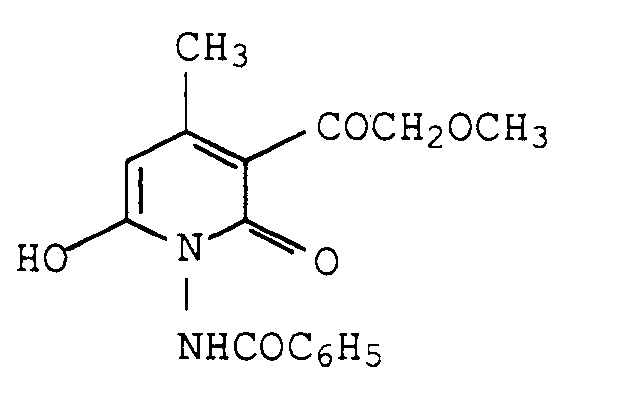
Eine aus Pentanol umkristallisierte Probe schmilzt bei 194 bis 195°C und zeigt folgende Analysenwerte:C₁₆H₁₆N₂O₅ (316) ber: C 60,7 H 5,1 N 8,9 O 25,3 gef: 60,5 5,2 8,8 25,7 -
- a) 198 g Cyanessigsäurehydrazid wurden in 1000 ml Wasser bei 50°C gelöst und nach und nach mit 296 g Phthalsäureanhydrid versetzt. Nach 4-stündigem Rühren bei 50°C wurde mit Eis gekühlt, abgesaugt und getrocknet. Man erhielt 386 g N-Cyanoacetyl-N'-phthaloylhydrazin in Form farbloser Kristalle vom Schmelzpunkt 291 bis 292°C (aus Ethanol).
- b) In 1500 ml Ethanol wurden 229 g des unter erhaltenen N-Cyanoacetyl-N'-phthaloylhydrazins und 115 g 3-Aminocrotonsäuremethylester eingetragen und 8 Stunden unter Rückfluß erhitzt. Dann wurde mit verdünnter Salzsäure auf einen pH-Wert von 1 gestellt und Ethanol mit Wasserdampf abdestilliert. Nach dem Erkalten wurde die Suspension abgesaugt, das erhaltene Produkt mit Wasser gewaschen und getrocknet. Man erhielt 232 g der Verbindung der Formel

- In 1000 ml Isopropanol wurden 115 g 3-Aminocrotonsäuremethylester und 218 g N-Cyanoacetyl-N'-phenylaminocarbonylhydrazin eingetragen und 8 Stunden unter Rückfluß erhitzt. Nach dem Erkalten wurde das ausgefallene Produkt abgesaugt, mit Aceton gewaschen und getrocknet. Man erhielt 218 g der Verbindung der Formel

Eine aus N,N-Dimethylformamid umkristallisierte Probe schmilzt bei 248 bis 249°C und zeigte folgende Analyse:C₁₄H₁₅N₅O₃ (301) ber: C 55,8 H 5,0 N 23,3 O 15,9 gef: 55,5 5,1 23,2 16,2 - In 750 ml Isobutanol wurden 115 g 3-Aminocrotonsäuremethylester und 198 g N-Cyanoacetyl-N'-butylaminocarbonylhydrazin eingetragen und 6 Stunden unter Rückfluß erhitzt. Dann wurde mit verdünnter Salzsäure angesäuert und Isobutanol mit Wasserdampf abdestilliert. Nach Erkalten wurde abgesaugt und mit Wasser gewaschen. Man erhielt nach dem Trocknen 193 g der Verbindung der Formel

Eine aus Essigsäure umkristallisierte Probe schmilzt bei 204 bis 205°C und gibt folgende Analyse:C₁₂H₁₆N₄O₃ (264) ber: C 54,5 H 6,1 N 21,2 O 18,2 gef: 54,3 6,2 21,2 18,2 - In 800 ml Isopropanol wurden 120 g 3-Aminocrotonsäuremethylester und 225 g der Verbindung der Formel

eingetragen und 8 Stunden unter Rückfluß erhitzt. Nach dem Erkalten wurde mit dem doppelten Volumen Wasser verdünnt und mit Salzsäure auf eine pH-Wert von 1 bis 2 angesäuert. Nach Stehen über Nacht wurde das ausgefallene Produkt abgesaugt, mit Wasser gewaschen und unter vermindertem Druck getrocknet. Man erhielt 237 g der Verbindung der Formel
Die Verbindung verliert auch beim Umkristallisieren aus Ethanol das Kristallwasser nicht; Schmelzpunkt 199 bis 200°C.Analyse: C₁₅H₂₃N₃O₄ (309) ber: C 58,3 H 7,4 N 13,6 O 20,7 gef: 58,3 7,5 13,6 20,8 - In 900 ml absol. Ethanol wurden 130 g Acetessigsäureethylester und 54 g festes Natriummethanolat eingetragen. Dazu gab man 217 g N-Cyanoacetyl-N'-phenylacetylhydrazin und erhitzte 8 Stunden unter Rückfluß. Nach dem Erkalten wurde das Reaktionsgemisch auf Eiswasser und überschüssige Salzsäure ausgetragen und über Nacht gerührt. Nach Absaugen und Trocknen erhielt man 228 g der Verbindung der Formel
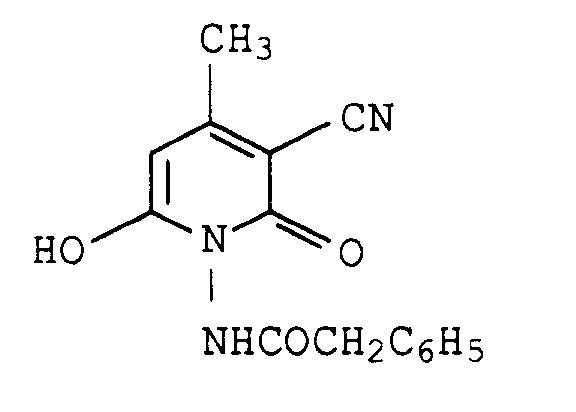
Eine aus Essigsäure umkristallisierte Probe schmilzt bei 232 bis 233°C und zeigt folgende Analyse:C₁₅H₁₃N₃O₃ (283) ber: C 63,6 H 4,6 N 14,8 O 16,9 gef: 63,3 4,8 14,6 17,3 - 5 g Hydrazinhydrat wurden unter Eiskühlung zu einem Gemisch von 10 ml Wasser und 9,9 ml Cyanessigsäuremethylester getropft. Es wurde dann 5 Stunden bei Raumtemperatur nachgerührt. Anschließend wurden 8,7 g Dikaliumhydrogenphosphat, gelöst in 40 ml Wasser, zum Reaktionsgemisch gegeben. Dieses wurde dann auf -5 bis 0°C abgekühlt und tropfenweise mit 14,05 g Benzoylchlorid versetzt. Danach wurde das Gemisch auf Raumtemperatur erwärmt und mit 13,5 ml 25 gew.-%iger Natronlauge versetzt, so daß sich ein pH-Wert von 9,9 einstellte. Es wurden 1,9 g Trimethylbenzylammoniumchlorid und 10,8 ml Acetessigsäuremethylester zugegeben, wobei ein pH-Wert von 9,3 resultierte. Das Reaktionsgemisch wurde 20 min bei Raumtemperatur gerührt, danach wurden 24 ml 25 gew.-%ige Natronlauge zugegeben, wobei ein pH-Wert von 10 resultierte, und 5 Stunden bei Raumtemperatur nachgerührt. Danach wurden weitere 7,6 ml Acetessigsäuremethylester und weitere 2 ml 25 gew.-%ige Natronlauge hinzugegeben. Nach 3,5-stündigem Nachrühren wurde das Reaktionsgemisch mit 25 ml konz. Salzsäure versetzt und der resultierende Niederschlag abgesaugt, mit Wasser gewaschen und getrocknet. Man erhielt 20,2 g des Pyridons der Formel

(Schmelzpunkt: 247°C)
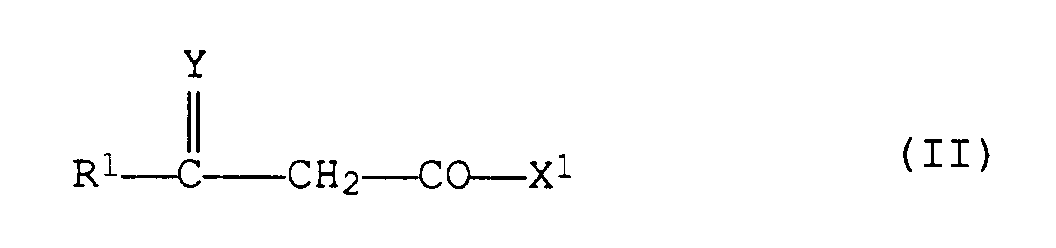
R²―CH₂―CO―X² (III),
worin Y Sauerstoff oder Imino und einer der Reste X¹ und X² einen Rest der Formel NH―NR³R⁴ und der andere C₁-C₆-Alkoxy bedeuten und R¹, R², R³ und R⁴ jeweils die obengenannte Bedeutung besitzen, in einem Verdünnungsmittel gegebenenfalls in Gegenwart einer Base umsetzt.
in Form farbloser Kristalle vom Schmelzpunkt 267 bis 268°C (aus Butyrolacton).
| Analyse für C₁₅H₉N₃O₄ (295) | ||||
| ber: | C 61,0 | H 3,1 | N 14,2 | O 21,7 |
| gef: | 60,8 | 3,2 | 14,1 | 22,2 |
Claims (7)
- Verfahren zur Herstellung von Pyridonen der Formel I
 R¹ Wasserstoff, C₁-C₆-Alkyl, C₃-C₇-Cycloalkyl, C₃-C₄-Alkenyl oder gegebenenfalls substituiertes Phenyl,R² Cyano, Carbamoyl, Carboxyl, C₁-C₆-Alkoxycarbonyl, gegebenenfalls substituiertes C₁-C₆-Alkanoyl, gegebenenfalls substituiertes Benzoyl, Halogen oder Nitro,R³ Wasserstoff undR⁴ gegebenenfalls substituiertes C₁-C₁₂-Alkanoyl, C₁-C₁₂-Alkoxycarbonyl, C₁-C₁₂-Monoalkylcarbamoyl, gegebenenfalls substituiertes Monophenylcarbamoyl, gegebenenfalls substituiertes C₁-C₁₂-Alkylsulfonyl, C₅-C₇-Cycloalkylsulfonyl, gegebenenfalls substituiertes Phenylsulfonyl, gegebenenfalls substituiertes Pyridylsulfonyl, gegebenenfalls substituiertes Benzoyl, Pyridylcarbonyl oder Thienylcarbonyl oder R³ und R⁴ zusammen mit dem sie verbindenden Stickstoffatom gegebenenfalls durch C₁-C₄-Alkyl substituiertes Succinimido oder gegebenenfalls durch C₁-C₄-Alkyl substituiertes Phthalimido bedeuten,dadurch gekennzeichnet, daß man die Carbonylverbindungen der Formel II und III
R²―CH₂―CO―X² (III),
worin Y Sauerstoff oder Imino und einer der Reste X¹ und X² einen Rest der Formel NH―NR³R⁴ und der andere C₁-C₆-Alkoxy bedeuten und R¹, R², R³ und R⁴ jeweils die obengenannte Bedeutung besitzen, in einem Verdünnungsmittel gegebenenfalls in Gegenwart einer Base umsetzt. - Verfahren nach Anspruch 1, dadurch gekennzeichnet, daß R¹ Wasserstoff oder C₁-C₄-Alkyl bedeutet.
- Verfahren nach Anspruch 1, dadurch gekennzeichnet, daß R² Cyano, C₁-C₄-Alkoxycarbonyl oder C₂-C₄-Alkanoyl, das gegebenenfalls durch Phenyl oder C₁-C₄-Alkoxy substituiert ist, bedeutet.
- Verfahren nach Anspruch 1, dadurch gekennzeichnet, daß R³ Wasserstoff und R⁴ C₁-C₈-Alkanoyl, das gegebenenfalls durch C₁-C₄-Alkoxy oder Phenyl substituiert ist, C₁-C₈-Monoalkylcarbamoyl, Monophenylcarbamoyl, C₁-C₈-Alkylsulfonyl, Phenylsulfonyl, Tolylsulfonyl, Pyridylsulfonyl, Benzoyl, Methylbenzoyl, Pyridylcarbonyl oder Thienylcarbonyl oder R³ und R⁴ zusammen mit dem sie verbindenden Stickstoffatom Succinimido oder Phthalimido bedeuten.
- Verfahren nach Anspruch 1, dadurch gekennzeichnet, daß die Carbonylverbindungen der Formel II und III im Molverhältnis 1:1 bis 1:3 zur Anwendung gelangen.
- Verfahren nach Anspruch 1, dadurch gekennzeichnet, daß man die Umsetzung bei einer Temperatur von 0 bis 150°C durchführt.
- Verfahren zur Herstellung des Pyridons der Formel IV
 a) in einem 1. Schritt Cyanessigsäure-C₁-C₄-alkylester mit Hydrazin in Wasser als Reaktionsmedium umsetzt, anschließend das resultierende Cyanessigsäurehydrazid ohne Zwischenisolierungb) in einem 2. Schritt in Gegenwart eines Puffersystems mit Benzoylchlorid behandelt und das resultierende N-Benzoylcyanessigsäurehydrazid danach ohne Zwischenisolierungc) in einem 3. Schritt in Gegenwart einer Base und eines Phasentransferkatalysators mit Acetessigsäure-C₁-C₄-alkylester umsetzt.
Applications Claiming Priority (2)
| Application Number | Priority Date | Filing Date | Title |
|---|---|---|---|
| DE4319675A DE4319675A1 (de) | 1993-06-14 | 1993-06-14 | Verfahren zur Herstellung von N-Aminopyridonen |
| DE4319675 | 1993-06-14 |
Publications (2)
| Publication Number | Publication Date |
|---|---|
| EP0628547A1 true EP0628547A1 (de) | 1994-12-14 |
| EP0628547B1 EP0628547B1 (de) | 1997-09-24 |
Family
ID=6490312
Family Applications (1)
| Application Number | Title | Priority Date | Filing Date |
|---|---|---|---|
| EP94108435A Expired - Lifetime EP0628547B1 (de) | 1993-06-14 | 1994-06-01 | Verfahren zur Herstellung von N-Aminopyridonen |
Country Status (4)
| Country | Link |
|---|---|
| US (1) | US5466812A (de) |
| EP (1) | EP0628547B1 (de) |
| JP (1) | JPH0710842A (de) |
| DE (2) | DE4319675A1 (de) |
Families Citing this family (1)
| Publication number | Priority date | Publication date | Assignee | Title |
|---|---|---|---|---|
| USD618535S1 (en) * | 2009-09-02 | 2010-06-29 | Chieh-Jung Chang | Padlock |
Citations (2)
| Publication number | Priority date | Publication date | Assignee | Title |
|---|---|---|---|---|
| DE2150772A1 (de) * | 1971-10-12 | 1973-04-19 | Cassella Farbwerke Mainkur Ag | Verfahren zur herstellung von 6-hydroxy-2-pyridon-3-carbonsaeureamidverbindungen |
| WO1992019684A1 (de) * | 1991-05-03 | 1992-11-12 | Basf Aktiengesellschaft | N-aminopyridonfarbstoffe |
-
1993
- 1993-06-14 DE DE4319675A patent/DE4319675A1/de not_active Withdrawn
-
1994
- 1994-06-01 EP EP94108435A patent/EP0628547B1/de not_active Expired - Lifetime
- 1994-06-01 DE DE59404129T patent/DE59404129D1/de not_active Expired - Lifetime
- 1994-06-07 US US08/255,752 patent/US5466812A/en not_active Expired - Fee Related
- 1994-06-10 JP JP6128865A patent/JPH0710842A/ja not_active Withdrawn
Patent Citations (2)
| Publication number | Priority date | Publication date | Assignee | Title |
|---|---|---|---|---|
| DE2150772A1 (de) * | 1971-10-12 | 1973-04-19 | Cassella Farbwerke Mainkur Ag | Verfahren zur herstellung von 6-hydroxy-2-pyridon-3-carbonsaeureamidverbindungen |
| WO1992019684A1 (de) * | 1991-05-03 | 1992-11-12 | Basf Aktiengesellschaft | N-aminopyridonfarbstoffe |
Non-Patent Citations (5)
| Title |
|---|
| Acta Pol. Pharm. 1975, 32(1), 129-31 * |
| CHEMICAL ABSTRACTS, vol. 114, no. 8, 25 February 1991, Columbus, Ohio, US; abstract no. 64264u, page 113; * |
| CHEMICAL ABSTRACTS, vol. 83, no. 17, 27 October 1975, Columbus, Ohio, US; abstract no. 147421k, page 494; * |
| CHEMICAL ABSTRACTS, vol. 92, no. 25, 23 June 1980, Columbus, Ohio, US; abstract no. 215333w, page 616; * |
| R. BALICKI: "Studies in the field ...", POLISH JOURNAL OF CHEMISTRY, vol. 58, 1984, WARSZAWA, PL, pages 85 - 95 * |
Also Published As
| Publication number | Publication date |
|---|---|
| DE4319675A1 (de) | 1994-12-15 |
| US5466812A (en) | 1995-11-14 |
| DE59404129D1 (de) | 1997-10-30 |
| JPH0710842A (ja) | 1995-01-13 |
| EP0628547B1 (de) | 1997-09-24 |
Similar Documents
| Publication | Publication Date | Title |
|---|---|---|
| EP0039482B1 (de) | Perylen-3,4,9,10-tetracarbonsäuremonoanhydridmonoimide, Verfahren zur Herstellung solcher Verbindungen und ihre Verwendung | |
| DE2715503C2 (de) | Verfahren zur Herstellung von Maleinimiden | |
| EP0161221A2 (de) | Verfahren zur Herstellung von Pyridin-2,3-dicarbonsäurederivaten und neue 1-Amino-1,4-dihydropyridin-2,3-dicarbonsäurederivate | |
| EP0172140B1 (de) | Verfahren zur Herstellung von Pyridin-2,3-dicarbonsäurederivaten und neue 1-Amino-1,2,3,4-tetrahydropyridin-2,3-dicarbonsäurederivate und 1,4-Dihydropyridin-2,3-dicarbonsäurederivate | |
| DE2119730C3 (de) | ||
| EP0188194B1 (de) | Aminoacrylsäure-Derivate | |
| DE2119730B2 (de) | Verfahren zur herstellung von 1,2-benzisothiazolin-3-onen | |
| EP0628547A1 (de) | Verfahren zur Herstellung von N-Aminopyridonen | |
| DE2733181B2 (de) | Verfahren zur Herstellung von N-substituierten a -Ketocarbonsäureamiden | |
| CH638516A5 (en) | Process for preparing substituted aminoquinazoline derivatives | |
| EP0378046B1 (de) | Verfahren zur Herstellung von 3-Phenylpyrrolderivaten | |
| EP0345464B1 (de) | Verfahren zur Herstellung von substituierten 3-Amino-2(benzoyl)-acrylsäureestern sowie ein Verfahren zur Herstellung von Zwischenprodukten für antibakterielle Wirkstoffe aus diesen Verbindungen | |
| DE2300221A1 (de) | Verfahren zur herstellung von 3anilino-pyrazolonen-(5) | |
| DE2705186C2 (de) | ||
| EP0056938B1 (de) | Verfahren zur Herstellung von 3,6-disubstituierten 4-Amino-1,2,4-triazin-5-onen | |
| EP0306866B1 (de) | Verfahren zur Herstellung von Pyrazolo [5,1-b] chinazolonen | |
| DE3312216A1 (de) | Verfahren zur herstellung von symmetrischen 1,4-dihydropyridincarbonsaeureestern | |
| EP0396077B1 (de) | Neue Phenylendiamine sowie ein Verfahren zur Herstellung von Phenylendiaminen | |
| EP0306876B1 (de) | Verfahren zur Herstellung von Pyrazolo [5,1-b] chinazolonen | |
| DE2445681A1 (de) | Verfahren zur herstellung von 3-phenylpyridazonen | |
| CH687327A5 (de) | Verfahren zur Herstellung von 5-Alkoxyindol-2-carbonsäuren. | |
| EP0510491A1 (de) | N'-substituierte N-Amino-3,4,5,6-tetrafluorphthalimide und Verfahren zu ihrer Herstellung | |
| AT400241B (de) | Verfahren zur herstellung eines 1,4-dihydro-pyridin-derivates | |
| DE2366215C2 (de) | Glyoxylsäurehydrazid-2-acylhydrazone | |
| DE1543941C (de) | Verfahren zur Herstellung von 1-Oxa-2-methyl-3-aminocarbonyl-4-thia-cyclohex-2-en-4-oxiden oder 4,4-dioxiden |
Legal Events
| Date | Code | Title | Description |
|---|---|---|---|
| PUAI | Public reference made under article 153(3) epc to a published international application that has entered the european phase |
Free format text: ORIGINAL CODE: 0009012 |
|
| AK | Designated contracting states |
Kind code of ref document: A1 Designated state(s): CH DE FR GB IT LI |
|
| 17P | Request for examination filed |
Effective date: 19941107 |
|
| 17Q | First examination report despatched |
Effective date: 19960117 |
|
| GRAG | Despatch of communication of intention to grant |
Free format text: ORIGINAL CODE: EPIDOS AGRA |
|
| GRAH | Despatch of communication of intention to grant a patent |
Free format text: ORIGINAL CODE: EPIDOS IGRA |
|
| GRAH | Despatch of communication of intention to grant a patent |
Free format text: ORIGINAL CODE: EPIDOS IGRA |
|
| GRAA | (expected) grant |
Free format text: ORIGINAL CODE: 0009210 |
|
| AK | Designated contracting states |
Kind code of ref document: B1 Designated state(s): CH DE FR GB IT LI |
|
| REG | Reference to a national code |
Ref country code: CH Ref legal event code: EP |
|
| REF | Corresponds to: |
Ref document number: 59404129 Country of ref document: DE Date of ref document: 19971030 |
|
| GBT | Gb: translation of ep patent filed (gb section 77(6)(a)/1977) |
Effective date: 19971024 |
|
| ITF | It: translation for a ep patent filed | ||
| ET | Fr: translation filed | ||
| PG25 | Lapsed in a contracting state [announced via postgrant information from national office to epo] |
Ref country code: GB Free format text: LAPSE BECAUSE OF NON-PAYMENT OF DUE FEES Effective date: 19980601 |
|
| PG25 | Lapsed in a contracting state [announced via postgrant information from national office to epo] |
Ref country code: DE Free format text: LAPSE BECAUSE OF THE APPLICANT RENOUNCES Effective date: 19980624 |
|
| PG25 | Lapsed in a contracting state [announced via postgrant information from national office to epo] |
Ref country code: LI Free format text: LAPSE BECAUSE OF NON-PAYMENT OF DUE FEES Effective date: 19980630 Ref country code: CH Free format text: LAPSE BECAUSE OF NON-PAYMENT OF DUE FEES Effective date: 19980630 |
|
| PLBE | No opposition filed within time limit |
Free format text: ORIGINAL CODE: 0009261 |
|
| STAA | Information on the status of an ep patent application or granted ep patent |
Free format text: STATUS: NO OPPOSITION FILED WITHIN TIME LIMIT |
|
| 26N | No opposition filed | ||
| GBPC | Gb: european patent ceased through non-payment of renewal fee |
Effective date: 19980601 |
|
| REG | Reference to a national code |
Ref country code: CH Ref legal event code: PL |
|
| PG25 | Lapsed in a contracting state [announced via postgrant information from national office to epo] |
Ref country code: FR Free format text: LAPSE BECAUSE OF NON-PAYMENT OF DUE FEES Effective date: 19990226 |
|
| REG | Reference to a national code |
Ref country code: FR Ref legal event code: ST |
|
| PG25 | Lapsed in a contracting state [announced via postgrant information from national office to epo] |
Ref country code: IT Free format text: LAPSE BECAUSE OF NON-PAYMENT OF DUE FEES;WARNING: LAPSES OF ITALIAN PATENTS WITH EFFECTIVE DATE BEFORE 2007 MAY HAVE OCCURRED AT ANY TIME BEFORE 2007. THE CORRECT EFFECTIVE DATE MAY BE DIFFERENT FROM THE ONE RECORDED. Effective date: 20050601 |