EP0628649A1 - Verfahren zum Herstellen von Doppelplüschgeweben - Google Patents
Verfahren zum Herstellen von Doppelplüschgeweben Download PDFInfo
- Publication number
- EP0628649A1 EP0628649A1 EP94201621A EP94201621A EP0628649A1 EP 0628649 A1 EP0628649 A1 EP 0628649A1 EP 94201621 A EP94201621 A EP 94201621A EP 94201621 A EP94201621 A EP 94201621A EP 0628649 A1 EP0628649 A1 EP 0628649A1
- Authority
- EP
- European Patent Office
- Prior art keywords
- pile
- fabric
- threads
- weft
- thread
- Prior art date
- Legal status (The legal status is an assumption and is not a legal conclusion. Google has not performed a legal analysis and makes no representation as to the accuracy of the status listed.)
- Granted
Links
- 239000004744 fabric Substances 0.000 title claims abstract description 301
- 238000000034 method Methods 0.000 title claims abstract description 88
- 238000004519 manufacturing process Methods 0.000 title claims abstract description 15
- 239000011230 binding agent Substances 0.000 claims abstract description 55
- 238000003780 insertion Methods 0.000 claims description 21
- 230000037431 insertion Effects 0.000 claims description 21
- 230000008859 change Effects 0.000 claims description 12
- 230000007704 transition Effects 0.000 claims description 6
- 230000000694 effects Effects 0.000 claims description 2
- 230000008901 benefit Effects 0.000 description 9
- 238000009941 weaving Methods 0.000 description 8
- 230000007246 mechanism Effects 0.000 description 6
- 230000035515 penetration Effects 0.000 description 6
- 238000012937 correction Methods 0.000 description 4
- 230000015572 biosynthetic process Effects 0.000 description 3
- 238000013461 design Methods 0.000 description 3
- 235000014676 Phragmites communis Nutrition 0.000 description 2
- 239000000463 material Substances 0.000 description 2
- 230000000149 penetrating effect Effects 0.000 description 2
- 238000000926 separation method Methods 0.000 description 2
- 239000000853 adhesive Substances 0.000 description 1
- 238000004026 adhesive bonding Methods 0.000 description 1
- 230000001070 adhesive effect Effects 0.000 description 1
- 239000003086 colorant Substances 0.000 description 1
- 238000005520 cutting process Methods 0.000 description 1
- 230000004048 modification Effects 0.000 description 1
- 238000012986 modification Methods 0.000 description 1
Images





Classifications
-
- D—TEXTILES; PAPER
- D03—WEAVING
- D03D—WOVEN FABRICS; METHODS OF WEAVING; LOOMS
- D03D27/00—Woven pile fabrics
- D03D27/02—Woven pile fabrics wherein the pile is formed by warp or weft
- D03D27/10—Fabrics woven face-to-face, e.g. double velvet
Definitions
- the present invention relates to a method for manufacturing a face-to-face pile fabric, in which
- the pile-forming pile warp threads are in each case interlaced with the third weft threads located on the back of the fabrics (except in case of a change of pile).
- the dead pile warp threads i.e. the pile warp threads or parts of pile warp threads which do not form pile
- a warp thread portee consists of a warp thread system of the top fabric and a warp thread system of the bottom fabric, whose binder warp threads, tension warp threads and pile warp threads are located one above the other).
- each fabric comprises successive rows of pile loops which have been interlaced with corresponding weft threads.
- These pile loops have upright pile sides.
- these pile sides In order to achieve perfect pile formation, these pile sides have to extend at right angles to the plane of the backing fabric (which comprises weft threads, binder warp threads and tension warp threads). If this is not the case (i.e. with a so-called drawn pile), a fabric of inferior quality is obtained. As a result of a drawn pile, mixing contours may occur in the fabrics.
- pile sides form different colour fields in a pile fabric (in order to produce a design or pattern)
- mixing contours occur when pile sides of a different colour are visible among pile sides of one colour on the pile surface of the fabrics. This is caused as a result of pile sides of one colour extending at an angle among the pile sides of another colour in the vicinity of the separation line between two colour fields, and being visible at the pile surface of the fabric.
- the fabric produced according to the method of FR-2.182.790 exhibits a drawn pile.
- first weft threads of successive groups extend in a first plane, which lies on the back relative to a second and third plane in which, respectively, the second and third weft threads of these successive groups extend, because the pile-forming pile warp threads are in each case interlaced with a first weft thread, and because the dead pile warp threads are bound in in each warp thread portee, distributed over both fabrics.
- two weft threads (the second and third weft threads), one above the other, are located in each case on either side of a pile loop. These weft threads keep the pile sides upright. In addition, the first weft thread is prevented from penetrating the second and third weft threads located above one another.
- the pile sides remain in the desired position after the face-to-face pile fabric is cut through, at right angles to the plane of the backing fabric, so that a drawn pile no longer occurs.
- the quality of the fabrics is also improved as the dead pile warp threads are bound in in each warp thread portee distributed over both fabrics.
- the pile warp threads which finish forming pile are interlaced with a second weft thread in a first warp thread portee before they are bound into the top fabric, and the pile warp threads which start forming pile are interlaced with a third weft thread before they start to form pile (run to the bottom fabric).
- the pile warp threads which finish forming pile are interlaced with a third weft thread before they are bound into the bottom fabric, and the pile warp threads which start forming pile are interlaced with a second weft thread before they start forming pile (run to the top fabric).
- the face-to-face pile fabric has alternating first and second warp thread portees.
- the pile sides thus formed are not visible on the back of the fabrics.
- the pattern of the pile fabrics is thus not completely visible on the back of the fabrics. Moreover, the visible part of the pattern appears as a dashed line.
- An additional object of this invention is to produce the complete pattern of the pile fabrics clearly on the back of the fabrics.
- said first and last pile sides are also laterally supported by weft threads located one above the other, after the face-to-face pile fabric has been cut through.
- the pile sides remain upright, thereby preventing mixing contours.
- each pile side is interlaced with a weft thread on the back, so that the pattern is clearly and completely visible on the back of the fabrics.
- Such fabrics are obtained according to the method described in FR-2.182.790.
- each warp thread portee both at a transition from a pile-forming part to a bound-in part and at a transition from a bound-in part to a pile-forming part of a pile warp thread, said pile warp thread is interlaced with a third weft thread before it is bound in or starts forming pile, respectively, and in that the dead pile warp threads in each warp thread portee are bound in distributed over both fabrics.
- the dead pile warp threads are bound in in each warp thread portee distributed over both fabrics. Mixing contours are prevented because all pile sides are supported by adjacent (first) weft threads, so that they remain in the desired upright position after the face-to-face pile fabric has been cut through.
- the first weft thread can also be prevented from penetrating the second and third weft threads lying one above the other by a special way of binding the weft threads in by means of the binder warp threads.
- the groups of weft threads are no longer provided in each case in one opening between the binder warp threads but are distributed in each case over two successive openings, so that a first weft thread or a second weft thread and a third weft thread, respectively, alternately extends between the binder warp threads.
- the dead pile warp threads are bound in distributed over both fabrics in each warp thread portee in order to improve the quality of the fabric.
- the first weft thread is in each case bound into an individual opening, separate from the adjacent second and third weft threads.
- the disadvantageous penetration of the second and third weft threads by the first weft threads is thus prevented.
- the above-mentioned disadvantages which are caused by said penetration are thus overcome by this method according to the invention.
- the penetration of adjacent second and third weft threads by the first weft threads can also be prevented by another special way of binding in the weft threads.
- a complete group of weft threads is also no longer always provided in the successive openings between the binder warp threads.
- the binding in of the weft threads takes place in such a manner that in each case the second and third weft threads extend through said successive openings while the first weft threads extend in each case through an opening which is formed between, on the one hand, two binder warp threads and, on the other hand, the tension warp thread or through an opening which is formed between, on the one hand, the two binder warp threads and, on the other hand, at least one dead pile warp thread.
- first weft threads in each case extend through individual openings and are consequently separated from the adjacent second and third weft threads, they can no longer penetrate said second and third weft threads.
- the abovementioned disadvantages which resulted from said penetration are consequently eliminated.
- the tension warp thread is bound in on the back of the fabric relative to the first weft threads, while the crossing of binder warp threads relative to the first weft threads is provided in each case on the pile side, so that the successive openings are formed between the crossing binder warp threads, on the one hand, and the tension warp thread, on the other.
- the dead pile warp threads are bound in on the pile side of the fabric relative to the first weft threads, while the crossing of the binder warp threads relative to the first weft threads is provided in each case on the back, so that the successive openings are formed between the crossing binder warp threads, on the one hand, and at least one dead pile warp thread, on the other.
- the method as described in the first paragraph of this description can also be carried out in such a manner that the pile-forming pile warp threads are not visible on the back of the fabric (fabrics where pile is not passed through). This is achieved by interlacing the pile-forming pile warp threads in each case with the first weft threads (not located on the back) of successive groups of weft threads.
- the dead pile warp threads are bound in divided over both fabrics and in each warp thread portee so as to improve the quality of the fabrics.
- the third weft threads on the back of the resulting fabrics are not used for interlacing pile threads, such fabrics are suitable in particular for gluing onto surfaces, for example on a floor or walls. Since, in addition, the adhesive is only present between the weft threads on the back and the surface, the flexibility of the fabric pile threads is not affected, yet the adhesion of the fabric on the surface is excellent. The pile thread loops of the active pile do not come into contact with the surface and will therefore not be subject to wear. Moreover, this method requires less pile thread to achieve a certain effective pile height.
- the methods according to this invention where the pile-forming pile warp threads are interlaced with third weft threads in order to produce fabrics where pile passes through can be modified to a method where the pile-forming pile warp threads are interlaced with first weft threads to produce fabrics where pile does not pass through by allowing the interlacing of the pile warp threads to take place one pick earlier or one pick later.
- the first and third weft threads are provided such that they extend in planes lying one above the other, while the tension warp threads are in each case bound in such that they extend between said first and third weft threads.
- the pile-forming pile warp threads are in each case interlaced with the weft thread (the first or third weft thread, depending on the method used according to this invention) running on the back of the tension warp thread, the pattern of the pile fabric is very accurate and clearly visible on the back of the pile fabrics.
- a fabric in particular, a carpet which is weaved according to a three-pick weave tends to curl towards the back. This is caused by the fact that, on the one hand, the pile warp thread bound in on the back prevents the elongation or extension of the fabric on the back, while, on the other hand, the bound-in dead pile warp threads push the fabric apart on the pile side.
- the weft threads situated on the pile side of the dead pile warp threads may push these dead pile warp threads between successive weft threads against the tension warp threads, as a result of which dead pile warp treads are bound in in a wave-like manner and causing increased pile consumption.
- An additional object of this invention is to eliminate these disadvantages.
- This object is achieved in that a second tension warp thread is provided for every warp thread system in each fabric.
- This second tension warp thread is bound in between the second and third weft threads so that only the second weft threads extend on the pile side of this second tension warp thread.
- the first tension warp thread extends between the first and third weft threads of every warp thread system.
- this second tension warp thread the fabric can not extend on the pile side and curling is prevented.
- the weft threads running on the pile side press the dead pile warp threads against the first tension warp threads.
- the dead pile warp threads remain extended and pile consumption for binding in remains at a minimum.
- the warp threads of a warp thread system can be arranged next to one another in the following order: the first tension warp thread, the two binder warp threads, the second tension warp thread, the pile warp threads.
- the pile warp threads are thus in each case situated between two tension warp threads (the second tension warp thread of a warp thread system and the first tension warp thread of a subsequent warp thread system).
- the pile sides are consequently out of range of the binder warp threads, so that these binder warp threads cannot affect the orientation of the pile sides.
- the pile sides assume the desired upright position and form straighter lines in the warp direction on the pile surface. This results in the pile sides not mixing with pile sides of an adjacent row of pile loops.
- an additional tension warp thread may serve as a guide for the weft insertion means so that dead pile warp threads do not have to carry a weft insertion means which could result in them being damaged or breaking as a consequence of their contact with a weft insertion means.
- Double (married) pile warp threads occur when a pile change is effected (when a first pile warp thread which formed pile from a certain pick onwards is bound in and a second pile warp thread which was bound in starts forming pile from the same pick onwards) in the face-to-face fabric, between a first pile warp thread which is to be bound into one fabric after the pile change and a second pile warp thread which was bound into the other fabric before the pile change.
- the pile warp thread whose pile loop is omitted is set so that the omission takes place in the direction where there is more than one pile loop.
- the method according to this invention can be implemented to great effect, using a triple weft insertion mechanism with which, alternately, a second and third weft thread are provided in the bottom fabric and a first weft thread in the top fabric, or a second and third weft thread in the top fabric and a first weft thread in the bottom fabric, respectively.
- At least one weft thread of the two weft threads of each group with which no pile warp thread is interlaced is chosen to be thinner than the other weft threads of that group.
- the pile-forming pile warp threads are thus interlaced in each case with a relatively thick weft thread while one or both of the other weft threads are relatively thin.
- An additional advantage thereof is the fact that the sides of the pile loops are pushed apart to a lesser degree if a relatively thin weft thread extends between these sides. This results in sides which are more upright which again serves to produce a clear and straight delineation of the pile fabric pattern.
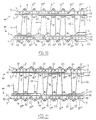
- a face-to-face pile fabric is manufactured by forming a top fabric (TF) and a bottom fabric (BF). Both fabrics (TF, BF) are formed by providing for each fabric in each case successive groups of three weft threads (6, 7, 8), so that, in every group, a first weft thread (6) extends next to a second (7) and a third weft thread (8), which are located one above the other, and by providing, for each fabric (TF, BF), adjacent warp thread systems having two binder warp threads (3, 4), one or more tension warp threads (9, 10; 9', 10') and one or more pile warp threads (11-16).
- binder warp threads (3, 4) cross each other a number of times so as to provide successive openings (49-55; 49, 49', 50, 50'; 49, 49'', 501 50''...; 49, 49''', 50, 50'''...) between their points of intersection, through which extend in each case one or more weft threads (6, 7, 8).
- the weft threads (6, 7, 8) are bound into the respective fabrics (TF, BF).
- the tension warp threads (9, 10;, 9', 10') are bound into the respective fabrics (TF, BF) in each of the warp thread systems.
- the pile-forming pile warp threads (11-14) are interlaced with a weft thread (6, 8) alternately in the top fabric (TF) and in the bottom fabric (BF) in accordance with a three-pick weave.
- a dead pile warp thread (11-16) is bound into one of the fabrics (TF, BF).
- a pile warp thread (11-14) may have a part which forms pile and another part which may be bound in as dead pile warp thread.
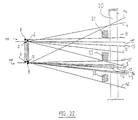
- the face-to-face pile fabric is manufactured on a face-to-face weaving loom provided with a triple weft insertion means (21, 22, 23, in Figure 22), by means of which in each case three weft threads (6, 7, 8) are inserted simultaneously.
- a second (7) and a third weft thread (8) are inserted into the top fabric (TF) and a first weft thread (6) is inserted into the bottom fabric (BF).
- a first weft thread (6) is inserted into the top fabric (TF) and a second (7) and third weft thread (8) are inserted into the bottom fabric (BF).
- a face-to-face carpet is manufactured, in which case the first weft threads (6) are provided in a plane on the back relative to the two planes above one another, through which the second (7) and third weft threads (8), respectively, extend.
- the binder warp threads (3, 4) cross a number of times and form successive openings (49-55) through which extend in each case a second (7) and a third weft thread (8), one above the other, followed by a first weft thread (6).
- a first tension warp thread (9, 10) is bound in which extends between the first weft threads (6) and the third weft threads (8).
- a second tension warp thread (9', 10') is bound in which extends between the second (7) and third weft threads (8).
- the dead pile warp threads (11-16) are bound in, divided over both fabrics (TF, BF), and extend between the second (7) and third weft threads (8).
- the pile-forming pile warp threads (11-13) are in each case interlaced with the first weft threads (6).
- the pile sides are supported by the second (7) and third weft threads (8) which extend next to one another. In this manner, an upright pile is produced and mixing contours are prevented.
- the first tension warp thread (9, 10) protects the dead pile warp threads (11-16) on the back of the carpet.
- the pattern is represented in full on the back of the carpet because a pile warp thread (12, 13) is interlaced with a first weft thread (6) at the transition from a bound-in part to a pile-forming part, before it starts forming pile, and because a pile warp thread (11, 12) is interlaced with a first weft thread (6) at the transition from a pile-forming part to a bound-in part, before it is bound in.
- a face-to-face carpet is manufactured, in which case the first weft threads (6) are provided in a plane situated between the two planes lying one above the other in which the second (7) and third weft threads (8), respectively, extend.
- a first weft thread (6) followed by the second (7) and third weft threads (8) lying one above the other are provided through the openings (49-55) between the binder warp threads (3, 4) which cross a number of times.
- the dead pile warp threads (11-16) and the first tension warp threads (9, 10) are bound in in the same manner as with the first variant method, and thus result in the same advantages.
- the pile-forming pile warp threads (11-14) are in each case interlaced with third weft threads (8) situated on the back.
- the pile warp threads (11, 12, 13), a bound-in part of which changes to a pile-forming part, and the pile warp threads (11, 12, 14), a pile-forming part of which changes to a bound-in part, are interlaced first with a third weft thread (8) before they start forming pile or are bound in, respectively.
- a face-to-face carpet is manufactured, in which case the weft threads (6, 7, 8) are in the same positions as with the second variant method.
- the dead pile warp threads (11-16) and the first tension warp thread (9, 10) are bound into the fabrics (TF, BF) in the same manner as with the second variant method.
- the pile-forming pile warp threads (11-14) also form pile along the third weft threads (8) situated on the back. At the start and at the finish of the pile formation, a pile warp thread (11-14) is first interlaced with a third weft thread (8) before it starts forming pile or is bound in, respectively.
- the difference with the second variant method is the fact that the first weft thread (6) is enclosed in each case in a separate opening (49', 50'%) by the binder warp threads (3, 4).
- first binder warp thread (3) which successively interlaces the first (6) and the third weft threads (8) with the first tension warp thread (9, 10) and there is a second binder warp thread (4) which in each case interlaces the second weft thread (7) between the pile sides so that it is separated from the first weft thread (6).
- the binder warp threads (3, 4) thus form successive openings (49, 49', 50, 50', ...) through which alternately a first weft thread (6) or a second (7) and third weft thread (8), respectively, extend.
- the first weft thread (6) thus extends in each case through a separate opening (49', 50', . ..) which is located between two openings (49, 50; 50, 51), through which in each case the adjacent second (7) and third weft threads (8) extend.
- first weft threads (6) can no longer penetrate the adjacent second (7) and third weft threads (8), as a result of which a drawn pile is prevented (and thus mixing contours as well).
- Figure 9 differs from Figure 8 in that a second tension warp thread (9', 10') was added to every warp thread system.
- a second tension warp thread (9', 10') was added to every warp thread system.
- a fourth variant method differs from the third variant method in that the weft threads (6, 7, 8) are bound in by the binder warp threads (3, 4) in a different manner.
- the binding in of the weft threads takes place in such a manner that in each case the second (7) and third weft threads (8) extend through successive openings (49-55) between the binder warp threads (3, 4), while the first weft threads (6) in each case extend through an opening (49'', 50'') which is formed between, on the one hand, two binder warp threads (3, 4) and, on the other hand, the tension warp thread (9, 10). Because the first weft threads in each case extend through a separate opening and are consequently separated from the adjacent second and third weft threads, they can no longer penetrate the second and third weft threads. The disadvantages indicated above which resulted from said penetration are thus eliminated.
- the face-to-face pile fabric according to Figure 12 differs from that according to Figure 10 in that a second tension warp thread (9', 10') was added to every warp thread system in each fabric (TF, BF), which results in the abovementioned advantages.
- the tension warp thread (9, 10) is bound in on the back of the fabric relative to the first weft threads (6), while the crossing of binder warp threads (3, 4) relative to the first weft threads (6) is in each case provided on the pile side, so that the openings (49'', 50'', ...) are formed between, on the one hand, the crossing binder warp threads (3, 4) and, on the other hand, the tension warp thread (9, 10).
- a fifth variant method according to this invention differs from the third and fourth variant method in that the weft threads (6, 7, 8) are bound in by the binder warp threads (3, 4) in yet another manner.
- the binding in of the weft threads (6, 7, 8) takes place such that in each case the second (7) and third weft threads (8) extend through successive openings (49-55) between the binder warp threads (3, 4), while the first weft threads (6) in each case extend through an opening (49''', 50''', ...) which is formed between, on the one hand, the two binder warp threads (3, 4) and, on the other hand, at least one dead pile warp thread (11-16).
- first deft threads (6) in each case extend through separate openings (49''', 50''', ...) as well and are consequently separated from the adjacent second (7) and third weft threads (8) which extend through the adjacent openings (49-55). These first weft threads (6) can therefore no longer penetrate said adjacent second (7) and third weft threads (8) as a result of which a drawn pile is prevented (and thus mixing contours as well).
- the face-to-face pile fabric according to Figure 13 differs from that of Figure 11 in that a second tension warp thread (9', 10') was added to every warp thread system in each fabric (TF, BF) which results in the abovementioned advantages.
- the dead pile warp threads (11-16) are bound in on the pile side of the fabric (TF, BF) relative to the first weft threads (6), while the crossing of the binder warp threads (3, 4) relative to the first weft threads (6) is in each case provided on the back, so that the openings (49''', 50''', ...) are formed between, on the one hand, the crossing binder warp threads (3, 4 ) and, on the other hand, at least one dead pile warp thread (11-16).
- the dead pile warp threads (11-16) are bound in on the pile side of the fabric (BF, TF) relative to the first weft threads (6) in order to prevent their colour showing through on the back of the fabric.
- the tension warp thread (9, 10) runs on the back of the fabric (BF, TF) relative to the first weft threads (6) and the pile-forming pile warp threads (11-14) are interlaced with the third weft threads (8).
- the resulting fabrics are pile fabrics where the pile passes through.
- both pile warp threads (12, 13) marry at that location (X) between the top fabric (TF) and the bottom fabric (BF). This is referred to as double pile warp threads (see Figures 16 and 17).
- the double pile warp threads can be eliminated in a quick and relatively simple manner by going through this data file containing software and finding the locations where a pile change, as described above, takes place and omit a loop knop at those locations.
- This omission takes place in the forward or backward direction, in the direction where there is more than one pile knop.
- Figure 18 shows a cross section of a face-to-face pile fabric where pile passes through and having in each case an additional tension warp thread (9', 10') in the top fabric (TF) and in the bottom fabric (BF).
- This fabric is manufactured according to the fourth variant method according to this invention. However, the following applies to all variant methods according to this invention where pile is formed on the third weft threads (8).
- the second weft threads (7) are chosen to be thinner than the other weft threads (6), (8). This results in the sides of the pile loops being pushed apart to a lesser degree. It is also possible to choose the second weft threads (7) and the first weft threads (6) to be thinner than the third weft threads (8). In addition to the aforementioned advantage, this also has the advantage that the fabric back becomes less thick, as a result of which the part of the pile knop which is located in the back is shortened leading to a saving in pile material.
- the relatively thick weft on the back ensures a clear pattern on the back and prevents the colour of the bound-in dead pile warp threads from showing through on the back.
- the backs of the bottom fabric (BF) and of the top fabric (TF) have an identical pattern: the design pattern.
- This method using relatively thin weft threads (7), and (6), (7), respectively, can also be used with face-to-face pile fabrics where pile does not pass through (see Figures 20 and 21).
- FIGs 4 to 7 inclusive illustrate several cases where relatively thin weft threads (6, 7, 8) are used, in which the weft threads (6, 7, 8) and a pile loop are shown of a fabric which has been manufactured according to the first variant method according to the invention.
- the desired positions relative to the successive weft threads (6, 7, 8) are stored in the form of a set of control data.
- This set is incorporated, for example, in a card design which is processed to form a data file or to control a jacquard device. During weaving, this jacquard device can position the pile warp threads in accordance with the input control data.
- the same set of control data can be used both for manufacturing a face-to-face pile fabric where pile passes through and for manufacturing a face-to-face pile fabric where pile does not pass through, as the pile-formation only has to be moved one pick in order to obtain either one or the other face-to-face pile fabric.
- the binder warp threads (3, 4), the tension warp threads (9, 10), (9', 10') and the pile warp threads (11-16) are taken to a level prior to every pick (or shot) relative to the respective weft insertion heights of the three weft insertion means (21, 22, 23) of a triple weft insertion mechanism such that these threads (3, 4, 9, 9', 10, 10', 11-16), after the insertion of the weft threads (6, 7, 8), extend in the top fabric (TF) and the bottom fabric (BF), in the position required according to the desired weave relative to the weft threads (6, 7, 8).
- the warp threads (3, 4, 9, 9', 10, 10', 11-16) extend through the reed (20). After the weft threads (6, 7, 8) have been inserted, they are pushed by the reed (20) to the edge of the face-to-face pile fabric (TF), (BF) already formed.
- TF face-to-face pile fabric
- the binder warp threads (3, 4) and the tension warp threads (9, 10), (9', 10') are positioned, for example, by means of heald frames, while the pile warp threads (11-16) are positioned by means of a jacquard mechanism.
- the triple weft insertion mechanism alternately inserts two weft threads (7, 8) into the top fabric (TF) and one weft thread (6) into the bottom fabric (BF), or two weft threads (7, 8) into the bottom fabric (BF) and one weft thread (6) into the top fabric (TF), respectively.
- the top weft insertion means (21) alternately inserts a weft thread (6) and a weft thread (8) into the top fabric (TF).
- the bottom weft insertion means (13) alternately inserts a weft thread (8) and a weft thread (6) into the bottom fabric (BF).
- the centre weft insertion means (22) alternately inserts a weft thread (7) into the bottom fabric (BF) and a weft thread (7) into the top fabric (TF).
- the tension warp threads (9, 10), (9', 10') serve as a guide for the weft insertion means (21, 22, 23).
- the tension warp thread (9) of the top fabric (TF), the tension warp thread (10') of the bottom fabric (BF) and the tension warp thread (10) of the bottom fabric (BF) form a guide for the top (21), centre (22) and bottom (23) weft insertion means, respectively.
- the dead pile warp threads (11-14) do not have to fulfil this guide function and they are prevented from being damaged or breaking.
- fabrics are produced which only differ from the second variant method ( Figures 2 and 3) in that the pile-forming pile warp threads (11-14) are in each case interlaced with the first weft threads (6).
- Figures 25 to 28 inclusive illustrate the weft threads (6, 7, 8) and a pile loop of a fabric which was manufactured according to this sixth variant method, and where (Fig. 26-28) the second (7) and/or the third weft thread (8) are chosen to be thinner than the other weft thread or weft threads.
Landscapes
- Engineering & Computer Science (AREA)
- Textile Engineering (AREA)
- Woven Fabrics (AREA)
- Looms (AREA)
Priority Applications (2)
| Application Number | Priority Date | Filing Date | Title |
|---|---|---|---|
| EP97201386A EP0805226B1 (de) | 1993-06-11 | 1994-06-07 | Verfahren zum Herstellen von Doppelplüschgeweben |
| EP97201387A EP0805227B1 (de) | 1993-06-11 | 1994-06-07 | Verfahren zum Herstellen von Doppelplüschgeweben |
Applications Claiming Priority (10)
| Application Number | Priority Date | Filing Date | Title |
|---|---|---|---|
| BE9300593 | 1993-06-11 | ||
| BE9300593A BE1007215A5 (nl) | 1993-06-11 | 1993-06-11 | Weefsel, in het bijzonder tapijt. |
| BE9300747A BE1007295A5 (nl) | 1993-07-16 | 1993-07-16 | Weefsel, in het bijzonder tapijt. |
| BE9300747 | 1993-07-16 | ||
| BE9400024 | 1994-01-10 | ||
| BE9400024A BE1008021A3 (nl) | 1994-01-10 | 1994-01-10 | Weefsel. |
| BE9400272 | 1994-03-11 | ||
| BE9400272A BE1008129A4 (nl) | 1994-03-11 | 1994-03-11 | Weefsel in het bijzonder tapijt. |
| BE9400450A BE1008340A3 (nl) | 1994-05-02 | 1994-05-02 | Werkwijze voor het vervaardigen van een dubbelstuk-poolweefsel. |
| BE9400450 | 1994-05-02 |
Related Child Applications (2)
| Application Number | Title | Priority Date | Filing Date |
|---|---|---|---|
| EP97201387A Division EP0805227B1 (de) | 1993-06-11 | 1994-06-07 | Verfahren zum Herstellen von Doppelplüschgeweben |
| EP97201386A Division EP0805226B1 (de) | 1993-06-11 | 1994-06-07 | Verfahren zum Herstellen von Doppelplüschgeweben |
Publications (2)
| Publication Number | Publication Date |
|---|---|
| EP0628649A1 true EP0628649A1 (de) | 1994-12-14 |
| EP0628649B1 EP0628649B1 (de) | 1998-01-07 |
Family
ID=27507785
Family Applications (3)
| Application Number | Title | Priority Date | Filing Date |
|---|---|---|---|
| EP97201387A Expired - Lifetime EP0805227B1 (de) | 1993-06-11 | 1994-06-07 | Verfahren zum Herstellen von Doppelplüschgeweben |
| EP94201621A Expired - Lifetime EP0628649B1 (de) | 1993-06-11 | 1994-06-07 | Verfahren zum Herstellen von Doppelplüschgeweben |
| EP97201386A Expired - Lifetime EP0805226B1 (de) | 1993-06-11 | 1994-06-07 | Verfahren zum Herstellen von Doppelplüschgeweben |
Family Applications Before (1)
| Application Number | Title | Priority Date | Filing Date |
|---|---|---|---|
| EP97201387A Expired - Lifetime EP0805227B1 (de) | 1993-06-11 | 1994-06-07 | Verfahren zum Herstellen von Doppelplüschgeweben |
Family Applications After (1)
| Application Number | Title | Priority Date | Filing Date |
|---|---|---|---|
| EP97201386A Expired - Lifetime EP0805226B1 (de) | 1993-06-11 | 1994-06-07 | Verfahren zum Herstellen von Doppelplüschgeweben |
Country Status (3)
| Country | Link |
|---|---|
| US (1) | US5655573A (de) |
| EP (3) | EP0805227B1 (de) |
| DE (3) | DE69430216T2 (de) |
Cited By (17)
| Publication number | Priority date | Publication date | Assignee | Title |
|---|---|---|---|---|
| EP0767261A1 (de) * | 1995-10-06 | 1997-04-09 | CHEMNITZER WEBMASCHINENBAU GmbH | Verfahren zur Herstellung eines Doppelteppichgewebes in Zweischussbindung und Vorrichtung zur wahlweisen Ansteuerung der Polfäden |
| EP0922799A3 (de) * | 1997-12-09 | 1999-10-27 | N.V. Michel Van de Wiele | Verfahren zum Weben eines Polgewebes mit hoher Poldichte |
| EP0919652A3 (de) * | 1997-12-01 | 1999-10-27 | N.V. Michel Van de Wiele | Verfahren zur Herstellung eines Polgewebes mit groben Kettpolfaden |
| NL1009196C2 (nl) * | 1998-05-18 | 1999-11-25 | Devantex N V | Jacquardschaduwvelours en werkwijze voor het vervaardigen van een dergelijk jacquardschaduwvelours. |
| DE19603691C2 (de) * | 1995-10-06 | 2000-04-20 | Chemnitzer Webmaschinen Gmbh | Verfahren zur Herstellung eines Doppelteppichgewebes in Zweischußbindung und Vorrichtung zur wahlweisen Ansteuerung der Polfäden |
| EP1013804A1 (de) * | 1998-12-21 | 2000-06-28 | N.V. Michel Van de Wiele | Verfahren zum Weben von Doppelplüschgeweben |
| EP1122347A1 (de) * | 2000-02-02 | 2001-08-08 | N.V. Michel Van de Wiele | Verfahren zur Herstellung von Polgewebe mit einer hohen Pohlfadenzahl pro Kettfadensystem |
| EP1180556A1 (de) * | 2000-08-16 | 2002-02-20 | SCHÖNHERR Textilmaschinenbau GmbH | Verfahren zur Herstellung eines Doppelpolgewebes |
| BE1013547A3 (nl) * | 2000-06-09 | 2002-03-05 | Wiele Michel Van De Nv | Werkwijze voor het dubbelstuk-weven van poolweefsels en volgens deze werkwijze geweven poolweefsels. |
| US6457489B2 (en) | 2000-05-02 | 2002-10-01 | N. V. Michel Van De Wiele | Face to face pile woven fabrics |
| EP1398403A1 (de) * | 2002-09-11 | 2004-03-17 | N.V. Michel Van de Wiele | Verfahren zum Weben eines Polgewebes |
| EP1746190A1 (de) * | 2005-06-24 | 2007-01-24 | NV Michel van de Wiele | Verfahren zum Weben eines Gewebes, Gewebe welches mit diesem Verfahren gewebt wurde und Webmaschine zum Weben eines solchen Gewebes |
| US7520303B2 (en) | 2005-06-24 | 2009-04-21 | N.V. Michel Van De Wiele | Method for weaving a fabric, fabric woven by means of such a method and weaving machine for weaving such a fabric |
| EP2107144A1 (de) | 2008-04-03 | 2009-10-07 | SCHÖNHERR Textilmaschinenbau GmbH | Webverfahren zur Herstellung eines Teppichs und mit diesem Verfahren hergestellter Teppich |
| WO2012098130A1 (en) | 2011-01-17 | 2012-07-26 | Vds Weaving Nv | A tridimensional woven fabric, an integrated permeate channel membrane comprising said fabric and uses thereof |
| BE1020257A3 (nl) * | 2011-09-22 | 2013-07-02 | Wiele Michel Van De Nv | Werkwijze voor het weven van een poolweefsel. |
| BE1020320A5 (nl) * | 2011-10-13 | 2013-08-06 | Wiele Michel Van De Nv | Werkwijze voor het weven van een poolweefsel. |
Families Citing this family (17)
| Publication number | Priority date | Publication date | Assignee | Title |
|---|---|---|---|---|
| BE1011348A3 (nl) * | 1997-09-02 | 1999-07-06 | Wiele Michel Van De Nv | Werkwijze voor het weven van dubbelstuktapijten en tapijtweefsels met verbeterde eigenschappen. |
| BE1011689A5 (nl) * | 1997-12-29 | 1999-12-07 | Wiele Michel Van De Nv | Werkwijze voor het weven van een poolweefsel met toepassing van bindingscorrecties. |
| DE29810240U1 (de) * | 1998-06-09 | 1998-09-24 | Scheibler Peltzer GmbH & Co, 47803 Krefeld | Reinigungstuch |
| BE1012366A3 (nl) * | 1998-12-23 | 2000-10-03 | Wiele Michel Van De Nv | Werkwijze voor het weven van een onecht boucle-weefsel. |
| US6923219B2 (en) * | 2003-04-11 | 2005-08-02 | J.B. Martin Company, Inc. | Double-sided fabric: flat side / woven pile fabric |
| ES2310905T3 (es) * | 2005-09-02 | 2009-01-16 | Textilma Ag | Procedimiento para la fabricacion de una cinta de terciopelo con pelo por ambos lados y telar de cintas para la ejecucion del procedimiento. |
| BE1016849A3 (nl) * | 2005-11-10 | 2007-08-07 | Wiele Michel Van De Nv | Werkwijze voor het weven van weefsels met zones met een ribstructuur met een grote variatie in kleureffecten. |
| BE1016883A3 (nl) * | 2005-12-06 | 2007-09-04 | Wiele Michel Van De Nv | Werkwijze voor het vervaardigen van poolweefsels met hoge dichtheid. |
| BE1016943A6 (nl) * | 2006-01-13 | 2007-10-02 | Wiele Michel Van De Nv | Werkwijze voor het vermijden van mengcontouren in poolweefsels. |
| BE1017429A3 (nl) * | 2006-12-22 | 2008-09-02 | Wiele Michel Van De Nv | Kunstgrasmatten. |
| BE1017428A3 (nl) | 2006-12-22 | 2008-09-02 | Wiele Michel Van De Nv | Kunstgrasmat en werkwijze voor het vervaardigen van dergelijke mat. |
| EP3640874A1 (de) | 2008-10-10 | 2020-04-22 | OI Europe Sàrl | Verfahren zum authentifizieren eines produkts in einem behälter und diesbezügliches verfahren zum verifizieren der authentizität des produkts und seines behälters |
| EP2251467B1 (de) * | 2009-05-13 | 2013-08-07 | SCHÖNHERR Textilmaschinenbau GmbH | Verfahren zum gleichzeitigen Weben von zwei Gewebe, Gewebe das mit einem solchen Verfahren gewebt wird und Webmaschine bei der dieses Verfahren anwendbar ist. |
| TR201808546T4 (tr) * | 2011-09-06 | 2018-07-23 | Staeubli Bayreuth Gmbh | Halı dokuma yöntemi ve böyle bir yöntemle dokunmuş halı. |
| CN103814162B (zh) * | 2011-09-22 | 2016-06-01 | 米歇尔.范德威尔公司 | 编织起绒织物的方法 |
| BE1021026B1 (nl) * | 2013-01-09 | 2015-01-27 | Nv Michel Van De Wiele | Tapijt met een schaduweffect en werkwijze voor het weven van een tapijtweefsel met een schaduweffect. |
| EP3702500B1 (de) * | 2019-02-26 | 2022-04-06 | STÄUBLI BAYREUTH GmbH | Verfahren zum weben von florgeweben und nach diesem verfahren gewebtes florgewebe |
Citations (2)
| Publication number | Priority date | Publication date | Assignee | Title |
|---|---|---|---|---|
| FR2182790A1 (de) * | 1972-05-03 | 1973-12-14 | Wirkmaschinenbau Karl Marx Veb | |
| DE4221376A1 (de) * | 1992-07-01 | 1994-01-05 | Chemnitzer Webmasch Gmbh | Verfahren zur Herstellung von in der Florebene trennbarem Doppelflorgewebe |
Family Cites Families (7)
| Publication number | Priority date | Publication date | Assignee | Title |
|---|---|---|---|---|
| FR624660A (fr) * | 1930-11-29 | 1927-07-23 | Taffin Et Cie H | Moyen de tissage permettant de lier dans les dossiers d'un velours jacquard double pièce les fils de poil ne formant pas velours |
| DE630133C (de) * | 1932-08-20 | 1936-05-22 | Naamlooze Vennootschap Gebr Va | Verfahren zum Herstellen von doppelschuetzig gewebten Doppelkettenflorgeweben mit festem Rand |
| BE793390A (fr) * | 1971-12-28 | 1973-04-16 | Felix Tonnar G M B H | Procede utilise pour tisser des doubles tissus a poils |
| DE3434351C1 (de) * | 1984-09-19 | 1985-10-10 | Herbert 4232 Xanten Janssen | Jacquard-Doppelplueschgewebe,Verfahren zum Herstellen des Gewebes und Vorrichtung zum Durchfuehren des Verfahrens |
| DE3742400A1 (de) * | 1987-12-15 | 1989-07-06 | Mehler Vario System Gmbh | Sandwich-leichtbaustoff und verfahren zu seiner herstellung |
| BE1004348A3 (nl) * | 1990-06-05 | 1992-11-03 | Wiele Michel Van De Nv | Werkwijze voor het vervaardigen van een dubbelstuktapijtweefsel, in een 2-schotbinding alsmede aldus verkregen weefsels. |
| BE1005761A5 (nl) * | 1992-04-10 | 1994-01-18 | Wiele Michel Van De Nv | Tweeschotsbinding voor het vervaardigen van dubbelstukweefsels, en dubbelstukweefmachine met vertikaal beweegbare inslaginbrenginrichtingen, voor de vervaardiging ervan. |
-
1994
- 1994-06-07 EP EP97201387A patent/EP0805227B1/de not_active Expired - Lifetime
- 1994-06-07 DE DE69430216T patent/DE69430216T2/de not_active Expired - Lifetime
- 1994-06-07 EP EP94201621A patent/EP0628649B1/de not_active Expired - Lifetime
- 1994-06-07 DE DE69430215T patent/DE69430215T2/de not_active Expired - Lifetime
- 1994-06-07 DE DE69407663T patent/DE69407663T2/de not_active Expired - Lifetime
- 1994-06-07 EP EP97201386A patent/EP0805226B1/de not_active Expired - Lifetime
- 1994-06-10 US US08/257,896 patent/US5655573A/en not_active Expired - Lifetime
Patent Citations (2)
| Publication number | Priority date | Publication date | Assignee | Title |
|---|---|---|---|---|
| FR2182790A1 (de) * | 1972-05-03 | 1973-12-14 | Wirkmaschinenbau Karl Marx Veb | |
| DE4221376A1 (de) * | 1992-07-01 | 1994-01-05 | Chemnitzer Webmasch Gmbh | Verfahren zur Herstellung von in der Florebene trennbarem Doppelflorgewebe |
Cited By (32)
| Publication number | Priority date | Publication date | Assignee | Title |
|---|---|---|---|---|
| EP0767261A1 (de) * | 1995-10-06 | 1997-04-09 | CHEMNITZER WEBMASCHINENBAU GmbH | Verfahren zur Herstellung eines Doppelteppichgewebes in Zweischussbindung und Vorrichtung zur wahlweisen Ansteuerung der Polfäden |
| DE19603691C2 (de) * | 1995-10-06 | 2000-04-20 | Chemnitzer Webmaschinen Gmbh | Verfahren zur Herstellung eines Doppelteppichgewebes in Zweischußbindung und Vorrichtung zur wahlweisen Ansteuerung der Polfäden |
| BE1012004A3 (nl) * | 1997-12-01 | 2000-04-04 | Wiele Michel Van De Nv | Werkwijze voor het vervaardigen van een poolweefsel met grove poolkettingdraden. |
| EP0919652A3 (de) * | 1997-12-01 | 1999-10-27 | N.V. Michel Van de Wiele | Verfahren zur Herstellung eines Polgewebes mit groben Kettpolfaden |
| US6092562A (en) * | 1997-12-01 | 2000-07-25 | N.V. Michel Van De Wiele | Method for manufacturing a pile fabric with coarse pile warp threads |
| BE1012005A3 (nl) * | 1997-12-09 | 2000-04-04 | Wiele Michel Van De Nv | Werkwijze voor het weven van een poolweefsel met hoge pooldichtheid. |
| US6095198A (en) * | 1997-12-09 | 2000-08-01 | N.V. Michel Van De Wiele | Method for weaving a pile fabric with high pile density |
| EP0922799A3 (de) * | 1997-12-09 | 1999-10-27 | N.V. Michel Van de Wiele | Verfahren zum Weben eines Polgewebes mit hoher Poldichte |
| NL1009196C2 (nl) * | 1998-05-18 | 1999-11-25 | Devantex N V | Jacquardschaduwvelours en werkwijze voor het vervaardigen van een dergelijk jacquardschaduwvelours. |
| EP1013804A1 (de) * | 1998-12-21 | 2000-06-28 | N.V. Michel Van de Wiele | Verfahren zum Weben von Doppelplüschgeweben |
| BE1012357A3 (nl) * | 1998-12-21 | 2000-10-03 | Wiele Michel Van De Nv | Werkwijze voor het dubbelstukweven van poolweefsels. |
| US6273148B1 (en) | 1998-12-21 | 2001-08-14 | N.V. Michel Van De Wiele | Method for face-to-face weaving pile fabrics |
| EP1122347A1 (de) * | 2000-02-02 | 2001-08-08 | N.V. Michel Van de Wiele | Verfahren zur Herstellung von Polgewebe mit einer hohen Pohlfadenzahl pro Kettfadensystem |
| BE1013266A3 (nl) * | 2000-02-02 | 2001-11-06 | Wiele Michel Van De Nv | Werkwijze voor het vervaardigen van een hoogkorig poolweefsel. |
| US6336475B2 (en) | 2000-02-02 | 2002-01-08 | N.V. Michel Van De Wiele | Method for manufacturing a pile fabric with a high frame count |
| US6457489B2 (en) | 2000-05-02 | 2002-10-01 | N. V. Michel Van De Wiele | Face to face pile woven fabrics |
| EP1152076A3 (de) * | 2000-05-02 | 2005-08-17 | NV Michel van de Wiele | Verfahren zum Herstellen von Doppelstück Plüschgewebe und nach diesem Verfahren hergestelltes Gewebe |
| BE1013547A3 (nl) * | 2000-06-09 | 2002-03-05 | Wiele Michel Van De Nv | Werkwijze voor het dubbelstuk-weven van poolweefsels en volgens deze werkwijze geweven poolweefsels. |
| US6502605B2 (en) | 2000-08-16 | 2003-01-07 | Schoenherr Textilmaschinenbau Gmbh | Process for the production of a face-to-face carpet fabric |
| EP1180556A1 (de) * | 2000-08-16 | 2002-02-20 | SCHÖNHERR Textilmaschinenbau GmbH | Verfahren zur Herstellung eines Doppelpolgewebes |
| EP1398403A1 (de) * | 2002-09-11 | 2004-03-17 | N.V. Michel Van de Wiele | Verfahren zum Weben eines Polgewebes |
| BE1015103A3 (nl) * | 2002-09-11 | 2004-10-05 | Wiele Michel Van De Nv | Werkwijze voor het weven van een poolweefsel. |
| US6945280B2 (en) | 2002-09-11 | 2005-09-20 | N. V. Michel Van De Wiele | Method for weaving a pile fabric |
| BE1016658A3 (nl) * | 2005-06-24 | 2007-04-03 | Wiele Michel Van De Nv | Werkwijze voor het weven van een weefsel, weefsel geweven volgens een dergeljke werkwijze en weefmachine voor het weven van een dergelijk weefsel. |
| EP1746190A1 (de) * | 2005-06-24 | 2007-01-24 | NV Michel van de Wiele | Verfahren zum Weben eines Gewebes, Gewebe welches mit diesem Verfahren gewebt wurde und Webmaschine zum Weben eines solchen Gewebes |
| US7520303B2 (en) | 2005-06-24 | 2009-04-21 | N.V. Michel Van De Wiele | Method for weaving a fabric, fabric woven by means of such a method and weaving machine for weaving such a fabric |
| EP2107144A1 (de) | 2008-04-03 | 2009-10-07 | SCHÖNHERR Textilmaschinenbau GmbH | Webverfahren zur Herstellung eines Teppichs und mit diesem Verfahren hergestellter Teppich |
| FR2929623A1 (fr) * | 2008-04-03 | 2009-10-09 | Schonherr Textilmaschb | Procede de tissage pour realiser un tapis et tapis obtenu par un tel procede |
| CN101550629B (zh) * | 2008-04-03 | 2013-07-10 | 圣豪纺织机械有限公司 | 织造地毯的方法和由这种方法获得的地毯 |
| WO2012098130A1 (en) | 2011-01-17 | 2012-07-26 | Vds Weaving Nv | A tridimensional woven fabric, an integrated permeate channel membrane comprising said fabric and uses thereof |
| BE1020257A3 (nl) * | 2011-09-22 | 2013-07-02 | Wiele Michel Van De Nv | Werkwijze voor het weven van een poolweefsel. |
| BE1020320A5 (nl) * | 2011-10-13 | 2013-08-06 | Wiele Michel Van De Nv | Werkwijze voor het weven van een poolweefsel. |
Also Published As
| Publication number | Publication date |
|---|---|
| EP0805227A2 (de) | 1997-11-05 |
| DE69430215T2 (de) | 2002-07-18 |
| DE69430216D1 (de) | 2002-04-25 |
| EP0805227A3 (de) | 1998-04-01 |
| DE69407663D1 (de) | 1998-02-12 |
| EP0805226B1 (de) | 2002-03-20 |
| DE69430215D1 (de) | 2002-04-25 |
| DE69430216T2 (de) | 2002-07-18 |
| EP0805226A3 (de) | 1998-04-01 |
| US5655573A (en) | 1997-08-12 |
| EP0805226A2 (de) | 1997-11-05 |
| EP0805227B1 (de) | 2002-03-20 |
| EP0628649B1 (de) | 1998-01-07 |
| DE69407663T2 (de) | 1998-10-22 |
Similar Documents
| Publication | Publication Date | Title |
|---|---|---|
| EP0805226B1 (de) | Verfahren zum Herstellen von Doppelplüschgeweben | |
| EP2758573B1 (de) | Verfahren zum weben eines polgewebes | |
| US5398730A (en) | Face-to-face 2-shot carpet weave | |
| US4334556A (en) | Woven slide fastener stringer | |
| CN108541280B (zh) | 具有阴阳花纹的织物以及编织具有阴阳花纹的织物的方法 | |
| EP2943603B1 (de) | Teppich mit einem schatteneffekt und verfahren zum weben eines teppichstoffs mit einem derartigen schatteneffekt | |
| US6457489B2 (en) | Face to face pile woven fabrics | |
| US5560401A (en) | Animated multi-image fabric and method of producing the same | |
| US10655252B2 (en) | Fabric and method of weaving a fabric, in particular a carpet | |
| US4958663A (en) | Woven multi-layer angle interlock fabrics having fill weaver yarns interwoven with relatively straight extending warp yarns | |
| US20010010236A1 (en) | Method for manufacturing a pile fabric with a high frame count | |
| US5313989A (en) | Slide fastener with continuous coupling coil woven into the support tape | |
| EP0922799B1 (de) | Verfahren zum Weben eines Polgewebes mit hoher Poldichte | |
| US6253797B1 (en) | Terry fabric with relief effect and method for its manufacture | |
| US5404917A (en) | Single-spool weave without color mixing | |
| US5482091A (en) | Fabric | |
| BE1020257A3 (nl) | Werkwijze voor het weven van een poolweefsel. | |
| BE1020320A5 (nl) | Werkwijze voor het weven van een poolweefsel. | |
| IE63473B1 (en) | Curtain heading tape |
Legal Events
| Date | Code | Title | Description |
|---|---|---|---|
| PUAI | Public reference made under article 153(3) epc to a published international application that has entered the european phase |
Free format text: ORIGINAL CODE: 0009012 |
|
| AK | Designated contracting states |
Kind code of ref document: A1 Designated state(s): BE DE FR IT |
|
| 17P | Request for examination filed |
Effective date: 19950526 |
|
| 17Q | First examination report despatched |
Effective date: 19960227 |
|
| GRAG | Despatch of communication of intention to grant |
Free format text: ORIGINAL CODE: EPIDOS AGRA |
|
| GRAG | Despatch of communication of intention to grant |
Free format text: ORIGINAL CODE: EPIDOS AGRA |
|
| GRAH | Despatch of communication of intention to grant a patent |
Free format text: ORIGINAL CODE: EPIDOS IGRA |
|
| GRAH | Despatch of communication of intention to grant a patent |
Free format text: ORIGINAL CODE: EPIDOS IGRA |
|
| GRAA | (expected) grant |
Free format text: ORIGINAL CODE: 0009210 |
|
| AK | Designated contracting states |
Kind code of ref document: B1 Designated state(s): BE DE FR IT |
|
| DX | Miscellaneous (deleted) | ||
| REF | Corresponds to: |
Ref document number: 69407663 Country of ref document: DE Date of ref document: 19980212 |
|
| ET | Fr: translation filed | ||
| ITF | It: translation for a ep patent filed | ||
| PLAV | Examination of admissibility of opposition |
Free format text: ORIGINAL CODE: EPIDOS OPEX |
|
| PLBQ | Unpublished change to opponent data |
Free format text: ORIGINAL CODE: EPIDOS OPPO |
|
| PLBI | Opposition filed |
Free format text: ORIGINAL CODE: 0009260 |
|
| PLAV | Examination of admissibility of opposition |
Free format text: ORIGINAL CODE: EPIDOS OPEX |
|
| PLBF | Reply of patent proprietor to notice(s) of opposition |
Free format text: ORIGINAL CODE: EPIDOS OBSO |
|
| PLBF | Reply of patent proprietor to notice(s) of opposition |
Free format text: ORIGINAL CODE: EPIDOS OBSO |
|
| 26 | Opposition filed |
Opponent name: SCHOENHERR TEXTILMASCHINENBAU GMBH Effective date: 19980929 |
|
| PLBF | Reply of patent proprietor to notice(s) of opposition |
Free format text: ORIGINAL CODE: EPIDOS OBSO |
|
| PLBQ | Unpublished change to opponent data |
Free format text: ORIGINAL CODE: EPIDOS OPPO |
|
| PLAB | Opposition data, opponent's data or that of the opponent's representative modified |
Free format text: ORIGINAL CODE: 0009299OPPO |
|
| PLBO | Opposition rejected |
Free format text: ORIGINAL CODE: EPIDOS REJO |
|
| R26 | Opposition filed (corrected) |
Opponent name: SCHOENHERR TEXTILMASCHINENBAU GMBH Effective date: 19980929 |
|
| PLBN | Opposition rejected |
Free format text: ORIGINAL CODE: 0009273 |
|
| STAA | Information on the status of an ep patent application or granted ep patent |
Free format text: STATUS: OPPOSITION REJECTED |
|
| 27O | Opposition rejected |
Effective date: 20000706 |
|
| PGFP | Annual fee paid to national office [announced via postgrant information from national office to epo] |
Ref country code: FR Payment date: 20080613 Year of fee payment: 15 |
|
| REG | Reference to a national code |
Ref country code: FR Ref legal event code: ST Effective date: 20100226 |
|
| PG25 | Lapsed in a contracting state [announced via postgrant information from national office to epo] |
Ref country code: FR Free format text: LAPSE BECAUSE OF NON-PAYMENT OF DUE FEES Effective date: 20090630 |
|
| PGFP | Annual fee paid to national office [announced via postgrant information from national office to epo] |
Ref country code: IT Payment date: 20110625 Year of fee payment: 18 |
|
| PGFP | Annual fee paid to national office [announced via postgrant information from national office to epo] |
Ref country code: DE Payment date: 20120622 Year of fee payment: 19 |
|
| PGFP | Annual fee paid to national office [announced via postgrant information from national office to epo] |
Ref country code: BE Payment date: 20120621 Year of fee payment: 19 |
|
| PG25 | Lapsed in a contracting state [announced via postgrant information from national office to epo] |
Ref country code: IT Free format text: LAPSE BECAUSE OF NON-PAYMENT OF DUE FEES Effective date: 20120607 |
|
| BERE | Be: lapsed |
Owner name: N.V. MICHEL *VAN DE WIELE Effective date: 20130630 |
|
| PG25 | Lapsed in a contracting state [announced via postgrant information from national office to epo] |
Ref country code: BE Free format text: LAPSE BECAUSE OF NON-PAYMENT OF DUE FEES Effective date: 20130630 |
|
| REG | Reference to a national code |
Ref country code: DE Ref legal event code: R119 Ref document number: 69407663 Country of ref document: DE Effective date: 20140101 |
|
| PG25 | Lapsed in a contracting state [announced via postgrant information from national office to epo] |
Ref country code: DE Free format text: LAPSE BECAUSE OF NON-PAYMENT OF DUE FEES Effective date: 20140101 |