EP0629217B1 - Feste, stäbchenförmige polymere - Google Patents
Feste, stäbchenförmige polymere Download PDFInfo
- Publication number
- EP0629217B1 EP0629217B1 EP93907055A EP93907055A EP0629217B1 EP 0629217 B1 EP0629217 B1 EP 0629217B1 EP 93907055 A EP93907055 A EP 93907055A EP 93907055 A EP93907055 A EP 93907055A EP 0629217 B1 EP0629217 B1 EP 0629217B1
- Authority
- EP
- European Patent Office
- Prior art keywords
- polymer
- rigid
- poly
- rod
- group
- Prior art date
- Legal status (The legal status is an assumption and is not a legal conclusion. Google has not performed a legal analysis and makes no representation as to the accuracy of the status listed.)
- Expired - Lifetime
Links
Images


Classifications
-
- C—CHEMISTRY; METALLURGY
- C08—ORGANIC MACROMOLECULAR COMPOUNDS; THEIR PREPARATION OR CHEMICAL WORKING-UP; COMPOSITIONS BASED THEREON
- C08L—COMPOSITIONS OF MACROMOLECULAR COMPOUNDS
- C08L71/00—Compositions of polyethers obtained by reactions forming an ether link in the main chain; Compositions of derivatives of such polymers
- C08L71/08—Polyethers derived from hydroxy compounds or from their metallic derivatives
- C08L71/10—Polyethers derived from hydroxy compounds or from their metallic derivatives from phenols
- C08L71/12—Polyphenylene oxides
- C08L71/123—Polyphenylene oxides not modified by chemical after-treatment
-
- B—PERFORMING OPERATIONS; TRANSPORTING
- B29—WORKING OF PLASTICS; WORKING OF SUBSTANCES IN A PLASTIC STATE IN GENERAL
- B29C—SHAPING OR JOINING OF PLASTICS; SHAPING OF MATERIAL IN A PLASTIC STATE, NOT OTHERWISE PROVIDED FOR; AFTER-TREATMENT OF THE SHAPED PRODUCTS, e.g. REPAIRING
- B29C55/00—Shaping by stretching, e.g. drawing through a die; Apparatus therefor
- B29C55/005—Shaping by stretching, e.g. drawing through a die; Apparatus therefor characterised by the choice of materials
-
- C—CHEMISTRY; METALLURGY
- C08—ORGANIC MACROMOLECULAR COMPOUNDS; THEIR PREPARATION OR CHEMICAL WORKING-UP; COMPOSITIONS BASED THEREON
- C08G—MACROMOLECULAR COMPOUNDS OBTAINED OTHERWISE THAN BY REACTIONS ONLY INVOLVING UNSATURATED CARBON-TO-CARBON BONDS
- C08G61/00—Macromolecular compounds obtained by reactions forming a carbon-to-carbon link in the main chain of the macromolecule
- C08G61/02—Macromolecular compounds containing only carbon atoms in the main chain of the macromolecule, e.g. polyxylylenes
-
- C—CHEMISTRY; METALLURGY
- C08—ORGANIC MACROMOLECULAR COMPOUNDS; THEIR PREPARATION OR CHEMICAL WORKING-UP; COMPOSITIONS BASED THEREON
- C08G—MACROMOLECULAR COMPOUNDS OBTAINED OTHERWISE THAN BY REACTIONS ONLY INVOLVING UNSATURATED CARBON-TO-CARBON BONDS
- C08G61/00—Macromolecular compounds obtained by reactions forming a carbon-to-carbon link in the main chain of the macromolecule
- C08G61/02—Macromolecular compounds containing only carbon atoms in the main chain of the macromolecule, e.g. polyxylylenes
- C08G61/10—Macromolecular compounds containing only carbon atoms in the main chain of the macromolecule, e.g. polyxylylenes only aromatic carbon atoms, e.g. polyphenylenes
-
- C—CHEMISTRY; METALLURGY
- C08—ORGANIC MACROMOLECULAR COMPOUNDS; THEIR PREPARATION OR CHEMICAL WORKING-UP; COMPOSITIONS BASED THEREON
- C08G—MACROMOLECULAR COMPOUNDS OBTAINED OTHERWISE THAN BY REACTIONS ONLY INVOLVING UNSATURATED CARBON-TO-CARBON BONDS
- C08G61/00—Macromolecular compounds obtained by reactions forming a carbon-to-carbon link in the main chain of the macromolecule
- C08G61/12—Macromolecular compounds containing atoms other than carbon in the main chain of the macromolecule
-
- C—CHEMISTRY; METALLURGY
- C08—ORGANIC MACROMOLECULAR COMPOUNDS; THEIR PREPARATION OR CHEMICAL WORKING-UP; COMPOSITIONS BASED THEREON
- C08J—WORKING-UP; GENERAL PROCESSES OF COMPOUNDING; AFTER-TREATMENT NOT COVERED BY SUBCLASSES C08B, C08C, C08F, C08G or C08H
- C08J5/00—Manufacture of articles or shaped materials containing macromolecular substances
- C08J5/18—Manufacture of films or sheets
-
- C—CHEMISTRY; METALLURGY
- C08—ORGANIC MACROMOLECULAR COMPOUNDS; THEIR PREPARATION OR CHEMICAL WORKING-UP; COMPOSITIONS BASED THEREON
- C08L—COMPOSITIONS OF MACROMOLECULAR COMPOUNDS
- C08L101/00—Compositions of unspecified macromolecular compounds
-
- C—CHEMISTRY; METALLURGY
- C08—ORGANIC MACROMOLECULAR COMPOUNDS; THEIR PREPARATION OR CHEMICAL WORKING-UP; COMPOSITIONS BASED THEREON
- C08L—COMPOSITIONS OF MACROMOLECULAR COMPOUNDS
- C08L23/00—Compositions of homopolymers or copolymers of unsaturated aliphatic hydrocarbons having only one carbon-to-carbon double bond; Compositions of derivatives of such polymers
- C08L23/02—Compositions of homopolymers or copolymers of unsaturated aliphatic hydrocarbons having only one carbon-to-carbon double bond; Compositions of derivatives of such polymers not modified by chemical after-treatment
-
- C—CHEMISTRY; METALLURGY
- C08—ORGANIC MACROMOLECULAR COMPOUNDS; THEIR PREPARATION OR CHEMICAL WORKING-UP; COMPOSITIONS BASED THEREON
- C08L—COMPOSITIONS OF MACROMOLECULAR COMPOUNDS
- C08L23/00—Compositions of homopolymers or copolymers of unsaturated aliphatic hydrocarbons having only one carbon-to-carbon double bond; Compositions of derivatives of such polymers
- C08L23/02—Compositions of homopolymers or copolymers of unsaturated aliphatic hydrocarbons having only one carbon-to-carbon double bond; Compositions of derivatives of such polymers not modified by chemical after-treatment
- C08L23/04—Homopolymers or copolymers of ethene
- C08L23/06—Polyethylene
-
- C—CHEMISTRY; METALLURGY
- C08—ORGANIC MACROMOLECULAR COMPOUNDS; THEIR PREPARATION OR CHEMICAL WORKING-UP; COMPOSITIONS BASED THEREON
- C08L—COMPOSITIONS OF MACROMOLECULAR COMPOUNDS
- C08L23/00—Compositions of homopolymers or copolymers of unsaturated aliphatic hydrocarbons having only one carbon-to-carbon double bond; Compositions of derivatives of such polymers
- C08L23/02—Compositions of homopolymers or copolymers of unsaturated aliphatic hydrocarbons having only one carbon-to-carbon double bond; Compositions of derivatives of such polymers not modified by chemical after-treatment
- C08L23/10—Homopolymers or copolymers of propene
-
- C—CHEMISTRY; METALLURGY
- C08—ORGANIC MACROMOLECULAR COMPOUNDS; THEIR PREPARATION OR CHEMICAL WORKING-UP; COMPOSITIONS BASED THEREON
- C08L—COMPOSITIONS OF MACROMOLECULAR COMPOUNDS
- C08L25/00—Compositions of, homopolymers or copolymers of compounds having one or more unsaturated aliphatic radicals, each having only one carbon-to-carbon double bond, and at least one being terminated by an aromatic carbocyclic ring; Compositions of derivatives of such polymers
- C08L25/02—Homopolymers or copolymers of hydrocarbons
- C08L25/04—Homopolymers or copolymers of styrene
- C08L25/06—Polystyrene
-
- C—CHEMISTRY; METALLURGY
- C08—ORGANIC MACROMOLECULAR COMPOUNDS; THEIR PREPARATION OR CHEMICAL WORKING-UP; COMPOSITIONS BASED THEREON
- C08L—COMPOSITIONS OF MACROMOLECULAR COMPOUNDS
- C08L65/00—Compositions of macromolecular compounds obtained by reactions forming a carbon-to-carbon link in the main chain; Compositions of derivatives of such polymers
-
- C—CHEMISTRY; METALLURGY
- C08—ORGANIC MACROMOLECULAR COMPOUNDS; THEIR PREPARATION OR CHEMICAL WORKING-UP; COMPOSITIONS BASED THEREON
- C08L—COMPOSITIONS OF MACROMOLECULAR COMPOUNDS
- C08L65/00—Compositions of macromolecular compounds obtained by reactions forming a carbon-to-carbon link in the main chain; Compositions of derivatives of such polymers
- C08L65/02—Polyphenylenes
-
- C—CHEMISTRY; METALLURGY
- C08—ORGANIC MACROMOLECULAR COMPOUNDS; THEIR PREPARATION OR CHEMICAL WORKING-UP; COMPOSITIONS BASED THEREON
- C08L—COMPOSITIONS OF MACROMOLECULAR COMPOUNDS
- C08L67/00—Compositions of polyesters obtained by reactions forming a carboxylic ester link in the main chain; Compositions of derivatives of such polymers
-
- C—CHEMISTRY; METALLURGY
- C08—ORGANIC MACROMOLECULAR COMPOUNDS; THEIR PREPARATION OR CHEMICAL WORKING-UP; COMPOSITIONS BASED THEREON
- C08L—COMPOSITIONS OF MACROMOLECULAR COMPOUNDS
- C08L67/00—Compositions of polyesters obtained by reactions forming a carboxylic ester link in the main chain; Compositions of derivatives of such polymers
- C08L67/02—Polyesters derived from dicarboxylic acids and dihydroxy compounds
-
- C—CHEMISTRY; METALLURGY
- C08—ORGANIC MACROMOLECULAR COMPOUNDS; THEIR PREPARATION OR CHEMICAL WORKING-UP; COMPOSITIONS BASED THEREON
- C08L—COMPOSITIONS OF MACROMOLECULAR COMPOUNDS
- C08L69/00—Compositions of polycarbonates; Compositions of derivatives of polycarbonates
-
- C—CHEMISTRY; METALLURGY
- C08—ORGANIC MACROMOLECULAR COMPOUNDS; THEIR PREPARATION OR CHEMICAL WORKING-UP; COMPOSITIONS BASED THEREON
- C08L—COMPOSITIONS OF MACROMOLECULAR COMPOUNDS
- C08L71/00—Compositions of polyethers obtained by reactions forming an ether link in the main chain; Compositions of derivatives of such polymers
- C08L71/08—Polyethers derived from hydroxy compounds or from their metallic derivatives
- C08L71/10—Polyethers derived from hydroxy compounds or from their metallic derivatives from phenols
- C08L71/12—Polyphenylene oxides
-
- C—CHEMISTRY; METALLURGY
- C08—ORGANIC MACROMOLECULAR COMPOUNDS; THEIR PREPARATION OR CHEMICAL WORKING-UP; COMPOSITIONS BASED THEREON
- C08L—COMPOSITIONS OF MACROMOLECULAR COMPOUNDS
- C08L77/00—Compositions of polyamides obtained by reactions forming a carboxylic amide link in the main chain; Compositions of derivatives of such polymers
-
- C—CHEMISTRY; METALLURGY
- C08—ORGANIC MACROMOLECULAR COMPOUNDS; THEIR PREPARATION OR CHEMICAL WORKING-UP; COMPOSITIONS BASED THEREON
- C08G—MACROMOLECULAR COMPOUNDS OBTAINED OTHERWISE THAN BY REACTIONS ONLY INVOLVING UNSATURATED CARBON-TO-CARBON BONDS
- C08G2261/00—Macromolecular compounds obtained by reactions forming a carbon-to-carbon link in the main chain of the macromolecule
- C08G2261/30—Monomer units or repeat units incorporating structural elements in the main chain
- C08G2261/31—Monomer units or repeat units incorporating structural elements in the main chain incorporating aromatic structural elements in the main chain
- C08G2261/312—Non-condensed aromatic systems, e.g. benzene
-
- C—CHEMISTRY; METALLURGY
- C08—ORGANIC MACROMOLECULAR COMPOUNDS; THEIR PREPARATION OR CHEMICAL WORKING-UP; COMPOSITIONS BASED THEREON
- C08J—WORKING-UP; GENERAL PROCESSES OF COMPOUNDING; AFTER-TREATMENT NOT COVERED BY SUBCLASSES C08B, C08C, C08F, C08G or C08H
- C08J2365/00—Characterised by the use of macromolecular compounds obtained by reactions forming a carbon-to-carbon link in the main chain; Derivatives of such polymers
- C08J2365/02—Polyphenylenes
-
- C—CHEMISTRY; METALLURGY
- C08—ORGANIC MACROMOLECULAR COMPOUNDS; THEIR PREPARATION OR CHEMICAL WORKING-UP; COMPOSITIONS BASED THEREON
- C08L—COMPOSITIONS OF MACROMOLECULAR COMPOUNDS
- C08L27/00—Compositions of homopolymers or copolymers of compounds having one or more unsaturated aliphatic radicals, each having only one carbon-to-carbon double bond, and at least one being terminated by a halogen; Compositions of derivatives of such polymers
- C08L27/02—Compositions of homopolymers or copolymers of compounds having one or more unsaturated aliphatic radicals, each having only one carbon-to-carbon double bond, and at least one being terminated by a halogen; Compositions of derivatives of such polymers not modified by chemical after-treatment
- C08L27/04—Compositions of homopolymers or copolymers of compounds having one or more unsaturated aliphatic radicals, each having only one carbon-to-carbon double bond, and at least one being terminated by a halogen; Compositions of derivatives of such polymers not modified by chemical after-treatment containing chlorine atoms
-
- C—CHEMISTRY; METALLURGY
- C08—ORGANIC MACROMOLECULAR COMPOUNDS; THEIR PREPARATION OR CHEMICAL WORKING-UP; COMPOSITIONS BASED THEREON
- C08L—COMPOSITIONS OF MACROMOLECULAR COMPOUNDS
- C08L71/00—Compositions of polyethers obtained by reactions forming an ether link in the main chain; Compositions of derivatives of such polymers
-
- H—ELECTRICITY
- H05—ELECTRIC TECHNIQUES NOT OTHERWISE PROVIDED FOR
- H05K—PRINTED CIRCUITS; CASINGS OR CONSTRUCTIONAL DETAILS OF ELECTRIC APPARATUS; MANUFACTURE OF ASSEMBLAGES OF ELECTRICAL COMPONENTS
- H05K3/00—Apparatus or processes for manufacturing printed circuits
- H05K3/46—Manufacturing multilayer circuits
- H05K3/4644—Manufacturing multilayer circuits by building the multilayer layer by layer, i.e. build-up multilayer circuits
- H05K3/4673—Application methods or materials of intermediate insulating layers not specially adapted to any one of the previous methods of adding a circuit layer
- H05K3/4676—Single layer compositions
Definitions
- This invention relates to soluble rigid-rod polymers having rigid-rod backbones and pendant, solubilizing organic groups attached to the backbone, and to methods for preparing the polymers.
- This invention also relates to copolymers comprising rigid-rod segments, having solubilizing organic groups attached to the rigid-rod segments.
- the rigid-rod polymers can, for example, be used as self-reinforced engineering plastics, can be used in combination with flexible coiled polymer binders for the preparation of high tensile strength molecular composites and can be used as matrix resins for fiber-containing composites.
- High-performance fiber-polymer composites are rapidly achieving a prominent role in the design and construction of military and commercial aircraft, sports and industrial equipment, and automotive components. Composites fill the need for stiffness, strength, and low weight that cannot be met by other materials.
- the most widely utilized high-performance fiber-polymer composites are composed of oriented carbon (graphite) fibers embedded in a suitable polymer matrix. To contribute high strength and stiffness . to the composite, the fibers must have a high aspect ratio (length to width). Fibers may be chopped or continuous. The mechanical properties of chopped fiber composites improve greatly as the aspect ratio increases from 1 to about 100. Mechanical properties still improve but at a slower rate for further increases in aspect ratio.
- aspect ratios of at least about 25, and preferably of at least about 100 are desirable for chopped fiber composites.
- Composites prepared with continuous fibers have the highest stiffness and strength. Fabricating fiber-containing composites, however, requires significant manual labor and such composites cannot be recycled. Furthermore, defective and/or damaged composite materials cannot be easily repaired.
- Molecular composites are high-performance materials which are much more economical and easier to process than conventional fiber-polymer composites. In addition, molecular composites can be recycled and are repairable. Molecular composites are composed of polymeric materials only, i.e., they contain no fibers. Such molecular composites can be fabricated much more simply than fiber-polymer composites.
- Molecular composites are materials composed of a rigid-rod polymer embedded in a flexible polymer matrix.
- the rigid-rod polymer can be thought of as the microscopic equivalent of the fiber in a fiber-polymer composite.
- Molecular composites with the optimum mechanical properties will contain a large fraction, at least 30 percent, of rigid-rod polymers, with the balance being polymeric binder.
- Molecular composites may contain either oriented or unoriented rigid-rod polymers.
- a molecular composite requires that the rigid-rod polymer be effectively embedded in a flexible, possibly coil-like, matrix resin polymer.
- the flexible polymer serves to disperse the rigid-rod polymer, preventing bundling of the rigid-rod molecules.
- the flexible polymer in a molecular composite helps to distribute stress along the rigid-rod molecules via elastic deformation of the flexible polymer.
- the second, or matrix-resin, polymer must be sufficiently flexible to effectively surround the rigid-rod molecules while still being able to stretch upon stress.
- the flexible and rigid-rod polymers can also interact strongly via Van der Waals, hydrogen bonding, or ionic interactions. The advantages of molecular composites can only be realized with the use of rigid-rod polymers.
- the second technical difficulty is that rigid-rod polymers of significant molecular weight are exceedingly difficult to prepare.
- the technical problem is exemplified by the rigid-rod polymer, polyparaphenylene.
- the rigid-rod polymer polyparaphenylene.
- the growing polymer chain becomes decreasingly soluble and precipitates from solution causing the polymerization to cease. This occurs after the chain has grown to a length of only six to ten monomer units.
- These oligomers, i.e., rigid-rod polymers are too short to contribute to the strength of a composite.
- a lack of solubility is a general property of rigid-rod polymers, hence, synthesis of all such rigid-rod polymers is difficult.
- the solubility problem may be avoided in the special case in which the product polymer contains basic groups which can be protonated in strong acid and the polymerization can be conducted in strong acid.
- rigid-rod polyquinoline can be prepared in the acidic solvent system dicresylhydrogenphosphate/m-cresol, because the quinoline group interacts with the acidic solvent, preventing precipitation.
- the resulting polymers are soluble only in strong acids, making further processing difficult.
- the present invention provides rigid-rod polymers, processes for their preparation, uses thereof an compositions comprising the rigid-rod polymers as defined in the claims.
- DP n (number of monomer molecules present initially)/(number of polymer chains in the system)
- the rigid-rod and segmented rigid-rod polymers of the present invention are unique in that they are soluble in one or more organic solvents.
- the polymer and the monomers demonstrate a significant degree of solubility in a common solvent system so that the polymer will remain in a dissolved state in the polymerization solvent system.
- the rigid-rod and segmented rigid-rod polymers of the present invention are made soluble by pendant solubilizing organic groups (side groups or side chains) which are attached to the backbone, that is, to the monomer units.
- the pendant organic groups impart increased solubility and meltability to the polymer by disrupting interactions between the rigid chains, providing favorable interactions with organic solvents, increasing the entropy (disorder) of the chains, and causing steric interactions which twist the phenylene units out of planarity. Therefore, such polymers can be considered to be self-reinforced plastics or single-component molecular composites.
- the rigid-rod and segmented rigid-rod polymers of the present invention have incorporated rod-like and coil-like components into a single molecular species.
- the rigid-rod or segmented rigid-rod polymer can also be mixed with a coil-like matrix resin to form a blend, wherein the pendant organic groups act as compatibilizers to inhibit phase separation.
- Rigid-rod polymers produced in the past are, in general, highly insoluble (except in the special case of polymers with basic groups which may be dissolved in strong acid) and are infusible. These properties make them difficult, and often impossible, to prepare and process.
- rigid-rod and segmented rigid-rod polymers of substantial molecular weight can be prepared.
- a polar solvent such as dimethylacetamide (DMAC) or N-methylpyrrolidinone (NMP)
- DMAC dimethylacetamide
- NMP N-methylpyrrolidinone
- the solubilizing organic side groups will preferably be polar and will have high dielectric constants, such as ketones, amides, esters and the like.
- the rigid-rod backbone/flexible side-chain polymers of the present invention can be prepared in common solvents and can be processed with standard methods to give a stable, single-component, molecular composite or self reinforced polymer useful for structural and other applications requiring high strength and modulus.
- the rigid-rod and segmented rigid-rod polymers of the present invention when used in a blend with a flexible polymer are the primary source of tensile strength and modulus of the resulting molecular composite.
- Such molecular composites may be homogeneous single phase blends, blends having microphase structure, or multi-phase blends having macroscopic structure.
- Pendant side groups can be chosen to increase compatibility between the rigid-rod or segmented rigid-rod polymer and the flexible polymer. The more compatible system will have finer phase structure. The most compatible will be miscible and homogeneous single phase.
- the rigid-rod and segmented rigid-rod polymers of the present invention can be blended with thermoplastics, thermosets, liquid crystalline polymers (LCP's), rubbers, elastomers, or any natural or synthetic polymeric material.
- LCP's liquid crystalline polymers
- the properties of chopped fiber composites improve as the aspect ratio of the fiber increases from 1 to about 100, with less relative additional improvement on further increases of aspect ratio.
- the strength and moduli of the molecular composite blend is a function of the aspect ratio of the rigid-rod component, and that these blends phase separate on heating (W. F. Hwang, D. R. Wiff, C. L. Benner, and T. E.
- the rigid-rod polymer of the present invention when employed as a self-reinforcing plastic, will have an aspect ratio of at least 100, that is, the backbone of the polymer (not including side groups) will have straight segments with an average aspect ratio of at least 100.
- aspect ratios greater than 100 are desirable.
- the rigid-rod polymer backbone can have an aspect ratio of 25 or more.
- the segmented rigid-rod polymers of the present invention when employed in structural applications will have segments with aspect ratios greater than about 6, preferably greater than about 8.
- the high strength and stiffness of the soluble rigid-rod and segmented rigid-rod polymers of the present invention are directly related to the aspect ratio of the straight segments comprising the polymer chains.
- aspect ratio of a monomer unit is meant the length to diameter ratio of the smallest diameter cylinder which will enclose the monomer unit, including half the length of each connecting bond, but not including any solubilizing side group(s), such that the connecting bonds are parallel to the axis of the cylinder.
- the aspect ratio of a polyphenylene monomer unit (-C 6 H 4 -) is about 1.
- the aspect ratio of a polymer segment is taken to be the length to diameter ratio of the smallest diameter cylinder which will enclose the polymer segment, including half the length of the terminal connecting bonds, but not including any attached side groups, such that the axis of the cylinder is parallel to the connecting bonds in the straight segment.
- aspect ratio will only be applied to rigid-rod polymers, rigid-rod monomer units, or straight segments of rigid-rod polymers.
- the aspect ratio of a rigid-rod polymer will be taken to mean the average aspect ratio of its straight segments.
- the above definition of aspect ratio is intended to provide a close analogy to its common usage with respect to fiber-containing composites.
- the polymer backbone of rigid-rod polymers provided in accordance with one embodiment of this invention will be substantially straight, with no flexibility that could result in bends or kinks in the backbone, that is, they will have a high aspect ratio. Accordingly, the polymers should be made employing processes which are not prone to the formation of occasional kinks or other imperfection which may interfere with the rigidity of the backbone. Nonetheless, almost all chemical reactions have side reactions, and, accordingly, some phenylene monomer units incorporated in the final polymer will not have 1,4 linkages, but rather, will have 1,2 or 1,3 linkages (non-parallel covalent bonds). Other side reactions are also possible leading to non-phenylene linkages, for example, ether linkages or phosphorous linkages.
- the rigid-rod polymers provided in accordance with practice of the present invention will have at least 95% 1,4 linkage, and preferably, at least 99% 1,4 linkage. Any 1,2 or 1,3 linkage in the polymer chain will reduce the average length of straight segments. Thus, a polymer chain of length 1000 monomer units having 99% 1,4 linkage and will contain, on average, 11 straight segments with a number average segment length (SL n ) equal to approximately 91.
- Rigid-rod polymers provided in accordance with this invention which have greater than 99% parallel covalent bonds, i.e., where greater than 99% of the backbone linkages are 1,4 linkages, will be exceptionally stiff and strong and will be useful where high tensile and flexural strengths and moduli are required, as in aerospace applications. Rigid-rod polymers having between about 95% and 99% parallel covalent bonds will be useful for less stringent applications, such as body panels, molded parts, electronic substrates, and myriad others.
- non-rigid-rod monomer units may intentionally be introduced into the polymer, to promote solubility or to modify other properties such as T g or elongation to break.
- the polymers provided in accordance with practice of the present invention can be homopolymers or can be copolymers of two or more different monomers.
- the polymers of the present invention comprise a rigid-rod backbone comprising at least about 25 phenylene units, preferably at least about 100 phenylene units, wherein at least about 95%, and preferably 99%, of the monomer units are coupled together via 1,4 linkages and the polymer and its monomers are soluble in a common solvent system.
- Solubility is provided by solubilizing groups which are attached to the rigid-rod backbone, that is, to at least some of the monomer units of the backbone.
- a solubilizing group is attached to at least 1 out of 100 monomer units.
- soluble will mean that a solution can be prepared containing greater than 0.5% by weight of the polymer and greater than about 0.5% of the monomer(s) being used to form the polymer.
- solubilizing groups functional groups which, when attached as side chains to the polymer in question, will render it soluble in an appropriate solvent system. It is understood that various factors must be considered in choosing a solubilizing group for a particular polymer and solvent, and that, all else being the same, a larger or higher molecular weight solubilizing group will induce a higher degree of solubility. Conversely, for smaller solubilizing groups, matching the properties of the solvent and solubilizing groups is more critical, and it may be necessary to have, in addition, other favorable interactions inherent in the structure of the polymer to aid in solubilization.
- rigid-rod monomer unit it is meant the basic, organic, structural units of the polymer rigid-rod backbone chain in which the covalent bonds connecting them to adjacent monomer units are parallel regardless of conformational changes within the rigid-rod monomer unit.
- rigid-rod monomer units will be limited to 1,4-phenylene units, including any attached side chain, i.e., solubilizing groups.
- non-rigid monomer unit will always be used in the present invention to mean “rigid-rod monomer unit.” In the instances where a flexible or non-rigid-rod monomer unit is discussed, it will be indicated as a “non-rigid monomer unit.” Most non-rigid monomer units cannot attain a conformation in which the bonds to the polymer chain are parallel, for example, the 1,3-phenylene group or the 4,4'-diphenylether group.
- non-rigid monomer units will admit a conformation in which the bonds to the polymer chain are parallel, such as the phenylene amide type non-rigid monomer units of a polymer provided by DuPont Company under the trademark KEVLAR (polyamide of 1,4-phenylenediamine and terephthalic acid).
- KEVLAR polyamide of 1,4-phenylenediamine and terephthalic acid.
- Polymers comprised of such non-rigid monomer units are "pseudo-rigid" due to the possibility of bent or kinked conformations.
- Rigid-rod polymers are, in general, stiffer than pseudo-rigid polymers.
- a monomer for the purposes of the present invention, it is meant the immediate chemical precursors to the polymer. Because most of the polymerization reactions described herein are condensation polymerizations, a monomer will typically lose one or more functional group(s) with respect to the corresponding monomer unit. For example, the monomer dichlorobenzene (C 6 H 4 Cl 2 ) polymerizes to a polymer with phenylene (C 6 H 4 ) monomer units.
- the solubility of rigid-rod and segmented rigid-rod polymers provided in accordance with this invention is achieved by the attachment of pendant, solubilizing organic groups to at least some of the monomer units of the polymers.
- organic substituent pendant organic group
- polymer backbone polymer backbone
- polymer configuration polymer configuration
- solvent system solvent system
- other environmental factors e.g., temperature, pressure
- pendant organic side groups do not provide a substantial increase in the solubility of rigid-rod oligomers and polymers.
- the pendant solubilizing organic groups of the polymer and the monomer starting material will be a group that is soluble in polar solvents.
- the pendant solubilizing organic group on the rigid-rod polymer backbone and the monomer starting material will be a group that is soluble in non-polar solvents.
- the rigid-rod and segmented rigid-rod polymers (homopolymers and copolymers) provided in accordance with the present invention will have at least one monomer unit for each 100 monomer units in the rigid-rod backbone substituted with a solubilizing organic group, or preferably one monomer unit for each ten monomer units in the rigid-rod backbone substituted with a solubilizing organic group.
- a higher degree of substitution is needed for good solubility.
- the monomer units should be unsubstituted, for example copolymers of 1,4-dichlorobenzene and 2,5-dichlorobenzophenone show appreciable decrease in solubility with 10% unsubstituted units, and only low MW material can be prepared at greater than about 50% unsubstituted units.
- the solubilizing organic groups which are substituted on, attached to, or pendant to the monomer units are organic molecules that have solubility in one or more organic solvent system(s). In order that relatively small organic groups, that is, those of a molecular weight of less than about 300, are capable of providing appropriate solubility, other favorable backbone interactions, as described above, may be required.
- At least one 2,2'-disubstituted biphenylene fragment would be required in the backbone for each 200 monomer units, and preferably for each 20 monomer units, and more preferably for each four monomer units in a polyparaphenylene type polymer.
- the rigid-rod polymer is a homopolymer
- the same organic or pendant group(s) occur(s) on each monomer unit.
- the side chains are chosen to enhance solubility, especially in the polymerization solvent system.
- polar groups such as N,N-dimethylamido groups, will enhance solubility in polar solvents.
- the polymer is a copolymer of two or more rigid monomer unit types, and the majority of monomer units are substituted with solubilizing organic groups.
- the polymer can be formed from two different monomer units or monomers, three different monomer units or monomers, four different monomer units or monomers, and so on. At least one out of every 100 (1%), preferably 10% and more preferably 50% of the monomer units in the rigid-rod backbone has a solubilizing organic group attached to it.
- the polymer is a copolymer having rigid-rod segments with segment length (SL N ) of at least about eight, and non-rigid segments of any length.
- segment length SL N
- the non-parallel linkages represent kinks in an otherwise straight polymer molecule, as for example would be introduced with isolated 4,4'-diphenyl ether monomer units. In this case the angle between the rigid-rod segments is fixed.
- the non-rigid monomer units have more than one non-parallel linkage, or if the non-rigid segments have length greater than one, the angle between the rigid-rod segments is not fixed, and the copolymer as a whole has much greater flexibility.
- the copolymer may be considered a single component molecular composite, where the rigid blocks reinforce the flexible blocks.
- rigid-rod polyphenylene segments are used in a block copolymer with non-rigid segments
- the rigid segments will have a dramatic effect on the physical and mechanical properties of the copolymer for relatively small aspect ratio of the rigid segments.
- the rigid-rod polymers provided in accordance with practice of the present invention are linear polyphenylenes which incorporate parallel covalent bonds (1,4 linkages) between monomer units.
- Such rigid-rod polymers will have at least 95% 1,4 linkages, and preferably at least 99% 1,4 linkages, i.e., the polymers will have high aspect ratios.
- the rigid-rod polymers of the present invention have the following general structure: wherein each R 1 , R 2 , R 3 , and R 4 are independently chosen solubilizing groups or hydrogen.
- the structure is meant to represent polymers having mixtures of monomer units as well as those having a single type of monomer unit. The structure does not imply any particular' orientation, order, stereochemistry, or regiochemistry of R groups.
- the polymer may have head-to-head, head-to-tail, random, block or more complicated order. The particular order will depend on the method of preparation and the reactivity and type of monomers used.
- rigid polyphenylene segments are separated by flexible monomer units or flexible segments or blocks to give a segmented rigid-rod polymer.
- the flexible segments contribute to solubility and processability as well as the solubilizing side groups on the rigid polyphenylene segments.
- the rigid backbone of the rigid segments provide the segmented rigid-rod polymer with a high degree of stiffness and strength, and also modify other properties, such as creep resistance, flammability, coefficient of thermal expansion, and the like, to a degree proportional to the relative amounts of rigid and flexible segments.
- such physical and mechanical properties can be precisely adjusted by adjusting the rigid fraction.
- the coefficient of thermal expansion of a segmented rigid-rod polymer may be adjusted to match a particular material by controlling the amount of rigid monomer relative to flexible monomer used in its preparation.
- Dihaloaromatic monomers of Structure II may be used in the preparation of segmented rigid-rod polymers.
- segmented rigid-rod polymers of the present invention should have rigid segments with number average segment length (SL n ) of at least about 8.
- One such exemplary embodiment of the structure of a polymer comprising rigid-rod polyphenylene segments separated by flexible monomer units is as follows: wherein: is a rigid-rod polymer segment, wherein each R 1 , R 2 , R 3 and R 4 on each monomer unit, independently, is H or a solubilizing side group, and -[A] m - is a non-rigid segment, for example as derived from non-rigid monomers of Structure II; wherein the rigid-rod polyphenylene segments have number average segment length SL n of at least about 8, n is the average number of monomer units in the rigid segment, m is the average number of monomer units in the flexible segment and m is at least 1.
- the segmented rigid-rod polymer of the present invention has structure III wherein -A- is: wherein B 1 -B 4 are independently selected from the group consisting of H, C 1 to C 22 alkyl, C 6 to C 2o Ar, alkaryl, F, CF 3 , phenoxy, -COAr, -COalkyl, -CO 2 Ar, -CO 2 alkyl, wherein Ar is aryl or heteroaryl.
- the flexible monomer units in this case may be derived from substituted 1,3-dichloroarenes.
- -A- is 1,3-phenylene and is derived from 1,3-dichlorobenzene.
- Other flexible monomers and monomer units may be used as are apparent to one skilled in the art.
- the segmented rigid-rod polymers may be used in the same ways as the rigid-rod polymers including compression and injection molding, extrusion, to prepare films and fibers, in blends, alloys and mixtures, as additives, as matrix resins, and in other ways apparent to those skilled in the art.
- the rigid-rod and segmented rigid-rod polymers of the present invention will have at least one monomer unit for each 100 monomer units in the rigid-rod backbone substituted with a solubilizing organic group.
- the polymer will have at least about one monomer unit in ten substituted with solubilizing organic groups. More preferably, the polymer will have more than one monomer unit per 10 monomer units substituted with solubilizing organic groups.
- the solubilizing organic groups which are substituted on, attached to, or pendant to, the monomer units are organic molecules that have solubility in one or more organic solvent system(s).
- Solubilizing organic groups which can be used include, but are not limited to, alkyl, aryl, alkaryl, aralkyl, alkyl or aryl amide, alkyl or aryl thioether, alkyl or aryl ketone, alkoxy, aryloxy, benzoyl, phenoxybenzoyl, sulfones, esters, imides, imines, alcohols, amines, and aldehydes.
- other organic groups providing solubility in particular solvents can also be used as solubilizing organic groups.
- a polymer of Structure I or III where at least one of the R groups is: wherein X is selected from the group consisting of hydrogen, amino, methylamino, dimethylamino, methyl, phenyl, benzyl, benzoyl, hydroxy, methoxy, phenoxy, -SC 6 H 5 , and -OCOCH 3 .
- a polymer of Structure I or III where at least one of the R groups is: and wherein X is selected from the group consisting of methyl, ethyl, phenyl, benzyl, F, and CF 3 , and n is 1, 2, 3, 4, or 5.
- a polymer of Structure I or III wherein one of R 1 , R 2 , R 3 or R 4 is selected from the group consisting of -CR 5 R 6 Ar where Ar is aryl, R 5 and R 6 are H, methyl, F, C1 to C20 alkoxy, OH, and R 5 and R 6 taken together as bridging groups -OCH 2 CH 2 O-, -OCH 2 CH(CH 2 OH)O-, -OC 6 H 4 O- (catechol), -OC 6 H 10 O- (1,2-cyclohexanediol), and -OCH 2 CHR 7 O- where R 7 is alkyl, or aryl.
- a polymer of Structure I or III wherein R 1 is -(CO)X where X is selected from the group consisting of 2-pyridyl 3-pyridyl, 4-pyridyl, -CH 2 C 6 H 5 , -CH 2 CH 2 C 6 H 5 , 1-naphthyl and 2-naphthyl or other aromatic, fused ring aromatic or heteroaromatic group.
- a polymer of Structure I or III wherein at least one of the R groups is -SO 2 X and wherein X is selected from the group consisting of phenyl, tolyl, 1-naphthyl, 2-naphthyl, methoxyphenyl, and phenoxyphenyl or other aromatic or substituted aromatic groups.
- a polymer of Structure I or III wherein at least one of the R groups is -NR 5 R 6 and wherein R 5 and R 6 may be the same or different and are independently chosen from the group consisting of alkyl, aryl, alkaryl, hydrogen, methyl, ethyl, phenyl, -COCH 3 and R 5 and R 6 taken together as bridging groups -CH 2 CH 2 OCH 2 CH 2 -, -CH 2 CH 2 CH 2 CH 2 CH 2 -, and -CH 2 CH 2 CH 2 CH 2 - and the like.
- the rigid-rod and segmented rigid-rod polymers of the present invention are made in accordance with well-known chemical polymerization and addition reactions or by novel processes described herein. Such processes for preparation of the rigid-rod and segmented rigid-rod polymers of the present invention employ chemical polymerization addition reactions in solvent systems in which the rigid-rod and segmented rigid-rod polymers and the monomer starting materials are both soluble. Of course, the monomer and polymer will not demonstrate complete solubility under all conditions. The polymer will likely demonstrate solubility only up to a certain weight fraction, depending on the exact solvent-polymer pair and other factors, such as temperature. Obviously, it is not necessary for the monomer to be completely soluble in a solvent for a chemical reaction to proceed.
- the properties of the appended organic groups must be matched to those of the desired solvent.
- the pendant solubilizing organic groups of the polymer and the monomer starting material will be groups that are soluble in polar solvents.
- the pendant solubilizing organic group on the rigid-rod and segmented rigid-rod polymer and the monomer starting material will be a group that is soluble in non-polar solvents.
- the solubilizing organic groups should have dielectric constants greater than about 5 and dipole moments greater than about 1.5.
- rigid-rod polyphenylene type polymers that is, rigid-rod polymers comprised of linear polyparaphenylene type monomer units having Structure I can be solubilized with relatively short organic groups appended, e.g., organic groups with molecular weights from about 15 to about 300.
- Solubility is typically achieved by a combination of favorable interactions acting together. For instance, solubility can be achieved in rigid-rod polyparaphenylenes substituted with the very small (i.e., low molecular weight) but very polar side chains hydroxy (-OH) and amino (-NH 2 ).
- Planar aromatics tend to stack well, causing them to be very crystalline and, thus, have low solubility.
- This tendency to stack can be reduced by forcing adjacent aromatic rings, e.g., monomer units, to twist away from planarity.
- This can be effected by the addition of substituents next to the covalent bonds linking the monomer units, leading to significant numbers of disubstituted 2,2'-biaryl type linkages.
- Such units have been shown to increase solubility when incorporated into other types of polymer systems. Therefore, to achieve maximum solubility of short chain appended polyparaphenylenes, either the nature of the monomer units or of the polymerization should be such that significant numbers of disubstituted 2,2'-biphenyl linkages are introduced into the polymer.
- rigid-rod polyphenylenes having benzoyl or substituted benzoyl solubilizing side groups are soluble in amide solvents, for example N-methylpyrrolidinone (NMP), and high MW rigid-rod polyphenylenes can be prepared in amide solvents.
- NMP N-methylpyrrolidinone
- Poly-1,4-(benzoylphenylene), 1 may be prepared from 2,5-dichlorobenzophenone by reductive coupling with a nickel catalyst.
- the resulting polymer dopes have very high viscosities and may be purified by precipitation into ethanol or other non-solvents.
- the dried polymer is soluble in NMP, dimethylacetamide, phenylether, m-cresol, sulfuric acid, anisole, 5% NMP in chloroform, chlorobenzene, and similar solvents.
- the molecular weight of polymer 1 will depend on the exact conditions of polymerization, including monomer to catalyst ratio, purity of the reactants and solvent, dryness of solvent, oxygen concentration, and the like.
- the method by which the zinc is activated greatly influences the molecular weight. It appears that the highest MW is obtained when the zinc is most active, that is when the reaction time is shortest. It is important that the zinc be free flowing powder which does not contain clumps which may form in the drying steps.
- the method of zinc activation given in the examples below is effective and convenient, however, other methods of activation are suitable including sonication, distillation, and treatment with other acids followed by rinsing and drying. It is also important that the zinc be well mixed during, and especially at the beginning of, the reaction.
- Molecular weight may be measured by many methods, most of which give only a relative molecular weight. Two of the most widely used methods are viscosity and gel permeation chromatography (GPC).
- ⁇ k ⁇ MW ⁇
- k and ⁇ must be obtained from other methods, or estimated using standards having structure similar to the polymer under study. Since there are no known rigid-rod polymers soluble in organic solvents there are no good standards for the polyphenylenes described here.
- the M l of trans -PBT is 2.15 x 10 9 cm -1
- the M l of cis -PBO is 1.83 x 10 9 cm -1
- M ⁇ M w (M z /M w ) 4/9
- M z /M w 1.3
- Intrinsic viscosity is useful as a relative measure of molecular weight even without Mark-Houwink constants.
- the highest reported viscosity for a polyphenylene is 2.05 dL/g ⁇ M. Rehahn, A.-D. Schlüter, G. Wegner Makromol. Chem . 1990 , 191, 1991-2003 ⁇ .
- molecular weights as determined by GPC require a calibration standard, and no rigid-rod standards are available.
- the GPC data given in the examples below are reported using a polystyrene standard and are therefore expected to be much higher than the actual weight average molecular weights.
- the soluble rigid-rod polymers of the present invention can be made by any method which is highly selective for 1,4-phenylene regiochemistry.
- Non-limiting examples of such reactions are: nickel catalyzed coupling of 4-chloroaryl Grignard reagents, nickel or palladium catalyzed coupling of 1,4-arylhalides, palladium catalyzed coupling of 4-chlorophenylboronic acids, Diels-Alder coupling of monosubstituted 2-pyrones (J.N.Braham, T.Hodgins, T.Katto, R.T.Kohl, and J.K.Stille, Macromolecules, 11 , 343-346, 1978.), anodic oxidation of 1,4-dialkoxybenzene, and addition polymerization of cyclohexadienediol derivatives.
- the polymer will be at least 25 monomer units in length, preferably at least 100 monomer units in length, and, most preferably, longer than 100 monomer units.
- the polymer can be a homopolymer of a single monomer or a copolymer of two or more different monomers or monomer units.
- the segmented rigid-rod polymers of the present invention can be made using the same methods as for the rigid-rod polymers, except that a non-rigid-rod monomer is added to the rigid-rod monomers before or during polymerization.
- 1,4-dibromobenzene (0.5 mole) and a 1,4-dibromobenzene substituted with a long-chain alkoxy group (1 mole) can be coupled in the presence of magnesium metal and a transition metal catalyst in an inert solvent, such as ether, to produce a polyparaphenylene rigid-rod polymer having on the average about two monomer units out of three monomer units substituted with a long-chain alkoxy group.
- a variety of dihalogenated benzenes can be polymerized using these methods (R 1 -R 12 of monomers IA, IB and IC are independently chosen from solubilizing groups and H).
- the NiCl 2 (2,2'-bipyridine) transition metal catalyst works satisfactorily for this reaction.
- Coupling of the paradihaloarene monomers is preferably carried out with nickel or palladium catalysts with zinc as the reducing agent.
- nickel or palladium catalysts with zinc as the reducing agent.
- We have discovered that such polymerizations give soluble rigid-rod polyparaphenylene polymers with high molecular weights in virtually quantitative yields.
- This approach has distinct advantages, since a wider variety of solvents can be employed, such as N,N-dimethylformamide (DMF), N-methylpyrrolidinone (NMP), hexamethylphosphoric triamide (HMPA), benzene, tetrahydrofuran (THF), and dimethoxyethane (DME).
- This coupling reaction can also be used with monomers having specially reactive groups, such as nitrile and carbonyl groups.
- a mixture of one equivalent of anhydrous nickel chloride, three equivalents of sodium iodide, seven equivalents of triphenylphosphine, and 50 equivalents of zinc metal is effective in the polymerization of about 30 equivalents of substituted paradichlorobenzene monomer.
- the polymerization reaction is preferably carried out at about 50°C but is effective from about 25°C to about 100°C.
- the ratio of equivalents of monomer to equivalents of nickel catalyst can vary over the range from about 10 to about 5000, and the ratio of equivalents of zinc to equivalents of monomer is at least 1.0.
- the ratio of equivalents of phosphine ligands to equivalents of nickel catalyst varies from about 3.0 to about 10 or more.
- the concentration of phosphine ligands should be about 2.5 M or more to prevent the formation of highly unsaturated nickel zero complexes which lead to undesired side reactions.
- Use of inorganic salt promoters is optional. When used, the inorganic salt promoter should be at a concentration of about 0.05 M to 1 M, preferably about 0.1 M.
- Non-limiting examples of inorganic salt promoters are alkali iodides, alkali. bromides, zinc halides and the like. These promoters reduce or eliminate the induction period which is typical of nickel catalyzed couplings of aryl halides.
- the nickel-triarylphosphine catalyst described above When using the nickel-triarylphosphine catalyst described above, one must be careful to select sufficiently reactive monomers in order to obtain high molecular weight polyparaphenylenes. If the reactivity is too low, we believe that side reactions are more likely to occur, which can limit molecular weight and/or deactivate the catalyst. Also, the two halide groups of the paradihaloarene monomers may have different reactivities, depending on the identity and location of the substituent groups. Therefore, the orientation (e.g. head-to-head, head-to-tail, and tail-to-tail) of the monomer groups along the polymer backbone will be largely determined by the relative reactivities of the halo groups of the monomer.
- Relative reactivities are also important to consider when copolymers are being prepared. For instance, it is desirable to choose comonomers of similar reactivities when a completely random distribution of the different monomer groups is desired in the copolymer. Conversely, it may be desirable to choose monomers with significantly different reactivities in order to obtain block-type copolymers, although molecular weight may be limited if the reactivity of any of the monomers is too low.
- Aryl group coupling to afford polyphenylenes has also been effected by the palladium catalyzed condensation of haloaryl boronic acids as reported by Y. H. Kim et al, Polymer Preprints, 1988, 29, 310 and M. Rehahn et al, Polymer , 1989, 30, 1060.
- the para-haloaryl boronic acid monomers required for formation of polyparaphenylenes can be prepared by the monolithiation of the paradihalobenzene with butyl lithium at low temperature and subsequent trimethylborate quench and aqueous acid workup. These polymerizations are carried out in aromatic and ethereal solvents in the presence of a base such as sodium carbonate.
- this type of reaction is suitable for producing polyparaphenylenes substituted with organic groups such as alkyl, aryl, aralkyl, alkaryl, polyfluoroalkyl, alkoxy, polyfluoroalkoxy, and the like.
- solvents for the various polymerization or condensation reactions will be somewhat dependent on the reaction type and the type of solubilizing organic groups appended to the monomers.
- the solvents of choice are ethers, and the best solubilizing side chains are ethers, such as phenoxyphenyl, and long-chain alkyls.
- Anodic polymerization is done in acetonitrile-type solvents, and ethers and aromatic side chains, such as phenylether, and benzyl would be the favored side chains.
- the monomer units are known or can be prepared by conventional chemical reactions from known starting materials.
- the 1,4-dichlorobenzophenone derivatives can be prepared from 2,5-dichlorobenzoic acid via 2,5-dichlorobenzoyl chloride followed by Friedel Crafts condensation with an aromatic compound, for example benzene, toluene, diphenylether and the like.
- the paradihalobenzene monomers substituted at the 2 position with an alkoxy group can be prepared from the corresponding 2,5-dihalophenol by allowing the phenol in the presence of sodium hydroxide and benzyltriethylammonium chloride to react with the corresponding 1-haloalkyl, such as benzyl bromide.
- Substituted dichlorobenzenes may also be prepared from the inexpensive 2,5-dichloroaniline by diazotization of the amine groups to yield corresponding p-dichlorobenzenediazonium salt.
- the diazonium salt is treated with nucleophiles in the presence of copper salts to form the desired product.
- the polymers of the present invention may be thermally processed, for example, by compression molding or by injection molding.
- injection molded specimens of poly-1,4-(4'-phenoxybenzoylphenylene), 2 have flexural moduli greater than 1 million pounds per square inch (MSI).
- polymers of the present invention will melt to form free flowing liquids.
- Poly-1,4-(methoxyethoxyethoxyethoxycarbonylphenylene),3, is a freely flowing liquid at about 250°C if protected from air. It was totally unexpected that high MW rigid-rod polyphenylenes having side groups with molecular weights less than 300 could be compression molded. It was even more surprising that such polymers would melt without decomposing.
- the side groups impart fusibility. That is the side groups lower the T g and melt viscosity to ranges suitable for thermoprocessing.
- Polyparaphenylene devoid of side groups is essentially infusible. It can be sintered at high temperature and pressure but it cannot be injection or compression molded or thermoformed by conventional techniques.
- other known rigid-rod polymers such as poly(benzobisthiazole) and rigid-rod polyquinolines are not thermoformable.
- the polymers of the present invention are thermoformable. Rigid-rod polyphenylenes having long, very flexible side groups will melt. For example, the triethylene glycol side groups of 3 imparts a low T g and T m . Even short side groups impart fusibility.
- Polymer 1 has side groups with molecular weight 105 and no exceptional flexibility. It was unexpected that polymers 1 and 2 could be compression molded. Surprisingly, even relatively high molecular weight 1 ([n] ⁇ 6, MW w ⁇ 500,000 by GPC vs polystyrene standard) can be compression molded to translucent to transparent panels.
- the polymers of the present invention have very high tensile moduli. Isotropic cast films and compression molded coupons have given moduli in the range of 1 million pounds per square inch (MPSI) to 3 MPSI. For the same polymer the modulus increases as the molecular weight increases. The high modulus is a clear indication of the rigid-rod nature of these polymers. Tensile moduli for polyphenylenes have not been reported, presumably because known polyphenylenes have molecular weights too small to give film flexible enough to be tested.
- rigid-rod polymers form liquid crystalline solutions if their aspect ratio and hence molecular weight increase beyond a critical value.
- Many pseudo-rigid-rod polymers are known to form liquid crystalline phases as they melt. It was therefore unexpected to find that the rigid-rod polymers 1, 2 and 3 neither form liquid crystalline solutions nor thermotropic liquid crystalline phases, even at intrinsic viscosity of over 7 and GPC molecular weights over 500,000. This is an advantage in molding operations where liquid crystallinity can lead to poor weld lines, poor transverse mechanical properties, poor compressive strength, and a fibrillar morphology. Polymers 1 and 2 , in contrast give nearly isotropic molded panels, show no evidence of crystallinity, and do not have a fibrillar structure.
- the low crystallinity of the polymers of the present invention is advantageous in many applications including molding, matrix resins, optical polymers, and blending.
- polymers of the present invention are soluble and will melt they can be processed using a wide variety of techniques.
- Polymer solutions may be spun into fibers by wet spinning, wherein the polymer solution is forced through an orifice directly into a non-solvent.
- the polymer forms a continuous fiber as it precipitates and may be washed dried and further processed in one continuous operation.
- Spinnerets having multiple orifices may be used to form poly-filament yarn.
- the orifices may have shapes other than round.
- the polymers of the present invention may also be dry jet wet spun, wherein an air gap is maintained between the spinneret and the non-solvent.
- Fibers may also be spun from a gel state. Gels have significantly different visco-elastic properties than liquids, and spinning fiber or casting film from a gel will often give products with dramatically different physical properties than those processed from simple solutions. Fibers spun from gels will can have a high degree of molecular orientation resulting in stronger, stiffer fibers.
- Fibers may also be spun directly from the melt. This method is environmentally the cleanest since it does not require any solvents.
- the polymer is heated and forced through an orifice. Orientation may occur at the orifice as a result of expansive flow. Orientation may also be induced by controlling the tension on the fiber to cause stretching. Multifilament yarn may also be spun from the melt.
- Fibers spun by any method may be further treated to influence physical and chemical properties. Further stretching, heating, twisting, etc. may be used to improve mechanical properties. Chemical treatments such as surface oxidation, reduction, sizing, coating, etching, etc. may be used to alter the chemical properties such as interaction with adhesives, matrix resins, dyes, and the like, and may also alter physical properties, such as appearance, tensile strength, flexural strength, resistance to light, heat and moisture, and the like.
- FIG. 1 there is shown a semi-schematic view of a multi-filament fiber 10 comprising a plurality of mono-filaments 12, comprising a rigid-rod or segmented rigid-rod polymer provided in accordance with practice of the present invention.
- the polymers of the present invention may also be fabricated into film. As with fibers many different methods may be used to form films. Since the rigid-rod and segmented rigid-rod polymers of this invention are both soluble and meltable, all of the conventional film forming techniques are applicable. Films may be cast from solution onto a substrate and the solvent removed either by emersion into a non solvent or by oven drying, under a vacuum or inert atmosphere if necessary. Either continuous or batch processes may be used. Films may also be extruded from the melt through a slit. Films may also be formed by blow extrusidn. Films may also be further processed by stretching and/or annealing. Special films such as bilayers, laminates, porous films, textured films and the like may be produced by techniques known in the art.
- Films may be oriented by stretching. Stretching along one dimension will result in uniaxial orientation. Stretching in two dimensions will give biaxial orientation. Stretching may be aided by heating near the glass transition temperature. Stretching may also be aided by plasticizers. More complex processes such as applying alternating cycles of stretching and annealing may also be used with the polymers of the present invention.
- FIG. 2 there is shown a roll 20 of free-standing film 22, formed from a rigid-rod or segmented rigid-rod polymer, prepared in accordance with practice of the present invention.
- the polymers of the present invention may also be fabricated into membranes useful for separations of mixed gases, liquids and solids.
- Membranes may be produced by the usual methods, for example asymmetric membranes by solvent casting. Filters may be prepared by weaving fibers prepared as described above, or forming non-woven mats from chopped fibers or fibrous material produced by precipitation of polymer solution with a non-solvent.
- FIG. 3 there is shown a cross-sectional side view of a semi-permeable membrane 30 comprised of a rigid-rod or segmented rigid-rod polymer provided in accordance with practice of the present invention.
- the upper surface 32 has very small pores and is denser than the lower surface 34 which has courser pores.
- the asymmetric structure of the membrane provides for higher selectivity and faster flow rates.
- Coatings may also be formed by any of the established techniques, including but not limited to: coating from solution, spray coating of solution, spin coating, coating from a latex, powder coating, laminating preformed films, spray coating molten droplets, and coating from the melt.
- Various molding techniques may be used to form articles from the polymers of the present invention. Powders, pellets, beads, flakes, reground material or other forms of rigid-rod and segmented rigid-rod polyphenylenes may be molded, with or without liquid or other additives, premixed or fed separately. Rigid-rod and segmented rigid-rod polyphenylene may be compression molded, the pressure and temperatures needed being dependent on the particular side groups present. Exact conditions may be determined by trial and error molding of small samples. Upper temperature limits may be estimated from thermal analysis such as thermogravimetric analysis. Lower temperature limits may be estimated from T g as measured for example by Dynamic Mechanical Thermal Analysis (DMTA). Some suitable conditions for particular side groups are given in the examples below.
- DMTA Dynamic Mechanical Thermal Analysis
- Some of the polymers provided in accordance with the present invention may also be injection molded. To determine if a particular polymer can be injection molded it is necessary to measure the melt viscosity under shear, typically using a capillary melt flow rheometer. Typically polymers having melt viscosities of less than 10,000 poises at shear rates greater than 10 3 sec -1 can be injection molded. To be suitable for injection molding, polymers must also remain fluid (ie. without gelling or solidifying) at the molding temperature during the molding operation. It is also desirable if the polymer can be remelted several times without degradation, so that regrind from molding processes can be used. Particular examples of rigid-rod and segmented rigid-rod polyphenylenes which meet these requirements are given below. However, injection molding is not limited to the particular side groups shown, and the utility of injection molding for any of the polymers of the present invention may readily be determined by one skilled in the art.
- FIG. 4 there is shown a schematic view of a radome 42 molded from a rigid-rod or segmented rigid-rod polymer provided in accordance with practice of the present invention.
- the radome 42 is shown mounted on the wing structure 44 of an aircraft.
- the radome is essentially a radar transparent cover which is structurally self-supporting.
- rigid-rod and segmented rigid-rod polyphenylenes may be produced by extrusion.
- Non-limiting examples include: angle, channel, hexagonal bar, hollow bar, I-beam, joining strip, rectangular tube, rod, sheet, square bar, square tube, T-section, tubes, or other shapes as is required for a particular application.
- pultrusion wherein a fiber reinforcement is continuously added to an extruded polymer.
- the polymers of the present invention may be used as a thermoplastic matrix which is pultruded with fibers, such as carbon fiber or glass fiber.
- the polymers of the present invention may be used as the fiber for pultrusion of a thermoplastic having a lower processing temperature.
- thermoplastics having moderate moduli and strength can be formed into composites with high moduli and strength by the incorporation of rigid-rod or segmented rigid-rod polyphenylene fibers.
- Such a composite is unique in that the reinforcing fibers are themselves thermoplastic and further processing at temperatures above the fiber T g will result in novel structures as the fibers physically and/or chemically mix with the matrix.
- rigid-rod and segmented rigid-rod polyphenylenes may be further processed and combined with other material to yield articles of higher value.
- Sheet stock may be cut, stamped, welded, or thermally formed.
- printed wiring boards may be fabricated from sheet or thick films by a process wherein copper is deposited on to one or both sides, patterned by standard photolithographic methods, etched, then holes are drilled, and several such sheets laminated together to form a finished board.
- hoards are novel in that they do not contain any fiber reinforcement. Such reinforcement is not necessary because of the unusually high modulus of the instant polymers.
- Such boards are also unique in that they may be bent into non-planar structures, by application of heat and pressure, to better fit limited volume enclosures, such as laptop computers.
- Sheet and film may also be thermoformed into any variety of housings, cabinets, containers, covers, chassis, plates, panels, fenders, hoods, and the like.
- FIG. 5 there is shown a semi-schematic cross-sectional side view of a four-layer wiring board 50.
- the board is comprised of rigid-rod or segmented rigid-rod polymer dielectric 52.
- Copper lines 54 are embedded in the dielectric 52 to form the inner two circuit planes.
- Copper lines 56 on the surface of the board form the two outer circuit planes.
- a via 58 is used to connect conducting lines in different planes.
- the via 58 connects conducting lines in the two outer planes with the line in one of the inner planes.
- the dielectric 52 can be a pure rigid-rod polymer, a segmented rigid-rod polymer, a blend, a laminate or fiber-containing composite.
- non-woven mat 60 which consists of chopped fibers 62 comprised of a rigid-rod or segmented rigid-rod polymer provided in accordance with practice of the present invention.
- Such non-woven mats may be used as filters or the like.
- FIG. 7 there is shown a block of foam 70 comprising a rigid-rod or segmented rigid-rod polymer provided in accordance with practice of the present invention.
- Rigid-rod and segmented rigid-rod polyphenylenes may also form the dielectric layers of multichip modules.
- Multichip modules are similar to printed wiring boards except that integrated circuits are mounted directly on the MCM without prior packaging. The integrated circuits may be more closely packed, saving total system volume, reducing propagation delays, and increasing maximum operating frequency, among other benefits.
- the basic structure of a multichip module is shown in Fig 8. There are alternating layers of dielectric and current carrying conducting lines. Means for electrically and physically attaching integrated circuits is provided, as well as interconnection to the next highest level of packaging.
- Such MCM structures may be fabricated by many diverse processes. Because the rigid-rod and segmented rigid-rod polyphenylenes of the present invention both melt and dissolve in common solvents any of the currently practiced methods of MCM fabrication may be applied.
- an MCM is typically (but not necessarily) fabricated using photolithographic techniques similar to those used in integrated circuit fabrication.
- an MCM may be constructed by spin coating a layer 82 of rigid-rod or segmented rigid-rod polyphenylene onto a silicon substrate 84, having a plurality of resistors 86 on its surface, to thereby form a dielectric layer.
- the polyphenylene layer 82 may be further cured thermally or chemically if necessary.
- a layer of copper 88 is deposited onto the polyphenylene layer, and a layer of photoresist (not shown) is deposited, exposed, developed and the underlying copper etched through the developed pattern in the resist.
- a second layer 90 of rigid-rod or segmented rigid-rod polyphenylene is spin coated and cured. Vias (not shown) to the underlying copper lines are cut, for example by laser drilling. Additional layers of copper 92 and dielectric 94 are added and patterned. Completed MCM's may have six or more alternating layers depending on the circuit complexity. The dielectric for MCM's may also be fabricated by laminating films, by spray coating or by other methods known in the art.
- the rigid-rod or segmented rigid-rod polyphenylene layer itself may be photosensitive, allowing additional methods of processing Photosensitivity of the rigid-rod or segmented rigid-rod polyphenylene will depend on the side group and addition of catalysts and sensitizers.
- the polymers of the present invention may also be combined with a variety of other polymers, additives, fillers, and the like, collectively called additives, before processing by any of the above or other methods.
- the polymers of the present invention may be blended with some amount of a more flexible polymer to improve the extension-to-break of the blend.
- finished products formed from such a blend e.g., film, sheet, rod or complex molded articles will be relatively tougher. Rubbers may be added to toughen the finished product.
- a liquid crystalline polymer may be added to reduce melt viscosity.
- each additive will depend on the application but may cover the range from none (pure rigid-rod or segmented rigid-rod polyphenylene) to large amounts. As the amount of additives becomes much larger than the amount of rigid-rod polyphenylene the rigid-rod polyphenylene itself may be considered an additive.
- Polymers comprising the rigid-rod and segmented rigid-rods of the present invention can also be used in structural applications. Because of their high intrinsic stiffness, parts fabricated with rigid-rod or segmented rigid-rod polymers will have mechanical properties approaching or equal to fiber containing composites. In many applications where fibers are necessary for structural reasons they cause other undesirable effects.
- radomes for airborne radar are typically constructed of glass fiber reinforced composites, but the glass fibers lead to signal loss and degredation of radar performance.
- Fiberless radomes comprised of rigid-rod or segmented rigid-rod polymers would improve radar performance over composite radomes. Fiberless radomes would also be easier to fabricate than composite radomes. Fiberless radomes comprising rigid-rod or segmented rigid-rod polymers provided in accordance with the present invention could be injection or compression molded or stamped from sheet, or machined from stock.
- Rigid-rod and segmented rigid-rod polymers can also be used to advantage in fiber containing composites as the matrix resin.
- the compressive strength of composites is related to the modulus of the matrix resin. Referring to FIGs. 9a and 9b, a composite 100 comprising reinforcing fibers 102 and 104 in the plane of the composite surface is shown. The fibers 102 run in a direction perpendicular to the fibers 104. Resins with high moduli will give composites with high compressive strength.
- the polymers of the present invention can be used to form composites by any of the established techniques, such as solution or powder impregnating (prepregging) fiber tows, yarns, tapes and fabrics, followed by lay-up of the prepregs to the desired shape with a mold or form, and consolidating the composite by application of heat and pressure.
- Additives may be used as is known in the art including mold releases, antioxidants, curing agents, particulates, tougheners and the like.
- Non limiting examples of additives which may be used with rigid-rod or segmented rigid-rod polyphenylenes are: adhesion promoters, antioxidants, carbon black, carbon fibers, compatibilizers, curing agents, dyes, fire retardants, glass fibers, lubricants, metal particles, mold release agents, pigments, plasticizers, rubbers, silica, smoke retardants, tougheners, UV absorbers, and the like.
- the rigid-rod and segmented rigid-rod polymers of the present invention may be used as additives to modify the properties of other polymers and compositions. Relatively small amounts of the polymers of the present invention will significantly increase the mechanical properties of flexible polymers. Addition of about 5% of the polymer to a blend of polystyrene and polyphenylene oxide increases the tensile modulus by about 50%.
- the polyphenylenes of the present invention may be added to any other polymer. The degree of improvement of mechanical properties will depend on the properties of the other polymer without the added polyphenylene, on the amount of polyphenylene used, on the degree to which the polyphenylene is soluble in the other polymer, and on the amounts and types of additives or compatibilizers.
- polymers of differing types do not mix. There are many exceptions to this rule and many pairs of completely miscible polymers are known. For most of these miscible polymers specific interactions result in a negative heat of mixing, for example, hydrogen bonding, or ionic interactions. Polymer pairs which are not miscible can often be made miscible by addition of a third polymer, typically a low MW copolymer having segments similar to the polymers to be blended. Use of these and other types of compatibilizers are known in the art. These techniques may be applied to the rigid-rod and segmented rigid-rod polyphenylenes of the present invention to enhance their utility as additives.
- a copolymer having segments which interact strongly with a rigid-rod polyphenylene as well as segments which interact strongly with a second polymer will act as a compatibilizer for the two.
- Smaller molecules such as NMP, triphenylphosphate, and diphenylether will also aid compatibility by solvating the polyphenylenes of the present invention.
- the particular side group on the rigid-rod or segmented rigid-rod polyphenylene will strongly influence its ability to blend.
- the side group should be chosen so that there is a negative heat of mixing between the side group and the polymer in which it must mix.
- complete miscibility is not always required.
- Blending often results in mixing on a microscopic, but not molecular, level. Such blends will have properties different than the pure polymers and are often desirable. Even blends with macroscopic phases may have utility and may be considered another form of composite.
- Rigid-rod and segmented rigid-rod polyphenylenes will be particularly useful as additives for flame retardants, smoke retardants, tougheners, or to control or enhance creep resistance, coefficient of thermal expansion, viscosity, modulus, tensile strength, hardness, moisture resistance, gas permeability, and abrasion resistance.
- 2,5-dichlorobenzoyl-containing compounds e.g. 2,5-dichlorobenzophenones and 2,5-dichlorobenzamides
- 2,5-dichlorobenzoylchloride Pure 2,5-dichlorobenzoylchloride is obtained by vacuum distillation of the mixture obtained from the reaction of commercially available 2,5-dichlorobenzoic acid with a slight excess of thionyl chloride in refluxing toluene.
- 2,5-dichlorobenzophenones e.g.
- 2,5-dichlorobenzophenone, 2,5-dichloro-4'-methylbenzophenone, 2,5-dichloro-4'-methoxybenzophenone and 2,5-dichloro-4'-phenoxybenzophenone) are prepared by the Friedel-Crafts benzoylations of an excess of benzene or substituted benzenes (e.g. toluene, anisole, or diphenyl ether, respectively) with 2,5-dichlorobenzoylchloride at 0-5°C using 2-3 mole equivalents of aluminum chloride as a catalyst.
- the solid products obtained upon quenching with water are purified by recrystallization from toluene/hexanes.
- 2,5-dichlorobenzoylmorpholine and 2,5-dichlorobenzoylpiperidine are prepared from the reaction of 2,5-dichloro-benzoylchloride and either morpholine or piperidine, respectively, in toluene with pyridine added to trap the hydrogen chloride that is evolved. After washing away the pyridinium salt and any excess amine, the product is crystallized from the toluene solution.
- Activated zinc powder is obtained after 2-3 washings of commercially available 325 mesh zinc dust with 1 molar hydrogen chloride in diethyl ether (anhydrous) and drying in vacuo or under inert atmosphere for several hours at about 100-120°C.
- the resulting powder should be sifted (e.g. a 150 mesh sieve seems to be satisfactory), to remove the larger clumps that sometimes form, to assure high activity.
- This material should be used immediately or stored under an inert atmosphere away from oxygen and moisture.
- the sample was found to have an intrinsic viscosity of 7.2 dL/g in 0.05 molar lithium bromide in NMP at 40°C.
- GPC analysis indicated a weight average molecular weight, relative to narrow polydispersity polystyrene standards, of 550,000-600,000.
- the monomer 2,5-dichloro-4'-phenoxybenzophenone (935g, 2725mmol) was added.
- the crude polymer was then stirred for several days in 1 molar hydrochloric acid in ethanol to remove the excess zinc metal.
- the polymer was collected by filtration, washed with water and acetone and dissolved in 16L of methylene chloride. The solution was filtered through 10 um polypropylene membrane with the aid of celite, coagulated in the same volume of acetone, filtered, extracted with acetone for three days and dried to 3afford 700g pale yellow polymer (94%). GPC analysis showed a weight average molecular weight of 653,000 with the polydispersity being 1.97, relative to polystyrene standard.
- the mixture was kept at this temperature for another 10 hours and then at 65°C for another 3 days. Ethanol was added to the reaction mixture.
- the solid was moved into a blender, ground into small pieces and then stirred with 50ml of 1 molar hydrochloric acid in ethanol for 2 hours.
- the off-white solid was filtered and stirred with acetone overnight. Filtration and vacuum drying gave 1.62g off-white powder (85%).
- the weight average molecular weight, relative to polystyrene standard, was 139,000 according to GPC analysis.
- Poly -1,4-(4'-phenoxybenzoylpheneylene) provided in accordance with Example 2 is dried to constant weight in a vacuum oven at 170 °C.
- the dry polymer is loaded into the hopper of a twin screw extruder with inlet and barrel temperature set to 270 °C.
- the extruder In a first extrusion run, the extruder is fitted with a heated die having a 50 cm by 2 mm slit. The extruded sheet is air cooled and cut into 50 cm lengths. The sheet stock is thermoformed by pressing between shaped platens of a steel mold at 250 °C and 500 psi.
- the extruder In a second extrusion run, the extruder is fitted with a heated die having a 10 cm by 0.2 mm slit.
- the extruded film is passed through a train of heated rollers and then abruptly accelerated between two rollers of different speeds to stretch the film by about 500%. Addition heat may be applied to keep the film above its T g (about 160 °C) by radiant heating.
- the stretched film is annealed and cooled on a further roller train and collected as a continuous roll.
- the extruder In a third extrusion run, the extruder is fitted with a die having 500 spinnerets, each 200 microns in diameter at the exit. The polymer is extruded through the die and the multifilaments allowed to air cool before being collected on a windup bobbin.
- the extruder is fitted with a die having 200 spinnerets, each 400 in diameter microns at the exit.
- the extruded filaments are pulled away from the exit at high velocity resulting in a draw ratio of about 12.
- the oriented fiber is collected on a windup bobbin.
- the extruder In a fifth extrusion run, the extruder is fitted with a die suitable for extrusion of 1/2 inch pipe having 1/16 inch wall thickness. The pipe is cut into 4 foot lengths.
- Example 2 50 g of poly-1,4-(4'-phenoxybenzoylphenylene) provided in accordance with Example 2 is dissolved in a mixture of NMP, 25 ml, and methylene chloride, 425 ml by stirring for 48 hours. The viscous solution is pumped through a 0.2 mm orifice.
- the orifice is submerged at one end of a one meter trough containing 95% ethanol.
- the solution coagulates as it is injected into the ethanol.
- the coagulated polymer is manually pulled through the trough to the end opposite the orifice where it is threaded through rollers and attached to a take up spool.
- the speed of the take up spool is regulated to provide a constant tension to the fiber.
- the orifice In the second run, the orifice is held one centimeter from the surface at one end of a trough containing 95% ethanol.
- the solution is forced through the orifice as a fine jet directed downward.
- the solution coagulates as it impinges on the ethanol.
- the coagulating fiber is fed around a roller and across the trough to the opposite end where it is collected on a constant tension take up roll.
- 50 g is of poly-1,4-(4'-phenoxybenzoylphenylene) dissolved in a mixture of NMP, 25 ml, and methylene chloride 425 ml by stirring for 48 hours.
- a 4" silicon wafer is coated with a thin film of poly-1,4-(4'-phenoxybenzoylphenylene) by spin coating the solution at 300 rpm for 15 sec followed by 1500 rpm for 60 sec. The coated wafer is further dried in a 100°C vacuum oven for 6 hrs.
- a blend of poly-1,4-(4'-phenoxybenzoylphenylene) 50 g, and polystyrene, 400 g are loaded into the heated reservoir of a spray gun.
- the molten blend is forced by compressed nitrogen through the gun nozzle to form a coarse spray.
- the spray is directed such that a metal part is uniformly covered with polymer.
- the coated part may be heated further in an oven to level the polymer coating.
- Poly-1,4-(4'-phenoxybenzoylphenylene) provided in accordance with Example 2 is prepared as a powder having average particle size of about 10 microns.
- the powder is placed at the bottom of a closed chamber having a means to stir the powder.
- Carbon fiber tow is drawn through the chamber whereupon the stirred powder forms a dust cloud which adheres to the carbon fibers.
- the coated carbon fibers then pass through a 150°C oven to fix the polymer powder.
- the resulting prepreg may be used to form composites by further forming and processing under heat and pressure.
- the prepreg of Example 10 is wound onto a cylindrical, tool. Heat and pressure are applied as the prepreg tow contacts the cylinder surface so as to consolidate the polymer powder.
- the cylinder is completely wound with six layers of prepreg. During this operation the new layers are bonded to the underlying layers with local application of heat and pressure. This on-line consolidation allows large parts to be fabricated without the use of an autoclave.
- the fiber tow of the fourth extrusion run of Example 5 is co-mingled with carbon fiber tow having 500 filaments and wound on a bobbin.
- the resulting tow is used to filament wind a nosecone.
- the nosecone and tool are placed in a 200°C oven for 1 hour to consolidate the polymer filaments.
- the fiber tow of the fourth extrusion run of Example 5 is continuously pulled through a polyetheretherketone melt and co-extruded through a die to form ribbed panels.
- a 90:10 blend of polycarbonate and poly-1,4-(4'-phenoxybenzoylphenylene) provided in accordance with Example 2 is used in an injection blow molding machine to produce 1 liter bottles.
- a parison is formed by an injection molding operation, the parison is then moved to a mold and inflated to fill the mold. After cooling the finished bottle is removed from the mold.
- Anhydrous bis(triphenylphosphine) nickel(II) chloride zinc powder (420 g, 6.42 mole) were weighed into a bottle under an inert atmosphere and added to an oven dried 22-liter flask, containing 4 liters of anhydrous NMP, against a vigorous nitrogen counterflow. This mixture was stirred for about 15 minutes, leading to a deep-red coloration. Solid 2,5-dichloro-4'-phenoxy-benzophenone and another 2 liters of anhydrous NMP were then added to the flask. After an initial slight endotherm (due to dissolution of monomer), the temperature of the vigorously stirred reaction mixture warmed to about 85°C over 15-20 minutes and was held there by use of a cooling bath.
- the crude polymer was dissolved in about 35 liters of NMP, pressure filtered through 1.2 micron (nominal) polypropylene fiber filters, coagulated into about 70 liters of acetone, continuously extracted with acetone, and dried to afford 1,186 g (91% yield) of a fine pale-yellow powder.
- the sample was found to have an intrinsic viscosity of 5.0 dL/g in 0.05 molar lithium bromide in NMP at 40°C.
- GPC analysis indicated a weight average molecular weight, relative to narrow polydispersity polystyrene standards, of 450,000-500,000.
- Anhydrous bis(triphenylphosphine) nickel(II) chloride (10 g; 15 mmole), triphenylphosphine (50 g; 0.19 mole), sodium iodide (12 g, 80 mmole), and 325 mesh activated zinc powder (60 g, 0.92 mole) were weighed into a bottle under an inert atmosphere and added to an oven dried 2-liter flask, containing 800 milliliters of anhydrous NMP, against a vigorous nitrogen counterflow. This mixture was stirred for about 15 minutes, leading to a deep-red coloration.
- the crude polymer was dissolved in about 600 mL of methylene chloride, pressure filtered through 1.2 micron (nominal) polypropylene fiber filters, coagulated into about 2 liters of acetone, continuously extracted with acetone, and dried to afford 92 g (93% yield) of a fine white powder.
- the sample was found to have an intrinsic viscosity of 1.75 dL/g in 0.05 molar lithium bromide in NMP at 40°C.
- GPC analysis indicated a weight average molecular weight, relative to narrow polydispersity polystyrene standards, of 150,000-200,000.
- DSC analysis indicated a glass transition temperature of 167°C.
- Copoly- ⁇ 1,4-(benzoylphenylene) ⁇ - ⁇ 1,4-phenylene ⁇ mmole), sodium chloride (2.0 g, 34.2 mmole), 325 mesh activated zinc powder (19.5 g, 298 mmole), and 250 mL of anhydrous NMP were weighed into an oven dried 1-liter flask under an inert atmosphere. This mixture was stirred for about 15 minutes, leading to a deep-red coloration. A mixture of 2,5-dichlorobenzophenone (45 g; 179 mmole) and 1,4-dichloro-benzene (2.95 g; 20 mmole) was then added to the flask.
- the crude polymer was dissolved in about 1.5 L of NMP and coagulated into about 4 L of acetone, continuously extracted with acetone, and dried to afford 30 g (89% yield) of an off-white powder.
- the sample was found to have an intrinsic viscosity of 4.9 dL/g in 0.05 molar lithium bromide in NMP at 40°C.
- GPC analysis indicated a weight average molecular weight, relative to narrow polydispersity polystyrene standards, of 346,000.
- DSC analysis indicated a glass transition temperature of 167°C.
- the mechanical (tensile) properties of the resulting films (A-F) were measured in accordance with ASTM-D-882 standards. Standard test samples were prepared by carefully cutting the films to the desired size (approximately 6"x 0.5"x 0.001"). The films prepared by method (b) were mare easily cut (i.e. without microcracking along the edge of the test strip) in their plasticized state.
- Example 18 E The film of Example 18 E is dried until it is approximately 5% by weight NMP.
- the NMP plasticized film is drawn through a set of rollers to give a draw ratio of 5 to 1.
- the oriented film may be further dried in vacuo at 100 °C.
- Coupons of the polymers provided in accordance with the procedures of Examples 1 and 2 can be compression molded at relatively moderate temperatures (200-400°C) and pressures (200-5,000 psi). Sometimes samples of the polymers of Examples 1 or 2 undergo darkening upon molding at these temperatures, but the properties do not seem to be adversely affected.
- the mold cavity is filled with about 8.0 g of resin and placed into an hydraulic press preheated to the specified temperature.
- a molded coupon (2"x 2"x 0.1"), L, of copoly- ⁇ 1,4-benzoylphenylene) ⁇ - ⁇ 1,3-phenylene ⁇ was prepared by compression molding about 8.0 g of resin at 300°C and 1,250 psi pressure for 30 minutes and then cooling slowly (about 3 hours) to ambient temperature while maintaining pressure.
- the polymer blends were prepared in a small (50 g) Brabender mixer (C.W. Brabender, Inc.; Hackensack, NJ).
- the mixer was preheated to the temperature indicated below for the specified polymer to be blended with poly-1,4-(4'-phenoxybenzoylphenylene), and the resin was added slowly and allowed to achieve uniform melt consistence over about 5 minutes.
- the poly-1,4-(4'-phenoxybenzoylphenylene) or a mixture of poly-1,4-(4'-phenoxybenzoylphenylene) and triphenylphosphate (TPP; used as a plasticizer to lower the melt viscosity of the polyparaphenylene) was then added. If the blend was not uniform after about 5 minutes of mixing, the temperature was increased to about 280-300°C for 5 minutes.
- Compression molded panels of the above blends were prepared for mechanical (tensile) testing according to ASTM-D-638 standards by molding at the temperature specified below at about 700 psi for 2 minutes and then cooling to room temperature.
- the glass transition temperatures (T g ) were determined for the blends by dynamic mechanical thermal analysis (DMTA) of the compression molded parts.
- DMTA dynamic mechanical thermal analysis
- Specimens appropriate for DMTA and mechanical testing were prepared from the molded panels by using a band-saw and/or a router. The following data was obtained: Sample Identification Molding Temp.
- the polymer blends were prepared in a small (50 g) Brabender mixer (C.W. Brabender, Inc.; Hackensack, NJ).
- the mixer was preheated to the temperature indicated below for the specified polymer to be blended with poly-1,4-(benzoylphenylene), and the resin was added slowly and allowed to achieve uniform melt consistence over about 5 minutes.
- the poly-1,4-(benzoylphenylene) or a mixture of poly-1,4-(benzoylphenylene) and triphenylphosphate (TPP; used as a plasticizer to lower the melt viscosity of the polyparaphenylene) was then added. If the blend was not uniform after about 5 minutes of mixing, the temperature was increased to about 280-300°C for 5 minutes. The mixer was then cooled to 165°C, and the blend was removed and allowed to cool to room temperature. The following blends were prepared in this manner: Sample Identification Base Resin Polyparaphenylene (wt %) Triphenyl Phosphate (wt %) Initial Temp.
- Compression molded panels of the above blends were prepared for mechanical (tensile) testing according to ASTM-D-638 standards by molding at the temperature specified below at about 700 psi for 2 minutes and then cooling to room temperature.
- the glass transition temperatures (T g ) were determined for the blends by dynamic mechanical thermal analysis (DMTA) of the compression molded parts.
- DMTA dynamic mechanical thermal analysis
- Specimens appropriate for DMTA and mechanical testing were prepared from the molded panels by using a band-saw and/or a router. The following data was obtained: Sample Identification Molding Temp.
- the polymer blends were prepared by mixing solutions of each polymer in chloroform or a solvent mixture comprised of 90 % (vol/vol) chloroform and 10 % (vol/vol) NMP in proper proportion to achieve the compositions specified below.
- the polystyrene was obtained from Hunter Chemical Co. (HCC9100).
- the blended resins were rapidly precipitated by pouring the co-solutions into methanol (3 volumes relative to the volume of polymer co-solution). The precipitate was filtered, washed with additional methanol, and dried under vacuum for 24 hours at 70°C. Compression molded panels of these blends were prepared for mechanical (tensile) testing according to ASTM-D-638 standards by molding at 175°C at about 700 psi for 2 minutes and then cooling to room temperature. The glass transition temperatures (T g ) were determined for the blends by dynamic mechanical thermal analysis (DMTA) of the compression molded parts. Specimens appropriate for DMTA and mechanical testing (size approximately 6"x 0.5"x 0.1") were prepared from the molded panels by using a band-saw and/or a router.
- DMTA dynamic mechanical thermal analysis
- the polymer blends were prepared by mixing solutions of each polymer in chloroform in proper proportion to achieve the compositions specified below.
- the polycarbonate was obtained from Mitsubishi Kasei Corporation (NOVAREX polycarbonate).
- the blended solutions were then cast onto a glass plate and dried rapidly to afford transparent free-standing thin film samples.
- Curing took from a few hours to two days depending on the amount of EDA. In all cases, a hard transparent mass was obtained. If the polymer mixture with EDA was heated to about 70°C a very exothermic reaction occurred. The resulting cured polymer blend in this case was slightly turbid. Curing was also successful when a small amount of NMP was used as plasticizer.
- anhydrous nickel chloride of the desired monohaloarene model compound was added to the flask.
- the course of the reaction was then followed by monitoring the disappearance of the monohaloarene model compound by standard quantitative gas chromatographic (GC) or high pressure liquid chromatographic (HPLC) techniques.
- GC quantitative gas chromatographic
- HPLC high pressure liquid chromatographic
- Ethanol was added to the reaction mixture.
- the solid was moved into a blender, ground into small pieces and then stirred with 50ml of 1 molar hydrochloric acid in ethanol for 2 hours.
- the off-white solid was filtered and stirred with acetone overnight. Filtration and vacuum drying gave off-white or pale yellow powder.
- the weight average molecular weight relative to polystyrene standard according to GPC analysis was 70,000.
- Ethanol was added to the reaction mixture.
- the solid was moved into a blender, ground into small pieces and then stirred with 50ml of 1 molar hydrochloric acid in ethanol for 2 hours.
- the off-white solid was filtered and stirred with acetone overnight. Filtration and vacuum drying gave off-white or pale yellow powder.
- the weight average molecular weight relative to polystyrene standard was 50,000 according to GPC analysis.
- the mixture was kept at 65°C for another 2-3 days. Ethanol was added to the reaction mixture.
- the solid was moved into a blender, ground into small pieces and then stirred with 50ml of 1 molar hydrochloric acid in ethanol for 2 hours.
- the off-white solid was filtered and stirred with acetone overnight. Filtration and vacuum drying gave off-white or pale yellow powder.
- the weight average molecular weight, relative to polystyrene standard according to GPC analysis was 72,000.
- the mixture was kept at 65°C for another 2-3 days. Ethanol was added to the reaction mixture.
- the solid was moved into a blender, ground into small pieces and then stirred with 50ml of 1 molar hydrochloric acid in ethanol for 2 hours.
- the off-white solid was filtered and stirred with acetone overnight. Filtration and vacuum drying gave off-white or pale yellow powder.
- the weight average molecular weight relative to polystyrene standard was 218,000 by GPC analysis.
Landscapes
- Chemical & Material Sciences (AREA)
- Organic Chemistry (AREA)
- Polymers & Plastics (AREA)
- Health & Medical Sciences (AREA)
- Chemical Kinetics & Catalysis (AREA)
- Medicinal Chemistry (AREA)
- Engineering & Computer Science (AREA)
- Manufacturing & Machinery (AREA)
- Materials Engineering (AREA)
- Mechanical Engineering (AREA)
- Compositions Of Macromolecular Compounds (AREA)
- Other Resins Obtained By Reactions Not Involving Carbon-To-Carbon Unsaturated Bonds (AREA)
- Manufacture Of Macromolecular Shaped Articles (AREA)
- Polyoxymethylene Polymers And Polymers With Carbon-To-Carbon Bonds (AREA)
- Addition Polymer Or Copolymer, Post-Treatments, Or Chemical Modifications (AREA)
- Shaping By String And By Release Of Stress In Plastics And The Like (AREA)
- Polyesters Or Polycarbonates (AREA)
Claims (66)
- Rigid-Rod-Polymer der Formel:worin R1, R2, R3 und R4 auf jeder Monomereinheit jeweils unabhängig voneinander H oder eine löslichmachende Seitengruppe sind, wobei mindestens eine unter 100 der Monomereinheiten eine löslichmachende Seitengruppe aufweist, wobei das Polymer ein Zahlenmittel des Polymerisationsgrades von mindestens 25 aufweist und wobei die Grenzviskosität des Polymeren größer als 3 Deziliter/Gramm ist, gemessen in 0,05 molarem Lithiumbromid in NMP bei 40°C.
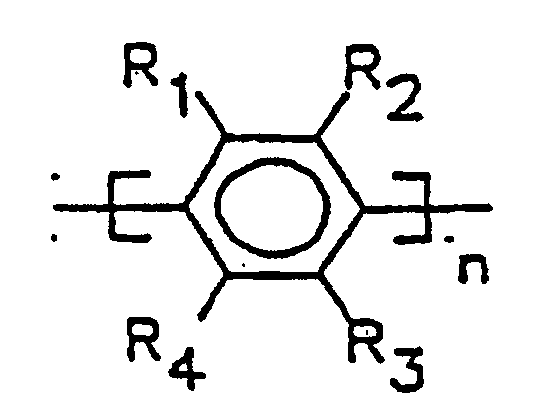
- Polymer nach Anspruch 1, wobei mindestens 30 % der Monomereinheiten eine löslichmachende Seitengruppe umfassen.
- Polymer nach Anspruch 1, wobei mindestens eine der Gruppen Rist, wobei X ausgewählt ist aus der Gruppe bestehend aus Wasserstoff, Amino, Methylamino; Dimethylamino, Methyl, Phenyl, Benzyl, Benzoyl, Hydroxy, Methoxy, Phenoxy, -SC6H5 und -OCOCH3.

- Polymer nach Anspruch 1, wobei mindestens eine der Gruppen Rist und wobei X ausgewählt ist aus der Gruppe bestehend aus Methyl, Ethyl, Phenyl, Benzyl, F und CF3 und wobei n 1, 2, 3, 4 oder 5 ist.
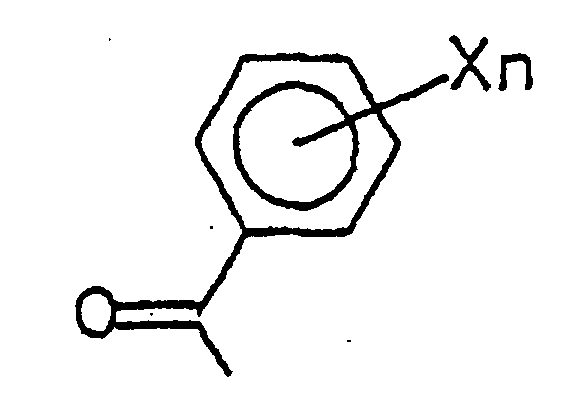
- Polymer nach Anspruch 1, wobei einer unter R1, R2, R3 oder R4 ausgewählt ist aus der Gruppe bestehend aus -CR5R6Ar, wobei Ar Aryl ist, R5 und R6 H, Methyl, F, C1 bis C20 Alkoxy, OH sind oder wobei R5 und R6 zusammengenommen eine verbindende Gruppe darstellen, umfassend -OCH2CH2O-, -OCH2CH(CH2OH)O-, -OC6H4O- (Catechol), -OC6H10O- (1,2-Cyclohexandiol) und -OCH2CHR7O- wobei R7 Alkyl oder Aryl ist.
- Polymer nach Anspruch 1, wobei mindestens eine der Gruppen R -(CO)X ist und X ausgewählt ist aus der Gruppe bestehend aus 2-Pyridyl, 3-Pyridyl, 4-Pyridyl, -CH2C6H5, -CH2CH2C6H5, 1-Naphthyl und 2-Naphthyl.
- Polymer nach Anspruch 1, wobei mindestens eine der Gruppen R -SO2X ist und wobei X ausgewählt ist aus der Gruppe bestehend aus Phenyl, Tolyl, 1-Naphthyl, 2-Naphthyl, Methoxyphenyl und Phenoxyphenyl.
- Polymer nach Anspruch 1, wobei mindestens eine der Gruppen R -NR5R6 ist und wobei R5 und R6 gleich oder verschieden sein können und unabhängig ausgewählt sind aus der Gruppe bestehend aus Wasserstoff, Methyl, Ethyl, Phenyl, -COCH3 und verbindenden Gruppen, wenn R5 und R6 zusammengenommen werden, -CH2CH2OCH2CH2-, -CH2CH2CH2CH2CH2- und -CH2CH2CH2CH2-.
- Polymer nach Anspruch 1, wobei mindestens eine der Gruppen R -N=CR5R6 ist, wobei R5 und R6 gleich oder verschieden sein können und unabhängig ausgewählt sind aus der Gruppe bestehend aus -H, -CH3, -CH2CH3, Phenyl, Tolyl, Methoxyphenyl, Benzyl, Aryl, C1 bis C22 Alkyl und verbindenden Gruppen, wenn R5 und R6 zusammengenommen werden, -CH2CH2OCH2CH2-, -CH2CH2CH2CH2CH2- und -CH2CH2CH2CH2-.
- Polymer nach Anspruch 1, wobei die Grenzviskosität besagten Polymeren größer als etwa 5 Deziliter/Gramm ist.
- Polymer nach Anspruch 1, wobei das Gewichtsmittel des Molekulargewichts besagten Polymeren, gemessen durch Gelpermeationschromatografie gegenüber Polystyrolstandards, größer als 100000 ist.
- Polymer nach Anspruch 1, wobei das Gewichtsmittel des Molekulargewichts besagten Polymeren, gemessen durch Gelpermeationschromatografie gegen Polystyrolstandards, gräßer als 250000 ist
- Polymer nach Anspruch 1, wobei das Gewichtsmittel des Molekulargewichts besagten Polymeren, gemessen durch Gelpermeationschromatografie gegen Polystyrolstandards, größer als 500000 ist
- Polymer nach Anspruch 1, wobei das Zugmodul eines nicht orientierten 25 Mikron-Films besagten Polymeren größer als (0,75 Millionen Pfund pro Quadratinch) 5,17 Millionen KPa ist.
- Polymer nach Anspruch 1, wobei das Zugmodul eines nicht orientierten 25 Mikron-Films besagten Polymeren größer als (1,5 Millionen Pfund pro Quadratinch) 10,37 Millionen KPa ist
- Verfahren für die Herstellung des Polymers nach Anspruch 1, wobei R1 Benzoyl ist und R2-R4 Wasserstoff sind, umfassend die reduktive Kupplungspolymerisation von 2,5-Dichlorobenzophenon mit Zink in einem wasserfreien Amid-Lösungsmittel in der Gegenwart von 1) einem Nickelkatalysatoren 2) einem Promotoren, ausgewählt aus der Gruppe bestehend aus Nullvariante, Alkalimetallchloriden, Alkalimetallbromiden, Alkalimetalliodiden und Zinkchlorid, und 3) einem Phosphinliganden.
- Verfahren für die Herstellung des Polymers nach Anspruch 3, umfassend die reduktive Kupplungspolymerisation eines Aroyl-2,5-dichlorobenzols mit Zink in einem wasserfreien Amid-Lösungsmittel in der Gegenwart von 1) einem Nickelkatalysatoren 2) einem Promotoren, ausgewählt aus der Gruppe bestehend aus Nullvariante, Alkalimetallchloriden, Alkalimetallbromiden, Alkalimetalliodiden und Zinkchlorid, und 3) einem Phosphinliganden.
- Freistehende Filme, Fasern, Schäume, faserartige Vliesmatten, geformte Artikel, Beschichtungszusammensetzungen, umfassend ein Polymer nach Anspruch 1, Multichipmodule, umfassend eine Mehrzahl an elektrischen Schichten, umfassend ein Polymer nach Anspruch 1, Fasern, enthaltend Composite, wobei das Matrixharz ein Polymer nach Anspruch 1 umfasst, gedruckte Schaltkreiskarten, wobei das Dielektrikum ein Polymer nach Anspruch 1 umfasst, und semipermeable Membranen, geformt durch Nassgießen einer Lösung, umfassend das Polymer nach Anspruch 1.
- Verwendung des Polymers nach Anspruch 1 zur Verringerung der Flammbarkeit von Polymerzusammensetzungen, umfassend das Einführen eines Additivs, umfassend ein Polymer nach Anspruch 1 in besagte Polymerzusammensetzung.
- Verwendung des Polymers nach Anspruch 1 zur Reduktion des Kriechens von Polymerzusammensetzungen, umfassend die Blendherstellung oder eine andere Einmischung eines Additivs, umfassend ein Polymer nach Anspruch 1, mit besagter Polymerzusammensetzung.
- Verwendung des Polymers nach Anspruch 1 zur Verringerung des Koeffizienten der thermischen Ausdehnung von polymeren Zusammensetzungen oder zum Erhöhen des Moduls einer Polymerzusammensetzung oder zur Erhöhung der Zähigkeit von Polymerzusammensetzungen oder zur Erhöhung der Abriebwiderstandsfähigkeit von Polymerzusammensetzungen, umfassend das Herstellen eines Blends oder eine andere Einmischung eines Additivs, umfassend ein Polymer nach Anspruch 1 mit besagter Polymerzusammensetzung.
- Verwendung eines Polymers nach Anspruch 1 für die Herstellung von freistehenden Filmen, umfassend das Schmelzen besagten Polymeren und Extrudieren der Schmelze durch einen Schlitz.
- Verwendung eines Polymers nach Anspruch 1 für die Herstellung eines Films, umfassend das Gießen einer Lösung besagten Polymeren auf eine Trägeroberfläche, gefolgt von Entfernung des Lösungsmittels, oder umfassend das Gießen einer Lösung besagten Polymeren auf eine Trägeroberfläche, gefolgt durch Eintauchung in ein Nichtlösungsmittel für besagtes Polymer.
- Verwendung eines Polymers nach Anspruch 1 für die Herstellung von Fasern, umfassend das Schmelzspinnen von Zusammensetzungen, enthaltend mindestens 50 Gew.-% besagten Polymeren, oder umfassend das Nassspinnen von Lösungen, wobei die gelösten Feststoffe mindestens 50 Gew.-% besagten Polymeren umfassen, oder umfassend das Trockendüsennassspinnen von Lösungen besagten Polymeren, wobei die gelösten Feststoffe mindestens 50 Gew.-% besagten Polymeren umfassen.
- Verwendung eines Polymers nach Anspruch 1 für die Beschichtung von festen Artikeln, umfassend die Anwendung einer Lösung umfassend besagtes Polymer, wobei die gelösten Feststoffe mindestens 50 Gew.-% besagten Polymeren umfassen, gefolgt von Entfernung des Lösungsmittels.
- Verwendung eines Polymers nach Anspruch 1 für die Beschichtung von festen Artikeln mit Polymerzusammensetzungen, enthaltend mindestens 50 Gew.-% des Polymers nach Anspruch 1, umfassend das Einsprühen des Artikels mit geschmolzenen Tröpfchen besagter Polymerzusammensetzung oder umfassend die Pulverbeschichtung des Artikels mit besagter Polymerzusammensetzung.
- Verwendung eines Polymers nach Anspruch 1 für die Herstellung von festen Artikels durch das Kompressionsformen, Walzenformen, Kalendem, Blasformen, Spritzgießen oder Extrudieren durch eine Düse einer Zusammensetzung umfassend ein Polymer nach Anspruch 1.
- Verwendung nach Anspruch 27, wobei die Zusammensetzung ein Polymer nach Anspruch 3 umfasst und wobei die festen Artikel hergestellt werden durch Kompressionsformung oder Spritzgießen.
- Verwendung eines Polymers nach Anspruch 1 für die Herstellung von Faser enthaltenden Compositen, umfassend die Stufen:Vermischen von Fasern, umfassend das Polymer nach Anspruch 1, mit Fasern aus einem zweiten Material,Formen der vermischten Fasern zu einer geeigneten Form, undErwärmen, um hervorzurufen, dass die Fasern, enthaltend das Polymer nach Anspruch 1 schmelzen.
- Verwendung eines Polymers nach Anspruch 1 für die Herstellung eines festen Artikels durch 1) Herstellen einer Blattlage, umfassend das Polymer nach Anspruch 1 und 2) Thermoformung besagter Blattlage, durch Anwendung von Wärme und Druck, zur endgültigen Form.
- Verwendung eines Polymers nach Anspruch 1 zur Herstellung eines zusammengesetzten Artikels durch Pultrusion von Fasern, umfassend das Polymer nach Anspruch 1, mit einem thermoplastischen Material mit einem niedrigeren Schmelzpunkt.
- Verwendung eines Polymers nach Anspruch 1 für die Herstellung eines Compositartikels durch Pultrusion einer thermoplastischen Zusammensetzung, umfassend das Polymer nach Anspruch 1, mit Fasern, die nicht bei den Pultrusionsbedingungen schmelzen.
- Verwendung nach Anspruch 21, weiter umfassend das Einmischen eines oder mehrerer Verträglichmacher, ausgewählt aus der Gruppe bestehend aus NMP, DMAC, DMF, Diphenylether, Styrol-Maleinsäureanhydridcopolymer und Copolymeren, wobei eine Komponente besagten Verträglichmachers ähnlich besagter Polymerzusammensetzung ist, die modifiziert werden soll, und eine andere Komponente besagten Verträglichkeitsmachers ein Polymer ist, das eine feste Lösung mit besagtem Polymer nach Anspruch 1 formen wird.
- Zusammensetzung, umfassend das Polymer nach Anspruch 1 und ein zweites Polymer.
- Zusammensetzung nach Anspruch 34, wobei besagtes zweites Polymer ausgewählt ist aus der Gruppe bestehend aus Polyamiden, Polycarbonat, Polyimiden, Polyestem, Polyolefinen, Polyacrylaten, Polystyrolen, Polyarylaten, Polyarylethem, Polyarylsulfiden, Polysiloxanen, Polyacetalen, Polyurethanen, Polycyanaten, Epoxyharzen, phenolischen Harzen, Cellulosematerialien, anderen natürlichen Polymeren, Gummi, Lacken, Gummi- und Latexmaterialien und Copolymeren, Mischungen, Blends und Legierungen dieser Polymere, Poly(hexamethylenadipamid), Poly(bisphenol-A-carbonat), Poly(bisphenol-A-terephthalat), Poly(bisphenol-A-isophthalat), Poly(acrylonitril), Polystyrol, Poly(methylmethacrylat), Poly(vinylchlorid), Poly(vinylidenchlorid), Poly(vinylalkohol), Poly(vinylacetat), Poly(acrylamid), Poly(ethylenoxid), Poly(propylenoxid), Poly(phenylenoxid), Poly(phenylensulfid), Poly(acetal), Poly(ethylen), Poly(isopren), Poly(cyclopentadien), Poly(chlorobutadien, Poly(tetrafluoroethylen) und Poly(vinylidenfluorid).
- Zusammensetzung nach Anspruch 34, wobei besagtes zweites Polymer ein Thermosetpolymer, ein thermoplastisches Polymer oder ein flüssigkristallines Polymer ist.
- Polymere Zusammensetzung, umfassend:(a) eine Polymerbasis, zusammengemischt mit(b) einem Additiv, umfassend ein Polymer nach Anspruch 1.
- Segmentiertes Rigid-Rod-Polymer mit der Formelwobei
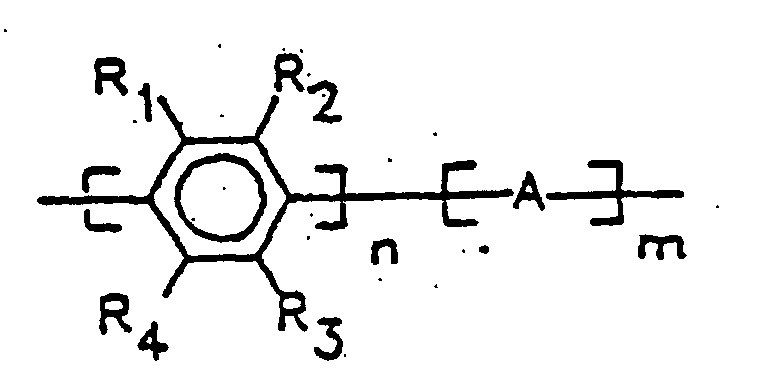 ein Rigid-Rod-Polyphenylensegment ist, wobei R1, R2, R3 und R4 auf jeder Monomereinheit jeweils unabhängig voneinander H oder eine löslichmachende Seitengruppe sind, wobei mindestens eine unter 100 Monomereinheiten in den Rigid-Rod-Segmenten eine löslichmachende Seitengruppe umfasst, und
- Polymer nach Anspruch 38, wobei die Nicht-Rigid-Rod-Segmente abgeleitet sind von dihaloaromatischen Monomeren der Strukturwobei R1-R8 unabhängig ausgewählt sind unter löslichmachenden Seitengruppen und H, wobei G -O-, -S-, -CH2-, -CY2-, -OCH2-, -OAr-, -O(ArO)n-, -1,3-Phenylen-, -1,2-Phenylen-, -(CH2)n-, -(CY2)n-, -CO-, -CO2-, -CONY-, -O(CH2CH2O)n-, -(CF2)n-, -COArCO-, -CO(CH2)nCO-, -C(CF3)2-, -C(CF3)Y-, -NY-, -P(=O)Y-, ist, X Cl, Br oder I ist und Ar eine aromatische Gruppe, eine heteroaromatische Gruppe oder eine substituierte aromatische Gruppe ist und Y unabhängig ausgewählt ist aus der Gruppe bestehend aus H, F, CF3, Alkyl, Aryl, Heteroaryl, und Aralkyl, und n 1 oder mehr ist.
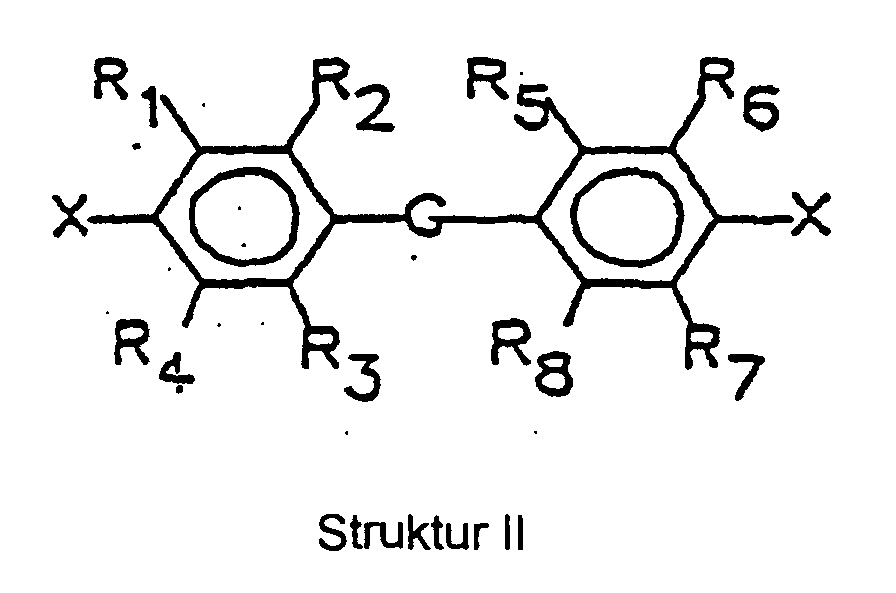
- Polymer nach Anspruch 38, wobei -A-ist, wobei B1-B4 unabhängig ausgewählt sind aus der Gruppe bestehend aus H, C1 bis C22Alkyl, C6 bis C20Ar, Alkaryl, F, CF3, Phenoxy, -COAr, COAlkyl, -CO2Ar, -CO2Alkyl, wobei Ar Aryl oder Heteroaryl ist.

- Polymer nach Anspruch 38, wobei -A-1,3-Phenylen ist.
- Polymer nach Anspruch 38, wobei mindestens etwa 30 % der Monomereinheiten eine löslichmachende Seitengruppe umfassen.
- Polymer nach Anspruch 38, wobei mindestens eine der Gruppen Rist, wobei X ausgewählt ist aus der Gruppe bestehend aus Wasserstoff, Amino, Methylamino, Dimethylamino, Methyl, Phenyl, Benzyl, Benzoyl, Hydroxy, Methoxy, Phenoxy, -SC6H5, -OCOCH3.

- Polymer nach Anspruch 38, wobei mindestens eine der Gruppen Rist, wobei X ausgewählt ist aus der Gruppe bestehend aus Methyl, Ethyl, Phenyl, Benzyl, F und CF3 und n 1, 2, 3, 4 oder 5 ist.
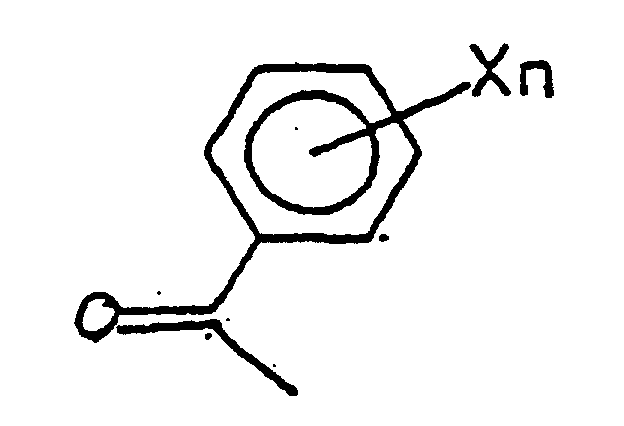
- Polymer nach Anspruch 38, wobei R1 ausgewählt ist aus der Gruppe bestehend aus -CR5R6Ar, wobei Ar Aryl ist, R5 und R6 H, Methyl, F, C1 bis C20 Alkoxy, OH sind oder R5 und R6 zusammengenommen eine verbrückende Gruppe darstellen, ausgewählt unter -OCH2CH2O-, -OCH2CH(CH2OH)O-, -OC6H4O- (Catechol), -OC6H10O- (1,2-Cyclohexandiol) und -OCH2CHR7O- wobei R7 Alkyl oder Aryl ist.
- Polymer nach Anspruch 38, wobei mindestens eine der Gruppen R -(CO)X ist und wobei X ausgewählt ist aus der Gruppe bestehend aus 2-Pyridyl, 3-Pyridyl, 4-Pyridyl, -CH2C6H5, -CH2CH2C6H5, 1-Naphthyl und 2-Naphthyl.
- Polymer nach Anspruch 38, wobei mindestens eine der Gruppen R -SO2X ist und wobei X ausgewählt ist aus der Gruppe bestehend aus Phenyl, Tolyl, 1-Naphthyl, 2-Naphthyl, Methoxyphenyl und Phenoxyphenyl.
- Polymer nach Anspruch 38, wobei mindestens eine der Gruppen R -NR5R6 ist und wobei R5 und R6 gleich oder verschieden sein können und unabhängig ausgewählt sind aus der Gruppe bestehend aus Wasserstoff, Methyl, Ethyl, Phenyl, -COCH3 und verbrückenden Gruppen, wenn R5 und R6 zusammengenommen werden, -CH2CH2OCH2CH2-, -CH2CH2CH2CH2CH2- und -CH2CH2CH2CH2-.
- Polymer nach Anspruch 38, wobei mindestens eine der Gruppen R -N-CR5R6 ist, wobei R5 und R6 gleich oder verschieden sein können und unabhängig ausgewählt sind aus der Gruppe bestehend aus -H, -CH3, -CH2CH3, Phenyl, Tolyl, Methoxyphenyl, Benzyl, Aryl, C1 bis C22 Alkyl und verbindenden Gruppen, wenn R5 und R6 zusammengenommen werden, -CH2CH2OCH2CH2-, -CH2CH2CH2CH2CH2-.
- Polymer nach Anspruch 38, wobei die Grenzviskosität besagten Polymers größer als 1 Deziliter/Gramm ist.
- Polymer nach Anspruch 38, wobei das Gewichtsmittel des Molekulargewichts besagten Polymers, gemessen durch Gelpermeationschromatografie gegen Polystyrolstandard, größer als 100000 ist.
- Polymer in Übereinstimmung mit Anspruch 38, wobei der Zugmodul eines nicht orientierten 25 Mikron-Films besagten Polymeren größer als (0,75 Millionen Pfund pro Quadratinch) 5,17 Millionen KPa ist.
- Verfahren für die Herstellung des Polymers nach Anspruch 38, umfassend die reduktive Kupplungspolymerisation eines Aroyl-2,5-dichlorobenzols und eines nicht starren Dichloroarens mit Zink in einem wasserfreien Amid-Lösungsmittel in der Gegenwart von 1) eines Nickelkatalysatoren, 2) eines Promotoren, ausgewählt aus der Gruppe bestehend aus Nullvariante, Alkalimetallchloriden, Alkalimetallbromiden, Alkalimetalliodiden und Zinkchlorid, und 3) einem Phosphinligand.
- Freistehender Film, Beschichtungszusammensetzungen, semipermeable Membranen, Fasem, Schäume, faserartige Vliesmatten, geformte Artikel, umfassend ein Polymer nach Anspruch 38, Faser enthaltende Composite, wobei das Matrixharz ein Polymer nach Anspruch 38 umfasst, gedruckte Schaltkreiskarten, wobei das Dielektrikum ein Polymer nach Anspruch 38 umfasst, Multichipmodule, umfassend eine Mehrzahl an dielektrischen Schichten, umfassend das Polymer nach Anspruch 38.
- Verwendung des Polymers nach Anspruch 38 zur Herstellung von Filmen und Fasern, umfassend das Schmelzen besagten Polymeren und Extrudieren der Schmelze durch eine Öffnung.
- Verwendung eines Polymers nach Anspruch 38 für die Herstellung von festen Artikeln durch Kompressionsformen, Extrudieren durch eine Öffnung oder Spritzgießen einer Zusammensetzung, umfassend ein Polymer nach Anspruch 38.
- Verwendung eines Polymers nach Anspruch 38 für die Herstellung eines festen Artikels durch 1) Herstellen einer Blattlage, umfassend das Polymer nach Anspruch 38, und 2) Thermoformen besagter Blattlage durch Anwendung von Wärme und Druck, zu einer endgültigen Form.
- Verwendung eines Polymers nach Anspruch 38, für die Reduktion des Kriechens in Polymerzusammensetzungen, zur Verringerung des Koeffizienten der thermischen Expansion von polymeren Zusammensetzungen oder zum Erhöhen des Moduls einer Polymerzusammensetzung, umfassend die Herstellung eines Blends oder einer anderen Art der Einmischung eines Additivs, umfassend ein Polymer nach Anspruch 38, mit besagter Polymerzusammensetzung.
- Zusammensetzung, umfassend das Polymer nach Anspruch 38 und ein zweites Polymer.
- Polymer in Übereinstimmung mit Anspruch 1, das ein Homopolymer ist.
- Polymer in Übereinstimmung mit Anspruch 1, wobei das Polymer Poly-1,4-(benzoylphenylen) ist, mit der Formel
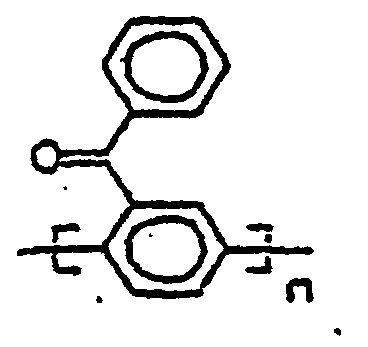
- Polymer in Übereinstimmung mit Anspruch 1, wobei das Polymer Poly-1,4-(4'phenoxybenzoylphenylen) ist, mit der Formel

- Polymer in Übereinstimmung mit Anspruch 1, wobei das Polymer Poly-1,4-(methoxyethoxyethoxyethoxy-carbonylphenylen) ist, mit der Formel
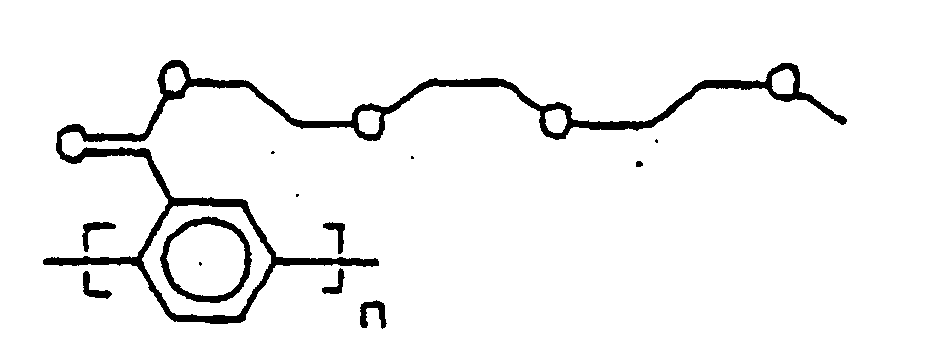
- Polymer in Übereinstimmung mit Anspruch 1, wobei R2, R3 und R4 Wasserstoff sind.
- Polymer in Übereinstimmung mit Anspruch 1, wobei das Molekulargewicht der löslichmachenden Seitengruppe von 15 bis 300 beträgt.
- Polymer in Übereinstimmung mit Anspruch 1, wobei R2, R3 und R4 Wasserstoff sind und das Molekulargewicht der löslichmachenden Seitengruppe im Bereich von 15 bis 300 ist.
Priority Applications (1)
| Application Number | Priority Date | Filing Date | Title |
|---|---|---|---|
| EP03010202A EP1352731A3 (de) | 1992-03-06 | 1993-02-24 | Verfahren zur Orientierung von Polymermolekülen |
Applications Claiming Priority (3)
| Application Number | Priority Date | Filing Date | Title |
|---|---|---|---|
| US84732192A | 1992-03-06 | 1992-03-06 | |
| US847321 | 1992-03-06 | ||
| PCT/US1993/001732 WO1993018076A1 (en) | 1992-03-06 | 1993-02-24 | Rigid-rod polymers |
Related Child Applications (1)
| Application Number | Title | Priority Date | Filing Date |
|---|---|---|---|
| EP03010202A Division EP1352731A3 (de) | 1992-03-06 | 1993-02-24 | Verfahren zur Orientierung von Polymermolekülen |
Publications (3)
| Publication Number | Publication Date |
|---|---|
| EP0629217A1 EP0629217A1 (de) | 1994-12-21 |
| EP0629217A4 EP0629217A4 (de) | 1995-03-29 |
| EP0629217B1 true EP0629217B1 (de) | 2003-05-07 |
Family
ID=25300330
Family Applications (2)
| Application Number | Title | Priority Date | Filing Date |
|---|---|---|---|
| EP93907055A Expired - Lifetime EP0629217B1 (de) | 1992-03-06 | 1993-02-24 | Feste, stäbchenförmige polymere |
| EP03010202A Withdrawn EP1352731A3 (de) | 1992-03-06 | 1993-02-24 | Verfahren zur Orientierung von Polymermolekülen |
Family Applications After (1)
| Application Number | Title | Priority Date | Filing Date |
|---|---|---|---|
| EP03010202A Withdrawn EP1352731A3 (de) | 1992-03-06 | 1993-02-24 | Verfahren zur Orientierung von Polymermolekülen |
Country Status (5)
| Country | Link |
|---|---|
| EP (2) | EP0629217B1 (de) |
| JP (1) | JP3245166B2 (de) |
| CA (1) | CA2130004C (de) |
| DE (1) | DE69332949T2 (de) |
| WO (1) | WO1993018076A1 (de) |
Cited By (1)
| Publication number | Priority date | Publication date | Assignee | Title |
|---|---|---|---|---|
| WO2022175455A1 (en) * | 2021-02-22 | 2022-08-25 | Solvay Specialty Polymers Usa, Llc | High hardness films |
Families Citing this family (24)
| Publication number | Priority date | Publication date | Assignee | Title |
|---|---|---|---|---|
| EP0566149B1 (de) * | 1992-04-17 | 2004-11-17 | Mazda Motor Corporation | Verbundmaterial und Verfahren zu dessen Herstellung |
| DE4401217A1 (de) * | 1994-01-18 | 1995-07-20 | Bayer Ag | Polymerblends |
| JP4104680B2 (ja) * | 1995-11-09 | 2008-06-18 | ミシシッピ ポリマー テクノロジーズ | 複素環式側基を有するポリマー |
| WO1998033836A1 (en) * | 1997-01-30 | 1998-08-06 | Jsr Corporation | Process for producing phenylene-containing polymer and film-forming material |
| DE10159946A1 (de) * | 2001-12-06 | 2003-06-18 | Covion Organic Semiconductors | Prozess zur Herstellung von Aryl-Aryl gekoppelten Verbindungen |
| JP4583705B2 (ja) | 2002-11-28 | 2010-11-17 | トヨタ自動車株式会社 | 含燐高分子化合物、その合成方法、高耐久性固体高分子電解質組成物、及び燃料電池 |
| US8067073B2 (en) | 2004-03-25 | 2011-11-29 | Boston Scientific Scimed, Inc. | Thermoplastic medical device |
| US8240252B2 (en) * | 2005-03-07 | 2012-08-14 | Nikica Maljkovic | Ammunition casing |
| JP4817690B2 (ja) * | 2005-03-25 | 2011-11-16 | 帝人化成株式会社 | 射出成形品およびその製造方法 |
| JP2006276655A (ja) * | 2005-03-30 | 2006-10-12 | Teijin Chem Ltd | プラスティックミラー用成形材料 |
| US7820767B2 (en) | 2006-03-07 | 2010-10-26 | Solvay Advanced Polymers, L.L.C. | Aromatic polyimide composition |
| DE602007010429D1 (de) * | 2006-03-07 | 2010-12-23 | Solvay Advanced Polymers Llc | Neue aromatische polyimidzusammensetzung |
| ATE517946T1 (de) * | 2006-03-07 | 2011-08-15 | Solvay Advanced Polymers Llc | Neue polyarylenzusammensetzung |
| US20080312387A1 (en) | 2006-08-11 | 2008-12-18 | Solvay Advanced Polymers, L.L.C. | New Polyarylene Composition |
| DE602007011298D1 (de) | 2006-09-06 | 2011-01-27 | Solvay Advanced Polymers Llc | Neue aromatisches polycarbonat enthaltende zusammensetzung |
| GB201320881D0 (en) * | 2013-11-26 | 2014-01-08 | Cambridge Display Tech Ltd | Organic light-emitting device and method |
| US9868820B2 (en) | 2014-08-29 | 2018-01-16 | Rohm And Haas Electronic Materials Llc | Polyarylene materials |
| JP2016088050A (ja) * | 2014-11-11 | 2016-05-23 | 住友ベークライト株式会社 | 樹脂層付き金属膜 |
| WO2016102113A1 (en) * | 2014-12-22 | 2016-06-30 | Solvay Specialty Polymers Usa, Llc | Polyphenylene fibers and corresponding fabrication methods |
| JP6596289B2 (ja) * | 2015-09-28 | 2019-10-23 | 旭化成株式会社 | ポリフェニレン共重合体を含む微多孔膜、及びその製造方法 |
| US10790146B2 (en) | 2016-12-05 | 2020-09-29 | Rohm And Haas Electronic Materials Llc | Aromatic resins for underlayers |
| CN107474225B (zh) * | 2017-09-20 | 2019-05-10 | 陕西科技大学 | 一种化学气相沉积法制备聚对二甲苯纳米纤维的方法 |
| US12064731B2 (en) * | 2018-12-20 | 2024-08-20 | Solvay Specialty Polymers Usa, Llc | Porous membranes for high pressure filtration |
| CN116180329A (zh) * | 2023-02-14 | 2023-05-30 | 上海理工大学 | 一种静电纺丝制备超交联聚合物纤维膜的方法 |
Family Cites Families (6)
| Publication number | Priority date | Publication date | Assignee | Title |
|---|---|---|---|---|
| US3582498A (en) * | 1967-09-05 | 1971-06-01 | Hughes Aircraft Co | Method of producing solvent soluble fusible polyphenylene polymers |
| CA1129418A (en) * | 1979-09-11 | 1982-08-10 | Ismael Colon | Coupling of aryl and heteroaryl polyhalides |
| US4486576A (en) * | 1982-04-22 | 1984-12-04 | Union Carbide Corporation | High-temperature, aromatic coating materials from aryl polyhalides |
| JP3009691B2 (ja) * | 1988-02-17 | 2000-02-14 | マックスデム インコーポレイテッド | 剛直性ポリマー |
| US5227457A (en) * | 1988-02-17 | 1993-07-13 | Maxdem Incorporated | Rigid-rod polymers |
| DE3821567A1 (de) * | 1988-06-25 | 1989-12-28 | Bayer Ag | Loesliche polyaromaten |
-
1993
- 1993-02-24 EP EP93907055A patent/EP0629217B1/de not_active Expired - Lifetime
- 1993-02-24 JP JP51576893A patent/JP3245166B2/ja not_active Expired - Lifetime
- 1993-02-24 WO PCT/US1993/001732 patent/WO1993018076A1/en not_active Ceased
- 1993-02-24 CA CA002130004A patent/CA2130004C/en not_active Expired - Fee Related
- 1993-02-24 EP EP03010202A patent/EP1352731A3/de not_active Withdrawn
- 1993-02-24 DE DE69332949T patent/DE69332949T2/de not_active Expired - Lifetime
Cited By (1)
| Publication number | Priority date | Publication date | Assignee | Title |
|---|---|---|---|---|
| WO2022175455A1 (en) * | 2021-02-22 | 2022-08-25 | Solvay Specialty Polymers Usa, Llc | High hardness films |
Also Published As
| Publication number | Publication date |
|---|---|
| CA2130004A1 (en) | 1993-09-07 |
| DE69332949T2 (de) | 2003-11-27 |
| EP0629217A4 (de) | 1995-03-29 |
| WO1993018076A1 (en) | 1993-09-16 |
| EP1352731A3 (de) | 2009-10-21 |
| DE69332949D1 (de) | 2003-06-12 |
| EP0629217A1 (de) | 1994-12-21 |
| JPH07504456A (ja) | 1995-05-18 |
| CA2130004C (en) | 2007-04-24 |
| JP3245166B2 (ja) | 2002-01-07 |
| EP1352731A2 (de) | 2003-10-15 |
Similar Documents
| Publication | Publication Date | Title |
|---|---|---|
| US6087467A (en) | Rigid-rod polymers | |
| US5654392A (en) | Rigid-rod polymers | |
| EP1352731A2 (de) | Verfahren zur Orientierung von Polymermolekülen | |
| US5496893A (en) | Macromonomers having reactive side groups | |
| CA2001716C (en) | Rigid-rod polymers | |
| US4835197A (en) | Aromatic polymer compositions | |
| EP0428743B1 (de) | Poly(arylen-äther-keton), verfahren zur herstellung desselben und dessen verwendung | |
| US5565543A (en) | Rigid-rod polymers | |
| JPH07278303A (ja) | 芳香族コポリアミド、その製法、成形構造体およびその製法 | |
| CN114651031B (zh) | 反应性聚酰胺酰亚胺寡聚物、方法及制品 | |
| JP2009529079A (ja) | 新規なポリアリーレン組成物 | |
| US4920005A (en) | Aromatic polymer compositions | |
| US5039779A (en) | Thermoplastically processible aromatic polyetheramide from 2,2-bis(4'-amino phenoxy phenyl) propane and terephthalic acid | |
| WO1993018077A1 (en) | Rigid-rod polymers | |
| JPH04501739A (ja) | ポリキノリン共重合体 | |
| JPS646232B2 (de) | ||
| JPH0224321A (ja) | 熱可塑性樹脂として加工できる芳香族コポリエーテルアミド、その製造方法およびそれを成形体の製造に用いる方法 | |
| JPH02281077A (ja) | 高分子複合体の製造法 |
Legal Events
| Date | Code | Title | Description |
|---|---|---|---|
| PUAI | Public reference made under article 153(3) epc to a published international application that has entered the european phase |
Free format text: ORIGINAL CODE: 0009012 |
|
| 17P | Request for examination filed |
Effective date: 19940905 |
|
| AK | Designated contracting states |
Kind code of ref document: A1 Designated state(s): DE FR GB IT NL |
|
| A4 | Supplementary search report drawn up and despatched |
Effective date: 19950206 |
|
| AK | Designated contracting states |
Kind code of ref document: A4 Designated state(s): DE FR GB IT NL |
|
| 17Q | First examination report despatched |
Effective date: 19981113 |
|
| RAP1 | Party data changed (applicant data changed or rights of an application transferred) |
Owner name: MISSISSIPPI POLYMER TECHNOLOGIES, INC. |
|
| GRAH | Despatch of communication of intention to grant a patent |
Free format text: ORIGINAL CODE: EPIDOS IGRA |
|
| GRAH | Despatch of communication of intention to grant a patent |
Free format text: ORIGINAL CODE: EPIDOS IGRA |
|
| GRAA | (expected) grant |
Free format text: ORIGINAL CODE: 0009210 |
|
| AK | Designated contracting states |
Designated state(s): DE FR GB IT NL |
|
| PG25 | Lapsed in a contracting state [announced via postgrant information from national office to epo] |
Ref country code: NL Free format text: LAPSE BECAUSE OF FAILURE TO SUBMIT A TRANSLATION OF THE DESCRIPTION OR TO PAY THE FEE WITHIN THE PRESCRIBED TIME-LIMIT Effective date: 20030507 Ref country code: IT Free format text: LAPSE BECAUSE OF FAILURE TO SUBMIT A TRANSLATION OF THE DESCRIPTION OR TO PAY THE FEE WITHIN THE PRESCRIBED TIME-LIMIT;WARNING: LAPSES OF ITALIAN PATENTS WITH EFFECTIVE DATE BEFORE 2007 MAY HAVE OCCURRED AT ANY TIME BEFORE 2007. THE CORRECT EFFECTIVE DATE MAY BE DIFFERENT FROM THE ONE RECORDED. Effective date: 20030507 |
|
| REG | Reference to a national code |
Ref country code: GB Ref legal event code: FG4D |
|
| REF | Corresponds to: |
Ref document number: 69332949 Country of ref document: DE Date of ref document: 20030612 Kind code of ref document: P |
|
| NLV1 | Nl: lapsed or annulled due to failure to fulfill the requirements of art. 29p and 29m of the patents act | ||
| ET | Fr: translation filed | ||
| PLBE | No opposition filed within time limit |
Free format text: ORIGINAL CODE: 0009261 |
|
| STAA | Information on the status of an ep patent application or granted ep patent |
Free format text: STATUS: NO OPPOSITION FILED WITHIN TIME LIMIT |
|
| 26N | No opposition filed |
Effective date: 20040210 |
|
| REG | Reference to a national code |
Ref country code: FR Ref legal event code: ST Effective date: 20061031 |
|
| REG | Reference to a national code |
Ref country code: FR Ref legal event code: D3 |
|
| PG25 | Lapsed in a contracting state [announced via postgrant information from national office to epo] |
Ref country code: FR Free format text: LAPSE BECAUSE OF NON-PAYMENT OF DUE FEES Effective date: 20060228 |
|
| PGFP | Annual fee paid to national office [announced via postgrant information from national office to epo] |
Ref country code: FR Payment date: 20100223 Year of fee payment: 18 |
|
| PGFP | Annual fee paid to national office [announced via postgrant information from national office to epo] |
Ref country code: GB Payment date: 20100202 Year of fee payment: 18 Ref country code: DE Payment date: 20100303 Year of fee payment: 18 |
|
| GBPC | Gb: european patent ceased through non-payment of renewal fee |
Effective date: 20110224 |
|
| REG | Reference to a national code |
Ref country code: FR Ref legal event code: ST Effective date: 20111102 |
|
| REG | Reference to a national code |
Ref country code: DE Ref legal event code: R119 Ref document number: 69332949 Country of ref document: DE Effective date: 20110901 |
|
| PG25 | Lapsed in a contracting state [announced via postgrant information from national office to epo] |
Ref country code: GB Free format text: LAPSE BECAUSE OF NON-PAYMENT OF DUE FEES Effective date: 20110224 |
|
| PG25 | Lapsed in a contracting state [announced via postgrant information from national office to epo] |
Ref country code: DE Free format text: LAPSE BECAUSE OF NON-PAYMENT OF DUE FEES Effective date: 20110901 |
|
| PG25 | Lapsed in a contracting state [announced via postgrant information from national office to epo] |
Ref country code: FR Free format text: LAPSE BECAUSE OF NON-PAYMENT OF DUE FEES Effective date: 20110228 |