EP0629348A2 - Nouvelle composition de levure - Google Patents
Nouvelle composition de levure Download PDFInfo
- Publication number
- EP0629348A2 EP0629348A2 EP94870100A EP94870100A EP0629348A2 EP 0629348 A2 EP0629348 A2 EP 0629348A2 EP 94870100 A EP94870100 A EP 94870100A EP 94870100 A EP94870100 A EP 94870100A EP 0629348 A2 EP0629348 A2 EP 0629348A2
- Authority
- EP
- European Patent Office
- Prior art keywords
- leavening
- rate
- calcium
- dough
- reaction
- Prior art date
- Legal status (The legal status is an assumption and is not a legal conclusion. Google has not performed a legal analysis and makes no representation as to the accuracy of the status listed.)
- Granted
Links
Images








Classifications
-
- A—HUMAN NECESSITIES
- A21—BAKING; EDIBLE DOUGHS
- A21D—TREATMENT OF FLOUR OR DOUGH FOR BAKING, e.g. BY ADDITION OF MATERIALS; BAKING; BAKERY PRODUCTS
- A21D2/00—Treatment of flour or dough by adding materials thereto before or during baking
- A21D2/02—Treatment of flour or dough by adding materials thereto before or during baking by adding inorganic substances
Definitions
- This invention relates to novel leavening compositions and to systems employing such compositions. More particularly, the invention relates to calcium acid pyrophosphate exhibiting unique leavening action as the acid factor in baking preparations.
- a baking preparation employing one form of calcium acid pyrophosphate is described in U. S. Patent 990,699 to Brown et al.
- the calcium salt is obtained by roasting calcium orthophosphate thereby removing about 2 moles of water from each mole of the orthophosphate.
- Calcium acid pyrophosphate prepared in such manner has a desirable reaction profile for some applications indicating a rapid rate of reaction.
- the product is usually impure having large amounts of other phosphates including unreacted calcium monophosphate.
- the reaction rate of monocalcium phosphate during leavening is modified by the addition to the system of calcium acid pyrophosphate according to U.S. Patent 2,263,487.
- the pyrophosphate is prepared by heating monocalcium phosphate to a temperature in the range of from about 200°C to about 250°C whereby a coating of the pyrophosphate is formed around at least a portion of the exterior of the monocalcium phosphate particles. It was observed that the calcium acid pyrophosphate coating on the monocalcium phosphate particles lowered the rate of release of carbon dioxide when only 10 percent of the particle was converted to the acid pyrophosphate.
- the product of the reaction is a mixture of calcium salts including the pyrophosphate and monocalcium orthophosphate.
- calcium acid pyrophosphate prepared by heating calcium orthophosphate may also be employed as the leavening acid improved by the addition of hexa metaphosphate.
- the relatively slow action of the calcium acid pyrophosphate is reportedly achieved by providing it in highly pure form from the dehydration reaction of monocalcium phosphate or the monohydrate thereof in a thin layer on the walls of a closed reactor which is closely controlled so as to heat the thin layer to a temperature in the range of from about 255°-330°C.
- the identity of the product as calcium acid pyrophosphate was reportedly confirmed by x-ray powder diffraction. By carefully controlling the dehydration process it is claimed that calcium acid pyrophosphate is obtained having a purity of at least 95%.
- the product is found to be in admixture with small amounts of monocalcium phosphate and calcium metaphosphates.
- the characteristics of a leavening system can be determined by means of a test commonly known in the industry as the "Dough Rate of Reaction” (DRR) test. Because the DRR test has been employed in research laboratories for a long period of time, the test has been found to be a reliable indicator of how a leavening system will operate in actual use. The test is described by Parks et al. in Cereal Chemistry, Vol. 37, pp. 503-518 July, 1960 hereby incorporated by reference. According to said test, the reaction characteristics of a leavening system, comprising an acid factor and a carbonate factor in a specified biscuit dough is determined. The characteristics are determined by measuring the amount of carbon dioxide released beginning with initial mixing of the dough ingredients and during subsequent time periods.
- DRR Dough Rate of Reaction
- the test is repeated at several different temperatures which are held constant throughout the test.
- a reaction profile (amount of CO2/time) of the leavening system can be determined.
- the results of such tests are best viewed by means of graphical display of the data.
- a novel leavening composition comprising a carbonate factor and calcium acid pyrophosphate, said composition exhibiting, in the DRR test, a maximum rate of release of carbon dioxide at a temperature of 40°C occurring between about 17 to about 40 minutes after initial reaction, said maximum rate being at least twice the rate observed at the termination of the mixing time in said test.
- the calcium acid pyrophosphate of this invention when employed as the acid factor in a leavening system, provides a unique reaction profile with ordinary carbonate factors such as sodium bicarbonate.
- the calcium acid pyrophosphate of this invention exhibits an initial slow reaction rate followed by a relatively rapid increase in reaction rate.
- Such characteristics or reaction profile in mixed dough is highly advantageous when the dough is intended for use in refrigerated or frozen dough regimes or in batter products requiring extended bench time.
- the calcium acid pyrophosphate of this invention provides, in a leavening system, a large amount of carbon dioxide relative to the total amount theoretically available. That is, after 60 minutes at 40° there is released at least 2-1/2 times the amount of carbon dioxide as was released at the time mixing is terminated (3 minutes after initial mixing) in the DRR test.
- the calcium acid pyrophosphate of this invention can be prepared by the addition of monocalcium phosphate monohydrate to an excess of phosphoric acid at elevated temperature whereby crystals of calcium acid pyrophosphate are formed.
- the crystal habit of such calcium acid pyrophosphate is platelet or tabular.
- Figure 1 shows the result of the DRR test employing a leavening system of this invention where in the calcium acid pyrophosphate of this invention is obtained by the reaction of monocalcium phosphate monohydrate and phosphoric acid.
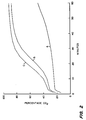
- Fig. 2 shows the result of the DRR test employing a leavening system of this invention wherein a different calcium ion source (calcium carbonate) is provided during preparation of the calcium acid pyrophosphate of this invention.
- a different calcium ion source calcium carbonate
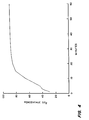
- Figs. 3-5 show the results of the DRR test employing a leavening system containing calcium acid pyrophosphate which was obtained by employing variations in the procedure for reacting a calcium source and phosphoric acid.
- Figs 6 and 7 show the results of the DRR test employing a leavening system of this invention provided by Examples 1A and 1B.
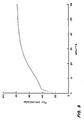
- Fig. 8 shows the results of the DRR test employing a comparable leavening system employing a calcium acid pyrophosphate of the prior art.
- Fig. 9 shows the results of the DRR test employing the calcium acid pyrophosphate of the prior art which has been milled to a smaller particle size.
- Fig. 10 shows the relationship between the amount of time delay before increase in carbon dioxide production after initial mixing in the DRR test and amount of hydrogen in the calcium acid pyrophosphate.
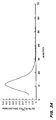
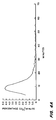
- Figs 1A - 9A show the results when the data of Figs. 1-9 are converted to the rate per minute of carbon dioxide evolution as a percent of total carbon dioxide theoretically available in the DRR test run at 40°C.
- the data graphically displayed in these figures are termed herein the "minute differential" curves which more visibly show the time delayed reaction in the DRR test run at 40°C.
- One method for obtaining the novel calcium acid pyrophosphate of this invention is provided by adding monocalcium orthophosphate or the monohydrate thereof to a molar excess of phosphoric acid at elevated temperature.
- elevated temperature is meant a temperature in the range of from about 180°C to about 250°C, preferably in the range of from about 200°C to about 220°C.
- molar excess is meant an excess of phosphoric acid expressed as H3PO4 over the calcium ion source expressed as calcium oxide of at least about 3 to 1 and typically about 5 to 1 up to about 15 to 1.
- a molar excess of phosphoric acid to calcium oxide source in the range of about 7 to about 15 to 1 may be employed.
- One means to obtain the crystals found useful in accordance with this invention is the step-wise addition of the orthophosphate to the phosphoric acid.
- Such processes are described in the literature by H. Bassett, J. Chem. Soc. 1958, pp 2949-2955 and by L. N. Eraizer et al, Inorganic Materials 1986 22(8), pp.1189-1193.
- the crystals After recovery of the crystalline product by the usual means such as filtration, the crystals may be washed with an organic solvent such as acetone to provide a product having a high degree of purity as indicated by x-ray diffraction pattern published by Morin, Bull. Soc Chim. France, 1726 (1961)
- Carbonate factors include any suitable basic materials such as sodium bicarbonate as well as other basic materials such as potassium bicarbonate, amorphous calcium carbonate or ammonium bicarbonate, and the like.
- the reactivity of the calcium acid pyrophosphate containing leavening system of this invention was evaluated in the DRR test as described by Parks et al. in Cereal Chemistry, Vol. 37, pp. 503-518 July, 1960 hereby incorporated by reference.
- the reaction rate of a leavening system in a specified biscuit dough is measured manometrically during mixing and during subsequent time periods at constant temperature, by a standardized procedure.
- a reaction profile amount of CO2/time
- the calcium acid pyrophosphate of this invention can be employed in admixture with other previously known leavening acids which include, without limitation, monosodium dihydrogen phosphate; sodium aluminum phosphate acidic; a mixture of sodium aluminum phosphate acidic with aluminum sulphate anhydrous; a mixture of sodium aluminum phosphate acidic with anhydrous coated monocalcium phosphate; monocalcium phosphate; anhydrous monocalcium phosphate, coated; sodium acid pyrophosphate; citric acid; mixtures of monocalcium phosphate and sodium acid pyrophosphate; mixtures of sodium aluminum sulphate and monocalcium phosphate; monocalcium phosphate, anhydrous; fumaric acid; monocalcium phosphate and sodium aluminum phosphate mixtures; glucono- ⁇ -lactone; monopotassium tartrate; sodium aluminum sulfate; aluminum sulfate and any other suitable, edible, non-toxic acid.
- leavening acids include, without limitation, monosodium dihydrogen
- sodium-free chemical leavening systems for baked goods comprising leavening acid of this invention as the acid factor and a carbonate factor free of sodium.
- the sodium content of the human diet has been noted to be desirably controlled because of its link to high blood pressure. Medical experts estimate that about 20 percent of the U.S. population is genetically predisposed to a form of high blood pressure that is sensitive to sodium in the diet. Much effort has been made to prepare low-sodium foods and even no sodium foods particularly with respect to patients suffering from heart disease and edema. It is therefore a particular advantage of the present invention that chemical leavening systems for baked goods are provided which do not contribute sodium to the human diet by consumption of the resultant baked goods.
- the leavening acid of this invention in combination with sodium free carbonate factor such as potassium bicarbonate provides a leavening system for fresh dough products and resulting baked goods having lower sodium content than can be provided by previous chemical leavening systems containing sodium bicarbonate with acid factors containing sodium.
- the chemical leavening system of this invention may be incorporated into a baking powder product conveniently prepared by admixing leavening acid of this invention with a carbonate factor as a dry powder mix. It is well known that baking powders in the dry powder form are best prepared together with fillers contributing to the bulk of the powder and aiding its measurement for actual use. Fillers such as starch or calcium carbonate are generally employed in baking powders of this invention. Conventional preservatives and fillers may be employed together with the baking powder composition of this invention as is known in the art.
- Fresh dough and batter can be prepared from the leavening systems of this invention in the conventional manner as has been practiced in the art.
- the ingredients may be dry mixed or prepared as a dough or batter.
- the dough or batter may be stored for conventional time periods under refrigeration.
- the dry mix is employed to prepare fresh dough or batter by incorporating suitable liquids such as milk and shortening materials as is known in the art.
- the desired pH of the final baked good can be controlled by incorporating into fresh dough or batter leavening acids and alkaline carbonate sources normally employed for that purpose in the art.
- the pH of the final baked product ranges from about 5.5 to about 9.0, preferably from about 6.9 to about 7.5.
- the amount of alkaline carbonate material added should provide sufficient carbon dioxide.
- the typical uses and levels of leavening acid of this invention typically employed therein are provided in the table below.
- the level of acid used with common, commercially available carbonate factors is an amount sufficient to neutralize and liberate carbon dioxide.
- the percentages shown are for the amount of calcium acid pyrophosphate of this invention (CAPP).
- the moisture content of the fresh doughs and batters of the present invention generally range from about 5% by weight to about 130% by weight, based upon the weight of the dry ingredients.
- the moisture content will vary, dependent upon the ultimate utility of the dough or batter as to whether it may be employed to prepare cookies, biscuits, cakes, etc.
- Baking times of the fresh doughs or batters of this invention are generally within the baking times generally known in the art with respect to the use of previously known leavening systems. It is typical that various mixes of fresh dough will require different baking times considering as well the baking characteristics of the ovens employed. Typical baking times range from 7 to 15 minutes for cookies and longer periods for biscuits and other baked goods.
- the doughs of the present invention are formed into pieces in conventional manner, using known bakery equipment such as wire cutting devices, rotary cutters, reciprocating cutters, and the like.
- fresh dough is prepared as in the prior art from flour, shortening, sugar, optionally emulsifiers and preservatives and from about .5% by weight to about 3.9% by weight of a leavening system of this invention.
- Other optional ingredients can be included as is well known in the art.
- the fresh doughs and batters of the present invention can optionally include many substances known in the art to be added to fresh dough including bulking agents such as dietary fiber and hydrocolloides, corn fiber, soy filtrate, wheat bran, and apple tomace fiber (dehydrated and freeze dried) as exemplary of dietary fibers.
- bulking agents such as dietary fiber and hydrocolloides, corn fiber, soy filtrate, wheat bran, and apple tomace fiber (dehydrated and freeze dried) as exemplary of dietary fibers.
- Texturizing and flavoring ingredients conventionally used in the production of baked goods may be employed in the novel doughs of this invention.
- the amounts employed are generally comparable to those used in the conventional formulation so as to achieve satisfactory mouthfeel, texture and taste.
- Typical amounts of conventional texturizing and flavoring ingredients used in the production of baked goods are in the range of from about 5% by weight up to about 25% by weight of the fresh dough.
- Other additives such as sweeteners, etc. can also be employed in combination with the novel leavening system of this invention.
- the calcium acid pyrophosphate of this invention can be prepared by the method of E. H. Brown et al. as described in Agricultural and Food Chemistry, Vol. 11, No. 3, May-June 1963 which is incorporated herein by reference.
- the calcium acid pyrophosphate of this invention was prepared according to said method by heating 1,275 g of reagent grade 86% phosphoric acid in a glass beaker to 210°C +-10°C with vigorous stirring which was continued throughout the preparation to prevent supersaturation.
- a first portion of monocalcium phosphate monohydrate (112 g) was added slowly at the rate of 2.5-3 g/minute until the first crystals appeared. Precipitation was aided by either seeding or scratching the beaker with a glass rod to prevent supersaturation.
- Example 1 The procedure of Example 1 was repeated except that a total of 95.6 g calcium carbonate was employed in place of the monocalcium phosphate monohydrate to prepare the calcium acid pyrophosphate.
- Example 1 The procedure of Example 1 was repeated except that the temperature of the phosphoric acid during addition of the calcium phosphate was 170°C. instead of 210°C.
- Example 1 The procedure of Example 1 was repeated except that the amount of monocalcium phosphate monohydrate added to the phosphoric acid was reduced by a factor of 25%.
- Example 1 The procedure of Example 1 was repeated with the exception that the amount of monocalcium phosphate monohydrate added to the phosphoric acid was increased by a factor of 25%.
- Example 1 The product of Example 1 was employed as the acid factor in a leavening system of a white cake mix.
- An additional 99 g of water was then added and the batter mixed at higher speed for 1 minute. After scraping down the sides and bottom, the batter was mixed for an additional minute at the same speed. Then, after again scraping down the sides and bottom, an additional 74 g of water was added followed by mixing at slower speed for 1 minute.
- Example 1 The product of Example 1 was employed as the acid factor in a leavening system of a pancake batter. To a bowl was added 237.14 g of Roland Pancake Base Mix. Separately, 5.25 g of sodium bicarbonate and 7.61 g of the product of Example 1 were placed into a tared boat. The mixture of leavening acid and soda were sprinkled over the mix and incorporated with a whisk. Then 263.5 g of water were added to the mix and blended with a whisk. A sample was taken for specific gravity measurement. Into a 100 ml graduated cylinder was added 50 ml of the batter. The volume in the cylinder was noted at 5, 10, 15, and 30 minutes for expansion.
- one level #24 scoop of batter was poured onto a heated griddle maintained at 375°F making eight pancakes.
- the pancakes were baked for 1.5 minutes and then turned over and baked for an additional 1.5 minutes. After baking they were removed from the griddle and evaluated.
- the specific gravity of the batter was determined to be 1.017 g/cc.
- the pH of the batter was found to be 7.34 after 1 minute and 7.0 after 30 minutes.
- the observed volume in the graduated cylinder at the various time intervals is as follows: Time (min.) Volume (ml) % expansion start 50 0 5 50 0 10 52 4 15 59 18 30 85 70
- the pH of the pancakes, internal was determined to be 8.5.
- a stack of 3 pancakes provided a specific volume of 2.563 cc/g and a ratio of diameter to height of 1.0395.
- the crust color was golden brown and the crumb color was yellow. The taste was sweet and acceptable.
- Fig. 1 there is shown the results of the DRR test employing calcium acid pyrophosphate of Example 1 as the acid factor in the leavening system.
- the DRR test was run as 21°C (line A), 40°C (line B) and 48°C (line C).
- the amount of carbon dioxide released from the dough as a percent of the theoretical amount available from the leavening system is indicated as percent and the time lapse from initiation of mixing the ingredients is shown in minutes.
- the data obtained in the above test at the different temperatures and graphically displayed in Fig. 1 are listed below in Table 2.
- Figure 1A there is shown the minute differential data based on the data obtained in the DRR test at 40°C.
- the reaction profile for the calcium acid pyrophosphate of Example 1 indicated a change in rate occurring at time periods after initial mixing. After initial mixing there is a relatively low rate of reaction and then, without change in temperature, a rapid change in reaction rate is observed, as indicated by an increase in carbon dioxide production. At 40°C, the maximum rate of carbon dioxide release (t 1/2 ) occurs at 20 minutes after initial mixing.
- Fig. 2 there is shown the results of the DRR test employing calcium acid pyrophosphate of Example 2 as the acid factor in the leavening system.
- the DRR test was run at 21°C (line A), 40°C (line B) and 48°C (line C).
- Fig. 2 there is indicated the amount of carbon dioxide released from the dough as a percent of the theoretical amount available from the leavening system during the time lapse from initiation of mixing the ingredients, shown in minutes.
- the data obtained in the above DRR test at the different temperatures and graphically displayed in Fig. 2 are listed below in Table 3.
- the reaction profile for the calcium acid pyrophosphate of Example 2 indicated a change in rate occurring at time periods after initial mixing, the maximum rate occurring at approximately 23 minutes at 40°C. After initial mixing there is observed a relatively low rate of reaction and then, without change in temperature, a rapid change in reaction rate is observed, as indicated by an increase in carbon dioxide production.
- Fig. 2A there is shown the minute differential obtained from the data collected in the above mentioned DRR test at 40°C.
- FIG. 3 there is shown the results of the DRR test employing a leavening system in which the calcium acid pyrophosphate of Example 3 was employed. Data was obtained at 40°C only in this test. The data obtained to provide Fig. 3 are presented below in Table 4.
- Fig. 3A there is shown the minute differential obtained from the data collected in the above-mentioned DRR test at 40°C. The t 1/2 point in the curves in Figs. 3 and 3A occurs at 12 minutes; therefore, not within the scope of this invention.
- Fig. 4 there is shown the results of the DRR test employing a leavening system in which the calcium acid pyrophosphate of Example 4 was employed. Data was obtained at 40°C only in this test. The data obtained to provide Fig. 4 are presented below in Table 5.
- Fig. 4A there is shown the minute differential obtained from the data collected in the above-mentioned DRR test at 40°C. The t 1/2 point in the curves in Figs. 4 and 4A occurs at 9 minutes; therefore, not within the scope of this invention.
- Fig. 5 there is shown the results of the DRR test employing a leavening system in which the calcium acid pyrophosphate of Example 5 was employed. Data was obtained at 40°C only in this test. The characteristic rapid increase in the rate of carbon dioxide production is observed about 29 minutes after initial mixing. This indicates that higher ratios of the calcium ion source to phosphoric acid in the reaction producing the calcium acid pyrophosphate of this invention affects the timing of carbon dioxide release in a leavening system.
- the data obtained to provide Fig. 5 are presented below in Table 6.
- Fig. 5A there is shown the minute differential obtained from the data collected in the above-mentioned DRR test at 40°C.
- Fig. 6 there is shown the results of the DRR test employing a leavening system in which the calcium acid pyrophosphate of Example 1A was employed.
- the DRR test was at 21°C (line A), 40°C (line B), and 48°C (line C).
- the characteristic rapid increase in the rate of carbon dioxide production is observed.
- the data obtained to provide Fig. 6 are presented below in Table 7.
- Fig. 6A there is shown the minute differential obtained from the data collected in the above-mentioned DRR test at 40°C.
- the t 1/2 point in the curves in Figs. 3 and 3A occurs at 38 minutes; therefore, is within the scope of this invention.
- Fig. 7 there is shown the results of the DRR test employing a leavening system in which the calcium acid pyrophosphate of Example 1B was employed.
- the DRR test was run at 21°C (line A), 40°C, (line B) and 48°C (line C).
- the characteristic rapid increase in the rate of carbon dioxide production is observed.
- the data obtained to provide Fig. 7 are presented below in Table 8.
- Fig. 7A there is shown the minute differential obtained from the data collected in the above-mentioned DRR test at 40°C.
- the t 1/2 point in the curves in Figs. 7 and 7A occurs at 26 minutes; therefore, is within the scope of this invention.
- Fig. 8 there is shown the results of the DRR test employing the above dough formula and conditions with calcium acid pyrophosphate obtained from BKL. An analysis of this product by x-ray diffraction indicated that it contained small amounts of monocalcium phosphate. Other available information about the material is provided in Table 1 above. The same amount of the commercial material was employed in the dough formulation as the acid factor in the DRR as was employed above to produce the data shown in Fig. 1. As in the other tests, the DRR test was run at 21°C (line A), 40°C, (line B) and 48°C (line C). The results of the DRR test, as shown in Fig. 8, indicates a fast reaction rate followed by little to no delayed increase in rate.
- Fig. 8A there is shown the minute differential obtained from the data collected in the above-mentioned DRR test at 40°C.
- the t 1/2 point in the curves in Figs. 8 and 8A occurs at 13 minutes.
- the maximum rate of release is less than twice the rate observed at the termination of mixing and is, therefore, not within the scope of this invention.
- Fig. 10 there is shown graphically the data in Table 1 indicating the amount of hydrogen found in the products of Examples 1, 1A, 1B and 2-5. This data is plotted against the t-1/2 data.
- the t-1/2 data is obtained in the DRR test at 40°C and is the amount of time in minutes at the mid-point in the slope of the curve indicating the maximum rate of increase occurring subsequent to the termination of initial mixing characteristic of the calcium acid pyrophosphate of this invention.
- the above noted examples provide several variations in the preparation of the calcium acid pyrophosphate of this invention. For convenience, these variations are presented in Table 11 below in summary form together with the data plotted in Fig. 10 .
Landscapes
- Chemical & Material Sciences (AREA)
- Inorganic Chemistry (AREA)
- Life Sciences & Earth Sciences (AREA)
- Engineering & Computer Science (AREA)
- Food Science & Technology (AREA)
- Bakery Products And Manufacturing Methods Therefor (AREA)
Applications Claiming Priority (2)
| Application Number | Priority Date | Filing Date | Title |
|---|---|---|---|
| US08/077,588 US5409724A (en) | 1993-06-18 | 1993-06-18 | Leavening composition and process of making |
| US77588 | 1993-06-18 |
Publications (3)
| Publication Number | Publication Date |
|---|---|
| EP0629348A2 true EP0629348A2 (fr) | 1994-12-21 |
| EP0629348A3 EP0629348A3 (fr) | 1995-07-19 |
| EP0629348B1 EP0629348B1 (fr) | 2001-08-16 |
Family
ID=22138962
Family Applications (1)
| Application Number | Title | Priority Date | Filing Date |
|---|---|---|---|
| EP94870100A Expired - Lifetime EP0629348B1 (fr) | 1993-06-18 | 1994-06-17 | Nouvelle composition de levure |
Country Status (4)
| Country | Link |
|---|---|
| US (1) | US5409724A (fr) |
| EP (1) | EP0629348B1 (fr) |
| JP (1) | JP3667790B2 (fr) |
| DE (1) | DE69427938T2 (fr) |
Cited By (2)
| Publication number | Priority date | Publication date | Assignee | Title |
|---|---|---|---|---|
| EP1874120A4 (fr) * | 2005-04-25 | 2011-06-22 | Innophos Inc | Produit alimentaire contenant une pate auto-levante et procedes de fabrication associes |
| EP2356029A4 (fr) * | 2008-11-21 | 2017-05-17 | General Mills Marketing, Inc. | Composition de levure pour produits à base de pâte réfrigérée |
Families Citing this family (14)
| Publication number | Priority date | Publication date | Assignee | Title |
|---|---|---|---|---|
| EP1145638A1 (fr) | 1995-06-05 | 2001-10-17 | The Pillsbury Company | Conditionnement de pâte |
| TW380040B (en) * | 1995-06-07 | 2000-01-21 | Pillsbury Co | Leavened dough compositions and process of increasing specific volume in a baked product |
| ES2272079T3 (es) * | 1998-07-24 | 2007-04-16 | Astaris Llc | Proceso y formulacion para una masa fermentada o producto de panaderia leudado quimicamente. |
| US6180151B1 (en) | 1999-06-10 | 2001-01-30 | The Pillsbury Company | Leavened dough extrusion process |
| US6886452B2 (en) * | 2001-08-23 | 2005-05-03 | Claud S. Gordon Company | System and method of leavening with carbon dioxide monitoring |
| ES2329889T3 (es) * | 2002-06-07 | 2009-12-02 | Innophos, Inc. | Composicion de pasta y metodo para obtener tortillas. |
| US20120263854A1 (en) * | 2002-06-07 | 2012-10-18 | Innophos, Inc. | Flat bread dough composition and method for making flat breads |
| US20040208957A1 (en) * | 2003-04-17 | 2004-10-21 | The Pillsbury Company | Dough made with encapsulated soda |
| DE102009045533A1 (de) * | 2009-10-09 | 2011-04-14 | Chemische Fabrik Budenheim Kg | Fumarsäure enthaltendes Treibsystem für die Herstellung von Backwaren |
| EP2327309B2 (fr) * | 2009-11-11 | 2020-11-04 | Chemische Fabrik Budenheim KG | Produit comprenant du pyrophosphate de magnésium et son utilisation comme acide mouvant pour la fabrication de produits boulangers |
| JP2013226090A (ja) * | 2012-04-26 | 2013-11-07 | Okuno Chemical Industries Co Ltd | 野菜用鮮度保持剤 |
| CA2870317C (fr) * | 2012-05-08 | 2020-06-16 | General Mills, Inc. | Composition de pate en boite |
| JP6948122B2 (ja) * | 2016-10-21 | 2021-10-13 | 株式会社ニップン | 揚げ物用衣材 |
| JP2018134009A (ja) * | 2017-02-20 | 2018-08-30 | 日本製粉株式会社 | 焼成食品用バッター |
Family Cites Families (14)
| Publication number | Priority date | Publication date | Assignee | Title |
|---|---|---|---|---|
| US990699A (en) * | 1910-02-15 | 1911-04-25 | Victor Chemical Works | Baking preparation. |
| US1847799A (en) * | 1927-12-31 | 1932-03-01 | Weil Louis | Food leavening composition |
| US1834747A (en) * | 1928-09-11 | 1931-12-01 | Royal Baking Powder Co | Effervescent mixture |
| US2133286A (en) * | 1937-05-11 | 1938-10-18 | Rumford Chemical Works | Acid calcium tetraphosphate and method of making the same |
| US2138029A (en) * | 1937-06-03 | 1938-11-29 | Rumford Chemical Works | Baking powder |
| US2263487A (en) * | 1939-03-18 | 1941-11-18 | Virginia Carolina Chem Corp | Leavening agent |
| US2366857A (en) * | 1942-07-18 | 1945-01-09 | Monsanto Chemicals | Leavening composition |
| GB608708A (en) * | 1946-02-28 | 1948-09-20 | Alfred Bird And Sons Ltd | Improvements in the manufacture of aerating powders and calcium pyrophosphate compounds |
| DE928581C (de) * | 1950-07-18 | 1955-06-06 | Chem Fab Budenheim A G | Verfahren zur Erhoehung der Backfaehigkeit von Mehl |
| US2844437A (en) * | 1955-02-21 | 1958-07-22 | Victor Chemical Works | Stabilized low reaction rate sodium acid pyrophosphate |
| US2870017A (en) * | 1956-11-30 | 1959-01-20 | Standard Brands Inc | Pyrophosphate baking powders |
| DE3820198A1 (de) * | 1988-06-14 | 1989-12-21 | Benckiser Knapsack Gmbh | Verwendung von calciumdihydrogendiphosphat als backtriebsaeure fuer langsam reagierende triebsysteme und verfahren zu seiner herstellung |
| US4966782A (en) * | 1988-09-27 | 1990-10-30 | Monsanto Company | Chemical leavening system |
| US5225226A (en) * | 1991-08-01 | 1993-07-06 | Church & Dwight Co., Inc. | Chemical leavening system |
-
1993
- 1993-06-18 US US08/077,588 patent/US5409724A/en not_active Expired - Lifetime
-
1994
- 1994-06-17 DE DE69427938T patent/DE69427938T2/de not_active Expired - Lifetime
- 1994-06-17 EP EP94870100A patent/EP0629348B1/fr not_active Expired - Lifetime
- 1994-06-17 JP JP16993294A patent/JP3667790B2/ja not_active Expired - Fee Related
Cited By (2)
| Publication number | Priority date | Publication date | Assignee | Title |
|---|---|---|---|---|
| EP1874120A4 (fr) * | 2005-04-25 | 2011-06-22 | Innophos Inc | Produit alimentaire contenant une pate auto-levante et procedes de fabrication associes |
| EP2356029A4 (fr) * | 2008-11-21 | 2017-05-17 | General Mills Marketing, Inc. | Composition de levure pour produits à base de pâte réfrigérée |
Also Published As
| Publication number | Publication date |
|---|---|
| DE69427938T2 (de) | 2002-04-04 |
| EP0629348A3 (fr) | 1995-07-19 |
| DE69427938D1 (de) | 2001-09-20 |
| EP0629348B1 (fr) | 2001-08-16 |
| US5409724A (en) | 1995-04-25 |
| JPH0750974A (ja) | 1995-02-28 |
| JP3667790B2 (ja) | 2005-07-06 |
Similar Documents
| Publication | Publication Date | Title |
|---|---|---|
| US4966782A (en) | Chemical leavening system | |
| US5405636A (en) | Leavening composition | |
| EP0629348B1 (fr) | Nouvelle composition de levure | |
| US5260082A (en) | Baked goods, doughs or batters, dry mixes and methods for producing thereof | |
| US2810650A (en) | Refrigeration of doughs and batters including as a leavening component dicalcium phosphate dihydrate | |
| US6149960A (en) | Process and formulation for a chemically leavened dough or bakery product | |
| JP2011004767A (ja) | 新規のふくらまし酸組成物 | |
| US5773068A (en) | Leavening system and products therefrom | |
| US5667836A (en) | Leavening acid composition produced by heating monocalcium phosphate at elevated temperatures | |
| US3096178A (en) | Chemically leavened yeast dough | |
| CA1336870C (fr) | Systeme de levage chimique | |
| US3275451A (en) | Alpha-glucoheptono-gamma-lactone containing premix for leavened baked food products | |
| US3275450A (en) | D-galactono-gamma lactone containing premix for leavened baked food products | |
| EP0126529B1 (fr) | Procédé de préparation de crackers et de biscuits à basse teneur en sodium et produits obtenus | |
| CA1175710A (fr) | Agent de levage pour produits de boulangerie contenant du fructose | |
| US4500557A (en) | Leavening acid composition | |
| CA2246600A1 (fr) | Systeme de levage de type nouveau | |
| MXPA98006782A (en) | Novedoso system of fermentac | |
| JPH05103601A (ja) | 化学的膨脹剤を使用する食品の製造法 |
Legal Events
| Date | Code | Title | Description |
|---|---|---|---|
| PUAI | Public reference made under article 153(3) epc to a published international application that has entered the european phase |
Free format text: ORIGINAL CODE: 0009012 |
|
| AK | Designated contracting states |
Kind code of ref document: A2 Designated state(s): BE DE FR GB IT NL |
|
| PUAL | Search report despatched |
Free format text: ORIGINAL CODE: 0009013 |
|
| AK | Designated contracting states |
Kind code of ref document: A3 Designated state(s): BE DE FR GB IT NL |
|
| 17P | Request for examination filed |
Effective date: 19960111 |
|
| 17Q | First examination report despatched |
Effective date: 19990319 |
|
| RAP1 | Party data changed (applicant data changed or rights of an application transferred) |
Owner name: SOLUTIA INC. |
|
| GRAG | Despatch of communication of intention to grant |
Free format text: ORIGINAL CODE: EPIDOS AGRA |
|
| RAP1 | Party data changed (applicant data changed or rights of an application transferred) |
Owner name: ASTARIS LLC |
|
| GRAG | Despatch of communication of intention to grant |
Free format text: ORIGINAL CODE: EPIDOS AGRA |
|
| GRAH | Despatch of communication of intention to grant a patent |
Free format text: ORIGINAL CODE: EPIDOS IGRA |
|
| GRAH | Despatch of communication of intention to grant a patent |
Free format text: ORIGINAL CODE: EPIDOS IGRA |
|
| GRAA | (expected) grant |
Free format text: ORIGINAL CODE: 0009210 |
|
| AK | Designated contracting states |
Kind code of ref document: B1 Designated state(s): BE DE FR GB IT NL |
|
| REF | Corresponds to: |
Ref document number: 69427938 Country of ref document: DE Date of ref document: 20010920 |
|
| ET | Fr: translation filed | ||
| REG | Reference to a national code |
Ref country code: GB Ref legal event code: IF02 |
|
| PLBI | Opposition filed |
Free format text: ORIGINAL CODE: 0009260 |
|
| PLBQ | Unpublished change to opponent data |
Free format text: ORIGINAL CODE: EPIDOS OPPO |
|
| PLBF | Reply of patent proprietor to notice(s) of opposition |
Free format text: ORIGINAL CODE: EPIDOS OBSO |
|
| 26 | Opposition filed |
Opponent name: CHEMISCHE FABRIK BUDENHEIM R.A. OETKER Effective date: 20020514 |
|
| NLR1 | Nl: opposition has been filed with the epo |
Opponent name: CHEMISCHE FABRIK BUDENHEIM R.A. OETKER |
|
| PLBF | Reply of patent proprietor to notice(s) of opposition |
Free format text: ORIGINAL CODE: EPIDOS OBSO |
|
| PLBF | Reply of patent proprietor to notice(s) of opposition |
Free format text: ORIGINAL CODE: EPIDOS OBSO |
|
| PLCK | Communication despatched that opposition was rejected |
Free format text: ORIGINAL CODE: EPIDOSNREJ1 |
|
| PLBN | Opposition rejected |
Free format text: ORIGINAL CODE: 0009273 |
|
| STAA | Information on the status of an ep patent application or granted ep patent |
Free format text: STATUS: OPPOSITION REJECTED |
|
| 27O | Opposition rejected |
Effective date: 20031126 |
|
| NLR2 | Nl: decision of opposition |
Effective date: 20031126 |
|
| REG | Reference to a national code |
Ref country code: FR Ref legal event code: TP |
|
| NLS | Nl: assignments of ep-patents |
Owner name: ICL PERFORMANCE PRODUCTS LP Effective date: 20080908 |
|
| PGFP | Annual fee paid to national office [announced via postgrant information from national office to epo] |
Ref country code: GB Payment date: 20130627 Year of fee payment: 20 Ref country code: DE Payment date: 20130627 Year of fee payment: 20 |
|
| PGFP | Annual fee paid to national office [announced via postgrant information from national office to epo] |
Ref country code: FR Payment date: 20130702 Year of fee payment: 20 Ref country code: IT Payment date: 20130624 Year of fee payment: 20 |
|
| PGFP | Annual fee paid to national office [announced via postgrant information from national office to epo] |
Ref country code: BE Payment date: 20130627 Year of fee payment: 20 |
|
| PGFP | Annual fee paid to national office [announced via postgrant information from national office to epo] |
Ref country code: NL Payment date: 20130626 Year of fee payment: 20 |
|
| REG | Reference to a national code |
Ref country code: DE Ref legal event code: R071 Ref document number: 69427938 Country of ref document: DE |
|
| REG | Reference to a national code |
Ref country code: DE Ref legal event code: R071 Ref document number: 69427938 Country of ref document: DE |
|
| REG | Reference to a national code |
Ref country code: NL Ref legal event code: V4 Effective date: 20140617 |
|
| BE20 | Be: patent expired |
Owner name: ICL PERFORMANCE PRODUCTS LP Effective date: 20140617 |
|
| REG | Reference to a national code |
Ref country code: GB Ref legal event code: PE20 Expiry date: 20140616 |
|
| PG25 | Lapsed in a contracting state [announced via postgrant information from national office to epo] |
Ref country code: GB Free format text: LAPSE BECAUSE OF EXPIRATION OF PROTECTION Effective date: 20140616 |
|
| PG25 | Lapsed in a contracting state [announced via postgrant information from national office to epo] |
Ref country code: DE Free format text: LAPSE BECAUSE OF EXPIRATION OF PROTECTION Effective date: 20140618 |