EP0630588A2 - Procédé et dispositif pour la transformation d'articles textiles plats - Google Patents
Procédé et dispositif pour la transformation d'articles textiles plats Download PDFInfo
- Publication number
- EP0630588A2 EP0630588A2 EP94108357A EP94108357A EP0630588A2 EP 0630588 A2 EP0630588 A2 EP 0630588A2 EP 94108357 A EP94108357 A EP 94108357A EP 94108357 A EP94108357 A EP 94108357A EP 0630588 A2 EP0630588 A2 EP 0630588A2
- Authority
- EP
- European Patent Office
- Prior art keywords
- textile
- textile fabric
- forming
- fabric
- lye
- Prior art date
- Legal status (The legal status is an assumption and is not a legal conclusion. Google has not performed a legal analysis and makes no representation as to the accuracy of the status listed.)
- Granted
Links
- 239000004753 textile Substances 0.000 title claims abstract description 86
- 238000000034 method Methods 0.000 title claims abstract description 70
- 230000001131 transforming effect Effects 0.000 title 1
- HEMHJVSKTPXQMS-UHFFFAOYSA-M Sodium hydroxide Chemical compound [OH-].[Na+] HEMHJVSKTPXQMS-UHFFFAOYSA-M 0.000 claims abstract description 95
- 239000004744 fabric Substances 0.000 claims abstract description 68
- 239000003513 alkali Substances 0.000 claims abstract description 21
- 239000000835 fiber Substances 0.000 claims abstract description 19
- WSFSSNUMVMOOMR-UHFFFAOYSA-N Formaldehyde Chemical compound O=C WSFSSNUMVMOOMR-UHFFFAOYSA-N 0.000 claims description 17
- 238000005406 washing Methods 0.000 claims description 16
- 238000006386 neutralization reaction Methods 0.000 claims description 12
- 239000000126 substance Substances 0.000 claims description 7
- 230000003472 neutralizing effect Effects 0.000 claims description 6
- 239000003795 chemical substances by application Substances 0.000 claims description 5
- 238000000071 blow moulding Methods 0.000 claims description 3
- 239000002253 acid Substances 0.000 claims description 2
- XLYOFNOQVPJJNP-UHFFFAOYSA-N water Substances O XLYOFNOQVPJJNP-UHFFFAOYSA-N 0.000 claims description 2
- 238000009740 moulding (composite fabrication) Methods 0.000 claims 1
- 238000007666 vacuum forming Methods 0.000 claims 1
- 235000011121 sodium hydroxide Nutrition 0.000 description 31
- 239000000243 solution Substances 0.000 description 17
- 238000007493 shaping process Methods 0.000 description 13
- 238000001035 drying Methods 0.000 description 11
- 229920000742 Cotton Polymers 0.000 description 9
- 239000000047 product Substances 0.000 description 8
- 229920003002 synthetic resin Polymers 0.000 description 6
- 239000000057 synthetic resin Substances 0.000 description 6
- 238000004519 manufacturing process Methods 0.000 description 5
- 239000007921 spray Substances 0.000 description 5
- 238000005470 impregnation Methods 0.000 description 4
- 239000007788 liquid Substances 0.000 description 4
- 239000000203 mixture Substances 0.000 description 4
- 229920002994 synthetic fiber Polymers 0.000 description 4
- QTBSBXVTEAMEQO-UHFFFAOYSA-N Acetic acid Chemical compound CC(O)=O QTBSBXVTEAMEQO-UHFFFAOYSA-N 0.000 description 3
- WMFOQBRAJBCJND-UHFFFAOYSA-M Lithium hydroxide Chemical compound [Li+].[OH-] WMFOQBRAJBCJND-UHFFFAOYSA-M 0.000 description 3
- 229920002678 cellulose Polymers 0.000 description 3
- 239000001913 cellulose Substances 0.000 description 3
- 239000004033 plastic Substances 0.000 description 3
- 229920003023 plastic Polymers 0.000 description 3
- 229920000642 polymer Polymers 0.000 description 3
- 238000012545 processing Methods 0.000 description 3
- 239000012209 synthetic fiber Substances 0.000 description 3
- 238000012360 testing method Methods 0.000 description 3
- 206010020751 Hypersensitivity Diseases 0.000 description 2
- 208000026935 allergic disease Diseases 0.000 description 2
- 239000003518 caustics Substances 0.000 description 2
- 239000007795 chemical reaction product Substances 0.000 description 2
- 230000006735 deficit Effects 0.000 description 2
- 238000002386 leaching Methods 0.000 description 2
- BDAGIHXWWSANSR-UHFFFAOYSA-N methanoic acid Natural products OC=O BDAGIHXWWSANSR-UHFFFAOYSA-N 0.000 description 2
- 230000003287 optical effect Effects 0.000 description 2
- 239000004014 plasticizer Substances 0.000 description 2
- OSWFIVFLDKOXQC-UHFFFAOYSA-N 4-(3-methoxyphenyl)aniline Chemical compound COC1=CC=CC(C=2C=CC(N)=CC=2)=C1 OSWFIVFLDKOXQC-UHFFFAOYSA-N 0.000 description 1
- 244000198134 Agave sisalana Species 0.000 description 1
- 244000025254 Cannabis sativa Species 0.000 description 1
- 235000012766 Cannabis sativa ssp. sativa var. sativa Nutrition 0.000 description 1
- 235000012765 Cannabis sativa ssp. sativa var. spontanea Nutrition 0.000 description 1
- 244000146553 Ceiba pentandra Species 0.000 description 1
- 235000003301 Ceiba pentandra Nutrition 0.000 description 1
- 240000000491 Corchorus aestuans Species 0.000 description 1
- 235000011777 Corchorus aestuans Nutrition 0.000 description 1
- 235000010862 Corchorus capsularis Nutrition 0.000 description 1
- 206010012442 Dermatitis contact Diseases 0.000 description 1
- 206010040880 Skin irritation Diseases 0.000 description 1
- GSEJCLTVZPLZKY-UHFFFAOYSA-N Triethanolamine Chemical compound OCCN(CCO)CCO GSEJCLTVZPLZKY-UHFFFAOYSA-N 0.000 description 1
- 238000010306 acid treatment Methods 0.000 description 1
- 230000007815 allergy Effects 0.000 description 1
- 230000015572 biosynthetic process Effects 0.000 description 1
- 235000009120 camo Nutrition 0.000 description 1
- 235000005607 chanvre indien Nutrition 0.000 description 1
- 238000004040 coloring Methods 0.000 description 1
- 208000010247 contact dermatitis Diseases 0.000 description 1
- 238000004132 cross linking Methods 0.000 description 1
- 238000013461 design Methods 0.000 description 1
- 238000010586 diagram Methods 0.000 description 1
- 238000007598 dipping method Methods 0.000 description 1
- 238000006073 displacement reaction Methods 0.000 description 1
- 230000000694 effects Effects 0.000 description 1
- 230000007717 exclusion Effects 0.000 description 1
- 235000019253 formic acid Nutrition 0.000 description 1
- 239000011487 hemp Substances 0.000 description 1
- 238000007654 immersion Methods 0.000 description 1
- 230000001771 impaired effect Effects 0.000 description 1
- 239000000463 material Substances 0.000 description 1
- 150000007522 mineralic acids Chemical class 0.000 description 1
- 238000012986 modification Methods 0.000 description 1
- 230000004048 modification Effects 0.000 description 1
- 239000004745 nonwoven fabric Substances 0.000 description 1
- 150000007524 organic acids Chemical class 0.000 description 1
- 230000000284 resting effect Effects 0.000 description 1
- 230000000717 retained effect Effects 0.000 description 1
- 239000012487 rinsing solution Substances 0.000 description 1
- 229920006395 saturated elastomer Polymers 0.000 description 1
- 230000035945 sensitivity Effects 0.000 description 1
- 238000009958 sewing Methods 0.000 description 1
- 230000036556 skin irritation Effects 0.000 description 1
- 231100000475 skin irritation Toxicity 0.000 description 1
- 238000009987 spinning Methods 0.000 description 1
- 238000005507 spraying Methods 0.000 description 1
- 239000004094 surface-active agent Substances 0.000 description 1
- 239000002351 wastewater Substances 0.000 description 1
- 238000004383 yellowing Methods 0.000 description 1
Images




Classifications
-
- A—HUMAN NECESSITIES
- A41—WEARING APPAREL
- A41C—CORSETS; BRASSIERES
- A41C5/00—Machines, appliances, or methods for manufacturing corsets or brassieres
Definitions
- the invention relates to a method and a device for reshaping textile fabrics.
- Such methods have become known in a wide variety of embodiments in the textile industry and in the finishing industry. Such forming processes are used for. B. for the formation of hats and bra cups and cups, and possibly men's underwear and the like. More.
- the former two materials can be subjected to thermal forming in order to produce the necessary brassiere cups or cups.
- thermal forming in order to produce the necessary brassiere cups or cups.
- this has the disadvantage that the necessity of using synthetic materials and / or impregnation with foreign polymers leads to an impairment of the wearing comfort.
- the author therefore rejects the degrees of shrinkage indicated by him in the range between 10-25% and therefore suggests that the preformed goods be impregnated with synthetic resin and deformed under heat.
- this was recognized as disadvantageous in the context of the present invention, because it contains allergy-causing substances such as formaldehyde which can damage the skin of the wearer.
- the invention is therefore based on the object of developing a method and a device for carrying out the method of the type mentioned in such a way that, with substantially improved wearing comfort of textile fabrics, less expensive production is ensured.
- the invention is characterized by the technical teaching of claim 1, in which a novel method is claimed.
- a device necessary to carry out the method is also claimed to be essential to the invention.
- the invention accordingly relates to all textile fabrics, namely woven, knitted and nonwoven fabrics.
- Another essential difference is that the textile treated with sodium hydroxide solution is deformed and remains fixed in the mold, even if the textile undergoes a subsequent neutralization process.
- the final treatment of the product also takes place in the form ie the product is washed in the mold and dried after neutralization.
- the reorientation of the cellulose molecules improves the tensile strength, something which has not yet been recognized and which therefore gives the article produced in this way optimum properties in processing and wearing.
- the leaching according to the invention has the advantage that a in the goods treated in this way A glossy effect is achieved, which is particularly desirable for corsetry, and which can otherwise only be achieved through a complex finish.
- An additional advantage of the proposed method is that, due to the increased tear strength achieved, it is now possible for the first time that the goods can also be embroidered, which was not previously possible. Because of the reduced tensile strength of corsetry impregnated with plastic, embroidery was not sensible, because the embroidery holes tore out when worn and damage to the stitches occurred.
- Linen fibers, jute, hemp, kapok and sisal are particularly suitable as further natural fibers which can be shaped as textile fabrics according to the present invention, and all fiber mixtures can also be shaped as textile fabrics according to the teaching of the technical invention.
- synthetic fibers and mixtures of synthetic and natural fibers are particularly suitable as further natural fibers which can be shaped as textile fabrics according to the present invention, and all fiber mixtures can also be shaped as textile fabrics according to the teaching of the technical invention.
- synthetic fibers and mixtures of synthetic and natural fibers are particularly suitable as further natural fibers which can be shaped as textile fabrics according to the present invention, and all fiber mixtures can also be shaped as textile fabrics according to the teaching of the technical invention.
- synthetic fibers and mixtures of synthetic and natural fibers are particularly suitable as further natural fibers which can be shaped as textile fabrics according to the present invention, and all fiber mixtures can also be shaped as textile fabrics according to the teaching of the technical invention.
- synthetic fibers and mixtures of synthetic and natural fibers are particularly suitable as
- the end product of the present method is without chemical residues and therefore makes it particularly comfortable to wear, so that allergenization of the user is definitely excluded.
- fiber mixture includes all synthetic fibers that can be processed with the natural fiber mentioned, so that textile fabrics are made therefrom that offer the highest wearing comfort.
- this textile fabric is then treated in such a way that the lye is completely removed from the fabric, as a result of which this textile fabric is practically returned to its original state. This means that a reshaped, residue-free textile fabric according to the invention is produced, which makes it extremely comfortable to wear.
- the present invention includes a certain pretreatment of the cotton knitwear at the entrance of the processing, which z. B. can be bleached, prewashed or dyed.
- the dry goods are first formed and subjected to the leaching process when the forming is fixed (i.e. remaining in the forming tool).
- sodium hydroxide solution which has a concentration of 30 ° Be.
- the lye is then removed as far as possible from the textile ware and then squeezed out, in order to subsequently subject it to mechanical shaping.
- an application of the alkali via a foulard is proposed instead of the alkali bath.
- Such a foulard consists of two counter-rotating rollers which define between them a nip through which the goods to be treated pass, the liquor solution being arranged above the nip.
- the liquor liquor can also be arranged below the nip, after which the goods then run through a liquor bath arranged under the padder.
- a die ie So worked with male and female, while in free forming only one female is molded into the flat fabric.
- roll forming forming is carried out in a roll gap, the shaping forming being achieved by corresponding recesses in one roll, into which corresponding projections on the opposite roll engage.
- this flat structure is drawn over a mandrel with possibly high temperatures, while in vacuum deep drawing the flat structure is also drawn over a tool mold under vacuum.
- an upward convex tool shape is covered with the textile fabric, which is then subsequently soaked by appropriate lye treatment (e.g. via spray nozzles) and is thus subjected to a shrinking process. It is usually provided here that this textile fabric is clamped at the edge regions in order to take advantage of the shrinkage of the goods and thus to adapt to the shape of the tool.
- the process steps to be applied after the shaping can, for. B. rinsing the fabric at 80 ° C z. B. under pressure with spray nozzles and in combination with a dipping process. Several rinsing processes can be switched in series. After rinsing, neutralize with a organic or inorganic acid by spraying and / or immersion, preferably formic or acetic acid.
- Plasticizers can then be sprayed on or optical brighteners applied. The goods are then finally dried.
- the product manufactured in this way is characterized in that it contains no synthetic resins or other foreign polymers for fixing the deformation.
- the chemicals necessary for fixing the shape are completely washed out, which means that a physiologically high-quality article, e.g. B. Bra is created.
- the advantages of the process according to the invention are that the tensile strength of the goods is significantly improved by the alkali treatment which takes place. as well as the feel and gloss of the treated fiber. With conventional deformation, which takes place at relatively high temperatures, there is a risk of yellowing of the natural fiber, while this is definitely excluded in the method according to the invention.
- the advantage is that the fabric produced with the method according to the invention has an improved absorbency compared to a fabric thermally treated according to the prior art.
- the extensibility is significantly improved. It is now possible for the first time to produce items of laundry with the highest wearing comfort that have a permanent three-dimensional deformation, which is retained even after multiple washing.
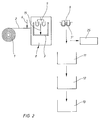
- a fabric roll 2 is unwound from a fabric roll 1, which may consist of a treated or untreated cotton knitwear, and introduced into a lye bath 3 via deflection rollers 4.
- the fabric web 2 stays for a certain time in the lye bath 3 of z. B. in the range between 10 and 40 seconds.
- the fabric web 2 is then passed through squeeze rollers 5, where a large part of the alkali is removed from the goods. Subsequently, the fabric is divided by one or more knives 6 into textile structures 7 which are still saturated with sodium hydroxide solution. These textile structures 7 undergo mechanical shaping 8, a die being described in more detail in FIGS. 1 to 3.
- the die 9 essentially consists of one or more forming dies which are guided against the stretched textile structure 7 so as to cause the previously shrunk textile fabric to stretch in the region of the forming zones.
- a drying unit 10 can be connected in order to dry and further process the goods treated with the alkali.
- the goods still in the die 9, which is now formed as a textile structure 7 ' are transferred to one or more baths.
- a rinsing bath 11 is used as the first bath, into which the textile structure 7 'resting in the die 9 is inserted, in order to remove part of the sodium hydroxide solution from the structure 7'.
- One or more rinsing baths 11 can be connected in series, different rinsing processes being carried out at different temperatures.
- the goods After passing through the neutralization bath 12, the goods are fed to a suction station 13, where the remaining liquid for the most part Will get removed. A final treatment 14 can then be connected.
- lye bath 3 can also be used with lyes of relatively low concentration, the drying concentration 10 achieving the effective concentration of the lye.
- the dry fabric web 2 is immediately subjected to mechanical shaping 8 and the shaping tool is lowered into the suds bath 3 together with the deformed textile structure 7.
- the die 9 remains in the lye bath 3 for a certain time in order to allow the shrinking process to develop to the desired degree of shrinkage.
- a dwell stage can be inserted before the rinsing and post-treatment processes.
- the dwell is preferably at room temperature with the exclusion of air.
- FIG. 3 Such a mechanical deformation is shown as an exemplary embodiment in FIG. 3, a lifting drive 18 which drives a die 9 in the vertical direction being arranged in a column frame 17.
- a lifting drive 18 which drives a die 9 in the vertical direction being arranged in a column frame 17.
- One or more tool shapes 23 are on the die 9 arranged, under which a clamping frame 19 can be raised and lowered.
- the clamping frame 19 moves onto the support frame 21 on which the textile structure 7 lies flat.
- the clamping frame 19 then clamps this textile structure 7 at least in the edge regions, so that the tool molds 23 push down the textile structures 23
- Tool molds press the textile structure down and carry out the reshaping in the desired regions.
- the support frame 20 is in this case mounted in the area of a support frame 21, in which a trough 22 is also arranged for collecting flowing liquid.
- a trough 22 is also arranged for collecting flowing liquid.
- endless deformation processes can also be carried out, i.e. Deformations in the area of a nip, which is formed by two opposing, opposing deformation rollers.
- discontinuous deformation processes can also be used and are claimed accordingly.
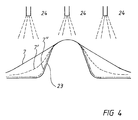
- FIG. 4 A free forming is shown in FIG. 4, wherein the textile structure 7 to be formed is clamped over a tool form 23. It is then treated with the alkali via spray nozzles 24, which leads to a Shrinkage occurs and the textile fabric in the form of the deformed structures 7 ', 7''fits positively on the mold 23.
- the other liquids namely the neutralization solution and the rinsing solutions, can also be introduced to the textile structure via the spray nozzles 24.
- FIG. 5 shows a modified exemplary embodiment of a method in comparison to the method according to FIG. 1.
- the goods are namely removed from the mold (die 9) after the neutralization bath 12 and thus form the textile structure 7 ′′.
- the textile fabric After being spun off in the washing machine, the textile fabric is put into a dryer, where it is dried in the range from dry to iron-damp.
- the textile structure 7 * removed from the dryer is then stretched onto a heated mold 28, in which case the shape in the heated mold should be the same as that described above in the same way Die 9 was manufactured.
- the mold is heated in the range of approximately 60 ° to 200 °, which depends on the length of time the textile structure remains in the mold and the sensitivity of the textile.
- washing machine 26 After washing and spinning the textile, it leaves the washing machine 26 as a textile structure 7x and is immediately clamped onto the heated mold 28 and dried there.
- FIGS. 5 and 6 also have in common that drying 10 can take place as an intermediate stage after the shaping in the mechanical shaping 8 and before the neutralization in the neutralizing bath 12.
- the intermediate drying process (drying 10) enables an increased alkali concentration in the textile structure 7 'to be achieved.
- alkalis instead of the sodium hydroxide solution described, other alkalis can also be used, such as. B. Potash, triethanolamine, lithium hydroxide and mixtures of the above chemicals.
Landscapes
- Engineering & Computer Science (AREA)
- Manufacturing & Machinery (AREA)
- Textile Engineering (AREA)
- Chemical Or Physical Treatment Of Fibers (AREA)
- Treatment Of Fiber Materials (AREA)
- Diaphragms For Electromechanical Transducers (AREA)
- Treatments For Attaching Organic Compounds To Fibrous Goods (AREA)
Applications Claiming Priority (2)
| Application Number | Priority Date | Filing Date | Title |
|---|---|---|---|
| DE4321139 | 1993-06-25 | ||
| DE4321139A DE4321139A1 (de) | 1993-06-25 | 1993-06-25 | Verfahren und Vorrichtung zur Umformung von textilen Flächengebilden |
Publications (3)
| Publication Number | Publication Date |
|---|---|
| EP0630588A2 true EP0630588A2 (fr) | 1994-12-28 |
| EP0630588A3 EP0630588A3 (fr) | 1995-05-17 |
| EP0630588B1 EP0630588B1 (fr) | 1998-09-09 |
Family
ID=6491209
Family Applications (1)
| Application Number | Title | Priority Date | Filing Date |
|---|---|---|---|
| EP94108357A Expired - Lifetime EP0630588B1 (fr) | 1993-06-25 | 1994-05-31 | Procédé et dispositif pour la transformation d'articles textiles plats |
Country Status (3)
| Country | Link |
|---|---|
| EP (1) | EP0630588B1 (fr) |
| AT (1) | ATE170719T1 (fr) |
| DE (2) | DE4321139A1 (fr) |
Cited By (4)
| Publication number | Priority date | Publication date | Assignee | Title |
|---|---|---|---|---|
| EP1386549A1 (fr) * | 2002-07-30 | 2004-02-04 | Chantelle | Procédé de fabrication d'articles d'habillement comprenant une pluralité de pièces assemblées entre elles |
| US8493081B2 (en) | 2009-12-08 | 2013-07-23 | Magna Closures Inc. | Wide activation angle pinch sensor section and sensor hook-on attachment principle |
| EP2885989A1 (fr) * | 2013-12-17 | 2015-06-24 | Mayser GmbH & Co. KG | Procédé et installation pour la transformation d'éléments textiles |
| US9234979B2 (en) | 2009-12-08 | 2016-01-12 | Magna Closures Inc. | Wide activation angle pinch sensor section |
Families Citing this family (3)
| Publication number | Priority date | Publication date | Assignee | Title |
|---|---|---|---|---|
| DE102013114186B4 (de) | 2013-12-17 | 2016-03-31 | Mayser Gmbh & Co. Kg | Verfahren zum Umformen von Textilgebilden sowie damit hergestellte Textilien |
| DE102013114185B3 (de) * | 2013-12-17 | 2014-11-27 | Mayser Gmbh & Co. Kg | Verfahren und Anlage zum Umformen textiler Flächengebilde sowie damit hergestellte Textilien |
| CN110074475B (zh) * | 2019-04-24 | 2021-04-27 | 佛山市南海真之玉内衣有限公司 | 一种模杯的制备工艺 |
Family Cites Families (12)
| Publication number | Priority date | Publication date | Assignee | Title |
|---|---|---|---|---|
| DE472359C (de) * | 1929-02-26 | John Manning Van Heusen | Verfahren zum Herstellen von Hueten aus baumwollenen Geweben oder Gewirken | |
| US1682870A (en) * | 1922-08-05 | 1928-09-04 | John M Van Heusen | Fabric hat and method of making the same |
| DE458496C (de) * | 1924-09-18 | 1928-04-12 | John Manning Van Heusen | Verfahren zur Herstellung von geformten Gegenstaenden, insbesondere von Kopfbedeckungen, aus baumwollenen Web- oder Wirkwaren |
| US1988517A (en) * | 1933-03-17 | 1935-01-22 | Maiden Form Brassiere Co Inc | Method and means for making brassieres |
| US2962025A (en) * | 1956-09-13 | 1960-11-29 | United Merchants & Mfg | Process of shaping and forming brassiere cups by chemical shrinkage of the fabric |
| FR1307344A (fr) * | 1961-09-14 | 1962-10-26 | Perfectionnements à la confection des soutien-gorge | |
| DE1249001B (de) * | 1962-09-26 | 1967-08-31 | Shell" Research Limited, London | Molluscicide Mittel |
| GB1096024A (en) * | 1963-10-08 | 1967-12-20 | Frank Peacock | Improvements in and relating to shaping cloth |
| US3347963A (en) * | 1964-12-28 | 1967-10-17 | Little Inc A | Method of stretch forming rayons |
| FR2193350A5 (fr) * | 1972-07-21 | 1974-02-15 | Sebreg | |
| GB2062711A (en) * | 1979-11-05 | 1981-05-28 | Mottana Spa E | Continuous Mercerisation of Knitted Fabric |
| DE4213127C1 (fr) * | 1992-04-21 | 1993-07-01 | Babcock Textilmaschinen Gmbh, 2105 Seevetal, De |
-
1993
- 1993-06-25 DE DE4321139A patent/DE4321139A1/de not_active Withdrawn
-
1994
- 1994-05-31 AT AT94108357T patent/ATE170719T1/de not_active IP Right Cessation
- 1994-05-31 EP EP94108357A patent/EP0630588B1/fr not_active Expired - Lifetime
- 1994-05-31 DE DE59406865T patent/DE59406865D1/de not_active Expired - Fee Related
Cited By (6)
| Publication number | Priority date | Publication date | Assignee | Title |
|---|---|---|---|---|
| EP1386549A1 (fr) * | 2002-07-30 | 2004-02-04 | Chantelle | Procédé de fabrication d'articles d'habillement comprenant une pluralité de pièces assemblées entre elles |
| FR2842997A1 (fr) * | 2002-07-30 | 2004-02-06 | Chantelle | Procede de fabrication d'articles d'habillement comprenant une pluralite de pieces assemblees entre elles |
| US8493081B2 (en) | 2009-12-08 | 2013-07-23 | Magna Closures Inc. | Wide activation angle pinch sensor section and sensor hook-on attachment principle |
| US9234979B2 (en) | 2009-12-08 | 2016-01-12 | Magna Closures Inc. | Wide activation angle pinch sensor section |
| US9417099B2 (en) | 2009-12-08 | 2016-08-16 | Magna Closures Inc. | Wide activation angle pinch sensor section |
| EP2885989A1 (fr) * | 2013-12-17 | 2015-06-24 | Mayser GmbH & Co. KG | Procédé et installation pour la transformation d'éléments textiles |
Also Published As
| Publication number | Publication date |
|---|---|
| EP0630588B1 (fr) | 1998-09-09 |
| EP0630588A3 (fr) | 1995-05-17 |
| DE59406865D1 (de) | 1998-10-15 |
| ATE170719T1 (de) | 1998-09-15 |
| DE4321139A1 (de) | 1995-01-05 |
Similar Documents
| Publication | Publication Date | Title |
|---|---|---|
| DE69719967T2 (de) | Mechanische und innere erweichung eines vliesstoffes | |
| DE69625710T2 (de) | Verfahren zur herstellung von geweben und gewirken aus garngefarbten rohseide | |
| DE69529358T2 (de) | Verfahren zur chemischen und mechanischen Erweichung eines Vliesstoffes | |
| DE1223335B (de) | Verfahren zum Herstellen von voluminoesen Textilstoffen | |
| DE69030668T2 (de) | Strecken von stapelfasern | |
| EP0799333B1 (fr) | Fibres et fils de cellulose presentant une propension reduite a la formation de fibrilles | |
| EP0630588B1 (fr) | Procédé et dispositif pour la transformation d'articles textiles plats | |
| DE2301107A1 (de) | Verfahren zur verarbeitung eines hitzeschrumpfbaren folienartigen materials | |
| DE1858902U (de) | Buestenhalter. | |
| DE69906689T2 (de) | Verfahren zum färben und veredeln von cellulosischen geweben | |
| DE939683C (de) | Verfahren zur Herstellung von haltbaren, mechanisch erzeugten Appretureffekten auf Cellulosematerial bzw. Seide | |
| DE917662C (de) | Verfahren zur Steigerung der Widerstandsfaehigkeit mechanisch erzeugter Ausruestungseffekte von Textilmaterial | |
| DE4239341C2 (de) | Gewebe aus Baumwolle mit kaschmirartigem Charakter und Verfahren zu dessen Hesttellung | |
| EP0863249A2 (fr) | Méthode de traitement des tissus contenant de la laine, notamment des vêtements | |
| DE2438024A1 (de) | Verfahren und vorrichtung zur behandlung von geweben | |
| DE112012000767T5 (de) | Verfahren zur Rohkonfektion eines Artikels enthaltend einen Mikrofaser Vliesstoff | |
| DE2207398C3 (fr) | ||
| DE69320795T2 (de) | Verfahren zur Herstellung von tierischer Wolle mit dünnem Querschnitt | |
| EP0499991B1 (fr) | Procédé de fixation chimique de la laine | |
| EP2885989B1 (fr) | Procédé et installation pour la transformation d'éléments textiles | |
| AT265201B (de) | Verfahren zur Verbesserung der textilen Eigenschaften von cellulosehaltigem Textilgut | |
| DE592867C (de) | Verwollen fertig verarbeiteter Ware aus pflanzlichen Werkstoffen | |
| DE60316382T2 (de) | Knöpfe die zusammen mit ihrem Gewebetrager färbbar sind | |
| DE102013114185B3 (de) | Verfahren und Anlage zum Umformen textiler Flächengebilde sowie damit hergestellte Textilien | |
| DE1039483B (de) | Verfahren zur Erzielung eines Seidenglanzes auf textilen Flaechengebilden, die aus synthetischem thermoplastischem Material bestehen oder solches enthalten |
Legal Events
| Date | Code | Title | Description |
|---|---|---|---|
| PUAI | Public reference made under article 153(3) epc to a published international application that has entered the european phase |
Free format text: ORIGINAL CODE: 0009012 |
|
| AK | Designated contracting states |
Kind code of ref document: A2 Designated state(s): AT DE GB IT |
|
| PUAL | Search report despatched |
Free format text: ORIGINAL CODE: 0009013 |
|
| AK | Designated contracting states |
Kind code of ref document: A3 Designated state(s): AT DE GB IT |
|
| 17P | Request for examination filed |
Effective date: 19950802 |
|
| 17Q | First examination report despatched |
Effective date: 19960621 |
|
| GRAG | Despatch of communication of intention to grant |
Free format text: ORIGINAL CODE: EPIDOS AGRA |
|
| GRAG | Despatch of communication of intention to grant |
Free format text: ORIGINAL CODE: EPIDOS AGRA |
|
| GRAH | Despatch of communication of intention to grant a patent |
Free format text: ORIGINAL CODE: EPIDOS IGRA |
|
| GRAH | Despatch of communication of intention to grant a patent |
Free format text: ORIGINAL CODE: EPIDOS IGRA |
|
| GRAA | (expected) grant |
Free format text: ORIGINAL CODE: 0009210 |
|
| AK | Designated contracting states |
Kind code of ref document: B1 Designated state(s): AT DE GB IT |
|
| REF | Corresponds to: |
Ref document number: 170719 Country of ref document: AT Date of ref document: 19980915 Kind code of ref document: T |
|
| REF | Corresponds to: |
Ref document number: 59406865 Country of ref document: DE Date of ref document: 19981015 |
|
| GBT | Gb: translation of ep patent filed (gb section 77(6)(a)/1977) |
Effective date: 19981109 |
|
| PLBQ | Unpublished change to opponent data |
Free format text: ORIGINAL CODE: EPIDOS OPPO |
|
| PLBI | Opposition filed |
Free format text: ORIGINAL CODE: 0009260 |
|
| PLBF | Reply of patent proprietor to notice(s) of opposition |
Free format text: ORIGINAL CODE: EPIDOS OBSO |
|
| 26 | Opposition filed |
Opponent name: TEXTILFORMUNG WILLI LEHMANN GMBH Effective date: 19990609 |
|
| PLBF | Reply of patent proprietor to notice(s) of opposition |
Free format text: ORIGINAL CODE: EPIDOS OBSO |
|
| PLBL | Opposition procedure terminated |
Free format text: ORIGINAL CODE: EPIDOS OPPC |
|
| PLBM | Termination of opposition procedure: date of legal effect published |
Free format text: ORIGINAL CODE: 0009276 |
|
| STAA | Information on the status of an ep patent application or granted ep patent |
Free format text: STATUS: OPPOSITION PROCEDURE CLOSED |
|
| 27C | Opposition proceedings terminated |
Effective date: 20010528 |
|
| REG | Reference to a national code |
Ref country code: GB Ref legal event code: IF02 |
|
| PGFP | Annual fee paid to national office [announced via postgrant information from national office to epo] |
Ref country code: DE Payment date: 20040407 Year of fee payment: 11 |
|
| PGFP | Annual fee paid to national office [announced via postgrant information from national office to epo] |
Ref country code: AT Payment date: 20040511 Year of fee payment: 11 |
|
| PGFP | Annual fee paid to national office [announced via postgrant information from national office to epo] |
Ref country code: GB Payment date: 20040525 Year of fee payment: 11 |
|
| PG25 | Lapsed in a contracting state [announced via postgrant information from national office to epo] |
Ref country code: IT Free format text: LAPSE BECAUSE OF NON-PAYMENT OF DUE FEES;WARNING: LAPSES OF ITALIAN PATENTS WITH EFFECTIVE DATE BEFORE 2007 MAY HAVE OCCURRED AT ANY TIME BEFORE 2007. THE CORRECT EFFECTIVE DATE MAY BE DIFFERENT FROM THE ONE RECORDED. Effective date: 20050531 Ref country code: GB Free format text: LAPSE BECAUSE OF NON-PAYMENT OF DUE FEES Effective date: 20050531 Ref country code: AT Free format text: LAPSE BECAUSE OF NON-PAYMENT OF DUE FEES Effective date: 20050531 |
|
| PG25 | Lapsed in a contracting state [announced via postgrant information from national office to epo] |
Ref country code: DE Free format text: LAPSE BECAUSE OF NON-PAYMENT OF DUE FEES Effective date: 20051201 |
|
| GBPC | Gb: european patent ceased through non-payment of renewal fee |
Effective date: 20050531 |
|
| PLAB | Opposition data, opponent's data or that of the opponent's representative modified |
Free format text: ORIGINAL CODE: 0009299OPPO |