EP0631432B1 - Videokamera mit elektronischem Bildstabilisator - Google Patents
Videokamera mit elektronischem Bildstabilisator Download PDFInfo
- Publication number
- EP0631432B1 EP0631432B1 EP19940110045 EP94110045A EP0631432B1 EP 0631432 B1 EP0631432 B1 EP 0631432B1 EP 19940110045 EP19940110045 EP 19940110045 EP 94110045 A EP94110045 A EP 94110045A EP 0631432 B1 EP0631432 B1 EP 0631432B1
- Authority
- EP
- European Patent Office
- Prior art keywords
- motion vector
- value
- correlative
- average
- detection areas
- Prior art date
- Legal status (The legal status is an assumption and is not a legal conclusion. Google has not performed a legal analysis and makes no representation as to the accuracy of the status listed.)
- Expired - Lifetime
Links
- 239000003381 stabilizer Substances 0.000 title claims description 6
- 239000013598 vector Substances 0.000 claims description 196
- 238000001514 detection method Methods 0.000 claims description 171
- 239000006185 dispersion Substances 0.000 claims description 60
- 238000012935 Averaging Methods 0.000 claims description 5
- 230000000087 stabilizing effect Effects 0.000 claims description 2
- 238000000034 method Methods 0.000 description 23
- 230000006641 stabilisation Effects 0.000 description 9
- 238000011105 stabilization Methods 0.000 description 9
- 238000012545 processing Methods 0.000 description 4
- 238000004364 calculation method Methods 0.000 description 3
- 238000012360 testing method Methods 0.000 description 3
- 238000009825 accumulation Methods 0.000 description 2
- 238000010586 diagram Methods 0.000 description 2
- 238000012937 correction Methods 0.000 description 1
- 238000011156 evaluation Methods 0.000 description 1
- 230000003287 optical effect Effects 0.000 description 1
- 238000005070 sampling Methods 0.000 description 1
- 238000010200 validation analysis Methods 0.000 description 1
Images


Classifications
-
- H—ELECTRICITY
- H04—ELECTRIC COMMUNICATION TECHNIQUE
- H04N—PICTORIAL COMMUNICATION, e.g. TELEVISION
- H04N5/00—Details of television systems
- H04N5/14—Picture signal circuitry for video frequency region
- H04N5/144—Movement detection
- H04N5/145—Movement estimation
-
- H—ELECTRICITY
- H04—ELECTRIC COMMUNICATION TECHNIQUE
- H04N—PICTORIAL COMMUNICATION, e.g. TELEVISION
- H04N23/00—Cameras or camera modules comprising electronic image sensors; Control thereof
- H04N23/60—Control of cameras or camera modules
- H04N23/68—Control of cameras or camera modules for stable pick-up of the scene, e.g. compensating for camera body vibrations
- H04N23/681—Motion detection
- H04N23/6811—Motion detection based on the image signal
-
- H—ELECTRICITY
- H04—ELECTRIC COMMUNICATION TECHNIQUE
- H04N—PICTORIAL COMMUNICATION, e.g. TELEVISION
- H04N23/00—Cameras or camera modules comprising electronic image sensors; Control thereof
- H04N23/60—Control of cameras or camera modules
- H04N23/68—Control of cameras or camera modules for stable pick-up of the scene, e.g. compensating for camera body vibrations
-
- H—ELECTRICITY
- H04—ELECTRIC COMMUNICATION TECHNIQUE
- H04N—PICTORIAL COMMUNICATION, e.g. TELEVISION
- H04N23/00—Cameras or camera modules comprising electronic image sensors; Control thereof
- H04N23/60—Control of cameras or camera modules
- H04N23/68—Control of cameras or camera modules for stable pick-up of the scene, e.g. compensating for camera body vibrations
- H04N23/682—Vibration or motion blur correction
- H04N23/683—Vibration or motion blur correction performed by a processor, e.g. controlling the readout of an image memory
Definitions
- the present invention relates to a video camera. More specifically, the present invention relates to a compact video camera with electronic picture stabilizer, which is utilized as a camcorder, for example.
- One example of a method for detecting an unintentional motion component of an image sensing device is disclosed in, for example, the 2 ⁇ th image engineering conference in 1989 by Matsushita Electric Industrial Corporation.
- this prior art method by utilizing a motion vector obtained by a representative point matching method disclosed in, for example, JP-A- 61(1986)-2 ⁇ 1581, the motion component of the image sensing device is detected according to image information.
- an electronic picture stabilization is performed on the basis of a whole motion vector obtained from the image information.
- the whole motion vector is evaluated by averaging the portion motion vectors of the four detection areas, or the whole motion vector is evaluated by averaging portion motion vectors of two portion motion vectors having intermediate values of the four portion motion vectors, whereby the electronic picture stabilization is performed on the basis of the whole motion vector thus evaluated.
- an electronic picture stabilizer for electronically stabilizing the picture taken by the camera against unintentional motion by using a whole motion vector
- EP-A-0 392 671 discloses an image motion vector detector including means for detecting motion vectors in motion vector detection regions defined in the whole or part of a picture frame, means for judging the reliability of the motion vector in each region and means for outputting a representative value of a set of reliable motion vectors as amotion vector of the frame in case the number of motion vectors judged to be reliable is more than or equal to predetermined number. Vectors in detection regions containing moving image portions are judged to be not reliable.
- a principal object of the present invention is to provide a video camera having a novel electronic picture stabilizer.
- Another object of the present invention is to provide a video camera with electronic picture stabilizer capable of accurately performing the electronic picture stabilization.
- valid detection area determinating means includes first means for evaluating correlative values of pixels at a present field or frame on the basis of an image signal of a last field or frame and an image signal of the present field or frame; means for evaluating an average correlative value that is a mean value of the correlative values; means for evaluating a minimum correlative value that is a minimum value out of the correlative values; means for evaluating a value obtained by dividing the average correlative value by the minimum correlative value; means for evaluating a gradient associated with the minimum correlative value; and means for determined whether or not a motion vector is correctly detected in accordance with whether or not the following conditions are satisfied:
- the threshold values to be compared with the gradient are changed in accordance with the average correlative value.
- the threshold value to be compared with the gradient is set to be large as indicated by the condition (C)
- the threshold value to be compared with the gradient is set to be small as indicated by the condition (D). Therefore, the gradient can be compared with the threshold value in corresponding to a change of the contrast in the screen (the third threshold value or the fourth threshold value), and therefore, determination whether or not an object having repeated pattern exists in the image field becomes to be performed more correctly.
- each of respective detection areas defined within the screen image field is a valid detection area by the valid detection area determinating means through determination whether or not all of the above described conditions are satisfied in respect to the detection area.
- first, a first absolute value and a second absolute value are evaluated for each detection area by first calculation means and second calculation means, respectively.
- first calculation means and second calculation means By adding the first absolute value and the second absolute value to each other for each detection area by addition means so as to obtain a first dispersion, and the arbitrary number of the first dispersions are selected by selection means in order of small.
- a whole motion vector is detected on the basis of portion motion vectors of the detection areas representing the selected first dispersions.
- a portion motion vector of an arbitrary invalid detection area is replaced with the whole motion vector of a field or frame before the present field or frame by first replacement means. Thereafter, the portion motion vector of the invalid detection area that is replaced with the whole motion vector and the portion motion vectors of the valid detection areas are utilized for detecting the whole motion vector at the present field or frame according to the above described processing.
- the number of valid detection areas is zero, as the whole motion vector of the present field or frame, a resulted vector by multiplying the whole motion vector evaluated one field or frame before by a predetermined coefficient less than 1 (decimal number less than 1) is utilized.
- a detecting method for detecting the whole motion vector is changed according to the number of valid detection areas, even if a portion motion vector that is not caused by the unintentional motion of the camera is detected in performing the electronic image stabilization, the influence thereof becomes very small, and therefore, it becomes possible to accurately detect an unintentional motion amount. Therefore, the unintentional motion of the camera can be corrected with precision.
- the whole motion vector may be evaluated on the basis of a second dispersion as described in the following. More specifically, first, the second dispersion is evaluated by second dispersion calculation means by utilizing an average vector of the portion motion vectors, that is evaluated by averaging means, and the portion motion vectors of the respective detection areas. A fact that the second dispersion is large indicates that variation of the portion motion vectors is large. This tendency occurs in a case where there is an object which moves in only a portion of the screen. On the other hand, a fact that the second dispersion is small means that the variation of the portion motion vectors is small. This tendency occurs in a case where no moving object exists on the screen, or a case where there is an object which moves all over the screen.
- the whole motion vector by utilizing the portion motion vector of the case where the second dispersion is large the whole motion vector having low reliability is obtained.
- the whole motion vector is evaluated by utilizing the portion motion vector of the case whether the second dispersion is small, the whole motion vector having high reliability is obtained. Therefore, in the case where the second dispersion is large, a value of the whole motion vector is made small by multiplying the average vector of the portion motion vectors by a small coefficient. Furthermore, in the case where the second dispersion is small, a value of the whole motion vector is made large by multiplying the average vector of the portion motion vectors by a large coefficient. That is, the whole motion vector of the case of the large second dispersion is not used as possible, and in contrast, the whole motion vector of the case of the small second dispersion is used as possible.
- a degree of a magnitude of the second dispersion is determined by comparing means, and the whole motion vector is detected in accordance with a comparison result.
- the whole motion vector is detected in accordance with the magnitude of the second dispersion, and therefore, it is possible to more correctly detect the whole motion vector. Accordingly, the unintentional motion amount can be detected with precision.
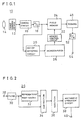
- a video camera 1 ⁇ of a preferred embodiment shown in Figure 1 includes a solid-state image sensing device 12 such as a CCD (Charge-Coupled Device) which converts an optical signal being inputted from an object (not shown) through a lens 14 into an electric signal.
- the electric signal from the solid-state image sensing device 12 is inputted to a camera circuit 16.
- the camera circuit 16 includes a sample-hold circuit by which the electric signal from the solid-state image sensing device 12 is sampled and held. The level of the electric signal thus sampled and held is adjusted by an AGC (Automatic Gain Control), and synchronization signals are added to the electric signal by a synchronization signal adding circuit (not shown).
- AGC Automatic Gain Control
- the camera circuit 16 converts the electric signal from the solid-state image sensing device 12 into an analog video signal.
- the analog video signal is further converted into a digital video signal by an A/D converter 18.
- the digital video signal is applied to a motion detecting circuit 2 ⁇ .
- the motion detecting circuit 2 ⁇ for example, an LSI "L7A ⁇ 948" manufactured by Sanyo Electric Co., Ltd. may be utilized.
- the digital video signal is written into a field memory 24 field by field.
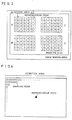
- the motion detecting circuit 2 ⁇ evaluates, for each of four detection areas A, B, C and D shown in Figure 3, the position of one point having the highest correlation degree (a minimum correlative value) and positions of four points around the one point, and correlative values by utilizing a well-known representative point matching method.
- the position data and the correlative value data are applied to a microcomputer 26.
- the motion detecting circuit 2 ⁇ shown in Figure 1 includes an input end 28 which receives the digital video signal from the A/D converter 18.
- the digital video signal inputted to the input end 28 is applied to the representative point memory 32 and a subtracting circuit 34, respectively, through a filter 3 ⁇ .
- the filter 3 ⁇ is a kind of digital low-pass filter which is utilized for improvement of an S/N ratio so as to secure a significant detection accuracy with a lesser number of representative points.
- the representative point memory 32 stores position data and luminance data of a plurality of representative points within each of the respective detection areas A-D shown in Figure 3.
- each of the detection areas is divided into thirty (3 ⁇ ) regions, and therefore, thirty (3 ⁇ ) representative points are determined, and accordingly, the representative point memory 32 stores the position data and the luminance data of the thirty (3 ⁇ ) representative points.
- Each of the divided regions 42 ( Figure 4) is constituted by 32 pixels in a horizontal direction (X direction) x 16 pixels in a vertical direction (Y direction).
- the subtracting circuit 34 executes subtracting operations of the luminance data of the representative point of the last field read-out the representative point memory 32 and luminance data of all the pixels of the present field applied from the input end 28 via the filter 3 ⁇ , and obtains absolute values of subtraction results. That is, the subtracting circuit 34 evaluates a luminance difference between the luminance data of the present field and the luminance data of the last field, and applies the luminance differences to an accumulating and adding circuit 36.
- the accumulating and adding circuit 36 executes an accumulation and addition of the luminance differences of thirty (3 ⁇ ) in this embodiment obtained by the subtracting circuit 34 of the same position or pixel in the same region 42 so as to output correlative values data.
- the correlative values data is applied to an arithmetic operation circuit 38 which evaluates a minimum correlative value and calculates an average correlative value for each of the detection areas A-D, and evaluates position data of the pixel having the minimum correlative value.
- Data of the minimum correlative value, average correlative value and positions thus obtained by the arithmetic operation circuit 38 is applied to the above described microcomputer 26 from an output end 4 ⁇ .
- arithmetic operations for the correlative values can be performed by the above described LSI "L7A ⁇ 948".
- a motion vector of a whole of a screen i.e. the image field 44 ( Figure 3) (simply called as "whole motion vector") is calculated on the basis of the position data and the correlative value data.
- a deviation of a pixel indicative of the minimum correlative value from the representative point is evaluated on the basis of the position data of that pixel, and the deviation is made as a portion motion vector.
- an internal interpolation is preformed by utilizing the correlative values of the four pixels around the pixel having the minimum correlative value so as to calculate the position data of the pixel having the minimum correlative value.
- the microcomputer 26 further evaluates a propriety of the portion motion vector detected for each detection area, that is, determines whether each of the detection areas is a valid detection area or an invalid detection area on the basis of the status of the image.
- a propriety of the portion motion vector detected for each detection area that is, determines whether each of the detection areas is a valid detection area or an invalid detection area on the basis of the status of the image.
- the change of the correlative value with respect to the coordinate positions becomes similar to Figure 11 (described later).
- conditions (A) - (C) are defined as follows.
- ⁇ , ⁇ , ⁇ , ⁇ , and ⁇ are constant threshold values, and ⁇ ⁇ ⁇ .
- the microcomputer 26 determines whether or not the contrast of the screen is low in accordance with the above described condition (A). The microcomputer 26 further determines whether or not the moving object exists within the detection area on the basis of the above described condition (B). Furthermore, the microcomputer 26 determines whether or not the object having repeated pattern exists in the detection area on the basis of the above described condition (C) at a time that the average correlative value is equal to or larger than the threshold value ⁇ , or the above described condition (D) at a time that the average correlative value is smaller than the threshold value ⁇ .
- the correlative value becomes small.
- the reliability of the detection result is small, and therefore, only when the condition (A) is satisfied, that is, the average correlative value > ⁇ , the detection area is determined as the valid detection area.
- the threshold value ⁇ can be determined through field tests or examinations. Thus, on the basis of the average correlative value, it is determined whether or not the screen has low contrast.
- the correlative value at a portion occupied by the moving object and the correlative value no moving object exists are different from each other.
- Various kinds of correlative values are obtained by the portion occupied by the moving object, and the correlative value from that portion becomes a large value generally (the correlation degree becomes low). Therefore, when the moving object exists within the detection area, there is a possibility that the minimum correlative value becomes large, and the portion motion vector of that detection area may be erroneously detected.
- the microcomputer 26 determines the presence or absence of the moving object by evaluating the value of the average correlative value / the minimum correlative value.
- one point having the minimum correlative value and the correlative values of four points around the one point are utilized so as to detect the object having repeated pattern (stripes, for example).
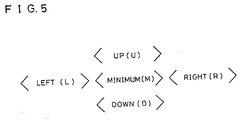
- the correlative values of the four points at left, right, up, and down are L, R, U, and D as shown in Figure 5.
- the differences between the respective correlative values, i.e. L - M, R - M, U - M and D - M are calculated, and a minimum value of the differences is defined as the gradient.
- the gradient is compared with the threshold value ⁇ that is determined through field tests.
- the detection area is determined as the invalid detection area.
- the gradient is compared with the threshold value ⁇ that is determined through field tests. If the gradient is larger than the threshold value ⁇ , the detection area is determined as the valid detection area, and if the gradient is equal to or smaller than the threshold value ⁇ , it is determined that the detection area is the invalid detection area.
- each of the detection areas is the valid detection area.
- the motion amount between the fields i.e. the whole motion vector is determined. Therefore, the whole motion vector is representative of the motion amount between the fields and a direction thereof.
- the whole motion vector thus evaluated is applied to the memory control circuit 22.
- a start address for reading-out the field memory 24 is determined on the basis of the whole motion vector, and therefore, the digital video signal stored in the field memory 24 becomes to be read-out at the start address. That is, the memory control circuit 22 moves an extracting area 46 ( Figure 6) formed by the digital video signal from the field memory 24 in accordance with the whole motion vector calculated by the microcomputer 26.
- an electronic zooming circuit 48 ( Figure 1) is utilized.
- the electronic zooming circuit 48 defines the image extracting area 46 wherein an image is enlarged according to a zooming magnification with respect to the image field 44.
- a position of the image extracting area 46 can be freely moved within a range of the image field 44 by changing the start address for reading-out the digital video signal from the field memory 24. Then, in order to obtain a video signal for a whole area of the image field 24 on the basis of the digital video signal extracted from the image extracting area 46, an image is enlarged by utilizing an internal interpolation on the basis of the digital video signal read-out the field memory 24.
- an image from the video camera 1 ⁇ is blurred, and resulting in a case where an object person exists in a left-lower portion within the image field 44 (shown at an upper portion in Figure 7) or a case where an object person exists at a right-upper portion within the image field (shown at a lower portion in Figure 47). Therefore, by moving the image extracting area 46 at every field according to the whole motion vector that is calculated by the microcomputer 26, as shown at a right portion in Figure 7, the object person can be just positioned in the image extracting area 46.
- the digital video signal thus outputted from the electronic zooming circuit 48 is converted into an analog signal by a D/A converter 52 so as to be outputted from an output terminal 54.
- processings set forth in the following may be executed by the microcomputer 26.
- the microcomputer 26 evaluates a mean value of four portion motion vectors (average vector) and a mean value of portion motion vectors of the valid detection areas, respectively.
- a dispersion is calculated by the microcomputer 26.
- a degree of variation of the portion motion vector of each of the detection areas is evaluated according to the dispersion.
- the dispersion is represented by the following equations.
- X direction dispersion ⁇ (
- Y direction dispersion ⁇ (
- a dispersion coefficient Hk is determined, and by multiplying the dispersion coefficient Hk by the mean value of the portion motion vectors of the valid detection areas, the whole motion vector is calculated.
- the dispersion coefficient Hk is determined in the X direction and the Y direction, respectively, and the X direction dispersion coefficient is multiplied to the X direction component of the means value of the portion motion vectors of the valid detection areas, and the Y direction dispersion coefficient is multiplied to the Y direction component of the mean value of the portion motion vectors.
- a minimum one of the four portion motion vectors is defined as the whole motion vector.
- the whole motion vector is calculated by multiplying the dispersion coefficient Hk to the mean value of the portion motion vectors of the valid detection areas; however, there is no valid detection area, the whole motion vector is defined as "the whole motion vector of the present field x a coefficient less than 1".
- the coefficient less than 1 in the embodiment shown, " ⁇ .97" is utilized.
- the whole motion vector is evaluated by utilizing the portion motion vectors of a case where the dispersion is large, the whole motion vector having low reliability is obtained.
- the whole motion vector is evaluated by utilizing the portion motion vectors of a case where the dispersion is small, the whole motion vector having high reliability is obtained.
- the whole motion vector is made smaller by multiplying a small dispersion coefficient Hk to the mean value of the portion motion vectors.
- the dispersion is small, by multiplying a large dispersion coefficient Hk to the mean value of the portion motion vectors, the whole motion vector is made larger. That is, the whole motion vector of the case where the dispersion is large is not used as possible, and in contrast, the whole motion vector of the case where the dispersion is small is used as possible, so that the whole motion vector having high reliability can be obtained.
- the unintentional motion is corrected, that is, the electronic picture stabilization is performed.
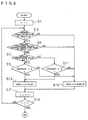
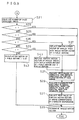
- n of the detection area is initially set as "1". If the average correlative value of the detection area n is larger than the threshold value ⁇ in a step S3, the process proceeds to a step S5 wherein it is determined whether or not the value obtained by dividing the average correlative value by the minimum correlative value is larger than the threshold value ⁇ . If the value is larger than the threshold value ⁇ in the step S5, in a step S7, it is determined whether or not the average correlative value is equal to or larger than the threshold value ⁇ .
- a step S9 it is determined whether or not the gradient of the detection area n is larger than the threshold value ⁇ . If “YES” is determined in the step S9, in a step S13, the detection area n is determined as a valid detection area. On the other hand, if the average correlative value is smaller than the threshold value ⁇ in the step S7, in a step S11, it is determined whether or not the gradient of the detection area n is larger than the threshold value ⁇ . If "YES" is determined in the step S11, in a step S13, the detection area n is determined as a valid detection area.
- the process proceeds to a step S15 in which, the detection area n is determined as an invalid detection area.
- step S17 After the step S13 or the step S15, in a step S17, "n" indicative of the detection area is incremented by 1. Then, in a step S19, it is determined whether or not "n” is equal to or smaller than "4", and if "YES", the process returns to the step S3. That is, the above described processings are repeated until “n” exceeds "4" in the step S19. If “n” exceeds "4" in the step S19, the process proceeds to a step S21 shown in Figure 9.
- step S21 the number of the valid detection areas is counted.
- step S23 it is determined whether or not the number of the valid detection areas is "4", and if "NO", in a step S25, it is determined whether or not the number of the valid detection areas is "3". If “YES” is determined in the step S23 or the step S25, that is, if the number of the valid detection areas is more than "3", in a step S27, mean values are calculated of the X (horizontal, for example) direction portion motion vectors and the Y (vertical, for example) direction portion motion vectors are calculated for each of the valid detection areas.
- a step S29 by utilizing the mean values calculated in the step S27, an absolute value of the X direction and an absolute value of the Y direction are evaluated for each of the valid detection areas, and then, the X direction absolute value and the Y direction absolute value are added to each other for each detection area to obtain the dispersion.
- the X direction absolute value is an absolute value of a difference between the X direction portion motion vectors of the respective detection areas and the mean value of the X direction portion motion vectors of the valid detection areas.
- the Y direction absolute value is an absolute value of a difference between the Y direction portion motion vectors of the respective detection areas and the mean value of the Y direction portion motion vectors of the valid detection areas.
- a step S31 two dispersions having smaller values are selected from the four dispersions calculated in the step S29, and a mean value of the portion motion vectors of the detect ion areas corresponding to the selected dispersions is calculated. Then, in a step S33, the mean value is used as the whole motion vector.
- a step S35 it is determined whether or not the number of the valid detection areas is "2". If the number of the valid detection areas is "2", in a step S37, the portion motion vector of an arbitrary one of the invalid detection areas is replaced with the whole motion vector evaluated before one field, and then, the process proceeds to the step S27. Then, through the execution of the steps S27 - S33, the whole motion vector is determined. In this embodiment shown, the portion motion vector of one of the two invalid detection area is replaced by the whole motion vector of the last field, but the portion motion vector of the remaining invalid detection area is not replaced with the whole motion vector. Therefore, the whole motion vector is determined on the basis of the portion motion vectors of the two valid detection areas and the portion motion vector of the invalid detection area being replaced with the whole motion vector.
- step S39 it is determined whether or not the number of the valid detection areas is "1". If “YES” is determined in the step S39, in a step S41, the portion motion vectors of arbitrary two invalid detection areas are replaced with the whole motion vector evaluated one field before and the whole motion vector evaluated two fields before, respectively, and the process proceeds to the step S27. Then, through the execution of the steps S27 - S33, the whole motion vector can be evaluated.
- the portion motion vectors of the two invalid detection areas out of the three invalid detection areas are replaced with the whole motion vector evaluated one field before and the whole motion vector evaluated two field before, respectively, and for the remaining one invalid detection area, the portion motion vector is not replaced with the whole motion vector. Therefore, in this embodiment shown, the whole motion vector is determined on the basis of the portion motion vector of one valid detection area and the portion motion vectors of the two invalid detection area being replaced with the whole motion vectors .
- step S43 by multiplying the coefficient " ⁇ .97" to the whole motion vector evaluated one field before, the whole motion vector of the present field in the step S33 is obtained.
- the unintentional motion is corrected by utilizing the whole motion vector according to the number of the valid detection areas; however, a correction method itself is well known, and therefore, a detailed description thereof is omitted here.
- the determination whether or not there is an object having repeated pattern within the detection areas can be made correctly, and the detection area may not be determined as the invalid detection area even if the contrast of the screen is slightly lowered. Therefore, the validation or the invalidation of the detection areas can be correctly determined, and accordingly, the detection accuracy of the whole motion vector becomes to be increased.
- the detection accuracy is largely affected by the status of the input image. Therefore, the propriety of the detected motion vector is evaluated by the microcomputer in accordance with the status of the image.
- Figure 11 is a graph showing a change of a correlative value with respect to coordinate positions in a case where the representative matching method is utilized.
- the correlative value has a sharp minimum point indicative of the minimum correlative value, and the motion vector is determined on the basis of the position of the minimum correlative value.
- the minimum correlative value can not be sharply detected, and therefore, the detection accuracy of the motion vector becomes to be deteriorated.
- a motion vector is determined by utilizing the motion vectors obtained from the valid detection areas only. As a method for determinating the motion vector, an averaging of the motion vectors of the valid detection areas is utilized, for example.
- the threshold value ⁇ of the condition (C) is to be made smaller.
- the threshold value ⁇ is made smaller irrespective of the contrast of the screen, it may be erroneously determined whether or not there is an object having a repeating pattern in the screen, and therefore, the detection accuracy of the motion vector is dropped.
- the gradient is compared with the large threshold value or the small threshold value according to another condition, such a problem can be solved.
- the correlative value is calculated through accumulation and addition of the luminance differences; however, the correlative value may be evaluated by utilizing a difference of the electric signals from the solid-state image sensing device 12 between the adjacent fields (frames) instead of the luminance differences.
- step S31 only one dispersion may be selected, that is, the arbitrary number of dispersions may be selected.
- the coefficient utilized in the step S43 is not limited to " ⁇ .97", and therefore, an arbitrary coefficient having a value larger than zero but smaller than 1 may be utilized.
- the four detection areas are defined within the image field in the above described embodiments; however, the number of the detection areas is arbitrary, and the larger number of the detection areas, the better the detection accuracy.
- the luminance difference is evaluated between the adjacent fields; however, the same may be evaluated between the adjacent frames. Furthermore, the replacement of the whole motion vector and etc. may be performed not a unit of field but a unit of frame.
Landscapes
- Engineering & Computer Science (AREA)
- Multimedia (AREA)
- Signal Processing (AREA)
- Compression Or Coding Systems Of Tv Signals (AREA)
- Studio Devices (AREA)
- Image Analysis (AREA)
- Closed-Circuit Television Systems (AREA)
Claims (3)
- Videokamera (10), welche aufweist:einen elektronischen Bildstabilisator zum elektronischen Stabilisieren des von der Kamera aufgenommenen Bildes gegenüber einer unbeabsichtigten Bewegung unter Verwendung eines Gesamt-Bewegungsvektors;ein Abschnitt-Bewegungsvektor-Erfassungsmittel (20, 26) zum Erfassen eines Abschnitt-Bewegungsvektors von jeweils einer Vielzahl von Erfassungsbereichen eines Halbbildes oder Vollbildes;ein Gültig-Erfassungsbereich-Bestimmungsmittel zum Bestimmen, ob jeder der Erfassungsbereiche ein gültiger Erfassungsbereich ist oder nicht, durch Bestimmen, ob jeder der Abschnitt-Bewegungsvektoren wirksam ist oder nicht, um eine unbeabsichtigte Bewegung der Kamera zu erfassen;
wobei das Gültig-Erfassungsbereich-Bestimmungsmittel enthält:ein erstes Mittel zum Auswerten von korrelativen Werten von Bildelementen durch Vergleich eines Bildsignals des letzten Halb- oder Vollbildes mit einem Bildsignal des momentanen Halb- oder Vollbildes;ein Mittel zum Auswerten eines mittleren korrelativen Werts, der ein Mittelwert des korrelativen Werts ist;ein Mittel zum Auswerten eines minimalen korrelativen Werts, der ein Minimalwert des korrelativen Werts ist;ein Mittel zum Auswerten eines Werts, der gewonnen wird, indem man den mittleren korrelativen Wert durch den minimalen korrelativen Wert dividiert;ein Mittel zum Auswerten eines Gradienten, der dem minimalen korrelativen Wert zugeordnet ist; und ein Mittel zum Bestimmen, ob der Abschnitt-Bewegungsvektor richtig erfasst wird, gemäß den folgenden Bedingungen:(A) mittlerer korrelativer Wert > erster Schwellenwert; und(B) Wert, der gewonnen wird, indem man den durchschnittlichen korrelativen Wert durch den minimalen korrelativen Wert dividiert > zweiter Schwellenwert; und(C) Gradient > dritter Schwellenwert (wenn der mittlere korrelative Wert ≥ fünfter Schwellenwert); und(D) Gradient > vierter Schwellenwert (wenn der mittlere korrelative Wert < fünfter Schwellenwert), wobei der dritte Schwellenwert gleich oder größer als der vierte Schwellenwert ist; undein Gesamt-Bewegungsvektor-Erfassungsmittel (26) zum Erfassen des Gesamt-Bewegungsvektors gemäß der Anzahl der gültigen Erfassungsbereiche;
wobei das Gesamt-Bewegungsvektor-Erfassungsmittel ein Dispersion-Berechnungsmittel enthält zur Gewinnung einer Dispersion für jeden Abschnitt-Bewegungsvektor in jedem gültigen Erfassungsbereich, wobei die Dispersion eine absolute Abweichung des jeweiligen Abschnitt-Bewegungsvektors von einem mittleren Abschnitt-Bewegungsvektor aller gültiger Erfassungsbereiche anzeigt;
wobei das Dispersion-Berechnungsmittel enthält: ein erstes Berechnungsmittel zum Auswerten eines ersten absoluten Werts, der für die Differenz zwischen der horizontalen Komponente eines Abschnitt-Bewegungsvektors und der horizontalen Komponente des mittleren Abschnitt-Bewegungsvektors repräsentativ ist;ein zweites Berechnungsmittel zum Auswerten eines zweiten absoluten Werts, der für die Differenz zwischen der vertikalen Komponente eines Abschnitt-Bewegungsvektors und der vertikalen Komponente des mittleren Abschnitt-Bewegungsvektors repräsentativ ist; undein Addiermittel zum Gewinnen der Dispersion für jeden der Erfassungsbereiche, indem man den ersten absoluten Wert und den zweiten absoluten Wert zueinander addiert;ein Auswahlmittel zum Auswählen von Abschnitt-Bewegungsvektoren einer Anzahl gültiger Erfassungsbereiche mit den niedrigsten Dispersionswerten; undein Erfassunsgmittel zum Erfassen des Gesamt-Bewegungsvektors ausgehend von den ausgewählten Abschnitt-Bewegungsvektoren. - Videokamera nach Anspruch 1, dadurch gekennzeichnet, daß das Erfassungsmittel den Gesamt-Bewegungsvektor erfasst, indem es die ausgewählten Abschnitt-Bewegungsvektoren mittelt.
- Videokamera nach Anspruch 1 oder 2, dadurch gekennzeichnet, daß die Anzahl der Erfassungsbereiche vier ist und das Erfassunsgmittel zwei Abschnitt-Bewegungsvektoren auswählt.
Applications Claiming Priority (9)
| Application Number | Priority Date | Filing Date | Title |
|---|---|---|---|
| JP156752/93 | 1993-06-28 | ||
| JP15675293 | 1993-06-28 | ||
| JP15675293A JP2940762B2 (ja) | 1993-06-28 | 1993-06-28 | 手振れ補正装置を有するビデオカメラ |
| JP5187895A JP2944369B2 (ja) | 1993-07-29 | 1993-07-29 | ビデオカメラの手振れ補正装置およびビデオカメラ |
| JP18789593 | 1993-07-29 | ||
| JP187895/93 | 1993-07-29 | ||
| JP26226993 | 1993-10-20 | ||
| JP26226993A JPH07115583A (ja) | 1993-10-20 | 1993-10-20 | 手振れ補正装置を有するビデオカメラ |
| JP262269/93 | 1993-10-20 |
Publications (2)
| Publication Number | Publication Date |
|---|---|
| EP0631432A1 EP0631432A1 (de) | 1994-12-28 |
| EP0631432B1 true EP0631432B1 (de) | 2000-09-06 |
Family
ID=27321043
Family Applications (1)
| Application Number | Title | Priority Date | Filing Date |
|---|---|---|---|
| EP19940110045 Expired - Lifetime EP0631432B1 (de) | 1993-06-28 | 1994-06-28 | Videokamera mit elektronischem Bildstabilisator |
Country Status (5)
| Country | Link |
|---|---|
| US (2) | US5563652A (de) |
| EP (1) | EP0631432B1 (de) |
| JP (1) | JP2940762B2 (de) |
| KR (1) | KR100314104B1 (de) |
| DE (1) | DE69425785T2 (de) |
Families Citing this family (70)
| Publication number | Priority date | Publication date | Assignee | Title |
|---|---|---|---|---|
| US6002431A (en) * | 1993-03-03 | 1999-12-14 | Goldstar Co., Ltd. | Video correction apparatus for camcorder |
| US5614945A (en) * | 1993-10-19 | 1997-03-25 | Canon Kabushiki Kaisha | Image processing system modifying image shake correction based on superimposed images |
| JP3339191B2 (ja) * | 1994-08-08 | 2002-10-28 | ミノルタ株式会社 | ブレ補正機能付カメラ |
| JPH0865567A (ja) * | 1994-08-26 | 1996-03-08 | Canon Inc | 撮像装置 |
| JP2902966B2 (ja) * | 1994-12-16 | 1999-06-07 | 三洋電機株式会社 | 手振れ補正装置およびそれを用いたビデオカメラ |
| JPH08186760A (ja) * | 1994-12-28 | 1996-07-16 | Philips Japan Ltd | 画揺れ補正装置 |
| JPH08336062A (ja) * | 1995-06-08 | 1996-12-17 | Sony Corp | テレビジョン受像機 |
| JPH08336165A (ja) * | 1995-06-09 | 1996-12-17 | Canon Inc | 複眼撮像装置 |
| US6049363A (en) * | 1996-02-05 | 2000-04-11 | Texas Instruments Incorporated | Object detection method and system for scene change analysis in TV and IR data |
| JPH09307857A (ja) * | 1996-05-17 | 1997-11-28 | Sony Corp | 画像信号処理装置及び画像信号処理方法 |
| JPH09322057A (ja) * | 1996-05-28 | 1997-12-12 | Canon Inc | 撮像装置 |
| JP3747523B2 (ja) * | 1996-07-02 | 2006-02-22 | ソニー株式会社 | 画像処理装置および処理方法 |
| US6452632B1 (en) * | 1997-01-31 | 2002-09-17 | Kabushiki Kaisha Toshiba | Solid state image sensor and video system using the same |
| KR100255648B1 (ko) * | 1997-10-10 | 2000-05-01 | 윤종용 | 그래디언트 패턴 정합에 의한 영상 움직임 검출장치 및 그 방법 |
| DE19909627A1 (de) * | 1999-03-05 | 2000-09-07 | Bosch Gmbh Robert | Verfahren und Vorrichtung zur Bestimmung einer Verschiebung von Bildern einer Bildsequenz |
| DE19909622A1 (de) * | 1999-03-05 | 2000-09-07 | Bosch Gmbh Robert | Verfahren und Vorrichtung zur Bestimmung einer Verschiebung von Bildern einer Bildsequenz |
| CN100481944C (zh) * | 1999-05-07 | 2009-04-22 | 西门子公司 | 对数字化图像实施由计算机支持的运动补偿的方法和装置 |
| RU2171014C2 (ru) * | 1999-06-28 | 2001-07-20 | Государственное унитарное предприятие "Научно-исследовательский институт промышленного телевидения "Растр" | Телевизионная камера с селективным масштабированием |
| RU2205521C2 (ru) * | 1999-12-14 | 2003-05-27 | Войсковая часть 75360 | Устройство однократного формирования сигнала изображения |
| US6532264B1 (en) | 2000-03-27 | 2003-03-11 | Teranex, Inc. | Processing sequential video images to detect image motion among interlaced video fields or progressive video images |
| US7072521B1 (en) | 2000-06-19 | 2006-07-04 | Cadwell Industries, Inc. | System and method for the compression and quantitative measurement of movement from synchronous video |
| JP4736173B2 (ja) * | 2000-10-27 | 2011-07-27 | 株式会社ニコン | 撮像装置 |
| TW530489B (en) * | 2001-09-11 | 2003-05-01 | Pixart Imaging Inc | Moving distance detection method of image sensor |
| US7791641B2 (en) * | 2001-09-12 | 2010-09-07 | Samsung Electronics Co., Ltd. | Systems and methods for utilizing activity detection information in relation to image processing |
| US20040100563A1 (en) | 2002-11-27 | 2004-05-27 | Sezai Sablak | Video tracking system and method |
| US7274828B2 (en) * | 2003-09-11 | 2007-09-25 | Samsung Electronics Co., Ltd. | Method and apparatus for detecting and processing noisy edges in image detail enhancement |
| US7382400B2 (en) * | 2004-02-19 | 2008-06-03 | Robert Bosch Gmbh | Image stabilization system and method for a video camera |
| US7742077B2 (en) * | 2004-02-19 | 2010-06-22 | Robert Bosch Gmbh | Image stabilization system and method for a video camera |
| JP4340968B2 (ja) | 2004-05-07 | 2009-10-07 | ソニー株式会社 | 画像処理装置および方法、記録媒体、並びにプログラム |
| US20050270372A1 (en) * | 2004-06-02 | 2005-12-08 | Henninger Paul E Iii | On-screen display and privacy masking apparatus and method |
| US8212872B2 (en) * | 2004-06-02 | 2012-07-03 | Robert Bosch Gmbh | Transformable privacy mask for video camera images |
| US9210312B2 (en) * | 2004-06-02 | 2015-12-08 | Bosch Security Systems, Inc. | Virtual mask for use in autotracking video camera images |
| JP4404822B2 (ja) * | 2004-08-31 | 2010-01-27 | 三洋電機株式会社 | 手ぶれ補正装置および撮像機器 |
| JP4187704B2 (ja) * | 2004-08-31 | 2008-11-26 | 三洋電機株式会社 | 手ぶれ補正装置 |
| US7649549B2 (en) * | 2004-09-27 | 2010-01-19 | Texas Instruments Incorporated | Motion stabilization in video frames using motion vectors and reliability blocks |
| JP4533089B2 (ja) * | 2004-11-01 | 2010-08-25 | 富士通セミコンダクター株式会社 | 動画データ生成装置 |
| JP4489033B2 (ja) * | 2005-03-25 | 2010-06-23 | 三洋電機株式会社 | フレームレート変換装置、パン・チルト判定装置および映像装置 |
| US7605845B2 (en) | 2005-04-28 | 2009-10-20 | Texas Instruments Incorporated | Motion stabilization |
| US7755667B2 (en) * | 2005-05-17 | 2010-07-13 | Eastman Kodak Company | Image sequence stabilization method and camera having dual path image sequence stabilization |
| JP5151075B2 (ja) * | 2005-06-21 | 2013-02-27 | ソニー株式会社 | 画像処理装置及び画像処理方法、撮像装置、並びにコンピュータ・プログラム |
| EP1915856A1 (de) * | 2005-08-10 | 2008-04-30 | Nxp B.V. | Verfahren und vorrichtung zur stabilisierung digitaler bilder |
| US20070076982A1 (en) * | 2005-09-30 | 2007-04-05 | Petrescu Doina I | System and method for video stabilization |
| JP2007122232A (ja) * | 2005-10-26 | 2007-05-17 | Casio Comput Co Ltd | 画像処理装置及びプログラム |
| DE602006014723D1 (de) | 2005-11-30 | 2010-07-15 | Nippon Kogaku Kk | Bewegungsvektorschätzung |
| US8482619B2 (en) | 2005-12-26 | 2013-07-09 | Nikon Corporation | Image processing method, image processing program, image processing device, and imaging device for image stabilization |
| KR100748174B1 (ko) * | 2005-12-27 | 2007-08-09 | 엠텍비젼 주식회사 | 동영상의 손떨림 검출 및 보정 장치 |
| JP2007279800A (ja) * | 2006-04-03 | 2007-10-25 | Seiko Epson Corp | 動きベクトル検出装置、動きベクトル検出方法、手ぶれ補正装置、手ぶれ補正方法、手ぶれ補正プログラム、及び手ぶれ補正装置を備えた動画像表示装置 |
| EP2052553A4 (de) * | 2006-07-26 | 2010-08-25 | Human Monitoring Ltd | Bildstabilisierer |
| US8013895B2 (en) * | 2006-08-07 | 2011-09-06 | Avago Technologies General Ip (Singapore) Pte. Ltd. | Optical motion sensing |
| JP4201809B2 (ja) * | 2006-11-13 | 2008-12-24 | 三洋電機株式会社 | 手ぶれ補正装置及び方法並びに撮像装置 |
| JP4958756B2 (ja) * | 2007-12-13 | 2012-06-20 | キヤノン株式会社 | 撮像装置及びその制御方法及びプログラム |
| JP5213493B2 (ja) | 2008-03-26 | 2013-06-19 | 三洋電機株式会社 | 動き検出装置 |
| WO2009131382A2 (en) * | 2008-04-22 | 2009-10-29 | Core Logic Inc. | Apparatus and method for correcting moving image wavering |
| JP5395512B2 (ja) * | 2009-05-26 | 2014-01-22 | オリンパスイメージング株式会社 | 撮影装置 |
| RU2415458C1 (ru) * | 2009-11-13 | 2011-03-27 | Общество с ограниченной ответственностью "АВТЭКС" | Система компенсации отклонений взаимного углового положения |
| USD689539S1 (en) | 2012-01-26 | 2013-09-10 | Michael Zaletel | Camera stabilizer |
| RU2517347C1 (ru) * | 2012-12-07 | 2014-05-27 | Федеральное государственное бюджетное образовательное учреждение высшего профессионального образования "Санкт-Петербургский государственный электротехнический университет "ЛЭТИ" им. В.И. Ульянова (Ленина)" | Устройство стабилизации изображения |
| JP2016019076A (ja) * | 2014-07-07 | 2016-02-01 | ソニー株式会社 | 撮像装置、撮像方法、およびプログラム、並びに再生装置 |
| US11241297B2 (en) | 2016-12-12 | 2022-02-08 | Cadwell Laboratories, Inc. | System and method for high density electrode management |
| JP6995561B2 (ja) * | 2017-10-23 | 2022-01-14 | キヤノン株式会社 | 像ブレ補正装置およびその制御方法、撮像装置 |
| US11517239B2 (en) | 2018-04-05 | 2022-12-06 | Cadwell Laboratories, Inc. | Systems and methods for processing and displaying electromyographic signals |
| US11596337B2 (en) | 2018-04-24 | 2023-03-07 | Cadwell Laboratories, Inc | Methods and systems for operating an intraoperative neurophysiological monitoring system in conjunction with electrocautery procedures |
| US11185684B2 (en) | 2018-09-18 | 2021-11-30 | Cadwell Laboratories, Inc. | Minimally invasive two-dimensional grid electrode |
| US11517245B2 (en) | 2018-10-30 | 2022-12-06 | Cadwell Laboratories, Inc. | Method and system for data synchronization |
| US12533069B2 (en) | 2018-11-09 | 2026-01-27 | Cadwell Laboratories, Inc. | Systems and methods of electrode switching for neurophysiological sensing and stimulation |
| US11471087B2 (en) | 2018-11-09 | 2022-10-18 | Cadwell Laboratories, Inc. | Integrity verification system for testing high channel count neuromonitoring recording equipment |
| US11317841B2 (en) | 2018-11-14 | 2022-05-03 | Cadwell Laboratories, Inc. | Method and system for electrode verification |
| US11529107B2 (en) | 2018-11-27 | 2022-12-20 | Cadwell Laboratories, Inc. | Methods for automatic generation of EEG montages |
| US11128076B2 (en) | 2019-01-21 | 2021-09-21 | Cadwell Laboratories, Inc. | Connector receptacle |
| US12514549B2 (en) | 2021-08-31 | 2026-01-06 | Cadwell Laboratories, Inc. | Methods and systems for evaluating echo data contemporaneous with an electrodiagnostic study |
Family Cites Families (15)
| Publication number | Priority date | Publication date | Assignee | Title |
|---|---|---|---|---|
| DE3689796T2 (de) * | 1985-01-16 | 1994-08-04 | Mitsubishi Denki K.K., Tokio/Tokyo | Videokodierungsvorrichtung. |
| JPS61201581A (ja) * | 1985-03-04 | 1986-09-06 | Toshiba Corp | 動きベクトル検出装置 |
| JPH07105949B2 (ja) * | 1989-03-20 | 1995-11-13 | 松下電器産業株式会社 | 画像の動きベクトル検出装置および揺れ補正装置 |
| JP2563567B2 (ja) * | 1989-03-20 | 1996-12-11 | 松下電器産業株式会社 | 揺れ補正装置 |
| JPH0810936B2 (ja) * | 1989-03-31 | 1996-01-31 | 松下電器産業株式会社 | 動きベクトル検出装置 |
| DE69128163T2 (de) * | 1990-03-30 | 1998-06-18 | Sanyo Electric Co | Bildaufnahmevorrichtung mit einer Kamera-Erschütterungsdetektionsfunktion |
| KR950003569B1 (ko) * | 1990-04-19 | 1995-04-14 | 미쯔비시덴끼 가부시끼가이샤 | 촬상장치 및 이를 이용한 자동 초점맞춤 장치 |
| US5237405A (en) * | 1990-05-21 | 1993-08-17 | Matsushita Electric Industrial Co., Ltd. | Image motion vector detecting device and swing correcting device |
| KR950006045B1 (ko) * | 1990-05-21 | 1995-06-07 | 마쯔시다덴기산교 가부시기가이샤 | 움직임벡터검출장치 및 화상흔들림보정장치 |
| US5453800A (en) * | 1991-10-17 | 1995-09-26 | Sony Corporation | Apparatus for judging a hand movement of an image |
| US5371539A (en) * | 1991-10-18 | 1994-12-06 | Sanyo Electric Co., Ltd. | Video camera with electronic picture stabilizer |
| JP2669977B2 (ja) * | 1991-10-24 | 1997-10-29 | 三洋電機株式会社 | 手ブレ補正機能付きビデオカメラの動きベクトル特定回路 |
| JPH05122590A (ja) * | 1991-10-24 | 1993-05-18 | Sanyo Electric Co Ltd | 手ブレ補正機能付きビデオカメラの動きベクトル特定回路 |
| JPH05130484A (ja) * | 1991-11-05 | 1993-05-25 | Sanyo Electric Co Ltd | 手ブレ補正機能付きビデオカメラの画角補正回路 |
| KR950009663B1 (ko) * | 1992-05-25 | 1995-08-25 | 엘지전자주식회사 | 캠코더의 손 떨림 보정 장치 |
-
1993
- 1993-06-28 JP JP15675293A patent/JP2940762B2/ja not_active Expired - Fee Related
-
1994
- 1994-06-27 KR KR1019940014786A patent/KR100314104B1/ko not_active Expired - Fee Related
- 1994-06-27 US US08/266,536 patent/US5563652A/en not_active Expired - Lifetime
- 1994-06-28 EP EP19940110045 patent/EP0631432B1/de not_active Expired - Lifetime
- 1994-06-28 DE DE69425785T patent/DE69425785T2/de not_active Expired - Lifetime
-
1995
- 1995-06-07 US US08/475,171 patent/US5648815A/en not_active Expired - Lifetime
Also Published As
| Publication number | Publication date |
|---|---|
| DE69425785D1 (de) | 2000-10-12 |
| EP0631432A1 (de) | 1994-12-28 |
| DE69425785T2 (de) | 2001-04-12 |
| KR950002403A (ko) | 1995-01-04 |
| JP2940762B2 (ja) | 1999-08-25 |
| KR100314104B1 (ko) | 2002-02-19 |
| JPH0738800A (ja) | 1995-02-07 |
| US5563652A (en) | 1996-10-08 |
| US5648815A (en) | 1997-07-15 |
Similar Documents
| Publication | Publication Date | Title |
|---|---|---|
| EP0631432B1 (de) | Videokamera mit elektronischem Bildstabilisator | |
| EP0632649B1 (de) | Videokamera mit elektronischer Bildstabilisierung und Erzeugung von Additionsdaten | |
| US6144405A (en) | Electronic picture stabilizer with movable detection areas and video camera utilizing the same | |
| US5371539A (en) | Video camera with electronic picture stabilizer | |
| US7633525B2 (en) | Unintentional hand movement canceling device and imaging apparatus | |
| US5712474A (en) | Image processing apparatus for correcting blurring of an image photographed by a video camera | |
| EP0488723B1 (de) | Gerät zur Detektion des Bewegungsvektors | |
| KR100252080B1 (ko) | 비트 플레인 정합을 이용한 입력영상의 움직임 보정을 통한 영상안정화 장치 및 그에 따른 영상 안정화방법 | |
| KR100680096B1 (ko) | 손 떨림 보정 장치 | |
| JP2957851B2 (ja) | 手振れ補正方法 | |
| JPH0686149A (ja) | 動きベクトル検出装置及びビデオカメラ | |
| JP2944369B2 (ja) | ビデオカメラの手振れ補正装置およびビデオカメラ | |
| JPH07115583A (ja) | 手振れ補正装置を有するビデオカメラ | |
| JP3208264B2 (ja) | 手振れ補正装置およびそれを用いたビデオカメラ | |
| CN1114820C (zh) | 测光方法 | |
| JP3152574B2 (ja) | 手振れ補正装置およびそれを用いたビデオカメラ | |
| JP3416378B2 (ja) | 手振れ補正機能付ビデオカメラ | |
| KR0158653B1 (ko) | 캠코더의 손떨림 보정장치 | |
| KR100228682B1 (ko) | 손떨림 보정시 전체적인 움직임 검출장치 및방법 | |
| JPH0746459A (ja) | 手振れ補正装置を有するビデオカメラ | |
| JPH099135A (ja) | 動きベクトル検出装置 | |
| JPH06121218A (ja) | 動きベクトル検出方法 | |
| JPH08154200A (ja) | 手振れ補正装置およびそれを用いたビデオカメラ | |
| JPH05122588A (ja) | 画像の手振れ補正装置 |
Legal Events
| Date | Code | Title | Description |
|---|---|---|---|
| PUAI | Public reference made under article 153(3) epc to a published international application that has entered the european phase |
Free format text: ORIGINAL CODE: 0009012 |
|
| AK | Designated contracting states |
Kind code of ref document: A1 Designated state(s): DE FR GB |
|
| 17P | Request for examination filed |
Effective date: 19950627 |
|
| 17Q | First examination report despatched |
Effective date: 19951025 |
|
| GRAG | Despatch of communication of intention to grant |
Free format text: ORIGINAL CODE: EPIDOS AGRA |
|
| GRAG | Despatch of communication of intention to grant |
Free format text: ORIGINAL CODE: EPIDOS AGRA |
|
| GRAH | Despatch of communication of intention to grant a patent |
Free format text: ORIGINAL CODE: EPIDOS IGRA |
|
| GRAH | Despatch of communication of intention to grant a patent |
Free format text: ORIGINAL CODE: EPIDOS IGRA |
|
| GRAA | (expected) grant |
Free format text: ORIGINAL CODE: 0009210 |
|
| AK | Designated contracting states |
Kind code of ref document: B1 Designated state(s): DE FR GB |
|
| PG25 | Lapsed in a contracting state [announced via postgrant information from national office to epo] |
Ref country code: FR Free format text: LAPSE BECAUSE OF FAILURE TO SUBMIT A TRANSLATION OF THE DESCRIPTION OR TO PAY THE FEE WITHIN THE PRESCRIBED TIME-LIMIT Effective date: 20000906 |
|
| REF | Corresponds to: |
Ref document number: 69425785 Country of ref document: DE Date of ref document: 20001012 |
|
| EN | Fr: translation not filed | ||
| PLBE | No opposition filed within time limit |
Free format text: ORIGINAL CODE: 0009261 |
|
| STAA | Information on the status of an ep patent application or granted ep patent |
Free format text: STATUS: NO OPPOSITION FILED WITHIN TIME LIMIT |
|
| 26N | No opposition filed | ||
| REG | Reference to a national code |
Ref country code: GB Ref legal event code: IF02 |
|
| PGFP | Annual fee paid to national office [announced via postgrant information from national office to epo] |
Ref country code: GB Payment date: 20110622 Year of fee payment: 18 |
|
| PGFP | Annual fee paid to national office [announced via postgrant information from national office to epo] |
Ref country code: DE Payment date: 20110622 Year of fee payment: 18 |
|
| GBPC | Gb: european patent ceased through non-payment of renewal fee |
Effective date: 20120628 |
|
| REG | Reference to a national code |
Ref country code: DE Ref legal event code: R119 Ref document number: 69425785 Country of ref document: DE Effective date: 20130101 |
|
| PG25 | Lapsed in a contracting state [announced via postgrant information from national office to epo] |
Ref country code: GB Free format text: LAPSE BECAUSE OF NON-PAYMENT OF DUE FEES Effective date: 20120628 Ref country code: DE Free format text: LAPSE BECAUSE OF NON-PAYMENT OF DUE FEES Effective date: 20130101 |