EP0632495A2 - Verfahren zur Herstellen von Mikrograben für Isolationszonen für Halbleiteranordnungen - Google Patents
Verfahren zur Herstellen von Mikrograben für Isolationszonen für Halbleiteranordnungen Download PDFInfo
- Publication number
- EP0632495A2 EP0632495A2 EP94304725A EP94304725A EP0632495A2 EP 0632495 A2 EP0632495 A2 EP 0632495A2 EP 94304725 A EP94304725 A EP 94304725A EP 94304725 A EP94304725 A EP 94304725A EP 0632495 A2 EP0632495 A2 EP 0632495A2
- Authority
- EP
- European Patent Office
- Prior art keywords
- silicon dioxide
- micro
- layer
- trenches
- hard film
- Prior art date
- Legal status (The legal status is an assumption and is not a legal conclusion. Google has not performed a legal analysis and makes no representation as to the accuracy of the status listed.)
- Withdrawn
Links
Images


Classifications
-
- H—ELECTRICITY
- H10—SEMICONDUCTOR DEVICES; ELECTRIC SOLID-STATE DEVICES NOT OTHERWISE PROVIDED FOR
- H10W—GENERIC PACKAGES, INTERCONNECTIONS, CONNECTORS OR OTHER CONSTRUCTIONAL DETAILS OF DEVICES COVERED BY CLASS H10
- H10W10/00—Isolation regions in semiconductor bodies between components of integrated devices
- H10W10/01—Manufacture or treatment
- H10W10/011—Manufacture or treatment of isolation regions comprising dielectric materials
- H10W10/014—Manufacture or treatment of isolation regions comprising dielectric materials using trench refilling with dielectric materials, e.g. shallow trench isolations
- H10W10/0145—Manufacture or treatment of isolation regions comprising dielectric materials using trench refilling with dielectric materials, e.g. shallow trench isolations of trenches having shapes other than rectangular or V-shape
-
- H—ELECTRICITY
- H10—SEMICONDUCTOR DEVICES; ELECTRIC SOLID-STATE DEVICES NOT OTHERWISE PROVIDED FOR
- H10W—GENERIC PACKAGES, INTERCONNECTIONS, CONNECTORS OR OTHER CONSTRUCTIONAL DETAILS OF DEVICES COVERED BY CLASS H10
- H10W10/00—Isolation regions in semiconductor bodies between components of integrated devices
- H10W10/10—Isolation regions comprising dielectric materials
- H10W10/17—Isolation regions comprising dielectric materials formed using trench refilling with dielectric materials, e.g. shallow trench isolations
-
- Y—GENERAL TAGGING OF NEW TECHNOLOGICAL DEVELOPMENTS; GENERAL TAGGING OF CROSS-SECTIONAL TECHNOLOGIES SPANNING OVER SEVERAL SECTIONS OF THE IPC; TECHNICAL SUBJECTS COVERED BY FORMER USPC CROSS-REFERENCE ART COLLECTIONS [XRACs] AND DIGESTS
- Y10—TECHNICAL SUBJECTS COVERED BY FORMER USPC
- Y10S—TECHNICAL SUBJECTS COVERED BY FORMER USPC CROSS-REFERENCE ART COLLECTIONS [XRACs] AND DIGESTS
- Y10S148/00—Metal treatment
- Y10S148/05—Etch and refill
Definitions
- the present invention relates generally to manufacturing semiconductor devices, and more particularly to methods of forming micro-trench isolation regions in the fabrication of semiconductor devices.
- Many electronic integrated circuits are formed by a strategic placement and interconnection of selected electronic devices, such as transistors and the like, within a semiconductor substrate.
- the electronic devices are interconnected using an array of surface conductors carrying data signals through which the devices communicate.
- the electronic devices must be sufficiently isolated from one another so that the signals in each respective electronic device do not interfere with and degrade the others' signal quality.
- Device isolation is typically achieved using local oxidation of silicon (“LOCOS”) or shallow trench isolation (“STI”).
- LOC local oxidation of silicon
- STI shallow trench isolation
- isolation is commonly provided by forming a recess or trench between two active areas, upon which the electronic devices are located, and filling the trench with an isolation material.
- the isolation for devices is typically spaced at 0.5 ⁇ m or greater and a physical delta- ⁇ (difference between the drawn active area width and actual active area width) of 0.30 ⁇ m or greater.
- the present inventive process provides a means to form device isolation trenches separated by about 0.10 ⁇ m to about 0.35 ⁇ m, about one-half the distance available with current technology. Further, the process yields a small physical delta- ⁇ of less than about 0.1 ⁇ m. This process is a modification of conventional processing and does not require advanced photolithography or plasma etch equipment. Thus, there is a significant cost benefit to employing the inventive technology, since other techniques to achieve similar results would require extensive and costly capital improvement.
- the present inventive process takes advantage of the characteristics of micro-trenching by incorporating them into isolation trenches. When the present inventive process is used in conjunction with standard techniques, such as STI, a device can be fabricated with variable trench width and variable distances between the trenches.
- the present invention provides a method of forming closely spaced micro-trench isolation regions in the fabrication of semiconductor devices.
- the invention in its broad form resides in a method of forming microtrench isolation regions in the fabrication of semiconductor devices, as recited in claim 1.
- the micro-trenches formed can be used to separate active areas by minimum widths of between 0.20 ⁇ m to 0.35 ⁇ m and generally have a delta- ⁇ of 0.1 ⁇ m or less.
- the method involves forming a silicon dioxide layer on a semiconductor substrate surface.
- a hard film layer such as polysilicon or silicon nitride is then deposited on the silicon dioxide layer and a layer of photoresist is deposited and patterned on the hard film.
- the exposed areas of the hard film are etched to transfer the photoresist pattern into the hard film.
- the layer of photoresist is removed to expose the hard film layer and the hard film layer is then cleaned.
- a channel stop implant is then performed which is self-aligned with the hard film and a thermal silicon dioxide layer is then formed in the micro-trenches of the substrate surface.
- An undoped silicon dioxide layer is deposited onto the hard film layer to fill the micro-trenches and a planar silicon dioxide layer is deposited onto the undoped silicon dioxide layer.
- the silicon dioxide layers are then removed by exposure to etchants and the hard film layer is stripped to achieve the final product.
- the hard film layer will be polysilicon.
- the method of this invention is useful in forming micro-trench isolation regions with a separation of 0.20 ⁇ m to 0.35 ⁇ m between active regions.
- the present process provides devices having a small physical delta- ⁇ ( ⁇ 0.1 ⁇ m) and enhances the ability to build MOS transistor arrays with a greater packing density than is presently possible using conventional techniques. Further, device simulations have shown that the isolation regions produced by the present inventive process can be adequate for a 2.5 or 3.3 volt technology. This method may be used in conjunction with STI to fabricate devices with variable spacing between active areas.
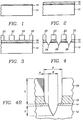
- FIGS. 1 through 12 are diagrammatic cross-sectional views showing successive stages of forming micro-trench isolation regions in a semiconductor device.
- the method of this invention is used in forming micro-trench isolation regions in semiconductor devices having a separation of 0.20 ⁇ m-0.35 ⁇ m between active areas and a delta- ⁇ of 0.1 ⁇ m or less.
- This device isolation method may be used independently or may be used in conjunction with another device isolation technique such as LOCOS or STI. These other device isolation techniques would be used for devices having a separation of greater than 0.35 ⁇ m between active areas.
- FIG. 1 shows a silicon semiconductor substrate 10 having a silicon dioxide layer 14 deposited thereon.
- the silicon dioxide layer 14 is typically 90 ⁇ thick and can be grown by various conventional techniques, such as thermal oxidation.
- the silicon dioxide layer 14 will typically range from 60 ⁇ to 120 ⁇ .
- a hard film layer (mask) 18 such as polysilicon is then deposited onto the silicon dioxide layer 14.
- the hard film layer will typically range from 2000 ⁇ to 4000 ⁇ . It is preferable to use undoped polysilicon rather than doped polysilicon because undoped polysilicon tends to etch with a sloped profile, and thereby enhances subsequent micro-trench formation. While the presently described embodiment features an undoped polysilicon layer 18, a silicon nitride layer can be used to advantage, especially if high nitride:oxide selectivity could be achieved.
- a layer of photoresist 22 is then patterned onto portions of the polysilicon layer 18.
- the exposed areas generally have a width of 0.2 ⁇ m to 0.5 ⁇ m.
- the width of resist layers between trenches is not critical and the resist is typically .5 ⁇ m to 2.0 ⁇ m thick. It is preferred that the aspect ratio of resist and polysilicon thickness to trench width range from 2:1 to 7:1. Subsequent micro-trenching into the silicon substrate increases with narrower trench spaces and higher aspect ratio.
- the resist pattern spacing can vary depending on the ultimate desired spacing of the micro-trench packing.
- Micro-trenches are defined as narrow grooves etched through the gate dielectric and into underlying silicon during the overetch portion of a polysilicon gate plasma etch process.
- the micro-trenches can be spaced away from the base of the polysilicon line by 600-800 ⁇ . They are formed as the result of an increase in the localized etch rate due to bombardment by charged ions scattered from the polysilicon/resist sidewall.
- the height of the polysilicon/resist stack and width of the space between lines have a direct impact on the formation of micro-trenches as does the ion energy.
- Higher aspect ratio serves to focus the ions toward the center of the space; ion bombardment greater than some critical energy will cause silicon dioxide breakdown at the center of the space while the region adjacent the polysilicon line will remain intact.
- the tapered polysilicon sidewall acts as a "focusing mirror" that causes ions to be reflected to the region adjacent the polysilicon line at a distance that is related to the slope of the sidewalls.
- resist lines with sloped sidewalls are more likely to produce micro-trenching than resist lines with steep or vertical sidewalls.
- the placement of the micro-trench can be manipulated.
- the wall with a shallow angle can yield a greater number of reflected ions than the opposing vertical wall. This increase in reflected ions would result in a micro-trench closer to the base of the tapered wall.
- Micro-trenches 26 are formed in the silicon substrate 10 during the overetch step.
- the micro-trenching is due to an enhanced etch reaction which occurs as a result of ion scattering from the resist/polysilicon sidewall.
- the depth of the micro-trenches can be varied by adjusting the etch time after the silicon dioxide surface is exposed.
- a V-shaped groove forms in the silicon at the center of the space between the two polysilicon sidewalls and increases with overetch time at a rate of approximately 1500 ⁇ /min. in depth and 750 ⁇ /min. in width.
- typical micro-trench dimensions for a 120 sec. overetch would be a trench width in the silicon substrate 10 of 1500 ⁇ and a trench depth of 3000 ⁇ . See exploded view in FIG. 4B.
- Region Typical Dimension a. Unetched Shoulder 400-800 ⁇ b. Micro-trench Width 1000-3500 ⁇ c. Micro-trench Depth 500-5000 ⁇ d. Space Between Lines 2000-5000 ⁇ e. Polysilicon/Resist Stack 5000-20,000 ⁇
- micro-trenches are narrow V-shaped grooves that are etched through the gate silicon dioxide and into the underlying semiconductor substrate in the space between two hard film lines.
- the semiconductor substrate is silicon and the hard film is polysilicon.
- the etch process replicates the resist pattern while creating a slight taper (about 83°) of the polysilicon sidewall.
- the micro-trenches generally are spaced away from the base of the polysilicon lines by a shoulder of approximately 400-800 ⁇ and are formed as a result of increased localized etch rate between closely spaced polysilicon lines. The increase in etch rate is due to ions scattering off the resist/polysilicon sidewalls and reflecting to the base of the polysilicon line.
- the scattering is enhanced under conditions of increasing aspect ratios (depth:width) and increasing pressure.
- the resist trench width is typically in the range of 0.2 ⁇ m to 0.5 and aspect ratios of 2:1 to 7:1.
- the open area i.e., regions where the aspect ratio is less than 1:1, there is essentially no punch through to the substrate layer because the etch rate is slower ( ⁇ 0.4 ⁇ /sec).
- the semiconductor substrate 10 is then processed through a silicon dioxide deposition 30, e.g., undoped CVD silicon dioxide (TEOS) which fills the micro-trenches 26 and covers the semiconductor substrate with a uniform layer of undoped silicon dioxide 30.
- a planar doped silicon dioxide layer 34 such as spin-on glass, BPSG, or B2O3, is then deposited onto the undoped silicon dioxide layer 30.
- the silicon dioxide layers 30 and 34 are then removed by chemical etching. Etching is typically achieved using a conventional reactive ion etch system with end-point capability. The etching process is stopped at a pre-determined time after the polysilicon layer 18 is detected to leave a plug of silicon dioxide 30 over the isolated micro-trenches.
- the polysilicon layer 18 is then stripped in a plasma process that has a high selectivity for polysilicon relative to silicon dioxide, typically greater than 40:1.
- the stripping process is stopped when the silicon dioxide layer 14 is detected.
- the semiconductor substrate 10 can be processed through other isolation processes such as LOCOS or STI to form additional isolation trenches for devices spaced at greater than 0.35 ⁇ m. See FIGS. 10, 11, 12 for a representative embodiment.
- the pad silicon dioxide layer 14 is grown ( ⁇ 225 ⁇ ), a silicon nitride layer 36 is deposited ( ⁇ 1800 ⁇ ) and a resist mask 38 is applied to select regions and overlapping the micro-trench regions 30.
- the resist pattern is transformed into silicon to form shallow trench isolation areas and the wafer is capped with CVD silicon dioxide 40 (TEOS-based) (about 6500 ⁇ thick) after a short thermal oxidation and channel stop implant.
- the isolated shallow trenches 42 are planarized with the gate 44 and silicon silicon dioxide areas formed in the conventional manner.
Landscapes
- Element Separation (AREA)
Applications Claiming Priority (2)
| Application Number | Priority Date | Filing Date | Title |
|---|---|---|---|
| US08/086,598 US5356828A (en) | 1993-07-01 | 1993-07-01 | Method of forming micro-trench isolation regions in the fabrication of semiconductor devices |
| US86598 | 1993-07-01 |
Publications (2)
| Publication Number | Publication Date |
|---|---|
| EP0632495A2 true EP0632495A2 (de) | 1995-01-04 |
| EP0632495A3 EP0632495A3 (de) | 1997-11-05 |
Family
ID=22199629
Family Applications (1)
| Application Number | Title | Priority Date | Filing Date |
|---|---|---|---|
| EP94304725A Withdrawn EP0632495A3 (de) | 1993-07-01 | 1994-06-28 | Verfahren zur Herstellen von Mikrograben für Isolationszonen für Halbleiteranordnungen |
Country Status (2)
| Country | Link |
|---|---|
| US (1) | US5356828A (de) |
| EP (1) | EP0632495A3 (de) |
Cited By (1)
| Publication number | Priority date | Publication date | Assignee | Title |
|---|---|---|---|---|
| WO1998009325A1 (en) * | 1996-08-30 | 1998-03-05 | Advanced Micro Devices, Inc. | A method of advanced trench isolation scaling |
Families Citing this family (12)
| Publication number | Priority date | Publication date | Assignee | Title |
|---|---|---|---|---|
| US5456952A (en) * | 1994-05-17 | 1995-10-10 | Lsi Logic Corporation | Process of curing hydrogen silsesquioxane coating to form silicon oxide layer |
| US5598021A (en) * | 1995-01-18 | 1997-01-28 | Lsi Logic Corporation | MOS structure with hot carrier reduction |
| US5702976A (en) * | 1995-10-24 | 1997-12-30 | Micron Technology, Inc. | Shallow trench isolation using low dielectric constant insulator |
| US5706164A (en) * | 1996-07-17 | 1998-01-06 | Vangaurd International Semiconductor Corporation | Method of fabricating high density integrated circuits, containing stacked capacitor DRAM devices, using elevated trench isolation and isolation spacers |
| US5721173A (en) * | 1997-02-25 | 1998-02-24 | Kabushiki Kaisha Toshiba | Method of forming a shallow trench isolation structure |
| US5960297A (en) * | 1997-07-02 | 1999-09-28 | Kabushiki Kaisha Toshiba | Shallow trench isolation structure and method of forming the same |
| US6781212B1 (en) | 1998-08-31 | 2004-08-24 | Micron Technology, Inc | Selectively doped trench device isolation |
| US6274498B1 (en) * | 1998-09-03 | 2001-08-14 | Micron Technology, Inc. | Methods of forming materials within openings, and method of forming isolation regions |
| US6372601B1 (en) | 1998-09-03 | 2002-04-16 | Micron Technology, Inc. | Isolation region forming methods |
| US6432832B1 (en) * | 1999-06-30 | 2002-08-13 | Lam Research Corporation | Method of improving the profile angle between narrow and wide features |
| US6576405B1 (en) | 1999-07-01 | 2003-06-10 | Zilog, Inc. | High aspect ratio photolithographic method for high energy implantation |
| US7985681B2 (en) * | 2007-06-22 | 2011-07-26 | Micron Technology, Inc. | Method for selectively forming symmetrical or asymmetrical features using a symmetrical photomask during fabrication of a semiconductor device and electronic systems including the semiconductor device |
Family Cites Families (11)
| Publication number | Priority date | Publication date | Assignee | Title |
|---|---|---|---|---|
| US4104086A (en) * | 1977-08-15 | 1978-08-01 | International Business Machines Corporation | Method for forming isolated regions of silicon utilizing reactive ion etching |
| EP0055521B1 (de) * | 1980-11-29 | 1985-05-22 | Kabushiki Kaisha Toshiba | Verfahren zum Füllen einer Rille in einem Halbleitersubstrat |
| JPS5848936A (ja) * | 1981-09-10 | 1983-03-23 | Fujitsu Ltd | 半導体装置の製造方法 |
| CA1204525A (en) * | 1982-11-29 | 1986-05-13 | Tetsu Fukano | Method for forming an isolation region for electrically isolating elements |
| JPS59135743A (ja) * | 1983-01-24 | 1984-08-04 | Hitachi Ltd | 半導体装置およびその製造方法 |
| US4533430A (en) * | 1984-01-04 | 1985-08-06 | Advanced Micro Devices, Inc. | Process for forming slots having near vertical sidewalls at their upper extremities |
| US4631803A (en) * | 1985-02-14 | 1986-12-30 | Texas Instruments Incorporated | Method of fabricating defect free trench isolation devices |
| US4952524A (en) * | 1989-05-05 | 1990-08-28 | At&T Bell Laboratories | Semiconductor device manufacture including trench formation |
| US5118384A (en) * | 1990-04-03 | 1992-06-02 | International Business Machines Corporation | Reactive ion etching buffer mask |
| US5130268A (en) * | 1991-04-05 | 1992-07-14 | Sgs-Thomson Microelectronics, Inc. | Method for forming planarized shallow trench isolation in an integrated circuit and a structure formed thereby |
| US5175122A (en) * | 1991-06-28 | 1992-12-29 | Digital Equipment Corporation | Planarization process for trench isolation in integrated circuit manufacture |
-
1993
- 1993-07-01 US US08/086,598 patent/US5356828A/en not_active Expired - Lifetime
-
1994
- 1994-06-28 EP EP94304725A patent/EP0632495A3/de not_active Withdrawn
Cited By (1)
| Publication number | Priority date | Publication date | Assignee | Title |
|---|---|---|---|---|
| WO1998009325A1 (en) * | 1996-08-30 | 1998-03-05 | Advanced Micro Devices, Inc. | A method of advanced trench isolation scaling |
Also Published As
| Publication number | Publication date |
|---|---|
| US5356828A (en) | 1994-10-18 |
| EP0632495A3 (de) | 1997-11-05 |
Similar Documents
| Publication | Publication Date | Title |
|---|---|---|
| CA2125465C (en) | Method of making integrated circuits | |
| US5298463A (en) | Method of processing a semiconductor wafer using a contact etch stop | |
| US6303447B1 (en) | Method for forming an extended metal gate using a damascene process | |
| US5534462A (en) | Method for forming a plug and semiconductor device having the same | |
| EP0542477B1 (de) | Verfahren zur Herstellung einer integrierten Schaltung mit selbstjustierten Kontakten zwischen eng beabstandeten Strukturen | |
| US5668052A (en) | Method of manufacturing semiconductor device | |
| US5316965A (en) | Method of decreasing the field oxide etch rate in isolation technology | |
| US6251734B1 (en) | Method for fabricating trench isolation and trench substrate contact | |
| US6469389B2 (en) | Contact plug | |
| US5950093A (en) | Method for aligning shallow trench isolation | |
| KR20020011257A (ko) | 트렌치 소자 분리형 반도체 장치 및 그 형성방법 | |
| JPH01290236A (ja) | 幅の広いトレンチを平坦化する方法 | |
| US5356828A (en) | Method of forming micro-trench isolation regions in the fabrication of semiconductor devices | |
| JPH09107028A (ja) | 半導体装置の素子分離方法 | |
| US5384281A (en) | Non-conformal and oxidizable etch stops for submicron features | |
| US7067364B1 (en) | Gate structures having sidewall spacers using selective deposition and method of forming the same | |
| US5668401A (en) | Chessboard pattern layout for scribe lines | |
| US20030201511A1 (en) | Shallow trench isolation type semiconductor device and method of forming the same | |
| US6278189B1 (en) | High density integrated circuits using tapered and self-aligned contacts | |
| EP0954022B1 (de) | Verfahren zur Bereitstellung einer flachen Grabenisolation von Transistoren | |
| US5162261A (en) | Method of forming a via having sloped sidewalls | |
| US6063699A (en) | Methods for making high-aspect ratio holes in semiconductor and its application to a gate damascene process for sub- 0.05 micron mosfets | |
| US6245657B1 (en) | Self-aligned, low contact resistance, via fabrication process | |
| US6184116B1 (en) | Method to fabricate the MOS gate | |
| US6413836B1 (en) | Method of making isolation trench |
Legal Events
| Date | Code | Title | Description |
|---|---|---|---|
| PUAI | Public reference made under article 153(3) epc to a published international application that has entered the european phase |
Free format text: ORIGINAL CODE: 0009012 |
|
| AK | Designated contracting states |
Kind code of ref document: A2 Designated state(s): DE FR GB IT |
|
| PUAL | Search report despatched |
Free format text: ORIGINAL CODE: 0009013 |
|
| AK | Designated contracting states |
Kind code of ref document: A3 Designated state(s): DE FR GB IT |
|
| 17P | Request for examination filed |
Effective date: 19971121 |
|
| STAA | Information on the status of an ep patent application or granted ep patent |
Free format text: STATUS: THE APPLICATION IS DEEMED TO BE WITHDRAWN |
|
| 18D | Application deemed to be withdrawn |
Effective date: 19991231 |