EP0633385A1 - Rohrzellen Fenstervorhang und Produktionsverfahren - Google Patents
Rohrzellen Fenstervorhang und Produktionsverfahren Download PDFInfo
- Publication number
- EP0633385A1 EP0633385A1 EP94305066A EP94305066A EP0633385A1 EP 0633385 A1 EP0633385 A1 EP 0633385A1 EP 94305066 A EP94305066 A EP 94305066A EP 94305066 A EP94305066 A EP 94305066A EP 0633385 A1 EP0633385 A1 EP 0633385A1
- Authority
- EP
- European Patent Office
- Prior art keywords
- cells
- adhesive
- window covering
- cell
- lines
- Prior art date
- Legal status (The legal status is an assumption and is not a legal conclusion. Google has not performed a legal analysis and makes no representation as to the accuracy of the status listed.)
- Granted
Links
- 238000000034 method Methods 0.000 title claims abstract description 16
- 238000004519 manufacturing process Methods 0.000 title claims description 4
- 239000000853 adhesive Substances 0.000 claims abstract description 68
- 230000001070 adhesive effect Effects 0.000 claims abstract description 68
- 239000004744 fabric Substances 0.000 claims abstract description 40
- 239000003292 glue Substances 0.000 claims description 21
- 239000000463 material Substances 0.000 claims description 18
- 238000010276 construction Methods 0.000 claims description 4
- 238000004132 cross linking Methods 0.000 claims description 4
- 239000012943 hotmelt Substances 0.000 claims description 2
- 230000000694 effects Effects 0.000 abstract 1
- 239000000835 fiber Substances 0.000 description 19
- 238000001723 curing Methods 0.000 description 5
- JOYRKODLDBILNP-UHFFFAOYSA-N Ethyl urethane Chemical compound CCOC(N)=O JOYRKODLDBILNP-UHFFFAOYSA-N 0.000 description 4
- 238000013008 moisture curing Methods 0.000 description 3
- 230000000717 retained effect Effects 0.000 description 3
- 239000002759 woven fabric Substances 0.000 description 3
- 239000004831 Hot glue Substances 0.000 description 2
- 229920003620 Grilon® Polymers 0.000 description 1
- WYTGDNHDOZPMIW-RCBQFDQVSA-N alstonine Natural products C1=CC2=C3C=CC=CC3=NC2=C2N1C[C@H]1[C@H](C)OC=C(C(=O)OC)[C@H]1C2 WYTGDNHDOZPMIW-RCBQFDQVSA-N 0.000 description 1
- 239000012237 artificial material Substances 0.000 description 1
- 230000015572 biosynthetic process Effects 0.000 description 1
- 230000001419 dependent effect Effects 0.000 description 1
- JBKVHLHDHHXQEQ-UHFFFAOYSA-N epsilon-caprolactam Chemical compound O=C1CCCCCN1 JBKVHLHDHHXQEQ-UHFFFAOYSA-N 0.000 description 1
- 238000009413 insulation Methods 0.000 description 1
- 230000000149 penetrating effect Effects 0.000 description 1
- 239000000126 substance Substances 0.000 description 1
Images



Classifications
-
- B—PERFORMING OPERATIONS; TRANSPORTING
- B29—WORKING OF PLASTICS; WORKING OF SUBSTANCES IN A PLASTIC STATE IN GENERAL
- B29C—SHAPING OR JOINING OF PLASTICS; SHAPING OF MATERIAL IN A PLASTIC STATE, NOT OTHERWISE PROVIDED FOR; AFTER-TREATMENT OF THE SHAPED PRODUCTS, e.g. REPAIRING
- B29C66/00—General aspects of processes or apparatus for joining preformed parts
- B29C66/50—General aspects of joining tubular articles; General aspects of joining long products, i.e. bars or profiled elements; General aspects of joining single elements to tubular articles, hollow articles or bars; General aspects of joining several hollow-preforms to form hollow or tubular articles
- B29C66/51—Joining tubular articles, profiled elements or bars; Joining single elements to tubular articles, hollow articles or bars; Joining several hollow-preforms to form hollow or tubular articles
- B29C66/54—Joining several hollow-preforms, e.g. half-shells, to form hollow articles, e.g. for making balls, containers; Joining several hollow-preforms, e.g. half-cylinders, to form tubular articles
- B29C66/543—Joining several hollow-preforms, e.g. half-shells, to form hollow articles, e.g. for making balls, containers; Joining several hollow-preforms, e.g. half-cylinders, to form tubular articles joining more than two hollow-preforms to form said hollow articles
-
- B—PERFORMING OPERATIONS; TRANSPORTING
- B29—WORKING OF PLASTICS; WORKING OF SUBSTANCES IN A PLASTIC STATE IN GENERAL
- B29C—SHAPING OR JOINING OF PLASTICS; SHAPING OF MATERIAL IN A PLASTIC STATE, NOT OTHERWISE PROVIDED FOR; AFTER-TREATMENT OF THE SHAPED PRODUCTS, e.g. REPAIRING
- B29C65/00—Joining or sealing of preformed parts, e.g. welding of plastics materials; Apparatus therefor
- B29C65/48—Joining or sealing of preformed parts, e.g. welding of plastics materials; Apparatus therefor using adhesives, i.e. using supplementary joining material; solvent bonding
-
- B—PERFORMING OPERATIONS; TRANSPORTING
- B29—WORKING OF PLASTICS; WORKING OF SUBSTANCES IN A PLASTIC STATE IN GENERAL
- B29C—SHAPING OR JOINING OF PLASTICS; SHAPING OF MATERIAL IN A PLASTIC STATE, NOT OTHERWISE PROVIDED FOR; AFTER-TREATMENT OF THE SHAPED PRODUCTS, e.g. REPAIRING
- B29C66/00—General aspects of processes or apparatus for joining preformed parts
- B29C66/01—General aspects dealing with the joint area or with the area to be joined
- B29C66/05—Particular design of joint configurations
- B29C66/10—Particular design of joint configurations particular design of the joint cross-sections
- B29C66/11—Joint cross-sections comprising a single joint-segment, i.e. one of the parts to be joined comprising a single joint-segment in the joint cross-section
- B29C66/112—Single lapped joints
- B29C66/1122—Single lap to lap joints, i.e. overlap joints
-
- B—PERFORMING OPERATIONS; TRANSPORTING
- B31—MAKING ARTICLES OF PAPER, CARDBOARD OR MATERIAL WORKED IN A MANNER ANALOGOUS TO PAPER; WORKING PAPER, CARDBOARD OR MATERIAL WORKED IN A MANNER ANALOGOUS TO PAPER
- B31D—MAKING ARTICLES OF PAPER, CARDBOARD OR MATERIAL WORKED IN A MANNER ANALOGOUS TO PAPER, NOT PROVIDED FOR IN SUBCLASSES B31B OR B31C
- B31D3/00—Making articles of cellular structure, e.g. insulating board
- B31D3/02—Making articles of cellular structure, e.g. insulating board honeycombed structures, i.e. the cells having an essentially hexagonal section
- B31D3/0207—Making articles of cellular structure, e.g. insulating board honeycombed structures, i.e. the cells having an essentially hexagonal section of particular shape or construction
- B31D3/0215—Making articles of cellular structure, e.g. insulating board honeycombed structures, i.e. the cells having an essentially hexagonal section of particular shape or construction for window coverings
-
- B—PERFORMING OPERATIONS; TRANSPORTING
- B31—MAKING ARTICLES OF PAPER, CARDBOARD OR MATERIAL WORKED IN A MANNER ANALOGOUS TO PAPER; WORKING PAPER, CARDBOARD OR MATERIAL WORKED IN A MANNER ANALOGOUS TO PAPER
- B31D—MAKING ARTICLES OF PAPER, CARDBOARD OR MATERIAL WORKED IN A MANNER ANALOGOUS TO PAPER, NOT PROVIDED FOR IN SUBCLASSES B31B OR B31C
- B31D3/00—Making articles of cellular structure, e.g. insulating board
- B31D3/02—Making articles of cellular structure, e.g. insulating board honeycombed structures, i.e. the cells having an essentially hexagonal section
- B31D3/0292—Making articles of cellular structure, e.g. insulating board honeycombed structures, i.e. the cells having an essentially hexagonal section involving auxiliary operations, e.g. expanding, moistening, glue-applying, joining, controlling
-
- E—FIXED CONSTRUCTIONS
- E06—DOORS, WINDOWS, SHUTTERS, OR ROLLER BLINDS IN GENERAL; LADDERS
- E06B—FIXED OR MOVABLE CLOSURES FOR OPENINGS IN BUILDINGS, VEHICLES, FENCES OR LIKE ENCLOSURES IN GENERAL, e.g. DOORS, WINDOWS, BLINDS, GATES
- E06B9/00—Screening or protective devices for wall or similar openings, with or without operating or securing mechanisms; Closures of similar construction
- E06B9/24—Screens or other constructions affording protection against light, especially against sunshine; Similar screens for privacy or appearance; Slat blinds
- E06B9/26—Lamellar or like blinds, e.g. venetian blinds
- E06B9/262—Lamellar or like blinds, e.g. venetian blinds with flexibly-interconnected horizontal or vertical strips; Concertina blinds, i.e. upwardly folding flexible screens
-
- B—PERFORMING OPERATIONS; TRANSPORTING
- B29—WORKING OF PLASTICS; WORKING OF SUBSTANCES IN A PLASTIC STATE IN GENERAL
- B29C—SHAPING OR JOINING OF PLASTICS; SHAPING OF MATERIAL IN A PLASTIC STATE, NOT OTHERWISE PROVIDED FOR; AFTER-TREATMENT OF THE SHAPED PRODUCTS, e.g. REPAIRING
- B29C65/00—Joining or sealing of preformed parts, e.g. welding of plastics materials; Apparatus therefor
- B29C65/48—Joining or sealing of preformed parts, e.g. welding of plastics materials; Apparatus therefor using adhesives, i.e. using supplementary joining material; solvent bonding
- B29C65/4805—Joining or sealing of preformed parts, e.g. welding of plastics materials; Apparatus therefor using adhesives, i.e. using supplementary joining material; solvent bonding characterised by the type of adhesives
- B29C65/481—Non-reactive adhesives, e.g. physically hardening adhesives
- B29C65/4815—Hot melt adhesives, e.g. thermoplastic adhesives
-
- B—PERFORMING OPERATIONS; TRANSPORTING
- B29—WORKING OF PLASTICS; WORKING OF SUBSTANCES IN A PLASTIC STATE IN GENERAL
- B29C—SHAPING OR JOINING OF PLASTICS; SHAPING OF MATERIAL IN A PLASTIC STATE, NOT OTHERWISE PROVIDED FOR; AFTER-TREATMENT OF THE SHAPED PRODUCTS, e.g. REPAIRING
- B29C65/00—Joining or sealing of preformed parts, e.g. welding of plastics materials; Apparatus therefor
- B29C65/48—Joining or sealing of preformed parts, e.g. welding of plastics materials; Apparatus therefor using adhesives, i.e. using supplementary joining material; solvent bonding
- B29C65/4805—Joining or sealing of preformed parts, e.g. welding of plastics materials; Apparatus therefor using adhesives, i.e. using supplementary joining material; solvent bonding characterised by the type of adhesives
- B29C65/483—Reactive adhesives, e.g. chemically curing adhesives
-
- B—PERFORMING OPERATIONS; TRANSPORTING
- B29—WORKING OF PLASTICS; WORKING OF SUBSTANCES IN A PLASTIC STATE IN GENERAL
- B29C—SHAPING OR JOINING OF PLASTICS; SHAPING OF MATERIAL IN A PLASTIC STATE, NOT OTHERWISE PROVIDED FOR; AFTER-TREATMENT OF THE SHAPED PRODUCTS, e.g. REPAIRING
- B29C65/00—Joining or sealing of preformed parts, e.g. welding of plastics materials; Apparatus therefor
- B29C65/48—Joining or sealing of preformed parts, e.g. welding of plastics materials; Apparatus therefor using adhesives, i.e. using supplementary joining material; solvent bonding
- B29C65/4805—Joining or sealing of preformed parts, e.g. welding of plastics materials; Apparatus therefor using adhesives, i.e. using supplementary joining material; solvent bonding characterised by the type of adhesives
- B29C65/483—Reactive adhesives, e.g. chemically curing adhesives
- B29C65/484—Moisture curing adhesives
-
- B—PERFORMING OPERATIONS; TRANSPORTING
- B29—WORKING OF PLASTICS; WORKING OF SUBSTANCES IN A PLASTIC STATE IN GENERAL
- B29C—SHAPING OR JOINING OF PLASTICS; SHAPING OF MATERIAL IN A PLASTIC STATE, NOT OTHERWISE PROVIDED FOR; AFTER-TREATMENT OF THE SHAPED PRODUCTS, e.g. REPAIRING
- B29C66/00—General aspects of processes or apparatus for joining preformed parts
- B29C66/50—General aspects of joining tubular articles; General aspects of joining long products, i.e. bars or profiled elements; General aspects of joining single elements to tubular articles, hollow articles or bars; General aspects of joining several hollow-preforms to form hollow or tubular articles
- B29C66/51—Joining tubular articles, profiled elements or bars; Joining single elements to tubular articles, hollow articles or bars; Joining several hollow-preforms to form hollow or tubular articles
- B29C66/52—Joining tubular articles, bars or profiled elements
- B29C66/522—Joining tubular articles
- B29C66/5227—Joining tubular articles for forming multi-tubular articles by longitudinally joining elementary tubular articles wall-to-wall (e.g. joining the wall of a first tubular article to the wall of a second tubular article) or for forming multilayer tubular articles
-
- B—PERFORMING OPERATIONS; TRANSPORTING
- B29—WORKING OF PLASTICS; WORKING OF SUBSTANCES IN A PLASTIC STATE IN GENERAL
- B29C—SHAPING OR JOINING OF PLASTICS; SHAPING OF MATERIAL IN A PLASTIC STATE, NOT OTHERWISE PROVIDED FOR; AFTER-TREATMENT OF THE SHAPED PRODUCTS, e.g. REPAIRING
- B29C66/00—General aspects of processes or apparatus for joining preformed parts
- B29C66/70—General aspects of processes or apparatus for joining preformed parts characterised by the composition, physical properties or the structure of the material of the parts to be joined; Joining with non-plastics material
- B29C66/72—General aspects of processes or apparatus for joining preformed parts characterised by the composition, physical properties or the structure of the material of the parts to be joined; Joining with non-plastics material characterised by the structure of the material of the parts to be joined
- B29C66/729—Textile or other fibrous material made from plastics
-
- B—PERFORMING OPERATIONS; TRANSPORTING
- B29—WORKING OF PLASTICS; WORKING OF SUBSTANCES IN A PLASTIC STATE IN GENERAL
- B29L—INDEXING SCHEME ASSOCIATED WITH SUBCLASS B29C, RELATING TO PARTICULAR ARTICLES
- B29L2031/00—Other particular articles
- B29L2031/60—Multitubular or multicompartmented articles, e.g. honeycomb
- B29L2031/601—Multi-tubular articles, i.e. composed of a plurality of tubes
-
- B—PERFORMING OPERATIONS; TRANSPORTING
- B29—WORKING OF PLASTICS; WORKING OF SUBSTANCES IN A PLASTIC STATE IN GENERAL
- B29L—INDEXING SCHEME ASSOCIATED WITH SUBCLASS B29C, RELATING TO PARTICULAR ARTICLES
- B29L2031/00—Other particular articles
- B29L2031/60—Multitubular or multicompartmented articles, e.g. honeycomb
- B29L2031/601—Multi-tubular articles, i.e. composed of a plurality of tubes
- B29L2031/602—Multi-tubular articles, i.e. composed of a plurality of tubes composed of several elementary tubular elements
-
- B—PERFORMING OPERATIONS; TRANSPORTING
- B29—WORKING OF PLASTICS; WORKING OF SUBSTANCES IN A PLASTIC STATE IN GENERAL
- B29L—INDEXING SCHEME ASSOCIATED WITH SUBCLASS B29C, RELATING TO PARTICULAR ARTICLES
- B29L2031/00—Other particular articles
- B29L2031/719—Curtains; Blinds; Shades
- B29L2031/7192—Venetian blinds
-
- E—FIXED CONSTRUCTIONS
- E06—DOORS, WINDOWS, SHUTTERS, OR ROLLER BLINDS IN GENERAL; LADDERS
- E06B—FIXED OR MOVABLE CLOSURES FOR OPENINGS IN BUILDINGS, VEHICLES, FENCES OR LIKE ENCLOSURES IN GENERAL, e.g. DOORS, WINDOWS, BLINDS, GATES
- E06B9/00—Screening or protective devices for wall or similar openings, with or without operating or securing mechanisms; Closures of similar construction
- E06B9/24—Screens or other constructions affording protection against light, especially against sunshine; Similar screens for privacy or appearance; Slat blinds
- E06B9/26—Lamellar or like blinds, e.g. venetian blinds
- E06B9/262—Lamellar or like blinds, e.g. venetian blinds with flexibly-interconnected horizontal or vertical strips; Concertina blinds, i.e. upwardly folding flexible screens
- E06B2009/2627—Cellular screens, e.g. box or honeycomb-like
Definitions
- the present invention relates generally to expandable and collapsible window coverings comprised of a plurality of contiguous tubular cells and more particularly to such a window covering wherein the tubular cells are bonded to adjacent cells to form undulations along the length of the cells.
- Window coverings formed from a plurality of collapsible contiguous tubular cells have acquired considerable desirability in recent years.
- the window coverings are desirable both from a utilitarian and aesthetic standpoint. From a utilitarian standpoint, air within each of the cells circulates only minimally such that when the shade is expanded so as to cover the window opening in which it is mounted, the covering provides good thermal insulation. From an aesthetic standpoint, since such window coverings are typically made of soft fabrics, they provide a softer appearance than conventional venetian blinds or minishades.
- Window coverings made out of contiguous tubular cells are sometimes referred to as honeycomb panel window coverings and the tubular cells may extend horizontally or vertically depending upon the desired aesthetic appearance.
- window coverings of the tubular cell type There are various prior art disclosures relating to window coverings of the tubular cell type with the following being illustrative:
- U.S. Patent No. 4,347,887 to Brown shows a "Thermal Shutter.”
- a wide band of material is folded transversely to form a double column of adjacent cells, which may have rounded visible contours.
- the cells are adhesively bonded to one another.
- the Brown structure is symmetrical, so that both sides of the shade thus formed have essentially the same appearance.
- U.S. Patent No. 4,450,027 to Colson shows a method and apparatus for fabricating a multiple cell shade wherein a continuous relatively narrow strip of fabric is folded longitudinally in order to define pleats in the shade material and the edges folded over on the center portion to create a tubular cell. Successive cells are assembled by applying an adhesive to folded-over edges of the cells and adhering each cell to the preceding cell when wound on a stacking rack.
- U.S. Patent No. 4,631,217 to Anderson shows in Figure 3 a shade of asymmetrical construction.
- a rear wall section of each cell is essentially straight or linear when the shade is in its expanded position.
- the width of these wall sections thus define the spacing of the adjacent cells, while the front of each cell, containing more material, presents a pleaded outward appearance.
- the Anderson patent also discloses a method of forming an expandable and collapsible shade consisting of an assembly of horizontally parallel cells, in which the cell structure is formed from a material folded into a Z-shape rather than a U-shape as shown in the Colson patent.
- U.S. Patent No. 4,846,243 to Schneider shows a foldable window covering formed of a wide material folded transversely, as in the Brown patent, to yield a collapsible shade.
- the front surface of the shade consists of a number of drooping loops formed by doubling the material back on itself.
- the successive cells are spaced in the expanded position of the shade by a relatively vertical rear wall section of each shade.
- the present invention consists of an expandable and collapsible tubular cell type window covering wherein the cells are affixed or bonded to adjacent cells so as to create undulations or waves along the length of each cell. While the cells may be oriented horizontally or vertically, depending upon the hardware and aesthetics desired, the appearance of the window covering is quite distinct from any in the prior art while providing the desired insulating properties of tubular cell or honeycomb panel window coverings.
- the cells are made from a stretchable fabric and the tubular cells are first stretched longitudinally into an elongated condition before an expansion or non-expansion adhesive is applied longitudinally to the cells.
- the cells are then bonded by moving them into compressed engagement and preferably after the adhesive has cured, the stretch is released so that only the fabric exposed to the adhesive is retained in an expanded or stretched condition while the remaining portions of the fabric are allowed to contract into their relaxed normal condition.
- the result is a honeycomb panel comprised of a plurality of bonded cells which are undulating or wavy along their length creating an unusual and desirable aesthetic appearance.
- a second embodiment of the invention is composed of tubular cells made of a woven or similar fabric and wherein a bonding medium that expands upon curing is used to bond adjacent cells.
- the bonding medium is first applied to one cell along the length of the cell and that cell is moved into compressive engagement with an adjacent cell.
- the bonding medium on curing will expand and stretch the fabric with which it is in contact while the remaining portion of the fabric remains unstretched. Again, the contrast between stretched and unstretched portions of the fabric creates undulations or waves along the length of the bonded cells.
- the lines of adhesive between adjacent cells are applied in a curved or non-linear orientation, such as a sinusoidal wave pattern.
- FIG. 1 is an isometric view of a window opening having a window covering therein fabricated in accordance with a first or second embodiment of the present invention.
- FIG. 2 is an enlarged fragmentary front elevation of the window covering shown in FIG. 1 .
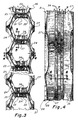
- FIG. 3 is a further enlarged fragmentary section taken along line 3-3 of FIG. 1.
- FIG. 4 is a fragmentary section taken along line 4-4 of FIG. 3 .
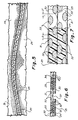
- FIG. 5 is a fragmentary section taken along line 5-5 of FIG. 3 .
- FIG. 6 is a fragmentary section taken along line 6-6 of FIG. 4 .
- FIG. 7 is an enlarged fragmentary section taken along line 7-7 of FIG. 4 .
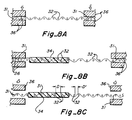
- FIGS. 8A, 8B, and 8C are diagrammatic operative views illustrating the method of fabricating the window covering shown in FIG. 1 .
- FIG. 9 is a fragmentary section taken between two adjacent cells showing one configuration of the bond lines bonding the cells in accordance with a third embodiment of the invention.
- FIG. 10 is a view taken along line 10-10 of FIG. 9 .
- FIG. 11 is an enlarged section taken along line 11-11 of FIG. 10 .
- FIG. 12 is an enlarged section taken along line 12-12 of FIG. 10 .
- FIG. 13 is a fragmentary section similar to FIG. 9 showing bond lines in a different orientation.
- FIG. 14 is a fragmentary section similar to FIG. 13 showing bond lines between two tubular cells shown in solid line and between the two next adjacent tubular cells shown in dashed lines.
- FIG. 15 is a fragmentary front elevation of a window covering wherein adjacent tubular cells are bonded with glue lines in accordance with FIG. 14 .
- FIG. 16 is an enlarged fragmentary section taken along line 16-16 of FIG. 15 .
- FIG. 17 is a fragmentary front elevation of a window covering made in accordance with either the first or third embodiment of the present invention when the fabric is a knit fabric.
- FIG. 18 is an enlarged fragmentary section taken along line 18-18 of FIG. 17 .
- FIG. 19 is a fragmentary section taken along line 19-19 of FIG. 18 .
- a window covering 20 made in accordance with a first embodiment of the present invention is illustrated in an installed condition in a window opening having a frame 22 .
- the window covering is shown to be composed of a plurality of vertically contiguous horizontally extending tubular cells 24 which have been affixed or bonded along their length to define an integrated panel 26 of honeycomb construction.
- the panel of honeycomb construction is suspended from an upper head rail 28 with known hardware (not shown) for supporting and operating window coverings of the tubular cell type.
- known hardware not shown
- An example of such hardware is disclosed in U.S. Patent No. 4,647,488, which is of common ownership with the subject application, the disclosure of which is hereby incorporated by reference.
- a weighted bottom rail 30 is attached to the lowermost horizontal tubular cell 24 in a conventional manner to assist in moving the window covering from an open condition, wherein the tubular cells are vertically or transversely collapsed and stacked adjacent the head rail 28 , to a closed position as illustrated in FIG. 1 with the tubular cells vertically or transversely expanded and the honeycomb panel entirely covering the window opening in which the window covering is mounted.
- Tubular cells used in tubular cell window coverings are bonded together along their length in numerous ways with an illustrative system being disclosed in the afore-noted U.S. Patent No. 4,450,027 to Colson.
- This patent is hereby incorporated by reference for purposes of illustrating how tubular cells may be formed by folding strips of fabric so that they can be subsequently bonded to adjacent similarly formed strips to form an integrated honeycomb panel of contiguous tubular cells. Bonding of two adjacent tubular cells could be accomplished in various ways but, depending on the formation of the cells, or the strips from which they are made, a line or a pair of lines of adhesive is usually applied along the longitudinal juncture 25 between adjacent cells.
- tubular cells 24 could be formed from any desirable material, including artificial materials or naturally woven or knitted materials
- the window covering embodiments of the present invention are preferably made from materials having fibers which have been woven or knitted. It will also be appreciated that depending upon the hardware utilized, the tubular cells could be oriented either horizontally or vertically depending upon the desired appearance for a window covering.
- the window covering 20 is made of a woven material or fabric 31 which is stretchable to some degree so that the fibers 32 (FIGS. 3 through 7 ) in the material can be stretched or otherwise separated from each other so as to assume a condition which is expanded relative to the relaxed or normal condition of the fibers in the material.
- Lines of adhesive 34 are applied to the strips of material which have been prefolded in accordance with the afore-noted Colson patent.
- the prefolded strips for purposes of the present disclosure, are made from an elongated planar strip of material, the side edges 35 of which are folded over and onto a center portion 37 of the strip so that the side edges are juxtaposed and in overlying relationship with the center portion of the strip.
- the lines of adhesive are applied to the exposed faces of the side edges so that the side edges can be bonded to the exposed center portion of a next adjacent strip.
- the folded strips define the tubular cells 24 which in combination comprise the integrated panel 26 .
- the lines of adhesive extend along the length of the strip and are applied after the strips have been stretched longitudinally so that when adjacent strips are moved into compressed engagement while being retained in the stretched condition, the adhesive will mingle with the fibers 32 in each adjacent strip or resultant tubular cell to bond the two cells together.
- the adhesive 34 may be a hot melt adhesive or other suitable adhesive such as a moisture cure urethane which upon curing will hold the fibers 32 with which it is engaged in the spread condition.
- the adhesive is allowed to cure before the stretch in the strips of material is released so that the adhesive will retain the fibers with which it is engaged in a stretched orientation while the remaining fibers in each strip are allowed to relax or assume their normal condition.
- FIG. 7 schematically illustrates the contrast between the spacing of the fibers with the spacing between the fibers embedded in the adhesive being designated by D and the spacing being the relaxed or non-embedded fibers being designated by D'.
- FIGS. 8A-8C The reaction of the fabric 31 to the adhesive when the afore-described procedure is utilized is illustrated in FIGS. 8A-8C .
- FIGS. 8A-8C These figures are only intended to illustrate the reaction of a stretchable fabric to the application of adhesive in the above-noted manner and does not illustrate the bonding or combination of adjacent layers of fabric with the adhesive.
- FIG. 8A illustrates a strip of fabric having clamps 36 at opposite ends with the fabric being in a relaxed or normal condition.
- FIG. 8B shows the fabric having been stretched by the clamps 36 and adhesive 34 applied to one side of the fabric.
- FIG. 8C shows the fabric having been released from the clamps and illustrating the portion of the fabric encased in the adhesive 34 being retained in an expanded condition while the fabric that is not directly exposed to the adhesive having returned to the normal unstretched condition shown in FIG. 8A .
- a continuous honeycomb panel 26 can be formed of any desired width and length so as to fit a designated window opening.
- FIGS. 1 and 3 illustrate how the afore-described method affects the appearance of the bonded strips.
- a fairly uniform undulating or wavy pattern is created along the length of each strip which has been formed into a transversely collapsible tubular cell 24 .
- the wavy pattern is probably best appreciated by reference to creases 27 in the front and rear side of each tubular cell as best seen in FIGS 1 and 3 .
- FIG. 3 illustrates in an enlarged sectional view the relationship of the adhesive lines to portions of the tubular cells. It should be appreciated that the adhesive lines are applied in a linear and continuous manner as clearly seen in FIG. 4 to create the appearance best illustrated in FIGS. 1 and 2 .
- FIG. 5 is a longitudinal section along a pair of bonded tubular cells 24 showing the wavy pattern created with this process.
- FIG. 6 is an enlargement showing the lines of adhesive 34 penetrating both layers of bonded fabric along the juncture of two tubular cells.
- FIG. 7 is a further enlarged view of a portion of two adjacent cells with part of the fibers 32 in each cell being exposed to the adhesive 34 and other fibers not. It can be seen clearly in FIG. 7 that the fibers that are not exposed to the adhesive have retracted into a much closer relationship than those fibers that are embedded in the adhesive which results in the undulating or wavy pattern along the length of the tubular cells.
- FIGS. 1 through 7 An identical or substantially identical wavy or undulating pattern as illustrated in FIGS. 1 through 7 can be created along the length of the cells with certain fabrics by using expandable glues or adhesives rather than pre-stretching the fabric strips from which the tubular cells 24 are created in accordance with the first embodiment of the invention.
- Fabrics which have been knitted have not been found to be as responsive to the use of expansion glues as are fabrics which have been woven.
- Woven fabrics when processed in accordance with a second embodiment of the present invention by utilizing an expandable cross-linking glue preferably of a moisture-cured urethane type, have been found to create the appearance illustrated in FIGS. 1 through 7 .
- Hot melt glues do not seem to work as they do not expand the fabric upon curing like cross-linking glues.
- An example of a glue which has been found satisfactory for this purpose is a glue manufactured by Lord Chemical of Erie, Pennsylvania, and marketed under type 7411.
- strips of woven fabric which have been formed, for example, in accordance with the teaching in the above-noted Colson U.S. 4,450,027 patent, have adhesive applied thereto similarly to the process described in the Colson patent but wherein the adhesive is an expandable glue of the cross-linking type. As the glue cures, it expands and pulls with it the fibers with which it is in engagement. Of course, the fibers that are not engaged with the glue remain in a relaxed or normal relationship with each other.
- FIGS. 9-12 A third embodiment for fabricating a tubular cell window covering 40 (FIGS. 9-12 ) having wavy or undulating tubular cells is fabricated by bonding adjacent cells with curved lines of adhesive 34 . While the curved lines could take many different configurations dependent upon the final appearance desired for the window covering, FIGS. 9-12 illustrate one such arrangement wherein a pair of bond lines 43 are applied to the side edges 35 of one side of a tubular strip from which the window covering is fabricated with the lines being in a serpentine or sinusoidal pattern. In FIG. 9 , both lines of adhesive are in phase.
- a suitable adhesive would be a hot melt adhesive of the type manufactured by EMS-American Grilon, Inc.
- the adhesive lines are non-linear, the adhesive creates a wavy or undulating pattern along the length of each cell 24 at its juncture 25 with an adjacent cell.
- the wavy appearance is created across the face 45 of the resultant honeycomb panel 42 even though the lines of adhesive are applied to the side edges 35 in a plane perpendicular to the faces of the panel.
- both faces of the resultant honeycomb panel 42 will have a substantially identical appearance.
- FIGS. 11 and 12 show how the cells 24 undulate along their length depending upon the location of the section relative to the sinusoidal adhesive lines.
- the wavy pattern is created due to the fact that the adhesive lines gets closer to one edge 44 of a tubular cell than the other as the lines progress along the length of the cells thereby pulling the material up or down at intervals along the length of each cell to create the wavy pattern.
- FIG. 13 shows a different adhesive line pattern but again the lines of adhesive 34 are sinusoidal. In this arrangement, however, the lines 46 are out of phase with each other by 180°.
- Each face of the resultant honeycomb panel would have an appearance similar to that shown in FIG. 10 , only the waves or undulations themselves are in phase on opposite sides of the panel at the same location along the length of the cells 24 so that the faces of the panel are mirror images.
- the adhesive lines would not have to be sinusoidal nor would they have to be in phase or 180° out of phase, as any relative relationship between the adhesive lines or configuration of the adhesive lines so long as they were not linear would create some form of a wavy or undulating pattern along the length of the cells.
- FIG. 14 shows a different arrangement wherein two adjacent cells are bonded together with a pair of 180° out of phase sinusoidal lines 47 of adhesive 34 (solid lines) formed as shown in FIG. 13 , but wherein the adhesive lines 49 (dashed lines) along the next adjacent juncture of cells, while being formed in an identical pattern, are 180° out of phase with the adhesive lines 47 between the first mentioned adjacent cells.
- the pair of adhesive lines between two particular cells 24 are 180° out of phase with each other and the adhesive lines along the next adjacent juncture 25 of cells, while also being 180° out of phase with each other, are also 180° out of phase with the first mentioned pair of adhesive lines.
- This configuration and arrangement of adhesive lines creates a front elevational appearance of a panel 50 as shown in FIG. 15 and in cross section in FIG. 16 .
- the window covering takes on a random, non-uniform, wavy appearance.
- the knit fabric 52 reacts differently to the glue than does the woven fabric 31 described previously and while it creates an undulating or wavy pattern along the length of the cells 24 at their juncture 25 with each other, the pattern is unpredictable and non-uniform.
- the resultant honeycomb panel 48 has an appearance which might look like the panel illustrated in FIG.
- FIGS. 18 and 19 are sections through the panel 48 formed from a knit fabric in accordance with either the first or third embodiment of the invention and it can there be seen the random undulating pattern created along the length of the tubular cells.
- window coverings of the expandable and collapsible type which have been made from elongated tubular cells can be formed in an interesting and aesthetically pleasing pattern.
- the pattern can be uniform or non-uniform and when uniform can be made in accordance with predesired configurations depending upon how glue lines are applied, the type of glue utilized, and the fabric material used to form the honeycomb panel.
- one window covering could be formed using various combinations of the methods disclosed. Various combinations of the methods could be used in bonding the same two cells together or in bonding different cells together in the same window covering.
Landscapes
- Engineering & Computer Science (AREA)
- Mechanical Engineering (AREA)
- Structural Engineering (AREA)
- Architecture (AREA)
- Civil Engineering (AREA)
- Blinds (AREA)
- Laminated Bodies (AREA)
- Treatment Of Fiber Materials (AREA)
Applications Claiming Priority (2)
| Application Number | Priority Date | Filing Date | Title |
|---|---|---|---|
| US89267 | 1993-07-09 | ||
| US08/089,267 US5390720A (en) | 1993-07-09 | 1993-07-09 | Tubular cell window covering with undulations along the length of the cells |
Publications (2)
| Publication Number | Publication Date |
|---|---|
| EP0633385A1 true EP0633385A1 (de) | 1995-01-11 |
| EP0633385B1 EP0633385B1 (de) | 1997-11-05 |
Family
ID=22216653
Family Applications (1)
| Application Number | Title | Priority Date | Filing Date |
|---|---|---|---|
| EP94305066A Expired - Lifetime EP0633385B1 (de) | 1993-07-09 | 1994-07-11 | Rohrzellen Fenstervorhang und Produktionsverfahren |
Country Status (4)
| Country | Link |
|---|---|
| US (1) | US5390720A (de) |
| EP (1) | EP0633385B1 (de) |
| CA (1) | CA2127569C (de) |
| DE (1) | DE69406598T2 (de) |
Families Citing this family (22)
| Publication number | Priority date | Publication date | Assignee | Title |
|---|---|---|---|---|
| US5834090A (en) * | 1994-12-28 | 1998-11-10 | Teh Yor Industrial Co., Ltd. | Cellular structure |
| US5701939A (en) * | 1995-12-21 | 1997-12-30 | Pinto; Michal | Sun blocking shade device |
| US6378258B1 (en) * | 1999-08-18 | 2002-04-30 | Johns Manville International, Inc. | Edge cut to increase effective width of insulation sheet and method of forming the same |
| USD473743S1 (en) | 2001-04-04 | 2003-04-29 | Ren Judkins | Double layer shade with woven woods roman shade |
| US20070074826A1 (en) | 2003-12-22 | 2007-04-05 | Jelic Ralph G | Retractable shade for coverings for architectural openings |
| EP1667837A1 (de) * | 2003-09-02 | 2006-06-14 | Ren Judkins | Verfahren und vorrichtung zur herstellung von zellenförmigem material unter verwendung von langsam aushärtenden klebstoffen |
| TWI277511B (en) * | 2005-08-17 | 2007-04-01 | Metal Ind Res & Dev Ct | Honeycomb insulating panel and method of making the same |
| CA2742403C (en) | 2008-11-18 | 2019-02-12 | Hunter Douglas Inc. | Slatted roller blind |
| DE102010005066A1 (de) * | 2010-01-13 | 2011-07-14 | Knauer, Dieter, 73240 | Strukturelement |
| US9458663B2 (en) | 2010-04-16 | 2016-10-04 | Hunter Douglas Inc. | Process and system for manufacturing a roller blind |
| CN102240151B (zh) | 2010-05-10 | 2013-08-28 | 德侑股份有限公司 | 窗帘用双蜂巢结构及其制程 |
| CN106567670B (zh) | 2010-06-23 | 2020-01-14 | 亨特道格拉斯公司 | 用于建筑开口的塑料双蜂巢遮帘 |
| US8459326B2 (en) * | 2011-01-06 | 2013-06-11 | Hunter Douglas, Inc. | Cellular shade assembly and method for constructing same |
| MX2013012013A (es) * | 2011-04-15 | 2014-01-17 | Hunter Douglas | Recubrimiento para abertura arquitectonica que incluye alabes de tablillas termoformables. |
| US9885812B2 (en) | 2011-08-26 | 2018-02-06 | Hunter Douglas Inc. | Feature for inhibiting light stripe between cellular elements in a covering for an architectural opening |
| USD734060S1 (en) | 2013-04-01 | 2015-07-14 | Hunter Douglas Inc. | Cellular shade component |
| US9657515B2 (en) | 2013-12-31 | 2017-05-23 | Hunter Douglas, Inc. | Cellular shade with divider webs |
| TWI572809B (zh) * | 2014-08-22 | 2017-03-01 | 鼎上坩堝有限公司 | 均光結構 |
| USD764836S1 (en) * | 2014-09-08 | 2016-08-30 | Hunter Douglas Inc. | Covering for an architectural opening having multiple columns of double cells |
| CA2956655C (en) | 2016-06-30 | 2026-04-14 | Hunter Douglas Inc. | Architectural covering and method of manufacturing |
| US10428533B2 (en) * | 2017-05-19 | 2019-10-01 | Natalie A. Magnusson | Wall panel system |
| US12269251B2 (en) | 2019-11-01 | 2025-04-08 | Thorhammer, LLC. | Floor and wall panel system |
Citations (5)
| Publication number | Priority date | Publication date | Assignee | Title |
|---|---|---|---|---|
| US4347887A (en) * | 1980-10-06 | 1982-09-07 | Brown Lawrence P | Thermal shutters |
| US4450027A (en) * | 1982-08-09 | 1984-05-22 | Colson Wendell B | Method and apparatus for fabricating honeycomb insulating material |
| EP0194219A1 (de) * | 1985-02-21 | 1986-09-10 | LE TEXTILE DELCER:Société Anonyme | Zusammenfaltbares Gewebe ohne permanente Falte und aus diesem Gewebe hergestellter Vorhang |
| US4631217A (en) * | 1985-10-25 | 1986-12-23 | Hunter Douglas Inc. | Honeycomb structure with Z-folded material and method of making same |
| US4846243A (en) * | 1988-08-19 | 1989-07-11 | Graber Industries, Inc. | Foldable window covering |
Family Cites Families (6)
| Publication number | Priority date | Publication date | Assignee | Title |
|---|---|---|---|---|
| US4446189A (en) * | 1983-05-12 | 1984-05-01 | Phillips Petroleum Company | Textured nonwoven textile fabric laminate and process of making said |
| US4647488B1 (en) * | 1984-08-07 | 1994-12-27 | Hunter Douglas | Method and apparatus for mounting and sealing honeycomb insulation |
| US5205333A (en) * | 1987-03-25 | 1993-04-27 | Verosol Usa Inc. | Shade and method for the manufacture thereof |
| US5193601A (en) * | 1988-12-22 | 1993-03-16 | Comfortex Corporation | Multi-cellular collapsible shade |
| US5043039A (en) * | 1989-01-25 | 1991-08-27 | Hunter Douglas Inc. | Method of manufacture of expandable and collapsible cellular shades of sheer fabric |
| US5097884A (en) * | 1989-11-06 | 1992-03-24 | Hunter Douglas Inc. | Roman shade |
-
1993
- 1993-07-09 US US08/089,267 patent/US5390720A/en not_active Expired - Lifetime
-
1994
- 1994-07-07 CA CA002127569A patent/CA2127569C/en not_active Expired - Fee Related
- 1994-07-11 DE DE69406598T patent/DE69406598T2/de not_active Expired - Fee Related
- 1994-07-11 EP EP94305066A patent/EP0633385B1/de not_active Expired - Lifetime
Patent Citations (5)
| Publication number | Priority date | Publication date | Assignee | Title |
|---|---|---|---|---|
| US4347887A (en) * | 1980-10-06 | 1982-09-07 | Brown Lawrence P | Thermal shutters |
| US4450027A (en) * | 1982-08-09 | 1984-05-22 | Colson Wendell B | Method and apparatus for fabricating honeycomb insulating material |
| EP0194219A1 (de) * | 1985-02-21 | 1986-09-10 | LE TEXTILE DELCER:Société Anonyme | Zusammenfaltbares Gewebe ohne permanente Falte und aus diesem Gewebe hergestellter Vorhang |
| US4631217A (en) * | 1985-10-25 | 1986-12-23 | Hunter Douglas Inc. | Honeycomb structure with Z-folded material and method of making same |
| US4846243A (en) * | 1988-08-19 | 1989-07-11 | Graber Industries, Inc. | Foldable window covering |
Also Published As
| Publication number | Publication date |
|---|---|
| DE69406598D1 (de) | 1997-12-11 |
| US5390720A (en) | 1995-02-21 |
| DE69406598T2 (de) | 1998-03-05 |
| EP0633385B1 (de) | 1997-11-05 |
| CA2127569A1 (en) | 1995-01-10 |
| CA2127569C (en) | 1998-01-06 |
Similar Documents
| Publication | Publication Date | Title |
|---|---|---|
| EP0633385B1 (de) | Rohrzellen Fenstervorhang und Produktionsverfahren | |
| CA2415284C (en) | Tubular slat for coverings for architectural openings | |
| US5749404A (en) | Fabric for an architectural covering and method and apparatus of manufacturing same | |
| EP0427477B1 (de) | Romanstores | |
| US7811651B2 (en) | Cellular structure | |
| EP0654577B1 (de) | Fenstervorhang | |
| CA1268106A (en) | Honeycomb structure with z-folded material | |
| US6192642B1 (en) | Cladding system and panel for use in such system | |
| US5603368A (en) | Roll up roman shade | |
| AU2001276930A1 (en) | Tubular slat for coverings for architectural openings | |
| JPH03125781A (ja) | セル構造を有する伸縮自在なブラインド | |
| HK1064994B (en) | Cellular structure and a method for making a cellular structure |
Legal Events
| Date | Code | Title | Description |
|---|---|---|---|
| PUAI | Public reference made under article 153(3) epc to a published international application that has entered the european phase |
Free format text: ORIGINAL CODE: 0009012 |
|
| AK | Designated contracting states |
Kind code of ref document: A1 Designated state(s): CH DE ES FR GB IT LI NL |
|
| 17P | Request for examination filed |
Effective date: 19950704 |
|
| RAP1 | Party data changed (applicant data changed or rights of an application transferred) |
Owner name: HUNTER DOUGLAS INTERNATIONAL NV |
|
| GRAG | Despatch of communication of intention to grant |
Free format text: ORIGINAL CODE: EPIDOS AGRA |
|
| 17Q | First examination report despatched |
Effective date: 19970108 |
|
| GRAH | Despatch of communication of intention to grant a patent |
Free format text: ORIGINAL CODE: EPIDOS IGRA |
|
| GRAH | Despatch of communication of intention to grant a patent |
Free format text: ORIGINAL CODE: EPIDOS IGRA |
|
| GRAA | (expected) grant |
Free format text: ORIGINAL CODE: 0009210 |
|
| AK | Designated contracting states |
Kind code of ref document: B1 Designated state(s): CH DE ES FR GB IT LI NL |
|
| PG25 | Lapsed in a contracting state [announced via postgrant information from national office to epo] |
Ref country code: LI Free format text: LAPSE BECAUSE OF FAILURE TO SUBMIT A TRANSLATION OF THE DESCRIPTION OR TO PAY THE FEE WITHIN THE PRESCRIBED TIME-LIMIT Effective date: 19971105 Ref country code: IT Free format text: LAPSE BECAUSE OF FAILURE TO SUBMIT A TRANSLATION OF THE DESCRIPTION OR TO PAY THE FEE WITHIN THE PRESCRIBED TIME-LIMIT;WARNING: LAPSES OF ITALIAN PATENTS WITH EFFECTIVE DATE BEFORE 2007 MAY HAVE OCCURRED AT ANY TIME BEFORE 2007. THE CORRECT EFFECTIVE DATE MAY BE DIFFERENT FROM THE ONE RECORDED. Effective date: 19971105 Ref country code: ES Free format text: THE PATENT HAS BEEN ANNULLED BY A DECISION OF A NATIONAL AUTHORITY Effective date: 19971105 Ref country code: CH Free format text: LAPSE BECAUSE OF FAILURE TO SUBMIT A TRANSLATION OF THE DESCRIPTION OR TO PAY THE FEE WITHIN THE PRESCRIBED TIME-LIMIT Effective date: 19971105 |
|
| RIN1 | Information on inventor provided before grant (corrected) |
Inventor name: SWISZCZ, PAUL G Inventor name: COLSON, WENDELL B Inventor name: ANTHONY, JAMES M |
|
| REG | Reference to a national code |
Ref country code: CH Ref legal event code: EP |
|
| REF | Corresponds to: |
Ref document number: 69406598 Country of ref document: DE Date of ref document: 19971211 |
|
| ET | Fr: translation filed | ||
| REG | Reference to a national code |
Ref country code: CH Ref legal event code: PL |
|
| PG25 | Lapsed in a contracting state [announced via postgrant information from national office to epo] |
Ref country code: GB Free format text: LAPSE BECAUSE OF NON-PAYMENT OF DUE FEES Effective date: 19980711 |
|
| PLBE | No opposition filed within time limit |
Free format text: ORIGINAL CODE: 0009261 |
|
| STAA | Information on the status of an ep patent application or granted ep patent |
Free format text: STATUS: NO OPPOSITION FILED WITHIN TIME LIMIT |
|
| 26N | No opposition filed | ||
| GBPC | Gb: european patent ceased through non-payment of renewal fee |
Effective date: 19980711 |
|
| PG25 | Lapsed in a contracting state [announced via postgrant information from national office to epo] |
Ref country code: FR Free format text: LAPSE BECAUSE OF NON-PAYMENT OF DUE FEES Effective date: 19990331 |
|
| REG | Reference to a national code |
Ref country code: FR Ref legal event code: ST |
|
| PGFP | Annual fee paid to national office [announced via postgrant information from national office to epo] |
Ref country code: DE Payment date: 20030724 Year of fee payment: 10 |
|
| PGFP | Annual fee paid to national office [announced via postgrant information from national office to epo] |
Ref country code: NL Payment date: 20030730 Year of fee payment: 10 |
|
| PG25 | Lapsed in a contracting state [announced via postgrant information from national office to epo] |
Ref country code: NL Free format text: LAPSE BECAUSE OF NON-PAYMENT OF DUE FEES Effective date: 20050201 Ref country code: DE Free format text: LAPSE BECAUSE OF NON-PAYMENT OF DUE FEES Effective date: 20050201 |
|
| NLV4 | Nl: lapsed or anulled due to non-payment of the annual fee |
Effective date: 20050201 |