EP0633700B1 - Méthode et dispositif pour la recherche d'un bloc de prédiction dans une compression vidéo prédictive - Google Patents
Méthode et dispositif pour la recherche d'un bloc de prédiction dans une compression vidéo prédictive Download PDFInfo
- Publication number
- EP0633700B1 EP0633700B1 EP94110460A EP94110460A EP0633700B1 EP 0633700 B1 EP0633700 B1 EP 0633700B1 EP 94110460 A EP94110460 A EP 94110460A EP 94110460 A EP94110460 A EP 94110460A EP 0633700 B1 EP0633700 B1 EP 0633700B1
- Authority
- EP
- European Patent Office
- Prior art keywords
- image
- block
- prediction block
- identifier
- encoded
- Prior art date
- Legal status (The legal status is an assumption and is not a legal conclusion. Google has not performed a legal analysis and makes no representation as to the accuracy of the status listed.)
- Expired - Lifetime
Links
Images
Classifications
-
- H—ELECTRICITY
- H04—ELECTRIC COMMUNICATION TECHNIQUE
- H04N—PICTORIAL COMMUNICATION, e.g. TELEVISION
- H04N19/00—Methods or arrangements for coding, decoding, compressing or decompressing digital video signals
- H04N19/50—Methods or arrangements for coding, decoding, compressing or decompressing digital video signals using predictive coding
- H04N19/503—Methods or arrangements for coding, decoding, compressing or decompressing digital video signals using predictive coding involving temporal prediction
- H04N19/51—Motion estimation or motion compensation
-
- H—ELECTRICITY
- H04—ELECTRIC COMMUNICATION TECHNIQUE
- H04N—PICTORIAL COMMUNICATION, e.g. TELEVISION
- H04N19/00—Methods or arrangements for coding, decoding, compressing or decompressing digital video signals
- H04N19/50—Methods or arrangements for coding, decoding, compressing or decompressing digital video signals using predictive coding
- H04N19/593—Methods or arrangements for coding, decoding, compressing or decompressing digital video signals using predictive coding involving spatial prediction techniques
-
- H—ELECTRICITY
- H04—ELECTRIC COMMUNICATION TECHNIQUE
- H04N—PICTORIAL COMMUNICATION, e.g. TELEVISION
- H04N19/00—Methods or arrangements for coding, decoding, compressing or decompressing digital video signals
- H04N19/90—Methods or arrangements for coding, decoding, compressing or decompressing digital video signals using coding techniques not provided for in groups H04N19/10-H04N19/85, e.g. fractals
- H04N19/94—Vector quantisation
Definitions
- the invention relates to a method and a device for the search for a prediction block in connection with predictive video compression, wherein a desired search area is searched for a prediction block resembling as closely as possible to an image block to be encoded.
- Video compression aims at reducing the number of bits required in the transmission and/or storing of a digitized image.
- Predictive video compression utilizes a prediction value derived e.g. from previously transmitted image material, and only the difference between the prediction value and an actual value is encoded.
- Predictive video compression methods presently in use divide the image to be encoded into image blocks each comprising n x m, typically 8 x 8 pixels having the following positions:
- Previously transmitted images are searched for a prediction value for each image block to be transmitted, i.e. a block resembling the image block to be transmitted as closely as possible.
- a prediction value for each image block to be transmitted i.e. a block resembling the image block to be transmitted as closely as possible.
- motion-compensation methods it is assumed that an object in the image moves in a certain direction, whereby the prediction block can be found in the preceding transmitted image in the immediate vicinity of the location of the block to be encoded in the direction of movement.
- ⁇ i,j n,m
- ⁇ i,j n,m
- ⁇ i,j n,m
- ⁇ pa i,j is the intensity value of the pixel of block A
- pb i,j is the intensity value of the pixel of block B
- the vertical lines stand for the absolute value of the difference between the intensity values.
- the intensity value means either a grey intensity value or a colour intensity value (even though in practice the search for the prediction block in the motion compensation method, for instance, is performed entirely on the basis of the monochrome image, i.e. the grey intensity value).
- Block A producing the smallest value of ⁇ is accepted as the prediction block.
- the greatest allowable value of ⁇ determines the magnitude of the matching error.
- the current image block position is encoded as by transform coding the difference between the blocks of consecutive frames.
- the codebook is considered dynamic as its contents are derived from a moving area from the previous frame. However, according to the method described by Sun et al. prediction blocks are not searched. Instead, found codewords (image blocks) are used as such for the decoded image.
- the object of the present invention is to dispense with the above disadvantages and to provide a method and a device by means of which the best possible prediction block can be found with considerably less calculation than previously.
- this object is achieved by a method for the search for a prediction block in connection with predictive video compression, wherein a desired search area is searched for a prediction block resembling as closely as possible to an image block to be encoded, whereby: image blocks acting as prediction block candidates within the search area are subjected to classification by deriving an identifier from each image block acting as a prediction block candidate, the identifier describing the image content of the concerned image block and each class being represented by its own identifier; the location of each image block acting as a prediction block candidate is stored in a memory at an address determined by said identifier, whereby the storing takes place such that at least one location data item remains in the memory for each identifier; the image block to be encoded is also subjected to said classification by deriving an identifier from said image block to be encoded, the identifier describing the image content of said image block to be encoded; and the location of the prediction block for the image block to be encoded is fetched from said memory from a
- a device for the search for a prediction block in predictive video compression wherein a desired search area is searched for a prediction block resembling as closely as possible to an image block to be encoded, comprising: memory means for storing the location of each image block acting as a prediction block candidate, and a processing unit for classifying each image block acting as prediction block candidate and the image block to be encoded, each class being represented by its own identifier, thereby deriving from each image block acting as prediction block candidate an identifier being a write address for writing into said memory means and from said image block to be encoded an identifier being a read address for reading from said memory means.
- the invention is based on the idea that (a) each prediction block candidate within the search area is subjected to unequivocal classification based on the image content of the blocks, and the location of the image block belonging to each class is stored as representing the class, and (b) the image content of the image block to be encoded is subjected to a similar classification, whereby the obtained classification allows the location of the prediction block to be fetched immediately from the memory, which location is the stored location of the image block belonging to the class.
- an identifier describing the class is derived by subsampling and truncation. In this case, no calculation is required in the search for the prediction block.
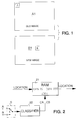
- FIG. 2 illustrates the principle of a device realizing the method according to the invention.
- the device comprises a RAM memory 21, and a processing unit such as a filter 22 deriving an identifier according to the invention from the image content of an image block and having an output connected to an address input ADDR in the memory 21.
- the device further comprises a selector, such as a switch S, which selects the image block to be applied to the input of the processing unit (a prediction block candidate A or a block B to be encoded).
- the displacement to the new prediction block candidate A takes place pixel by pixel, and the displacement operation is preferably performed over the entire image in the same way as in the prior art search methods (the image here also refers to the field in the case of an interlaced video signal).
- the location of each block is stored in the memory 21 at an address derived from the image content of block A in a processing step performed by the processing unit 22. In the figure this address is indicated with the reference CA. The next location data item to be stored at the same address is written over the preceding location data item, so there is only one location data item at a time at the same address (i.e. in each class).
- the output of the processing unit 22 thus gives the write address at which the location of the concerned image block is stored.
- the processing step is e.g. filtering or subsampling.
- the location of the prediction block of block B to be encoded is then obtained immediately from the memory 21 by subjecting image block B to the same processing step (with the switch S in the position "B") and by feeding the image content of the block to be encoded, after the above-mentioned processing, as the read address of the memory 21.
- this read address is indicated with the reference CB.
- image information is thus first classified on the basis of the image content in a processing step covering the entire search area (each class being represented by its own identifier CA).
- the prediction block of each image block to be encoded is then obtained as simply and rapidly as possible by fetching the address of the image block representing the class of the image block to be encoded from the memory.
- Location data to be stored in the memory 21 may be encoded in vector form in the same way as in the prior art methods.
- Location data obtained from the memory may be absolute, but it may also be converted into relative form so as to make it more suitable for further compression.
- the processing step determines the maximum matching error.
- the processing may also be performed in several stages, whereby the search is repeated with a greater matching error if the processing stage with a smaller matching error (such as filtering) did not produce a desired result.
- the processing step performed to derive the identifier CA or CB describing the image content of the image block selected as a prediction block candidate and that of the image block to be encoded, respectively may consist of several possible ways of processing.
- An essential feature of the processing and the processing unit performing it is that the identifier derived from the image content of the image block classifies the concerned image block unequivocally into a certain class within which the image blocks differ only slightly from each other and which thus represents a larger number of nearly similar blocks.
- the processing may consist e.g. of a combination of subsampling and truncation (subsampling means that some of the samples are disregarded, while truncation means that the number of bits used per one pixel is reduced).
- the method according to the invention considerably less calculation is required than previously as the pixel-by-pixel displacement to the new prediction block candidate A is performed only once on the entire search area, e.g. on an image, instead of repeating it with each block to be encoded as in the prior art methods. Moreover, if the processing step consists e.g. of subsampling and truncation, the method according to the invention requires no calculation.
- the search for the prediction block can be conducted easily over the entire area of the image or field instead of searching e.g. only the immediate vicinity of the block to be encoded. Also, the search for the prediction block may equally well be performed over an arbitrary previous field or image. The search area may thus be very large, which ensures that the end result will be the best possible with the highest possible probability.
- the prediction block may also be compiled from sub-blocks derived from different locations.
- the image block is thereby divided into smaller sub-blocks; for instance, an image block having 8 x 8 pixels is divided into four blocks having 4 x 4 pixels, and a prediction block is located for each sub-block as described above (the classification is performed on the basis of the sub-block size).
- the obtained four prediction blocks are then combined into a single prediction block for the entire image block.
- a prediction block for the image B to be encoded is derived from the selected prediction block by subjecting it to the inverse transformation of the above-mentioned transformation.
- Affine transformation is a transformation in which the shape of the image block changes, from a square to a rhombus, for instance.
- the read and write addresses of the memory need not be derived directly as a result of the processing performed by the processing unit, but they may be derived in an additional step on the basis of the identifier obtained from the processing unit and representing a particular class. It is also possible to store more than one location data item per address (class) in the memory, which, however, complicates the device unnecessarily.
Landscapes
- Engineering & Computer Science (AREA)
- Multimedia (AREA)
- Signal Processing (AREA)
- Compression Or Coding Systems Of Tv Signals (AREA)
- Compression, Expansion, Code Conversion, And Decoders (AREA)
Claims (11)
- Méthode pour la recherche d'un bloc de prédiction en relation avec une compression vidéo prédictive, dans laquelle une zone de recherche souhaitée est examinée afin de rechercher un bloc de prédiction ressemblant autant que possible à un bloc d'image (B) à coder, dans laquelle :des blocs d'image (A) utilisés comme blocs de prédiction candidats à l'intérieur de la zone de recherche sont soumis à une classification en dérivant un identifiant (CA) issu de chaque bloc d'image (A) utilisé comme bloc de prédiction candidat, l'identifiant désignant le contenu d'image du bloc d'image concerné et chaque classe étant représentée par son propre identifiant ;l'emplacement de chaque bloc d'image (A) utilisé comme bloc de prédiction candidat est enregistré dans une mémoire (21) à une adresse déterminée par ledit identifiant (CA), l'enregistrement se déroulant de telle sorte qu'au moins un élément de donnée d'emplacement reste en mémoire pour chaque identifiant (CA) ;le bloc d'image (B) devant être codé est également soumis à ladite classification en dérivant un identifiant (CB) dudit bloc d'image (B) à coder, l'identifiant décrivant le contenu d'image dudit bloc d'image (B) à coder ; etl'emplacement du bloc de prédiction pour le bloc d'image (B) à coder est extrait de ladite mémoire (21) à partir d'une position de mémoire déterminée par l'identifiant (CB) décrivant le contenu d'image du bloc d'image (B) à coder.
- Méthode selon la revendication 1, caractérisée en ce que tous les blocs d'image à l'intérieur de la zone de recherche son soumis à ladite classification suivant un déplacement pixel par pixel vers le nouveau bloc de prédiction candidat (A).
- Méthode selon la revendication 1 ou 2, caractérisée en ce que seul un élément de donnée d'emplacement reste dans la mémoire pour chaque identifiant (CA).
- Méthode selon la revendication 1, caractérisée en ce que ledit identifiant (CA) est obtenu par filtrage du contenu d'image de chaque bloc d'image (A) utilisé comme bloc de prédiction candidat.
- Méthode selon la revendication 1, caractérisée en ce que ledit identifiant (CA) est obtenu par sous-échantillonnage et troncature du contenu d'image de chaque bloc d'image (A) utilisé comme bloc de prédiction candidat.
- Méthode selon la revendication 1, caractérisée en ce que la zone de recherche représente la surface entière de l'image.
- Méthode selon la revendication 1, caractérisée en ce que la zone de recherche représente la surface de plusieurs images.
- Méthode selon la revendication 1, caractérisée en ce que le bloc d'image à coder est divisé en sous-blocs, un bloc de prédiction est localisé pour chaque sous-bloc, et les blocs de prédiction localisés sont ensuite combinés dans un seul bloc de prédiction pour le bloc d'image entier.
- Méthode selon la revendication 1, caractérisée en ce que le bloc d'image est converti par transformation affine en un certain nombre de nouveaux blocs d'image, un bloc de prédiction est localisé pour chaque nouveau bloc d'image et un bloc de prédiction est dérivé pour le bloc à coder à partir d'un bloc de prédiction sélectionné parmi lesdits blocs de prédiction pour les nouveaux blocs d'image en effectuant la transformation inverse de ladite transformation sur le bloc de prédiction sélectionné.
- Dispositif pour la recherche d'un bloc de prédiction en relation avec une compression vidéo prédictive, dans lequel une zone de recherche est examinée afin de rechercher un bloc de prédiction ressemblant autant que possible à un bloc d'image (B) à coder, comprenant :un moyen de mémoire (21) pour stocker l'emplacement de chaque bloc d'image (A) utilisé comme bloc de prédiction candidat, etune unité de traitement (22) pour classifier chaque bloc d'image (A) utilisé comme bloc de prédiction candidat et le bloc d'image (B) à coder, chaque classe étant représentée par son propre identifiant, dérivant ainsi de chaque bloc d'image (A) utilisé comme bloc de prédiction candidat un identifiant (CA) étant une adresse d'écriture pour écrire dans ledit moyen de mémoire (21), et dudit bloc d'image (B) à coder un identifiant (CB) étant une adresse de lecture pour lire ledit moyen de mémoire (21).
- Dispositif selon la revendication 10, caractérisé en ce que lesdits moyens comprennent un filtre (22).
Applications Claiming Priority (2)
| Application Number | Priority Date | Filing Date | Title |
|---|---|---|---|
| FI933093 | 1993-07-05 | ||
| FI933093A FI94307C (fi) | 1993-07-05 | 1993-07-05 | Menetelmä ja laite ennustuslohkon hakemiseksi prediktiivisen videonkompression yhteydessä |
Publications (3)
| Publication Number | Publication Date |
|---|---|
| EP0633700A2 EP0633700A2 (fr) | 1995-01-11 |
| EP0633700A3 EP0633700A3 (fr) | 1995-04-19 |
| EP0633700B1 true EP0633700B1 (fr) | 2000-05-03 |
Family
ID=8538283
Family Applications (1)
| Application Number | Title | Priority Date | Filing Date |
|---|---|---|---|
| EP94110460A Expired - Lifetime EP0633700B1 (fr) | 1993-07-05 | 1994-07-05 | Méthode et dispositif pour la recherche d'un bloc de prédiction dans une compression vidéo prédictive |
Country Status (3)
| Country | Link |
|---|---|
| EP (1) | EP0633700B1 (fr) |
| DE (1) | DE69424230T2 (fr) |
| FI (1) | FI94307C (fr) |
Cited By (1)
| Publication number | Priority date | Publication date | Assignee | Title |
|---|---|---|---|---|
| CN101605255B (zh) * | 2008-06-12 | 2011-05-04 | 华为技术有限公司 | 一种视频编解码的方法及装置 |
Families Citing this family (5)
| Publication number | Priority date | Publication date | Assignee | Title |
|---|---|---|---|---|
| US8625665B2 (en) | 1996-09-20 | 2014-01-07 | At&T Intellectual Property Ii, L.P. | Video coder providing implicit coefficient prediction and scan adaptation for image coding and intra coding of video |
| US6810086B1 (en) | 2001-06-05 | 2004-10-26 | At&T Corp. | System and method of filtering noise |
| US6968006B1 (en) | 2001-06-05 | 2005-11-22 | At&T Corp. | Method of content adaptive video decoding |
| US6970513B1 (en) | 2001-06-05 | 2005-11-29 | At&T Corp. | System for content adaptive video decoding |
| US7773670B1 (en) | 2001-06-05 | 2010-08-10 | At+T Intellectual Property Ii, L.P. | Method of content adaptive video encoding |
Family Cites Families (4)
| Publication number | Priority date | Publication date | Assignee | Title |
|---|---|---|---|---|
| EP0137314B1 (fr) * | 1983-09-06 | 1992-05-13 | Mitsubishi Denki Kabushiki Kaisha | Quantificateur de vecteurs pour de l'information image |
| US5194950A (en) * | 1988-02-29 | 1993-03-16 | Mitsubishi Denki Kabushiki Kaisha | Vector quantizer |
| DE3835368A1 (de) * | 1988-10-18 | 1990-04-19 | Bosch Gmbh Robert | Schaltungsanordnung zum auslesen von daten aus einem bildspeicher |
| DE3837590A1 (de) * | 1988-11-05 | 1990-05-10 | Ant Nachrichtentech | Verfahren zum reduzieren der datenrate von digitalen bilddaten |
-
1993
- 1993-07-05 FI FI933093A patent/FI94307C/fi active
-
1994
- 1994-07-05 EP EP94110460A patent/EP0633700B1/fr not_active Expired - Lifetime
- 1994-07-05 DE DE69424230T patent/DE69424230T2/de not_active Expired - Fee Related
Cited By (1)
| Publication number | Priority date | Publication date | Assignee | Title |
|---|---|---|---|---|
| CN101605255B (zh) * | 2008-06-12 | 2011-05-04 | 华为技术有限公司 | 一种视频编解码的方法及装置 |
Also Published As
| Publication number | Publication date |
|---|---|
| EP0633700A2 (fr) | 1995-01-11 |
| FI933093A0 (fi) | 1993-07-05 |
| FI933093L (fi) | 1995-01-06 |
| FI94307B (fi) | 1995-04-28 |
| DE69424230D1 (de) | 2000-06-08 |
| DE69424230T2 (de) | 2000-12-21 |
| EP0633700A3 (fr) | 1995-04-19 |
| FI94307C (fi) | 1995-08-10 |
Similar Documents
| Publication | Publication Date | Title |
|---|---|---|
| US5583580A (en) | Method and apparatus for detecting motion vectors based on hierarchical motion estimation | |
| EP0871336B1 (fr) | Méthode et appareil de codage et décodage prédictif d'image | |
| EP1249132B1 (fr) | Procede de codage d'images, et codeur d'images | |
| EP0689359B1 (fr) | Méthode et appareil de codage avec compensation de mouvement adaptatif à la quantité de mouvement | |
| RU2654200C1 (ru) | Усовершенствованное кодирование содержимого экрана с улучшенными способами кодирования таблицы палитры и индексной карты | |
| US4698672A (en) | Coding system for reducing redundancy | |
| US6084912A (en) | Very low bit rate video coding/decoding method and apparatus | |
| US6037986A (en) | Video preprocessing method and apparatus with selective filtering based on motion detection | |
| EP0614318B1 (fr) | Codeur et décodeur vidéo | |
| US5767909A (en) | Apparatus for encoding a digital video signal using an adaptive scanning technique | |
| US5808700A (en) | Motion video coding systems with motion vector detection | |
| US6041078A (en) | Method for simplifying bit matched motion estimation | |
| US5909513A (en) | Bit allocation for sequence image compression | |
| JPH03136595A (ja) | デイジタル動画像の記憶または伝送に用いるビデオ画像データの処理方法 | |
| KR100334703B1 (ko) | 디지탈화상복호장치 | |
| US6252905B1 (en) | Real-time evaluation of compressed picture quality within a digital video encoder | |
| GB2300083A (en) | Fractal image compression | |
| WO1997016026A1 (fr) | Compression de donnees | |
| US6888891B2 (en) | Wavelet domain half-pixel motion compensation | |
| KR100541623B1 (ko) | 움직임 보상을 이용한 예측 코딩 방법 및 장치 | |
| US6163576A (en) | Video encoder having reduced memory bandwidth requirements | |
| US6058142A (en) | Image processing apparatus | |
| US5689312A (en) | Block matching motion estimation method | |
| EP0633700B1 (fr) | Méthode et dispositif pour la recherche d'un bloc de prédiction dans une compression vidéo prédictive | |
| EP0632657A1 (fr) | Méthode pour la prédiction d'une image vidéo |
Legal Events
| Date | Code | Title | Description |
|---|---|---|---|
| PUAI | Public reference made under article 153(3) epc to a published international application that has entered the european phase |
Free format text: ORIGINAL CODE: 0009012 |
|
| AK | Designated contracting states |
Kind code of ref document: A2 Designated state(s): DE ES FR GB IT NL SE |
|
| PUAL | Search report despatched |
Free format text: ORIGINAL CODE: 0009013 |
|
| AK | Designated contracting states |
Kind code of ref document: A3 Designated state(s): DE ES FR GB IT NL SE |
|
| 17P | Request for examination filed |
Effective date: 19950725 |
|
| 17Q | First examination report despatched |
Effective date: 19981006 |
|
| GRAG | Despatch of communication of intention to grant |
Free format text: ORIGINAL CODE: EPIDOS AGRA |
|
| GRAG | Despatch of communication of intention to grant |
Free format text: ORIGINAL CODE: EPIDOS AGRA |
|
| GRAH | Despatch of communication of intention to grant a patent |
Free format text: ORIGINAL CODE: EPIDOS IGRA |
|
| RAP1 | Party data changed (applicant data changed or rights of an application transferred) |
Owner name: OY NOKIA AB |
|
| GRAH | Despatch of communication of intention to grant a patent |
Free format text: ORIGINAL CODE: EPIDOS IGRA |
|
| GRAA | (expected) grant |
Free format text: ORIGINAL CODE: 0009210 |
|
| AK | Designated contracting states |
Kind code of ref document: B1 Designated state(s): DE ES FR GB IT NL SE |
|
| PG25 | Lapsed in a contracting state [announced via postgrant information from national office to epo] |
Ref country code: IT Free format text: LAPSE BECAUSE OF FAILURE TO SUBMIT A TRANSLATION OF THE DESCRIPTION OR TO PAY THE FEE WITHIN THE PRE;WARNING: LAPSES OF ITALIAN PATENTS WITH EFFECTIVE DATE BEFORE 2007 MAY HAVE OCCURRED AT ANY TIME BEFORE 2007. THE CORRECT EFFECTIVE DATE MAY BE DIFFERENT FROM THE ONE RECORDED.SCRIBED TIME-LIMIT Effective date: 20000503 Ref country code: ES Free format text: THE PATENT HAS BEEN ANNULLED BY A DECISION OF A NATIONAL AUTHORITY Effective date: 20000503 |
|
| REF | Corresponds to: |
Ref document number: 69424230 Country of ref document: DE Date of ref document: 20000608 |
|
| ET | Fr: translation filed | ||
| PG25 | Lapsed in a contracting state [announced via postgrant information from national office to epo] |
Ref country code: SE Free format text: LAPSE BECAUSE OF FAILURE TO SUBMIT A TRANSLATION OF THE DESCRIPTION OR TO PAY THE FEE WITHIN THE PRESCRIBED TIME-LIMIT Effective date: 20000803 |
|
| PLBE | No opposition filed within time limit |
Free format text: ORIGINAL CODE: 0009261 |
|
| STAA | Information on the status of an ep patent application or granted ep patent |
Free format text: STATUS: NO OPPOSITION FILED WITHIN TIME LIMIT |
|
| 26N | No opposition filed | ||
| REG | Reference to a national code |
Ref country code: GB Ref legal event code: IF02 |
|
| PGFP | Annual fee paid to national office [announced via postgrant information from national office to epo] |
Ref country code: GB Payment date: 20020703 Year of fee payment: 9 |
|
| PGFP | Annual fee paid to national office [announced via postgrant information from national office to epo] |
Ref country code: FR Payment date: 20020709 Year of fee payment: 10 |
|
| PGFP | Annual fee paid to national office [announced via postgrant information from national office to epo] |
Ref country code: DE Payment date: 20020710 Year of fee payment: 9 |
|
| PGFP | Annual fee paid to national office [announced via postgrant information from national office to epo] |
Ref country code: NL Payment date: 20020730 Year of fee payment: 9 |
|
| PG25 | Lapsed in a contracting state [announced via postgrant information from national office to epo] |
Ref country code: GB Free format text: LAPSE BECAUSE OF NON-PAYMENT OF DUE FEES Effective date: 20030705 |
|
| PG25 | Lapsed in a contracting state [announced via postgrant information from national office to epo] |
Ref country code: NL Free format text: LAPSE BECAUSE OF NON-PAYMENT OF DUE FEES Effective date: 20040201 |
|
| PG25 | Lapsed in a contracting state [announced via postgrant information from national office to epo] |
Ref country code: DE Free format text: LAPSE BECAUSE OF NON-PAYMENT OF DUE FEES Effective date: 20040203 |
|
| GBPC | Gb: european patent ceased through non-payment of renewal fee |
Effective date: 20030705 |
|
| PG25 | Lapsed in a contracting state [announced via postgrant information from national office to epo] |
Ref country code: FR Free format text: LAPSE BECAUSE OF NON-PAYMENT OF DUE FEES Effective date: 20040331 |
|
| NLV4 | Nl: lapsed or anulled due to non-payment of the annual fee |
Effective date: 20040201 |
|
| REG | Reference to a national code |
Ref country code: FR Ref legal event code: ST |