EP0633890B1 - Festfase bei oligonukleotidsynthese - Google Patents
Festfase bei oligonukleotidsynthese Download PDFInfo
- Publication number
- EP0633890B1 EP0633890B1 EP93907979A EP93907979A EP0633890B1 EP 0633890 B1 EP0633890 B1 EP 0633890B1 EP 93907979 A EP93907979 A EP 93907979A EP 93907979 A EP93907979 A EP 93907979A EP 0633890 B1 EP0633890 B1 EP 0633890B1
- Authority
- EP
- European Patent Office
- Prior art keywords
- group
- support
- ring
- substituted
- hydroxy
- Prior art date
- Legal status (The legal status is an assumption and is not a legal conclusion. Google has not performed a legal analysis and makes no representation as to the accuracy of the status listed.)
- Expired - Lifetime
Links
- 0 COP(N(*)*)O* Chemical compound COP(N(*)*)O* 0.000 description 3
Images

Classifications
-
- C—CHEMISTRY; METALLURGY
- C07—ORGANIC CHEMISTRY
- C07H—SUGARS; DERIVATIVES THEREOF; NUCLEOSIDES; NUCLEOTIDES; NUCLEIC ACIDS
- C07H21/00—Compounds containing two or more mononucleotide units having separate phosphate or polyphosphate groups linked by saccharide radicals of nucleoside groups, e.g. nucleic acids
-
- C—CHEMISTRY; METALLURGY
- C07—ORGANIC CHEMISTRY
- C07D—HETEROCYCLIC COMPOUNDS
- C07D307/00—Heterocyclic compounds containing five-membered rings having one oxygen atom as the only ring hetero atom
- C07D307/02—Heterocyclic compounds containing five-membered rings having one oxygen atom as the only ring hetero atom not condensed with other rings
- C07D307/04—Heterocyclic compounds containing five-membered rings having one oxygen atom as the only ring hetero atom not condensed with other rings having no double bonds between ring members or between ring members and non-ring members
- C07D307/18—Heterocyclic compounds containing five-membered rings having one oxygen atom as the only ring hetero atom not condensed with other rings having no double bonds between ring members or between ring members and non-ring members with hetero atoms or with carbon atoms having three bonds to hetero atoms with at the most one bond to halogen, e.g. ester or nitrile radicals, directly attached to ring carbon atoms
- C07D307/20—Oxygen atoms
-
- Y—GENERAL TAGGING OF NEW TECHNOLOGICAL DEVELOPMENTS; GENERAL TAGGING OF CROSS-SECTIONAL TECHNOLOGIES SPANNING OVER SEVERAL SECTIONS OF THE IPC; TECHNICAL SUBJECTS COVERED BY FORMER USPC CROSS-REFERENCE ART COLLECTIONS [XRACs] AND DIGESTS
- Y02—TECHNOLOGIES OR APPLICATIONS FOR MITIGATION OR ADAPTATION AGAINST CLIMATE CHANGE
- Y02P—CLIMATE CHANGE MITIGATION TECHNOLOGIES IN THE PRODUCTION OR PROCESSING OF GOODS
- Y02P20/00—Technologies relating to chemical industry
- Y02P20/50—Improvements relating to the production of bulk chemicals
- Y02P20/55—Design of synthesis routes, e.g. reducing the use of auxiliary or protecting groups
Definitions
- This invention relates to a support carrying a homocyclic or heterocyclic ring suitable for use in oligonucleotide synthesis, its preparation and use, to a homocyclic or heterocyclic compound which may be attached to a support and to a support linked to an oligonucleotide through a group derived from the compound.
- oligonucleotides in a stepwise manner on a solid support carrying a terminal nucleoside.
- a support is formed by attaching an organic spacer group to a carrier, for example to controlled pore glass (CPG).
- CPG controlled pore glass
- nucleoside having a succinyl group is coupled to the terminal -NH 2 group, for example using 1,3-dicyclohexylcarbodiimide (DCCI).
- DCCI 1,3-dicyclohexylcarbodiimide
- a limitation of such a ready made support coupled to a nucleoside is that the nucleoside becomes part of the desired oligonucleotide when the oligonucleotide is cleaved from the support.
- the nucleoside becomes part of the desired oligonucleotide when the oligonucleotide is cleaved from the support.
- a support having an appropriate nucleoside attached to it which corresponds to the initial nucleoside in the desired oligonucleotide.
- an operative generally has to keep a number of different derivatised supports to cater for each of the different nucleosides found in DNA and RNA.
- a versatile derivatised support which is compatible with the chemistry used by synthesisers of oligonucleotides, which is compatible with both DNA and RNA synthesis irrespective of the first nucleoside in a desired oligonucleotide, and which can be used to prepare DNA or RNA having a non-nucleosidic terminal group. Furthermore, a derivatised support which can be used irrespective of the first group of a desired oligonucleotide would greatly reduce the likelihood of an operative inadvertently using a support derivatised with the wrong nucleoside.
- the present invention provides the linkage to the support through a first carbon next to a second carbon which carries the free or protected hydroxyl so that only the desired product is formed.
- a particularly preferred heterocyclic ring is a pyran or furan ring, especially a pyran or furan ring free from double covalent bonds.
- the identity of the support carrying the ring is not critical to the present invention.
- the support may be soluble in an organic solvent or may itself be a liquid, but is preferably a solid, more preferably a solid which is insoluble in an organic solvent.
- the preference for the support being a solid is because this can be packed into the column of an automated oligonucleotide synthesiser.
- the preferred soluble or liquid support is an organic polymer having little or no crosslinking, for example polyethylene glycol.
- the preferred support comprises a carrier and organic spacer group; said ring is connected to the organic spacer group. Alternatively said ring may be connected directly to the carrier.
- the preferred carrier comprises an organic polymer or an inorganic polymer.
- a preferred organic polymer is a cellulosic substrate (for example a paper), a polystyrene, a polyacryloylmorpholide, a polyamide resin, a polyacryloyl pyrollidone, polyethylene glycol-polystyrene, or a cross-linked dextran or agarose.
- a preferred inorganic polymer is a silica, porous glass, aluminosilicate, borosilicate, or a clay, especially a controlled pore glass, a silica gel, Porasil C. Mixtures of inorganic and organic polymers may also be used, for example an acrylamide-kieselguhr resin, PEPSYN K or a POLYHIPE resin.
- the length of the organic spacer group is not critical to the present invention.
- a preferred spacer group is at least 6, more preferably at least 8, especially at least 10 atoms long, and is preferably less than 100, more preferably less than 75, especially less than 30 atoms long.
- the preferred organic spacer group is straight or branched chain and preferably comprises a chain of methylene groups optionally interrupted by one or more carbonyl, amino, amide, ureido, urethane, ether, ester, silyl or aryl (e.g. phenylene) groups.
- the organic spacer group is free from phosphorus, particularly phosphate groups.
- organic spacer groups there may be mentioned: and wherein each m independently has a value of from 2 to 6.
- the second carbon atom on the ring is substituted by a hydroxy group protected by said acid labile protecting group or a phosphate group substituted by an oligonucleotide.
- the acid labile group is preferably sufficiently labile so that it may be removed under conditions which do not degrade DNA or RNA.
- the acid labile protecting groups are tetrahydropyranyl groups, e.g.
- the preferred acid labile protecting group is a dimethoxytrityl group, especially 4,4'-dimethoxytrityl.
- nucleophilic group groups which are convertible to a nucleophilic group on treatment with base will be apparent to those skilled in the art. It is preferred that such groups are convertible to a nucleophilic group under conditions which do not degrade DNA or RNA.
- the preferred nucleophilic group is a hydroxy group.
- Preferred conditions which do not degrade DNA or RNA include treatment with an inorganic base for example, sodium hydroxide, potassium hydroxide, ammonium hydroxide (conc), or an organic base (e.g. an organic amine, especially an alkylamine such as methylamine, triethylamine, diisopropylamine or a cyclic amine such as piperidine) at ambient or slightly elevated temperatures.
- an inorganic base for example, sodium hydroxide, potassium hydroxide, ammonium hydroxide (conc), or an organic base (e.g. an organic amine, especially an alkylamine such as methylamine, triethylamine, diisopropylamine or a cyclic amine such as piperidine) at ambient or slightly elevated temperatures.
- an inorganic base for example, sodium hydroxide, potassium hydroxide, ammonium hydroxide (conc), or an organic base (e.g. an organic amine, especially an alkylamine such as methylamine, trieth
- a preferred group which is convertible to a hydroxy group is an ester group which, on treatment with base, hydrolyses to give an acid, amide, (e.g. when hydrolysed with an amine) and a hydroxy group.
- the convertible group may be an ether group which, on treatment with a base, hydrolyses to give a hydroxy group.
- Formulae (1a) and (1b) illustrate the way in which the ring may be linked to the support by an ester group.
- the ester group preferably contains less than 10 carbon atoms, more preferably less than 7 carbon atoms, and especially contains from 2 to 7 carbon atoms.
- Examples of preferred ester groups containing less than 10 carbon atoms include esters of any dicarboxylic acid, for example, succinyloxy and oxalyloxy.
- ester group links the ring to the support.
- group convertible to a hydroxy group on treatment with base is an ester formed between an acid on the support and a hydroxy group on the first carbon atom.
- a support carrying said ring containing a first and second carbon atom characterised by any one or more of (a) to (c) in which (a) the ring is not substituted with any of adenine, guanine, cytosine, thymine or uracil by direct attachment to the ring; (b) the substituents on the ring include no more than one hydroxy group; (c) the ring is optionally substituted with C 1-6 alkoxy on carbon atoms other than the first and second carbon atoms.
- first carbon atom A is substituted by a group convertible to a hydroxy group on treatment with base
- second carbon atom B is substituted by a phosphate group substituted by an oligonucleotide, and A and B are directly connected by a covalent bond.
- first carbon atom A is substituted by a group convertible to a hydroxy group on treatment with base
- second carbon atom B is substituted by a hydroxy group protected by an acid labile protecting group
- a and B are directly connected by a covalent bond.
- the term "substituted by” as used herein is intended to include both the coupling to the support being indirectly through a substituent on the homocyclic or heterocyclic ring or directly onto the ring itself.
- the term “coupled ... through” as used herein means coupled directly to the ring or indirectly by means of a bond formed with the substituent on the ring, as described above by formulae (1a) or (1b) and in more detail below.
- the term 'oligonucleotide' used in this specification includes oligoribonucleotides and oligodeoxyribonucleotides.
- the preferred oligonucleotides comprise at least 2, more preferably at least 5, especially at least 10 nucleosides, and preferably less than 1000, more preferably less than 500, especially less than 200 nucleosides.
- the support carrying a ring where the second carbon atom is substituted by an oligonucleotide may be prepared from a support according to the invention in which the second carbon atom is substituted by a hydroxy group protected by acid labile protecting group, as will be apparent to those skilled in the art. It is preferred that the oligonucleotide is synthesised in the 3' to 5' direction.
- a support in which the second carbon atom is substituted by a dimethoxytrityloxy group may be packed into an oligonucleotide synthesiser column, and an oligonucleotide formed in a stepwise manner in an analogous way to that in which an oligonucleotide is formed on conventional derivatised supports, for example those of Formula (A) derivatised with a nucleoside succinate.
- the support according to the invention in which the second carbon atom is substituted by a dimethoxytrityloxy group and forms an oligonucleotide thereon using the known steps of
- Steps 1 to 5 are repeated for each nucleoside phosphoramidite until the desired oligonucleotide has been obtained.
- the phosphates in the oligonucleotide chain are, where desired, deprotected and the oligonucleotide may be cleaved from the support using a base, preferably aqueous ammonia or methylamine at room temperature.
- a base preferably aqueous ammonia or methylamine at room temperature.
- the oligonucleotide may be prepared using chemistry other than phosphoramidite chemistry.
- the cleavage step frees the oligonucleotide from the support but residues of the ring remain attached to the oligonucleotide by a phosphate ester group these may be removed by further treatment with base, for example by incubation therewith at 20-80°C, especially 30-70°C, for up to 48, especially 1 to 24 hours, to give an oligonucleotide having a 3' OH group.
- the support carrying the ring in which the second carbon atom is substituted by an acid labile protecting group as previously defined may be prepared by coupling a support and said ring, preferably by formation of an ester, amide or ether bond therebetween.
- the ester or amide bond is preferably formed by selecting one of either the ring or support to carry a hydroxy or amino group and the other to have an acid group, activating the acid, and coupling to form an ester or amide bond.
- an acid may be activated, for example it may be converted to an acid halide (e.g. using SOCl 2 ) or an activated ester (e.g. an o -nitrophenyl ester using DCCI).
- Preferably coupling is performed in the presence of a base.
- the ring may be coupled to the support through a side chain on the ring having an acid, amino or hydroxy group, thereby effectively lengthening the spacer group.
- a support according to the first aspect of the present invention where the second carbon atom is substituted by a hydroxy group may be prepared by deprotection of such a support where the second carbon atom is substituted by a hydroxy group protected by an acid labile protecting group, for example using Cl 3 CO 2 H.
- a preferred support according to the invention carries a group of Formula (2): wherein :
- Formula (la) above shows one example of a hydroxy group on a carbon atom directly attached to B by a covalent bond.
- n 1
- the substituents which may be present on the ring of which A and B are adjacent carbon atoms are preferably selected from hydroxy; a group convertible to hydroxy on treatment with base; straight or branched chain C 1-6 -alkyl, especially methyl, ethyl, propyl, butyl or tertiary butyl; C 1-6 -alkoxy, especially methoxy, ethoxy, propoxy and butoxy, particularly methoxy; aryloxy, especially optionally substituted phenoxy halogen, cyano, nitro, optionally protected oxycarbonyl, thio or amino or a group which is convertible to a thio or amino group on treatment with base, or an electron withdrawing group.
- thioesters examples include thioesters, carbamates and amides such as trifluoracetamide.
- Preferred groups of Formula (2) are illustrated by Formulae (1b) and (1d) above. It is particularly preferred that the ring has one or two C 1-4 -alkoxy substituents as these may assist cleavage of the oligonucleotide from B at the end of synthesis thereof.
- the support carrying the group of Formula (2) wherein Z 2 is an acid labile protecting group may be prepared, for example, by coupling a support containing an organic spacer group having a terminal hydroxyl or amino group with a compound of the Formula (3): wherein X is HO or a leaving group; L is an organic linking group; and A, B, Z 1 and n are as hereinbefore defined.
- the preferred leaving group represented by X is a halide, especially chloride, or the residue of an activated ester, for example o -nitrophenoxy, or an anhydride.
- Suitable conditions for the coupling reaction will be apparent to those skilled in the art. It is preferred that the coupling is performed in an aprotic solvent, especially in the presence of a base. DCCI may be used to make an activated ester.
- the preferred organic linking group represented by L is from 1 to 20 carbon atoms long, more preferably 2 to 6 carbon atoms long. It is preferred that L is phenylene or -(CH 2 ) p -where p is from 2 to 6, especially 2.
- Y is 0, CH 2 or CH 2 CH 2 .
- Z 3 is preferably an acid labile protecting group as hereinbefore described.
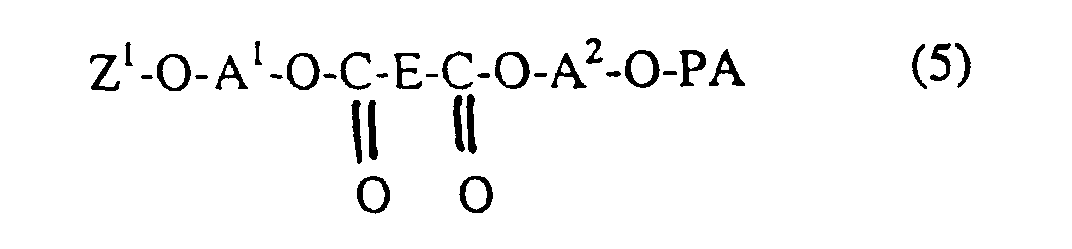
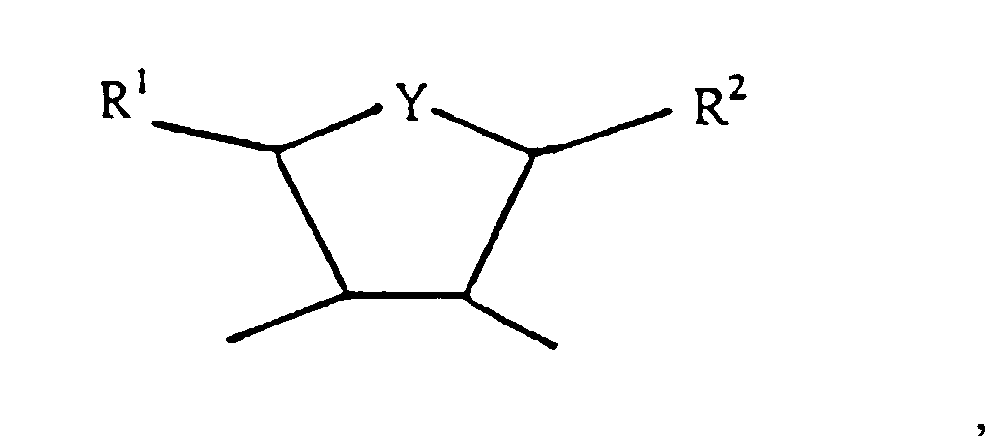
- An alternative method for preparing a derivatised support according to the invention is to condense a support comprising a carrier and organic spacer group, wherein the organic spacer group has an amino, thio or hydroxy group, with a compound of Formula (5): wherein -O-PA is a phosphoramidite group, phosphate ester group or a H-phosphonate group; A 1 is a divalent group of the formula (a): E is an organic spacer group; Y, Z 1 , R 1 and R 2 are as hereinbefore defined; and A 2 is of formula (a) or formula (b): wherein m has a value of from 1 to 5; the carbon atom marked with an asterisk is attached to an oxygen atom shown in Formula (5); and each R 3 independently represents H or optionally substituted alkyl.
- a 1 and A 2 are both of Formula (a) and m preferably has a value of from 1 to 3, more preferably 2.
- the preferred carrier, organic linking group, acid labile group and groups represented by Y, R 1 and R 2 are as hereinbefore defined.
- E is preferably an organic spacer group having a length of 2 to 15 carbon atoms, more preferably 2 to 6 carbon atoms.
- E is preferably an alkyl, alkenyl, aryl or aralkyl spacer group optionally interrupted by an oxygen, sulphur, amino or amido group.
- Preferred groups represented by E are optionally substituted phenylene and C 2-6 -alkylene, especially -CH 2 -CH 2 .
- R 3 is preferably H or C 1-4 -alkyl, especially H.
- phosphate ester groups and H-phosphonate groups there may be mentioned groups which, in the free acid form, are respectively of formula: wherein Z 4 is a base labile protecting group, for example 2-chlorophenyl or 2,4-dichlorophenyl.
- the preferred phosphoramidite group represented by -O-PA is of the formula: wherein R 4 and R 5 are each independently optionally substituted alkyl, especially C 1-4 -alkyl; optionally substituted aralkyl, especially optionally substituted benzyl; cycloalkyl and cycloalkylalkyl containing up to ten carbon atoms, such as cyclopentyl or cyclohexyl; or R 4 and R 5 taken together with the nitrogen atom to which they are attached form an optionally substituted pyrollidine or piperidine ring or R 4 and R 5 when taken together with the nitrogen atom to which they are attached form a saturated nitrogen heterocycle which optionally includes one or more additional hetero atom from the group consisting of nitrogen, oxygen and sulphur.
- R 4 and R 5 are preferably iso-propyl.
- R 6 represents a hydrogen atom or a protecting group, for example a phosphate protecting group.
- phosphate protecting groups there may be mentioned optionally substituted alkyl groups, for example methyl, 2-cyanoethyl, 2-chlorophenyl, 2,2,2-trihalo-l,l-dimethyl ethyl, 5-chloroquin-8-yl, 2-methylthioethyl and 2-phenylthioethyl groups in which the phenyl ring is optionally substituted, for example by a group selected from halogen, eg. chlorine, or NO 2 .
- R 6 is methyl or, more preferably, 2-cyanoethyl.
- the compounds of the present invention can exist in either the cis or trans form.
- the trans form of the compounds demonstrate a slower rate of cleavage and therefore result in oligonucleotides bearing terminal organic phosphate groups which may find applications in situations where the termini are required to be blocked.
- the compound of Formula (5) may be condensed with said amino, thio or hydroxy group by activating -O-PA, e.g. with tetrazole, condensing with the support, capping, e.g. with acetic anhydride, and if desired oxidising with H 2 O/I 2 or H 2 O 2 .
- -O-PA e.g. with tetrazole
- capping e.g. with acetic anhydride
- Compounds of Formula (5) wherein -O-PA is a phosphoramidite may be prepared by reacting a compound of formula with a compound of formula X 1 -PA in CH 2 Cl 2 using di(N-isopropyl)ethylamine as base.
- PA is preferably a phosphoramidite as defined above for -O-PA except that -O- is absent, and Z 1 , A 1 , E and A 2 are as hereinbefore defined, and X 1 is a leaving group, for example Cl or Br.
- the compound of Formula (5) may be prepared by reaction of a compound of formula with the triazolide of the corresponding free phosphate ester using a method analogous to that described in the above book by M.J. Gait.
- the compound of Formula (5) may be prepared by reaction of a compound of formula with PCl 3 in the presence of 1,2,4-triazole using a method analogous to that described by B.C.Froehler et al, Nucleic Acid Research, (1986), 14 , 5399-5407.
- the compound of formula may be prepared, for example, by reaction of a compound of formula with a compound of formula HO-A 2 -OH, preferably in an aprotic solvent using a suitable condensing agent such as the aforementioned DCCI or 1-(3-Dimethylaminopropyl)-3- ethylcarbodiimide.
- a suitable condensing agent such as the aforementioned DCCI or 1-(3-Dimethylaminopropyl)-3- ethylcarbodiimide.
- the compound of formula Z 1 -O-A 1 -E-CO 2 H may be prepared by the reaction of the compound of formula Z 1 -O-A 1 -OH with an activated form of the compound of formula HO 2 C-E-CO 2 H, preferably in an aprotic solvent in the presence of a molar equivalent of base.
- the dicarboxylic acid may be activated to attack by the hydroxyl group by being present as the acid anhydride, the acid chloride or some other suitable derivative, or the reaction may be mediated by the presence of a coupling agent as described above.
- the compound of formula Z 1 -O-A 1 -OH may be prepared by the reaction of the compound of formula HO-A 1 -OH with Z 1 -Cl (or some other suitably activated form of Z 1 ) in an anhydrous aprotic solvent in the presence of a molar equivalent of base.
- the compound of formula Z 1 -O-A 1 -OH is preferably prepared by debenzoylation of a compound of formula Z 1 -O-A 1 -O-CO-Ph in methanol using methylamine.
- the compound of formula Z 1 -O-A 1 -O-CO-Ph may be prepared by reaction of compound of formula HO-A 1 -O-CO-Ph with Z 1 -X 1 wherein X 1 is a leaving group, for example Cl.
- Z 1 , A 1 , E, A 2 , DCCI and -O-PA are as hereinbefore defined.
- the derivatised support of the invention will be of particular value in automated oligonucleotide synthesisers which currently use several different types of column to cater for the different oligonucleotide a user may wish to prepare.
- Using the present invention only one universal derivatised support packed into a column is necessary thereby reducing the probability of error through an operative selective an inappropriate support.
- heterocyclic ring (3) is protected by a 4,4 1 -dimethoxytrityl group (4) and is carried by a support comprising carrier (1) and organic spacer group (2).
- Figure 1b illustrates the support from Figure la after it has been used to synthesise a strand of DNA, for example by using phosphoramidite chemistry.
- Treatment with ammonia has cleaved the heterocyclic ring (3) from the organic spacer group (2) and handle (1). Further treatment with base frees the DNA from the heterocyclic group (3) by a mechanism which is believed to be as illustrated, wherein a nucleophilic hydroxy group displaces DNA from the phosphate to give DNA having a 3' hydroxy group.
- Reagent A1 was prepared using the preparations numbered 1-4 detailed below.
- 2,5-Dihydro-2,5-dimethoxyfuran (50g; Aldrich, cis/trans mixture) was dissolved in tetrahydrofuran (500ml) in a 5 litre, three-necked flask fitted with a mechanical stirrer. The contents of the flask were cooled to -5°c, and a solution of potassium permanganate (61.9g) in water (2250ml) was added dropwise with vigorous stirring at such a rate as to keep the temperature of the flask contents between 4° and 6°C. This addition took 80 minutes. The reaction mixture was then left stirring and allowed to warm to room temperature over 15 hours. The precipitated manganese dioxide was filtered off through Celite and washed with THF (200ml).
- step 1) The product from step 1) above (1.7g) was dissolved in dry pyridine (10ml) and 4-N,N-dimethylaminopyridine (DMAP) (100mg) was added. The mixture was swirled to dissolve the solid and benzoyl chloride (1.2ml) was added. The mixture was then left to stand at 20°c for 16 hours. The mixture was rotary evaporated, and residual pyridine was removed by repeated co-evaporation with toluene. The residual oil was partitioned between ethyl acetate and lM HCl (40ml of each).
- DMAP 4-N,N-dimethylaminopyridine
- step 2) above (2.47g), 4,4'-dimethoxytrityl chloride (3.12g) and DMAP (0.15g) were stirred in dry pyridine (20ml) at room temperature for 16 hours.
- the solvent was removed by rotary evaporation and residual pyridine was removed by repeated co-evaporation with toluene.
- step 3 The product from step 3) above (2.28g) was dissolved in dry pyridine (20ml) and succinic anhydride (0.55g) and DMAP (0.4g) were added. The mixture was swirled to dissolve the solids and then left at room temperature for 16 hours. The solvent was removed by rotary evaporation and residual pyridine was removed by repeated co-evaporation with toluene. The residue was partitioned between ethyl acetate and 10% (w/v) citric acid (50ml of each).
- Reagent A1 60mg was dissolved in dioxan (4ml) containing pyridine (0.2ml) and o -nitrophenol (14mg). To this solution was added 1,3-dicyclohexylcarbodiimide (51.5mg) and the mixture was incubated at room temperature for 5 hours and then at 4°C for 1 hour. The dicylohexylurea was filtered off, and the filtrate was added to a suspension in dry dimethylformamide of controlled pore glass derivatized with a long chain alkylamine (CPG LCAA available from Cruachem) (particle size 120-177um, primary amino loading of 215 ⁇ mole/g, pore diameter 500A, 100mg).
- CPG LCAA long chain alkylamine
- Triethylamine (0.1ml) was added and a yellow colouration immediately developed.
- the reaction mixture was incubated at room temperature for 16 hours with occasional swirling.
- the mixture was filtered on a glass sinter, and the solid was washed extensively with DMF, methanol and diethyl ether and dried in vacuo .
- the extent of loading of the support with reagent Al was determined by treatment of 2mg with perchloric acid followed by spectrophotometric determination of the dimethoxytrityl cation as described by Atkinson and Smith in the book by M.J. Gait. By this method, the loading of the support with reagent Al was 69.5 ⁇ moles/g.
- the support coupled with reagent Al was suspended in a solution of acetic anhydride (lml) in dry pyridine (10ml) containing DMAP (10mg), and this mixture was incubated at room temperature for 30 minutes. The mixture was filtered on a glass sinter, washed extensively with methanol and diethyl ether and dried overnight in vacuo .
- the resultant product was a support carrying a group of Formula:
- the right hand side is connected to CPG via an organic spacer group.
- Example 2 The method of Example 2) was repeated, except that in place of the controlled pore glass derivatised with a long chain alkylamine used in Example 2), there was used aminomethyl polystyrene (Applied Biosystems Inc.) (primary amino loading of 20 ⁇ mole/g, 100mg).
- aminomethyl polystyrene Applied Biosystems Inc.
- the extent of loading of the support with Reagent Al was determined by the method of Example 2). By this method, the loading of the support with Reagent A1 was 14 ⁇ mole/g.
- the support coupled with Reagent A1 was suspended in a solution of acetic anhydride (lml) in dry pyridine containing DMAP (lOmg), and this mixture was incubated at room temperature for 30 minutes. The mixture was filtered on a glass sinter, washed extensively with methanol and diethyl ether, and dried overnight in vacuo.
- the resultant product was a support carrying a group of Formula:
- the right hand side is connected to polystyrene via an organic spacer group.
- a fully protected oligodeoxyribonucleotide of sequence (5') CAAGTTTTCAGTCAGCCGAGTTCAG (3') was prepared as follows.
- a column containing the product from Example 2 (3mg) was attached to an Applied Biosystems 380B DNA synthesizer and the oligomer whose sequence is shown above was synthesized in a stepwise manner from nucleoside phosphoramidites using standard synthesis cycles, as fully described in the protocol to the synthesizer.
- oligonucleotide phosphoramidites used were the 2-cyanoethyl-N,N-diisopropylaminophosphoramidites of
- the detritylated oligodeoxyribonucleotide sequence was cleaved from the solid support by treatment with ammonium hydroxide (sp.gr. 0.88) on the synthesizer, and the ammoniacal solution was washed into a collection vial according to normal synthesizer protocols. Complete deprotection and removal of the terminal 3'-phosphate were performed by incubation of this solution at 55°C for 16 hours.
- ammonium hydroxide sp.gr. 0.88
- a second oligonucleotide was synthesized by conventional procedures as described above but using a conventional support having a guanine containing nucleoside attached thereto.
- the sequence of this oligonucleotide was: (5') CAAGTTTTCAGTCAGCCGAGTTCAG (3')
- the second oligonucleotide is of identical length and sequence to the product expected from using the support of the invention and removal of the terminal phosphate from the example described above.
- oligonucleotides After treatment of the oligonucleotides with concentrated ammonium hydroxide the solutions were lyophilized and the oligonucleotides redissolved in water to a concentration of approximately lmg/ml. For each oligomer, one microlitre of this solution was then added to an Eppendorf tube containing water (6 ⁇ l), 10x reaction buffer ("One Phor All", Pharmacia, 1 ⁇ l), [gamma 32 p] adenosine triphosphate (Amersham, 1ul) and T4 polynucleotide kinase (Pharmacia, 1ul). This mixture was then incubated at 37°C for one hour.
- Ethanol (30ul) was then added, the contents were mixed by repeated inversion of the tube, and the sample was incubated at -70°C for 15 minutes.
- the tube was spun in an Eppendorf centrifuge (Model 5415) at 14000 rpm for 15 minutes and the supernatant was discarded.
- the pellet was dried briefly in vacuo and was redissolved in 10ul of a solution containing 80% formamide, 0.1% bromophenol blue, 0.1% xylene cyanol and lOuM EDTA. This solution was loaded into one of the wells of a denaturing polyacrylamide gel (12% acrylamide, 50% urea) adjacent to the appropriate radiolabelled size marker, and the gel was run at 40W for approximately two hours. The locations and sizes of labelled DNA fragments were determined by autoradiography.
- a fully protected oligodeoxyribonucleotide of sequence: (5') AAAA (3') was prepared using the method of Example 4), except that in place of a column containing the product from Example 2), there was used a column containing the product from Example 3).
- the detritylated oligodeoxyribonucleotide sequence was cleaved from the solid support by treatment with ammonium hydroxide (sp.gr. 0.88) on the synthesiser, and the ammoniacal solution was washed into a collection vial according to normal synthesiser protocols. Deprotection and removal of the terminal 3'-phosphate were performed by incubation of this solution at 55°C for 16 hours.
- a second oligonucleotide was synthesised by conventional procedures as described in Example 4), but using a conventional support having an adenine containing nucleoside attached thereto.
- the sequence of this oligonucleotide was: (5') AAAA (3').
- the second oligonucleotide is of identical length and sequence to the product expected from using the support of the invention and removal of the terminal phosphate from the example described above.
- Example 5 The method of Example 5) was repeated, except that the detritylated oligonucleotide sequence was not cleaved from the solid support by treatment with ammonium hydroxide (sp.gr. 0.88) on the synthesiser, but instead was cleaved from the solid support by the following method.
- ammonium hydroxide sp.gr. 0.88
- a polypropylene syringe To each end of the synthesis column containing the detritylated oligonucleotide bound to the solid support was attached a polypropylene syringe. Into one of these syringes was added a solution of methylamine in water (40% methylamine, 2ml) and the solution was passed through the column and collected in the syringe at the other end. This passage of the alkaline solution through the column was repeated several times over the course of one hour at room temperature, after which the solution was then decanted into a collection vial and incubated at 60°C for 16 hours.
- Example 5 The method of Example 5) was repeated, except that the detritylated oligonucleotide sequence was not cleaved from the solid support by treatment with ammonium hydroxide (sp.gr. 0.88) on the synthesiser, but instead was cleaved from the solid support by the following method.
- ammonium hydroxide sp.gr. 0.88
- a polypropylene syringe To each end of the synthesis column containing the detritylated oligonucleotide bound to the solid support was attached a polypropylene syringe. Into one of these syringes was added a solution of ethylenediamine in ethanol (50% ethylenediamine, 2ml) and the solution was passed through the column and collected in the syringe at the other end. This passage of the alkaline solution through the column was repeated several times over the course of one hour at room temperature, after which the solution was then decanted into a collection vial and incubated at 60°C for 16 hours.
- Example 5 The method of Example 5) was repeated, except that the detritylated oligonucleotide sequence was not cleaved from the solid support by treatment with ammonium hydroxide (sp.gr. 0.88) on the synthesiser, but instead was cleaved from the solid support by the following method.
- ammonium hydroxide sp.gr. 0.88
- a polypropylene syringe To each end of the synthesis column containing the detritylated oligonucleotide bound to the solid support was attached a polypropylene syringe. Into one of these syringes was added a solution of triethylamine in methanol (50% triethylamine, 2ml) and the solution was passed through the column and collected in the syringe at the other end. This passage of the alkaline solution through the column was repeated several times over the course of one hour at room temperature, after which the solution was then decanted into a collection vial and incubated at 60°C for 16 hours.
- Example 5 The method of Example 5, was repeated, except that the detritylated oligonucleotide sequence was not cleaved from the solid support by treatment with ammonium hydroxide (sp.gr. 0-88) on the synthesiser, but instead was cleaved from the solid support by the following method.
- ammonium hydroxide sp.gr. 0-88
- a polypropylene syringe To each end of the synthesis column containing the detritylated oligonucleotide bound to the solid support was attached a polypropylene syringe. Into one of these syringes was added a solution of piperidine in water 10% piperidine, 2ml) and the solution was passed through the column and collected in the syringe at the other end. This passage of the alkaline solution through the column was repeated several times over the course of one hour at room temperature, after which the solution was then decanted into a collection vial and incubated at 60°C for 16 hours.
- Example 5 The method of Example 5) was repeated, except that the detritylated oligonucleotide sequence was not cleaved from the solid support by treatment with ammonium hydroxide (sp.gr. 0.88) on the synthesiser, but instead was cleaved from the solid support by the following method.
- ammonium hydroxide sp.gr. 0.88
- a polypropylene syringe To each end of the synthesis column containing the detritylated oligonucleotide bound to the solid support was attached a polypropylene syringe. Into one of these syringes was added a 0.5 molar solution of sodium hydroxide in a mixture of methanol and water (1/1, 2ml) and the solution was passed through the column and collected in the syringe at the other end. This passage of the alkaline solution through the column was repeated several times over the course of one hour at room temperature, after which the solution was then decanted into a collection vial and incubated at room temperature for 16 hours.
- oligoribonucleotide For each oligoribonucleotide, a column containing the product from Example 2) (3mg) was attached to an Applied Biosystems 380B DNA synthesiser and the oligomers whose sequences are shown above were synthesised in a stepwise manner from ribonucleoside phosphoramidites, as fully described in the protocol supplied by Cruachem Ltd. for use with their reagents.
- ribonucleoside phosphoramidites used were the 2'-(1-[2-fluorophenyl]-4-methoxypiperidin-1-yl)-3'-(2-cyanoethyl-N,N-diisopropylamino) phosphoramidites of
- detritylated oligoribonucleotide sequences were cleaved from the solid support by treatment with ammonium hydroxide (sp.gr. 0.88) on the synthesiser, and the ammoniacal solution was washed into a collection vial according to normal synthesiser protocols. Deprotection and removal of the terminal 3'-phosphate were performed by incubation of this solution at 60°C for 16 hours.
- oligoribonucleotides of sequence were prepared by conventional procedures as described above but using conventional supports having a uracil, cytosine, guanine, or adenine containing ribonucleoside respectively, attached thereto.
- these oligoribonucleotides are of identical length and sequence to the products expected from using the support of the invention and removal of the terminal phosphate from the examples described above.
- a fully protected oligodeoxyribonucleotide of sequence: (5') TTTT C 16 -SPACER (3') was prepared using the method of Example 5), except that in place of a column containing the product from Example 3), there was used a column containing the product from Example 2), wherein C 16 -SPACER is a group of structure: -O-(CH 2 ) 16 -O- introduced into the oligonucleotide by means of the fully protected phosphoramidite: DMT-O-(CH 2 ) 16 -O-PA in which DMT and PA are as hereinbefore described.
- the detritylated oligonucleotide sequence was cleaved from the solid support by treatment with ammonium hydroxide (sp.gr. 0.88) on the synthesiser, and the ammoniacal solution was washed into a collection vial according to normal synthesiser protocols. Deprotection and removal of the terminal 3'-phosphate were performed by incubation of this solution at 60°C for 16 hours.
- DMT is 4,4'dimethyoxytrityl.
- the dichloromethane solution was dried by the addition of anhydrous sodium sulphate and filtered. The filtrate was evaporated to a gum and redissolved in methanol saturated with methylamine. The resultant solution was incubated at room temperature until no starting material could be detected by TLC. The solvent was removed by rotary evaporation, and the residue redissolved in the minimum volume of dichloromethane/methanol (9/1) and loaded on a silica chromatography column. Elution with the same solvent gave the title compound as a white foam (22g, 54%).
- step 1 The product from step 1 (log, 24.6mmol) was dissolved in dry pyridine (150ml) and succinic anhydride (10g, 100mmol) was added. When dissolution was complete, 4-(N,N-dimethylamino)pyridine (500mg) was added and the solution was stirred at room temperature overnight. The solvent was evaporated under reduced pressure and residual pyridine removed by repeated co-evaporation with toluene. The residue was redissolved in dichloromethane (500ml) and washed three times with ice cold 10% citric acid solution.
- the extent of loading of the support with Reagent A2) was determined by the method of Example 2). By this method, the loading of the support with Reagent A2) was 15 ⁇ mole/g.
- the resultant product was a support carrying a group of Formula:
- the right hand side is connected to CPG via an organic spacer group.
- Example 5 The method of Example 5) was repeated, except that in place of a column containing the product from Example 3), there was used a column containing the product from Example 14).
- Example 2 The method of Example 2) was repeated, except that in place of Reagent A1 there was used Reagent A4.
- the extent of loading of the support with Reagent A4) was determined by the method of Example 2). By this method, the loading of the support with Reagent A4) was 19 ⁇ mole/g.
- the resultant product was a support carrying a group of Formula:
- the right hand side is connected to CPG via an organic spacer group.
- Example 5 The method of Example 5) was repeated except that in place of a column containing the product from Example 3), there was used a column containing the product from Example 20).
- Reagent A2 from Example 13, step 2 (10g, 19.5mmol) was dissolved in dry pyridine (200ml) containing 1,4-anhydroerythritol (10.4g, 100mmol). To this solution was added 1-(3-dimethylaminopropyl)-3-ethyl carbodiimide hydrochloride (Aldrich, 3.75g, 19.5mmol). The solution was stirred at room temperature overnight when TLC in dichloromethane:methanol (19:1) showed there to be no starting material present. The solvent was removed under reduced pressure and residual pyridine removed by repeated co-evaporation with toluene.
- step 1 The product from step 1 (2g, 3.3mmol) was dissolved in dry dichloromethane (50ml) and the solution stirred under a stream of dry argon. To this solution was added dry diisopropylethylamine (2.7ml, 16mmol) and 2-cyanoethyl-N,N diisopropylamino- chlorophosphine (1.05ml, 4.72mmol). The solution was stirred at room temperature under a stream of dry argon for 30 minutes when TLC in dichloromethane:triethylamine (19:1) showed there to be no starting material present. The reaction was quenched by addition of dry methanol (5ml) and the solution was diluted with ethyl acetate (200ml).
- Reagent A5 may be condensed with a support comprising a carrier and an organic spacer group having a terminal amino group or a terminal hydroxy group by 1. activating reagent A5 with tetrazole; 2. condensing the product with the support; 3. capping with acetic anhydride; and 4. oxidation using H 2 O/I 2 .
- Example 2 The method of Example 2) was repeated, except that in place of Reagent Al there was used Reagent A6.
- the extent of loading of the support with Reagent A6) was determined by the method of Example 2). By this method, the loading of the support with Reagent A6) was 51 ⁇ mole/g.
- the resultant product was a support carrying a group of Formula:
- the right hand side is connected to CPG via an organic spacer group.
- Example 5 The method of Example 5) was repeated except that in place of a column containing the product from Example 3), there was used a column containing the product from Example 24).
- Example 2 The method of Example 2) was repeated, except that in place of Reagent Al there was used Reagent A7.
- the extent of loading of the support with Reagent A7) was determined by the method of Example 2). By this method, the loading of the support with Reagent A7) was 46 ⁇ mole/g.
- the resultant product was a support carrying a group of Formula:
- the right hand side is connected to CPG via an organic spacer group.
- Example 5 The method of Example 5) was repeated except that in place of a column containing the product from Example 3), there was used a column containing the product from Example 27).
- Example 2 The method of Example 2) was repeated, except that in place of Reagent Al there was used Reagent A8.
- the extent of loading of the support with Reagent A8) was determined by the method of Example 2). By this method, the loading of the support with Reagent A8) was 11 ⁇ mole/g.
- the resultant product was a support carrying a group of Formula:
- the right hand side is connected to CPG via an organic spacer group.
- Example 5 The method of Example 5) was repeated except that in place of a column containing the product from Example 3), there was used a column containing the product from Example 30).
Landscapes
- Chemical & Material Sciences (AREA)
- Organic Chemistry (AREA)
- Health & Medical Sciences (AREA)
- Life Sciences & Earth Sciences (AREA)
- Biochemistry (AREA)
- Molecular Biology (AREA)
- Engineering & Computer Science (AREA)
- Biotechnology (AREA)
- General Health & Medical Sciences (AREA)
- Genetics & Genomics (AREA)
- Saccharide Compounds (AREA)
- Organic Low-Molecular-Weight Compounds And Preparation Thereof (AREA)
Claims (14)
- Träger, der einen Cyclopentylring oder einen Cyclohexylring oder einen heterocyclischen Ring, bestehend aus 4 oder 5 Kohlenstoffatomen und 1 Stickstoff-, Schwefel- oder Sauerstoffatom, trägt, wobei der Ring ein erstes und ein zweites Kohlenstoffatom enthält, wobei:(i) das erste Kohlenstoffatom mit einem nukleophilen Rest, ausgewählt aus einer Amino-, Thio- und Hydroxygruppe oder einem aus einem Ether oder Ester ausgewählten Rest, der nach Behandlung mit einer Base in einen nukleophilen Rest umgewandelt werden kann, substituiert ist;(ii) das zweite Kohlenstoffatom mit einer Hydroxygruppe, einer Hydroxygruppe, geschützt durch eine säurelabile Schutzgruppe, ausgewählt aus Tetrahydropyranylgruppen, gegebenenfalls substituierten Tritylgruppen, einer Pixyl-, Isobutyloxycarbonyl-, t.-Butyl- und Dimethylsilygruppe, oder einer mit einem Oligonukleotid substituierten Phosphatgruppe substituiert ist und(iii) das erste und das zweite Kohlenstoffatom direkt durch eine kovalente Bindung verbunden sind; und(iv) der Ring gegebenenfalls weiter mit einer Hydroxygruppe, einem bei Behandlung mit einer Base in eine Hydroxygruppe umwandelbaren Rest; einem gerad- oder verzweigtkettigen C1-6-Alkyl-, C1-6-Alkoxy-, Aryloxyrest, einem Halogenatom, einer Cyano-, Nitro-, gegebenenfalls geschützten Oxycarbonyl-, Thio-, Aminogruppe oder einem Rest, der nach Behandlung mit einer Base in eine Thio- oder Aminogruppe umwandelbar ist, oder einem elektronenentziehenden Rest substituiert ist; und(v) der Ring über das erste Kohlenstoffatom oder über den nukleophilen Rest oder den in einen nukleophilen Rest umwandelbaren Rest an den Träger gekuppelt ist.
- Träger nach Anspruch 1, der einen Cyclopentylring oder einen Cyclohexylring oder einen heterocyclischen Ring, bestehend aus 4 oder 5 Kohlenstoffatomen und 1 Stickstoff-, Schwefel- oder Sauerstoffatom, trägt, wobei der Ring ein erstes und ein zweites Kohlenstoffatom enthält, gekennzeichnet durch ein oder mehrere Merkmale (a) bis (c), wobei (a) der Ring nicht mit Adenin, Guanin, Cytosin, Thymin oder Uracil durch direkte Bindung an den Ring substituiert ist; (b) die Substituenten des Ringes nicht mehr als eine Hydroxygruppe einschließen; (c) der Ring gegebenenfalls mit einem C1-6-Alkoxyrest an einem Kohlenstoffatom, das vom ersten und zweiten Kohlenstoffatom verschieden ist, substituiert ist.
- Träger nach einem der Ansprüche 1 oder 2, wobei der in einen nukleophilen Rest umwandelbare Rest ein Ester ist.
- Träger nach Anspruch 3, wobei der Ester zwischen einer Säure am Träger und einer Hydroxygruppe am ersten Kohlenstoffatom gebildet wird.
- Träger, der einem Rest der Formel (2)trägt, in der:
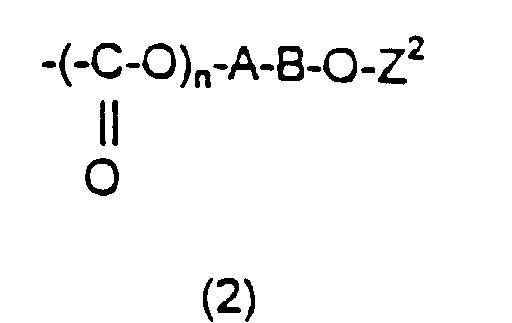
- A und B
- das erste und das zweite Kohlenstoffatom des Ringes sind und direkt durch eine kovalente Bindung verbunden sind; der Ring gegebenenfalls mit einer Hydroxygruppe, einem nach Behandlung mit Base in eine Hydroxygruppe umwandelbaren Rest. einem gerad- oder verzweigtkettigen C1-6-Alkyl-, C1-6- Alkoxyrest, einem Halogenatom, einer Cyano-, Nitro-, gegebenenfalls geschützten Oxycarbonyl-, Thio- oder Aminogruppe oder einem Rest, der nach Behandlung mit Base in eine Thio- oder Aminogruppe umwandelbar ist, oder einem elektronenentziehenden Rest substituiert ist;
- Z2
- H, eine säurelabile Schutzgruppe, ausgewählt aus Tetrahydropyranylgruppen, gegebenenfalls substituierten Tritylgruppen, einer Pixyl-, Isobutyloxycarbonyl-, t.-Butyl- und Dimethylsilylgruppe, oder eine mit einem Oligonukleotid substituierte Phosphatgruppe ist; und
- n
- 0 oder 1 ist;
- Träger nach einem der vorangehenden Ansprüche, wobei der heterocyclische Ring ein Pyran- oder ein Furanring ohne kovalente Doppelbindungen ist.
- Träger nach einem der vorangehenden Ansprüche, wobei der Ring weiter substituiert ist mit einem oder mehreren Resten, ausgewählt aus Methyl-, Ethyl-, Propyl-, Butyl-, tert.-Butyl-, Methoxy-, Ethoxy-, Propoxy-, Butoxy- und gegebenenfalls substituierten Phenoxygruppen.
- Träger nach einem der vorstehenden Ansprüche, wobei die säurelabile Schutzgruppe eine Dimethoxytritylgruppe ist.
- Verfahren zur Herstellung eines Trägers nach einem der Ansprüche 1 bis 8, wobei das zweite Kohlenstoffatom mit einer Hydroxygruppe substituiert ist, umfassend die Entfernung der Schutzgruppe von einem Träger, wenn das zweite Kohlenstoffatom durch eine durch eine säurelabile Schutzgruppe geschützte Hydroxygruppe substituiert ist.
- Verfahren zur Herstellung eines Trägers nach einem der Ansprüche 1 bis 8, wobei das zweite Kohlenstoffatom durch eine säurelabile Schutzgruppe geschützt ist, umfassend das Kuppeln eines Trägers und des Ringes durch Herstellung einer Ester- oder einer Amid- oder einer Etherbindung dazwischen.
- Verfahren zur Herstellung eines Trägers nach einem der Ansprüche 5 bis 8, wobei Z2 im Rest der Formel (2) eine säurelabile Schutzgruppe ist, umfassend das Kuppeln eines Trägers, der eine organische Spacer-Gruppe mit einer endständigen Hydroxyl- oder Aminogruppe enthält, mit einer Verbindung der Formel (3):in der X HO, ein Anhydrid, der Rest eines aktivierten Esters oder Halogenides ist; L eine organische Verbindungsgruppe mit 1 bis 20 Kohlenstoffatomen ist und Z1 eine säurelabile Schutzgruppe mit der vorstehenden Bedeutung ist.

- Verbindung mit einer der nachstehenden Formeln:
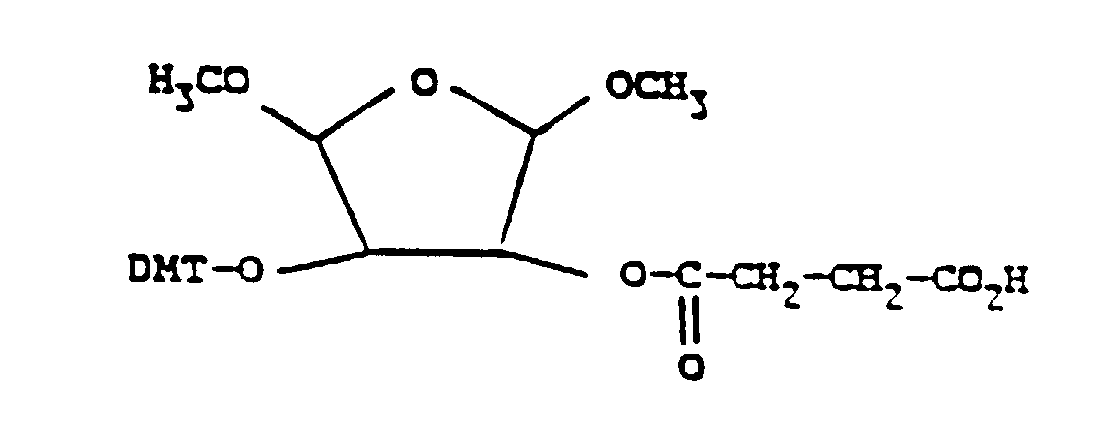
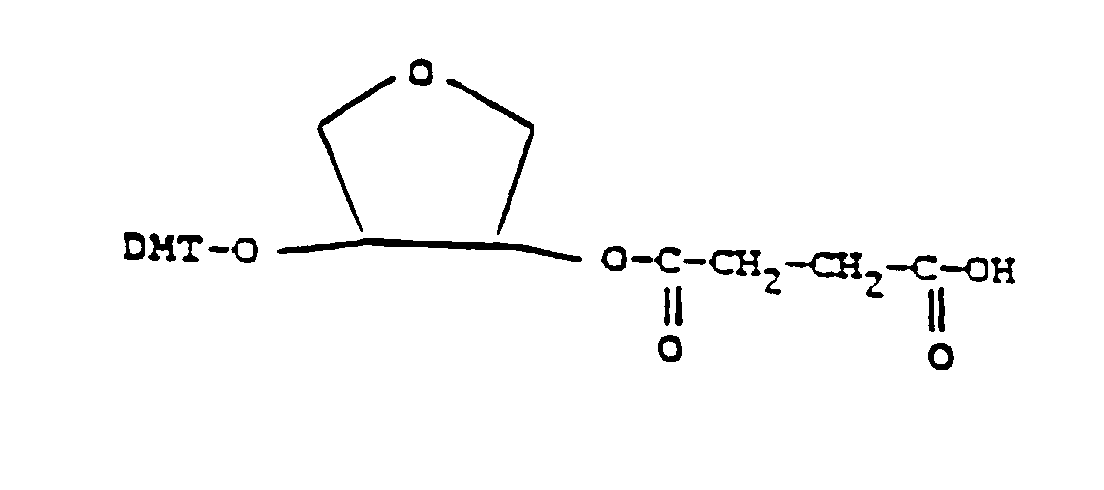
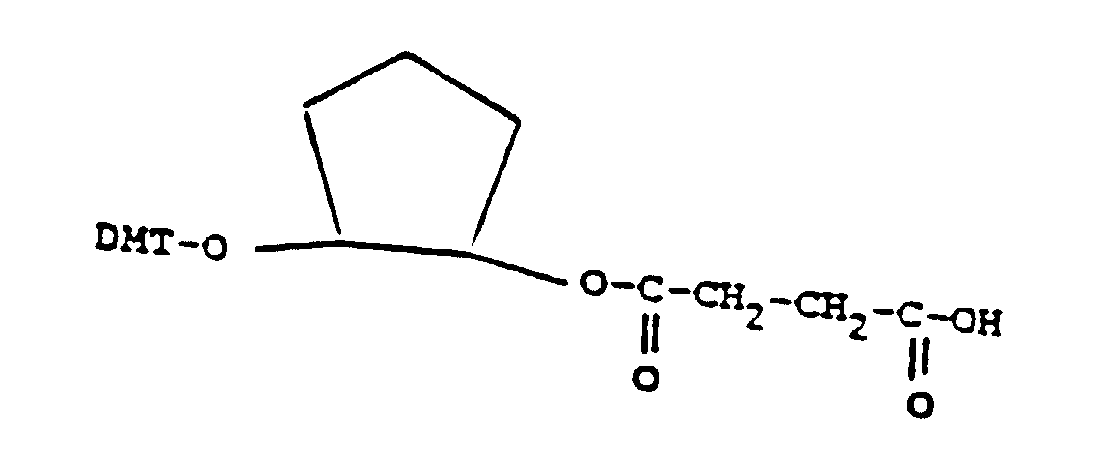 in denen DMT die Bedeutung 4,4'-Dimethoxytrityl hat.
- Verfahren zur Herstellung eines derivatisierten Trägers nach einem der Ansprüche 1 bis 8, umfassend das Kondensieren eines einen Träger und eine organische Spacer-Gruppe umfassenden Trägers, wobei die organische Spacer-Gruppe eine Amino-, Thio-, oder Hydroxygruppe aufweist, mit einer Verbindung der Formel (5)in der O-PA ein Phosphoramiditrest, ein Phosphatesterrest oder ein H-Phosphonatrest ist; A1 ein zweiwertiger Rest der Formel (a) ist:
 E eine organische Spacer-Gruppe mit 2 bis 15 Kohlenstoffatomen ist; Y, Z1, R1 und R2 die vorstehende Bedeutung haben; und A2 die Formel (a) oder Formel (b) hat:
 in der m einen Wert von 1 bis 5 hat; das mit * markierte Kohlenstoffatom an ein in Formel (5) gezeigtes Sauerstoffatom gebunden ist und jeder der Reste R3 unabhängig voneinander H oder einen gegebenenfalls substituierten Alkylrest wiedergibt.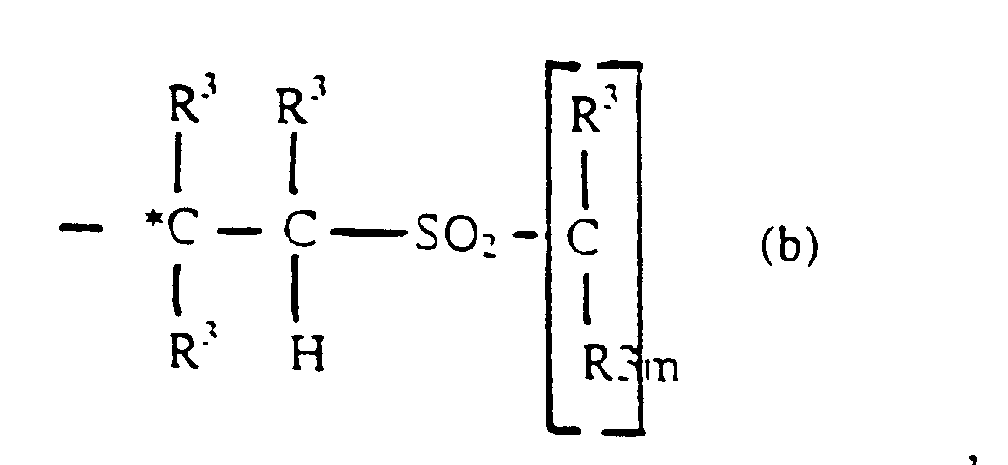
- Verfahren zur Herstellung von DNA oder RNA unter Venvendung eines Trägers nach einem der Ansprüche 1 bis 8.
Applications Claiming Priority (3)
| Application Number | Priority Date | Filing Date | Title |
|---|---|---|---|
| GB9207380 | 1992-04-03 | ||
| GB929207380A GB9207380D0 (en) | 1992-04-03 | 1992-04-03 | Compounds |
| PCT/GB1993/000693 WO1993020091A1 (en) | 1992-04-03 | 1993-04-02 | Support for oligonucleotide synthesis |
Publications (2)
| Publication Number | Publication Date |
|---|---|
| EP0633890A1 EP0633890A1 (de) | 1995-01-18 |
| EP0633890B1 true EP0633890B1 (de) | 1998-09-09 |
Family
ID=10713444
Family Applications (1)
| Application Number | Title | Priority Date | Filing Date |
|---|---|---|---|
| EP93907979A Expired - Lifetime EP0633890B1 (de) | 1992-04-03 | 1993-04-02 | Festfase bei oligonukleotidsynthese |
Country Status (11)
| Country | Link |
|---|---|
| US (2) | US5681945A (de) |
| EP (1) | EP0633890B1 (de) |
| JP (1) | JPH07505386A (de) |
| AT (1) | ATE170865T1 (de) |
| AU (1) | AU671629B2 (de) |
| CA (1) | CA2131993A1 (de) |
| DE (1) | DE69320949T2 (de) |
| FI (1) | FI111371B (de) |
| GB (1) | GB9207380D0 (de) |
| NO (1) | NO306254B1 (de) |
| WO (1) | WO1993020091A1 (de) |
Families Citing this family (18)
| Publication number | Priority date | Publication date | Assignee | Title |
|---|---|---|---|---|
| GB9207380D0 (en) * | 1992-04-03 | 1992-05-13 | Ici Plc | Compounds |
| US5869696A (en) * | 1996-04-22 | 1999-02-09 | Beckman Instruments, Inc. | Universal solid supports and methods for their use |
| US5998604A (en) * | 1997-09-15 | 1999-12-07 | The Perkin-Elmer Corporation | Polynucleotide purification method |
| US6451998B1 (en) | 1999-10-18 | 2002-09-17 | Agilent Technologies, Inc. | Capping and de-capping during oligonucleotide synthesis |
| US20040215010A1 (en) * | 2000-06-13 | 2004-10-28 | Viktor Kumarev | Universal solid supports for solid phase oligosynthesis and methods for their preparation and use |
| AU2002217893A1 (en) * | 2000-11-29 | 2002-06-11 | Glen Research Corporation | Universal supports for oligonucleotide synthesis |
| WO2004011474A1 (en) * | 2002-07-31 | 2004-02-05 | Isis Pharmaceuticals, Inc. | Universal support media for synthesis of oligomeric compounds |
| US6653468B1 (en) * | 2002-07-31 | 2003-11-25 | Isis Pharmaceuticals, Inc. | Universal support media for synthesis of oligomeric compounds |
| US20040242897A1 (en) * | 2002-07-31 | 2004-12-02 | Guzaev Andrei P. | Universal support media for synthesis of oligomeric compounds |
| US7202264B2 (en) * | 2003-01-31 | 2007-04-10 | Isis Pharmaceuticals, Inc. | Supports for oligomer synthesis |
| US20050130736A1 (en) * | 2003-12-12 | 2005-06-16 | Lottofone, Inc. | Prepaid wagering card |
| JP5438922B2 (ja) * | 2008-06-25 | 2014-03-12 | 日東電工株式会社 | 核酸の製造方法 |
| JP5360763B2 (ja) | 2009-10-21 | 2013-12-04 | 日東電工株式会社 | 核酸固相合成用リンカー及び担体 |
| KR20140000696A (ko) * | 2010-10-26 | 2014-01-03 | 스미또모 가가꾸 가부시끼가이샤 | 봉구재 및 세라믹스 허니컴 소성체의 제조 방법 |
| EP2620444B1 (de) | 2012-01-30 | 2015-05-06 | Nitto Denko Corporation | Linker und Träger für die Festphasensynthese von Nukleinsäure |
| EP2666794A1 (de) | 2012-05-23 | 2013-11-27 | Nitto Denko Corporation | Festphasenträger für Oligonukleotidsynthese und Oligonukleotidsyntheseverfahren |
| JP6537338B2 (ja) | 2015-04-24 | 2019-07-03 | 日東電工株式会社 | 核酸固相合成用リンカー及び担体 |
| EP3601310B1 (de) * | 2017-03-29 | 2021-04-14 | Roche Innovation Center Copenhagen A/S | Schnelle unylinker-spaltung |
Citations (1)
| Publication number | Priority date | Publication date | Assignee | Title |
|---|---|---|---|---|
| WO1993002057A1 (en) * | 1991-07-17 | 1993-02-04 | Smithkline Beecham Corporation | Retroviral protease inhibitors |
Family Cites Families (9)
| Publication number | Priority date | Publication date | Assignee | Title |
|---|---|---|---|---|
| OA03606A (fr) * | 1967-01-16 | 1971-03-30 | Ciba Geigy | Procédé de préparation de nouveaux dérivés glucidiques. |
| EP0067597A1 (de) * | 1981-05-29 | 1982-12-22 | ens BIO LOGICALS INC. | Verfahren für Polynukleotidsynthese |
| WO1985001051A1 (en) * | 1983-09-02 | 1985-03-14 | Molecular Biosystems, Inc. | Oligonucleotide polymeric support system |
| US4775619A (en) * | 1984-10-16 | 1988-10-04 | Chiron Corporation | Polynucleotide determination with selectable cleavage sites |
| US5118605A (en) * | 1984-10-16 | 1992-06-02 | Chiron Corporation | Polynucleotide determination with selectable cleavage sites |
| US4818681A (en) * | 1985-02-22 | 1989-04-04 | Molecular Diagnostics, Inc. | Fast and specific immobilization of nucleic acids to solid supports |
| US5378825A (en) * | 1990-07-27 | 1995-01-03 | Isis Pharmaceuticals, Inc. | Backbone modified oligonucleotide analogs |
| GB9021625D0 (en) * | 1990-10-04 | 1990-11-21 | Ici Plc | Synthesis of oligonucleotides |
| GB9207380D0 (en) * | 1992-04-03 | 1992-05-13 | Ici Plc | Compounds |
-
1992
- 1992-04-03 GB GB929207380A patent/GB9207380D0/en active Pending
-
1993
- 1993-04-02 EP EP93907979A patent/EP0633890B1/de not_active Expired - Lifetime
- 1993-04-02 CA CA002131993A patent/CA2131993A1/en not_active Abandoned
- 1993-04-02 JP JP5517254A patent/JPH07505386A/ja active Pending
- 1993-04-02 DE DE69320949T patent/DE69320949T2/de not_active Expired - Lifetime
- 1993-04-02 AU AU38980/93A patent/AU671629B2/en not_active Ceased
- 1993-04-02 WO PCT/GB1993/000693 patent/WO1993020091A1/en not_active Ceased
- 1993-04-02 AT AT93907979T patent/ATE170865T1/de not_active IP Right Cessation
- 1993-04-05 US US08/041,591 patent/US5681945A/en not_active Expired - Lifetime
-
1994
- 1994-09-30 FI FI944567A patent/FI111371B/fi active
- 1994-09-30 NO NO943667A patent/NO306254B1/no not_active IP Right Cessation
-
1997
- 1997-05-09 US US08/853,673 patent/US5886193A/en not_active Expired - Lifetime
Patent Citations (1)
| Publication number | Priority date | Publication date | Assignee | Title |
|---|---|---|---|---|
| WO1993002057A1 (en) * | 1991-07-17 | 1993-02-04 | Smithkline Beecham Corporation | Retroviral protease inhibitors |
Non-Patent Citations (8)
| Title |
|---|
| C.R.Arcad. Sci. Paris. Série C, Vol. 278 (17), pp 1069-1071 (1974) * |
| CHEMICAL ABSTRACTS, vol. 84, No. 12, 22 March 1976, abstrat no. 84:75995w * |
| Derwent Abstract AN-75-59564W[36](&JP-A-5005335) * |
| J.Am.Chem.Soc. Vol. 110(20) pp 6917-6918 (1988) * |
| J.Org.Chem. Vol. 54(11), pp 2599-2605 (1989) * |
| Makromol. Chem., Vol. 190, pp 1737-1753 (1989) JOACHIM THIEM et al.: "Ring-opening polymerization of carbohydrate-derived dialkoxyoxolanes" * |
| Tetrahedron Letters Vol. 31 (44), pp 6283-6286 (1990) * |
| TETRAHEDRON LETTERS, Vol. 31, No.5, pp 735-738, (1990) N. IRANPOOR et al.: "2,3-DICHLORO-5,6-DICYANO-P-BENZOQUINONE, AN EFFICIENT, MILD, NEUTRAL AND HIGHLY REGIOSELECTIVE CATALYST FOR ALCOHOLYSIS OF EXPOXIDES" * |
Also Published As
| Publication number | Publication date |
|---|---|
| FI111371B (fi) | 2003-07-15 |
| ATE170865T1 (de) | 1998-09-15 |
| JPH07505386A (ja) | 1995-06-15 |
| EP0633890A1 (de) | 1995-01-18 |
| DE69320949T2 (de) | 1999-05-12 |
| NO943667L (no) | 1994-09-30 |
| WO1993020091A1 (en) | 1993-10-14 |
| US5886193A (en) | 1999-03-23 |
| AU671629B2 (en) | 1996-09-05 |
| DE69320949D1 (de) | 1998-10-15 |
| AU3898093A (en) | 1993-11-08 |
| FI944567L (fi) | 1994-09-30 |
| NO306254B1 (no) | 1999-10-11 |
| FI944567A0 (fi) | 1994-09-30 |
| NO943667D0 (no) | 1994-09-30 |
| CA2131993A1 (en) | 1993-10-14 |
| US5681945A (en) | 1997-10-28 |
| GB9207380D0 (en) | 1992-05-13 |
Similar Documents
| Publication | Publication Date | Title |
|---|---|---|
| EP0633891B1 (de) | Oligonukleotide synthese | |
| US5886193A (en) | Homocyclic and heterocyclic compounds suitable for use in oligonucleotide synthesis | |
| US5783690A (en) | Protecting group for synthesizing oligonucleotide analogs | |
| Scaringe | RNA oligonucleotide synthesis via 5′-silyl-2′-orthoester chemistry | |
| RU2079508C1 (ru) | Способ соединения нуклеозидов 3'-5'-межнуклеотидным силильным звеном | |
| US6590093B1 (en) | Orthoester protecting groups | |
| US5264566A (en) | Method for in vitro oligonucleotide synthesis using H-phosphonates | |
| JP4580870B2 (ja) | リボヌクレオチド又はリボヌクレオチド誘導体の製造方法 | |
| EP0843684B1 (de) | Universale feste träger und verfahren zu ihrer verwendung | |
| AU665174B2 (en) | Synthesis of oligonucleotides | |
| US5623068A (en) | Synthesis of DNA using substituted phenylacetyl-protected nucleotides | |
| JPH05503715A (ja) | オリゴヌクレオチド合成の方法および手段 | |
| Wang et al. | 5′-C-branched thymidines: Synthesis, stereochemistry, and incorporation into oligodeoxynucleotides | |
| WO1998029429A1 (en) | Method for the synthesis of nucleotide or oligonucleotide phosphoramidites | |
| US5756704A (en) | Nucleosides and nucleoside derivatives containing enzymatically cleavable protecting groups | |
| US20030195351A1 (en) | Methods for the integrated synthesis and purification of oligonucleotides | |
| US5808035A (en) | Protected nucleoside and method for its synthesis |
Legal Events
| Date | Code | Title | Description |
|---|---|---|---|
| PUAI | Public reference made under article 153(3) epc to a published international application that has entered the european phase |
Free format text: ORIGINAL CODE: 0009012 |
|
| 17P | Request for examination filed |
Effective date: 19940824 |
|
| AK | Designated contracting states |
Kind code of ref document: A1 Designated state(s): AT BE CH DE DK ES FR GB GR IE IT LI LU MC NL PT SE |
|
| 17Q | First examination report despatched |
Effective date: 19950517 |
|
| GRAG | Despatch of communication of intention to grant |
Free format text: ORIGINAL CODE: EPIDOS AGRA |
|
| GRAG | Despatch of communication of intention to grant |
Free format text: ORIGINAL CODE: EPIDOS AGRA |
|
| GRAH | Despatch of communication of intention to grant a patent |
Free format text: ORIGINAL CODE: EPIDOS IGRA |
|
| GRAH | Despatch of communication of intention to grant a patent |
Free format text: ORIGINAL CODE: EPIDOS IGRA |
|
| GRAH | Despatch of communication of intention to grant a patent |
Free format text: ORIGINAL CODE: EPIDOS IGRA |
|
| GRAA | (expected) grant |
Free format text: ORIGINAL CODE: 0009210 |
|
| ITF | It: translation for a ep patent filed | ||
| AK | Designated contracting states |
Kind code of ref document: B1 Designated state(s): AT BE CH DE DK ES FR GB GR IE IT LI LU MC NL PT SE |
|
| PG25 | Lapsed in a contracting state [announced via postgrant information from national office to epo] |
Ref country code: NL Free format text: LAPSE BECAUSE OF FAILURE TO SUBMIT A TRANSLATION OF THE DESCRIPTION OR TO PAY THE FEE WITHIN THE PRESCRIBED TIME-LIMIT Effective date: 19980909 Ref country code: GR Free format text: LAPSE BECAUSE OF NON-PAYMENT OF DUE FEES Effective date: 19980909 Ref country code: ES Free format text: THE PATENT HAS BEEN ANNULLED BY A DECISION OF A NATIONAL AUTHORITY Effective date: 19980909 Ref country code: BE Free format text: LAPSE BECAUSE OF FAILURE TO SUBMIT A TRANSLATION OF THE DESCRIPTION OR TO PAY THE FEE WITHIN THE PRESCRIBED TIME-LIMIT Effective date: 19980909 Ref country code: AT Free format text: LAPSE BECAUSE OF FAILURE TO SUBMIT A TRANSLATION OF THE DESCRIPTION OR TO PAY THE FEE WITHIN THE PRESCRIBED TIME-LIMIT Effective date: 19980909 |
|
| REF | Corresponds to: |
Ref document number: 170865 Country of ref document: AT Date of ref document: 19980915 Kind code of ref document: T |
|
| REG | Reference to a national code |
Ref country code: CH Ref legal event code: NV Representative=s name: A. BRAUN, BRAUN, HERITIER, ESCHMANN AG PATENTANWAE Ref country code: CH Ref legal event code: EP |
|
| REF | Corresponds to: |
Ref document number: 69320949 Country of ref document: DE Date of ref document: 19981015 |
|
| ET | Fr: translation filed | ||
| REG | Reference to a national code |
Ref country code: IE Ref legal event code: FG4D |
|
| PG25 | Lapsed in a contracting state [announced via postgrant information from national office to epo] |
Ref country code: DK Free format text: LAPSE BECAUSE OF FAILURE TO SUBMIT A TRANSLATION OF THE DESCRIPTION OR TO PAY THE FEE WITHIN THE PRESCRIBED TIME-LIMIT Effective date: 19981209 |
|
| PG25 | Lapsed in a contracting state [announced via postgrant information from national office to epo] |
Ref country code: PT Free format text: LAPSE BECAUSE OF FAILURE TO SUBMIT A TRANSLATION OF THE DESCRIPTION OR TO PAY THE FEE WITHIN THE PRESCRIBED TIME-LIMIT Effective date: 19981214 |
|
| NLV1 | Nl: lapsed or annulled due to failure to fulfill the requirements of art. 29p and 29m of the patents act | ||
| PG25 | Lapsed in a contracting state [announced via postgrant information from national office to epo] |
Ref country code: LU Free format text: LAPSE BECAUSE OF NON-PAYMENT OF DUE FEES Effective date: 19990402 Ref country code: IE Free format text: LAPSE BECAUSE OF NON-PAYMENT OF DUE FEES Effective date: 19990402 |
|
| PLBE | No opposition filed within time limit |
Free format text: ORIGINAL CODE: 0009261 |
|
| STAA | Information on the status of an ep patent application or granted ep patent |
Free format text: STATUS: NO OPPOSITION FILED WITHIN TIME LIMIT |
|
| 26N | No opposition filed | ||
| PG25 | Lapsed in a contracting state [announced via postgrant information from national office to epo] |
Ref country code: MC Free format text: LAPSE BECAUSE OF NON-PAYMENT OF DUE FEES Effective date: 19991031 |
|
| REG | Reference to a national code |
Ref country code: GB Ref legal event code: 732E |
|
| REG | Reference to a national code |
Ref country code: IE Ref legal event code: MM4A |
|
| REG | Reference to a national code |
Ref country code: CH Ref legal event code: PUE Owner name: SYNGENTA LIMITED TRANSFER- AVECIA LIMITED Ref country code: CH Ref legal event code: PFA Free format text: ZENECA LIMITED TRANSFER- SYNGENTA LIMITED |
|
| REG | Reference to a national code |
Ref country code: GB Ref legal event code: IF02 |
|
| REG | Reference to a national code |
Ref country code: FR Ref legal event code: TP |
|
| REG | Reference to a national code |
Ref country code: GB Ref legal event code: 732E |
|
| REG | Reference to a national code |
Ref country code: CH Ref legal event code: PUE Owner name: AVECIA BIOTECHNOLOGY INC Free format text: AVECIA LIMITED#PO BOX 42 HEXAGON HOUSE#BLACKLEY, MANCHESTER M9 8ZS (GB) -TRANSFER TO- AVECIA BIOTECHNOLOGY INC#155 FORTUNE BOULEVARD#MILFORD, MA 01757 (US) |
|
| REG | Reference to a national code |
Ref country code: FR Ref legal event code: TP |
|
| REG | Reference to a national code |
Ref country code: CH Ref legal event code: PFA Owner name: AVECIA BIOTECHNOLOGY INC Free format text: AVECIA BIOTECHNOLOGY INC#155 FORTUNE BOULEVARD#MILFORD, MA 01757 (US) -TRANSFER TO- AVECIA BIOTECHNOLOGY INC#155 FORTUNE BOULEVARD#MILFORD, MA 01757 (US) |
|
| PGFP | Annual fee paid to national office [announced via postgrant information from national office to epo] |
Ref country code: IT Payment date: 20090421 Year of fee payment: 17 |
|
| PGFP | Annual fee paid to national office [announced via postgrant information from national office to epo] |
Ref country code: CH Payment date: 20090416 Year of fee payment: 17 |
|
| REG | Reference to a national code |
Ref country code: CH Ref legal event code: PL |
|
| PG25 | Lapsed in a contracting state [announced via postgrant information from national office to epo] |
Ref country code: LI Free format text: LAPSE BECAUSE OF NON-PAYMENT OF DUE FEES Effective date: 20100430 Ref country code: CH Free format text: LAPSE BECAUSE OF NON-PAYMENT OF DUE FEES Effective date: 20100430 |
|
| PG25 | Lapsed in a contracting state [announced via postgrant information from national office to epo] |
Ref country code: IT Free format text: LAPSE BECAUSE OF NON-PAYMENT OF DUE FEES Effective date: 20100402 |
|
| PGFP | Annual fee paid to national office [announced via postgrant information from national office to epo] |
Ref country code: DE Payment date: 20110330 Year of fee payment: 19 Ref country code: SE Payment date: 20110412 Year of fee payment: 19 Ref country code: GB Payment date: 20110330 Year of fee payment: 19 Ref country code: FR Payment date: 20110426 Year of fee payment: 19 |
|
| REG | Reference to a national code |
Ref country code: SE Ref legal event code: EUG |
|
| GBPC | Gb: european patent ceased through non-payment of renewal fee |
Effective date: 20120402 |
|
| REG | Reference to a national code |
Ref country code: FR Ref legal event code: ST Effective date: 20121228 |
|
| PG25 | Lapsed in a contracting state [announced via postgrant information from national office to epo] |
Ref country code: GB Free format text: LAPSE BECAUSE OF NON-PAYMENT OF DUE FEES Effective date: 20120402 |
|
| REG | Reference to a national code |
Ref country code: DE Ref legal event code: R119 Ref document number: 69320949 Country of ref document: DE Effective date: 20121101 |
|
| PG25 | Lapsed in a contracting state [announced via postgrant information from national office to epo] |
Ref country code: FR Free format text: LAPSE BECAUSE OF NON-PAYMENT OF DUE FEES Effective date: 20120430 Ref country code: SE Free format text: LAPSE BECAUSE OF NON-PAYMENT OF DUE FEES Effective date: 20120403 |
|
| PG25 | Lapsed in a contracting state [announced via postgrant information from national office to epo] |
Ref country code: DE Free format text: LAPSE BECAUSE OF NON-PAYMENT OF DUE FEES Effective date: 20121101 |