EP0633954B1 - Monofilaments en polyamide de haute tenacite et leur procede de production - Google Patents
Monofilaments en polyamide de haute tenacite et leur procede de production Download PDFInfo
- Publication number
- EP0633954B1 EP0633954B1 EP93908711A EP93908711A EP0633954B1 EP 0633954 B1 EP0633954 B1 EP 0633954B1 EP 93908711 A EP93908711 A EP 93908711A EP 93908711 A EP93908711 A EP 93908711A EP 0633954 B1 EP0633954 B1 EP 0633954B1
- Authority
- EP
- European Patent Office
- Prior art keywords
- monofilament
- draw
- water
- draw point
- coating
- Prior art date
- Legal status (The legal status is an assumption and is not a legal conclusion. Google has not performed a legal analysis and makes no representation as to the accuracy of the status listed.)
- Expired - Lifetime
Links
- 238000000034 method Methods 0.000 title claims abstract description 61
- 239000004952 Polyamide Substances 0.000 title claims abstract description 27
- 229920002647 polyamide Polymers 0.000 title claims abstract description 27
- XLYOFNOQVPJJNP-UHFFFAOYSA-N water Substances O XLYOFNOQVPJJNP-UHFFFAOYSA-N 0.000 claims abstract description 78
- 230000004807 localization Effects 0.000 claims abstract description 29
- 239000011248 coating agent Substances 0.000 claims abstract description 23
- 238000000576 coating method Methods 0.000 claims abstract description 23
- 238000010791 quenching Methods 0.000 claims abstract description 21
- 238000010438 heat treatment Methods 0.000 claims abstract description 10
- 238000009987 spinning Methods 0.000 claims abstract description 10
- 239000007788 liquid Substances 0.000 claims abstract description 4
- BDAGIHXWWSANSR-UHFFFAOYSA-N methanoic acid Natural products OC=O BDAGIHXWWSANSR-UHFFFAOYSA-N 0.000 claims description 14
- 229920001971 elastomer Polymers 0.000 claims description 13
- 229920002302 Nylon 6,6 Polymers 0.000 claims description 11
- OSWFIVFLDKOXQC-UHFFFAOYSA-N 4-(3-methoxyphenyl)aniline Chemical compound COC1=CC=CC(C=2C=CC(N)=CC=2)=C1 OSWFIVFLDKOXQC-UHFFFAOYSA-N 0.000 claims description 7
- 235000019253 formic acid Nutrition 0.000 claims description 7
- 230000005855 radiation Effects 0.000 claims description 7
- 229920006395 saturated elastomer Polymers 0.000 claims description 6
- -1 poly(hexamethylene adipamide) Polymers 0.000 claims description 5
- 238000002844 melting Methods 0.000 claims description 2
- 230000008018 melting Effects 0.000 claims description 2
- 230000000052 comparative effect Effects 0.000 description 10
- 239000004677 Nylon Substances 0.000 description 9
- 229920001778 nylon Polymers 0.000 description 9
- 229920000642 polymer Polymers 0.000 description 9
- 210000003739 neck Anatomy 0.000 description 8
- 230000000704 physical effect Effects 0.000 description 7
- QEDQZYNGDXULGO-UHFFFAOYSA-N 3-methyl-2-(3-methylphenyl)morpholine Chemical compound CC1NCCOC1C1=CC=CC(C)=C1 QEDQZYNGDXULGO-UHFFFAOYSA-N 0.000 description 5
- 239000000835 fiber Substances 0.000 description 5
- FZEIVUHEODGHML-UHFFFAOYSA-N 2-phenyl-3,6-dimethylmorpholine Chemical compound O1C(C)CNC(C)C1C1=CC=CC=C1 FZEIVUHEODGHML-UHFFFAOYSA-N 0.000 description 4
- 239000000203 mixture Substances 0.000 description 4
- 239000002904 solvent Substances 0.000 description 4
- YKCSYIYQRSVLAK-UHFFFAOYSA-N 3,5-dimethyl-2-phenylmorpholine Chemical compound CC1NC(C)COC1C1=CC=CC=C1 YKCSYIYQRSVLAK-UHFFFAOYSA-N 0.000 description 3
- 230000001143 conditioned effect Effects 0.000 description 3
- 229920001519 homopolymer Polymers 0.000 description 3
- 238000005259 measurement Methods 0.000 description 3
- NWNCIXFIIDVRKE-UHFFFAOYSA-N 3-methyl-2-(4-methylphenyl)morpholine Chemical compound CC1NCCOC1C1=CC=C(C)C=C1 NWNCIXFIIDVRKE-UHFFFAOYSA-N 0.000 description 2
- 239000000853 adhesive Substances 0.000 description 2
- 230000001070 adhesive effect Effects 0.000 description 2
- 230000003750 conditioning effect Effects 0.000 description 2
- 230000001276 controlling effect Effects 0.000 description 2
- 238000001816 cooling Methods 0.000 description 2
- 229920001577 copolymer Polymers 0.000 description 2
- 239000013078 crystal Substances 0.000 description 2
- 238000011161 development Methods 0.000 description 2
- 238000005213 imbibition Methods 0.000 description 2
- 230000000171 quenching effect Effects 0.000 description 2
- 230000001105 regulatory effect Effects 0.000 description 2
- 238000010025 steaming Methods 0.000 description 2
- 239000002344 surface layer Substances 0.000 description 2
- 239000002352 surface water Substances 0.000 description 2
- 238000010998 test method Methods 0.000 description 2
- 230000009466 transformation Effects 0.000 description 2
- 229910000831 Steel Inorganic materials 0.000 description 1
- 230000002411 adverse Effects 0.000 description 1
- 125000001931 aliphatic group Chemical group 0.000 description 1
- 238000013459 approach Methods 0.000 description 1
- 230000015572 biosynthetic process Effects 0.000 description 1
- 238000002425 crystallisation Methods 0.000 description 1
- 230000008025 crystallization Effects 0.000 description 1
- 230000000694 effects Effects 0.000 description 1
- 238000011067 equilibration Methods 0.000 description 1
- 238000009472 formulation Methods 0.000 description 1
- 150000004677 hydrates Chemical class 0.000 description 1
- 230000001939 inductive effect Effects 0.000 description 1
- 239000010410 layer Substances 0.000 description 1
- 239000000155 melt Substances 0.000 description 1
- 238000010128 melt processing Methods 0.000 description 1
- 238000002360 preparation method Methods 0.000 description 1
- 239000010959 steel Substances 0.000 description 1
- 238000009864 tensile test Methods 0.000 description 1
- 238000012360 testing method Methods 0.000 description 1
Images

Classifications
-
- D—TEXTILES; PAPER
- D01—NATURAL OR MAN-MADE THREADS OR FIBRES; SPINNING
- D01F—CHEMICAL FEATURES IN THE MANUFACTURE OF ARTIFICIAL FILAMENTS, THREADS, FIBRES, BRISTLES OR RIBBONS; APPARATUS SPECIALLY ADAPTED FOR THE MANUFACTURE OF CARBON FILAMENTS
- D01F6/00—Monocomponent artificial filaments or the like of synthetic polymers; Manufacture thereof
- D01F6/58—Monocomponent artificial filaments or the like of synthetic polymers; Manufacture thereof from homopolycondensation products
- D01F6/60—Monocomponent artificial filaments or the like of synthetic polymers; Manufacture thereof from homopolycondensation products from polyamides
-
- D—TEXTILES; PAPER
- D01—NATURAL OR MAN-MADE THREADS OR FIBRES; SPINNING
- D01D—MECHANICAL METHODS OR APPARATUS IN THE MANUFACTURE OF ARTIFICIAL FILAMENTS, THREADS, FIBRES, BRISTLES OR RIBBONS
- D01D5/00—Formation of filaments, threads, or the like
- D01D5/12—Stretch-spinning methods
- D01D5/16—Stretch-spinning methods using rollers, or like mechanical devices, e.g. snubbing pins
-
- Y—GENERAL TAGGING OF NEW TECHNOLOGICAL DEVELOPMENTS; GENERAL TAGGING OF CROSS-SECTIONAL TECHNOLOGIES SPANNING OVER SEVERAL SECTIONS OF THE IPC; TECHNICAL SUBJECTS COVERED BY FORMER USPC CROSS-REFERENCE ART COLLECTIONS [XRACs] AND DIGESTS
- Y10—TECHNICAL SUBJECTS COVERED BY FORMER USPC
- Y10T—TECHNICAL SUBJECTS COVERED BY FORMER US CLASSIFICATION
- Y10T428/00—Stock material or miscellaneous articles
- Y10T428/29—Coated or structually defined flake, particle, cell, strand, strand portion, rod, filament, macroscopic fiber or mass thereof
- Y10T428/2913—Rod, strand, filament or fiber
-
- Y—GENERAL TAGGING OF NEW TECHNOLOGICAL DEVELOPMENTS; GENERAL TAGGING OF CROSS-SECTIONAL TECHNOLOGIES SPANNING OVER SEVERAL SECTIONS OF THE IPC; TECHNICAL SUBJECTS COVERED BY FORMER USPC CROSS-REFERENCE ART COLLECTIONS [XRACs] AND DIGESTS
- Y10—TECHNICAL SUBJECTS COVERED BY FORMER USPC
- Y10T—TECHNICAL SUBJECTS COVERED BY FORMER US CLASSIFICATION
- Y10T428/00—Stock material or miscellaneous articles
- Y10T428/29—Coated or structually defined flake, particle, cell, strand, strand portion, rod, filament, macroscopic fiber or mass thereof
- Y10T428/2913—Rod, strand, filament or fiber
- Y10T428/2973—Particular cross section
Definitions
- This invention relates to high tenacity, heavy denier polyamide monofilaments, and more particularly relates to heavy denier polyamide monofilaments having high tenacity and high tensile uniformity and a process for making such monofilaments which provides improved control over drawing in the first draw stage.
- U.S. Patent Nos. 4,009,511, 4,056,652 and 5,082,611 disclose processes for making heavy denier, high tenacity polyamide monofilaments which are well suited for use in reinforced rubber goods such as tires. These processes include the steps of spinning, water-quenching, and drawing a heavy denier, polyamide monofilament in at least first and second draw stages. In the first draw stage, the quenched monofilament is advanced through a steamer containing a high temperature steam atmosphere and is advanced in the second draw stage through a zone heated with a radiant heater. The monofilament is drawn to a total draw ratio of at least about 5.5X.
- the monofilaments produced by these processes have a surface with an orientation less than the orientation of the core which, besides imparting improved physical properties to the monofilaments, provides good adhesion to rubber.
- U.S. Patent No. 5,082,611 provides a method for controlling the location of the draw point and can provide a standard deviation of tenacity of less than about 0.25 in high tenacity monofilament.
- This process utilizes controlling the temperature of the quenched monofilament in advance of the steamer by adjusting the length of time in the quench bath or by regulating the quench bath temperature so that the draw point is maintained after the feed rolls and before the high temperature steam atmosphere.
- a preferred location for the draw point is in the steam expansion zone of the high pressure steamer.
- it is often difficult to provide the proper quench conditions which achieve both the low crystallinity needed for very high tenacities and the desired control over the location of the draw point to provide uniformity. Small perturbations in the process with time can result in movement of the draw point from outside to inside the steamer resulting in less than desired tensile strength and/or tensile strength uniformity.
- an improved process including the steps of spinning, water-quenching, and drawing a heavy denier, polyamide monofilament in at least first and second draw stages to a total draw ratio of at least about 5.5X.
- the quenched monofilament is advanced in the first draw stage through a steamer containing a high temperature steam atmosphere and is advanced in the second draw stage through a zone heated with a radiant heater.
- the improved process includes:
- the invention is particularly useful for thick monofilaments such as those where the minimum thickness of the quenched monofilament is greater than about 0.8 mm.
- the core temperature of the quenched filament before being advanced into the draw point localization zone is less than about 55°C, preferably less than about 50°C.
- the draw point localization zone is enclosed within a draw point localization chamber and the coating of water is provided by applying water heated to at least about 90°C in the chamber.
- the process further comprises heating the coating of water by contacting the coating of water with saturated steam in the chamber.
- the process further comprises heating the coating of water by exposing the coating of water to microwave radiation in the chamber.
- polyamide monofilaments are provided of greater than about 1000 denier (1100 dtex) having a tenacity greater than about 10 gpd (88 dN/tex), a formic acid relative viscosity of at least about 60, an along-end standard deviation of tenacity of less than 0.10 gpd (0.088 dN/tex), and a hot air shrinkage at 177°C of less than about 15%.
- Another polyamide monofilament in accordance with the invention of greater than about 1000 denier (1100 dtex) has a formic acid relative viscosity of at least about 60 and a cured-in-rubber tenacity greater than about 10 gpd (8.8 dN/tex).
- the monofilament product has a minimum thickness greater than about 0.35 mm
- Polyamide as used in this application refers to any of the various generally linear, aliphatic polycarbonamide homopolymers and copolymers which are typically melt-spinnable and, when drawn, yield fibers having properties suitable for industrial applications.
- poly(hexamethylene adipamide) (6,6 nylon) and poly( ⁇ -caproamide) (6 nylon), poly(tetramethylene adipamide) (4,6 nylon) are typically-used polyamides for industrial fibers.
- the invention is also applicable to copolymers and mixtures of polyamides although such copolyamides and mixtures are generally not preferred since shrinkages are typically increased over homopolymers. Because of a balance of properties including dimensional stability which is imparted to the resulting fiber and reasonable melt-processing temperatures, homopolymer poly(hexamethylene adipamide) (6,6 nylon) is the preferred polyamide for the practice of the present invention.
- the relative viscosity (RV) of the polyamide should be sufficiently high for good product properties.
- the RV when measured in a capillary viscometer at 25°C in a solution formed by dissolving 8.4% by weight polyamide polymer in a solvent of formic acid containing 10% by weight of water preferably is above about 60.
- the polyamide is melt-spun through a spinneret 10 having, for example, a relatively large round, obround or rectangular spinneret orifice.
- the melt temperature is appropriate for the polyamide being spun.
- melt temperatures from 270-300°C are suitable.
- the monofilament indicated by the numeral 12 in Figure 1 is subjected to attenuation in an air gap 13 below the spinneret and quenched in a quench bath 14 containing water at a temperature less than about 50°C.
- the air gap 13 should be between about 10 and 40 inches (25 and 100 cm) in length before the filament enters the quench bath 14.
- Tension in the air gap and quench bath is minimized by adjusting the air gap distance in order to minimize the development of positive birefringence and orientation in the monofilament surface before the monofilament is orientation-stretched.
- the tension must be sufficient to provide stability to the threadline in the quench bath.
- water in an amount of at least 10% based on the dry weight of the monofilament is provided on the monofilament before it contacts any surfaces such as feed rolls, guides or other surfaces.
- the monofilament encounters an air jet designated by the numeral 16 which regulates residual quench water on the monofilament to between about 10% and about 25% by weight based on the dry weight of the monofilament.
- the wet filament is then forwarded to puller rolls 18 which control the tension on the filament when spun and as it advances through the quench bath 14.
- the monofilament is then advanced through pre-tension rolls 20 and feed rolls 22.
- the pre-tension rolls are employed to increase tension on the monofilament to stabilize the monofilament on the feed rolls.
- the monofilament is drawn in at least two draw stages with the total draw ratio being at least about 5.5X.
- the first draw stage which occurs between the feed rolls 22 and first stage draw rolls 62, the monofilament is drawn at a draw ratio of at least 3.0X.
- the monofilament is subjected to treatment with a high temperature steam atmosphere in a steamer 26 as in known processes such as that disclosed in U.S. Patent No. 5,082,611.
- the process in accordance with the invention provides a draw point localization zone providing a treatment step which is separate and distinct from the treatment with the high temperature steam atmosphere and is enclosed within a chamber shown schematically as 28.
- the draw point localization zone thus is in advance of and remote from the steamer 26 containing the high temperature steam atmosphere and is enclosed within a chamber shown schematically as 28.
- the distance between the draw point localization zone and the high pressure steamer is not critical, typically a distance of approximately 10 to 40 inches (25 to 100 cm) depending on monofilament thickness and process speed is used to insure that the draw point does not approach the high pressure steamer under any conditions.
- the coating of water on the monofilament must be generally uniform and be in an amount greater than about 5 % by weight based on the dry weight of the monofilament. so that steam does not directly contact the surface of the monofilament.
- the amount of water provided is between about 5% and about 25%, most preferably between about 10% and about 15% .
- the coating of water is heated in the draw point localization zone generally uniformly to a sufficient temperature and for a sufficient time to induce neck draw of said monofilament. It has been found that this temperature should be greater than about 90°C. Preferably, the water is heated to a temperature greater than about 95°C, most preferably 98°C.
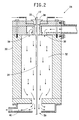
- FIG. 2 is a partially schematic view of one preferred draw point localizer 28 which employs both heated water application and steam as heat source for inducing neck draw.
- the combination of heated water and steam is used instead of steam with cold water to avoid the time required to heat the water and thereby shorten the residence time for the monofilament to be heated to a temperature at which neck draw occurs.
- the draw point localizer 28 includes a body 30 which provides an enclosed chamber 32 of sufficient length to enclose the draw point (designated by the numeral 34) and provides adequate heating for drawing using steam at or near atmospheric pressure.
- the chamber 32 preferably is sufficiently long to contain the extended neck draw of heavy monofilaments. Typically, a chamber of 9 to 24 inches (23 to 60 cm) in length may be used.
- the draw point localizer 28 provides means to uniformly apply the heated water to the monofilament as it enters the chamber through entrance 33.
- Felt wicks 36 which encircle the monofilament 12 where it enters the draw point localizer 28 are suitably employed for this purpose.
- the wicks 36 supply heated water from a source (not shown) and heated via a coiled heat exchanger (also not shown) in the body of the draw point localizer 28.
- the draw point localizer 28 shown in Figure 2 also provides a means for supplying steam from a source (not shown) to the chamber 32. This is suitably accomplished using a steam supply manifold 38 which provides steam at a low flow rate into the chamber 32 close to the entrance 33. Adjacent to a monofilament exit 39, a steam exhaust 40 is provided which is connected to a source of vacuum (not shown) to withdraw the steam from the chamber and prevent the steam being vented into the plant environment. It is preferable for the steam in the chamber 32 to be saturated steam at atmospheric pressure since it has been found that higher temperatures are not necessary to keep the coating of water hot enough to induce draw in the monofilament and control over temperature is facilitated.
- suitable, low pressure saturated steam preferably at about 5 to 15 psi (34 to 103 kPa), can be supplied to the manifold 38 to provide the atmospheric pressure steam atmosphere in the chamber 32.
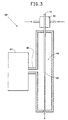
- FIG 3 illustrates another preferred embodiment of draw point localization apparatus 28' which employs microwave radiation as the heat source.
- This apparatus operates similar to draw point localizer 28 in that water is coated on the monofilament using means such as felt wicks at water applicator 42 although there is no advantage in heating the water.
- the water coated monofilament enters a tuned microwave cavity 44 which is supplied through a wave guide 46 with microwave radiation from a microwave source 47.
- the microwave source can be, for example, a 1800 watt (Max.) 2450 MHz microwave generator.
- the water on the monofilament is heated by the microwave radiation to heat the monofilament to induce draw.
- the draw point localizer 28 provides a way to stabilize the draw point as a single neck draw away from the high pressure steam atmosphere.
- the monofilament thereby can be more thoroughly quenched to achieve a monofilament core temperature less than about 55°C to provide low crystallinity and yield higher tenacity products without the possible loss of control over the draw point location which can adversely affect uniformity.
- the invention is especially useful with higher denier monofilament products in which the minimum thickness of the quenched monofilament is greater than about 0.8 mm.
- minimum thickness refers to the diameter of the smallest inscribing circle determined by the monofilament cross-sectional surface.
- the monofilament 12 enters the high temperature steamer 26.
- the steam atmosphere of the steamer substantially deorients and hydrates the surface of the monofilament to prevent or minimize the development of molecular orientation or birefringence in the surface as the filament is stretched.
- the conditions for steaming are established to conform to the properties of a particular polyamide.
- the steam atmosphere in the steamer 26 for 6-6 nylon is typically between about 80 and 170 psig (550 and 1200 kPa) and the steam may be selected from a range of from 40% wet to 120°C of superheat.
- the steamer is suitably provided by an elongated casing which provides a pressurized steam chamber 48 having an entrance seal 50 and an exit seal 52 which minimize steam pressure loss while admitting the monofilament 12 into the chamber 48 and providing an exit for the monofilament at the opposite end.
- the steamer 26 also has separate chambers at each end providing entrance and exit steam expansion zones 54 and 56, respectively, which are connected to a vacuum source (not shown). Seals with openings somewhat larger than the seals 50 and 52 are provided for these chambers for the monofilament to enter and exit the steamer.
- the primary purpose for the expansion zones is to prevent steam which leaks through the seals 50 and 52 from being vented into the plant environment.
- U.S. Patent No. 5,082,611 the expanding steam in the entrance to the steamer was utilized as a draw assist. Since this function is no longer needed with the present invention, the size of the expansion zone can be drastically reduced thus reducing the overall size of the steamer 26.
- the monofilament surface is cooled prior to passing through the steamer exit seal 52 to less than 100°C.
- this is accomplished as indicated in Figure 1 by passing the monofilament through a water bath 58 provided within the chamber 48 of the steamer 26. It is advantageous for the bath to have a temperature of less than about 80°C.
- the water bath 58 is located in the chamber 48 adjacent the exit seal 52 so that the monofilament is exposed only briefly to high temperature steam in the chamber 48 after the bath and is not substantially reheated. Thus, the water bath 58 effectively serves as the end of the high temperature steam heating zone.
- an air stripper 60 removes most, e.g., leaves less than about 2%, of the surface water on the monofilament 12.
- first stage draw rolls 62 After exiting from the steamer 26 and passing through stripper 60, the monofilament 12 is then contacted by first stage draw rolls 62.
- the amount of draw in the first draw stage is determined by the speed of first stage draw rolls in relation to the feed rolls 22.
- the first stage draw rolls 62 are preferably heated to begin heating the monofilament for the second stage draw. Heated draw rolls enable the use of a shorter path length through the second stage heater and better control the second stage draw. For 6-6 nylon, the rolls are heated to a temperature of 110-160°C, preferably about 140°C.
- the monofilament 12 advances into a radiant heater 64 employed in the second stage draw.
- Radiant heating in the second stage draw involves the use of a heater 64 at temperatures and residence times matched to the polymer of the monofilament.
- a temperature of 700°C to 1300°C with an exposure time such that the filament surface temperature remains at least 10°C below the melting point of the polymer is preferably employed.
- the monofilament is preferably conveyed over change-of-direction rolls 66 in the second draw stage to provide several passes through the radiant heater 64 and with controlled amount of draw in each pass to provide a controlled draw profile.
- an optimum second stage draw profile is one that does not exceed a total draw ratio of about 4.0 until the filament core temperature is greater than that at which a molecular transformation takes place such as the triclinic to hexagonal crystal transformation that is believed to take place at 140-160°C. If draw in excess of 4.0X occurs below this temperature, molecular chains will rupture because the intramolecular bonds of the triclinic crystal are greater than the carbon-carbon chain bonds which reduces molecular weight and, in turn, tenacity and fiber fatigue resistance.
- the monofilament exits from the heater 64 and contacts the second stage draw rolls 68.
- the difference in speed between the second stage draw rolls and the first stage draw rolls determines the draw ratio in the second draw stage.
- the monofilament 12 passes around tension let-down rolls 70 before windup of the monofilament on a package 72.
- monofilaments are spun at a polymer throughput rate of greater than about 13 kg (30 pounds) per hour per monofilament, most preferably 20 kg (45 pounds) per hour per monofilament.
- a monofilament of the invention of greater than about 1000 denier (1100 dtex) can be produced which has a tenacity greater than about 10 gpd (8.8 dN/tex), a formic acid relative viscosity of at least about 60, an along-end standard deviation of tenacity of less than 0.10 gpd (0.088 dN/tex), and a hot air shrinkage at 177°C of less than about 15%.
- Another form of the monofilament of the invention of greater than about 1000 denier (1100 dtex) has a formic acid relative viscosity of at least about 60 and a cured-in-rubber tenacity greater than about 10 gpd (8.8 dN/tex).
- the monofilament has a minimum thickness greater than about 0.35 mm,
- the minimum thickness greater than about 0.35 mm for a drawn filament corresponds generally to a quenched filament thickness of 0.8 mm.
- Known processes have not provided monofilaments of this thickness with both the high tenacity and the standard deviation in tenacity of less than 0.10 gpd (0.088 dN/tex).
- the monofilament has an along-end standard deviation of tenacity of less than about 0.05 gpd (0.044 dN/tex).
- Monofilaments in accordance with the invention may have a variety of cross-sectional shapes.
- the monofilaments have an oblong cross-section, most preferably with a width-to-thickness ratio greater than about 2.0, i.e., the width of the circumscribing rectangle divided by the thickness, is greater than about 2.0.
- the cross-section is obround, i.e., having a generally rectangular cross-section with rounded corners or semicircular ends and thus is produced by spinning through an obround or rectangular spinneret orifice.
- the resulting monofilament has a cross-section which may vary somewhat from the cross-section of the spinneret and may assume some oval character and the "flat" areas may be somewhat convex.
- obround is intended to refer to obround cross-sections or those which approximate obround cross-sections.
- Other preferred embodiments include monofilaments with an oval cross-section.
- the denier of the monofilaments in accordance with the invention can be as high as 12000 (13000 dtex) or more. Monofilaments having a denier of greater than about 2000 (2200 dtex) are preferred.
- Monofilaments produced in the process have a deoriented surface layer which for polyamides is about 3-15 microns thick with a parallel refractive index, n
- Relative viscosity of polyamides refers to the ratio of solution and solvent viscosities measured in capillary viscometer at 25°C.
- the solvent is formic acid containing 10% by weight of water.
- the solution is 8.4% by weight polyamide polymer dissolved in the solvent.
- Width and Thickness are measured with a Starrett Model 722 digital caliper or equivalent instrument.
- For width measurements it is convenient to fold the monofilament into a "V” and measure both sides of the "V” at the same time, being sure to keep the vertex of the "V” just outside the measured zone. This technique assures that the monofilament does not tilt between the faces of the measuring instrument giving a low reading.
- Minimum Thickness is measured from a photomicrograph of a monofilament cross-section taken perpendicular to the filament axis. Using a compass, the smallest circle that can be inscribed within the cross section is determined and the diameter of this circle is the minimum thickness. Minimum thickness for simple cross-sections such as round, obround, oval, and rectangular can be determined using the caliper method described above for determining width and thickness.
- Denier The monofilament is conditioned at 55 ⁇ 2 % relative humidity, and 75 ⁇ 2°F (24 ⁇ 1°C) on the package for a specified period, usually 24 hours when the monofilament has aged more than ten days since being made. A 0.9 meter sample of monofilament is weighed. Denier is calculated as the weight of a 9000 meter sample in grams.
- Tensile Properties Before tensile testing of as-spun monofilaments, the monofilament is conditioned on the package for a minimum specified period at 55 ⁇ 2% relative humidity and 75 ⁇ 2°F (24 ⁇ 1°C). This period is usually 24 hours when the filament has aged more than ten days since spinning.
- a recording Instron unit is used to characterize the stress/stain behavior of the conditioned monofilament. Samples are gripped in air-activated Type 4-D Instron clamps maintained at at least 40 psi (280 kPa) pressure. Samples are elongated to break while continuously recording monofilament stress as a function of strain. Initial gauge length is 10 inches (25.4 cm), and cross head speed is maintained at a constant 6 inches (15.3 cm)/minute.
- Break strength is the maximum load achieved prior to rupture of the sample and is expressed in pounds or kilograms.
- Tenacity is calculated from the break strength divided by the denier (after correcting for any adhesive on the filament) and is expressed as grams per denier (gpd).
- Elongation is the strain in the sample when it ruptures.
- Modulus is the slope of the tangent line to the initial straight line portion of the stress strain curve, multiplied by 100 and divided by the adhesive-free denier. The modulus is generally recorded at less than 2% strain.
- the knot tensiles are measured in the same manner as straight tensiles except that a simple overhand knot is tied in the monofilament at about the midpoint of the sample to be tested.
- the simple overhand knot is made by crossing a length of monofilament on itself at about the midpoint of its length and pulling one end through the loop so formed. Since the monofilament tends to assume some of the curvature of the wind-up package, the knot is tied with and against this curvature on separate samples and the two values averaged.
- Toughness is the product of tenacity in gpd times the square root of the break elongation in percent.
- Cured-in-rubber tenacity is measured by wrapping adhesive (RFL) treated cord around a 2-7/8 inch (7.3 cm) by 10-7/8 inch (27.6 cm) clean, flat steel plate with approximately 0.025 inch (0.064 cm) spacing between adjacent wraps of cord.
- RRL wrapping adhesive
- the two ends of the cord are tied together at the back of the plate using a double square knot to firmly secure the sample to the plate.
- a 2-7/8 inch (7.3 cm) by 10-7/8 (27.6 cm) inch piece of rubber of appropriate composition in this case a typical passenger tire carcass stock formulation), 0.030" (0.76 mm) thick, is placed on top of the cords wrapped around the plate.
- the sample is then cured in a hydraulic press for 20 minutes at 177 ⁇ 2°C under 3.3 (3000 kgm) tons pressure. At the end of the curing cycle the sample is removed from the press and the exposed cords on the back side of the plate are immediately cut. After cooling to room temperature, the cords are pulled from the rubber and then allowed to condition at 24°C / 55% RH for at least 48 hrs. Cured-in-rubber breaking tenacity is then determined using a 6 inch (15.2 cm) gauge length and a strain rate of 120%/min.
- Dry Heat Shrinkage is measured on a Testrite shrinkage instrument manufactured by Testrite Ltd. Avenue, England.
- a ⁇ 24" ( ⁇ 61 cm) length of monofilament is inserted into the Testrite apparatus and the shrinkage recorded after 2 minutes at 177°C under a 0.05 g/d (0.044 dN/tex) load.
- Initial and final lengths are determined under the 0.05 g/d (0.044 dN/tex) load.
- Final length is measured while the monofilament is at 177°C.
- monofilament temperature is calibrated by attaching a thermocouple to the monofilament.
- This example describes the preparation by the preferred process in accordance with the invention of an approximately 6000 denier (6600 dtex) polyhexamethylene adipamide monofilament having an obround cross-section with a width-to-thickness ratio of about 3.
- High quality polyhexamethylene adipamide polymer is made in a continuous polymerizer having a relative viscosity of 70 and is extruded into a monofilament at a rate of 45 pounds per hour (20.5 kg/hr) through an obround spinneret orifice (rectangular having rounded corners 2.79 x 9.65 mm), is passed vertically downward through an air gap of 23 inches (58.4 cm), and is quenched in water at 27°C for a distance of 188 inches (477 cm).
- the amount of residual quench water on the filament is regulated by adjustment of the air flow in an air jet so that the quantity of water on the surface of the filament is between 10 and 25% by weight of water on the dry weight of the monofilament.
- the wet monofilament is then forwarded in sequence to a puller roll at 97.0 ypm (88.7 mpm), pretension rolls at 97.7 ypm (89.4 mpm), and feed rolls at 98.5 ypm (90 mpm).
- the monofilament enters the draw point localizer of the type depicted in Figure 2 with a water flow rate of 2.0 gallons per hour (0.008 cubic meter per hour) and a temperature of 99.8°C being supplied to the felt wick hot water applicator .
- the draw point locator apparatus is 18 inches (45.7 cm) long and is supplied with atmospheric saturated steam at 100°C to keep the water layer at ⁇ 100°C.
- a first stage draw ratio of 4.08X is used and the draw point is within or at the exit of the draw locator apparatus. Approximately 36 inches (91.4 cm) of space exists between the draw locator apparatus and the high pressure steamer.
- the monofilament is next forwarded in a 49 cm long steamer of the type depicted in Figure 1 and is treated with saturated steam at 140 psi (960 kPa) (180°C) . While still in the steamer but near the exit of the high pressure steam chamber, the monofilament is run through a bath about 3 cm long containing water at a temperature of 60°C and flowing at a rate of about six gallons per hour (0.02 cubic meter per hour). The surface of the monofilament is cooled in the bath before leaving the steamer in order to avoid damage of the filament by the exit seal of the steamer.
- the monofilament is then forwarded to an air stripper which removes most of the surface water from the filament to a level of less than 2% water on weight of the dry filament.
- the monofilament is then forwarded to the first stage draw rolls which are heated to 140°C and running at 401.9 ypm (367.3 mpm).
- the filament is then forwarded in two passes through a radiant heater of about 50 inches (127 cm) in length at a mean temperature of about 910°C. Controlled speed of the roll prior to the first pass through the heater was 418.4 ypm (382.4 mpm), after the first pass was 490.5 ypm (448.3 mpm), and after the second pass was 527.7 ypm (482.3 mpm).
- the monofilament is then forwarded to the second stage draw rolls running at about 576 ypm (526.5 mpm), tension letdown rolls at about 563.3 ypm (516.7 mpm), and to a windup package at 565.3 ypm (516.7 mpm). The windup tension is about 900 grams and is adjusted for good package formation.
- the process of the invention was used to make an approximately 6000 denier (6600 dtex) polyhexamethylene adipamide monofilament having an obround cross-section a width-to-thickness ratio of about 4.8.
- Process conditions were the same as Example 1 except for the spinneret orifice of 2.24 x 12.7 mm, the puller roller speed of 96.6 ypm (88.3 mpm), an additional quench after the puller roller of 188 inches (477 cm) was done with water at the same temperature (calculated monofilament core temperature of 42°C), the pretension roll speed of 97.3 ypm (89.0 mpm), the feed roll speed of 98.1 ypm (98.7 mpm), the draw point localizer was supplied with 99.8°C water at a rate of 1.5 gallons per hour (0.006 cubic meter per hour).
- Example 1 A 6000 denier (6600 dtex) polyhexamethylene adipamide monofilament with a width-to-thickness ratio of about 3 was prepared as in Example 1, except without the draw point localizer. Water at 1.0 gallon per hour (0.004 cubic mters per hour) and at 35°C was added to the monofilament prior to the high pressure steaming step. Physical properties are shown in Table 1. Compared to the preferred process in Example 1, yarn tenacity is significantly lower, product is less uniform, and elongation at break and toughness are lower. More breaks occurred in this process than in Example 1.
- a 6000 denier (6600 dtex) polyhexamethylene adipamide monofilament was prepared as in Comparative 1 again without the first stage draw point localizer apparatus but now with a lower first stage draw ratio (3.73X) and lower total draw ratio (5.73X) to obtain satisfactory spinning continuity which was poor with Comparative 1.
- Process conditions were the same as Comparative 1 except for puller roll speed of 99.1 ypm (90.6 mpm), pretension roll speed of 99.8 ypm (90.8 mpm), feed roll speed of 100.5 ypm (91.9 mpm), first stage roll speed of 374.9 ypm, (342.7 mpm) roll speed before first pass of radiant heater of 390.9 ypm (357.3 mpm), roll speed after first pass of radiant heater of 475.5 ypm (434.6 mpm) and roll speed after second pass of radiant heater of 520.4 ypm (475.6 mpm).
- Comparative 2 Physical properties of Comparative 2 are given in Table 1. While spinning continuity and product uniformity is good in this Comparative 2 as compared with Comparative 1, tenacity is not as high since a lower draw ratio was used.
- the process of the invention was used to make an approximately 2000 denier (2200 dtex) polyhexamethylene adipamide monofilament having an obround cross-section and a width-to-thickness ratio of about 3.0.
- Process conditions were the same as Example 1 except for the polymer throughput of 30.8 pounds per hour (14 kg/hr), spinneret orifice of 2.79 x 9.65 mm, the air gap of 19 inches (48 cm), quench distance of 104 inches (227 cm) (calculated monofilament core temperature of 41°C), the puller roller speed of 94.6 ypm (86.5 mpm), the pretension roll speed of 95.15 ypm (87.0 mpm), the feed roll speed of 96.1 ypm (87.8 mpm), the draw point localizer was supplied with 99.8°C water at a rate of 1.5 gallons per hour (0.006 cubic meter per hour).
- This product has a cured-in-rubber tenacity greater than 10 gpd (8.8 dN/tex) which is the highest known cured-in-rubber tenacity for any polyhexamethylene adipamide monofilament.
- Examples 4 and 5 illustrate the use of a microwave draw point localizer of the type illustrate in Figure 3.
- Process conditions for 6000 and 3000 denier (6600 and 3300 dtex) monofilaments with width-to-thickness ratios of about 3 were similar to Example 1 except that a 2450 megahertz, 18 inch (46 cm) long microwave heater was installed in place of the hot water/steam draw point localizer and the other process differences noted in Table 2.
- Water at ambient temperature was applied to the monofilament in the amount of about 1 gallon per hour (0.004 cubic meter per hour).
- the microwave unit was used to heat the water in Examples 4 and 5 and was turned off for Comparatives 3 and 4.
- Physical properties are shown in Table 3.
- Table 3 the use of the microwave draw point localizer in Examples 4 and 5 yielded superior tensile properties when compared with Comparatives 3 and 4, respectively.
Landscapes
- Engineering & Computer Science (AREA)
- Textile Engineering (AREA)
- Mechanical Engineering (AREA)
- Chemical & Material Sciences (AREA)
- Chemical Kinetics & Catalysis (AREA)
- General Chemical & Material Sciences (AREA)
- Artificial Filaments (AREA)
Abstract
Claims (22)
- Un procédé comprenant les étapes de filage, de trempe à l'eau et d'étirage d'un monofilament en polyamide de denier élevé dans au moins une première étape et une seconde étape d'étirage, le monofilament trempé étant envoyé dans la première étape d'étirage par un dispositif de traitement à la vapeur contenant une atmosphère de vapeur à haute température et ensuite dans la seconde étape d'étirage par une zone chauffée à l'aide d'un élément chauffant par rayonnement, le taux d'étirage total étant d'au moins environ 5,5 X, ce procédé étant caractérisé par :le déplacement de ce monofilament dans une zone de localisation du point d'étirage dans ladite première étape d'étirage située avant et séparée dudit dispositif de traitement à la vapeur;l'apport d'un revêtement d'eau liquide généralement uniforme sur ledit monofilament dans ladite zone de localisation du point d'étirage, ladite eau étant apportée en une quantité supérieure à environ 5% en poids par rapport au poids sec du monofilament; etle chauffage dudit revêtement d'eau sur ledit monofilament dans ladite zone de localisation du point d'étirage de façon généralement uniforme à une température supérieure à environ 90°C pour induire un étirage à striction de ce monofilament dans cette zone de localisation du point d'étirage.
- Le procédé selon la revendication 1, dans lequel au moins environ 80% dudit étirage dans ladite première étape d'étirage ont lieu dans ladite zone de localisation du point d'étirage.
- Le procédé selon la revendication 1, dans lequel ladite quantité d'eau apportée sur ledit monofilament est comprise entre 5% et 25% en poids par rapport au poids sec du monofilament.
- Le procédé selon la revendication 1, dans lequel ladite quantité d'eau apportée sur ledit monofilament est comprise entre 10% et 15% en poids par rapport au poids sec du monofilament.
- Le procédé selon la revendication 1, dans lequel ledit revêtement d'eau est chauffé à une température supérieure à environ 95°C.
- Le procédé selon la revendication 1, dans lequel ledit revêtement d'eau est chauffé à une température supérieure à environ 98°C.
- Le procédé selon la revendication 1, dans lequel l'épaisseur minimum du monofilament trempé est supérieure à environ 0,8 mm.
- Le procédé selon la revendication 1, dans lequel la température de l'âme dudit filament trempé est inférieure à environ 55°C avant l'entrée du filament dans ladite zone de localisation du point d'étirage.
- Le procédé selon la revendication 1, dans lequel la température de l'âme de ce filament trempé est inférieure à environ 50°C avant l'entrée du filament dans ladite zone de localisation du point d'étirage.
- Le procédé selon la revendication 1, dans lequel ladite zone de localisation du point d'étirage est confinée à l'intérieur d'une enceinte de localisation du point d'étirage et ledit revêtement d'eau est apporté par application d'eau sur ledit monofilament dans ladite enceinte.
- Le procédé selon la revendication 10, dans lequel ladite eau appliquée dans ladite enceinte est chauffée à au moins environ 90°C et ledit revêtement d'eau est de plus chauffé par mise en contact dudit revêtement d'eau avec de la vapeur saturée dans ladite enceinte.
- Le procédé selon la revendication 10, dans lequel ledit revêtement d'eau est chauffé par exposition dudit revêtement d'eau à une radiation microonde dans ladite enceinte.
- Le procédé selon la revendication 10, dans lequel ce monofilament est déplacé verticalement vers le bas dans ladite enceinte.
- Le procédé selon la revendication 1, dans lequel ledit polyamide est un poly(hexaméthylène adipamide).
- Le procédé selon la revendication 1, dans lequel la température de ladite atmosphère de vapeur à haute température est supérieure à une température d'environ 5°C inférieure au point de fusion du polyamide hydraté du monofilament.
- Le procédé selon la revendication 1, dans lequel ledit monofilament est amené dans ladite zone de localisation du point d'étirage à une vitesse supérieure à environ 75 m/minute.
- Un monofilament en polyamide d'un denier supérieur à environ 1000 (1100 dtex) ayant une ténacité supérieure à environ 10 gpd (8,8 dN/tex), une viscosité relative dans l'acide formique d'au moins environ 60, un écart type de ténacité sur toute la longueur inférieure à 0,10 gpd (0,088 dN/tex), et un retrait à l'air chaud à 177°C inférieur à environ 15%.
- Le monofilament selon la revendication 17 ayant une ténacité après durcissement dans un caoutchouc supérieure à environ 10 gpd (8,8 dN/tex).
- Le monofilament selon la revendication 17 ayant une épaisseur minimum supérieure à environ 0,35 mm.
- Le monofilament selon la revendication 17 ayant une section droite de forme oblongue.
- Le monofilament selon la revendication 17, dans lequel ledit polyamide est un poly(hexaméthylène adipamide).
- Le monofilament selon la revendication 17, dans lequel ledit écart type de ténacité sur toute la longueur est inférieur à environ 0,05 gpd (0,044 dN/tex).
Applications Claiming Priority (3)
| Application Number | Priority Date | Filing Date | Title |
|---|---|---|---|
| US861993 | 1992-04-01 | ||
| US07/861,993 US5262099A (en) | 1992-04-01 | 1992-04-01 | Process of making high tenacity polyamide monofilaments |
| PCT/US1993/003064 WO1993020267A1 (fr) | 1992-04-01 | 1993-04-01 | Monofilaments en polyamide de haute tenacite et leur procede de production |
Publications (2)
| Publication Number | Publication Date |
|---|---|
| EP0633954A1 EP0633954A1 (fr) | 1995-01-18 |
| EP0633954B1 true EP0633954B1 (fr) | 1996-07-03 |
Family
ID=25337336
Family Applications (1)
| Application Number | Title | Priority Date | Filing Date |
|---|---|---|---|
| EP93908711A Expired - Lifetime EP0633954B1 (fr) | 1992-04-01 | 1993-04-01 | Monofilaments en polyamide de haute tenacite et leur procede de production |
Country Status (7)
| Country | Link |
|---|---|
| US (2) | US5262099A (fr) |
| EP (1) | EP0633954B1 (fr) |
| JP (1) | JP2735950B2 (fr) |
| DE (1) | DE69303476T2 (fr) |
| HK (1) | HK165996A (fr) |
| MX (1) | MX9301844A (fr) |
| WO (1) | WO1993020267A1 (fr) |
Families Citing this family (19)
| Publication number | Priority date | Publication date | Assignee | Title |
|---|---|---|---|---|
| AR011096A1 (es) | 1997-03-20 | 2000-08-02 | Rhodia Filtec Ag | Metodo para la fabricacion de monofilamentos redondos y monofilamento para tejido tecnico |
| EP1454003B1 (fr) * | 2001-12-06 | 2012-04-11 | E.I. Du Pont De Nemours And Company | Procede pour conferer la permanence de forme a un materiau fibreux non thermoplastique fa onne |
| DE10200406A1 (de) * | 2002-01-08 | 2003-07-24 | Zimmer Ag | Spinnvorrichtung und -verfahren mit turbulenter Kühlbeblasung |
| DE10204381A1 (de) * | 2002-01-28 | 2003-08-07 | Zimmer Ag | Ergonomische Spinnanlage |
| DE10213007A1 (de) * | 2002-03-22 | 2003-10-09 | Zimmer Ag | Verfahren und Vorrichtung zur Regelung des Raumklimas bei einem Spinnprozess |
| DE10223268B4 (de) * | 2002-05-24 | 2006-06-01 | Zimmer Ag | Benetzungseinrichtung und Spinnanlage mit Benetzungseinrichtung |
| DE10314878A1 (de) * | 2003-04-01 | 2004-10-28 | Zimmer Ag | Verfahren und Vorrichtung zur Herstellung nachverstreckter Cellulose-Spinnfäden |
| DE102004024029A1 (de) * | 2004-05-13 | 2005-12-08 | Zimmer Ag | Lyocell-Verfahren und -Vorrichtung mit Steuerung des Metallionen-Gehalts |
| DE102004024030A1 (de) * | 2004-05-13 | 2005-12-08 | Zimmer Ag | Lyocell-Verfahren mit polymerisationsgradabhängiger Einstellung der Verarbeitungsdauer |
| DE102004024028B4 (de) * | 2004-05-13 | 2010-04-08 | Lenzing Ag | Lyocell-Verfahren und -Vorrichtung mit Presswasserrückführung |
| US20060033231A1 (en) * | 2004-08-10 | 2006-02-16 | Reuter Rene F | Monofilament reinforced rubber component and method of producing |
| US9278495B2 (en) | 2011-08-03 | 2016-03-08 | Milliken & Company | Rubber reinforced article with high modulus, rectangular cross-section fibers |
| US9267566B2 (en) | 2012-01-17 | 2016-02-23 | Milliken & Company | Polyester/nylon 6 fibers for rubber reinforcement |
| WO2015031226A1 (fr) * | 2013-08-28 | 2015-03-05 | E. I. Du Pont De Nemours And Company | Cordon fibreux et procédé de fabrication |
| TWI794146B (zh) | 2015-12-01 | 2023-03-01 | 美商阿散德性能材料營運公司 | 具有均一相對黏度及低凝膠含量之高分子量聚醯胺及共聚醯胺 |
| JP6727486B2 (ja) * | 2016-06-17 | 2020-07-22 | 貴恒 菊田 | 水硬性材料補強用ナイロン繊維、水硬性材料補強用ナイロン繊維の製造方法、及びこれを用いた水硬性材料 |
| KR102486322B1 (ko) * | 2017-03-09 | 2023-01-06 | 어드밴식스 레진즈 앤드 케미컬즈 엘엘씨 | 폴리아미드의 겔 방적을 위한 조성물 및 방법 |
| WO2020007907A1 (fr) | 2018-07-05 | 2020-01-09 | Universiteit Maastricht | Post-traitement d'articles en polyamide mis en forme |
| US20260049419A1 (en) * | 2024-08-13 | 2026-02-19 | North Carolina State University | Apparatus and method for improving yarn strength and hairiness in singles ring yarns |
Family Cites Families (13)
| Publication number | Priority date | Publication date | Assignee | Title |
|---|---|---|---|---|
| CH317573A (de) * | 1953-12-11 | 1956-11-30 | Inventa Ag | Verfahren zur Herstellung von endlosen, verstreckten, profilierten Gebilden aus Polyamid |
| US3650884A (en) * | 1967-02-17 | 1972-03-21 | Du Pont | Polyamide monofilament having a microporous surface layer |
| US3452131A (en) * | 1967-06-27 | 1969-06-24 | Du Pont | Process for stretching filaments |
| GB1430449A (en) * | 1973-07-04 | 1976-03-31 | Du Pont | Heavy denier polyamide monofilament and process for the preparation thereof |
| US4056652A (en) * | 1973-07-04 | 1977-11-01 | E. I. Du Pont De Nemours And Company | Monofilament of polyhexamethylene adipamide having a surface layer of reduced orientation relative to the orientation of the core |
| US3963678A (en) * | 1974-06-17 | 1976-06-15 | E. I. Du Pont De Nemours And Company | Large denier polyethylene terephthalate monofilaments having good transverse properties |
| US4098864A (en) * | 1976-02-18 | 1978-07-04 | The Firestone Tire & Rubber Company | Steam drawing of polyester monofilament to improve loop strength and resistance to fibrillation |
| US4396570A (en) * | 1981-05-01 | 1983-08-02 | Allied Corporation | Nylon spin-draw process with steam conditioning |
| JPS59157314A (ja) * | 1983-02-18 | 1984-09-06 | Mitsubishi Chem Ind Ltd | ポリアミドモノフイラメントの製造法 |
| JPS63235519A (ja) * | 1987-03-20 | 1988-09-30 | Mitsubishi Kasei Corp | ポリアミドモノフイラメントの製造法 |
| US4850412A (en) * | 1987-10-13 | 1989-07-25 | E. I. Du Pont De Nemours And Company | Radial tires containing polyamide monofilament |
| US5082611A (en) * | 1988-07-15 | 1992-01-21 | E. I. Du Pont De Nemours And Company | Process for spinning and drawing monofilaments with high tenacity and high tensile uniformity |
| BR9102420A (pt) * | 1990-06-14 | 1992-01-14 | Du Pont | Monofilamentos de poliester para reforcar pneus |
-
1992
- 1992-04-01 US US07/861,993 patent/US5262099A/en not_active Expired - Lifetime
-
1993
- 1993-03-31 MX MX9301844A patent/MX9301844A/es unknown
- 1993-04-01 EP EP93908711A patent/EP0633954B1/fr not_active Expired - Lifetime
- 1993-04-01 WO PCT/US1993/003064 patent/WO1993020267A1/fr not_active Ceased
- 1993-04-01 DE DE69303476T patent/DE69303476T2/de not_active Expired - Fee Related
- 1993-04-01 JP JP5517690A patent/JP2735950B2/ja not_active Expired - Fee Related
-
1996
- 1996-01-11 US US08/586,510 patent/US5683808A/en not_active Expired - Fee Related
- 1996-09-05 HK HK165996A patent/HK165996A/en not_active IP Right Cessation
Also Published As
| Publication number | Publication date |
|---|---|
| DE69303476D1 (de) | 1996-08-08 |
| JP2735950B2 (ja) | 1998-04-02 |
| US5262099A (en) | 1993-11-16 |
| DE69303476T2 (de) | 1996-12-05 |
| WO1993020267A1 (fr) | 1993-10-14 |
| JPH07505455A (ja) | 1995-06-15 |
| US5683808A (en) | 1997-11-04 |
| HK165996A (en) | 1996-09-13 |
| EP0633954A1 (fr) | 1995-01-18 |
| MX9301844A (es) | 1994-02-28 |
Similar Documents
| Publication | Publication Date | Title |
|---|---|---|
| US5262099A (en) | Process of making high tenacity polyamide monofilaments | |
| EP0541133B1 (fr) | Mono-filament ayant une haute ténacité et une haute uniformité de ténacité | |
| HK1011149B (en) | Monofilaments with high tenacity and high tensile uniformity | |
| HK1011150B (en) | Process and apparatus for spinning and drawing monofilaments with high tenacity and high tensile uniformity | |
| US4414169A (en) | Production of polyester filaments of high strength possessing an unusually stable internal structure employing improved processing conditions | |
| US4009511A (en) | Process for drawing polyamide monofilaments | |
| US3963678A (en) | Large denier polyethylene terephthalate monofilaments having good transverse properties | |
| US4456575A (en) | Process for forming a continuous filament yarn from a melt spinnable synthetic polymer | |
| US5279783A (en) | Process for manufacture of polyamide monofilament suture | |
| US4056652A (en) | Monofilament of polyhexamethylene adipamide having a surface layer of reduced orientation relative to the orientation of the core | |
| JP2967098B2 (ja) | オンライン繊維熱処理 | |
| US4123492A (en) | Nylon 66 spinning process | |
| EP0461900B1 (fr) | Procédé de préparation de monofilaments polyesters | |
| US5023035A (en) | Cyclic tensioning of never-dried yarns | |
| US4113821A (en) | Process for preparing high strength polyamide and polyester filamentary yarn | |
| US4973657A (en) | High-strength polyester yarn and process for its preparation | |
| US5137670A (en) | Polyester fiber and process for manufacture | |
| US3452130A (en) | Jet initiated drawing process | |
| US5223187A (en) | Process of making polyester monofilaments for reinforcing tires | |
| JPH0261109A (ja) | ポリエステル繊維 | |
| US4500278A (en) | Yarn heat treatment apparatus | |
| JPS63315608A (ja) | ポリエステル繊維 | |
| JPS62268814A (ja) | 高強力ポリアミド繊維の製造法 | |
| CA1152273A (fr) | Methode pour l'obtention de fil de filament continu a partir d'un polymere synthetique file par fusion, et nouveaux fils de polyester fabriques par cette methode |
Legal Events
| Date | Code | Title | Description |
|---|---|---|---|
| PUAI | Public reference made under article 153(3) epc to a published international application that has entered the european phase |
Free format text: ORIGINAL CODE: 0009012 |
|
| 17P | Request for examination filed |
Effective date: 19940908 |
|
| AK | Designated contracting states |
Kind code of ref document: A1 Designated state(s): DE FR GB IT NL |
|
| 17Q | First examination report despatched |
Effective date: 19950907 |
|
| GRAA | (expected) grant |
Free format text: ORIGINAL CODE: 0009210 |
|
| AK | Designated contracting states |
Kind code of ref document: B1 Designated state(s): DE FR GB IT NL |
|
| GRAH | Despatch of communication of intention to grant a patent |
Free format text: ORIGINAL CODE: EPIDOS IGRA |
|
| REF | Corresponds to: |
Ref document number: 69303476 Country of ref document: DE Date of ref document: 19960808 |
|
| ET | Fr: translation filed | ||
| ITF | It: translation for a ep patent filed | ||
| PLBE | No opposition filed within time limit |
Free format text: ORIGINAL CODE: 0009261 |
|
| STAA | Information on the status of an ep patent application or granted ep patent |
Free format text: STATUS: NO OPPOSITION FILED WITHIN TIME LIMIT |
|
| 26N | No opposition filed | ||
| REG | Reference to a national code |
Ref country code: GB Ref legal event code: IF02 |
|
| REG | Reference to a national code |
Ref country code: GB Ref legal event code: 732E |
|
| REG | Reference to a national code |
Ref country code: GB Ref legal event code: 732E |
|
| PGFP | Annual fee paid to national office [announced via postgrant information from national office to epo] |
Ref country code: NL Payment date: 20050403 Year of fee payment: 13 |
|
| PGFP | Annual fee paid to national office [announced via postgrant information from national office to epo] |
Ref country code: GB Payment date: 20050406 Year of fee payment: 13 |
|
| PGFP | Annual fee paid to national office [announced via postgrant information from national office to epo] |
Ref country code: DE Payment date: 20050407 Year of fee payment: 13 |
|
| PGFP | Annual fee paid to national office [announced via postgrant information from national office to epo] |
Ref country code: FR Payment date: 20050408 Year of fee payment: 13 |
|
| PG25 | Lapsed in a contracting state [announced via postgrant information from national office to epo] |
Ref country code: GB Free format text: LAPSE BECAUSE OF NON-PAYMENT OF DUE FEES Effective date: 20060401 |
|
| PGFP | Annual fee paid to national office [announced via postgrant information from national office to epo] |
Ref country code: IT Payment date: 20060430 Year of fee payment: 14 |
|
| PG25 | Lapsed in a contracting state [announced via postgrant information from national office to epo] |
Ref country code: NL Free format text: LAPSE BECAUSE OF NON-PAYMENT OF DUE FEES Effective date: 20061101 Ref country code: DE Free format text: LAPSE BECAUSE OF NON-PAYMENT OF DUE FEES Effective date: 20061101 |
|
| GBPC | Gb: european patent ceased through non-payment of renewal fee |
Effective date: 20060401 |
|
| NLV4 | Nl: lapsed or anulled due to non-payment of the annual fee |
Effective date: 20061101 |
|
| REG | Reference to a national code |
Ref country code: FR Ref legal event code: ST Effective date: 20061230 |
|
| PG25 | Lapsed in a contracting state [announced via postgrant information from national office to epo] |
Ref country code: FR Free format text: LAPSE BECAUSE OF NON-PAYMENT OF DUE FEES Effective date: 20060502 |
|
| PG25 | Lapsed in a contracting state [announced via postgrant information from national office to epo] |
Ref country code: IT Free format text: LAPSE BECAUSE OF NON-PAYMENT OF DUE FEES Effective date: 20070401 |