EP0634586B1 - Endstück für einen Reibbelagverschleisssensor, insbesondere für Bremsbeläge - Google Patents
Endstück für einen Reibbelagverschleisssensor, insbesondere für Bremsbeläge Download PDFInfo
- Publication number
- EP0634586B1 EP0634586B1 EP94401593A EP94401593A EP0634586B1 EP 0634586 B1 EP0634586 B1 EP 0634586B1 EP 94401593 A EP94401593 A EP 94401593A EP 94401593 A EP94401593 A EP 94401593A EP 0634586 B1 EP0634586 B1 EP 0634586B1
- Authority
- EP
- European Patent Office
- Prior art keywords
- terminal fitting
- locking part
- groove
- wings
- wire
- Prior art date
- Legal status (The legal status is an assumption and is not a legal conclusion. Google has not performed a legal analysis and makes no representation as to the accuracy of the status listed.)
- Expired - Lifetime
Links
Images


Classifications
-
- F—MECHANICAL ENGINEERING; LIGHTING; HEATING; WEAPONS; BLASTING
- F16—ENGINEERING ELEMENTS AND UNITS; GENERAL MEASURES FOR PRODUCING AND MAINTAINING EFFECTIVE FUNCTIONING OF MACHINES OR INSTALLATIONS; THERMAL INSULATION IN GENERAL
- F16D—COUPLINGS FOR TRANSMITTING ROTATION; CLUTCHES; BRAKES
- F16D66/00—Arrangements for monitoring working conditions, e.g. wear, temperature
- F16D66/02—Apparatus for indicating wear
- F16D66/021—Apparatus for indicating wear using electrical detection or indication means
- F16D66/022—Apparatus for indicating wear using electrical detection or indication means indicating that a lining is worn to minimum allowable thickness
- F16D66/023—Apparatus for indicating wear using electrical detection or indication means indicating that a lining is worn to minimum allowable thickness directly sensing the position of braking members
- F16D66/024—Sensors mounted on braking members adapted to contact the brake disc or drum, e.g. wire loops severed on contact
Definitions
- the present invention relates to a tip for wear indicator of friction lining, in particular of brake pad.
- EP-A-0 304 356 describes a wear indicator, for disc or drum brake, comprising an end piece in the form of a ring, and an electrical conductor in the form of a coaxial cable, the l the conductive core and sheath are connected by a socket.
- the present invention aims to provide a tip for friction lining wear indicator which has the advantage of being very simple to install and does not require any specific tools.
- the tip according to the invention is also particularly simple and economical.
- the subject of the present invention is a tip for a friction lining wear indicator mounted on a support plate, in particular a brake pad, intended to be secured to the end of an electric conducting wire and snapped into a notch made in the support plate, comprising a locking part which, in the rest position, cannot be engaged or released from the notch of the support plate, and which is capable of deforming elastically to assume an operating position allowing its engagement or disengagement from said notch, said locking part of the endpiece comprising a housing in which the electric conductive wire can be inserted by preventing said locking part from deforming elastically to assume its operating position, characterized by the fact that the housing for the electrically conductive wire opens laterally outward through a passage allowing the insertion of the wire.
- the latter when the electrical conductor wire is inserted into the housing of the locking part, the latter can no longer be snapped into the notch of the support plate, or withdrawn from the latter.
- the latter in the absence of the electrical conductor wire in the housing of the locking part, the latter can be easily deformed by an external action to be engaged in the notch of the support plate, or to be removed therefrom.
- the axis of the housing of the locking part is arranged in such a way that when the end piece is inserted into the friction lining, the wire coming out of the lining is folded down, an angle of about 90 °, on the side opposite the wear surface of said seal and fits into the housing of the locking part.
- the locking part of the endpiece comprises two elastically deformable wings which are able to be brought closer to one another to take the operating position allowing their engagement in the notch of the support plate, the housing for the electrically conductive wire being provided between said wings and having a diameter such that the presence of the electrically conductive wire between the wings prevents the latter from approaching to assume the operating position allowing their engagement or their release of the notch on the support plate.
- the inner wall of the wings has a surface suitable for holding in position of the electrical conductor wire, for example by each comprising a rib parallel to the longitudinal axis of the housing.
- the end piece comprises a cylindrical part, also designated barrel, which is intended to penetrate inside an orifice provided in the friction lining, in the vicinity of the support plate .
- Such a tip comprising a barrel can be provided to receive a single or double electrical conductor wire, as is well known for the tips of wear indicators of the prior art.
- the cylindrical part, or barrel is hollow and the electric conductive wire is inserted inside said cylindrical part where it is held in place according to a known technique, for example by gluing or overmolding.
- An electrical conductor of coaxial type can identically be inserted into the barrel.
- said cylindrical part, or barrel is advantageously full and has two grooves extending along generatrices situated on either side of its axis, joined at the end of said part cylindrical by a groove which extends along a diameter of this cylindrical part.
- the electrical conductor wire is then held on the cylindrical part, or barrel, passing inside the grooves, but outside said cylindrical part.
- the present invention has the additional advantage that said wire can be held in the grooves of the barrel, including when the end piece is not yet mounted on a support plate, what most of the prior art double wire end caps do not allow easily.
- the housing for the wire provided according to the invention in the locking part of the end piece, the wire can be kept taut by insertion into said housing, even before the end piece is placed on the support plate.
- This advantage makes it possible to prepare end pieces provided with double electrical conductor wires before putting these end pieces in place later on support plates. For example, the two operations of mounting the wire on the end piece and placing the end piece on a support plate can be carried out on two different industrial sites.
- the procedure is as follows: the wire is positioned in the grooves of the barrel, then blocked stretched in the housing of the locking part.
- the tip thus prepared can then be sent to an assembly site without the wire coming out of the grooves.
- the wire is extracted from the housing so as to allow elastic deformation of the locking part of the end piece.
- the tip is snapped into the notch of the support plate and the wire is again inserted into the housing, which has the effect of preventing the release of the locking portion of the notch of the support plate.
- the end piece does not have a cylindrical part, or barrel, and the electrical conductor wire is directly engaged in the friction lining.
- the end piece comprises a heat shield intended to protect the portion of electrical conductor wire situated between the friction lining and the housing of the locking part from the high temperatures to which it is exposed due the rise in temperature of a disc rubbing on said friction lining.
- This screen is located opposite the housing for the electrical conductor wire of the locking part, that is to say in the extension of the barrel or, in the absence of a barrel, in the extension of the orifice provided in the gasket. friction, by being placed on the side of the wear surface of the friction lining.
- the heat shield is produced in one piece with the end piece which is made of a material resistant to temperatures of the order of 450 ° C., such as in particular a polyimide, a phenolic resin, PEK ( polyetherketone), or PEEK (polyetheretherketone).
- a material resistant to temperatures of the order of 450 ° C. such as in particular a polyimide, a phenolic resin, PEK ( polyetherketone), or PEEK (polyetheretherketone).
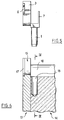
- the two tips shown in Figures 1 and 2 are made of a material resistant to very high temperatures of the order of 450 ° C, for example PEEK.
- Each end piece comprises, in accordance with the invention, a locking part 2 constituted by two elastically deformable wings 3, the lower part 3 a of which has an outer V-shaped section.
- the middle part 3 b of said wings 3 has a constriction in external section, so that the upper end of the lower part 3 a constitutes a boss B on the external wall of each wing 3.
- the upper part 3c of the wings 3 has a flared outer section.
- the two wings 3 define an interior housing 4 between their interior walls which are parallel in the position at rest of the locking part 2.
- the housing 4 is closed at the bottom by the connection part of the two wings 3 and opens outward at the top via a flared passage.
- the lateral edges of the wings 3 have reinforcing ribs 5 a and 5 b in their middle parts 3 b and upper 3 c .
- each wing 3 comprises, at the height of the middle parts 3 b and upper part 3 c , a thin plate 6 situated in the plane of the ribs 5 b opposite the cylindrical part 1.
- the plates 6 are inscribed in a rectangle whose two sides are parallel to the axis of the cylindrical part 1.
- the locking part 2 is connected below the cylindrical part 1 by a base 1 a secured to the upper end of said cylindrical part 1.
- the base la Opposite the locking part 2, the base la comprises a heat shield 7 of rectangular shape which extends parallel to the edge of the wings 3 up to the height of the middle part 3 b of said wings 3.
- the thickness of the screen 7 is relatively small, it must be determined as a function of the material used, so that said screen 7 constitutes sufficient protection for the electrical conductive wire to withstand the temperatures of use of a brake pad. .
- the cylindrical part 1 of the endpiece shown in FIG. 1 is full and has two longitudinal grooves 8 which extend over the entire length of said part 1, being joined at the lower end of the cylindrical part 1 by a groove 9 of the same section as the grooves 8.
- the cylindrical part 1 comprises a cylindrical interior cavity 10 closed at the lower end of said cylindrical part 1.
- each end piece is capable of receiving an electrical conductor wire.
- the reference numeral 11 designates an electrical conductive wire which is inserted into the cavity 10, of the cylindrical part 1 of the end piece.
- the electrical conductor wire 11 is held in the cavity 10 by bonding according to a known technique.
- the electrical conductor wire 11 is folded back at 90 ° between the wings 3 of the end piece to be inserted in the housing 4 whose dimensions correspond substantially to those of the outer sheath of the wire 11.
- ribs 12 make it possible to keep the wire 11 bent at a right angle.
- the nozzle of FIG. 1 is capable of receiving a double electrical conductor wire (not shown) passing through the grooves 8 and 9 where it is held in position by traction, said wire being blocked between the two wings 3 to 1. inside the housing 4.
- FIGS. 4 and 6 represent a brake pad comprising a support plate 13 on which a friction lining 14 is mounted.
- a notch 15 is produced in the support plate 13, a clearance 16 being provided in the friction lining 14 around the notch 15.
- the notch 15 has a substantially circular closed at its mouth by a neck 15 has smaller width.
- a bore 17 is produced around the notch 15 on the face of the support plate 13 opposite the friction lining 14.
- the thickness of the bore 17 is substantially equal to that of the plates 6 of the end piece according to the invention, as seen in Figures 5 and 6.
- the bore 17 has a width substantially equal to the distance which separates the two most distant edges of the two plates 6.
- the friction lining 14 is provided with an orifice 18 which is located in the axis of the notch 15 and at a distance from the support plate 13 such that said orifice 18 is in the thickness of the friction lining from which it is necessary to indicate the level of wear of this friction lining.
- the depth and the outside diameter of the orifice 18 correspond substantially to the height and to the diameter of the cylindrical part 1 of the end piece.
- the electric conducting wire has not been shown in FIGS. 3 and 5, but it is clear that before insertion of the cylindrical part 1 in the orifice 18, the electric conducting wire is already put in place in the nozzle. However, it is assumed that the electrical conductor wire is not inserted in the housing 4 located between the wings 3.
- the middle portion 3 b of the wings 3 is sufficiently stiffened so that the elastic deformation of the wings occurs mainly in the vicinity of the lower connecting portion.
- the endpiece can then be inserted into its housing, the cylindrical part 1 penetrating into the orifice 18, while the wings 3 snap into the notch 15 of the support plate 13.
- the plates 6 engage in the bore 17 of the support plate 13.
- the electrical conductor wire leaving the cylindrical part 1 is folded back into the housing 4 located between the wings 3, as shown in FIG. 2, which has the effect of occupying the volume left free in the housing 4 located between the wings 3.
- the presence of the heat shield 7 proves to be beneficial to the electrical conductor wire when using the friction lining, a wear disc of the lining emitting near this electrical conductor wire thermal radiation. which subjects the nozzle to temperatures of the order of 450 ° C.
- the elastic deformation of the locking part is such that the latter can be easily snapped into the notch provided on the support plate.
- the operating position of the locking part authorizes a free engagement of the latter in the notch.
Landscapes
- Engineering & Computer Science (AREA)
- General Engineering & Computer Science (AREA)
- Mechanical Engineering (AREA)
- Braking Arrangements (AREA)
Claims (9)
- Endhülse zur Verschleißanzeige eines auf einer Trägerplatte, insbesondere einer Bremsbacke, montierten Reibbelages, die dazu bestimmt ist, am Ende einer elektrisch leitenden Ader befestigt und in eine in der Trägerplatte ausgebildete Kerbe eingerastet zu werden, mit einem Verriegelungsteil (2), der in der Ruhestellung weder in die Kerbe (15) der Trägerplatte (16) eingerastet noch aus dieser ausgerastet werden kann und der sich elastisch verformen kann, um eine Betätigungsstellung einzunehmen, die sein Einrasten in oder Ausrasten aus der Kerbe (15) gestattet, wobei der Verriegelungsteil (2) der Endhülse eine Aufnahme (4) aufweist, in die die elektrisch leitende Ader (11) eingesteckt werden kann, so daß sie den Verriegelungsteil (2) daran hindert, sich elastisch zu verformen, um seine Betätigungsstellung einzunehmen, dadurch gekennzeichnet, daß die Aufnahme (4) für die elektrisch leitende Ader sich über einen das Einführen der Ader ermöglichenden Durchlaß seitlich nach außen öffnet.
- Endhülse nach Anspruch 1, dadurch gekennzeichnet, daß die Achse der Aufnahme (4) des Verriegelungsteils so angeordnet ist, daß, wenn die Endhülse in den Reibbelag eingeführt ist, die aus dem Reibbelag austretende Ader um einen Winkel von etwa 90° zu der der Verschleißfläche dieses Belages entgegengesetzten Seite umgelegt wird und in die Aufnahme (4) des Verriegelungsteil eintritt.
- Endhülse nach Anspruch 1 oder 2, dadurch gekennzeichnet, daß der Verriegelungsteil (2) der Endhülse zwei elastisch verformbare Flügel (3) aufweist, die sich aufeinander zu bewegen können, um die Betätigungsstellung einzunehmen, wobei die Aufnahme (4) für die elektrisch leitende Ader (11) zwischen diesen Flügeln (3) vorgesehen ist und einen solchen Durchmesser besitzt, daß die Anwesenheit der elektrisch leitenden Ader (11) zwischen den Flügeln diese daran hindert, sich aufeinander zu zu bewegen, um die Betätigungsstellung einzunehmen, die ihr Einrasten in die oder ihr Ausrasten aus der Kerbe der Trägerplatte (16) ermöglicht.
- Endhülse nach Anspruch 3, dadurch gekennzeichnet, daß die Innenwand der Flügel (3) eine Oberfläche bildet, die dazu ausgebildet ist, die elektrisch leitende Ader in Position zu halten, beispielsweise indem sie je eine zu der Längsachse der Aufnahme (4) parallele Rippe (12) aufweist.
- Endhülse nach einem der Ansprüche 1 bis 4, dadurch gekennzeichnet, daß sie einen zylindrischen Teil (1) aufweist, der dazu bestimmt ist, in das Innere einer Öffnung (18) einzutreten, die in der Nähe der Trägerplatte (13) in dem Reibbelag (14) vorgesehen ist.
- Endhülse nach Anspruch 5, dadurch gekennzeichnet, daß der zylindrische Teil (1) hohl ist.
- Endhülse nach Anspruch 5, dadurch gekennzeichnet, daß der zylindrische Teil (1) zwei Nuten (8) aufweist, die sich längs beiderseits seiner Achse liegender Mantellinien erstrecken und am Ende des zylindrischen Teils (1) durch eine Nut (9) verbunden sind, die sich längs eines Durchmessers des zylindrischen Teils (11) erstreckt.
- Endhülse nach einem der Ansprüche 1 bis 7, dadurch gekennzeichnet, daß sie, gegenüberliegend zu der Aufnahme (4), einen Hitzeschild (7) aufweist, der dazu bestimmt ist, den Teil der elektrisch leitenden Ader, der sich zwischen dem Reibbelag und der Aufnahme (4) des Verriegelungsteils befindet, zu schützen, wenn die Endhülse in den Reibbelag eingesteckt ist.
- Endhülse nach einem der Ansprüche 1 bis 8, dadurch gekennzeichnet, daß sie aus einem gegenüber Temperaturen in der Größenordnung von 450°C beständigen Material besteht, wie insbesondere Polyimid, einem Phenolharz, PEK oder PEEK.
Applications Claiming Priority (2)
| Application Number | Priority Date | Filing Date | Title |
|---|---|---|---|
| FR9308560A FR2707719B1 (fr) | 1993-07-12 | 1993-07-12 | Embout pour témoin d'usure de garniture de friction, notamment de plaquette de frein. |
| FR9308560 | 1993-07-12 |
Publications (2)
| Publication Number | Publication Date |
|---|---|
| EP0634586A1 EP0634586A1 (de) | 1995-01-18 |
| EP0634586B1 true EP0634586B1 (de) | 1997-12-29 |
Family
ID=9449179
Family Applications (1)
| Application Number | Title | Priority Date | Filing Date |
|---|---|---|---|
| EP94401593A Expired - Lifetime EP0634586B1 (de) | 1993-07-12 | 1994-07-11 | Endstück für einen Reibbelagverschleisssensor, insbesondere für Bremsbeläge |
Country Status (6)
| Country | Link |
|---|---|
| EP (1) | EP0634586B1 (de) |
| AT (1) | ATE161616T1 (de) |
| DE (2) | DE69407500T2 (de) |
| ES (1) | ES2069522T3 (de) |
| FR (1) | FR2707719B1 (de) |
| GR (1) | GR950300025T1 (de) |
Cited By (2)
| Publication number | Priority date | Publication date | Assignee | Title |
|---|---|---|---|---|
| EP2287489A1 (de) | 2009-08-21 | 2011-02-23 | BPW Bergische Achsen KG | Vorrichtung zum Befestigen eines elektrischen Bauteils einer Fahrzeugbremse |
| WO2023108217A1 (en) * | 2021-12-15 | 2023-06-22 | K F Group Pty Ltd | Wear sensor |
Families Citing this family (5)
| Publication number | Priority date | Publication date | Assignee | Title |
|---|---|---|---|---|
| FR2743126B1 (fr) * | 1995-12-27 | 1998-03-06 | Plastic Omnium Cie | Temoin d'usure de garniture de friction, notamment de plaquette de frein |
| DE19823022C1 (de) * | 1998-05-22 | 2000-01-05 | Lucas Automotive Gmbh | Bremsbelagbaugruppe mit elektrischer Belagverschleißwarnanzeige |
| EP1740846B1 (de) * | 2004-04-30 | 2008-12-10 | Freni Brembo S.p.A. | Fühler für verschleissanzeige für bremsbeläge |
| FR2897914B1 (fr) * | 2006-02-27 | 2008-05-30 | Plastic Omnium Cie | Embout d'un temoin d'usure bifilaire destine a etre relie a une plaquette de frein de vehicule automobile |
| GB2557195A (en) * | 2016-11-30 | 2018-06-20 | Jaguar Land Rover Ltd | Controller for a braking system of a vehicle |
Family Cites Families (5)
| Publication number | Priority date | Publication date | Assignee | Title |
|---|---|---|---|---|
| JPS5164167A (ja) * | 1974-10-09 | 1976-06-03 | Daimler Benz Ag | Enbanbureekinorainingunomamohyojisochi |
| DE3307394A1 (de) * | 1982-03-04 | 1983-09-15 | Lucas Industries P.L.C., Birmingham, West Midlands | Warnanzeigevorrichtung fuer belagverschleiss an bremsbacken |
| FR2618505B1 (fr) * | 1987-07-24 | 1990-12-28 | Bendix France | Temoin d'usure d'organe de friction pour frein de vehicule automobile et organe de friction equipe de ce temoin |
| DE9012887U1 (de) * | 1990-09-10 | 1992-01-16 | Lucas Industries P.L.C., Birmingham, West Midlands | Bremsbackenanordnung für Scheibenbremsen |
| DE4117423A1 (de) * | 1991-05-28 | 1992-12-03 | Porsche Ag | Verschleissanzeigevorrichtung fuer eine scheibenbremse |
-
1993
- 1993-07-12 FR FR9308560A patent/FR2707719B1/fr not_active Expired - Fee Related
-
1994
- 1994-07-11 DE DE69407500T patent/DE69407500T2/de not_active Expired - Fee Related
- 1994-07-11 AT AT94401593T patent/ATE161616T1/de not_active IP Right Cessation
- 1994-07-11 ES ES94401593T patent/ES2069522T3/es not_active Expired - Lifetime
- 1994-07-11 EP EP94401593A patent/EP0634586B1/de not_active Expired - Lifetime
- 1994-07-11 DE DE0634586T patent/DE634586T1/de active Pending
-
1995
- 1995-06-30 GR GR950300025T patent/GR950300025T1/el unknown
Cited By (2)
| Publication number | Priority date | Publication date | Assignee | Title |
|---|---|---|---|---|
| EP2287489A1 (de) | 2009-08-21 | 2011-02-23 | BPW Bergische Achsen KG | Vorrichtung zum Befestigen eines elektrischen Bauteils einer Fahrzeugbremse |
| WO2023108217A1 (en) * | 2021-12-15 | 2023-06-22 | K F Group Pty Ltd | Wear sensor |
Also Published As
| Publication number | Publication date |
|---|---|
| ES2069522T3 (es) | 1998-04-01 |
| FR2707719B1 (fr) | 1995-09-15 |
| GR950300025T1 (en) | 1995-06-30 |
| ES2069522T1 (es) | 1995-05-16 |
| ATE161616T1 (de) | 1998-01-15 |
| DE69407500D1 (de) | 1998-02-05 |
| DE634586T1 (de) | 1995-10-12 |
| EP0634586A1 (de) | 1995-01-18 |
| FR2707719A1 (fr) | 1995-01-20 |
| DE69407500T2 (de) | 1998-07-16 |
Similar Documents
| Publication | Publication Date | Title |
|---|---|---|
| EP0469949A1 (de) | Vorrichtung zur schnellen Verbindung eines Schlauches mit einem Automobilwärmetauscher | |
| FR2797528A1 (fr) | Dispositif de guidage d'au moins un element longiligne souple, tel que cable ou autre, a contour substantiellement ferme | |
| EP0780582A1 (de) | Befestigungs- oder Verschlussvorrichtung mit Überschreitung eines toten Punktes | |
| EP0634586B1 (de) | Endstück für einen Reibbelagverschleisssensor, insbesondere für Bremsbeläge | |
| FR2756879A1 (fr) | Dispositif d'assemblage d'un corps de revolution sur un support, au moyen d'une agrafe | |
| EP0078750A1 (de) | Flachverbinder für eine grosse Anzahl von Kontakten | |
| EP2839546B1 (de) | Schnelles einwegverbindungssystem | |
| EP2112416B1 (de) | Steckanschluss für mindestens ein Rohr | |
| EP3479446B1 (de) | Nockengriff zur montage einer kaltschrumpfhülse auf dem ende eines kabels oder um eine verbindung zwischen zwei kabeln | |
| EP0526324B1 (de) | Kabelklemme | |
| FR3032070A1 (fr) | Systeme de suspension pour cable conducteur aerien | |
| FR2527015A1 (fr) | Connecteur verrouillable et deverrouillable pour cables electriques | |
| EP0172779B1 (de) | Mehrpoliger elektrischer Verbinder | |
| EP0669481B1 (de) | System zum Erfassen des Verschleisses des Reibbelages einer Scheiben- oder Trommelbremse | |
| FR2630070A1 (fr) | Balai d'essuie-glace comportant un dispositif de connexion perfectionne d'un etrier principal sur un etrier secondaire | |
| FR2779240A1 (fr) | Connecteur pour fibres optiques | |
| EP0594515B1 (de) | Abnutzungswarnsensor für Kraftfahrzeugbremsbelag | |
| FR2924535A1 (fr) | Appareillage electrique encastre a connexion rapide | |
| EP0327478A1 (de) | Elektrischer Endanschluss | |
| FR2765450A1 (fr) | Dispositif d'etancheite electromagnetique pour paroi mobile | |
| EP1251601A1 (de) | Elektromagnetische Abschirmungsvorrichtung für elektrische Verbinder | |
| FR2505099A1 (fr) | Cosse femelle de contact electrique | |
| FR2714130A1 (fr) | Embout de dispositif de détection d'usure de garniture de friction. | |
| FR3154110A1 (fr) | Système d’alimentation et d’entraînement pour un tambour, dispositif d’enroulement de câble le comportant et ensemble drone filaire ou rendu filaire et base | |
| EP0680110A1 (de) | Antennenfuss |
Legal Events
| Date | Code | Title | Description |
|---|---|---|---|
| PUAI | Public reference made under article 153(3) epc to a published international application that has entered the european phase |
Free format text: ORIGINAL CODE: 0009012 |
|
| AK | Designated contracting states |
Kind code of ref document: A1 Designated state(s): AT BE CH DE DK ES GB GR IT LI LU NL SE |
|
| ITCL | It: translation for ep claims filed |
Representative=s name: MODIANO & ASSOCIATI S.R.L. |
|
| REG | Reference to a national code |
Ref country code: ES Ref legal event code: BA2A Ref document number: 2069522 Country of ref document: ES Kind code of ref document: T1 |
|
| GBC | Gb: translation of claims filed (gb section 78(7)/1977) | ||
| 17P | Request for examination filed |
Effective date: 19950405 |
|
| TCNL | Nl: translation of patent claims filed | ||
| TCAT | At: translation of patent claims filed | ||
| DET | De: translation of patent claims | ||
| 17Q | First examination report despatched |
Effective date: 19951222 |
|
| GRAG | Despatch of communication of intention to grant |
Free format text: ORIGINAL CODE: EPIDOS AGRA |
|
| GRAG | Despatch of communication of intention to grant |
Free format text: ORIGINAL CODE: EPIDOS AGRA |
|
| GRAH | Despatch of communication of intention to grant a patent |
Free format text: ORIGINAL CODE: EPIDOS IGRA |
|
| GRAH | Despatch of communication of intention to grant a patent |
Free format text: ORIGINAL CODE: EPIDOS IGRA |
|
| GRAA | (expected) grant |
Free format text: ORIGINAL CODE: 0009210 |
|
| AK | Designated contracting states |
Kind code of ref document: B1 Designated state(s): AT BE CH DE DK ES GB GR IT LI LU NL SE |
|
| PG25 | Lapsed in a contracting state [announced via postgrant information from national office to epo] |
Ref country code: GR Free format text: LAPSE BECAUSE OF FAILURE TO SUBMIT A TRANSLATION OF THE DESCRIPTION OR TO PAY THE FEE WITHIN THE PRESCRIBED TIME-LIMIT Effective date: 19971229 |
|
| REF | Corresponds to: |
Ref document number: 161616 Country of ref document: AT Date of ref document: 19980115 Kind code of ref document: T |
|
| REG | Reference to a national code |
Ref country code: CH Ref legal event code: EP |
|
| REF | Corresponds to: |
Ref document number: 69407500 Country of ref document: DE Date of ref document: 19980205 |
|
| ITF | It: translation for a ep patent filed | ||
| GBT | Gb: translation of ep patent filed (gb section 77(6)(a)/1977) |
Effective date: 19980305 |
|
| REG | Reference to a national code |
Ref country code: ES Ref legal event code: FG2A Ref document number: 2069522 Country of ref document: ES Kind code of ref document: T3 |
|
| REG | Reference to a national code |
Ref country code: CH Ref legal event code: NV Representative=s name: KIRKER & CIE SA |
|
| PLBE | No opposition filed within time limit |
Free format text: ORIGINAL CODE: 0009261 |
|
| STAA | Information on the status of an ep patent application or granted ep patent |
Free format text: STATUS: NO OPPOSITION FILED WITHIN TIME LIMIT |
|
| 26N | No opposition filed | ||
| PGFP | Annual fee paid to national office [announced via postgrant information from national office to epo] |
Ref country code: DK Payment date: 20000705 Year of fee payment: 7 |
|
| PGFP | Annual fee paid to national office [announced via postgrant information from national office to epo] |
Ref country code: AT Payment date: 20000706 Year of fee payment: 7 |
|
| PGFP | Annual fee paid to national office [announced via postgrant information from national office to epo] |
Ref country code: SE Payment date: 20000711 Year of fee payment: 7 |
|
| PGFP | Annual fee paid to national office [announced via postgrant information from national office to epo] |
Ref country code: LU Payment date: 20000724 Year of fee payment: 7 |
|
| PGFP | Annual fee paid to national office [announced via postgrant information from national office to epo] |
Ref country code: NL Payment date: 20000731 Year of fee payment: 7 |
|
| PGFP | Annual fee paid to national office [announced via postgrant information from national office to epo] |
Ref country code: BE Payment date: 20000907 Year of fee payment: 7 |
|
| PGFP | Annual fee paid to national office [announced via postgrant information from national office to epo] |
Ref country code: CH Payment date: 20001010 Year of fee payment: 7 |
|
| PG25 | Lapsed in a contracting state [announced via postgrant information from national office to epo] |
Ref country code: LU Free format text: LAPSE BECAUSE OF NON-PAYMENT OF DUE FEES Effective date: 20010711 Ref country code: DK Free format text: LAPSE BECAUSE OF NON-PAYMENT OF DUE FEES Effective date: 20010711 Ref country code: AT Free format text: LAPSE BECAUSE OF NON-PAYMENT OF DUE FEES Effective date: 20010711 |
|
| PG25 | Lapsed in a contracting state [announced via postgrant information from national office to epo] |
Ref country code: SE Free format text: LAPSE BECAUSE OF NON-PAYMENT OF DUE FEES Effective date: 20010712 |
|
| PG25 | Lapsed in a contracting state [announced via postgrant information from national office to epo] |
Ref country code: LI Free format text: LAPSE BECAUSE OF NON-PAYMENT OF DUE FEES Effective date: 20010731 Ref country code: CH Free format text: LAPSE BECAUSE OF NON-PAYMENT OF DUE FEES Effective date: 20010731 Ref country code: BE Free format text: LAPSE BECAUSE OF NON-PAYMENT OF DUE FEES Effective date: 20010731 |
|
| REG | Reference to a national code |
Ref country code: GB Ref legal event code: IF02 |
|
| BERE | Be: lapsed |
Owner name: CIE PLASTIC OMNIUM Effective date: 20010731 |
|
| PG25 | Lapsed in a contracting state [announced via postgrant information from national office to epo] |
Ref country code: NL Free format text: LAPSE BECAUSE OF NON-PAYMENT OF DUE FEES Effective date: 20020201 |
|
| EUG | Se: european patent has lapsed |
Ref document number: 94401593.2 |
|
| REG | Reference to a national code |
Ref country code: CH Ref legal event code: PL |
|
| REG | Reference to a national code |
Ref country code: DK Ref legal event code: EBP |
|
| NLV4 | Nl: lapsed or anulled due to non-payment of the annual fee |
Effective date: 20020201 |
|
| PGFP | Annual fee paid to national office [announced via postgrant information from national office to epo] |
Ref country code: GB Payment date: 20090720 Year of fee payment: 16 Ref country code: DE Payment date: 20090722 Year of fee payment: 16 |
|
| PGFP | Annual fee paid to national office [announced via postgrant information from national office to epo] |
Ref country code: ES Payment date: 20100825 Year of fee payment: 17 |
|
| PGFP | Annual fee paid to national office [announced via postgrant information from national office to epo] |
Ref country code: IT Payment date: 20100730 Year of fee payment: 17 |
|
| GBPC | Gb: european patent ceased through non-payment of renewal fee |
Effective date: 20100711 |
|
| PG25 | Lapsed in a contracting state [announced via postgrant information from national office to epo] |
Ref country code: DE Free format text: LAPSE BECAUSE OF NON-PAYMENT OF DUE FEES Effective date: 20110201 |
|
| REG | Reference to a national code |
Ref country code: DE Ref legal event code: R119 Ref document number: 69407500 Country of ref document: DE Effective date: 20110201 |
|
| PG25 | Lapsed in a contracting state [announced via postgrant information from national office to epo] |
Ref country code: GB Free format text: LAPSE BECAUSE OF NON-PAYMENT OF DUE FEES Effective date: 20100711 |
|
| PG25 | Lapsed in a contracting state [announced via postgrant information from national office to epo] |
Ref country code: IT Free format text: LAPSE BECAUSE OF NON-PAYMENT OF DUE FEES Effective date: 20110711 |
|
| REG | Reference to a national code |
Ref country code: ES Ref legal event code: FD2A Effective date: 20130404 |
|
| PG25 | Lapsed in a contracting state [announced via postgrant information from national office to epo] |
Ref country code: ES Free format text: LAPSE BECAUSE OF NON-PAYMENT OF DUE FEES Effective date: 20110712 |